
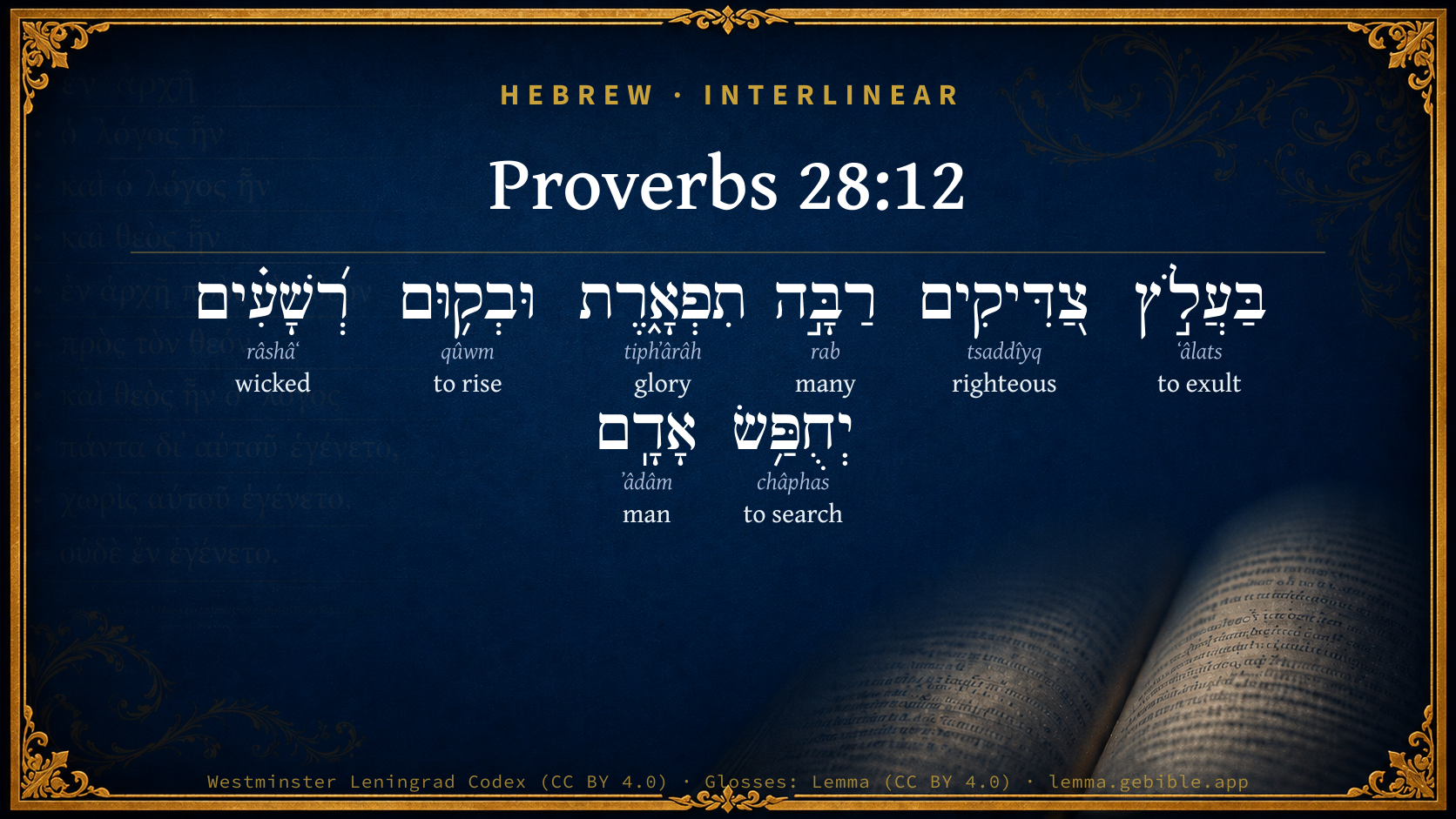
Proverbs 28:12

Hebrew (Westminster Leningrad Codex) Proverbs 28:12 appears in the Hebrew Old Testament. The text above is from the Westminster Leningrad Codex. Each word links to its Strong’s number, a concise gloss, and parsing drawn from the Open Scriptures Hebrew Bible morphology. Click any word for its full Brown-Driver-Briggs (BDB) entry.
Download image
Cite this verse

Proverbs 28:12 (World English Bible). Public Domain. Lemma interlinear Bible study tool, https://lemma.gebible.app/v/proverbs/28/12.

Show BibTeX & RIS
BibTeX
RIS
English Translation
When the righteous triumph, there is great glory; But when the wicked rise, men hide themselves.
World English Bible · Public Domain
Download a study sheet

One document with this verse’s original text, its word-by-word gloss line, the meaning frame, cross-references with their text, attributed commentary, and full source and license credits — printable, and it pastes into notes with its structure intact.

This verse Autodidact and up

Study sheet (.html) Plain text (.txt)

A passage Seminary Student

Up to 50 verses in one chapter. A passage sheet keeps up to 6 commentary sources and 12 cross-references per verse, in the order this page ranks them, and says so on the sheet whenever that leaves anything out. Ask for a single verse and you get the Autodidact verse sheet above.

Everything on this page stays free to read, with no account — the sheet is a download of what is already on screen, not access to it.

Want to remove ads? Support Godless Engineer
Compare translations 3

The same verse in 3 English versions, stacked beneath the original-language interlinear above. Click any original word for its lexicon entry.

Each is an independent rendering of the whole verse — the interlinear is not word-aligned to these translations.

Highlighted words mark where these versions differ — a whole-verse word diff, not a word-by-word alignment.

  • World English Bible Public Domain
    When the righteous triumph, there is great glory; But when the wicked rise, men hide themselves.
  • King James Version Public Domain
    When righteous men do rejoice, there is great glory: but when the wicked rise, a man is hidden.
  • unfoldingWord Literal Text CC BY-SA 4.0
    When the righteous exult, great splendor, but when the wicked arise, a man is searched for.

unfoldingWord Literal Text — © unfoldingWord, licensed CC BY-SA 4.0. Word-aligned USFM3 via Door43 (git.door43.org/unfoldingWord/en_ult).

Versions to compare (up to 4)

3 of 4 selected

Show all 18 translations

Every available English version of this verse, each an independent rendering of the whole verse.

  • World English Bible Public Domain
    When the righteous triumph, there is great glory; But when the wicked rise, men hide themselves.
  • Berean Standard Bible Public Domain
    When the righteous triumph, there is great glory, but when the wicked rise, men hide themselves.
  • Majority Standard Bible Public Domain
    When the righteous triumph, there is great glory, but when the wicked rise, men hide themselves.
  • King James Version Public Domain
    When righteous men do rejoice, there is great glory: but when the wicked rise, a man is hidden.
  • American Standard Version (1901) Public Domain
    When the righteous triumph, there is great glory; But when the wicked rise, men hide themselves.
  • Revised Version (1885) Public Domain
    When the righteous triumph, there is great glory: but when the wicked rise, men hide themselves.
  • Geneva Bible (1599) Public Domain
    When righteous men reioyce, there is great glory: but when the wicked come vp, the man is tried.
  • Douay-Rheims (1899) Public Domain
    In the joy of the just there is great glory: when the wicked reign, men are ruined.
  • Young's Literal Translation Public Domain
    In the exulting of the righteous the glory `is' abundant, And in the rising of the wicked man is apprehensive.
  • Literal Standard Version CC BY-SA 4.0
    In the exulting of the righteous the glory [is] abundant, || And in the rising of the wicked man is apprehensive.
  • Unlocked Literal Bible CC BY-SA 4.0
    When the righteous triumph, there is great glory; but when the wicked arise, people are sought out.
  • unfoldingWord Literal Text CC BY-SA 4.0
    When the righteous exult, great splendor, but when the wicked arise, a man is searched for.
  • Darby Bible Public Domain
    When the righteous triumph, there is great glory; but when the wicked rise, men conceal themselves.
  • World Messianic Bible Public Domain
    When the righteous triumph, there is great glory; but when the wicked rise, men hide themselves.
  • Webster's Bible Public Domain
    When righteous men rejoice, there is great glory: but when the wicked rise, a man is hidden.
  • Free Bible Version CC BY-SA 4.0
    When good people win, everyone celebrates, but when the wicked come to power, people hide.
  • Bible in Basic English Public Domain
    When the upright do well, there is great glory; but when evil-doers are lifted up, men do not let themselves be seen.
  • JPS Tanakh (1917) Public Domain
    When the righteous exult, there is great glory; but when the wicked rise, men must be sought for.

Literal Standard Version (2020), Covenant Press — licensed CC BY-SA 4.0. Text via the HelloAO Bible API (eBible.org). Unlocked Literal Bible (unfoldingWord) — licensed CC BY-SA 4.0. Text via the HelloAO Bible API (eBible.org). unfoldingWord Literal Text — © unfoldingWord, licensed CC BY-SA 4.0. Word-aligned USFM3 via Door43 (git.door43.org/unfoldingWord/en_ult). Free Bible Version, Dr. Jonathan Gallagher — licensed CC BY-SA 4.0. Text via the HelloAO Bible API (eBible.org).

Word by word

More ways to search: Search by grammar → Find every occurrence → Compare this word →

Practice this passage: Drill this verse → Learn its vocabulary →

About this verse

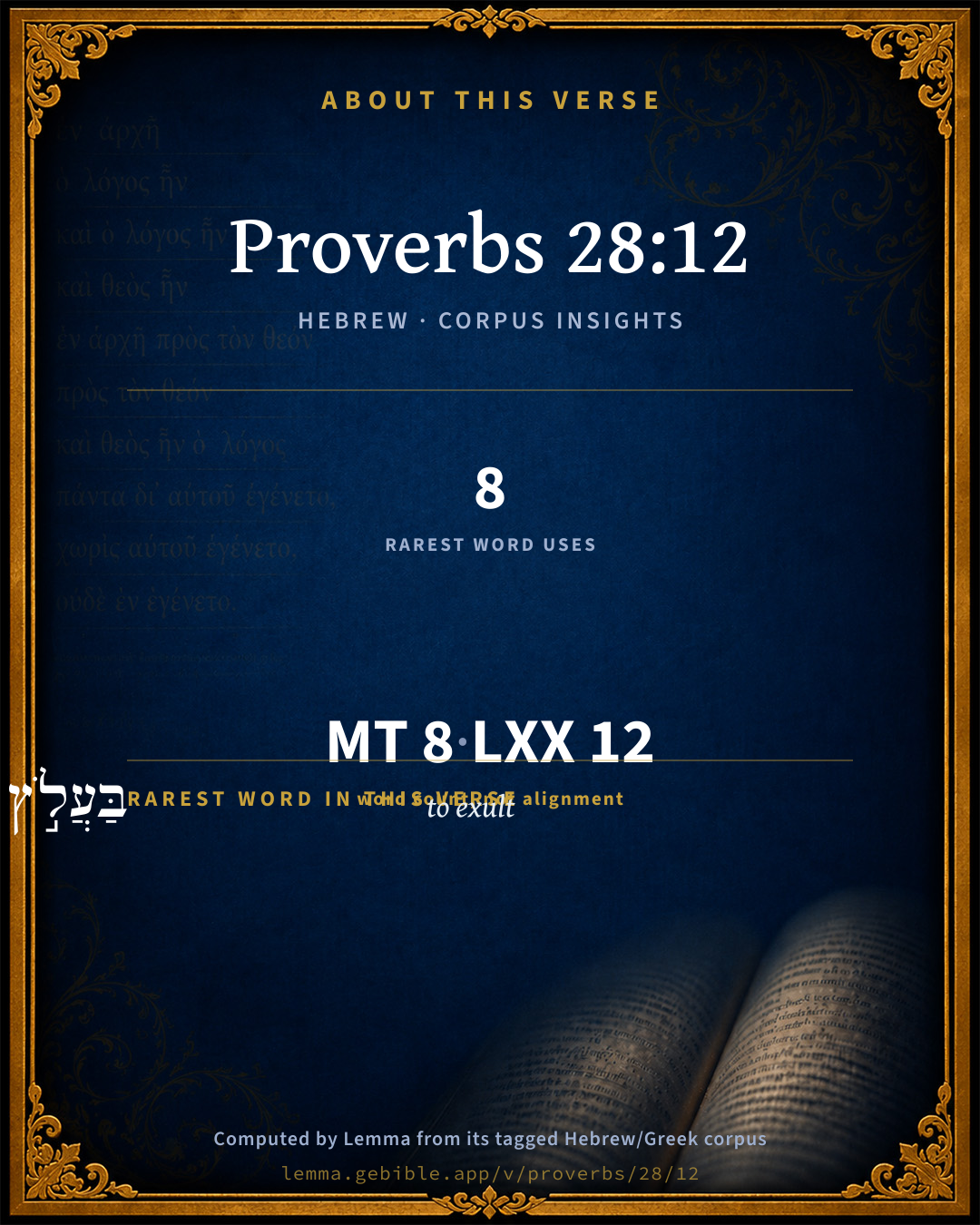
These counts appear in no published source. They are computed here, from the morphology-tagged text and Lemma’s own curated glosses. What Lemma adds →

8
words
8
distinct lemmas
Wisdom
section

Notable vocabulary

The rarest word here is בַּעֲלֹ֣ץ to exult H5970 — appearing just 8 times in the whole Hebrew Bible.

Shared distinctive vocabulary

בַּעֲלֹ֣ץ to exult H5970 occurs in 8 verses of the Hebrew Bible. Also found in:

Grammatical profile

  • 3 verbs
  • 2 nouns
  • 3 adjectives

Verb forms

  • בַּעֲלֹ֣ץ Qal · Infinitive Construct
  • וּבְק֥וּם Qal · Infinitive Construct
  • יְחֻפַּ֥שׂ Pual · Imperfect

Hebrew & Septuagint length

In English translation the verse runs 16 words from the Hebrew and 21 from the Septuagint (LXX English) — closely comparable.

A rough comparison of the two English renderings, which tokenize alike — not a word-level alignment.

Word counts can differ between the Hebrew and the Greek without any difference in meaning — e.g. the Hebrew direct-object marker אֵת has no separate Greek word, and Greek often adds the article ὁ.

In the original languages it is 8 Hebrew tokens and 12 Greek tokens — but the two are counted differently (Hebrew bundles its prefixes and suffixes into one token; the Greek is in lemma form), so that isn’t a like-for-like length.

Cross-references

20

Topical passages linked to Proverbs 28:12 in the Treasury of Scripture Knowledge — connected by theme and wording, ordered by reader-vote popularity; previews shown in the World English Bible.

  • Proverbs 29:2 When the righteous thrive, the people rejoice; But when the wicked rule, the people groan.
  • Proverbs 11:10 When it goes well with the righteous, the city rejoices. When the wicked perish, there is shouting.
  • Proverbs 28:28 When the wicked rise, men hide themselves; But when they perish, the righteous thrive.
  • Esther 8:15–17 Mordecai went forth from the presence of the king in royal clothing of blue and white, and with a great crown of gold, and with a robe of fine linen and purple: and the city of Shushan shouted and was glad.
  • Job 29:11–20 For when the ear heard me, then it blessed me; And when the eye saw me, it commended me:
  • Hebrews 11:37–38 They were stoned. They were sawn apart. They were tempted. They were slain with the sword. They went around in sheep skins and in goat skins; being destitute, afflicted, ill-treated
  • 1 Samuel 24:11 Moreover, my father, behold, yes, see the skirt of your robe in my hand; for in that I cut off the skirt of your robe, and didn't kill you, know you and see that there is neither evil nor disobedience in my hand, and I have not sinned against you, though you hunt after my life to take it.
  • 1 Kings 17:3–24 Get you hence, and turn you eastward, and hide yourself by the brook Cherith, that is before the Jordan.
  • 1 Kings 18:13 Wasn't it told my lord what I did when Jezebel killed the prophets of Yahweh, how I hid one hundred men of Yahweh's prophets by fifty in a cave, and fed them with bread and water?
  • 1 Kings 19:3 When he saw that, he arose, and went for his life, and came to Beersheba, which belongs to Judah, and left his servant there.
  • 1 Chronicles 15:25–28 So David, and the elders of Israel, and the captains over thousands, went to bring up the ark of the covenant of Yahweh out of the house of Obed-edom with joy.
  • 1 Chronicles 16:7–36 Then on that day David first ordained to give thanks to Yahweh, by the hand of Asaph and his brothers.
  • 1 Chronicles 29:20–22 David said to all the assembly, Now bless Yahweh your God. All the assembly blessed Yahweh, the God of their fathers, and bowed down their heads, and worshiped Yahweh, and the king.
  • 2 Chronicles 7:10 On the three and twentieth day of the seventh month he sent the people away to their tents, joyful and glad of heart for the goodness that Yahweh had shown to David, and to Solomon, and to Israel his people.
  • 2 Chronicles 30:22–27 Hezekiah spoke comfortably to all the Levites who had good understanding [in the service] of Yahweh. So they ate throughout the feast for the seven days, offering sacrifices of peace-offerings, and making confession to Yahweh, the God of their fathers.
  • Ecclesiastes 10:5–6 There is an evil which I have seen under the sun, the sort of error which proceeds from the ruler.
  • Ecclesiastes 10:16 Woe to you, land, when your king is a child, And your princes eat in the morning!
  • Jeremiah 5:1 Run you back and forth through the streets of Jerusalem, and see now, and know, and seek in the broad places of it, if you can find a man, if there are any who does justly, who seeks truth; and I will pardon her.
  • Jeremiah 36:26 The king commanded Jerahmeel the king's son, and Seraiah the son of Azriel, and Shelemiah the son of Abdeel, to take Baruch the scribe and Jeremiah the prophet; but Yahweh hid them.
  • Luke 19:37–38 As he was now getting near, at the descent of the Mount of Olives, the whole multitude of the disciples began to rejoice and praise God with a loud voice for all the mighty works which they had seen,

Cross-references courtesy of OpenBible.info (CC BY 4.0).

Hebrew and Greek witnesses Masoretic Hebrew ↔ Greek Septuagint

The same verse in the two great witnesses to the Old Testament, shown verse-for-verse.

These are two independent witnesses, not word-aligned to each other, and the Septuagint is shown in lemma (dictionary) form.

Hebrew Proverbs 28:12 Masoretic · Westminster Leningrad Codex

בַּעֲלֹ֣ץ צַ֭דִּיקִים רַבָּ֣ה תִפְאָ֑רֶת וּבְק֥וּם רְ֝שָׁעִ֗ים יְחֻפַּ֥שׂ אָדָֽם

When the righteous triumph, there is great glory; But when the wicked rise, men hide themselves.

World English Bible · Public Domain

Greek LXX Proverbs 28:12 Septuagint · lemma form

διά βοήθεια δίκαιος πολύς γίγνομαι δόξα ἐν δέ τόπος ἀσεβής ἁλίσκω ἄνθρωπος

By reason of the help of righteous men great glory arises: but in the places of the ungodly men are caught.

LXX2012 (modern English Septuagint) · Public Domain

On this verse, The Pulpit Commentary discusses the Septuagint’s reading. Read the note in Commentary ↓

Hebrew: Westminster Leningrad Codex (CC BY 4.0). Greek: Septuagint (public domain); English from LXX2012 (modern English Septuagint) (Public Domain). How the Septuagint differs from the Hebrew →

Commentary

Notes on Proverbs 28:12 from classic Christian and Jewish commentators (each source and its license shown beneath its notes). The classic Christian expositions comment on the surrounding passage and are grouped to its opening verse, so a note may address several verses; the Jewish commentaries on the Tanakh (Rashi and others) are per-verse, so they appear only where the commentator wrote on this verse.

Lemma curates 59 commentaries, every one of them public domain or Creative Commons licensed, each selected and text-cleaned for this edition rather than reprinted as found. About our sources →

Trapp's Complete Commentary

John Trapp

Pro 28:12 When righteous [men] do rejoice, [there is] great glory: but when the wicked rise, a man is hidden.

Ver. 12. When righteous men do rejoice, there is great glory.] That is, There is cause of common joy to all; for they have public spirits, and rectified judgments, neither can they be merry at heart when it goes ill with the Church. All comforts are but Ichabods to them, if the ark be taken; all places but Hadadrimmons, if the Church be in heaviness. Terentius, under Valens, the Arian emperor, asked nothing but that the Church might be freed from Arians, and when the emperor tore his petition, he said that he would never ask anything for himself if he might not prevail for the Church, for that his happiness was laid up in hers.

But when the wicked rise, a man is hidden.] That is, When tyrants are set up, "a man," that is, a good man - for God reckons of men by their righteousness {Jer 5:1} - "is hidden," lies close, and hath no heart to show himself, lest he should suffer either in his own person or in his possession. Thus the man Moses fled and hid himself from Pharaoh, David from Saul, Eliah from Ahab, Obadiah’s clients from Jezebel, Jeremiah from Jehoiakim, Joseph and the child Jesus from Herod; those worthies, of whom the world was not worthy, {Heb 11:38} from Antiochus, that little Antichrist, and other persecutors, and the Christian Church from the greater Antichrist, {Rev 12:1-17} so that she was not to be sought in tectis et exteriori pampa, sed potius in carceribus et speluncis, in palaces of worldly pomp, but in dens and dungeons, as Hilary hath it: "She fled into the wilderness, into her place, from the face of the serpent." {Rev 12:14}

John Trapp, A Commentary or Exposition upon All the Books of the Old and New Testament (1647–1656) — public domain. Text from a community e-Sword module.

Joseph Benson's Commentary

Pro 28:12. When righteous men rejoice — Are encouraged and promoted to places of trust and power; there is great glory — In that commonwealth. The state of that kingdom is honourable, comfortable and safe, so that good men can show their faces with courage and confidence; but when the wicked rise — Are advanced to honour and authority; a man is hidden — The state of that nation is so shameful and dangerous, that wise and good men withdraw themselves into obscure places. Or, as יחפשׂ אדםis rendered by many, both ancient and later interpreters, a man is sought out, that is, sober and good men, who had retired into secret places, are searched for and brought forth as sheep to the slaughter, as being most suspected, hated, and feared by bloody tyrants.

Joseph Benson's Commentary on the Old and New Testaments (1811–1818) — public domain. Text from a community e-Sword module.

Keil & Delitzsch

C. F. Keil & F. Delitzsch

We take Pro 28:12-20 together. A proverb regarding riches closes this group, as also the foregoing is closed, and its commencement is related in form and in its contents to Pro 28:2 :

12 When righteous men triumph, the glory is great;

And when the godless rise, the people are searched for.

The first line of this distich is parallel with Pro 29:2; cf. Pro 11:10, Pro 11:11 : when the righteous rejoice, viz., as conquerors (cf. e.g., Psa 60:8), who have the upper hand, then תּפארת, bright prosperity, is increased; or as Fleischer, by comparison of the Arab. yawm alazynt (day of ornament = festival day), explains: so is there much festival adornment, i.e., one puts on festival clothes, signum pro re signata: thus all appears festal and joyous, for prosperity and happiness then show themselves forth. רבּה is adj. and pred. of the substantival clause; Hitzig regards it as the attribute: "then is there great glory;" this supposition is possible (vid., Pro 7:26, and under Psa 89:51), but here it is purely arbitrary. 28a is parallel with 12b: "if the godless arise, attain to power and prominence, these men are spied out, i.e., as we say, after Zep 1:12, they are searched for as with lamps. יחפּשׂ אדם is to be understood after Obadiah, Oba 1:6, cf. Pro 2:4 : men are searched out, i.e., are plundered (in which sense Heidenheim regards חפשׂ as here a transposition from חשׂף), or, with reference to the secret police of despotism: they are subjected to espionage. But a better gloss is יסּתר אדם 28a: the people let themselves be sought for, they keep themselves concealed in the inside of their houses, they venture not out into the streets and public places (Fleischer), for mistrust and suspicion oppress them all; one regards his person and property nowhere safer than within the four walls of his house; the lively, noisy, variegated life which elsewhere rules without, is as if it were dead.

Keil & Delitzsch — Biblical Commentary on the Old Testament (1861–1891) — public domain (CC PDM 1.0). Text via the HelloAO Bible API. (Old Testament only.)

Tyndale Open Study Notes

Tyndale Open Resources

28:12 When the wicked take charge: See also 28:28.

Tyndale Open Study Notes — © Tyndale Open Resources, licensed CC BY-SA 4.0. Text via the HelloAO Bible API.

Geneva Bible (1599)

Geneva Bible translators

He is known by his doings to be wicked.

Geneva Bible (1599) marginal notes — public domain. Text via Bolls.life.

Matthew Henry's Commentary

Note, 1. The comfort of the people of God is the honour of the nation in which they live. There is a great glory dwelling in the land when the righteous do rejoice, when they have their liberty, the free exercise of their religion, and are not persecuted, when the government countenances them and speaks comfortably to them, when they prosper and grow rich, and, much more, when they are preferred and employed and have power put into their hands. 2. The advancement of the wicked is the eclipsing of the beauty of a nation: When the wicked rise and get head they make head against all that is sacred, and then a man is hidden, a good man is thrust into obscurity, is necessitated to abscond for his own safety; corruptions prevail so generally that, as in Elijah's time, there seem to be no good men left, the wicked walk so thickly on every side.

Matthew Henry's Commentary on the Whole Bible (1708–1710) — public domain (CC PDM 1.0). Text via the HelloAO Bible API.

Jamieson, Fausset & Brown

Robert Jamieson, A. R. Fausset & David Brown

great glory--or, cause for it to a people, for the righteous rejoice in good, and righteousness exalts a nation (Pro 14:34).

a man . . . hidden--that is, the good retire, or all kinds try to escape a wicked rule.

Jamieson, Fausset & Brown — Commentary Critical and Explanatory on the Whole Bible (1871) — public domain (CC PDM 1.0). Text via the HelloAO Bible API.

Adam Clarke's Commentary

Verse 12. When righteous men do rejoice] When true religion is no longer persecuted, and the word of God duly esteemed, there is great glory; for the word of the Lord has then free course, runs, and is glorified: but when the wicked rise-when they are elevated to places of trust, and put at the head of civil affairs, then the righteous man is obliged to hide himself; the word of the Lord becomes scarce, and there is no open vision. The first vas the case in this country, in the days of Edward VI.; the second in the days of his successor, MARY I. Popery, cruelty, and knavery, under her, nearly destroyed the Church and the State in these islands.

Adam Clarke's Commentary on the Bible (1810–1826) — public domain. Text from a community e-Sword/MySword module.

Ellicott's Commentary for English Readers

(12) When righteous men do rejoice—i.e., prosper, or triumph.

There is great glory.—Men rejoice, and array themselves in their gayest attire.

A man is hidden.—Literally, is sought for. They hide themselves for fear (comp. Pro_28:28), and must be sought for, in order to be found.

A Bible Commentary for English Readers, edited by Charles John Ellicott (1878–1897) — public domain. Text from a community e-Sword module.

The Cambridge Bible for Schools and Colleges

gen. ed. J. J. S. Perowne

12. a man is hidden] Rather, men hide themselves, R.V. “Heb. must be searched for,” marg. Comp. Pro_28:28.

The Cambridge Bible for Schools and Colleges (gen. ed. J. J. S. Perowne; Cambridge University Press, 1878–1918) — public domain. Text from a community e-Sword module.

John Gill's Exposition

When righteous men do rejoice, there is great glory,.... When it is well with them; when they are in prosperous circumstances; when they are countenanced and encouraged by the government under which they are; when they have the free exercise of their religion; and especially when they are advanced to places of profit, honour, and trust, which must make them cheerful and joyful; it is a glory to a land, it adds greatly to the glory of it, and a fine prospect there is of the increase and continuance of it;

but when the wicked rise: to honour and dignity, and are set in high places, and are in great power and authority, which they exercise to the distress of the righteous and all good men:

a man is hidden: a good man; he hides himself, as in Pro 28:28; he withdraws himself from court, from city, from company, from commerce, and business, because of the tyranny and persecution of wicked men; and flees to distant places, and wanders in deserts and mountains, in caves and dens of the earth; as some saints, under the Old Testament, did, and as the Church, in Gospel times, fled from the tyranny of antichrist into the wilderness, to hide herself: or, "a man is" or "shall be sought for" (i), and searched out; as wicked persecutors are very diligent to search for and find out such persons that hide themselves, and fetch them out of their hiding places, and cruelly use them.

(i) "investigabitur", Pagninus, Montanus; "exploratur", Tigurine version; "explorabitur", Baynus; "pervestigatur", Junius & Tremellius, Piscator, Michaelis.

John Gill's Exposition of the Whole Bible (1746–1763) — public domain (CC PDM 1.0). Text via the HelloAO Bible API.

Albert Barnes' Notes on the Bible

There is great glory - Men array themselves in festive apparel, and show their joy conspicuously.

A man is hidden - Better, men hide themselves, they shrink and cower for fear, and yet are hunted out.

Albert Barnes' Notes on the Bible (1834–1885) — public domain. Text from a community e-Sword/MySword module.

Matthew Poole's English Annotations

When righteous men do rejoice, are encouraged and promoted to places of trust and power, there is great glory in that commonwealth. The state of that kingdom is honourable, and comfortable, and safe, so as good men can show their faces with courage and confidence.

When the wicked rise, are advanced to honour and authority,

a man is hidden; the state of that nation is so shameful and dangerous, that wise and good men, who only are worthy of the name of men, withdraw themselves, or run into corners and obscure places; partly out of grief and shame to behold the wickedness which is publicly and impudently committed; and partly to avoid the rage and injuries of wicked oppressors, and the judgments of God, which commonly follow such persons and their confederates in sin. Or, as others, both ancient and later interpreters, render it, a man is sought out. Sober and good men, who had retired themselves, are searched for, and brought forth like sheep to the slaughter, as being most suspected, and hated, and feared by bloody tyrants.

Matthew Poole's English Annotations on the Holy Bible (1683–1685) — public domain. Text from a community e-Sword/MySword module.

Whedon's Commentary on the Bible

Daniel D. Whedon

12. Great glory — תפארת, (tiphareth,) ornament, beauty. In the exulting of the righteous there is great beauty. The latter part of the proverb seems to imply that the rejoicing of the righteous is on account of the promotion of good men to places of trust and influence.

Wicked… hidden — When bad men rise to power the good, from disgust or for personal safety, often retire to obscurity. Compare Pro_28:28; Pro_11:10; Pro_29:2; Ecc_10:6.

When vice prevails, and impious men bear sway,

The post of honour is a private station. ADDISON’S Cato.

Daniel D. Whedon (gen. ed.), Commentary on the Old and New Testaments (1874–1909) — public domain. Text from a community e-Sword module.

The Pulpit Commentary

When righteous men do rejoice, there is great glory. (comp. Pro_29:2 Pro_11:10) "Rejoice," rather triumph, as conquerors, right prevailing and wickedness being overcome. Then there is great show of joy, and, as the expression implies, men put on their festal garments to do honorer to the occasion: See the description of Solomon"s time. (1Ki_4:20, 1Ki_4:25) If we take this verse in connection with ver. 2, we may see in it the triumph of order after a period of confusion and anarchy. Septuagint, "Through the help of righteous men great glory arises." But when the wicked rise, a man is hidden (comp. ver. 28, where, however, the verb is different). The Authorized Version m, one that when the wicked rise to power, people have to hide themselves in order to escape danger to life and property. The verb is more literally rendered, "are searched for," i.e. they have betaken themselves to hiding places, and have to be looked for; they fear oppression and injury, and venture no longer into the streets and open places. Vulgate,regnantibus impiis ruinae hominum, "When evil men are m power, there is general ruin;" Septuagint, "In the places of the ungodly men are caught." Other interpretations of the proverb have been suggested, though none is so satisfactory as that given above. Thus some take the searching out to mean testing, in the sense that evil times try men"s characters, and bring out their true nature. (1Co_11:19) Others explain that, under the reign of the impious, men do not come forward to take part in public affairs, but retire sullenly into private life.

Vers. 12, 28. Hidden manhood.

The two main truths here taught have been anticipated by a foregoing proverb, viz. the advantage to society of promoting the good; and the injury done by the advancement of the wicked. (see Pro_11:10)

But there is a truth suggested by the wise man"s language which does not elsewhere appear; he says that when the wicked rise "a man is hidden," that "men hide themselves." The fact here alluded to is clear enough; we have often read, or have frequently observed, that the best men retire to seclusion and inactivity when iniquity is on the throne, when unprincipled cleverness holds the reins; they will not serve under a sovereign whom they despise, or in circumstances which make office holding a disgrace, if not a danger. But beyond and beneath this fact the language is fitted to suggest to us that there is much of hidden manhood amongst us. We find it in

I PREMATURE RETIREMENT. Not only under the conditions stated in the text, when the withdrawal of honorable men is necessary to the upright and the high-minded, but also under very different conditions. When men are allured by a desire for quietude and ease, or when they are disheartened by disappointment, or are disgusted by the slowness of their ascent to place and power, or when they underestimate their capacity and their opportunity, and they therefore lay down the weapon and leave the field. This is a serious loss. Then "a man is hidden;" a man is burying the wisdom of maturity, the large result of manifold experience, the gathered fruit of many years. He is hiding in his own home the cultured capacity he should be expending on the city, on the country of his birth.

II UNDEVELOPED FACULTY. We do not know how often it happens that men are born with great capacities in their nature, and who live and die without manifesting them to the world. They fail to receive the education which would bring them forth, or they are confined within a range so narrow that they have no chance of showing what they could be and do. They "die with all their music in them;" they pass away, unknown, unproved, unfelt. That is expended upon unimportant trifles which might have directed the affairs of some great company, or guided the activities of some influential Church, or decided the course of some powerful nation. A "man is hidden," and a community is left unenriched.

III UNDISCIPLINED FORCE. When God gives to a human spirit a strong power of will, there is an imperative necessity that it should be wisely and rightly guided and controlled in youth. Faithfully disciplined, such a one becomes a most useful man, who will contribute largely to the advancement and happiness of the world. But if that discipline be withheld, and the clever, wilful boy be allowed to grow up into untrained and uncultured manhood, there will be a sad waste of power. He will be more likely than not to do harm rather than good to his generation; he may be a blight instead of a blessing. There is "a man hidden;" one who has it in him to be one of the highest and worthiest, but who, as it is, is lost or even worse than lost, to his contemporaries and his country.

IV UNRESCUED WRONG. Even when we see humanity at its very worst, in its very foulness and baseness, we do well to feel that beneath the humiliating and pitiful exterior is a hidden manhood. It is the noble work of Christian beneficence to get down to this, to lay its kind and holy hand upon it, to raise and to restore it, to bring it into the sunshine of truth and love, to make it visible and even beautiful in the sight of God and in the estimate of man. C.

The Pulpit Commentary (1880–1919), ed. H.D.M. Spence-Jones & Joseph S. Exell — public domain. Text from a community e-Sword module.

John Wesley's Explanatory Notes

Rejoice - Are promoted. Glory - In that common-wealth. Rise - Are advanced to authority. Hidden - Wise and good men, who only are worthy of the name of men, withdraw themselves into obscure places.

John Wesley, Explanatory Notes Upon the Whole Bible (1754–1765) — public domain. Text via the GEBible commentary corpus.

Bridges on Proverbs

Charles Bridges

"We are made" — said a righteous man — "as the filth of the earth, and are the offscouring of all things unto this day."†1 Yet these are the men, who "bear up the pillars of the state."†2 When therefore they rejoice — when they are raised to honor, — there is great glory.†3 The whole kingdom feels more or less the influence of this national blessing. Godliness is countenanced. Men are protected in the free exercise of their religion. "When Mordecai went out from the presence of the king in the king’s royal apparel, the city of Shushan rejoiced, and were glad. The Jews had light, and gladness, and joy, and honor; in every province a feast, and a good day." (Est 8:17 .) The same result is seen in the experience of the Church. When "the Churches had rest" from the fiery trial, "they were edified and walked in the fear of the Lord, and in the comfort of the Holy Ghost." (Act 9:31 .) And what glory so great, as the sunshine of the enjoyment of their God!

But when the wicked rise to honor, how is this glory eclipsed! The people of God are removed into corners, silenced, hidden. (Pro 28:28 .) The light of upwards of an hundred prophets, and even Elijah himself, was hidden for awhile under the tyranny of Ahab.†4 And in every age the power of the wicked, especially under a despotic rule, hides much valuable influence. Yet it is hidden only to the eye of sense. For of those, who "wander about in sheep-skins and goat-skins, in deserts, and caves of the earth," what greater glory could we give, than the divine inscription stamped upon them — "Of whom the world was not worthy"?†5

Footnotes:

†1 1Co 4:13 .

†2 Psa 75:3.

†3 Pro 11:10; Pro 29:2 .

†4 1Ki 17:2-3 ; 1Ki 18:4 ; 1Ki 19:1-4 .

†5 Heb 11:37-38. Rev 12:6 .

Charles Bridges, An Exposition of the Book of Proverbs (1846) — public domain. Text from a community e-Sword module.

Rashi

Rabbi Shlomo Yitzchaki (Rashi)

person will be searched out He will be searched out with all kinds of false accusations.

Rashi on the Tanakh — English translations: “The Judaica Press complete Tanach with Rashi, translated by A. J. Rosenberg” (CC BY 4.0); “Pentateuch with Rashi's commentary by M. Rosenbaum and A.M. Silbermann, 1929-1934” (public domain); “The Metsudah Tanach series, Lakewood, N.J” (CC BY 4.0); and “The Book of Joshua, Metsudah Publications, 1997” (CC BY 4.0). Text via Sefaria.

Lesson kit

Teaching starters — assembled from the data on this page, not authored interpretation. Every prompt links to the verse data it draws on. Edit before teaching.

Proverbs, in the Wisdom, opens this verse with 8 words (8 distinct Hebrew lemmas). Its most distinctive word is ʻâlats (“to exult”). A historical commentator’s framing appears above. Read the whole chapter for the surrounding context.

Discussion questions

  1. What does “to exult” (ʻâlats) contribute to the verse as a whole?
  2. 1 Samuel 2:1 shares the word «to exult» with this verse. How do the two illuminate each other?
  3. These translations render this verse differently; the difference is in the English rendering, not the original. What questions does that raise?
  4. The verb «בַּעֲלֹ֣ץ» is Qal Infinitive Construct. How does its form color the action?
  5. Reading how Trapp's Complete Commentary and Joseph Benson's Commentary read this verse, where do the two commentators agree and where do they part?

Things to notice

Reading settings

Reading text

Shown beneath each verse's original-language words.

Old Testament
Old Testament edition

Read the OT as the Masoretic Hebrew (MT) or the Greek Septuagint (LXX).

English shown for the Greek Septuagint (in the Hebrew ↔ Greek comparison).

Comparing translations? Open the Compare panel on any verse page to stack up to four side by side.