
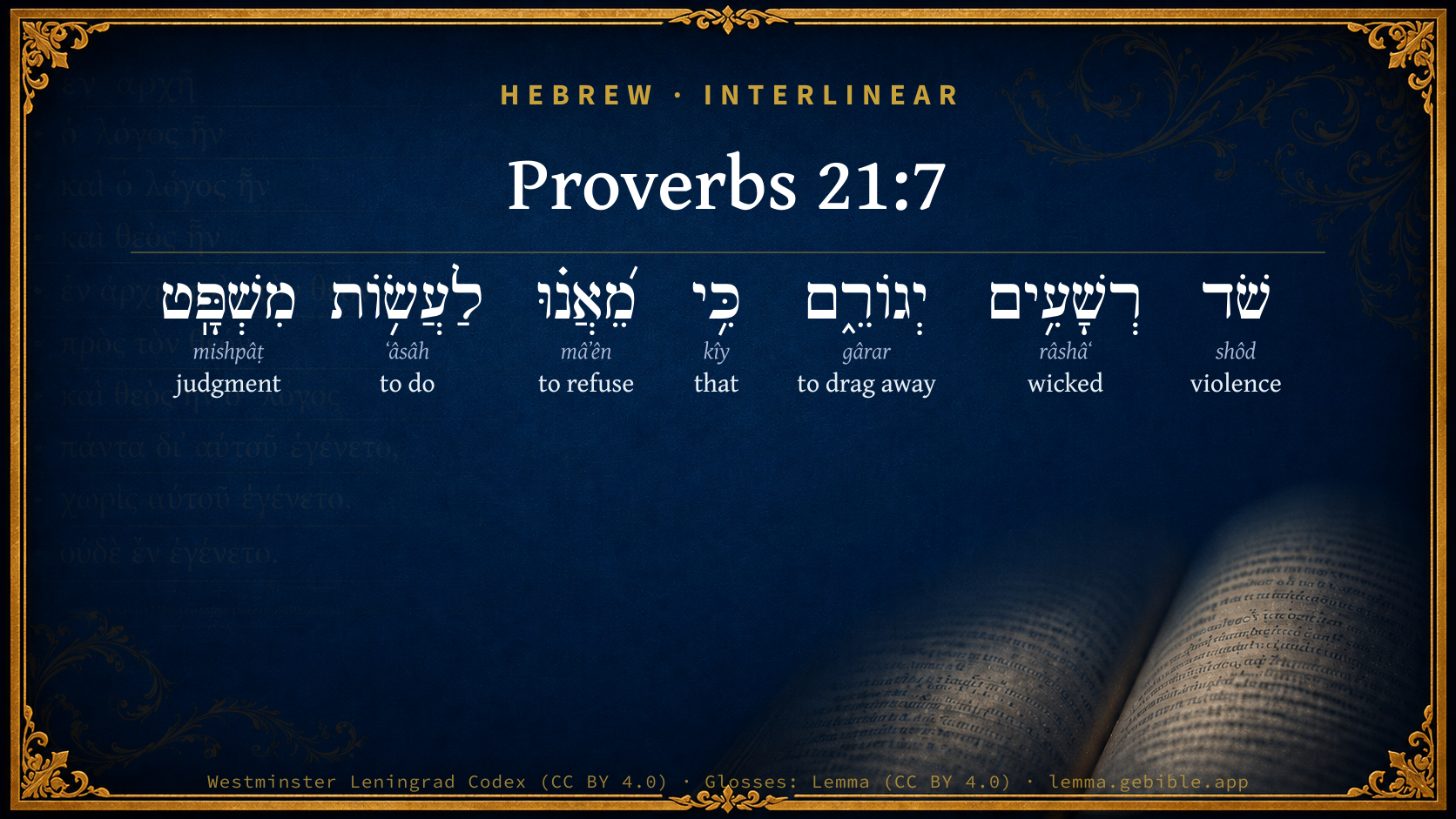
Proverbs 21:7

Hebrew (Westminster Leningrad Codex) Proverbs 21:7 appears in the Hebrew Old Testament. The text above is from the Westminster Leningrad Codex. Each word links to its Strong’s number, a concise gloss, and parsing drawn from the Open Scriptures Hebrew Bible morphology. Click any word for its full Brown-Driver-Briggs (BDB) entry.
Download image
Cite this verse

Proverbs 21:7 (World English Bible). Public Domain. Lemma interlinear Bible study tool, https://lemma.gebible.app/v/proverbs/21/7.

Show BibTeX & RIS
BibTeX
RIS
English Translation
The violence of the wicked will drive them away, Because they refuse to do what is right.
World English Bible · Public Domain
Download a study sheet

One document with this verse’s original text, its word-by-word gloss line, the meaning frame, cross-references with their text, attributed commentary, and full source and license credits — printable, and it pastes into notes with its structure intact.

This verse Autodidact and up

Study sheet (.html) Plain text (.txt)

A passage Seminary Student

Up to 50 verses in one chapter. A passage sheet keeps up to 6 commentary sources and 12 cross-references per verse, in the order this page ranks them, and says so on the sheet whenever that leaves anything out. Ask for a single verse and you get the Autodidact verse sheet above.

Everything on this page stays free to read, with no account — the sheet is a download of what is already on screen, not access to it.

Want to remove ads? Support Godless Engineer
Compare translations 3

The same verse in 3 English versions, stacked beneath the original-language interlinear above. Click any original word for its lexicon entry.

Each is an independent rendering of the whole verse — the interlinear is not word-aligned to these translations.

Highlighted words mark where these versions differ — a whole-verse word diff, not a word-by-word alignment.

  • World English Bible Public Domain
    The violence of the wicked will drive them away, Because they refuse to do what is right.
  • King James Version Public Domain
    The robbery of the wicked shall destroy them; because they refuse to do judgment.
  • unfoldingWord Literal Text CC BY-SA 4.0
    The violence of the wicked will drag them away, for they refuse to do justice.

unfoldingWord Literal Text — © unfoldingWord, licensed CC BY-SA 4.0. Word-aligned USFM3 via Door43 (git.door43.org/unfoldingWord/en_ult).

Versions to compare (up to 4)

3 of 4 selected

Show all 18 translations

Every available English version of this verse, each an independent rendering of the whole verse.

  • World English Bible Public Domain
    The violence of the wicked will drive them away, Because they refuse to do what is right.
  • Berean Standard Bible Public Domain
    The violence of the wicked will sweep them away because they refuse to do what is just.
  • Majority Standard Bible Public Domain
    The violence of the wicked will sweep them away because they refuse to do what is just.
  • King James Version Public Domain
    The robbery of the wicked shall destroy them; because they refuse to do judgment.
  • American Standard Version (1901) Public Domain
    The violence of the wicked shall sweep them away, Because they refuse to do justice.
  • Revised Version (1885) Public Domain
    The violence of the wicked shall sweep them away; because they refuse to do judgment.
  • Geneva Bible (1599) Public Domain
    The robberie of the wicked shall destroy them: for they haue refused to execute iudgement.
  • Douay-Rheims (1899) Public Domain
    The robberies of the wicked shall be their downfall, because they would not do judgment.
  • Young's Literal Translation Public Domain
    The spoil of the wicked catcheth them, Because they have refused to do judgment.
  • Literal Standard Version CC BY-SA 4.0
    The spoil of the wicked catches them, || Because they have refused to do judgment.
  • Unlocked Literal Bible CC BY-SA 4.0
    The violence of the wicked will drag them away, for they refuse to do what is just.
  • unfoldingWord Literal Text CC BY-SA 4.0
    The violence of the wicked will drag them away, for they refuse to do justice.
  • Darby Bible Public Domain
    The devastation of the wicked sweepeth them away, because they refuse to do what is right.
  • World Messianic Bible Public Domain
    The violence of the wicked will drive them away, because they refuse to do what is right.
  • Webster's Bible Public Domain
    The robbery of the wicked shall destroy them; because they refuse to do judgment.
  • Free Bible Version CC BY-SA 4.0
    The destruction caused by the wicked will destroy them, for they refuse to do what's right.
  • Bible in Basic English Public Domain
    By their violent acts the evil-doers will be pulled away, because they have no desire to do what is right.
  • JPS Tanakh (1917) Public Domain
    The violence of the wicked shall drag them away; because they refuse to do justly.

Literal Standard Version (2020), Covenant Press — licensed CC BY-SA 4.0. Text via the HelloAO Bible API (eBible.org). Unlocked Literal Bible (unfoldingWord) — licensed CC BY-SA 4.0. Text via the HelloAO Bible API (eBible.org). unfoldingWord Literal Text — © unfoldingWord, licensed CC BY-SA 4.0. Word-aligned USFM3 via Door43 (git.door43.org/unfoldingWord/en_ult). Free Bible Version, Dr. Jonathan Gallagher — licensed CC BY-SA 4.0. Text via the HelloAO Bible API (eBible.org).

Word by word

More ways to search: Search by grammar → Find every occurrence → Compare this word →

Practice this passage: Drill this verse → Learn its vocabulary →

About this verse

These counts appear in no published source. They are computed here, from the morphology-tagged text and Lemma’s own curated glosses. What Lemma adds →

7
words
7
distinct lemmas
Wisdom
section

Notable vocabulary

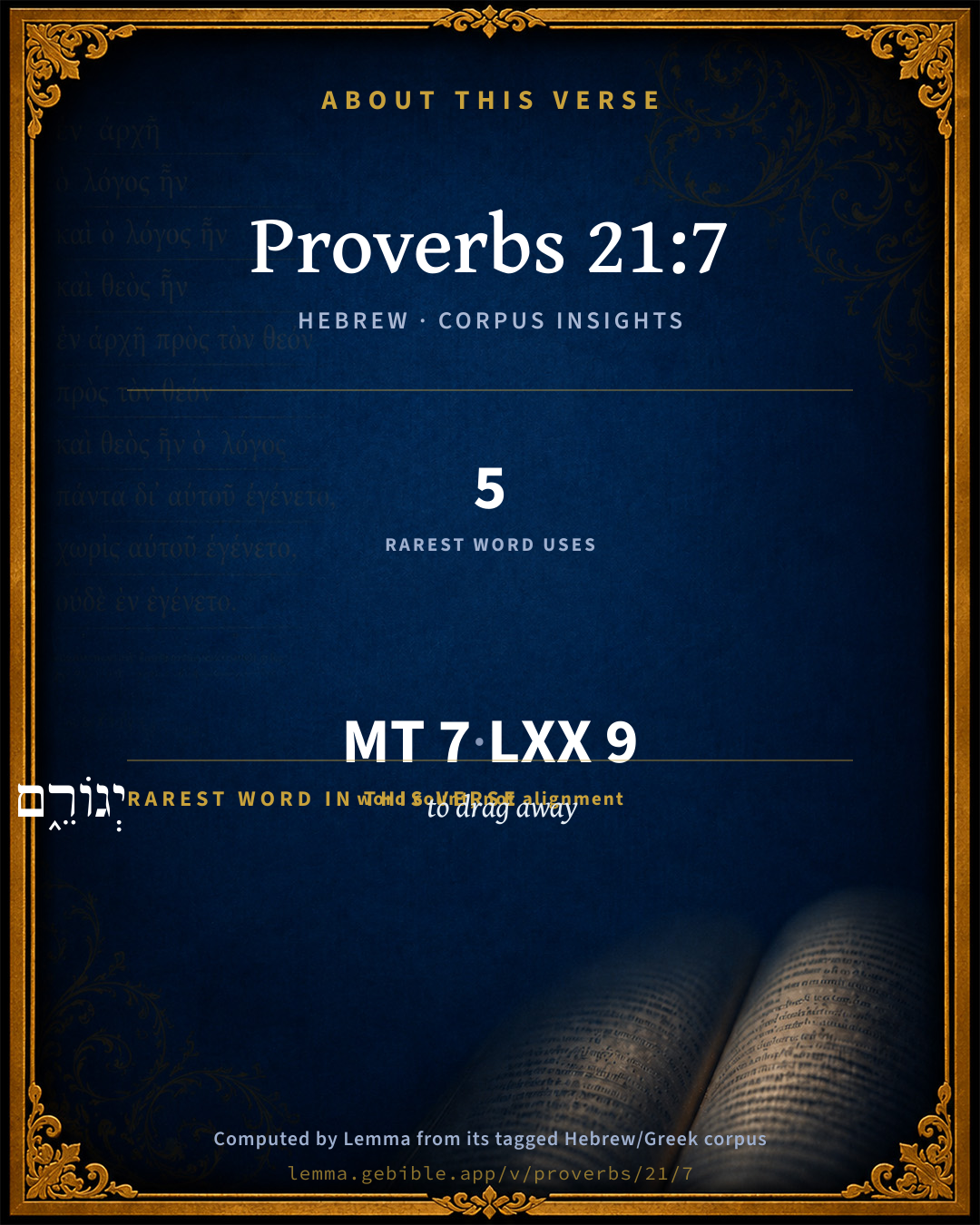
The rarest word here is יְגוֹרֵ֑ם to drag away H1641 — appearing just 5 times in the whole Hebrew Bible.

Shared distinctive vocabulary

יְגוֹרֵ֑ם to drag away H1641 occurs in 5 verses of the Hebrew Bible. Also found in:

Grammatical profile

  • 3 verbs
  • 2 nouns
  • 1 adjective
  • 1 conjunction

Verb forms

  • יְגוֹרֵ֑ם Qal · Imperfect
  • מֵ֝אֲנ֗וּ Piel · Perfect
  • לַעֲשׂ֥וֹת Qal · Infinitive Construct

Hebrew & Septuagint length

In English translation the verse runs 17 words from the Hebrew and 12 from the Septuagint (LXX English) — the Septuagint runs noticeably shorter here. See the side-by-side →

A rough comparison of the two English renderings, which tokenize alike — not a word-level alignment.

Word counts can differ between the Hebrew and the Greek without any difference in meaning — e.g. the Hebrew direct-object marker אֵת has no separate Greek word, and Greek often adds the article ὁ.

In the original languages it is 7 Hebrew tokens and 9 Greek tokens — but the two are counted differently (Hebrew bundles its prefixes and suffixes into one token; the Greek is in lemma form), so that isn’t a like-for-like length.

Cross-references

14

Topical passages linked to Proverbs 21:7 in the Treasury of Scripture Knowledge — connected by theme and wording, ordered by reader-vote popularity; previews shown in the World English Bible.

  • Proverbs 21:21 He who follows after righteousness and kindness Finds life, righteousness, and honor.
  • Psalms 7:16 The trouble he causes shall return to his own head. His violence shall come down on the crown of his own head.
  • Proverbs 22:22–23 Don't exploit the poor, because he is poor; And don't crush the needy in court;
  • Micah 3:9–12 Please listen to this, you heads of the house of Jacob, And rulers of the house of Israel, Who abhor justice, And pervert all equity.
  • Zechariah 5:3–4 Then he said to me, "This is the curse that goes out over the surface of the whole land; for everyone who steals shall be cut off according to it on the one side; and everyone who swears falsely shall be cut off according to it on the other side.
  • Ephesians 5:6 Let no one deceive you with empty words. For because of these things, the wrath of God comes on the children of disobedience.
  • Psalms 9:16 Yahweh has made himself known. He has executed judgment. The wicked is snared by the work of his own hands. Meditation. Selah.
  • Proverbs 1:18–19 But these lay wait for their own blood. They lurk secretly for their own lives.
  • Proverbs 10:6 Blessings are on the head of the righteous, But violence covers the mouth of the wicked.
  • Isaiah 1:23–24 Your princes are rebellious, and companions of thieves. Everyone loves bribes, and follows after rewards. They don't judge the fatherless, Neither does the cause of the widow come to them.
  • Jeremiah 7:9–11 Will you steal, murder, and commit adultery, and swear falsely, and burn incense to Baal, and walk after other gods that you have not known,
  • Jeremiah 7:15 I will cast you out of my sight, as I have cast out all your brothers, even the whole seed of Ephraim.
  • Ezekiel 18:18 As for his father, because he cruelly oppressed, robbed his brother, and did that which is not good among his people, behold, he shall die in his iniquity.
  • Ezekiel 22:13–14 Behold, therefore, I have struck my hand at your dishonest gain which you have made, and at your blood which has been in the midst of you.

Cross-references courtesy of OpenBible.info (CC BY 4.0).

Hebrew and Greek witnesses Masoretic Hebrew ↔ Greek Septuagint

The same verse in the two great witnesses to the Old Testament, shown verse-for-verse.

Here the Septuagint runs noticeably shorter than the Hebrew — LXX2012 (modern English Septuagint) 12 words vs World English Bible 17. A rough length comparison of the two English translations, not a word-level alignment — read both below.

These are two independent witnesses, not word-aligned to each other, and the Septuagint is shown in lemma (dictionary) form.

Hebrew Proverbs 21:7 Masoretic · Westminster Leningrad Codex

שֹׁד רְשָׁעִ֥ים יְגוֹרֵ֑ם כִּ֥י מֵ֝אֲנ֗וּ לַעֲשׂ֥וֹת מִשְׁפָּֽט

The violence of the wicked will drive them away, Because they refuse to do what is right.

World English Bible · Public Domain

Greek LXX Proverbs 21:7 Septuagint · lemma form

ὄλεθρος ἀσεβής ἐπιξενόω οὐ γάρ βούλομαι πράσσω ὁ δίκαιος

Destruction shall lodge with the ungodly; for they refuse to do justly.

LXX2012 (modern English Septuagint) · Public Domain

On this verse, The Pulpit Commentary discusses the Septuagint’s reading. Read the note in Commentary ↓

Hebrew: Westminster Leningrad Codex (CC BY 4.0). Greek: Septuagint (public domain); English from LXX2012 (modern English Septuagint) (Public Domain). How the Septuagint differs from the Hebrew →

Commentary

Notes on Proverbs 21:7 from classic Christian and Jewish commentators (each source and its license shown beneath its notes). The classic Christian expositions comment on the surrounding passage and are grouped to its opening verse, so a note may address several verses; the Jewish commentaries on the Tanakh (Rashi and others) are per-verse, so they appear only where the commentator wrote on this verse.

Lemma curates 59 commentaries, every one of them public domain or Creative Commons licensed, each selected and text-cleaned for this edition rather than reprinted as found. About our sources →

Trapp's Complete Commentary

John Trapp

Pro 21:7 The robbery of the wicked shall destroy them; because they refuse to do judgment.

Ver. 7. The robbery of the wicked shall destroy them.] Heb., Shall saw them: that is, shall bring upon them exquisite and extreme torments, such as the prophet Isaiah, and those martyrs {Heb 11:37} were put unto unjustly; such as Agag suffered justly, and those barbarous Ammonites. {2Sa 12:31} Some render it dissecabit eos shall cut them in twain, as that evil servant, {Luk 12:46} and those blasphemers of Daniel’s God. {Dan 3:29} Others render it, Shall abide upon them, or, Dwell with them. Their illgotten goods vanish, but their punishment remains. Their stolen venison is soon eaten up, but the shot is not yet paid; there is a sad reckoning behind. God will rake out of their bellies those tit bits - those murdering morsels. Besides that, for their last dish is served up astonishment and fearful expectation of just revenge. The Hebrew word here translated "destroy" signifies also to terrify and fear. They shall be a Magormissabib to themselves, as Pashur was, {Jer 20:3-4} running from chamber to chamber, to hide from the hand of justice - as that notable thief Bulas in the days of Severus the emperor {a} - but they shall not escape; their sin will find them out. God will pour upon them, and not spare, whether they be private thieves, or those public robbers, qui in auto et purpura visuntur, {b} as Cato once said, that are clad with purple, and have gold chains about their necks; corrupt judges, who judge for reward, and take away the righteousness of the righteous from him. Such were Empson and Dudley in their generation. Such was Judge Belknap in Richard II’s days, who, being about to subscribe the articles against proceedings of parliament, said there wanted but a hurdle, a horse, and a halter to carry him where he might suffer for assenting to them. {c} And that of these public thieves Solomon chiefly speaks here we may well think by the following clause, shewing the cause of their sore and sharp punishment, because they refuse to do judgment.

{a} Dio. in Sever.

{b} Gell., lib. xi. cap. 16.

{c} Speed, p. 747.

John Trapp, A Commentary or Exposition upon All the Books of the Old and New Testament (1647–1656) — public domain. Text from a community e-Sword module.

Joseph Benson's Commentary

Pro 21:7-8. The robbery of the wicked shall destroy them — The injury which they do to others shall, either by God or men, be returned upon their own heads; because they refuse to do judgment — They wilfully and obstinately give up themselves to unrighteous practices. The way of man — The course of man’s life, of the life of every man, as he is by nature, or in his corrupt state; is froward and strange — Perverse and estranged from God, and from man’s primitive integrity, and from the rule which God hath given him whereby to direct his actions, namely, reason and Scripture; but as for the pure, his work is right — His conversation, his tempers, words, and works; his designs and undertakings are agreeable to that rule.

Joseph Benson's Commentary on the Old and New Testaments (1811–1818) — public domain. Text from a community e-Sword module.

Geneva Bible (1599)

Geneva Bible translators

He meaneth this chiefly of Judges, and Princes which leave that vocation, whereunto God hath called them, and powle their subjects to maintain their lusts.

Geneva Bible (1599) marginal notes — public domain. Text via Bolls.life.

Matthew Henry's Commentary

See here, 1. The nature of injustice. Getting money by lying (Pro 21:6) is no better than downright robbery. Cheating is stealing; you might as well pick a man's pocket as impose upon him by a lie in making a bargain, which he had no fence against but by not believing you; and it will be no excuse from the guilt of robbery to say that he might choose whether he would believe you, for that is a debt we should owe to all men. 2. The cause of injustice. Men refuse to do judgment; they will not render to all their due, but withhold it, and omissions make way for commissions; they come at length to robbery itself. Those that refuse to do justice will choose to do wrong. 3. The effects of injustice; it will return upon the sinner's own head. The robbery of the wicked will terrify them (so some); their consciences will be filled with horror and amazement, will cut them, will saw them asunder (so others); it will destroy them here and for ever, therefore he had said (Pro 21:6), They seek death.

Matthew Henry's Commentary on the Whole Bible (1708–1710) — public domain (CC PDM 1.0). Text via the HelloAO Bible API.

Jamieson, Fausset & Brown

Robert Jamieson, A. R. Fausset & David Brown

robbery--or, "destruction," especially oppression, of which they are authors.

shall destroy--literally, "cut with a saw" (Kg1 7:9), that is, utterly ruin them. Their sins shall be visited on them in kind.

to do judgment--what is just and right.

Jamieson, Fausset & Brown — Commentary Critical and Explanatory on the Whole Bible (1871) — public domain (CC PDM 1.0). Text via the HelloAO Bible API.

Adam Clarke's Commentary

Verse 7. The robbery of the wicked] The wicked shall be terrified and ruined by the means they use to aggrandize themselves. And as they refuse to do judgment, they shall have judgment without mercy.

Adam Clarke's Commentary on the Bible (1810–1826) — public domain. Text from a community e-Sword/MySword module.

Ellicott's Commentary for English Readers

(7) The robbery of the wicked.—Or, their violence. See above on Pro_1:19. (Comp. Psa_9:15.)

A Bible Commentary for English Readers, edited by Charles John Ellicott (1878–1897) — public domain. Text from a community e-Sword module.

The Cambridge Bible for Schools and Colleges

gen. ed. J. J. S. Perowne

7. robbery] Rather, violence.

destroy them] Rather, sweep them up, or catch them, as fishes, for example, in a net. Comp. Hab_1:15, where the same Heb. word is used.

The Cambridge Bible for Schools and Colleges (gen. ed. J. J. S. Perowne; Cambridge University Press, 1878–1918) — public domain. Text from a community e-Sword module.

John Gill's Exposition

The robbery of the wicked shall destroy them,.... Or cut them, so Ben Melech: dissect or "saw" (s) them; cut them to the heart; that is, when the sins they have been guilty of, in robbing God of his due, or doing injury to men in their properties, cheating them or stealing from them, are set home on their consciences, they are in the utmost agonies and distress; it is as if a saw was drawn to and fro over them, and will be their case for ever without true repentance: this is the worm that never dies, and the fire that is never quenched; this is everlasting destruction from the presence of the Lord, and is very just and righteous;

because they refuse to do judgment; to do that which is just between man and man, to let everyone enjoy his own property: as it is true of private robbers, so of men in public offices, whose business it is to defend men in the quiet possession of property; which, if they refuse to do, as it is a refusal to do judgment, it is in effect a robbery of them; and will be charged on their consciences at one time or another.

(s) "dissecabit eos", Junius & Tremellius, Piscator; "serrabit eos", Aben Ezra & Kimchi in Mercer. Michaelis; "gravem ipsis uterum trahit", Schultens.

John Gill's Exposition of the Whole Bible (1746–1763) — public domain (CC PDM 1.0). Text via the HelloAO Bible API.

Albert Barnes' Notes on the Bible

Robbery - Probably the “violence” which the wicked practice.

Shall destroy them - More literally, carries them away.

Albert Barnes' Notes on the Bible (1834–1885) — public domain. Text from a community e-Sword/MySword module.

Matthew Poole's English Annotations

The robbery of the wicked shall destroy them; the injury which they do to others shall either by God or men be returned upon their own heads. They refuse to do judgment; they wilfully and obstinately give up themselves to unrighteous practices.

Matthew Poole's English Annotations on the Holy Bible (1683–1685) — public domain. Text from a community e-Sword/MySword module.

Whedon's Commentary on the Bible

Daniel D. Whedon

7. Robbery — Rapacity or violence.

Shall destroy them — Sweep them sway; shall be the occasion of their destruction. Compare Pro_24:21. Refuse to do judgment — That which is just and right between man and man. The idea in the first clause is, that the violence they practised upon others shall fall upon themselves. “His violent dealing shall come down upon his own pate.” Psa_7:16. The incendiary shall be consumed in the fire which he kindles. Comp. Pro_1:18-19; Psa_34:21.

Daniel D. Whedon (gen. ed.), Commentary on the Old and New Testaments (1874–1909) — public domain. Text from a community e-Sword module.

The Pulpit Commentary

The robbery of the wicked shall destroy them; Vulgate, rapinae impiorum detrahenteos; Revised Version, "The violence of the wicked shall sweep them away," like chaff before the wind. The violence with which they treat others shall rebound on themselves, shall bring its own punishment; they shall sink in the pit that they made, and their foot shall be taken in the net which they hid. (Psa_9:15; comp. Pro_1:18, Pro_1:19) Septuagint, "Destruction shall sojourn as guest (epixenwyhsetai ) with the ungodly." The reason of this fate is given in the concluding hemistich: Because they refuse to do judgment. This is a judicial retribution on them for wilfully declining (ver. 25) to do what is right.

The Pulpit Commentary (1880–1919), ed. H.D.M. Spence-Jones & Joseph S. Exell — public domain. Text from a community e-Sword module.

Keil & Delitzsch

C. F. Keil & F. Delitzsch

7 The violence of the godless teareth them away,

For they have refused to do what is right.

The destruction which they prepare for others teareth or draggeth them away to destruction, by which wicked conduct brings punishment on itself; their own conduct is its own executioner (cf. Pro 1:19); for refusing to practise what is right, they have pronounced judgment against themselves, and fallen under condemnation. Rightly Jerome, detrahent, with Aquila, κατασπάσει = j'gurrem (as Hab 1:15), from גּרר; on the contrary, the lxx incorrectly, ἐπιξενωθήσεται, from גוּר, to dwell, to live as a guest; and the Venet., as Luther, in opposition to the usus loq.: δεδίξεται (fut. of δεδίσσεσθαι, to terrify), from גוּר, to dread, fear, which also remains intrans., with the accus. following, Deu 32:27. The Syr. and the Targ. freely: robbery (Targ. רבּוּנא, perhaps in the sense of usury) will seize them, viz., in the way of punishment. In Arab. jarr (jariyratn) means directly to commit a crime; not, as Schultens explains, admittere crimen paenam trahens, but attrahere (arripere), like (Arab.) jany (jinâytn), contrahere crimen; for there the crime is thought of as violent usurpation, here as wicked accumulation.

Keil & Delitzsch — Biblical Commentary on the Old Testament (1861–1891) — public domain (CC PDM 1.0). Text via the HelloAO Bible API. (Old Testament only.)

Kretzmann's Popular Commentary

Paul E. Kretzmann

v. 7. The robbery of the wicked, the violence which they try to exert in working harm to others, shall destroy them, they are swept away as the result of their own wickedness, because they refuse to do judgment, that which is just and right before the Lord.

Paul E. Kretzmann, Popular Commentary of the Bible (1921–1924) — public domain. Text from a community e-Sword module.

unfoldingWord translationNotes

Door43 World Missions Community

The violence of the wicked will drag them away

The writer speaks as though violence were a person who could drag other people away. God will punish wicked people who harm their innocent neighbors. (See: Personification)

violence of the wicked

The abstract noun "violence" refers to violent deeds or things people do to harm their innocent neighbors. The word "wicked" is a nominal adjective that refers to wicked people. AT: "The violent actions of wicked people" (See: Abstract Nouns and Nominal Adjectives)

drag them away

This phrase refers to dragging a net through water to catch fish. The wicked being destroyed by their own actions is spoken of as if their actions trapped them in a net like one would catch fish. AT "drag them away like fish" or "destroy them as easily as one catches fish in a net" (See: Assumed Knowledge and Implicit Information and Metaphor)

The way of a guilty person is crooked

This compares the way one lives to a crooked road one may travel. This is also an idiom. AT: "The way a guilty person lives is crooked" (See: Idiom and Metaphor)

crooked

Here "crooked" means bent or not straight. This is a metaphor for morally wrong. AT: "wrong" (See: Metaphor)

translationWords

evil

just

guilt

pure

unfoldingWord translationNotes — © Distant Shores Media and the Door43 World Missions Community, licensed CC BY-SA 4.0. Source: git.door43.org/Door43/en_tn.

Rashi

Rabbi Shlomo Yitzchaki (Rashi)

The plunder of the wicked frightens them Heb. יגורם, [like] יגור אותם.

Rashi on the Tanakh — English translations: “The Judaica Press complete Tanach with Rashi, translated by A. J. Rosenberg” (CC BY 4.0); “Pentateuch with Rashi's commentary by M. Rosenbaum and A.M. Silbermann, 1929-1934” (public domain); “The Metsudah Tanach series, Lakewood, N.J” (CC BY 4.0); and “The Book of Joshua, Metsudah Publications, 1997” (CC BY 4.0). Text via Sefaria.

Lesson kit

Teaching starters — assembled from the data on this page, not authored interpretation. Every prompt links to the verse data it draws on. Edit before teaching.

Proverbs, in the Wisdom, opens this verse with 7 words (7 distinct Hebrew lemmas). Its most distinctive word is gârar (“to drag away”). The Greek Septuagint runs shorter here. A historical commentator’s framing appears above. Read the whole chapter for the surrounding context.

Discussion questions

  1. The word gârar carries the sense “to drag away.” How does it shape the verse?
  2. How does Leviticus 11:7, which shares the word «to drag away», read alongside this verse?
  3. The Septuagint runs shorter here than the Hebrew. What might account for the difference?
  4. The translations on this page render this verse differently — a whole-verse word diff, not a word-by-word alignment. What might account for the different wordings?
  5. «יְגוֹרֵ֑ם» is a Qal Imperfect verb. How does that grammatical form shape the action described?
  6. Compare how Trapp's Complete Commentary and Joseph Benson's Commentary read this verse. Where do they agree or differ?

Things to notice

Reading settings

Reading text

Shown beneath each verse's original-language words.

Old Testament
Old Testament edition

Read the OT as the Masoretic Hebrew (MT) or the Greek Septuagint (LXX).

English shown for the Greek Septuagint (in the Hebrew ↔ Greek comparison).

Comparing translations? Open the Compare panel on any verse page to stack up to four side by side.