
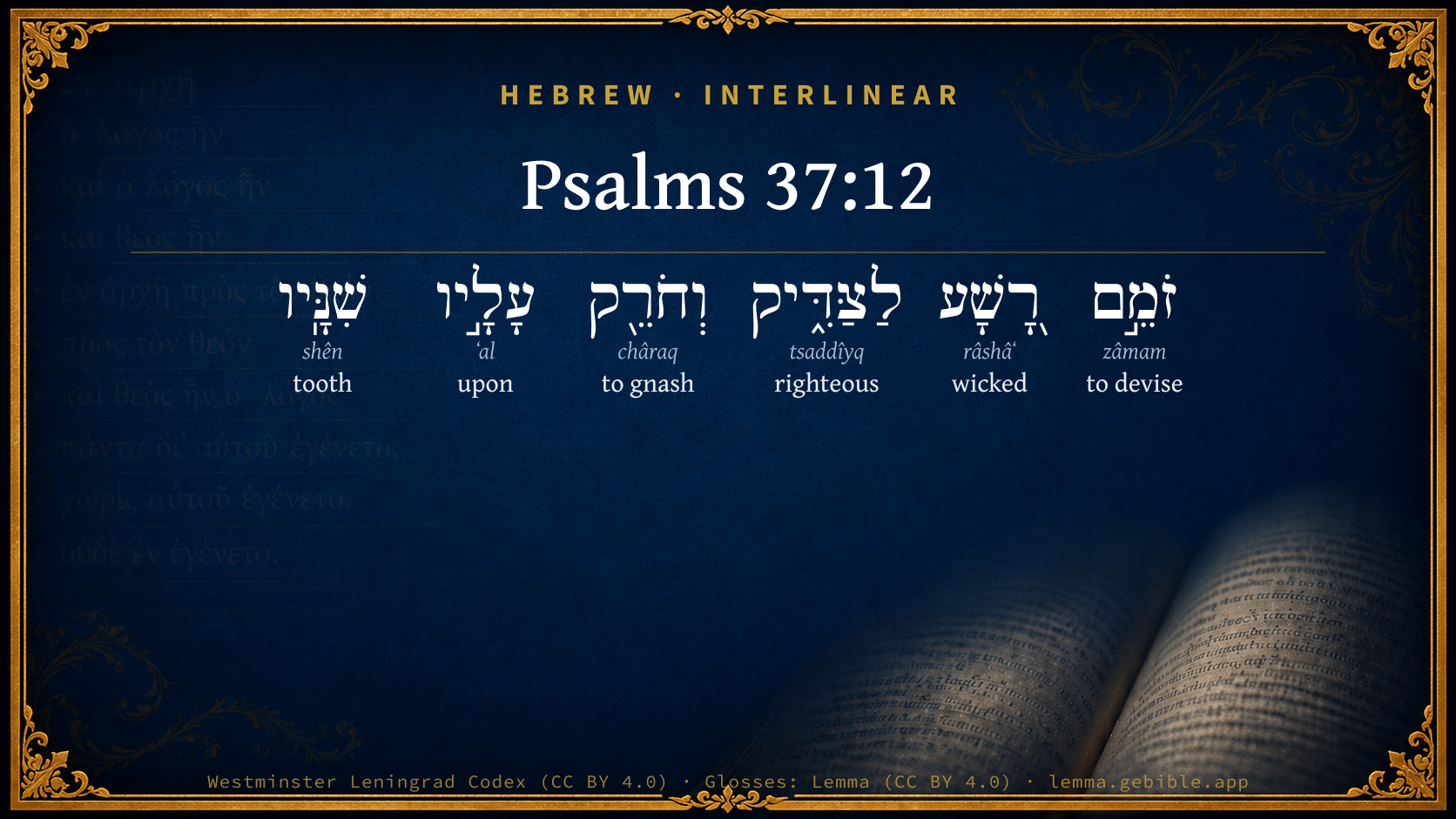
Psalms 37:12

Hebrew (Westminster Leningrad Codex) Psalms 37:12 appears in the Hebrew Old Testament. The text above is from the Westminster Leningrad Codex. Each word links to its Strong’s number, a concise gloss, and parsing drawn from the Open Scriptures Hebrew Bible morphology. Click any word for its full Brown-Driver-Briggs (BDB) entry.
Download image
Cite this verse

Psalms 37:12 (World English Bible). Public Domain. Lemma interlinear Bible study tool, https://lemma.gebible.app/v/psalms/37/12.

Show BibTeX & RIS
BibTeX
RIS
English Translation
The wicked plots against the just, And gnashes at him with his teeth.
World English Bible · Public Domain
Download a study sheet

One document with this verse’s original text, its word-by-word gloss line, the meaning frame, cross-references with their text, attributed commentary, and full source and license credits — printable, and it pastes into notes with its structure intact.

This verse Autodidact and up

Study sheet (.html) Plain text (.txt)

A passage Seminary Student

Up to 50 verses in one chapter. A passage sheet keeps up to 6 commentary sources and 12 cross-references per verse, in the order this page ranks them, and says so on the sheet whenever that leaves anything out. Ask for a single verse and you get the Autodidact verse sheet above.

Everything on this page stays free to read, with no account — the sheet is a download of what is already on screen, not access to it.

Want to remove ads? Support Godless Engineer
Compare translations 3

The same verse in 3 English versions, stacked beneath the original-language interlinear above. Click any original word for its lexicon entry.

Each is an independent rendering of the whole verse — the interlinear is not word-aligned to these translations.

Highlighted words mark where these versions differ — a whole-verse word diff, not a word-by-word alignment.

  • World English Bible Public Domain
    The wicked plots against the just, And gnashes at him with his teeth.
  • King James Version Public Domain
    The wicked plotteth against the just, and gnasheth upon him with his teeth.
  • unfoldingWord Literal Text CC BY-SA 4.0
    The wicked is plotting against the righteous and is gnashing his teeth against him.

unfoldingWord Literal Text — © unfoldingWord, licensed CC BY-SA 4.0. Word-aligned USFM3 via Door43 (git.door43.org/unfoldingWord/en_ult).

Versions to compare (up to 4)

3 of 4 selected

Show all 18 translations

Every available English version of this verse, each an independent rendering of the whole verse.

  • World English Bible Public Domain
    The wicked plots against the just, And gnashes at him with his teeth.
  • Berean Standard Bible Public Domain
    The wicked scheme against the righteous and gnash their teeth at them,
  • Majority Standard Bible Public Domain
    The wicked scheme against the righteous and gnash their teeth at them,
  • King James Version Public Domain
    The wicked plotteth against the just, and gnasheth upon him with his teeth.
  • American Standard Version (1901) Public Domain
    The wicked plotteth against the just, And gnasheth upon him with his teeth.
  • Revised Version (1885) Public Domain
    The wicked plotteth against the just, and gnasheth upon him with his teeth.
  • Geneva Bible (1599) Public Domain
    The wicked practiseth against the iust, and gnasheth his teeth against him.
  • Douay-Rheims (1899) Public Domain
    The sinner shall watch the just man: and shall gnash upon him with his teeth.
  • Young's Literal Translation Public Domain
    The wicked is devising against the righteous, And gnashing against him his teeth.
  • Literal Standard Version CC BY-SA 4.0
    The wicked is devising against the righteous, || And gnashing his teeth against him.
  • Unlocked Literal Bible CC BY-SA 4.0
    The wicked man plots against the righteous and he grinds his teeth in rage against him.
  • unfoldingWord Literal Text CC BY-SA 4.0
    The wicked is plotting against the righteous and is gnashing his teeth against him.
  • Darby Bible Public Domain
    The wicked plotteth against the righteous, and gnasheth his teeth against him.
  • World Messianic Bible Public Domain
    The wicked plots against the just, and gnashes at him with his teeth.
  • Webster's Bible Public Domain
    The wicked plotteth against the just, and gnasheth upon him with his teeth.
  • Free Bible Version CC BY-SA 4.0
    The wicked plot evil against those who do good, gnashing their teeth at them.
  • Bible in Basic English Public Domain
    The sinner has evil designs against the upright, lifting up the voice of wrath against him.
  • JPS Tanakh (1917) Public Domain
    The wicked plotteth against the righteous, and gnasheth at him with his teeth.

Literal Standard Version (2020), Covenant Press — licensed CC BY-SA 4.0. Text via the HelloAO Bible API (eBible.org). Unlocked Literal Bible (unfoldingWord) — licensed CC BY-SA 4.0. Text via the HelloAO Bible API (eBible.org). unfoldingWord Literal Text — © unfoldingWord, licensed CC BY-SA 4.0. Word-aligned USFM3 via Door43 (git.door43.org/unfoldingWord/en_ult). Free Bible Version, Dr. Jonathan Gallagher — licensed CC BY-SA 4.0. Text via the HelloAO Bible API (eBible.org).

Word by word

More ways to search: Search by grammar → Find every occurrence → Compare this word →

Practice this passage: Drill this verse → Learn its vocabulary →

About this verse

These counts appear in no published source. They are computed here, from the morphology-tagged text and Lemma’s own curated glosses. What Lemma adds →

6
words
6
distinct lemmas
Wisdom
section

Notable vocabulary

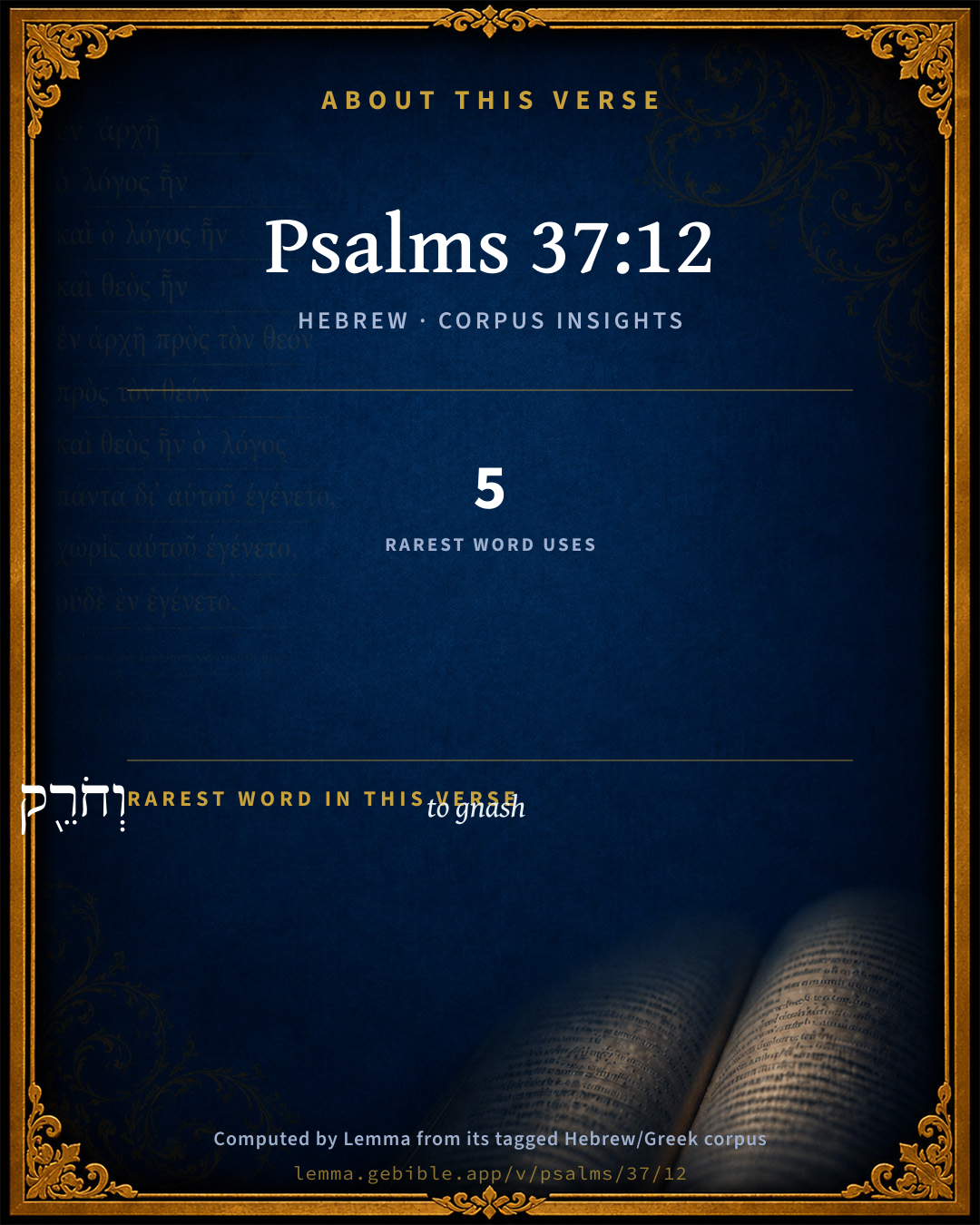
The rarest word here is וְחֹרֵ֖ק to gnash H2786 — appearing just 5 times in the whole Hebrew Bible.

Shared distinctive vocabulary

וְחֹרֵ֖ק to gnash H2786 occurs in 5 verses of the Hebrew Bible. Also found in:

Grammatical profile

  • 2 verbs
  • 1 noun
  • 2 adjectives
  • 1 preposition

Verb forms

  • זֹמֵ֣ם Qal · Participle Active
  • וְחֹרֵ֖ק Qal · Participle Active

Hebrew & Septuagint length

In English translation the verse runs 13 words from the Hebrew and 13 from the Septuagint (LXX English) — the same length.

A rough comparison of the two English renderings, which tokenize alike — not a word-level alignment.

Word counts can differ between the Hebrew and the Greek without any difference in meaning — e.g. the Hebrew direct-object marker אֵת has no separate Greek word, and Greek often adds the article ὁ.

Cross-references

12

Topical passages linked to Psalms 37:12 in the Treasury of Scripture Knowledge — connected by theme and wording, ordered by reader-vote popularity; previews shown in the World English Bible.

  • Psalms 35:16 Like the profane mockers in feasts, They gnashed their teeth at me.
  • Micah 2:1 Woe to those who devise iniquity And work evil on their beds! When the morning is light, they practice it, Because it is in the power of their hand.
  • Psalms 31:13 For I have heard the slander of many, terror on every side, While they conspire together against me, They plot to take away my life.
  • Daniel 8:12 The host was given over [to it] together with the continual [burnt offering] through disobedience; and it cast down truth to the ground, and it did [its pleasure] and prospered.
  • Matthew 26:16 From that time he sought opportunity to betray him.
  • 1 Samuel 18:21 Saul said, I will give her to him, that she may be a snare to him, and that the hand of the Philistines may be against him. Therefore Saul said to David, You shall this day be my son-in-law a second time.
  • 1 Samuel 23:7–9 It was told Saul that David was come to Keilah. Saul said, God has delivered him into my hand; for he is shut in, by entering into a town that has gates and bars.
  • 2 Samuel 15:10–12 But Absalom sent spies throughout all the tribes of Israel, saying, As soon as you hear the sound of the trumpet, then you shall say, Absalom is king in Hebron.
  • Esther 3:6 But he scorned the thought of laying hands on Mordecai alone; for they had made known to him the people of Mordecai: therefore Haman sought to destroy all the Jews who were throughout the whole kingdom of Ahasuerus, even the people of Mordecai.
  • Psalms 37:32 The wicked watches the righteous, And seeks to kill him.
  • Daniel 8:24 His power shall be mighty, but not by his own power; and he shall destroy wonderfully, and shall prosper and do [his pleasure]; and he shall destroy the mighty ones and the holy people.
  • Matthew 26:4 They took counsel together that they might take Jesus by deceit, and kill him.

Cross-references courtesy of OpenBible.info (CC BY 4.0).

Hebrew and Greek witnesses Masoretic Hebrew ↔ Greek Septuagint

The same verse in the two great witnesses to the Old Testament, shown verse-for-verse.

You’re reading Greek Psalm 36 (Hebrew Psalm 37). The Septuagint counts the superscription, so verse numbers can differ from the Hebrew — chapter-level alignment, not verse-by-verse. Numbering follows Rahlfs.

These are two independent witnesses, not word-aligned to each other, and the Septuagint is shown in lemma (dictionary) form.

Hebrew Psalms 37:12 Masoretic · Westminster Leningrad Codex

זֹמֵ֣ם רָ֭שָׁע לַצַּדִּ֑יק וְחֹרֵ֖ק עָלָ֣יו שִׁנָּֽיו

The wicked plots against the just, And gnashes at him with his teeth.

World English Bible · Public Domain

Greek LXX Greek Psalm 36:12 Septuagint · lemma form

παρατηρέω ὁ ἁμαρτωλός ὁ δίκαιος καί βρύχω ἐπί αὐτός ὁ ὀδούς αὐτός

The sinner will watch for the righteous, and gnash his teeth upon him.

LXX2012 (modern English Septuagint) · Public Domain

Hebrew: Westminster Leningrad Codex (CC BY 4.0). Greek: Septuagint (public domain); English from LXX2012 (modern English Septuagint) (Public Domain). How the Septuagint differs from the Hebrew →

Commentary

Notes on Psalms 37:12 from classic Christian and Jewish commentators (each source and its license shown beneath its notes). The classic Christian expositions comment on the surrounding passage and are grouped to its opening verse, so a note may address several verses; the Jewish commentaries on the Tanakh (Rashi and others) are per-verse, so they appear only where the commentator wrote on this verse.

Lemma curates 59 commentaries, every one of them public domain or Creative Commons licensed, each selected and text-cleaned for this edition rather than reprinted as found. About our sources →

Trapp's Complete Commentary

John Trapp

Psa 37:12 The wicked plotteth against the just, and gnasheth upon him with his teeth.

Ver. 12. The wicked plotteth against the just] Plotteth and practiseth, being set on by that old manslayer, who lendeth the wicked man his seven heads to plot, and his ten horns to push.

And gnasheth upon him with his teeth] Saying unto him, when he hath laid hold on him, Nunc inveni te, as Kimchi paraphraseth, Now I have found you, and shall be even with you. Art thou come, thou villain? said Stephen Gardiner to Doctor Taylor, martyr, when he first appeared before him. How darest thou look me in the face for shame? Knowest thou not who I am? (Acts and Mon.) Thus that proud prelate, gnashing his teeth, and boasting great matters with his tongue; and he was bravely answered, as hath been before related.

John Trapp, A Commentary or Exposition upon All the Books of the Old and New Testament (1647–1656) — public domain. Text from a community e-Sword module.

The Biblical Illustrator

Joseph S. Exell

Psa_37:12-15

The wicked plotteth against the just, and gnasheth upon him with his teeth.

The plottings of the wicked against the good

That the wicked plot against the just is matter of history, and of everyday experience. They envy the moral character of the good, with the respect it wins and the influence it wields. They are also rebuked by the quiet dignity of the Christian character, and hence, through sheer hatred, seek to persecute and remove it out of their sight.

I. The plottings of the wicked against the good are wrathful. And gnasheth upon him, etc. The wicked show by their gestures the rage they indulge against, and injury they would inflict upon, the good if it were in their power.

II. The plottings of the wicked against the good are cruel. The wicked have drawn out the sword. They have drawn the weapon out of the sheath and await the time to use it.

III. The plottings of the wicked against the good are determined. And have bent their bow. They take steady aim that they may wound a vital part. And thus the wicked, in their plottings against the just, make use of all the instrumentalities they can command, exercise all the talents they possess, and are strong in their determination to achieve the end they contemplate.

IV. The plottings of the wicked against the good are cowardly. They attack the feeble who are too meek in spirit to suspect their mischief, or to defend themselves from it; they attack the poor who have not wherewith to protect themselves from the assaults of their imperious enemies. Wicked men are generally cowardly. They have not the courage of their rage, or the valour of their determination.

V. The plottings of the wicked against the good are self-destructive. The very weapon intended for the destruction of the good, under the mysterious but retributive arrangements of Divine providence, shall be employed in the defeat of the wicked. The wicked are often hung upon gallows built by themselves. Lessons:--

1. It is foolish for the wicked to plot against the good.

2. Such plottings are intelligible to the good, being explained by the enmity of the world to Christ.

3. Such plottings are not to be feared, but are to be outlived by trust in God. (Joseph S. Exell, M. A.)

The Biblical Illustrator, edited by Joseph S. Exell (c. 1880s–1900s) — public domain. Text from a community e-Sword module.

The Treasury of David

Charles H. Spurgeon

Ver. 12-15. Here is the portrait of a proud oppressor armed to the teeth.

Ver. 12. The wicked plotteth against the just. Why can he not let the good man alone? Because there is enmity between the serpent's seed and the seed of the woman. Why not attack him fairly? Why plot and scheme? Because it is according to the serpent's nature to be very subtle. Plain sailing does not suit those who are on board of "The Apollyon." And gnashed upon him with his teeth. The wicked show by their gestures what they would do if they could; if they cannot gnaw they will gnash; if they may not bite they will at least bark. This is precisely what the graceless world did with "that just One, "the Prince of Peace. Yet he took no vengeance upon them, but like a silent lamb received injuries in patience.

Ver. 12-13. Note how the gesture of the wicked in gnashing their teeth is returned to them in the Lord's scornful laughter at their devices. Their plotting, too, is countermined by that winding up of all plots, which the Lord knoweth, though they are wilfully ignorant of it. C. H. S.

None.

Psalms 37:13*

Ver. 12-13. See Psalms on "Ps 37:12" for further information.

Charles H. Spurgeon's The Treasury of David (1869–1885) — public domain. Psalms only. Text from a community e-Sword/MySword module.

Joseph Benson's Commentary

Psa 37:12-13. The wicked plotteth against the just — There is a rooted enmity in the seed of the wicked one against the righteous seed: their aim is, if they can, to destroy their righteousness; if that fail, then to destroy them. To this end they plot, or act with a great deal of policy and contrivance; and gnasheth upon him with his teeth — Out of malice and rage. They join zeal and fury to craft and subtlety, inflamed with eager desire to have it in their power to destroy them, and full of wrath and indignation because it is not in their power. The Lord shall laugh at him — Shall despise and deride all their hopes and endeavours against the good, as vain and foolish. For he seeth that his day is coming — The day of his punishment. Thus, Jer 5:31, Thy day is come, the time that I will visit thee.

Joseph Benson's Commentary on the Old and New Testaments (1811–1818) — public domain. Text from a community e-Sword module.

J. A. Alexander on Psalms

Joseph Addison Alexander

12. (Psa 37:12) Plotting, habitually meditating evil, (is the) wicked (man), as to (or against) the righteous, and gnashing at him (or upon him) with his teeth, gnashing his teeth at him, as a natural token of bestial malignity. This is a kind of concession, that the wicked man deserves no forbearance on the part of the righteous, who is not, however, therefore at liberty to anticipate God's judgments, for the reason given in the next verse.

Joseph Addison Alexander, The Psalms Translated and Explained (1850) — public domain. Text from a community e-Sword module.

Tyndale Open Study Notes

Tyndale Open Resources

37:12-17 The wicked seek to destroy the Lord’s order, but he defeats them.

37:12-13 The wicked snarl to express their bitter envy. They plot to bring an end to the godly, but the Lord derides them because they cannot succeed (2:4).

Tyndale Open Study Notes — © Tyndale Open Resources, licensed CC BY-SA 4.0. Text via the HelloAO Bible API.

Geneva Bible (1599)

Geneva Bible translators

The godly are assured that the power and craft of the wicked shall not prevail against them, but fall on their own necks, and therefore ought patiently to abide God’s time, and in the meanwhile bewail their sins, and offer up their tears, is a sacrifice of their obedience.

Geneva Bible (1599) marginal notes — public domain. Text via Bolls.life.

Jamieson, Fausset & Brown

Robert Jamieson, A. R. Fausset & David Brown

gnasheth . . . teeth--in beastly rage.

Jamieson, Fausset & Brown — Commentary Critical and Explanatory on the Whole Bible (1871) — public domain (CC PDM 1.0). Text via the HelloAO Bible API.

John Calvin's Commentaries

12. The wicked plotteth against the righteous. David here anticipates an objection which might have been taken to the preceding verse. Where, it might be said, can tranquillity and joy be found when the wicked are mad with rage, and plot every kind of mischief against the children of God? And how shall they cherish good hope for the future who see themselves surrounded with innumerable sources of death? David therefore replies, That although the life of the godly should be assailed by many dangers, yet they are secure in the aid and protection of God; and that however much the wicked should plot against them, they shall be continually preserved. Thus, the design of David is to obviate our fears, lest the malice of the ungodly should terrify us above measure, as if they had the power of doing with us according to their pleasure. He indeed confesses that they are not only full of fraud, and expert in deceiving, but also that they burn with anger, and a raging desire of doing mischief, when he says, that they plot mischief deceitfully against the righteous, and gnash upon them with their teeth But after making this statement, he immediately adds, that their endeavors shall be vain. Yet he seems to provide very coldly for our consolation under sorrow, for he represents God as merely laughing But if God values highly our salvation, why does he not set himself to resist the fury of our enemies, and vigorously oppose them? We know that this, as has been said in Psalm 2:4, is a proper trial of our patience, when God does not come forth at once, armed for the discomfiture of the ungodly, but connives for a time and withholds his hand. But as the eye of sense in such circumstances reckons that he delays his coming too long, and from that delay concludes that he indulges in ease, and feels no interest in the affairs of men, it is no small consolation to be able by the eye of faith to behold him laughing; for then we are assured that he is not seated idly in heaven, nor closes his eyes, resigning to chance the government of the world, but purposely delays and keeps silence because he despises their vanity and folly.

And lest the flesh should still murmur and complain, demanding why God should only laugh at the wicked, and not rather take vengeance upon them, the reason is added, that he sees the day of their destruction at hand: For he seeth that his day is coming. Whence is it that the injuries we sustain from the wickedness of man so trouble us, if it be not that, when not obtaining a speedy redress, we begin to despair of ever seeing a better state of things? But he who sees the executioner standing behind the aggressor with drawn sword no longer desires revenge, but rather exults in the prospect of speedy retribution. David, therefore, teaches us that it is not meet that God, who sees the destruction of the wicked to be at hand, should rage and fret after the manner of men. There is then a tacit distinction here made between God and men, who, amidst the troubles and confusions of the world, do not see the day of the wicked coming, and who, oppressed by cares and fears, cannot laugh, but because vengeance is delayed, rather become so impatient that they murmur and fret. It is not, however, enough for us to know that God acts in a manner altogether different from us, unless we learn to weep patiently whilst he laughs, so that our tears may be a sacrifice of obedience. In the meantime, let us pray that he would enlighten us by his light, for by this means alone will we, by beholding with the eye of faith his laughter, become partakers thereof, even in the midst of sorrow. Some, indeed, explain these two verses in another sense; as if David meant to say, that the faithful live so happily that the wicked envy them. But the reader will now perceive that this is far from the design of the prophet.

John Calvin's Commentaries (1540-1563) — public domain. Text from the Calvin Translation Society English edition (1840s-50s) via the Christian Classics Ethereal Library (ccel.org). Calvin's coverage is partial (roughly two-thirds of the Bible); uncommented books and verses are honest gaps, never fabricated. The 19th-century editor's footnotes and remarks are omitted so the notes are faithfully Calvin's own voice.

The Cambridge Bible for Schools and Colleges

gen. ed. J. J. S. Perowne

12. The wicked deviseth mischief against the righteous. Cp. Psa_37:7; Psa_37:32.

gnasheth &c.] Like a furious wild beast, eager to seize its prey. Cf. Psa_35:16.

12, 13. Stanza of Zayin. The impotent rage of the wicked.

12–20. Disappointment and destruction are the destiny of the wicked.

The Cambridge Bible for Schools and Colleges (gen. ed. J. J. S. Perowne; Cambridge University Press, 1878–1918) — public domain. Text from a community e-Sword module.

John Gill's Exposition

The Lord shall laugh at him,.... Have him and his plots in derision, confound his schemes, and disappoint him of his designs, bring him into calamity, and laugh at it; see Psa 2:4;

for he seeth that his day is coming; either the day of the Lord, which he has appointed to judge the world in, and which comes suddenly, at unawares, as a thief in the night, and is known unto the Lord, though to none else; or the day of the wicked man's ruin and destruction, to which he is appointed, and which is the same; and so the Targum is, "the day of his calamity": which the Lord observes is hastening on, when he will be for ever miserable.

John Gill's Exposition of the Whole Bible (1746–1763) — public domain (CC PDM 1.0). Text via the HelloAO Bible API.

Albert Barnes' Notes on the Bible

The wicked plotteth against the just - Margin, “practiceth.” The Hebrew word means to plot; to lie in wait; to plan; to purpose; to devise. See Psa 31:13. The meaning is, that wicked people lay their plans against the righteous, but that they will not be able to carry them out, or accomplish them, for they will be cut off, and the Lord will protect His friends.

And gnasheth upon him with his teeth - An expression of rage or anger. See the notes at Psa 35:16.

Albert Barnes' Notes on the Bible (1834–1885) — public domain. Text from a community e-Sword/MySword module.

Matthew Poole's English Annotations

Out of malice and rage. See Poole "Psa 35:16".

Matthew Poole's English Annotations on the Holy Bible (1683–1685) — public domain. Text from a community e-Sword/MySword module.

Whedon's Commentary on the Bible

Daniel D. Whedon

12. Gnasheth upon him—In imitation of wild beasts. See on Psa_35:16

Daniel D. Whedon (gen. ed.), Commentary on the Old and New Testaments (1874–1909) — public domain. Text from a community e-Sword module.

The Pulpit Commentary

The wicked plotteth against the just. (comp. Psa_31:13 Psa_35:4, Psa_35:7, etc.) Wicked men commonly lay their plots against the righteous, as being less likely to suspect them, and perhaps as less likely to resist their machinations. And gnasheth upon him with his teeth. (comp. Psa_35:16)

Vers. 12-20. The righteous and the wicked.

The argument is continued and repeated in various forms, that the righteous is to hold fast his confidence in God, and not to be discouraged by the prosperity of the wicked. For

I CONSIDER THE EXPERIENCE OF THE WICKED. (Vers. 12-15, 20)

1. The impotence of the plots which they in their anger devise. (Vers. 12, 13) The Lord shall laugh. "No weapon formed against him shall prosper.

2. The punishment of the wicked is near and certain. (Vers. 13, 20) "He seeth that his day is coming.

3. The weapons which they employ against the righteous shall recoil upon themselves. (Vers. 14, 15) God overrules the contest between them.

II THE BLESSEDNESS Or THE RIGHTEOUS. (Vers. 16-19)

1. A little with righteousness is worth more than much with wickedness. (Ver. 16)

2. The strength of the righteous is maintained and upheld by God. (Ver. 17) While the "arms equivalent to the "strength of the wicked soon break down.

3. They fulfil their divinely appointed days, and their goods descend to their posterity. (Ver. 18) They are secure, and all things work together for good. The Christian knows of an eternal inheritance.

4. God will provide for all their wants. (Ver. 19) This we know more abundantly in Christ. S.

The Pulpit Commentary (1880–1919), ed. H.D.M. Spence-Jones & Joseph S. Exell — public domain. Text from a community e-Sword module.

Keil & Delitzsch

C. F. Keil & F. Delitzsch

The verb זמם is construed with ל of that which is the object at which the evil devices aim. To gnash the teeth (elsewhere also: with the teeth) is, as in Psa 35:16, cf. Job 16:9, a gesture of anger, not of mockery, although anger and mockery are usually found together. But the Lord, who regards an assault upon the righteous as an assault upon Himself, laughs (Psa 2:4) at the enraged schemer; for He, who orders the destinies of men, sees beforehand, with His omniscient insight into the future, his day, i.e., the day of his death (Sa1 26:10), of his visitation (Psa 137:7, Oba 1:12, Jer 50:27, Jer 50:31).

Keil & Delitzsch — Biblical Commentary on the Old Testament (1861–1891) — public domain (CC PDM 1.0). Text via the HelloAO Bible API. (Old Testament only.)

Rashi

Rabbi Shlomo Yitzchaki (Rashi)

and gnashes Heb. וחרק, as (in Lam. 2:16): “and gnashed (ויחרקו) their teeth”; e rechineynt in Old French.

Rashi on the Tanakh — English translations: “The Judaica Press complete Tanach with Rashi, translated by A. J. Rosenberg” (CC BY 4.0); “Pentateuch with Rashi's commentary by M. Rosenbaum and A.M. Silbermann, 1929-1934” (public domain); “The Metsudah Tanach series, Lakewood, N.J” (CC BY 4.0); and “The Book of Joshua, Metsudah Publications, 1997” (CC BY 4.0). Text via Sefaria.

Lesson kit

Teaching starters — assembled from the data on this page, not authored interpretation. Every prompt links to the verse data it draws on. Edit before teaching.

Psalms, in the Wisdom, opens this verse with 6 words (6 distinct Hebrew lemmas). Its most distinctive word is châraq (“to gnash”). A historical commentator’s framing appears above. Read the whole chapter for the surrounding context.

Discussion questions

  1. How does “to gnash” (châraq) shape what this verse is saying?
  2. How does Job 16:9, which shares the word «to gnash», read alongside this verse?
  3. These translations render this verse differently. What is at stake in choosing one wording over another?
  4. «זֹמֵ֣ם» is a Qal Participle Active verb. How does that grammatical form shape the action described?
  5. Compare how Trapp's Complete Commentary and The Biblical Illustrator read this verse. Where do they agree or differ?

Things to notice

Reading settings

Reading text

Shown beneath each verse's original-language words.

Old Testament
Old Testament edition

Read the OT as the Masoretic Hebrew (MT) or the Greek Septuagint (LXX).

English shown for the Greek Septuagint (in the Hebrew ↔ Greek comparison).

Comparing translations? Open the Compare panel on any verse page to stack up to four side by side.