
Proverbs 29:12

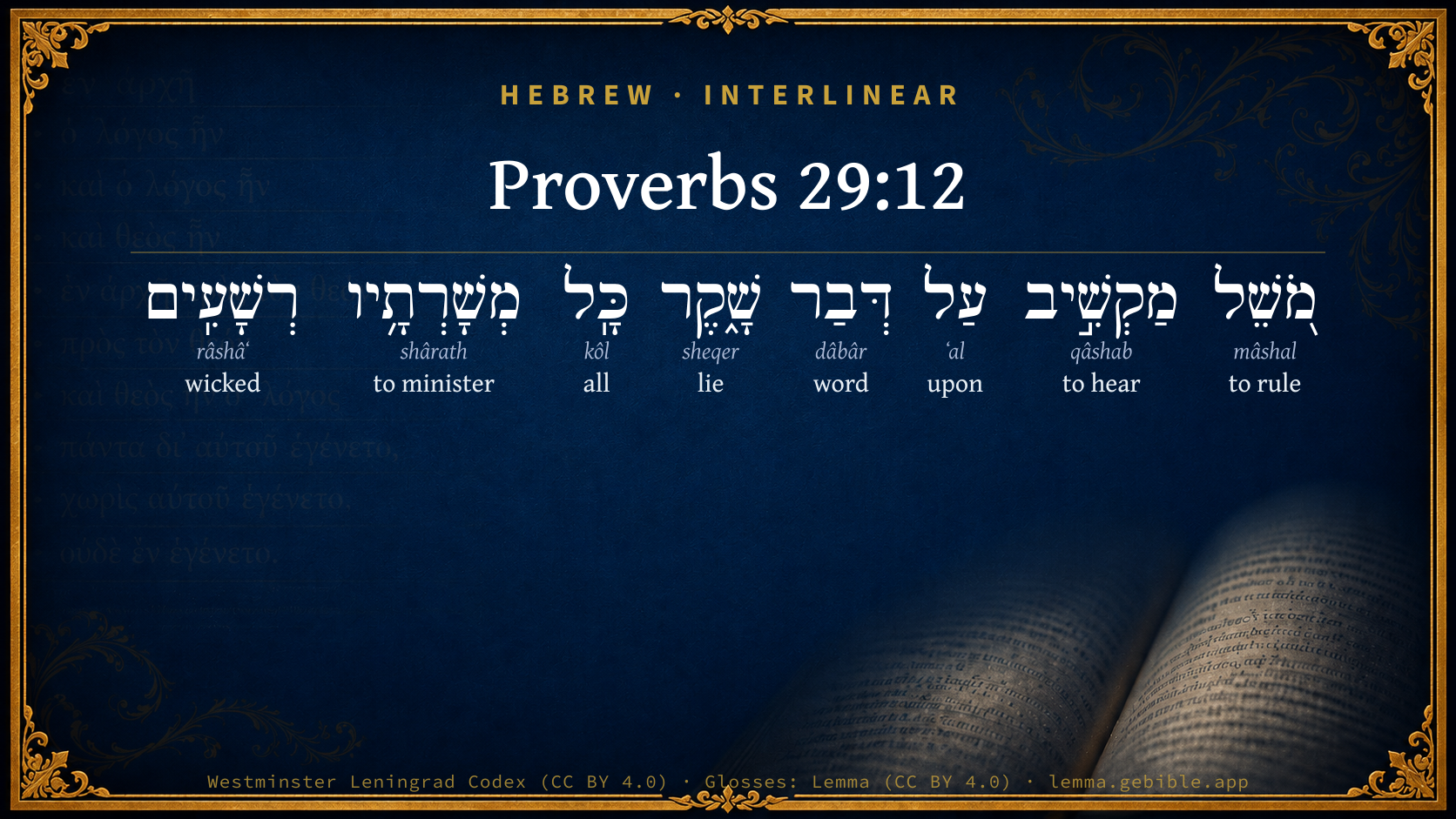
Hebrew (Westminster Leningrad Codex) Proverbs 29:12 appears in the Hebrew Old Testament. The text above is from the Westminster Leningrad Codex. Each word links to its Strong’s number, a concise gloss, and parsing drawn from the Open Scriptures Hebrew Bible morphology. Click any word for its full Brown-Driver-Briggs (BDB) entry.
Download image
Cite this verse

Proverbs 29:12 (World English Bible). Public Domain. Lemma interlinear Bible study tool, https://lemma.gebible.app/v/proverbs/29/12.

Show BibTeX & RIS
BibTeX
RIS
English Translation
If a ruler listens to lies, All of his officials are wicked.
World English Bible · Public Domain
Download a study sheet

One document with this verse’s original text, its word-by-word gloss line, the meaning frame, cross-references with their text, attributed commentary, and full source and license credits — printable, and it pastes into notes with its structure intact.

This verse Autodidact and up

Study sheet (.html) Plain text (.txt)

A passage Seminary Student

Up to 50 verses in one chapter. A passage sheet keeps up to 6 commentary sources and 12 cross-references per verse, in the order this page ranks them, and says so on the sheet whenever that leaves anything out. Ask for a single verse and you get the Autodidact verse sheet above.

Everything on this page stays free to read, with no account — the sheet is a download of what is already on screen, not access to it.

Want to remove ads? Support Godless Engineer
Compare translations 3

The same verse in 3 English versions, stacked beneath the original-language interlinear above. Click any original word for its lexicon entry.

Each is an independent rendering of the whole verse — the interlinear is not word-aligned to these translations.

Highlighted words mark where these versions differ — a whole-verse word diff, not a word-by-word alignment.

  • World English Bible Public Domain
    If a ruler listens to lies, All of his officials are wicked.
  • King James Version Public Domain
    If a ruler hearken to lies, all his servants are wicked.
  • unfoldingWord Literal Text CC BY-SA 4.0
    A ruler who listens attentively to a word of falsehood, all his servants wicked ones.

unfoldingWord Literal Text — © unfoldingWord, licensed CC BY-SA 4.0. Word-aligned USFM3 via Door43 (git.door43.org/unfoldingWord/en_ult).

Versions to compare (up to 4)

3 of 4 selected

Show all 18 translations

Every available English version of this verse, each an independent rendering of the whole verse.

  • World English Bible Public Domain
    If a ruler listens to lies, All of his officials are wicked.
  • Berean Standard Bible Public Domain
    If a ruler listens to lies, all his officials will be wicked.
  • Majority Standard Bible Public Domain
    If a ruler listens to lies, all his officials will be wicked.
  • King James Version Public Domain
    If a ruler hearken to lies, all his servants are wicked.
  • American Standard Version (1901) Public Domain
    If a ruler hearkeneth to falsehood, All his servants are wicked.
  • Revised Version (1885) Public Domain
    If a ruler hearkeneth to falsehood, all his servants are wicked.
  • Geneva Bible (1599) Public Domain
    Of a prince that hearkeneth to lyes, all his seruants are wicked.
  • Douay-Rheims (1899) Public Domain
    A prince that gladly heareth lying words, hath all his servants wicked.
  • Young's Literal Translation Public Domain
    A ruler who is attending to lying words, All his ministers `are' wicked.
  • Literal Standard Version CC BY-SA 4.0
    A ruler who is attending to lying words, || All his ministers [are] wicked.
  • Unlocked Literal Bible CC BY-SA 4.0
    If a ruler pays attention to lies, all his officials will be wicked.
  • unfoldingWord Literal Text CC BY-SA 4.0
    A ruler who listens attentively to a word of falsehood, all his servants wicked ones.
  • Darby Bible Public Domain
    If a ruler hearken to lying words, all his servants are wicked.
  • World Messianic Bible Public Domain
    If a ruler listens to lies, all of his officials are wicked.
  • Webster's Bible Public Domain
    If a ruler hearkeneth to lies, all his servants are wicked.
  • Free Bible Version CC BY-SA 4.0
    A ruler who listens to lies will have nothing but wicked officials.
  • Bible in Basic English Public Domain
    If a ruler gives attention to false words, all his servants are evil-doers.
  • JPS Tanakh (1917) Public Domain
    If a ruler hearkeneth to falsehood, all his servants are wicked.

Literal Standard Version (2020), Covenant Press — licensed CC BY-SA 4.0. Text via the HelloAO Bible API (eBible.org). Unlocked Literal Bible (unfoldingWord) — licensed CC BY-SA 4.0. Text via the HelloAO Bible API (eBible.org). unfoldingWord Literal Text — © unfoldingWord, licensed CC BY-SA 4.0. Word-aligned USFM3 via Door43 (git.door43.org/unfoldingWord/en_ult). Free Bible Version, Dr. Jonathan Gallagher — licensed CC BY-SA 4.0. Text via the HelloAO Bible API (eBible.org).

Word by word

More ways to search: Search by grammar → Find every occurrence → Compare this word →

Practice this passage: Drill this verse → Learn its vocabulary →

About this verse

These counts appear in no published source. They are computed here, from the morphology-tagged text and Lemma’s own curated glosses. What Lemma adds →

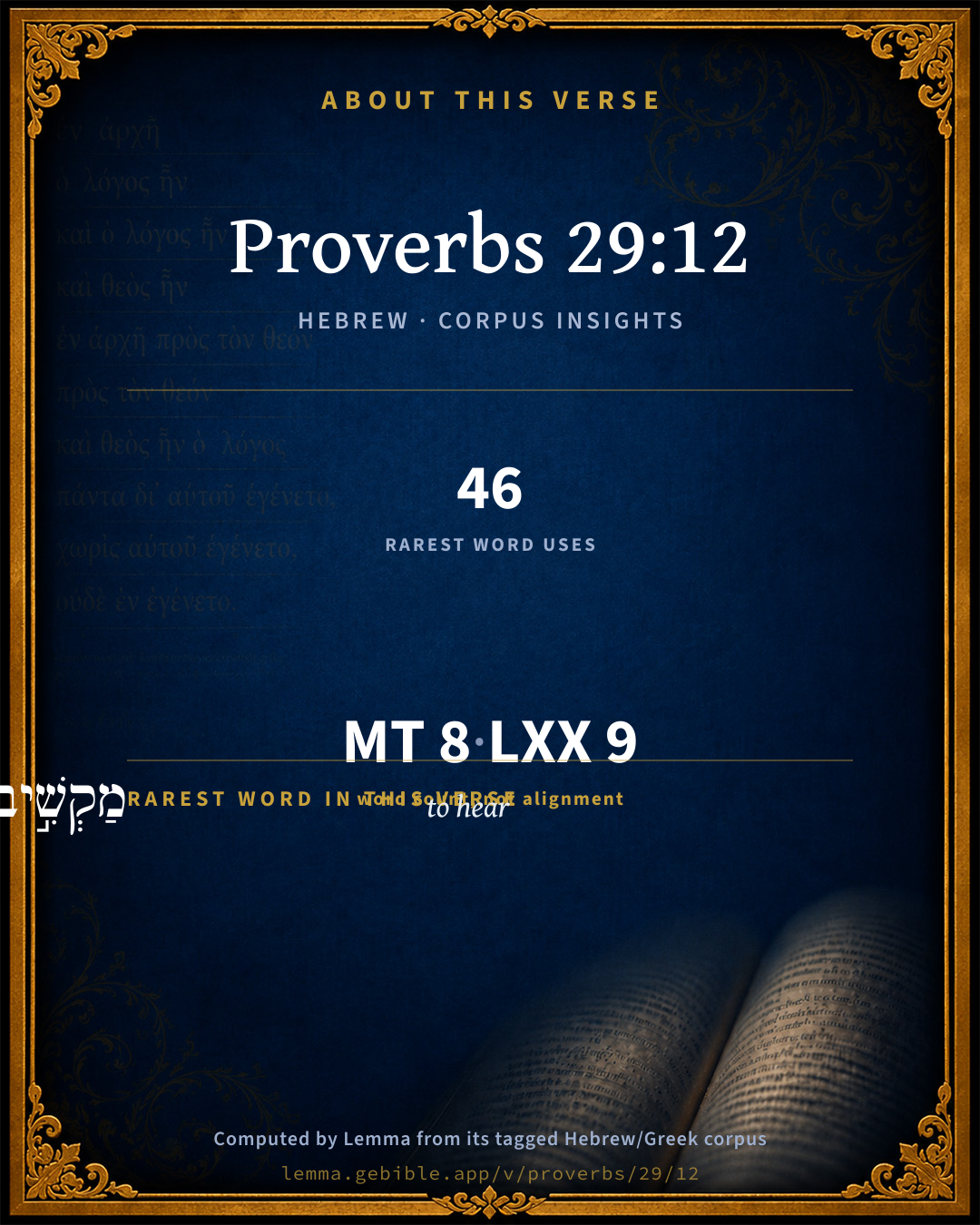
8
words
8
distinct lemmas
Wisdom
section

Shared distinctive vocabulary

מַקְשִׁ֣יב to hear H7181 occurs in 45 verses of the Hebrew Bible. Also found in:

Grammatical profile

  • 3 verbs
  • 3 nouns
  • 1 adjective
  • 1 preposition

Verb forms

  • מֹ֭שֵׁל Qal · Participle Active
  • מַקְשִׁ֣יב Hiphil · Participle Active
  • מְשָׁרְתָ֥יו Piel · Participle Active

Hebrew & Septuagint length

In English translation the verse runs 12 words from the Hebrew and 12 from the Septuagint (LXX English) — the same length.

A rough comparison of the two English renderings, which tokenize alike — not a word-level alignment.

Word counts can differ between the Hebrew and the Greek without any difference in meaning — e.g. the Hebrew direct-object marker אֵת has no separate Greek word, and Greek often adds the article ὁ.

In the original languages it is 8 Hebrew tokens and 9 Greek tokens — but the two are counted differently (Hebrew bundles its prefixes and suffixes into one token; the Greek is in lemma form), so that isn’t a like-for-like length.

Cross-references

10

Topical passages linked to Proverbs 29:12 in the Treasury of Scripture Knowledge — connected by theme and wording, ordered by reader-vote popularity; previews shown in the World English Bible.

  • Proverbs 20:8 A king who sits on the throne of judgment Scatters away all evil with his eyes.
  • 1 Samuel 22:8–23 that all of you have conspired against me, and there is none who discloses to me when my son makes a league with the son of Jesse, and there is none of you who is sorry for me, or discloses to me that my son has stirred up my servant against me, to lie in wait, as at this day?
  • 2 Kings 10:6–7 Then he wrote a letter the second time to them, saying, If you be on my side, and if you will listen to my voice, take the heads of the men your master's sons, and come to me to Jezreel by tomorrow this time. Now the king's sons, being seventy persons, were with the great men of the city, who brought them up.
  • Psalms 52:2–4 Your tongue plots destruction, Like a sharp razor, working deceitfully.
  • Psalms 101:5–7 I will silence whoever secretly slanders his neighbor. I won't tolerate one who is haughty and conceited.
  • 1 Samuel 23:19–23 Then came up the Ziphites to Saul to Gibeah, saying, Doesn't David hide himself with us in the strongholds in the wood, in the hill of Hachilah, which is on the south of the desert?
  • 2 Samuel 3:7–11 Now Saul had a concubine, whose name was Rizpah, the daughter of Aiah: and [Ish-bosheth] said to Abner, Why have you gone in to my father's concubine?
  • 2 Samuel 4:5–12 The sons of Rimmon the Beerothite, Rechab and Baanah, went, and came about the heat of the day to the house of Ish-bosheth, as he took his rest at noon.
  • 1 Kings 21:11–13 The men of his city, even the elders and the nobles who lived in his city, did as Jezebel had sent to them, according as it was written in the letters which she had sent to them.
  • Proverbs 25:23 The north wind brings forth rain: So a backbiting tongue brings an angry face.

Cross-references courtesy of OpenBible.info (CC BY 4.0).

Hebrew and Greek witnesses Masoretic Hebrew ↔ Greek Septuagint

The same verse in the two great witnesses to the Old Testament, shown verse-for-verse.

These are two independent witnesses, not word-aligned to each other, and the Septuagint is shown in lemma (dictionary) form.

Hebrew Proverbs 29:12 Masoretic · Westminster Leningrad Codex

מֹ֭שֵׁל מַקְשִׁ֣יב עַל דְּבַר שָׁ֑קֶר כָּֽל מְשָׁרְתָ֥יו רְשָׁעִֽים

If a ruler listens to lies, All of his officials are wicked.

World English Bible · Public Domain

Greek LXX Proverbs 29:12 Septuagint · lemma form

βασιλεύς ὑποἀκούω λόγος ἄδικος πᾶς ὁ ὑπό αὐτός παράνομος

When a king hearkens to unjust language, all his subjects are transgressors.

LXX2012 (modern English Septuagint) · Public Domain

Hebrew: Westminster Leningrad Codex (CC BY 4.0). Greek: Septuagint (public domain); English from LXX2012 (modern English Septuagint) (Public Domain). How the Septuagint differs from the Hebrew →

Commentary

Notes on Proverbs 29:12 from classic Christian and Jewish commentators (each source and its license shown beneath its notes). The classic Christian expositions comment on the surrounding passage and are grouped to its opening verse, so a note may address several verses; the Jewish commentaries on the Tanakh (Rashi and others) are per-verse, so they appear only where the commentator wrote on this verse.

Lemma curates 59 commentaries, every one of them public domain or Creative Commons licensed, each selected and text-cleaned for this edition rather than reprinted as found. About our sources →

Trapp's Complete Commentary

John Trapp

Pro 29:12 If a ruler hearken to lies, all his servants [are] wicked.

Ver. 12. If a ruler hearken to lies, all his servants are wicked.] He shall have his Aiones and Negones, that will say as he says, and fit his humour to a hair, as Doeg did Saul’s, as the false prophets did Ahab’s, as Herod’s courtiers did him on his birthday feast, &c. These were fit helves for such hatchets, fit lettuce for such lips, fit servants for such masters.

“Mobile mutatur semper eum principe vulgus.”

Claudian.

Like prince, like people. The common sort are like a flock of cranes; as the first fly, all follow. Or as in a beast, the whole body follows the head. Rulers are the looking glasses according to which most men dress themselves. Their sins do much hurt, as by imputation - 2Sa 24:15-17, the prince sinned, the people suffered {a} - so by imitation; for man is a creature apt to imitate, and is led more by his eyes than by his ears. Magis intuentur quid fecerit Iupiter, quam quid docuit Plato, saith Augustine. Jupiter’s adulteries drew the people to like wantonness. Hence Chaerea in Terence, Haec ego non facerem quae Iupiter fecit? saith he, Should I make dainty of doing that which Jupiter did? Height of place ever adds two wings to sin, example and scandal, whereby it soars higher, and flies much farther. Let rulers, therefore, look to it. Let them not be "partakers of other men’s sins" {1Ti 5:22} - they have enough of their own to answer for. Potentes potenter torquebuntur - let them take heed that "the iniquity of their heels," of those that follow them at the heels, "doth not compass them about." {Psa 69:5}

{a} Delirant reges, plectuntur Achivi.

John Trapp, A Commentary or Exposition upon All the Books of the Old and New Testament (1647–1656) — public domain. Text from a community e-Sword module.

The Preacher's Complete Homiletical Commentary

Joseph S. Exell (gen. ed.)

CRITICAL NOTES.—

Pro_29:13. The deceitful. Rather “the usurer.” A man of usury is only a more concrete expression for a rich man, and this is the corresponding term in chap. Pro_22:2 (Zöckler).

MAIN HOMILETICS OF Pro_29:12

A MORAL CANCER IN A KING’S COURT

I. A man in authority should be a discerner of character. The man whose bodily sight is defective is not fit to be entrusted with the destinies of others in any case in which clear vision is needed. A purblind seaman would not be the man to stand upon the bridge of a vessel and direct its movements, nor would a general unable to distinguish friends from foes be a safe person to whom to entrust the guidance of an army in the field. And a man is manifestly in the wrong place if he is a ruler over others and is not a discerner of character.

II. A man in authority should be the possessor of a character. A ruler may be a good man himself and yet be imposed upon by others, but as a rule a lover of truth is a discerner of truth, and an honest man will detect the false ring of the liar’s words. But if a man is himself a liar, he will instinctively shrink from contact with true men, and true men will not care to hold intercourse with him, or to serve him, and so he must necessarily gather round him servants who are like himself. Such processes of attraction and repulsion are always going on in the world, in all departments of government, in the family, in the factory, and in the court. The servants are generally what the master is, and the courtiers reflect the character of the monarch.

III. It is therefore indispensable to the moral purity of any community that its head be first a good man and then an able man. Moral excellence is before all other things needful, but it is not the only thing needful. A good man is not always a keen discerner of character, although his goodness will strengthen his power of discernment, but he who rules men should possess in an uncommon degree the power of reading them as well as that of setting them a good example in his own life.

OUTLINES AND SUGGESTIVE COMMENTS

He that carrieth Satan in his ear is no less blameworthy than he which carrieth him in his tongue. Untruths are cherished and fostered, as it were, by those who are too light of belief. But this credulity is especially to be shunned by rulers in church, commonwealth, or private families; for all the inferiors commonly follow the example of the superiors.… It may indeed sometimes fall out that an Obadiah may lurk in Ahab’s court, but this is rare, and commonly the sway goeth another way. Who were Saul’s courtiers but Doeg and such backbiters?—Muffett.

How wise was David’s determination—both as the sovereign of his people and the ruler of his house—to discountenance lies, and uphold the cause of faithful men! (Psa_101:2-7.—Bridges.

It is natural, when we think of Solomon’s own situation as king of Israel, to expect to find some of his maxims of proverbial wisdom bearing special reference to the character and conduct of men in power. And so it is. When, moreover, we think of the wisdom with which, at the outset of his reign, and at his own earnest request, he was divinely endowed, we as naturally anticipate a correspondence between the maxims and the character. Nor are we disappointed. The maxims are not those of the selfishness of power,—not those of arbitrary despotism or the sovereignty of royal will; nor are they those of an artful, intriguing, Machiavelian policy. They are sound and liberal, and based on the great principle of the public good being the end of all government—the principle that kings reign, not for themselves, but for their people; while, in all their administration, they ought to be swayed and regulated by the laws of an authority higher than their own, by a regard to the will of God as their rule, and the glory of God, to which all else must ever be subordinate, as their supreme aim. But we must not forget, that the Book of Proverbs forms part of the canon of inspired Scripture; that it does not contain, therefore, the mere dictates of human wisdom, how extraordinary soever that wisdom was; that “a greater than Solomon is here.”—Wardlaw.

The reigns of those princes who gave an easy belief to accusations, are stained with the most atrocious crimes. Tiberius Cæsar put to death the greater number of his own privy councillors, by giving ear to lies, and encouraging his servants to be wicked; and it is probable that the worst action that ever was committed since the fall of Adam, the murder of the Prince of Life, was occasioned by Pilate’s wicked and cowardly regard to the temper of that tyrant, and his fear of being accused as an encourager of treason, if he had suffered our Lord to escape.—Lawson.

Rulers are the looking-glasses according to which most men dress themselves. Their sins do much hurt, as by imputation (2 Samuel 24.)—the prince sinned, the people suffered—so by imitation; for man is a creature apt to imitate, and is more led by his eyes than his ears.… Height of place ever adds two wings to sin, example, and scandal, whereby it soars higher and flies much further.—Trapp.

The subject of Pro_29:13 is the same as that of chap. Pro_22:22, page 636. The deceitful man should be “the man of usury, money-lender,” meaning simply the “rich man.” (Zöckler.) For subjects of Pro_29:14-15, see on chapter Pro_16:10-15, page 472, and Pro_13:24, page 335, also on chap. Pro_19:13-18, page 573.

The Preacher's Complete Homiletical Commentary (gen. ed. Joseph S. Exell; Funk & Wagnalls, c. 1892) — public domain (pre-1929). A full-Bible homiletical/sermon-outline anthology covering 65 of 66 books (2 John is absent from the source module). Text from a community e-Sword module.

Matthew Henry's Commentary

Note, 1. It is a great sin in any, especially in rulers, to hearken to lies; for thereby they not only give a wrong judgment themselves of persons and things, according to the lies they give credit to, but they encourage others to give wrong informations. Lies will be told to those that will hearken to them; but the receiver, in this case, is as bad as the thief. 2. Those that do so will have all their servants wicked. All their servants will appear wicked, for they will have lies told of them; and they will be wicked, for they will tell lies to them. All that have their ear will fill their ear with slanders and false characters and representations; and so if princes, as well as people, will be deceived, they shall be deceived, and, instead of devolving the guilt of their own false judgments upon their servants that misinformed them, they must share in their servants' guilt, and on them will much of the blame lie for encouraging such misinformations and giving countenance and ear to them.

Matthew Henry's Commentary on the Whole Bible (1708–1710) — public domain (CC PDM 1.0). Text via the HelloAO Bible API.

Jamieson, Fausset & Brown

Robert Jamieson, A. R. Fausset & David Brown

His servants imitate him.

Jamieson, Fausset & Brown — Commentary Critical and Explanatory on the Whole Bible (1871) — public domain (CC PDM 1.0). Text via the HelloAO Bible API.

Adam Clarke's Commentary

Verse 12. If a ruler hearken to lies] Wherever the system of espionage is permitted to prevail, there the system of falsity is established; for he who is capable of being a spy and informer, is not only capable of telling and swearing lies, but also of cutting his king's or even his father's throat. I have seen cases, where the same spy received pay from both parties, and deceived both.

Adam Clarke's Commentary on the Bible (1810–1826) — public domain. Text from a community e-Sword/MySword module.

Ellicott's Commentary for English Readers

(12) If a ruler hearken to lies, all his servants are wicked.—If a ruler shows that he likes adulation and falsehood rather than unpleasant truths, his attendants will provide him with what he wishes. (Comp. Sir_10:2.) So Jeremiah complains (Jer_5:31) that prophets, priests, and people were all wilfully deceiving each other.

A Bible Commentary for English Readers, edited by Charles John Ellicott (1878–1897) — public domain. Text from a community e-Sword module.

The Cambridge Bible for Schools and Colleges

gen. ed. J. J. S. Perowne

12. Comp.

“As is the judge of his people, so are his ministers;

And as is the ruler of the city, such are all they that dwell therein.”

Sir_10:2.

The Cambridge Bible for Schools and Colleges (gen. ed. J. J. S. Perowne; Cambridge University Press, 1878–1918) — public domain. Text from a community e-Sword module.

John Gill's Exposition

If a ruler hearken to lies,.... To men that tell them in order to soothe and flatter him, or to hurt the character and reputation of others, that they may raise their own: rulers should not listen to and encourage such sort of persons; for, as lying lips do not become a prince, so it is not right to have liars about him; David would not suffer such to dwell in his court, Psa 101:7;

all his servants are wicked; or the greatest part of them: for a ruler of such a disposition will take none but such into his service, that flatter him, and calumniate others; and such a conduct, being pleasing and agreeable to him, is a temptation to his ministers to act the same wicked part; as is a prince, such are his courtiers; his example has a great influence upon them.

John Gill's Exposition of the Whole Bible (1746–1763) — public domain (CC PDM 1.0). Text via the HelloAO Bible API.

Albert Barnes' Notes on the Bible

All his servants are wicked - They know what will please, and they become informers and backbiters.

Albert Barnes' Notes on the Bible (1834–1885) — public domain. Text from a community e-Sword/MySword module.

Matthew Poole's English Annotations

If a ruler hearken to lies, delight in flatteries or calumnies, or any lying words or deceitful and wicked practices,

all his servants are wicked; partly because he chooseth only such for his service; and partly because they are either corrupted by his example, or engaged by their place and interest to please him, and comply with his base lusts.

Matthew Poole's English Annotations on the Holy Bible (1683–1685) — public domain. Text from a community e-Sword/MySword module.

Whedon's Commentary on the Bible

Daniel D. Whedon

12. Lies — Hebrew, word of falsehood. It may mean a false accusation against some one, or a false suggestion as to his own merits, abilities, or prerogatives. Bacon takes it to mean an easy, credulous temper; ready to believe detractors and sycophants without examination. “As the judge of the people is himself, so are his officers; and what manner of man the ruler of the city is, such are they that dwell therein.” Sir_10:2. This last is far too strong.

Daniel D. Whedon (gen. ed.), Commentary on the Old and New Testaments (1874–1909) — public domain. Text from a community e-Sword module.

The Pulpit Commentary

All his servants are wicked. The ruler is willing to be deceived, and does not care to hear the truth, so his servants flatter and lie to him, and the whole atmosphere is charged with unreality and deceit. Qualis rex, talis grex. Ecc_10:2, "As the judge of the people is himself, so are his officers; and what manner of man the ruler of the city is, such are all that dwell therein." Claudian, "IV Cons. Hon.," 299"Componitur orbis Regis ad exemplum: nec sic inflectere sensus Humanos edicta valent, ut vita regentis. Mobile mutatur semper cum principe vulgus." "By the king"s precedent The world is ordered; and men"s minds are moved Less by stern edicts than their ruler"s life. The fickle crowd aye by the prince is swayed. Cicero, "De Leg.," 3:13, "Ut enim cupiditatibus principum et vitiis iufici solet tota civitas, sic emendari et corrigi continentia." And ibid., 14, "Quo perniciosius de republica merentur vitiosi principes, quod non solum vitia concipiunt ipsi, sod ea infundunt in civitatem; neque solum obsunt, ipsi quod corrumpuntur, sed etiam quod corrumpunt, plusque exemplo, quam peccato, nocent.

Vers. 12-17. Government in truth and equity.

I THERE MUST BE THE FORCE OF EXAMPLE. (Ver. 12) Especially in regard to truthfulness. Nothing is more easily caught than an example of untruthfulness, evasion, hypocrisy. Servants" manners reflect their masters" characters. The more conspicuous the station, the further the influence of the example extends.

II THERE MUST BE RESPECT TO THE RULER AND JUDGE OF ALL. (Ver. 13) He is no Respecter of persons; but he is the Protector of all, and the Judge between man and man. The distinctions of ruler and subject, of rank and rank, of class and class, are temporary; the common relation of all to God is spiritual and eternal.

III THERE MUST BE REGARD TO THE LOWLY. (Ver. 14) Must not the test of every government be at last this What did it accomplish for the poor, for the burdened, for the slave and the oppressed? "Glorious" wars and additions of territory can never compensate for injustice at home; the renown of arms for a people"s misery. The throne that is not propped by bayonets, but built upon a people"s gratitude and loyalty, may defy the storms of revolution.

IV DOMESTIC GOVERNMENT TEACHES THE SAME TRUTHS ON A SMALLER SCALE. (Vers. 15-17)

There is the same need of firmness and discipline. Absolute liberty is licence. All our freedom is bounded by necessity. The good of the whole demands fixed law; and this must be observed in the household as in the body politic. A weakness in the administration of acknowledged law is fatal to the purity of the home, to the welfare of nations. Evil doers must be kept down; if their character cannot be changed, their power to work mischief must be taken from them by the unflinching administration of law. And lastly, firmness, so far from alienating, really wins the good will, the respect, and obedience of subjects in the petty commonwealth of home and in the larger sphere of the state. J.

The Pulpit Commentary (1880–1919), ed. H.D.M. Spence-Jones & Joseph S. Exell — public domain. Text from a community e-Sword module.

Keil & Delitzsch

C. F. Keil & F. Delitzsch

12 A ruler who listens to deceitful words,

All his servants are godless.

They are so because they deceive him, and they become so; for instead of saying the truth which the ruler does not wish to hear, they seek to gain his favour by deceitful flatteries, misrepresentations, exaggerations, falsehoods. Audita rex quae praecipit lex. He does not do this, as the saying is, sicut rex ita grex (Sir. 10:2), in the sense of this proverb of Solomon.

Keil & Delitzsch — Biblical Commentary on the Old Testament (1861–1891) — public domain (CC PDM 1.0). Text via the HelloAO Bible API. (Old Testament only.)

Bridges on Proverbs

Charles Bridges

The influence of the ruler’s personal character upon his people involves a fearful responsibility.†1 A wicked prince makes a wicked people.†2 In his more immediate sphere, if he hearken to lies, contrary to the laws of God and of charity;†3 he will never want those about him ready to minister to is folly. ’Lies will be told to those that are ready to hearken to them.’†4 Envy, ambition, malice, self-interest, will always be at hand for prejudice and scandal. The credulous ruler becomes the tool of all manner of wickedness. His corruption pushes away the godly from his presence; and all his servants are wicked. Exceptions there are to this maxim (as Obadiah in the court of Ahab,†5 Ebedmelech in the service of Zedekiah,†6 Daniel in Nebuchadnezzar’s court.†7 But this is the natural tendency, the general result, to his own disgrace and ruin. If he would therefore rule in uprightness and in the fear of God; instead of lending himself to detraction or flattery, he must carefully close his ears against doubtful characters, lest he should countenance wicked servants, and discourage those, that will boldly speak the truth.

How wise was David’s determination — both as the sovereign of his people, and the ruler of his house — to discountenance lies, and uphold the cause of faithful men! (Psa 101:2-7 .) Contrast Ahab surrounded with his wicked prophets; all combining in one lie to please their weak and ungodly master. We see how ready he was to hearken to lies, and how well the flattery worked; when he punished the only man who was "valiant for the truth," and who persisted in declaring it — "not fearing the wrath of the king."†8

But all in authority may learn a lesson of responsibility. Let Ministers especially, not only hold the truth in its full integrity, and take heed that their character will bear the strictest scrutiny; but let them turn away from the fawning flattery of those, of whose uprightness there is at best but doubtful proof.

Footnotes:

†1 . . . . . . . Componitur orbis

Regis ad exemplum; nec tantum inflectere sensus

Humanos edicta valent, quàm vita regentis.

Mobile mutatur semper cum principe vulgus.

Claud. De Honorii Consul.

†2 1Ki 15:30 ; 1Ki 16:2 .

†3 Exo 23:1. M.R. Compare Pro 13:5 .

†4 Henry.

†5 1Ki 18:3 .

†6 Jer 38:7-13.

†7 Dan 2:48-49.

†8 1Ki 22:6, 1Ki 22:26-27 . Compare Hos 7:3 . ’Many kings have been destroyed by poison; but none has been so efficaciously mortal, as that drunk in by the ear.’ - South. Massillon well taught his young prince, that the flattery of the courtier was little less dangerous than the rebellion of the traitor.

Charles Bridges, An Exposition of the Book of Proverbs (1846) — public domain. Text from a community e-Sword module.

Lesson kit

Teaching starters — assembled from the data on this page, not authored interpretation. Every prompt links to the verse data it draws on. Edit before teaching.

Proverbs, in the Wisdom, opens this verse with 8 words (8 distinct Hebrew lemmas). Its most distinctive word is qâshab (“to hear”). A historical commentator’s framing appears above. Read the whole chapter for the surrounding context.

Discussion questions

  1. How does “to hear” (qâshab) shape what this verse is saying?
  2. How does 1 Samuel 15:22, which shares the word «to hear», read alongside this verse?
  3. The translations on this page render this verse differently — a whole-verse word diff, not a word-by-word alignment. What might account for the different wordings?
  4. «מֹ֭שֵׁל» is a Qal Participle Active verb. How does that grammatical form shape the action described?
  5. Compare how Trapp's Complete Commentary and The Preacher's Complete Homiletical Commentary read this verse. Where do they agree or differ?

Things to notice

Reading settings

Reading text

Shown beneath each verse's original-language words.

Old Testament
Old Testament edition

Read the OT as the Masoretic Hebrew (MT) or the Greek Septuagint (LXX).

English shown for the Greek Septuagint (in the Hebrew ↔ Greek comparison).

Comparing translations? Open the Compare panel on any verse page to stack up to four side by side.