

Proverbs 11:23

Hebrew (Westminster Leningrad Codex) Proverbs 11:23 appears in the Hebrew Old Testament. The text above is from the Westminster Leningrad Codex. Each word links to its Strong’s number, a concise gloss, and parsing drawn from the Open Scriptures Hebrew Bible morphology. Click any word for its full Brown-Driver-Briggs (BDB) entry.
Download image
Cite this verse

Proverbs 11:23 (World English Bible). Public Domain. Lemma interlinear Bible study tool, https://lemma.gebible.app/v/proverbs/11/23.

Show BibTeX & RIS
BibTeX
RIS
English Translation
The desire of the righteous is only good. The expectation of the wicked is wrath.
World English Bible · Public Domain
Download a study sheet

One document with this verse’s original text, its word-by-word gloss line, the meaning frame, cross-references with their text, attributed commentary, and full source and license credits — printable, and it pastes into notes with its structure intact.

This verse Autodidact and up

Study sheet (.html) Plain text (.txt)

A passage Seminary Student

Up to 50 verses in one chapter. A passage sheet keeps up to 6 commentary sources and 12 cross-references per verse, in the order this page ranks them, and says so on the sheet whenever that leaves anything out. Ask for a single verse and you get the Autodidact verse sheet above.

Everything on this page stays free to read, with no account — the sheet is a download of what is already on screen, not access to it.

Want to remove ads? Support Godless Engineer
Compare translations 3

The same verse in 3 English versions, stacked beneath the original-language interlinear above. Click any original word for its lexicon entry.

Each is an independent rendering of the whole verse — the interlinear is not word-aligned to these translations.

Highlighted words mark where these versions differ — a whole-verse word diff, not a word-by-word alignment.

  • World English Bible Public Domain
    The desire of the righteous is only good. The expectation of the wicked is wrath.
  • King James Version Public Domain
    The desire of the righteous is only good: but the expectation of the wicked is wrath.
  • unfoldingWord Literal Text CC BY-SA 4.0
    The desire of the righteous only good; the expectation of the wicked rage.

unfoldingWord Literal Text — © unfoldingWord, licensed CC BY-SA 4.0. Word-aligned USFM3 via Door43 (git.door43.org/unfoldingWord/en_ult).

Versions to compare (up to 4)

3 of 4 selected

Show all 18 translations

Every available English version of this verse, each an independent rendering of the whole verse.

  • World English Bible Public Domain
    The desire of the righteous is only good. The expectation of the wicked is wrath.
  • Berean Standard Bible Public Domain
    The desire of the righteous leads only to good, but the hope of the wicked brings wrath.
  • Majority Standard Bible Public Domain
    The desire of the righteous leads only to good, but the hope of the wicked brings wrath.
  • King James Version Public Domain
    The desire of the righteous is only good: but the expectation of the wicked is wrath.
  • American Standard Version (1901) Public Domain
    The desire of the righteous is only good; `But' the expectation of the wicked is wrath.
  • Revised Version (1885) Public Domain
    The desire of the righteous is only good: but the expectation of the wicked is wrath.
  • Geneva Bible (1599) Public Domain
    The desire of the righteous is onely good: but the hope of the wicked is indignation.
  • Douay-Rheims (1899) Public Domain
    The desire of the just is all good: the expectation of the wicked is indignation.
  • Young's Literal Translation Public Domain
    The desire of the righteous `is' only good, The hope of the wicked `is' transgression.
  • Literal Standard Version CC BY-SA 4.0
    The desire of the righteous [is] only good, || The hope of the wicked [is] transgression.
  • Unlocked Literal Bible CC BY-SA 4.0
    The desires of righteous people result in good, but wicked people can only hope for wrath.
  • unfoldingWord Literal Text CC BY-SA 4.0
    The desire of the righteous only good; the expectation of the wicked rage.
  • Darby Bible Public Domain
    The desire of the righteous is only good; the expectation of the wicked is wrath.
  • World Messianic Bible Public Domain
    The desire of the righteous is only good. The expectation of the wicked is wrath.
  • Webster's Bible Public Domain
    The desire of the righteous is only good: but the expectation of the wicked is wrath.
  • Free Bible Version CC BY-SA 4.0
    Good people want what's best, but what the wicked hope for ends in death.
  • Bible in Basic English Public Domain
    The desire of the upright man is only for good, but wrath is waiting for the evil-doer.
  • JPS Tanakh (1917) Public Domain
    The desire of the righteous is only good; but the expectation of the wicked is wrath.

Literal Standard Version (2020), Covenant Press — licensed CC BY-SA 4.0. Text via the HelloAO Bible API (eBible.org). Unlocked Literal Bible (unfoldingWord) — licensed CC BY-SA 4.0. Text via the HelloAO Bible API (eBible.org). unfoldingWord Literal Text — © unfoldingWord, licensed CC BY-SA 4.0. Word-aligned USFM3 via Door43 (git.door43.org/unfoldingWord/en_ult). Free Bible Version, Dr. Jonathan Gallagher — licensed CC BY-SA 4.0. Text via the HelloAO Bible API (eBible.org).

Word by word

More ways to search: Search by grammar → Find every occurrence → Compare this word →

Practice this passage: Drill this verse → Learn its vocabulary →

About this verse

These counts appear in no published source. They are computed here, from the morphology-tagged text and Lemma’s own curated glosses. What Lemma adds →

7
words
7
distinct lemmas
Wisdom
section

Notable vocabulary

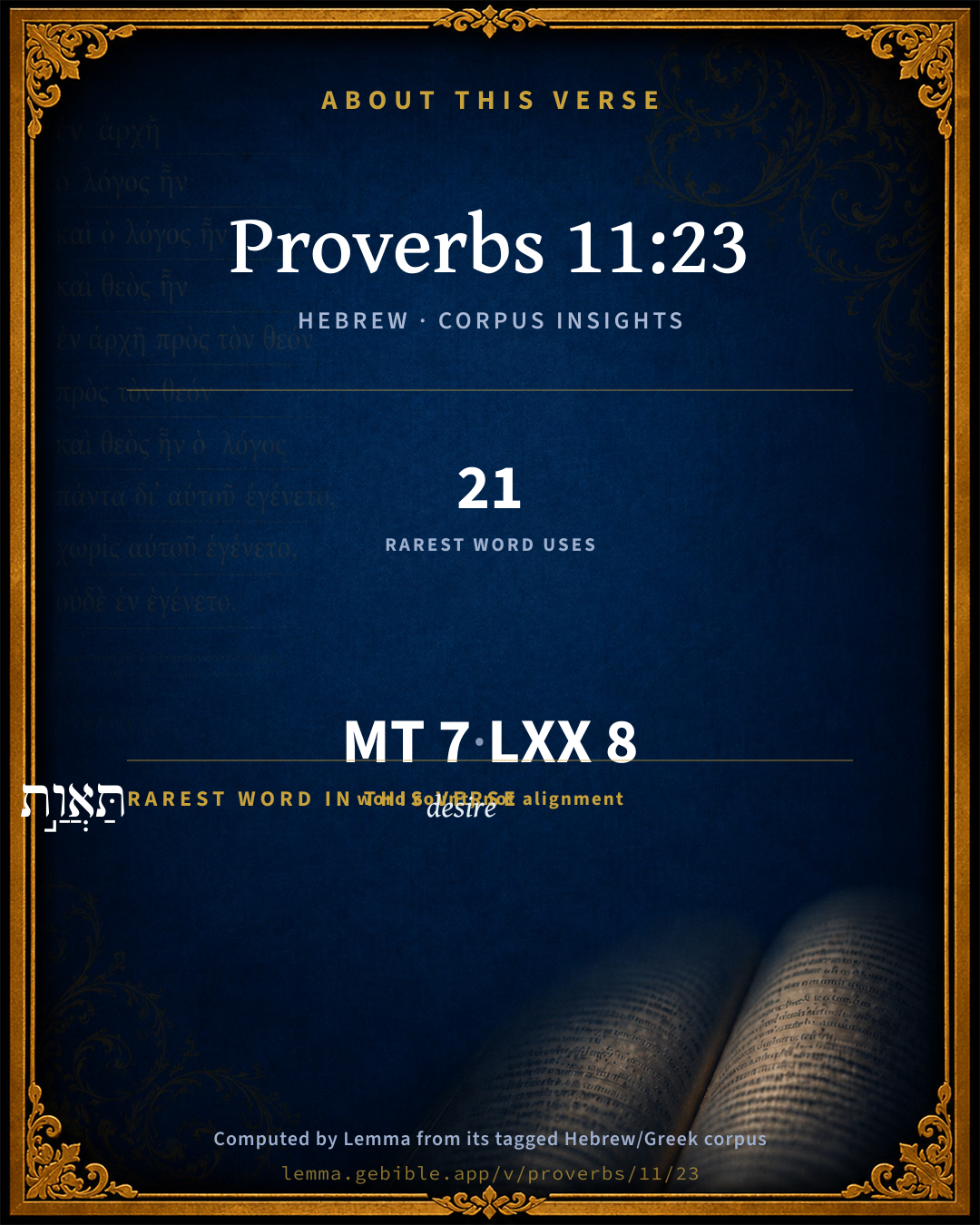
The rarest word here is תַּאֲוַ֣ת desire H8378 — appearing just 21 times in the whole Hebrew Bible.

Shared distinctive vocabulary

תַּאֲוַ֣ת desire H8378 occurs in 21 verses of the Hebrew Bible. Also found in:

Grammatical profile

  • 3 nouns
  • 3 adjectives
  • 1 particle

Hebrew & Septuagint length

In English translation the verse runs 15 words from the Hebrew and 16 from the Septuagint (LXX English) — closely comparable.

A rough comparison of the two English renderings, which tokenize alike — not a word-level alignment.

Word counts can differ between the Hebrew and the Greek without any difference in meaning — e.g. the Hebrew direct-object marker אֵת has no separate Greek word, and Greek often adds the article ὁ.

In the original languages it is 7 Hebrew tokens and 8 Greek tokens — but the two are counted differently (Hebrew bundles its prefixes and suffixes into one token; the Greek is in lemma form), so that isn’t a like-for-like length.

Cross-references

13

Topical passages linked to Proverbs 11:23 in the Treasury of Scripture Knowledge — connected by theme and wording, ordered by reader-vote popularity; previews shown in the World English Bible.

  • Psalms 37:4 Also delight yourself in Yahweh, And he will give you the desires of your heart.
  • Matthew 5:6 Blessed are those who hunger and thirst after righteousness, For they shall be filled.
  • Romans 2:8–9 but to those who are self-seeking, and don't obey the truth, but obey unrighteousness, will be wrath and indignation,
  • Psalms 10:17 Yahweh, you have heard the desire of the humble. You will prepare their heart. You will cause your ear to hear,
  • Psalms 27:4 One thing I have asked of Yahweh, that I will seek after, That I may dwell in the house of Yahweh all the days of my life, To see Yahweh's beauty, And to inquire in his temple.
  • Psalms 119:10 With my whole heart, I have sought you. Don't let me wander from your commandments.
  • Proverbs 10:28 The prospect of the righteous is joy, But the hope of the wicked will perish.
  • Isaiah 26:9 With my soul have I desired you in the night; yes, with my spirit within me will I seek you earnestly: for when your judgments are in the earth, the inhabitants of the world learn righteousness.
  • Jeremiah 17:16 As for me, I have not hurried from being a shepherd after you; neither have I desired the woeful day; you know: that which came out of my lips was before your face.
  • Psalms 39:7–8 Now, Lord, what do I wait for? My hope is in you.
  • Psalms 119:5 Oh that my ways were steadfast To obey your statutes!
  • Proverbs 11:7 When a wicked man dies, hope perishes, And expectation of power comes to nothing.
  • Hebrews 10:27 but a certain fearful expectation of judgment, and a fierceness of fire which will devour the adversaries.

Cross-references courtesy of OpenBible.info (CC BY 4.0).

Hebrew and Greek witnesses Masoretic Hebrew ↔ Greek Septuagint

The same verse in the two great witnesses to the Old Testament, shown verse-for-verse.

These are two independent witnesses, not word-aligned to each other, and the Septuagint is shown in lemma (dictionary) form.

Hebrew Proverbs 11:23 Masoretic · Westminster Leningrad Codex

תַּאֲוַ֣ת צַדִּיקִ֣ים אַךְ ט֑וֹב תִּקְוַ֖ת רְשָׁעִ֣ים עֶבְרָֽה

The desire of the righteous is only good. The expectation of the wicked is wrath.

World English Bible · Public Domain

Greek LXX Proverbs 11:23 Septuagint · lemma form

ἐπιθυμία δίκαιος πᾶς ἀγαθός ἐλπίς δέ ἀσεβής ἀποὀλλύω

All the desire of the righteous is good: but the hope of the ungodly shall perish.

LXX2012 (modern English Septuagint) · Public Domain

On this verse, The Pulpit Commentary discusses the Septuagint’s reading. Read the note in Commentary ↓

Hebrew: Westminster Leningrad Codex (CC BY 4.0). Greek: Septuagint (public domain); English from LXX2012 (modern English Septuagint) (Public Domain). How the Septuagint differs from the Hebrew →

Commentary

Notes on Proverbs 11:23 from classic Christian and Jewish commentators (each source and its license shown beneath its notes). The classic Christian expositions comment on the surrounding passage and are grouped to its opening verse, so a note may address several verses; the Jewish commentaries on the Tanakh (Rashi and others) are per-verse, so they appear only where the commentator wrote on this verse.

Lemma curates 59 commentaries, every one of them public domain or Creative Commons licensed, each selected and text-cleaned for this edition rather than reprinted as found. About our sources →

Trapp's Complete Commentary

John Trapp

Pro 11:23 The desire of the righteous [is] only good: [but] the expectation of the wicked [is] wrath.

Ver. 23. The desire of the righteous is only good,] i.e., So far as he is righteous, or spiritual, he "delights in the law of God after the inward man," {Rom 7:22} "willing in all things to live honestly." {Heb 13:18} Evil motions haunt his mind otherwhiles, but there they inhabit not. Lust was a stranger to David, as Peter Martyr observes out of Nathan’s parable; - "There came a traveller to this rich man." {2Sa 12:4} The main stream of his desires, the course and current of his heart ran upon God and godliness. {Psa 119:4-5; Psa 39:1; Psa 39:3} He resolved to do better than he did. "The spirit ever lusteth against the flesh"; howbeit when the flesh gets the wind and hill of the spirit, all is not so well carried. As the ferryman plies the oar, and eyes the shore homeward, where he would be, yet there comes a gust of wind that carries him back again, so it is oft with a Christian. But every man is with God so good as he desires to be. In vitae libro scribuntur qui quod possunt faciunt, etsi quod debent non possunt. {a} They are written in the book of life that do what good they can, though they cannot do as they would.

But the expectation of the wicked is wrath,] i.e., The good they expect proves to be "indignation and wrath, tribulation and anguish," {Rom 2:8-9} woeful perplexities and convulsions of soul, which will be so great and so grievous, as will make them rave and rage with madness and fury, especially because they looked for a better state.

{a} Bernard.

John Trapp, A Commentary or Exposition upon All the Books of the Old and New Testament (1647–1656) — public domain. Text from a community e-Sword module.

Joseph Benson's Commentary

Pro 11:23. The desire of the righteous is only good — “The righteous desire nothing, but that it may be well with all men; but the wicked wish for trouble and disturbance to all others but themselves, that they may execute their malice and wrath upon those whom they hate.” — Bishop Patrick. Or, rather, the meaning is, the desires and expectations of the righteous shall end in their good and happiness, but the desires and expectations of the wicked shall be disappointed, and end in the wrath of God.

Joseph Benson's Commentary on the Old and New Testaments (1811–1818) — public domain. Text from a community e-Sword module.

The Preacher's Complete Homiletical Commentary

Joseph S. Exell (gen. ed.)

CRITICAL NOTES.—

Pro_11:23. Wrath, i.e. God’s wrath (Zöckler).

MAIN HOMILETICS OF Pro_11:23

We cannot understand the first clause of this verse to mean that all a righteous man’s desires are good.

1. History contradicts it. Solomon must have known it was not true of his own father. David was a righteous man, but some of his desires were not only not good, but inhuman and devilish. Of all the good men of whom we read, whether in inspired or uninspired history, there is hardly one of whom some act is not recorded which reveals that their desires were sometimes sinful.

2. Present experience contradicts it. If those who are now looked upon as the salt of the earth were appealed to upon this matter they would emphatically deny that their desires were at all times and altogether good. But this we may affirm. I. That the main desire of a righteous man is that he may be good, and that to all his fellow-creatures “good may be the final goal of ill.” II. That there will be a period in his history when his desires will be “only” good. In nature all things tend towards a perfection—a completion. If no untoward circumstance prevent, a tree or a flower will go on growing until it has attained to the perfectness to which it has been ordained. The Christian is destined to attain to perfectness of moral beauty. And when this completion is arrived at his desires will be only good. See 1Jn_3:1-2, etc. (For full treatment of the verse see Homiletics on chap. 10: Pro_11:24; Pro_11:28.)

OUTLINES AND SUGGESTIVE COMMENTS

Here we are to contrast a wish and an assurance (expectation) like that class of passages already alluded to where the last clause is intensive. The mere wish of the righteous is an intrinsic good; either first, because all actings of his heart, whether wise or unwise, will exercise him (Psa_84:7), and will speed him to his celestial state; or secondly, because the wish of a righteous man, quoad a righteous man, will be a righteous wish, and, therefore, will be good in itself, and will be sure to be gratified. The wish of a righteous man, like the spongelets of a tree, is that which goes searching for God’s gifts, and is sure in the end to attain them. Therefore, emphasising “only” the wish of a righteous man will be made altogether to work for his good, however disappointed, and however kept low and troubled in the difficulties of the present life. But “an assurance of the wicked;” that is, a thing so grasped and reached as to be no longer a “wish,” but a certainty; wealth, when it is made his, or honour, when it is actually grasped, will not only be lost; will not only be followed by “wrath” in the sense of actually bringing it; but “is wrath” in the sense of being sent as punishment, and in the further sense that the sinner knew it all the time; and that his assurance, though it seemed to be a certainty of joy, was, lower down, a certainty of punishment; we mean by that an assurance (which he would confess if he were asked) that all his properties could end only in increasing retribution.—Miller.

“Desire is the wing of the soul, whereby it moveth, and is carried to the thing which it loveth as the eagle to the carcase, to feed itself upon it, and be satisfied with it” (Bishop Reynolds). The desire of the righteous must be good because it is God’s own work (Psa_10:17; Rom_8:26-27). It must be only good, because it centres in Himself (Psa_73:25; Isa_26:8-9).… The corrupt mixture of worldliness, selfishness, and pride is against our better will (Rom_7:15). In despite of this mighty assault—“Lord, all my desire is before thee; thou knowest all things; thou knowest that I love thee” (Psa_38:9; Joh_21:17).—Bridges.

Evil motions haunt his mind other-whiles, but there they inhabit not … As the ferryman plies the oar, and eyes the shore homeward, where he would be, yet there comes a gust of wind that carries him back again, so it is oft with a Christian. But every man is with God so good as he desires to be. They are written in the book of life that do what they can, though they cannot do as they would.—Trapp.

Pro_11:23 and chap. Pro_10:24. I. What, or who is the righteous man?

1. He is one whom God makes righteous by bestowing righteousness upon him—by counting the righteousness of His Son for his (Rom_5:19). A man must be righteous by imputation before he can be made good, for the Spirit which makes our persons good—which sanctifies our nature—is the fruit of the righteousness which is by Jesus Christ.

2. God makes a man righteous by bestowing upon him a principle of righteousness. Men must have eyes before they can see, tongues before they can speak, and legs before they go: even so a man must be made habitually good and righteous before he can work righteousness.

3. The man is practically righteous. Fruits show outwardly what the heart is principled with. Mark how the apostle words it: “Being made free from sin, and become servants to God, ye have your fruit unto holiness” (Rom_6:22). The works flow from the heart of a righteous man—of a man that before he had any good work had a twofold righteousness imparted to him—one to make him righteous before God, the other to principle him to be righteous before the world. II. What a righteous man desires. A righteous man is sometimes taken for his best part, or as he is a second creation, as in 2Co_5:17; Col_3:10, etc. In which places the sinful flesh, the old man, the outward man—all of which are corrupt according to the deceitful lusts—are excluded, and so pared off from the man, that he is righteous. As Paul in Rom_7:15-17 severs himself in twain,—himself as he is spiritual from himself as he is carnal—so the righteous man here must be taken for the I that would do the good, the I that hates the evil. There is a spring that yieldeth water good and clear, but the channels through which this water comes to us are muddy and foul: now, of the channels the water receives a disadvantage, and so come to us savouring of what came not with them from the fountain of grace—the Holy Ghost—but from the channels through which they must pass. The desires of a righteous man, then, are comprised under,

(1) those they would have accomplished here, and

(2) those which they know cannot be enjoyed until after death. And the first are comprised under communion with God in spirit and the liberty of enjoyment of His ordinances. And the second are comprehended under the desire of that presence of the Lord which is personal, and their desire to be in that country where their Lord personally is. These last have a long neck: for they look over the brazen wall of this, quite into another world. They breed a divorce betwixt the soul and all inordinate love of the world; their strength is such, that they are ready to dissolve that sweet knot of union betwixt body and soul and to grapple with the King of Terrors. These desires do deal with death, as Jacob’s love to Rachel did with the seven long years which he was to serve for her. III. What is meant by granting the righteous man’s desires. It is to accomplish them. There is nothing that God likes of ours better than he likes our true desires. For, indeed, true desires are the smoke of our incense, the flower of our graces, the vital part of the new man. Right desires jump with God’s mind; they are the life of prayer; they are a man’s kindness to God; (chap. Pro_19:22) and they which will take him up from the ground, and carry him after God to do His will, be the work never so hard. Is it any marvel, then, that God has promised they shall be granted?—Bunyan.

The desire of all, as it is desire, is only of good; but as desire is accomplished, so it is the desire of the righteous only that is good, and their desire accomplished is good only. It is simply good, there is no mixture of evil added to it, yea, it is not only all good, but all the good that desire can wish.—Jermin.

The Preacher's Complete Homiletical Commentary (gen. ed. Joseph S. Exell; Funk & Wagnalls, c. 1892) — public domain (pre-1929). A full-Bible homiletical/sermon-outline anthology covering 65 of 66 books (2 John is absent from the source module). Text from a community e-Sword module.

Tyndale Open Study Notes

Tyndale Open Resources

11:23 The wicked might prosper and the godly might suffer in the short term, but the future will right this imbalance.

Tyndale Open Study Notes — © Tyndale Open Resources, licensed CC BY-SA 4.0. Text via the HelloAO Bible API.

Geneva Bible (1599)

Geneva Bible translators

They can look for nothing but God’s vengeance.

Geneva Bible (1599) marginal notes — public domain. Text via Bolls.life.

Matthew Henry's Commentary

This tells us what the desire and expectation of the righteous and of the wicked are and how they will prove, what they would have and what they shall have. 1. The righteous would have good, only good; all they desire is that it may go well with all about them; they wish no hurt to any, but happiness to all; as to themselves, their desire is not to gratify any evil lust, but to obtain the favour of a good God and to preserve the peace of a good conscience; and good they shall have, that good which they desire, Psa 37:4. 2. The wicked would have wrath; they desire the woeful day, that God's judgments may gratify their passion and revenge, may remove those that stand in their way, and that they may make an advantage to themselves by fishing in troubled waters; and wrath they shall have, so shall their doom be. They expect and desire mischief to others, but it shall return upon themselves; as they loved cursing, they shall have enough of it.

Matthew Henry's Commentary on the Whole Bible (1708–1710) — public domain (CC PDM 1.0). Text via the HelloAO Bible API.

Jamieson, Fausset & Brown

Robert Jamieson, A. R. Fausset & David Brown

(Compare Pro 10:28).

wrath--is that of God.

Jamieson, Fausset & Brown — Commentary Critical and Explanatory on the Whole Bible (1871) — public domain (CC PDM 1.0). Text via the HelloAO Bible API.

Ellicott's Commentary for English Readers

(23) The desire of the righteous is only good, and therefore it, being in accordance with the will of God, is granted to them.

The expectation of the wicked is wrath.—Rather, presumption; they do not ask in the way or for the things which God wills they should (Jas_4:3), and therefore it is mere presumption on their part to expect the fulfilment of their desires.

A Bible Commentary for English Readers, edited by Charles John Ellicott (1878–1897) — public domain. Text from a community e-Sword module.

The Cambridge Bible for Schools and Colleges

gen. ed. J. J. S. Perowne

23. wrath] Strictly, outpouring, or overflowing, sc. of (God’s) wrath. Comp. Heb_10:27; and rod τοῦ θυμοῦ τῆς ὀργῆς, Rev_19:15.

Stated in full the proverb would be: That which the righteous desires is good, and therefore his desire when accomplished brings good or prosperity to himself; whereas the wicked, who desires evil, has nothing to look for but the just reward of evil, the displeasure of Almighty God.

The Cambridge Bible for Schools and Colleges (gen. ed. J. J. S. Perowne; Cambridge University Press, 1878–1918) — public domain. Text from a community e-Sword module.

John Gill's Exposition

The desire of the righteous is only good,.... Or, "what is good" (z); only good is the object of it. His desire is to do good, and that only; though be does not always do what he would do: as he delights in the law of God, after the inward man; as he is a righteous, holy, and good man, and would be conformable thereunto, and serves it with his mind, will, and affections; his desires are to the Lord, and to the remembrance of his name; he desires his favour, the discoveries of his love, communion with him, and communications of grace from him; he desires all spiritual good things, and everything that is good, for himself and others, and which he desires in submission to the will of God; and all things do work for and issue in his good. Good is what he is continually desirous of, wishing and praying for; and good is what he has eventually here and hereafter: though there may be many irregular and unlawful desires in him at times, and all things he has may not seem good; yet acting as a good man, his desires are only good, and there is nothing attends him but what is for his good;

but the expectation of the wicked is wrath; what he is desirous of, wishing, and looking for, is wrath and vengeance upon all that displease him, and he is angry with; he desires no good to them, but evil; he desires and hopes for nothing but what is offensive to God, and will bring upon him his fierce wrath and sore displeasure; so that eventually nothing else will be the fruit and consequence of his expectation and hope; and some are so shockingly profane, and so dreadfully hardened, that they wait for hell, as Jarchi on the place observes; they look for damnation and expect it, and are easy about it.

(z) "tantummodo bonum quid est", Michaelis; "tantum bonum", Cocceius; "nihil cupiunt quod bonum non sit", Mercerus; "tamen bonum quid", Gussetius, p. 39.

John Gill's Exposition of the Whole Bible (1746–1763) — public domain (CC PDM 1.0). Text via the HelloAO Bible API.

Matthew Poole's English Annotations

The desire; either,

1. Properly so called. So the sense is, His desires are generally and constantly to do good to men, as wicked men’s designs are to do hurt, and to execute wrath and hatred against them. Or rather,

2. The object, or event, or effect of their desire, as appears from the next clause, where

expectation is clearly put for the object or event of it. And the sense of the proverb seems to be this, The desires and expectations of the righteous shall end in their good and happiness, but the desires and expectations of wicked men shall be sadly disappointed, and end in the wrath of God and their utter ruin.

Matthew Poole's English Annotations on the Holy Bible (1683–1685) — public domain. Text from a community e-Sword/MySword module.

Whedon's Commentary on the Bible

Daniel D. Whedon

23. Desire of the righteous is only good — Tends to and ends in good to him.

Expectation of the wicked is wrath — Tends to and ends in “wrath” to him: the divine indignation at his evil conduct being followed by the punishment of his wickedness.

Daniel D. Whedon (gen. ed.), Commentary on the Old and New Testaments (1874–1909) — public domain. Text from a community e-Sword module.

The Pulpit Commentary

Comp. Pro_10:28. The desire of the righteous is only good. They want only what is just and honest, and therefore they obtain their wiches. The expectation of the wicked that on which they set their hope and heart is wrath, (Pro_11:4) is an object of God"s wrath. Other commentators, ancient and modern, take the clause to imply that the wishes of evil men, animated by wrath and ill temper, are only satisfied by inflicting injuries on others. Delitzsch would translate ebrah, "excess," "presumption," as in Pro_21:24. But the first interpretation seems most suitable. (scrap. Rom_2:8, Rom_2:9) The LXX, pointing differently, for "wrath" reads "shall perish.

Wishes and hopes.

The wishes of the righteous are only good, for God prospers and fulfils them; but the hope of the wicked is extinguished in calamity (the wrath of God).

I WISHES AND HOPES HAVE A CERTAIN POWER TO FULFIL THEMSELVES. (See Mozley"s fine sermon on this subject.)

II THE REGULATION OF THE WISHES IS AN IMPORTANT PART OF SELF-DISCIPLINE.

III TO WISH AND TO HOPE FOE NOTHING BUT THE BEST (IN ACCORD WITH THE WILL OF GOD) IS AN INSURANCE AGAINST DISAPPOINTMENT.

IV SELFISH HOPES LEAD TO UNANSWERED PRAYERS AND TO BITTER CHAGRINS. J.

The Pulpit Commentary (1880–1919), ed. H.D.M. Spence-Jones & Joseph S. Exell — public domain. Text from a community e-Sword module.

John Wesley's Explanatory Notes

The desire - The desires and expectations of the righteous shall end in their happiness, but the desires and expectations of the wicked men shall be disappointed, and end in the wrath of God.

John Wesley, Explanatory Notes Upon the Whole Bible (1754–1765) — public domain. Text via the GEBible commentary corpus.

Keil & Delitzsch

C. F. Keil & F. Delitzsch

The following proverbs are especially directed, as connected with this כן, against the contradiction of the external appearance and of the masked internal nature.

20 An abomination to Jahve are the crookedly dishonest of heart,

And they who are of honest walk are his delight.

Keil & Delitzsch — Biblical Commentary on the Old Testament (1861–1891) — public domain (CC PDM 1.0). Text via the HelloAO Bible API. (Old Testament only.)

Bridges on Proverbs

Charles Bridges

’Desire is the wing of the soul, whereby it moveth, and is carried to the thing which it loveth, as the eagle to the carcass, in the Scripture Proverbs (Job 39:30 . Mat 24:28 ), to feed itself upon it, and to be satisfied with it.’†1 The desire of the righteous must be good, because it is God’s own work. (Psa 10:17 . Rom 8:26-27 .) It must be only good, because it centers in himself. (Psa 73:25 . Isa 26:8-9 .) God in Christ is his portion: and what earthly portion can compare with it? (Psa 4:6-7 ) — his object; and what object is worth living for — worth half a serious thought — besides? (Rom 14:8-9 . 1Co 6:19-20 . Php 1:21 .) Only let me subordinate my desires to his will (1Jn 5:14 ); and I shall be equally happy, whether they be granted or withheld. (1Ki 8:17-18 .) As a physician, "he knoweth my frame" (Psa 103:14 ); what is, what is not, expedient for me. "As a Father, he pitieth" my weakness. (Psa 103:13 .) As a God, he fully supplies my real need. (Php 4:19 .) The desire, therefore, inwrought by him, fixed on him, submitted to his will, must be good. But might not an angel weep to see the corrupt mixture†2 of worldliness (Mar 10:35-37 ), selfishness (2Sa 23:15 . Jon 4:8-9 ), pride? (1Ch 21:1-2 .) Yet is this against our better will. (Rom 7:15 .) The main strength of the desire is to God; even though the tossing tempest of sin and Satan may combine to drive it out of its course. (Rom 7:22 .) In despite of this mighty assault — "LORD, all my desire is before thee; thou knowest all things; thou knowest that I love thee." (Psa 38:9 . Joh 21:17 .) ’Thou didst put into my mind good desires; and thou wilt bring the same to good effect!’†3

But the expectation of the wicked is discontent and opposition to God. Often is it indulged, but with the fearful accompaniment of wrath. (Num 11:18 . Psa 78:29-31 ; Psa 106:15 .) And how shortly will the deluding dream end in inexpressible, eternal wrath! (Pro 11:7 . Luk 16:23 . Rom 2:8-9 . Heb 10:27 .) Oh! let me daily test my desires by the true standard, and discipline them, that they may be fixed upon the true object; so that, "delighting myself in the LORD," I may find them "granted" "exceedingly abundantly above" my largest expectations. (Pro 10:24 . Psa 37:4 . Eph 3:20 .)

Footnotes:

†1 Bishop Reynolds’ Treatise on the Passions. — Works, p. 666.

†2 Compare Article ix.

†3 Collect for Easter Day.

Charles Bridges, An Exposition of the Book of Proverbs (1846) — public domain. Text from a community e-Sword module.

Kretzmann's Popular Commentary

Paul E. Kretzmann

v. 23. The desire of the righteous is only good, they want only such things as are pleasing to the Lord; but the expectation of the wicked is wrath, a presumption which challenges the wrath of God and brings destruction upon themselves.

Paul E. Kretzmann, Popular Commentary of the Bible (1921–1924) — public domain. Text from a community e-Sword module.

unfoldingWord translationNotes

Door43 World Missions Community

There is one who scatters—he will accumulate even more

This is a metaphor for a person who becomes more wealthy by being generous. AT: "Some people give freely to others and yet become more wealthy"

one who scatters

You may need to make explicit that the person scatters seeds for crops to grow. AT: "one who scatters much seed" (See: Assumed Knowledge and Implicit Information and Metaphor)

will accumulate even more

"will gain even more"

withholds what he should give

This refers to a person who thinks that he can become rich by refusing to be generous.

translationWords

good

hope

wrath

plant

unfoldingWord translationNotes — © Distant Shores Media and the Door43 World Missions Community, licensed CC BY-SA 4.0. Source: git.door43.org/Door43/en_tn.

Rashi

Rabbi Shlomo Yitzchaki (Rashi)

the hope of the wicked is wrath They are assured and hope for Gehinnom.

Rashi on the Tanakh — English translations: “The Judaica Press complete Tanach with Rashi, translated by A. J. Rosenberg” (CC BY 4.0); “Pentateuch with Rashi's commentary by M. Rosenbaum and A.M. Silbermann, 1929-1934” (public domain); “The Metsudah Tanach series, Lakewood, N.J” (CC BY 4.0); and “The Book of Joshua, Metsudah Publications, 1997” (CC BY 4.0). Text via Sefaria.

Lesson kit

Teaching starters — assembled from the data on this page, not authored interpretation. Every prompt links to the verse data it draws on. Edit before teaching.

Proverbs, in the Wisdom, opens this verse with 7 words (7 distinct Hebrew lemmas). Its most distinctive word is taʼăvâh (“desire”). A historical commentator’s framing appears above. Read the whole chapter for the surrounding context.

Discussion questions

  1. How does “desire” (taʼăvâh) shape what this verse is saying?
  2. Genesis 3:6 shares the word «desire» with this verse. How do the two illuminate each other?
  3. The translations on this page render this verse differently — a whole-verse word diff, not a word-by-word alignment. What might account for the different wordings?
  4. Reading how Trapp's Complete Commentary and Joseph Benson's Commentary read this verse, where do the two commentators agree and where do they part?

Things to notice

Reading settings

Reading text

Shown beneath each verse's original-language words.

Old Testament
Old Testament edition

Read the OT as the Masoretic Hebrew (MT) or the Greek Septuagint (LXX).

English shown for the Greek Septuagint (in the Hebrew ↔ Greek comparison).

Comparing translations? Open the Compare panel on any verse page to stack up to four side by side.