
Proverbs 12:7

Hebrew (Westminster Leningrad Codex) Proverbs 12:7 appears in the Hebrew Old Testament. The text above is from the Westminster Leningrad Codex. Each word links to its Strong’s number, a concise gloss, and parsing drawn from the Open Scriptures Hebrew Bible morphology. Click any word for its full Brown-Driver-Briggs (BDB) entry.
Download image
Cite this verse

Proverbs 12:7 (World English Bible). Public Domain. Lemma interlinear Bible study tool, https://lemma.gebible.app/v/proverbs/12/7.

Show BibTeX & RIS
BibTeX
RIS
English Translation
The wicked are overthrown, and are no more, But the house of the righteous shall stand.
World English Bible · Public Domain
Download a study sheet

One document with this verse’s original text, its word-by-word gloss line, the meaning frame, cross-references with their text, attributed commentary, and full source and license credits — printable, and it pastes into notes with its structure intact.

This verse Autodidact and up

Study sheet (.html) Plain text (.txt)

A passage Seminary Student

Up to 50 verses in one chapter. A passage sheet keeps up to 6 commentary sources and 12 cross-references per verse, in the order this page ranks them, and says so on the sheet whenever that leaves anything out. Ask for a single verse and you get the Autodidact verse sheet above.

Everything on this page stays free to read, with no account — the sheet is a download of what is already on screen, not access to it.

Want to remove ads? Support Godless Engineer
Compare translations 3

The same verse in 3 English versions, stacked beneath the original-language interlinear above. Click any original word for its lexicon entry.

Each is an independent rendering of the whole verse — the interlinear is not word-aligned to these translations.

Highlighted words mark where these versions differ — a whole-verse word diff, not a word-by-word alignment.

  • World English Bible Public Domain
    The wicked are overthrown, and are no more, But the house of the righteous shall stand.
  • King James Version Public Domain
    The wicked are overthrown, and are not: but the house of the righteous shall stand.
  • unfoldingWord Literal Text CC BY-SA 4.0
    The wicked are overthrown, and they are naught, but the house of the righteous will stand.

unfoldingWord Literal Text — © unfoldingWord, licensed CC BY-SA 4.0. Word-aligned USFM3 via Door43 (git.door43.org/unfoldingWord/en_ult).

Versions to compare (up to 4)

3 of 4 selected

Show all 18 translations

Every available English version of this verse, each an independent rendering of the whole verse.

  • World English Bible Public Domain
    The wicked are overthrown, and are no more, But the house of the righteous shall stand.
  • Berean Standard Bible Public Domain
    The wicked are overthrown and perish, but the house of the righteous will stand.
  • Majority Standard Bible Public Domain
    The wicked are overthrown and perish, but the house of the righteous will stand.
  • King James Version Public Domain
    The wicked are overthrown, and are not: but the house of the righteous shall stand.
  • American Standard Version (1901) Public Domain
    The wicked are overthrown, and are not; But the house of the righteous shall stand.
  • Revised Version (1885) Public Domain
    The wicked are overthrown, and are not: but the house of the righteous shall stand.
  • Geneva Bible (1599) Public Domain
    God ouerthroweth the wicked, and they are not: but the house of the righteous shall stand.
  • Douay-Rheims (1899) Public Domain
    Turn the wicked, and they shall not be: but the house of the just shall stand firm.
  • Young's Literal Translation Public Domain
    Overthrow the wicked, and they are not, And the house of the righteous standeth.
  • Literal Standard Version CC BY-SA 4.0
    Overthrow the wicked, and they are not, || And the house of the righteous stands.
  • Unlocked Literal Bible CC BY-SA 4.0
    Wicked people are overthrown and they are gone, but the house of the righteous person will stand.
  • unfoldingWord Literal Text CC BY-SA 4.0
    The wicked are overthrown, and they are naught, but the house of the righteous will stand.
  • Darby Bible Public Domain
    Overthrow the wicked, and they are no [more]; but the house of the righteous shall stand.
  • World Messianic Bible Public Domain
    The wicked are overthrown, and are no more, but the house of the righteous shall stand.
  • Webster's Bible Public Domain
    The wicked are overthrown, and are not: but the house of the righteous shall stand.
  • Free Bible Version CC BY-SA 4.0
    The wicked are destroyed, and they're gone, but the family of the good stands firm.
  • Bible in Basic English Public Domain
    Evil-doers are overturned and never seen again, but the house of upright men will keep its place.
  • JPS Tanakh (1917) Public Domain
    The wicked are overthrown, and are not; but the house of the righteous shall stand.

Literal Standard Version (2020), Covenant Press — licensed CC BY-SA 4.0. Text via the HelloAO Bible API (eBible.org). Unlocked Literal Bible (unfoldingWord) — licensed CC BY-SA 4.0. Text via the HelloAO Bible API (eBible.org). unfoldingWord Literal Text — © unfoldingWord, licensed CC BY-SA 4.0. Word-aligned USFM3 via Door43 (git.door43.org/unfoldingWord/en_ult). Free Bible Version, Dr. Jonathan Gallagher — licensed CC BY-SA 4.0. Text via the HelloAO Bible API (eBible.org).

Word by word

More ways to search: Search by grammar → Find every occurrence → Compare this word →

Practice this passage: Drill this verse → Learn its vocabulary →

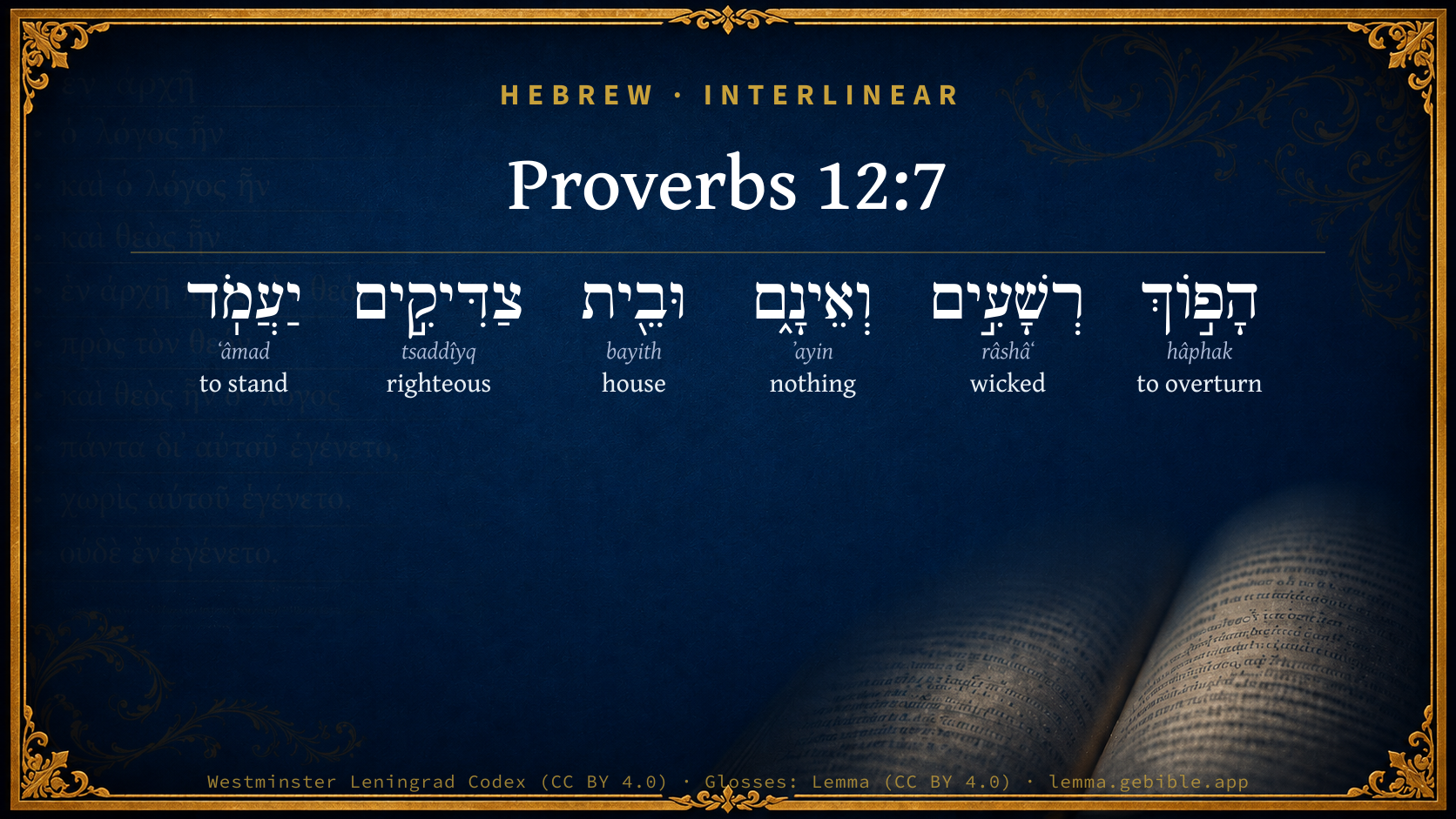
הָפ֣וֹךְ
hâphak
H2015
“to overturn”
Verb, Qal, Infinitive Absolute
Part of Speech
Verb
Stem
Qal
Form
Infinitive Absolute
Full BDB Definition

Origin: a primitive root

TWOT: 512

to turn, overthrow, overturn - (Qal) - to overturn, overthrow - to turn, turn about, turn over, turn around - to change, transform - (Niphal) - to turn oneself, turn, turn back - to change oneself - to be perverse - to be turned, be turned over, be changed, be turned against - to be reversed - to be overturned, be overthrown - to be upturned - (Hithpael) - to transform oneself - to turn this way and that, turn every way - (Hophal) to turn on someone
  1. רְשָׁעִ֣ים râshâʻ H7563 “wicked” Adjective, Adjective, Masculine, Plural, Absolute
  2. וְאֵינָ֑ם ʼayin H369 “and · nothing · them” Conjunction + Particle, Negative + Suffix, Personal, 3rd Person, Masculine, Plural
  3. וּבֵ֖ית bayith H1004 “and · house of” Conjunction + Noun, Common, Masculine, Singular, Construct
  4. צַדִּיקִ֣ים tsaddîyq H6662 “righteous” Adjective, Adjective, Masculine, Plural, Absolute
  5. יַעֲמֹֽד ʻâmad H5975 “to stand” Verb, Qal, Imperfect, 3rd Person, Masculine, Singular

About this verse

These counts appear in no published source. They are computed here, from the morphology-tagged text and Lemma’s own curated glosses. What Lemma adds →

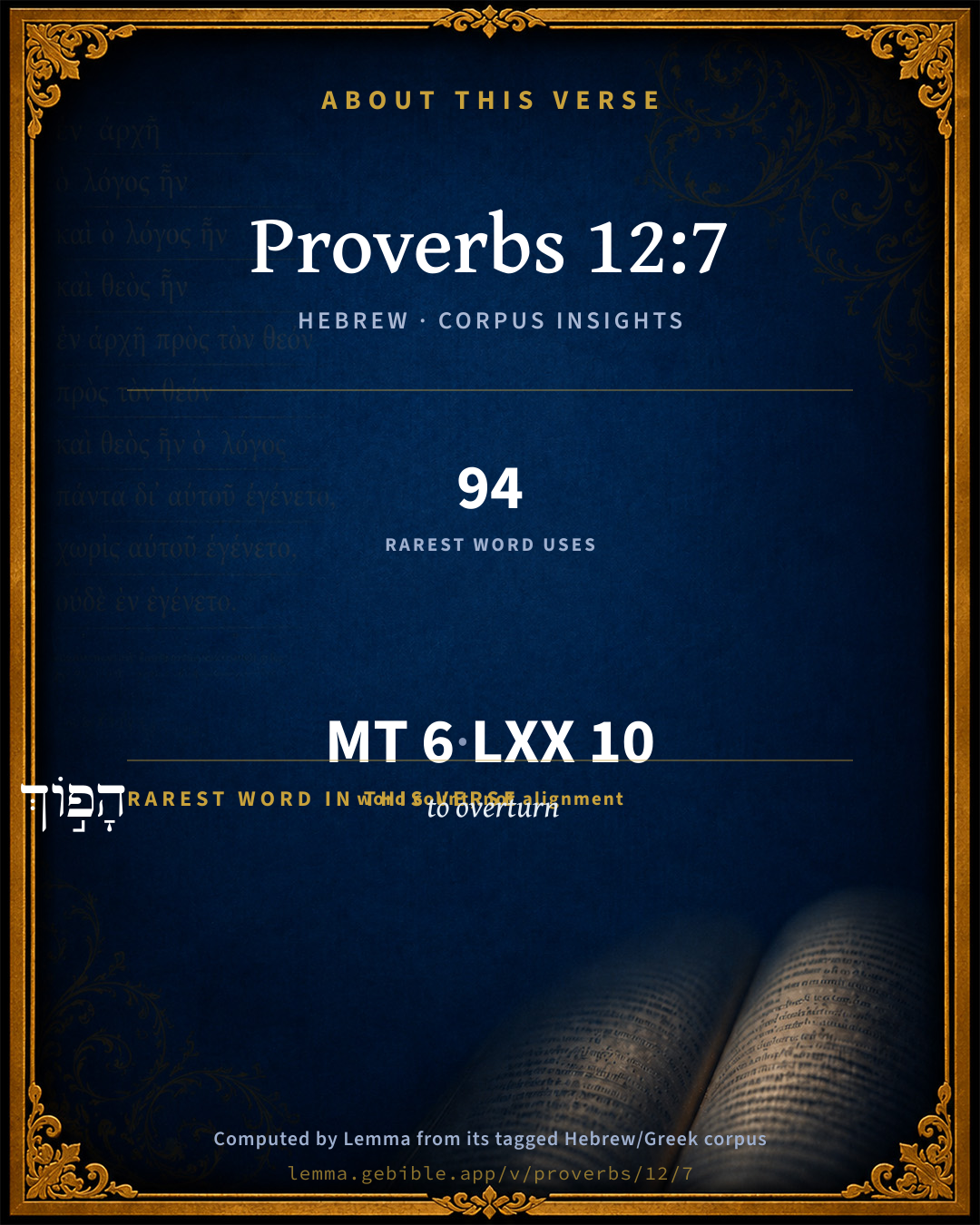
6
words
6
distinct lemmas
Wisdom
section

Grammatical profile

  • 2 verbs
  • 1 noun
  • 2 adjectives
  • 1 particle

Verb forms

  • הָפ֣וֹךְ Qal · Infinitive Absolute
  • יַעֲמֹֽד Qal · Imperfect

Hebrew & Septuagint length

In English translation the verse runs 16 words from the Hebrew and 15 from the Septuagint (LXX English) — closely comparable.

A rough comparison of the two English renderings, which tokenize alike — not a word-level alignment.

Word counts can differ between the Hebrew and the Greek without any difference in meaning — e.g. the Hebrew direct-object marker אֵת has no separate Greek word, and Greek often adds the article ὁ.

In the original languages it is 6 Hebrew tokens and 10 Greek tokens — but the two are counted differently (Hebrew bundles its prefixes and suffixes into one token; the Greek is in lemma form), so that isn’t a like-for-like length.

Cross-references

19

Topical passages linked to Proverbs 12:7 in the Treasury of Scripture Knowledge — connected by theme and wording, ordered by reader-vote popularity; previews shown in the World English Bible.

  • Matthew 7:24–27 "Everyone therefore who hears these words of mine, and does them, I will liken him to a wise man, who built his house on a rock.
  • Proverbs 10:25 When the whirlwind passes, the wicked is no more; But the righteous stand firm forever.
  • Proverbs 11:21 Most assuredly, the evil man will not be unpunished, But the seed of the righteous will be delivered.
  • 2 Samuel 7:16 Your house and your kingdom shall be made sure for ever before you: your throne shall be established forever.
  • 2 Samuel 7:26 Let your name be magnified forever, saying, Yahweh of hosts is God over Israel; and the house of your servant David shall be established before you.
  • Esther 9:6–10 In Shushan the palace the Jews killed and destroyed five hundred men.
  • Esther 9:14 The king commanded it so to be done: and a decree was given out in Shushan; and they hanged Haman's ten sons.
  • Job 5:3–4 I have seen the foolish taking root, But suddenly I cursed his habitation.
  • Job 11:20 But the eyes of the wicked shall fail, They shall have no way to flee; Their hope shall be the giving up of the spirit."
  • Job 18:15–20 There shall dwell in his tent that which is none of his. Sulfur shall be scattered on his habitation.
  • Job 27:18–23 He builds his house as the moth, As a booth which the watchman makes.
  • Psalms 37:10 For yet a little while, and the wicked will be no more. Yes, though you look for his place, he isn't there.
  • Job 34:25 Therefore he takes knowledge of their works. He overturns them in the night, so that they are destroyed.
  • Psalms 37:35–37 I have seen the wicked in great power, Spreading himself like a green tree in its native soil.
  • Psalms 73:18–19 Surely you set them in slippery places. You throw them down to destruction.
  • Proverbs 14:1 Every wise woman builds her house, But the foolish one tears it down with her own hands.
  • Proverbs 14:11 The house of the wicked will be overthrown, But the tent of the upright will flourish.
  • Proverbs 15:25 Yahweh will uproot the house of the proud, But he will keep the widow's borders intact.
  • Proverbs 24:3–4 Through wisdom a house is built; By understanding it is established;

Cross-references courtesy of OpenBible.info (CC BY 4.0).

Hebrew and Greek witnesses Masoretic Hebrew ↔ Greek Septuagint

The same verse in the two great witnesses to the Old Testament, shown verse-for-verse.

These are two independent witnesses, not word-aligned to each other, and the Septuagint is shown in lemma (dictionary) form.

Hebrew Proverbs 12:7 Masoretic · Westminster Leningrad Codex

הָפ֣וֹךְ רְשָׁעִ֣ים וְאֵינָ֑ם וּבֵ֖ית צַדִּיקִ֣ים יַעֲמֹֽד

The wicked are overthrown, and are no more, But the house of the righteous shall stand.

World English Bible · Public Domain

Greek LXX Proverbs 12:7 Septuagint · lemma form

ὅς ἐάν στρέφω ἀσεβής ἀπο ἀναἵζω οἶκος δέ δίκαιος παραμένω

When the ungodly is overthrown, he vanishes away; but the houses of the just remain.

LXX2012 (modern English Septuagint) · Public Domain

On this verse, The Pulpit Commentary discusses the Septuagint’s reading. Read the note in Commentary ↓

Hebrew: Westminster Leningrad Codex (CC BY 4.0). Greek: Septuagint (public domain); English from LXX2012 (modern English Septuagint) (Public Domain). How the Septuagint differs from the Hebrew →

Commentary

Notes on Proverbs 12:7 from classic Christian and Jewish commentators (each source and its license shown beneath its notes). The classic Christian expositions comment on the surrounding passage and are grouped to its opening verse, so a note may address several verses; the Jewish commentaries on the Tanakh (Rashi and others) are per-verse, so they appear only where the commentator wrote on this verse.

Lemma curates 59 commentaries, every one of them public domain or Creative Commons licensed, each selected and text-cleaned for this edition rather than reprinted as found. About our sources →

Trapp's Complete Commentary

John Trapp

Pro 12:7 The wicked are overthrown, and [are] not: but the house of the righteous shall stand.

Ver. 7. The wicked are overthrown, and are not.] Say that the righteous cannot prevail by their apologies for themselves and others, God will take the matter into his own hand, and avenge them, {Luk 18:7} as he did the primitive Christians and the French Protestants, upon their merciless persecutors.

“ Tu, vero, Herodes sanguinolente, time. ”

As Beza warned Charles IX, author of the massacre.

But the house of the righteous shall stand.] God’s house, the Church, shall; as the gloss applies this text, "The mountain of the Lord shall be exalted above all mountains." The Church, because it is highest in the favour of God, so it shall be highest in itself; when the enemies shall be in that place that is fittest for them, the lowest, that is the footstool of Christ. There is a council in heaven will dash the mould of all contrary counsels upon earth. {Psa 2:1-12} Gaudeo quod Christus dominus est: alioqui totus desperassem; - ‘ I am glad yet that Christ is king; for otherwise I should have been utterly out of hope,’ writes Miconius to Calvin, upon the view of the Church’s enemies.

John Trapp, A Commentary or Exposition upon All the Books of the Old and New Testament (1647–1656) — public domain. Text from a community e-Sword module.

The Biblical Illustrator

Joseph S. Exell

Pro_12:7

But the house of the righteous shall stand.

Virtuous kindred

I. In the first place, the circumstance of belonging to the house of the righteous, is a great security that the early principles which so commonly decide the character of the man, have been the subjects of a judicious and anxious attention. The child of such a house cannot have been left to collect from the chance companions of after-life those important truths upon the knowledge of which so much depends.

II. It is a second advantage belonging to the house of the righteous that the companions and examples furnished by it are likely to have a powerful influence in deepening every good impression, and recommending every valuable lesson received in it.

III. It is another privilege belonging to an early education in the house of the righteous that virtue is there seen from the first in its own lovely form, and its influence felt to be full of calm and lasting enjoyment.

IV. Another of these advantages is the additional motive felt in such a connection to respectable conduct--to conduct which may recommend us to the continued regard of the numerous and friendly witnesses who, with anxious interest, are watching our progress. (J. G. Robberds.)

The Biblical Illustrator, edited by Joseph S. Exell (c. 1880s–1900s) — public domain. Text from a community e-Sword module.

Tyndale Open Study Notes

Tyndale Open Resources

12:7 The wicked might prosper momentarily, but they do not last. The family of the godly stands firm for generations.

Tyndale Open Study Notes — © Tyndale Open Resources, licensed CC BY-SA 4.0. Text via the HelloAO Bible API.

Matthew Henry's Commentary

We are here taught as before (Pro 12:3 and Pro 10:25, Pro 10:30), 1. That the triumphing of the wicked is short. They may be exalted for a while, but in a little time they are overthrown and are not; their trouble proves their overthrow, and those who made a great show disappear, and their place knows them no more. Turn the wicked, and they are not; they stand in such a slippery place that the least touch of trouble brings them down, like the apples of Sodom, which look fair, but touch them and they go to dust. 2. That the prosperity of the righteous has a good bottom and will endure. Death will remove them, but their house shall stand, their families shall be kept up, and the generation of the upright shall be blessed.

Matthew Henry's Commentary on the Whole Bible (1708–1710) — public domain (CC PDM 1.0). Text via the HelloAO Bible API.

Jamieson, Fausset & Brown

Robert Jamieson, A. R. Fausset & David Brown

Such conduct brings a proper return, by the destruction of the wicked and well-being of the righteous and his family.

Jamieson, Fausset & Brown — Commentary Critical and Explanatory on the Whole Bible (1871) — public domain (CC PDM 1.0). Text via the HelloAO Bible API.

Adam Clarke's Commentary

Verse 7. The wicked are overthrown] Seldom does God give such a long life or numerous offspring.

But the house of the righteous shall stand.] God blesses their progeny, and their families continue long in the earth; whereas the wicked seldom have many generations in a direct line. This is God's mercy, that the entail of iniquity may be in some sort cut off, so that the same vices may not be strengthened by successive generations. For generally the bad root produces not only a bad plant, but one worse than itself.

Adam Clarke's Commentary on the Bible (1810–1826) — public domain. Text from a community e-Sword/MySword module.

Ellicott's Commentary for English Readers

(7) The wicked are overthrown.—By the righteous judgments of God (Psa_37:35-36), or by the storms of temptation and trouble, which, when they come, overwhelm the house built on the sand of earthly hopes, and not on the “Rock of ages.” (Isa_26:4; Mat_7:24, sqq.)

A Bible Commentary for English Readers, edited by Charles John Ellicott (1878–1897) — public domain. Text from a community e-Sword module.

The Cambridge Bible for Schools and Colleges

gen. ed. J. J. S. Perowne

7. the wicked are overthrown] Lit. to overthrow the wicked! It is only to overthrow them, and they cease to exist; they have no stay, no power of recovery in them. Comp. Pro_10:25; Psa_37:9-10; Psa_37:35-38.

The Cambridge Bible for Schools and Colleges (gen. ed. J. J. S. Perowne; Cambridge University Press, 1878–1918) — public domain. Text from a community e-Sword module.

John Gill's Exposition

The wicked are overthrown, and are not,.... With such an overthrow as God overthrew Sodom and Gomorrah. The kingdom of the beast shall not only be full of darkness, as at the pouring of the fifth vial, and be in the utmost confusion, but it shall be brought to ruin and destruction; which stands opposed to "the house of the righteous", in the next clause: the ten kings, the supporters of antichrist, shall be overcome by the Lamb, with whom they will make war; the beast, and the false prophet, shall be taken by him, and destroyed; and Babylon shall sink like a millstone into the sea, and be no more; the wicked shall be consumed out of the earth; these Heathens shall be no more in the land; the man of sin shall never revive again;

but the house of the righteous shall stand; not his material dwelling house; nor the earthly house of his tabernacle, his body; nor his family, as the generality of interpreters, for the family of the righteous may be extinct, and especially not continue as righteous; but the church of God, as the gloss upon the text, the house of the living God, the pillar and ground of truth; the church which is built on the Rock, Christ; the mountain of the Lord's house, which shall be established upon the top of the mountains in the latter day, when the kingdom of antichrist shall be overthrown, and be no more. This is the same with the household of faith, and the household of God, and here called "the house of the righteous"; because they dwell in it, have a place and a name in it better than sons and daughters; and indeed none but they ought to be in it, that have on the wedding garment, the robe of Christ's righteousness; and who walk uprightly, and work righteousness. Now this house shall stand; its foundation, which is Christ, is sure, an everlasting one; its pillars are firm and stable, the ministers of the word, who will be to the end of the world; the ordinances of it will continue till Christ's second coming; the doctrines of it are the word of God, which standeth for ever, when all flesh is as grass. This house stands, notwithstanding all the persecutions of men; it has stood against all the fury of Rome, Pagan and Papal, and still will continue, notwithstanding the craft of false teachers to undermine it; and though it may sometimes be in a waste and ruinous condition seemingly, yet the Lord will raise it up again, and glorify this house of his glory, and make it beautiful and honourable: it shall stand, because it is the Lord's house, of his building, and where he delights to dwell in; because it is the house of Christ, which he, Wisdom, has built; and where he presides as a Son, as a Prophet, Priest, and King; and because it is the house where his people are born and brought up, and therefore shall continue tilt everyone are brought in; and because it is built on a rock, against which the gates of hell cannot prevail, Mat 16:18; compare with this Mat 7:24.

John Gill's Exposition of the Whole Bible (1746–1763) — public domain (CC PDM 1.0). Text via the HelloAO Bible API.

Haydock's Catholic Bible Commentary

Turn. In a moment the wicked is not to be found, chap. x. 25., and Psalm xxxvi. 35.

George Leo Haydock (1774–1849), Haydock's Catholic Family Bible and Commentary, 1859 edition — public domain. Excludes Psalms (Douay-Rheims chapter numbering differs from Protestant) and Deuterocanonical books (Catholic canon only).

Matthew Poole's English Annotations

Are not; both they and their families shall suddenly perish. The house; the family or posterity.

Matthew Poole's English Annotations on the Holy Bible (1683–1685) — public domain. Text from a community e-Sword/MySword module.

Whedon's Commentary on the Bible

Daniel D. Whedon

7. Are not — Are no more — there is nothing left of them. Compare Pro_10:25; Est_9:6; Job_5:3; Job_18:15; Job_27:18; Psa_37:10; Psa_37:37; Psa_73:18; Mat_7:27.

Daniel D. Whedon (gen. ed.), Commentary on the Old and New Testaments (1874–1909) — public domain. Text from a community e-Sword module.

The Pulpit Commentary

The wicked are overthrown, and are not; or, overthrow the wicked, and they shall be no more. The verb is in the infinitive, and may be rendered either way; but the notion is scarcely of an overthrow. The Vulgate has, verte impios; i.e. change them a little from their previous state, let them suffer a blow from any cause or of any degree, and they succumb, they have no power of resistance. What the stroke is, or whence it comes, is not expressed; it may be the just judgment of God temptation, trouble, sickness but whatever it is, they cannot withstand it as the righteous do. (see Pro_11:7) Some commentators see in the phrase the idea of suddenness, "While they turn themselves round, they are no more". (Pro_10:25 Job_20:5) Septuagint, "Wheresoever the wicked turn, he is destroyed." The house of the righteous, being founded on a secure foundation, shall stand. (Mat_7:24, etc.)

The Pulpit Commentary (1880–1919), ed. H.D.M. Spence-Jones & Joseph S. Exell — public domain. Text from a community e-Sword module.

John Wesley's Explanatory Notes

Are not - Both they and their families suddenly perish.

John Wesley, Explanatory Notes Upon the Whole Bible (1754–1765) — public domain. Text via the GEBible commentary corpus.

Keil & Delitzsch

C. F. Keil & F. Delitzsch

7 The godless are overturned and are no more,

But the house of the righteous stands.

Bertheau and Zckler explain: The wicked turn about, then are they no more; i.e., as we say: it is over with them "in the turning of a hand." The noun in the inf. absol. may certainly be the subject, like Pro 17:12, as well as the object (Ewald, 328c), and הפך may be used of the turning about of oneself, Psa 78:9; Kg2 5:26; Ch2 9:12. That explanation also may claim for itself that הפך nowhere occurs with a personal object, if we except one questionable passage, Isa 1:7. But here the interpretation of the רשׁעים as the object lies near the contrast of בית, and moreover the interpretation of the הפך, not in the sense of στρέφεσθαι (lxx), but of καταστρέφειν (Syr., Targ., Jerome, Graec. Venet., Luther), lies near the contrast of יעמד. The inf. absol. thus leaves the power from which the catastrophe proceeds indefinite, as the pass. יהפפכוּ would also leave it, and the act designedly presented in a vague manner to connect with ו the certain consequences therewith, as Pro 25:4., as if to say: there comes only from some quarter an unparalleled overthrow which overwhelms the godless; thus no rising up again is to be thought on, it is all over with them; while, on the contrary, the house of the righteous withstands the storm which sweeps away the godless.

Keil & Delitzsch — Biblical Commentary on the Old Testament (1861–1891) — public domain (CC PDM 1.0). Text via the HelloAO Bible API. (Old Testament only.)

Kretzmann's Popular Commentary

Paul E. Kretzmann

v. 7. The wicked are overthrown and are not, they come to an end like the ungodly inhabitants of Sodom and Gomorrah; but the house of the righteous shall stand, sustained in the midst of all storms by the power of Jehovah.

Paul E. Kretzmann, Popular Commentary of the Bible (1921–1924) — public domain. Text from a community e-Sword module.

unfoldingWord translationNotes

Door43 World Missions Community

Wicked people are overthrown

This can be stated in active form. AT: "People will overthrow the wicked people" or "People will remove the wicked people from power" (See: Active or Passive)

house

The term "house" is often used figuratively in the Bible to refer to a person's ancestors, descendants or other relatives. AT: "family" or "descendants" (See: Metonymy)

A person is praised by how much wisdom he has

This can be stated in active form. AT: "People will praise those who have wisdom" (See: Active or Passive)

the one who makes perverse choices is despised

This can be stated in active form. AT: "people will hate the one who always thinks evil thoughts" or "people will hate the one who takes good things and twists them into bad" (See: Active or Passive)

translationWords

evil

praise

wise

unfoldingWord translationNotes — © Distant Shores Media and the Door43 World Missions Community, licensed CC BY-SA 4.0. Source: git.door43.org/Door43/en_tn.

Rashi

Rabbi Shlomo Yitzchaki (Rashi)

The wicked will be overthrown Heb. הפוך, like להפוך, to overthrow. Like a sudden overthrow they are overthrown [lit. like an overthrow in a second].

and they are no more They are destroyed, e.g. Sodom.

but the house of the righteous will stand Will endure.

Rashi on the Tanakh — English translations: “The Judaica Press complete Tanach with Rashi, translated by A. J. Rosenberg” (CC BY 4.0); “Pentateuch with Rashi's commentary by M. Rosenbaum and A.M. Silbermann, 1929-1934” (public domain); “The Metsudah Tanach series, Lakewood, N.J” (CC BY 4.0); and “The Book of Joshua, Metsudah Publications, 1997” (CC BY 4.0). Text via Sefaria.

Lesson kit

Teaching starters — assembled from the data on this page, not authored interpretation. Every prompt links to the verse data it draws on. Edit before teaching.

Proverbs, in the Wisdom, opens this verse with 6 words (6 distinct Hebrew lemmas). Its most distinctive word is hâphak (“to overturn”). A historical commentator’s framing appears above. Read the whole chapter for the surrounding context.

Discussion questions

  1. The word hâphak carries the sense “to overturn.” How does it shape the verse?
  2. How does Matthew 7:24–27, which shares this passage’s theme, read alongside this verse?
  3. These translations render this verse differently. What is at stake in choosing one wording over another?
  4. «הָפ֣וֹךְ» is a Qal Infinitive Absolute verb. How does that grammatical form shape the action described?
  5. Compare how Trapp's Complete Commentary and The Biblical Illustrator read this verse. Where do they agree or differ?

Things to notice

Reading settings

Reading text

Shown beneath each verse's original-language words.

Old Testament
Old Testament edition

Read the OT as the Masoretic Hebrew (MT) or the Greek Septuagint (LXX).

English shown for the Greek Septuagint (in the Hebrew ↔ Greek comparison).

Comparing translations? Open the Compare panel on any verse page to stack up to four side by side.