
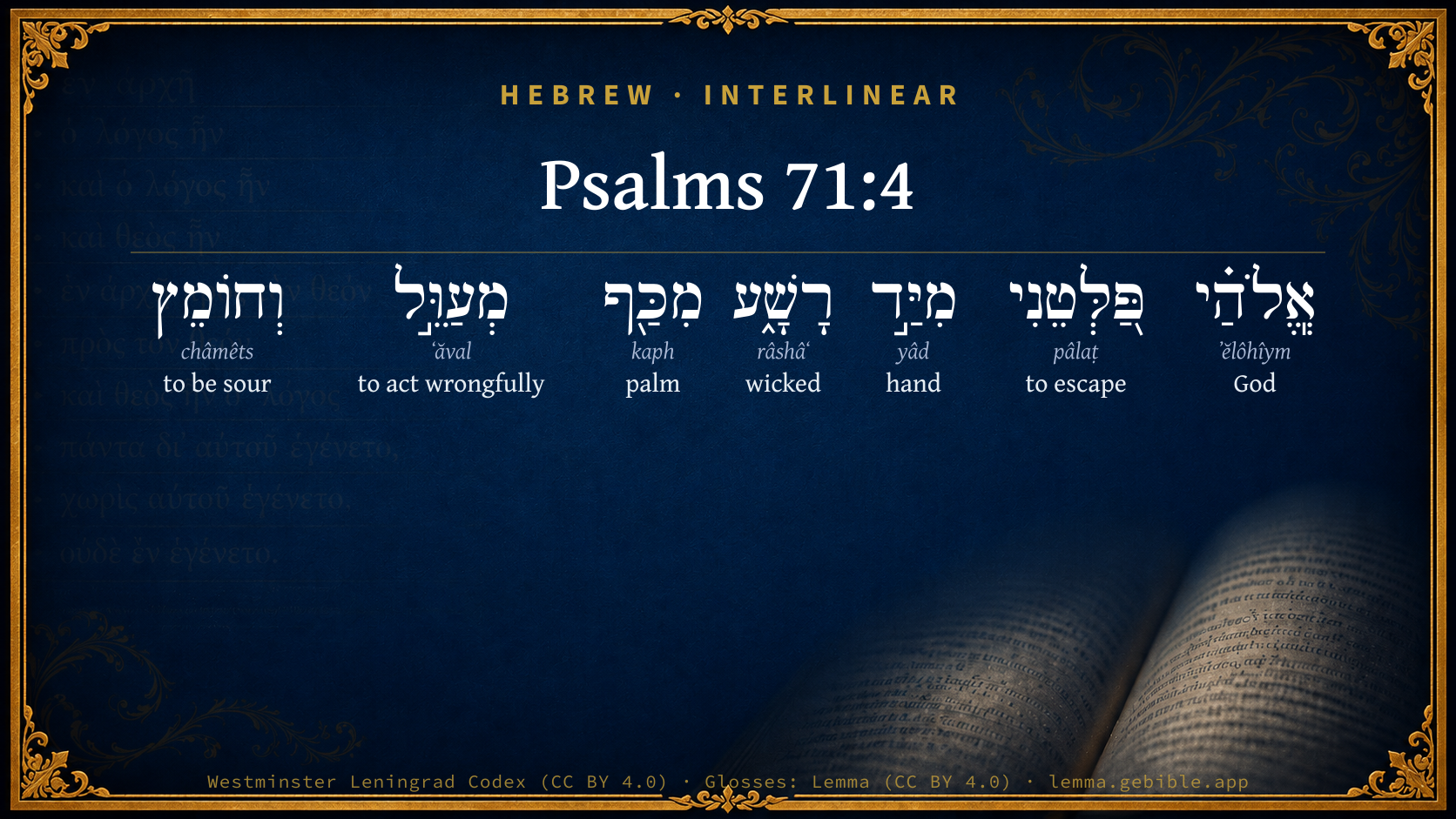
Psalms 71:4

Hebrew (Westminster Leningrad Codex) Psalms 71:4 appears in the Hebrew Old Testament. The text above is from the Westminster Leningrad Codex. Each word links to its Strong’s number, a concise gloss, and parsing drawn from the Open Scriptures Hebrew Bible morphology. Click any word for its full Brown-Driver-Briggs (BDB) entry.
Download image
Cite this verse

Psalms 71:4 (World English Bible). Public Domain. Lemma interlinear Bible study tool, https://lemma.gebible.app/v/psalms/71/4.

Show BibTeX & RIS
BibTeX
RIS
English Translation
Rescue me, my God, from the hand of the wicked, From the hand of the unrighteous and cruel man.
World English Bible · Public Domain
Highlights
  • 1 first appearance in the Hebrew Bible
Full analysis ↓
Download a study sheet

One document with this verse’s original text, its word-by-word gloss line, the meaning frame, cross-references with their text, attributed commentary, and full source and license credits — printable, and it pastes into notes with its structure intact.

This verse Autodidact and up

Study sheet (.html) Plain text (.txt)

A passage Seminary Student

Up to 50 verses in one chapter. A passage sheet keeps up to 6 commentary sources and 12 cross-references per verse, in the order this page ranks them, and says so on the sheet whenever that leaves anything out. Ask for a single verse and you get the Autodidact verse sheet above.

Everything on this page stays free to read, with no account — the sheet is a download of what is already on screen, not access to it.

Want to remove ads? Support Godless Engineer
Compare translations 3

The same verse in 3 English versions, stacked beneath the original-language interlinear above. Click any original word for its lexicon entry.

Each is an independent rendering of the whole verse — the interlinear is not word-aligned to these translations.

Highlighted words mark where these versions differ — a whole-verse word diff, not a word-by-word alignment.

  • World English Bible Public Domain
    Rescue me, my God, from the hand of the wicked, From the hand of the unrighteous and cruel man.
  • King James Version Public Domain
    Deliver me, O my God, out of the hand of the wicked, out of the hand of the unrighteous and cruel man.
  • unfoldingWord Literal Text CC BY-SA 4.0
    My God, rescue me from the hand of the wicked, from the palm of the one doing wrong and the one being cruel;

unfoldingWord Literal Text — © unfoldingWord, licensed CC BY-SA 4.0. Word-aligned USFM3 via Door43 (git.door43.org/unfoldingWord/en_ult).

Versions to compare (up to 4)

3 of 4 selected

Show all 18 translations

Every available English version of this verse, each an independent rendering of the whole verse.

  • World English Bible Public Domain
    Rescue me, my God, from the hand of the wicked, From the hand of the unrighteous and cruel man.
  • Berean Standard Bible Public Domain
    Deliver me, O my God, from the hand of the wicked, from the grasp of the unjust and ruthless.
  • Majority Standard Bible Public Domain
    Deliver me, O my God, from the hand of the wicked, from the grasp of the unjust and ruthless.
  • King James Version Public Domain
    Deliver me, O my God, out of the hand of the wicked, out of the hand of the unrighteous and cruel man.
  • American Standard Version (1901) Public Domain
    Rescue me, O my God, out of the hand of the wicked, Out of the hand of the unrighteous and cruel man.
  • Revised Version (1885) Public Domain
    Rescue me, O my God, out of the hand of the wicked, out of the hand of the unrighteous and cruel man.
  • Geneva Bible (1599) Public Domain
    Deliuer mee, O my God, out of the hande of the wicked: out of the hande of the euill and cruell man.
  • Douay-Rheims (1899) Public Domain
    Deliver me, O my God, out of the hand of the sinner, and out of the hand of the transgressor of the law and of the unjust.
  • Young's Literal Translation Public Domain
    O my God, cause me to escape From the hand of the wicked, From the hand of the perverse and violent.
  • Literal Standard Version CC BY-SA 4.0
    O my God, cause me to escape || From the hand of the wicked, || From the hand of the perverse and violent.
  • Unlocked Literal Bible CC BY-SA 4.0
    Rescue me, my God, out of the hand of the wicked, out of the hand of the unrighteous and cruel.
  • unfoldingWord Literal Text CC BY-SA 4.0
    My God, rescue me from the hand of the wicked, from the palm of the one doing wrong and the one being cruel;
  • Darby Bible Public Domain
    My God, rescue me out of the hand of the wicked, out of the hand of the unrighteous and cruel man.
  • World Messianic Bible Public Domain
    Rescue me, my God, from the hand of the wicked, from the hand of the unrighteous and cruel man.
  • Webster's Bible Public Domain
    Deliver me, O my God, from the hand of the wicked, from the hand of the unrighteous and cruel man.
  • Free Bible Version CC BY-SA 4.0
    My God, rescue me from the power of the wicked, from the clutches of those who are evil and brutal.
  • Bible in Basic English Public Domain
    O my God, take me out of the hand of the sinner, out of the hand of the evil and cruel man.
  • JPS Tanakh (1917) Public Domain
    O my God, rescue me out of the hand of the wicked, out of the grasp of the unrighteous and ruthless man.

Literal Standard Version (2020), Covenant Press — licensed CC BY-SA 4.0. Text via the HelloAO Bible API (eBible.org). Unlocked Literal Bible (unfoldingWord) — licensed CC BY-SA 4.0. Text via the HelloAO Bible API (eBible.org). unfoldingWord Literal Text — © unfoldingWord, licensed CC BY-SA 4.0. Word-aligned USFM3 via Door43 (git.door43.org/unfoldingWord/en_ult). Free Bible Version, Dr. Jonathan Gallagher — licensed CC BY-SA 4.0. Text via the HelloAO Bible API (eBible.org).

Word by word

More ways to search: Search by grammar → Find every occurrence → Compare this word →

Practice this passage: Drill this verse → Learn its vocabulary →

About this verse

These counts appear in no published source. They are computed here, from the morphology-tagged text and Lemma’s own curated glosses. What Lemma adds →

7
words
7
distinct lemmas
Wisdom
section

Notable vocabulary

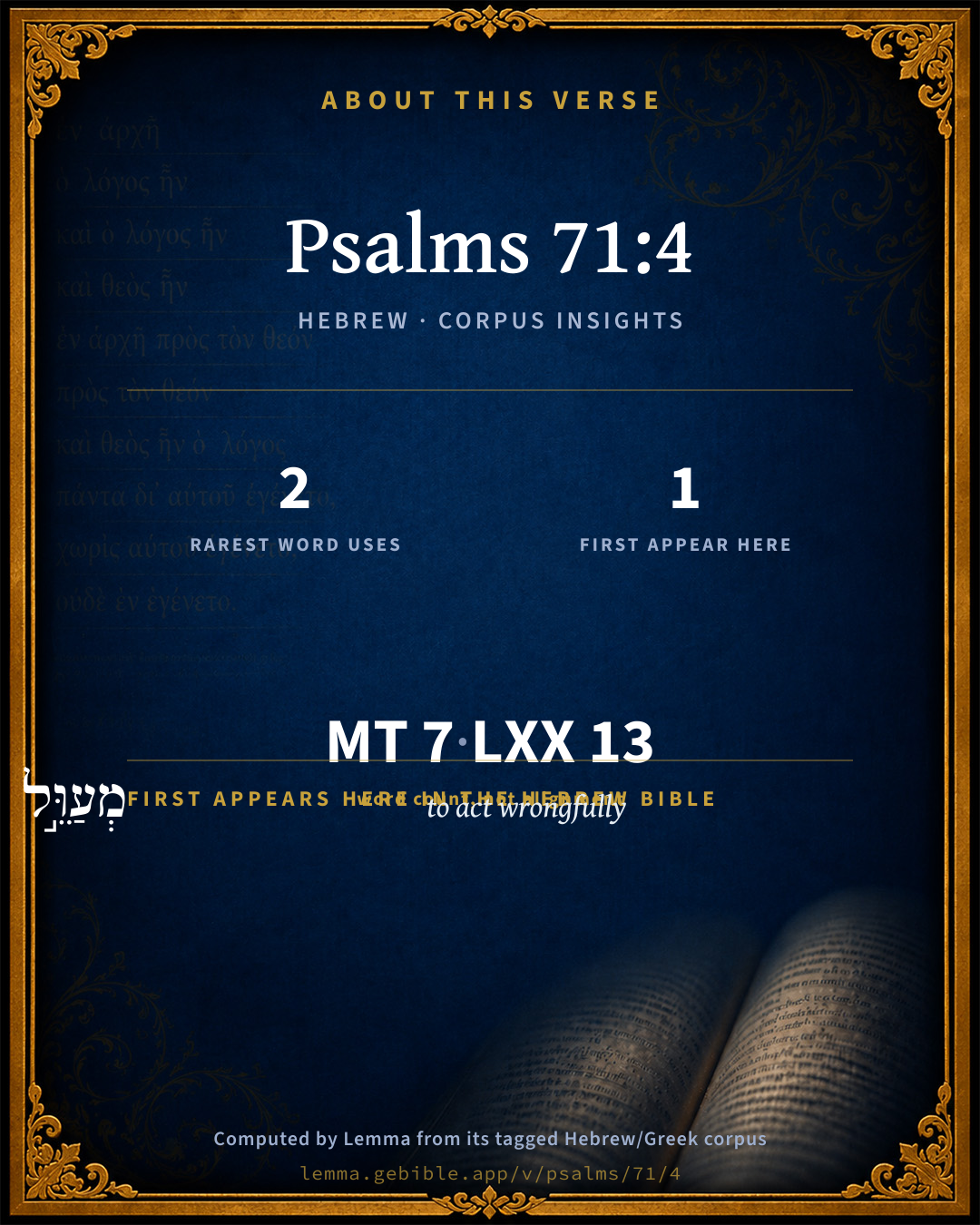
The rarest word here is מְעַוֵּ֣ל to act wrongfully H5765 — appearing just 2 times in the whole Hebrew Bible.

First appearance in Scripture

This word makes its first canonical appearance in the Hebrew Bible here:

  • מְעַוֵּ֣ל to act wrongfully H5765

Shared distinctive vocabulary

מְעַוֵּ֣ל to act wrongfully H5765 occurs in 2 verses of the Hebrew Bible. Also found in:

Grammatical profile

  • 3 verbs
  • 3 nouns
  • 1 adjective

Verb forms

  • פַּ֭לְּטֵנִי Piel · Imperative
  • מְעַוֵּ֣ל Piel · Participle Active
  • וְחוֹמֵץ Qal · Participle Active

Hebrew & Septuagint length

In English translation the verse runs 19 words from the Hebrew and 20 from the Septuagint (LXX English) — closely comparable.

A rough comparison of the two English renderings, which tokenize alike — not a word-level alignment.

Word counts can differ between the Hebrew and the Greek without any difference in meaning — e.g. the Hebrew direct-object marker אֵת has no separate Greek word, and Greek often adds the article ὁ.

In the original languages it is 7 Hebrew tokens and 13 Greek tokens — but the two are counted differently (Hebrew bundles its prefixes and suffixes into one token; the Greek is in lemma form), so that isn’t a like-for-like length.

Cross-references

8

Topical passages linked to Psalms 71:4 in the Treasury of Scripture Knowledge — connected by theme and wording, ordered by reader-vote popularity; previews shown in the World English Bible.

  • Psalms 59:1–2 Deliver me from my enemies, my God. Set me on high from those who rise up against me.
  • Psalms 140:1–4 Deliver me, Yahweh, from the evil man. Preserve me from the violent man;
  • 2 Samuel 17:1–2 Moreover Ahithophel said to Absalom, Let me now choose out twelve thousand men, and I will arise and pursue after David this night:
  • Psalms 17:8–9 Keep me as the apple of your eye; Hide me under the shadow of your wings,
  • Psalms 17:13 Arise, Yahweh, Confront him, cast him down. Deliver my soul from the wicked by your sword;
  • 2 Samuel 16:21–22 Ahithophel said to Absalom, Go in to your father's concubines, that he has left to keep the house; and all Israel will hear that you are abhorred of your father: then will the hands of all who are with you be strong.
  • 2 Samuel 17:12–14 So shall we come on him in some place where he shall be found, and we will light on him as the dew falls on the ground; and of him and of all the men who are with him we will not leave so much as one.
  • 2 Samuel 17:21 It happened, after they had departed, that they came up out of the well, and went and told king David; and they said to David, Arise you, and pass quickly over the water; for thus has Ahithophel counseled against you.

Cross-references courtesy of OpenBible.info (CC BY 4.0).

Hebrew and Greek witnesses Masoretic Hebrew ↔ Greek Septuagint

The same verse in the two great witnesses to the Old Testament, shown verse-for-verse.

You’re reading Greek Psalm 70 (Hebrew Psalm 71). The Septuagint counts the superscription, so verse numbers can differ from the Hebrew — chapter-level alignment, not verse-by-verse. Numbering follows Rahlfs.

These are two independent witnesses, not word-aligned to each other, and the Septuagint is shown in lemma (dictionary) form.

Hebrew Psalms 71:4 Masoretic · Westminster Leningrad Codex

אֱֽלֹהַ֗י פַּ֭לְּטֵנִי מִיַּ֣ד רָשָׁ֑ע מִכַּ֖ף מְעַוֵּ֣ל וְחוֹמֵץ

Rescue me, my God, from the hand of the wicked, From the hand of the unrighteous and cruel man.

World English Bible · Public Domain

Greek LXX Greek Psalm 70:4 Septuagint · lemma form

ὁ θεός ἐγώ ῥύομαι ἐγώ ἐκ χείρ ἁμαρτωλός ἐκ χείρ παρανομέω καί ἀδικέω

Deliver me, O my God, from the hand of the sinner, from the hand of the transgressor and unjust man.

LXX2012 (modern English Septuagint) · Public Domain

Hebrew: Westminster Leningrad Codex (CC BY 4.0). Greek: Septuagint (public domain); English from LXX2012 (modern English Septuagint) (Public Domain). How the Septuagint differs from the Hebrew →

Commentary

Notes on Psalms 71:4 from classic Christian and Jewish commentators (each source and its license shown beneath its notes). The classic Christian expositions comment on the surrounding passage and are grouped to its opening verse, so a note may address several verses; the Jewish commentaries on the Tanakh (Rashi and others) are per-verse, so they appear only where the commentator wrote on this verse.

Lemma curates 59 commentaries, every one of them public domain or Creative Commons licensed, each selected and text-cleaned for this edition rather than reprinted as found. About our sources →

Trapp's Complete Commentary

John Trapp

Psa 71:4 Deliver me, O my God, out of the hand of the wicked, out of the hand of the unrighteous and cruel man.

Ver. 4. Out of the hand of the unrighteous] That seeketh by fraud to undermine me, and by force to overturn me.

And cruel man] Qui totus in fermento iacet; sour as leaven, sharp as vinegar.

John Trapp, A Commentary or Exposition upon All the Books of the Old and New Testament (1647–1656) — public domain. Text from a community e-Sword module.

J. A. Alexander on Psalms

Joseph Addison Alexander

Psa 71:4. My God, free me, cause me to escape, from the hand of the wicked, from the palm, a poetical equivalent to hand, of the perverse and corruptoer. The last word in Hebrew occurs only here, but from its form appears to be the particle of a verb that means to be (or become) sour, to ferment, to putrefy. The infinitive of the same verb is applied to moral evil in Isa 1:17.

Joseph Addison Alexander, The Psalms Translated and Explained (1850) — public domain. Text from a community e-Sword module.

Geneva Bible (1599)

Geneva Bible translators

That is, from Absalom, Ahithophel and that conspiracy.

Geneva Bible (1599) marginal notes — public domain. Text via Bolls.life.

Adam Clarke's Commentary

Verse 4. Out of the hand of the wicked] Probably his unnatural son Absalom, called here רשע rasha, the WICKED, because he had violated all laws, human and Divine.

The unrighteous and cruel man.] Probably Ahithophel who was the iniquitous counsellor of a wicked and rebellious son.

Adam Clarke's Commentary on the Bible (1810–1826) — public domain. Text from a community e-Sword/MySword module.

John Calvin's Commentaries

4. O my God! deliver me from the hand of the wicked man. Here he uses the singular number; but he is not to be understood as indicating one man only. It is highly probable that he comprehends the whole host of the enemies who assaulted him. We have elsewhere had occasion to observe how greatly it contributes to inspire us with the confidence of obtaining our requests, when we are so assured of our own integrity, as to be able freely to complain before God that we are unjustly and wickedly assaulted by our enemies; for we ought not to doubt that God, who has promised to become the defender of those who are unjustly oppressed, will, in that case, undertake our cause.

John Calvin's Commentaries (1540-1563) — public domain. Text from the Calvin Translation Society English edition (1840s-50s) via the Christian Classics Ethereal Library (ccel.org). Calvin's coverage is partial (roughly two-thirds of the Bible); uncommented books and verses are honest gaps, never fabricated. The 19th-century editor's footnotes and remarks are omitted so the notes are faithfully Calvin's own voice.

Ellicott's Commentary for English Readers

(4-6) These verses are manifestly founded on Psa_31:8-10; but the variations are more marked than usual, and indicate a definite purpose of adaptation rather than copying.

A Bible Commentary for English Readers, edited by Charles John Ellicott (1878–1897) — public domain. Text from a community e-Sword module.

The Cambridge Bible for Schools and Colleges

gen. ed. J. J. S. Perowne

4. Deliver me] R.V., rescue me, as in Psa_71:2.

the unrighteous and cruel man] Comp. the complaints in Habakkuk (Hab_1:2-4) and Jeremiah (Jer_6:7; &c.) of the prevailing injustice and violence. The singular is probably collective.

4–8. The ground of the Psalmist’s appeal for deliverance.

The Cambridge Bible for Schools and Colleges (gen. ed. J. J. S. Perowne; Cambridge University Press, 1878–1918) — public domain. Text from a community e-Sword module.

John Gill's Exposition

Deliver me, O my God, out of the hand of the wicked,.... Meaning Absalom his son, as Arama, who had risen up in rebellion against him; and he may not only intend him, but all those wicked men that had joined with him: it was David's mercy he had a covenant God to go to, and could claim his interest in him, who had power to deliver him, and from whom he might expect it;

out of the hand of the unrighteous and cruel man; or "leavened" (s); a sour ill natured man; one leavened with malice and wickedness: perhaps Ahithophel is intended. It may be applied to any wicked, lawless, and tyrannical persecutor of God's people; and particularly to the lawless and wicked one, the man of sin, the son of perdition, antichrist, Th2 2:4.

(s) "malitiae fermento prorsus corrupti", Michaelis, "secundum", Gejerum & Gussetium; so Ainsworth.

John Gill's Exposition of the Whole Bible (1746–1763) — public domain (CC PDM 1.0). Text via the HelloAO Bible API.

Albert Barnes' Notes on the Bible

Deliver me, O my God, out of the hand of the wicked - It is, of course, not possible now to ascertain who are particularly referred to here. If David was the author of the psalm, they may have been any of the numerous enemies that he had in his life.

Out of the hand of the unrighteous and cruel man - Hebrew, “out of the palm.” This means here the same as hand, and refers to the “grasp” which anyone makes in taking hold of a thing by the hand.

Albert Barnes' Notes on the Bible (1834–1885) — public domain. Text from a community e-Sword/MySword module.

The Treasury of David

Charles H. Spurgeon

Ver. 4. Deliver me, O my God, out of the hand of the wicked. God is on the same side with us, and those who are our enemies are also his, for they are wicked; therefore will the Lord surely rescue his own confederates, and he will not suffer the evil to triumph over the just. He who addresses such a prayer as this to heaven, does more injury to his enemies than if he had turned a battery of Armstrongs upon them.

Out of the hand of the unrighteous and cruel man. Being wicked to God, they become unrighteous towards men, and cruel in their persecutions of the godly. Two hands are here mentioned: they grasp and they crush; they strike and they would slay if God did not prevent; had they as many hands as Briarcus, the finger of God would more than match them.

Ver. 4. The cruel man is literally the leavened man, leavened with hatred of truth and enmity to God; and, therefore, a violent opposer of his people. So, in 1Co 5:8 we are cautioned against the "leaven of malice and wickedness, "which, in accordance with the figure, may pervade the whole natural character of an ungodly man, his faculties and affections. W. Wilson.

Ver. 4.

I. When God is for us, the wicked are against us.

II. When the wicked are against us, God is for us.

Psalms 71:5*

Charles H. Spurgeon's The Treasury of David (1869–1885) — public domain. Psalms only. Text from a community e-Sword/MySword module.

Whedon's Commentary on the Bible

Daniel D. Whedon

4. The unrighteous and cruel man—If this refers to any one individual, and we have rightly judged the occasion of the psalm, the allusion might well be to Ahithophel. See our note on Psa_55:12. But it may be a general and abstract term for any and every man who is “unrighteous and cruel.”

Daniel D. Whedon (gen. ed.), Commentary on the Old and New Testaments (1874–1909) — public domain. Text from a community e-Sword module.

The Pulpit Commentary

Deliver me, O my God, out of the hand of the wicked, out of the hand (rather, grasp) of the unrighteous and cruel man. it is characteristic of David to single out from his adversaries an individual man, from whom he especially asks to be delivered. (comp. Psa_13:2 Psa_17:13 Psa_18:17, 48 35:8 41:6, 9, 11 55:13, 14, etc.)

The Pulpit Commentary (1880–1919), ed. H.D.M. Spence-Jones & Joseph S. Exell — public domain. Text from a community e-Sword module.

unfoldingWord translationNotes

Door43 World Missions Community

out of the hand of the wicked, out of the hand of the unrighteous

Possible meanings are 1) the word "hand" is a metonym for power. AT: "from the power of the wicked, from the power of the unrighteous" or 2) "hand" refers to the person himself. AT: "from wicked people, from unrighteous ... people" or "so that wicked people and unrighteous ... people cannot harm me" (See: Metonymy)

wicked, out of the hand of the unrighteous

"wicked; rescue me out of the hand of the unrighteous." You can make clear the understood information. (See: Ellipsis)

wicked ... unrighteous ... cruel

These adjectives can be translated as noun phrases. AT: "wicked people ... unrighteous people ... cruel people" (See: Nominal Adjectives)

you are my hope

Here "hope" is a metonym for the one in whom the psalmist hopes. AT: "you are the one whom I confidently expect to help me" (See: Metonymy)

translationWords

God

hand

evil

righteous

hope

Lord Yahweh

trust

unfoldingWord translationNotes — © Distant Shores Media and the Door43 World Missions Community, licensed CC BY-SA 4.0. Source: git.door43.org/Door43/en_tn.

Rashi

Rabbi Shlomo Yitzchaki (Rashi)

and robs Heb. וחומץ, like וחומס. Similarly (Isa. 1:17): “strengthen the robbed (חמוץ)”; the robbed.

Rashi on the Tanakh — English translations: “The Judaica Press complete Tanach with Rashi, translated by A. J. Rosenberg” (CC BY 4.0); “Pentateuch with Rashi's commentary by M. Rosenbaum and A.M. Silbermann, 1929-1934” (public domain); “The Metsudah Tanach series, Lakewood, N.J” (CC BY 4.0); and “The Book of Joshua, Metsudah Publications, 1997” (CC BY 4.0). Text via Sefaria.

Lesson kit

Teaching starters — assembled from the data on this page, not authored interpretation. Every prompt links to the verse data it draws on. Edit before teaching.

Psalms, in the Wisdom, opens this verse with 7 words (7 distinct Hebrew lemmas). Its most distinctive word is ʻăval (“to act wrongfully”). A historical commentator’s framing appears above. Read the whole chapter for the surrounding context.

Discussion questions

  1. What does “to act wrongfully” (ʻăval) contribute to the verse as a whole?
  2. The word “to act wrongfully” first appears here in Scripture. What is being introduced at this debut?
  3. Isaiah 26:10 shares the word «to act wrongfully» with this verse. How do the two illuminate each other?
  4. The translations on this page render this verse differently — a whole-verse word diff, not a word-by-word alignment. What might account for the different wordings?
  5. The verb «פַּ֭לְּטֵנִי» is Piel Imperative. How does its form color the action?
  6. Reading how Trapp's Complete Commentary and J. A. Alexander on Psalms read this verse, where do the two commentators agree and where do they part?

Things to notice

Reading settings

Reading text

Shown beneath each verse's original-language words.

Old Testament
Old Testament edition

Read the OT as the Masoretic Hebrew (MT) or the Greek Septuagint (LXX).

English shown for the Greek Septuagint (in the Hebrew ↔ Greek comparison).

Comparing translations? Open the Compare panel on any verse page to stack up to four side by side.