
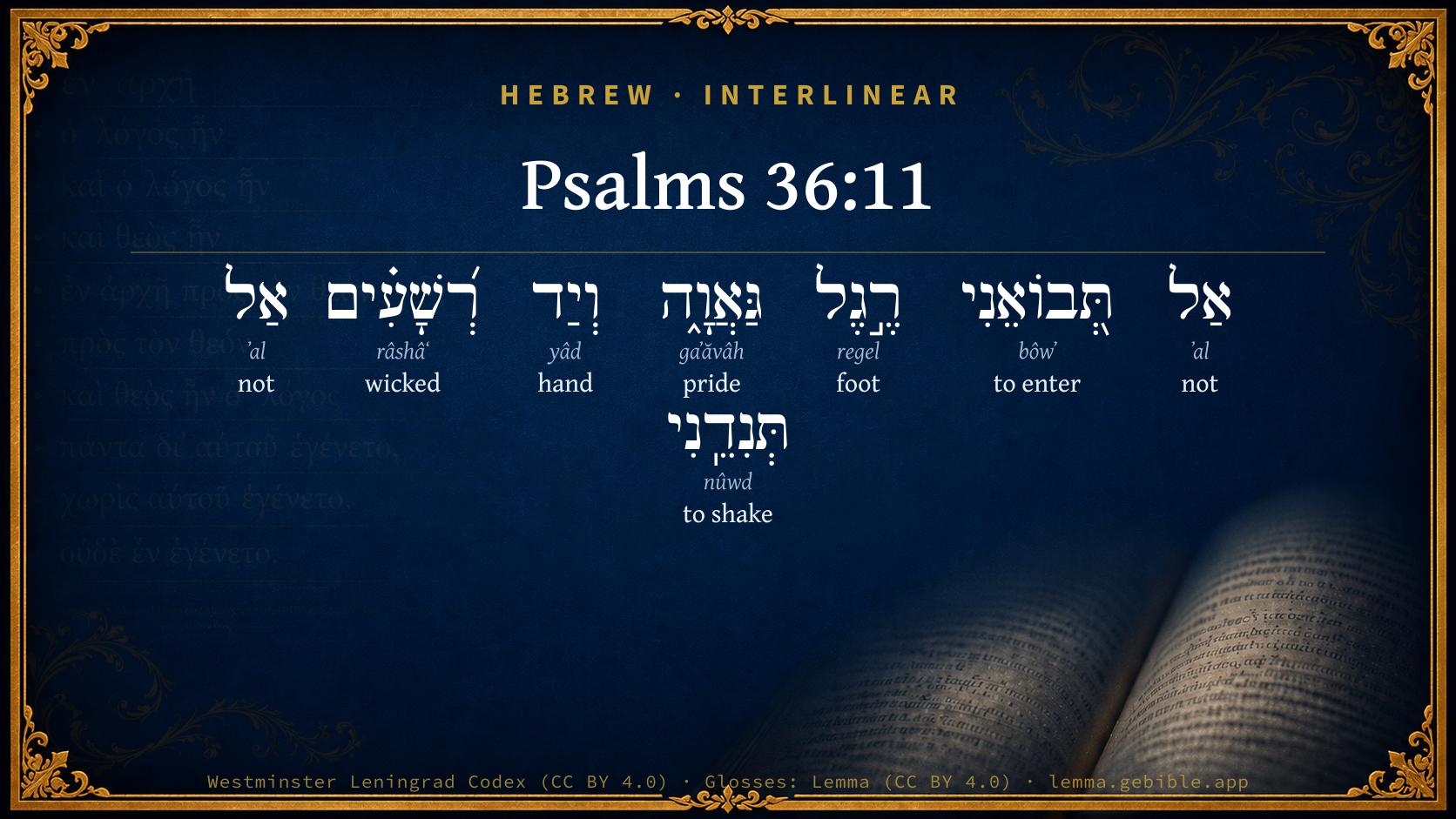
Psalms 36:11

Hebrew (Westminster Leningrad Codex) Psalms 36:11 appears in the Hebrew Old Testament. The text above is from the Westminster Leningrad Codex. Each word links to its Strong’s number, a concise gloss, and parsing drawn from the Open Scriptures Hebrew Bible morphology. Click any word for its full Brown-Driver-Briggs (BDB) entry.
Download image
Cite this verse

Psalms 36:11 (World English Bible). Public Domain. Lemma interlinear Bible study tool, https://lemma.gebible.app/v/psalms/36/11.

Show BibTeX & RIS
BibTeX
RIS
English Translation
Don't let the foot of pride come against me. Don't let the hand of the wicked drive me away.
World English Bible · Public Domain
Download a study sheet

One document with this verse’s original text, its word-by-word gloss line, the meaning frame, cross-references with their text, attributed commentary, and full source and license credits — printable, and it pastes into notes with its structure intact.

This verse Autodidact and up

Study sheet (.html) Plain text (.txt)

A passage Seminary Student

Up to 50 verses in one chapter. A passage sheet keeps up to 6 commentary sources and 12 cross-references per verse, in the order this page ranks them, and says so on the sheet whenever that leaves anything out. Ask for a single verse and you get the Autodidact verse sheet above.

Everything on this page stays free to read, with no account — the sheet is a download of what is already on screen, not access to it.

Want to remove ads? Support Godless Engineer
Compare translations 3

The same verse in 3 English versions, stacked beneath the original-language interlinear above. Click any original word for its lexicon entry.

Each is an independent rendering of the whole verse — the interlinear is not word-aligned to these translations.

Highlighted words mark where these versions differ — a whole-verse word diff, not a word-by-word alignment.

  • World English Bible Public Domain
    Don't let the foot of pride come against me. Don't let the hand of the wicked drive me away.
  • King James Version Public Domain
    Let not the foot of pride come against me, and let not the hand of the wicked remove me.
  • unfoldingWord Literal Text CC BY-SA 4.0
    Let not the foot of pride come to me, and let not the hand of the wicked remove me.

unfoldingWord Literal Text — © unfoldingWord, licensed CC BY-SA 4.0. Word-aligned USFM3 via Door43 (git.door43.org/unfoldingWord/en_ult).

Versions to compare (up to 4)

3 of 4 selected

Show all 18 translations

Every available English version of this verse, each an independent rendering of the whole verse.

  • World English Bible Public Domain
    Don't let the foot of pride come against me. Don't let the hand of the wicked drive me away.
  • Berean Standard Bible Public Domain
    Let not the foot of the proud come against me, nor the hand of the wicked drive me away.
  • Majority Standard Bible Public Domain
    Let not the foot of the proud come against me, nor the hand of the wicked drive me away.
  • King James Version Public Domain
    Let not the foot of pride come against me, and let not the hand of the wicked remove me.
  • American Standard Version (1901) Public Domain
    Let not the foot of pride come against me, And let not the hand of the wicked drive me away.
  • Revised Version (1885) Public Domain
    Let not the foot of pride come against me, and let not the hand of the wicked drive me away.
  • Geneva Bible (1599) Public Domain
    Let not ye foote of pride come against me, and let not the hand of ye wicked men moue me.
  • Douay-Rheims (1899) Public Domain
    Extend thy mercy to them that know thee, and thy justice to them that are right in heart.
  • Young's Literal Translation Public Domain
    Let not a foot of pride meet me, And a hand of the wicked let not move me.
  • Literal Standard Version CC BY-SA 4.0
    Do not let a foot of pride meet me, || And do not let a hand of the wicked move me.
  • Unlocked Literal Bible CC BY-SA 4.0
    Do not let the foot of the arrogant man come near to me. Do not let the hand of the wicked drive me away.
  • unfoldingWord Literal Text CC BY-SA 4.0
    Let not the foot of pride come to me, and let not the hand of the wicked remove me.
  • Darby Bible Public Domain
    Let not the foot of pride come against me, and let not the hand of the wicked drive me away.
  • World Messianic Bible Public Domain
    Don’t let the foot of pride come against me. Don’t let the hand of the wicked drive me away.
  • Webster's Bible Public Domain
    \\36:10\\O continue thy loving-kindness to them that know thee; and thy righteousness to the upright in heart.
  • Free Bible Version CC BY-SA 4.0
    Don't let the arrogant trample me down; don't let the wicked drive me out.
  • Bible in Basic English Public Domain
    Let not the foot of pride come against me, or the hand of the evil-doers put me out of my place.
  • JPS Tanakh (1917) Public Domain
    (36-12) Let not the foot of pride overtake me, and let not the hand of the wicked drive me away.

Literal Standard Version (2020), Covenant Press — licensed CC BY-SA 4.0. Text via the HelloAO Bible API (eBible.org). Unlocked Literal Bible (unfoldingWord) — licensed CC BY-SA 4.0. Text via the HelloAO Bible API (eBible.org). unfoldingWord Literal Text — © unfoldingWord, licensed CC BY-SA 4.0. Word-aligned USFM3 via Door43 (git.door43.org/unfoldingWord/en_ult). Free Bible Version, Dr. Jonathan Gallagher — licensed CC BY-SA 4.0. Text via the HelloAO Bible API (eBible.org).

Word by word

More ways to search: Search by grammar → Find every occurrence → Compare this word →

Practice this passage: Drill this verse → Learn its vocabulary →

About this verse

These counts appear in no published source. They are computed here, from the morphology-tagged text and Lemma’s own curated glosses. What Lemma adds →

8
words
7
distinct lemmas
Wisdom
section

Notable vocabulary

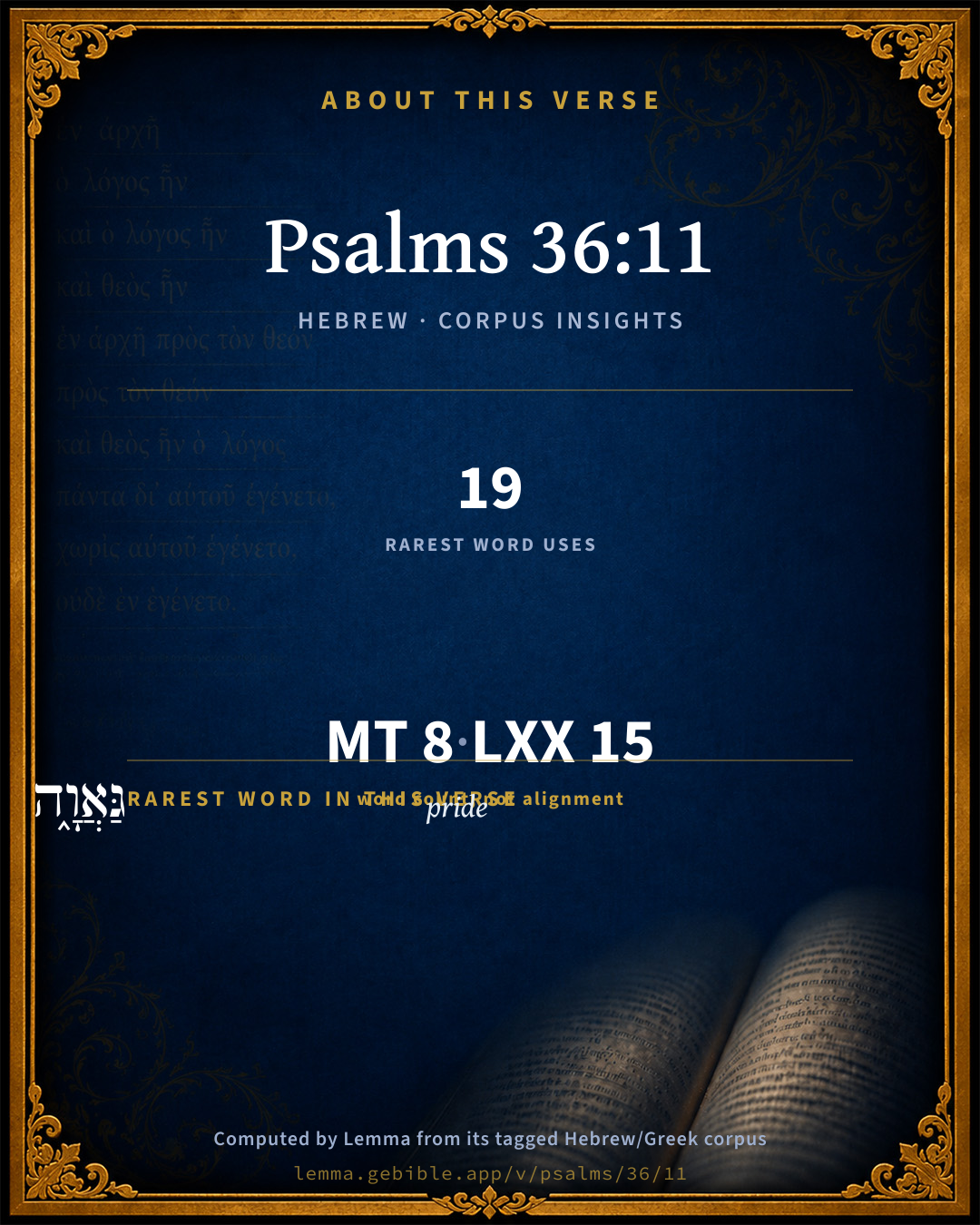
The rarest word here is גַּאֲוָ֑ה pride H1346 — appearing just 19 times in the whole Hebrew Bible.

Shared distinctive vocabulary

גַּאֲוָ֑ה pride H1346 occurs in 19 verses of the Hebrew Bible. Also found in:

Grammatical profile

  • 2 verbs
  • 3 nouns
  • 1 adjective
  • 2 particles

Verb forms

  • תְּ֭בוֹאֵנִי Qal · Jussive
  • תְּנִדֵֽנִי Hiphil · Jussive

Repetition

A word recurs within this verse — often emphatic in Hebrew:

  • אַל not H408 ×2

Hebrew & Septuagint length

In English translation the verse runs 19 words from the Hebrew and 18 from the Septuagint (LXX English) — closely comparable.

A rough comparison of the two English renderings, which tokenize alike — not a word-level alignment.

Word counts can differ between the Hebrew and the Greek without any difference in meaning — e.g. the Hebrew direct-object marker אֵת has no separate Greek word, and Greek often adds the article ὁ.

In the original languages it is 8 Hebrew tokens and 15 Greek tokens — but the two are counted differently (Hebrew bundles its prefixes and suffixes into one token; the Greek is in lemma form), so that isn’t a like-for-like length.

Cross-references

16

Topical passages linked to Psalms 36:11 in the Treasury of Scripture Knowledge — connected by theme and wording, ordered by reader-vote popularity; previews shown in the World English Bible.

  • Psalms 16:8 I have set Yahweh always before me. Because he is at my right hand, I shall not be moved.
  • Job 40:11–12 Pour forth the fury of your anger. Look on everyone who is proud, and bring him low.
  • Psalms 12:3–5 May Yahweh cut off all flattering lips, And the tongue that boasts,
  • Psalms 123:3–4 Have mercy on us, Yahweh, have mercy on us, For we have endured much contempt.
  • Isaiah 51:23 and I will put it into the hand of those who afflict you, who have said to your soul, Bow down, that we may go over; and you have laid your back as the ground, and as the street, to those who go over.
  • Psalms 10:2 In arrogance, the wicked hunt down the weak; They are caught in the schemes that they devise.
  • Psalms 17:8–14 Keep me as the apple of your eye; Hide me under the shadow of your wings,
  • Psalms 119:51 The arrogant mock me excessively, But I don't swerve from your law.
  • Psalms 119:69 The proud have smeared a lie upon me. With my whole heart, I will keep your precepts.
  • Psalms 119:85 The proud have dug pits for me, Contrary to your law.
  • Psalms 119:122 Ensure your servant's well-being. Don't let the proud oppress me.
  • Psalms 21:7–8 For the king trusts in Yahweh. Through the loving kindness of the Most High, he shall not be moved.
  • Psalms 62:6 He alone is my rock and my salvation, my fortress. I will not be shaken.
  • Psalms 125:1–3 Those who trust in Yahweh are as Mount Zion, Which can't be moved, but remains forever.
  • Daniel 4:37 Now I, Nebuchadnezzar, praise and extol and honor the King of heaven; for all his works are truth, and his ways justice; and those who walk in pride he is able to abase.
  • Romans 8:35–39 Who shall separate us from the love of Christ? Could oppression, or anguish, or persecution, or famine, or nakedness, or peril, or sword?

Cross-references courtesy of OpenBible.info (CC BY 4.0).

Hebrew and Greek witnesses Masoretic Hebrew ↔ Greek Septuagint

The same verse in the two great witnesses to the Old Testament, shown verse-for-verse.

You’re reading Greek Psalm 35 (Hebrew Psalm 36). The Septuagint counts the superscription, so verse numbers can differ from the Hebrew — chapter-level alignment, not verse-by-verse. Numbering follows Rahlfs.

These are two independent witnesses, not word-aligned to each other, and the Septuagint is shown in lemma (dictionary) form.

Hebrew Psalms 36:11 Masoretic · Westminster Leningrad Codex

אַל תְּ֭בוֹאֵנִי רֶ֣גֶל גַּאֲוָ֑ה וְיַד רְ֝שָׁעִ֗ים אַל תְּנִדֵֽנִי

Don't let the foot of pride come against me. Don't let the hand of the wicked drive me away.

World English Bible · Public Domain

Greek LXX Greek Psalm 35:11 Septuagint · lemma form

παρατείνω ὁ ἔλεος σύ ὁ γιγνώσκω σύ καί ὁ δικαιοσύνη σύ ὁ εὐθύς ὁ καρδία

Let not the foot of pride come against me, and let not the hand of sinners move me.

LXX2012 (modern English Septuagint) · Public Domain

Hebrew: Westminster Leningrad Codex (CC BY 4.0). Greek: Septuagint (public domain); English from LXX2012 (modern English Septuagint) (Public Domain). How the Septuagint differs from the Hebrew →

Commentary

Notes on Psalms 36:11 from classic Christian and Jewish commentators (each source and its license shown beneath its notes). The classic Christian expositions comment on the surrounding passage and are grouped to its opening verse, so a note may address several verses; the Jewish commentaries on the Tanakh (Rashi and others) are per-verse, so they appear only where the commentator wrote on this verse.

Lemma curates 59 commentaries, every one of them public domain or Creative Commons licensed, each selected and text-cleaned for this edition rather than reprinted as found. About our sources →

Trapp's Complete Commentary

John Trapp

Psa 36:11 Let not the foot of pride come against me, and let not the hand of the wicked remove me.

Ver. 11. Let not the foot of pride come against me] The wicked do manibus pedibusque obnixe omnia facere, that they may ruin the righteous (Terent.); but God can divert them, manacle them, shackle them, that they shall neither march against his people nor meddle to unsettle their faith. Nevertheless, he looketh to be sought unto for these things, Eze 36:37 Dan 10:12, I came forth for thy word, saith the angel, that is, upon thy prayer.

John Trapp, A Commentary or Exposition upon All the Books of the Old and New Testament (1647–1656) — public domain. Text from a community e-Sword module.

Joseph Benson's Commentary

Psa 36:11. Let not the foot of pride — That is, of my proud and insolent enemies; come against me — Or upon me, namely, so as to overthrow or remove me, as it is in the next clause; either, 1st, From my trust in, and obedience to thee: or, 2d, From my place and station; from the land of my nativity, and the place of thy worship. Or as תנדני, tenedeeni, may be rendered, shake me, or cast me down, that is, subdue and destroy me. Some translate the former clause; Let me not be trampled under the foot of pride. “There seems,” says Dr. Dodd, “to be a particular beauty in this expression, by which David elegantly intimates the supercilious haughtiness and disdainful insolence of his enemy; who, if he had been in his power, would spurn him under his foot, and trample on him.”

Joseph Benson's Commentary on the Old and New Testaments (1811–1818) — public domain. Text from a community e-Sword module.

J. A. Alexander on Psalms

Joseph Addison Alexander

12. (Psa 36:11). Suffer not to come (upon) me foot of pride, and let not hand of wicked ones expel me. What he had just asked for the upright in general, he now asks for himself in particular, plainly implying that the view which he had taken of human depravity in Psa 36:2-5 (1-4), was suggested by his own sufferings, or fear of suffering, at the hand of wicked enemies.—The verb in the first clause does not merely mean to come against, invade or threaten, but to come upon, implying actual and violent assault. See above, Psa 35:8. The mention of the foot suggests the ideas of spurning trampling, and crushing; that of the hand the more general idea of exerted strength or violence. The last verb is a causative, and strictly means to put to flight; cause to wander, or send into exile. Compare its use in 2Ki 21:8. The general idea of the verse is, do not give me up to the power of my enemies.

Joseph Addison Alexander, The Psalms Translated and Explained (1850) — public domain. Text from a community e-Sword module.

Geneva Bible (1599)

Geneva Bible translators

Let not the proud advance himself against me, neither the power of the wicked drive me away.

Geneva Bible (1599) marginal notes — public domain. Text via Bolls.life.

Jamieson, Fausset & Brown

Robert Jamieson, A. R. Fausset & David Brown

foot of . . . hand . . . wicked--all kinds of violent dealing.

Jamieson, Fausset & Brown — Commentary Critical and Explanatory on the Whole Bible (1871) — public domain (CC PDM 1.0). Text via the HelloAO Bible API.

Adam Clarke's Commentary

Verse 11. Let not the foot of pride come against me] Let me not be trampled under foot by proud and haughty men.

Let not the hand of the wicked remove me.] תנדני tenideni, shake me, or cause me to wander. Both these verses may have immediate respect to the captives in Babylon. The Jews were, when compared with the Babylonians, the people that knew God; for in Jewry was God known, Ps 76:1; and the psalmist prays against the treatment which the Jews had received from the proud and insolent Babylonians during the seventy years of their captivity: "Restore us to our own land; and let not the proud foot or the violent hand ever remove us from our country and its blessings; the temple, and its ordinances."

Adam Clarke's Commentary on the Bible (1810–1826) — public domain. Text from a community e-Sword/MySword module.

John Calvin's Commentaries

11. Let not the foot of pride come upon me As I have observed a little before, the Psalmist here applies to his own circumstances the prayer which he had offered. But by including in his prayer in the preceding verse all the children of God, he designed to show that he asked nothing for himself apart from others, but only desired that as one of the godly and upright, who have their eyes directed to God, he might enjoy his favor. He has employed the expressions, the foot of pride, and the hand of the wicked, in the same sense. As the wicked rush boldly to the destruction of good men, lifting up their feet to tread upon them, and having their hands ready to do them wrong, David entreats God to restrain their hands and their feet; and thus he confesses that he is in danger of being exposed to their insolence, abuse, and violence, unless God come speedily to his aid.

John Calvin's Commentaries (1540-1563) — public domain. Text from the Calvin Translation Society English edition (1840s-50s) via the Christian Classics Ethereal Library (ccel.org). Calvin's coverage is partial (roughly two-thirds of the Bible); uncommented books and verses are honest gaps, never fabricated. The 19th-century editor's footnotes and remarks are omitted so the notes are faithfully Calvin's own voice.

Ellicott's Commentary for English Readers

(11) The foot of pride . . . the hand of the wicked.—The one tramples on the lowly; the other is full of violence.

Remove.—Better, expel, but we have no indication from where. Perhaps from the Temple.

A Bible Commentary for English Readers, edited by Charles John Ellicott (1878–1897) — public domain. Text from a community e-Sword module.

The Cambridge Bible for Schools and Colleges

gen. ed. J. J. S. Perowne

11. Let me not be trampled under foot by proud oppressors, or driven from my home by wicked violence. This verse clearly refers to Psa_36:1-4. The Psalmist is himself in danger of falling a victim to the ruthless oppressors there described.

remove me] R.V. drive me away, from hearth and home to become a wanderer and a vagabond. The word may be used of exile (2Ki_21:8; Jer_4:1); but there is not the slightest hint here of an impending invasion. What the Psalmist fears is treatment like that described in Mic_2:9, leaving him a homeless beggar (Job_15:23; Psa_109:10).

The Cambridge Bible for Schools and Colleges (gen. ed. J. J. S. Perowne; Cambridge University Press, 1878–1918) — public domain. Text from a community e-Sword module.

John Gill's Exposition

Let not the foot of pride come against me,.... Meaning some proud enemy, such an one as Ahithophel, of whom R. Obadiah expounds, it, who lifted up his heel against him; and is applicable to any haughty enemy of Christ and his people, and particularly to antichrist, the man of sin, that exalts himself above all that is called God;

and let not the hand of the wicked remove me; either from the house of God; or from his throne, that high station and dignity in which he was placed.

John Gill's Exposition of the Whole Bible (1746–1763) — public domain (CC PDM 1.0). Text via the HelloAO Bible API.

Albert Barnes' Notes on the Bible

Let not the foot of pride come against me - The foot of the proud man. The word rendered “come against me” more properly means, “come not upon me;” and the meaning is, Let me not be “trampled down” as they who are vanquished in battle are “trodden down” by their conquerors. Compare the notes at Psa 18:40.

And let not the hand of the wicked remove me - Let no efforts of the wicked do this. The “hand” is the instrument by which we accomplish anything, and the reference here is to the efforts which the wicked might make to destroy him. The prayer is, that he might be “firm” and “unmoved” amid all the attempts which might be made to take his life.

Albert Barnes' Notes on the Bible (1834–1885) — public domain. Text from a community e-Sword/MySword module.

Matthew Poole's English Annotations

Of pride, i. e. of my proud and insolent enemies; the abstract being put for the concrete, as Jer 50:31,32; so also Pro 12:27; 13:6.

Against me; or, upon me, to wit, so as to overthrow or remove me, as it is in the next clause. Remove me; either,

1. From my trust in thee, or obedience to thee. Or,

2. From my place and station; from the land of my nativity, and the place of thy worship. Or, shake me, or cast me down, i.e. subdue and destroy me.

Matthew Poole's English Annotations on the Holy Bible (1683–1685) — public domain. Text from a community e-Sword/MySword module.

The Treasury of David

Charles H. Spurgeon

Ver. 11. Let not the foot of pride come against me. The general prayer is here turned into a particular and personal one for himself. Pride is the devil's sin. Good men may well be afraid of proud men, for the serpent's seed will never cease to bite the heel of the godly. Fain would proud scoffers spurn the saints or trample them under foot: against their malice prayer lifts up her voice. No foot shall come upon us, no hand shall prevail against us, while Jehovah is on our side. Let not the hand of the wicked remove me. Suffer me not to be driven about as a fugitive, nor torn from my place like an uprooted tree. Violence with both hand and foot, with means fair and means foul, strove to overthrow the psalmist, but he resorts to his great Patron, and sings a song of triumph in anticipation of the defeat of his foes.

Ver. 11. Foot...Hand. Both foot and hand are named because both used in waging war. Simeon de Muis.

None.

Psalms 36:12*

Charles H. Spurgeon's The Treasury of David (1869–1885) — public domain. Psalms only. Text from a community e-Sword/MySword module.

The Pulpit Commentary

Let not the foot of pride come against me. The mention of "the foot of pride" is noted as a mark of Davidical authorship. "Every psalm of David which speaks of danger points to the pride of his enemies as the source" (Canon Cook). And let not the hand of the wicked remove me; or, drive me away (Revised Version), i.e. force me into exile, as Absalom"s party succeeded for a time in doing. (2Sa_15:13-30)

The Pulpit Commentary (1880–1919), ed. H.D.M. Spence-Jones & Joseph S. Exell — public domain. Text from a community e-Sword module.

John Wesley's Explanatory Notes

The foot - Of my proud and insolent enemies. Come - So as to overthrow me.

John Wesley, Explanatory Notes Upon the Whole Bible (1754–1765) — public domain. Text via the GEBible commentary corpus.

Lesson kit

Teaching starters — assembled from the data on this page, not authored interpretation. Every prompt links to the verse data it draws on. Edit before teaching.

Psalms, in the Wisdom, opens this verse with 8 words (7 distinct Hebrew lemmas). Its most distinctive word is gaʼăvâh (“pride”). A historical commentator’s framing appears above. Read the whole chapter for the surrounding context.

Discussion questions

  1. What does “pride” (gaʼăvâh) contribute to the verse as a whole?
  2. How does Deuteronomy 33:26, which shares the word «pride», read alongside this verse?
  3. What does the repetition of “not” (2× in this one verse) do in this verse?
  4. These translations render this verse differently; the difference is in the English rendering, not the original. What questions does that raise?
  5. «תְּ֭בוֹאֵנִי» is a Qal Jussive verb. How does that grammatical form shape the action described?
  6. Compare how Trapp's Complete Commentary and Joseph Benson's Commentary read this verse. Where do they agree or differ?

Things to notice

Reading settings

Reading text

Shown beneath each verse's original-language words.

Old Testament
Old Testament edition

Read the OT as the Masoretic Hebrew (MT) or the Greek Septuagint (LXX).

English shown for the Greek Septuagint (in the Hebrew ↔ Greek comparison).

Comparing translations? Open the Compare panel on any verse page to stack up to four side by side.