
Job 8:22

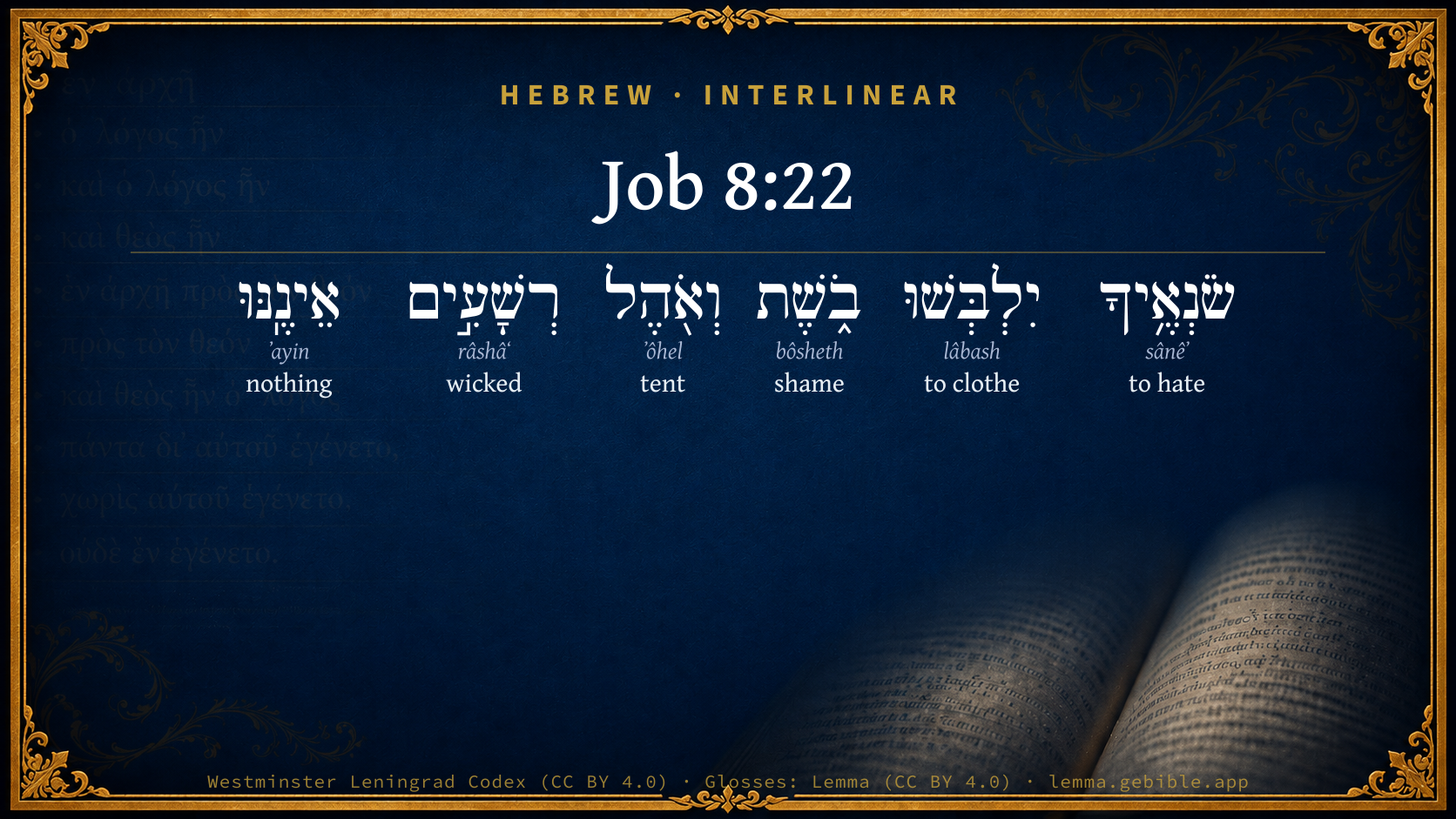
Hebrew (Westminster Leningrad Codex) Job 8:22 appears in the Hebrew Old Testament. The text above is from the Westminster Leningrad Codex. Each word links to its Strong’s number, a concise gloss, and parsing drawn from the Open Scriptures Hebrew Bible morphology. Click any word for its full Brown-Driver-Briggs (BDB) entry.
Download image
Cite this verse

Job 8:22 (World English Bible). Public Domain. Lemma interlinear Bible study tool, https://lemma.gebible.app/v/job/8/22.

Show BibTeX & RIS
BibTeX
RIS
English Translation
Those who hate you shall be clothed with shame. The tent of the wicked shall be no more."
World English Bible · Public Domain
Download a study sheet

One document with this verse’s original text, its word-by-word gloss line, the meaning frame, cross-references with their text, attributed commentary, and full source and license credits — printable, and it pastes into notes with its structure intact.

This verse Autodidact and up

Study sheet (.html) Plain text (.txt)

A passage Seminary Student

Up to 50 verses in one chapter. A passage sheet keeps up to 6 commentary sources and 12 cross-references per verse, in the order this page ranks them, and says so on the sheet whenever that leaves anything out. Ask for a single verse and you get the Autodidact verse sheet above.

Everything on this page stays free to read, with no account — the sheet is a download of what is already on screen, not access to it.

Want to remove ads? Support Godless Engineer
Compare translations 3

The same verse in 3 English versions, stacked beneath the original-language interlinear above. Click any original word for its lexicon entry.

Each is an independent rendering of the whole verse — the interlinear is not word-aligned to these translations.

Highlighted words mark where these versions differ — a whole-verse word diff, not a word-by-word alignment.

  • World English Bible Public Domain
    Those who hate you shall be clothed with shame. The tent of the wicked shall be no more."
  • King James Version Public Domain
    They that hate thee shall be clothed with shame; and the dwelling place of the wicked shall come to nought.
  • unfoldingWord Literal Text CC BY-SA 4.0
    The ones hating you will wear shame, and the tent of the wicked will not exist.”

unfoldingWord Literal Text — © unfoldingWord, licensed CC BY-SA 4.0. Word-aligned USFM3 via Door43 (git.door43.org/unfoldingWord/en_ult).

Versions to compare (up to 4)

3 of 4 selected

Show all 18 translations

Every available English version of this verse, each an independent rendering of the whole verse.

  • World English Bible Public Domain
    Those who hate you shall be clothed with shame. The tent of the wicked shall be no more."
  • Berean Standard Bible Public Domain
    Your enemies will be clothed in shame, and the tent of the wicked will be no more.”
  • Majority Standard Bible Public Domain
    Your enemies will be clothed in shame, and the tent of the wicked will be no more.”
  • King James Version Public Domain
    They that hate thee shall be clothed with shame; and the dwelling place of the wicked shall come to nought.
  • American Standard Version (1901) Public Domain
    They that hate thee shall be clothed with shame; And the tent of the wicked shall be no more.
  • Revised Version (1885) Public Domain
    They that hate thee shall be clothed with shame; and the tent of the wicked shall be no more.
  • Geneva Bible (1599) Public Domain
    They that hate thee, shall be clothed with shame, and the dwelling of the wicked shall not remaine.
  • Douay-Rheims (1899) Public Domain
    They that hate thee, shall be clothed with confusion: and the dwelling of the wicked shall not stand.
  • Young's Literal Translation Public Domain
    Those hating thee do put on shame, And the tent of the wicked is not!
  • Literal Standard Version CC BY-SA 4.0
    Those hating you put on shame, || And the tent of the wicked is not!”
  • Unlocked Literal Bible CC BY-SA 4.0
    Those who hate you will be clothed with shame; the tent of the wicked will be no more.”
  • unfoldingWord Literal Text CC BY-SA 4.0
    The ones hating you will wear shame, and the tent of the wicked will not exist.”
  • Darby Bible Public Domain
    They that hate thee shall be clothed with shame, and the tent of the wicked be no more.
  • World Messianic Bible Public Domain
    Those who hate you will be clothed with shame. The tent of the wicked will be no more.”
  • Webster's Bible Public Domain
    They that hate thee shall be clothed with shame; and the dwelling place of the wicked shall come to naught.
  • Free Bible Version CC BY-SA 4.0
    Those who hate you will be put to shame, and the place where the wicked live will be destroyed.”
  • Bible in Basic English Public Domain
    Your haters will be clothed with shame, and the tent of the sinner will not be seen again.
  • JPS Tanakh (1917) Public Domain
    They that hate thee shall be clothed with shame; and the tent of the wicked shall be no more.

Literal Standard Version (2020), Covenant Press — licensed CC BY-SA 4.0. Text via the HelloAO Bible API (eBible.org). Unlocked Literal Bible (unfoldingWord) — licensed CC BY-SA 4.0. Text via the HelloAO Bible API (eBible.org). unfoldingWord Literal Text — © unfoldingWord, licensed CC BY-SA 4.0. Word-aligned USFM3 via Door43 (git.door43.org/unfoldingWord/en_ult). Free Bible Version, Dr. Jonathan Gallagher — licensed CC BY-SA 4.0. Text via the HelloAO Bible API (eBible.org).

Word by word

More ways to search: Search by grammar → Find every occurrence → Compare this word →

Practice this passage: Drill this verse → Learn its vocabulary →

About this verse

These counts appear in no published source. They are computed here, from the morphology-tagged text and Lemma’s own curated glosses. What Lemma adds →

6
words
6
distinct lemmas
Wisdom
section

Shared distinctive vocabulary

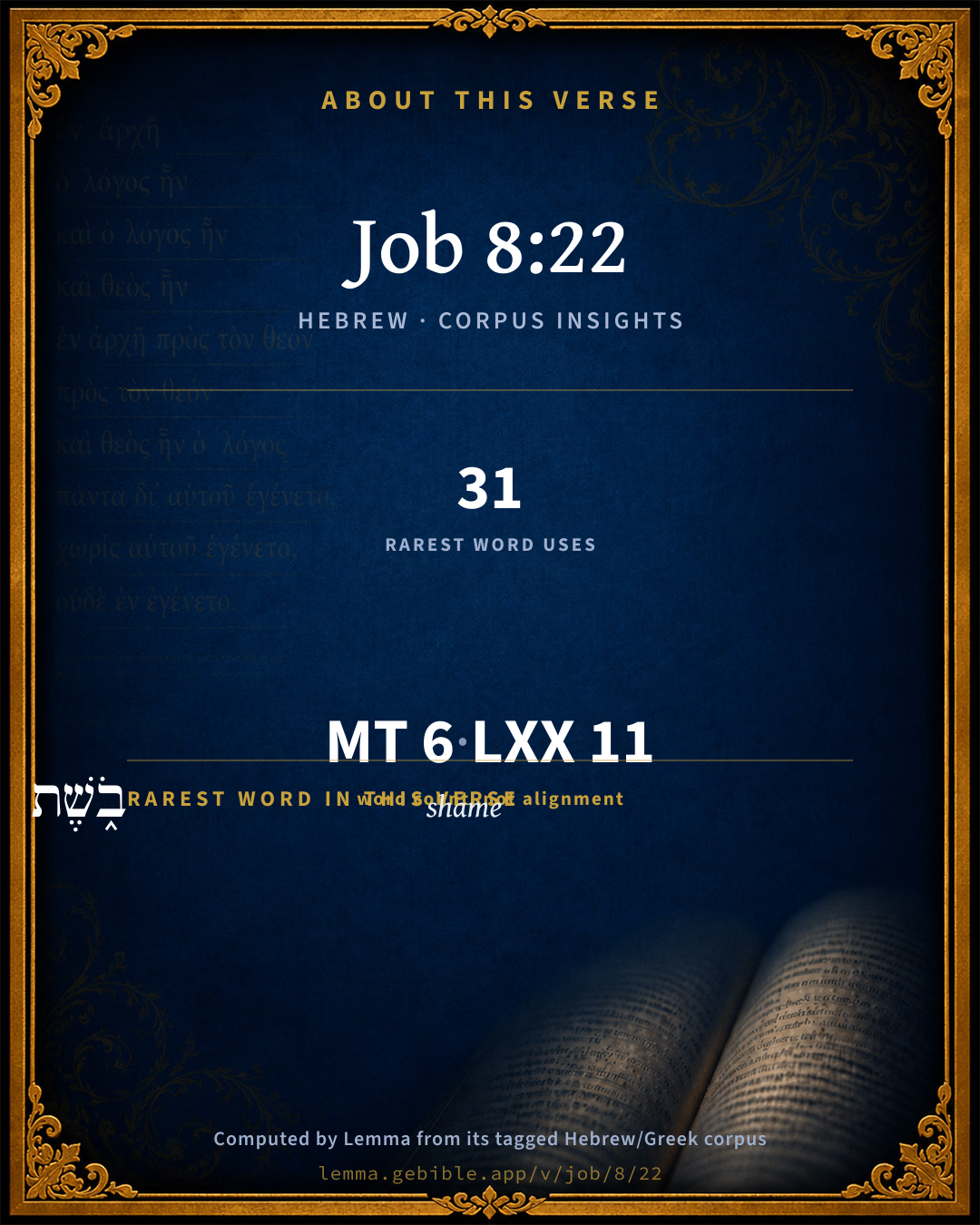
בֹ֑שֶׁת shame H1322 occurs in 30 verses of the Hebrew Bible. Also found in:

Grammatical profile

  • 2 verbs
  • 2 nouns
  • 1 adjective
  • 1 particle

Verb forms

  • שֹׂנְאֶ֥יךָ Qal · Participle Active
  • יִלְבְּשׁוּ Qal · Imperfect

Hebrew & Septuagint length

In English translation the verse runs 18 words from the Hebrew and 16 from the Septuagint (LXX English) — closely comparable.

A rough comparison of the two English renderings, which tokenize alike — not a word-level alignment.

Word counts can differ between the Hebrew and the Greek without any difference in meaning — e.g. the Hebrew direct-object marker אֵת has no separate Greek word, and Greek often adds the article ὁ.

In the original languages it is 6 Hebrew tokens and 11 Greek tokens — but the two are counted differently (Hebrew bundles its prefixes and suffixes into one token; the Greek is in lemma form), so that isn’t a like-for-like length.

Cross-references

7

Topical passages linked to Job 8:22 in the Treasury of Scripture Knowledge — connected by theme and wording, ordered by reader-vote popularity; previews shown in the World English Bible.

  • Psalms 132:18 I will clothe his enemies with shame, But on himself, his crown will be resplendant."
  • Psalms 35:26 Let them be disappointed and confounded together who rejoice at my calamity. Let them be clothed with shame and dishonor who magnify themselves against me.
  • Psalms 109:29 Let my adversaries be clothed with dishonor. Let them cover themselves with their own shame as with a robe.
  • Job 18:14 He shall be rooted out of his tent where he trusts. He shall be brought to the king of terrors.
  • Job 8:18 If he is destroyed from his place, Then it shall deny him, saying, 'I have not seen you.'
  • Job 7:21 Why do you not pardon my disobedience, and take away my iniquity? For now shall I lie down in the dust. You will seek me diligently, but I shall not be."
  • 1 Peter 5:5 Likewise, you younger ones, be subject to the elder. Yes, all of you gird yourselves with humility, to subject yourselves to one another; for "God resists the proud, but gives grace to the humble."

Cross-references courtesy of OpenBible.info (CC BY 4.0).

Hebrew and Greek witnesses Masoretic Hebrew ↔ Greek Septuagint

The same verse in the two great witnesses to the Old Testament, shown verse-for-verse.

These are two independent witnesses, not word-aligned to each other, and the Septuagint is shown in lemma (dictionary) form.

Hebrew Job 8:22 Masoretic · Westminster Leningrad Codex

שֹׂנְאֶ֥יךָ יִלְבְּשׁוּ בֹ֑שֶׁת וְאֹ֖הֶל רְשָׁעִ֣ים אֵינֶֽנּוּ

Those who hate you shall be clothed with shame. The tent of the wicked shall be no more."

World English Bible · Public Domain

Greek LXX Job 8:22 Septuagint · lemma form

ὁ δέ ἐχθρός αὐτός ἐνδύω αἰσχύνη δίαιτα δέ ἀσεβής οὐ εἰμί

But their adversaries shall clothe themselves with shame; and the habitation of the ungodly shall perish.

LXX2012 (modern English Septuagint) · Public Domain

Hebrew: Westminster Leningrad Codex (CC BY 4.0). Greek: Septuagint (public domain); English from LXX2012 (modern English Septuagint) (Public Domain). How the Septuagint differs from the Hebrew →

Commentary

Notes on Job 8:22 from classic Christian and Jewish commentators (each source and its license shown beneath its notes). The classic Christian expositions comment on the surrounding passage and are grouped to its opening verse, so a note may address several verses; the Jewish commentaries on the Tanakh (Rashi and others) are per-verse, so they appear only where the commentator wrote on this verse.

Lemma curates 59 commentaries, every one of them public domain or Creative Commons licensed, each selected and text-cleaned for this edition rather than reprinted as found. About our sources →

The Cambridge Bible for Schools and Colleges

gen. ed. J. J. S. Perowne

22. In his concluding words Bildad puts himself and his friends right with Job, and desires to put Job right with himself and God. By referring to Job’s haters he intimates that he and his friends are none of them; and by identifying these haters with the wicked (Job_8:22), he lets Job know that he regards him as at heart one who belongs to quite a different class.

The position of Job’s friends cannot be understood at all unless we consider that they assumed Job’s piety at heart, but concluded from his calamities that he had been guilty of some great sins. And as Eliphaz had already brought to bear on Job’s mind the influence of a revelation, the next strongest argument was the consent of mankind. And to some minds, especially in that condition of perplexity and confusion on religious experience in which Job’s was, the general accord of mankind speaks with a more persuasive voice than anything called revelation. Bildad clearly enough perceived the drift of Job’s words in ch. 7; they were to the effect that the government of the world and the supreme Power in it was un-moral. And his reply, that mankind everywhere, and especially in circumstances that gave their judgment weight, had perceived a moral law ruling the universe, was conclusive as a general principle. His error lay in supposing that this was the only principle on which the universe was ruled, and in imagining that this principle operated always in a manner direct and immediate. Hence the principle lost its effectiveness in his hands by being stretched to uses which it did not cover.

The Cambridge Bible for Schools and Colleges (gen. ed. J. J. S. Perowne; Cambridge University Press, 1878–1918) — public domain. Text from a community e-Sword module.

Trapp's Complete Commentary

John Trapp

Job 8:22 They that hate thee shall be clothed with shame; and the dwelling place of the wicked shall come to nought.

Ver. 22. They that hate thee shall be clothed with shame] It shall cover their faces, Psa 69:7, yea, cover over the whole man; when beyond all expectation they shall see thee restored to thy former prosperity. Where it is worth considering, saith one, how truly this happened touching Job, and these friends of his; he was restored, and they, by God’s reproving them, covered with shame, as it appeareth, Job 42:7-10

And the dwelling place of the wicked shall come to nought] Heb. Shall not be. See Job 8:18. Understand it not of his tabernacle only, or dwelling place, but of his whole estate, both temporal and spiritual, all shall come to rack and ruin. God shall utterly overturn them, as Zisca did those 300 monasteries, and among the rest that famous monastery called the king’s court, a mile from Prague; in the walls whereof the whole Bible was most exquisitely written in letters of gold (Mr Clark in his Life). "The house of the wicked shall be overthrown: but the tabernacle of the upright shall flourish," Pro 14:11.

John Trapp, A Commentary or Exposition upon All the Books of the Old and New Testament (1647–1656) — public domain. Text from a community e-Sword module.

Joseph Benson's Commentary

Job 8:22. They that hate thee — That rejoice in thy calamities; shall be clothed with shame — That is, shall be wholly covered with it, shall be utterly confounded, when they shall observe thee, whom they have despised and insulted over, to be wonderfully restored to thy former or greater felicity. And the dwelling-place of the wicked — Either, particularly, of thy enemies, who acted so unworthily and wickedly toward thee; or, more generally, of all wicked men; shall come to naught — Having showed what good God would do to the perfect, or good man, he now declares what would be the portion of the wicked. And, as he said, Job 8:20, that God would not help them; so here he adds, that God would bring not only them, but their house, that is, their family and estate, to utter ruin.

Joseph Benson's Commentary on the Old and New Testaments (1811–1818) — public domain. Text from a community e-Sword module.

Jamieson, Fausset & Brown

Robert Jamieson, A. R. Fausset & David Brown

The haters of Job are the wicked. They shall be clothed with shame (Jer 3:25; Psa 35:26; Psa 109:29), at the failure of their hope that Job would utterly perish, and because they, instead of him, come to naught.

Next: Job Chapter 9

Jamieson, Fausset & Brown — Commentary Critical and Explanatory on the Whole Bible (1871) — public domain (CC PDM 1.0). Text via the HelloAO Bible API.

Albert Barnes' Notes on the Bible

They that hate thee shall be clothed with shame - When they see your returning prosperity, and the evidences of the divine favor. They will then be ashamed that they regarded you as a hypocrite, and that they reproached you in your trials.

And the dwelling-place of the wicked ... - The wicked shall be destroyed, and his family shall pass away. That is, God will favor the righteous, but punish the wicked. This opinion the friends of Job maintain all along, and by this they urge him to forsake his sins, repent, and return to God.

Albert Barnes' Notes on the Bible (1834–1885) — public domain. Text from a community e-Sword/MySword module.

Matthew Poole's English Annotations

They that hate thee, that rejoice in thy calamities, shall be wholly covered with shame, shall be utterly confounded, when they shall observe thee, whom they have despised and insulted over, to be so wonderfully and surprisingly restored to thy former or a greater felicity.

Of the wicked; either particularly of thy enemies, who dealt so unworthily and wickedly with thee; or more generally of all wicked men. Having showed what good God would do to the perfect man, he now declares the contrary portion of the wicked; and as he said that God would not help them, Job 8:20, so here he adds, that God will bring not only them, but their house, i.e. their family and estate, to nought.

Matthew Poole's English Annotations on the Holy Bible (1683–1685) — public domain. Text from a community e-Sword/MySword module.

Whedon's Commentary on the Bible

Daniel D. Whedon

22. Clothed with shame — לבשׁ clothe, when employed metaphorically is for the most part used of righteousness, (Job_29:14;) also of the divine Spirit, light, glory, etc.; here, (also Psa_35:26,) with concealed sarcasm, the signification is, their best attire is shame.

Dwelling-place —In the place of בית, house, three times appearing in the ancient poem, we now have אהל, ohel, tent, happily chosen to set forth the transitoriness of the home of the wicked in comparison with that of the spider, and even the running vine.

Daniel D. Whedon (gen. ed.), Commentary on the Old and New Testaments (1874–1909) — public domain. Text from a community e-Sword module.

The Pulpit Commentary

They that hate thee shall be clothed with shame; (comp. Psa_35:26) and the dwelling-place (literally, tent, or tabernacle) of the wicked shall come to nought (literally, shall not be). The words are involved and obscure, because Bildad does not wish to make his meaning plain. He has to invent phrases which may cut both ways, and, while they seem directed against Job"s enemies, may pain and wound Job himself.

The Pulpit Commentary (1880–1919), ed. H.D.M. Spence-Jones & Joseph S. Exell — public domain. Text from a community e-Sword module.

Lesson kit

Teaching starters — assembled from the data on this page, not authored interpretation. Every prompt links to the verse data it draws on. Edit before teaching.

Job, in the Wisdom, opens this verse with 6 words (6 distinct Hebrew lemmas). Its most distinctive word is bôsheth (“shame”). A historical commentator’s framing appears above. Read the whole chapter for the surrounding context.

Discussion questions

  1. How does “shame” (bôsheth) shape what this verse is saying?
  2. How does 1 Samuel 20:30, which shares the word «shame», read alongside this verse?
  3. These translations render this verse differently; the difference is in the English rendering, not the original. What questions does that raise?
  4. «שֹׂנְאֶ֥יךָ» is a Qal Participle Active verb. How does that grammatical form shape the action described?
  5. Compare how The Cambridge Bible for Schools and Colleges and Trapp's Complete Commentary read this verse. Where do they agree or differ?

Things to notice

Reading settings

Reading text

Shown beneath each verse's original-language words.

Old Testament
Old Testament edition

Read the OT as the Masoretic Hebrew (MT) or the Greek Septuagint (LXX).

English shown for the Greek Septuagint (in the Hebrew ↔ Greek comparison).

Comparing translations? Open the Compare panel on any verse page to stack up to four side by side.