
Psalms 1:5

Hebrew (Westminster Leningrad Codex) Psalms 1:5 appears in the Hebrew Old Testament. The text above is from the Westminster Leningrad Codex. Each word links to its Strong’s number, a concise gloss, and parsing drawn from the Open Scriptures Hebrew Bible morphology. Click any word for its full Brown-Driver-Briggs (BDB) entry.
Download image
Cite this verse

Psalms 1:5 (World English Bible). Public Domain. Lemma interlinear Bible study tool, https://lemma.gebible.app/v/psalms/1/5.

Show BibTeX & RIS
BibTeX
RIS
English Translation
Therefore the wicked shall not stand in the judgment, Nor sinners in the congregation of the righteous.
World English Bible · Public Domain
Download a study sheet

One document with this verse’s original text, its word-by-word gloss line, the meaning frame, cross-references with their text, attributed commentary, and full source and license credits — printable, and it pastes into notes with its structure intact.

This verse Autodidact and up

Study sheet (.html) Plain text (.txt)

A passage Seminary Student

Up to 50 verses in one chapter. A passage sheet keeps up to 6 commentary sources and 12 cross-references per verse, in the order this page ranks them, and says so on the sheet whenever that leaves anything out. Ask for a single verse and you get the Autodidact verse sheet above.

Everything on this page stays free to read, with no account — the sheet is a download of what is already on screen, not access to it.

Want to remove ads? Support Godless Engineer
Compare translations 3

The same verse in 3 English versions, stacked beneath the original-language interlinear above. Click any original word for its lexicon entry.

Each is an independent rendering of the whole verse — the interlinear is not word-aligned to these translations.

Highlighted words mark where these versions differ — a whole-verse word diff, not a word-by-word alignment.

  • World English Bible Public Domain
    Therefore the wicked shall not stand in the judgment, Nor sinners in the congregation of the righteous.
  • King James Version Public Domain
    Therefore the ungodly shall not stand in the judgment, nor sinners in the congregation of the righteous.
  • unfoldingWord Literal Text CC BY-SA 4.0
    Thus the wicked will not stand in the judgment, nor sinners in the congregation of the righteous. ts\*

unfoldingWord Literal Text — © unfoldingWord, licensed CC BY-SA 4.0. Word-aligned USFM3 via Door43 (git.door43.org/unfoldingWord/en_ult).

Versions to compare (up to 4)

3 of 4 selected

Show all 18 translations

Every available English version of this verse, each an independent rendering of the whole verse.

  • World English Bible Public Domain
    Therefore the wicked shall not stand in the judgment, Nor sinners in the congregation of the righteous.
  • Berean Standard Bible Public Domain
    Therefore the wicked will not stand in the judgment, nor sinners in the assembly of the righteous.
  • Majority Standard Bible Public Domain
    Therefore the wicked will not stand in the judgment, nor sinners in the assembly of the righteous.
  • King James Version Public Domain
    Therefore the ungodly shall not stand in the judgment, nor sinners in the congregation of the righteous.
  • American Standard Version (1901) Public Domain
    Therefore the wicked shall not stand in the judgment, Nor sinners in the congregation of the righteous.
  • Revised Version (1885) Public Domain
    Therefore the wicked shall not stand in the judgment, nor sinners in the congregation of the righteous.
  • Geneva Bible (1599) Public Domain
    Therefore the wicked shall not stande in the iudgement, nor sinners in the assemblie of the righteous.
  • Douay-Rheims (1899) Public Domain
    Therefore the wicked shall not rise again in judgment: nor sinners in the council of the just.
  • Young's Literal Translation Public Domain
    Therefore the wicked rise not in judgment, Nor sinners in the company of the righteous,
  • Literal Standard Version CC BY-SA 4.0
    Therefore the wicked do not rise in judgment, || Nor sinners in the congregation of the righteous,
  • Unlocked Literal Bible CC BY-SA 4.0
    So the wicked will not stand in the judgment, nor sinners in the assembly of the righteous.
  • unfoldingWord Literal Text CC BY-SA 4.0
    Thus the wicked will not stand in the judgment, nor sinners in the congregation of the righteous. ts\*
  • Darby Bible Public Domain
    Therefore the wicked shall not stand in the judgment, nor sinners in the assembly of the righteous.
  • World Messianic Bible Public Domain
    Therefore the wicked shall not stand in the judgment, nor sinners in the congregation of the righteous.
  • Webster's Bible Public Domain
    Therefore the ungodly shall not stand in the judgment, nor sinners in the congregation of the righteous.
  • Free Bible Version CC BY-SA 4.0
    For this reason the wicked will not survive the judgment—sinners have no place among those who live right.
  • Bible in Basic English Public Domain
    For this cause there will be no mercy for sinners when they are judged, and the evil-doers will have no place among the upright,
  • JPS Tanakh (1917) Public Domain
    Therefore the wicked shall not stand in the judgment, nor sinners in the congregation of the righteous.

Literal Standard Version (2020), Covenant Press — licensed CC BY-SA 4.0. Text via the HelloAO Bible API (eBible.org). Unlocked Literal Bible (unfoldingWord) — licensed CC BY-SA 4.0. Text via the HelloAO Bible API (eBible.org). unfoldingWord Literal Text — © unfoldingWord, licensed CC BY-SA 4.0. Word-aligned USFM3 via Door43 (git.door43.org/unfoldingWord/en_ult). Free Bible Version, Dr. Jonathan Gallagher — licensed CC BY-SA 4.0. Text via the HelloAO Bible API (eBible.org).

Word by word

More ways to search: Search by grammar → Find every occurrence → Compare this word →

Practice this passage: Drill this verse → Learn its vocabulary →

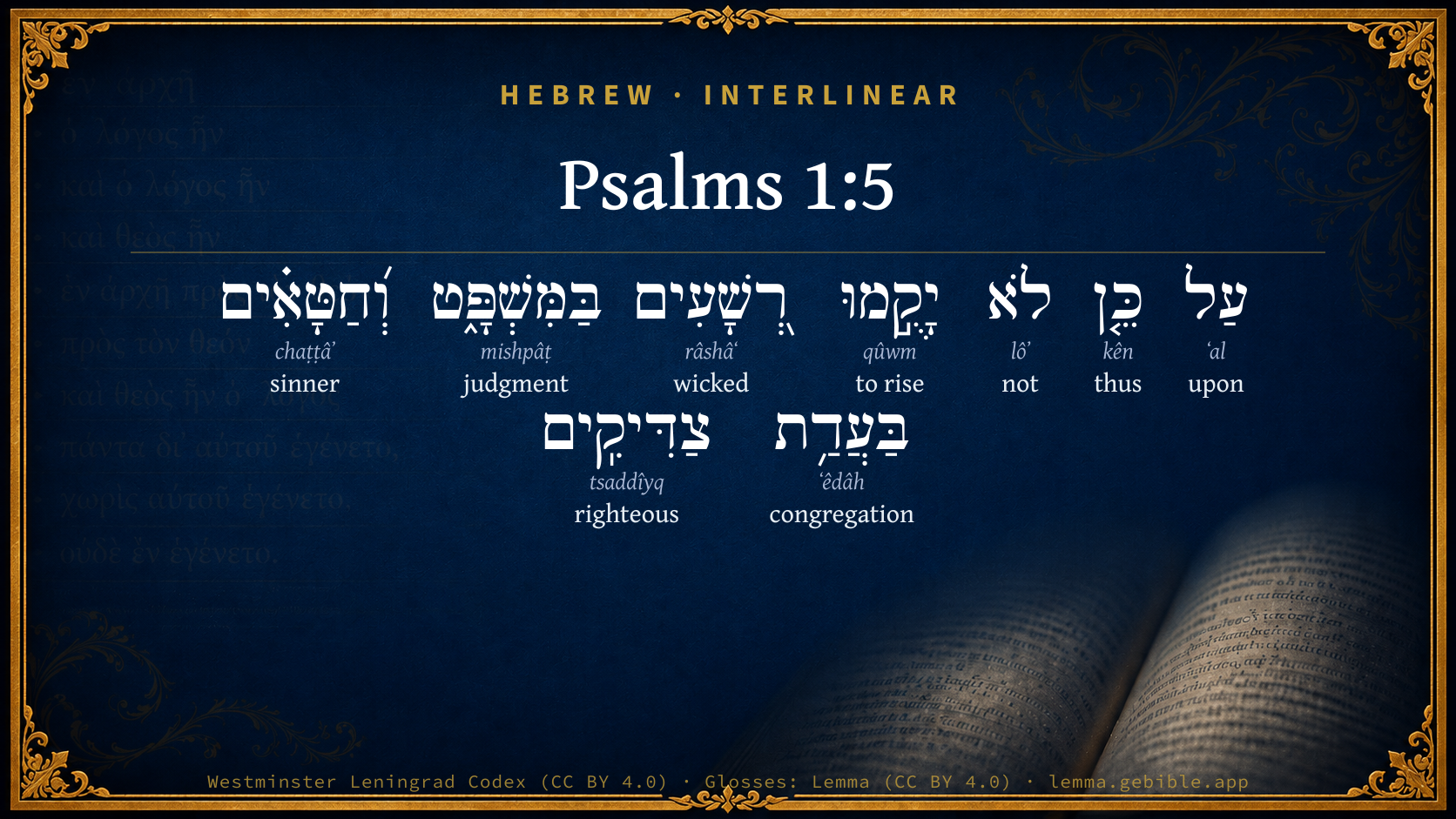
וְ֝חַטָּאִ֗ים
chaṭṭâʼ
H2400
“and · sinner”
Conjunction + Adjective, Adjective, Masculine, Plural, Absolute
Part of Speech
Conjunction + Adjective
Type
Adjective
Gender
Masculine
Number
Plural
State
Absolute
Full BDB Definition

Origin: intensively from H2398

TWOT: 638b

sinners (noun masculine) - sinful (adjective) - exposed to condemnation, reckoned as offenders (adjective)
  1. עַל ʻal H5921 “upon” Preposition
  2. כֵּ֤ן kên H3651 “thus” Particle, Demonstrative
  3. לֹא lôʼ H3808 “not” Particle, Negative
  4. יָקֻ֣מוּ qûwm H6965 “to rise” Verb, Qal, Imperfect, 3rd Person, Masculine, Plural
  5. רְ֭שָׁעִים râshâʻ H7563 “wicked” Adjective, Adjective, Masculine, Plural, Absolute
  6. בַּמִּשְׁפָּ֑ט mishpâṭ H4941 “in/at the · judgment” Preposition, Determined + Noun, Common, Masculine, Singular, Absolute
  7. בַּעֲדַ֥ת ʻêdâh H5712 “in/at · congregation of” Preposition + Noun, Common, Feminine, Singular, Construct
  8. צַדִּיקִֽים tsaddîyq H6662 “righteous” Adjective, Adjective, Masculine, Plural, Absolute

About this verse

These counts appear in no published source. They are computed here, from the morphology-tagged text and Lemma’s own curated glosses. What Lemma adds →

9
words
9
distinct lemmas
Wisdom
section

Notable vocabulary

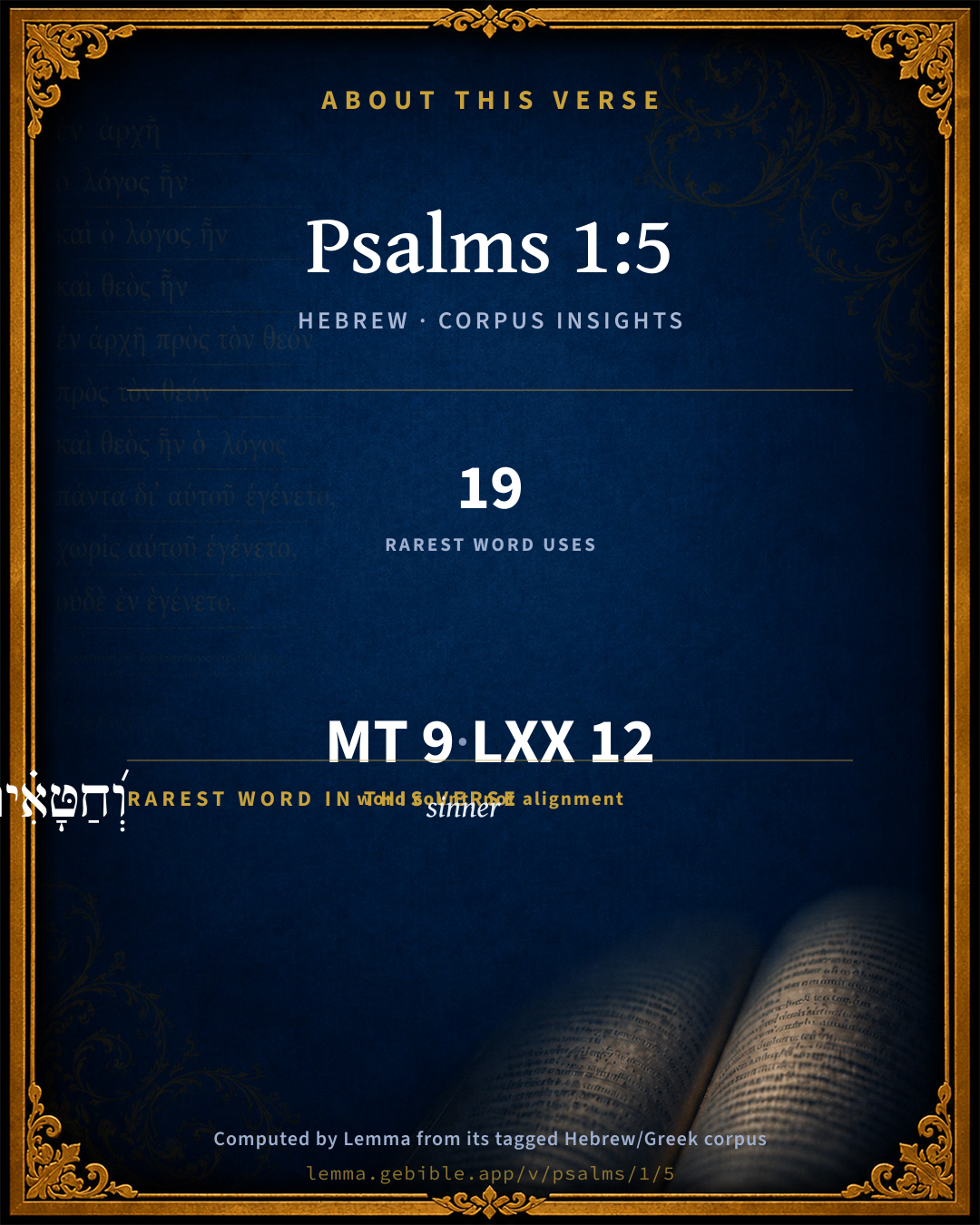
The rarest word here is וְ֝חַטָּאִ֗ים sinner H2400 — appearing just 19 times in the whole Hebrew Bible.

Shared distinctive vocabulary

וְ֝חַטָּאִ֗ים sinner H2400 occurs in 19 verses of the Hebrew Bible. Also found in:

Grammatical profile

  • 1 verb
  • 2 nouns
  • 3 adjectives
  • 1 preposition
  • 2 particles

Verb forms

  • יָקֻ֣מוּ Qal · Imperfect

Hebrew & Septuagint length

In English translation the verse runs 17 words from the Hebrew and 16 from the Septuagint (LXX English) — closely comparable.

A rough comparison of the two English renderings, which tokenize alike — not a word-level alignment.

Word counts can differ between the Hebrew and the Greek without any difference in meaning — e.g. the Hebrew direct-object marker אֵת has no separate Greek word, and Greek often adds the article ὁ.

In the original languages it is 9 Hebrew tokens and 12 Greek tokens — but the two are counted differently (Hebrew bundles its prefixes and suffixes into one token; the Greek is in lemma form), so that isn’t a like-for-like length.

Cross-references

12

Topical passages linked to Psalms 1:5 in the Treasury of Scripture Knowledge — connected by theme and wording, ordered by reader-vote popularity; previews shown in the World English Bible.

  • Psalms 5:5 The arrogant shall not stand in your sight. You hate all workers of iniquity.
  • Matthew 25:46 These will go away into eternal punishment, but the righteous into eternal life."
  • Malachi 3:18 Then you shall return and discern between the righteous and the wicked, between him who serves God and him who doesn't serve him.
  • Matthew 25:41 Then he will say also to those on the left hand, 'Depart from me, you cursed, into the eternal fire which is prepared for the devil and his angels;
  • Luke 21:36 Therefore be watchful all the time, asking that you may be counted worthy to escape all these things that will happen, and to stand before the Son of Man."
  • Matthew 25:32 Before him all the nations will be gathered, and he will separate them one from another, as a shepherd separates the sheep from the goats.
  • Matthew 13:49 So will it be in the end of the world. The angels will come forth, and separate the wicked from among the righteous,
  • Psalms 9:7–8 But Yahweh reigns forever. He has prepared his throne for judgment.
  • Jude 1:15 to execute judgment on all, and to convict all the ungodly of all their works of ungodliness which they have done in an ungodly way, and of all the hard things which ungodly sinners have spoken against him."
  • Psalms 26:9 Don't gather my soul with sinners, Nor my life with bloodthirsty men;
  • Psalms 9:16 Yahweh has made himself known. He has executed judgment. The wicked is snared by the work of his own hands. Meditation. Selah.
  • Psalms 24:3 Who may ascend to Yahweh's hill? Who may stand in his holy place?

Cross-references courtesy of OpenBible.info (CC BY 4.0).

Hebrew and Greek witnesses Masoretic Hebrew ↔ Greek Septuagint

The same verse in the two great witnesses to the Old Testament, shown verse-for-verse.

You’re reading Greek Psalm 1 (Hebrew Psalm 1). The Septuagint counts the superscription, so verse numbers can differ from the Hebrew — chapter-level alignment, not verse-by-verse. Numbering follows Rahlfs.

These are two independent witnesses, not word-aligned to each other, and the Septuagint is shown in lemma (dictionary) form.

Hebrew Psalms 1:5 Masoretic · Westminster Leningrad Codex

עַל כֵּ֤ן לֹא יָקֻ֣מוּ רְ֭שָׁעִים בַּמִּשְׁפָּ֑ט וְ֝חַטָּאִ֗ים בַּעֲדַ֥ת צַדִּיקִֽים

Therefore the wicked shall not stand in the judgment, Nor sinners in the congregation of the righteous.

World English Bible · Public Domain

Greek LXX Greek Psalm 1:5 Septuagint · lemma form

διά οὗτος οὐ ἀναἵστημι ἀσεβής ἐν κρίσις οὐδέ ἁμαρτωλός ἐν βουλή δίκαιος

Therefore the ungodly shall not rise in judgment, nor sinners in the counsel of the just.

LXX2012 (modern English Septuagint) · Public Domain

On this verse, Ellicott's Commentary for English Readers discusses the Septuagint’s reading. Read the note in Commentary ↓

Hebrew: Westminster Leningrad Codex (CC BY 4.0). Greek: Septuagint (public domain); English from LXX2012 (modern English Septuagint) (Public Domain). How the Septuagint differs from the Hebrew →

Commentary

Notes on Psalms 1:5 from classic Christian and Jewish commentators (each source and its license shown beneath its notes). The classic Christian expositions comment on the surrounding passage and are grouped to its opening verse, so a note may address several verses; the Jewish commentaries on the Tanakh (Rashi and others) are per-verse, so they appear only where the commentator wrote on this verse.

Lemma curates 59 commentaries, every one of them public domain or Creative Commons licensed, each selected and text-cleaned for this edition rather than reprinted as found. About our sources →

Trapp's Complete Commentary

John Trapp

Psa 1:5 Therefore the ungodly shall not stand in the judgment, nor sinners in the congregation of the righteous.

Ver. 5. Therefore the ungodly shall not stand in the judgment] i.e. Causa cadent et damnabuntur, at the great assizes they shall be cast and condemned. Vix steteris (Terent.). Rev 6:17, "For the great day of his wrath is come; and who shall be able to stand?" "If the righteous scarcely be saved, where shall the ungodly and sinner appear?" 1Pe 4:18. Surely nowhere, but in hell, their own place, Act 1:25 : not before God, for he is a consuming fire, Heb 12:29, and they chaff or stubble, fully dried, see Isa 33:14; not before Christ, for he shall come in flaming fire, rendering vengeance, &c., 2Th 1:7; not in heaven, for it is an undefiled inheritance, neither may any dirty dog trample on that golden pavement, Rev 22:15; not any longer on earth, defiled by their iniquities, and, therefore, to be purged by the fire of the last day; for the earth also, and the works that are therein, shall be burnt up, 2Pe 3:10. R. David Kimchi by judgment here understandeth the day of the wicked man’s death; and indeed his death’s day is his doom’s day, when he must take a fearful farewell, and breathe out his soul and hope together with the breath of the same dying groan, Job 27:8; Job 11:20. Hinc illae lachrymae, hence that lothing to depart, though some set a good face upon it when to die, as Sir Thomas Moore, who died for the pope’s supremacy with a light jest in his mouth. Vespasian likewise died with a jest, and Augustus in a compliment. This was but the hypocrisy of mirth; for death is the king of terror to a natural man. See Heb 2:15 1Sa 15:32; 1Sa 28:20. Saul, at the message of death, swooned quite away, and fell all along, Quantus quantus erat, as Peter Martyr phraseth it; yea, good Hezekiah wept when sentenced to death, and the approach of it was to him Mar mar, bitter bitterness, Isa 38:3; Isa 38:17. He must have his faith at his fingers’ ends, as one saith, that will die actively. But all men have not faith, 2Th 3:2, and those few that have are not always assured that their hearts shall live for ever, as Psa 22:26, and that death, the devil’s sergeant, to drag wicked men to hell, shall be to them the Lord’s gentle usher, to conduct them to heaven, as Mr Brightman expresseth it.

Nor sinners in the congregation of the righteous] They shall never set foot within heaven’s threshold, within that general assembly, that sacred panegyris {a}, ample amphitheatre, the congregation house of crowned saints and glorious angels. Tertullian saith of Pompey’s theatre (which was the greatest ornament of old Rome) that it was Arx omnium turpitudinum, a receptacle of all kind of ribaldry and roguery. Not so heaven: "There shall ill nowise enter into it anything that defileth, neither whatsoever worketh abomination or maketh a lie," Rev 21:27. The Irish air will sooner brook a toad, or a snake, than heaven a sinner. Mali in area nobiscum esse possunt, in horreo non possunt, Chaff may be with God’s good grain on the floor, but in the garner it shall not (Augustin). For Christ "will throughly purge his floor, and gather his wheat into the garner; but will burn up the chaff with unquenchable fire," Mat 3:12.

{a} Gr. Antiq. A general assembly; esp. a festal assembly in honour of a god.

John Trapp, A Commentary or Exposition upon All the Books of the Old and New Testament (1647–1656) — public domain. Text from a community e-Sword module.

The Biblical Illustrator

Joseph S. Exell

Psa_1:5

The ungodly shall not stand in the judgment.

The day of judgment

1. None will deny that the law of God, which is holy, just, and good, explicitly condemns the sinner, and consigns him to the second death. By the law can no man be justified. It contains no provision for pardon.

2. He will not be able to stand in the last trial, because all the witnesses will be against him. His companions in sin will testify against him. The example of the righteous will testify against the impenitent. The sinners own awakened conscience and memory will testify against him. So will the sufferings of the Lord Jesus Christ.

3. The eternal Judge will be inflexibly strict in interpreting and upholding the law. And

4. The impenitent sinner at Gods bar will have no advocate. (A. Dickinson,.)

The ungodly rising to judgment

They shall not rise in the judgment, this is more than St. Paul would have said himself if he had been in the prophets place, for who ever thought the ungodly should rise in the judgment, who are sure to fall in the judgment, seeing their judgment shall be to condemnation and not to deliverance? To rise to the judgment is to be brought to public trial, and this is the general resurrection that we believe; but to rise in the judgment is upon trial to come off with credit, and, by the sentence of the Judge, not only to be justified, but advanced. And who ever believed this rising to belong to the wicked? (Sir Richard Baker.)

A congregation in which sinners cannot stand

And as there shall be a general judgment, in which the ungodly shall not rise, so, after the judgment, there shall be a particular congregation of the righteous, in which sinners shall not stand. And, indeed, what society can there be between a tree and chaff? or who can think it fit that trees and chaff should be made companions? And as there is no reason that the ungodly, having made others by their counsel to fall here, should rise themselves in judgment hereafter, so there is no reason, seeing the righteous could not be suffered to stand here in the way of sinners, that sinners should be suffered to stand hereafter in the congregation of the righteous. And here now a multitude of reasons seem assembled, as it were, to make it good, that sinners neither can nor ought to stand in this assembly. It is a congregation which none can make but the righteous; for sinners are all rebels, and would make it a rout. It is a court where all must be neat and clean; and so are none but the righteous; for sinners are all lepers, and would make it a spital. It is a company that makes a communion, and that can none do but saints, for sinners seek everyone their own, and are all for themselves. They must be all Gods friends; at least, such as He knows; and such are only the righteous, for sinners are all mere strangers and aliens from God. (Sir Richard Baker.)

Failure in judgment

And now let the great men of the world please themselves, and think it a happiness that they can rise in honours, can rise in riches and estimation in the world; yet, alas! what is all this, if they fail of rising in the judgment to come? (Sir Richard Baker.)

The Biblical Illustrator, edited by Joseph S. Exell (c. 1880s–1900s) — public domain. Text from a community e-Sword module.

Joseph Benson's Commentary

Psa 1:5. The ungodly shall not stand in the judgment — Shall not endure the time of trial, which will assuredly come. It may be that God will arise, and judge, and punish them by temporal calamities, and that these will fill their consciences with horror, and cause their hearts to fail. But if not, if they escape these, it is certain they shall not stand, nor escape condemnation and wrath in the great and general judgment of the whole world. Nor sinners in the congregation of the righteous — That is, in that society which shall consist of none but righteous persons. “At present,” as Dr. Horne observes, “wheat and chaff lie in one floor; wheat and tares grow in one field; good and bad fishes are comprehended in one net; good and bad men are contained in the visible church;” but let us wait with patience God’s time of separation. The husbandman will appear, with his fan in his hand, and will thoroughly purge his floor; the harvest will come, and the tares shall be gathered up, and bound in bundles to be burned; the net shall be drawn to shore, and, while the good fishes are gathered into vessels, the bad shall be cast away. In other words, at His command who is the governor of his church, and to whom the Father hath committed all judgment, the angels shall come forth, and sever the wicked from among the just, and then not one sinner shall be found in the congregation of the righteous.

Joseph Benson's Commentary on the Old and New Testaments (1811–1818) — public domain. Text from a community e-Sword module.

Tyndale Open Study Notes

Tyndale Open Resources

1:5 The wicked cannot abide the scrutiny of the Lord’s judgment; they are already condemned (see 5:5; 7:6; 101:7).

Tyndale Open Study Notes — © Tyndale Open Resources, licensed CC BY-SA 4.0. Text via the HelloAO Bible API.

Geneva Bible (1599)

Geneva Bible translators

But tremble when they feel God’s wrath.

Geneva Bible (1599) marginal notes — public domain. Text via Bolls.life.

Jamieson, Fausset & Brown

Robert Jamieson, A. R. Fausset & David Brown

stand in the judgment--be acquitted. They shall be driven from among the good (Mat 25:45-46).

Jamieson, Fausset & Brown — Commentary Critical and Explanatory on the Whole Bible (1871) — public domain (CC PDM 1.0). Text via the HelloAO Bible API.

Adam Clarke's Commentary

Verse 5. Therefore the ungodly shall not stand] This refers to the winnowing mentioned in the preceding verse. Some of the versions have, The ungodly shall not arise in the judgment - they shall have no resurrection, except to shame and everlasting contempt. But probably the meaning is, When they come to be judged, they shall be condemned. They shall have nothing to plead in their behalf. That the impious were never to have any resurrection, but be annihilated, was the opinion of several among the Jews, and of some among Christians. The former believe that only the true Israelites shall be raised again; and that the souls of all others, the Christians not excepted, die with their bodies. Such unfounded opinions are unworthy of refutation.

Adam Clarke's Commentary on the Bible (1810–1826) — public domain. Text from a community e-Sword/MySword module.

John Calvin's Commentaries

In the fifth verse, the prophet teaches that a happy life depends on a good conscience, and that, therefore, it is not wonderful, if the ungodly suddenly fall from the happiness of which they fancied themselves in possession. And there is implied in the words a kind of concession; the prophet tacitly acknowledges that the ungodly please and enjoy themselves, and triumph during the reign of moral disorder in the world; just as robbers revel in the woods and caves, when beyond the reach of justice. But he assures us, that things will not always remain in their present state of confusion, and that when they shall have been reduced to proper order, these ungodly persons shall be entirely deprived of their pleasures, and feel that they were infatuated when they thought themselves happy. We now see how the Psalmist pronounces the ungodly to be miserable, because happiness is the inward blessing of a good conscience. He does not deny, that before they are driven to judgment, all things succeed well with them; but he denies that they are happy unless they have substantial and steadfast integrity of character to sustain them: for the true integrity of the righteous manifests itself when it comes at length to be tried. It is indeed true, that the Lord daily executes judgment, by making a distinction between the righteous and the wicked, but because this is done only partially in this life, we must look higher if we desire to behold the assembly of the righteous, of which mention is here made.

John Calvin's Commentaries (1540-1563) — public domain. Text from the Calvin Translation Society English edition (1840s-50s) via the Christian Classics Ethereal Library (ccel.org). Calvin's coverage is partial (roughly two-thirds of the Bible); uncommented books and verses are honest gaps, never fabricated. The 19th-century editor's footnotes and remarks are omitted so the notes are faithfully Calvin's own voice.

Ellicott's Commentary for English Readers

(5) Therefore.—Notice contrast with Psa_1:1. Those who had deliberately chosen the assembly of the scornful will have no place in that of the good.

Shall not stand.—Properly, shall not rise. Probably like our phrase, “shall not hold up his head.” Will be self-convicted, and shrink away before God’s unerring scrutiny, like the man without a wedding garment in our Lord’s parable (Mat_22:12). The LXX. and Vulg. have “rise again,” as if with thought of an after state.

The congregation of the righteous.—A phrase repeating itself in different forms in the Psalms. It implies either Israel as opposed to the heathen, or faithful Israel as opposed to those who had proved disloyal to the covenant. In theory all the congregation was holy (Num_16:3), but we meet in the Psalms with the feeling expressed in the Apostle’s words, “They are not all Israel that are of Israel.”

A Bible Commentary for English Readers, edited by Charles John Ellicott (1878–1897) — public domain. Text from a community e-Sword module.

The Cambridge Bible for Schools and Colleges

gen. ed. J. J. S. Perowne

5. Therefore] The real character of the wicked will be manifested in the judgement. Since they are thus worthless and unstable, destitute of root and fruit, the wicked will not hold their ground in the judgement, in which Jehovah separates the chaff from the wheat (Mat_3:12).

stand] So Lat. causa stare, and the opposite causa cadere. Cp. Psa_5:5; Psa_130:3; Nah_1:6; Mal_3:2; Wis_5:1.

in the judgment] Not, before a human tribunal: nor merely in the last judgement, (as the Targum and many interpreters understand it): but in every act of judgement by which Jehovah separates between the righteous and the wicked, and vindicates His righteous government of the world. Cp. as an illustration Numbers 16. Each such ‘day of the Lord’ is a type and pledge of the great day of judgement. Cp. Isa_1:24 ff; Isa_2:12 ff.; Mal_3:5; Ecc_12:14.

in the congregation of the righteous] The ‘congregation of Israel,’ which is the congregation of Jehovah,’ is in its true idea and ultimate destination, the ‘congregation of the righteous’ (Psa_111:1). It is the aim of each successive judgement to purify it, until at last the complete and final separation shall be effected (Mat_13:41-43).

The Cambridge Bible for Schools and Colleges (gen. ed. J. J. S. Perowne; Cambridge University Press, 1878–1918) — public domain. Text from a community e-Sword module.

John Gill's Exposition

Therefore the ungodly shall not stand in the judgment,.... Neither in temporal judgment, when God comes forth in a way of wrath and sore displeasure; for who can stand before him when he is angry? what are chaff and stubble, thorns and briers, to consuming fire? nor in the last and great day of judgment, so the Targum and Kimchi interpret the words; for that day will burn like an oven the wicked, who will be as stubble, and leave neither root nor branch, Mal 4:1, when the great day of the Lamb's wrath is come, who will be able to stand? Rom 6:16; there will be no standing for the wicked when he appears; they will all stand before the judgment seat of Christ, to take their trial and hear their sentence, Co2 5:10; but they shall not stand in the same place with the righteous, not at Christ's right hand, but at his left; they shall not stand with an holy confidence, with intrepidity, and without shame, as the blessed man will; they will not stand, but fall in judgment; they will not be acquitted and discharged, but be condemned to everlasting punishment, Mat 25:30; and this sense the Targum on the place expresses, "the ungodly shall not be justified in the great day"; the Vulgate Latin and Septuagint versions render the words, "the ungodly shall not rise again in judgment"; from whence some have concluded there will be no resurrection of the wicked: which seems, to be the sense of Kimchi and other Jewish writers; who assert that the souls of the wicked perish with their bodies at death, and that the latter rise not, contrary to Ecc 12:7; but that the wicked will, rise may be concluded from the justice of God, which requires that the bodies which have sinned should be punished; and from the general judgment of good and bad, and from the account of the punishment of hell, which will be inflicted on the body as well as on the soul: besides, the contrary doctrine is a licentious one, and is calculated to harden wicked men in their sins, and is directly repugnant to the assertions of Christ, and the Apostle Paul, Joh 5:28; nor has it any foundation in this text, even admitting such a version; which does not absolutely affirm that the wicked shall not rise again, but that they shall not rise again in, judgment, in the first resurrection, the resurrection of the just, and so as to be acquitted and discharged, but they shall rise to the resurrection of damnation;

nor sinners in the congregation of the righteous; who are made righteous by the righteousness of Christ imputed to them, and have a work of grace and holiness wrought in them; and who, under the influence of grace, live soberly, righteously, and godly; these are the same with the blessed man, Psa 1:1; and who at the day of judgment will be perfectly holy, and free from all sin; and they will be all gathered together by the holy angels; the dead saints will be raised, the living ones will be changed, and both will be caught up together to meet the Lord in the air, and will make up one general assembly and church of the firstborn; and among these, and in this assembly, there will not be a single sinner; there are now sinners in Zion, foolish virgins with the wise, chaff and tares among Christ's wheat, and wolves and goats among his sheep; but then there will be an eternal separation, and no mixing together any more.

John Gill's Exposition of the Whole Bible (1746–1763) — public domain (CC PDM 1.0). Text via the HelloAO Bible API.

Albert Barnes' Notes on the Bible

Therefore - Because they are thus worthless.

The ungodly - See the notes at Psa 1:1. The wicked in general; the wicked of any kind or degree.

Shall not stand - Compare the notes at Psa 1:1. The idea is, that they will not be found among those who are acquitted by the Judge, and approved by him. The idea seems to be derived from the act of standing up to be tried, or to receive a sentence.

In the judgment - The Aramaic Paraphrase renders this, “in the great day” - understanding it of the day of judgment. The Septuagint and Vulgate render it, “the wicked shall not rise - ἀναστήσονται anastēsontai - resurgent - in judgment.” Most of the Jewish interpreters, following the Aramaic Paraphrase, understand this as referring to the last judgment. Rosenmuller, in loc. The truth stated, however, seems to be more general than that, though that is probably included. The meaning is, that they would not share the lot of the righteous: in all places, and at all times, where character is determined, and where the divine estimate of human character is manifested, it would be found that they could not stand the trial, or abide the result, so as to have a place with the righteous. Their true character would in all such cases be shown, and they would be treated like the chaff that is driven away. This would be true alike in those situations of trial in the present life when character is determined, and at the last judgment, when the sentence will be pronounced which will determine the final doom of mankind.

Nor sinners - See the notes at Psa 1:1.

In the congregation of the righteous - Be reckoned or regarded as belonging to the righteous. That is, in all the places where the righteous, as such, are assembled, they will have no place: where they assemble to worship God; where they meet as his friends; where they unitedly participate in his favor; when, in the last day, they shall be gathered together to receive their reward, and when they shall be assembled together in heaven. The sinner has no place in the congregations of the people of God.

Albert Barnes' Notes on the Bible (1834–1885) — public domain. Text from a community e-Sword/MySword module.

Matthew Poole's English Annotations

Therefore, to wit, because they are ungodly; or because, as this particle is sometimes used, as Gen 38:26; Num 10:31; 14:43; Psa 42:6; for this verse is added to enforce or prove what he said in the former.

Shall not stand, i.e. not subsist or endure the trial; or not be justified, or carry his cause, as this word is oft used; being opposed to falling, as Psa 18:38; 20:8; Mal 3:2; Luk 21:36; Rom 14:4; Eph 6:13.

In the judgment; either,

1. In the time of temporal calamities, when God shall arise to judge and punish them; for then the hearts of the wicked fail, and their consciences are filled with horror. Or,

2. In that great and general judgment of the whole world, called here

the judgment emphatically; in that solemn and general congregation of all mankind, as the next words express it. In the congregation of the righteous, i.e. In that society which shall consist of none but righteous persons, or amongst the righteous ones on Christ’s right hand, Mat 25:32.

Matthew Poole's English Annotations on the Holy Bible (1683–1685) — public domain. Text from a community e-Sword/MySword module.

The Treasury of David

Charles H. Spurgeon

Verse 5. They shall stand there to be judged, but not to be acquitted. Fear shall lay hold upon them there; they shall not stand their ground; they shall flee away; they shall not stand in their own defence; for they shall blush and be covered with eternal contempt. Well may the saints long for heaven, for no evil men shall dwell there, "nor sinners in the congregation of the righteous." All our congregations upon earth are mixed. Every Church hath one devil in it. The tares grow in the same furrows as the wheat. There is no floor which is as yet thoroughly purged from chaff. Sinners mix with saints, as dross mingles with gold. God's precious diamonds still lie in the same field with pebbles. Righteous Lots are this side heaven continually vexed by the men of Sodom. Let us rejoice then, that in "the general assembly and church of the firstborn" above, there shall by no means be admitted a single unrenewed soul. Sinners cannot live in heaven. They would be out of their element. Sooner could a fish live upon a tree than the wicked in Paradise. Heaven would be an intolerable hell to an impenitent man, even if he could be allowed to enter; but such a privilege shall never be granted to the man who perseveres in his iniquities. May God grant that we may have a name and a place in his courts above!

Verse 5. "Therefore the ungodly shall not stand in the judgment," etc. And may not a reason also be conceived thus, why the ungodly can never come to be of the congregation of the righteous: the righteous go a way that God knows, and the wicked go a way that God destroys; and seeing that these ways can never meet, how should the men meet that go these ways? And to make sure work that they shall never meet indeed, the prophet expresseth the way of the righteous by the first link of the chain of God's goodness, which is his knowledge; but expresseth the way of the wicked by the last link of God's justice, which is his destroying; and though God's justice and his mercy do often meet, and are contiguous one to another, yet the first link of his mercy and the last link of his justice can never meet, for it never comes to destroying till God be heard to say Nescio vos, "I know you not," and nescio vos in God, and God's knowledge, can certainly never possibly meet together. Sir Richard Baker.

Verse 5. The Irish air will sooner brook a toad, or a snake, than heaven a sinner. John Trapp.

Verse 5. The sinner's double doom.

1. Condemned at the judgment-bar.

2. Separated from the saints.

Reasonableness of these penalties, "therefore," and the way to escape them. "The congregation of the righteous" viewed as the church of the first-born above. This may furnish a noble topic.

Charles H. Spurgeon's The Treasury of David (1869–1885) — public domain. Psalms only. Text from a community e-Sword/MySword module.

Whedon's Commentary on the Bible

Daniel D. Whedon

5. Not stand in the judgment— “Judgment” is strictly a forensic term: “God will bring every work into judgment.” Ecc_12:14. The declaration that “the ungodly shall not stand,” is equal to they shall be overthrown; as in Nah_1:6, “Who can abide [Hebrew, stand up] in the fierceness of his anger?” and Exo_15:7, “Thou hast overthrown them that rose up [or, stood up] against thee.” See also Deu_28:7, and 2 Samuel 20:40, 49. The wicked have “risen up,” or “stood up,” against God and his Church. They shall be judged, and shall not stand, and their overthrow shall be as opposite to the blessings of the godly man as their character is opposite.

Nor sinners in the congregation of the righteous—This forms a parallelism with the previous hemistich, and so means essentially the same. “Congregation of the righteous” must be understood in the true Hebraistic sense, as including not simply the upright, but those only whose names were on the genealogical records of the covenant people. See Eze_13:10; Neh_7:5; Neh_7:61; Ezr_2:62. From this figure arose the New Testament description, “general assembly and church of the firstborn, which are written in heaven.” Heb_12:23. See also Luk_10:20; Rev_21:27. The words in the text refer us to the final trial, by which sinners, who now mix with the righteous like tares among the wheat, shall be sifted out and separated from the assembly whose names are written in the book of life.

Daniel D. Whedon (gen. ed.), Commentary on the Old and New Testaments (1874–1909) — public domain. Text from a community e-Sword module.

The Pulpit Commentary

Therefore the ungodly (or, the wicked) shall not stand in the judgment. "Therefore," as being chaff, i.e. "destitute of spiritual vitality" (Kay), "the wicked shall not stand," or shall not rise up , in the judgment," i.e. in the judgment of the last day. So the Targum, Rashi, Dr. Kay, Canon Cook, and others. It is certainly not conceivable that any human judgment is intended by "the judgment" (fpvMih), and though possibly "all manifestations of God"s punitive righteousness are comprehended" (Hengstenberg), yet the main idea must be that the wicked shall not be able to "stand," or" rise up," i.e. "hold up their heads" (Aglen), in the last day. Nor sinners in the congregation of the righteous. Here the human judgment comes in. Sinners will be cast out, not only from heaven, hut also from the Church, or "congregation of the righteous," if not before, at any rate when the "congregation" is finally made up.

The Pulpit Commentary (1880–1919), ed. H.D.M. Spence-Jones & Joseph S. Exell — public domain. Text from a community e-Sword module.

John Wesley's Explanatory Notes

Not stand - Not endure the trial. Judgment - In the great and general judgment of the world.

John Wesley, Explanatory Notes Upon the Whole Bible (1754–1765) — public domain. Text via the GEBible commentary corpus.

J. A. Alexander on Psalms

Joseph Addison Alexander

5. Therefore, because they are unlike a living tree, and like the worthless chaff, fit only to be scattered by the wind, wicked (men) shall not stand, i.e. stand their ground or be able to sustain themselves, in the judgment, i.e. at the bar of God. This includes two ideas, that of God's unerring estimation of all creatures at their real value, and that of his corresponding action towards them. The wicked shall neither be approved by God, nor, as a necessary consequence, continue to enjoy his favour, even in appearance. Whatever providential inequalities may now exist will all be rectified hereafter. The wicked shall not always be confounded with their betters. They shall not stand in the judgment, either present intermediate judgments, or the final judgment of the great day. And sinners, the same persons under another name, as in Psa 1:1 (shall not stand) in the congregation, or assembly, of righteous (men). They shall not continue intermingled with them in society as now, and, what is more important, they shall not for ever seem to form part of the church or chosen people, to which the word translated congregation is constantly applied in the Old Testament. Whatever doubt may now exist, the time is coming when the wicked are to take their proper place and to be seen in their true character, as totally unlike the righteous.

Joseph Addison Alexander, The Psalms Translated and Explained (1850) — public domain. Text from a community e-Sword module.

Rashi

Rabbi Shlomo Yitzchaki (Rashi)

Therefore, etc. This refers to the verse following it.

Rashi on the Tanakh — English translations: “The Judaica Press complete Tanach with Rashi, translated by A. J. Rosenberg” (CC BY 4.0); “Pentateuch with Rashi's commentary by M. Rosenbaum and A.M. Silbermann, 1929-1934” (public domain); “The Metsudah Tanach series, Lakewood, N.J” (CC BY 4.0); and “The Book of Joshua, Metsudah Publications, 1997” (CC BY 4.0). Text via Sefaria.

Radak

Rabbi David Kimhi (Radak)

Therefore wicked men shall not rise up: – Therefore, since the wicked walk in an evil way in this world, they shall not rise up in the Judgment: He means to say, in the Day of Judgment, and that is the day of death, they shall have no rising again.

Nor sinners – likewise; and it is the judgment on the scornful – they shall have no rising again. in the congregation of righteous men: for the righteous, when they die shall have a rising again; but as for the wicked, for them there is none, but their soul shall perish with their body in the day of death. And he says in the congregation, for when the righteous dies his soul is with the souls of the righteous rejoicing in the glory of the Most High.

Radak on the Tanakh — English translations: “Sefaria Community Translation” (CC0 1.0 (public-domain dedication)); “Eliyahu Munk, HaChut Hameshulash” (CC BY 4.0); “Rabbi Mike Feuer, Jerusalem Anthology” (CC BY 4.0); and “R. David Kimhi on the first book of Psalms, Translated by R.G. Finch, London, 1919” (public domain). Text via Sefaria.

Ibn Ezra

Rabbi Abraham ibn Ezra

Therefore (עַל־כֵּן - al ken): This refers back [to the previous verse, indicating the consequence of being like chaff]: that the souls of the wicked will perish, and the memory of their descendants in this world [will also perish]. Therefore, the word "will not stand" (lo yakumu) means they will not endure (ya'amdu).

In the judgment (בַּמִּשְׁפָּ֑ט - ba-mishpat): This is similar to (Ecclesiastes 12:14): "For God shall bring every work into judgment (be-mishpat)." [Regarding the grammatical form ba-mishpat:] The bet [prefix] has a patach vowel, [which may be noted] to indicate [their] lack of knowledge/understanding [that leads them to this judgment]. This usage is similar in structure to (Psalm 36:6): "O Lord, Your kindness is in the heavens (be-ha-shamayim)." [This is applicable] because it is the Day of Judgment (Yom HaDin) for everyone [together] on a single day, or [alternatively] for each individual at the time of their death.

In the assembly of the righteous (בַּעֲדַ֥ת צַדִּיקִֽים - ba'adat tzaddikim): [Sinners will not stand there] because their [the righteous'] association (hitchabrutam - their joining together) is beneficial for all of them, the opposite of the company (chaburat) of the wicked.

Ibn Ezra on the Tanakh — English translations: “Sefaria Community Translation” (CC0 1.0 (public-domain dedication)); “Yalkut, Sifsei Chachomim Chumash, Metsudah Publications, 2009” (CC BY 4.0); and “Commentary of Ibn Ezra on Isaiah - trans. by M. Friedlander, 1873” (public domain). Text via Sefaria.

Lesson kit

Teaching starters — assembled from the data on this page, not authored interpretation. Every prompt links to the verse data it draws on. Edit before teaching.

Psalms, in the Wisdom, opens this verse with 9 words (9 distinct Hebrew lemmas). Its most distinctive word is chaṭṭâʼ (“sinner”). A historical commentator’s framing appears above. Read the whole chapter for the surrounding context.

Discussion questions

  1. The word chaṭṭâʼ carries the sense “sinner.” How does it shape the verse?
  2. Genesis 13:13 shares the word «sinner» with this verse. How do the two illuminate each other?
  3. The translations on this page render this verse differently — a whole-verse word diff, not a word-by-word alignment. What might account for the different wordings?
  4. The verb «יָקֻ֣מוּ» is Qal Imperfect. How does its form color the action?
  5. Reading how Trapp's Complete Commentary and The Biblical Illustrator read this verse, where do the two commentators agree and where do they part?

Things to notice

Reading settings

Reading text

Shown beneath each verse's original-language words.

Old Testament
Old Testament edition

Read the OT as the Masoretic Hebrew (MT) or the Greek Septuagint (LXX).

English shown for the Greek Septuagint (in the Hebrew ↔ Greek comparison).

Comparing translations? Open the Compare panel on any verse page to stack up to four side by side.