
Ecclesiastes 8:14

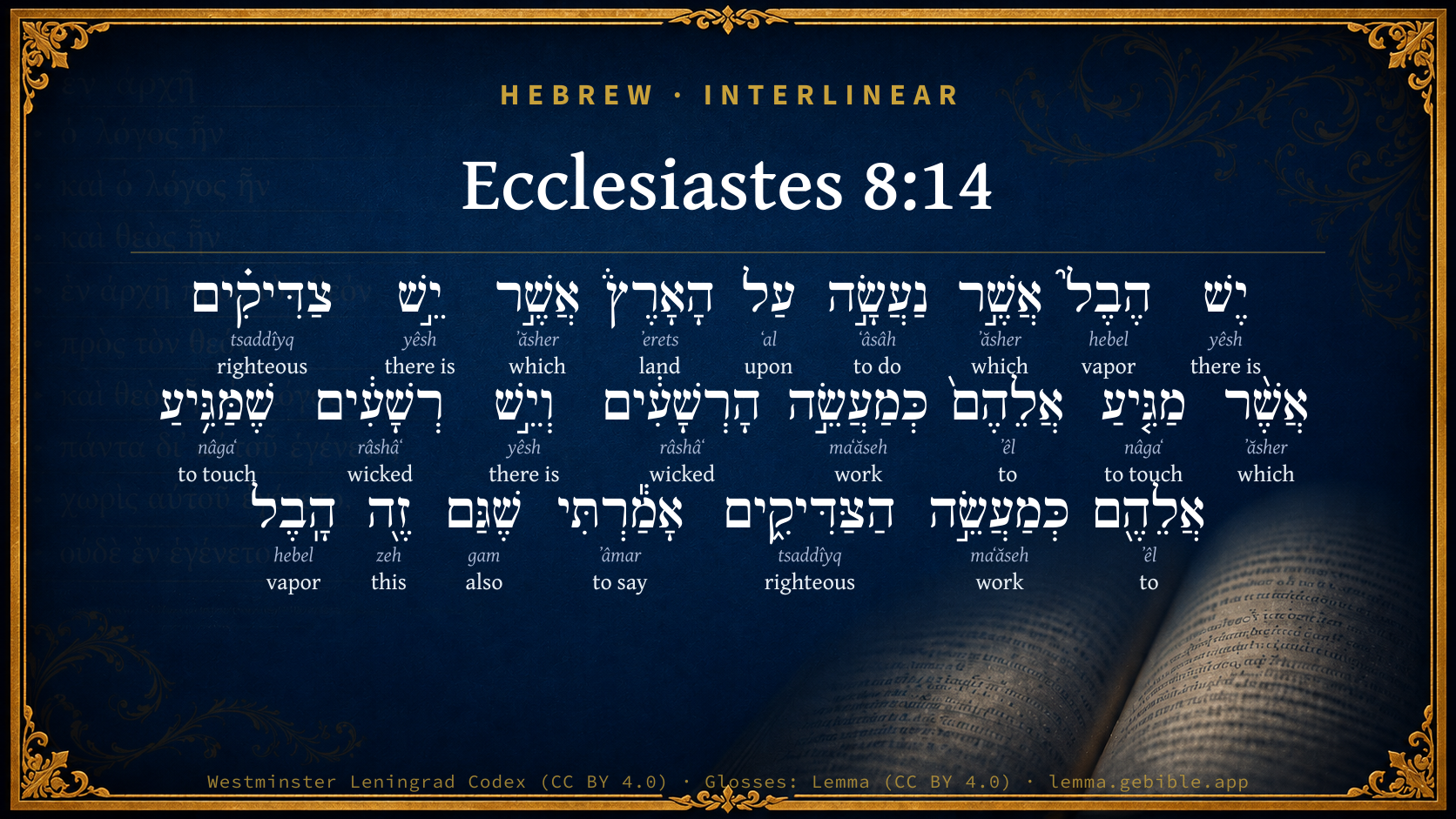
Hebrew (Westminster Leningrad Codex) Ecclesiastes 8:14 appears in the Hebrew Old Testament. The text above is from the Westminster Leningrad Codex. Each word links to its Strong’s number, a concise gloss, and parsing drawn from the Open Scriptures Hebrew Bible morphology. Click any word for its full Brown-Driver-Briggs (BDB) entry.
Download image
Cite this verse

Ecclesiastes 8:14 (World English Bible). Public Domain. Lemma interlinear Bible study tool, https://lemma.gebible.app/v/ecclesiastes/8/14.

Show BibTeX & RIS
BibTeX
RIS
English Translation
There is a vanity which is done on the earth, that there are righteous men to whom it happens according to the work of the wicked. Again, there are wicked men to whom it happens according to the work of the righteous. I said that this also is vanity.
World English Bible · Public Domain
Download a study sheet

One document with this verse’s original text, its word-by-word gloss line, the meaning frame, cross-references with their text, attributed commentary, and full source and license credits — printable, and it pastes into notes with its structure intact.

This verse Autodidact and up

Study sheet (.html) Plain text (.txt)

A passage Seminary Student

Up to 50 verses in one chapter. A passage sheet keeps up to 6 commentary sources and 12 cross-references per verse, in the order this page ranks them, and says so on the sheet whenever that leaves anything out. Ask for a single verse and you get the Autodidact verse sheet above.

Everything on this page stays free to read, with no account — the sheet is a download of what is already on screen, not access to it.

Want to remove ads? Support Godless Engineer
Compare translations 3

The same verse in 3 English versions, stacked beneath the original-language interlinear above. Click any original word for its lexicon entry.

Each is an independent rendering of the whole verse — the interlinear is not word-aligned to these translations.

Highlighted words mark where these versions differ — a whole-verse word diff, not a word-by-word alignment.

  • World English Bible Public Domain
    There is a vanity which is done on the earth, that there are righteous men to whom it happens according to the work of the wicked. Again, there are wicked men to whom it happens according to the work of the righteous. I said that this also is vanity.
  • King James Version Public Domain
    There is a vanity which is done upon the earth; that there be just men, unto whom it happeneth according to the work of the wicked; again, there be wicked men, to whom it happeneth according to the work of the righteous: I said that this also is vanity.
  • unfoldingWord Literal Text CC BY-SA 4.0
    There is vapor that is done on the earth: that there are righteous people who befalls to them like the deeds of the wicked people, and there are wicked people who befalls to them like the deeds of the righteous people. I say that also this vapor.

unfoldingWord Literal Text — © unfoldingWord, licensed CC BY-SA 4.0. Word-aligned USFM3 via Door43 (git.door43.org/unfoldingWord/en_ult).

Versions to compare (up to 4)

3 of 4 selected

Show all 18 translations

Every available English version of this verse, each an independent rendering of the whole verse.

  • World English Bible Public Domain
    There is a vanity which is done on the earth, that there are righteous men to whom it happens according to the work of the wicked. Again, there are wicked men to whom it happens according to the work of the righteous. I said that this also is vanity.
  • Berean Standard Bible Public Domain
    There is a futility that is done on the earth: There are righteous men who get what the actions of the wicked deserve, and there are wicked men who get what the actions of the righteous deserve. I say that this too is futile.
  • Majority Standard Bible Public Domain
    There is a futility that is done on the earth: There are righteous men who get what the actions of the wicked deserve, and there are wicked men who get what the actions of the righteous deserve. I say that this too is futile.
  • King James Version Public Domain
    There is a vanity which is done upon the earth; that there be just men, unto whom it happeneth according to the work of the wicked; again, there be wicked men, to whom it happeneth according to the work of the righteous: I said that this also is vanity.
  • American Standard Version (1901) Public Domain
    There is a vanity which is done upon the earth, that there are righteous men unto whom it happeneth according to the work of the wicked; again, there are wicked men to whom it happeneth according to the work of the righteous: I said that this also is vanity.
  • Revised Version (1885) Public Domain
    There is a vanity which is done upon the earth; that there be righteous men, unto whom it happeneth according to the work of the wicked; again, there be wicked men, to whom it happeneth according to the work of the righteous: I said that this also is vanity.
  • Geneva Bible (1599) Public Domain
    There is a vanitie, which is done vpon the earth, that there be righteous men to whom it commeth according to the worke of the wicked: and there be wicked men to whom it commeth according to the worke of the iust: I thought also that this is vanitie.
  • Douay-Rheims (1899) Public Domain
    There is also another vanity, which is done upon the earth. There are just men to whom evils happen, as though they had done the works of the wicked: and there are wicked men, who are as secure, as though they had the deeds of the just: but this also I judge most vain.
  • Young's Literal Translation Public Domain
    There is a vanity that hath been done upon the earth, that there are righteous ones unto whom it is coming according to the work of the wicked, and there are wicked ones unto whom it is coming according to the work of the righteous. I have said that this also `is' vanity.
  • Literal Standard Version CC BY-SA 4.0
    There is a vanity that has been done on the earth, that there are righteous ones to whom it is coming according to the work of the wicked, and there are wicked ones to whom it is coming according to the work of the righteous. I have said that this [is] also vanity.
  • Unlocked Literal Bible CC BY-SA 4.0
    There is another useless vapor—something else that is done on the earth. Things happen to righteous people as they happen to wicked people, and things happen to wicked people as they happen to righteous people. I say that this also is useless vapor.
  • unfoldingWord Literal Text CC BY-SA 4.0
    There is vapor that is done on the earth: that there are righteous people who befalls to them like the deeds of the wicked people, and there are wicked people who befalls to them like the deeds of the righteous people. I say that also this vapor.
  • Darby Bible Public Domain
    There is a vanity which is done upon the earth; that there are righteous [men] unto whom it happeneth according to the work of the wicked; and there are wicked [men] to whom it happeneth according to the work of the righteous. I said that this also is vanity.
  • World Messianic Bible Public Domain
    There is a vanity which is done on the earth, that there are righteous men to whom it happens according to the work of the wicked. Again, there are wicked men to whom it happens according to the work of the righteous. I said that this also is vanity.
  • Webster's Bible Public Domain
    There is a vanity which is done upon the earth; that there are just men, to whom it happeneth according to the work of the wicked; again, there are wicked men, to whom it happeneth according to the work of the righteous: I said that this also is vanity.
  • Free Bible Version CC BY-SA 4.0
    Another thing that is hard to understand is this: good people are treated as the wicked should be, and the wicked are treated as good people should be. As I say, this is difficult to comprehend!
  • Bible in Basic English Public Domain
    There is a thing which is to no purpose done on the earth: that there are good men to whom is given the same punishment as those who are evil, and there are evil men who get the reward of the good. I say that this again is to no purpose.
  • JPS Tanakh (1917) Public Domain
    There is a vanity which is done upon the earth: that there are righteous men, unto whom it happeneth according to the work of the wicked; again, there are wicked men, to whom it happeneth according to the work of the righteous — I said that this also is vanity.

Literal Standard Version (2020), Covenant Press — licensed CC BY-SA 4.0. Text via the HelloAO Bible API (eBible.org). Unlocked Literal Bible (unfoldingWord) — licensed CC BY-SA 4.0. Text via the HelloAO Bible API (eBible.org). unfoldingWord Literal Text — © unfoldingWord, licensed CC BY-SA 4.0. Word-aligned USFM3 via Door43 (git.door43.org/unfoldingWord/en_ult). Free Bible Version, Dr. Jonathan Gallagher — licensed CC BY-SA 4.0. Text via the HelloAO Bible API (eBible.org).

Word by word

More ways to search: Search by grammar → Find every occurrence → Compare this word →

Practice this passage: Drill this verse → Learn its vocabulary →

הֶבֶל֮
hebel
H1892
“vapor”
Noun, Common, Masculine, Singular, Absolute
Part of Speech
Noun
Type
Common
Gender
Masculine
Number
Singular
State
Absolute
Full BDB Definition

Origin: from H1891

TWOT: 463a

vapour, breath - breath, vapour - vanity (figuratively) - vainly
  1. יֶשׁ yêsh H3426 “there is” Particle, Demonstrative
  2. אֲשֶׁ֣ר ʼăsher H834 “which” Particle, Relative
  3. נַעֲשָׂ֣ה ʻâsâh H6213 “to do” Verb, Niphal, Perfect, 3rd Person, Masculine, Singular
  4. עַל ʻal H5921 “upon” Preposition
  5. הָאָרֶץ֒ ʼerets H776 “the · land” Particle, Definite Article + Noun, Common, Both, Singular, Absolute
  6. אֲשֶׁ֣ר ʼăsher H834 “which” Particle, Relative
  7. יֵ֣שׁ yêsh H3426 “there is” Particle, Demonstrative
  8. צַדִּיקִ֗ים tsaddîyq H6662 “righteous” Adjective, Adjective, Masculine, Plural, Absolute
  9. אֲשֶׁ֨ר ʼăsher H834 “which” Particle, Relative
  10. מַגִּ֤יעַ nâgaʻ H5060 “touching” Verb, Hiphil, Participle Active, Masculine, Singular, Absolute
  11. אֲלֵהֶם֙ ʼêl H413 “to · them” Preposition + Suffix, Personal, 3rd Person, Masculine, Plural
  12. כְּמַעֲשֵׂ֣ה maʻăseh H4639 “like/as · work of” Preposition + Noun, Common, Masculine, Singular, Construct
  13. הָרְשָׁעִ֔ים râshâʻ H7563 “the · wicked” Particle, Definite Article + Adjective, Adjective, Masculine, Plural, Absolute
  14. וְיֵ֣שׁ yêsh H3426 “and · there is” Conjunction + Particle, Demonstrative
  15. רְשָׁעִ֔ים râshâʻ H7563 “wicked” Adjective, Adjective, Masculine, Plural, Absolute
  16. שֶׁמַּגִּ֥יעַ nâgaʻ H5060 “who/which · touching” Particle, Relative + Verb, Hiphil, Participle Active, Masculine, Singular, Absolute
  17. אֲלֵהֶ֖ם ʼêl H413 “to · them” Preposition + Suffix, Personal, 3rd Person, Masculine, Plural
  18. כְּמַעֲשֵׂ֣ה maʻăseh H4639 “like/as · work of” Preposition + Noun, Common, Masculine, Singular, Construct
  19. הַצַּדִּיקִ֑ים tsaddîyq H6662 “the · righteous” Particle, Definite Article + Adjective, Adjective, Masculine, Plural, Absolute
  20. אָמַ֕רְתִּי ʼâmar H559 “to say” Verb, Qal, Perfect, 1st Person, Common, Singular
  21. שֶׁגַּם gam H1571 “who/which · also” Particle, Relative + Adverb
  22. זֶ֖ה zeh H2088 “this” Pronoun, Demonstrative, Masculine, Singular
  23. הָֽבֶל hebel H1892 “vapor” Noun, Common, Masculine, Singular, Absolute

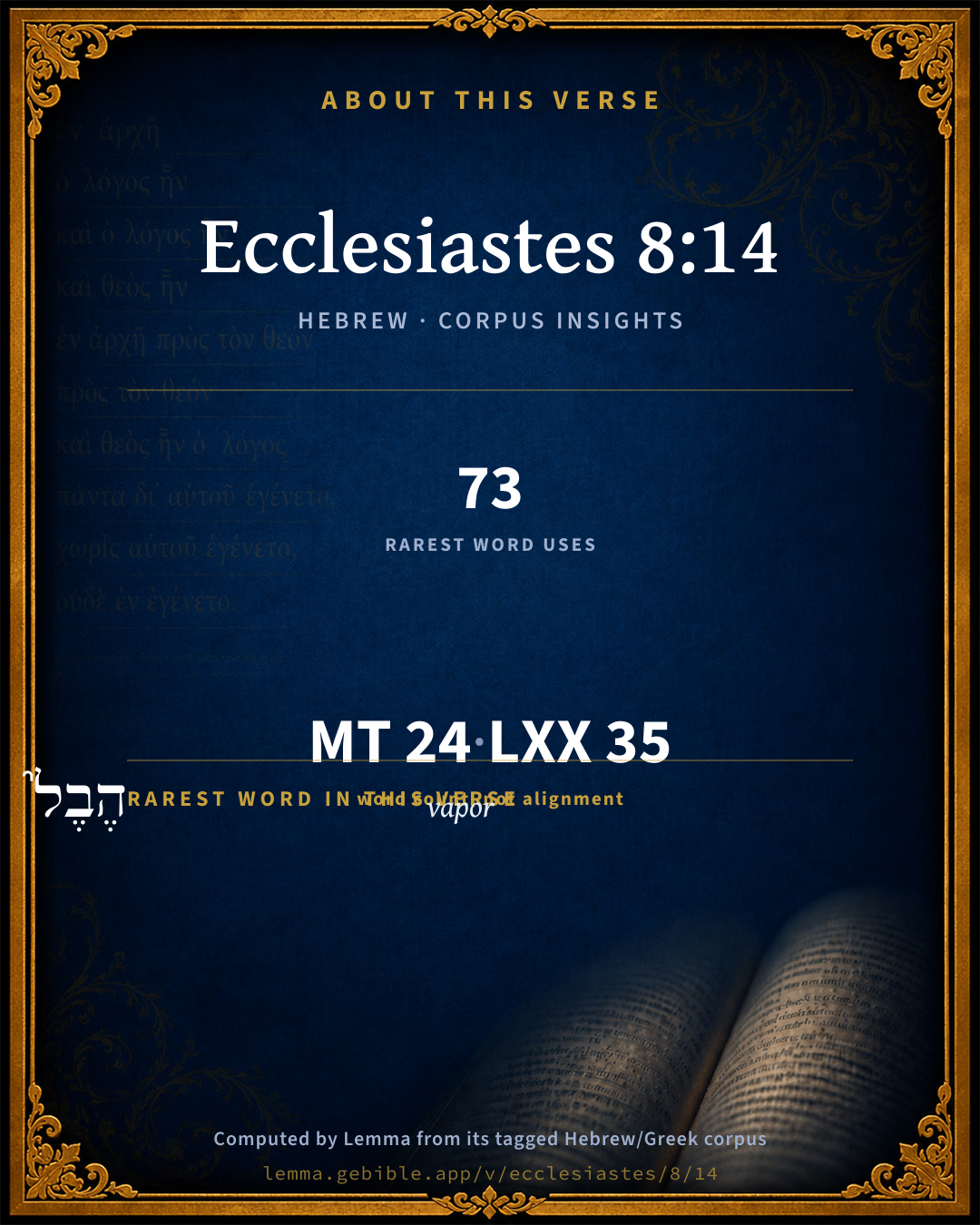
About this verse

These counts appear in no published source. They are computed here, from the morphology-tagged text and Lemma’s own curated glosses. What Lemma adds →

24
words
14
distinct lemmas
Wisdom
section

Grammatical profile

  • 4 verbs
  • 5 nouns
  • 4 adjectives
  • 1 pronoun
  • 3 prepositions
  • 1 adverb
  • 6 particles

Verb forms

  • נַעֲשָׂ֣ה Niphal · Perfect
  • מַגִּ֤יעַ Hiphil · Participle Active
  • שֶׁמַּגִּ֥יעַ Hiphil · Participle Active
  • אָמַ֕רְתִּי Qal · Perfect

Repetition

Words recur within this verse — often emphatic in Hebrew:

  • יֶשׁ there is H3426 ×3
  • הֶבֶל֮ vapor H1892 ×2
  • צַדִּיקִ֗ים righteous H6662 ×2
  • מַגִּ֤יעַ to touch H5060 ×2
  • כְּמַעֲשֵׂ֣ה work H4639 ×2
  • הָרְשָׁעִ֔ים wicked H7563 ×2
  • אֲשֶׁ֣ר which H834 ×3
  • אֲלֵהֶם֙ to H413 ×2

Hebrew & Septuagint length

In English translation the verse runs 49 words from the Hebrew and 48 from the Septuagint (LXX English) — closely comparable.

A rough comparison of the two English renderings, which tokenize alike — not a word-level alignment.

Word counts can differ between the Hebrew and the Greek without any difference in meaning — e.g. the Hebrew direct-object marker אֵת has no separate Greek word, and Greek often adds the article ὁ.

In the original languages it is 24 Hebrew tokens and 35 Greek tokens — but the two are counted differently (Hebrew bundles its prefixes and suffixes into one token; the Greek is in lemma form), so that isn’t a like-for-like length.

Cross-references

14

Topical passages linked to Ecclesiastes 8:14 in the Treasury of Scripture Knowledge — connected by theme and wording, ordered by reader-vote popularity; previews shown in the World English Bible.

  • Ecclesiastes 7:15 All this have I seen in my days of vanity: there is a righteous man who perishes in his righteousness, and there is a wicked man who lives long in his evil-doing.
  • Ecclesiastes 2:14 The wise man's eyes are in his head, and the fool walks in darkness--and yet I perceived that one event happens to them all.
  • Malachi 3:15 Now we call the proud happy; yes, those who work wickedness are built up; yes, they tempt God, and escape.'
  • Ecclesiastes 9:1–3 For all this I laid to my heart, even to explore all this: that the righteous, and the wise, and their works, are in the hand of God; whether it is love or hatred, man doesn't know it; all is before them.
  • Job 21:7 "Why do the wicked live, Become old, yes, and grow mighty in power?
  • Psalms 73:3 For I was envious of the arrogant, When I saw the prosperity of the wicked.
  • Psalms 73:12–14 Behold, these are the wicked. Being always at ease, they increase in riches.
  • Job 9:22–24 "It is all the same. Therefore I say, He destroys the blameless and the wicked.
  • Job 21:17–34 "How often is it that the lamp of the wicked is put out? That their calamity comes on them? That God distributes sorrows in his anger?
  • Job 24:21–25 He devours the barren who don't bear. He shows no kindness to the widow.
  • Ecclesiastes 4:4 Then I saw all the labor and achievement that is the envy of a man's neighbor. This also is vanity and a striving after wind.
  • Ecclesiastes 4:8 There is one who is alone, and he has neither son nor brother. There is no end to all of his labor, neither are his eyes satisfied with wealth. For whom then, do I labor, and deprive my soul of enjoyment? This also is vanity, yes, it is a miserable business.
  • Ecclesiastes 10:5 There is an evil which I have seen under the sun, the sort of error which proceeds from the ruler.
  • Jeremiah 12:1 Righteous are you, Yahweh, when I contend with you; yet would I reason the cause with you: why does the way of the wicked prosper? why are all they at ease who deal very treacherously?

Cross-references courtesy of OpenBible.info (CC BY 4.0).

Hebrew and Greek witnesses Masoretic Hebrew ↔ Greek Septuagint

The same verse in the two great witnesses to the Old Testament, shown verse-for-verse.

These are two independent witnesses, not word-aligned to each other, and the Septuagint is shown in lemma (dictionary) form.

Hebrew Ecclesiastes 8:14 Masoretic · Westminster Leningrad Codex

יֶשׁ הֶבֶל֮ אֲשֶׁ֣ר נַעֲשָׂ֣ה עַל הָאָרֶץ֒ אֲשֶׁ֣ר יֵ֣שׁ צַדִּיקִ֗ים אֲשֶׁ֨ר מַגִּ֤יעַ אֲלֵהֶם֙ כְּמַעֲשֵׂ֣ה הָרְשָׁעִ֔ים וְיֵ֣שׁ רְשָׁעִ֔ים שֶׁמַּגִּ֥יעַ אֲלֵהֶ֖ם כְּמַעֲשֵׂ֣ה הַצַּדִּיקִ֑ים אָמַ֕רְתִּי שֶׁגַּם זֶ֖ה הָֽבֶל

There is a vanity which is done on the earth, that there are righteous men to whom it happens according to the work of the wicked. Again, there are wicked men to whom it happens according to the work of the righteous. I said that this also is vanity.

World English Bible · Public Domain

Greek LXX Ecclesiastes 8:14 Septuagint · lemma form

εἰμί ματαιότης ὅς ποιέω ἐπί ὁ γῆ ὅτι εἰμί δίκαιος ὅτι φθάνω πρός αὐτός ὡς ποίημα ὁ ἀσεβής καί εἰμί ἀσεβής ὅτι φθάνω πρός αὐτός ὡς ποίημα ὁ δίκαιος εἶπον ὅτι καί γέ οὗτος ματαιότης

There is a vanity which is done upon the earth; that there are righteous persons to whom it happens according to the doing of the ungodly; and there are ungodly men, to whom it happens according to the doing of the just: I said, This is also vanity.

LXX2012 (modern English Septuagint) · Public Domain

On this verse, Keil & Delitzsch discusses the Septuagint’s reading. Read the note in Commentary ↓

Hebrew: Westminster Leningrad Codex (CC BY 4.0). Greek: Septuagint (public domain); English from LXX2012 (modern English Septuagint) (Public Domain). How the Septuagint differs from the Hebrew →

Commentary

Notes on Ecclesiastes 8:14 from classic Christian and Jewish commentators (each source and its license shown beneath its notes). The classic Christian expositions comment on the surrounding passage and are grouped to its opening verse, so a note may address several verses; the Jewish commentaries on the Tanakh (Rashi and others) are per-verse, so they appear only where the commentator wrote on this verse.

Lemma curates 59 commentaries, every one of them public domain or Creative Commons licensed, each selected and text-cleaned for this edition rather than reprinted as found. About our sources →

Matthew Henry's Commentary

Wise and good men have, of old, been perplexed with this difficulty, how the prosperity of the wicked and the troubles of the righteous can be reconciled with the holiness and goodness of the God that governs the world. Concerning this Solomon here gives us his advice.

I. He would not have us to be surprised at it, as though some strange thing happened, for he himself saw it in his days, Ecc 8:14. 1. He saw just men to whom it happened according to the work of the wicked, who, notwithstanding their righteousness, suffered very hard things, and continued long to do so, as if they were to be punished for some great wickedness. 2. He saw wicked men to whom it happened according to the work of the righteous, who prospered as remarkably as if they had been rewarded for some good deed, and that from themselves, from God, from men. We see the just troubled and perplexed in their own minds, the wicked easy, fearless, and secure, - the just crossed and afflicted by the divine Providence, the wicked prosperous, successful, and smiled upon, - the just, censured, reproached, and run down, by the higher powers, the wicked applauded and preferred.

II. He would have us to take occasion hence, not to charge God with iniquity, but to charge the world with vanity. No fault is to be found with God; but, as to the world, This is vanity upon the earth, and again, This is also vanity, that is, it is a certain evidence that the things of this world are not the best things nor were ever designed to make a portion and happiness for us, for, if they had, God would not have allotted so much of this world's wealth to his worst enemies and so much of its troubles to his best friends; there must therefore be another life after this the joys and griefs of which must be real and substantial, and able to make men truly happy or truly miserable, for this world does neither.

III. He would have us not to fret and perplex ourselves about it, or make ourselves uneasy, but cheerfully to enjoy what God has given us in the world, to be content with it and make the best of it, though it be much better with others, and such as we think very unworthy (Ecc 8:15): Then I commended joy, a holy security and serenity of mind, arising from a confidence in God, and his power, providence, and promise, because a man has no better thing under the sun (though a good man has much better things above the sun) than to eat and drink, that is, soberly and thankfully to make use of the things of this life according as his rank is, and to be cheerful, whatever happens, for that shall abide with him of his labour. That is all the fruit he has for himself of the pains that he takes in the business of the world; let him therefore take it, and much good may it do him; and let him not deny himself that, out of a peevish discontent because the world does not go as he would have it. That shall abide with him during the days of his life which God gives him under the sun. Our present life is a life under the sun, but we look for the life of the world to come, which will commence and continue when the sun shall be turned into darkness and shine no more. This present life must be reckoned by days; this life is given us, and the days of it are allotted to us, by the counsel of God, and therefore while it does last we must accommodate ourselves to the will of God and study to answer the ends of life.

IV. He would not have us undertake to give a reason for that which God does, for his way is in the sea and his path in the great waters, past finding out, and therefore we must be contentedly and piously ignorant of the meaning of God's proceedings in the government of the world, Ecc 8:16, Ecc 8:17. Here he shows, 1. That both he himself and many others had very closely studied the point, and searched far into the reasons of the prosperity of the wicked and the afflictions of the righteous. He, for his part, had applied his heart to know this wisdom, and to see the business that is done, by the divine Providence, upon the earth, to find out if there were any certain scheme, any constant rule or method, by which the affairs of this lower world were administered, any course of government as sure and steady as the course of nature, so that by what is done now we might as certainly foretel what will be done next as by the moon's changing now we can foretel when it will be at the full; this he would fain have found out. Others had likewise set themselves to make this enquiry with so close an application that they could not find time for sleep, either day or night, nor find in their hearts to sleep, so full of anxiety were they about these things. Some think Solomon speaks of himself, that he was so eager in prosecuting this great enquiry that he could not sleep for thinking of it. 2. That it was all labour in vain, Ecc 8:17. When we look upon all the works of God and his providence, and compare one part with another, we cannot find that there is any such certain method by which the work that is done under the sun is directed; we cannot discover any key by which to decipher the character, nor by consulting precedents can we know the practice of this court, nor what the judgment will be. [1.] Though a man be ever so industrious, thou he labour to seek it out. [2.] Though he be ever so ingenious, though he be a wise man in other things, and can fathom the counsels of kings themselves and trace them by their footsteps. Nay, [3.] Though he be very confident of success, though he think to know it, yet he shall not; he cannot find it out. God's ways are above ours, nor is he tied to his own former ways, but his judgments are a great deep.

Matthew Henry's Commentary on the Whole Bible (1708–1710) — public domain (CC PDM 1.0). Text via the HelloAO Bible API.

Jamieson, Fausset & Brown

Robert Jamieson, A. R. Fausset & David Brown

An objection is here started (entertained by Solomon in his apostasy), as in Ecc 3:16; Ecc 7:15, to the truth of retributive justice, from the fact of the just and the wicked not now receiving always according to their respective deserts; a cavil, which would seem the more weighty to men living under the Mosaic covenant of temporal sanctions. The objector adds, as Solomon had said, that the worldling's pursuits are "vanity" (Ecc 8:10), "I say (not 'said') this also is vanity. Then I commend mirth," &c. [HOLDEN]. Ecc 8:14-15 may, however, be explained as teaching a cheerful, thankful use of God's gifts "under the sun," that is, not making them the chief good, as sensualists do, which Ecc 2:2; Ecc 7:2, forbid; but in "the fear of God," as Ecc 3:12; Ecc 5:18; Ecc 7:18; Ecc 9:7, opposed to the abstinence of the self-righteous ascetic (Ecc 7:16), and of the miser (Ecc 5:17).

Jamieson, Fausset & Brown — Commentary Critical and Explanatory on the Whole Bible (1871) — public domain (CC PDM 1.0). Text via the HelloAO Bible API.

Trapp's Complete Commentary

John Trapp

Ecc 8:14 There is a vanity which is done upon the earth; that there be just [men], unto whom it happeneth according to the work of the wicked; again, there be wicked [men], to whom it happeneth according to the work of the righteous: I said that this also [is] vanity.

Ver. 14. There is a vanity which is done upon the earth.] Symmachus reads it thus: Est difficile cognitu quod sit super terram, There is that done upon the earth that is hard to be understood. It hath gravelled great divines - as David, Jeremiah, Habakkuk {Psa 73:3-9 Jer 12:1-2 Hab 2:4-5 Lam 3:33} - to see good men suffer, bad men prosper. But it is but upon the earth that this befalls: here God must meet with his people, or nowhere, and it is non nisi coactus, as that emperor said of himself, that he doth anything to their grief:

“ Ille dolet quoties cogitur esse ferox. ”

An unruly patient makes a cruel physician. {a} And as for the wicked, it is but "upon earth" that they live in pleasure, and lie melting in sensual and sinful delights, "nourishing their hearts as in a day of slaughter." {Jas 5:5} Once they shall hear with horror, "Son, remember that thou in thy life time receivedst thy good things, and likewise Lazarus evil things: but now he is comforted, and thou art tormented." {Luk 16:25} The meditation of eternity would much mitigate this vanity. What is that to the infinite? said the old Lord Brook to a friend of his, discoursing of an incident matter very considerable, but was taken off with this quick interrogation of that wise and noble person. {b}

{a} Crudelem medicum intemperans aeger facit. - Mimus.

{b} Dr Hall’s Remedy of Profaneness, p. 114.

John Trapp, A Commentary or Exposition upon All the Books of the Old and New Testament (1647–1656) — public domain. Text from a community e-Sword module.

The Biblical Illustrator

Joseph S. Exell

Ecc_8:14

There be just men, unto whom it happeneth according to the work of the wicked.

Apparent discrepancy between character and circumstances

There is doubtless a law for everything in heaven and on earth; a systematic connection between cause and effect, alike in the physical, moral and spiritual existences. Our wise men acknowledge this, and find in the heavens above and the earth beneath, as far as their intellects can penetrate, a sequence and an irrevocable destiny in everything they study. But as for the laws that morally govern the world, that give rise to its convulsions and preserve its peace, that dismay us now and overjoy us then, that frustrate our plans or help us to attain our desires, from the dismemberment of a kingdom to the trivialities of existence--these laws are unwritten. The Almighty has set the machinery of nature in motion, and its action is unchangeable till its destiny is attained. But He sits with the sceptre of His moral government in His hands, and the rules by which He governs, and the ends He means to attain, we know not; and it is this ignorance of the Almightys plans which baffles our little hopes. It is with this dissimilitude of events as they occur with those we had hoped and striven for, and by probability led ourselves to expect, that our text has to do. It deals with the apparent reversal in many cases of an ordinary law, and shows the utter impossibility of human minds gaining any clue to the moral events which happen, or may happen, around us. Men make use of their limited wisdom to produce a desired effect. If that effect is not gained they abandon their attempts. The initiative is their own, and they abandon it as they please. Far otherwise is it, however, in matters of moral or spiritual import. The initiative is not mans, but the Almightys. Eternal life is not a bait held out for our greed to clutch at, but rather a spontaneous reward for our obedience and love. That this is clearly a principle, our text teaches, and everyday life verifies. The good man in this world often meets with the treatment, and is placed in the circumstances, which attend the career of the vilest; while the wicked man oft sits in the highest place, and mockingly sways his prostrate courtiers with the arrogant pretentiousness of a usurped power. He thinks his position is the reward of his genius, and scoffs at the idea of anything having to do with his elevation but himself. These reversed positions clearly show that the reward or punishment of the good or wicked does not necessarily begin, and clearly does not end, with this mortal life. This, to a good man, is a source of joy. He forgets his present ignominy in his future hopes: the present calamity he takes as an earnest for his future bliss. The wicked man, however, often has somewhat of his own way in the world. He takes the present as his all, and is satisfied therewith. He wants no future reward: his enjoyment now is ample, and instead of taking warning from the position of the good man as indicative of what his position ought possibly to be, his gratified senses and pampered vanity stifle his reason and destroy his conscience, and he descends to the grave in a false position to open his appalled eyes in the one belonging to him. (Homilist.)

The Biblical Illustrator, edited by Joseph S. Exell (c. 1880s–1900s) — public domain. Text from a community e-Sword module.

Joseph Benson's Commentary

Ecc 8:14-15. There is a vanity which is done upon the earth — Either by wicked potentates, who do commonly advance unworthy men, and oppress persons of the greatest virtue and merit: or, by God’s providence, who sees it fit for many weighty reasons so to manage the affairs of the present world. To whom it happeneth, &c. — Who meet with such usage as the worst of men deserve. There be wicked men to whom it happeneth — Who, instead of those punishments which they deserve, receive those rewards which are due to virtuous men. This also is vanity — This is a very unreasonable thing, if it be considered without respect unto another life, as it is here, where Solomon is discoursing of the vanity of the present life, and of the impossibility of finding satisfaction and happiness in it. Then I commended mirth — Hebrew, השׂמחה, joy or gladness. Upon these considerations I concluded, that it was most advisable for a man not to perplex and torment himself with the thoughts of the seeming inequality of the dispensations of Divine Providence, and of the great disorders which are in the world, or with cares and fears about future temporal events, or with insatiable desires of worldly things, but quietly, cheerfully, and thankfully to enjoy the comforts which God gives him. See notes on Ecc 2:24; Ecc 3:12-13; for that shall abide with him of his labour, &c. — This is the best advantage which he can make of this world’s goods, as to the present life.

Joseph Benson's Commentary on the Old and New Testaments (1811–1818) — public domain. Text from a community e-Sword module.

The Preacher's Complete Homiletical Commentary

Joseph S. Exell (gen. ed.)

CRITICAL NOTES.—

Ecc_8:14. There is a vanity which is done upon the earth.] These seeming anomalies in the moral government of God are part of that vanity to which man has been made subject on account of sin.

Ecc_8:16. And to see the business that is done upon the earth.] Travail, or torment; not business. Compare with Chap. Ecc_2:26, and Ecc_3:10. The painful labour of seriously considering human life and destiny. Neither day nor night seeth sleep with his eyes.] The “travail” is so earnestly carried on as to interfere with proper rest.

Ecc_8:17. All the work of God.] His universal dominion—the whole sphere of the Divine operation as observed by man. He shall not find it.] He shall not be able to comprehend, or fathom it. Compare with Chap. Ecc_3:11, and Ecc_7:24.

MAIN HOMILETICS OF THE PARAGRAPH.—Ecc_8:14-17

OUR DUTY UNDER THE MORAL DISCREPANCIES OF THE PRESENT LIFE

The origin of evil is a profound mystery, but not less so is the permission of evil. These exercise the wisest with painful speculation; they remain a difficulty and a sore trial, even for the best. Still there is a course of duty which is clear, and a light of faith which is sufficient. There are moral discrepancies in the present life (Ecc_8:14), but they do not set aside great moral duties, and wise efforts to reach after a more satisfactory state of things, which God, in his own good time, shall bring in. Our duty is indicated here.

I. We Should Feel their Temporary Character. “I said that this also is vanity.” We see the wicked prosper as if they were rewarded for their works, and the good afflicted, and abandoned to cruel wrongs and oppressions, as if they were punished for their righteousness. We must survey this seeming confusion of right and wrong not with wild amazement, but calmly. It is our duty to explore our situation in the world, and to discover what course is best for us. The just man beaten down by calamity, while he beholds the wicked apparently enjoying the rewards of virtue, may feel a strange perplexity. But he has to consider that even this is “vanity.” There is little in it to cause him any permanent anxiety or pain. He may reflect—

1. That these discrepancies exist under the rule of a Moral Governor who is both wise and good. Physical and moral evil exist in the world. God is both wise and good. We must admit these two facts as beyond debate. However difficult their reconcilement may be, we are bound to believe that no disorders of this present time can obscure those bright attributes of the Divine Nature. The good man has faith in the character of God, and waits till He shall make all clear.

2. Such a condition of things cannot be final. To a narrow view, it might appear as if Providence was entirely regardless of moral qualities in human character; yea, as if the stamp of approval was affixed to wickedness. Yet God’s meek and patient children know that these disorders cannot be endured for ever. They are but passing shadows, and the full glory of God will yet shine forth. The stern realities of things will appear in the light of eternity. Slowly the ages pass on for us; but to the eye of God they are but as “yesterday when it is past, and as a watch in the night.”

3. These moral discrepancies have no practical significance for us. If we are the true and faithful servants of God, these things to us are mere vanity. They amount to nothing. If we have a lively sense of the eternal verities, we can afford to despise them. What do they signify for us, since life is so short, and the scenes of retribution so soon to be unfolded? With such a thought, St. Paul consoles Christians even in slavery; “Art thou called being a servant (i.e., a bond-servant—a slave)? care not for it” (1Co_7:21). Nothing is of practical significance to the good man but those things that abide.

II. We should Enjoy with Contentment the Blessings that Remain. (Ecc_8:15.) The disordered condition of things may be puzzling; yea, in some of their aspects, disheartening; but there are present blessings. There are great facts and duties appearing in clear light. There is enough left which we may contentedly and soberly enjoy.

1. This enjoyment is reasonable. “Then I commended mirth because a man hath no better thing under the sun.” This is the best and most reasonable course for us, to cultivate a cheerful spirit which gladly enjoys whatever lies within its reach. In the worst state of things, there are some blessings remaining; and if God is the portion of our inheritance, we cannot be entirely destitute. Anxious care only brings torment, and leads to no good. It is the highest prudence to make the best of what lies before us. Besides, the godly are sustained by the consciousness of the good that is reserved for them.

2. It is the safe course. “For that shall abide with him.” Changes occur in the outward conditions of life, but the habit of cheerful gratitude abides with a man. It is to him an accession of spiritual treasure which the most disastrous reverses of fortune cannot alienate.

3. It is godly. The mirth here commended is not the coarse, thoughtless mirth of the children of this world, but that joy which flows from piety. It is the cheerful acceptance, on the part of the righteous man, of those blessings “which God giveth him under the sun.” Such a man hath faith in God, and is distinguished by that elevation of character which comes of taking a large and comprehensive view.

III. We should Abstain from Fruitless Speculations. (Ecc_8:16-17.) To enquire into “the business that is done upon the earth” is to investigate the “travail” that is connected with human life, action, and fate. But a wise man will not allow such speculations unduly to distress his mind, or to attract him from the paths of humble duty. We may say of such enquiries, when pushed beyond the bounds of soberness,

1. They are a wearisome effort. They may be carried so far as to interfere with present enjoyment, and even to rob us of the needful rest of sleep. (Ecc_8:16.)

2. They are a profitless effort. (Ecc_8:17.) The bottom of the mystery cannot be reached by the greatest labours of the wisest. To know “all the work of God” completely is far beyond our depth. God’s great secrets lie hidden.

3. They lead to no good practical result. That restless curiosity and impatience of mystery, which is the temptation of some minds, does but weaken the capacity for duty and humble trust in God. In the mazes of speculation a man may lose the clear sight of what lies before him. It is best to do what is close at hand, and to await in faith and hope the disclosures of futurity.

4. They interfere with our spiritual life. It is the plan of God to begin with what is comparatively imperfect, and to proceed to greater perfection. Thus chaos was before order, and darkness before light. This life is but the commencement of our existence, and it is marked by imperfection. Yet this imperfection is necessary to the life of faith. The full vision, which the future shall alone disclose, would interfere with that life. If we can see but one step before us, it is enough. Light, in the fulness of it, is a reward “sown for the righteous.” It is an “inheritance” reserved and guarded for us while we are in our minority, but into whose full possession we shall come when we have attained to the full manhood of our existence. Col_1:12.

SUGGESTIVE COMMENTS ON THE VERSES

Ecc_8:14. Look at Joseph in the dungeon. He has been a disciple of heavenly wisdom. He has resisted a strong temptation to sin, and it has happened to him according to the work of the wicked. He is loaded with reproach and shame—he is left to languish in prison, either forgotten or despised. Look at Paul bruised and bleeding, when he has been all but stoned to death at the gates of Lystra, or writhing under the cruel and ignominious scourge at Philippi, or dragged through the streets and beaten by the infuriated populace at Jerusalem. Or, once more, take a far more illustrious example than either of these—look at Him who was the very impersonation and living embodiment of wisdom. Was He not all His life long a man of sorrows and acquainted with grief? Was He not despised and rejected of men? And did He not terminate His earthly career upon a malefactor’s cross? [Buchanan.]

God rewards His people with better things than the perishing good of this life.

The righteous are often taught by the course of Providence that godliness cannot be turned to outward gain.

It is not certain that even the best men will have prosperity in this life, or any external reward of goodness. How vain then to set our hearts upon that which is not, and to lose sight of a certain and enduring reward!

The seeming confusion of good and evil in the world is part of the vanity of our present state. Faith sees this old order passing away and giving place to the new. The sons of God shall yet be delivered from this vanity.

Ecc_8:15. The measure of a man’s earthly prosperity, and of the success of his labour, is a matter of complete uncertainty, but a cheerful and contented spirit, disposed to enjoy whatever portion is sent, is a sure and constant blessing. The secret of happiness, as far as it depends on the things of time, is to enjoy prosperity cheerfully, and without the irksome and depressing apprehensions of an anxious mind, as long as it continues; and if it is lessened or withdrawn, still to receive our diminished and stinted supplies with the same cheerful and buoyant gratitude; thus making the best of that which, both in its degree and its continuance, is so proverbially uncertain. Amidst all changes, this happy frame of spirit may be preserved [Wardlaw].

Our labour is often in vain, our works perish; but the habit of cheerfulness, arising from the conviction that our portion of life is from God, abides with us. The possessions of the mind and soul survive all outward changes.

Of our labour, the most valuable remaining product—saved, as it were, from the wreck of it—is the spiritual dispositions which it has served to generate in us.

He who manifests the spirit of a pious and sober joy is imitating one of the qualities of the Divine nature. The reward of heaven consists in the entering into God’s own joy.

The Preacher having spoken of the oppressions of the wicked, and of the troubles of the righteous, here he showeth a good remedy against them, and an excellent carriage in them. “Then I commended mirth;” when he had considered the troubles of man’s life, then he commended cheerfulness as a thing worthy of praise in itself; he commended it unto men as a thing bringing much good unto them. And this it is which the prophet David commended, “Serve the Lord with gladness, come before His presence with singing” [Jermin].

Ecc_8:16. That wisdom which is possible to man can only be attained by the earnest application of all our powers.

He who engages in the study of the condition and character of man has laid upon himself a difficult and painful task. He has accepted the burden of humanity, thus attracting upon himself the penalty of restless anxiety and the sorrows of a disappointing search after that which must for ever lie beyond his reach.

The unreflecting multitude, whose minds are never exercised on such questions at all, have no conception of the amount both of time and effort which it costs to master them. They do not know, though it is a fact, that there are men who, in handling such profound problems as the mysteries of Divine Providence, in connection with the state and prospects of the human race, present, “neither day nor night see sleep will their eyes [Buchanan].

Ecc_8:17. There are works of God quite beyond the range of our observation, and which, therefore, we cannot fathom. But even those works of God which concern human affairs, though they lie near and about us, are beyond our capacity fully to explore.

A wise man may be tempted to impatience of mystery, and thus weary himself with fruitless endeavours to rest on the much-desired ground of ultimate truths. But it is the highest wisdom contentedly to accept the fact of our ignorance.

Mere human reason could do nothing to explain the origin or the existence, under the government of an all-wise, almighty, and infinitely righteous God, of a state of things in which it should ever happen to just men to be treated according to the deserts of the wicked, or to wicked men to be treated according to the deserts of the righteous. There is no human philosophy that could ever have thrown one ray of true and satisfying light on an anomaly so great. Even divine revelation itself, though it tells us how it came to pass, does not tell us why this was permitted. That it was permitted for God’s glory, we do indeed confidently infer and unhesitatingly believe, because that is and must be the grand final cause of all things. But still, as regards the principle that is to harmonize the existence of sin and misery in God’s universe with the infinite perfections of His own being, it is altogether hidden from us—it is far above and beyond the grasp, at least in its present feeble condition, of any human mind [Buchanan].

The Preacher's Complete Homiletical Commentary (gen. ed. Joseph S. Exell; Funk & Wagnalls, c. 1892) — public domain (pre-1929). A full-Bible homiletical/sermon-outline anthology covering 65 of 66 books (2 John is absent from the source module). Text from a community e-Sword module.

Geneva Bible (1599)

Geneva Bible translators

Which are punished as though they were wicked, as Eccl. 7:17.

Geneva Bible (1599) marginal notes — public domain. Text via Bolls.life.

Adam Clarke's Commentary

Verse 14. There be just men] See on Ec 7:16.

Adam Clarke's Commentary on the Bible (1810–1826) — public domain. Text from a community e-Sword/MySword module.

Ellicott's Commentary for English Readers

(14) Happeneth.—The word is used in this sense only in Est_9:26.

A Bible Commentary for English Readers, edited by Charles John Ellicott (1878–1897) — public domain. Text from a community e-Sword module.

The Cambridge Bible for Schools and Colleges

gen. ed. J. J. S. Perowne

14. There is a vanity] There is something almost painful in the iteration of the ever-recurring thought that after all there are disorders in the world. A modern writer, we feel, would have pruned, condensed, and avoided such a repetition of himself. We are dealing, however, with “Thoughts” like Pascal’s Pensées, rather than with a treatise, jotted down, it may be, day by day, as has been said before, on his tablets or his papyrus, and there is, as has been said before, something significant in the fact that, wherever the thinker turns, the same anomalies stare him in the face.

The Cambridge Bible for Schools and Colleges (gen. ed. J. J. S. Perowne; Cambridge University Press, 1878–1918) — public domain. Text from a community e-Sword module.

John Gill's Exposition

There is a vanity which is done upon the earth,.... Transacted in this lower world under the sun, through the permission and direction of divine Providence; not that it is a vanity on the part of God, who has wise ends to answer by it, for the good of his people, the trial of their graces, &c. or to bring sinners to repentance, or harden them in sin; but this shows the vanity and uncertainty of all worldly things, and that there is no happiness to be had in them;

that there be just men, unto whom it happeneth according to the work of the wicked: to whom evil comes, as the Targum and Jarchi; who are treated as if they were wicked men, and dealt with in providence as sinners would be, if they had the just desert of their wicked works; being attended with poverty, sickness, and disgrace, and other calamities of life, as Job, Asaph, Lazarus, and others, and yet truly righteous and good men;

again, there be wicked men to whom it happeneth according to the work of the righteous; to whom good things come, as the Targum and Jarchi; who have an affluence of good things, all the outward blessings of life, as health, wealth, honour, long life, &c. as if they had lived the best of lives, and were the most righteous persons upon earth; see Job 21:7;

I said, that this also is vanity; this is said, as some think, according to the judgment of corrupt nature; or as it is apprehended by such who do not rightly consider the judgments of God and the wisdom of Providence in the ordering of things to answer good purposes; or rather the sense is, this is one of the miseries and infelicities of this life, and which demonstrates the emptiness of all things here below, and that the chief good and supreme happiness is not to be had here; but there is and must be a future state, when all things will be set right, and everyone will have and enjoy his proper portion.

John Gill's Exposition of the Whole Bible (1746–1763) — public domain (CC PDM 1.0). Text via the HelloAO Bible API.

Albert Barnes' Notes on the Bible

Which is done upon the earth - The instance of vanity, to which these words are applied, is the seeming inequality of God’s justice; but if they are considered in connection with the profession of personal faith in God’s absolute justice Ecc 8:12, the conclusion is irresistible, that, whatever reason the Preacher had for reserve in declaring his belief, he certainly looked forward to final judgment in a future state of existence (compare Ecc 3:17; Ecc 12:14).

Albert Barnes' Notes on the Bible (1834–1885) — public domain. Text from a community e-Sword/MySword module.

Haydock's Catholic Bible Commentary

Vain, or afflicting. Hence some have denied Providence, Jeremias xii. 1. (Calmet)

George Leo Haydock (1774–1849), Haydock's Catholic Family Bible and Commentary, 1859 edition — public domain. Excludes Psalms (Douay-Rheims chapter numbering differs from Protestant) and Deuterocanonical books (Catholic canon only).

Matthew Poole's English Annotations

Which is done; either by wicked potentates, who do commonly advance unworthy men, and oppress persons of greatest virtue and merit; or by God’s providence, who sees it fit for many weighty reasons so to manage the affairs of the present world.

Unto whom it happeneth according to the work of the wicked, i.e. the merit of their work; the work being oft put for the recompence given or belonging to it, as Lev 19:13; Job 7:2; Psa 109:20. The sense is, who meets with such hard usage as the worst of men deserve.

To whom it happeneth according to the work of the righteous; who, instead of those just and dreadful punishments which they deserve by the laws of God and men, receive those encouragements and rewards which are due to virtuous and worthy men.

This also is vanity; this is a very unreasonable and foolish thing, if it be considered without respect unto another life, as it is here, where Solomon is discoursing of the vanity of the present life, and of the impossibility of finding satisfaction and happiness in it.

Matthew Poole's English Annotations on the Holy Bible (1683–1685) — public domain. Text from a community e-Sword/MySword module.

Whedon's Commentary on the Bible

Daniel D. Whedon

14. There is a vanity — This verse is a concession, and needs to be introduced by a concessive word, like still, however; rare words in Hebrew. The sufferings due the wicked seem sometimes appointed to the righteous, and the happiness due the righteous falls to the wicked. This unwelcome but stubborn fact seems to make all retribution look like “vanity.”

Daniel D. Whedon (gen. ed.), Commentary on the Old and New Testaments (1874–1909) — public domain. Text from a community e-Sword module.

The Pulpit Commentary

There is a vanity which is done upon the earth. The vanity is named in what follows, viz. the seeming injustice it, the distribution of good and evil. There be just men, unto whom it happeneth according to the work of the wicked (comp. ver. 10; Ecc_3:16) The melancholy fact is noted that the righteous often experience that fate with which the wicked,are threatened, which their conduct might be expected to bring upon them. The verb translated "happeneth" (nags), with el, "to come to," "strike against," is thus used only in later Hebrew, e.g. Est_9:26. According to the work of the righteous. The wicked meet with that outward prosperity and success which were thought to be the special reward of those who served God. The Vulgate is explanatory, "There are just men whom evils befall as if they did the works of the wicked; and there are wicked men who are as free from care as if they had the deeds of the just." Commenting on Job_34:10, Job_34:11, St. Gregory writes, "It is by no means always the case in this life that God renders to each man according to his work and according to his own ways. For both many who commit unlawful and wicked deeds he prevents of his free grace, and converts to works of holiness; and some who are devoted to good deeds he reproves by means of the scourge, and so afflicts those who please him, as though they were displeasing to him.... God doubtless so ordains it of his inestimable mercy, that both scourges should torture the just, lest their doings should elate them, and that the unjust should pass this life at least without punishment, because by their evil doings they are hastening onwards to those torments which are without end. For that the just are sometimes scourged in no way according to their deserts is shown by this history of Job. Elihu, therefore, would speak more truly it" he had said that there is not unmercifulness and iniquity in God, even when he seems not to render to men according to their ways. For even that which we do lint understand is brought forth from the righteous balance of secret judgment" ("Moral.," 24:44). Koheleth ends by repeating his melancholy refrain, I said that this also (indeed) is vanity. This conclusion, however, does not lead to despair or infidelity.

Vers. 14, 15.

A misunderstood providence and a mistaken judgment.

I THE MISUNDERSTOOD PROVIDENCE.

1. The providence is undeniable. "There be righteous men, unto whom it happeneth according to the work of the wicked;" and "there be wicked men, to whom it happeneth according to the work of the righteous." Of the former, Joseph, David, Job, Asaph, and Jeremiah were examples; as also the apostles and early Christians, the martyrs and confessors of the New Testament Church. Of the latter, Noah"s sons, who, though not themselves righteous, were saved in the ark; Pharaoh"s butler, who, though guilty of having conspired against the king"s life, was nevertheless spared; Haman, who for a time at least flourished, though he was essentially a bad man besides others may be cited as examples.

2. The providence is inevitable. The constitution of the world being what it is, and the human family interlaced and interdependent as it is, it is impossible but that calamities should sometimes fall upon the righteous, and blessings descend upon the heads of the wicked, and that occasionally even wicked men should be deliberately treated as if they were righteous, and righteous men rewarded as if they were wicked. Good men often suffer the consequences of other people"s evil deeds, and vice versa bad men reap the benefits of other people"s good works.

3. The providence is mysterious. That such things should occur in a world presided over by an all-wise and all-powerful as well as holy and just God, who loves righteousness and. hates iniquity, is undoubtedly "hard to be understood," and for the full solution of the enigma it is more than likely the clearer light of the future must be awaited.

1. The providence is symbolic. At least it has its counterpart in the spiritual world in the experience of Christ the Righteous One, who was numbered with transgressors, (Mar_15:28) and made sin for us, though he knew no sin; (2Co_5:21) and in that of believers, who, though personally sinful and unrighteous, are yet accepted as righteous in God"s sight, and treated as such on account of the righteousness of Christ (Rom_3:25, Rom_3:26; 1Co_1:30; 2Co_5:21; Eph_1:6) May this not in part explain the occurrence of such phenomena in actual life? Nevertheless, it often happens that:

4. The providence is misunderstood. Men because of it rush to conclusions that cannot be sustained as e.g. that there is no such thing as a providential government of the world, that the Supreme Being is indifferent to moral distinctions, that there is no profit in piety, and that no disadvantage follows on the practice of wickedness, and the like.

II THE MISTAKEN JUDGMENT.

1. The judgment is wrong. It may not be wrong to affirm that a man, more especially if good and wise, should eat, drink, and be merry, (Ecc_9:7) though such as do so are not always either good or; (Luk_12:19) but it certainly is not right to say that a man has nothing better to do under the sun than to eat, drink, and be merry. He who thinks so must have a low conception of both the nature and the destiny of man.

2. The reason is doubtful. That mirth will abide with a man in his labor all the days of his life. One fears this cannot be sustained as in perfect accord with experience. Inward happiness or joy in God may abide with a soul through every varying phase of external circumstances; it is not clear that so outward a thing as mirth, hilarity, satisfaction in creature-comforts, will abide with any to the close of life.

Learn:

1. To trust God even in the darkest and most mysterious providences.

2. To rejoice in God rather than in any of his creatures.

Vers. 14, 15.

One way out of perplexity.

The Preacher has just attained for a moment to higher ground, from which he may get a wider view of life with all its changes and anomalies (vers. 12, 13). His hope revives, his faith comes back. "For a moment he has pierced through the ring which has confined him to the interests of common life, and risen also above his own dark misgivings; and there has flashed across his soul for a moment the certainty that there is a power in the world that "makes for righteousness," a Divine and supreme law behind all the puzzles and anomalies of life, which will solve them all. He lays his hand on this, but he cannot grasp it" (Bradley.). The inequalities in human lot, the just suffering as though they had been wicked, the wicked prospering as though they had been righteous, afflict his heart once more (ver. 13). His recurrence so often to this perplexing phenomenon is almost painful; it reveals a distress so deep that no arguments can diminish it, no exercise of faith can charm it away. Nothing but fresh light upon the mysteries of life and death can give relief, and this is denied him. He is one of those of whom the Savior spoke (Luk_10:24) who desired to see and hear the things seen and heard by those who were privileged to receive a revelation of God in Christ, but whose longings were doomed never to be satisfied on earth. In the mean time to what conclusion did the Preacher come? To that which he has already expressed four times over (Ecc_2:24 Ecc_3:12, 22 5:18) that it is better to enjoy the good things of life than to pine after an impossible ideal; to eat the fruit of one"s toil in spite of all that is calculated to sadden and perplex (ver. 14). Yet we must be fair to him. He does not recommend riot and excess, or a life of mere epicurean enjoyment. There is work to be done in life before enjoyment is won; there is a God from whom the blessings come as a gift, and the remembrance of this fact will prevent mere brutish self, indulgence. The fear of God gives a dignity to his counsel which is wanting in the somewhat similar words of heathen poets, in which we have Epicureanism pure and simple in the songs of Anacreon and Horace and Omar Khayyam. It would indeed be a mistake to imagine that the advice he gives, however often it is repeated, is the best that can be given, or even the best that he has to give. It prescribes but a temporary relief from sorrow and care and perplexity. And even when he makes the most of the satisfaction gained by "eating and drinking and being merry," we remember his own words, that "it is better to go to the house of mourning than to the house of feasting". J.W. (Ecc_7:2)

The Pulpit Commentary (1880–1919), ed. H.D.M. Spence-Jones & Joseph S. Exell — public domain. Text from a community e-Sword module.

John Wesley's Explanatory Notes

Done - Either by wicked potentates, who do commonly advance unworthy men, and oppress persons of greatest virtue and merit: or, by God's providence, who sees it fit for many weighty reasons so to manage the affairs of the present world. To whom - Who meet with such usage as the worst of men deserve. It happeneth - Who, instead of those punishments which they deserve, receive those rewards which are due to virtuous men.

John Wesley, Explanatory Notes Upon the Whole Bible (1754–1765) — public domain. Text via the GEBible commentary corpus.

Keil & Delitzsch

C. F. Keil & F. Delitzsch

"Who is like the wise? and who understandeth the interpretation of things? The wisdom of a man maketh his face bright, and the rudeness of his face is changed." Unlike this saying: "Who is like the wise?" are the formulas חכם מי, Hos 14:9, Jer 11:11, Psa 107:43, which are compared by Hitzig and others. "Who is like the wise?" means: Who is equal to him? and this question, after the scheme מי־כמכה, Exo 15:11, presents him as one who has not his like among men. Instead of כּה the word כּחכם might be used, after לחכם, Ecc 2:16, etc. The syncope is, as at Eze 40:25, omitted, which frequently occurs, particularly in the more modern books, Eze 47:22; Ch2 10:7; Ch2 25:10; Ch2 29:27; Neh 9:19; Neh 12:38. The regular giving of Dagesh to כ after מי, with Jethib, not Mahpach, is as at Ecc 8:7 after כּי; Jethib is a disjunctive. The second question is not כּיודע, but יודע וּמי, and thus does not mean: who is like the man of understanding, but: who understands, viz., as the wise man does; thus it characterizes the incomparably excellent as such. Many interpreters (Oetinger, Ewald, Hitz., Heiligst., Burg., Elst., Zckl.) persuade themselves that דּבר פּשׁר is meant of the understanding of the proverb, 8b. The absence of the art., says Hitzig, does not mislead us: of a proverb, viz., the following; but in this manner determinate ideas may be made from all indeterminate ones. Rightly, Gesenius: explicationem ullius rei; better, as at Ecc 7:8 : cujusvis rei. Ginsburg compares נבון דּבר, Sa1 16:18, which, however, does not mean him who has the knowledge of things, but who is well acquainted with words. It is true that here also the chief idea פּשׁר first leads to the meaning verbum (according to which the lxx, Jer., the Targ., and Syr. translate; the Venet.: ἑρμηνείαν λόγου); but since the unfolding or explaining (pēshěr) refers to the actual contents of the thing spoken, verbi and rei coincide. The wise man knows how to explain difficult things, to unfold mysterious things; in short, he understands how to go to the foundation of things.

Keil & Delitzsch — Biblical Commentary on the Old Testament (1861–1891) — public domain (CC PDM 1.0). Text via the HelloAO Bible API. (Old Testament only.)

unfoldingWord translationNotes

Door43 World Missions Community

There is another useless vapor

"There is another useless mist." The author speaks of things as being useless and meaningless as if they were "vapor." See how you translated the word "vapor" in Ecclesiastes 1:14. AT: "There is something else as useless as vapor" or "There is something else meaningless" (See: Metaphor)

something else that is done on the earth

This can be stated in active form. AT: "something else that people do on the earth" (See: Active or Passive)

this also is useless vapor

"this also is useless mist." The author speaks of things as being useless and meaningless as if they were 'vapor.' See how you translated the word "vapor" in Ecclesiastes 1:14. AT: "this also is as useless as vapor" or "this also is meaningless" (See: Metaphor)

under the sun

This refers to things that are done on earth. See how you translated this in Ecclesiastes 1:3. AT: "on the earth" (See: Idiom)

for all the days of his life that God has given him

This is an idiom. AT: "for as long as God allows him to live" (See: Idiom)

translationWords

earth

righteous

labor

unfoldingWord translationNotes — © Distant Shores Media and the Door43 World Missions Community, licensed CC BY-SA 4.0. Source: git.door43.org/Door43/en_tn.

Rashi

Rabbi Shlomo Yitzchaki (Rashi)

There is vanity which causes people to think foolishly.

that there are righteous men to whom evil happens [fitting as retribution for] the deeds of the wicked, and there are wicked to whom good happens [fitting as reward for] the deeds of the righteous. I said that this too is one of the vanities that prevail in the world. However, our Rabbis expounded it in a different manner in Tractate Horayoth (10b), but to me, it is not explained satisfactorily, according to the line of thought here where the wise man (Koheleth) concludes by saying, “This too is vanity.”

Rashi on the Tanakh — English translations: “The Judaica Press complete Tanach with Rashi, translated by A. J. Rosenberg” (CC BY 4.0); “Pentateuch with Rashi's commentary by M. Rosenbaum and A.M. Silbermann, 1929-1934” (public domain); “The Metsudah Tanach series, Lakewood, N.J” (CC BY 4.0); and “The Book of Joshua, Metsudah Publications, 1997” (CC BY 4.0). Text via Sefaria.

Lesson kit

Teaching starters — assembled from the data on this page, not authored interpretation. Every prompt links to the verse data it draws on. Edit before teaching.

Ecclesiastes, in the Wisdom, opens this verse with 24 words (14 distinct Hebrew lemmas). Its most distinctive word is hebel (“vapor”). A historical commentator’s framing appears above. Read the whole chapter for the surrounding context.

Discussion questions

  1. The word hebel carries the sense “vapor.” How does it shape the verse?
  2. How does Ecclesiastes 7:15, which shares this passage’s theme, read alongside this verse?
  3. What does the repetition of “there is” (3× in this one verse) do in this verse?
  4. These translations render this verse differently; the difference is in the English rendering, not the original. What questions does that raise?
  5. «נַעֲשָׂ֣ה» is a Niphal Perfect verb. How does that grammatical form shape the action described?
  6. Compare how Matthew Henry's Commentary and Jamieson, Fausset & Brown read this verse. Where do they agree or differ?

Things to notice

Reading settings

Reading text

Shown beneath each verse's original-language words.

Old Testament
Old Testament edition

Read the OT as the Masoretic Hebrew (MT) or the Greek Septuagint (LXX).

English shown for the Greek Septuagint (in the Hebrew ↔ Greek comparison).

Comparing translations? Open the Compare panel on any verse page to stack up to four side by side.