
Job 38:13

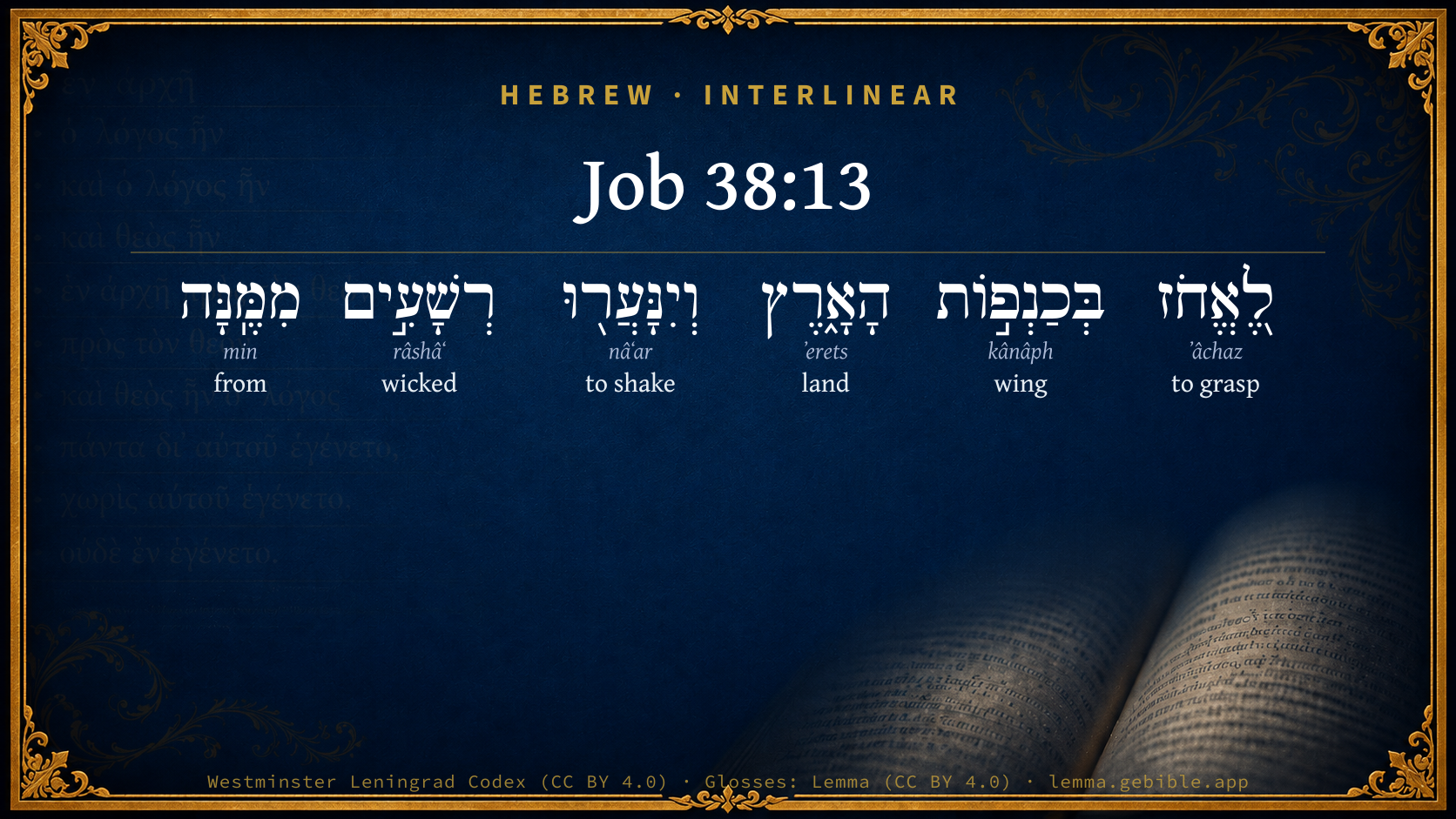
Hebrew (Westminster Leningrad Codex) Job 38:13 appears in the Hebrew Old Testament. The text above is from the Westminster Leningrad Codex. Each word links to its Strong’s number, a concise gloss, and parsing drawn from the Open Scriptures Hebrew Bible morphology. Click any word for its full Brown-Driver-Briggs (BDB) entry.
Download image
Cite this verse

Job 38:13 (World English Bible). Public Domain. Lemma interlinear Bible study tool, https://lemma.gebible.app/v/job/38/13.

Show BibTeX & RIS
BibTeX
RIS
English Translation
That it might take hold of the ends of the earth, And shake the wicked out of it?
World English Bible · Public Domain
Download a study sheet

One document with this verse’s original text, its word-by-word gloss line, the meaning frame, cross-references with their text, attributed commentary, and full source and license credits — printable, and it pastes into notes with its structure intact.

This verse Autodidact and up

Study sheet (.html) Plain text (.txt)

A passage Seminary Student

Up to 50 verses in one chapter. A passage sheet keeps up to 6 commentary sources and 12 cross-references per verse, in the order this page ranks them, and says so on the sheet whenever that leaves anything out. Ask for a single verse and you get the Autodidact verse sheet above.

Everything on this page stays free to read, with no account — the sheet is a download of what is already on screen, not access to it.

Want to remove ads? Support Godless Engineer
Compare translations 3

The same verse in 3 English versions, stacked beneath the original-language interlinear above. Click any original word for its lexicon entry.

Each is an independent rendering of the whole verse — the interlinear is not word-aligned to these translations.

Highlighted words mark where these versions differ — a whole-verse word diff, not a word-by-word alignment.

  • World English Bible Public Domain
    That it might take hold of the ends of the earth, And shake the wicked out of it?
  • King James Version Public Domain
    That it might take hold of the ends of the earth, that the wicked might be shaken out of it?
  • unfoldingWord Literal Text CC BY-SA 4.0
    for taking hold of the edges of the earth, and the wicked are shaken from it?

unfoldingWord Literal Text — © unfoldingWord, licensed CC BY-SA 4.0. Word-aligned USFM3 via Door43 (git.door43.org/unfoldingWord/en_ult).

Versions to compare (up to 4)

3 of 4 selected

Show all 18 translations

Every available English version of this verse, each an independent rendering of the whole verse.

  • World English Bible Public Domain
    That it might take hold of the ends of the earth, And shake the wicked out of it?
  • Berean Standard Bible Public Domain
    that it might spread to the ends of the earth and shake the wicked out of it?
  • Majority Standard Bible Public Domain
    that it might spread to the ends of the earth and shake the wicked out of it?
  • King James Version Public Domain
    That it might take hold of the ends of the earth, that the wicked might be shaken out of it?
  • American Standard Version (1901) Public Domain
    That it might take hold of the ends of the earth, And the wicked be shaken out of it?
  • Revised Version (1885) Public Domain
    That it might take hold of the ends of the earth, and the wicked be shaken out of it?
  • Geneva Bible (1599) Public Domain
    That it might take hold of the corners of the earth, and that the wicked might be shaken out of it?
  • Douay-Rheims (1899) Public Domain
    And didst thou hold the extremities of the earth shaking them, and hast thou shaken the ungodly out of it?
  • Young's Literal Translation Public Domain
    To take hold on the skirts of the earth, And the wicked are shaken out of it,
  • Literal Standard Version CC BY-SA 4.0
    To take hold on the skirts of the earth, || And the wicked are shaken out of it,
  • Unlocked Literal Bible CC BY-SA 4.0
    so that it might take hold of the edges of the earth and shake the wicked out of it?
  • unfoldingWord Literal Text CC BY-SA 4.0
    for taking hold of the edges of the earth, and the wicked are shaken from it?
  • Darby Bible Public Domain
    That it might take hold of the ends of the earth, and the wicked might be shaken out of it?
  • World Messianic Bible Public Domain
    that it might take hold of the ends of the earth, and shake the wicked out of it?
  • Webster's Bible Public Domain
    That it might take hold of the ends of earth, that the wicked might be shaken out of it?
  • Free Bible Version CC BY-SA 4.0
    Have you ever told the dawn where to appear that it might take hold of the corners of the earth and shake the wicked out?
  • Bible in Basic English Public Domain
    So that it might take a grip of the skirts of the earth, shaking all the evil-doers out of it?
  • JPS Tanakh (1917) Public Domain
    That it might take hold of the ends of the earth, and the wicked be shaken out of it?

Literal Standard Version (2020), Covenant Press — licensed CC BY-SA 4.0. Text via the HelloAO Bible API (eBible.org). Unlocked Literal Bible (unfoldingWord) — licensed CC BY-SA 4.0. Text via the HelloAO Bible API (eBible.org). unfoldingWord Literal Text — © unfoldingWord, licensed CC BY-SA 4.0. Word-aligned USFM3 via Door43 (git.door43.org/unfoldingWord/en_ult). Free Bible Version, Dr. Jonathan Gallagher — licensed CC BY-SA 4.0. Text via the HelloAO Bible API (eBible.org).

Word by word

More ways to search: Search by grammar → Find every occurrence → Compare this word →

Practice this passage: Drill this verse → Learn its vocabulary →

וְיִנָּעֲר֖וּ
nâʻar
H5287
“and · to shake”
Conjunction + Verb, Niphal, Imperfect, 3rd Person, Masculine, Plural
Part of Speech
Conjunction + Verb
Stem
Niphal
Form
Imperfect
Person
3rd Person
Gender
Masculine
Number
Plural
Full BDB Definition

Origin: a primitive root [probably identical with H5286 , through the idea of the rustling of mane, which usually accompanies the lion's roar]

TWOT: 1388

to shake, shake out or off - (Qal) to shake out, show emptiness - (Niphal) - to be shaken - to shake oneself - (Piel) to shake off or out - (Hithpael) to shake oneself
  1. לֶ֭אֱחֹז ʼâchaz H270 “to grasp” Preposition + Verb, Qal, Infinitive Construct
  2. בְּכַנְפ֣וֹת kânâph H3671 “in/at · wings of” Preposition + Noun, Common, Feminine, Plural, Construct
  3. הָאָ֑רֶץ ʼerets H776 “the · land” Particle, Definite Article + Noun, Common, Both, Singular, Absolute
  4. רְשָׁעִ֣ים râshâʻ H7563 “wicked” Adjective, Adjective, Masculine, Plural, Absolute
  5. מִמֶּֽנָּה min H4480 “from · her” Preposition + Suffix, Personal, 3rd Person, Feminine, Singular

About this verse

These counts appear in no published source. They are computed here, from the morphology-tagged text and Lemma’s own curated glosses. What Lemma adds →

6
words
6
distinct lemmas
Wisdom
section

Notable vocabulary

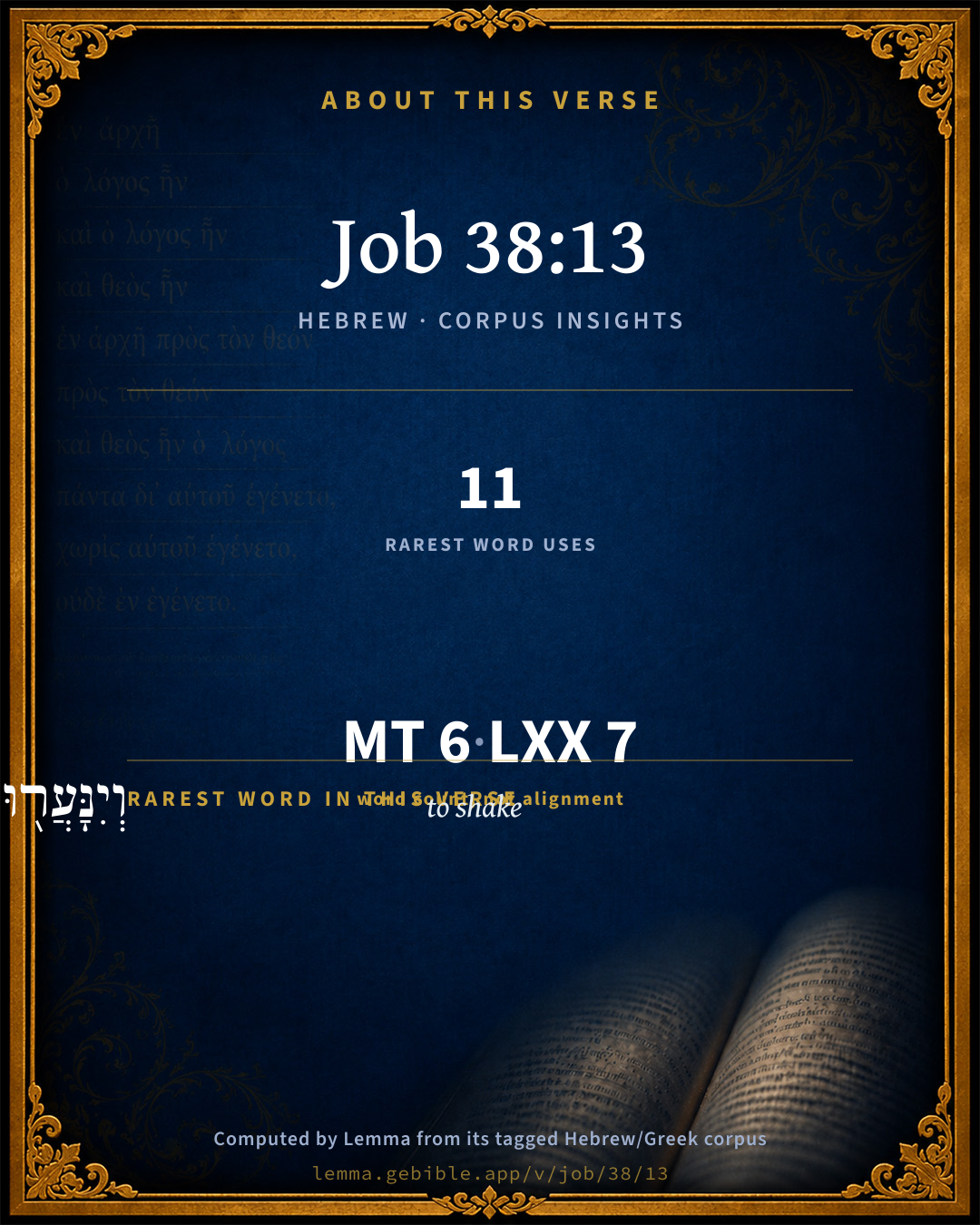
The rarest word here is וְיִנָּעֲר֖וּ to shake H5287 — appearing just 11 times in the whole Hebrew Bible.

Shared distinctive vocabulary

וְיִנָּעֲר֖וּ to shake H5287 occurs in 9 verses of the Hebrew Bible. Also found in:

Grammatical profile

  • 2 verbs
  • 2 nouns
  • 1 adjective
  • 1 preposition

Verb forms

  • לֶ֭אֱחֹז Qal · Infinitive Construct
  • וְיִנָּעֲר֖וּ Niphal · Imperfect

Hebrew & Septuagint length

In English translation the verse runs 18 words from the Hebrew and 17 from the Septuagint (LXX English) — closely comparable.

A rough comparison of the two English renderings, which tokenize alike — not a word-level alignment.

Word counts can differ between the Hebrew and the Greek without any difference in meaning — e.g. the Hebrew direct-object marker אֵת has no separate Greek word, and Greek often adds the article ὁ.

In the original languages it is 6 Hebrew tokens and 7 Greek tokens — but the two are counted differently (Hebrew bundles its prefixes and suffixes into one token; the Greek is in lemma form), so that isn’t a like-for-like length.

Cross-references

7

Topical passages linked to Job 38:13 in the Treasury of Scripture Knowledge — connected by theme and wording, ordered by reader-vote popularity; previews shown in the World English Bible.

  • Job 37:3 He sends it forth under the whole sky, And his lightning to the ends of the earth.
  • Psalms 104:35 Let sinners be consumed out of the earth. Let the wicked be no more. Bless Yahweh, my soul. Praise Yah!
  • Exodus 14:27 Moses stretched out his hand over the sea, and the sea returned to its strength when the morning appeared; and the Egyptians fled against it. Yahweh overthrew the Egyptians in the midst of the sea.
  • Job 24:13–17 "These are of those who rebel against the light; They don't know the ways of it, Nor abide in the paths of it.
  • Psalms 19:4–6 Their voice has gone out through all the earth, Their words to the end of the world. In them he has set a tent for the sun,
  • Psalms 104:21–22 The young lions roar after their prey, And seek their food from God.
  • Psalms 139:9–12 If I take the wings of the dawn, And settle in the uttermost parts of the sea;

Cross-references courtesy of OpenBible.info (CC BY 4.0).

Hebrew and Greek witnesses Masoretic Hebrew ↔ Greek Septuagint

The same verse in the two great witnesses to the Old Testament, shown verse-for-verse.

These are two independent witnesses, not word-aligned to each other, and the Septuagint is shown in lemma (dictionary) form.

Hebrew Job 38:13 Masoretic · Westminster Leningrad Codex

לֶ֭אֱחֹז בְּכַנְפ֣וֹת הָאָ֑רֶץ וְיִנָּעֲר֖וּ רְשָׁעִ֣ים מִמֶּֽנָּה

That it might take hold of the ends of the earth, And shake the wicked out of it?

World English Bible · Public Domain

Greek LXX Job 38:13 Septuagint · lemma form

ἐπιλαμβάνω πτέρυξ γῆ ἐκτινάσσω ἀσεβής ἐκ αὐτός

to lay hold of the extremities of the earth, to cast out the ungodly out of it?

LXX2012 (modern English Septuagint) · Public Domain

On this verse, Haydock's Catholic Bible Commentary discusses the Septuagint’s reading. Read the note in Commentary ↓

Hebrew: Westminster Leningrad Codex (CC BY 4.0). Greek: Septuagint (public domain); English from LXX2012 (modern English Septuagint) (Public Domain). How the Septuagint differs from the Hebrew →

Commentary

Notes on Job 38:13 from classic Christian and Jewish commentators (each source and its license shown beneath its notes). The classic Christian expositions comment on the surrounding passage and are grouped to its opening verse, so a note may address several verses; the Jewish commentaries on the Tanakh (Rashi and others) are per-verse, so they appear only where the commentator wrote on this verse.

Lemma curates 59 commentaries, every one of them public domain or Creative Commons licensed, each selected and text-cleaned for this edition rather than reprinted as found. About our sources →

Trapp's Complete Commentary

John Trapp

Job 38:13 That it might take hold of the ends of the earth, that the wicked might be shaken out of it?

Ver. 13. That it might take hold of the ends of the earth] That is, suddenly illighten the whole horizon; for which cause also David ascribeth wings to the morning, Psa 139:9, so that the light is not a body, nor, as some will have it, a substance, but an accident. The truth is, no man can tell what it is of any certainty; an admirable creature it is, surely a divine and heavenly thing, than which nothing is more desirable, nothing more profitable. Two excellent uses of it are here set forth: 1. To refresh men by the sight of the earth, and the things thereon. 2. To set us upon serious employment, such as is the punishment of evil doers, for so some interpret those next words.

That the wicked might be shaken out of it?] sc. By banishment, or rather by death, inflicted upon them in the light, for their deeds of darkness. Or, at least, that those Lucifugae, tenebriones, those inauspicate night birds, who hate the light, because their works are evil, might be shamed and shunned. Their motto is, Iam lux inimica propinquat (Virg.). See Job 24:13; Job 24:17.

John Trapp, A Commentary or Exposition upon All the Books of the Old and New Testament (1647–1656) — public domain. Text from a community e-Sword module.

Geneva Bible (1599)

Geneva Bible translators

Who having in the night been given to wickedness, cannot abide the light, but hide themselves.

Geneva Bible (1599) marginal notes — public domain. Text via Bolls.life.

Jamieson, Fausset & Brown

Robert Jamieson, A. R. Fausset & David Brown

take hold of the ends, &c.--spread itself over the earth to its utmost bounds in a moment.

wicked--who hate the light, and do their evil works in the dark (Job 24:13).

shaken out of it--The corners (Hebrew, "wings" or "skirts") of it, as of a garment, are taken hold of by the dayspring, so as to shake off the wicked.

Jamieson, Fausset & Brown — Commentary Critical and Explanatory on the Whole Bible (1871) — public domain (CC PDM 1.0). Text via the HelloAO Bible API.

Adam Clarke's Commentary

Verse 13. That the wicked might be shaken out of it?] The meaning appears to be this: as soon as the light begins to dawn upon the earth, thieves, assassins, murderers, and adulterers, who all hate and shun the light, fly like ferocious beasts to their several dens and hiding places; for such do not dare to come to the light, lest their works be manifest, which are not wrought in God. To this verse the fifteenth appears to belong, as it connects immediately with it, which connection the introduction of the fourteenth verse disturbs. "And from the wicked," such as are mentioned above "their light is withholden;" they love darkness rather than light, because their deeds are evil; and as they prowl after their prey in the night-season, they are obliged to sleep in the day, and thus its "light is withholden" from them. "And the high arm shall be broken;" or, as Mr. Good translates, "The roving of wickedness is broken off." They can no longer pursue their predatory and injurious excursions.

Adam Clarke's Commentary on the Bible (1810–1826) — public domain. Text from a community e-Sword/MySword module.

Ellicott's Commentary for English Readers

(13) Shaken out of it.—The figure is that of a man shaking a cloth (Job_24:15-17).

A Bible Commentary for English Readers, edited by Charles John Ellicott (1878–1897) — public domain. Text from a community e-Sword module.

The Cambridge Bible for Schools and Colleges

gen. ed. J. J. S. Perowne

13. ends of the earth] lit. skirts or wings of the earth. The figure is beautiful; the dawn as it pours forth along the whole horizon, on both sides of the beholder, lays hold of the borders of the earth, over which night lay like a covering; and seizing this covering by its extremities it shakes the wicked out of it. The wicked flee from the light. The dawn is not a physical phenomenon merely, it is a moral agent.

The Cambridge Bible for Schools and Colleges (gen. ed. J. J. S. Perowne; Cambridge University Press, 1878–1918) — public domain. Text from a community e-Sword module.

John Gill's Exposition

That it might take hold of the ends of the earth,.... As when the morning light springs forth, it quickly does, reaching in a short time the extreme part of the hemisphere; which, and what goes before, may be applied to the light of the Gospel, and the direction of that under divine Providence in the several parts of the world, and unto the ends of it; see Psa 19:4;

that the wicked might be shaken out of it? the earth, by means of the light; which may be understood either of wicked men who have been all night upon works of darkness, and be take themselves on the approach of light to private lurking places, like beasts of prey, so that the earth seems to be, as it were, clear of them; or of their being taken up in the morning for deeds done in the night, and brought to justice, which used to be exercised in mornings, Jer 21:12; and so the earth rid of them: thus wicked men shun the light, of the Gospel, and are condemned by it; and in the latter day light and glory they will cease from the earth; see Joh 3:19.

John Gill's Exposition of the Whole Bible (1746–1763) — public domain (CC PDM 1.0). Text via the HelloAO Bible API.

Albert Barnes' Notes on the Bible

That it might take hold of the ends of the earth - Margin, as in Hebrew “wings.” Wings are in the Scriptures frequently given to the earth, because it seems to be spread out, and the expression refers to its extremities. The language is derived from the supposition that the earth was a plain, and had limits or bounds. The idea here is, that God causes the light of the morning suddenly to spread to the remotest parts of the world, and to reveal everything which was there.

That the wicked might be shaken out of it - Out of the earth; that is, by the light which suddenly shines upon them. The sense is, that the wicked perform their deeds in the darkness of the night, and that in the morning light they flee away. The effect of the light coming upon them is to disturb their plans, to fill them with alarm, and to cause them to flee. The idea is highly poetic. The wicked are engaged in various acts of iniquity under cover of the night. Robbers, thieves, and adulterers, go forth to their deeds of darkness as though no one saw them. The light of the morning steals suddenly upon them, and they flee before it under the apprehension of being detected. “The dawn,” says Herder, “is represented as a watchman, a messenger of the Prince of heaven, sent to chase away the bands of robbers.” It may illustrate this to observe that it is still the custom of the Arabs to go on plundering excursions before the dawn. When on their way this faithful watchman, the aurora, goes out to spread light about them, to intimidate them, and to disperse them; compare the notes at Job 24:13-17.

Albert Barnes' Notes on the Bible (1834–1885) — public domain. Text from a community e-Sword/MySword module.

Haydock's Catholic Bible Commentary

And didst. Some explain Hebrew, "that it (Aurora) might spread at once to the extremities of the earth. Then the wicked flee before it;" as they hate the light, chap. xxxiv. 26., and John iii. 20. (Calmet) --- Septuagint and Protestants may be understood in this sense. (Haydock) --- Allusion may also be made to the shaking of a sieve, to separate the wheat from the chaff; (Amos ix. 9., and Luke xxii. 31.; Calmet) or of a carpet, to clean it from the dust. (Du Hamel) --- Did God ask thee to help him to exterminate the wicked? The short digression in these three verses, shews the punishment exercised on offenders. It is not contrary to the true spirit of poetry. (Menochius)

George Leo Haydock (1774–1849), Haydock's Catholic Family Bible and Commentary, 1859 edition — public domain. Excludes Psalms (Douay-Rheims chapter numbering differs from Protestant) and Deuterocanonical books (Catholic canon only).

Matthew Poole's English Annotations

That this morning light should in a moment spread itself over the face of the whole earth, from one end of the hemisphere to the other.

Shaken out of it, from the face of the earth. And this effect the morning light hath upon the wicked, partly because it discovers them, and drives them into their lurking holes; whereas the darkness hides them, and draws them forth, and gives them opportunity to execute their villanies without observation, Job 24:15-17; and partly because it brings them to condign punishment, the morning being the most fit and the most usual time for executing judgment; of which see Psa 101:8; Jer 21:12.

Matthew Poole's English Annotations on the Holy Bible (1683–1685) — public domain. Text from a community e-Sword/MySword module.

Whedon's Commentary on the Bible

Daniel D. Whedon

13. Ends of the earth — See note on Job_37:3. Daylight, as it chases evil-doers back to their hiding places, seems “to take hold of the carpet of the earth, as it were, by the edges,” and shake from it the wicked. The dawn shines forth under the figure of “a watchman, a messenger of the prince of heaven sent to chase away bands of robbers,” with their deeds of darkness. In ancient times justice was administered in the early morning, (Jer_21:12,) as Drusius has fully shown. There is an unmistakable allusion to Job’s complaint, (Job_24:16-17.) The constant return of the light of the day “thus becomes an image of the perpetual flight and destruction of wicked men before God.” — Ewald, 297.

Daniel D. Whedon (gen. ed.), Commentary on the Old and New Testaments (1874–1909) — public domain. Text from a community e-Sword module.

The Pulpit Commentary

That it might take hold of the ends of the earth, that the wicked might be shaken out of it? The idea seems to he that the dawn, suddenly appearing, seizes hold of all the ends of the earth "at one rush" (Canon Cook), and lights up the whole terrestrial region. The wicked, lovers of darkness, are taken by surprise, and receive a shock from which they recover with difficulty. (comp. Job_24:16, Job_24:17) That they are "shaken from the earth" must be regarded as Oriental hyperbole.

The Pulpit Commentary (1880–1919), ed. H.D.M. Spence-Jones & Joseph S. Exell — public domain. Text from a community e-Sword module.

John Wesley's Explanatory Notes

That - That this morning light should in a moment spread itself, from one end of the hemisphere to the other. Shaken - From the face of the earth. And this effect the morning-light hath upon the wicked, because it discovers them, whereas darkness hides them; and because it brings them to condign punishment, the morning being the usual time for executing judgment.

John Wesley, Explanatory Notes Upon the Whole Bible (1754–1765) — public domain. Text via the GEBible commentary corpus.

Rashi

Rabbi Shlomo Yitzchaki (Rashi)

To grasp the corners of the earth Moreover, in all your days, did you command [anyone] to grasp the corners of the earth like a man who grasps the corners of a garment and shakes it? So am I destined to grasp it [the earth] by its corners and shake the wicked [out of it]. Likewise, Scripture states (Isa. 31:3): “and the Lord shall turn His hand, and the helper shall stumble,” like a person who, holding something in his hand, drops it by inclining his hand.

Rashi on the Tanakh — English translations: “The Judaica Press complete Tanach with Rashi, translated by A. J. Rosenberg” (CC BY 4.0); “Pentateuch with Rashi's commentary by M. Rosenbaum and A.M. Silbermann, 1929-1934” (public domain); “The Metsudah Tanach series, Lakewood, N.J” (CC BY 4.0); and “The Book of Joshua, Metsudah Publications, 1997” (CC BY 4.0). Text via Sefaria.

Lesson kit

Teaching starters — assembled from the data on this page, not authored interpretation. Every prompt links to the verse data it draws on. Edit before teaching.

Job, in the Wisdom, opens this verse with 6 words (6 distinct Hebrew lemmas). Its most distinctive word is nâʻar (“to shake”). A historical commentator’s framing appears above. Read the whole chapter for the surrounding context.

Discussion questions

  1. How does “to shake” (nâʻar) shape what this verse is saying?
  2. Exodus 14:27 shares the word «to shake» with this verse. How do the two illuminate each other?
  3. These translations render this verse differently. What is at stake in choosing one wording over another?
  4. The verb «לֶ֭אֱחֹז» is Qal Infinitive Construct. How does its form color the action?
  5. Reading how Trapp's Complete Commentary and Geneva Bible (1599) read this verse, where do the two commentators agree and where do they part?

Things to notice

Reading settings

Reading text

Shown beneath each verse's original-language words.

Old Testament
Old Testament edition

Read the OT as the Masoretic Hebrew (MT) or the Greek Septuagint (LXX).

English shown for the Greek Septuagint (in the Hebrew ↔ Greek comparison).

Comparing translations? Open the Compare panel on any verse page to stack up to four side by side.