Psalms 146:9

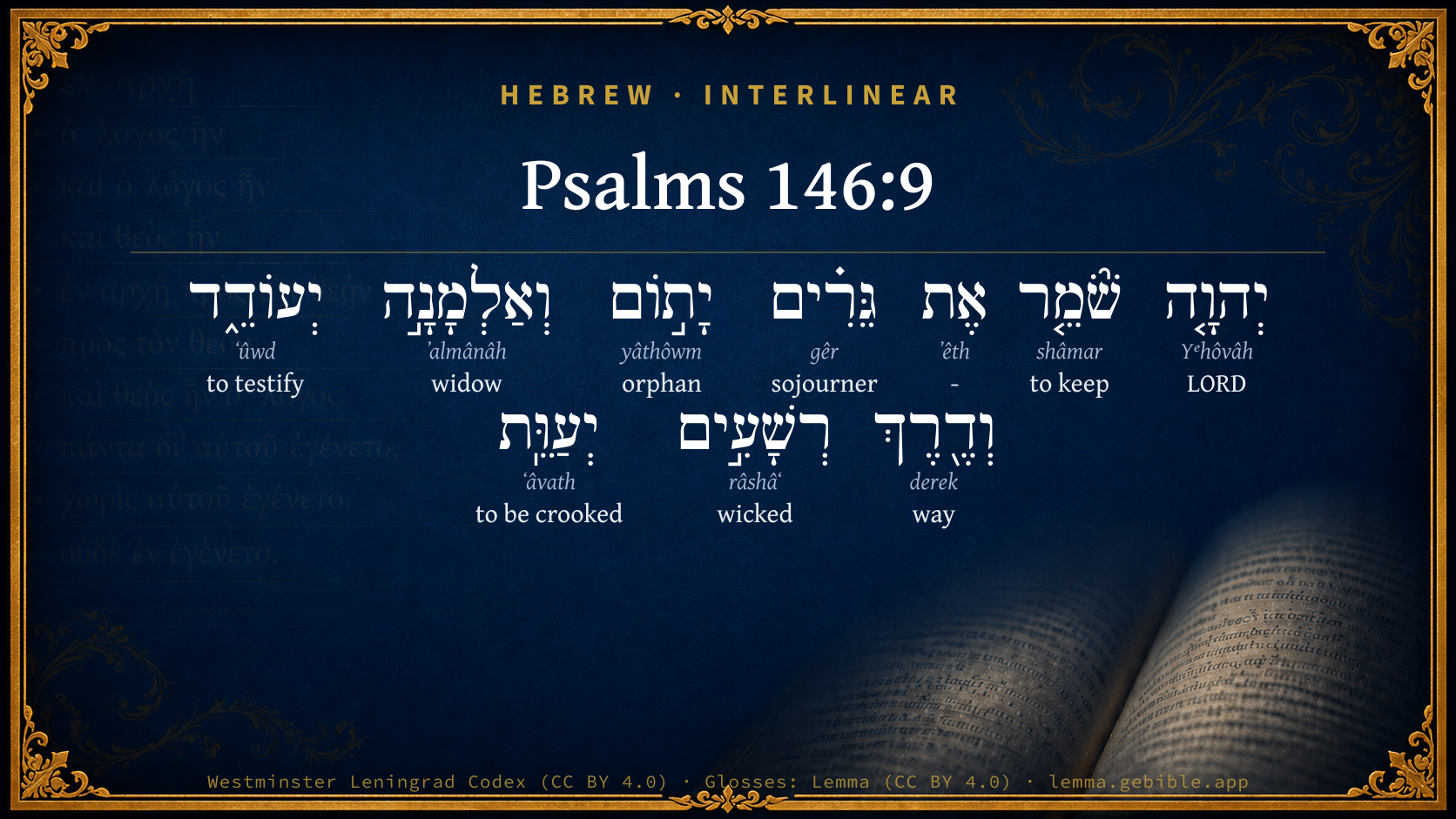
Hebrew (Westminster Leningrad Codex) Psalms 146:9 appears in the Hebrew Old Testament. The text above is from the Westminster Leningrad Codex. Each word links to its Strong’s number, a concise gloss, and parsing drawn from the Open Scriptures Hebrew Bible morphology. Click any word for its full Brown-Driver-Briggs (BDB) entry.
Download image
Cite this verse

Psalms 146:9 (World English Bible). Public Domain. Lemma interlinear Bible study tool, https://lemma.gebible.app/v/psalms/146/9.

Show BibTeX & RIS
BibTeX
RIS
English Translation
Yahweh preserves the foreigners. He upholds the fatherless and widow, But the way of the wicked he turns upside down.
World English Bible · Public Domain
Download a study sheet

One document with this verse’s original text, its word-by-word gloss line, the meaning frame, cross-references with their text, attributed commentary, and full source and license credits — printable, and it pastes into notes with its structure intact.

This verse Autodidact and up

Study sheet (.html) Plain text (.txt)

A passage Seminary Student

Up to 50 verses in one chapter. A passage sheet keeps up to 6 commentary sources and 12 cross-references per verse, in the order this page ranks them, and says so on the sheet whenever that leaves anything out. Ask for a single verse and you get the Autodidact verse sheet above.

Everything on this page stays free to read, with no account — the sheet is a download of what is already on screen, not access to it.

Want to remove ads? Support Godless Engineer
Compare translations 3

The same verse in 3 English versions, stacked beneath the original-language interlinear above. Click any original word for its lexicon entry.

Each is an independent rendering of the whole verse — the interlinear is not word-aligned to these translations.

Highlighted words mark where these versions differ — a whole-verse word diff, not a word-by-word alignment.

  • World English Bible Public Domain
    Yahweh preserves the foreigners. He upholds the fatherless and widow, But the way of the wicked he turns upside down.
  • King James Version Public Domain
    The LORD preserveth the strangers; he relieveth the fatherless and widow: but the way of the wicked he turneth upside down.
  • unfoldingWord Literal Text CC BY-SA 4.0
    Yahweh is guarding the sojourners; he upholds the orphan and the widow, but the way of the wicked, he overturns.

unfoldingWord Literal Text — © unfoldingWord, licensed CC BY-SA 4.0. Word-aligned USFM3 via Door43 (git.door43.org/unfoldingWord/en_ult).

Versions to compare (up to 4)

3 of 4 selected

Show all 18 translations

Every available English version of this verse, each an independent rendering of the whole verse.

  • World English Bible Public Domain
    Yahweh preserves the foreigners. He upholds the fatherless and widow, But the way of the wicked he turns upside down.
  • Berean Standard Bible Public Domain
    The LORD protects foreigners; He sustains the fatherless and the widow, but the ways of the wicked He frustrates.
  • Majority Standard Bible Public Domain
    The LORD protects foreigners; He sustains the fatherless and the widow, but the ways of the wicked He frustrates.
  • King James Version Public Domain
    The LORD preserveth the strangers; he relieveth the fatherless and widow: but the way of the wicked he turneth upside down.
  • American Standard Version (1901) Public Domain
    Jehovah preserveth the sojourners; He upholdeth the fatherless and widow; But the way of the wicked he turneth upside down.
  • Revised Version (1885) Public Domain
    The LORD preserveth the strangers; he upholdeth the fatherless and widow; but the way of the wicked he turneth upside down.
  • Geneva Bible (1599) Public Domain
    The Lord keepeth the strangers: he relieueth the fatherlesse and widowe: but he ouerthroweth the way of the wicked.
  • Douay-Rheims (1899) Public Domain
    The Lord is sweet to all: and his tender mercies are over all his works.
  • Young's Literal Translation Public Domain
    Jehovah is preserving the strangers, The fatherless and widow He causeth to stand, And the way of the wicked He turneth upside down.
  • Literal Standard Version CC BY-SA 4.0
    YHWH is preserving the strangers, || He causes the fatherless and widow to stand, || And He turns the way of the wicked upside down.
  • Unlocked Literal Bible CC BY-SA 4.0
    Yahweh protects the foreigners in the land; he lifts up the fatherless and widow, but he opposes the wicked.
  • unfoldingWord Literal Text CC BY-SA 4.0
    Yahweh is guarding the sojourners; he upholds the orphan and the widow, but the way of the wicked, he overturns.
  • Darby Bible Public Domain
    Jehovah preserveth the strangers; he lifteth up the fatherless and the widow; but the way of the wicked doth he subvert.
  • World Messianic Bible Public Domain
    The LORD preserves the foreigners. He upholds the fatherless and widow, but he turns the way of the wicked upside down.
  • Webster's Bible Public Domain
    The LORD preserveth the strangers; he relieveth the fatherless and widow: but the way of the wicked he turneth upside down.
  • Free Bible Version CC BY-SA 4.0
    The Lord takes care of strangers among us. He looks after widows and orphans. But he makes life difficult for the wicked.
  • Bible in Basic English Public Domain
    The Lord takes care of those who are in a strange land; he gives help to the widow and to the child who has no father; but he sends destruction on the way of sinners.
  • JPS Tanakh (1917) Public Domain
    The LORD preserveth the strangers; He upholdeth the fatherless and the widow; but the way of the wicked He maketh crooked.

Literal Standard Version (2020), Covenant Press — licensed CC BY-SA 4.0. Text via the HelloAO Bible API (eBible.org). Unlocked Literal Bible (unfoldingWord) — licensed CC BY-SA 4.0. Text via the HelloAO Bible API (eBible.org). unfoldingWord Literal Text — © unfoldingWord, licensed CC BY-SA 4.0. Word-aligned USFM3 via Door43 (git.door43.org/unfoldingWord/en_ult). Free Bible Version, Dr. Jonathan Gallagher — licensed CC BY-SA 4.0. Text via the HelloAO Bible API (eBible.org).

Word by word

More ways to search: Search by grammar → Find every occurrence → Compare this word →

Practice this passage: Drill this verse → Learn its vocabulary →

יְעַוֵּֽת
ʻâvath
H5791
“to be crooked”
Verb, Piel, Imperfect, 3rd Person, Masculine, Singular
Part of Speech
Verb
Stem
Piel
Form
Imperfect
Person
3rd Person
Gender
Masculine
Number
Singular
Full BDB Definition

Origin: a primitive root

TWOT: 1591

to be bent, be crooked, bend, make crooked, pervert - (Piel) - to make crooked, falsify, pervert, subvert - to bend, make crooked - (Pual) thing bent (participle) - (Hithpael) to bend oneself
  1. יְהוָ֤ה Yᵉhôvâh H3068 “LORD” Noun, Proper
  2. שֹׁ֘מֵ֤ר shâmar H8104 “keeping” Verb, Qal, Participle Active, Masculine, Singular, Absolute
  3. אֶת ʼêth H853 “-” Particle, Direct Object
  4. גֵּרִ֗ים gêr H1616 “sojourners” Noun, Common, Masculine, Plural, Absolute
  5. יָת֣וֹם yâthôwm H3490 “orphan” Noun, Common, Masculine, Singular, Absolute
  6. וְאַלְמָנָ֣ה ʼalmânâh H490 “and · widow” Conjunction + Noun, Common, Feminine, Singular, Absolute
  7. יְעוֹדֵ֑ד ʻûwd H5749 “to testify” Verb, Polel, Imperfect, 3rd Person, Masculine, Singular
  8. וְדֶ֖רֶךְ derek H1870 “and · way of” Conjunction + Noun, Common, Both, Singular, Construct
  9. רְשָׁעִ֣ים râshâʻ H7563 “wicked” Adjective, Adjective, Masculine, Plural, Absolute

About this verse

These counts appear in no published source. They are computed here, from the morphology-tagged text and Lemma’s own curated glosses. What Lemma adds →

10
words
10
distinct lemmas
Wisdom
section

Notable vocabulary

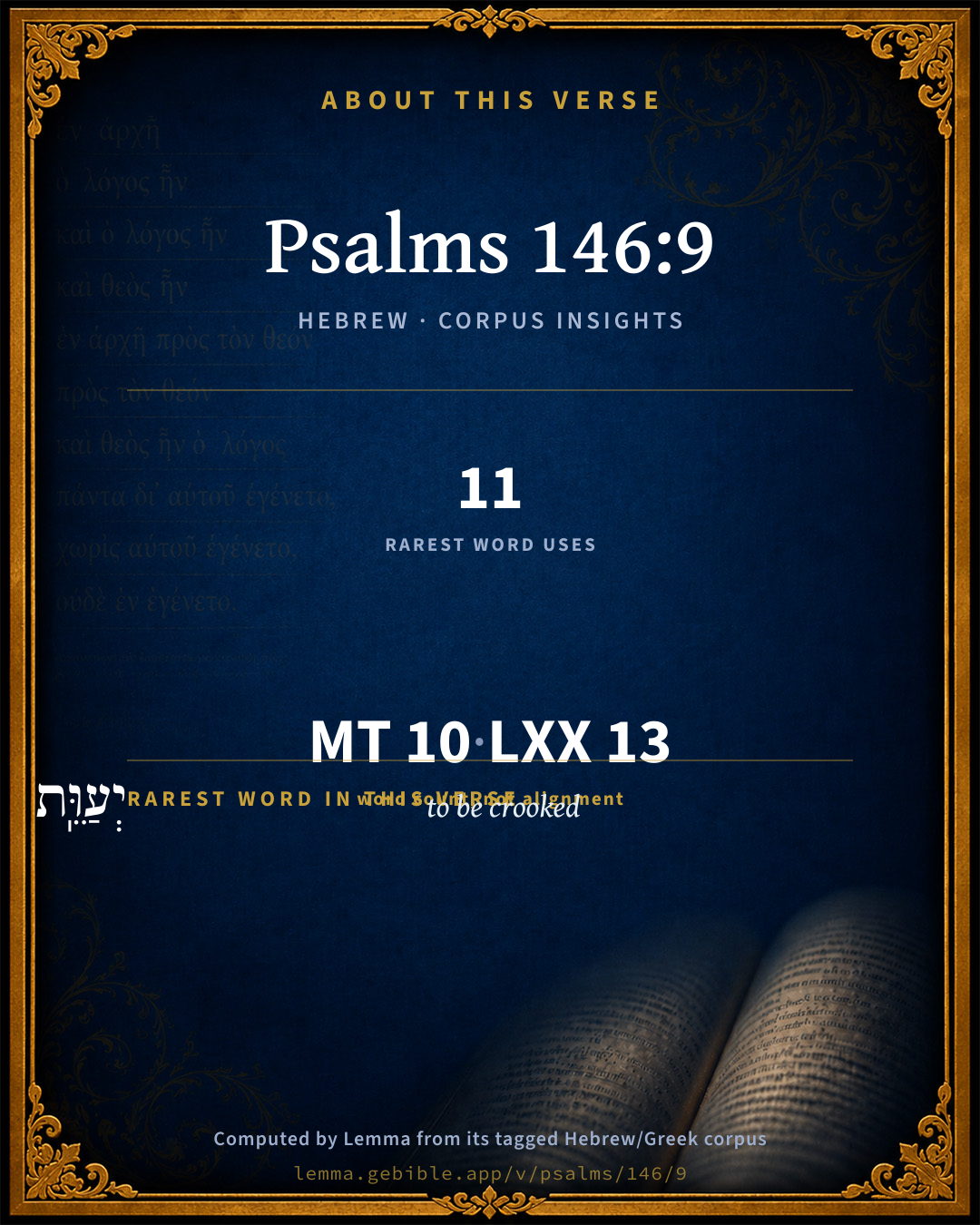
The rarest word here is יְעַוֵּֽת to be crooked H5791 — appearing just 11 times in the whole Hebrew Bible.

Shared distinctive vocabulary

יְעַוֵּֽת to be crooked H5791 occurs in 10 verses of the Hebrew Bible. Also found in:

Grammatical profile

  • 3 verbs
  • 5 nouns
  • 1 adjective
  • 1 particle

Verb forms

  • שֹׁ֘מֵ֤ר Qal · Participle Active
  • יְעוֹדֵ֑ד Polel · Imperfect
  • יְעַוֵּֽת Piel · Imperfect

Hebrew & Septuagint length

In English translation the verse runs 20 words from the Hebrew and 15 from the Septuagint (LXX English) — closely comparable.

A rough comparison of the two English renderings, which tokenize alike — not a word-level alignment.

Word counts can differ between the Hebrew and the Greek without any difference in meaning — e.g. the Hebrew direct-object marker אֵת has no separate Greek word, and Greek often adds the article ὁ.

In the original languages it is 10 Hebrew tokens and 13 Greek tokens — but the two are counted differently (Hebrew bundles its prefixes and suffixes into one token; the Greek is in lemma form), so that isn’t a like-for-like length.

Cross-references

11

Topical passages linked to Psalms 146:9 in the Treasury of Scripture Knowledge — connected by theme and wording, ordered by reader-vote popularity; previews shown in the World English Bible.

  • Psalms 68:5 A father of the fatherless, and a defender of the widows, Is God in his holy habitation.
  • Deuteronomy 10:18–19 He does execute justice for the fatherless and widow, and loves the foreigner, in giving him food and clothing.
  • Psalms 147:6 Yahweh upholds the humble. He brings the wicked down to the ground.
  • Exodus 22:21–22 "You shall not wrong an alien, neither shall you oppress him, for you were aliens in the land of Egypt.
  • Proverbs 15:25 Yahweh will uproot the house of the proud, But he will keep the widow's borders intact.
  • Jeremiah 49:11 Leave your fatherless children, I will preserve them alive; and let your widows trust in me.
  • Malachi 3:5 I will come near to you to judgment; and I will be a swift witness against the sorcerers, and against the adulterers, and against the perjurers, and against those who oppress the hireling in his wages, the widow, and the fatherless, and who deprive the foreigner of justice, and don't fear me," says Yahweh of Hosts.
  • James 1:27 Pure religion and undefiled before our God and Father is this: to visit the fatherless and widows in their affliction, and to keep oneself unstained by the world.
  • Psalms 83:13–17 My God, make them like tumbleweed; Like chaff before the wind.
  • Psalms 145:20 Yahweh preserves all those who love him, But all the wicked he will destroy.
  • Proverbs 4:19 The way of the wicked is like darkness. They don't know what they stumble over.

Cross-references courtesy of OpenBible.info (CC BY 4.0).

Hebrew and Greek witnesses Masoretic Hebrew ↔ Greek Septuagint

The same verse in the two great witnesses to the Old Testament, shown verse-for-verse.

You’re reading Greek Psalm 145 (Hebrew Psalm 146). The Septuagint counts the superscription, so verse numbers can differ from the Hebrew — chapter-level alignment, not verse-by-verse. Numbering follows Rahlfs.

These are two independent witnesses, not word-aligned to each other, and the Septuagint is shown in lemma (dictionary) form.

Hebrew Psalms 146:9 Masoretic · Westminster Leningrad Codex

יְהוָ֤ה שֹׁ֘מֵ֤ר אֶת גֵּרִ֗ים יָת֣וֹם וְאַלְמָנָ֣ה יְעוֹדֵ֑ד וְדֶ֖רֶךְ רְשָׁעִ֣ים יְעַוֵּֽת

Yahweh preserves the foreigners. He upholds the fatherless and widow, But the way of the wicked he turns upside down.

World English Bible · Public Domain

Greek LXX Greek Psalm 145:9 Septuagint · lemma form

κύριος φυλάσσω ὁ προσήλυτος ὀρφανός καί χήρα ἀναλαμβάνω καί ὁδός ἁμαρτωλός ἀπο ἀναί(ζω

he will relieve the orphan and widow: but will utterly remove the way of sinners.

LXX2012 (modern English Septuagint) · Public Domain

On this verse, The Cambridge Bible for Schools and Colleges discusses the Septuagint’s reading. Read the note in Commentary ↓

Hebrew: Westminster Leningrad Codex (CC BY 4.0). Greek: Septuagint (public domain); English from LXX2012 (modern English Septuagint) (Public Domain). How the Septuagint differs from the Hebrew →

Commentary

Notes on Psalms 146:9 from classic Christian and Jewish commentators (each source and its license shown beneath its notes). The classic Christian expositions comment on the surrounding passage and are grouped to its opening verse, so a note may address several verses; the Jewish commentaries on the Tanakh (Rashi and others) are per-verse, so they appear only where the commentator wrote on this verse.

Lemma curates 59 commentaries, every one of them public domain or Creative Commons licensed, each selected and text-cleaned for this edition rather than reprinted as found. About our sources →

Trapp's Complete Commentary

John Trapp

Psa 146:9 The LORD preserveth the strangers; he relieveth the fatherless and widow: but the way of the wicked he turneth upside down.

Ver. 9. The Lord preserveth] These all are his clients, because neglected by the world, as yielding no profit.

He turneth upside down] As one doth a dish that is washed and wiped, 2Ki 21:13.

John Trapp, A Commentary or Exposition upon All the Books of the Old and New Testament (1647–1656) — public domain. Text from a community e-Sword module.

The Biblical Illustrator

Joseph S. Exell

Psa_146:9

He relieveth the fatherless.

The fatherless relieved

The Lord relieveth the fatherless--

I. By exciting the compassion of others in their behalf. The feeling of sympathy is one of the noblest affections of our rational nature. To be without compassion for the miserable and the helpless is a strong indication of deep moral depravity. That all are not thus depraved must be owing to the distinguishing goodness and grace of God.

1. Even among those who are still in an unregenerate state we find many who are easily affected with the calamities of others, and who listen with eagerness, as well as with deep concern, to the tale of woe.

2. When Christians behold others around them in poverty and affliction they ascribe it to undeserved mercy that they themselves are not in similar, or even in worse, circumstances. This thought moves their compassion.

II. By exciting the liberality of others towards their support.

1. Even those who are strangers to the power of His grace are often led by a natural principle of benevolence, or perhaps of self-gratification, to abound in alms-deeds. But more especially the Lord endows many of His own servants with a kind and liberal spirit. Being conscious that they have nothing but what they have received, they consider themselves as stewards, who are bound to be faithful. They endeavour, therefore, to honour the Lord with their substance, and with the first-fruits of their increase.

III. By stirring up others to active exertions in their behalf.

IV. By rendering the exertions of others, and especially of His own servants, effectual for this end.

V. More especially by bringing them to an acquaintance with Himself, and sometimes by placing them in stations of usefulness, and even of eminence in the world. (D. Dickson.)

The Biblical Illustrator, edited by Joseph S. Exell (c. 1880s–1900s) — public domain. Text from a community e-Sword module.

J. A. Alexander on Psalms

Joseph Addison Alexander

9. (Psa 146:9) Jehovah preserves strangers; orphan and widow he relieves; and the way of wicked men makes crooked. The stranger, the orphan, and the widow are constantly presented in the Law as objects of compassion and beneficence. See above, on Psa 68:5-6. Relieves, restores, raises up from their low condition. As a straight path is an emblem of prosperity, to render one's path crooked is to involve him in calamity. The same verb is applied, in a moral sense, to the perverse conduct of the wicked, Psa 119:78.

Joseph Addison Alexander, The Psalms Translated and Explained (1850) — public domain. Text from a community e-Sword module.

Geneva Bible (1599)

Geneva Bible translators

Meaning, all them that are destitute of worldly means and succor.

Geneva Bible (1599) marginal notes — public domain. Text via Bolls.life.

Adam Clarke's Commentary

Verse 9. Preserveth the strangers] He has preserved you strangers in a strange land, where you have been in captivity for seventy years; and though in an enemy's country, he has provided for the widows and orphans as amply as if he had been in the promised land.

The way of the wicked he turneth upside down.] He subverts, turns aside. They shall not do all the wickedness they wish; they shall not do all that is in their power. In their career he will either stop them, turn them aside, or overturn them.

Adam Clarke's Commentary on the Bible (1810–1826) — public domain. Text from a community e-Sword/MySword module.

John Calvin's Commentaries

9. Jehovah guarding, etc. By strangers, orphans, and widows, the Psalmist means all those in general who are destitute of the help of man. While all show favor to those who are known to them and near to them, we know that strangers are, for the most part, exposed to injurious treatment. We find comparatively few who come forward to protect and redress widows and orphans; it seems lost labor, where there is no likelihood of compensation. Under these cases the Psalmist shows that whatever the grievance may be under which we suffer, the reason can only be with ourselves if God, who so kindly invites all who are in distress to come to him, does not stretch forth his arm for our help. On the other hand, he declares that everything will have an adverse and unfortunate issue to those who wickedly despise God. We have said upon the first Psalm, that by the way is meant the course of life in general. God will destroy the way of the wicked, inasmuch as he will curse all their counsels, acts, attempts, and enterprises, so that none of them shall have good success. However excellent they may be in planning, although they may be crafty and sharp-sighted, and abound in strength of resources of every kind, God will overturn all their expectations. While he extends his hand to those who are his people, and brings them through all obstacles, and even impassable ways, he on the contrary destroys the path of the wicked, when apparently most open and plain before them.

John Calvin's Commentaries (1540-1563) — public domain. Text from the Calvin Translation Society English edition (1840s-50s) via the Christian Classics Ethereal Library (ccel.org). Calvin's coverage is partial (roughly two-thirds of the Bible); uncommented books and verses are honest gaps, never fabricated. The 19th-century editor's footnotes and remarks are omitted so the notes are faithfully Calvin's own voice.

Ellicott's Commentary for English Readers

(9) The stranger, the widow, and the orphan are constantly presented in the Law as objects of compassion and beneficence. The orphan and widow are mentioned as under God’s care (Psa_68:5).

Relieveth.—Or rather, restoreth, by taking up their cause and seeing justice done. Certain forms of the verb are used of bearing witness, and possibly here there is allusion to a court of justice, in which God appears as witnessing on the side of the weak and defenceless.

Turneth upside down.—Rather, bends aside. The same word in Psa_119:78 is rendered” dealt perversely.” The idea seems in both cases to be that of interference, to thwart and impede a course of action. In Psalms 119 it is an evil-disposed person who interferes with the righteous. Here it is the Divine providence which, when the wicked man has laid out his plans, and looks as it were along a plain and level road of prosperity, bends the prosperous course aside; makes the path crooked, instead of straight; full of trouble and calamity, instead of prosperous and sure.

A Bible Commentary for English Readers, edited by Charles John Ellicott (1878–1897) — public domain. Text from a community e-Sword module.

The Cambridge Bible for Schools and Colleges

gen. ed. J. J. S. Perowne

9. As in Psa_94:6 the sojourners[89] or resident aliens who had no rights of citizenship, orphans, and widows are typical examples of defencelessness. They are therefore specially under Jehovah’s protection, and are commended in the Law to the care of the Israelites.

[89] The LXX regularly renders gçr, ‘sojourner,’ by προσήλυτος; but this does not mean ‘proselyte’ in the later technical sense of “a Gentile who through circumcision and observance of the law had been admitted into full religious fellowship with Israel,” but, as the Vulg. renders it here, ‘advena.’ See Schürer’s Hist. of Jewish People, § 31, E.T. ii. ii. 315.

relieveth] R.V. upholdeth.

turneth upside dawn] Lit. as R.V. marg., maketh crooked; turns aside from its goal, so that it leads to destruction. Cp. Psa_1:6. That which they would fain do to innocent men (Psa_119:78) He does to them.

The Cambridge Bible for Schools and Colleges (gen. ed. J. J. S. Perowne; Cambridge University Press, 1878–1918) — public domain. Text from a community e-Sword module.

John Gill's Exposition

The Lord preserveth the strangers,.... The life of them, as he did the daughter of: the Greek, a Syrophenician woman, and a Samaritan, by healing them of their diseases, Mar 7:26; and in a spiritual sense he preserves the lives and saves the souls of his people among the Gentiles, who are aliens from the commonwealth of Israel, and strangers to the covenant of promise; for these he laid down his life a ransom, and became the propitiation for their sins; to these he sends his Gospel, which is the power of God to salvation unto them;

he relieveth the fatherless and widow; in their distresses and troubles, who have no helper; a wonderful instance of his relieving a widow, in the most disconsolate circumstances, we have in raising the widow of Nain's son to life, and restoring him to his mother, Luk 7:12; in him "the fatherless", and all that in a spiritual sense are destitute of help in the creatures, and see they are so, "find mercy"; nor will he leave his people comfortless, or as orphans and fatherless ones, but will and does come and visit them, relieve and supply them with everything convenient for them; though his church here on earth may seem to be as a widow, he being in heaven at the right hand of God, yet he cares for her in the wilderness, and provides for her support, where she is nourished with the word and ordinances, and will be until he comes again; see Hos 14:3;

but the way of the wicked he turneth upside down; so that they cannot find it; nor their hands perform their enterprise; their schemes and counsels are all confounded and blasted by him, and all their policy and power are not able to prevail against his church and people; see Psa 1:6.

John Gill's Exposition of the Whole Bible (1746–1763) — public domain (CC PDM 1.0). Text via the HelloAO Bible API.

Albert Barnes' Notes on the Bible

The Lord preserveth the strangers - He regards them with interest; he defends and guides them. This is the ninth reason why those who trust in the Lord are happy. The stranger - away from home and friends; with no one to feel an interest in him or sympathy for him; with the feeling that he is forsaken; with no one on whom he can call for sympathy in distress - may find in God one who will regard his condition; who will sympathize with him; who is able to protect and befriend him. Compare Exo 12:49; Exo 22:21; Exo 23:9; Lev 19:33; Deu 1:16; Deu 10:18-19; Isa 56:3, Isa 56:6.

He relieveth the fatherless and widow - He is their friend. This is the tenth reason why those who put their trust in the Lord are happy. It is that God is the Friend of those who have no earthly protector. See the notes at Psa 68:5 : “A father of the fatherless, and a judge of the widows, is God in his holy habitation.”

But the way of the wicked he turneth upside down - He overturns their plans; defeats their schemes; makes their purposes accomplish what they did not intend they should accomplish. The Hebrew word here means to bend, to curve, to make crooked, to distort; then, to overturn, to turn upside down. The same word is applied to the conduct of the wicked, in Psa 119:78 : “They dealt perversely with me.” The idea here is, that their path is not a straight path; that God makes it a crooked way; that they are diverted from their design; that through them he accomplishes purposes which they did not intend; that he prevents their accomplishing their own designs; and that he will make their plans subservient to a higher and better purpose than their own. This is the eleventh reason why those who put their trust in God are happy. It is that God is worthy of confidence and love, because he has all the plans of wicked men entirely under his control.

Albert Barnes' Notes on the Bible (1834–1885) — public domain. Text from a community e-Sword/MySword module.

Matthew Poole's English Annotations

He overthroweth their goings, as the phrase is, Psa 140:4. He maketh them to lose their way; he not only frustrateth their plots and enterprises but turneth them against themselves. This and all the foregoing sentences are so many arguments to encourage all good men to trust in God in all their straits and afflictions.

Matthew Poole's English Annotations on the Holy Bible (1683–1685) — public domain. Text from a community e-Sword/MySword module.

The Treasury of David

Charles H. Spurgeon

Ver. 9. The Lord preserveth the strangers. Many monarchs hunted aliens down, or transported them from place to place, or left them as outlaws unworthy of the rights of man; but Jehovah made special laws for their shelter within his domain. In this country the stranger was, a little while ago, looked upon as a vagabond, a kind of wild beast to be avoided if not to be assaulted; and even to this day there are prejudices against foreigners which are contrary to our holy religion. Our God and King is never strange to any of his creatures, and if any are left in a solitary and forlorn condition he has a special eye to their preservation.

He relieveth the fatherless and widow. These excite his compassion, and he shows it in a practical way by upraising them from their forlorn condition. The Mosaic law made provision for these destitute persons. When the secondary fatherhood is gone the child falls back upon the primary fatherhood of the Creator; when the husband of earth is removed the godly widow casts herself upon the care of her Maker.

But the way of the wicked he turneth upside down. He fills it with crooked places; he reverses it, sets it down, or upsets it. That which the man aimed at he misses, and he secures that for himself which he would gladly have avoided. The wicked man's way is in itself a turning of things upside down morally, and the Lord makes it so to him providentially: everything goes wrong with him who goes wrong.

Ver. 9. The LORD preserveth the strangers. God has peculiar love for wanderers and pilgrims (De 10:18), and Jacob was a stranger in a strange land when God showed himself to be the God of Jacob as his elect servant. Thomas Le Blanc.

Ver. 9. The Lord preserveth the strangers. They who do not belong to Babylon, nor to this world, but the true pilgrims in a strange land. Robert Bellarmine.

Ver. 9. He relieveth the fatherless and the widow. The olive tree is not to be twice shaken, the vineyard is not to be twice gathered, nor are the sheaves of corn left in the fields to be gleaned; all that belongs to the poor, to the widow and the orphan. It was allowable to pluck with the hand the ears of corn while passing through a neighbour's field (De 23:25), though a sickle might not be used. The law cares most anxiously for widows and orphans, for "God is a father of the fatherless and a judge of the widows" (Ps 68:5). A widow's raiment might not be taken in pledge, and both widows and orphans were to be invited to their feasts. An institution specially designed for the protection and relief of the poor was the second tithe, the so called poor's tithe. The first tithe belonged to the Levites. What remained over was again tithed, and the produce of this second tithe, devoted in the first two years to a feast in the sanctuary at the offering of firstfruits, was devoted in the third year to a feast in the dwelling house, to which the Levites and the strangers, the widows and the orphans, were invited (De 14:28-29 De 26:12-13). G. Uhlhorn, in "Christian Charity in the Ancient Church", 1883.

Ver. 9. The way of the wicked he turneth upside down. He overturns their plans, defeats their schemes; makes their purposes accomplish what they did not intend they should accomplish: The Hebrew word here means to bend, to curve, to make crooked, to distort; then, to overturn, to turn upside down. The same word is applied to the conduct of the wicked, in Ps 119:78: "They dealt perversely with me." The idea here is that the path is not a straight path; that God makes it a crooked way; that they are diverted from their design; that through them he accomplishes purposes which they did not intend; that he prevents their accomplishing their own designs; and that he will make their plans subservient to a higher and better purpose than their own. This is the eleventh reason why those who put their trust in God are happy. It is that God is worthy of confidence and love, because he has all the plans of wicked men entirely under his control. Albert Barnes.

Ver. 9. The way of the wicked he turneth upside down. As the potter's clay, when the potter hath spent some time and pains in tempering and forming it upon the wheel, and now the vessel is even almost brought to its shape, a man that stands by may, with the least push, put it clean out of shape, and mar all on a sudden that he hath been so long a making: so is it that all the plots and contrivances of wicked men, all their turning of things upside down shall be but as the potter's clay; for when they think they have brought all to maturity, ripeness, and perfection, when they look upon their business as good as done, all on a sudden all their labour is lost; for God, who stands by all the while and looks on, will, with one small touch, with the least breath of his wrath, blast and break all in pieces. Edlin, 1656.

Ver. 9. The way of the wicked he turneth upside down. All the ten clauses preceding lift up the poor saint step by step, higher and higher. At one word suddenly, like Satan falling as lightning from heaven, the wicked are shown dashed down the whole way from the summit of pride to the depths of hell. Johannes Paulus Palanterius.

Ver. 9. The way of the wicked he turneth upside down. A striking illustration of the folly of counting God out of one's plans for life is given in the course of William M. Tweed, whose death is recently announced. Here was a man who sought wealth and power, and who for a time seemed successful in their pursuit. Apparently he did not propose to obey God or to live for a life to come. What he wanted was worldly prosperity. He thought he had it. He went to Congress. He gathered his millions. He controlled the material interests of the metropolis of his country. He openly defied public sentiment and courts of justice in the prosecution of his plans. He was a brilliant and therefore a dangerous example of successful villainy. But the promise of prosperity for the life which now is, is only to the godly. As William M. Tweed lay dying in a prison house in the city he once ruled, his confession of bitter disappointment was, "My life has been a failure in everything. There is nothing I am proud of." If any young man wants to come to an end like this, the way to it is simple and plain. "The great God that formed all things both rewardeth the fool, and rewardeth transgressors." "The way of the wicked he turneth upside down." American Sunday School Times, 1878.

Ver. 9. Observe the provision made in the Jewish law for the stranger. The way in which strangers were received by God. The truth that his chosen are strangers in the world. His design to gather in strangers in the latter days.

Ver. 9. (centre clause). The claims of orphans and widows upon the people of God.

Ver. 9. (last clause). Illustrated by Joseph's brethren, Haman, and others.

Psalms 146:10*

Charles H. Spurgeon's The Treasury of David (1869–1885) — public domain. Psalms only. Text from a community e-Sword/MySword module.

Whedon's Commentary on the Bible

Daniel D. Whedon

9. The word upside is not in the Hebrew, and is not desirable. The way of the wicked is turned down, toward the abyss of darkness, while that of the just is turned upward, toward the perfect day.

Daniel D. Whedon (gen. ed.), Commentary on the Old and New Testaments (1874–1909) — public domain. Text from a community e-Sword module.

The Pulpit Commentary

The Lord preserveth the strangers. God"s goodness leads him not only to protect the righteous, but also to lend his special help to the weak and afflicted classes. "The stranger, the fatherless, and the widow" are constantly mentioned in the Old Testament as peculiar objects of the Divine care. (Exo_22:21, 22 Lev_19:33, 34 Deu_10:18 Job_29:12 Psa_82:3 Isa_1:28 Jer_7:6, etc.) He relieveth the fatherless and widow; or, "upholdeth" (see the Revised Version). But the way of the wicked he turneth upside down. (comp. Psa_145:20) His merciful protection of his saints leads him to overthrow the goings of the wicked, who are their enemies.

Types of the helpless.

The stranger, the widow, and the orphan are constantly presented in the Law as objects of compassion and beneficence. "God obtains right for the oppressed, gives bread to the hungry, and consequently proves himself to be the Succorer of those who suffer wrong without doing wrong, and the Provider for those who look for their daily bread from his gracious hand.

I THE ORPHAN IS THE COMMON TYPE OF THE HELPLESS IN ALL LANDS. Before powers of self-help are developed, he is deprived of both the father who earns for him, and the mother who cares for him. The God of the helpless is at once revealed when he is called the "Father of the fatherless," and when it is said, "In thee the fatherless findeth mercy.

II FOR THE WIDOW AS A TYPE OF THE HELPLESS, IT IS NECESSARY TO THINK OF THE WILLOWS OF EASTERN LANDS. Illustrations may be taken from India. There the widow is not allowed to marry again; she is unable to work for her living, and would not be permitted to do so if she could; and, worse than all, at home she is only tolerated, for her husband"s death is regarded as a judgment on some sin of hers. It is of the tenderest significance that God is called the "Judge of the widow," and that he is represented as saying, "Let the widows trust in me.

III THE STRANGER IS AN EASTERN TYPE OF HELPLESSNESS, Modern civilization has destroyed personal concern for the welfare of strangers. It has provided its hotels and institutions, and shifted on to public bodies its individual concern. But in the East the stranger arriving at any place was freely offered hospitality; every home was open to him. He was recognized as temporarily helpless, because for the time away from home and friends.

Think, then, how the good man is influenced by these three types of helplessness. And from the good man rise to think of God as moved by the pitiful sight of the widow, the hopeless outlooking of the orphan, and the anxious inquiring of the desolate stranger. They, and all helpless ones, may be sure of two things:

1. God will help them to help themselves.

2. God will help them when they cannot help themselves. "Friend of the friendless and the faint. R.T.

Divine judgment in the confusion of plans.

"Turneth upside down," or "bends aside." "The Divine providence, when the wicked man has laid out his plans, and looks as it were along a plain and level road of prosperity, bends the prosperous course aside, makes the path crooked instead of straight, full of trouble and calamity instead of prosperous and sure." "That which happens in the course of God"s providence, and as the inevitable result of his righteous laws, is usually ascribed in Scripture to his immediate agency." "Turneth upside down." "He fills it with crooked places; he reverses it, sets it down, upsets it. That which the man aimed at he misses, and he secures that for himself which he would gladly have avoided. The wicked man"s way is in itself a turning of things upside down morally, and the Lord makes it so to him providentially. Everything goes wrong with him who goes wrong" (C.H.S.).

I PLANS MADE WITHOUT GOD WILL HAVE, SOONER OR LATER, TO TAKE GOD INTO ACCOUNT. The honest truth is that man can never safely make any plans without taking God, and God"s relation to things, into consideration. And yet this must be acknowledged as a truthful description of the wicked man is not in all his thoughts." But all man can ever do is, strong-willedly persist in putting God out of consideration. And God may respond by leaving him alone for a while. But the man cannot keep up his self-willedness long, and God will not keep aloof forever. When God puts himself into consideration, man"s schemes are confused, and man"s plans fall about him in ruins. Man proposes; God disposes.

II GOD WILL SURELY OVERRIDE ALL MAN"S SELF-WILLED PLANS IN THE LONG RUN. Asaph and the psalmists of his class are full of fretfulness because the plans of the wicked seem to succeed. "He brmgeth wicked devices to pass. But Asaph goes into the sanctuary of God, and then he understands their end. Wait but a while. God is sure to "arise and shake terribly the earth," and shake down the most apparently stable erections of self-willedness. R.T.

The Pulpit Commentary (1880–1919), ed. H.D.M. Spence-Jones & Joseph S. Exell — public domain. Text from a community e-Sword module.

unfoldingWord translationNotes

Door43 World Missions Community

he lifts up

God helping someone is spoken of as if he were physically lifting them up. (See: Metaphor)

your God, Zion

Here "Zion" represents all the people of Israel. The writer is speaking to the people of Israel as if they were there listening to him. AT: "your God, people of Israel" (See: Metonymy and Apostrophe)

for all generations

The words "will reign" are understood. AT: "will reign for all generations" or "will reign forever" (See: Ellipsis)

translationWords

alien

evil

reign

Zion

generation

praise

unfoldingWord translationNotes — © Distant Shores Media and the Door43 World Missions Community, licensed CC BY-SA 4.0. Source: git.door43.org/Door43/en_tn.

Rashi

Rabbi Shlomo Yitzchaki (Rashi)

strengthens Heb. יעודד, an expression of strength.

Rashi on the Tanakh — English translations: “The Judaica Press complete Tanach with Rashi, translated by A. J. Rosenberg” (CC BY 4.0); “Pentateuch with Rashi's commentary by M. Rosenbaum and A.M. Silbermann, 1929-1934” (public domain); “The Metsudah Tanach series, Lakewood, N.J” (CC BY 4.0); and “The Book of Joshua, Metsudah Publications, 1997” (CC BY 4.0). Text via Sefaria.

Ibn Ezra

Rabbi Abraham ibn Ezra

"God guards converts" - Who have no aid as they are from another nation.

And the word "יעודד" - I have explained it [already].

And the meaning of "He will twist" is that he will switch causes. He will prepare outcomes to twist their way, that their request not be fulfilled and their desires will not be.

Ibn Ezra on the Tanakh — English translations: “Sefaria Community Translation” (CC0 1.0 (public-domain dedication)); “Yalkut, Sifsei Chachomim Chumash, Metsudah Publications, 2009” (CC BY 4.0); and “Commentary of Ibn Ezra on Isaiah - trans. by M. Friedlander, 1873” (public domain). Text via Sefaria.

Lesson kit

Teaching starters — assembled from the data on this page, not authored interpretation. Every prompt links to the verse data it draws on. Edit before teaching.

Psalms, in the Wisdom, opens this verse with 10 words (10 distinct Hebrew lemmas). Its most distinctive word is ʻâvath (“to be crooked”). A historical commentator’s framing appears above. Read the whole chapter for the surrounding context.

Discussion questions

  1. What does “to be crooked” (ʻâvath) contribute to the verse as a whole?
  2. Job 8:3 shares the word «to be crooked» with this verse. How do the two illuminate each other?
  3. The translations on this page render this verse differently — a whole-verse word diff, not a word-by-word alignment. What might account for the different wordings?
  4. The verb «שֹׁ֘מֵ֤ר» is Qal Participle Active. How does its form color the action?
  5. Reading how Trapp's Complete Commentary and The Biblical Illustrator read this verse, where do the two commentators agree and where do they part?

Things to notice

Reading settings

Reading text

Shown beneath each verse's original-language words.

Old Testament
Old Testament edition

Read the OT as the Masoretic Hebrew (MT) or the Greek Septuagint (LXX).

English shown for the Greek Septuagint (in the Hebrew ↔ Greek comparison).

Comparing translations? Open the Compare panel on any verse page to stack up to four side by side.