
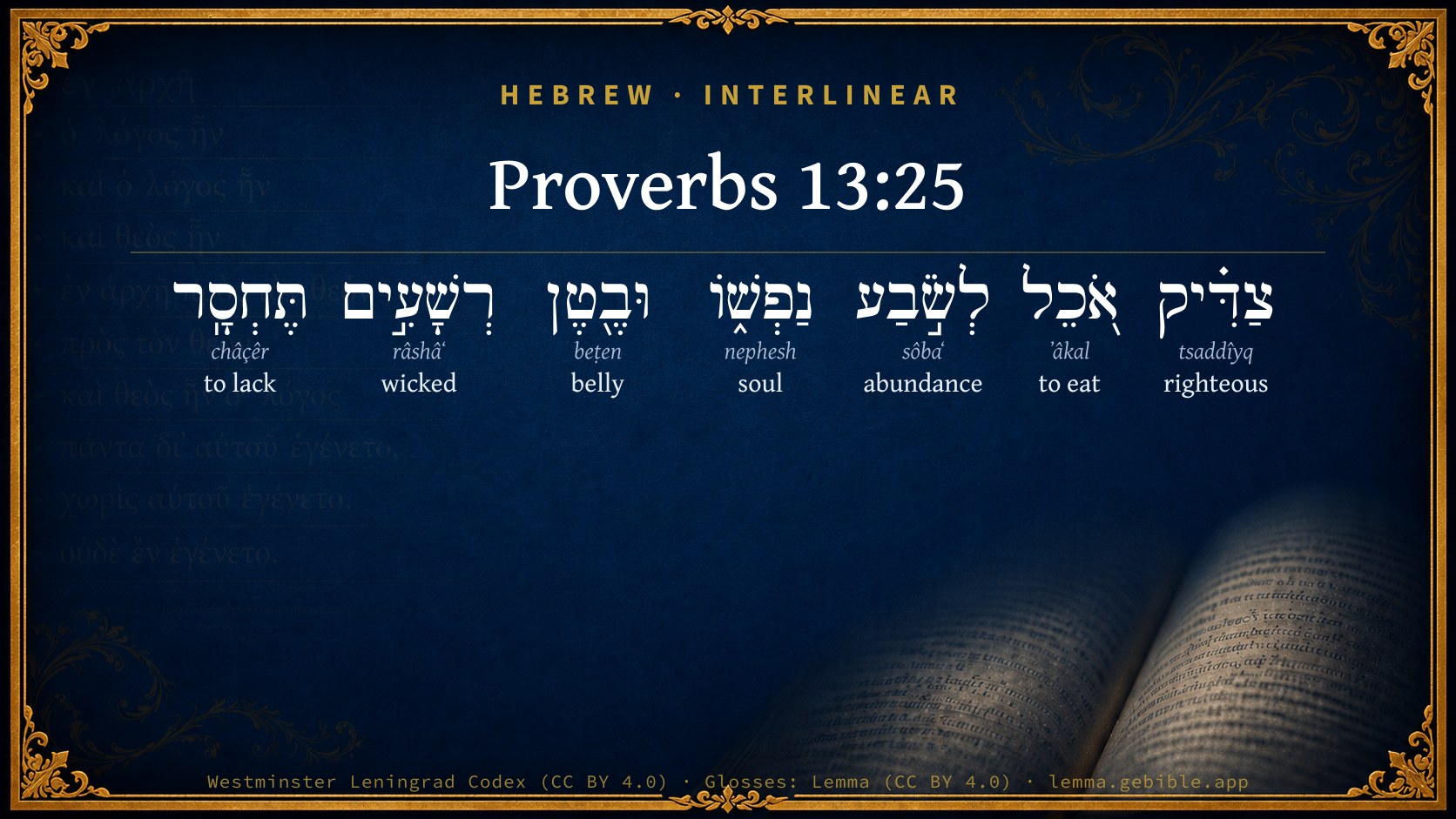
Proverbs 13:25

Hebrew (Westminster Leningrad Codex) Proverbs 13:25 appears in the Hebrew Old Testament. The text above is from the Westminster Leningrad Codex. Each word links to its Strong’s number, a concise gloss, and parsing drawn from the Open Scriptures Hebrew Bible morphology. Click any word for its full Brown-Driver-Briggs (BDB) entry.
Download image
Cite this verse

Proverbs 13:25 (World English Bible). Public Domain. Lemma interlinear Bible study tool, https://lemma.gebible.app/v/proverbs/13/25.

Show BibTeX & RIS
BibTeX
RIS
English Translation
The righteous one eats to the satisfying of his soul, But the belly of the wicked goes hungry.
World English Bible · Public Domain
Download a study sheet

One document with this verse’s original text, its word-by-word gloss line, the meaning frame, cross-references with their text, attributed commentary, and full source and license credits — printable, and it pastes into notes with its structure intact.

This verse Autodidact and up

Study sheet (.html) Plain text (.txt)

A passage Seminary Student

Up to 50 verses in one chapter. A passage sheet keeps up to 6 commentary sources and 12 cross-references per verse, in the order this page ranks them, and says so on the sheet whenever that leaves anything out. Ask for a single verse and you get the Autodidact verse sheet above.

Everything on this page stays free to read, with no account — the sheet is a download of what is already on screen, not access to it.

Want to remove ads? Support Godless Engineer
Compare translations 3

The same verse in 3 English versions, stacked beneath the original-language interlinear above. Click any original word for its lexicon entry.

Each is an independent rendering of the whole verse — the interlinear is not word-aligned to these translations.

Highlighted words mark where these versions differ — a whole-verse word diff, not a word-by-word alignment.

  • World English Bible Public Domain
    The righteous one eats to the satisfying of his soul, But the belly of the wicked goes hungry.
  • King James Version Public Domain
    The righteous eateth to the satisfying of his soul: but the belly of the wicked shall want.
  • unfoldingWord Literal Text CC BY-SA 4.0
    A righteous eating to the satisfaction of his appetite, but the stomach of the wicked will lack.

unfoldingWord Literal Text — © unfoldingWord, licensed CC BY-SA 4.0. Word-aligned USFM3 via Door43 (git.door43.org/unfoldingWord/en_ult).

Versions to compare (up to 4)

3 of 4 selected

Show all 18 translations

Every available English version of this verse, each an independent rendering of the whole verse.

  • World English Bible Public Domain
    The righteous one eats to the satisfying of his soul, But the belly of the wicked goes hungry.
  • Berean Standard Bible Public Domain
    A righteous man eats to his heart’s content, but the stomach of the wicked is empty.
  • Majority Standard Bible Public Domain
    A righteous man eats to his heart’s content, but the stomach of the wicked is empty.
  • King James Version Public Domain
    The righteous eateth to the satisfying of his soul: but the belly of the wicked shall want.
  • American Standard Version (1901) Public Domain
    The righteous eateth to the satisfying of his soul; But the belly of the wicked shall want.
  • Revised Version (1885) Public Domain
    The righteous eateth to the satisfying of his soul: but the belly of the wicked shall want.
  • Geneva Bible (1599) Public Domain
    The righteous eateth to the contentation of his minde: but the belly of the wicked shall want.
  • Douay-Rheims (1899) Public Domain
    The just eateth and filleth his soul: but the belly of the wicked is never to be filled.
  • Young's Literal Translation Public Domain
    The righteous is eating to the satiety of his soul, And the belly of the wicked lacketh!
  • Literal Standard Version CC BY-SA 4.0
    The righteous is eating to the satiety of his soul, || And the belly of the wicked lacks!
  • Unlocked Literal Bible CC BY-SA 4.0
    The righteous person eats until he satisfies his appetite, but the stomach of the wicked is always hungry.
  • unfoldingWord Literal Text CC BY-SA 4.0
    A righteous eating to the satisfaction of his appetite, but the stomach of the wicked will lack.
  • Darby Bible Public Domain
    The righteous eateth to the satisfying of his soul; but the belly of the wicked shall want.
  • World Messianic Bible Public Domain
    The righteous one eats to the satisfying of his soul, but the belly of the wicked goes hungry.
  • Webster's Bible Public Domain
    The righteous eateth to the satisfying of his soul: but the belly of the wicked shall want.
  • Free Bible Version CC BY-SA 4.0
    The good eat until they're full; but the belly of the wicked is empty.
  • Bible in Basic English Public Domain
    The upright man has food to the full measure of his desire, but there will be no food for the stomach of evil-doers.
  • JPS Tanakh (1917) Public Domain
    The righteous eateth to the satisfying of his desire; but the belly of the wicked shall want.

Literal Standard Version (2020), Covenant Press — licensed CC BY-SA 4.0. Text via the HelloAO Bible API (eBible.org). Unlocked Literal Bible (unfoldingWord) — licensed CC BY-SA 4.0. Text via the HelloAO Bible API (eBible.org). unfoldingWord Literal Text — © unfoldingWord, licensed CC BY-SA 4.0. Word-aligned USFM3 via Door43 (git.door43.org/unfoldingWord/en_ult). Free Bible Version, Dr. Jonathan Gallagher — licensed CC BY-SA 4.0. Text via the HelloAO Bible API (eBible.org).

Word by word

More ways to search: Search by grammar → Find every occurrence → Compare this word →

Practice this passage: Drill this verse → Learn its vocabulary →

About this verse

These counts appear in no published source. They are computed here, from the morphology-tagged text and Lemma’s own curated glosses. What Lemma adds →

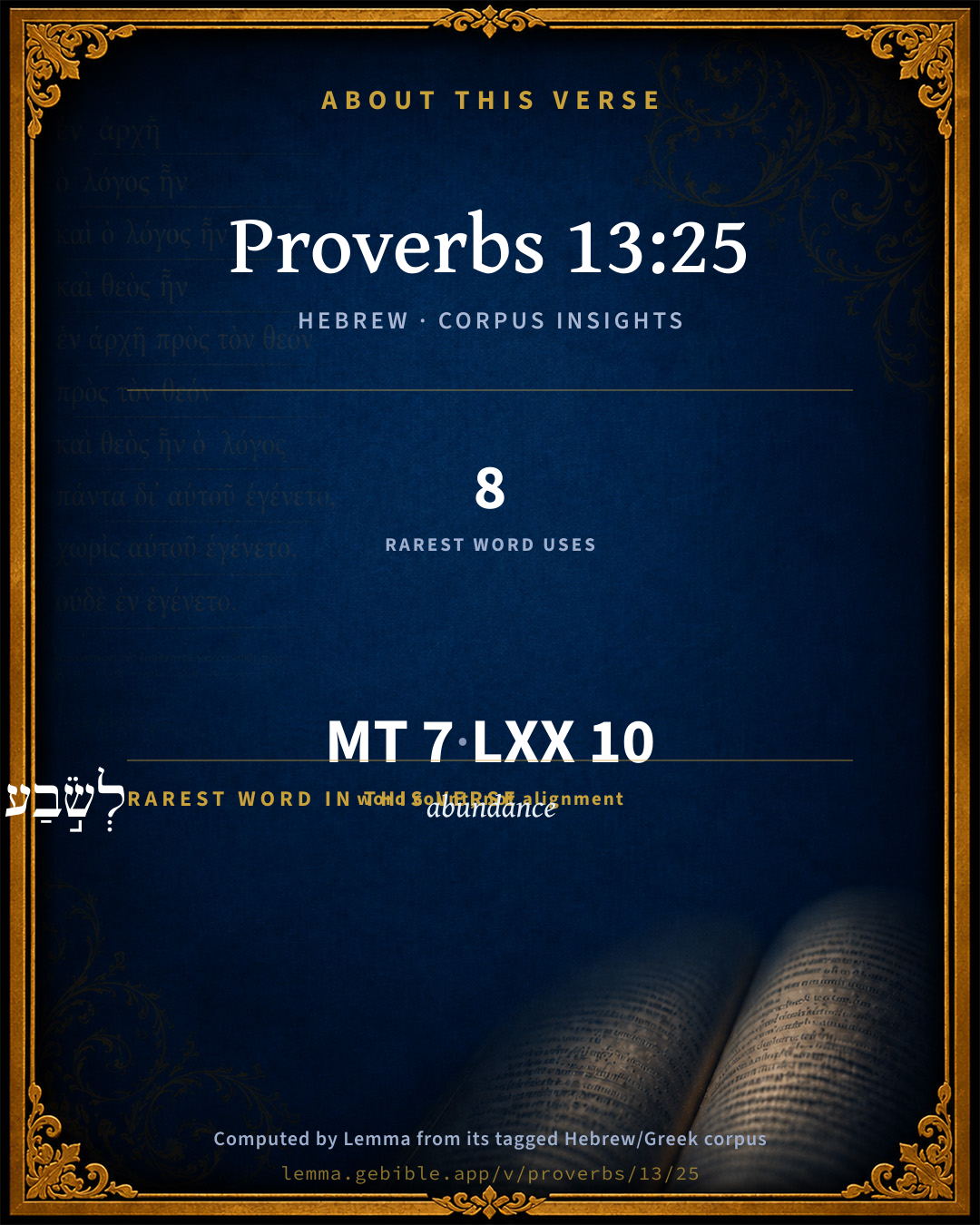
7
words
7
distinct lemmas
Wisdom
section

Notable vocabulary

The rarest word here is לְשֹׂ֣בַע abundance H7648 — appearing just 8 times in the whole Hebrew Bible.

Shared distinctive vocabulary

לְשֹׂ֣בַע abundance H7648 occurs in 8 verses of the Hebrew Bible. Also found in:

Grammatical profile

  • 2 verbs
  • 3 nouns
  • 2 adjectives

Verb forms

  • אֹ֭כֵל Qal · Participle Active
  • תֶּחְסָֽר Qal · Imperfect

Hebrew & Septuagint length

In English translation the verse runs 18 words from the Hebrew and 17 from the Septuagint (LXX English) — closely comparable.

A rough comparison of the two English renderings, which tokenize alike — not a word-level alignment.

Word counts can differ between the Hebrew and the Greek without any difference in meaning — e.g. the Hebrew direct-object marker אֵת has no separate Greek word, and Greek often adds the article ὁ.

In the original languages it is 7 Hebrew tokens and 10 Greek tokens — but the two are counted differently (Hebrew bundles its prefixes and suffixes into one token; the Greek is in lemma form), so that isn’t a like-for-like length.

Cross-references

13

Topical passages linked to Proverbs 13:25 in the Treasury of Scripture Knowledge — connected by theme and wording, ordered by reader-vote popularity; previews shown in the World English Bible.

  • Psalms 34:10 The young lions do lack, and suffer hunger, But those who seek Yahweh shall not lack any good thing.
  • Proverbs 10:3 Yahweh will not allow the soul of the righteous to go hungry, But he thrusts away the desire of the wicked.
  • Hebrews 13:5 Be free from the love of money, content with such things as you have, for he has said, "I will in no way leave you, neither will I in any way forsake you."
  • 1 Timothy 4:8 For bodily exercise has some value, but godliness has value for all things, having the promise of the life which is now, and of that which is to come.
  • Deuteronomy 32:24 [They shall be] wasted with hunger, and devoured with burning heat Bitter destruction; The teeth of animals will I send on them, With the poison of crawling things of the dust.
  • Proverbs 6:11 So your poverty will come as a robber, And your scarcity as an armed man.
  • Deuteronomy 28:48 therefore shall you serve your enemies whom Yahweh shall send against you, in hunger, and in thirst, and in nakedness, and in want of all things: and he shall put a yoke of iron on your neck, until he have destroyed you.
  • Psalms 37:3 Trust in Yahweh, and do good. Dwell in the land, and enjoy safe pasture.
  • Psalms 37:16 Better is a little that the righteous has, Than the abundance of many wicked.
  • Psalms 37:18–19 Yahweh knows the days of the perfect. Their inheritance shall be forever.
  • Proverbs 24:34 So shall your poverty come as a robber, And your want as an armed man.
  • Isaiah 65:13–14 Therefore thus says the Lord Yahweh, Behold, my servants shall eat, but you shall be hungry; behold, my servants shall drink, but you shall be thirsty; behold, my servants shall rejoice, but you shall be disappointed;
  • 2 Thessalonians 3:10 For even when we were with you, we commanded you this: "If anyone will not work, neither let him eat."

Cross-references courtesy of OpenBible.info (CC BY 4.0).

Hebrew and Greek witnesses Masoretic Hebrew ↔ Greek Septuagint

The same verse in the two great witnesses to the Old Testament, shown verse-for-verse.

These are two independent witnesses, not word-aligned to each other, and the Septuagint is shown in lemma (dictionary) form.

Hebrew Proverbs 13:25 Masoretic · Westminster Leningrad Codex

צַדִּ֗יק אֹ֭כֵל לְשֹׂ֣בַע נַפְשׁ֑וֹ וּבֶ֖טֶן רְשָׁעִ֣ים תֶּחְסָֽר

The righteous one eats to the satisfying of his soul, But the belly of the wicked goes hungry.

World English Bible · Public Domain

Greek LXX Proverbs 13:25 Septuagint · lemma form

δίκαιος ἐσθίω ἐνπιπλάω ὁ ψυχή αὐτός ψυχή δέ ἀσεβής ἐνδεής

A just man eats and satisfies his soul: but the souls of the ungodly are in lack.

LXX2012 (modern English Septuagint) · Public Domain

Hebrew: Westminster Leningrad Codex (CC BY 4.0). Greek: Septuagint (public domain); English from LXX2012 (modern English Septuagint) (Public Domain). How the Septuagint differs from the Hebrew →

Commentary

Notes on Proverbs 13:25 from classic Christian and Jewish commentators (each source and its license shown beneath its notes). The classic Christian expositions comment on the surrounding passage and are grouped to its opening verse, so a note may address several verses; the Jewish commentaries on the Tanakh (Rashi and others) are per-verse, so they appear only where the commentator wrote on this verse.

Lemma curates 59 commentaries, every one of them public domain or Creative Commons licensed, each selected and text-cleaned for this edition rather than reprinted as found. About our sources →

Trapp's Complete Commentary

John Trapp

Pro 13:25 The righteous eateth to the satisfying of his soul: but the belly of the wicked shall want.

Ver. 25. The righteous eateth to the satisfying of his soul.] Have he more or less, he hath that which satisfies him. Nature is content with a little, grace with less; Cibus et potus sunt divitiae Christianorum. food and drink are the divinity of Christians, If Jacob may but have "bread to eat, and clothes to put on," it sufficeth him; and this he dare be bold to promise himself. Beg his bread he hopes he shall not; but if he should, he can say with Luther (who made many a meal with a broiled herring), Mendicato pane hic vivamus; annon hoc pulchre sarcitur in eo quod pascimur pane cum angelis, et vita aeterna, Christo, et sacramentis? {a} Let us be content to fare hard here: have we not the bread that came down from heaven?

But the belly of the wicked shall want.] Because "their belly prepares deceit," {Job 15:35} not their heads only; they take as much delight in their witty wickedness, as the epicure in his bellytimber. Therefore, "in the fulness of their sufficiency they are in straits"; {Job 20:22} they are sick of the bulimy, or doggish appetite. {Mic 6:14}

{a} Luth. in Ps. cxxxii.

John Trapp, A Commentary or Exposition upon All the Books of the Old and New Testament (1647–1656) — public domain. Text from a community e-Sword module.

The Biblical Illustrator

Joseph S. Exell

Pro_13:25

The righteous eateth to the satisfying of his soul.

The satisfaction of the body determined by the condition of the soul

Bodily satisfaction is an essential element in our happiness so long as we are in this world. The text implies that the satisfaction of the body depends upon the condition of the soul; and this is a great truth greatly neglected. Consider what bodily satisfaction requires.

I. Bodily health. No food can satisfy a diseased body, a body whose organs and functions are out of order. But the condition of the soul has much to do with physical health. The anxieties, ill-tempers, recriminations, impure passions of a wicked heart, will soon reduce the body to disease, feebleness, and ruin. On the other hand, a true, virtuous, and happy soul tends to physical health. A merry heart doeth good like medicine. One thought can disorganise a healthy body and do much to restore a diseased one.

II. Bodily supplies. The supplies necessary to satisfy the body should be--

1. Of a right kind. A body restless with hunger would scarcely be satisfied with confectionery. Now, the condition of the soul has much to do with the kind of food. The soul not only modifies our natural appetites, but creates artificial ones, and hence supplies provisions for the body which are unnatural and unhealthy. The soul, by its working on the bodys appetites, has brought to the bodys table compounds unsatisfying and deleterious.

2. A right amount. An insufficient amount, even of right provisions, would leave the body unsatisfied. But the question of sufficiency also depends greatly on the soul. Indolence, extravagance, intemperance, bad management, often so reduce mens material resources that they are left utterly destitute of the necessary food. These thoughts, we think, give an important meaning to the text, The righteous eateth to the satisfying of his soul: but the belly of the wicked shall want. A corrupt soul will evermore have a dissatisfied body. (Homilist.)

.

The Biblical Illustrator, edited by Joseph S. Exell (c. 1880s–1900s) — public domain. Text from a community e-Sword module.

The Preacher's Complete Homiletical Commentary

Joseph S. Exell (gen. ed.)

MAIN HOMILETICS OF Pro_13:25

WANT AND SATISFACTION

I. The limited truth of the assertion in relation both to the righteous and the wicked. Read in the light of personal experience, and in the light of history, it is found true, and is found not true in the case of the righteous. Elijah ate to satisfaction beside the brook Cherith, while many of his idolatrous countrymen suffered want. But Paul was often in hunger (2Co_11:27), while Nero lived in luxury. Christians have died from hunger, and others have had all their bodily wants supplied all their lives, and sometimes by most remarkable providential interpositions. Godliness is often profitable in this sense for the “life that now is” (1Ti_4:8), but not always, and wickedness often brings a man literally to the condition of the prodigal when he would “fain have filled his belly with the husks that the swine did eat;” but many a wicked man, like him of the parable (Luk_16:19), have “fared sumptuously every day” from their cradle to their grave. To take our text as absolutely true of material food would be to contradict the testimony of Scripture itself.

II. Its absolute truth in relation to both characters.

1. That wickedness gives a man no real satisfaction is a fact of experience. Men have testified over and over again that while they lived in sin they knew nothing of real heartsatisfaction and rest, and have borne witness to the words of St. Augustine, who spoke from experience when he said, “Thou hast made us for thyself, and the heart is restless till it finds rest in Thee.” A man who feeds upon unwholesome food is always in want, because that upon which he feeds is not suited to meet the demands of his physical frame, so is it with the soul of a godless man.

2. The history of the world testifies that it is so. The unrest of the ungodly is the explanation of much of the ambition, of many of the selfish schemes of some men, as well as of the voluntary asceticism, the self-imposed sufferings of others. The key to both is that they have spent “money for that which is not bread, and their labour for that which satisfieth not” (Isa_55:2). The teaching of Christ confirms it. Want was the condition of the prodigal; he wanted the bread which his father’s home and table alone could supply. “Except ye eat the flesh of the Son of Man and drink His blood, ye have no life in you” (Joh_6:53). On this subject see Dr. Arnot’s remarks on Pro_13:12 in the comments on that verse.

3. That there is satisfaction in sainthood is declared by Christ, and testified to be true by all His followers. The bread upon which a renewed man feeds is the Divine word—the thoughts of God in the abstract, and the personal thought or word Jesus Christ. “As the living Father hath sent Me and I live by the Father, so he that eateth Me shall live by Me” (Joh_6:57). And life is but another word for satisfaction. “He that believeth on Me, as the Scripture hath said, out of His heart shall flow rivers of living water” (Joh_7:38). Millions of men and women in all circumstances, both poor and rich in worldly wealth, have set to their “seal that God is true” (Joh_3:33) when He invites men to “hearken diligently unto Him, and eat that which is good, and let their souls delight themselves in fatness” (Isa_55:2).

OUTLINES AND SUGGESTIVE COMMENTS

One of the confidences of the wicked is that he, at least, has his pleasure in this world. The inspired Solomon denies it. He himself has left us an experience (Ecclesiastes 1). The righteous man seeks righteousness and peace, and these things do satisfy him. He seeks them, not as the world does, under a mistake, but for what they really are. He seeks them more and more as he knows them better, and shall be seeking them and enjoying them through eternal ages. “But the wicked,” even in his “belly,” wants. His delights, even of the more carnal sort, are not to be directly gazed at. If they are, they vanish. He cannot trust himself to theorise over any solid pleasures. So hollow are they that he would not live over again the history of the past, and so poor that he grows tired of enjoying them.—Miller.

Have he more or less, he hath that which satisfies him. Nature is content with little, grace with less. If Jacob may have but “bread to eat and raiment to put on” it sufficeth him; and this he dare be bold to promise himself. Beg his bread he hopes he shall not, but if he should, he can say with Luther (who made many a meal of a broiled herring), “Let us be content to fare hard here: have we not the bread that came down from heaven?”—Trapp.

To have to eat is the common mercy of God, who openeth His hand and feedeth all things living. To have enough to eat is a great mercy in itself, and greater than man’s nature, which hath never enough of sinning anyway deserveth; but to be satisfied with that which is enough is a peculiar property bestowed on the righteous. The belly of the wicked wanting enough to eat in some degree is punished for feeding too greedily on the husks of sin. Wanting all food is more hardly punished, and it may be for the hardness of their hearts in resisting all instruction; but that it shall want though it have enough, this is a severe punishment of wickedness, though thought to be the least. The wise man doth not speak of the want of the mouth of the wicked as showing that the mouth should have Sufficient, and yet the belly be punished with want in not being satisfied.—Jermin.

HOMILETIC TREATMENT OF THE CHAPTER AS A WHOLE

“The true Christian education of children.”

(1) Its basis: God’s Word (Pro_13:1; Pro_13:13-14);

(2) Its means: Love and strictness in inculcating God’s Word (Pro_13:1; Pro_13:18; Pro_13:24);

(3) Its aim: Guidance of the youth to the promotion of his temporal and eternal welfare (Pro_13:2 sq. Pro_13:16 sq.)—Lange’s Commentary.

The Preacher's Complete Homiletical Commentary (gen. ed. Joseph S. Exell; Funk & Wagnalls, c. 1892) — public domain (pre-1929). A full-Bible homiletical/sermon-outline anthology covering 65 of 66 books (2 John is absent from the source module). Text from a community e-Sword module.

Matthew Henry's Commentary

Note, 1. It is the happiness of the righteous that they shall have enough and that they know when they have enough. They desire not to be surfeited, but, being moderate in their desires, they are soon satisfied. nature is content with a little and grace with less; enough is as good as a feast. Those that feed on the bread of life, that feast on the promises, meet with abundant satisfaction of soul there, eat, and are filled. 2. It is the misery of the wicked that, through the insatiableness of their own desires, they are always needy; not only their souls shall not be satisfied with the world and the flesh, but even their belly shall want; their sensual appetite is always craving. In hell they shall be denied a drop of water.

Matthew Henry's Commentary on the Whole Bible (1708–1710) — public domain (CC PDM 1.0). Text via the HelloAO Bible API.

Jamieson, Fausset & Brown

Robert Jamieson, A. R. Fausset & David Brown

The comparative temporal prosperity of the righteous and wicked, rather than contentment and discontent, is noted.

Next: Proverbs Chapter 14

Jamieson, Fausset & Brown — Commentary Critical and Explanatory on the Whole Bible (1871) — public domain (CC PDM 1.0). Text via the HelloAO Bible API.

Adam Clarke's Commentary

Verse 25. To the satisfying of his soul] His desires are all moderate; he is contented with his circumstances, and is pleased with the lot which God is pleased to send. The wicked, though he use all shifts and expedients to acquire earthly good, not sticking even at rapine and wrong, is frequently in real want, and always dissatisfied with his portion. A contented mind is a continual feast. At such feasts he eats not.

Adam Clarke's Commentary on the Bible (1810–1826) — public domain. Text from a community e-Sword/MySword module.

Ellicott's Commentary for English Readers

(25) The righteous eateth to the satisfying of his soul—i.e., has enough for his wants. (See above on Pro_10:3.)

A Bible Commentary for English Readers, edited by Charles John Ellicott (1878–1897) — public domain. Text from a community e-Sword module.

John Gill's Exposition

The righteous eateth to the satisfying of his soul,.... He is blessed with a sufficient competency to live upon; and he is contented with what he has, and uses it moderately; he has enough to eat, and is contented with his portion, and eats no more than sufficeth; he eats to the satisfying of his appetite, and no more; he does not indulge to luxury and excess: and so as to spiritual things; he eats to the satisfying of his soul, with the goodness and fatness of God's house, with the word and ordinances, with the promises of the Gospel, and with Jesus Christ, the bread of life; with these he is satisfied, as with marrow and fatness;

but the belly of the wicked shall want; not only spiritual food, which he has no appetite for, but corporeal food; he shall starve in the midst of plenty, not having a heart to put that food into his mouth, and fill his belly with it, as nature requires, through his covetousness; or, having spent his substance in rioting and wantonness, wants bread to satisfy the craving of his appetite.

Next: Proverbs Chapter 14

John Gill's Exposition of the Whole Bible (1746–1763) — public domain (CC PDM 1.0). Text via the HelloAO Bible API.

Matthew Poole's English Annotations

God’s favour and blessing gives the righteous man a competent estate, and a heart to use it, and comfort and satisfaction in it; whereas wicked men commonly want either all these blessings, or some of them.

Matthew Poole's English Annotations on the Holy Bible (1683–1685) — public domain. Text from a community e-Sword/MySword module.

Whedon's Commentary on the Bible

Daniel D. Whedon

25. To the satisfying of his soul — What his need requires to the proper sustenance of his life.

Belly — בשׂן, (beten,) stomach. A righteous man’s desires are moderate, and he lives in the temperate enjoyment of God’s blessings; but wicked men frequently bring themselves to poverty by their luxury and extravagance; and others, in consequence of the insatiableness of their desires, never have enough. Compare Pro_10:3; Psa_34:10.

Daniel D. Whedon (gen. ed.), Commentary on the Old and New Testaments (1874–1909) — public domain. Text from a community e-Sword module.

The Pulpit Commentary

The righteous eateth to the satisfying of his soul. (comp. Pro_10:3 Psa_34:10) The good man has always enough to satisfy his wants, because he is temperate, and his substance has the blessing of God. "The chief thing for life," says Siracides (Ecc 29:21), "is water, and bread, and clothing, and a house to cover shame." The belly of the wicked shall want. The wicked are punished by penury and desires never satisfied. These different results are providentially ordered.

The Pulpit Commentary (1880–1919), ed. H.D.M. Spence-Jones & Joseph S. Exell — public domain. Text from a community e-Sword module.

Keil & Delitzsch

C. F. Keil & F. Delitzsch

25 The righteous has to eat to the satisfying of his soul;

But the body of the godless must suffer want.

Jerome translates תחסר freely by insaturabilis (he has want = has never enough), but in that case we would have expected תחסר תּמיד; also in 25a עד־שׂבע would have been used. We have thus before us no commendation of temperance and moderation in contrast to gluttony, but a statement regarding the diversity of fortune of the righteous and the godless - another way of clothing the idea of Pro 10:3. שׂבע is a segolate form, thus an infin. formation, formally different from the similar שׂבע, Pro 3:10. Regarding בּטן, vid., Psychol. p. 265f.; it is a nobler word than "Bauch" [belly], for it denotes not the external arch, but, like κοιλία (R. בט, concavus), the inner body, here like Pro 18:20, as that which receives the nourishment and changes it in succum et sanguinem. That God richly nourishes the righteous, and on the contrary brings the godless to want and misery, is indeed a rule with many exceptions, but understood in the light of the N.T., it has deep inward everlasting truth.

Keil & Delitzsch — Biblical Commentary on the Old Testament (1861–1891) — public domain (CC PDM 1.0). Text via the HelloAO Bible API. (Old Testament only.)

Bridges on Proverbs

Charles Bridges

This is one of the many proofs, that "the righteous is more excellent than his neighbour." (Pro 12:26 .) Temporal blessings are assured, so far as they are really good for him; whether little or much; enough to satisfy his wants, not to "fulfill his lusts." (Pro 10:3 . Psa 34:10 ; Psa 37:3, Psa 37:18 .) Indeed ’he can never want a sufficiency, because his desires are moderate, and he makes a temperate use of God’s blessings.’†1 He therefore shall eat to his satisfying, while the wicked shall want. Jacob was fed with the best of the land, while the Egyptians were destitute. (Gen 47:11-13 .) Elijah was fed, first by ravens, afterwards by a widow, when the wicked nation were in extremity. (1Ki 17:1-11 ; 1Ki 18:5 .) The fare of the righteous may be coarse, and that of the wicked "sumptuous." But did not Daniel and his friends eat their pulse with more satisfaction, than their fellow-captives did their richer dainties? (Dan 1:12-16 .) And — as to higher food and heavenly satisfaction, Christ is a substitute for everything; nothing for Him. — ’If then’ — as the noble Luther declares — ’we live here by begging our bread, is not this well recompensed, that we are nourished with the food of angels, with eternal life, and Christ himself?’†2

Such a chaos of desires is the soul of the wicked, that no abundance can satisfy his want. Ahab’s crown could give him no rest, without Naboth’s vineyard. (1Ki 21:1-4 . Job 20:20, Job 20:22 .) So full is the ungodly heart of insatiable cravings! (Psa 17:14 . Isa 65:13-14 . Hos 4:10 . Mic 6:14 .) But how intolerable will be this conscious want throughout eternity, when a drop of water to cool the tormented tongue shall be denied! (Luk 16:24 .)

Footnotes:

†1 Bishop Patrick.

†2 Luther on Psa 132:16 . Compare Psa 36:8 . Joh 6:35, Joh 6:55 .

Charles Bridges, An Exposition of the Book of Proverbs (1846) — public domain. Text from a community e-Sword module.

Kretzmann's Popular Commentary

Paul E. Kretzmann

v. 25. The righteous eateth to the satisfying of his soul, the Lord granting him enough to satisfy all his needs; but the belly of the wicked shall want, not only because the Lord often punishes their wickedness with a lack of the necessities of life, but because their enjoyment of them is often not attended with true happiness.

Paul E. Kretzmann, Popular Commentary of the Bible (1921–1924) — public domain. Text from a community e-Sword module.

unfoldingWord translationNotes

Door43 World Missions Community

he satisfies his appetite

"he has satisfied himself" or "he fulfills his desires"

the stomach of the wicked is always hungry

Here "stomach" represents the desires of a person. AT: "the wicked person is always hungry for more" (See: Metonymy)

translationWords

righteous

evil

unfoldingWord translationNotes — © Distant Shores Media and the Door43 World Missions Community, licensed CC BY-SA 4.0. Source: git.door43.org/Door43/en_tn.

Rashi

Rabbi Shlomo Yitzchaki (Rashi)

to sate his appetite It always seems to him that he is satisfied. (

shall feel want It does not seem to them that they are satisfied.)

Rashi on the Tanakh — English translations: “The Judaica Press complete Tanach with Rashi, translated by A. J. Rosenberg” (CC BY 4.0); “Pentateuch with Rashi's commentary by M. Rosenbaum and A.M. Silbermann, 1929-1934” (public domain); “The Metsudah Tanach series, Lakewood, N.J” (CC BY 4.0); and “The Book of Joshua, Metsudah Publications, 1997” (CC BY 4.0). Text via Sefaria.

Lesson kit

Teaching starters — assembled from the data on this page, not authored interpretation. Every prompt links to the verse data it draws on. Edit before teaching.

Proverbs, in the Wisdom, opens this verse with 7 words (7 distinct Hebrew lemmas). Its most distinctive word is sôbaʻ (“abundance”). A historical commentator’s framing appears above. Read the whole chapter for the surrounding context.

Discussion questions

  1. What does “abundance” (sôbaʻ) contribute to the verse as a whole?
  2. Exodus 16:3 shares the word «abundance» with this verse. How do the two illuminate each other?
  3. The translations on this page render this verse differently — a whole-verse word diff, not a word-by-word alignment. What might account for the different wordings?
  4. The verb «אֹ֭כֵל» is Qal Participle Active. How does its form color the action?
  5. Reading how Trapp's Complete Commentary and The Biblical Illustrator read this verse, where do the two commentators agree and where do they part?

Things to notice

Reading settings

Reading text

Shown beneath each verse's original-language words.

Old Testament
Old Testament edition

Read the OT as the Masoretic Hebrew (MT) or the Greek Septuagint (LXX).

English shown for the Greek Septuagint (in the Hebrew ↔ Greek comparison).

Comparing translations? Open the Compare panel on any verse page to stack up to four side by side.