
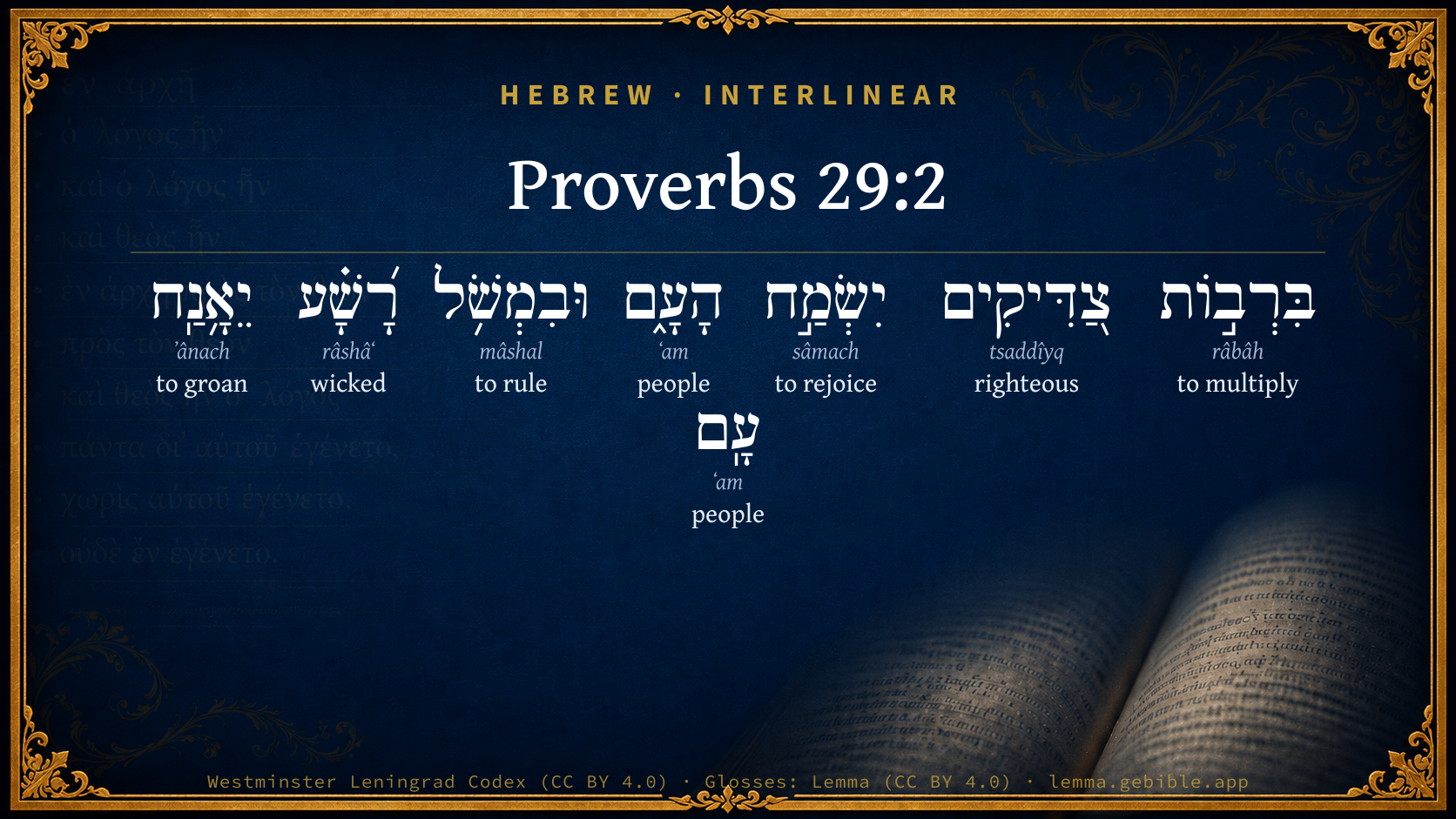
Proverbs 29:2

Hebrew (Westminster Leningrad Codex) Proverbs 29:2 appears in the Hebrew Old Testament. The text above is from the Westminster Leningrad Codex. Each word links to its Strong’s number, a concise gloss, and parsing drawn from the Open Scriptures Hebrew Bible morphology. Click any word for its full Brown-Driver-Briggs (BDB) entry.
Download image
Cite this verse

Proverbs 29:2 (World English Bible). Public Domain. Lemma interlinear Bible study tool, https://lemma.gebible.app/v/proverbs/29/2.

Show BibTeX & RIS
BibTeX
RIS
English Translation
When the righteous thrive, the people rejoice; But when the wicked rule, the people groan.
World English Bible · Public Domain
Download a study sheet

One document with this verse’s original text, its word-by-word gloss line, the meaning frame, cross-references with their text, attributed commentary, and full source and license credits — printable, and it pastes into notes with its structure intact.

This verse Autodidact and up

Study sheet (.html) Plain text (.txt)

A passage Seminary Student

Up to 50 verses in one chapter. A passage sheet keeps up to 6 commentary sources and 12 cross-references per verse, in the order this page ranks them, and says so on the sheet whenever that leaves anything out. Ask for a single verse and you get the Autodidact verse sheet above.

Everything on this page stays free to read, with no account — the sheet is a download of what is already on screen, not access to it.

Want to remove ads? Support Godless Engineer
Compare translations 3

The same verse in 3 English versions, stacked beneath the original-language interlinear above. Click any original word for its lexicon entry.

Each is an independent rendering of the whole verse — the interlinear is not word-aligned to these translations.

Highlighted words mark where these versions differ — a whole-verse word diff, not a word-by-word alignment.

  • World English Bible Public Domain
    When the righteous thrive, the people rejoice; But when the wicked rule, the people groan.
  • King James Version Public Domain
    When the righteous are in authority, the people rejoice: but when the wicked beareth rule, the people mourn.
  • unfoldingWord Literal Text CC BY-SA 4.0
    When the righteous increase, the people rejoice, but when a wicked rules, a people groans.

unfoldingWord Literal Text — © unfoldingWord, licensed CC BY-SA 4.0. Word-aligned USFM3 via Door43 (git.door43.org/unfoldingWord/en_ult).

Versions to compare (up to 4)

3 of 4 selected

Show all 18 translations

Every available English version of this verse, each an independent rendering of the whole verse.

  • World English Bible Public Domain
    When the righteous thrive, the people rejoice; But when the wicked rule, the people groan.
  • Berean Standard Bible Public Domain
    When the righteous flourish, the people rejoice, but when the wicked rule, the people groan.
  • Majority Standard Bible Public Domain
    When the righteous flourish, the people rejoice, but when the wicked rule, the people groan.
  • King James Version Public Domain
    When the righteous are in authority, the people rejoice: but when the wicked beareth rule, the people mourn.
  • American Standard Version (1901) Public Domain
    When the righteous are increased, the people rejoice; But when a wicked man beareth rule, the people sigh.
  • Revised Version (1885) Public Domain
    When the righteous are increased, the people rejoice: but when a wicked man beareth rule, the people sigh.
  • Geneva Bible (1599) Public Domain
    When the righteous are in authoritie, the people reioyce: but when the wicked beareth rule, the people sigh.
  • Douay-Rheims (1899) Public Domain
    When just men increase, the people shall rejoice: when the wicked shall bear rule, the people shall mourn.
  • Young's Literal Translation Public Domain
    In the multiplying of the righteous the people rejoice, And in the ruling of the wicked the people sigh.
  • Literal Standard Version CC BY-SA 4.0
    In the multiplying of the righteous the people rejoice, || And in the ruling of the wicked the people sigh.
  • Unlocked Literal Bible CC BY-SA 4.0
    When righteous people increase, the people rejoice, but when a wicked person is the ruler, the people sigh.
  • unfoldingWord Literal Text CC BY-SA 4.0
    When the righteous increase, the people rejoice, but when a wicked rules, a people groans.
  • Darby Bible Public Domain
    When the righteous increase, the people rejoice; but when the wicked beareth rule, the people mourn.
  • World Messianic Bible Public Domain
    When the righteous thrive, the people rejoice; but when the wicked rule, the people groan.
  • Webster's Bible Public Domain
    When the righteous are in authority, the people rejoice: but when the wicked beareth rule, the people mourn.
  • Free Bible Version CC BY-SA 4.0
    When good people are in charge, everybody celebrates; but when the wicked rule, everybody groans.
  • Bible in Basic English Public Domain
    When the upright have power, the people are glad; when an evil man is ruler, grief comes on the people.
  • JPS Tanakh (1917) Public Domain
    When the righteous are increased, the people rejoice; but when the wicked beareth rule, the people sigh.

Literal Standard Version (2020), Covenant Press — licensed CC BY-SA 4.0. Text via the HelloAO Bible API (eBible.org). Unlocked Literal Bible (unfoldingWord) — licensed CC BY-SA 4.0. Text via the HelloAO Bible API (eBible.org). unfoldingWord Literal Text — © unfoldingWord, licensed CC BY-SA 4.0. Word-aligned USFM3 via Door43 (git.door43.org/unfoldingWord/en_ult). Free Bible Version, Dr. Jonathan Gallagher — licensed CC BY-SA 4.0. Text via the HelloAO Bible API (eBible.org).

Word by word

More ways to search: Search by grammar → Find every occurrence → Compare this word →

Practice this passage: Drill this verse → Learn its vocabulary →

About this verse

These counts appear in no published source. They are computed here, from the morphology-tagged text and Lemma’s own curated glosses. What Lemma adds →

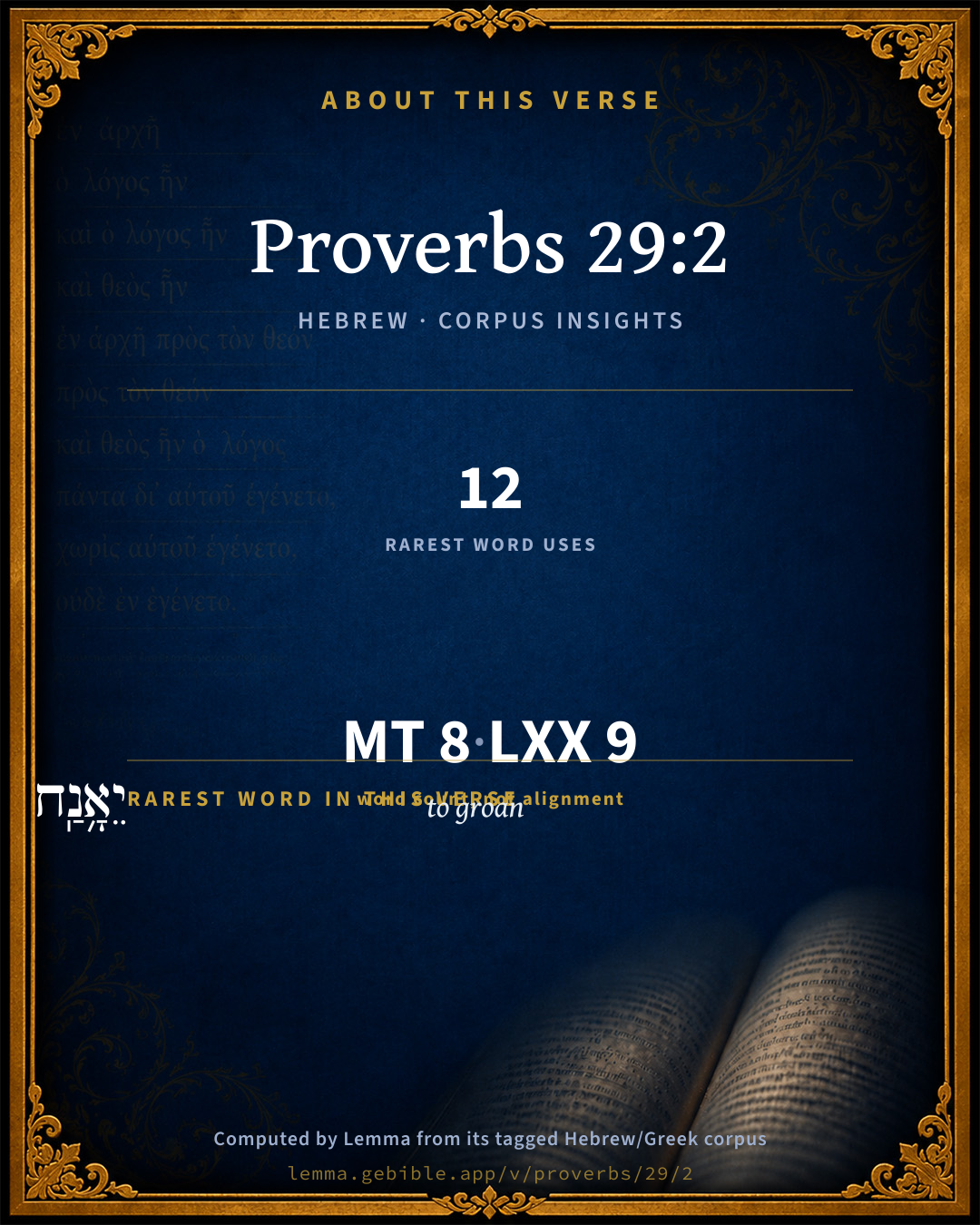
8
words
7
distinct lemmas
Wisdom
section

Notable vocabulary

The rarest word here is יֵאָ֥נַֽח to groan H584 — appearing just 12 times in the whole Hebrew Bible.

Shared distinctive vocabulary

יֵאָ֥נַֽח to groan H584 occurs in 11 verses of the Hebrew Bible. Also found in:

Grammatical profile

  • 4 verbs
  • 2 nouns
  • 2 adjectives

Verb forms

  • בִּרְב֣וֹת Qal · Infinitive Construct
  • יִשְׂמַ֣ח Qal · Imperfect
  • וּבִמְשֹׁ֥ל Qal · Infinitive Construct
  • יֵאָ֥נַֽח Niphal · Imperfect

Repetition

A word recurs within this verse — often emphatic in Hebrew:

  • הָעָ֑ם people H5971 ×2

Hebrew & Septuagint length

In English translation the verse runs 15 words from the Hebrew and 16 from the Septuagint (LXX English) — closely comparable.

A rough comparison of the two English renderings, which tokenize alike — not a word-level alignment.

Word counts can differ between the Hebrew and the Greek without any difference in meaning — e.g. the Hebrew direct-object marker אֵת has no separate Greek word, and Greek often adds the article ὁ.

In the original languages it is 8 Hebrew tokens and 9 Greek tokens — but the two are counted differently (Hebrew bundles its prefixes and suffixes into one token; the Greek is in lemma form), so that isn’t a like-for-like length.

Cross-references

12

Topical passages linked to Proverbs 29:2 in the Treasury of Scripture Knowledge — connected by theme and wording, ordered by reader-vote popularity; previews shown in the World English Bible.

  • Proverbs 28:12 When the righteous triumph, there is great glory; But when the wicked rise, men hide themselves.
  • Proverbs 11:10 When it goes well with the righteous, the city rejoices. When the wicked perish, there is shouting.
  • Proverbs 28:28 When the wicked rise, men hide themselves; But when they perish, the righteous thrive.
  • Esther 8:15 Mordecai went forth from the presence of the king in royal clothing of blue and white, and with a great crown of gold, and with a robe of fine linen and purple: and the city of Shushan shouted and was glad.
  • Ecclesiastes 10:5 There is an evil which I have seen under the sun, the sort of error which proceeds from the ruler.
  • Esther 3:15 The posts went forth in haste by the king's commandment, and the decree was given out in Shushan the palace. The king and Haman sat down to drink; but the city of Shushan was perplexed.
  • Revelation 11:15 The seventh angel sounded, and great voices in heaven followed, saying, "The kingdom of the world has become the Kingdom of our Lord, and of his Christ. He will reign forever and ever!"
  • Psalms 72:1–7 God, give the king your justice; Your righteousness to the royal son.
  • Isaiah 32:1–2 Behold, a king shall reign in righteousness, and princes shall rule in justice.
  • Jeremiah 23:5–6 Behold, the days come, says Yahweh, that I will raise to David a righteous Branch, and he shall reign as king and deal wisely, and shall execute justice and righteousness in the land.
  • Matthew 2:16 Then Herod, when he saw that he was mocked by the wise men, was exceedingly angry, and sent out, and killed all the male children who were in Bethlehem and in all the surrounding countryside, from two years old and under, according to the exact time which he had learned from the wise men.
  • Matthew 2:3 When Herod the king heard it, he was troubled, and all Jerusalem with him.

Cross-references courtesy of OpenBible.info (CC BY 4.0).

Hebrew and Greek witnesses Masoretic Hebrew ↔ Greek Septuagint

The same verse in the two great witnesses to the Old Testament, shown verse-for-verse.

These are two independent witnesses, not word-aligned to each other, and the Septuagint is shown in lemma (dictionary) form.

Hebrew Proverbs 29:2 Masoretic · Westminster Leningrad Codex

בִּרְב֣וֹת צַ֭דִּיקִים יִשְׂמַ֣ח הָעָ֑ם וּבִמְשֹׁ֥ל רָ֝שָׁ֗ע יֵאָ֥נַֽח עָֽם

When the righteous thrive, the people rejoice; But when the wicked rule, the people groan.

World English Bible · Public Domain

Greek LXX Proverbs 29:2 Septuagint · lemma form

ἐνκωμιάζω δίκαιος εὐφραίνω λαός ἄρχω δέ ἀσεβής στένω ἀνήρ

When the righteous are praised, the people will rejoice: but when the ungodly rule, men mourn.

LXX2012 (modern English Septuagint) · Public Domain

On this verse, The Cambridge Bible for Schools and Colleges discusses the Septuagint’s reading. Read the note in Commentary ↓

Hebrew: Westminster Leningrad Codex (CC BY 4.0). Greek: Septuagint (public domain); English from LXX2012 (modern English Septuagint) (Public Domain). How the Septuagint differs from the Hebrew →

Commentary

Notes on Proverbs 29:2 from classic Christian and Jewish commentators (each source and its license shown beneath its notes). The classic Christian expositions comment on the surrounding passage and are grouped to its opening verse, so a note may address several verses; the Jewish commentaries on the Tanakh (Rashi and others) are per-verse, so they appear only where the commentator wrote on this verse.

Lemma curates 59 commentaries, every one of them public domain or Creative Commons licensed, each selected and text-cleaned for this edition rather than reprinted as found. About our sources →

Trapp's Complete Commentary

John Trapp

Pro 29:2 When the righteous are in authority, the people rejoice: but when the wicked beareth rule, the people mourn.

Ver. 2. When the righteous are in authority.] Or, Are increased, as Pro 28:28; {See Trapp on "Pro 28:28"}

The people mourn.] Heb., Sigh (as the oppressed Israelites in Egypt did) where they dare not speak out. But what a bloody tyrant was Sulla, who put to death Marcus Plaetorius only for sighing at the cruel execution of Marcus Marius! So one Lancelot was burnt in Giles’s fields for pitying the cruel death of a couple of martyrs. {a}

{a} Acts and Mon., fol. 1164.

John Trapp, A Commentary or Exposition upon All the Books of the Old and New Testament (1647–1656) — public domain. Text from a community e-Sword module.

The Biblical Illustrator

Joseph S. Exell

Pro_29:2

When the righteous are in authority, the people rejoice.

The happiness of the people

Man is, for the most part, equally unhappy when subjected, without redress, to the passions of another, or left, without control, to the dominion of his own. Government is necessary to the safety of particular men and the happiness of society. The people cannot rejoice except the righteous are in authority.

I. The duty of those in authority to promote the happiness of the people. No man is born merely for his own sake, to consult his own advantage or pleasure, and unconnected with the good of others. This is more evidently true of those who are exalted into high rank, dignified with honours, and vested with authority. He who wears the honours and receives the revenues of an exalted station, without attending to the duties of his post, is, in a very high degree, criminal, both in the eye of God and man.

II. By what means the happiness of the people may be most effectually promoted. The only uniform and perpetual cause of public happiness is public virtue. Without virtue nothing can be securely possessed or properly enjoyed. In a country like ours the great demand is for the security of property, the confirmation of liberty, and the extension of commerce. If riches and liberty could make us happy, it would remain to be considered how riches and liberty can be secured. Human laws must be limited in their effects. The deficiencies in civil life can be supplied only by religion. The first duty of a governor is therefore to diffuse through the community a spirit of religion. To this end it is necessary that the external order of religion be diligently maintained, that the solemnities of worship be duly observed, and a proper reverence preserved for the times and places appropriated to piety. And governors must co-operate with their laws by their own examples.

III. How the people are to assist and further the endeavours of their governors. Nations cannot be governed but by their own consent. The first duty of subjects is obedience to the laws. No man thinks laws unnecessary for others; and no man, if he considers his own inherent frailty, can justly think them unnecessary for himself. Even the errors and deficiencies of authority must be treated with respect. All institutions are defective by their nature, and all rulers have their imperfections, like other men. As government is difficult to be administered, so it is difficult to be understood; and where very few have capacity to judge, very few have a right to censure. The laws will be easily obeyed by him who adds to human sanctions the obligations of conscience; and he will not easily be disposed to censure his superiors whom religion has made acquainted with his own failings. (John Taylor.)

A righteous government

I. Some of the chief advantages that people enjoy under a righteous government.

1. The laws are duly executed. This keeps all the springs of the body politic in their right tone, and gives life and vigour to their motion.

2. True merit finds protection and encouragement under it. This enlivens peoples spirits and makes them study to be serviceable upon a right principle.

3. Such a government appears abroad with weight and authority. Righteousness exalteth a nation and spreads its fame and reputation in countries far remote.

4. Such a government is attended with the blessing of God.

II. How ought people to express their joy when the righteous are in authority?

1. By a ready and cheerful obedience to authority.

2. By grateful acknowledgments to God for so great a blessing.

3. The people should express their joy by their gratitude to such rulers. (Bp. John Hough.)

The Biblical Illustrator, edited by Joseph S. Exell (c. 1880s–1900s) — public domain. Text from a community e-Sword module.

Joseph Benson's Commentary

Pro 29:2. When the righteous are in authority — The Hebrew word here used signifies to increase, either in number, or in dignity and power, but it appears from the opposite clause that the latter is intended in this place. The people rejoice — For the blessed effects of their good government; but when the wicked beareth rule — When an ungodly man governs; the people mourn — For the oppressions and mischiefs which they feel, and for the dreadful judgments of God, which they justly fear.

Joseph Benson's Commentary on the Old and New Testaments (1811–1818) — public domain. Text from a community e-Sword module.

Geneva Bible (1599)

Geneva Bible translators

Or, are increased.

Geneva Bible (1599) marginal notes — public domain. Text via Bolls.life.

Matthew Henry's Commentary

This is what was said before, Pro 28:12, Pro 28:28. 1. The people will have cause to rejoice or mourn according as their rulers are righteous or wicked; for, if the righteous be in authority, sin will be punished and restrained, religion and virtue will be supported and kept in reputation; but, if the wicked get power in their hands, wickedness will abound, religion and religious people will be persecuted, and so the ends of government will be perverted. 2. The people will actually rejoice or mourn according as their rulers are righteous or wicked. Such a conviction are even the common people under of the excellency of virtue and religion that they will rejoice when they see them preferred and countenanced; and, on the contrary, let men have ever so much honour or power, if they be wicked and vicious, and use it ill, they make themselves contemptible and base before all the people (as those priests, Mal 2:9) and subjects will think themselves miserable under such a government.

Matthew Henry's Commentary on the Whole Bible (1708–1710) — public domain (CC PDM 1.0). Text via the HelloAO Bible API.

Jamieson, Fausset & Brown

Robert Jamieson, A. R. Fausset & David Brown

(Compare Pro 11:10; Pro 28:28).

in authority--(Compare Margin), increased in power.

Jamieson, Fausset & Brown — Commentary Critical and Explanatory on the Whole Bible (1871) — public domain (CC PDM 1.0). Text via the HelloAO Bible API.

The Cambridge Bible for Schools and Colleges

gen. ed. J. J. S. Perowne

2. in authority] This rendering is supported by the parallelism, but it is relegated to the margin in R.V. The rendering, increased, R.V. text, A.V. marg., gives the more usual meaning of the Heb. word, See Pro_28:28, and Pro_29:16 below.

the wicked] Or, a wicked man, R.V. The word is singular, but may be taken with A.V. collectively, ἀρχόντων δὲ ἀσεβῶν, LXX.; cum impii sumserint principatum, Vulg.

The Cambridge Bible for Schools and Colleges (gen. ed. J. J. S. Perowne; Cambridge University Press, 1878–1918) — public domain. Text from a community e-Sword module.

John Gill's Exposition

When the righteous are in authority,.... Or "are increased" (g); either in number or in riches, or in power and dominion; are set in high places, and have the exercise of civil government and the execution of the laws in their hands; for the protection of good men in their civil and religious privileges, and for the punishment of evil men; for the encouraging of all that is good, and for the discouraging of everything that is bad;

the people rejoice; the whole body of the people, because of the public good; a state is happy under such an administration; everyone feels and enjoys the advantage of it; see Kg1 4:20;

but when the wicked beareth rule, the people mourn; or "groan" (h), or "will groan", under their tyranny and oppression, and because of the sad state of things; the number of good men is lessened, being cut off, or obliged to flee; wicked men and wickedness are encouraged and promoted; heavy taxes are laid upon them, and exorbitant demands made and cruelty, injustice, and arbitrary power exercised; and no man's person and property safe; see Pro 10:11.

(g) "cum augentur", Junius & Tremellius; "cum multiplicati fuerit, vel multiplicantur", Vatablus, Baynus, Cocceius, Michaelis; "in multiplicari justos", Montanus. (h) "gemet", Pagninus, Montanus, V. L. "gemit", Michaelis; "ingemiscit", Schultens; so the Tugurine version, Mercerus; "suspirat", Junius & Tremellius, Piscator, Cocceius.

John Gill's Exposition of the Whole Bible (1746–1763) — public domain (CC PDM 1.0). Text via the HelloAO Bible API.

Matthew Poole's English Annotations

In authority; which interpretation is confirmed from the opposite clause. The Hebrew word signifies to increase either in number, or in dignity and power.

The people rejoice, for the blessed effects of their good government.

The people mourn, both for the oppressions and mischiefs which they feel, and for the dreadful judgments of God which they justly fear.

Matthew Poole's English Annotations on the Holy Bible (1683–1685) — public domain. Text from a community e-Sword/MySword module.

Whedon's Commentary on the Bible

Daniel D. Whedon

2. Righteous… in authority — Literally, in their becoming great. Some render, when they multiply, increase; but this is not accordant with the next clause.

Mourn — Grieve, are oppressed. Compare Pro_11:10; Pro_28:12; Pro_28:28; Ecc_10:5.

Daniel D. Whedon (gen. ed.), Commentary on the Old and New Testaments (1874–1909) — public domain. Text from a community e-Sword module.

The Pulpit Commentary

When the righteous are in authority; rather, as in Pro_28:28, when the righteous are increased; Vulgate, in multiplicatione justorum. When sinners are put away, and the righteous are in the majority. Septuagint, "when the just are commended." When good men give the tone to society and conduct all affairs according to their own high standard, the people rejoice; there is general happiness; prosperity abounds, and voices ring cheerfully. (Pro_11:10 Pro_28:12) When the wicked beareth rule, the people mourn; they suffer violence and injustice, and have bitter cause for complaint and lamentation. This proverb is not applicable to the age of Solomon.

The religion of politics.

I RELIGION IS CONCERNED WITH POLITICS. Too often the two spheres are kept disastrously distinct. On the one hand, it is pretended that the sacred character of religion would be desecrated by its being dragged into the political arena; and on the other hand, the claim of religion to have a voice in public affairs is set down to the ambition and tyranny of priestcraft. Now, it is not to be supposed that purely religious subjects should be obtruded on the uncongenial platform of a public meeting. Very possibly they would be resented; we are not to cast pearl before swine. Moreover, there is a time for everything. But religion claims to influence politics, to be a leading factor in public movements, to hold the standard by which all political actions are to be judged. It must do this if it is to carry out its mission of leavening the whole lump. It should leave no region of life untouched; commerce, literature, art, science, recreation, society, and politics must all come under its influence. For religion to withdraw from politics is to hand that important region of life over to the devil. We find that the Bible has much to say on the conduct of public affairs.

II THE WELFARE OF A PEOPLE IS LARGELY DETERMINED BY THE MORAL CHARACTER OF THE GOVERNMENT.

1. The principal influence of religion on politics must be moral. In public life nice distinctions of creed, fine varieties of abstract dogma, and academic discussions of theoretical divinity are brushed aside as mere cobwebs compared to the serious, practical, present day questions that are at stake. But the moral influence of religion does not belong to any of these categories. That influence is direct, practical, and real. The religion of politics is the morality of public life viewed in the light of God.

2. The moral character of public affairs is of vital interest to the people. States are ruined by immoral government. Bad passions stir up needless strife. Wicked greed, jealousy, or revenge are at the root of most wars. A government of a high moral character would have found a means of keeping the peace, where one of lower tone has plunged the nation into all the horrors of war. The right and peaceable relation of class to class within the community can only be preserved when justice and humanity are observed in the conduct of public affairs.

III IT IS THE DUTY OF CHRISTIAN MEN TO SEE THAT THE RIGHTEOUS ARE IN AUTHORITY.

1. In a system of popular government all who have a voice should make that voice heard. It is a distinct dereliction of duty for any Christian man to withdraw from all influence in public life. It may be urged that the tone of that life is worldly. If so there is the more reason why unworldly men should enter it in order to give it a higher character. The Christian is not a recluse. He is called to be the salt of the earth, to season all society with wholesome thought and action. It is unfair to leave the burden of public affairs to others, and then to profit by their labours; and yet this is what is done by those people who are too devout to assist in the making of good laws, but by no means too devout to avail themselves of those laws when they are made.

2. Religion will best influence politics by good men being at the head of affairs. Good men will make good measures. It is therefore necessary to select men of high character for parliament and also for municipal offices.

See homily on Pro_11:10. C.

The Pulpit Commentary (1880–1919), ed. H.D.M. Spence-Jones & Joseph S. Exell — public domain. Text from a community e-Sword module.

Keil & Delitzsch

C. F. Keil & F. Delitzsch

The general ethical proverb is here followed by one that is political:

2 When the righteous increase, the people rejoice;

And when a godless man ruleth, the people mourn.

Regarding 'בּרבות צדּ (Aquila rightly, ἐν τῷ πληθῦναι δικαίους), vid., at Pro 28:28. If the righteous form the majority, or are in such numbers that they are the party that give the tone, that form the predominant power among the people (Fleischer, cum incrementa capiunt justi), then the condition of the people is a happy one, and their voice joyful (Pro 11:10); if, on the contrary, a godless man or (after Pro 28:1) godless men rule, the people are made to sigh (יאנח עם, with the Gaja, according to rule). "There is reason," as Hitzig remarks, "why עם should be placed first with, and then without, the article." In the first case it denotes the people as those among whom there is such an increase of the righteous; in the second case, the article is wanting, because it is not generally used in poetry; and, besides, its absence makes the second line consist of nine syllables, like the first.

Keil & Delitzsch — Biblical Commentary on the Old Testament (1861–1891) — public domain (CC PDM 1.0). Text via the HelloAO Bible API. (Old Testament only.)

Bridges on Proverbs

Charles Bridges

’The robes of honor to the righteous are the garments of gladness to the people. The scepter of authority to the godly is the staff of comfort to the people. On the other hand, the vestments of dignity to the wicked are the weeds of mourning to the people. The throne of command to the one is the dungeon of misery to the other. The titles of honor given to the one are sighs of sorrow wrung from the other.’†1 The contrast of the government of Mordecai and Haman illustrates this joy and mourning.†2 The special rejoicings at the accession of Solomon might probably be connected with the confidence, that he would "walk in the ways of David his father."†3 The reigns of the righteous kings of Judah were pre-eminently distinguished by national happiness.†4 The glorious era yet in store for the world, is, when "the Lord shall bless" his own kingdom, "as the habitation of justice and mountain of holiness."†5 For what but righteousness can truly bless either an individual, a family, or a nation?†6

When therefore the wicked bear rule — the people — not the godly — only mourn. The depth of the mourning is surely the joy at the removal of the scourge. Meanwhile it is borne by "the faithful in the land" as a national scourge.†7 And ’if tears be their drink, patience will be their bread, till God have mercy on them.’†8 What need have we to thank God, that our guilty country, with so much to humble us in shame, should have been so long spared from the curse of wicked rulers! The tyrant rules for his own sinful ends. The Christian sovereign for the good of the people.

Footnotes:

†1 Jermin. Compare Pro 28:12, Pro 28:28 . Sir 10:3 .

†2 Est 8:15-16; Est 10:3, with Est 3:15 ; Est 4:1-3 .

†3 1Ki 1:39-40, with 1Ki 3:3 . Compare 1Ki 4:20 .

†4 2Ch 15:12-15 ; 2Ch 20:27-30 . 2Ch 29:36 ; 2Ch 30:21 .

†5 Jer 31:23. Isa 1:26 .

†6 Psa 72:1-7. Isa 32:1 . ’It is no peculiar conceit, but a matter of sound consequence, that all duties are by so much the better performed, by how much the men are more religious, from whose abilities the same proceed. For if the course of politic affairs cannot in any good sort go forward without fit instruments, and that which fitteth them be their virtues, let polity acknowledge itself indebted to religion, godliness being the chiefest, top and well-spring of all true virtue, even as God is of all good things.’ Thus admirably does our great Hooker insist, that ’religion, unfeignedly loved, perfecteth man’s abilities unto all kind of virtuous services in the commonwealth.’ - Eccl. Pol. Book v. c. 1.

†7 Ecc 10:5-6. Isa 3:4-5 . Mic 3:9-12 .

†8 Jermin ut supra.

Charles Bridges, An Exposition of the Book of Proverbs (1846) — public domain. Text from a community e-Sword module.

Lesson kit

Teaching starters — assembled from the data on this page, not authored interpretation. Every prompt links to the verse data it draws on. Edit before teaching.

Proverbs, in the Wisdom, opens this verse with 8 words (7 distinct Hebrew lemmas). Its most distinctive word is ʼânach (“to groan”). A historical commentator’s framing appears above. Read the whole chapter for the surrounding context.

Discussion questions

  1. What does “to groan” (ʼânach) contribute to the verse as a whole?
  2. Exodus 2:23 shares the word «to groan» with this verse. How do the two illuminate each other?
  3. “people” occurs 2× in this one verse. What is the effect of the repetition?
  4. These translations render this verse differently. What is at stake in choosing one wording over another?
  5. The verb «בִּרְב֣וֹת» is Qal Infinitive Construct. How does its form color the action?
  6. Reading how Trapp's Complete Commentary and The Biblical Illustrator read this verse, where do the two commentators agree and where do they part?

Things to notice

Reading settings

Reading text

Shown beneath each verse's original-language words.

Old Testament
Old Testament edition

Read the OT as the Masoretic Hebrew (MT) or the Greek Septuagint (LXX).

English shown for the Greek Septuagint (in the Hebrew ↔ Greek comparison).

Comparing translations? Open the Compare panel on any verse page to stack up to four side by side.