Psalms 97:10

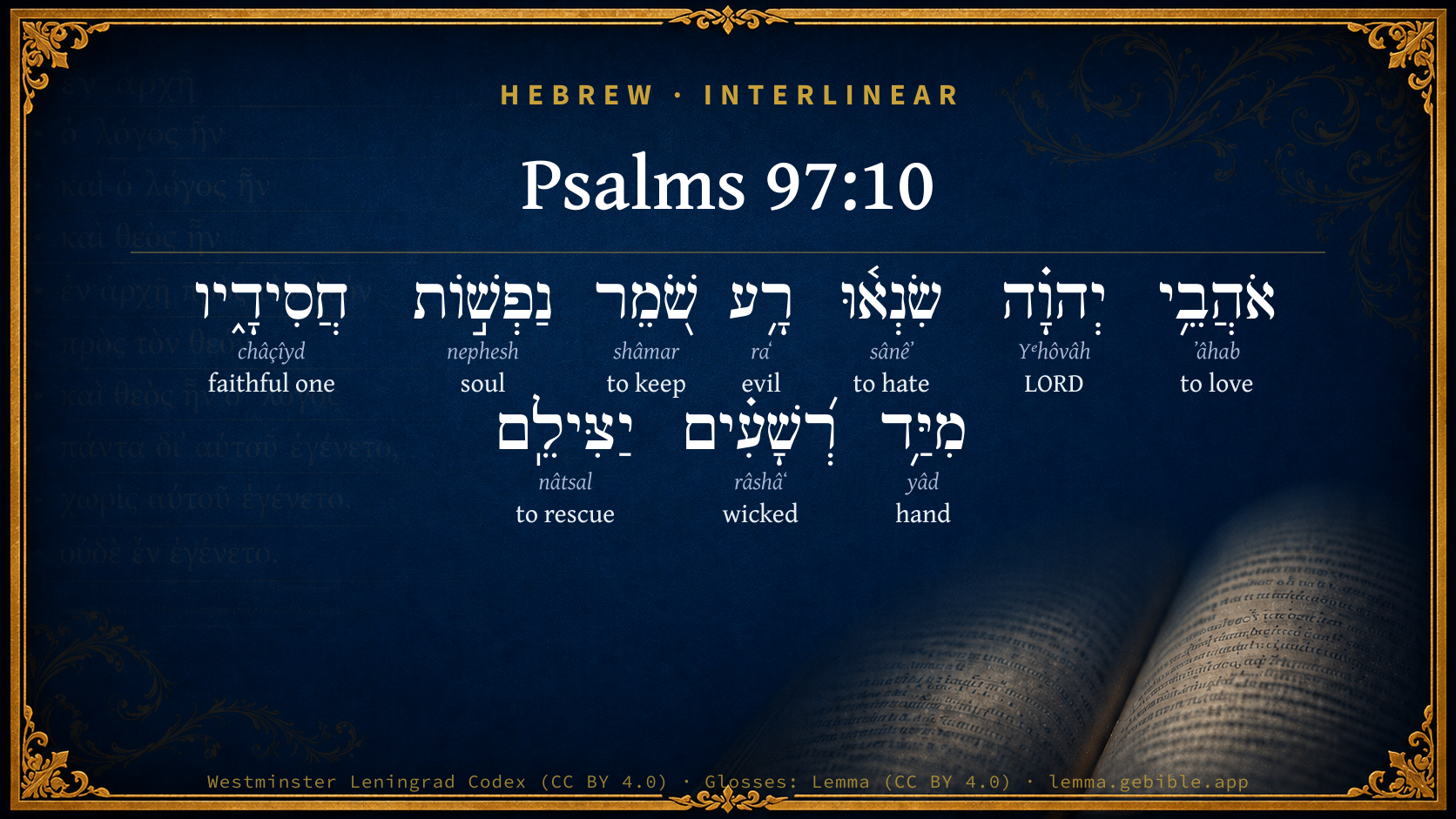
Hebrew (Westminster Leningrad Codex) Psalms 97:10 appears in the Hebrew Old Testament. The text above is from the Westminster Leningrad Codex. Each word links to its Strong’s number, a concise gloss, and parsing drawn from the Open Scriptures Hebrew Bible morphology. Click any word for its full Brown-Driver-Briggs (BDB) entry.
Download image
Cite this verse

Psalms 97:10 (World English Bible). Public Domain. Lemma interlinear Bible study tool, https://lemma.gebible.app/v/psalms/97/10.

Show BibTeX & RIS
BibTeX
RIS
English Translation
You who love Yahweh, hate evil. He preserves the souls of his saints. He delivers them out of the hand of the wicked.
World English Bible · Public Domain
Download a study sheet

One document with this verse’s original text, its word-by-word gloss line, the meaning frame, cross-references with their text, attributed commentary, and full source and license credits — printable, and it pastes into notes with its structure intact.

This verse Autodidact and up

Study sheet (.html) Plain text (.txt)

A passage Seminary Student

Up to 50 verses in one chapter. A passage sheet keeps up to 6 commentary sources and 12 cross-references per verse, in the order this page ranks them, and says so on the sheet whenever that leaves anything out. Ask for a single verse and you get the Autodidact verse sheet above.

Everything on this page stays free to read, with no account — the sheet is a download of what is already on screen, not access to it.

Want to remove ads? Support Godless Engineer
Compare translations 3

The same verse in 3 English versions, stacked beneath the original-language interlinear above. Click any original word for its lexicon entry.

Each is an independent rendering of the whole verse — the interlinear is not word-aligned to these translations.

Highlighted words mark where these versions differ — a whole-verse word diff, not a word-by-word alignment.

  • World English Bible Public Domain
    You who love Yahweh, hate evil. He preserves the souls of his saints. He delivers them out of the hand of the wicked.
  • King James Version Public Domain
    Ye that love the LORD, hate evil: he preserveth the souls of his saints; he delivereth them out of the hand of the wicked.
  • unfoldingWord Literal Text CC BY-SA 4.0
    Lovers of Yahweh, hate evil! The protector of the lives of his faithful, from the hand of the wicked he snatches them.

unfoldingWord Literal Text — © unfoldingWord, licensed CC BY-SA 4.0. Word-aligned USFM3 via Door43 (git.door43.org/unfoldingWord/en_ult).

Versions to compare (up to 4)

3 of 4 selected

Show all 18 translations

Every available English version of this verse, each an independent rendering of the whole verse.

  • World English Bible Public Domain
    You who love Yahweh, hate evil. He preserves the souls of his saints. He delivers them out of the hand of the wicked.
  • Berean Standard Bible Public Domain
    Hate evil, O you who love the LORD! He preserves the souls of His saints; He delivers them from the hand of the wicked.
  • Majority Standard Bible Public Domain
    Hate evil, O you who love the LORD! He preserves the souls of His saints; He delivers them from the hand of the wicked.
  • King James Version Public Domain
    Ye that love the LORD, hate evil: he preserveth the souls of his saints; he delivereth them out of the hand of the wicked.
  • American Standard Version (1901) Public Domain
    O ye that love Jehovah, hate evil: He preserveth the souls of his saints; He delivereth them out of the hand of the wicked.
  • Revised Version (1885) Public Domain
    O ye that love the LORD, hate evil: he preserveth the souls of his saints; he delivereth them out of the hand of the wicked.
  • Geneva Bible (1599) Public Domain
    Ye that loue the Lord, hate euill: he preserueth the soules of his Saints: hee will deliuer them from the hand of the wicked.
  • Douay-Rheims (1899) Public Domain
    You that love the Lord, hate evil: the Lord preserveth the souls of his saints, he will deliver them out of the hand of the sinner.
  • Young's Literal Translation Public Domain
    Ye who love Jehovah, hate evil, He is keeping the souls of His saints, From the hand of the wicked he delivereth them.
  • Literal Standard Version CC BY-SA 4.0
    You who love YHWH, hate evil, || He is keeping the souls of His saints, || He delivers them from the hand of the wicked.
  • Unlocked Literal Bible CC BY-SA 4.0
    You who love Yahweh, hate evil! He protects the lives of his saints, and he takes them out of the hand of the wicked.
  • unfoldingWord Literal Text CC BY-SA 4.0
    Lovers of Yahweh, hate evil! The protector of the lives of his faithful, from the hand of the wicked he snatches them.
  • Darby Bible Public Domain
    Ye that love Jehovah, hate evil: he preserveth the souls of his saints, he delivereth them out of the hand of the wicked.
  • World Messianic Bible Public Domain
    You who love the LORD, hate evil! He preserves the souls of his holy ones. He delivers them out of the hand of the wicked.
  • Webster's Bible Public Domain
    Ye that love the LORD, hate evil: he preserveth the souls of his saints; he delivereth them out of the hand of the wicked.
  • Free Bible Version CC BY-SA 4.0
    You who love the Lord, hate evil! He protects the lives of those who are faithful to him, and saves them from the power of wicked people.
  • Bible in Basic English Public Domain
    You who are lovers of the Lord, be haters of evil; he keeps the souls of his saints; he takes them out of the hand of sinners.
  • JPS Tanakh (1917) Public Domain
    O ye that love the LORD, hate evil; He preserveth the souls of His saints; He delivered them out of the hand of the wicked.

Literal Standard Version (2020), Covenant Press — licensed CC BY-SA 4.0. Text via the HelloAO Bible API (eBible.org). Unlocked Literal Bible (unfoldingWord) — licensed CC BY-SA 4.0. Text via the HelloAO Bible API (eBible.org). unfoldingWord Literal Text — © unfoldingWord, licensed CC BY-SA 4.0. Word-aligned USFM3 via Door43 (git.door43.org/unfoldingWord/en_ult). Free Bible Version, Dr. Jonathan Gallagher — licensed CC BY-SA 4.0. Text via the HelloAO Bible API (eBible.org).

Word by word

More ways to search: Search by grammar → Find every occurrence → Compare this word →

Practice this passage: Drill this verse → Learn its vocabulary →

חֲסִידָ֑יו
châçîyd
H2623
“faithful one · his”
Adjective, Adjective, Masculine, Plural, Construct + Suffix, Personal, 3rd Person, Masculine, Singular
Part of Speech
Adjective
Type
Adjective
Gender
Masculine
Number
Plural
State
Construct
Full BDB Definition

Origin: from H2616

TWOT: 698b

faithful, kind, godly, holy one, saint, pious - kind - pious, godly - faithful ones (substantive)
  1. אֹהֲבֵ֥י ʼâhab H157 “loving” Verb, Qal, Participle Active, Masculine, Plural, Construct
  2. יְהוָ֗ה Yᵉhôvâh H3068 “LORD” Noun, Proper
  3. שִׂנְא֫וּ sânêʼ H8130 “hate” Verb, Qal, Imperative, 2nd Person, Masculine, Plural
  4. רָ֥ע raʻ H7451 “evil” Adjective, Adjective, Masculine, Singular, Absolute
  5. שֹׁ֭מֵר shâmar H8104 “keeping” Verb, Qal, Participle Active, Masculine, Singular, Absolute
  6. נַפְשׁ֣וֹת nephesh H5315 “souls of” Noun, Common, Both, Plural, Construct
  7. מִיַּ֥ד yâd H3027 “from · hand of” Preposition + Noun, Common, Both, Singular, Construct
  8. רְ֝שָׁעִ֗ים râshâʻ H7563 “wicked” Adjective, Adjective, Masculine, Plural, Absolute
  9. יַצִּילֵֽם nâtsal H5337 “to rescue · them” Verb, Hiphil, Imperfect, 3rd Person, Masculine, Singular + Suffix, Personal, 3rd Person, Masculine, Plural

About this verse

These counts appear in no published source. They are computed here, from the morphology-tagged text and Lemma’s own curated glosses. What Lemma adds →

10
words
10
distinct lemmas
Wisdom
section

Shared distinctive vocabulary

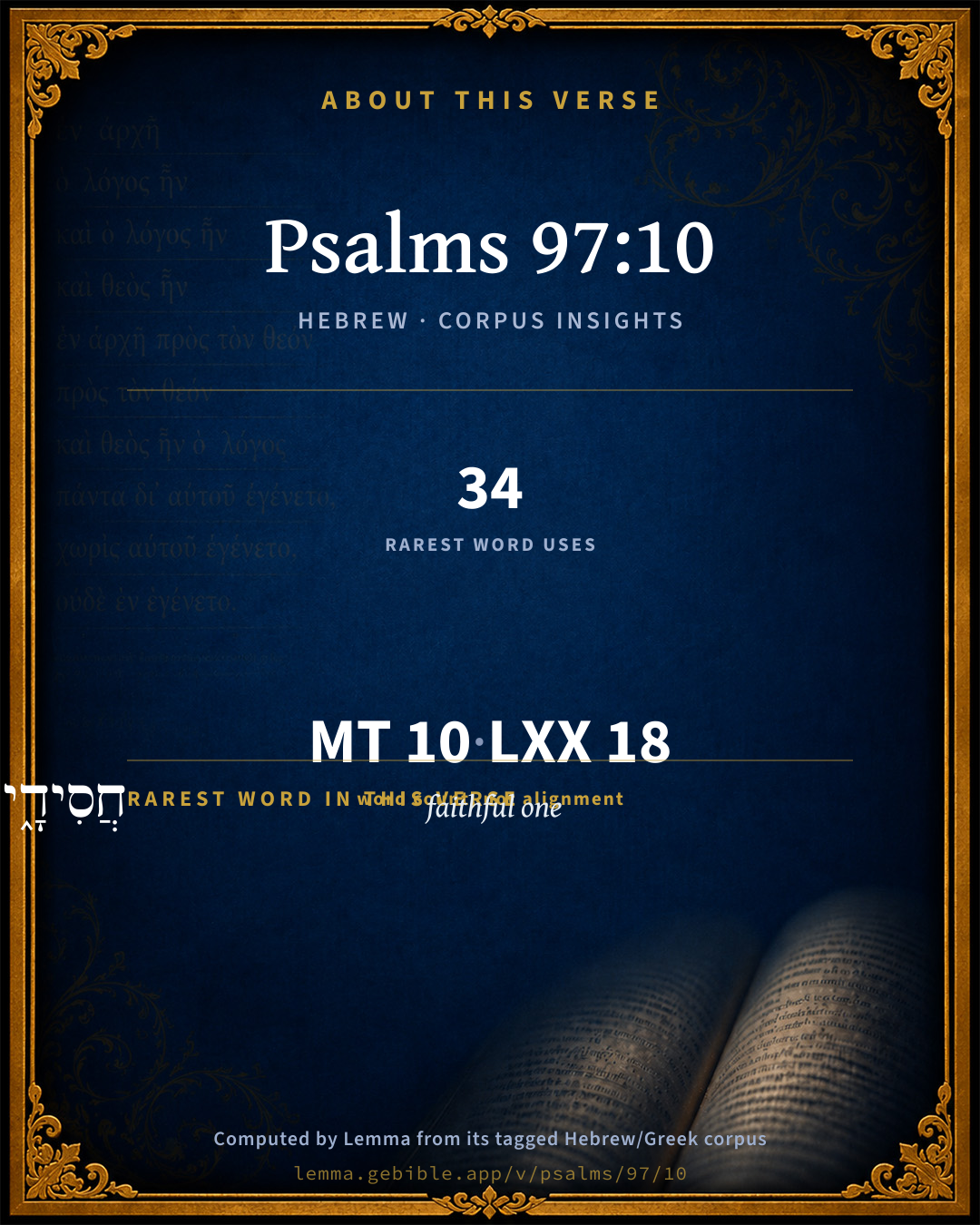
חֲסִידָ֑יו faithful one H2623 occurs in 32 verses of the Hebrew Bible. Also found in:

Grammatical profile

  • 4 verbs
  • 3 nouns
  • 3 adjectives

Verb forms

  • אֹהֲבֵ֥י Qal · Participle Active
  • שִׂנְא֫וּ Qal · Imperative
  • שֹׁ֭מֵר Qal · Participle Active
  • יַצִּילֵֽם Hiphil · Imperfect

Hebrew & Septuagint length

In English translation the verse runs 23 words from the Hebrew and 24 from the Septuagint (LXX English) — closely comparable.

A rough comparison of the two English renderings, which tokenize alike — not a word-level alignment.

Word counts can differ between the Hebrew and the Greek without any difference in meaning — e.g. the Hebrew direct-object marker אֵת has no separate Greek word, and Greek often adds the article ὁ.

In the original languages it is 10 Hebrew tokens and 18 Greek tokens — but the two are counted differently (Hebrew bundles its prefixes and suffixes into one token; the Greek is in lemma form), so that isn’t a like-for-like length.

Cross-references

36

Topical passages linked to Psalms 97:10 in the Treasury of Scripture Knowledge — connected by theme and wording, ordered by reader-vote popularity; previews shown in the World English Bible.

  • Proverbs 8:13 The fear of Yahweh is to hate evil. I hate pride, arrogance, the evil way, and the perverse mouth.
  • Romans 12:9 Let love be without hypocrisy. Abhor that which is evil. Cling to that which is good.
  • Jeremiah 15:21 I will deliver you out of the hand of the wicked, and I will redeem you out of the hand of the terrible.
  • Psalms 34:14 Depart from evil, and do good. Seek peace, and pursue it.
  • Psalms 145:20 Yahweh preserves all those who love him, But all the wicked he will destroy.
  • Daniel 3:28 Nebuchadnezzar spoke and said, Blessed be the God of Shadrach, Meshach, and Abednego, who has sent his angel, and delivered his servants who trusted in him, and have changed the king's word, and have yielded their bodies, that they might not serve nor worship any god, except their own God.
  • Psalms 31:23 Oh love Yahweh, all you his saints! Yahweh preserves the faithful, And pays back him who deals proudly in full.
  • Amos 5:15 Hate evil, love good, And establish justice in the courts. It may be that Yahweh, the God of hosts, will be gracious to the remnant of Joseph."
  • 2 Thessalonians 3:2 and that we may be delivered from unreasonable and evil men; for not all have faith.
  • Proverbs 2:8 That he may guard the paths of justice, And preserve the way of his saints.
  • 1 John 5:18 We know that whoever is born of God doesn't sin, but he who was born of God keeps himself, and the evil one doesn't touch him.
  • Psalms 37:39–40 But the salvation of the righteous is from Yahweh. He is their stronghold in the time of trouble.
  • Daniel 6:27 He delivers and rescues, and he works signs and wonders in heaven and in earth, who has delivered Daniel from the power of the lions.
  • 1 Peter 1:5 who by the power of God are guarded through faith for a salvation ready to be revealed in the last time.
  • Psalms 91:14 "Because he has set his love on me, therefore I will deliver him. I will set him on high, because he has known my name.
  • Proverbs 3:7 Don't be wise in your own eyes. Fear Yahweh, and depart from evil.
  • Psalms 125:3 For the scepter of wickedness won't remain over the allotment of the righteous; So that the righteous won't use their hands to do evil.
  • Isaiah 45:17 [But] Israel shall be saved by Yahweh with an everlasting salvation: you shall not be disappointed nor confounded world without end.
  • James 1:12 Blessed is the man who endures temptation, for when he has been approved, he will receive the crown of life, which the Lord promised to those who love him.
  • James 2:5 Listen, my beloved brothers. Didn't God choose those who are poor in this world to be rich in faith, and heirs of the Kingdom which he promised to those who love him?
  • Psalms 37:27–28 Depart from evil, and do good; Live securely forever.
  • Daniel 6:22 My God has sent his angel, and has shut the lions' mouths, and they have not hurt me; because as before him innocence was found in me; and also before you, O king, have I done no hurt.
  • 2 Thessalonians 2:8–12 Then the lawless one will be revealed, whom the Lord will kill with the breath of his mouth, and bring to nothing by the brightness of his coming;
  • 1 John 4:19 We love Him, because he first loved us.
  • Revelation 13:8 All who dwell on the earth will worship him, everyone whose name has not been written from the foundation of the world in the book of life of the Lamb who has been killed.
  • Psalms 119:104 Through your precepts, I get understanding; Therefore I hate every false way.
  • Psalms 119:163 I hate and abhor falsehood. I love your law.
  • 1 Corinthians 8:3 But if anyone loves God, the same is known by him.
  • Psalms 101:3 I will set no vile thing before my eyes. I hate the deeds of faithless men. They will not cling to me.
  • Romans 7:15 For I don't know what I am doing. For I don't practice what I desire to do; but what I hate, that I do.
  • Romans 8:28–30 We know that all things work together for good for those who love God, to those who are called according to his purpose.
  • 1 Peter 1:8 whom not having known you love; in whom, though now you don't see him, yet believing, you rejoice greatly with joy unspeakable and full of glory--
  • Psalms 36:4 He plots iniquity on his bed. He sets himself in a way that is not good; He doesn't abhor evil.
  • John 20:28–30 Thomas answered him, "My Lord and my God!"
  • Romans 7:24 What a wretched man I am! Who will deliver me out of the body of this death?
  • 1 John 5:2–3 By this we know that we love the children of God, when we love God and keep his commandments.

Cross-references courtesy of OpenBible.info (CC BY 4.0).

Hebrew and Greek witnesses Masoretic Hebrew ↔ Greek Septuagint

The same verse in the two great witnesses to the Old Testament, shown verse-for-verse.

You’re reading Greek Psalm 96 (Hebrew Psalm 97). The Septuagint counts the superscription, so verse numbers can differ from the Hebrew — chapter-level alignment, not verse-by-verse. Numbering follows Rahlfs.

These are two independent witnesses, not word-aligned to each other, and the Septuagint is shown in lemma (dictionary) form.

Hebrew Psalms 97:10 Masoretic · Westminster Leningrad Codex

אֹהֲבֵ֥י יְהוָ֗ה שִׂנְא֫וּ רָ֥ע שֹׁ֭מֵר נַפְשׁ֣וֹת חֲסִידָ֑יו מִיַּ֥ד רְ֝שָׁעִ֗ים יַצִּילֵֽם

You who love Yahweh, hate evil. He preserves the souls of his saints. He delivers them out of the hand of the wicked.

World English Bible · Public Domain

Greek LXX Greek Psalm 96:10 Septuagint · lemma form

ὁ ἀγαπάω ὁ κύριος μισέω πονηρός φυλάσσω κύριος ὁ ψυχή ὁ ὅσιος αὐτός ἐκ χείρ ἁμαρτωλός ῥύομαι αὐτός

You⌃ that love the Lord, hate evil; the Lord preserves the souls of his saints; he shall deliver them from the hand of sinners.

LXX2012 (modern English Septuagint) · Public Domain

Hebrew: Westminster Leningrad Codex (CC BY 4.0). Greek: Septuagint (public domain); English from LXX2012 (modern English Septuagint) (Public Domain). How the Septuagint differs from the Hebrew →

Commentary

Notes on Psalms 97:10 from classic Christian and Jewish commentators (each source and its license shown beneath its notes). The classic Christian expositions comment on the surrounding passage and are grouped to its opening verse, so a note may address several verses; the Jewish commentaries on the Tanakh (Rashi and others) are per-verse, so they appear only where the commentator wrote on this verse.

Lemma curates 59 commentaries, every one of them public domain or Creative Commons licensed, each selected and text-cleaned for this edition rather than reprinted as found. About our sources →

Trapp's Complete Commentary

John Trapp

Psa 97:10 Ye that love the LORD, hate evil: he preserveth the souls of his saints; he delivereth them out of the hand of the wicked.

Ver. 10. Ye that love the Lord] As having tasted of Christ’s sweetness, being justified by his merit, and sanctified by his Spirit, 1Pe 2:4 1Co 6:11; carried after him with strength of desire, Psa 42:1, and delight, Psa 73:25. Such as these only are Christ’s true subjects; others will pretend to him, but they are but hangbys, unless the love of Christ constrain them to hate evil, to hate it as hell, Rom 12:9. Sin seemeth to have its name of Sena to hate (the word שׁנא here used), because it is most of all to be hated, as the greatest evil; as that which setteth us farthest from God, the greatest good αποστυγουντες. This none can do but those that love the Lord Christ in sincerity; for all hatred comes from love. A natural man may be angry with his sin, as a man is sometimes with his wife or friend for some present vexation; but hate it he cannot; yea, he may leave it (for the ill consequents of sin), but not loathe it. If he did, he would loathe all, as well as any, for hatred is ever against the whole kind of a thing, saith Aristotle, το μισος προς τα γενη (Rhetor. lib. 2).

John Trapp, A Commentary or Exposition upon All the Books of the Old and New Testament (1647–1656) — public domain. Text from a community e-Sword module.

The Biblical Illustrator

Joseph S. Exell

Psa_97:10-12

Ye that love the Lord, hate evil.

The privileges and duties of the Lords people

I. The character of the persons addressed. Ye that love the Lord. This love is--

1. The consequence of Gods love to the soul (Jer_31:3).

2. Genuine, or pure (Rom_12:9).

3. In its power unconquerable (Son_8:6-7).

4. In its duration lasting (Php_1:9-11).

5. In its influence constraining (2Co_5:14).

6. In its nature--

(1) Working.

(2) Uniting.

(3) Confirming.

(4) Lasting to eternity.

II. Their privilege declared. He preserveth the souls of His saints, etc.

1. He secures them from the sinfulness of their hearts (Rom_6:14).

2. From the prevalency of ignorance (Psa_73:24).

3. From all slavish fear (Isa_26:3).

4. From the curse of the broken law (Gal_3:13).

5. He rescueth them from Satan (Rom_16:20).

6. From wicked and deceitful men (Psa_27:2-3).

7. From every other kind of opponent (1Pe_1:5).

III. The duty or practice exhorted to. Hate evil.

1. Personal or internal evil (Rom_7:6).

2. The sin which we see in others (Psa_139:21-22).

3. The evil that is in the world (Psa_119:104).

4. All national evils (Pro_14:34).

IV. The state of the soul described (Psa_97:11).

1. Light.

(1) The knowledge of Gods purpose of grace (Eph_1:3-4).

(2) The comprehension of Scripture (Psa_119:105).

(3) Light was sown for the righteous (Isa_9:2).

(4) Salvation is sown for the righteous (Psa_27:1).

(5) The teaching of the Holy Ghost is light (2Co_4:6).

2. Gladness.

(1) Heartfelt (Psa_4:7).

(2) The gladness of received mercy (1Pe_4:13).

(3) Future and joyous gladness (Psa_31:7; Psa_31:19).

V. The evidences and experiences of the Christian (Psa_97:12).

1. Rejoice in the Lord.

(1) In the death of the Lord.

(2) In the life or righteousness of the Lord.

(3) In the majesty or power of the Lord.

(4) In Christ the salvation of the righteous.

2. Give thanks to Him.

(1) For His essential holiness as a Divine person.

(2) The holiness of His life as God-man mediator.

(3) For our being partakers of His holiness.

(4) And for that perfect holiness which we shall have and enjoy in heaven with Christ hereafter. (T. B. Baker, M.A.)

Righteous hatred

The Spirit of Christ is love. Wherever He governs, love reigns. The Christian man is not allowed to hate any one. But we may and must hate a mans sins. Hatred is a power of manhood, and therefore to be exercised. And we may hate and sin not. We may have hatred in our hearts, only see to it that it run only in one stream, and that against evil. And we are to hate all evil, not merely some. It was said long ago of some professors that they did--

Compound for sins they were inclined to,

By damning those they had no mind to.

But it is a universal duty to which we are here called.

I. Hate all evil in thyself. Thou hast good reason. Think--

1. What mischief it has already wrought thee. It kept you from Jesus, it would have lost you your soul but that grace interfered.

2. How unbecoming it is to thee. Thou art of the blood royal of the Kingdom of God. Shall such a man as thou sin? Thou art set apart for God Himself.

3. How it weakens you. Can you pray after committing sin? You know you cannot. You have lost your power. Sin will make thee leave off praying or else praying will make thee leave off sinning. And if you try to engage in work for Christ, you cannot do it. An unholy man must be a useless one.

4. Hate it, because if you indulge in it you will have to smart for it (Psa_51:1-19). If thou wouldest strew thy path with thorns and put nettles in thy death-pillow, then live in sin.

5. You will do hurt to others. The Church of Christ--how you will shame that: and poor sinners, how you will cause them to stumble and encourage them in their sin. And think especially--

6. How it grieves Christ. Now, if you would be rid of sin, the terrors of the law will not help you, but communion with Christ will. And get as much light as you can upon it. The housewife when she is busy about her house, with curtains drawn, may think everything looks clean; but she opens a little corner of the window, and in streams a ray of light, in which ten thousand grains of dust are dancing up and down. Ah, she thinks, my room is not so clean as I thought it was; here is dust where I thought there was none. Now, endeavour to get not the farthing rushlight of your own judgment, but the sunlight of the Holy Spirit streaming upon your heart, and it will help you to detect your sin--and detection of sin is halfway towards its cure. And if you have fallen into sin make confession of it, and when your mind is in a holy state seek to estimate sin aright. With regard to some sins, flee them. There is no other way. And if you would keep from sin, seek always to have a fresh anointing of the Holy Spirit. Old Master Dyer says, Lock up your hearts by prayer every morning and give God the key, so that nothing can get in. And never palliate sin.

II. Hate sin in others. Then, if you do, never countenance it, not even by a look. Often condemn it openly. Of course prudently. And do not get into it yourself. Those who live in glass houses, etc. And encourage all who are fighting against it. (C. H. Spurgeon.)

A good man sensitive to moral evil

If we would realize the full force of the term hatred of evil as it ought to exist in all, as it would exist in a perfectly righteous man, we should do well to consider how sensitive we are to pain, suffering and misfortune. How delicately is the physical frame of man constructed, and how keenly is the slightest derangement in any part of it felt. A little mote in the eye hardly discernible by the eye of another, the swelling of a small gland, the deposit of a small grain of sand--what agonies may these slight causes inflict. That fine filament of nerves of feeling spread like a wonderful network over the whole surface of the body, how exquisitely susceptible it is. A trifling burn, scald, or excision, how does it cause the member affected to be drawn back suddenly and the patient to cry out. Now, there can be no question that if man were in a perfectly moral state, moral evil would affect his mind as sensibly and in as lively a manner--would, in short, be as much an affliction as pain is to his physical frame. He would shrink and snatch himself away as sin came near; the first entrance of it into his imagination would wound and arouse his moral sensibilities, and make him positively unhappy. (Dean Goulburn.)

The Biblical Illustrator, edited by Joseph S. Exell (c. 1880s–1900s) — public domain. Text from a community e-Sword module.

Joseph Benson's Commentary

Psa 97:10. Ye that love the Lord — O all you that love and worship the true God, and rejoice in the establishment of his kingdom; hate evil — Show your love to him by hating all sin in temper, word, and work. Thus the psalmist, “having sung the glory of the Redeemer, now delineates the duty of the redeemed. They are characterized by their love of God; they are enjoined to hate evil; the hatred of which indeed is a consequence and a sure proof of that love, when it is genuine and sincere. Religion must be rooted in the heart and spring from thence. A Christian must not only serve God outwardly, but must inwardly love him; he must not content himself with abstaining from overt acts of sin, but must truly hate it. They who do so are the saints of God, whose souls he preserveth from evil, and will finally deliver from the evil one and his associates, by a happy death and a glorious resurrection.” — Horne.

Joseph Benson's Commentary on the Old and New Testaments (1811–1818) — public domain. Text from a community e-Sword module.

Keil & Delitzsch

C. F. Keil & F. Delitzsch

It is true Psa 97:12 is = Psa 32:11, Psa 97:12 = Psa 30:5, and the promise in Psa 97:10 is the same as in Psa 37:28; Psa 34:21; but as to the rest, particularly Psa 97:11, this strophe is original. It is an encouraging admonition to fidelity in an age in which an effeminate spirit of looking longingly towards lit. ogling heathenism was rife, and stedfast adherence to Jahve was threatened with loss of life. Those who are faithful in their confession, as in the Maccabaean age (Ἀσιδαῖοι), are called חסדיו. The beautiful figure in Psa 97:11 is misapprehended by the ancient versions, inasmuch as they read זרח (Psa 112:4) instead of זרע. זרע does not here signify sown = strewn into the earth, but strewn along his life's way, so that he, the righteous one, advances step by step in the light. Hitzig rightly compares ki'dnatai ski'dnatai, used of the dawn and of the sun. Of the former Virgil also says, Et jam prima novo spargebat lumine terras.

Keil & Delitzsch — Biblical Commentary on the Old Testament (1861–1891) — public domain (CC PDM 1.0). Text via the HelloAO Bible API. (Old Testament only.)

J. A. Alexander on Psalms

Joseph Addison Alexander

10. (Psa 97:10) Lovers of Jehovah, hate evil! He keeps the souls of his gracious ones; from the hand of wicked (men) he will set them free. The people of God are now exhorted not to do evil in the hope of thereby being safer. Evil, in the moral sense of wickedness, and more especially injustice. See above, on Psa 7:9; Psa 34:14-15. With the first words of the verse compare Psa 5:11. He keeps, or rather, he (is) keeping, i.e. habitually, constantly preserving. The danger, against which they particularly need protection, is distinctly mentioned in the last clause, namely, that arising from the enmity of wicked men. Gracious ones, objects of God's mercy, subjects of his grace, a favourite description of the righteous or true believers, as a class. See above, on Psa 4:3.

Joseph Addison Alexander, The Psalms Translated and Explained (1850) — public domain. Text from a community e-Sword module.

Geneva Bible (1599)

Geneva Bible translators

He requireth two things of his children: the one that they detest vice, the other, that they put their trust in God for their deliverance.

Geneva Bible (1599) marginal notes — public domain. Text via Bolls.life.

Adam Clarke's Commentary

Verse 10. Ye that love the Lord hate evil] Because it is inconsistent with his love to you, as well as your love to him.

He preserveth the souls of his saints] The saints, חסידיו chasidaiv, his merciful people: their souls-lives, are precious in his sight. He preserves them; keeps them from every evil, and every enemy.

Out of the hand of the wicked.] From his power and influence.

Adam Clarke's Commentary on the Bible (1810–1826) — public domain. Text from a community e-Sword/MySword module.

John Calvin's Commentaries

10 Ye that love Jehovah, hate evil Those that fear God are here enjoined to practice righteousness, as Paul says,

“Let every one that nameth the name of Christ depart from iniquity,” (2 Timothy 2:19)

He shows from the very nature of God, that we cannot be judged and acknowledged to be his servants unless we depart from sin, and practice holiness. God is in himself the fountain of righteousness, and he must necessarily hate all iniquity, unless we could suppose that he should deny himself; and we have fellowship with him only on the terms of separation from unrighteousness. As the persecution of the wicked is apt to provoke us to seek revenge, and unwarrantable methods of escape, the Psalmist guards us against this temptation, by asserting that God is the keeper and protector of his people. If persuaded of being under the Divine guardianship, we will not strive with the wicked, nor retaliate injury upon those who have wronged us, but commit our safety to him who will faithfully defend it. This gracious act of condescension, by which God takes us under his care, should serve as a check to any impatience we might feel in abstaining from what is evil, and preserving the course of integrity under provocation.

John Calvin's Commentaries (1540-1563) — public domain. Text from the Calvin Translation Society English edition (1840s-50s) via the Christian Classics Ethereal Library (ccel.org). Calvin's coverage is partial (roughly two-thirds of the Bible); uncommented books and verses are honest gaps, never fabricated. The 19th-century editor's footnotes and remarks are omitted so the notes are faithfully Calvin's own voice.

Ellicott's Commentary for English Readers

(10) Ye that love the Lord.—Notwithstanding certain points of similarity between this verse and Psa_34:10-20; Psa_37:28, and between Psa_97:12 and Psa_32:11, the psalmist shows himself at the close more than a compiler—a true poet.

Hate evil.—It is better to point for the indicative, They who love Jehovah, hate evil, in order to avoid the awkward transition in the next clause. This practical test of true religion can never be obsolete. Love of God implies the hatred of all He hates. A heathen writer has expressed this in a striking way. Philosophy, holding a dialogue with Lucian, is made to say, “To love and to hate, they say, spring from the same source.” To which he replies, “That, O Philosophy, should be best known to you. My business is to hate the bad, and to love and commend the good, and that I stick to.”

A Bible Commentary for English Readers, edited by Charles John Ellicott (1878–1897) — public domain. Text from a community e-Sword module.

The Cambridge Bible for Schools and Colleges

gen. ed. J. J. S. Perowne

10. There is no need to alter the text as some modern critics would do, and read, They that love Jehovah hate evil; or, Jehovah loveth those that hate evil. An exhortation to those who love Jehovah to prove themselves what they profess to be by positive abhorrence of all that is antagonistic to Him was not superfluous, in an age when many an Israelite might still be tempted to half-hearted service. It corresponds to the warning of Psa_95:7 ff. For the language of the whole verse cp. Amo_5:15; Psa_37:28; Psa_34:20.

his saints] His beloved, or, his godly ones. See Appendix, Note I.

10–12. The duty and the confidence of Israel.

The Cambridge Bible for Schools and Colleges (gen. ed. J. J. S. Perowne; Cambridge University Press, 1878–1918) — public domain. Text from a community e-Sword module.

John Gill's Exposition

Ye that love the Lord, hate evil,.... The evil of sin, which is to be hated, because of the evil nature of it, it being exceeding sinful; and because of its evil consequences, bringing death, ruin, and destruction with it to the souls of men, unless grace prevents; and disquietude, distress, and trouble to the saints themselves; and because it is hateful to God, being contrary to his nature, will, and law, and is hated by Christ; and therefore those that love him should hate that, shun it, avoid it, depart from it, and abstain from all appearance of it; as all such will that love him in sincerity above all persons and things; and all of him, and that belong to him, his people, ways, worship, truths, and ordinances: and such are they that have seen the loveliness of him, and know his love, and have had it shed abroad in their hearts; and these will not only hate the evil of sin, but evil men; not their persons, but their actions and conversations; and will avoid them, and have no fellowship with the unfruitful works of darkness:

he preserveth the souls of his saints; that are set apart by him, and chosen in him to be holy; that are sanctified by his blood, and by his Spirit and grace, and to whom he is made sanctification: the "souls" of these, their better and more noble part, which are dear to him, and he has redeemed by his blood, and whose salvation he has obtained, and they still receive, he "preserves" from the evil of sin, from its governing and damning power, from a final and total apostasy by it, from ruin and destruction through it, from being hurt by the second death; and he preserves them from all their enemies, sin, Satan, and the world, from being destroyed by them, safe to his kingdom and glory; therefore he is to be loved, and sin to be hated by them:

he delivereth them out of the hand of the wicked; of wicked and unreasonable men, into whose hands they sometimes fall, cruel and bloodthirsty persecutors; as he is able to deliver them, so oftentimes he does; and will, ere long, put them entirely out of their reach. Kimchi interprets this of the deliverance of the Jews from the captivity of Babylon, Media, and Persia.

John Gill's Exposition of the Whole Bible (1746–1763) — public domain (CC PDM 1.0). Text via the HelloAO Bible API.

Albert Barnes' Notes on the Bible

Ye that love the Lord, hate evil - Show your love for the Lord “by” hating all that is evil; that is, all that he hates, or that is evil in his sight. There can be no true love for God where evil is not hated in all its forms, since it is the object of the divine abhorrence. We cannot be like God unless we love what he loves, and hate what he hates. There is nothing more clearly affirmed in the Scriptures than that in order to the love of God there must be the hatred of all that is wrong, and that where there is the love of sin in the heart, there can be no true religion. Compare the notes at Isa 1:16-20.

He preserveth the souls of his saints - The lives of his saints, or his holy ones. That is, he guards them from danger, and watches over them with a careful eye. See Psa 3:8; Psa 37:39.

He delivereth them out of the hand of the wicked - That is, he often does this; they may expect that he will do it. He does not, indeed, always deliver them from the temporal calamities which wicked people bring upon them - for they are not unfrequently persecuted and wronged; but ultimately he will deliver them altogether from the power of the wicked. In heaven none of the machinations of wicked people can reach them. At the same time it is also true that God often interposes in behalf of his people, and delivers them as such from the designs of the wicked: that is, he delivers them because they are righteous, or because they are his friends. Compare the notes at Dan 3:16-17, notes at Dan 3:24-25; notes at Dan 6:18-23.

Albert Barnes' Notes on the Bible (1834–1885) — public domain. Text from a community e-Sword/MySword module.

Matthew Poole's English Annotations

Ye that love the Lord; O all you who love and worship the true God and his anointed, and rejoice in the establishment of his kingdom.

Hate evil; show your love to him by your abhorrency of all idolatry, which is sometimes called evil or sin by way of eminency, and of all other wickedness. And although you that love the Lord Christ and his kingdom will meet with many troubles and persecutions, yet be not discouraged, for he will preserve you in troubles, and in his time deliver you out of them all.

Matthew Poole's English Annotations on the Holy Bible (1683–1685) — public domain. Text from a community e-Sword/MySword module.

The Treasury of David

Charles H. Spurgeon

Ver. 10. Ye that love the Lord, hate evil. For He hates it, his fire consumes it, his lightnings blast it, his presence shakes it out of its place, and his glory confounds all the lovers of it. We cannot love God without hating that which he hates. We are not only to avoid evil, and to refuse to countenance it, but we must be in arms against it, and bear towards it a hearty indignation.

He preserveth the souls of his saints. Therefore they need not be afraid of proclaiming war with the party which favours sin. The saints are the safe ones: they have been saved and shall be saved. God keeps those who keep his law. Those who love the Lord shall see his love manifested to them in their preservation from their enemies, and as they keep far from evil so shall evil be kept far from them.

He delivereth them out of the hand of the wicked. It is not consistent with the glory of his name to give over to the power of his foes those whom his grace has made his friends. He may leave the bodies of his persecuted saints in the hand of the wicked, but not their souls, these are very dear to him, and he preserves them safe in his bosom. This foretells for the church a season of battling with the powers of darkness, but the Lord will preserve it and bring it forth to the light.

Ver. 10. Ye that love the LORD, hate evil. It is evident that our conversion is sound when we loathe and hate sin from the heart: a man may know his hatred of evil to be true, first, if it be universal: he that hates sin truly, hates all sin. Secondly, true hatred is fixed; there is no appeasing it but by abolishing the thing hated. Thirdly, hatred is a more rooted affection than anger: anger may be appeased, but hatred remains and sets itself against the whole kind. Fourthly, if our hatred be true, we hate all evil, in ourselves first, and then in others; he that hates a toad, would hate it most in his own bosom. Many, like Judah, are severe in censuring others (Ge 38:24), but partial to themselves. Fifthly, he that hates sin truly, hates the greatest sin in the greatest measure; he hates all evil in a just proportion. Sixthly, our hatred is right if we can endure admonition and reproof for sin, and not be enraged; therefore, those that swell against reproof do not appear to hate sin. Richard Sibbes.

Ver. 10. Hate evil. Sin seemeth to have its name of sana, anv (the word here used) because it is most of all to be hated, as the greatest evil; as that which setteth us furthest from God the greatest good. John Trapp.

Ver. 10. Get mortifying graces, especially love to God, for those that love the Lord, will hate evil. And the more they love him, the more they will hate it. David Clarkson.

Ver. 10. God is a Spirit, and he looks to our very spirits; and what we are in our spirits, in our hearts and affections, that we are to him. Therefore, what ill we shun, let us do it from the heart, by hating it first. A man may avoid an evil action from fear, or out of other respects, but that is not sincerity. Therefore look to thy heart, see that thou hate evil, and let it come from sincere looking to God. Ye that love the LORD, hate evil, saith David: not only avoid it, but hate it; and not only hate it, but hate it out of love to God. Richard Sibbes.

Ver. 10. Hate evil.

LUCIAN. I am the declared enemy of all false pretence, all quackery, all lies, and all puffing. I am a lover of truth, of beauty, of undisguised nature; in short, of everything that is lovely.

PHILOSOPHY. To love and to hate, they say, spring from one and the same source.

LUCIAN. That, O philosophy, must be best known to you. My business is to hate the bad, and to love and commend the good; and that I stick to. Lucian. Piscat. c, 8.

Ver. 10. He preserveth the souls of his saints. Let us observe that there are two parts of divine protectionpreservation and deliverance. Preservation is keeping lest we should be imperilled: deliverance has reference to those already involved in perils. The shepherd keeps his sheep lest they should fall among wolves; but if perchance they should fall into the clutches of the wolf he pursues and delivers. Both parts the Prophet exhibits, persuading us that it is the Lord who keeps the souls of his saints lest they fall into the hands of the wicked; and if they should fall, He will deliver them. Musculus.

Ver. 10.

1. What you do now: "Love the Lord." Reciprocally, personally, supremely, habitually, progressively.

2. What you must do: "Hate evil." Evil working, evil writing, evil speaking, evil thinking; renounce evil, master it, supplant it. W.J.

Ver. 10.

1. The distinguishing peculiarity of the people of God: "Ye that love the Lord."

2. Its manifestation: "Hate evil."

3. Its reward: "The Lord preserveth", etc.; "He delivereth", etc.

G.R.

Ver. 10-11. David notes in God three characteristics of a true friend: First with fidelity and good will He keepeth the souls of the pious. Secondly, with his power and majesty He delivereth them from their enemies. Thirdly, with his wisdom and holiness He enlightens and refreshes them. Le Blanc.

Psalms 97:11*

Charles H. Spurgeon's The Treasury of David (1869–1885) — public domain. Psalms only. Text from a community e-Sword/MySword module.

Whedon's Commentary on the Bible

Daniel D. Whedon

10. Ye that love the Lord, hate evil—Learn to abhor it from this example of divine judgments against idolatry.

Daniel D. Whedon (gen. ed.), Commentary on the Old and New Testaments (1874–1909) — public domain. Text from a community e-Sword module.

The Pulpit Commentary

Ye that love the Lord, hate evil. The psalmist ends his strain with an exhortation to the faithful an exhortation, first of all, to "hate evil." God hates evil; (Psa_45:7) evil will separate them from God, evil will be their destruction. Therefore let them hate and abhor it. It is indifference to evil, that, more than anything else, lays men open to the assaults of Satan. He preserveth the souls of his saints. He (i.e. Jehovah) watches tenderly over the souls of his saints his holy loving ones, and preserves them in being, keeps them from destruction, and delivereth them out of the hand of the wicked.

The hatred of sin.

"Ye that love the Lord, hate evil." On the darkest, most puzzling of all questions the origin of evil the Bible leaves us quite in the dark. Old and New Testaments are alike silent. This would be very astonishing if the purpose of Scripture were to make deep philosophers or subtle theologians. We cease to wonder when we understand, what people have come to see more clearly in these days than formerly, that the object of God"s Word is to "make wise unto salvation;" to teach us to know God and to know ourselves, and to bring us home to God. In a word, it is the very same as the angel declared to be the purpose of the Incarnation, "He shall save his people from their sins". (Mat_1:21) Therefore, while the Bible is dumb as to all questions of curiosity, it has a plain answer to such practical questions as, "What is sin? How ought we to regard it?" Sin in conduct is disobedience to God; in character, unlikeness to God. The first sin was an act of deliberate disobedience. Sin in every form is "that abominable thing" which our Father hates. Therefore we ought to hate it with perfect hatred. "Ye that love the Lord, hate evil!" We may take these words

(1) as a description;

(2) as a command.

I HATRED OF SIN A CHARACTERISTIC FEATURE OF THOSE WHO LOVE GOD. It is to be expected of them; is peculiar to them; is a mark by which they may be known. It may be objected that this hatred of evil is felt by multitudes who make no pretence to love God. Every just man hates injustice to others as much as to himself. Every benevolent man hates cruelty; every honest man, knavery; every sober man, intemperance; every one of pure life, impurity. All this without reference to God. This is so; and just here lies the difference. The Bible deals with evil not merely as wrong done to man, but first and foremost as sin against God. So the sinner is taught to see it. (Psa_51:1-4) So the saint laments it in others. (Psa_119:136, Psa_119:158) So God regards it, both in judging and in pardoning. (Psa_50:21 Exo_34:6, 7 Hos_7:2 Psa_32:1, Psa_32:2) To set forth the complete teaching of Scripture on this would be practically to quote the whole Bible. If we wanted a title for the Scriptures, we might write on the back, "The story of sin, and how God deals with it." Real hatred of sin, then, springs from the Holy Spirit"s teaching. An ungodly man may hate and despise many kinds of sin; but not as sin breaking God"s Law, dishonouring God, hateful in his sight, inconsistent with love to him. So also an ungodly heart may admire and delight in many kinds of goodness; but not because goodness and holiness are God"s likeness, the fulfilment of his Law, and pleasing to him. Love of what God loves; hatred of what God hates; this is the supreme test of character; in one word, sympathy with God. (Joh_14:21, Joh_14:24) Our Saviour is in this, as in all else, our perfect Model. His habitual calm and gentleness, the stress he lays on doing good to those who hate or injure us, and his meek submission to immeasurable wrong, are apt to conceal from us his unsparing condemnation of sin. No denunciations of Old Testament prophets are more severe than our Lord"s warnings concerning the impenitent cities, the hypocritical Pharisees, the guilty city of Jerusalem, the unfaithful servants. Nothing in the Bible is more terrible than his words to those who have tried to combine religious profession with a sinful life: "I never knew you; depart from me, ye that work iniquity.

II Therefore THIS COMMAND COMES TO US, WE MAY SAY, WITH THE WHOLE BIBLE AT ITS BACK all the motives of the gospel added to all the motives of the Law. The words of the old Hebrew psalmist should have tenfold force in the ears and hearts of Christian believers, "Ye that love the Lord, hate evil." Reasons for hating sin are to be found in every page of human history; in every home and heart throughout the world. It is hateful as the source, directly or indirectly, of all the misery which pervades the world. Hateful as degrading, deforming, debasing, human nature; for which reason sin is so constantly represented in Scripture by the loathsome image of defilement. (Job_9:30, Job_9:31) Hateful because "the end of those things is death". (Rom_6:21) What the Bible precisely means, what God means, by the death of a soul has been of late years fiercely controverted. I feel no warrant or wish to dogmatize. I only point out here that the tendency of sin, unforgiven, unrepented, unremoved, is to the extinction of all that is worth calling "life." Even one single sin, lying, e.g., or pride, or gluttony, if it were to gain absolute unchecked mastery, would render the man hopelessly selfish, blind to duty, incapable of nobleness, unfit for society, unfit, in a word, to live. But it is not by any or all of these reasons that we are here urged to "hate evil." It is by love. "Ye that love the Lord." Love to God and love of evil are the two most irreconcilable opposites in the universe. One must be fatal to the other. We could not love God, at least not aright, did we not know that "his work is perfect," etc. (Deu_32:4) The supreme truth that "God is love" involves his eternal abhorrence of sin, for sin is the deadly foe of love. The opposite of love is selfishness; and sin and selfishness are so closely connected that some of the deepest thinkers have reckoned them identical. Perhaps it is true to say that the essence of sin is want of love to God; and where love is absent, selfishness rushes in to fill the void. Accordingly, the great crowning proof of God"s love is declared to be that which is at the same time God"s crowning condemnation of sin," the death of his Son". (Rom_5:10) Our Lord himself declares this to be a new and glorious reason for his Father"s love. (Isa_10:17) The crucial test of his own love. (Joh_15:13) Of God"s love to the world. (Joh_3:16 1Jn_4:9, 1Jn_4:10) In sight of the cross let us learn how to "hate evil.

Good haters.

These are sadly wanted. Evil is not hated as it ought to be, as in this verse it is commanded to be. The world and the Church alike are suffering from need of those who hate well. The world is left without guidance, and the Church without strength, or honour, or joy.

I THERE ARE MANY WHO HATE NEITHER GOOD NOR EVIL.

1. They do not hate goodness. They would be shocked to be told they did. They often say fine things about it, and, like Herod with John the Baptist, do "many things" because of it. They do not practise it much never, unless it is conventional and in good form. Still, they do not hate it. It would be almost better if they did. For then they could not deceive themselves as now they do. They imagine all is well with them, simply because they do not openly oppose goodness. Though not with it, they are, so they flatter themselves, not against it. It was specially to such that our Lord spoke his stern, solemn word, "He that is not with me is against me." They are the would be neutrals. Our Lord likens them to the "house swept and garnished," from which one devil is gone out, but who soon comes back with seven others worse. The publicans and harlots, who know and feel their sin, go into the kingdom of heaven before such.

2. And assuredly they do not hate evil. If it be very gross and flagrant, they will condemn it, but if it comes to them in plausible and specious garb, as it generally does, they make excuses for it, and allow it both in themselves and others. The devil has it pretty much his own way so far as these people are concerned. He fears none but those who hate evil.

II BUT THOSE WHO LOVE THE LORD MUST HATE EVIL.

1. It stands to reason. Such hatred of evil is but the necessary consequence and concomitant of the love of the Lord; where the one is, the other is also.

2. They will do so always and everywhere. Most and first of all in themselves. Not only in its outward manifestations, but in its secret spring the heart from whence it proceeds. It is of no use fulminating against evil in others whilst we cherish it in ourselves. This they deeply feel, and hence their perpetual prayer is for the "clean heart." And they will hate evil in others also. They will not connive at it, nor in any way countenance it; their lives will be a witness and protest against it, they will be "the salt of the earth.

III THE MOTIVES THAT URGE THEM ARE FULL OF FORCE.

1. Sin is the curse of humanity. Its steps are blood marked all through the world"s history. It "brought death into the world, and all our woe;" and as it was, so it is still.

2. It slew our Lord. How would we feel towards the murderer of our dearest friend?

3. Whenever we in any degree allow it in ourselves, it weakens and humiliates us, and brings darkness into our souls.

4. It is life or death with us. If we do not destroy it, it will destroy us.

5. It robs us of power over others, save to do them harm.

IV BUT THIS HATRED OF EVIL NEEDS TO BE DILIGENTLY CHERISHED. For we are in peril of getting used to it, and so of acquiescing in it as a thing that cannot be helped. Therefore:

1. Pray the Holy Spirit to fill you with the love of Christ.

2. To reveal you to yourself.

3. Walk in the light.

4. Confess at once if you have sinned.

5. Openly commit yourself on the Lord"s side.

6. Attack evil wherever possible.

7. Pray without ceasing. S.C.

-Our attitude toward evil.

"Hate evil." In Scripture the term "evil" is employed in two senses calamity and wrong doing. We can only "hate evil" when it stands for wrong doing. But it is necessary to carefully distinguish between hate of the wrong doer and hate of the wrong doing. The first is never right, the second is always right. We are to hate our own wrong doing, and to hate other people"s. The term "hate" is also used in Scripture in two senses. Sometimes it means "feel intense dislike towards;" sometimes it means "put in the second place of your regard." The use of the term as applied to evil, and as representing the attitude towards evil of those who love God, may be seen in the other synonymous terms used in the Bible.

1. To hate is to eschew. A strong term, applying to something found unpleasant in the mouth, and therefore cast out. Of Job as an upright man it is said, "He feared God, and eschewed evil.

2. To hate is to depart from. So the psalmist (Psa_24:1-4) bids us "depart from evil, and do good.

3. To hate is to abhor. The Apostle Paul (Rom_12:9) bids us "abhor that which is evil, cleave to that which is good." Gibbes says, "A man may know his hatred of evil to be true, first, if it be universal: he that hates sin truly hates all sin. Secondly, true hatred is fixed; there is no appeasing it but by abolishing the thing hated. Thirdly, hatred is a more rooted affection than anger; anger may be appeased, but hatred remains and sets itself against the whole kind. Fourthly, if our hatred be true, we hate all evil, in ourselves first, and then in others. Fifthly, he that hates sin truly hates the greatest sin in the greatest measure. Sixthly, our hatred is right if we can endure admonition and reproof for sin, and not be enraged." The points that may be opened and illustrated are these

I THE HATE WE CHERISH FOR EVIL IS AN INWARD FEELING. Show the natural repulsion of the pure minded from foul conversation. Those who love God become like minded with God; and so inwardly feel sin to be "the abominable thing.

II THE HATE WE CHERISH FOR EVIL WILL FIND OUTWARD EXPRESSION.

1. In separation from it.

2. In resistance of it.

3. In fighting with it.

But never in any persecution of, or unauthorized attempts to punish, the wrong doers. R.T.

Our Soul preserver.

It has always been a source of questioning and doubting to anxious minded men, such as the Psalmist Asaph, that God does not always preserve the bodies, or the circumstances, of his servants. But this ought to be no surprise to those who apprehend that God promises to preserve the soul; and he may, sometimes, be actually preserving the soul by not preserving the body. But perhaps this involves the higher Christian idea of the soul. In the older Scripture, and sometimes in the newer, the word "soul" is equivalent to "life;" and preservation of natural life is the thing assured. Take the promise in its twofold sense.

I GOD PRESERVES OUR NATURAL LIFE. We press that truth into the familiar saying, "Man is immortal till his work is done." Nothing can ever touch a man"s life save on God"s permission. Evil of circumstance can never of itself rise to that height. Illustrate by the permissions and restrictions given to the "Satan" of the Book of Job. But our Lord raises an argument on God"s care of our life. He who keeps alive will surely provide. The Preserver of our soul is surely the Provider of our need. What we may ever need of deliverance is guaranteed in the grace of our Preserver. Keeper always, Redeemer at call of our need.

II GOD PRESERVES OUR SPIRITUAL LIFE. That is our supreme treasure; or rather, that is our true, our permanent self. Natural, animal life we do but share with the animals, and we can have it but for a time; circumstances are only the surroundings of our time of probation. They may all go, and we remain. What we are, when we have done with circumstances, and have ended our animal life, is the matter of supreme concern to us. It is, then, the soul character that God preserves and delivers; as the apostle says, "He will keep that we have committed to him unto the great day." Not a thing we have, and say we own, is safe. All may take wing and flee away. But with absolute confidence we may say, "He shall preserve our soul. R.T.

The Pulpit Commentary (1880–1919), ed. H.D.M. Spence-Jones & Joseph S. Exell — public domain. Text from a community e-Sword module.

Lesson kit

Teaching starters — assembled from the data on this page, not authored interpretation. Every prompt links to the verse data it draws on. Edit before teaching.

Psalms, in the Wisdom, opens this verse with 10 words (10 distinct Hebrew lemmas). Its most distinctive word is châçîyd (“faithful one”). A historical commentator’s framing appears above. Read the whole chapter for the surrounding context.

Discussion questions

  1. What does “faithful one” (châçîyd) contribute to the verse as a whole?
  2. How does Deuteronomy 33:8, which shares the word «faithful one», read alongside this verse?
  3. These translations render this verse differently; the difference is in the English rendering, not the original. What questions does that raise?
  4. «אֹהֲבֵ֥י» is a Qal Participle Active verb. How does that grammatical form shape the action described?
  5. Compare how Trapp's Complete Commentary and The Biblical Illustrator read this verse. Where do they agree or differ?

Things to notice

Reading settings

Reading text

Shown beneath each verse's original-language words.

Old Testament
Old Testament edition

Read the OT as the Masoretic Hebrew (MT) or the Greek Septuagint (LXX).

English shown for the Greek Septuagint (in the Hebrew ↔ Greek comparison).

Comparing translations? Open the Compare panel on any verse page to stack up to four side by side.