
Psalms 109:7

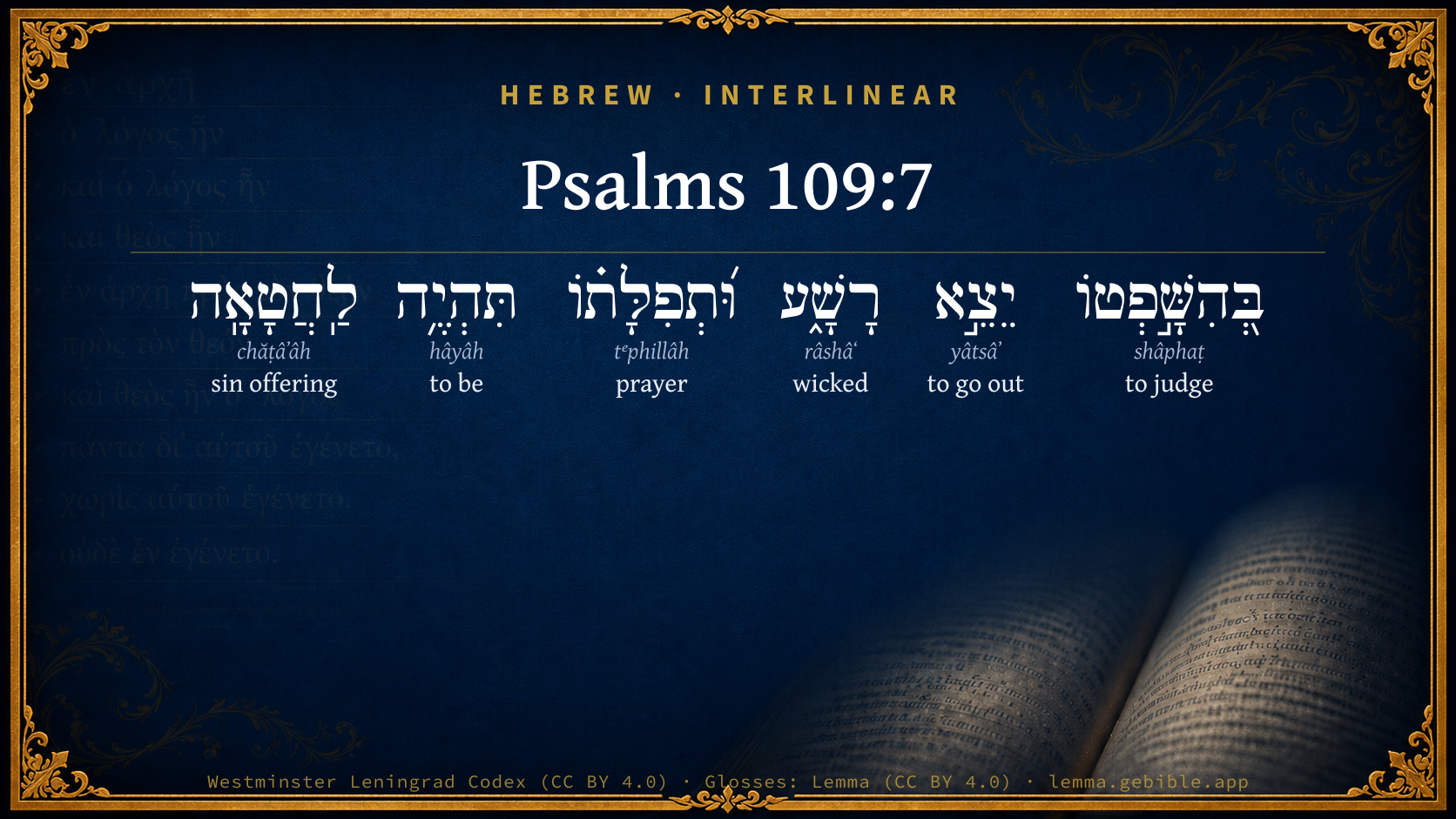
Hebrew (Westminster Leningrad Codex) Psalms 109:7 appears in the Hebrew Old Testament. The text above is from the Westminster Leningrad Codex. Each word links to its Strong’s number, a concise gloss, and parsing drawn from the Open Scriptures Hebrew Bible morphology. Click any word for its full Brown-Driver-Briggs (BDB) entry.
Download image
Cite this verse

Psalms 109:7 (World English Bible). Public Domain. Lemma interlinear Bible study tool, https://lemma.gebible.app/v/psalms/109/7.

Show BibTeX & RIS
BibTeX
RIS
English Translation
When he is judged, let him come forth guilty. Let his prayer be turned into sin.
World English Bible · Public Domain
Download a study sheet

One document with this verse’s original text, its word-by-word gloss line, the meaning frame, cross-references with their text, attributed commentary, and full source and license credits — printable, and it pastes into notes with its structure intact.

This verse Autodidact and up

Study sheet (.html) Plain text (.txt)

A passage Seminary Student

Up to 50 verses in one chapter. A passage sheet keeps up to 6 commentary sources and 12 cross-references per verse, in the order this page ranks them, and says so on the sheet whenever that leaves anything out. Ask for a single verse and you get the Autodidact verse sheet above.

Everything on this page stays free to read, with no account — the sheet is a download of what is already on screen, not access to it.

Want to remove ads? Support Godless Engineer
Compare translations 3

The same verse in 3 English versions, stacked beneath the original-language interlinear above. Click any original word for its lexicon entry.

Each is an independent rendering of the whole verse — the interlinear is not word-aligned to these translations.

Highlighted words mark where these versions differ — a whole-verse word diff, not a word-by-word alignment.

  • World English Bible Public Domain
    When he is judged, let him come forth guilty. Let his prayer be turned into sin.
  • King James Version Public Domain
    When he shall be judged, let him be condemned: and let his prayer become sin.
  • unfoldingWord Literal Text CC BY-SA 4.0
    When he is judged, may he come out guilty; and may his prayer be as sin.

unfoldingWord Literal Text — © unfoldingWord, licensed CC BY-SA 4.0. Word-aligned USFM3 via Door43 (git.door43.org/unfoldingWord/en_ult).

Versions to compare (up to 4)

3 of 4 selected

Show all 18 translations

Every available English version of this verse, each an independent rendering of the whole verse.

  • World English Bible Public Domain
    When he is judged, let him come forth guilty. Let his prayer be turned into sin.
  • Berean Standard Bible Public Domain
    When he is tried, let him be found guilty, and may his prayer be regarded as sin.
  • Majority Standard Bible Public Domain
    When he is tried, let him be found guilty, and may his prayer be regarded as sin.
  • King James Version Public Domain
    When he shall be judged, let him be condemned: and let his prayer become sin.
  • American Standard Version (1901) Public Domain
    When he is judged, let him come forth guilty; And let his prayer be turned into sin.
  • Revised Version (1885) Public Domain
    When he is judged, let him come forth guilty; and let his prayer be turned into sin.
  • Geneva Bible (1599) Public Domain
    Whe he shalbe iudged, let him be condemned, and let his praier be turned into sinne.
  • Douay-Rheims (1899) Public Domain
    When he is judged, may he go out condemned; and may his prayer be turned to sin.
  • Young's Literal Translation Public Domain
    In his being judged, he goeth forth wicked, And his prayer is for sin.
  • Literal Standard Version CC BY-SA 4.0
    In his being judged, he goes forth wicked, || And his prayer is for sin.
  • Unlocked Literal Bible CC BY-SA 4.0
    When he is judged, may he be found guilty; may his prayer be considered sinful.
  • unfoldingWord Literal Text CC BY-SA 4.0
    When he is judged, may he come out guilty; and may his prayer be as sin.
  • Darby Bible Public Domain
    When he shall be judged, let him go out guilty, and let his prayer become sin;
  • World Messianic Bible Public Domain
    When he is judged, let him come out guilty. Let his prayer be turned into sin.
  • Webster's Bible Public Domain
    When he shall be judged, let him be condemned: and let his prayer become sin.
  • Free Bible Version CC BY-SA 4.0
    When he is judged and sentenced, may he be found guilty. Let his prayers be counted as sins.
  • Bible in Basic English Public Domain
    When he is judged, let the decision go against him; and may his prayer become sin.
  • JPS Tanakh (1917) Public Domain
    When he is judged, let him go forth condemned; and let his prayer be turned into sin.

Literal Standard Version (2020), Covenant Press — licensed CC BY-SA 4.0. Text via the HelloAO Bible API (eBible.org). Unlocked Literal Bible (unfoldingWord) — licensed CC BY-SA 4.0. Text via the HelloAO Bible API (eBible.org). unfoldingWord Literal Text — © unfoldingWord, licensed CC BY-SA 4.0. Word-aligned USFM3 via Door43 (git.door43.org/unfoldingWord/en_ult). Free Bible Version, Dr. Jonathan Gallagher — licensed CC BY-SA 4.0. Text via the HelloAO Bible API (eBible.org).

Word by word

More ways to search: Search by grammar → Find every occurrence → Compare this word →

Practice this passage: Drill this verse → Learn its vocabulary →

About this verse

These counts appear in no published source. They are computed here, from the morphology-tagged text and Lemma’s own curated glosses. What Lemma adds →

6
words
6
distinct lemmas
Wisdom
section

Notable vocabulary

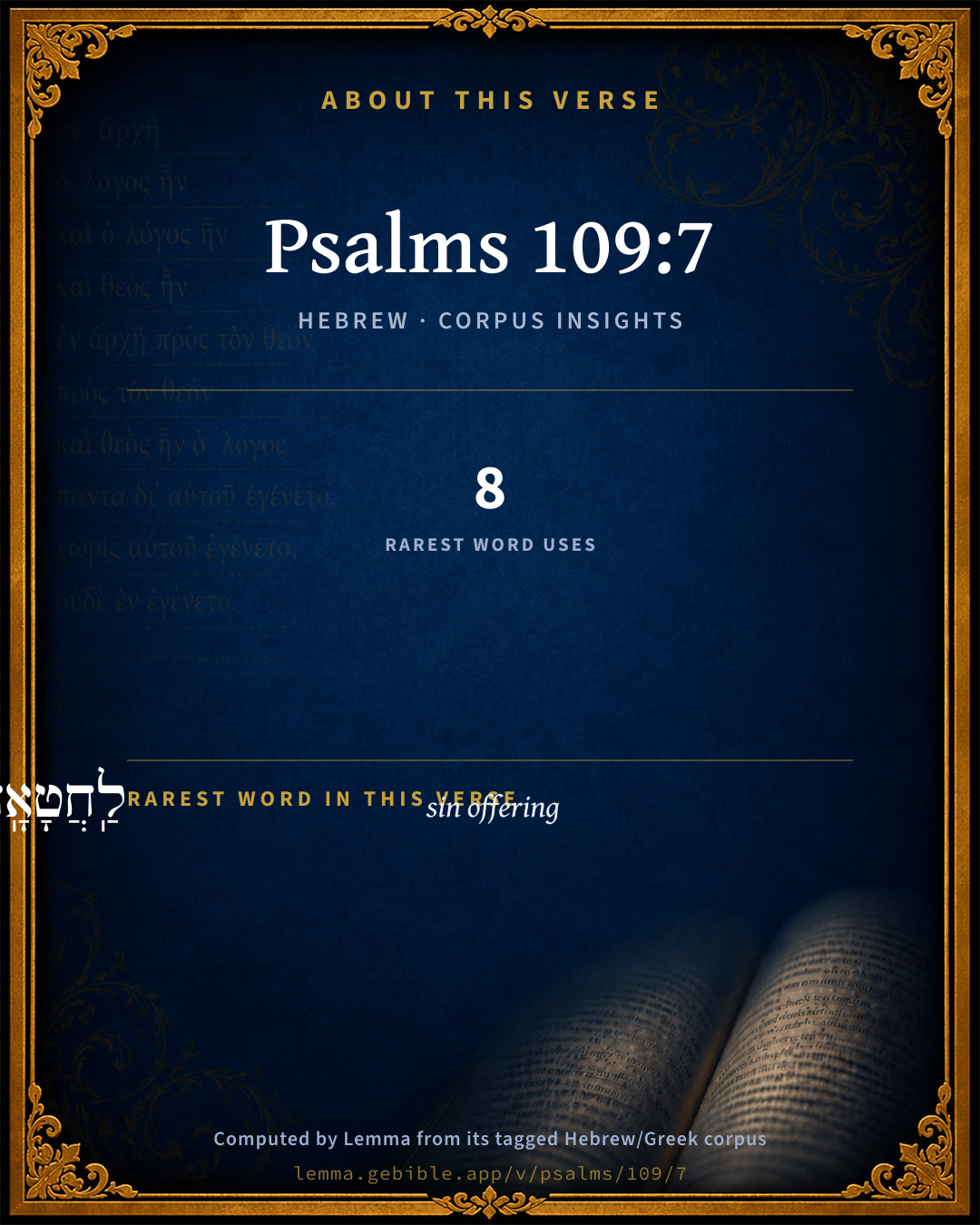
The rarest word here is לַֽחֲטָאָֽה sin offering H2401 — appearing just 8 times in the whole Hebrew Bible.

Shared distinctive vocabulary

לַֽחֲטָאָֽה sin offering H2401 occurs in 8 verses of the Hebrew Bible. Also found in:

Grammatical profile

  • 3 verbs
  • 2 nouns
  • 1 adjective

Verb forms

  • בְּ֭הִשָּׁ֣פְטוֹ Niphal · Infinitive Construct
  • יֵצֵ֣א Qal · Imperfect
  • תִּהְיֶ֥ה Qal · Imperfect

Hebrew & Septuagint length

In English translation the verse runs 16 words from the Hebrew and 15 from the Septuagint (LXX English) — closely comparable.

A rough comparison of the two English renderings, which tokenize alike — not a word-level alignment.

Word counts can differ between the Hebrew and the Greek without any difference in meaning — e.g. the Hebrew direct-object marker אֵת has no separate Greek word, and Greek often adds the article ὁ.

Cross-references

9

Topical passages linked to Psalms 109:7 in the Treasury of Scripture Knowledge — connected by theme and wording, ordered by reader-vote popularity; previews shown in the World English Bible.

  • Proverbs 28:9 He who turns away his ear from hearing the law, Even his prayer is an abomination.
  • Proverbs 21:27 The sacrifice of the wicked is an abomination: How much more, when he brings it with a wicked mind!
  • Proverbs 15:8 The sacrifice made by the wicked is an abomination to Yahweh, But the prayer of the upright is his delight.
  • Galatians 3:10 For as many as are of the works of the law are under a curse. For it is written, "Cursed is everyone who doesn't continue in all things that are written in the book of the law, to do them."
  • 2 Samuel 15:7–8 It happened at the end of forty years, that Absalom said to the king, please let me go and pay my vow, which I have vowed to Yahweh, in Hebron.
  • Isaiah 1:15 When you spread forth your hands, I will hide my eyes from you; Yes, when you make many prayers, I will not hear. Your hands are full of blood.
  • Isaiah 66:3 He who kills an ox is as he who kills a man; he who sacrifices a lamb, as he who breaks a dog's neck; he who offers an offering, [as he who offers] pig's blood; he who burns frankincense, as he who blesses an idol. Yes, they have chosen their own ways, and their soul delights in their abominations:
  • Matthew 23:13 "Woe to you, scribes and Pharisees, hypocrites! For you devour widows' houses, and as a pretense you make long prayers. Therefore you will receive greater condemnation.
  • Romans 3:19 Now we know that whatever things the law says, it speaks to those who are under the law, that every mouth may be closed, and all the world may be brought under the judgment of God.

Cross-references courtesy of OpenBible.info (CC BY 4.0).

Hebrew and Greek witnesses Masoretic Hebrew ↔ Greek Septuagint

The same verse in the two great witnesses to the Old Testament, shown verse-for-verse.

You’re reading Greek Psalm 108 (Hebrew Psalm 109). The Septuagint counts the superscription, so verse numbers can differ from the Hebrew — chapter-level alignment, not verse-by-verse. Numbering follows Rahlfs.

These are two independent witnesses, not word-aligned to each other, and the Septuagint is shown in lemma (dictionary) form.

Hebrew Psalms 109:7 Masoretic · Westminster Leningrad Codex

בְּ֭הִשָּׁ֣פְטוֹ יֵצֵ֣א רָשָׁ֑ע וּ֝תְפִלָּת֗וֹ תִּהְיֶ֥ה לַֽחֲטָאָֽה

When he is judged, let him come forth guilty. Let his prayer be turned into sin.

World English Bible · Public Domain

Greek LXX Greek Psalm 108:7 Septuagint · lemma form

ἐν ὁ κρίνω αὐτός ἐκἔρχομαι καταδικάζω καί ὁ προσευχή αὐτός γίγνομαι εἰς ἁμαρτία

When he is judged, let him go forth condemned: and let his prayer become sin.

LXX2012 (modern English Septuagint) · Public Domain

Hebrew: Westminster Leningrad Codex (CC BY 4.0). Greek: Septuagint (public domain); English from LXX2012 (modern English Septuagint) (Public Domain). How the Septuagint differs from the Hebrew →

Commentary

Notes on Psalms 109:7 from classic Christian and Jewish commentators (each source and its license shown beneath its notes). The classic Christian expositions comment on the surrounding passage and are grouped to its opening verse, so a note may address several verses; the Jewish commentaries on the Tanakh (Rashi and others) are per-verse, so they appear only where the commentator wrote on this verse.

Lemma curates 59 commentaries, every one of them public domain or Creative Commons licensed, each selected and text-cleaned for this edition rather than reprinted as found. About our sources →

Trapp's Complete Commentary

John Trapp

Psa 109:7 When he shall be judged, let him be condemned: and let his prayer become sin.

Ver. 7. When he shall be judged] Let him be cast in all his suits, causa excidat.

And let his prayer become sin] Quot apud iudicem preces adhibebit tot sibi mulctas aecersat, If he beg favour of the judge, let it be the worse for him, as it befell Haman, Est 7:7-8.

John Trapp, A Commentary or Exposition upon All the Books of the Old and New Testament (1647–1656) — public domain. Text from a community e-Sword module.

J. A. Alexander on Psalms

Joseph Addison Alexander

7. (Psa 109:7) When he is tried he shall go forth guilty; and his prayer shall be for sin. The future meaning of the second verb is determined by the form of the third, which is not apocopated, as in Psa 109:12-13. When he is tried, literally, in his being tried. The next phrase simply means that he shall be condemned; the last clause, that his very prayer for mercy shall be reckoned as a new offence, a strong description of extreme judicial rigour and inexorable justice.

Joseph Addison Alexander, The Psalms Translated and Explained (1850) — public domain. Text from a community e-Sword module.

Geneva Bible (1599)

Geneva Bible translators

As to the elect all things turn to their profit: so to the reprobate, even those things that are good, turn to their damnation.

Geneva Bible (1599) marginal notes — public domain. Text via Bolls.life.

Adam Clarke's Commentary

Verse 7. Let him be condemned] יצא רשע yetse rasha. "Let him come out a wicked man;" that is let his wickedness be made manifest.

Let his prayer become sin.] Thus paraphrased by Calmet: "Let him be accused, convicted, and condemned, and let the defence which he brings for his justification only serve to deepen his guilt, and hasten his condemnation." I once more apprise the reader, that if these are not the words of David's enemies against himself, (see on Ps 109:20,) they are prophetic denunciations against a rebellious and apostate person or people, hardened in crime, and refusing to return to God.

Adam Clarke's Commentary on the Bible (1810–1826) — public domain. Text from a community e-Sword/MySword module.

John Calvin's Commentaries

7 When he is judged, let him depart guilty Another imprecation is, that, being summoned to judgment, he might be punished without mercy, and that, though he humbly crave forgiveness, the judge should remain inexorable. This might with propriety be understood to relate not merely to his being judged at the bar of men, but also at the tribunal of God. But as it accords very well with the decisions awarded by an earthly judge, and as this is the commonly received interpretation, I have no wish to depart from it. There are two things which must be noticed here; that the wickedness of the wicked may be so palpable as to leave no room to escape from the execution of justice, and that all their entreaties for pardon may be disregarded. Accordingly, the Psalmist represents him as a condemned criminal leaving the presence of the judge, bearing the ignominy of the condemnation which he righteously merited, having his nefarious deeds disclosed and detected. With respect to the other interpretation which places the ungodly before God’s judgment-seat, it by no means appears absurd to say that their prayers should be turned against them to sin, the more especially as we know that all their sacrifices are an abomination unto him. And by how much they themselves are filthy, by so much do all their plausible virtues become offensive and displeasing to God. But as the scope of the passage is in favor of that interpretation which applies it to earthly judges, I do not consider it necessary to insist farther upon this point.

John Calvin's Commentaries (1540-1563) — public domain. Text from the Calvin Translation Society English edition (1840s-50s) via the Christian Classics Ethereal Library (ccel.org). Calvin's coverage is partial (roughly two-thirds of the Bible); uncommented books and verses are honest gaps, never fabricated. The 19th-century editor's footnotes and remarks are omitted so the notes are faithfully Calvin's own voice.

Ellicott's Commentary for English Readers

(7) When he shall be judged.—Literally, in his being judged. (See margin.) The meaning is, “may he go out of court a condemned man.”

Let his prayer become sin.—If this clause stood by itself, the most natural way would be to give “prayer” and “sin” their usual sense, and see in it the horrible hope that the man’s prayer to God for mercy would be reckoned as “sin.” That such was the result of the performance of religious rites by a wicked man was, it is true, a thought familiar to the Hebrew. (See, in addition to the marginal reference, Pro_15:8; Pro_21:27.) But the judgment just spoken of is that of an earthly tribunal. Hence we must render here, let his prayer be an offence, that is, instead of procuring him a mitigation of his sentence, let it rather provoke the unscrupulous judge to make it heavier. For sin in this sense of offence, see Ecc_10:4, and comp. 1Ki_1:21.

A Bible Commentary for English Readers, edited by Charles John Ellicott (1878–1897) — public domain. Text from a community e-Sword module.

The Cambridge Bible for Schools and Colleges

gen. ed. J. J. S. Perowne

7. When he is Judged, he shall come out guilty] Lit. wicked: he will be shewn to be what he is and condemned accordingly. Cp. Psa_37:33.

and his prayer shall be held as a sin] This cannot mean that his plea to the judge or to his accuser (Mat_18:26) will be regarded as an aggravation of his offence, for the word for prayer is never used of requests made to men; but that when he cries to God for help, his prayer will only be regarded as a sin and find no hearing. Terrible as this statement is, it is only in accord with the teaching of many other passages. See Psa_66:18 ff.; Pro_1:28 ff; Pro_15:8; Pro_21:27; Pro_28:9; Isa_1:15. A prayer, wrung from the wicked man in his extremity, and prompted by no true penitence, would only be an appeal to God to take the part of the wicked, to the confusion of the moral order of the world. The Versions and commentators generally ignore the fact that the verb in the second line is not in the optative (jussive) form let it be held, but a simple future (imperfect), it shall be held: and presumably the verb in the first line is also to be translated as a future not an optative, though in this case no distinctive form exists.

The Cambridge Bible for Schools and Colleges (gen. ed. J. J. S. Perowne; Cambridge University Press, 1878–1918) — public domain. Text from a community e-Sword module.

John Gill's Exposition

When he shall be judged, let him be condemned,.... When he shall be arraigned at the bar of his own conscience, and be charged with the sin of which he is guilty, let conscience, which is as a thousand witnesses, rise up against him, and condemn him; so it did Judas, Mat 26:1, or when he shall stand before the judgment seat of Christ at the last day,

let him go out a wicked, or a guilty or condemned man (z); let him hear the awful sentence, "go, thou cursed, into everlasting fire": and let him go out immediately from the presence of the Judge into eternal punishment, the condemnation of the devil: so Judas is said to go to his own place, Act 1:25.

And let his prayer become sin, let it be fruitless and in vain; and so far from being heard, let it he treated as an abomination; let it be considered as an aggravation of his crime, as Haman's was, Est 7:7, let his prayer being without faith in the blood of Christ, be reckoned sinful, as it was; let his cries, and tears, and repentance issue in desperation, and that in sin, as it did in destroying himself, Mat 27:5.

(z) "exeat impius", Pagninus, Montanus, Vatablus, De Dieu, Gejerus; "damnatus", Junius & Tremellius; "condemnatus", Cocceius.

John Gill's Exposition of the Whole Bible (1746–1763) — public domain (CC PDM 1.0). Text via the HelloAO Bible API.

Albert Barnes' Notes on the Bible

When he shall be judged ... - When for his offences he shall be arraigned. The psalmist supposes that he “might” be put on trial; he seems to suppose that this “would be.” Such wickedness could not always escape detection, and sooner or later he would be arrested and brought to trial. “When” this should occur, the psalmist prays that justice might be done; that he might be condemned, as he “ought” to be. Such a prayer could not in itself be wrong, for assuredly it cannot be proper for magistrates to pray that the wicked man may escape, or that they may themselves fail in the very object for which they are appointed. See the General Introduction, 6 (5) e. f.

And let his prayer become sin - Evidently his prayer in reference to his “trial” for crime; his prayer that he might be acquitted and discharged. Let it be seen in the result that such a prayer was wrong; that it was, in fact, a prayer for the discharge of a bad man - a man who ought to be punished. Let it be seen to be what a prayer would be if offered for a murderer, or violator of the law - a prayer that he might escape or not be punished. All must see that such a prayer would be wrong, or would be a “sin;” and so, in his own case, it would be equally true that a prayer “for his own escape” would be “sin.” The psalmist asks that, by the result of the trial, such a prayer might be “seen” to be in fact a prayer “for the” protection and escape of a “bad man.” A just sentence in the case would demonstrate this; and this is what the psalmist prays for.

Albert Barnes' Notes on the Bible (1834–1885) — public domain. Text from a community e-Sword/MySword module.

Matthew Poole's English Annotations

When he shall be judged; when he shall be called to an account, and his cause examined before thy tribunal.

Let his prayer become sin, i.e. be turned into sin, or be imputed to him as his sin, or be as unavailable with God for his relief as his sins. When he makes supplication to his Judge, as Job speaks, Job 9:15, for pity and pardon, let him be the more provoked and enraged by it.

Matthew Poole's English Annotations on the Holy Bible (1683–1685) — public domain. Text from a community e-Sword/MySword module.

The Treasury of David

Charles H. Spurgeon

Ver. 7. When he shall be judged, let him be condemned. He judged and condemned others in the vilest manner, he suffered not the innocent to escape; and it would be a great shame if in his time of trial, being really guilty, he should be allowed to go free. Who would wish Judge Jeffries to be acquitted if he were tried for perverting justice? Who would desire Nero or Caligula to be cleared if set at the bar for cruelty? When Shylock goes into court, who wishes him to win his suit?

And let his prayer become sin. It is sin already, let it be so treated. To the injured it must seem terrible that the black hearted villain should nevertheless pretend to pray, and very naturally do they beg that he may not be heard, but that his pleadings may be regarded as an addition to his guilt. He has devoured the widow's house, and yet he prays. He has put Naboth to death by false accusation and taken possession of his vineyard, and then he presents prayers to the Almighty. He has given up villages to slaughter, and his hands are red with the blood of babes and maidens, and then he pays his vows unto Allah! He must surely be accursed himself who does not wish that such abominable prayers may be loathed of heaven and written down as new sins. He who makes it a sin for others to pray will find his own praying become sin. When he at last sees his need of mercy, mercy herself shall resent his appeal as an insult. "Because that he remembered not to show mercy", he shall himself be forgotten by the God of grace, and his bitter cries for deliverance shall be regarded as mockeries of heaven.

Ver. 7. Let his prayer become sin. As the clamours of a condemned malefactor, not only find no acceptance, but are looked upon as an affront to the court. The prayers of the wicked now become sin, because soured with the leaven of hypocrisy and malice; and so they will in the great day, because then it will be too late to cry, "Lord, Lord, open unto us." Matthew Henry.

Ver. 7. Let his prayer become sin. Evidently his prayer in reference to his trial for crime; his prayer that he might be acquitted and discharged. Let it be seen in the result that such a prayer was wrong; that it was in fact, a prayer for the discharge of a bad mana man who ought to be punished. Let it be seen to be what a prayer would be if offered for a murderer, or violator of the law, a prayer that he might escape or not be punished. All must see that such a prayer would be wrong, or would be a "sin"; and so, in his own case, it would be equally true that a prayer for his own escape would be "sin." The Psalmist asks that, by the result of the trial, such a prayer might be seen to be in fact a prayer for the protection and escape of a bad man. A just sentence in the case would demonstrate this; and this is what the Psalmist prays for. Albert Barnes.

Ver. 7. Let his prayer become sin. Kimchi in his annotations thus explains these words: i.e., "let it be without effect, so that he does not get what he asks for; let him not hit the mark at which he aims": for ajx sometimes has the meaning to miss. Wolfgang Musculus.

Ver. 7. Let his prayer become sin. St. Jerome says that Judas's prayer was turned into sin, by reason of his want of hope when he prayed: and thus it was that in despair he hanged himself. Robert Bellarmine.

Ver. 7. Let his prayer become sin. The prayer of the hypocrite is sin formally, and it is sin in the effect, that is, instead of getting any good by it, he gets hurt, and the Lord instead of helping him because he prays, punishes him because of the sinfulness of his prayers. Thus his prayer becomes sin to him, because he receives no more respect from God when he prays than when he sins. And sin doth not only mingle with his prayer (as it doth with the prayers of the holiest), but his prayer is nothing else but a mixture or mingle mangle (as we speak) of many sins. Joseph Caryl.

Ver. 7. Let his prayer become sin. We should be watchful in prayer lest the most holy worship of God should become an abomination: Isa 1:15 66:3 Jas 4:3 Ho 7:14 Am 5:23. If the remedy be poisoned, how shall the diseased be cured? Martin Geier.

Ver. 7-19. These and the following verses, although they contain terrible imprecations, will become less dreadful if we understand them as spoken concerning men pertinaciously cleaving to their vices, against whom only has God threatened punishments; not against those who repent with all their heart, and become thoroughly changed in life. John Le Clerc.

Ver. 7. When may prayer become sin. From what is sought, how sought, by whom sought, and wherefore sought.

Psalms 109:8*

Charles H. Spurgeon's The Treasury of David (1869–1885) — public domain. Psalms only. Text from a community e-Sword/MySword module.

Whedon's Commentary on the Bible

Daniel D. Whedon

7. When he shall be judged—The narrative shows that it is of human courts, not the divine tribunal, that David speaks.

Let him be condemned—Literally, He shall go out [from court] guilty.

Let his prayer become sin—His prayer shall become sin; that is, when he shall plead innocence, and pray against judgment due to guilt, it shall be counted as adding sin to sin. See Pro_28:9; Isa_1:15; Psa_66:18

Daniel D. Whedon (gen. ed.), Commentary on the Old and New Testaments (1874–1909) — public domain. Text from a community e-Sword module.

The Pulpit Commentary

When he shall be judged, let him be condemned; literally, let him go forth condemned; Let him quit the court under sentence. And let his prayer become sin. The most terrible of all the imprecations. "Let him even be unable to pray to God acceptably," and so let any prayer that he offers when he is brought low be an additional sin. (comp. Pro_15:8 Pro_28:9 Isa_1:12-15)

The Pulpit Commentary (1880–1919), ed. H.D.M. Spence-Jones & Joseph S. Exell — public domain. Text from a community e-Sword module.

John Wesley's Explanatory Notes

Sin - Because it is not from his heart.

John Wesley, Explanatory Notes Upon the Whole Bible (1754–1765) — public domain. Text via the GEBible commentary corpus.

Rashi

Rabbi Shlomo Yitzchaki (Rashi)

When he is judged before You, may he emerge from Your judgment guilty and wicked.

Rashi on the Tanakh — English translations: “The Judaica Press complete Tanach with Rashi, translated by A. J. Rosenberg” (CC BY 4.0); “Pentateuch with Rashi's commentary by M. Rosenbaum and A.M. Silbermann, 1929-1934” (public domain); “The Metsudah Tanach series, Lakewood, N.J” (CC BY 4.0); and “The Book of Joshua, Metsudah Publications, 1997” (CC BY 4.0). Text via Sefaria.

Lesson kit

Teaching starters — assembled from the data on this page, not authored interpretation. Every prompt links to the verse data it draws on. Edit before teaching.

Psalms, in the Wisdom, opens this verse with 6 words (6 distinct Hebrew lemmas). Its most distinctive word is chăṭâʼâh (“sin offering”). A historical commentator’s framing appears above. Read the whole chapter for the surrounding context.

Discussion questions

  1. The word chăṭâʼâh carries the sense “sin offering.” How does it shape the verse?
  2. How does Genesis 20:9, which shares the word «sin offering», read alongside this verse?
  3. The translations on this page render this verse differently — a whole-verse word diff, not a word-by-word alignment. What might account for the different wordings?
  4. «בְּ֭הִשָּׁ֣פְטוֹ» is a Niphal Infinitive Construct verb. How does that grammatical form shape the action described?
  5. Compare how Trapp's Complete Commentary and J. A. Alexander on Psalms read this verse. Where do they agree or differ?

Things to notice

Reading settings

Reading text

Shown beneath each verse's original-language words.

Old Testament
Old Testament edition

Read the OT as the Masoretic Hebrew (MT) or the Greek Septuagint (LXX).

English shown for the Greek Septuagint (in the Hebrew ↔ Greek comparison).

Comparing translations? Open the Compare panel on any verse page to stack up to four side by side.