Job 11:20

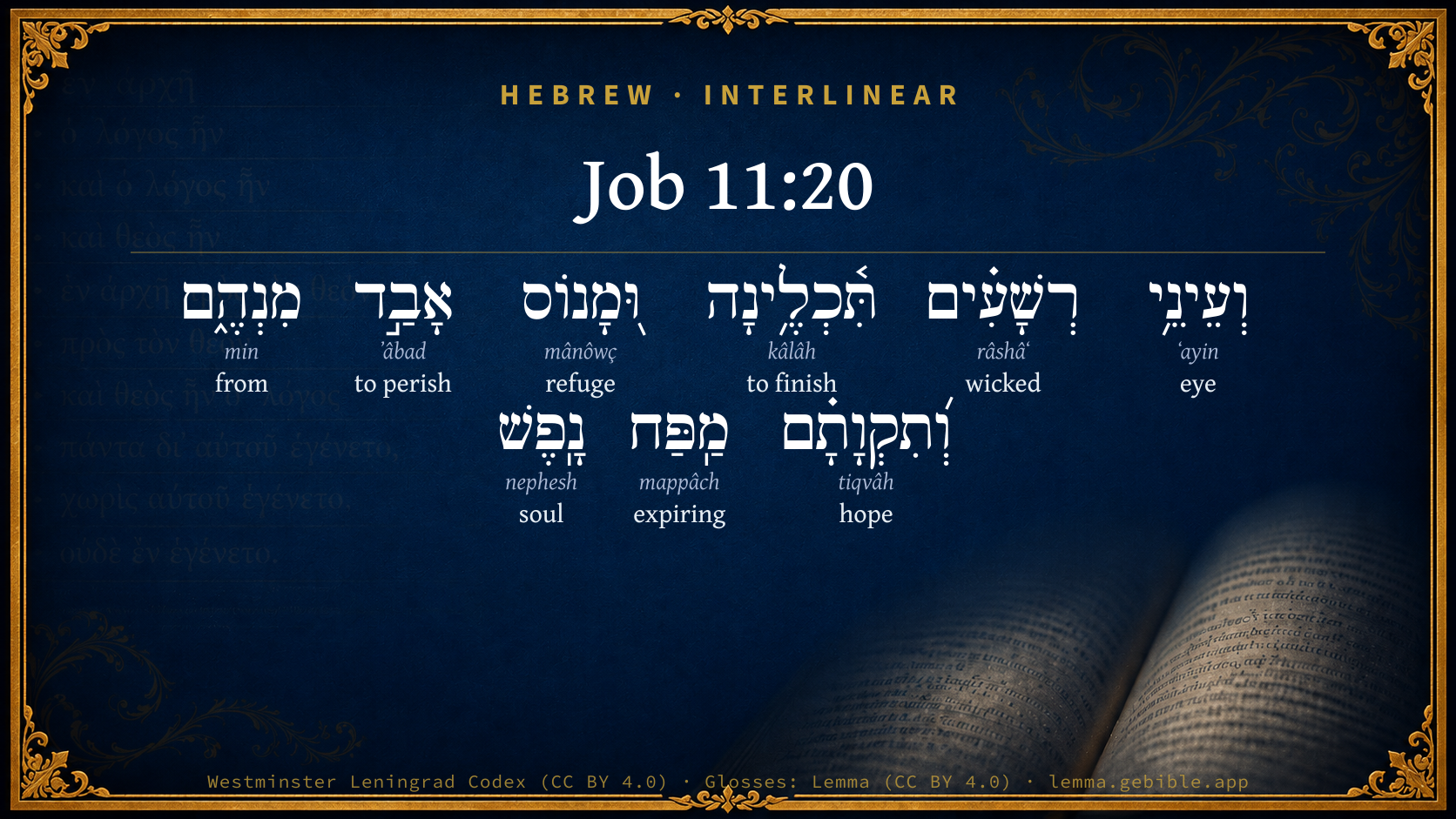
Hebrew (Westminster Leningrad Codex) Job 11:20 appears in the Hebrew Old Testament. The text above is from the Westminster Leningrad Codex. Each word links to its Strong’s number, a concise gloss, and parsing drawn from the Open Scriptures Hebrew Bible morphology. Click any word for its full Brown-Driver-Briggs (BDB) entry.
Download image
Cite this verse

Job 11:20 (World English Bible). Public Domain. Lemma interlinear Bible study tool, https://lemma.gebible.app/v/job/11/20.

Show BibTeX & RIS
BibTeX
RIS
English Translation
But the eyes of the wicked shall fail, They shall have no way to flee; Their hope shall be the giving up of the spirit."
World English Bible · Public Domain
Highlights
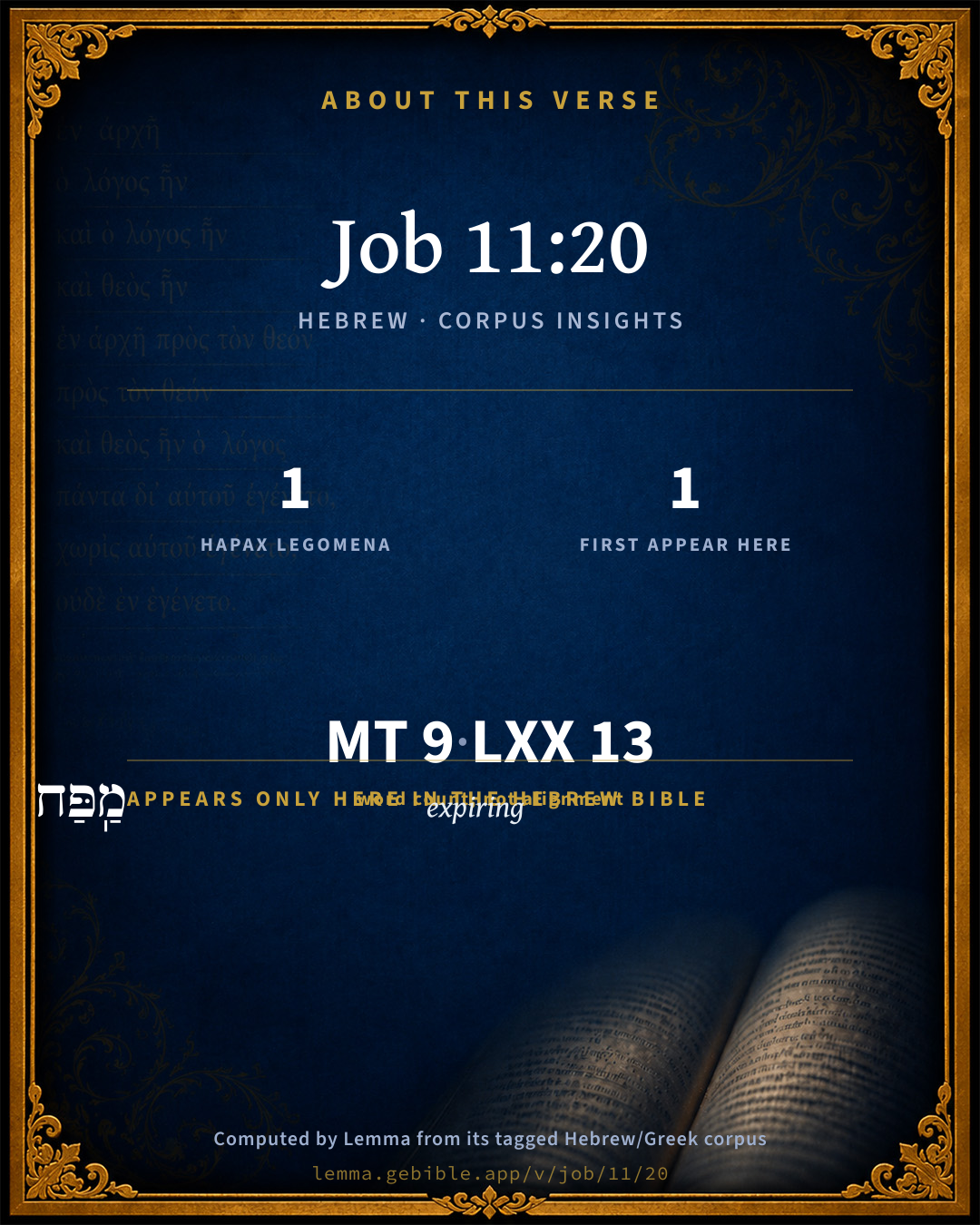
  • 1 hapax legomenon — only here in the Hebrew Bible
  • 1 first appearance in the Hebrew Bible
Full analysis ↓
Download a study sheet

One document with this verse’s original text, its word-by-word gloss line, the meaning frame, cross-references with their text, attributed commentary, and full source and license credits — printable, and it pastes into notes with its structure intact.

This verse Autodidact and up

Study sheet (.html) Plain text (.txt)

A passage Seminary Student

Up to 50 verses in one chapter. A passage sheet keeps up to 6 commentary sources and 12 cross-references per verse, in the order this page ranks them, and says so on the sheet whenever that leaves anything out. Ask for a single verse and you get the Autodidact verse sheet above.

Everything on this page stays free to read, with no account — the sheet is a download of what is already on screen, not access to it.

Want to remove ads? Support Godless Engineer
Compare translations 3

The same verse in 3 English versions, stacked beneath the original-language interlinear above. Click any original word for its lexicon entry.

Each is an independent rendering of the whole verse — the interlinear is not word-aligned to these translations.

Highlighted words mark where these versions differ — a whole-verse word diff, not a word-by-word alignment.

  • World English Bible Public Domain
    But the eyes of the wicked shall fail, They shall have no way to flee; Their hope shall be the giving up of the spirit."
  • King James Version Public Domain
    But the eyes of the wicked shall fail, and they shall not escape, and their hope shall be as the giving up of the ghost.
  • unfoldingWord Literal Text CC BY-SA 4.0
    But the eyes of the wicked will fail, and escape will perish from them, and their hope an expiration of breath.”

unfoldingWord Literal Text — © unfoldingWord, licensed CC BY-SA 4.0. Word-aligned USFM3 via Door43 (git.door43.org/unfoldingWord/en_ult).

Versions to compare (up to 4)

3 of 4 selected

Show all 18 translations

Every available English version of this verse, each an independent rendering of the whole verse.

  • World English Bible Public Domain
    But the eyes of the wicked shall fail, They shall have no way to flee; Their hope shall be the giving up of the spirit."
  • Berean Standard Bible Public Domain
    But the eyes of the wicked will fail, and escape will elude them; they will hope for their last breath.”
  • Majority Standard Bible Public Domain
    But the eyes of the wicked will fail, and escape will elude them; they will hope for their last breath.”
  • King James Version Public Domain
    But the eyes of the wicked shall fail, and they shall not escape, and their hope shall be as the giving up of the ghost.
  • American Standard Version (1901) Public Domain
    But the eyes of the wicked shall fail, And they shall have no way to flee; And their hope shall be the giving up of the ghost.
  • Revised Version (1885) Public Domain
    But the eyes of the wicked shall fail, and they shall have no way to flee, and their hope shall be the giving up of the ghost.
  • Geneva Bible (1599) Public Domain
    But the eyes of the wicked shall faile, and their refuge shall perish, and their hope shalbe sorow of minde.
  • Douay-Rheims (1899) Public Domain
    But the eyes of the wicked shall decay, and the way to escape shall fail them, and their hope the abomination of the soul.
  • Young's Literal Translation Public Domain
    And the eyes of the wicked are consumed, And refuge hath perished from them, And their hope `is' a breathing out of soul!
  • Literal Standard Version CC BY-SA 4.0
    And the eyes of the wicked are consumed, || And refuge has perished from them, || And their hope [is] a breathing out of soul!”
  • Unlocked Literal Bible CC BY-SA 4.0
    But the eyes of wicked people will fail; they will have no way to flee; their only hope will be a last gasp of life.”
  • unfoldingWord Literal Text CC BY-SA 4.0
    But the eyes of the wicked will fail, and escape will perish from them, and their hope an expiration of breath.”
  • Darby Bible Public Domain
    But the eyes of the wicked shall fail, and [all] refuge shall vanish from them, and their hope [shall be] the breathing out of life.
  • World Messianic Bible Public Domain
    But the eyes of the wicked will fail. They will have no way to flee. Their hope will be the giving up of the spirit.”
  • Webster's Bible Public Domain
    But the eyes of the wicked shall fail, and they shall not escape, and their hope shall be as the expiration of the breath.
  • Free Bible Version CC BY-SA 4.0
    But the eyes of the wicked will fail, they will not be able to escape, and their only hope is in death.”
  • Bible in Basic English Public Domain
    But the eyes of the evil-doers will be wasting away; their way of flight is gone, and their only hope is the taking of their last breath.
  • JPS Tanakh (1917) Public Domain
    But the eyes of the wicked shall fail, and they shall have no way to flee, and their hope shall be the drooping of the soul.

Literal Standard Version (2020), Covenant Press — licensed CC BY-SA 4.0. Text via the HelloAO Bible API (eBible.org). Unlocked Literal Bible (unfoldingWord) — licensed CC BY-SA 4.0. Text via the HelloAO Bible API (eBible.org). unfoldingWord Literal Text — © unfoldingWord, licensed CC BY-SA 4.0. Word-aligned USFM3 via Door43 (git.door43.org/unfoldingWord/en_ult). Free Bible Version, Dr. Jonathan Gallagher — licensed CC BY-SA 4.0. Text via the HelloAO Bible API (eBible.org).

Word by word

More ways to search: Search by grammar → Find every occurrence → Compare this word →

Practice this passage: Drill this verse → Learn its vocabulary →

About this verse

These counts appear in no published source. They are computed here, from the morphology-tagged text and Lemma’s own curated glosses. What Lemma adds →

9
words
9
distinct lemmas
Wisdom
section

Notable vocabulary

1 hapax legomenon — a word that appears only here in the entire Hebrew Bible:

  • מַֽפַּח expiring H4646

First appearance in Scripture

This word makes its first canonical appearance in the Hebrew Bible here:

  • מַֽפַּח expiring H4646

Shared distinctive vocabulary

וּ֭מָנוֹס refuge H4498 occurs in 8 verses of the Hebrew Bible. Also found in:

Grammatical profile

  • 2 verbs
  • 5 nouns
  • 1 adjective
  • 1 preposition

Verb forms

  • תִּ֫כְלֶ֥ינָה Qal · Imperfect
  • אָבַ֣ד Qal · Perfect

Hebrew & Septuagint length

In English translation the verse runs 25 words from the Hebrew and 19 from the Septuagint (LXX English) — closely comparable.

A rough comparison of the two English renderings, which tokenize alike — not a word-level alignment.

Word counts can differ between the Hebrew and the Greek without any difference in meaning — e.g. the Hebrew direct-object marker אֵת has no separate Greek word, and Greek often adds the article ὁ.

In the original languages it is 9 Hebrew tokens and 13 Greek tokens — but the two are counted differently (Hebrew bundles its prefixes and suffixes into one token; the Greek is in lemma form), so that isn’t a like-for-like length.

Cross-references

18

Topical passages linked to Job 11:20 in the Treasury of Scripture Knowledge — connected by theme and wording, ordered by reader-vote popularity; previews shown in the World English Bible.

  • Deuteronomy 28:65 Among these nations shall you find no ease, and there shall be no rest for the sole of your foot: but Yahweh will give you there a trembling heart, and failing of eyes, and pining of soul;
  • Job 17:5 He who denounces his friends for a prey, Even the eyes of his children shall fail.
  • Job 31:16 "If I have withheld the poor from their desire, Or have caused the eyes of the widow to fail,
  • Leviticus 26:16 I also will do this to you: I will appoint terror over you, even consumption and fever, that shall consume the eyes, and make the soul to pine away; and you will sow your seed in vain, for your enemies will eat it.
  • Job 8:13–14 So are the paths of all who forget God. The hope of the godless man shall perish,
  • Job 18:14 He shall be rooted out of his tent where he trusts. He shall be brought to the king of terrors.
  • Job 27:8 For what is the hope of the godless, when he is cut off, When God takes away his life?
  • Job 27:22 For it hurls at him, and does not spare, As he flees away from his hand.
  • Job 34:22 There is no darkness, nor thick gloom, Where the workers of iniquity may hide themselves.
  • Psalms 69:3 I am weary with my crying. My throat is dry. My eyes fail, looking for my God.
  • Proverbs 10:24 What the wicked fear, will overtake them, But the desire of the righteous will be granted.
  • Proverbs 20:20 Whoever curses his father or his mother, His lamp shall be put out in blackness of darkness.
  • Lamentations 4:17 Our eyes do yet fail [in looking] for our vain help: In our watching we have watched for a nation that could not save.
  • Amos 2:14 Flight will perish from the swift; And the strong won't strengthen his force; Neither shall the mighty deliver himself;
  • Amos 5:19–20 As if a man fled from a lion, And a bear met him; Or he went into the house and leaned his hand on the wall, And a snake bit him.
  • Amos 9:1–3 I saw the Lord standing beside the altar, and he said, "Strike the tops of the pillars, that the thresholds may shake; and break them in pieces on the head of all of them; and I will kill the last of them with the sword: there shall not one of them flee away, and there shall not one of them escape.
  • Luke 16:23–26 In Hades, he lifted up his eyes, being in torment, and saw Abraham far off, and Lazarus at his bosom.
  • Hebrews 2:3 how will we escape if we neglect so great a salvation-- which at the first having been spoken through the Lord, was confirmed to us by those who heard;

Cross-references courtesy of OpenBible.info (CC BY 4.0).

Hebrew and Greek witnesses Masoretic Hebrew ↔ Greek Septuagint

The same verse in the two great witnesses to the Old Testament, shown verse-for-verse.

These are two independent witnesses, not word-aligned to each other, and the Septuagint is shown in lemma (dictionary) form.

Hebrew Job 11:20 Masoretic · Westminster Leningrad Codex

וְעֵינֵ֥י רְשָׁעִ֗ים תִּ֫כְלֶ֥ינָה וּ֭מָנוֹס אָבַ֣ד מִנְהֶ֑ם וְ֝תִקְוָתָ֗ם מַֽפַּח נָֽפֶשׁ

But the eyes of the wicked shall fail, They shall have no way to flee; Their hope shall be the giving up of the spirit."

World English Bible · Public Domain

Greek LXX Job 11:20 Septuagint · lemma form

σωτηρία δέ αὐτός ἀπολείπω ὁ γάρ ἐλπίς αὐτός ἀπώλεια ὀφθαλμός δέ ἀσεβής τήκω

But safety shall fail them; for their hope is destruction, and the eyes of the ungodly shall waste away.

LXX2012 (modern English Septuagint) · Public Domain

Hebrew: Westminster Leningrad Codex (CC BY 4.0). Greek: Septuagint (public domain); English from LXX2012 (modern English Septuagint) (Public Domain). How the Septuagint differs from the Hebrew →

Commentary

Notes on Job 11:20 from classic Christian and Jewish commentators (each source and its license shown beneath its notes). The classic Christian expositions comment on the surrounding passage and are grouped to its opening verse, so a note may address several verses; the Jewish commentaries on the Tanakh (Rashi and others) are per-verse, so they appear only where the commentator wrote on this verse.

Lemma curates 59 commentaries, every one of them public domain or Creative Commons licensed, each selected and text-cleaned for this edition rather than reprinted as found. About our sources →

Trapp's Complete Commentary

John Trapp

Job 11:20 But the eyes of the wicked shall fail, and they shall not escape, and their hope [shall be as] the giving up of the ghost.

Ver. 20. But the eyes of the wicked shall fail] Contraries illustrate one another; and Zophar, willing his words should stick and work, thinks to leave a sting in Job’s mind by telling him what he must trust to if he persist in his sin. And first, his eyes shall fail. The eye is a principal part of the body; and the failing of the eyes followeth either upon some sudden fright or upon much weeping, Lam 1:2 Psa 38:1-22 Psa 88:1-18. (we read of one Faustus, son of Vortigem, king of Britain, who wept out his eyes), or too long looking after the same thing, or on the same object. Ut vehementius vellicet et fodiat inopinatum, ut putabat Iobi, animum (Merl., Speed.). The wicked, saith Zophar, shall never lach frights and griefs; they shall also look many a long look after help, but none shall appear, Lam 4:17; their hopes shall be fruitless, their projects successless.

And they shall not escape] Heb. Refuge or flight shall perish from them; miseries and mischiefs they shall never be able to avert or avoid. "Many sorrows shall be to the wicked," Psa 32:10; and although they may think to get off or outrun them, yet it will not be, Amo 2:14 Psa 142:4. Saul for instance: God hath forsaken me, saith he, and the Philistines are upon me, 1Sa 28:15.

Their hope shall be as the giving up of the ghost] Broughton rendereth it, Their hope is nought but pangs of the soul. Of that which yieldeth but cold comfort we use to say, It comforteth a man like the pangs of death. The Vulgate hath it, Their hope shall be the abomination of their soul; the Tigurine, Their hope shall be most vain, even as a puff of breath, which presently passeth away, and cometh to nothing. Some Rabbis make this the sense, Their hope shall be as the snuffing of the breath; that is, they shall be so angry at their disappointments, that they shall vex and snuff at it. According to our translation, the wicked man’s hope is set forth as utterly forlorn, and at an end for any good ever to befall him. The godly man’s hope is lively, 1Pe 1:8, and the righteous hath hope in his death, Pro 14:32 Cum expiro spero, when I die I have hope, is his motto; whereas the wicked’s word when he dieth is, or may be, Spes et fortuna valete, Farewell hope and fortune, My life and hope endeth together. Spes eorum expiratione animae, so Tremellius rendereth the text. Death causeth in the wicked a total despair, and a most dreadful screek giveth the guilty soul, when it seeth itself launching into an infinite ocean of scalding lead, and considereth that therein it must swim naked for ever.

John Trapp, A Commentary or Exposition upon All the Books of the Old and New Testament (1647–1656) — public domain. Text from a community e-Sword module.

The Biblical Illustrator

Joseph S. Exell

Job_11:20

But the eyes of the wicked shall fail . . . and their hope shall be as the giving up of the ghost.

The doom of the wicked

1. Here is the loss of energy. The eyes of the wicked shall fail. The souls eyes gone, and the spiritual universe is midnight.

2. Here is the loss of safety. They shall not escape. All efforts directed to safety utterly fruitless.

3. Here is the loss of hope. Their hope shall be as the giving up of the ghost. The idea is that the loss of hope is like death, the separation of the soul from the body. What the soul is to the body, the dominant hope is to the soul, the inspirer of its energies and the spring of its being. The loss of the dominant hope is like death in two respects.

(1) In respect to its painfulness. The loss of the dominant hope is like death--

(2) In respect to its ruinousness. When hope takes her exit from the soul all beauty departs, all pleasures end, all usefulness is gone. (Homilist.)

Delusive hopes of ungodly men

Like many a sick man that I have known in the beginning of a consumption, or some grievous disease, they hope there is no danger in it; or they hope it will go away of itself, and it is but some cold; or they hope that such and such medicine will cure it, till they are past hope, and then they must give up these hopes and their lives together, whether they will or no. Just so do poor wretches by their souls. They know that all is not well with them, but they hope God is merciful, that He will not condemn them; or they hope to be converted sometime hereafter; or they hope that less ado may serve their turn, and that their good wishes and prayers may save their souls; and thus in these hopes they hold on, till they find themselves to be past remedy, and their hopes and they be dead together. There is scarcely a greater hindrance of conversion than these false, deceiving hopes of sinners. (R. Baxter.)

.

The Biblical Illustrator, edited by Joseph S. Exell (c. 1880s–1900s) — public domain. Text from a community e-Sword module.

Joseph Benson's Commentary

Job 11:20. The eyes of the wicked shall fail — Either through grief and tears for their sore calamities, or with long looking for what they shall never attain. Failing of the eyes is one of those expressions in Scripture to be admired for its beauteous simplicity. It represents a very eager and passionate desire to obtain that which we are in pursuit of: and, at the same time, the great uneasiness which must unavoidably follow from a disappointment. One of the appeals which Job makes, in vindication of his integrity, is, that he had not caused the eyes of the widow to fail, chap. Job 31:16; that he had not frustrated her expectations when she applied to him for relief and assistance in her distress. The psalmist writes, Mine eyes fail while I wait for my God, Psa 69:3. They shall not escape — Hebrew, מנושׂ אבד, manos abad, flight perishes from them, or safety leaves them. This is another of those elegant Scripture phrases which suggests to us the strongest efforts made by a guilty person to escape punishment; but fainting and sinking by the way, through fatigue and weariness, and failing of attaining his purpose. The Prophet Jeremiah uses the same phraseology with regard to the shepherds, or principal men among the Jews, Jer 25:35; which is literally, Flight shall perish from the shepherds. Compare Amo 2:14, where the exact and literal translation of the Hebrew is given: Flight shall perish from the swift. Their hope shall be as the giving up of the ghost — Shall be as vain and desperate as the hope of life is in a man when he is at the very point of death. Shall be as a puff of breath, as the margin reads it; gone in a moment without any hope of recovery. Or their hope shall perish, as a man doth with respect to this world, when he gives up the ghost; it will fail them when they have most need of it; and, when they expected the accomplishment of it, it will die away and leave them in utter confusion.

Joseph Benson's Commentary on the Old and New Testaments (1811–1818) — public domain. Text from a community e-Sword module.

Geneva Bible (1599)

Geneva Bible translators

He showeth that contrary things shall come unto them that do not repent.

Geneva Bible (1599) marginal notes — public domain. Text via Bolls.life.

Jamieson, Fausset & Brown

Robert Jamieson, A. R. Fausset & David Brown

A warning to Job, if he would not turn to God.

The wicked--that is, obdurate sinners.

eyes . . . fail--that is, in vain look for relief (Deu 28:65). Zophar implies Job's only hope of relief is in a change of heart.

they shall not escape--literally, "every refuge shall vanish from them."

giving up of the ghost--Their hope shall leave them as the breath does the body (Pro 11:7).

Next: Job Chapter 12

Jamieson, Fausset & Brown — Commentary Critical and Explanatory on the Whole Bible (1871) — public domain (CC PDM 1.0). Text via the HelloAO Bible API.

Adam Clarke's Commentary

Verse 20. The eyes of the wicked shall fail] They shall be continually looking out for help and deliverance; but their expectation shall be cut off.

And they shall not escape] They shall receive the punishment due to their deserts; for God has his eye continually upon them. מנהם ומנוס אבד umanos abad minnehem, literally, "And escape perishes from them." Flight from impending destruction is impossible.

And their hope shall be as the giving up of the ghost.] ותקותם מפח נפש vethikratham mappach naphesh, "And their hope an exhalation of breath," or a mere wish of the mind. They retain their hope to the last; and the last breath they breathe is the final and eternal termination of their hope. They give up their hope and their ghost together; for a vain hope cannot enter into that place where shadow and representation exist not; all being substance and reality. And thus endeth Zophar the Naamathite; whose premises were in general good, his conclusions legitimate, but his application of them to Job's case totally erroneous; because he still proceeded on the ground that Job was a wicked man, if not ostensibly, yet secretly; and that the sufferings he was undergoing were the means by which God was unmasking him to the view of men.

But, allowing that Job had been a bad man, the exhortations of Zophar were well calculated to enforce repentance and excite confidence in the Divine mercy. Zophar seems to have had a full conviction of the all-governing providence of God; and that those who served him with an honest and upright heart would be ever distinguished in the distribution of temporal good. He seems however to think that rewards and punishments were distributed in this life, and does not refer, at least very evidently, to a future state. Probably his information on subjects of divinity did not extend much beyond the grave; and we have much cause to thank God for a clearer dispensation. Deus nobis haec otia fecit. God grant that we may make a good use of it!

Adam Clarke's Commentary on the Bible (1810–1826) — public domain. Text from a community e-Sword/MySword module.

Ellicott's Commentary for English Readers

(20) As the giving up of the ghost.—Omit the as of comparison; or do so, and take the margin. Thus ends the first part of this mighty argument, the first fytte of this grand poem.

A Bible Commentary for English Readers, edited by Charles John Ellicott (1878–1897) — public domain. Text from a community e-Sword module.

The Cambridge Bible for Schools and Colleges

gen. ed. J. J. S. Perowne

20. Zophar concludes by setting in opposition to this picture another, the fate of the wicked.

their hope shall be as the giving] Rather, shall be the giving up of the ghost; death is what they have to look for. Perhaps Zophar adds these words by way of warning to Job. Eliphaz allowed no streak of darkness to cloud the brightness of the prospect he anticipated for Job, ch. Job_5:19-26; Bildad spoke of perishing, but it was of Job’s enemies, ch. Job_8:22; Zophar throws out his warning more generally, and Job may accept it if it fits him.

The problems that trouble us are not new. These ancient disputants graze at least the edges of most of them. Under Zophar’s speech lies the question, If the affirmations of a man’s conscience or of his consciousness be contradicted by the affirmations of God, what does it become a man to do? Job’s conscience declared that he had not been guilty of sins, while God by his afflictions was clearly intimating that he had.—It may be safely concluded that a real contradiction of this kind will never occur. Both Zophar and Job were under a false impression when they supposed that God by His affliction of Job was affirming his guilt. They put a wrong meaning on his afflictions. Zophar, however, thought that a man must bow to God. But as Job’s consciousness spoke to a fact, which was to him indubitable, he felt that he was unable to submit. The history of Job teaches us that the wise course in such circumstances is to raise the prior question, Is this supposed affirmation of God really His affirmation? It may be that we are putting a wrong construction on His words or providence And as such supposed contradictions will not usually be, as in Job’s case, in regard to simple facts but to moral judgments and the like, there is much room always to raise the prior question also on the other side, Is this affirmation of conscience, which seems opposed to the intimations of God, a true affirmation of conscience? the affirmation of an enlightened, universal conscience? As none of us, unfortunately, is in possession of this universal conscience of mankind, but only of our own particular one, which must, however, be our guide, perplexities may occasionally arise in our actual religious experience.

The Cambridge Bible for Schools and Colleges (gen. ed. J. J. S. Perowne; Cambridge University Press, 1878–1918) — public domain. Text from a community e-Sword module.

John Gill's Exposition

But the eyes of the wicked shall fail,.... Either through grief and envy at Job's prosperity, and with looking for his fall into troubles again; or rather through expectation of good things for themselves, and for deliverance out of trouble, but all in vain; see Lam 4:17;

and they shall not escape; afflictions and calamities in this life, nor the righteous judgment, nor wrath to come: or, "refuge shall perish from them" (a); there will be none to betake themselves unto for safety; in vain will they seek it from men; refuge will fail them, and no man care for them; and in vain will they fly to rocks and mountains to fall upon them:

and their hope shall be as the giving up of the ghost; it is with them as when a man is just expiring, and it is all over with him, and there is no hope of his reviving; so the hope of wicked men is a dying hope, a lost hope; it is not hope, but despair; their hope is gone, and they are lost and undone; and if they retain their hope in life, when they come to die they have none; though the righteous has hope in his death, their hope dies with them, if not before them: or, "their hope is the giving up of the ghost" (b); all they have to hope and wish for is death, to relieve them from their present troubles and agonies they are in; and sometimes are left amidst their guilt, despair, and horror, to destroy themselves: now Zophar by all this would suggest, that should not Job take his advice, he would appear to be such a wicked man, whose eyes would fail for his own help, and would not escape the judgments of God here and hereafter, and would die without hope, in black despair; or at least without any hope that would be of any avail.

(a) "et refugium peribit ab eis", Pagninus, Montanus, Bolducius; "perfugium", Junius & Tremellius; "effugium", Mercerus, Cocceius, Schmidt, Schultens. (b) "Spes vel expectatio eorum est, vel erit efflatio animae", Mercerus, Cocceius.

Next: Job Chapter 12

John Gill's Exposition of the Whole Bible (1746–1763) — public domain (CC PDM 1.0). Text via the HelloAO Bible API.

Albert Barnes' Notes on the Bible

But the eyes of the wicked shall fail - That is, they shall be wearied out by anxiously looking for relief from their miseries. “Noyes.” Their expectation shall be vain, and they shall find no relief. Perhaps Zophar here means to apply this to Job, and to say to him that with his present views and character, his hope of relief would fail. His only hope of relief was in a change - in turning to God - since it was a settled maxim that the wicked would look for relief in vain. This assumption that he was a wicked man, must have been among the most trying things that Job had to endure. Indeed nothing could he more provoking than to have others take it for granted as a matter that did not admit of argument, that he was a hypocrite, and that God was dealing with him as an incorrigible sinner.

And they shall not escape - Margin, “Flight shall perish from them.” The margin is a literal translation of the Hebrew. The sense is, escape for the wicked is out of the question. They must be arrested and punished.

And their hope shall be as the giving up of the ghost - literally, “the breathing out of the life or soul.” Their hope shall leave them as the breath or life does the body. It is like death. The expression does not mean that their hope would always expire at death, but that it would certainly expire as life leaves the body. The meaning is, that whatever hope a wicked man has of future happiness and salvation, must fail. The time must come when it will cease to comfort and support him. The hope of the pious man lives until it is lost in fruition in heaven. It attends him in health; supports him in sickness; is with him at home; accompanies him abroad; cheers him in solitude; is his companion in society; is with him as he goes down into the shades of adversity, and it brightens as he travels along the valley of the shadow of death. It stands as a bright star over his grave - and is lost only in the glories of heaven, as the morning star is lost in the superior brightness of the rising sun. Not so the hypocrite and the sinner. His hope dies - and he leaves the world in despair. Sooner or later the last ray of his delusive hopes shall take its departure from the soul, and leave it to darkness. No matter how bright it may have been; no matter how long he has cherished it; no matter on what it is founded - whether on his morals, his prayers, his accomplishments, his learning; if it be not based on true conversion, and the promised mercy of God through a Redeemer, it must; soon cease to shine, and will leave the soul to the gloom of black despair.

Albert Barnes' Notes on the Bible (1834–1885) — public domain. Text from a community e-Sword/MySword module.

Haydock's Catholic Bible Commentary

Soul, because hope deferred causeth pain to the soul, Proverbs xiii. 12. (Menochius) --- Hebrew, "their hope shall be the sorrow, or the breathing out of the soul." (Calmet) --- Protestants, "the giving up of the ghost." Marginal note, "a puff of breath," chap. xviii. 14. (Haydock)

George Leo Haydock (1774–1849), Haydock's Catholic Family Bible and Commentary, 1859 edition — public domain. Excludes Psalms (Douay-Rheims chapter numbering differs from Protestant) and Deuterocanonical books (Catholic canon only).

Matthew Poole's English Annotations

Fail; or be consumed; either with grief and fears for their sore calamities; or with long looking for what they shall never attain, as this phrase is taken, Psa 69:3; Jer 14:6; Lam 4:17. And this shall be thy condition, O Job, if thou persistest in thine impiety.

They shall not escape; they shall never obtain deliverance out of their distresses, but shall perish in them.

As the giving up of the ghost, i.e. shall be as vain and desperate as the hope of life is in a man, when he is at the very point of death. Or, as a puff of breath, which is gone in a moment without all hopes of recovery.

Matthew Poole's English Annotations on the Holy Bible (1683–1685) — public domain. Text from a community e-Sword/MySword module.

Whedon's Commentary on the Bible

Daniel D. Whedon

20. They shall not escape — Refuge vanishes from them. Like “the fleeing shores of Italy,” it is in sight, but never reached.

The giving up of the ghost — Or, The breathing forth of life. The downfall of the wicked is beyond recovery. Zophar seems to advert to Job’s ardent desire for death, (Job_6:9;) as if he would say, thus the wicked die; and thus, without repentance, Job will die. The sting of the scorpion was in the tail, Rev_9:10; the last words of this address are tipped with a sting, its climax of bitterness is now reached. “Eliphaz barely appended a slight warning; Bildad briefly blends it with his promise by way of contrast; Zophar adds a verse which already looks like the advanced picket of an army of similar harsh menacers in chaps. 15, 18, 20.” — Ewald.

Daniel D. Whedon (gen. ed.), Commentary on the Old and New Testaments (1874–1909) — public domain. Text from a community e-Sword module.

The Pulpit Commentary

Had Zophar ended with ver. 19 Job might possibly have taken some comfort from his speech, holding out, as it did, a hope of restoration to God"s favour and a return to happiness. But, as if to accentuate the unfavourable view which he takes of Job"s conduct and character, he will not end with words of good omen, but appends a passage which has a ring of malice, menace, and condemnation. But the eyes of the wicked shall fail; or, waste away"grew weary, i.e. "of looking for a help that does not come, and a deliverer who does not make his appearance. And they shall not escape; literally, their refuge is perished from them. And their hope shall be as the giving up of the ghost; rather, shall be the giving up of the ghost. They shall have no other hope but death a manifest allusion to Job"s repeated declarations that he looks for death, longs for it, and has no expectation of any other deliverance. (see Job_3:21, 22 6:7, 8 7:15 10:1, 18 etc.) Such, says Zophar, is always the final condition of the wicked.

The Pulpit Commentary (1880–1919), ed. H.D.M. Spence-Jones & Joseph S. Exell — public domain. Text from a community e-Sword module.

John Wesley's Explanatory Notes

Fail - Either with grief and tears for their sore calamities: or with long looking for what they shall never attain. Their hope - They shall never obtain deliverance out of their distresses, but shall perish in them. Ghost - Shall be as vain and desperate as the hope of life is in a man, when he is at the very point of death.

John Wesley, Explanatory Notes Upon the Whole Bible (1754–1765) — public domain. Text via the GEBible commentary corpus.

unfoldingWord translationNotes

Door43 World Missions Community

the eyes of wicked people will fail

Their eyes represent their understanding. AT: "the understanding of the wicked people will fail" or "the wicked people will not be able to understand" (See: Metaphor)

translationWords

evil

hope

unfoldingWord translationNotes — © Distant Shores Media and the Door43 World Missions Community, licensed CC BY-SA 4.0. Source: git.door43.org/Door43/en_tn.

Rashi

Rabbi Shlomo Yitzchaki (Rashi)

And the eyes of the wicked your enemies,

will fail when they turn to your troubles to see, but will not achieve their desire. Every expression of כליון עינים failure of the eyes, in the holy tongue means one who looks forward to see something but does not achieve [his wish], and as (Deut. 28:32) “and languish (כלות) for them etc.”

way to flee Heb. מנוס. That is a refuge

and their hope What they hope to see in you will be intense grief for them.

Rashi on the Tanakh — English translations: “The Judaica Press complete Tanach with Rashi, translated by A. J. Rosenberg” (CC BY 4.0); “Pentateuch with Rashi's commentary by M. Rosenbaum and A.M. Silbermann, 1929-1934” (public domain); “The Metsudah Tanach series, Lakewood, N.J” (CC BY 4.0); and “The Book of Joshua, Metsudah Publications, 1997” (CC BY 4.0). Text via Sefaria.

Lesson kit

Teaching starters — assembled from the data on this page, not authored interpretation. Every prompt links to the verse data it draws on. Edit before teaching.

Job, in the Wisdom, opens this verse with 9 words (9 distinct Hebrew lemmas). Its most distinctive word is mappâch (“expiring”). A historical commentator’s framing appears above. Read the whole chapter for the surrounding context.

Discussion questions

  1. What does “expiring” (mappâch) contribute to the verse as a whole?
  2. 1 word here appears nowhere else in the Hebrew Bible. Why might the author reach for such rare wording?
  3. This is the first place “expiring” appears in Scripture (first appears here). What does its debut here establish?
  4. How does 2 Samuel 22:3, which shares the word «refuge», read alongside this verse?
  5. The translations on this page render this verse differently — a whole-verse word diff, not a word-by-word alignment. What might account for the different wordings?
  6. «תִּ֫כְלֶ֥ינָה» is a Qal Imperfect verb. How does that grammatical form shape the action described?
  7. Compare how Trapp's Complete Commentary and The Biblical Illustrator read this verse. Where do they agree or differ?

Things to notice

Reading settings

Reading text

Shown beneath each verse's original-language words.

Old Testament
Old Testament edition

Read the OT as the Masoretic Hebrew (MT) or the Greek Septuagint (LXX).

English shown for the Greek Septuagint (in the Hebrew ↔ Greek comparison).

Comparing translations? Open the Compare panel on any verse page to stack up to four side by side.