
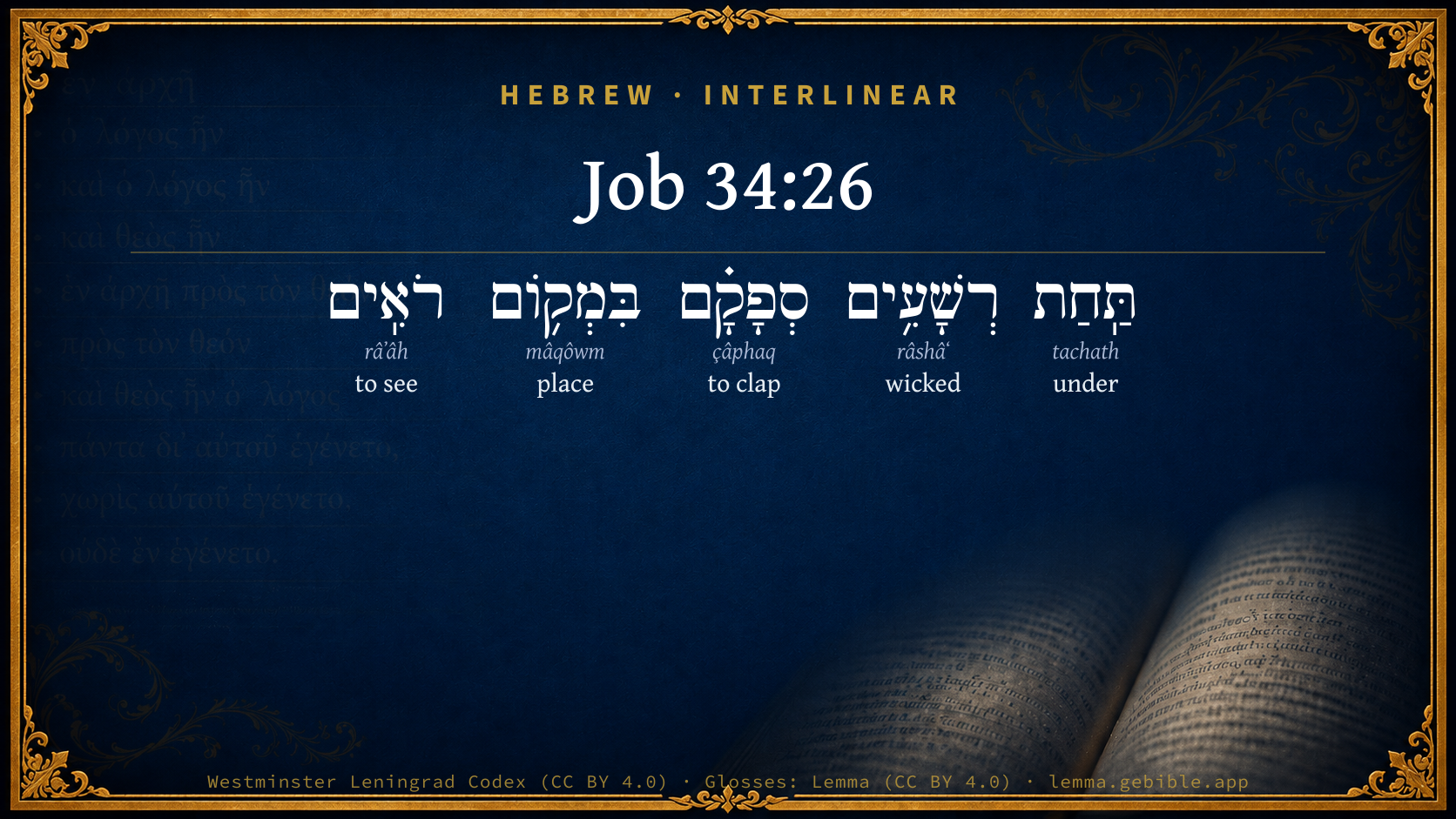
Job 34:26

Hebrew (Westminster Leningrad Codex) Job 34:26 appears in the Hebrew Old Testament. The text above is from the Westminster Leningrad Codex. Each word links to its Strong’s number, a concise gloss, and parsing drawn from the Open Scriptures Hebrew Bible morphology. Click any word for its full Brown-Driver-Briggs (BDB) entry.
Download image
Cite this verse

Job 34:26 (World English Bible). Public Domain. Lemma interlinear Bible study tool, https://lemma.gebible.app/v/job/34/26.

Show BibTeX & RIS
BibTeX
RIS
English Translation
He strikes them as wicked men In the open sight of others;
World English Bible · Public Domain
Download a study sheet

One document with this verse’s original text, its word-by-word gloss line, the meaning frame, cross-references with their text, attributed commentary, and full source and license credits — printable, and it pastes into notes with its structure intact.

This verse Autodidact and up

Study sheet (.html) Plain text (.txt)

A passage Seminary Student

Up to 50 verses in one chapter. A passage sheet keeps up to 6 commentary sources and 12 cross-references per verse, in the order this page ranks them, and says so on the sheet whenever that leaves anything out. Ask for a single verse and you get the Autodidact verse sheet above.

Everything on this page stays free to read, with no account — the sheet is a download of what is already on screen, not access to it.

Want to remove ads? Support Godless Engineer
Compare translations 3

The same verse in 3 English versions, stacked beneath the original-language interlinear above. Click any original word for its lexicon entry.

Each is an independent rendering of the whole verse — the interlinear is not word-aligned to these translations.

Highlighted words mark where these versions differ — a whole-verse word diff, not a word-by-word alignment.

  • World English Bible Public Domain
    He strikes them as wicked men In the open sight of others;
  • King James Version Public Domain
    He striketh them as wicked men in the open sight of others;
  • unfoldingWord Literal Text CC BY-SA 4.0
    He strikes them for their wickednesses in the place of the ones seeing,

unfoldingWord Literal Text — © unfoldingWord, licensed CC BY-SA 4.0. Word-aligned USFM3 via Door43 (git.door43.org/unfoldingWord/en_ult).

Versions to compare (up to 4)

3 of 4 selected

Show all 18 translations

Every available English version of this verse, each an independent rendering of the whole verse.

  • World English Bible Public Domain
    He strikes them as wicked men In the open sight of others;
  • Berean Standard Bible Public Domain
    He strikes them for their wickedness in full view,
  • Majority Standard Bible Public Domain
    He strikes them for their wickedness in full view,
  • King James Version Public Domain
    He striketh them as wicked men in the open sight of others;
  • American Standard Version (1901) Public Domain
    He striketh them as wicked men In the open sight of others;
  • Revised Version (1885) Public Domain
    He striketh them as wicked men in the open sight of others;
  • Geneva Bible (1599) Public Domain
    He striketh them as wicked men in the places of the seers,
  • Douay-Rheims (1899) Public Domain
    He hath struck them, as being wicked, in open sight.
  • Young's Literal Translation Public Domain
    As wicked He hath stricken them, In the place of beholders.
  • Literal Standard Version CC BY-SA 4.0
    As wicked He has struck them, || In the place of beholders.
  • Unlocked Literal Bible CC BY-SA 4.0
    In the open sight of others, he kills them for their wicked deeds like criminals
  • unfoldingWord Literal Text CC BY-SA 4.0
    He strikes them for their wickednesses in the place of the ones seeing,
  • Darby Bible Public Domain
    He striketh them as wicked men in the open sight of others,
  • World Messianic Bible Public Domain
    He strikes them as wicked men in the open sight of others;
  • Webster's Bible Public Domain
    He striketh them as wicked men in the open sight of others;
  • Free Bible Version CC BY-SA 4.0
    He strikes them down for their wickedness in public where they can be seen
  • Bible in Basic English Public Domain
    The evil-doers are broken by his wrath, he puts his hand on them with force before the eyes of all onlookers.
  • JPS Tanakh (1917) Public Domain
    He striketh them as wicked men in the open sight of others;

Literal Standard Version (2020), Covenant Press — licensed CC BY-SA 4.0. Text via the HelloAO Bible API (eBible.org). Unlocked Literal Bible (unfoldingWord) — licensed CC BY-SA 4.0. Text via the HelloAO Bible API (eBible.org). unfoldingWord Literal Text — © unfoldingWord, licensed CC BY-SA 4.0. Word-aligned USFM3 via Door43 (git.door43.org/unfoldingWord/en_ult). Free Bible Version, Dr. Jonathan Gallagher — licensed CC BY-SA 4.0. Text via the HelloAO Bible API (eBible.org).

Word by word

More ways to search: Search by grammar → Find every occurrence → Compare this word →

Practice this passage: Drill this verse → Learn its vocabulary →

About this verse

These counts appear in no published source. They are computed here, from the morphology-tagged text and Lemma’s own curated glosses. What Lemma adds →

5
words
5
distinct lemmas
Wisdom
section

Notable vocabulary

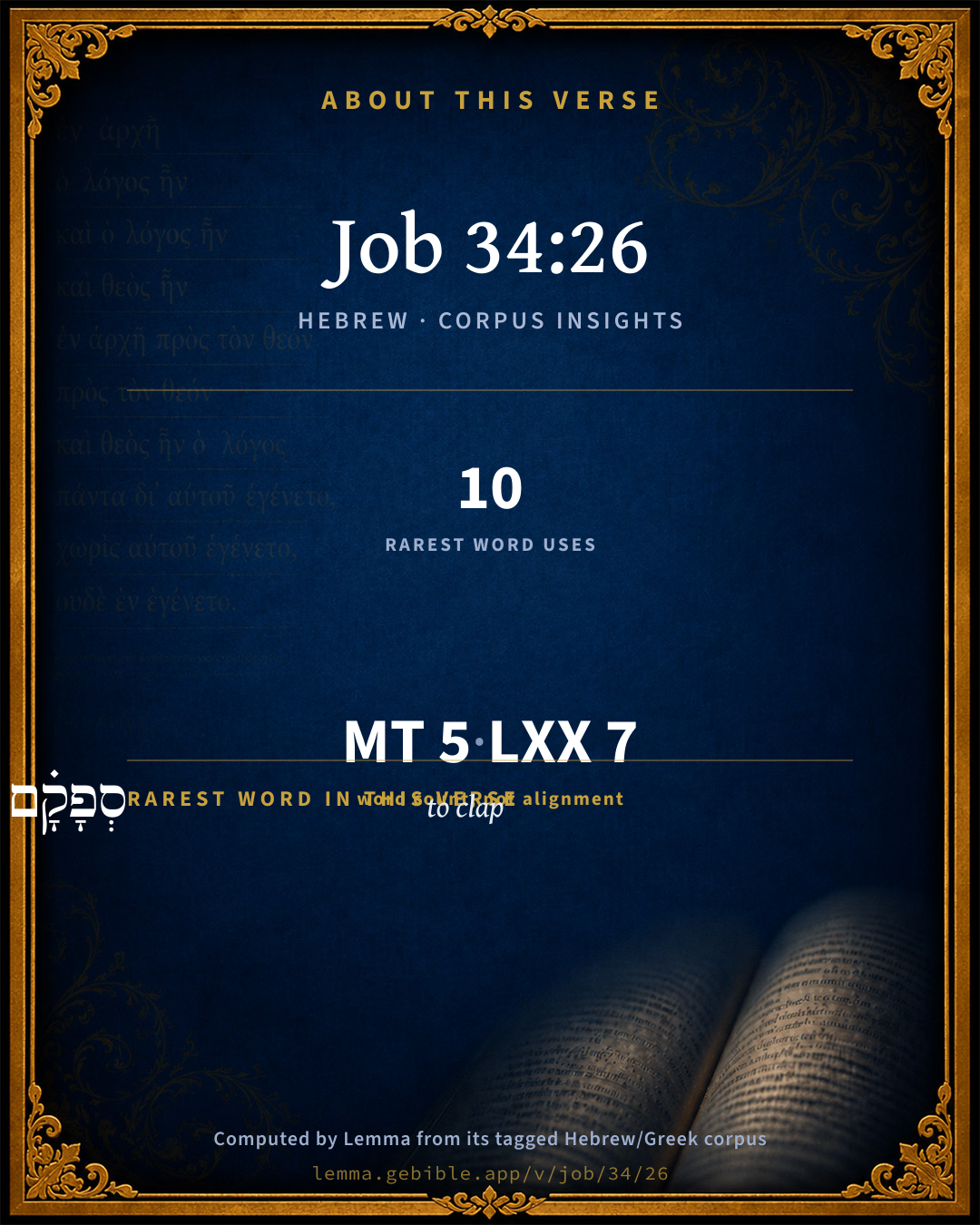
The rarest word here is סְפָקָ֗ם to clap H5606 — appearing just 10 times in the whole Hebrew Bible.

Shared distinctive vocabulary

סְפָקָ֗ם to clap H5606 occurs in 10 verses of the Hebrew Bible. Also found in:

Grammatical profile

  • 2 verbs
  • 1 noun
  • 1 adjective
  • 1 preposition

Verb forms

  • סְפָקָ֗ם Qal · Perfect
  • רֹאִֽים Qal · Participle Active

Hebrew & Septuagint length

In English translation the verse runs 12 words from the Hebrew and 12 from the Septuagint (LXX English) — the same length.

A rough comparison of the two English renderings, which tokenize alike — not a word-level alignment.

Word counts can differ between the Hebrew and the Greek without any difference in meaning — e.g. the Hebrew direct-object marker אֵת has no separate Greek word, and Greek often adds the article ὁ.

In the original languages it is 5 Hebrew tokens and 7 Greek tokens — but the two are counted differently (Hebrew bundles its prefixes and suffixes into one token; the Greek is in lemma form), so that isn’t a like-for-like length.

Cross-references

10

Topical passages linked to Job 34:26 in the Treasury of Scripture Knowledge — connected by theme and wording, ordered by reader-vote popularity; previews shown in the World English Bible.

  • Psalms 58:10–11 The righteous shall rejoice when he sees the vengeance. He shall wash his feet in the blood of the wicked;
  • Exodus 14:30 Thus Yahweh saved Israel that day out of the hand of the Egyptians; and Israel saw the Egyptians dead on the seashore.
  • Deuteronomy 13:9–11 but you shall surely kill him; your hand shall be first on him to put him to death, and afterwards the hand of all the people.
  • Deuteronomy 21:21 All the men of his city shall stone him to death with stones: so shall you put away the evil from the midst of you; and all Israel shall hear, and fear.
  • 2 Samuel 12:11–12 This is what Yahweh says: 'Behold, I will raise up evil against you out of your own house; and I will take your wives before your eyes, and give them to your neighbor, and he will lie with your wives in the sight of this sun.
  • Isaiah 66:24 They shall go forth, and look on the dead bodies of the men who have transgressed against me: for their worm shall not die, neither shall their fire be quenched; and they shall be an abhorring to all flesh.
  • 1 Timothy 5:20 Those who sin, reprove in the sight of all, that the rest also may be in fear.
  • 1 Timothy 5:24 Some men's sins are evident, preceding them to judgment, and some also follow later.
  • Revelation 18:9–10 The kings of the earth, who committed sexual immorality and lived wantonly with her, will weep and wail over her, when they look at the smoke of her burning,
  • Revelation 18:20 Rejoice over her, O heaven, you saints, apostles, and prophets; for God has judged your judgment on her."

Cross-references courtesy of OpenBible.info (CC BY 4.0).

Hebrew and Greek witnesses Masoretic Hebrew ↔ Greek Septuagint

The same verse in the two great witnesses to the Old Testament, shown verse-for-verse.

These are two independent witnesses, not word-aligned to each other, and the Septuagint is shown in lemma (dictionary) form.

Hebrew Job 34:26 Masoretic · Westminster Leningrad Codex

תַּֽחַת רְשָׁעִ֥ים סְפָקָ֗ם בִּמְק֥וֹם רֹאִֽים

He strikes them as wicked men In the open sight of others;

World English Bible · Public Domain

Greek LXX Job 34:26 Septuagint · lemma form

σβέννυμι δέ ἀσεβής ὁρατός δέ ἐναντίον αὐτός

And he quite destroys the ungodly, for they are seen before him.

LXX2012 (modern English Septuagint) · Public Domain

Hebrew: Westminster Leningrad Codex (CC BY 4.0). Greek: Septuagint (public domain); English from LXX2012 (modern English Septuagint) (Public Domain). How the Septuagint differs from the Hebrew →

Commentary

Notes on Job 34:26 from classic Christian and Jewish commentators (each source and its license shown beneath its notes). The classic Christian expositions comment on the surrounding passage and are grouped to its opening verse, so a note may address several verses; the Jewish commentaries on the Tanakh (Rashi and others) are per-verse, so they appear only where the commentator wrote on this verse.

Lemma curates 59 commentaries, every one of them public domain or Creative Commons licensed, each selected and text-cleaned for this edition rather than reprinted as found. About our sources →

Trapp's Complete Commentary

John Trapp

Job 34:26 He striketh them as wicked men in the open sight of others;

Ver. 26. He striketh them as wicked men, &c.] Complodit cos, saith Junius, scilicet ut inflatas vesicas in sun ipsorum sede, he striketh upon them, as blown bladders, in their own seat. This is an elegant similitude, setting forth the sudden overthrow of graceless great ones, as with a kind of noise, and not without public notice; for it followeth,

In the open sight of others] Heb. In the place of beholders, in proscenio, as upon a stage or scaffold, Discant iustitiam moniti; et non temnere numen, others may hear and fear, and do no more so. God is pleased for this purpose to bang up some notorious offenders as it were in gibbets; as Pharaoh, Sennacherib, Antiochus, Herod, Julian. See those writs of execution, 1Co 10:5-7, and be wise by others’ woes; enjoy their follies, and gather, with the bee, sweet honey out of those bitter weeds, Poena ad paucos, metus ad omnes. Punishment to the poor, fear at all.

John Trapp, A Commentary or Exposition upon All the Books of the Old and New Testament (1647–1656) — public domain. Text from a community e-Sword module.

Tyndale Open Study Notes

Tyndale Open Resources

34:26 When God renders justice openly, it leads to proper fear among the wicked (Deut 21:21; 1 Tim 5:20) and to public rejoicing among the righteous (cp. Exod 14:30-31).

Tyndale Open Study Notes — © Tyndale Open Resources, licensed CC BY-SA 4.0. Text via the HelloAO Bible API.

Geneva Bible (1599)

Geneva Bible translators

Meaning, openly in the sight of all men.

Geneva Bible (1599) marginal notes — public domain. Text via Bolls.life.

Jamieson, Fausset & Brown

Robert Jamieson, A. R. Fausset & David Brown

He striketh them--chasteneth.

as--that is, because they are wicked.

sight of others--Sinners hid themselves in darkness; therefore they are punished before all, in open day. Image from the place of public execution (Job 40:12; Exo 14:30; Sa2 12:12).

Jamieson, Fausset & Brown — Commentary Critical and Explanatory on the Whole Bible (1871) — public domain (CC PDM 1.0). Text via the HelloAO Bible API.

Adam Clarke's Commentary

Verse 26. He striketh them as wicked men] At other times he executes his judgments more openly; and they are suddenly destroyed in the sight of the people.

Adam Clarke's Commentary on the Bible (1810–1826) — public domain. Text from a community e-Sword/MySword module.

Ellicott's Commentary for English Readers

(26) He striketh them as wicked men.—Rather, in the place of wicked men he striketh them: i.e., the wicked—that is, “He executeth His judgments in the sight of all beholders, striking down wicked men in their very place, so that there can be no doubt as to who are stricken or why they are stricken.”

A Bible Commentary for English Readers, edited by Charles John Ellicott (1878–1897) — public domain. Text from a community e-Sword module.

John Gill's Exposition

So that they cause the cry of the poor to come to him,.... To God; through their oppressions of the poor they are made to cry by reason of them, and who come to God with their cries, and tears, and supplications, and which enter into the ears of the Lord of hosts;

and he heareth the cry of the afflicted; as he did the cry of the Israelites under Egyptian bondage; he is a God hearing and answering prayer, and he particularly attends to the cry of the humble and of the afflicted, and arises for their help and deliverance.

John Gill's Exposition of the Whole Bible (1746–1763) — public domain (CC PDM 1.0). Text via the HelloAO Bible API.

Albert Barnes' Notes on the Bible

He striketh them as wicked men - literally, “Under the wicked, or on account of the wicked, he smites them.” That is, he deals with them “as if” they were wicked; he regards and treats them as such. He deals with them “under” the general character of wicked people, and punishes them accordingly.

In the open sight of others - Margin, as in Hebrew “in the place of beholders.” The idea is, that it is done openly or publicly. Their sins had been committed in secret, but they are punished openly. The manifestation of the divine displeasure is in the presence of spectators, or is so open and public, that it cannot but be seen. It is very probable that in all this description Elihu had his eye upon the public calamities which had come upon Job, and that he meant to include him among the number of mighty men whom God thus suddenly overturned.

Albert Barnes' Notes on the Bible (1834–1885) — public domain. Text from a community e-Sword/MySword module.

Haydock's Catholic Bible Commentary

Sight. Literally, "in the place of the beholders," (Haydock) in public. (Calmet)

George Leo Haydock (1774–1849), Haydock's Catholic Family Bible and Commentary, 1859 edition — public domain. Excludes Psalms (Douay-Rheims chapter numbering differs from Protestant) and Deuterocanonical books (Catholic canon only).

Matthew Poole's English Annotations

As wicked men, i.e. as he useth to smite wicked men, with a grievous and terrible stroke. Compare Isa 27:7. Or, for wicked men; or, because they are wicked men, therefore he destroys them without any regard to their quality.

In the open sight of others; in public view, for their greater shame, and for the greater glory of God’s justice, and for the greater terror of other oppressors, and comfort of the oppressed.

Matthew Poole's English Annotations on the Holy Bible (1683–1685) — public domain. Text from a community e-Sword/MySword module.

Whedon's Commentary on the Bible

Daniel D. Whedon

26. In the open sight of others — Literally, They (the mighty) are punished like malefactors, in the place of beholders; that is, where all can see, in order that they may take warning.

Daniel D. Whedon (gen. ed.), Commentary on the Old and New Testaments (1874–1909) — public domain. Text from a community e-Sword module.

The Pulpit Commentary

He striketh them as wicked men; i.e. as open and acknowledged malefactors. In the open sight of others; literally, in the place of beholders; i.e. publicly, openly, where their fate is an example to others.

The Pulpit Commentary (1880–1919), ed. H.D.M. Spence-Jones & Joseph S. Exell — public domain. Text from a community e-Sword module.

John Wesley's Explanatory Notes

As - Because they are wicked men. In the open light - In publick view for their greater shame, and for the greater glory of his justice.

John Wesley, Explanatory Notes Upon the Whole Bible (1754–1765) — public domain. Text via the GEBible commentary corpus.

unfoldingWord translationNotes

Door43 World Missions Community

General Information:

Elihu continues speaking.

In the open sight of others, he kills them for their wicked deeds like criminals

This phrase compares the way that these people die to how criminals die. AT: "He kills them for their wicked deeds, in the open sight of others as if they were criminals" (See: Simile)

In the open sight of others

This is an idiom. AT: "In a place where everyone can see" (See: Idiom)

he kills them

This speaks of God causing these people to die, though he does not actually strike them with a sword himself. He may cause someone else to kill them or disaster to come upon them. AT: "he causes them to die" (See: Assumed Knowledge and Implicit Information)

his ways

This refers to God's instructions for how people should behave. (See: Idiom)

they made the cry of poor people come to him

The word "cry" can be expressed as a verb. This speaks of God hearing their cry as if the cry were a person that came to him. AT: "they made the poor people cry, and God heard them" (See: Abstract Nouns and Personification)

translationWords

crime

turn

acknowledge

afflicted

unfoldingWord translationNotes — © Distant Shores Media and the Door43 World Missions Community, licensed CC BY-SA 4.0. Source: git.door43.org/Door43/en_tn.

Rashi

Rabbi Shlomo Yitzchaki (Rashi)

In the place of the wicked Heb. תחת, in their location.

He smote them The people of Sodom.

in the place of viewers Before everyone’s eyes.

Rashi on the Tanakh — English translations: “The Judaica Press complete Tanach with Rashi, translated by A. J. Rosenberg” (CC BY 4.0); “Pentateuch with Rashi's commentary by M. Rosenbaum and A.M. Silbermann, 1929-1934” (public domain); “The Metsudah Tanach series, Lakewood, N.J” (CC BY 4.0); and “The Book of Joshua, Metsudah Publications, 1997” (CC BY 4.0). Text via Sefaria.

Lesson kit

Teaching starters — assembled from the data on this page, not authored interpretation. Every prompt links to the verse data it draws on. Edit before teaching.

Job, in the Wisdom, opens this verse with 5 words (5 distinct Hebrew lemmas). Its most distinctive word is çâphaq (“to clap”). A historical commentator’s framing appears above. Read the whole chapter for the surrounding context.

Discussion questions

  1. How does “to clap” (çâphaq) shape what this verse is saying?
  2. Numbers 24:10 shares the word «to clap» with this verse. How do the two illuminate each other?
  3. These translations render this verse differently. What is at stake in choosing one wording over another?
  4. The verb «סְפָקָ֗ם» is Qal Perfect. How does its form color the action?
  5. Reading how Trapp's Complete Commentary and Tyndale Open Study Notes read this verse, where do the two commentators agree and where do they part?

Things to notice

Reading settings

Reading text

Shown beneath each verse's original-language words.

Old Testament
Old Testament edition

Read the OT as the Masoretic Hebrew (MT) or the Greek Septuagint (LXX).

English shown for the Greek Septuagint (in the Hebrew ↔ Greek comparison).

Comparing translations? Open the Compare panel on any verse page to stack up to four side by side.