
Psalms 37:21

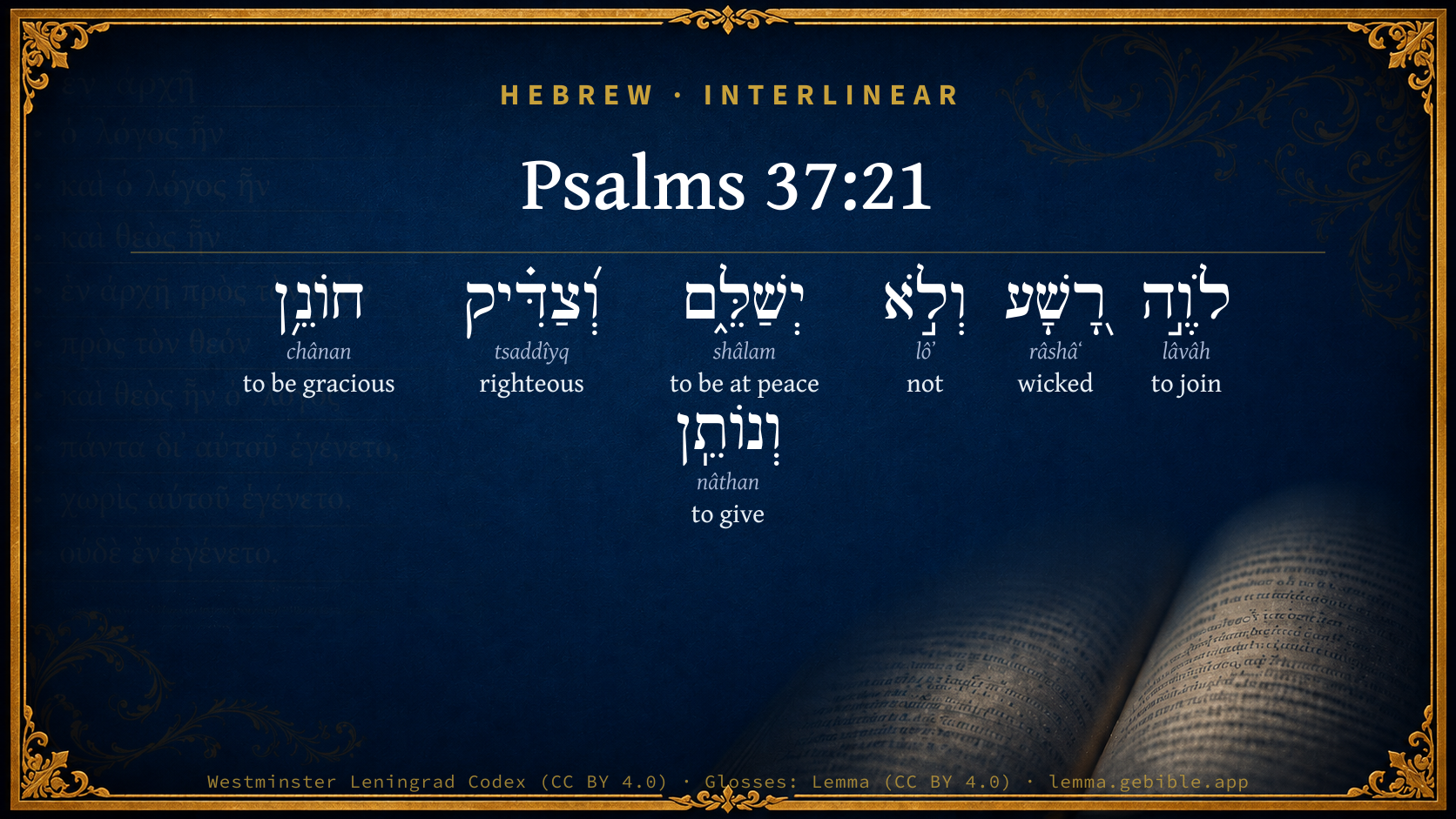
Hebrew (Westminster Leningrad Codex) Psalms 37:21 appears in the Hebrew Old Testament. The text above is from the Westminster Leningrad Codex. Each word links to its Strong’s number, a concise gloss, and parsing drawn from the Open Scriptures Hebrew Bible morphology. Click any word for its full Brown-Driver-Briggs (BDB) entry.
Download image
Cite this verse

Psalms 37:21 (World English Bible). Public Domain. Lemma interlinear Bible study tool, https://lemma.gebible.app/v/psalms/37/21.

Show BibTeX & RIS
BibTeX
RIS
English Translation
The wicked borrow, and don't pay back, But the righteous give generously.
World English Bible · Public Domain
Download a study sheet

One document with this verse’s original text, its word-by-word gloss line, the meaning frame, cross-references with their text, attributed commentary, and full source and license credits — printable, and it pastes into notes with its structure intact.

This verse Autodidact and up

Study sheet (.html) Plain text (.txt)

A passage Seminary Student

Up to 50 verses in one chapter. A passage sheet keeps up to 6 commentary sources and 12 cross-references per verse, in the order this page ranks them, and says so on the sheet whenever that leaves anything out. Ask for a single verse and you get the Autodidact verse sheet above.

Everything on this page stays free to read, with no account — the sheet is a download of what is already on screen, not access to it.

Want to remove ads? Support Godless Engineer
Compare translations 3

The same verse in 3 English versions, stacked beneath the original-language interlinear above. Click any original word for its lexicon entry.

Each is an independent rendering of the whole verse — the interlinear is not word-aligned to these translations.

Highlighted words mark where these versions differ — a whole-verse word diff, not a word-by-word alignment.

  • World English Bible Public Domain
    The wicked borrow, and don't pay back, But the righteous give generously.
  • King James Version Public Domain
    The wicked borroweth, and payeth not again: but the righteous sheweth mercy, and giveth.
  • unfoldingWord Literal Text CC BY-SA 4.0
    The wicked is borrowing and does not repay, but the righteous is showing grace and giving.

unfoldingWord Literal Text — © unfoldingWord, licensed CC BY-SA 4.0. Word-aligned USFM3 via Door43 (git.door43.org/unfoldingWord/en_ult).

Versions to compare (up to 4)

3 of 4 selected

Show all 18 translations

Every available English version of this verse, each an independent rendering of the whole verse.

  • World English Bible Public Domain
    The wicked borrow, and don't pay back, But the righteous give generously.
  • Berean Standard Bible Public Domain
    The wicked borrow and do not repay, but the righteous are gracious and giving.
  • Majority Standard Bible Public Domain
    The wicked borrow and do not repay, but the righteous are gracious and giving.
  • King James Version Public Domain
    The wicked borroweth, and payeth not again: but the righteous sheweth mercy, and giveth.
  • American Standard Version (1901) Public Domain
    The wicked borroweth, and payeth not again; But the righteous dealeth graciously, and giveth.
  • Revised Version (1885) Public Domain
    The wicked borroweth, and payeth not again: but the righteous dealeth graciously, and giveth.
  • Geneva Bible (1599) Public Domain
    The wicked boroweth and payeth not againe. but the righteous is mercifull, and giueth.
  • Douay-Rheims (1899) Public Domain
    The sinner shall borrow, and not pay again; but the just sheweth mercy and shall give.
  • Young's Literal Translation Public Domain
    The wicked is borrowing and repayeth not, And the righteous is gracious and giving.
  • Literal Standard Version CC BY-SA 4.0
    The wicked is borrowing and does not repay, || And the righteous is gracious and giving.
  • Unlocked Literal Bible CC BY-SA 4.0
    The wicked person borrows but does not repay, but the righteous person is generous and gives.
  • unfoldingWord Literal Text CC BY-SA 4.0
    The wicked is borrowing and does not repay, but the righteous is showing grace and giving.
  • Darby Bible Public Domain
    The wicked borroweth, and payeth not again; but the righteous is gracious and giveth:
  • World Messianic Bible Public Domain
    The wicked borrow, and don’t pay back, but the righteous give generously.
  • Webster's Bible Public Domain
    The wicked borroweth, and payeth not again: but the righteous showeth mercy, and giveth.
  • Free Bible Version CC BY-SA 4.0
    The wicked borrow, but don't repay; while those who do right give generously.
  • Bible in Basic English Public Domain
    The sinner takes money and does not give it back; but the upright man has mercy, and gives to others.
  • JPS Tanakh (1917) Public Domain
    The wicked borroweth, and payeth not; but the righteous dealeth graciously, and giveth.

Literal Standard Version (2020), Covenant Press — licensed CC BY-SA 4.0. Text via the HelloAO Bible API (eBible.org). Unlocked Literal Bible (unfoldingWord) — licensed CC BY-SA 4.0. Text via the HelloAO Bible API (eBible.org). unfoldingWord Literal Text — © unfoldingWord, licensed CC BY-SA 4.0. Word-aligned USFM3 via Door43 (git.door43.org/unfoldingWord/en_ult). Free Bible Version, Dr. Jonathan Gallagher — licensed CC BY-SA 4.0. Text via the HelloAO Bible API (eBible.org).

Word by word

More ways to search: Search by grammar → Find every occurrence → Compare this word →

Practice this passage: Drill this verse → Learn its vocabulary →

About this verse

These counts appear in no published source. They are computed here, from the morphology-tagged text and Lemma’s own curated glosses. What Lemma adds →

7
words
7
distinct lemmas
Wisdom
section

Shared distinctive vocabulary

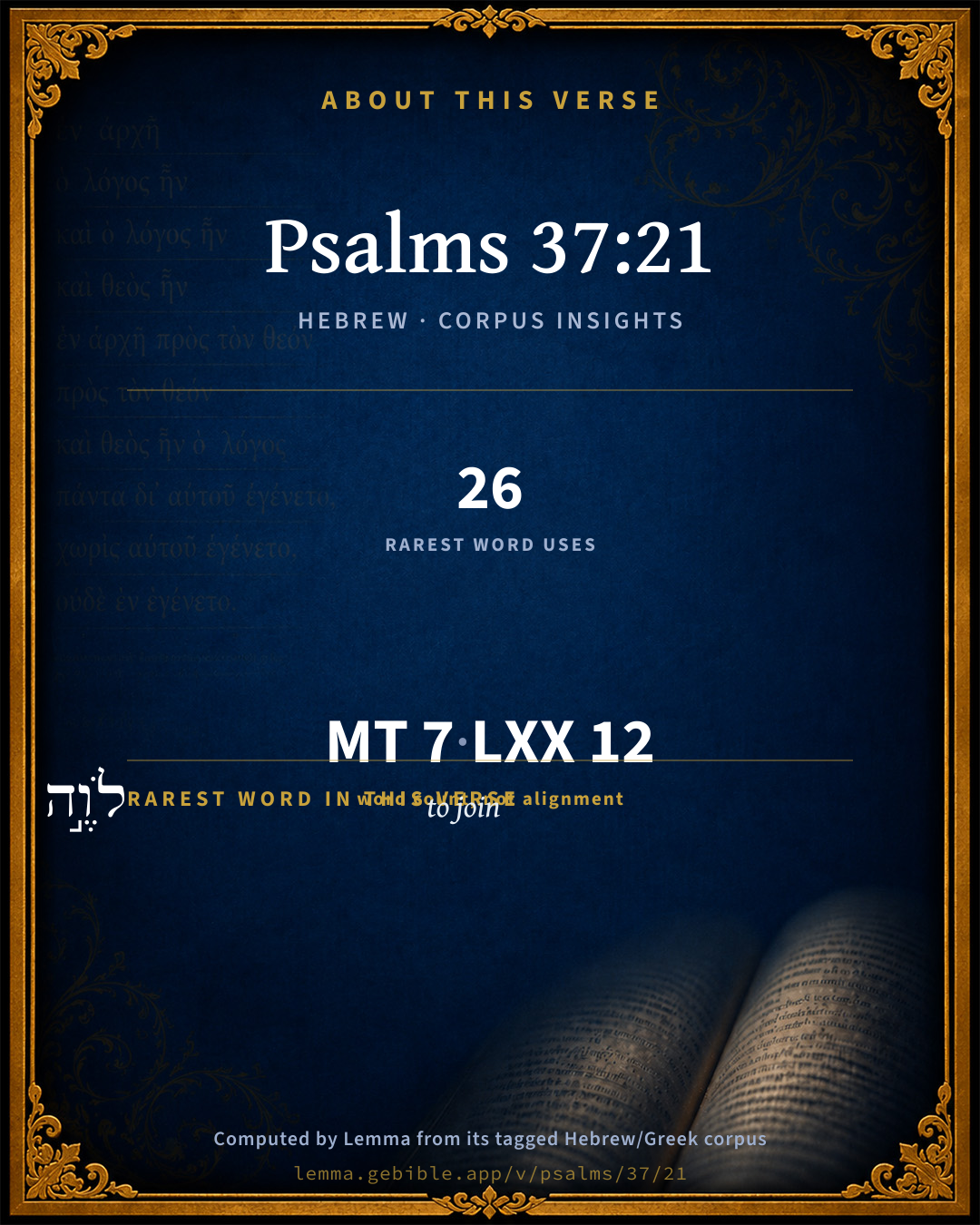
לֹוֶ֣ה to join H3867 occurs in 22 verses of the Hebrew Bible. Also found in:

Grammatical profile

  • 4 verbs
  • 2 adjectives
  • 1 particle

Verb forms

  • לֹוֶ֣ה Qal · Participle Active
  • יְשַׁלֵּ֑ם Piel · Imperfect
  • חוֹנֵ֥ן Qal · Participle Active
  • וְנוֹתֵֽן Qal · Participle Active

Hebrew & Septuagint length

In English translation the verse runs 12 words from the Hebrew and 15 from the Septuagint (LXX English) — closely comparable.

A rough comparison of the two English renderings, which tokenize alike — not a word-level alignment.

Word counts can differ between the Hebrew and the Greek without any difference in meaning — e.g. the Hebrew direct-object marker אֵת has no separate Greek word, and Greek often adds the article ὁ.

In the original languages it is 7 Hebrew tokens and 12 Greek tokens — but the two are counted differently (Hebrew bundles its prefixes and suffixes into one token; the Greek is in lemma form), so that isn’t a like-for-like length.

Cross-references

18

Topical passages linked to Psalms 37:21 in the Treasury of Scripture Knowledge — connected by theme and wording, ordered by reader-vote popularity; previews shown in the World English Bible.

  • Hebrews 13:16 But don't forget to be doing good and sharing, for with such sacrifices God is well pleased.
  • Psalms 112:5 It is well with the man who deals graciously and lends. He will maintain his cause in judgment.
  • Proverbs 22:7 The rich rule over the poor. The borrower is servant to the lender.
  • Psalms 112:9 He has dispersed, he has given to the poor. His righteousness endures forever. His horn will be exalted with honor.
  • Luke 6:30 Give to everyone who asks you, and don't ask him who takes away your goods to give them back again.
  • Deuteronomy 28:12 Yahweh will open to you his good treasure in the sky, to give the rain of your land in its season, and to bless all the work of your hand: and you shall lend to many nations, and you shall not borrow.
  • 2 Corinthians 8:9 For you know the grace of our Lord Jesus Christ, that, though he was rich, yet for your sakes he became poor, that you through his poverty might become rich.
  • Deuteronomy 15:9–11 Beware that there not be a base thought in your heart, saying, The seventh year, the year of release, is at hand; and your eye be evil against your poor brother, and you give him nothing; and he cry to Yahweh against you, and it be sin to you.
  • Job 31:16–20 "If I have withheld the poor from their desire, Or have caused the eyes of the widow to fail,
  • Isaiah 58:7–10 Isn't it to deal your bread to the hungry, and that you bring the poor who are cast out to your house? when you see the naked, that you cover him; and that you not hide yourself from your own flesh?
  • Acts 20:35 In all things I gave you an example, that so laboring you ought to help the weak, and to remember the words of the Lord Jesus, that he himself said, 'It is more blessed to give than to receive.'"
  • 2 Corinthians 9:6–15 Remember this: he who sows sparingly will also reap sparingly. He who sows bountifully will also reap bountifully.
  • Deuteronomy 28:43–44 The foreigner who is in the midst of you shall mount up above you higher and higher; and you shall come down lower and lower.
  • 2 Kings 4:1–5 Now there cried a certain woman of the wives of the sons of the prophets to Elisha, saying, Your servant my husband is dead; and you know that your servant did fear Yahweh: and the creditor is come to take to him my two children to be bondservants.
  • Nehemiah 5:1–5 Then there arose a great cry of the people and of their wives against their brothers the Jews.
  • Isaiah 32:8 But the noble devises noble things; and in noble things shall he continue.
  • Acts 11:29 As any of the disciples had plenty, each determined to send relief to the brothers who lived in Judea;
  • Hebrews 6:10 For God is not unrighteous, so as to forget your work and the labor of love which you showed toward his name, in that you served the saints, and still do serve them.

Cross-references courtesy of OpenBible.info (CC BY 4.0).

Hebrew and Greek witnesses Masoretic Hebrew ↔ Greek Septuagint

The same verse in the two great witnesses to the Old Testament, shown verse-for-verse.

You’re reading Greek Psalm 36 (Hebrew Psalm 37). The Septuagint counts the superscription, so verse numbers can differ from the Hebrew — chapter-level alignment, not verse-by-verse. Numbering follows Rahlfs.

These are two independent witnesses, not word-aligned to each other, and the Septuagint is shown in lemma (dictionary) form.

Hebrew Psalms 37:21 Masoretic · Westminster Leningrad Codex

לֹוֶ֣ה רָ֭שָׁע וְלֹ֣א יְשַׁלֵּ֑ם וְ֝צַדִּ֗יק חוֹנֵ֥ן וְנוֹתֵֽן

The wicked borrow, and don't pay back, But the righteous give generously.

World English Bible · Public Domain

Greek LXX Greek Psalm 36:21 Septuagint · lemma form

δανείζω ὁ ἁμαρτωλός καί οὐ ἀποτίνω ὁ δέ δίκαιος οἰκτείρω καί δίδωμι

The sinner borrows, and will not pay again: but the righteous has compassion, and gives.

LXX2012 (modern English Septuagint) · Public Domain

On this verse, John Gill's Exposition discusses the Septuagint’s reading. Read the note in Commentary ↓

Hebrew: Westminster Leningrad Codex (CC BY 4.0). Greek: Septuagint (public domain); English from LXX2012 (modern English Septuagint) (Public Domain). How the Septuagint differs from the Hebrew →

Commentary

Notes on Psalms 37:21 from classic Christian and Jewish commentators (each source and its license shown beneath its notes). The classic Christian expositions comment on the surrounding passage and are grouped to its opening verse, so a note may address several verses; the Jewish commentaries on the Tanakh (Rashi and others) are per-verse, so they appear only where the commentator wrote on this verse.

Lemma curates 59 commentaries, every one of them public domain or Creative Commons licensed, each selected and text-cleaned for this edition rather than reprinted as found. About our sources →

Matthew Henry's Commentary

These verses are much to the same purport with the foregoing verses of this psalm, for it is a subject worthy to be dwelt upon. Observe here,

I. What is required of us as the way to our happiness, which we may learn both from the characters here laid down and from the directions here given. If we would be blessed of God, 1. We must make conscience of giving every body his own; for the wicked borrows and pays not again, Psa 37:21. It is the first thing which the Lord our God requires of us, that we do justly, and render to all their due. It is not only a shameful paltry thing, but a sinful wicked thing, not to repay what we have borrowed. Some make this an instance, not so much of the wickedness of the wicked as of the misery and poverty to which they are reduced by the just judgment of God, that they shall be necessitated to borrow for their supply and then be in no capacity to repay it again, and so lie at the mercy of their creditors. Whatever some men seem to think of it, as it is a great sin for those that are able to deny the payment of their just debts, so it is a great misery not to be able to pay them. 2. We must be ready to all acts of charity and beneficence; for, as it is an instance of God's goodness to the righteous that he puts it into the power of his hand to be kind and to do good (and so some understand it, God's blessing increases his little to such a degree that he has abundance to spare for the relief of others), so it is an instance of the goodness of the righteous man that he has a heart proportionable to his estate: He shows mercy, and gives, Psa 37:21. He is ever merciful, or every day, or all the day, merciful, and lends, and sometimes there is as true charity in lending as in giving; and giving and lending are acceptable to God when they proceed from a merciful disposition in the heart, which, if it be sincere, will be constant, and will keep us from being weary of well-doing. he that is truly merciful will be ever merciful. 3. We must leave our sins, and engage in the practice of serious godliness (Psa 37:27): Depart from evil and do good. Cease to do evil and abhor it; learn to do well and cleave to it; this is true religion. 4. We must abound in good discourse, and with our tongues must glorify God and edify others. It is part of the character of a righteous man (Psa 37:30) that his mouth speaketh wisdom; not only he speaks wisely, but he speaks wisdom, like Solomon himself, for the instruction of those about him. His tongue talks not of things idle and impertinent, but of judgment, that is, of the word and providence of God and the rules of wisdom for the right ordering of the conversation. Out of the abundance of a good heart will the mouth speak that which is good and to the use of edifying. 5. We must have our wills brought into an entire subjection to the will and word of God (Psa 37:31): The law of God, of his God, is in his heart; and in vain do we pretend that God is our God if we do not receive his law into our hearts and resign ourselves to the government of it. It is but a jest and a mockery to speak wisdom, and to talk of judgment (Psa 37:30), unless we have the law in our hearts, and we think as we speak. The law of God must be a commanding ruling principle in the heart; it must be a light there, a spring there, and then the conversation will be regular and uniform: None of his steps will slide; it will effectually prevent backsliding into sin, and the uneasiness that follows from it.

II. What is assured to us, as instances of our happiness and comfort, upon these conditions.

1. That we shall have the blessing of God, and that blessing shall be the spring, and sweetness, and security of all our temporal comforts and enjoyments (Psa 37:22): Such as are blessed of God, as all the righteous are, with a Father's blessing, by virtue of that shall inherit the earth, or the land (for so the same word is translated, Psa 37:29), the land of Canaan, that glory of all lands. Our creature-comforts are comforts indeed to us when we see them flowing from the blessing of God, we are sure not to want any thing that is good for us in this world. The earth shall yield us her increase if God, as our own God, give us his blessing, Psa 67:6. And as those whom God blesses are thus blessed indeed (for they shall inherit the land), so those whom he curses are cursed indeed; they shall be cut off and rooted out, and their extirpation by the divine curse will set off the establishment of the righteous by the divine blessing and be a foil to it.

2. That God will direct and dispose of our actions and affairs so as may be most for his glory (Psa 37:23): The steps of a good man are ordered by the Lord. By his grace and Holy Spirit he directs the thoughts, affections, and designs of good men. He has all hearts in his hand, but theirs by their own consent. By his providence he overrules the events that concern them, so as to make their way plain before them, both what they should do and what they may expect. Observe, God orders the steps of a good man; not only his way in general, by his written word, but his particular steps, by the whispers of conscience, saying, This is the way, walk in it. He does not always show him his way at a distance, but leads him step by step, as children are led, and so keeps him in a continual dependence upon his guidance; and this, (1.) Because he delights in his way, and is well pleased with the paths of righteousness wherein he walks. The Lord knows the way of the righteous (Psa 1:6), knows it with favour, and therefore directs it. (2.) That he may delight in his way. Because God orders his way according to his own will, therefore he delights in it; for, as he loves his own image upon us, so he is well pleased with what we do under his guidance.

3. That God will keep us from being ruined by our falls either into sin or into trouble (Psa 37:24): Though he fall, he shall not be utterly cast down. (1.) A good man may be overtaken in a fault, but the grace of God shall recover him to repentance, so that he shall not be utterly cast down. Though he may, for a time, lose the joys of God's salvation, yet they shall be restored to him; for God shall uphold him with his hand, uphold him with his free Spirit. The root shall be kept alive, though the leaf wither; and there will come a spring after the winter. (2.) A good man may be in distress, his affairs embarrassed, his spirits sunk, but he shall not be utterly cast down; God will be the strength of his heart when his flesh and heart fail, and will uphold him with his comforts, so that the spirit he has made shall not fail before him.

4. That we shall not want the necessary supports of this life (Psa 37:25): "I have been young and now am old, and, among all the changes I have seen in men's outward condition and the observations I have made upon them, I never saw the righteous forsaken of God and man, as I have sometimes seen wicked people abandoned both by heaven and earth; nor do I ever remember to have seen the seed of the righteous reduced to such an extremity as to beg their bread." David had himself begged his bread of Abimelech the priest, but it was when Saul hunted him; and our Saviour has taught us to except the case of persecution for righteousness' sake out of all the temporal promises (Mar 10:30), because that has such peculiar honours and comforts attending it as make it rather a gift (as the apostle reckons it, Phi 1:29) than a loss or grievance. But there are very few instances of good men, or their families, that are reduced to such extreme poverty as many wicked people bring themselves to by their wickedness. He had not seen the righteous forsaken, nor his seed begging their bread. Forsaken (so some expound it); if they do want God will raise them up friends to supply them, without a scandalous exposing of themselves to the reproach of common beggars; or, if they go from door to door for meat, it shall not be with despair, as the wicked man that wanders abroad for bread, saying, Where is it? Job 15:23. Nor shall he be denied, as the prodigal, that would fain have filled his belly, but no man gave unto him, Luk 15:16. Nor shall he grudge if he be not satisfied, as David's enemies, when they wandered up and down for meat, Psa 59:15. Some make this promise relate especially to those that are charitable and liberal to the poor, and to intimate that David never observed any that brought themselves to poverty by their charity. It is withholding more than is meet that tends to poverty, Pro 11:24.

5. That God will not desert us, but graciously protect us in our difficulties and straits (Psa 37:28): The Lord loves judgment; he delights in doing justice himself and he delights in those that do justice; and therefore he forsakes not his saints in affliction when others make themselves strange to them and become shy of them, but he takes care that they be preserved for ever, that is, that the saint in every age be taken under his protection, that the succession be preserved to the end of time, and that particular saints be preserved from all the temptations and through all the trials of this present time, to that happiness which shall be for ever. He will preserve them to his heavenly kingdom; that is a preservation for ever, Ti2 4:18; Psa 12:7.

6. That we shall have a comfortable settlement in this world, and in a better when we leave this. That we shall dwell for evermore (Psa 37:27), and not be cut off as the seed of the wicked, Psa 37:28. Those shall not be tossed that make God their rest and are at home in him. But on this earth there is no dwelling for ever, no continuing city; it is in heaven only, that city which has foundations, that the righteous shall dwell for ever; that will be their everlasting habitation.

7. That we shall not become a prey to our adversaries, who seek our ruin, Psa 37:32, Psa 37:33. There is an adversary that takes all opportunities to do us a mischief, a wicked one that watches the righteous (as a roaring lion watches his prey) and seeks to slay him. There are wicked men that do so, that are very subtle (they watch the righteous, that they may have an opportunity to do them a mischief effectually and may have a pretence wherewith to justify themselves in the doing of it), and very spiteful, for they seek to slay him. But it may very well be applied to the wicked one, the devil, that old serpent, who has his wiles to entrap the righteous, his devices which we should not be ignorant of, - that great red dragon, who seeks to slay them, - that roaring lion, who goes about continually, restless and raging, and seeking whom he may devour. But it is here promised that he shall not prevail, neither Satan nor his instruments. (1.) He shall not prevail as a field-adversary: The Lord will not leave him in his hand; he will not permit Satan to do what he would, nor will he withdraw his strength and grace from his people, but will enable them to resist and overcome him, and their faith shall not fail, Luk 22:31, Luk 22:32. A good man may fall into the hands of a messenger of Satan, and be sorely buffeted, but God will not leave him in his hands, Co1 10:13. (2.) He shall not prevail as a law-adversary: God will not condemn him when he is judged, though urged to do it by the accuser of the brethren, who accuses them before our God day and night. His false accusations will be thrown out, as those exhibited against Joshua (Zac 3:1, Zac 3:2), The Lord rebuke thee, O Satan! It is God that justifies, and then who shall lay any thing to the charge of God's elect?

Matthew Henry's Commentary on the Whole Bible (1708–1710) — public domain (CC PDM 1.0). Text via the HelloAO Bible API.

Trapp's Complete Commentary

John Trapp

Psa 37:21 The wicked borroweth, and payeth not again: but the righteous sheweth mercy, and giveth.

Ver. 21. The wicked borroweth, and payeth not again] Either because he cannot, he is so unable; or because he cares not, he is so unconscionable, Non sunt reddendo. But in the midst of his wealth he is many times wanting; in the fulness of his sufficiency he is in straits; and to supply his necessities, sticketh long in the usurer’s furnace, which leaveth him at last neither metal nor matter.

But the righteous showeth mercy, and giveth] Of that which is his own, to which end he hath a great care to pay his debts. When Archbishop Cranmer discerned the storm which after fell upon him in Queen Mary’s days, he took express order for the payment of all his debts, which, when it was done, a most joyful man was he. How hospitable he was and liberal, Tremellius testifieth in his epistle before his Comment on Hosea.

John Trapp, A Commentary or Exposition upon All the Books of the Old and New Testament (1647–1656) — public domain. Text from a community e-Sword module.

The Biblical Illustrator

Joseph S. Exell

Psa_37:21-26

The wicked borroweth, and payeth not again: but the righteous showeth mercy, and giveth.

The superiority of the righteous to the wicked

I. In relation to society.

1. The righteous man here is put in social contrast to the wicked, which borroweth and doth not pay. David means to say that the wicked are often in society needy and dishonest.

2. In contrast with this, look at the righteous, The righteous showeth mercy and giveth.

(1) He has the means of helping. Moral goodness is favourable to secular prosperity. As a rule the genuinely religious are not too indigent to render some help to their fellow-men.

(2) He has always the disposition to help. The righteous showeth mercy and giveth. The instinct of generous communication is the law of his life. Why should such a man, then, envy the wicked?

II. In relation to God.

1. He blesses the righteous, but not the wicked. Such as be blessed of Him.

2. He establishes the righteous, but not the wicked. The steps of a good man, etc. As God has put every planet into its separate orbit, and each to move around the sun, so He has put every good man in his particular course of life, and on that course he pursues his way with a vigour and a wisdom derived from heaven.

3. He is pleased with the righteous, but not with the wicked. He delighteth in his way.

III. In relation to the world.

1. They will be kept from utter destitution. Though he fall he shall not be utterly cast down. Moral goodness, though highly favourable to secular prosperity, is not an infallible guarantee against reverses in fortune and adversity. Albeit, they are not utterly cast down. The Lord upholdeth him with His hand. They may be persecuted, but not forsaken; cast down, but not destroyed.

2. Neither they nor their children shall be utterly neglected. I have been young, etc. (Homilist.)

The Biblical Illustrator, edited by Joseph S. Exell (c. 1880s–1900s) — public domain. Text from a community e-Sword module.

Joseph Benson's Commentary

Psa 37:21-22. The wicked borroweth and payeth not again — Either through covetousness, or injustice; or, rather, because of that great penury into which God brings him; while the righteous is not only provided for sufficiently for himself, but hath abundance and to spare for others. For the psalmist is here comparing the wicked and the righteous, not so much with respect to their virtues or moral qualities as their outward conditions. This also appears from the following verse, which gives the reason of this. For such as be blessed of him — Of the Lord, as appears from Psa 37:20, where he is named, and from the nature of the thing, this being God’s prerogative to bless or to curse men. And this he mentions, both as the foundation and as the proof of the certainty of their future happiness.

Joseph Benson's Commentary on the Old and New Testaments (1811–1818) — public domain. Text from a community e-Sword module.

Keil & Delitzsch

C. F. Keil & F. Delitzsch

It is the promise expressed in Deu 15:6; Deu 28:12, Deu 28:44, which is rendered in Psa 37:21 in the more universal, sententious form. לוה signifies to be bound or under obligation to any one = to borrow and to owe (nexum esse). The confirmation of Psa 37:22 is not inappropriate (as Hitzig considers it, who places Psa 37:22 after Psa 37:20): in that ever deeper downfall of the ungodly, and in that charitableness of the righteous, which becomes more and more easy to him by reason of his prosperity, the curse and blessing of God, which shall be revealed in the end of the earthly lot of both the righteous and the ungodly, are even now foretold. Whilst those who reject the blessing of God are cut off, the promise given to the patriarchs is fulfilled in the experience of those who are blessed of God, in all its fulness.

Keil & Delitzsch — Biblical Commentary on the Old Testament (1861–1891) — public domain (CC PDM 1.0). Text via the HelloAO Bible API. (Old Testament only.)

J. A. Alexander on Psalms

Joseph Addison Alexander

21. (Psa 37:21) Borrowing, a habitual borrower, (is) the wicked, and he will not pay, i.e. he cannot, because he is reduced to poverty, whereas the righteous, under the divine blessing on his outward condition, is continually shewing mercy, doing acts of kindness, and particularly giving, supplying the necessities of others. This description of the difference between the two conditions is derived from the promise in the Law to the true Israel. "For the Lord thy God hath blessed thee as he said to thee, and thou shalt lend to many nations and thou shalt not borrow, and thou shalt rule over many nations, and over thee they shall not rule." Deu 15:6; Deu 28:12; Deu 28:44. Compare Pro 22:7. This proverbial use of borrowing and lending as a sign of poverty and wealth, shews that the verse before us does not relate to willingness but to ability to lend or give. It is not the moral but the material difference of the two men, or the classes which they represent, that is here brought directly into view, although the one is really dependent on the other, as appears from the next verse.

Joseph Addison Alexander, The Psalms Translated and Explained (1850) — public domain. Text from a community e-Sword module.

Tyndale Open Study Notes

Tyndale Open Resources

37:21 To borrow and never repay is a behavior of a crooked lifestyle. • Generous givers freely share what they freely receive from the Lord (see 111:5; 112:5).

Tyndale Open Study Notes — © Tyndale Open Resources, licensed CC BY-SA 4.0. Text via the HelloAO Bible API.

Geneva Bible (1599)

Geneva Bible translators

God so furnisheth him with his blessings, that he is able to help others.

Geneva Bible (1599) marginal notes — public domain. Text via Bolls.life.

Jamieson, Fausset & Brown

Robert Jamieson, A. R. Fausset & David Brown

payeth not--not able; having grown poor (compare Deu 15:7). Ability of the one and inability of the other do not exclude moral dispositions. God's blessing or cursing makes the difference.

Jamieson, Fausset & Brown — Commentary Critical and Explanatory on the Whole Bible (1871) — public domain (CC PDM 1.0). Text via the HelloAO Bible API.

Adam Clarke's Commentary

Verse 21. The wicked borroweth] Is often reduced to penury, and is obliged to become debtor to those whom he before despised.

And payeth not again] May refuse to do it, because he is a wicked man; or be unable to do it, because he is reduced to beggary.

But the righteous showeth mercy] Because he has received mercy from God, therefore he shows mercy to men. And even to his enemies he showeth mercy, and giveth; his heart being disposed to it by the influence of Divine grace, and his hand being enabled to do it by the blessing of God's providence.

Adam Clarke's Commentary on the Bible (1810–1826) — public domain. Text from a community e-Sword/MySword module.

John Calvin's Commentaries

21 The wicked borroweth, and payeth not again Those are mistaken who suppose that the wicked are here blamed for their treachery in carrying off the goods of others by fraud and deception; and that, on the other hand, the children of God are commended for their kindness in being always ready to relieve the wants of their poorer brethren. The prophet rather extols, on the one hand, the blessing of God towards the godly; and declares, on the other, that the ungodly never have enough. The meaning therefore is, that God deals bountifully with his own people, that they may be able to aid others; but that the ungodly are always in want, so that their poverty leads them to have recourse to fraud and rapine. And were we not blinded by insensibility and indifference, we could not fail to perceive the many proofs of this which are daily presented to our view. However great the abundance of the ungodly, yet their covetousness is so insatiable, that, like robbers, they plunder right and left, and yet are never able to pay; while God bestows upon his own people a sufficiency not only for the supply of their own ordinary wants, but also to enable them to aid others. I do not indeed deny, that the wicked are reproved for wasteful extravagance, by which they defraud their creditors of what is their due, and also that the righteous are praised for applying to a proper use the bounty of God; but the design of the prophet is to show the high value of the divine blessing. This is confirmed by the following verse, in which he illustrates the difference resulting from the blessing and the curse of God. It then it is asked, whence the children of God are able to relieve the wants of the needy, and to exercise liberality towards them? and why it is that the ungodly are continually contracting debts from which they are never able to extricate themselves? David answers, that the former are blessed of the Lord, and that the latter are brought to utter ruin by his curse. Some expound the word מברכיו, meborakayv, actively, as if it were, Those who bless the righteous shall possess, etc.; but this is constrained and absurd. The meaning is simply this, that whatever we need for the preservation and maintenance of life, and for the exercise of humanity towards others, comes to us neither from the heavens nor from the earth, but only from the favor and blessing of God; and that if he once withdraw his grace, the abundance of the whole world would not satisfy us.

John Calvin's Commentaries (1540-1563) — public domain. Text from the Calvin Translation Society English edition (1840s-50s) via the Christian Classics Ethereal Library (ccel.org). Calvin's coverage is partial (roughly two-thirds of the Bible); uncommented books and verses are honest gaps, never fabricated. The 19th-century editor's footnotes and remarks are omitted so the notes are faithfully Calvin's own voice.

The Cambridge Bible for Schools and Colleges

gen. ed. J. J. S. Perowne

21. At first sight it may seem that the Psalmist intends to contrast the dishonesty of the wicked with the liberality of the righteous. But Psa_37:22 makes it clear that this is not the meaning. Looking forward, he foresees the future which awaits them. He sees the wicked man falling into debt and forced to contract loans which he cannot repay, while the righteous man has enough and to spare, and makes a bountiful use of his wealth. The promise to Israel as a nation finds its analogy within the nation (Deu_15:6; Deu_28:12; Deu_28:44).

sheweth mercy] Better as R.V., dealeth graciously. Cp. Psa_37:26.

21, 22. Stanza of Lamed. The wicked are impoverished, while the righteous are enriched. Cp. Pro_3:33.

21–31. God’s care for the righteous.

The Cambridge Bible for Schools and Colleges (gen. ed. J. J. S. Perowne; Cambridge University Press, 1878–1918) — public domain. Text from a community e-Sword module.

John Gill's Exposition

For such as be blessed of him,.... Not of the righteous man; for he blesses them that curse and persecute him, and despitefully use him; but of the Lord, as the Syriac version expresses it; or by the Word of the Lord, as the Targum; both in a providential way, for it is the blessing of the Lord that makes rich, and puts into a capacity to give to others; and in a way of grace, with an interest in God as a covenant God in Christ; and with the blessings of grace in him, with a justifying righteousness, pardon of sin, and a right to eternal glory. The Septuagint version, and those that follow that, render the words actively, "such as bless him"; either such as bless the righteous, who are blessed also, Gen 12:3; or rather such as bless the Lord, as the righteous do, for all their blessings temporal and spiritual they receive from him; these

shall inherit the earth; See Gill on Psa 37:9;

and they that be cursed of him; not of the righteous man, but of the Lord, according to the tenor of his righteous law, which they have broken:

shall be cut off; out of the land of the living; many of them in the midst of their days, and shall everlastingly perish.

John Gill's Exposition of the Whole Bible (1746–1763) — public domain (CC PDM 1.0). Text via the HelloAO Bible API.

Albert Barnes' Notes on the Bible

The wicked borroweth, and payeth not again - This is probably intended here, not so much to describe the “character” as the “condition” of the wicked. The idea is, that he will be in such a condition of want that he will be under a necessity of borrowing, but will not have the means of repaying what he has borrowed, while the righteous will not only have enough for himself, but will have the means of showing mercy to others, and of “giving” to them what they need. The ability to lend to others is referred to as a part of the promise of God to his people, and as marking their condition as a prosperous one, in Deu 15:6 : “And thou shalt lend unto many nations, and shalt not borrow.” Compare Deu 28:12, Deu 28:44. It is true, however, as a characteristic of a wicked man, that he will often be “disposed” to borrow and not pay again; that he will be “reckless” about borrowing and careless about paying; and that it is a characteristic of a good or upright man that he will not borrow when he can avoid it, and that he will be punctual and conscientious in paying what he has borrowed.

But the righteous showeth mercy, and giveth - That is, in this connection, he is not under the necessity of borrowing of others for the supply of his wants. He has not only enough for himself, but he has the means of aiding others, and has the disposition to do it. It is his “character” to show favors, and he has the means of gratifying this desire.

And giveth - Imparts to others. He has enough for himself, and has also that which he can give to others. Of course all this is designed to be general. It does not mean that this will universaly be the case, but that the tendency of a life of piety is to make a man prosperous in his worldly affairs; to give him what he needs for himself, and to furnish him with the means, as he has the disposition, to do good to others. Other things being equal, the honest, temperate, pure, pious man will be the most prosperous in the world: for honesty, temperance, purity, and piety produce the industry, economy, and prudence on which prosperity depends.

Albert Barnes' Notes on the Bible (1834–1885) — public domain. Text from a community e-Sword/MySword module.

Matthew Poole's English Annotations

The wicked borroweth, and payeth not again; either through covetousness and injustice; or rather, because of that great penury into which God shall bring him; whilst the righteous is not only provided sufficiently for himself, but hath abundance and to spare for others. For he is here comparing the wicked and the righteous, not so much in their virtues or moral qualities, as in their outward conditions, which also appears from the following verse, which gives the reason of this.

Matthew Poole's English Annotations on the Holy Bible (1683–1685) — public domain. Text from a community e-Sword/MySword module.

The Treasury of David

Charles H. Spurgeon

Ver. 21. The wicked borroweth, and payeth not again. Partly because he will not, but mainly because he cannot. Want follows upon waste, and debt remains undischarged. Often are the wicked thus impoverished in this life. Their wanton extravagance brings them down to the usurer's door and to the bankrupt's suit. But the righteous sheweth mercy, and giveth, Mercy has given to him, and therefore he gives in mercy. He is generous and prosperous. He is not a borrower, but a giver. So far as the good man can do it, he lends an ear to the requests of need, and instead of being impoverished by what he imparts, he grows richer, and is able to do more. He does not give to encourage idleness, but in real mercy, which supposes real need. The text suggests to us how much better it generally is to give than to lend. Generally, lending comes to giving in the end, and it is as well to anticipate the fact, and by a little liberality forestall the inevitable. If these two sentences describe the wicked and the righteous, the writer of these lines has reason to know that in and about the city of London the wicked are very numerous.

Ver. 21. Payeth not again; i.e., has it not in his power, from his straitened circumstances, to repay what he has borrowed: compare De 28:12. A Jew thus circumstanced became the bond slave of his creditors: compare 2Ki 4:1. Daniel Cresswell.

Ver. 21. Monetary transactions tests of character.

Psalms 37:22*

Charles H. Spurgeon's The Treasury of David (1869–1885) — public domain. Psalms only. Text from a community e-Sword/MySword module.

Whedon's Commentary on the Bible

Daniel D. Whedon

21. Wicked borroweth and payeth not again—A description of abject poverty as a judgment of God. Deu_15:16; Deu_28:12; Deu_28:44. That this is poverty induced by vice and crime is seen from Psa_37:22

Daniel D. Whedon (gen. ed.), Commentary on the Old and New Testaments (1874–1909) — public domain. Text from a community e-Sword module.

The Pulpit Commentary

The wicked borroweth, and pay-eth not again. The wicked man borrows with a light heart, though he may have no prospect of ever being able to repay. Living under God"s curse (ver. 22), he is for the most part not able to repay; when he happens to be able, he is often not willing. But the righteous showeth mercy, and giveth. (comp. Psa_112:5, Psa_112:9) The righteous has not often need to borrow. (see Deu_15:6 Deu_28:12, Deu_28:44) Rather, he lends and gives freely.

The Pulpit Commentary (1880–1919), ed. H.D.M. Spence-Jones & Joseph S. Exell — public domain. Text from a community e-Sword module.

Rashi

Rabbi Shlomo Yitzchaki (Rashi)

A wicked man borrows and does not pay, but the Righteous is gracious and gives The Holy One, blessed be He, Who is the Righteous One of the world, is gracious with His own and gives it to the one who lent what he [the borrower] stole from him.

Rashi on the Tanakh — English translations: “The Judaica Press complete Tanach with Rashi, translated by A. J. Rosenberg” (CC BY 4.0); “Pentateuch with Rashi's commentary by M. Rosenbaum and A.M. Silbermann, 1929-1934” (public domain); “The Metsudah Tanach series, Lakewood, N.J” (CC BY 4.0); and “The Book of Joshua, Metsudah Publications, 1997” (CC BY 4.0). Text via Sefaria.

Lesson kit

Teaching starters — assembled from the data on this page, not authored interpretation. Every prompt links to the verse data it draws on. Edit before teaching.

Psalms, in the Wisdom, opens this verse with 7 words (7 distinct Hebrew lemmas). Its most distinctive word is lâvâh (“to join”). A historical commentator’s framing appears above. Read the whole chapter for the surrounding context.

Discussion questions

  1. The word lâvâh carries the sense “to join.” How does it shape the verse?
  2. How does Genesis 29:34, which shares the word «to join», read alongside this verse?
  3. These translations render this verse differently. What is at stake in choosing one wording over another?
  4. «לֹוֶ֣ה» is a Qal Participle Active verb. How does that grammatical form shape the action described?
  5. Compare how Matthew Henry's Commentary and Trapp's Complete Commentary read this verse. Where do they agree or differ?

Things to notice

Reading settings

Reading text

Shown beneath each verse's original-language words.

Old Testament
Old Testament edition

Read the OT as the Masoretic Hebrew (MT) or the Greek Septuagint (LXX).

English shown for the Greek Septuagint (in the Hebrew ↔ Greek comparison).

Comparing translations? Open the Compare panel on any verse page to stack up to four side by side.