
Proverbs 10:16

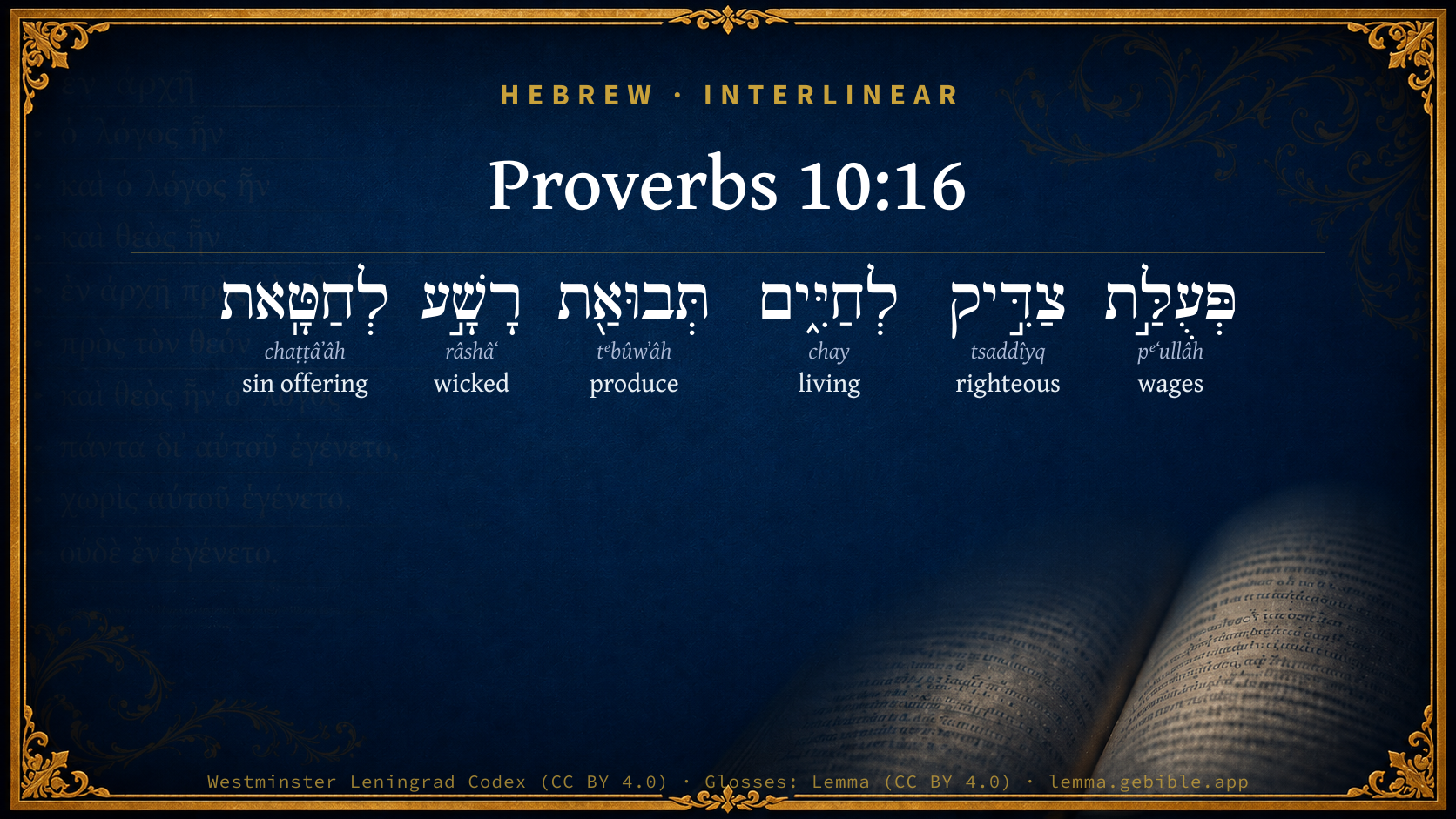
Hebrew (Westminster Leningrad Codex) Proverbs 10:16 appears in the Hebrew Old Testament. The text above is from the Westminster Leningrad Codex. Each word links to its Strong’s number, a concise gloss, and parsing drawn from the Open Scriptures Hebrew Bible morphology. Click any word for its full Brown-Driver-Briggs (BDB) entry.
Download image
Cite this verse

Proverbs 10:16 (World English Bible). Public Domain. Lemma interlinear Bible study tool, https://lemma.gebible.app/v/proverbs/10/16.

Show BibTeX & RIS
BibTeX
RIS
English Translation
The labor of the righteous leads to life. The increase of the wicked leads to sin.
World English Bible · Public Domain
Download a study sheet

One document with this verse’s original text, its word-by-word gloss line, the meaning frame, cross-references with their text, attributed commentary, and full source and license credits — printable, and it pastes into notes with its structure intact.

This verse Autodidact and up

Study sheet (.html) Plain text (.txt)

A passage Seminary Student

Up to 50 verses in one chapter. A passage sheet keeps up to 6 commentary sources and 12 cross-references per verse, in the order this page ranks them, and says so on the sheet whenever that leaves anything out. Ask for a single verse and you get the Autodidact verse sheet above.

Everything on this page stays free to read, with no account — the sheet is a download of what is already on screen, not access to it.

Want to remove ads? Support Godless Engineer
Compare translations 3

The same verse in 3 English versions, stacked beneath the original-language interlinear above. Click any original word for its lexicon entry.

Each is an independent rendering of the whole verse — the interlinear is not word-aligned to these translations.

Highlighted words mark where these versions differ — a whole-verse word diff, not a word-by-word alignment.

  • World English Bible Public Domain
    The labor of the righteous leads to life. The increase of the wicked leads to sin.
  • King James Version Public Domain
    The labour of the righteous tendeth to life: the fruit of the wicked to sin.
  • unfoldingWord Literal Text CC BY-SA 4.0
    The wage of a righteous to life; the income of a wicked to sin.

unfoldingWord Literal Text — © unfoldingWord, licensed CC BY-SA 4.0. Word-aligned USFM3 via Door43 (git.door43.org/unfoldingWord/en_ult).

Versions to compare (up to 4)

3 of 4 selected

Show all 18 translations

Every available English version of this verse, each an independent rendering of the whole verse.

  • World English Bible Public Domain
    The labor of the righteous leads to life. The increase of the wicked leads to sin.
  • Berean Standard Bible Public Domain
    The labor of the righteous leads to life, but the gain of the wicked brings punishment.
  • Majority Standard Bible Public Domain
    The labor of the righteous leads to life, but the gain of the wicked brings punishment.
  • King James Version Public Domain
    The labour of the righteous tendeth to life: the fruit of the wicked to sin.
  • American Standard Version (1901) Public Domain
    The labor of the righteous `tendeth' to life; The increase of the wicked, to sin.
  • Revised Version (1885) Public Domain
    The labour of the righteous tendeth to life; the increase of the wicked to sin.
  • Geneva Bible (1599) Public Domain
    The labour of the righteous tendeth to life: but the reuenues of the wicked to sinne.
  • Douay-Rheims (1899) Public Domain
    The work of the just is unto life: but the fruit of the wicked, unto sin.
  • Young's Literal Translation Public Domain
    The wage of the righteous `is' for life, The increase of the wicked for sin.
  • Literal Standard Version CC BY-SA 4.0
    The wage of the righteous [is] for life, || The increase of the wicked for sin.
  • Unlocked Literal Bible CC BY-SA 4.0
    The wage of the righteous person leads to life; the profit of the wicked leads them to sin.
  • unfoldingWord Literal Text CC BY-SA 4.0
    The wage of a righteous to life; the income of a wicked to sin.
  • Darby Bible Public Domain
    The labour of a righteous [man] [tendeth] to life; the revenue of a wicked [man], to sin.
  • World Messianic Bible Public Domain
    The labor of the righteous leads to life. The increase of the wicked leads to sin.
  • Webster's Bible Public Domain
    The labor of the righteous tendeth to life: the fruit of the wicked to sin.
  • Free Bible Version CC BY-SA 4.0
    If you do right you're rewarded with life, but if you're wicked all you gain is sin.
  • Bible in Basic English Public Domain
    The work of the upright gives life: the increase of the evil-doer is a cause of sin.
  • JPS Tanakh (1917) Public Domain
    The wages of the righteous is life; the increase of the wicked is sin.

Literal Standard Version (2020), Covenant Press — licensed CC BY-SA 4.0. Text via the HelloAO Bible API (eBible.org). Unlocked Literal Bible (unfoldingWord) — licensed CC BY-SA 4.0. Text via the HelloAO Bible API (eBible.org). unfoldingWord Literal Text — © unfoldingWord, licensed CC BY-SA 4.0. Word-aligned USFM3 via Door43 (git.door43.org/unfoldingWord/en_ult). Free Bible Version, Dr. Jonathan Gallagher — licensed CC BY-SA 4.0. Text via the HelloAO Bible API (eBible.org).

Word by word

More ways to search: Search by grammar → Find every occurrence → Compare this word →

Practice this passage: Drill this verse → Learn its vocabulary →

About this verse

These counts appear in no published source. They are computed here, from the morphology-tagged text and Lemma’s own curated glosses. What Lemma adds →

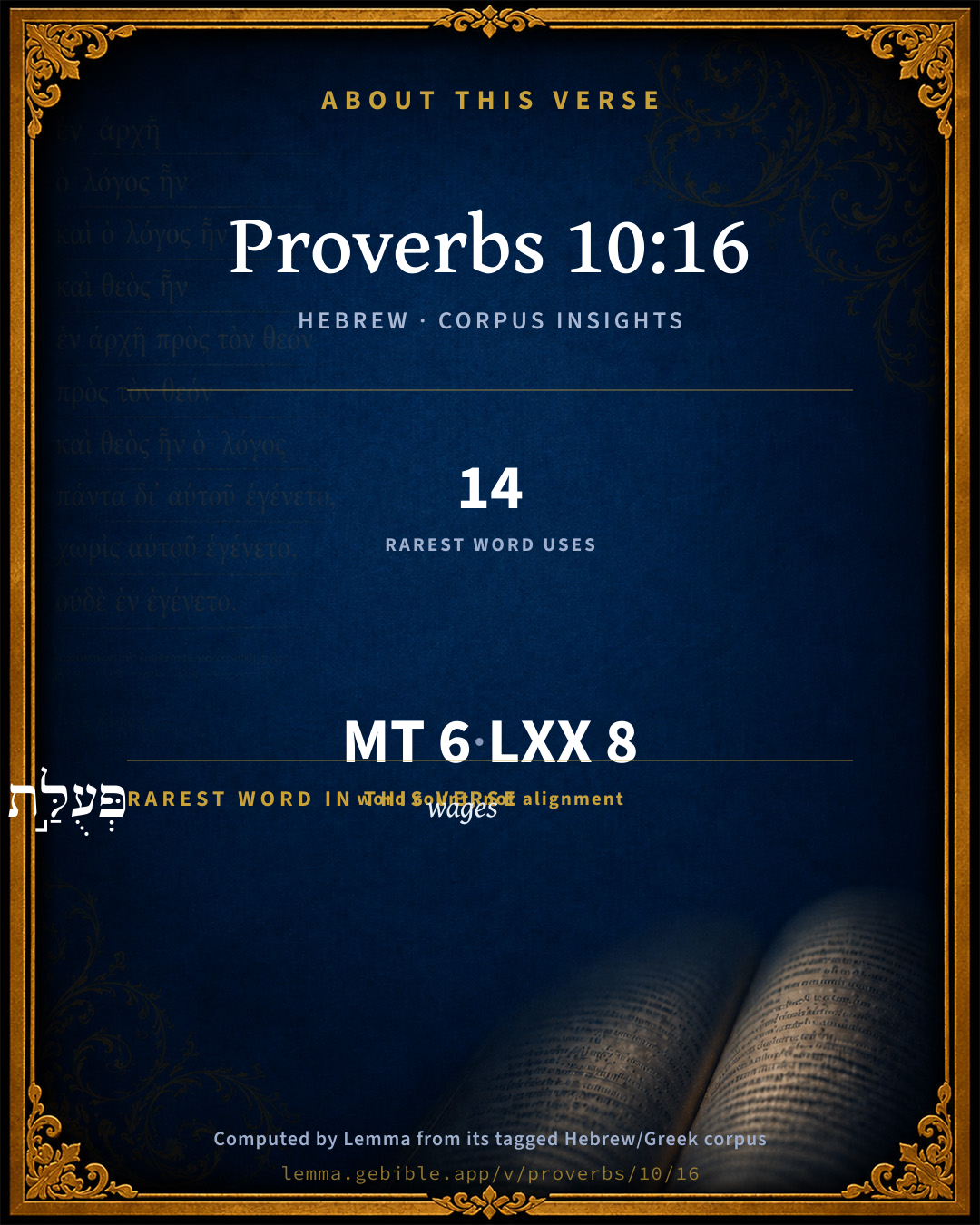
6
words
6
distinct lemmas
Wisdom
section

Notable vocabulary

The rarest word here is פְּעֻלַּ֣ת wages H6468 — appearing just 14 times in the whole Hebrew Bible.

Shared distinctive vocabulary

פְּעֻלַּ֣ת wages H6468 occurs in 14 verses of the Hebrew Bible. Also found in:

Grammatical profile

  • 4 nouns
  • 2 adjectives

Hebrew & Septuagint length

In English translation the verse runs 16 words from the Hebrew and 15 from the Septuagint (LXX English) — closely comparable.

A rough comparison of the two English renderings, which tokenize alike — not a word-level alignment.

Word counts can differ between the Hebrew and the Greek without any difference in meaning — e.g. the Hebrew direct-object marker אֵת has no separate Greek word, and Greek often adds the article ὁ.

In the original languages it is 6 Hebrew tokens and 8 Greek tokens — but the two are counted differently (Hebrew bundles its prefixes and suffixes into one token; the Greek is in lemma form), so that isn’t a like-for-like length.

Cross-references

13

Topical passages linked to Proverbs 10:16 in the Treasury of Scripture Knowledge — connected by theme and wording, ordered by reader-vote popularity; previews shown in the World English Bible.

  • Isaiah 3:10–11 Tell the righteous "Good!" For they shall eat the fruit of their deeds.
  • Romans 6:23 For the wages of sin is death, but the free gift of God is eternal life in Christ Jesus our Lord.
  • John 6:27 Don't work for the food which perishes, but for the food which remains to eternal life, which the Son of Man will give to you. For God the Father has sealed him."
  • Hebrews 6:10 For God is not unrighteous, so as to forget your work and the labor of love which you showed toward his name, in that you served the saints, and still do serve them.
  • Proverbs 11:18–19 Wicked people earn deceitful wages, But one who sows righteousness reaps a sure reward.
  • 1 Corinthians 15:58 Therefore, my beloved brothers, be steadfast, immovable, always abounding in the Lord's work, because you know that your labor is not in vain in the Lord.
  • Proverbs 11:30 The fruit of the righteous is a tree of life. He who is wise wins souls.
  • Matthew 7:17–18 Even so, every good tree produces good fruit; but the corrupt tree produces evil fruit.
  • Matthew 12:33–34 "Either make the tree good, and its fruit good, or make the tree corrupt, and its fruit corrupt; for the tree is known by its fruit.
  • Galatians 6:7–9 Don't be deceived. God is not mocked, for whatever a man sows, that will he also reap.
  • Matthew 15:19 For out of the heart come forth evil thoughts, murders, adulteries, sexual sins, thefts, false testimony, and blasphemies.
  • 2 Timothy 2:17–18 and their word will consume like gangrene, of whom is Hymenaeus and Philetus;
  • 2 Timothy 3:13 But evil men and impostors will grow worse and worse, deceiving and being deceived.

Cross-references courtesy of OpenBible.info (CC BY 4.0).

Hebrew and Greek witnesses Masoretic Hebrew ↔ Greek Septuagint

The same verse in the two great witnesses to the Old Testament, shown verse-for-verse.

These are two independent witnesses, not word-aligned to each other, and the Septuagint is shown in lemma (dictionary) form.

Hebrew Proverbs 10:16 Masoretic · Westminster Leningrad Codex

פְּעֻלַּ֣ת צַדִּ֣יק לְחַיִּ֑ים תְּבוּאַ֖ת רָשָׁ֣ע לְחַטָּֽאת

The labor of the righteous leads to life. The increase of the wicked leads to sin.

World English Bible · Public Domain

Greek LXX Proverbs 10:16 Septuagint · lemma form

ἔργον δίκαιος ζωή ποιέω καρπός δέ ἀσεβής ἁμαρτία

The works of the righteous produce life; but the fruits of the ungodly produce sins.

LXX2012 (modern English Septuagint) · Public Domain

On this verse, John Gill's Exposition discusses the Septuagint’s reading. Read the note in Commentary ↓

Hebrew: Westminster Leningrad Codex (CC BY 4.0). Greek: Septuagint (public domain); English from LXX2012 (modern English Septuagint) (Public Domain). How the Septuagint differs from the Hebrew →

Commentary

Notes on Proverbs 10:16 from classic Christian and Jewish commentators (each source and its license shown beneath its notes). The classic Christian expositions comment on the surrounding passage and are grouped to its opening verse, so a note may address several verses; the Jewish commentaries on the Tanakh (Rashi and others) are per-verse, so they appear only where the commentator wrote on this verse.

Lemma curates 59 commentaries, every one of them public domain or Creative Commons licensed, each selected and text-cleaned for this edition rather than reprinted as found. About our sources →

Trapp's Complete Commentary

John Trapp

Pro 10:16 The labour of the righteous [tendeth] to life: the fruit of the wicked to sin.

Ver. 16. The labour of the righteous, &c.] If the righteous man may but sweat out a poor living, get enough to bear his charges home to heaven, have enough to serve his turn here, be it but "food and raiment, he is content." {1Ti 6:8} Cibus et potus sunt divitiae Christianorum. The true Christian desires but meat and drink.

The fruit of the wicked.] Or, The revenues of the wicked are wasted upon their lusts, which to seek to satisfy is an endless labour, besides the danger of fathomless perdition. {1Ti 6:4}

John Trapp, A Commentary or Exposition upon All the Books of the Old and New Testament (1647–1656) — public domain. Text from a community e-Sword module.

Joseph Benson's Commentary

Pro 10:16. The labour of the righteous tendeth to life — The design of his labour is only this, that he may have wherewith to live honestly, without making use of any sinful shifts. Or rather, the fruit or effect of his labour and industry is the preservation of this life, and the obtaining of eternal life, to which an honest and conscientious diligence in a man’s calling greatly contributes. The fruit of the wicked — The fruit of all their labours and endeavours; to sin — Tendeth to sin, serves only for fuel to feed their pride, luxury, and worldly-mindedness, and by that means often causes, or, at least, hastens temporal death, and always, without repentance, issues in eternal death.

Joseph Benson's Commentary on the Old and New Testaments (1811–1818) — public domain. Text from a community e-Sword module.

Matthew Henry's Commentary

Solomon here confirms what his father had said (Psa 37:16), A little that a righteous man has is better than the riches of many wicked. 1. Perhaps a righteous man has no more than what he works hard for; he eats only the labour of his hands, but that labour tends to life; he aims at nothing but to get an honest livelihood, covets not to be rich and great, but is willing to live and maintain his family. Nor does it tend only to his own life, but he would enable himself to do good to others; he labours that he may have to give (Eph 4:28); all his business turns to some good account or other. Or it may be meant of his labour in religion; he takes most pains in that which has a tendency to eternal life; he sows to the Spirit, that he may reap life everlasting. 2. Perhaps a wicked man's wealth is fruit which he did not labour for, but came easily by, but it tends to sin. He makes it the food and fuel of his lusts, his pride and luxury; he gets hurt with it and not good; he gets hurt by it and is hardened by it in his wicked ways. The things of this world are good or evil, life or death, as they are used, and as those are that have them.

Matthew Henry's Commentary on the Whole Bible (1708–1710) — public domain (CC PDM 1.0). Text via the HelloAO Bible API.

Jamieson, Fausset & Brown

Robert Jamieson, A. R. Fausset & David Brown

The industry of the righteous is alone truly successful, while the earnings of the wicked tempt and lead to sin.

Jamieson, Fausset & Brown — Commentary Critical and Explanatory on the Whole Bible (1871) — public domain (CC PDM 1.0). Text via the HelloAO Bible API.

Adam Clarke's Commentary

Verse 16. The labour of the righteous] The good man labours that he may be able to support life; this is his first object: and then to have something to divide with the poor; this is his next object.

The fruit of the wicked to sin.] This man lives to eat and drink, and his property he spends in riot and excess. God's blessings are cursed to him.

Adam Clarke's Commentary on the Bible (1810–1826) — public domain. Text from a community e-Sword/MySword module.

Ellicott's Commentary for English Readers

(16) The labour of the righteous tendeth to life.—For the gains of his honest toil have the blessing of God upon them, and so bring him satisfaction of mind and the power of performing his duties in life; whereas all that the wicked man acquires only helps him to sin yet more, by enabling him to indulge his evil passions.

A Bible Commentary for English Readers, edited by Charles John Ellicott (1878–1897) — public domain. Text from a community e-Sword module.

The Cambridge Bible for Schools and Colleges

gen. ed. J. J. S. Perowne

16. fruit] or, increase, R.V. It has been thought that a contrast is here drawn between the actual “labour” of the righteous which, however toilsome in itself, has its issue in life, and the “increase,” the fruit of labour, of the wicked, which is sin. Comp. Pro_10:2 above. But “labour” may mean “the fruit of labour”, or “increase”, which for the righteous tends to what truly may be called “life.” The same Heb. word is rendered “wages,” Lev_19:13, and “reward,” Psa_109:20.

sin] which involves death, the opposite of “life” in the first clause of the parallelism.

The Speaker’s Comm. suggests that this maxim is intended to guard against a misunderstanding of Pro_10:15.

The Cambridge Bible for Schools and Colleges (gen. ed. J. J. S. Perowne; Cambridge University Press, 1878–1918) — public domain. Text from a community e-Sword module.

John Gill's Exposition

The labour of the righteous tendeth to life,.... To natural life, and the support of it; all that he labours for is to get a livelihood for himself and family; that is all he desires, nor does he seek great things for himself: or to spiritual life; so his spiritual exercises in praying, reading, and hearing the word, and waiting upon ordinances, have a tendency to promote and maintain a spiritual life in him: or to eternal life; not that the works of a righteous man (so the Targum, Septuagint, and Arabic versions, render it in the plural number) are meritorious of eternal life; for life and righteousness are not to be had by the works of men, but by the grace of God; yet, as the righteous man labours for the meat which endures to everlasting life, given by the Son of God, his labour may be said to tend to life eternal, Joh 6:27;

the fruit of the wicked to sin; whatever he enjoys, whether got by labour; though the word seems purposely omitted, as some observe, to signify that is not intended; or whether left him as an inheritance; or whatever way acquired, lawfully or unlawfully; all his revenues and riches, the increase of his substance and fields, are all used to sinful purposes, to pride, luxury, and wantonness; and so tend to death, even death eternal, the just wages of sin.

John Gill's Exposition of the Whole Bible (1746–1763) — public domain (CC PDM 1.0). Text via the HelloAO Bible API.

Albert Barnes' Notes on the Bible

A warning against the conclusion to seek wealth first of all, which men of lower natures might draw from Pro 10:15.

“Quaerenda pecunia primum est;

Virtus post nummos?”

Horace, Ep. 1. i. 53.

Such an inference is met by the experience, that while wealth gotten by honest industry is not only, like inherited riches a defense, but also a blessing, the seeming profit (rather than “fruit”) of the wicked tends to further sin 1Ti 6:10, and so to punishment. Compare Rom 6:21.

Albert Barnes' Notes on the Bible (1834–1885) — public domain. Text from a community e-Sword/MySword module.

Haydock's Catholic Bible Commentary

Life. In abundance he is not puffed up; but the wicked make use of their fruit or revenue to do evil. Their works are bad, unless they turn to God by at least an initial love of justice.

George Leo Haydock (1774–1849), Haydock's Catholic Family Bible and Commentary, 1859 edition — public domain. Excludes Psalms (Douay-Rheims chapter numbering differs from Protestant) and Deuterocanonical books (Catholic canon only).

Matthew Poole's English Annotations

The labour of the righteous tendeth to life: either,

1. The design of his labour is only this, that he may have wherewith to live honestly, without sinful shifts. Or,

2. The fruit or effect of his labour or industry (as this word labour is most commonly understood, and this best answers to the following clause, where fruit is put instead of this labour) is the preservation and prolongation of this life, and the obtaining of eternal life, to which an honest and conscientious diligence in men’s worldly callings doth in some manner contribute. The fruit of the wicked, the fruit of all their labours and endeavours, to sin; tendeth to sin, serves only for fuel to men’s pride, and luxury, and worldliness, and by that means oft causeth temporal, and always, without repentance, eternal death.

Matthew Poole's English Annotations on the Holy Bible (1683–1685) — public domain. Text from a community e-Sword/MySword module.

Whedon's Commentary on the Bible

Daniel D. Whedon

16. Fruit — Income, increase, earnings, (tendeth) to sin, and “sin bringeth forth death,” in antithesis to the life of the first clause. This is a good illustration of the fact that the antithesis in these proverbs is often implied or intimated, and is to be inferred from what is said. Rueetschi well observes: “It is, in general, a peculiar charm of many proverbs that the parallelism is not perfectly clear; but it remains the function of the reader to seek out the intermediate thoughts and to make the deductions.” On latter clause compare 1Ti_6:10.

Daniel D. Whedon (gen. ed.), Commentary on the Old and New Testaments (1874–1909) — public domain. Text from a community e-Sword module.

The Pulpit Commentary

Tendeth to life. (Pro_11:19) Honest labour brings its own reward in the blessing of God and a long and peaceful life. The fruit of the wicked. All the profit that the wicked make they use in the service of sin, which tends only to death. (Rom_6:21) The due reward of honourable industry is contrasted with the gains obtained by any means, discreditable or not.

The Pulpit Commentary (1880–1919), ed. H.D.M. Spence-Jones & Joseph S. Exell — public domain. Text from a community e-Sword module.

John Wesley's Explanatory Notes

The labour - The fruit of his labour, to the preservation of this life, and obtaining eternal life. Fruit - The fruit of all their labour tends to sin, and serves only for fuel to mens pride and luxury.

John Wesley, Explanatory Notes Upon the Whole Bible (1754–1765) — public domain. Text via the GEBible commentary corpus.

Keil & Delitzsch

C. F. Keil & F. Delitzsch

Regarding gain:

The gain of the righteous tendeth to life;

The income of the godless to sin.

Intentionally, that which the righteous received is called פּעלּה (as Lev 19:13), as a reward of his labour; that which the godless receives is called תּבוּאה, as income which does not need to be the reward of labour, and especially of his own immediate labour. And with לחיּים, לחטּאת runs parallel, from the supposition that sin carries the germ of death in itself. The reward of his labour serves to the righteous to establish his life, i.e., to make sure his life-position, and to elevate his life-happiness. On the contrary, the income of the godless serves only to ruin his life; for, made thereby full and confident, he adds sin to sin, whose wages is death. Hitzig translates: for expiation, i.e., to lose it again as atonement for past sins; but if חיים and חטאת are contrasted with each other, then חטאת is death-bringing sin (Pro 8:35.).

Keil & Delitzsch — Biblical Commentary on the Old Testament (1861–1891) — public domain (CC PDM 1.0). Text via the HelloAO Bible API. (Old Testament only.)

Bridges on Proverbs

Charles Bridges

Labour, not idleness, is the stamp of a servant of God: thus cheered by the glowing confidence, that it tendeth to life. (Joh 6:27 .) "Occupy till I come — Do all to the glory of God" (Luk 19:13 . 1Co 10:31 ) — this is the standard. Thus the duties even of our daily calling tend to life. (Pro 11:19 . Jer 22:15-16 .) God works in us, by us, with us, through us. (Isa 26:12 .) We work in and through him. Our labour therefore is his work — wrought in dependence on him; not for life, but to life. (Rom 8:13 . 1Co 15:10 . Php 2:12-13 .) And this is life indeed; the only exercise deserving the name; the only object worth living for. (Php 1:21 .) Lord! quicken us to "life more abundantly." Thus sowing "to the Spirit, of the Spirit we shall reap life everlasting." (Gal 6:8 .) With the wicked, self is both the object and the end. His fruit therefore is sin. (Pro 21:4 . Tit 1:15 . Mat 12:33 ; Mat 15:19 .) His Master, so long as he serves him faithfully, cares little how or in what sphere. "He that soweth to the flesh, shall of the flesh reap corruption." Each tendeth to its own end. "Whatsoever a man soweth, that shall he also reap." (Gal 6:7 .)

Charles Bridges, An Exposition of the Book of Proverbs (1846) — public domain. Text from a community e-Sword module.

Kretzmann's Popular Commentary

Paul E. Kretzmann

v. 16. The labor of the righteous tendeth to life, his earnings, his income, will be used by him in such activities as will bring him true happiness in living; the fruit of the wicked [tendeth] to sin, for he squanders his income for sinful purposes and brings ruin upon himself.

Paul E. Kretzmann, Popular Commentary of the Bible (1921–1924) — public domain. Text from a community e-Sword module.

unfoldingWord translationNotes

Door43 World Missions Community

The wage ... the profit

These terms normally refer to the money a worker earns. Here they represents the results of either doing what is right or doing what is wrong. (See: Metaphor)

There is a path to life for the one who follows discipline

"The person who obeys wise instruction will have a long and happy life"

but the one who rejects correction is led astray

This can be stated in active form. AT: "but the one who does not obey wise instruction will not have a good life" (See: Active or Passive)

translationWords

life

profit

evil

sin

discipline

astray

unfoldingWord translationNotes — © Distant Shores Media and the Door43 World Missions Community, licensed CC BY-SA 4.0. Source: git.door43.org/Door43/en_tn.

Rashi

Rabbi Shlomo Yitzchaki (Rashi)

The act of the righteous is for life [This is to be understood] according to its apparent meaning, but the Midrash Aggadah states: Solomon performed the construction of the Temple for the life of Israel, for their atonement.

what the wicked bring in What Manasseh brought in, for he brought in the image—that was for sin.

Rashi on the Tanakh — English translations: “The Judaica Press complete Tanach with Rashi, translated by A. J. Rosenberg” (CC BY 4.0); “Pentateuch with Rashi's commentary by M. Rosenbaum and A.M. Silbermann, 1929-1934” (public domain); “The Metsudah Tanach series, Lakewood, N.J” (CC BY 4.0); and “The Book of Joshua, Metsudah Publications, 1997” (CC BY 4.0). Text via Sefaria.

Lesson kit

Teaching starters — assembled from the data on this page, not authored interpretation. Every prompt links to the verse data it draws on. Edit before teaching.

Proverbs, in the Wisdom, opens this verse with 6 words (6 distinct Hebrew lemmas). Its most distinctive word is pᵉʻullâh (“wages”). A historical commentator’s framing appears above. Read the whole chapter for the surrounding context.

Discussion questions

  1. How does “wages” (pᵉʻullâh) shape what this verse is saying?
  2. How does Leviticus 19:13, which shares the word «wages», read alongside this verse?
  3. These translations render this verse differently; the difference is in the English rendering, not the original. What questions does that raise?
  4. Compare how Trapp's Complete Commentary and Joseph Benson's Commentary read this verse. Where do they agree or differ?

Things to notice

Reading settings

Reading text

Shown beneath each verse's original-language words.

Old Testament
Old Testament edition

Read the OT as the Masoretic Hebrew (MT) or the Greek Septuagint (LXX).

English shown for the Greek Septuagint (in the Hebrew ↔ Greek comparison).

Comparing translations? Open the Compare panel on any verse page to stack up to four side by side.