
Psalms 91:8

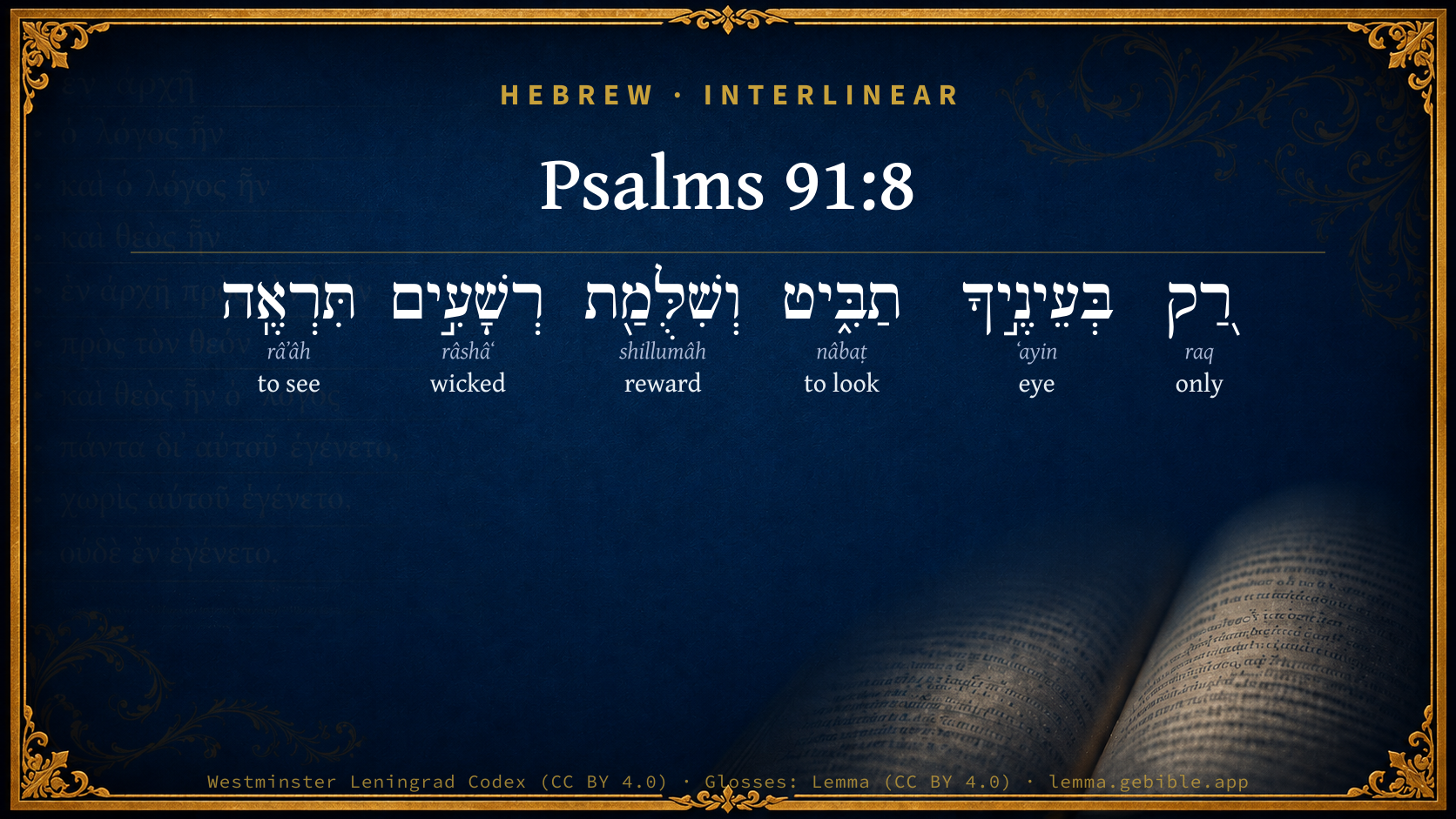
Hebrew (Westminster Leningrad Codex) Psalms 91:8 appears in the Hebrew Old Testament. The text above is from the Westminster Leningrad Codex. Each word links to its Strong’s number, a concise gloss, and parsing drawn from the Open Scriptures Hebrew Bible morphology. Click any word for its full Brown-Driver-Briggs (BDB) entry.
Download image
Cite this verse

Psalms 91:8 (World English Bible). Public Domain. Lemma interlinear Bible study tool, https://lemma.gebible.app/v/psalms/91/8.

Show BibTeX & RIS
BibTeX
RIS
English Translation
You will only look with your eyes, And see the recompense of the wicked.
World English Bible · Public Domain
Highlights
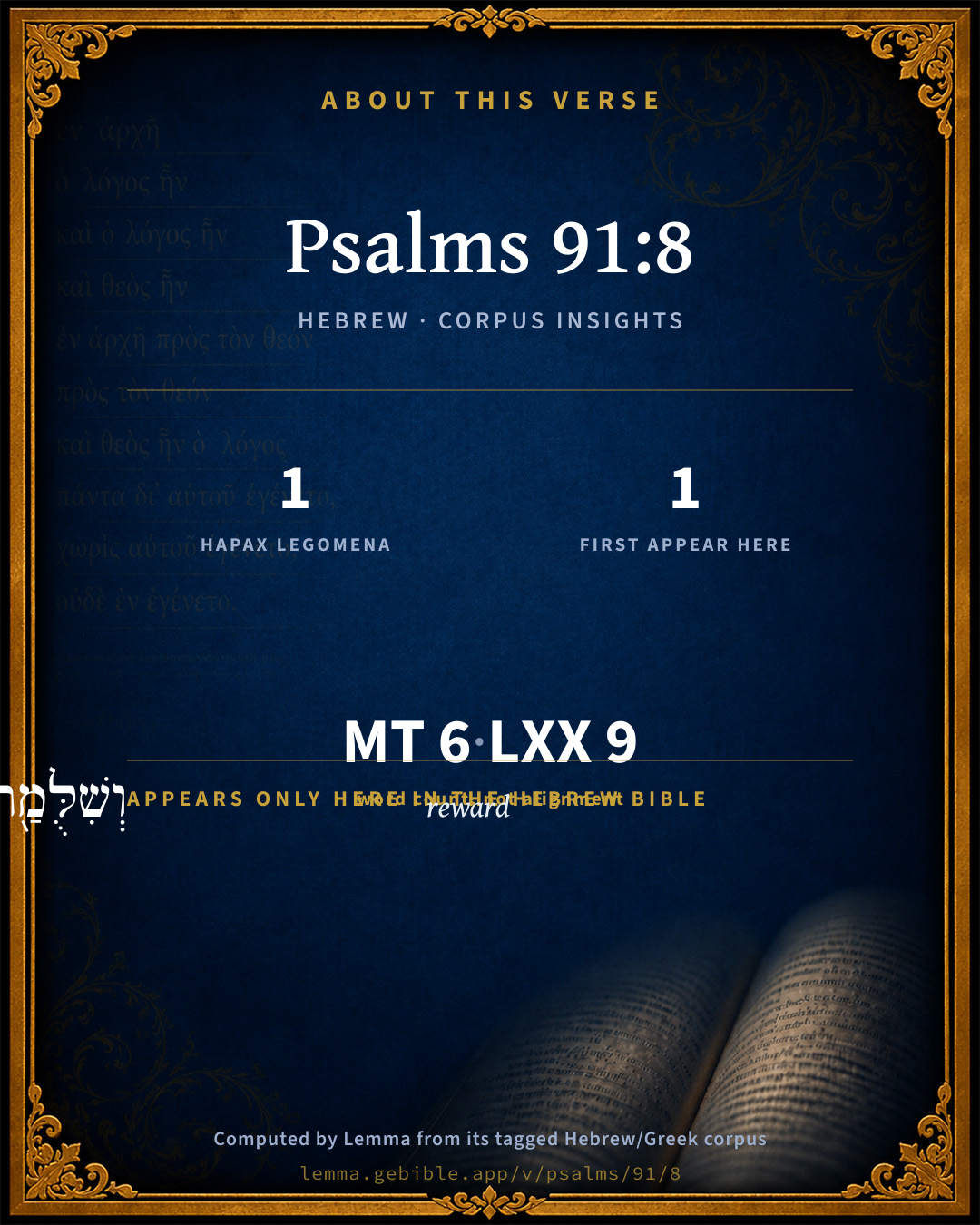
  • 1 hapax legomenon — only here in the Hebrew Bible
  • 1 first appearance in the Hebrew Bible
Full analysis ↓
Download a study sheet

One document with this verse’s original text, its word-by-word gloss line, the meaning frame, cross-references with their text, attributed commentary, and full source and license credits — printable, and it pastes into notes with its structure intact.

This verse Autodidact and up

Study sheet (.html) Plain text (.txt)

A passage Seminary Student

Up to 50 verses in one chapter. A passage sheet keeps up to 6 commentary sources and 12 cross-references per verse, in the order this page ranks them, and says so on the sheet whenever that leaves anything out. Ask for a single verse and you get the Autodidact verse sheet above.

Everything on this page stays free to read, with no account — the sheet is a download of what is already on screen, not access to it.

Want to remove ads? Support Godless Engineer
Compare translations 3

The same verse in 3 English versions, stacked beneath the original-language interlinear above. Click any original word for its lexicon entry.

Each is an independent rendering of the whole verse — the interlinear is not word-aligned to these translations.

Highlighted words mark where these versions differ — a whole-verse word diff, not a word-by-word alignment.

  • World English Bible Public Domain
    You will only look with your eyes, And see the recompense of the wicked.
  • King James Version Public Domain
    Only with thine eyes shalt thou behold and see the reward of the wicked.
  • unfoldingWord Literal Text CC BY-SA 4.0
    You will only observe with your eyes and see the recompense of the wicked.

unfoldingWord Literal Text — © unfoldingWord, licensed CC BY-SA 4.0. Word-aligned USFM3 via Door43 (git.door43.org/unfoldingWord/en_ult).

Versions to compare (up to 4)

3 of 4 selected

Show all 18 translations

Every available English version of this verse, each an independent rendering of the whole verse.

  • World English Bible Public Domain
    You will only look with your eyes, And see the recompense of the wicked.
  • Berean Standard Bible Public Domain
    You will only see it with your eyes and witness the punishment of the wicked.
  • Majority Standard Bible Public Domain
    You will only see it with your eyes and witness the punishment of the wicked.
  • King James Version Public Domain
    Only with thine eyes shalt thou behold and see the reward of the wicked.
  • American Standard Version (1901) Public Domain
    Only with thine eyes shalt thou behold, And see the reward of the wicked.
  • Revised Version (1885) Public Domain
    Only with thine eyes shalt thou behold, and see the reward of the wicked.
  • Geneva Bible (1599) Public Domain
    Doubtlesse with thine eyes shalt thou beholde and see the reward of the wicked.
  • Douay-Rheims (1899) Public Domain
    But thou shalt consider with thy eyes: and shalt see the reward of the wicked.
  • Young's Literal Translation Public Domain
    But with thine eyes thou lookest, And the reward of the wicked thou seest,
  • Literal Standard Version CC BY-SA 4.0
    But with your eyes you look, || And you see the reward of the wicked,
  • Unlocked Literal Bible CC BY-SA 4.0
    You will only observe and see the punishment of the wicked.
  • unfoldingWord Literal Text CC BY-SA 4.0
    You will only observe with your eyes and see the recompense of the wicked.
  • Darby Bible Public Domain
    Only with thine eyes shalt thou behold, and see the reward of the wicked.
  • World Messianic Bible Public Domain
    You will only look with your eyes, and see the recompense of the wicked.
  • Webster's Bible Public Domain
    Only with thy eyes shalt thou behold and see the reward of the wicked.
  • Free Bible Version CC BY-SA 4.0
    You only have to open your eyes and you will see how the wicked are repaid.
  • Bible in Basic English Public Domain
    Only with your eyes will you see the reward of the evil-doers.
  • JPS Tanakh (1917) Public Domain
    Only with thine eyes shalt thou behold, and see the recompense of the wicked.

Literal Standard Version (2020), Covenant Press — licensed CC BY-SA 4.0. Text via the HelloAO Bible API (eBible.org). Unlocked Literal Bible (unfoldingWord) — licensed CC BY-SA 4.0. Text via the HelloAO Bible API (eBible.org). unfoldingWord Literal Text — © unfoldingWord, licensed CC BY-SA 4.0. Word-aligned USFM3 via Door43 (git.door43.org/unfoldingWord/en_ult). Free Bible Version, Dr. Jonathan Gallagher — licensed CC BY-SA 4.0. Text via the HelloAO Bible API (eBible.org).

Word by word

More ways to search: Search by grammar → Find every occurrence → Compare this word →

Practice this passage: Drill this verse → Learn its vocabulary →

About this verse

These counts appear in no published source. They are computed here, from the morphology-tagged text and Lemma’s own curated glosses. What Lemma adds →

6
words
6
distinct lemmas
Wisdom
section

Notable vocabulary

1 hapax legomenon — a word that appears only here in the entire Hebrew Bible:

  • וְשִׁלֻּמַ֖ת reward H8011

First appearance in Scripture

This word makes its first canonical appearance in the Hebrew Bible here:

  • וְשִׁלֻּמַ֖ת reward H8011

Grammatical profile

  • 2 verbs
  • 2 nouns
  • 1 adjective
  • 1 particle

Verb forms

  • תַבִּ֑יט Hiphil · Imperfect
  • תִּרְאֶֽה Qal · Imperfect

Hebrew & Septuagint length

In English translation the verse runs 14 words from the Hebrew and 13 from the Septuagint (LXX English) — closely comparable.

A rough comparison of the two English renderings, which tokenize alike — not a word-level alignment.

Word counts can differ between the Hebrew and the Greek without any difference in meaning — e.g. the Hebrew direct-object marker אֵת has no separate Greek word, and Greek often adds the article ὁ.

In the original languages it is 6 Hebrew tokens and 9 Greek tokens — but the two are counted differently (Hebrew bundles its prefixes and suffixes into one token; the Greek is in lemma form), so that isn’t a like-for-like length.

Cross-references

7

Topical passages linked to Psalms 91:8 in the Treasury of Scripture Knowledge — connected by theme and wording, ordered by reader-vote popularity; previews shown in the World English Bible.

  • Psalms 37:34 Wait for Yahweh, and keep his way, And he will exalt you to inherit the land. When the wicked are cut off, you shall see it.
  • Proverbs 3:25–26 Don't be afraid of sudden fear, Neither of the desolation of the wicked, when it comes:
  • Psalms 92:11 My eye has also seen my enemies. My ears have heard of the wicked enemies who rise up against me.
  • Malachi 1:5 Your eyes will see, and you will say, "Yahweh is great--even beyond the border of Israel!"
  • Psalms 58:10–11 The righteous shall rejoice when he sees the vengeance. He shall wash his feet in the blood of the wicked;
  • Isaiah 3:11 Woe to the wicked! Disaster is upon them; For the deeds of his hands will be paid back to him.
  • Hebrews 2:2 For if the word spoken through angels proved steadfast, and every transgression and disobedience received a just recompense;

Cross-references courtesy of OpenBible.info (CC BY 4.0).

Hebrew and Greek witnesses Masoretic Hebrew ↔ Greek Septuagint

The same verse in the two great witnesses to the Old Testament, shown verse-for-verse.

You’re reading Greek Psalm 90 (Hebrew Psalm 91). The Septuagint counts the superscription, so verse numbers can differ from the Hebrew — chapter-level alignment, not verse-by-verse. Numbering follows Rahlfs.

These are two independent witnesses, not word-aligned to each other, and the Septuagint is shown in lemma (dictionary) form.

Hebrew Psalms 91:8 Masoretic · Westminster Leningrad Codex

רַ֭ק בְּעֵינֶ֣יךָ תַבִּ֑יט וְשִׁלֻּמַ֖ת רְשָׁעִ֣ים תִּרְאֶֽה

You will only look with your eyes, And see the recompense of the wicked.

World English Bible · Public Domain

Greek LXX Greek Psalm 90:8 Septuagint · lemma form

πλήν ὁ ὀφθαλμός σύ κατανοέω καί ἀνταπόδοσις ἁμαρτωλός ὁράω

Only with your eyes shall you observe and see the reward of sinners.

LXX2012 (modern English Septuagint) · Public Domain

Hebrew: Westminster Leningrad Codex (CC BY 4.0). Greek: Septuagint (public domain); English from LXX2012 (modern English Septuagint) (Public Domain). How the Septuagint differs from the Hebrew →

Commentary

Notes on Psalms 91:8 from classic Christian and Jewish commentators (each source and its license shown beneath its notes). The classic Christian expositions comment on the surrounding passage and are grouped to its opening verse, so a note may address several verses; the Jewish commentaries on the Tanakh (Rashi and others) are per-verse, so they appear only where the commentator wrote on this verse.

Lemma curates 59 commentaries, every one of them public domain or Creative Commons licensed, each selected and text-cleaned for this edition rather than reprinted as found. About our sources →

Trapp's Complete Commentary

John Trapp

Psa 91:8 Only with thine eyes shalt thou behold and see the reward of the wicked.

Ver. 8. Only with thine eyes shalt thou behold] And say, Oh the severity of divine justice! Oh the venomous and mischievous nature and effects of men’s sin! Behold the goodness and severity of God; on them which fell severity, but toward me goodness, if I continue in his goodness; otherwise I shall also be cut off, Rom 11:22.

And see the reward of the wicked] Thyself being, as it were, shot free; thy sincerity prevailing for thy safety.

John Trapp, A Commentary or Exposition upon All the Books of the Old and New Testament (1647–1656) — public domain. Text from a community e-Sword module.

The Biblical Illustrator

Joseph S. Exell

Psa_91:8

Surely He shall deliver thee from the snare of the fowler, and from the noisome pestilence.

The snare of the fowler

A very comforting text to all believers, when beset by temptation.

I. The snare of the fowler.

1. It is intimately connected with Secrecy (Pro_1:17). Many a man has been entrapped into sin by Satan, not knowing that it was evil! Some one has hinted to him in business, for instance, You may very safely do such-and-such a thing; all the shopkeepers in the street have done it; it is not actually dishonest; it improves the article; and although you can thus sell an article at a dearer rate than you ought to sell it, yet you need not tell the public; and if the article is all the better for it, it is quite fair and safe that you should adulterate it. And so the good easy man, not opening both his eyes, I think, but shutting one of them a little, lest he should see too well to be able to fill his pockets in the dark, is a little taken aside; and by and by he is led to discover that the act which he has done is the taking of him in the snare of the fowler, for he has been sinning against his God, and his God therefore punishes him for it with many stripes, and lays his rod upon him.

2. It is generally noted for its adaptation. A cunning enemy we have to deal with; he knows our weak points; he has been dealing with men for these last six thousand years; he knows all about them. He is possessed of a gigantic intellect, though he be a fallen spirit; and he is easily able to discover where our sore places are, and there it is he immediately attacks us. If we be like Achilles, and cannot be wounded anywhere but in our heel, then at the heel he will send his dart, and nowhere else. He will find out our easily besetting sin, and there, if he can, he will attempt to work our ruin and our destruction. Let us bless God that it is written, Surely He shall deliver thee from the snare of the fowler.

3. It is frequently connected with pleasure, profit, and advantage. Cleopatras asp was introduced in a basket of flowers; so are sins often brought to us in the flowers of our pleasures. Satan offers to the drunkard the sweetness of the intoxicating cup, which rejoices him, when his brain is rioting in frolic, and when his soul is lifted up within him. He offers to the lustful man the scenes and pleasures of carnal mirth, and merriment, and delight, and so he leadeth him astray with the bait, concealing the hook which afterwards shall pain him. Let us remember that the snare of the fowler is generally connected with some pretended pleasure or profit, but that Satans end is not our pleasing, but our destruction.

4. Sometimes the fowler very wisely employs the force of example. We all know the influence of the decoy-duck, in endeavouring to bring others into the snare. How very often Satan, the fowler, employs a decoy to lead Gods people into sin! You get with a man; you think him to be a true Christian; you have some respect for his character; he is a high professor, can talk religion by the yard, and can give you any quantity of theology you like to ask for. You see him commit a sin; ten to one but you will do the same, if you have much respect for him; and so he will lead you on. And mark, Satan is very careful in the men whom he chooses to be decoys. If he wants his errand well done, he sends one to me whom I call brother; and so through the brotherhood of profession I am apt to give him credence and pay him respect; and then if he goeth astray the force of example is very powerful, and so I may easily be led into the net too. Take care of your best friends; be careful of your companions. Choose the best you can; then follow them no farther than they follow Christ. Let your course be entirely independent of every one else.

II. The deliverance. Two thoughts here: from--out of. First, He delivers them from the snare--does not let them get in it; secondly, when they do get in it He delivers them out of it. The first promise is the most precious to some of us; the second is the best to others.

1. He shall deliver thee from the snare. How does He do that?

(1) Very often by trouble. I doubt not, many of you have been saved from ruin by your sorrows, your griefs, your troubles, your woes, your lossest and your crosses. All these have been the breaking of the net that set you free from the snare of the fowler.

(2) At other times God keeps His people from the sin of the fowler by giving them great spiritual strength, a spirit of great courage; so that when they are tempted to do evil they say, with decision, How can I do this great wickedness and sin against God?

2. God delivers His people, even when they get into the snare. Alas! you and I know something about the net; we have not only seen it spread, we have been in its folds. We know something about the cage, for we have, unfortunately, been in the cage ourselves, even since we have known the Lord. The fowlers hand has been upon our neck; it has only been the sovereign grace of God that has prevented him from utterly destroying us. Poor Christian and Hopeful got into the fowlers net when they entered into the castle of Giant Despair; but the key of promise picked the lock, and they escaped. They were in the fowlers net, too, when Flatterer cast a net over them, and left them in the lane; but there came one who, after he had beaten them full sore, took the not off, and they went on their way, better men than before. O backslider, be cast down, but do not despair; God will restore thee yet.

III. Surely. The assurance of every truth of Scripture is just the beauty of it. Now, it says surely He shall deliver thee. Why? First because He has promised to do it; and Gods promises are bonds that never yet were dishonoured. Secondly, because Christ Jesus hath taken an oath that He will do it. (C. H. Spurgeon.)

Psa_91:8

Only with thine eyes shalt thou behold and see the reward of the wicked.

The reward of the wicked

I. There is a difference between the sufferings of the righteous and the wicked. The same external afflictions and trials may befall them; but to the righteous they are educational, to the wicked they are punitive--the reward, etc.

II. The Divine rule in this world is righteous. Under it the godly are protected by God, while the wicked are punished.

III. The righteousness of the Divine rule is not always manifest in this world.

IV. The righteousness of the Divine rule will ultimately be clearly manifest to all. The godly with their eyes shall see the reward of the wicked. There is a state where all the apparent inequalities of the moral government of our world will be clearly rectified (Isa_3:11).

V. The weak and fearful believer, notwithstanding his fears, shall not perish with the wicked. Only with his eyes shall he see the reward of the wicked, while he himself shall enjoy the glorious inheritance of the good.

The Biblical Illustrator, edited by Joseph S. Exell (c. 1880s–1900s) — public domain. Text from a community e-Sword module.

Joseph Benson's Commentary

Psa 91:8. Only with thine eyes shalt thou behold, &c. — Without any terror or danger to thyself, and with a thankful reflection on God’s goodness to thee; and see the reward of the wicked — The just recompense of their sins, or the vengeance of God upon them. Observe well, reader, those that preserve their purity in times of general corruption, may trust God with their safety in times of general desolation. When multitudes die around us, though thereby we ought to be awakened to prepare for our own death, yet we ought not to be afraid with any amazement, nor make ourselves subject to bondage, as many do all their lifetime, through fear of death. The sprinkling of blood secured the firstborn of Israel, when thousands fell.

Joseph Benson's Commentary on the Old and New Testaments (1811–1818) — public domain. Text from a community e-Sword module.

J. A. Alexander on Psalms

Joseph Addison Alexander

8. (Psa 91:8) Only with thine eyes shalt thou behold, and the recompence of wicked (men) see. The only puts mere sight in opposition to experience or participation. Compare Deu 32:35; Deu 32:41. As usual in such cases, it is implied that the destruction of the wicked and deliverance of the righteous, will be coincident and simultaneous. See below, on Psa 92:11.

Joseph Addison Alexander, The Psalms Translated and Explained (1850) — public domain. Text from a community e-Sword module.

Geneva Bible (1599)

Geneva Bible translators

The godly shall have some experience of God’s judgments against the wicked even in this life, but fully they shall see it at that day when all things shall be revealed.

Geneva Bible (1599) marginal notes — public domain. Text via Bolls.life.

Adam Clarke's Commentary

Verse 8. The reward of the wicked.] Thou shalt not only be safe thyself, but thou shalt see all thy enemies discomfited and cast down.

Adam Clarke's Commentary on the Bible (1810–1826) — public domain. Text from a community e-Sword/MySword module.

John Gill's Exposition

Only with thine eyes shall thou behold,.... The flying arrow, the walking pestilence, and wasting destruction, and the great devastations made by it:

and see the reward of the wicked; the vengeance of God upon them, and this as a just punishment for their sins; not looking upon it with delight and pleasure, rejoicing in the misery of their fellow creatures, any otherwise than as the glory of divine justice is displayed in it; see Psa 52:6, the pestilence is always threatened, and it always comes, as a Judgment upon a wicked generation of men; and so it is ever to be considered, and is considered by good men, Lev 26:5.

John Gill's Exposition of the Whole Bible (1746–1763) — public domain (CC PDM 1.0). Text via the HelloAO Bible API.

Albert Barnes' Notes on the Bible

Only - That is, This is “all” that will occur to you. The only thing which you have to anticipate is, that you will see how God punishes sinners.

With thine eyes shalt thou behold and see the reward of the wicked - Your own eyes shall see it. See the notes at Psa 37:34. You will see the just punishment of the ungodly, the vicious, the profane, the sensual. You will see what is the proper fruit of their conduct; what is the just expression of the views which God takes of their character. This undoubtedly refers to the general principle that there is a moral government on earth; that vice is often punished as such; that the general course of the divine dealings is such as to show that God is favorable to virtue, and is opposed to vice. The system is not complete here, and there are many things which could not be reconciled with this, if the present world were all, and if there were no future state: but the course of events indicates the general character of the divine administration, and what is the tendency of things. The completion - the actual and perfect adjustment - is reserved for a future state. The facts as they occur on earth prove that there is an attribute of justice in God; the fact that his dealings here are not wholly and fully in accordance with what justice demands, proves that there will be a state where full justice will be done, and where the whole system will be adjusted.

Albert Barnes' Notes on the Bible (1834–1885) — public domain. Text from a community e-Sword/MySword module.

Matthew Poole's English Annotations

Thou shalt behold, without any terror or danger to thyself, and with a delightful and thankful reflection upon God’s goodness to thee. The reward of the wicked; the just recompence of their sins, or the vengeance of God upon them.

Matthew Poole's English Annotations on the Holy Bible (1683–1685) — public domain. Text from a community e-Sword/MySword module.

The Treasury of David

Charles H. Spurgeon

Ver. 8. Only with thine eyes shalt thou behold and see the reward of the wicked. The sight shall reveal both the justice and the mercy of God; in them that perish the severity of God will be manifest, and in the believer's escape the richness of divine goodness will be apparent. Joshua and Caleb verified this promise. The Puritan preachers during the plague of London must have been much impressed with this verse as they came out of their hiding places to proclaim mercy and judgment to the dissolute age which was so sorely visited with the pest. The sight of God's judgments softens the heart, excites a solemn awe, creates gratitude, and so stirs up the deepest kind of adoration. It is such a sight as none of us would wish to see, and yet if we did see it we might thus be lifted up to the very noblest style of manhood. Let us but watch providence, and we shall find ourselves living in a school where examples of the ultimate reward of sin are very plentiful. One case may not be judged alone lest we misjudge, but instances of divine visitation will be plentiful in the memory of any attentive observer of men and things; from all these put together we may fairly draw conclusions, and unless we shut our eyes to that which is self evident, we shall soon perceive that there is after all a moral ruler over the sons of men, who sooner or later rewards the ungodly with due punishment.

Ver. 8. Only with thine eyes shalt thou behold and see the reward of the wicked. First, indeed, because of thy own escape; secondly, on account of thy complete security; thirdly, for the sake of comparison; fourthly, because of the perfect preeminence of justice itself. For then it will not be the time of mercy, but of judgment; nor shall any mercy in any way be ever shown towards the wicked there, where no improvement can be hoped for. Far away will be that softness of human infirmity, which meanwhile charity nevertheless uses for salvation, collecting in the ample folds of her outspread net good and bad fishes, that is, pleasant and hurtful affections. But this is done at sea. On the shore she chooses only the good, and so rejoicing with them that do rejoice, it hence comes to pass that she weeps not with those that weep. Bernard.

Ver. 8. What we have actually seen of the reward of the wicked.

Psalms 91:9*

Charles H. Spurgeon's The Treasury of David (1869–1885) — public domain. Psalms only. Text from a community e-Sword/MySword module.

Whedon's Commentary on the Bible

Daniel D. Whedon

8. With thine eyes shalt thou behold—Like the Israelites who saw the overthrow of their enemies, a stated Exo_14:30-31

Daniel D. Whedon (gen. ed.), Commentary on the Old and New Testaments (1874–1909) — public domain. Text from a community e-Sword module.

The Pulpit Commentary

Only with thine eyes shalt thou behold and see the reward (or, "the recompense") of the wicked; i.e. without suffering anything thyself, thou shalt look on, and see the punishment of the ungodly. So Israel in the land of Goshen "looked on," and saw the calamities of the Egyptians.

The Pulpit Commentary (1880–1919), ed. H.D.M. Spence-Jones & Joseph S. Exell — public domain. Text from a community e-Sword module.

unfoldingWord translationNotes

Door43 World Missions Community

You will only observe and see

"You yourself will not suffer, but you will watch carefully, and you will see"

the punishment of the wicked

The abstract noun "punishment" can be translated with a verbal phrase. AT: "how God punishes the wicked" (See: Abstract Nouns)

Yahweh is my refuge

The writer speaks of Yahweh protecting him as if Yahweh were a safe place for him to find protection from his enemies. AT: "Yahweh protects me, like a person finds protection in a place of refuge" (See: Metaphor)

Make the Most High your refuge also

"You should make the Most High your refuge also." The psalmist stops speaking to God and speaks to the reader.

translationWords

punish

evil

Yahweh

Most High

unfoldingWord translationNotes — © Distant Shores Media and the Door43 World Missions Community, licensed CC BY-SA 4.0. Source: git.door43.org/Door43/en_tn.

Rashi

Rabbi Shlomo Yitzchaki (Rashi)

and...the annihilation Heb. ושלמת, complete destruction. And why?

Rashi on the Tanakh — English translations: “The Judaica Press complete Tanach with Rashi, translated by A. J. Rosenberg” (CC BY 4.0); “Pentateuch with Rashi's commentary by M. Rosenbaum and A.M. Silbermann, 1929-1934” (public domain); “The Metsudah Tanach series, Lakewood, N.J” (CC BY 4.0); and “The Book of Joshua, Metsudah Publications, 1997” (CC BY 4.0). Text via Sefaria.

Lesson kit

Teaching starters — assembled from the data on this page, not authored interpretation. Every prompt links to the verse data it draws on. Edit before teaching.

Psalms, in the Wisdom, opens this verse with 6 words (6 distinct Hebrew lemmas). Its most distinctive word is shillumâh (“reward”). A historical commentator’s framing appears above. Read the whole chapter for the surrounding context.

Discussion questions

  1. The word shillumâh carries the sense “reward.” How does it shape the verse?
  2. This verse holds 1 word here found nowhere else in the Hebrew Bible. What might the rare word draw attention to?
  3. The word “reward” first appears here in Scripture. What is being introduced at this debut?
  4. Psalms 37:34 shares this passage’s theme. How do the two illuminate each other?
  5. These translations render this verse differently; the difference is in the English rendering, not the original. What questions does that raise?
  6. The verb «תַבִּ֑יט» is Hiphil Imperfect. How does its form color the action?
  7. Reading how Trapp's Complete Commentary and The Biblical Illustrator read this verse, where do the two commentators agree and where do they part?

Things to notice

Reading settings

Reading text

Shown beneath each verse's original-language words.

Old Testament
Old Testament edition

Read the OT as the Masoretic Hebrew (MT) or the Greek Septuagint (LXX).

English shown for the Greek Septuagint (in the Hebrew ↔ Greek comparison).

Comparing translations? Open the Compare panel on any verse page to stack up to four side by side.