Job 10:3

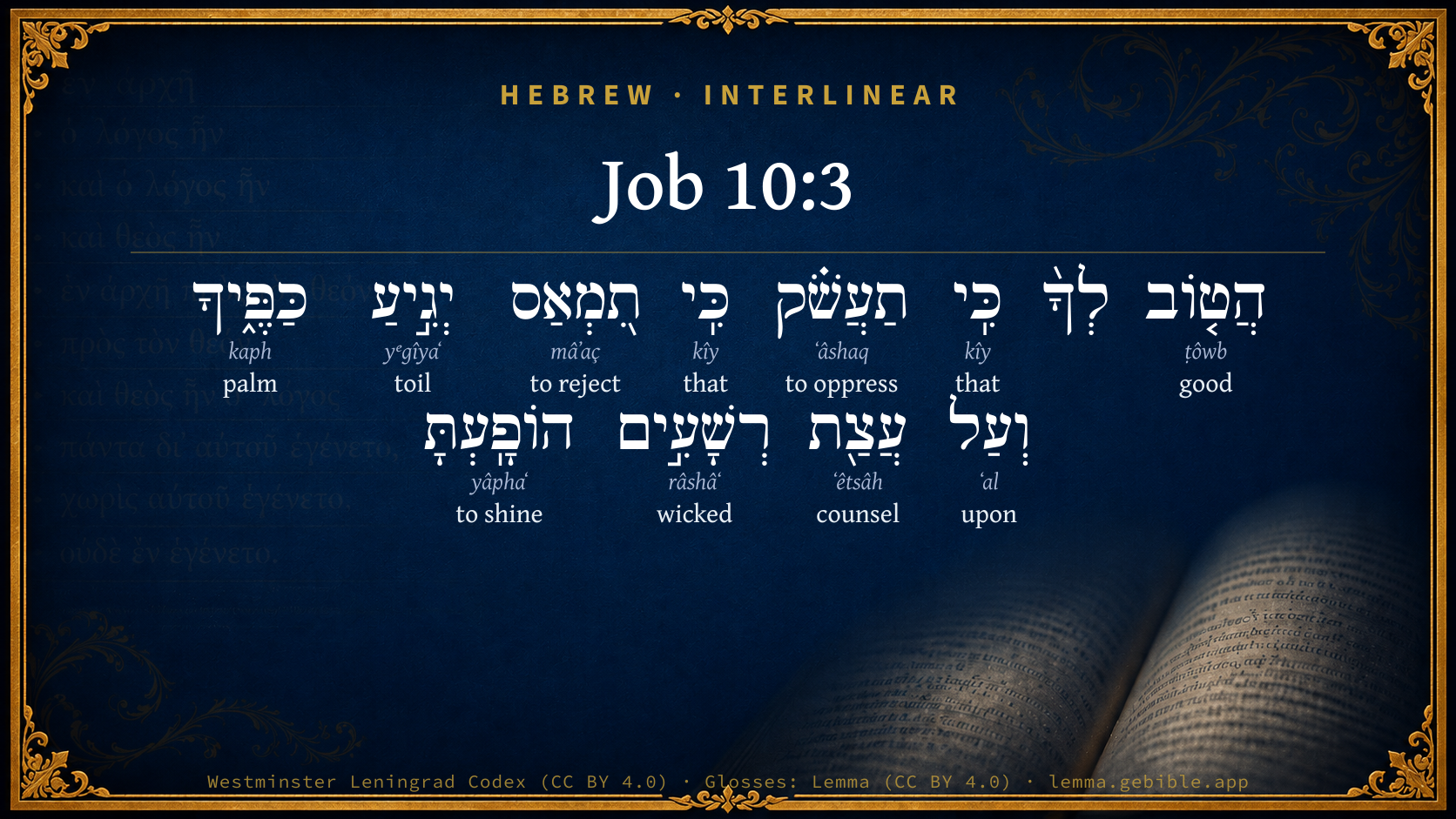
Hebrew (Westminster Leningrad Codex) Job 10:3 appears in the Hebrew Old Testament. The text above is from the Westminster Leningrad Codex. Each word links to its Strong’s number, a concise gloss, and parsing drawn from the Open Scriptures Hebrew Bible morphology. Click any word for its full Brown-Driver-Briggs (BDB) entry.
Download image
Cite this verse

Job 10:3 (World English Bible). Public Domain. Lemma interlinear Bible study tool, https://lemma.gebible.app/v/job/10/3.

Show BibTeX & RIS
BibTeX
RIS
English Translation
Is it good to you that you should oppress, That you should despise the work of your hands, And smile on the counsel of the wicked?
World English Bible · Public Domain
Download a study sheet

One document with this verse’s original text, its word-by-word gloss line, the meaning frame, cross-references with their text, attributed commentary, and full source and license credits — printable, and it pastes into notes with its structure intact.

This verse Autodidact and up

Study sheet (.html) Plain text (.txt)

A passage Seminary Student

Up to 50 verses in one chapter. A passage sheet keeps up to 6 commentary sources and 12 cross-references per verse, in the order this page ranks them, and says so on the sheet whenever that leaves anything out. Ask for a single verse and you get the Autodidact verse sheet above.

Everything on this page stays free to read, with no account — the sheet is a download of what is already on screen, not access to it.

Want to remove ads? Support Godless Engineer
Compare translations 3

The same verse in 3 English versions, stacked beneath the original-language interlinear above. Click any original word for its lexicon entry.

Each is an independent rendering of the whole verse — the interlinear is not word-aligned to these translations.

Highlighted words mark where these versions differ — a whole-verse word diff, not a word-by-word alignment.

  • World English Bible Public Domain
    Is it good to you that you should oppress, That you should despise the work of your hands, And smile on the counsel of the wicked?
  • King James Version Public Domain
    Is it good unto thee that thou shouldest oppress, that thou shouldest despise the work of thine hands, and shine upon the counsel of the wicked?
  • unfoldingWord Literal Text CC BY-SA 4.0
    Is it good to you that you will oppress, that you will despise the work of your hands, but on the plans of the wicked you shine?

unfoldingWord Literal Text — © unfoldingWord, licensed CC BY-SA 4.0. Word-aligned USFM3 via Door43 (git.door43.org/unfoldingWord/en_ult).

Versions to compare (up to 4)

3 of 4 selected

Show all 18 translations

Every available English version of this verse, each an independent rendering of the whole verse.

  • World English Bible Public Domain
    Is it good to you that you should oppress, That you should despise the work of your hands, And smile on the counsel of the wicked?
  • Berean Standard Bible Public Domain
    Does it please You to oppress me, to reject the work of Your hands and favor the schemes of the wicked?
  • Majority Standard Bible Public Domain
    Does it please You to oppress me, to reject the work of Your hands and favor the schemes of the wicked?
  • King James Version Public Domain
    Is it good unto thee that thou shouldest oppress, that thou shouldest despise the work of thine hands, and shine upon the counsel of the wicked?
  • American Standard Version (1901) Public Domain
    Is it good unto thee that thou shouldest oppress, That thou shouldest despise the work of thy hands, And shine upon the counsel of the wicked?
  • Revised Version (1885) Public Domain
    Is it good unto thee that thou shouldest oppress, that thou shouldest despise the work of thine hands, and shine upon the counsel of the wicked?
  • Geneva Bible (1599) Public Domain
    Thinkest thou it good to oppresse me, and to cast off the labour of thine handes, and to fauour the counsel of the wicked?
  • Douay-Rheims (1899) Public Domain
    Doth it seem good to thee that thou shouldst calumniate me, and oppress me, the work of thy own hands, and help the counsel of the wicked?
  • Young's Literal Translation Public Domain
    Is it good for Thee that Thou dost oppress? That Thou despisest the labour of Thy hands, And on the counsel of the wicked hast shone?
  • Literal Standard Version CC BY-SA 4.0
    Is it good for You that You oppress? That You despise the labor of Your hands, || And shine on the counsel of the wicked?
  • Unlocked Literal Bible CC BY-SA 4.0
    Is it good to you that you should oppress me, to despise the work of your hands while you smile on the plans of the wicked?
  • unfoldingWord Literal Text CC BY-SA 4.0
    Is it good to you that you will oppress, that you will despise the work of your hands, but on the plans of the wicked you shine?
  • Darby Bible Public Domain
    Doth it please thee to oppress, that thou shouldest despise the work of thy hands, and shine upon the counsel of the wicked?
  • World Messianic Bible Public Domain
    Is it good to you that you should oppress, that you should despise the work of your hands, and smile on the counsel of the wicked?
  • Webster's Bible Public Domain
    Is it good to thee that thou shouldst oppress, that thou shouldst despise the work of thy hands, and shine upon the counsel of the wicked?
  • Free Bible Version CC BY-SA 4.0
    Do you enjoy accusing me? Why do you reject me, someone you made with your own hands, and yet smile on the scheming of the wicked?
  • Bible in Basic English Public Domain
    What profit is it to you to be cruel, to give up the work of your hands, looking kindly on the design of evil-doers?
  • JPS Tanakh (1917) Public Domain
    Is it good unto Thee that Thou shouldest oppress, that Thou shouldest despise the work of Thy hands, and shine upon the counsel of the wicked?

Literal Standard Version (2020), Covenant Press — licensed CC BY-SA 4.0. Text via the HelloAO Bible API (eBible.org). Unlocked Literal Bible (unfoldingWord) — licensed CC BY-SA 4.0. Text via the HelloAO Bible API (eBible.org). unfoldingWord Literal Text — © unfoldingWord, licensed CC BY-SA 4.0. Word-aligned USFM3 via Door43 (git.door43.org/unfoldingWord/en_ult). Free Bible Version, Dr. Jonathan Gallagher — licensed CC BY-SA 4.0. Text via the HelloAO Bible API (eBible.org).

Word by word

More ways to search: Search by grammar → Find every occurrence → Compare this word →

Practice this passage: Drill this verse → Learn its vocabulary →

הוֹפָֽעְתָּ
yâphaʻ
H3313
“to shine”
Verb, Hiphil, Perfect, 2nd Person, Masculine, Singular
Part of Speech
Verb
Stem
Hiphil
Form
Perfect
Person
2nd Person
Gender
Masculine
Number
Singular
Full BDB Definition

Origin: a primitive root

TWOT: 892

to shine, shine forth or out, cause to shine, send out beams - (Hiphil) - to shine out, shine forth, send out beams - to cause to shine
  1. הֲט֤וֹב ṭôwb H2896 “good” Particle, Interrogative + Adjective, Adjective, Masculine, Singular, Absolute
  2. כִּֽי kîy H3588 “that” Conjunction
  3. תַעֲשֹׁ֗ק ʻâshaq H6231 “to oppress” Verb, Qal, Imperfect, 2nd Person, Masculine, Singular
  4. כִּֽי kîy H3588 “that” Conjunction
  5. תִ֭מְאַס mâʼaç H3988 “to reject” Verb, Qal, Imperfect, 2nd Person, Masculine, Singular
  6. יְגִ֣יעַ yᵉgîyaʻ H3018 “toil of” Noun, Common, Masculine, Singular, Construct
  7. כַּפֶּ֑יךָ kaph H3709 “palms · your” Noun, Common, Feminine, Dual, Construct + Suffix, Personal, 2nd Person, Masculine, Singular
  8. וְעַל ʻal H5921 “and · upon” Conjunction + Preposition
  9. עֲצַ֖ת ʻêtsâh H6098 “counsel of” Noun, Common, Feminine, Singular, Construct
  10. רְשָׁעִ֣ים râshâʻ H7563 “wicked” Adjective, Adjective, Masculine, Plural, Absolute

About this verse

These counts appear in no published source. They are computed here, from the morphology-tagged text and Lemma’s own curated glosses. What Lemma adds →

12
words
10
distinct lemmas
Wisdom
section

Notable vocabulary

The rarest word here is הוֹפָֽעְתָּ to shine H3313 — appearing just 8 times in the whole Hebrew Bible.

Shared distinctive vocabulary

הוֹפָֽעְתָּ to shine H3313 occurs in 8 verses of the Hebrew Bible. Also found in:

Grammatical profile

  • 3 verbs
  • 3 nouns
  • 2 adjectives
  • 2 prepositions
  • 2 conjunctions

Verb forms

  • תַעֲשֹׁ֗ק Qal · Imperfect
  • תִ֭מְאַס Qal · Imperfect
  • הוֹפָֽעְתָּ Hiphil · Perfect

Repetition

A word recurs within this verse — often emphatic in Hebrew:

  • כִּֽי that H3588 ×2

Hebrew & Septuagint length

In English translation the verse runs 26 words from the Hebrew and 26 from the Septuagint (LXX English) — the same length.

A rough comparison of the two English renderings, which tokenize alike — not a word-level alignment.

Word counts can differ between the Hebrew and the Greek without any difference in meaning — e.g. the Hebrew direct-object marker אֵת has no separate Greek word, and Greek often adds the article ὁ.

In the original languages it is 12 Hebrew tokens and 14 Greek tokens — but the two are counted differently (Hebrew bundles its prefixes and suffixes into one token; the Greek is in lemma form), so that isn’t a like-for-like length.

Cross-references

18

Topical passages linked to Job 10:3 in the Treasury of Scripture Knowledge — connected by theme and wording, ordered by reader-vote popularity; previews shown in the World English Bible.

  • Isaiah 64:8 But now, Yahweh, you are our Father; we are the clay, and you our potter; and we all are the work of your hand.
  • Job 14:15 You would call, and I would answer you. You would have a desire to the work of your hands.
  • Psalms 138:8 Yahweh will fulfill that which concerns me; Your loving kindness, Yahweh, endures forever. Don't forsake the works of your own hands.
  • Jeremiah 12:1–3 Righteous are you, Yahweh, when I contend with you; yet would I reason the cause with you: why does the way of the wicked prosper? why are all they at ease who deal very treacherously?
  • Job 8:20 "Behold, God will not cast away a blameless man, Neither will he uphold the evil-doers.
  • Job 9:22 "It is all the same. Therefore I say, He destroys the blameless and the wicked.
  • Job 9:24 The earth is given into the hand of the wicked. He covers the faces of the judges of it. If not he, then who is it?
  • Job 21:16 Behold, their prosperity is not in their hand: The counsel of the wicked is far from me.
  • Job 22:18 Yet he filled their houses with good things, But the counsel of the wicked is far from me.
  • Job 34:5–7 For Job has said, 'I am righteous, God has taken away my right:
  • Job 34:18–19 Who says to a king, 'Vile!' Or to nobles, 'Wicked!'
  • Job 36:7–9 He doesn't withdraw his eyes from the righteous, But with kings on the throne, He sets them forever, and they are exalted.
  • Job 36:17–18 "But you are full of the judgment of the wicked. Judgment and justice take hold of you.
  • Job 40:2 "Shall he who argues contend with the Almighty? He who argues with God, let him answer it."
  • Job 40:8 Will you even annul my judgment? Will you condemn me, that you may be justified?
  • Psalms 69:33 For Yahweh hears the needy, And doesn't despise his captive people.
  • Lamentations 3:2–18 He has led me and caused me to walk in darkness, and not in light.
  • 1 Peter 4:19 Therefore let them also who suffer according to the will of God in doing good entrust their souls to him, as to a faithful Creator.

Cross-references courtesy of OpenBible.info (CC BY 4.0).

Hebrew and Greek witnesses Masoretic Hebrew ↔ Greek Septuagint

The same verse in the two great witnesses to the Old Testament, shown verse-for-verse.

These are two independent witnesses, not word-aligned to each other, and the Septuagint is shown in lemma (dictionary) form.

Hebrew Job 10:3 Masoretic · Westminster Leningrad Codex

הֲט֤וֹב לְךָ֨ כִּֽי תַעֲשֹׁ֗ק כִּֽי תִ֭מְאַס יְגִ֣יעַ כַּפֶּ֑יךָ וְעַל עֲצַ֖ת רְשָׁעִ֣ים הוֹפָֽעְתָּ

Is it good to you that you should oppress, That you should despise the work of your hands, And smile on the counsel of the wicked?

World English Bible · Public Domain

Greek LXX Job 10:3 Septuagint · lemma form

ἦ καλός σύ ἐάν ἀδικέω ὅτι ἀποεἶπον ἔργον χείρ σύ βουλή δέ ἀσεβής προςἔχω

Is it good before you if I be unrighteous? for you have disowned the work of your hands, and attended to the counsel of the ungodly.

LXX2012 (modern English Septuagint) · Public Domain

Hebrew: Westminster Leningrad Codex (CC BY 4.0). Greek: Septuagint (public domain); English from LXX2012 (modern English Septuagint) (Public Domain). How the Septuagint differs from the Hebrew →

Commentary

Notes on Job 10:3 from classic Christian and Jewish commentators (each source and its license shown beneath its notes). The classic Christian expositions comment on the surrounding passage and are grouped to its opening verse, so a note may address several verses; the Jewish commentaries on the Tanakh (Rashi and others) are per-verse, so they appear only where the commentator wrote on this verse.

Lemma curates 59 commentaries, every one of them public domain or Creative Commons licensed, each selected and text-cleaned for this edition rather than reprinted as found. About our sources →

Trapp's Complete Commentary

John Trapp

Job 10:3 [Is it] good unto thee that thou shouldest oppress, that thou shouldest despise the work of thine hands, and shine upon the counsel of the wicked?

Ver. 3. Is it good unto thee that thou shouldest oppress?] It is the guise of wicked judges to take this counsel, to follow this course; whom thou, being a most just and righteous judge, canst not confirm or encourage by thine own example, as it were by a light shining from above. Thus Job rhetoricateth; his complaints are high, yet ever with an alloy or mixture of modesty (Beza).

That thou shouldest despise the work of thine hands] i.e. Me, thy poor creature, wilt thou do and undo? make a man, and unmake him again for thy mind’s sake? Builders use not to ruin what they have built; artificers love and plead for their own handiwork; fathers foster their children with all tenderness. Some authors dote upon their own doings, as Laurentius Valla did upon his logic, as if there had been none such, calling it, in a bravado, Logicam Laurentinam; and as Campian the Jesuit did upon his ten leaden reasons, which he deemed and boasted to be unanswerable, Heliodorus would rather be unbishoped than yield that his Ethiopic history (a toilsome toy, but the brat of his brain) should be abolished. The saints are "God’s building," 1Co 3:9; handy work, Eph 2:10; "children," Rom 9:26; "epistles known and read of all men," 2Co 3:2-3. This if we plead, when sorely afflicted (as the Church did, Isa 64:8, and David, Psa 138:8, and Job here), we may have anything. See that notable text, Isa 45:11, and that other, Isa 59:16.

And shine upon the counsel of the wicked?] That is, favour and further their designs. God makes his sun to shine upon such, but himself never shineth upon them. He may be angry enough with men, though they outwardly prosper; yea, to prosper in sin is a most heavy judgment. See Zec 1:15. {See Trapp on "Zec 1:15"}

John Trapp, A Commentary or Exposition upon All the Books of the Old and New Testament (1647–1656) — public domain. Text from a community e-Sword module.

The Biblical Illustrator

Joseph S. Exell

Job_10:3-17

Is it good unto Thee that Thou shouldest oppress?

Jobs mistaken views of his sufferings

I. As inconsistent with all his ideas of his Maker.

1. As inconsistent with His goodness. Is it good unto Thee that Thou shouldest oppress, that Thou shouldest despise the work of Thine hands? I thought Thee benevolent and merciful, but in my suffering I feel Thee to be malign. There is a strong tendency in all men under suffering to regard the Almighty as anything but good.

2. With His justice. And shine upon the counsel of the wicked. Job saw wicked men around him, strong and hale in body, buoyant in animal spirits, and prosperous in worldly affairs, whilst he who was in his deepest heart in sympathy with right, and the God of right, was reduced to the utmost distress. He failed to see justice in this.

3. With His greatness. Hast Thou eyes of flesh, etc. I cannot reconcile the sufferings with which Thou dost afflict an insignificant creature like me with Thine omniscience and eternity.

II. As an unrighteous display of arbitrary power. Thou knowest that I am not wicked, etc. Job does not regard himself as absolutely holy. The Omniscient One knew he was not guilty of that hypocrisy with which his friends had charged him. Where, then, is the righteousness of his afflictions?

III. As contrary to what the Divine organisation and preservation of his existence led him to expect. In the eighth and two following verses he ascribes the formation of his body to God. He ascribes his sustentation as well. He seemed astonished that the God who thus produced and supported him should thus mar his beauty, destroy his health, and overwhelm him with misery. This is, in truth, a perplexity to us as well as to Job.

IV. As baffling all attempts to understand. And these things Thou hast hid in Thine heart. If there is a reason, it is in Thy heart shut up and hid from me, and I cannot reach it. The more he thought, the more was Job embarrassed with the mysteries of his being. Conclusion--

1. The greatness of mans capability for suffering. To what inexpressible wretchedness and agony was Job now reduced, both in soul and in body.

2. The absoluteness of Gods power over us. We are in His bands, all of us.

3. The value of Christianity as an interpreter of suffering. Jobs great confusion in his suffering seemed to arise from the idea that unless a man was a great sinner there was no reason for great suffering. Afflictions to good men are disciplinary, not punitive. (Homilist.)

That Thou shouldest despise the work of Thine hands.

Man is the work of God

Job alludes to artificers who, having made an excellent piece, will not destroy or break it in pieces; they are very tender of their work, yea, they are apt to boast and grow proud of it. Man was the masterpiece of the whole visible creation. The Lord needs not to be ashamed of, neither doth He despise any part of His work, much less this, which is the best and noblest part of it. As the body, so the soul of man is the work of Gods hand. His power and wisdom wrought it, and work mightily in it. In regard of bodily substance, the most inferior creatures claim kindred of man, and he may be compared to the beast that perisheth; but in regard of the soul, man transcends them all, and may challenge a nearness, if not an equality with the angels. Take three cautions.

1. Be not proud of what ye are, all is the work of God. How beautiful or comely, how wise or holy soever ye are, it is not of yourselves.

2. Despise not what others are or have; though they are not such exact pieces, though they have not such excellent endowments as yourselves, yet they are what the hand of God hath wrought them, and they have what the hand of God hath wrought in them.

3. Despise not what yourselves are; to do so is a sin, and a sin very common. Men are ashamed to be seen as God hath made them; few are ashamed to be seen what the devil hath made them. Many are troubled at small defects of the outward man. They who come after God to mend His work, lest they should be despised, will but make themselves more despicable. (Joseph Caryl.)

The Biblical Illustrator, edited by Joseph S. Exell (c. 1880s–1900s) — public domain. Text from a community e-Sword module.

Joseph Benson's Commentary

Job 10:3. Is it good unto thee? — Dost thou take any pleasure in it, that those shouldest oppress? — By thy absolute and irresistible power, without regard to that justice and clemency by which thou usest to govern mankind. Shouldest despise the work of thy hands — Show thy contempt of thy creatures, either by denying them protection, or by destroying them. And shine upon the counsel of the wicked — That is, by the methods of thy providence seem to favour the practices of wicked men, to whom thou givest prosperity and success, while thou frownest upon me and other good men. Far be it from Job to think that God did him wrong. But he is at a loss to reconcile his providences with his justice. And so other good men have often been, and will be, until the day shall declare it.

Joseph Benson's Commentary on the Old and New Testaments (1811–1818) — public domain. Text from a community e-Sword module.

Keil & Delitzsch

C. F. Keil & F. Delitzsch

3 Doth it please Thee when Thou oppressest,

That Thou rejectest the work of Thy hands,

While Thou shinest upon the counsel of the wicked?

4 Hast Thou eyes of flesh,

Or seest Thou as a mortal seeth?

5 Are Thy days as the days of a mortal,

Or Thy years as man's days,

6 That Thou seekest after my iniquity,

And searchest after my sin?

7 Although Thou knowest that I am not a wicked man,

And there is none that can deliver out of Thy hand.

There are three questions by which Job seeks to exhaust every possible way of accounting for his sufferings as coming from God. These attempts at explanation, however, are at once destroyed, because they proceed upon conceptions which are unworthy of God, and opposed to His nature. Firstly, Whether it gives Him pleasure (טּוב, agreeable, as Job 13:9) when He oppresses, when He despises, i.e., keeps down forcibly or casts from Him as hateful (מאס, as Psa 89:39; Isa 54:6) the work of His hand; while, on the contrary, He permits light to shine from above upon the design of the wicked, i.e., favours it? Man is called the יגיע of the divine hands, as though he were elaborated by them, because at his origin (Gen 2:7), the continuation of which is the development in the womb (Psa 139:15), he came into existence in a remarkable manner by the directly personal, careful, and, so to speak, skilful working of God. That it is the morally innocent which is here described, may be seen not only from the contrast (Job 10:3), but also from the fact that he only can be spoken of as oppressed and rejected. Moreover, "the work of Thy hands" involves a negative reply to the question. Such an unloving mood of self-satisfaction is contrary to the bounty and beneficence of that love to which man owes his existence. Secondly, Whether God has eyes of flesh, i.e., of sense, which regard only the outward appearance, without an insight into the inner nature, or whether He sees as mortals see, i.e., judges, κατὰ τῆν σάρκα (Joh 8:15)? Mercier correctly: num ex facie judicas, ut affectibus ducaris more hominum. This question also supplies its own negative; it is based upon the thought that God lookest on the heart (Sa1 16:7). Thirdly, Whether His life is like to the brevity of man's life, so that He is not able to wait until a man's sin manifests itself, but must institute such a painful course of investigation with him, in order to extort from him as quickly as possible a confession of it? Suffering appears here to be a means of inquisition, which is followed by the final judgment when the guilt is proved. What is added in Job 10:7 puts this supposition aside also as inconceivable. Such a mode of proceeding may be conceived of in a mortal ruler, who, on account of his short-sightedness, seeks to bring about by severe measures that which was at first only conjecture, and who, from the apprehension that he may not witness that vengeance in which he delights, hastens forward the criminal process as much as possible, in order that his victim may not escape him. God, however, to whom belongs absolute knowledge and absolute power, would act thus, although, etc. על, although, notwithstanding (proceeding from the signification, besides, insuper), as Job 17:16 (Isa 53:9), Job 34:6. God knows even from the first that he (Job) will not appear as a guilty person (רשׁע, as in Job 9:29); and however that may be, He is at all events sure of him, for nothing escapes the hand of God.

That operation of the divine love which is first echoed in "the labour of Thy hands," is taken up in the following strophe, and, as Job contemplates it, his present lot seems to him quite incomprehensible.

Keil & Delitzsch — Biblical Commentary on the Old Testament (1861–1891) — public domain (CC PDM 1.0). Text via the HelloAO Bible API. (Old Testament only.)

Geneva Bible (1599)

Geneva Bible translators

Wilt thou gratify the wicked and condemn me?

Is it agreeable to thy justice to do me wrong?

Wilt thou be without compassion?

Geneva Bible (1599) marginal notes — public domain. Text via Bolls.life.

Jamieson, Fausset & Brown

Robert Jamieson, A. R. Fausset & David Brown

Job is unwilling to think God can have pleasure in using His power to "oppress" the weak, and to treat man, the work of His own hands, as of no value (Job 10:8; Psa 138:8).

shine upon--favor with prosperity (Psa 50:2).

Jamieson, Fausset & Brown — Commentary Critical and Explanatory on the Whole Bible (1871) — public domain (CC PDM 1.0). Text via the HelloAO Bible API.

Adam Clarke's Commentary

Verse 3. Is it good unto thee] Surely it can be no gratification to thee to distress the children of men, as if thou didst despise the work of thy own hands.

And shine upon the counsel] For by my afflictions the harsh judgments of the wicked will appear to be confirmed: viz., that God regards not his most fervent worshippers; and it is no benefit to lead a religious life.

Adam Clarke's Commentary on the Bible (1810–1826) — public domain. Text from a community e-Sword/MySword module.

The Cambridge Bible for Schools and Colleges

gen. ed. J. J. S. Perowne

3. is it good unto thee] The usual meaning of the phrase is, Is it thy pleasure, does it seem right to thee? Deu_23:17. The words might also mean, Is it becoming thee? Exo_14:12. The former sense suits the connexion better, because Job is groping after the discovery of some characteristic or quality in God to account for his afflictions.

the work of thine hands] No doubt both Job and the wicked were all the work of God’s hands, but the righteous are in such a special sense the work of His hands that here they are so described in opposition to the wicked.

The Cambridge Bible for Schools and Colleges (gen. ed. J. J. S. Perowne; Cambridge University Press, 1878–1918) — public domain. Text from a community e-Sword module.

John Gill's Exposition

Is it good unto thee that thou shouldest oppress?.... This God does not approve of in others; he dehorts men from it; he threatens to punish those that do so, and to be a swift witness against them; he promises to arise to the help of the oppressed, and to be a refuge for them, and therefore will never do the same himself; it can never be pleasant to him, nor right and just in his sight, nor is it of any advantage to him. Job here suggests that his afflictions were an oppression to him; and, indeed, no affliction is joyous, but grievous, and sometimes the hand of God presses hard and sore, but then there is no injury nor any injustice done, as the word (e) here used signifies; and he intimates also, as if God took some seeming delight and pleasure in thus oppressing him, and therefore expostulates with him about it, as if such conduct was not fit and becoming him, not agreeable to his perfections, and could afford neither pleasure nor profit. This, and what follows in this verse, are expostulations too bold and daring, and in which Job uses too much freedom with the Almighty, and in which he is not so modest as in Job 10:2,

that thou shouldest despise the work of thine hands? which he tacitly insinuates he did. Job means himself, who, as to his body, and the several members of it, were the work of God's hands, curiously and wonderfully made by him, as is afterwards expressed; and as to his soul, and the powers and faculties of it, they were his make, who is the Father of spirits; and moreover, as a new man, he was made by him, was the workmanship of God, and a curious piece indeed, created after his image in righteousness and true holiness; and he was in every sense the work of his hands, or "the labour of his hands" (f); wrought with great care and labour, even with the "palms of his hands", as is the word (g) used; and could Job think that God "despised" such a work? he who, upon a survey of his works, said they were all very good; who forsakes not the work of his hands, nor despises the day of small things, could never do this; nor are afflictions to be interpreted in such a manner, as if God was indifferent unto, slighted and thought meanly of, what he himself has wrought; since these are so far from having such a meaning, that they flow from that great respect he has for his own work, and are for the good of it:

and shine upon the counsel of the wicked? either the counsel of the wicked one, Satan, who moved God to afflict him in the manner he had, or of the Sabeans and Chaldeans, who thrived and prospered, notwithstanding the injury they had done him; or of his friends, who consulted to brand his character with hypocrisy; or, rather, of wicked men in general, on whose counsel God may be thought to "shine", when it succeeds, and God seems to smile upon them in his providence, and they are in prosperous circumstances, and have what heart can wish, when good men are greatly afflicted; which sometimes has been a temptation, and greatly distressing, to the latter; see Psa 73:2; but this is not always the case; the counsel of the froward is sometimes carried headlong, the counsel of the wise counsellors of Pharaoh is made brutish, and that of Ahithophel was defeated by him; and whenever he seems to countenance it, it is to answer some ends of his glory.

(e) "est opprimere vim injustam alicui facere", Schmidt. (f) "laborem", Pagninus, Montanus, Schultens, Michaelis. (g) "volarum tuarum", Montanus, Bolducius.

John Gill's Exposition of the Whole Bible (1746–1763) — public domain (CC PDM 1.0). Text via the HelloAO Bible API.

Albert Barnes' Notes on the Bible

Is it good unto thee that thou shouldest oppress - The sense of this is, that it could not be with God a matter of personal gratification to inflict pain wantonly. There must be a reason why he did it. This was clear to Job, and he was anxious, therefore, to know the reason why he was treated in this manner. Yet there is evidently here not a little of the spirit of complaining. There is an insinuation that God was afflicting him beyond what he deserved; see Job 10:7. The state of his mind appears to have been this: he is conscious to himself that he is a sincere friend of God, and he is unwilling to believe that God can wantonly inflict pain - and yet he has no other way of accounting for it. He is in a sort driven to this painful conclusion - and he asks with deep feeling, whether it can be so? Is there no other solution than this? Is there no way of explaining the fact that he suffers so much, than either the supposition that he is a hypocrite - which he feels assured he is not; or that God took a wanton pleasure in inflicting pain - which he was as little disposed to believe, if he could avoid it? Yet his mind rather verges to this latter belief, for he seems more disposed to believe that God was severe than that he himself was a hypocrite and a wicked man. Neither of these conclusions was necessary. If he had taken a middle ground, and had adverted to the fact that God might afflict his own children for their good, the mystery would have been solved. He could have retained the consciousness of his integrity, and at the same time his confidence in God.

That thou shouldest despise the work of thine hands - Margin, labor. That is, despise man, or treat him as if he were of no value. The idea is, that it would be natural for God to love his own work, and that his treatment of Job seemed as if he regarded his own workmanship - man - as of no value.

And shine upon the counsel of the wicked - By giving them health and prosperity.

Albert Barnes' Notes on the Bible (1834–1885) — public domain. Text from a community e-Sword/MySword module.

Haydock's Catholic Bible Commentary

Calumniate permissively, by treating me in such a manner, that others lay false crimes to my charge. Hebrew, "oppress and despise the work." --- Wicked, who are ready enough (Haydock) to assert that virtue is useless, (Calmet) and that God mindeth not human affairs. My affliction will confirm them in their false notion, (Haydock) and my friends will triumph as if their arguments were well founded. The devil will also exult. (Calmet) --- He knew that God could not be guilty of calumny, and inquireth why he is afflicted. (Worthington)

George Leo Haydock (1774–1849), Haydock's Catholic Family Bible and Commentary, 1859 edition — public domain. Excludes Psalms (Douay-Rheims chapter numbering differs from Protestant) and Deuterocanonical books (Catholic canon only).

Matthew Poole's English Annotations

Dost thou take any pleasure in it? Hast thou any advantage or honour by it? Dost thou think it right and just, and becoming the Ruler of the world?

That thou shouldest oppress, by thy absolute and irresistible power, without any regard to that justice, and equity, and clemency by which thou usest to govern mankind.

That thou shouldest despise, i.e. show thy contempt of them, either by denying them common favour and protection, or by destroying them.

The work of thine hands, which every workman loves and maintains.

Shine upon the counsel of the wicked, i.e. by the methods of thy providence seem to favour the courses and practices of wicked men, to whom thou givest prosperity, and success, whilst thou frownest upon me and other good men. This may have reference either to Job’s friends, whose ungodly censures God seemed to approve, by continuing Job’s afflictions upon him; or to the Chaldeans and Sabeans, who had succeeded in their wicked attempts upon Job; but it seems to he more generally meant of wicked men.

Matthew Poole's English Annotations on the Holy Bible (1683–1685) — public domain. Text from a community e-Sword/MySword module.

Whedon's Commentary on the Bible

Daniel D. Whedon

3. Is it good — השׂוב: Is it becoming thee? — Thus Dillmann and others. The first reason why God should not treat men as he does — for instance, in the threefold way disclosed in this verse: 1. Oppression in general; 2. The oppression of the just, “the work of his hands;” 3. The showing of favour to the wicked — is, that such a course does not comport with the nature of God.

Daniel D. Whedon (gen. ed.), Commentary on the Old and New Testaments (1874–1909) — public domain. Text from a community e-Sword module.

The Pulpit Commentary

Is it good unto thee that thou shouldest oppress? Job assumes that he is oppressed. He has no conception that his sufferings are a purification, (Joh_15:2) intended to lead to the elevation and improvement of his moral character. He therefore asks Is it worthy of God, is it good in him, is it compatible with his perfect excellence, to be an oppressor? It is a sort of argumentum ad verecundiam"well enough between man and man, but quite out of place between a man and his Maker. That thou shouldest despise the work of thine hands. (comp. Psa_138:8) This argument is more legitimate. God may be expected, not to despise, but to care for, the work of his own hands. (comp. Isa_19:25 Isa_29:23 Isa_64:2 Isa_64:8 Eph_2:10) Every maker of a thing, as Aristotle says, loves his work, and naturally guards it, cares for it, and cherishes it. And shine upon the counsel of the wicked . (comp. Job_9:24) The prosperity of evil-doers must arise, Job thinks, from God allowing his countenance to shine upon them.

The Pulpit Commentary (1880–1919), ed. H.D.M. Spence-Jones & Joseph S. Exell — public domain. Text from a community e-Sword module.

John Wesley's Explanatory Notes

Good - Dost thou take any pleasure in it? Far be it from Job, to think that God did him wrong. But he is at a loss to reconcile his providences with his justice. And so other good men have often been, and will be, until the day shall declare it.

John Wesley, Explanatory Notes Upon the Whole Bible (1754–1765) — public domain. Text via the GEBible commentary corpus.

Rashi

Rabbi Shlomo Yitzchaki (Rashi)

Is it good Heb. הטוב, an interrogative form. [Is it good to You] that You should oppress and rob the righteous man of his righteousness, [while] upon the council of the wicked, who vex You, You shine Your splendor to show them a friendly countenance?

Rashi on the Tanakh — English translations: “The Judaica Press complete Tanach with Rashi, translated by A. J. Rosenberg” (CC BY 4.0); “Pentateuch with Rashi's commentary by M. Rosenbaum and A.M. Silbermann, 1929-1934” (public domain); “The Metsudah Tanach series, Lakewood, N.J” (CC BY 4.0); and “The Book of Joshua, Metsudah Publications, 1997” (CC BY 4.0). Text via Sefaria.

Lesson kit

Teaching starters — assembled from the data on this page, not authored interpretation. Every prompt links to the verse data it draws on. Edit before teaching.

Job, in the Wisdom, opens this verse with 12 words (10 distinct Hebrew lemmas). Its most distinctive word is yâphaʻ (“to shine”). A historical commentator’s framing appears above. Read the whole chapter for the surrounding context.

Discussion questions

  1. How does “to shine” (yâphaʻ) shape what this verse is saying?
  2. How does Deuteronomy 33:2, which shares the word «to shine», read alongside this verse?
  3. What does the repetition of “that” (2× in this one verse) do in this verse?
  4. These translations render this verse differently. What is at stake in choosing one wording over another?
  5. «תַעֲשֹׁ֗ק» is a Qal Imperfect verb. How does that grammatical form shape the action described?
  6. Compare how Trapp's Complete Commentary and The Biblical Illustrator read this verse. Where do they agree or differ?

Things to notice

Reading settings

Reading text

Shown beneath each verse's original-language words.

Old Testament
Old Testament edition

Read the OT as the Masoretic Hebrew (MT) or the Greek Septuagint (LXX).

English shown for the Greek Septuagint (in the Hebrew ↔ Greek comparison).

Comparing translations? Open the Compare panel on any verse page to stack up to four side by side.