Psalms 9:16

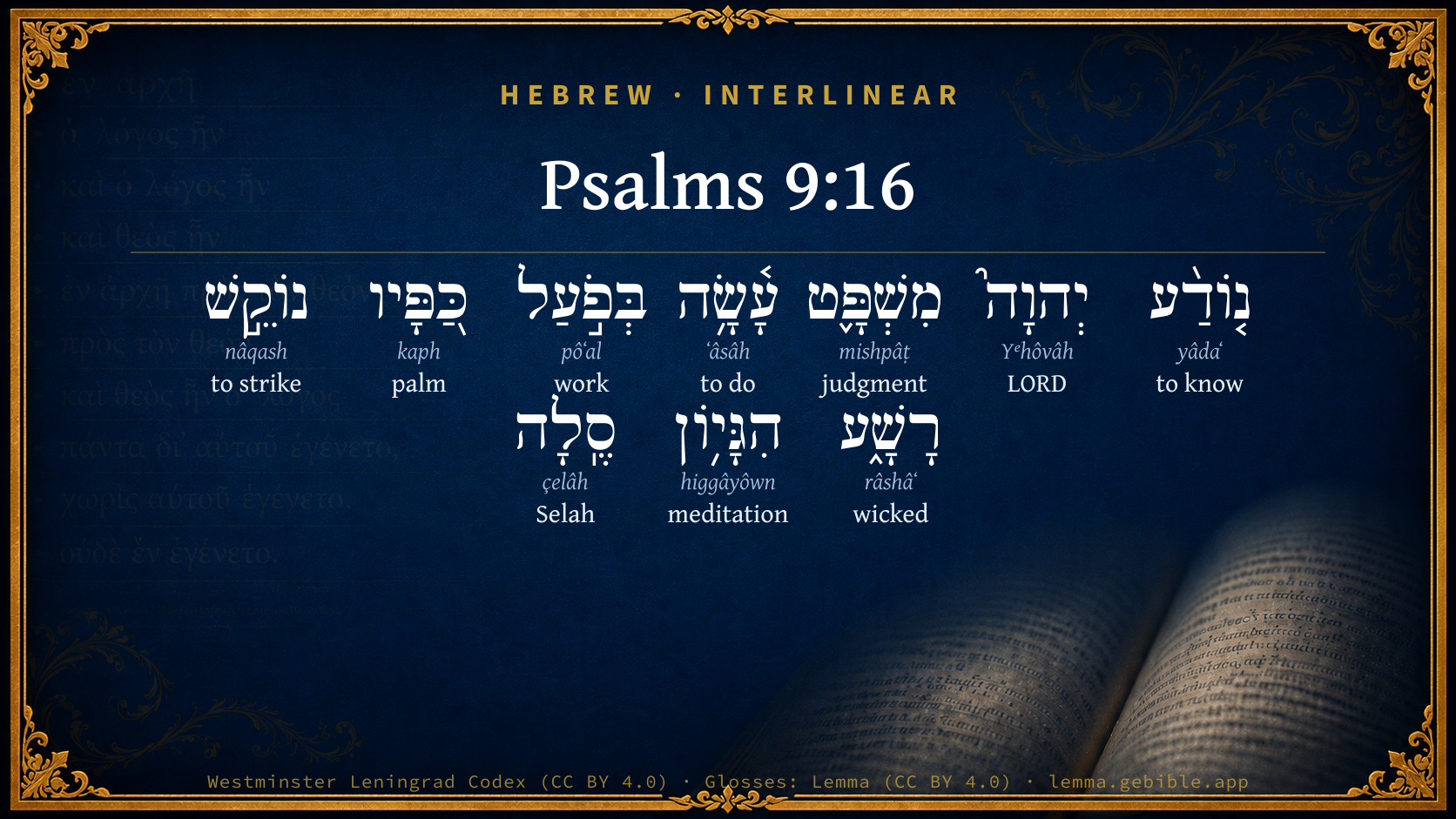
Hebrew (Westminster Leningrad Codex) Psalms 9:16 appears in the Hebrew Old Testament. The text above is from the Westminster Leningrad Codex. Each word links to its Strong’s number, a concise gloss, and parsing drawn from the Open Scriptures Hebrew Bible morphology. Click any word for its full Brown-Driver-Briggs (BDB) entry.
Download image
Cite this verse

Psalms 9:16 (World English Bible). Public Domain. Lemma interlinear Bible study tool, https://lemma.gebible.app/v/psalms/9/16.

Show BibTeX & RIS
BibTeX
RIS
English Translation
Yahweh has made himself known. He has executed judgment. The wicked is snared by the work of his own hands. Meditation. Selah.
World English Bible · Public Domain
Highlights
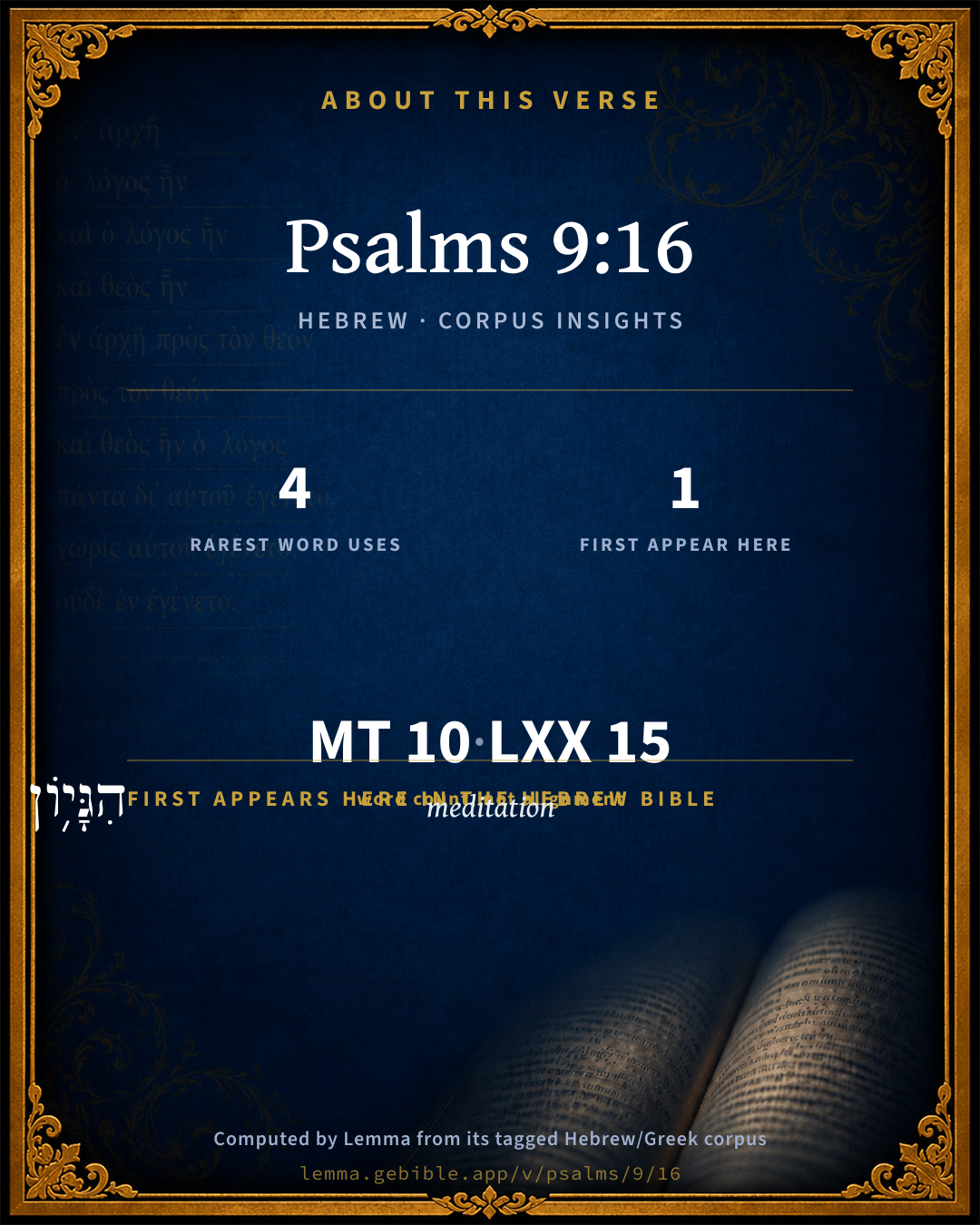
  • 1 first appearance in the Hebrew Bible
Full analysis ↓
Download a study sheet

One document with this verse’s original text, its word-by-word gloss line, the meaning frame, cross-references with their text, attributed commentary, and full source and license credits — printable, and it pastes into notes with its structure intact.

This verse Autodidact and up

Study sheet (.html) Plain text (.txt)

A passage Seminary Student

Up to 50 verses in one chapter. A passage sheet keeps up to 6 commentary sources and 12 cross-references per verse, in the order this page ranks them, and says so on the sheet whenever that leaves anything out. Ask for a single verse and you get the Autodidact verse sheet above.

Everything on this page stays free to read, with no account — the sheet is a download of what is already on screen, not access to it.

Want to remove ads? Support Godless Engineer
Compare translations 3

The same verse in 3 English versions, stacked beneath the original-language interlinear above. Click any original word for its lexicon entry.

Each is an independent rendering of the whole verse — the interlinear is not word-aligned to these translations.

Highlighted words mark where these versions differ — a whole-verse word diff, not a word-by-word alignment.

  • World English Bible Public Domain
    Yahweh has made himself known. He has executed judgment. The wicked is snared by the work of his own hands. Meditation. Selah.
  • King James Version Public Domain
    The LORD is known by the judgment which he executeth: the wicked is snared in the work of his own hands. Higgaion. Selah.
  • unfoldingWord Literal Text CC BY-SA 4.0
    Yahweh has revealed himself, he has done justice; the wicked is ensnared by the work of his hands. Higgaion Selah

unfoldingWord Literal Text — © unfoldingWord, licensed CC BY-SA 4.0. Word-aligned USFM3 via Door43 (git.door43.org/unfoldingWord/en_ult).

Versions to compare (up to 4)

3 of 4 selected

Show all 18 translations

Every available English version of this verse, each an independent rendering of the whole verse.

  • World English Bible Public Domain
    Yahweh has made himself known. He has executed judgment. The wicked is snared by the work of his own hands. Meditation. Selah.
  • Berean Standard Bible Public Domain
    The LORD is known by the justice He brings; the wicked are ensnared by the work of their hands. Higgaion Selah
  • Majority Standard Bible Public Domain
    The LORD is known by the justice He brings; the wicked are ensnared by the work of their hands. Higgaion Selah
  • King James Version Public Domain
    The LORD is known by the judgment which he executeth: the wicked is snared in the work of his own hands. Higgaion. Selah.
  • American Standard Version (1901) Public Domain
    Jehovah hath made himself known, he hath executed judgment: The wicked is snared in the work of his own hands. Higgaion. Selah
  • Revised Version (1885) Public Domain
    The LORD hath made himself known, he hath executed judgment: the wicked is snared in the work of his own hands. Higaion. Selah
  • Geneva Bible (1599) Public Domain
    The Lord is knowen by executing iudgement: the wicked is snared in the worke of his owne handes. Higgaion. Selah.
  • Douay-Rheims (1899) Public Domain
    I will rejoice in thy salvation: the Gentiles have stuck fast in the destruction which they have prepared. Their foot hath been taken in the very snare which they hid.
  • Young's Literal Translation Public Domain
    Jehovah hath been known, Judgment He hath done, By a work of his hands Hath the wicked been snared. Meditation. Selah.
  • Literal Standard Version CC BY-SA 4.0
    YHWH has been known, || He has done judgment; By a work of his hands || The wicked has been snared. Meditation. Selah.
  • Unlocked Literal Bible CC BY-SA 4.0
    Yahweh has made himself known; he has executed judgment; the wicked is ensnared by his own actions. Selah
  • unfoldingWord Literal Text CC BY-SA 4.0
    Yahweh has revealed himself, he has done justice; the wicked is ensnared by the work of his hands. Higgaion Selah
  • Darby Bible Public Domain
    Jehovah is known [by] the judgment he hath executed: the wicked is ensnared in the work of his own hands. Higgaion. Selah.
  • World Messianic Bible Public Domain
    The LORD has made himself known. He has executed judgment. The wicked is snared by the work of his own hands. Meditation. Selah.
  • Webster's Bible Public Domain
    \\9:15\\The heathen are sunk down in the pit that they made: in the net which they hid is their own foot taken.
  • Free Bible Version CC BY-SA 4.0
    The Lord is known for his fairness; the wicked are trapped by their own actions. Higgaion. Selah.
  • Bible in Basic English Public Domain
    The Lord has given knowledge of himself through his judging: the evil-doer is taken in the net which his hands had made. (Higgaion. Selah.)
  • JPS Tanakh (1917) Public Domain
    (9-17) The LORD hath made Himself known, He hath executed judgment, the wicked is snared in the work of his own hands. Higgaion. Selah

Literal Standard Version (2020), Covenant Press — licensed CC BY-SA 4.0. Text via the HelloAO Bible API (eBible.org). Unlocked Literal Bible (unfoldingWord) — licensed CC BY-SA 4.0. Text via the HelloAO Bible API (eBible.org). unfoldingWord Literal Text — © unfoldingWord, licensed CC BY-SA 4.0. Word-aligned USFM3 via Door43 (git.door43.org/unfoldingWord/en_ult). Free Bible Version, Dr. Jonathan Gallagher — licensed CC BY-SA 4.0. Text via the HelloAO Bible API (eBible.org).

Word by word

More ways to search: Search by grammar → Find every occurrence → Compare this word →

Practice this passage: Drill this verse → Learn its vocabulary →

About this verse

These counts appear in no published source. They are computed here, from the morphology-tagged text and Lemma’s own curated glosses. What Lemma adds →

10
words
10
distinct lemmas
Wisdom
section

Notable vocabulary

The rarest word here is הִגָּי֥וֹן meditation H1902 — appearing just 4 times in the whole Hebrew Bible.

First appearance in Scripture

This word makes its first canonical appearance in the Hebrew Bible here:

  • הִגָּי֥וֹן meditation H1902

Shared distinctive vocabulary

הִגָּי֥וֹן meditation H1902 occurs in 4 verses of the Hebrew Bible. Also found in:

Grammatical profile

  • 3 verbs
  • 5 nouns
  • 1 adjective
  • 1 particle

Verb forms

  • נ֤וֹדַ֨ע Niphal · Perfect
  • עָ֫שָׂ֥ה Qal · Perfect
  • נוֹקֵ֣שׁ Qal · Participle Active

Hebrew & Septuagint length

In English translation the verse runs 22 words from the Hebrew and 21 from the Septuagint (LXX English) — closely comparable.

A rough comparison of the two English renderings, which tokenize alike — not a word-level alignment.

Word counts can differ between the Hebrew and the Greek without any difference in meaning — e.g. the Hebrew direct-object marker אֵת has no separate Greek word, and Greek often adds the article ὁ.

In the original languages it is 10 Hebrew tokens and 15 Greek tokens — but the two are counted differently (Hebrew bundles its prefixes and suffixes into one token; the Greek is in lemma form), so that isn’t a like-for-like length.

Cross-references

23

Topical passages linked to Psalms 9:16 in the Treasury of Scripture Knowledge — connected by theme and wording, ordered by reader-vote popularity; previews shown in the World English Bible.

  • Exodus 7:5 The Egyptians shall know that I am Yahweh, when I stretch forth my hand on Egypt, and bring out the children of Israel from among them."
  • Proverbs 12:13 An evil man is trapped by sinfulness of lips, But the righteous shall come out of trouble.
  • Exodus 14:31 Israel saw the great work which Yahweh did to the Egyptians, and the people feared Yahweh; and they believed in Yahweh, and in his servant Moses.
  • Psalms 83:17–18 Let them be disappointed and dismayed forever. Yes, let them be confounded and perish;
  • Exodus 14:4 I will harden Pharaoh's heart, and he will follow after them; and I will get honor over Pharaoh, and over all his host; and the Egyptians shall know that I am Yahweh." They did so.
  • Joshua 2:10–11 For we have heard how Yahweh dried up the water of the Red Sea before you, when you came out of Egypt; and what you did to the two kings of the Amorites, who were beyond the Jordan, to Sihon and to Og, whom you utterly destroyed.
  • Judges 1:7 Adoni-bezek said, "Seventy kings, having their thumbs and their great toes cut off, gathered [their food] under my table: as I have done, so God has requited me." They brought him to Jerusalem, and he died there.
  • Isaiah 8:15 Many shall stumble thereon, and fall, and be broken, and be snared, and be taken.
  • Exodus 14:10 When Pharaoh drew near, the children of Israel lifted up their eyes, and behold, the Egyptians were marching after them; and they were very afraid. The children of Israel cried out to Yahweh.
  • Deuteronomy 29:22–28 The generation to come, your children who shall rise up after you, and the foreigner who shall come from a far land, shall say, when they see the plagues of that land, and the sicknesses with which Yahweh has made it sick;
  • 1 Samuel 6:19–20 He struck of the men of Beth-shemesh, because they had looked into the ark of Yahweh, he struck of the people fifty thousand seventy men; and the people mourned, because Yahweh had struck the people with a great slaughter.
  • 1 Samuel 17:46 This day will Yahweh deliver you into my hand; and I will strike you, and take your head from off you; and I will give the dead bodies of the host of the Philistines this day to the birds of the sky, and to the wild animals of the earth; that all the earth may know that there is a God in Israel,
  • 2 Kings 19:19 Now therefore, Yahweh our God, save you us, I beg you, out of his hand, that all the kingdoms of the earth may know that you Yahweh are God alone.
  • 2 Kings 19:34–35 For I will defend this city to save it, for my own sake, and for my servant David's sake.
  • Psalms 5:1 Give ear to my words, Yahweh. Consider my meditation.
  • Psalms 11:6 On the wicked he will rain blazing coals; Fire, sulfur, and scorching wind shall be the portion of their cup.
  • Psalms 19:14 Let the words of my mouth and the meditation of my heart Be acceptable in your sight, Yahweh, my rock, and my redeemer.
  • Psalms 48:11 Let Mount Zion be glad! Let the daughters of Judah rejoice, Because of your judgments.
  • Psalms 58:10–11 The righteous shall rejoice when he sees the vengeance. He shall wash his feet in the blood of the wicked;
  • Proverbs 6:2 You are trapped by the words of your mouth. You are ensnared with the words of your mouth.
  • Psalms 92:3 With the ten-stringed lute, with the harp, And with the melody of the lyre.
  • Psalms 140:9 As for the head of those who surround me, Let the mischief of their own lips cover them.
  • Isaiah 28:13 Therefore shall the word of Yahweh be to them precept on precept, precept on precept; line on line, line on line; here a little, there a little; that they may go, and fall backward, and be broken, and snared, and taken.

Cross-references courtesy of OpenBible.info (CC BY 4.0).

Hebrew and Greek witnesses Masoretic Hebrew ↔ Greek Septuagint

The same verse in the two great witnesses to the Old Testament, shown verse-for-verse.

You’re reading Greek Psalm 9 (Hebrew Psalm 9). The Septuagint counts the superscription, so verse numbers can differ from the Hebrew — chapter-level alignment, not verse-by-verse. Numbering follows Rahlfs.

These are two independent witnesses, not word-aligned to each other, and the Septuagint is shown in lemma (dictionary) form.

Hebrew Psalms 9:16 Masoretic · Westminster Leningrad Codex

נ֤וֹדַ֨ע יְהוָה֮ מִשְׁפָּ֪ט עָ֫שָׂ֥ה בְּפֹ֣עַל כַּ֭פָּיו נוֹקֵ֣שׁ רָשָׁ֑ע הִגָּי֥וֹן סֶֽלָה

Yahweh has made himself known. He has executed judgment. The wicked is snared by the work of his own hands. Meditation. Selah.

World English Bible · Public Domain

Greek LXX Greek Psalm 9:16 Septuagint · lemma form

ἐνπήγνυμι ἔθνος ἐν διαφθορά ὅς ποιέω ἐν παγίς οὗτος ὅς κρύπτω συνλαμβάνω ὁ πούς αὐτός

The Lord is known as executing judgments: the sinner is taken in the works of his hands. A song of Pause.

LXX2012 (modern English Septuagint) · Public Domain

On this verse, Albert Barnes' Notes on the Bible discusses the Septuagint’s reading. Read the note in Commentary ↓

Hebrew: Westminster Leningrad Codex (CC BY 4.0). Greek: Septuagint (public domain); English from LXX2012 (modern English Septuagint) (Public Domain). How the Septuagint differs from the Hebrew →

Commentary

Notes on Psalms 9:16 from classic Christian and Jewish commentators (each source and its license shown beneath its notes). The classic Christian expositions comment on the surrounding passage and are grouped to its opening verse, so a note may address several verses; the Jewish commentaries on the Tanakh (Rashi and others) are per-verse, so they appear only where the commentator wrote on this verse.

Lemma curates 59 commentaries, every one of them public domain or Creative Commons licensed, each selected and text-cleaned for this edition rather than reprinted as found. About our sources →

Trapp's Complete Commentary

John Trapp

Psa 9:16 The LORD is known [by] the judgment [which] he executeth: the wicked is snared in the work of his own hands. Higgaion. Selah.

Ver. 16. The Lord is known by the judgment, &c.] The heathen historian Herodotus oberved, that the ruin of Troy served to teach men that God punisheth great sinners with heavy plagues. "Go up to Shiloh," &c

The wicked is snared in the work of his own hands] Heb. palms, hollows, noting the close conveyance of his wicked plots and practices, but for his own mischief.

Higgaion. Selah] Ainsworth rendereth it Meditation Selah; meaning that this is a matter of deep meditation, worthy to be well minded, and spoken or sung with earnest consideration always. The word is found only here and Psa 92:3, where also the wonderful works of God are discoursed. R. Solomon’s note here is, Ultimum iudicium debet esse continua meditatio, The last judgment should be continually thought upon.

John Trapp, A Commentary or Exposition upon All the Books of the Old and New Testament (1647–1656) — public domain. Text from a community e-Sword module.

The Biblical Illustrator

Joseph S. Exell

Psa_9:16

With long life will I satisfy him.

Healthy religion

Through the mistake of its friends religion has been chiefly associated with sickbeds and grave yards. It is high time this thing were changed, and that religion, instead of being represented as a hearse to carry out the dead, should be represented as a chariot in which the living are to triumph. Religion, so far from subtracting from ones vitality, is a glorious addition. It is sanative, curative, hygienic. It is good for every part of man. Religion has only just touched our world. Give it full power for a few centuries, and who can tell what will be the strength of man, and the beauty of woman, and the longevity of all! Practical religion is ever the friend of longevity.

I. It makes the care of our health a positive Christian duty. Whether we shall keep early or late hours, take food digestible or indigestible, etc., is often referred to the realm of whimsicality; but the Christian man lifts this whole problem of health into the accountable and the Divine. The body is the temple of the Holy Ghost, and to deface its altars, or mar its walls, or crumble its pillars, is a God-defying sacrilege.

II. It is a protest against dissipations which injure and destroy the health. Bad men and women live very short lives. Their sins kill them. There are many aged ones who would have been dead twenty-five years ago but for the defences and equipoise of religion.

III. It takes the worry out of our temporalities. It is not work but worry that kills men. When a man becomes a Christian he makes over to God not only his affections but his family, his business, his reputation, his body, his mind, his soul--everything. He gives God the management of his affairs. If the nervous and feverish people of the world would try this almighty sedative, they would live twenty-five years longer under its soothing power. It is not chloral or morphine that they want; it is more of the Gospel of Christ.

IV. It removes all corroding care about a future existence. Everyone wants to know what is to become of him. There are people who fret themselves to death for fear of dying. The Gospel offers you perfect peace now and hereafter. What do you want in the future? This is the robust, healthy religion that will tend to make you live long in this world, and in the world to come give you eternal life. (T. De Witt Talmage, D. D.)

The Biblical Illustrator, edited by Joseph S. Exell (c. 1880s–1900s) — public domain. Text from a community e-Sword module.

J. A. Alexander on Psalms

Joseph Addison Alexander

17. (Psa 9:16). Known is Jehovah, or has made himself known. Justice has he done, or judgment has he executed. In the work of his (own) hands ensnared is a wicked (man). Higgaion, meditation. Selah, pause. God has revealed himself as present and attentive, notwithstanding his apparent oblivion and inaction, by doing justice on his enemies, or rather by making them do justice on themselves, converting their devices against others into means of self-destruction. In view of this most striking attestation of God's providential government, the reader is summoned to reflect, and enabled so to do by a significant and solemn pause. The sense of meditation or reflection is clear from Psa 9:15 (14), and Lam 3:62. See below, on Psa 92:4 (3). The addition of Higgaion to Selah here confirms the explanation already given of the latter word. See above, on Psa 3:3 (2). With this understanding of the terms, we may well say, to ourselves or others, in view of every signal providential retribution, especially where sin is conspicuously made its own avenger, Higgaion Selah!

Joseph Addison Alexander, The Psalms Translated and Explained (1850) — public domain. Text from a community e-Sword module.

Geneva Bible (1599)

Geneva Bible translators

Or, this is worthy to be noted.

The mercy of God toward his Saints must be declared, and the fall of the wicked must always be considered.

Geneva Bible (1599) marginal notes — public domain. Text via Bolls.life.

Jamieson, Fausset & Brown

Robert Jamieson, A. R. Fausset & David Brown

Higgaion--means "meditation," and, combined with Selah, seems to denote a pause of unusual solemnity and emphasis (compare Psa 3:2). Though Selah occurs seventy-three times, this is the only case in which Higgaion is found. In the view which is given here of the retribution on the wicked as an instance of God's wise and holy ordering, we may well pause in adoring wonder and faith.

Jamieson, Fausset & Brown — Commentary Critical and Explanatory on the Whole Bible (1871) — public domain (CC PDM 1.0). Text via the HelloAO Bible API.

Adam Clarke's Commentary

Verse 16. The Lord is known by the judgment] It is not every casualty that can properly be called a judgment of God. Judgment is his strange work; but when he executes it, his mind is plainly to be seen. There are no natural causes to which such calamities can be legally attributed.

The wicked is snared in the work of his own hands.] There is nothing that a wicked man does that is not against his own interest. He is continually doing himself harm, and takes more pains to destroy his soul than the righteous man does to get his saved unto eternal life. This is a weighty truth; and the psalmist adds: Higgaion; Selah. Meditate on this; mark it well. See on Ps 3:3. Some think that it is a direction to the musicians, something like our Presto, Largo, Vivace, Allegro, "Play briskly and boldly; beat away; and let sense and sound accompany each other."

Adam Clarke's Commentary on the Bible (1810–1826) — public domain. Text from a community e-Sword/MySword module.

John Calvin's Commentaries

16. The Lord is known in executing judgment. The reading of the words literally is this, The known Lord has done judgment. This manner of speech is abrupt, and its very brevity renders it obscure. It is therefore explained in two ways. Some explain it thus:- God begins then to be known when he punishes the wicked. But the other sense suits the passage better, namely, that it is a thing obvious and manifest to all that God executes the office of judge, as often as he ensnares the wicked in their own maliciousness. In short, whenever God turns back upon themselves whatever schemes of mischief they devise, David declares that in this case the divine judgment is so evident, that what happens can be ascribed neither to nature nor to fortune. If God, therefore, in this way manifestly display, at any time, the power of his hand, let us learn to open our eyes, that from the judgments which he executes upon the enemies of his Church our faith may be confirmed more and more. As to the word Higgaion, which properly signifies meditation, I cannot at present assign a better reason why it has been inserted than this, that David intended to fix the minds of the godly in meditation upon the judgments of God. The word Selah was intended to answer the same purpose, and as I have said before, regulated the singing in such a manner as to make the music correspond to the words and the sentiment.

John Calvin's Commentaries (1540-1563) — public domain. Text from the Calvin Translation Society English edition (1840s-50s) via the Christian Classics Ethereal Library (ccel.org). Calvin's coverage is partial (roughly two-thirds of the Bible); uncommented books and verses are honest gaps, never fabricated. The 19th-century editor's footnotes and remarks are omitted so the notes are faithfully Calvin's own voice.

Ellicott's Commentary for English Readers

(16) The Lord.—Better, Jehovah hath made himself known. He hath executed judgment, snaring the wicked in the work of his own hands.

Higgaion. Selah.—Higgaion occurs three times in the Psalms—here. Psa_19:14, and Psa_92:4 (Heb.). In the two latter places it is translated; in Psa_19:14, “meditation;” in Psa_92:4, “solemn sound.” Both meanings are etymologically possible, but the word apparently, indicates some change in the music, or possibly, as joined with selah, a direction to some particular part of the orchestra.

A Bible Commentary for English Readers, edited by Charles John Ellicott (1878–1897) — public domain. Text from a community e-Sword module.

The Cambridge Bible for Schools and Colleges

gen. ed. J. J. S. Perowne

16. Jehovah hath made himself known, he hath executed judgment,

Snaring the wicked in the work of his own hands.

For God’s revelation of Himself in judgment comp. Psa_48:3 (R.V.): Exo_7:5; Exo_14:4; Exo_14:18; Eze_38:23.

Higgaion] A musical term, rendered a solemn sound in Psa_92:3, and here in conjunction with Selah directing the introduction of a jubilant interlude, to celebrate the triumph of the divine righteousness.

The Cambridge Bible for Schools and Colleges (gen. ed. J. J. S. Perowne; Cambridge University Press, 1878–1918) — public domain. Text from a community e-Sword module.

John Gill's Exposition

The wicked shall be turned into hell,.... Some render it, "shall return to the grave" (p), to the earth, the original dust from whence they came; but this is common to all men, to the righteous as well as the wicked; rather here signifies the place of torment, commonly called hell, where devils and damned spirits are; hither the souls of the wicked go immediately upon their departure from their bodies, Luk 16:23; and after the judgment is over, they will be remanded thither in soul and body; and their damnation is called the destruction of soul and body in hell; which will consist in an everlasting separation from God, and in a sense of his wrath and fiery indignation: and though this is true of all the wicked, yet here that wicked one, antichrist, and his wicked followers, are chiefly designed; even the beast and false prophet, who shall be cast alive into the lake of fire burning with brimstone, Rev 19:20;

and all the nations that forget God; which is not to be understood of the Pagan nations, though they may be said to forget God, since he is to be known by the light of nature, and yet they worship idols, the works of their hands; but the Papal nations, who adore the pope of Rome as God on earth, worship angels and saints departed, and images of gold and silver, and wood and stone. It may be applied to every wicked man who forgets there is a God who sees and knows all things, and to whom men are accountable; see Psa 50:22.

(p) "revertentur ad vel in sepulchrum", Pagninus, Montanus, Vatablus, Junius & Tremellius, Piscator.

John Gill's Exposition of the Whole Bible (1746–1763) — public domain (CC PDM 1.0). Text via the HelloAO Bible API.

Albert Barnes' Notes on the Bible

The Lord is known by the judgment which he executeth - By what; he does in his dealings with men, in dispensing rewards and punishments, bestowing blessings upon the righteous, and sending punishments upon the ungodly. That is, his character can be learned from his dealings with mankind; or, by studying the dispensation of his Providence, we may learn what he is. This is always a fair and proper way of estimating character, alike in regard to God and man; and it is proper, at all times, to study what God does, to learn what he is.

The wicked is snared in the work of his own hands - The same sentiment which is expressed here occurs in Psa 7:16. The idea is that the wicked are the cause of their own destruction; their own devices and designs are the means of their ruin, and they are made their own executioners. It is this to which the writer seems particularly to refer in the former part of the verse, when he says that “the Lord is known by the judgment which he executeth.” This great principle is brought out in his dealings with human beings, that the course which wicked men pursue is the cause of their own ruin. The laws of God in a great measure execute themselves, and men bring upon themselves their own destruction. It is the highest perfection of government to make ttle laws execute themselves.

Higgaion - Margin, “Meditation.” This word occurs elsewhere only in the following places, Psa 19:14, rendered meditation; Psa 92:3, rendered solemn sound; Lam 3:62. rendered device. Its proper meaning is, murmur; muttering; the utterance of a low sound, as the low sound of a harp; or the murmuring or muttering of one who talks to himself; and then meditation. Compare the notes at Psa 2:1, on the word “imagine,” Margin, meditate, - the verb from which this is derived. Gesenius supposes that it is here a musical sound. So it is understood by the Septuagint - ᾠδὴ διαψάλματος ōdē diapsalmatos. It is not known why it is introduced here. There seems to be nothing in the sense which demands it, as there is no particular reason why the reader should pause and meditate here rather than in any other place in the psalm. It is doubtless a mere musical pause, though perhaps indicating the kind of pause in the music, as some special sound or interlude on the musical instrument that was employed.

Selah - Another musical term, see the notes at Psa 3:2. This indicates a general pause; the word Higgaion denotes the particular kind of pause.

Albert Barnes' Notes on the Bible (1834–1885) — public domain. Text from a community e-Sword/MySword module.

Matthew Poole's English Annotations

The Lord is known, or, hath made himself known, or famous even among his enemies, by his most wise counsels and wonderful works.

By the judgment which he executeth upon the wicked, as it followeth.

Higgaion is either a musical term, or a note of attention, a kind of behold, intimating that the matter deserves deep and frequent meditation, or consideration, as the word signifies.

Matthew Poole's English Annotations on the Holy Bible (1683–1685) — public domain. Text from a community e-Sword/MySword module.

The Treasury of David

Charles H. Spurgeon

Ver. 16. Jehovah is known by the judgment which he executeth; his holiness and abhorrence of sin is thus displayed. A ruler who winked at evil would soon be known by all his subjects to be evil himself, and he, on the other hand, who is severely just in judgment reveals his own nature thereby. So long as our God is God, he will not, he cannot spare the guilty; except through that one glorious way in which he is just, and yet the justifier of him that believeth in Jesus. We must notice, secondly, that the manner of his judgment is singularly wise, and indisputably just. He makes the wicked become their own executioners.

"The heathen are sunk down in the pit that they made, "etc. Like cunning hunters they prepared a pitfall for the godly and fell into it themselves: the foot of the victim escaped their crafty snares, but the toils surrounded themselves: the cruel snare was laboriously manufactured, and it proved its efficacy by snaring its own maker. Persecutors and oppressors are often ruined by their own malicious projects. "Drunkards kill themselves; prodigals beggar themselves; " the contentious are involved in ruinous costs; the vicious are devoured with fierce diseases; the envious eat their own hearts; and blasphemers curse their own souls. Thus, men may read their sin in their punishment. They sowed the seed of sin, and the ripe fruit of damnation is the natural result.

Ver. 16. The Lord is known by the judgments which he executeth. Now if the Lord be known by the judgment which he executeth; then, the judgment which he executeth must be known; it must be an open judgment; and such are very many of the judgments of God, they are acted as upon a stage. And I may give you an account in three particulars why the Lord will sometimes do justice in the place of beholders, or in the open sight of others. First, that there may be witnesses enough of what he doth, and so a record of it be kept, at least in the minds and memories of faithful men for the generations to come. Secondly, the Lord doth it not only that he may have witnesses of his justice, but also that his justice and the proceedings of it, may have an effect and a fruit upon those who did not feel it, nor fall under it. This was the reason why the Lord threatened to punish Jerusalem in the sight of the nations. Eze 5:6-8, 14-15...God would execute judgment in Jerusalem, a city placed in the midst of the nations, that as the nations had taken notice of the extraordinary favours, benefits, deliverances, and salvations which God wrought for Jerusalem, so they might also take notice of his judgments and sore displeasure against them. Jerusalem was not seated in some nook, corner, or by place of the world, but in the midst of the nations, that both the goodness and severity of God toward them might be conspicuous...God lets some sinners suffer, or punishes them openly, both because he would have all others take notice that he dislikes what they have done, as also because he would not have others do the like, lest they be made like them, both in the matter and manner of their sufferings. It is a favour as well as our duty, to be taught by other men's harms, and to be instructed by their strokes, to prevent our own...Thirdly, God strikes some wicked men in open view, or in the place of beholders for the comfort of his own people, and for their encouragement. Ps 58:10-11. "The righteous shall rejoice when he seeth the vengeance; "not that he shall be glad of the vengeance, purely as it is a hurt or a suffering to the creature; but the righteous shall be glad when he seeth the vengeance of God as it is a fulfilling of the threatening of God against the sin of man, and an evidence of his own holiness...It is said (Ex 14:30-31), that God having overwhelmed the Egyptians in the Red Sea, the Israelites saw the Egyptians dead upon the sea shore: God did not suffer the carcases of the Egyptians to sink to the bottom of the sea, but caused them to lie upon the shore, that the Israelites might see them; and when Israel saw that dreadful stroke of the Lord upon the Egyptians, it is said, "The people feared the Lord, and believed the Lord, and his servant Moses." Thus they were confirmed in their faith by God's open judgments upon the Egyptians. They were smitten in the place of the beholders, or in the open sight of others. Condensed from Joseph Caryl.

Ver. 16. The Lord is known by the judgment which he executeth; when he lays his hand upon sinners, saints tremble, consider his power, majesty, greatness, the nature of his judgments, and so judge themselves, and remove out of the way whatever may provoke... As fire begets a splendour round about where it is, so do the judgments of God set out to the world his glory, justice, holiness. William Greenhill.

Ver. 16. Snared in the work of his own hands. The wages that sin bargains with the sinner are life, pleasure, and profit; but the wages it pays him with are death, torment, and destruction. He that would understand the falsehood and deceit of sin, must compare its promises and its payment together. Robert South, D.D., 1633-1716.

Ver. 16. Higgaion, Selah, that is, as Ainsworth renders it, "Meditation, Selah:" showing this ought to be seriously considered of. The word "Higgaion" is again had (Ps 92:3); being mentioned among other musical instruments, whereby we may gather it to be one of them; for there is psaltery, nable, higgaion, and harp, John Mayer.

Ver. 16. The wicked is snared in the work of his own hands. Not only do we read it in the word of God, but all history, all experience, records the same righteous justice of God, in snaring the wicked in the work of their own hands. Perhaps the most striking instance on record, next to Haman on his own gallows, is one connected with the horrors of the French Revolution, in which we are told that, "within nine months of the death of the queen Marie Antoinette by the guillotine, every one implicated in her untimely end, her accusers, the judges, the jury, the prosecutors, the witnesses, all, every one at least whose fate is known, perished by the same instrument as their innocent victim." In the net which they had laid for her was their own foot taken into the pit which they digged for her did they themselves fall. Barton Bouchier, 1855.

Ver. 16. Awful knowledge; a tremendous alternative as compared with Ps 9:10.

Charles H. Spurgeon's The Treasury of David (1869–1885) — public domain. Psalms only. Text from a community e-Sword/MySword module.

The Pulpit Commentary

The Lord is known by the judgment which he executeth; rather, the Lord hath made himself known; he executeth judgment. (see the Revised Version; and comp. Eze_20:9) The two clauses are grammatically distinct, though no doubt closely connected in their meaning. God makes himself known manifests his character, by the judgments which he executes, shows himself just, perhaps severe, certainly One who "will not at all acquit the wicked". (Nah_1:3) The wicked is snared in the work of his own hands. Some translate, "he snareth the wicked," or, "by snaring the wicked the special way in which God manifests himself (see Kay, p. 31; "Speaker"s Commentary," vol. 4. p. 190). Higgaion. This word is found in three other places only, viz. Psa_19:14 Psa_92:3; and Lam_3:61. In the first it is translated "meditation," and has clearly that meaning; in the second it is supposed to mean "a gentle strain:" in the third it seems best rendered by "musing" or "reflection." Here it stands by itself, as a sort of rubrical direction, like the following word, "Selah." Some suppose it a direction to the choir to play a gentle strain of instrumental music as an interlude; others regard it as enjoining upon the congregation a space of quiet "meditation" (see Hengstenberg, ad loc. ; and compare Professor Alexander"s work, "The Psalms translated and explained," p. 45). Selah. (see the comment on Psa_3:2)

The Pulpit Commentary (1880–1919), ed. H.D.M. Spence-Jones & Joseph S. Exell — public domain. Text from a community e-Sword module.

John Wesley's Explanatory Notes

Higgaion - This is either a musical term, or a note of attention, intimating that the matter deserves deep meditation, or consideration, as the word signifies.

John Wesley, Explanatory Notes Upon the Whole Bible (1754–1765) — public domain. Text via the GEBible commentary corpus.

Rashi

Rabbi Shlomo Yitzchaki (Rashi)

Nations have sunk This is the praise that I will tell.

Rashi on the Tanakh — English translations: “The Judaica Press complete Tanach with Rashi, translated by A. J. Rosenberg” (CC BY 4.0); “Pentateuch with Rashi's commentary by M. Rosenbaum and A.M. Silbermann, 1929-1934” (public domain); “The Metsudah Tanach series, Lakewood, N.J” (CC BY 4.0); and “The Book of Joshua, Metsudah Publications, 1997” (CC BY 4.0). Text via Sefaria.

Radak

Rabbi David Kimhi (Radak)

The nations are sunk down in the pit that they made: – The Philistines who came to fight against us thought to cause us to fall, and they have fallen themselves In a net which they hid: – and in a net which they hid to take us is their own foot fallen: – And the explanation of the particle זוּ is that it is equivalent to אשׁר; and so (in the passage) לו חטאנו זוּ, “He against whom we have sinned” (Is. 42:24); but it is possible to take it in its usual sense as equivalent to זֶה, this (i.e. in this net).

Radak on the Tanakh — English translations: “Sefaria Community Translation” (CC0 1.0 (public-domain dedication)); “Eliyahu Munk, HaChut Hameshulash” (CC BY 4.0); “Rabbi Mike Feuer, Jerusalem Anthology” (CC BY 4.0); and “R. David Kimhi on the first book of Psalms, Translated by R.G. Finch, London, 1919” (public domain). Text via Sefaria.

Lesson kit

Teaching starters — assembled from the data on this page, not authored interpretation. Every prompt links to the verse data it draws on. Edit before teaching.

Psalms, in the Wisdom, opens this verse with 10 words (10 distinct Hebrew lemmas). Its most distinctive word is higgâyôwn (“meditation”). A historical commentator’s framing appears above. Read the whole chapter for the surrounding context.

Discussion questions

  1. What does “meditation” (higgâyôwn) contribute to the verse as a whole?
  2. The word “meditation” first appears here in Scripture. What is being introduced at this debut?
  3. Psalms 19:14 shares the word «meditation» with this verse. How do the two illuminate each other?
  4. These translations render this verse differently. What is at stake in choosing one wording over another?
  5. The verb «נ֤וֹדַ֨ע» is Niphal Perfect. How does its form color the action?
  6. Reading how Trapp's Complete Commentary and The Biblical Illustrator read this verse, where do the two commentators agree and where do they part?

Things to notice

Reading settings

Reading text

Shown beneath each verse's original-language words.

Old Testament
Old Testament edition

Read the OT as the Masoretic Hebrew (MT) or the Greek Septuagint (LXX).

English shown for the Greek Septuagint (in the Hebrew ↔ Greek comparison).

Comparing translations? Open the Compare panel on any verse page to stack up to four side by side.