
Proverbs 10:30

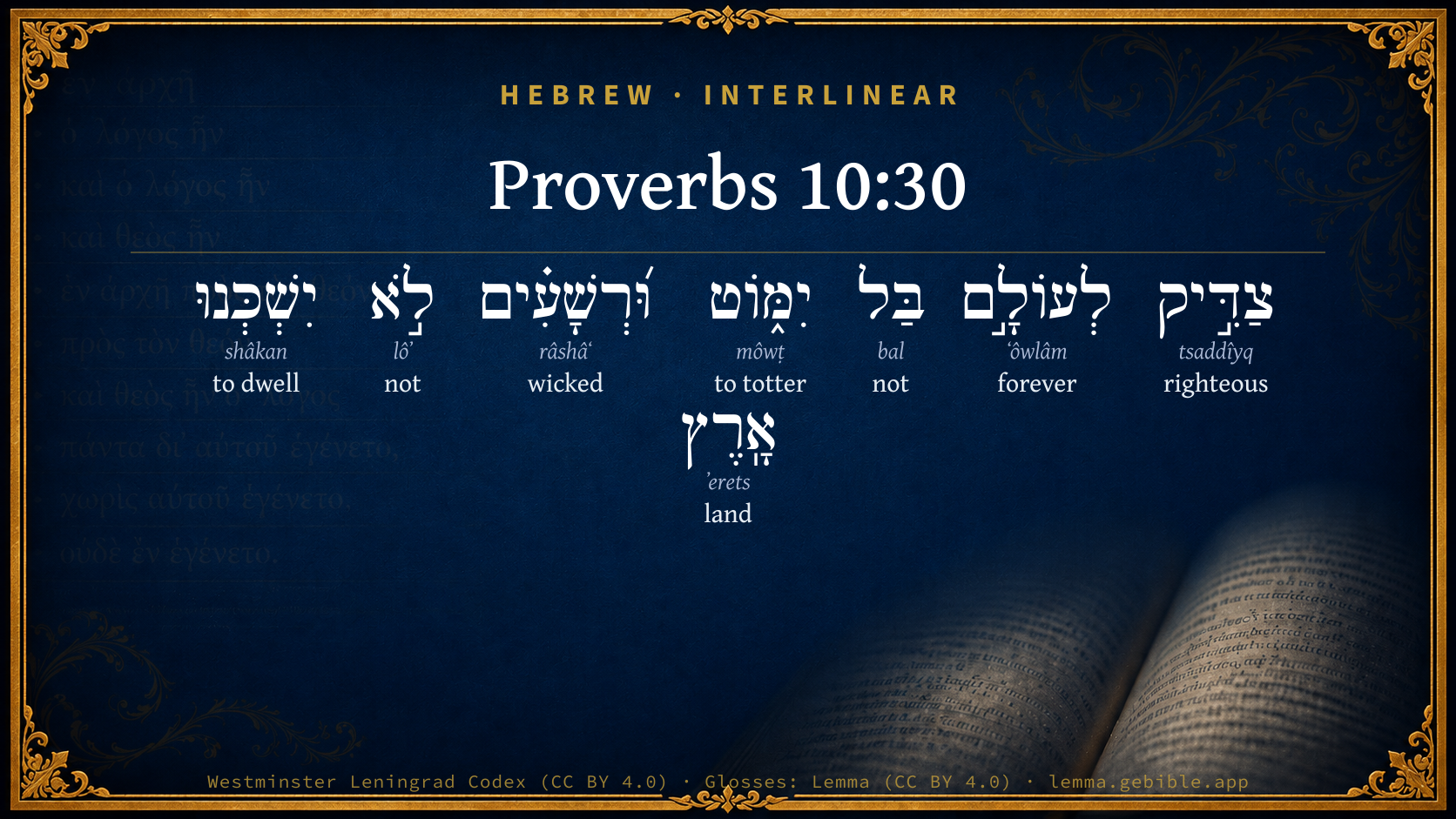
Hebrew (Westminster Leningrad Codex) Proverbs 10:30 appears in the Hebrew Old Testament. The text above is from the Westminster Leningrad Codex. Each word links to its Strong’s number, a concise gloss, and parsing drawn from the Open Scriptures Hebrew Bible morphology. Click any word for its full Brown-Driver-Briggs (BDB) entry.
Download image
Cite this verse

Proverbs 10:30 (World English Bible). Public Domain. Lemma interlinear Bible study tool, https://lemma.gebible.app/v/proverbs/10/30.

Show BibTeX & RIS
BibTeX
RIS
English Translation
The righteous will never be removed, But the wicked will not dwell in the land.
World English Bible · Public Domain
Download a study sheet

One document with this verse’s original text, its word-by-word gloss line, the meaning frame, cross-references with their text, attributed commentary, and full source and license credits — printable, and it pastes into notes with its structure intact.

This verse Autodidact and up

Study sheet (.html) Plain text (.txt)

A passage Seminary Student

Up to 50 verses in one chapter. A passage sheet keeps up to 6 commentary sources and 12 cross-references per verse, in the order this page ranks them, and says so on the sheet whenever that leaves anything out. Ask for a single verse and you get the Autodidact verse sheet above.

Everything on this page stays free to read, with no account — the sheet is a download of what is already on screen, not access to it.

Want to remove ads? Support Godless Engineer
Compare translations 3

The same verse in 3 English versions, stacked beneath the original-language interlinear above. Click any original word for its lexicon entry.

Each is an independent rendering of the whole verse — the interlinear is not word-aligned to these translations.

Highlighted words mark where these versions differ — a whole-verse word diff, not a word-by-word alignment.

  • World English Bible Public Domain
    The righteous will never be removed, But the wicked will not dwell in the land.
  • King James Version Public Domain
    The righteous shall never be removed: but the wicked shall not inhabit the earth.
  • unfoldingWord Literal Text CC BY-SA 4.0
    A righteous one will not falter to eternity, but wicked ones will not dwell the land.

unfoldingWord Literal Text — © unfoldingWord, licensed CC BY-SA 4.0. Word-aligned USFM3 via Door43 (git.door43.org/unfoldingWord/en_ult).

Versions to compare (up to 4)

3 of 4 selected

Show all 18 translations

Every available English version of this verse, each an independent rendering of the whole verse.

  • World English Bible Public Domain
    The righteous will never be removed, But the wicked will not dwell in the land.
  • Berean Standard Bible Public Domain
    The righteous will never be shaken, but the wicked will not inhabit the land.
  • Majority Standard Bible Public Domain
    The righteous will never be shaken, but the wicked will not inhabit the land.
  • King James Version Public Domain
    The righteous shall never be removed: but the wicked shall not inhabit the earth.
  • American Standard Version (1901) Public Domain
    The righteous shall never be removed; But the wicked shall not dwell in the land.
  • Revised Version (1885) Public Domain
    The righteous shall never be removed: but the wicked shall not dwell in the land.
  • Geneva Bible (1599) Public Domain
    The righteous shall neuer be remooued: but the wicked shall not dwell in the land.
  • Douay-Rheims (1899) Public Domain
    The just shall never be moved: but the wicked shall not dwell on the earth.
  • Young's Literal Translation Public Domain
    The righteous to the age is not moved, And the wicked inhabit not the earth.
  • Literal Standard Version CC BY-SA 4.0
    The righteous is not moved for all time, || And the wicked do not inhabit the earth.
  • Unlocked Literal Bible CC BY-SA 4.0
    The righteous person will never be overthrown, but the wicked will not remain in the land.
  • unfoldingWord Literal Text CC BY-SA 4.0
    A righteous one will not falter to eternity, but wicked ones will not dwell the land.
  • Darby Bible Public Domain
    The righteous [man] shall never be moved; but the wicked shall not inhabit the land.
  • World Messianic Bible Public Domain
    The righteous will never be removed, but the wicked will not dwell in the land.
  • Webster's Bible Public Domain
    The righteous shall never be removed: but the wicked shall not inhabit the earth.
  • Free Bible Version CC BY-SA 4.0
    The good will never be removed from the land, but the wicked will not remain there.
  • Bible in Basic English Public Domain
    The upright man will never be moved, but evil-doers will not have a safe resting-place in the land.
  • JPS Tanakh (1917) Public Domain
    The righteous shall never be moved; but the wicked shall not inhabit the land.

Literal Standard Version (2020), Covenant Press — licensed CC BY-SA 4.0. Text via the HelloAO Bible API (eBible.org). Unlocked Literal Bible (unfoldingWord) — licensed CC BY-SA 4.0. Text via the HelloAO Bible API (eBible.org). unfoldingWord Literal Text — © unfoldingWord, licensed CC BY-SA 4.0. Word-aligned USFM3 via Door43 (git.door43.org/unfoldingWord/en_ult). Free Bible Version, Dr. Jonathan Gallagher — licensed CC BY-SA 4.0. Text via the HelloAO Bible API (eBible.org).

Word by word

More ways to search: Search by grammar → Find every occurrence → Compare this word →

Practice this passage: Drill this verse → Learn its vocabulary →

About this verse

These counts appear in no published source. They are computed here, from the morphology-tagged text and Lemma’s own curated glosses. What Lemma adds →

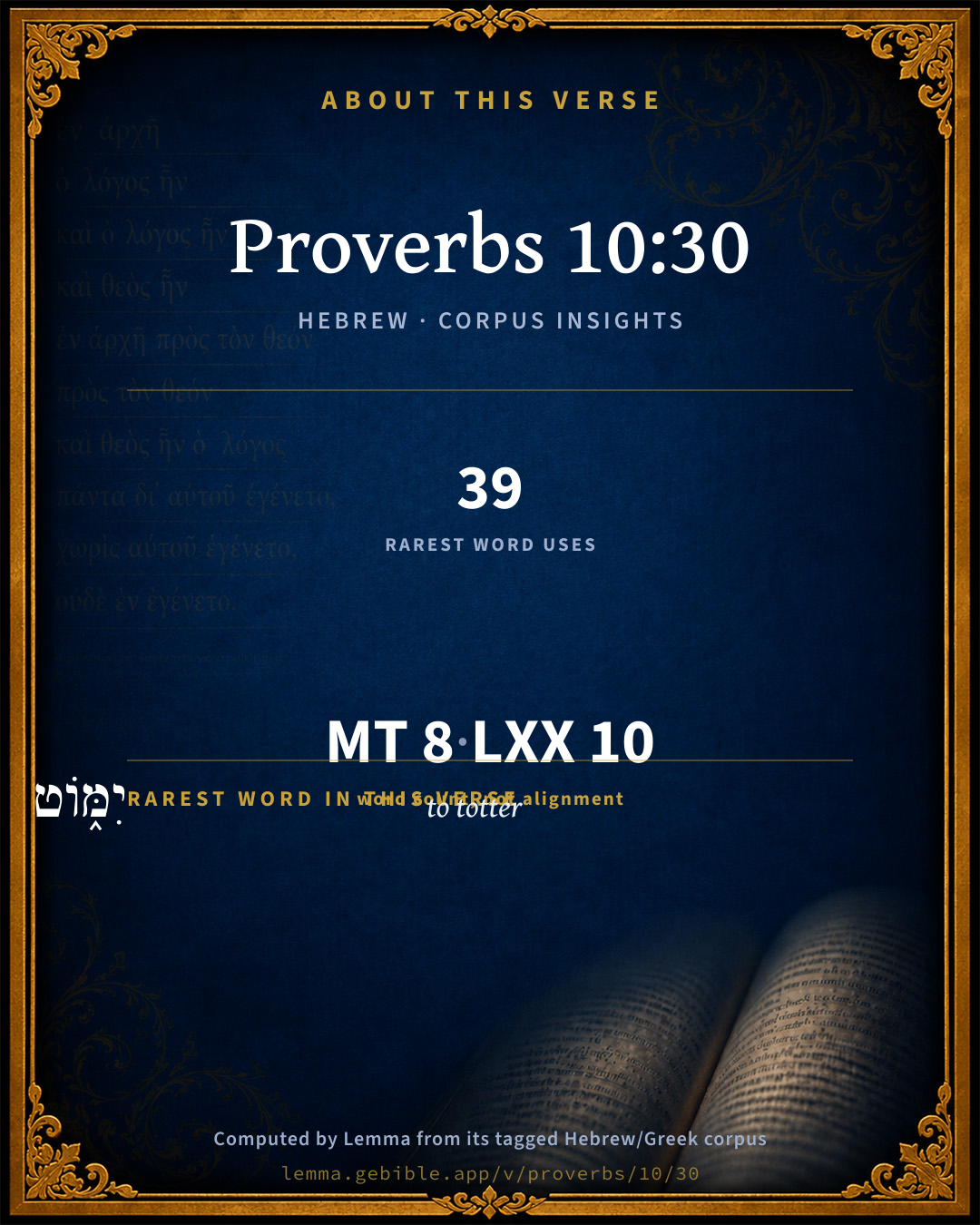
8
words
8
distinct lemmas
Wisdom
section

Shared distinctive vocabulary

יִמּ֑וֹט to totter H4131 occurs in 36 verses of the Hebrew Bible. Also found in:

Grammatical profile

  • 2 verbs
  • 2 nouns
  • 2 adjectives
  • 2 particles

Verb forms

  • יִמּ֑וֹט Niphal · Imperfect
  • יִשְׁכְּנוּ Qal · Imperfect

Hebrew & Septuagint length

In English translation the verse runs 15 words from the Hebrew and 14 from the Septuagint (LXX English) — closely comparable.

A rough comparison of the two English renderings, which tokenize alike — not a word-level alignment.

Word counts can differ between the Hebrew and the Greek without any difference in meaning — e.g. the Hebrew direct-object marker אֵת has no separate Greek word, and Greek often adds the article ὁ.

In the original languages it is 8 Hebrew tokens and 10 Greek tokens — but the two are counted differently (Hebrew bundles its prefixes and suffixes into one token; the Greek is in lemma form), so that isn’t a like-for-like length.

Cross-references

14

Topical passages linked to Proverbs 10:30 in the Treasury of Scripture Knowledge — connected by theme and wording, ordered by reader-vote popularity; previews shown in the World English Bible.

  • Psalms 37:22 For such as are blessed by him shall inherit the land. Those who are cursed by him shall be cut off.
  • Psalms 125:1 Those who trust in Yahweh are as Mount Zion, Which can't be moved, but remains forever.
  • Psalms 37:9–10 For evildoers shall be cut off, But those who wait for Yahweh shall inherit the land.
  • Psalms 37:28–29 For Yahweh loves justice, And doesn't forsake his saints. They are preserved forever, But the children of the wicked shall be cut off.
  • Proverbs 2:21–22 For the upright will dwell in the land. The perfect will remain in it.
  • Proverbs 10:25 When the whirlwind passes, the wicked is no more; But the righteous stand firm forever.
  • Psalms 16:8 I have set Yahweh always before me. Because he is at my right hand, I shall not be moved.
  • Psalms 112:6 For he will never be shaken. The righteous will be remembered forever.
  • Matthew 21:41 They told him, "He will miserably destroy those miserable men, and will lease out the vineyard to other farmers, who will give him the fruit in its season."
  • Romans 8:35–39 Who shall separate us from the love of Christ? Could oppression, or anguish, or persecution, or famine, or nakedness, or peril, or sword?
  • 2 Peter 1:10–11 Therefore, brothers, be more diligent to make your calling and election sure. For if you do these things, you will never stumble.
  • Psalms 52:5 God will likewise destroy you forever. He will take you up, and pluck you out of your tent, And root you out of the land of the living. Selah.
  • Ezekiel 33:24–26 Son of man, they who inhabit those waste places in the land of Israel speak, saying, Abraham was one, and he inherited the land: but we are many; the land is given us for inheritance.
  • Micah 2:9–10 You drive the women of my people out from their pleasant houses; From their young children you take away my blessing forever.

Cross-references courtesy of OpenBible.info (CC BY 4.0).

Hebrew and Greek witnesses Masoretic Hebrew ↔ Greek Septuagint

The same verse in the two great witnesses to the Old Testament, shown verse-for-verse.

These are two independent witnesses, not word-aligned to each other, and the Septuagint is shown in lemma (dictionary) form.

Hebrew Proverbs 10:30 Masoretic · Westminster Leningrad Codex

צַדִּ֣יק לְעוֹלָ֣ם בַּל יִמּ֑וֹט וּ֝רְשָׁעִ֗ים לֹ֣א יִשְׁכְּנוּ אָֽרֶץ

The righteous will never be removed, But the wicked will not dwell in the land.

World English Bible · Public Domain

Greek LXX Proverbs 10:30 Septuagint · lemma form

δίκαιος ὁ αἰών οὐ ἐνδίδωμι ἀσεβής δέ οὐ οἰκέω γῆ

The righteous shall never fail: but the ungodly shall not dwell in the earth.

LXX2012 (modern English Septuagint) · Public Domain

Hebrew: Westminster Leningrad Codex (CC BY 4.0). Greek: Septuagint (public domain); English from LXX2012 (modern English Septuagint) (Public Domain). How the Septuagint differs from the Hebrew →

Commentary

Notes on Proverbs 10:30 from classic Christian and Jewish commentators (each source and its license shown beneath its notes). The classic Christian expositions comment on the surrounding passage and are grouped to its opening verse, so a note may address several verses; the Jewish commentaries on the Tanakh (Rashi and others) are per-verse, so they appear only where the commentator wrote on this verse.

Lemma curates 59 commentaries, every one of them public domain or Creative Commons licensed, each selected and text-cleaned for this edition rather than reprinted as found. About our sources →

Trapp's Complete Commentary

John Trapp

Pro 10:30 The righteous shall never be removed: but the wicked shall not inhabit the earth.

Ver. 30. The righteous shall never be removed.] Or, They shall not be removed for ever, though for a while they may seem to be so.

But the wicked shall not inhabit the earth.] God sits upon the circle of the earth, to shake them out thence, as by a canvass.

John Trapp, A Commentary or Exposition upon All the Books of the Old and New Testament (1647–1656) — public domain. Text from a community e-Sword module.

The Preacher's Complete Homiletical Commentary

Joseph S. Exell (gen. ed.)

CRITICAL NOTES.—

Pro_10:31. Cut out, “rooted out.”

MAIN HOMILETICS OF Pro_10:30

THE EARTH THE POSSESSION OF THE RIGHTEOUS

I. From their relation to God it is theirs now. The estate of an English nobleman is the portion of all his family to a certain extent. They all live upon it, and partake of its productions. But the eldest son has a special inheritance in it—it is the perpetual possession of the heir of the house, and it is therefore his in a sense in which it is not the property of his brothers and sisters. “The earth is the Lord’s, and the fulness thereof” (Psa_24:1), and it is therefore the property of His children—of those who are His sons and heirs (Rom_8:17). All men enjoy to some extent the blessings of the earth, but it belongs only to them whom Paul addresses when he says, “All things are yours, whether.… the world, or life, or death, or things present, or things to come” (1Co_3:21-22).

II. From their relation to God it shall be theirs in the future. The regenerated earth is to be the eternal abode of the righteous. The glorified body of the redeemed man will have enough of his present body to enable us to identify each other. Although we have not now the “body that shall be” (1Co_15:37), there will be such a relationship between the present and the future as shall make them the same individual man. So, although the earth is to be “a new earth” (2Pe_3:13), there will be that about it which will enable the regenerated man to recognise his old home. And if in the new earth there is to dwell “righteousness,” it is because it is to be the abode of righteous beings. On this subject see also Homiletics on Chap. Pro_2:21-22.

OUTLINES AND SUGGESTIVE COMMENTS

Pro_10:30. Love of home is an impulse and emotion natural to, man; but to no people was fatherland so greatly delighted in, to none was exile and banishment from fatherland so dreadful a thought, as it was to the people of Israel. Expatriation is the worst of all evils with which the prophets threatened individuals and the people; and the history of Israel in their exile, which was a punishment of their national apostasy, confirms this proverb, and explains its form.… In general, the proverb means that the righteous fearlessly maintains the position he takes; while, on the contrary, all they who have no hold on God lose also their outward position. But often enough this saying is fulfilled in this, that they, in order that they may escape disgrace, become wanderers and fugitives, and are compelled to conceal themselves among strangers.—Delitzsch.

The desire of the righteous is not to stay upon earth, neither is that the reward which God hath appointed for them. They know a better place to go unto, and where better things than the earth can afford are provided for them. Hugo de Sancto Victore saith, therefore, making three sorts of men, “He is very delicate whose own country is delicious unto him; he is valiant to whom every country is his own; he is perfect to whom the world is a banishment. The first hath fastened his love upon the world, the second hath scattered his love in the world, the last hath extinguished his love from the world.” And this is the righteous man of whom it is here said that he shall never be removed, because he shall never be taken hence with an unwilling and reluctant mind. He having never set his affection upon the world, can never be removed from it. When he goeth hence, he goeth cheerfully and gladly; it is not a remove of him, but a pleasant passage to him.—Jermin.

Moved, not removed, but shaken: shall not be seriously disturbed.—Miller.

See also comments on chap. Pro_2:21-22.

(For Homiletics on Pro_10:31, see on Pro_10:13-14; Pro_10:20-21.)

OUTLINES AND SUGGESTIVE COMMENTS

The figure here is of a sprout or seedling which has the capacity to grow for ever. “Wisdom” is such a tree. It grows from the mouth of the good man, and will grow for ever; that is, the good man will incessantly spread abroad wisdom. God, who is invisible, spreads abroad wisdom only through the creature. But the ungodly tongue, literally “the tongue of upturnings,” overturning everything, and being in this world the great instrument for leading others astray, will be put in a condition to be foiled of such an influence: as the inspired sentence expresses it, will be “cut out.”—Miller.

As a tree full of life and sap brings forth its fruit, so in Isa_57:19, the cognate word is translated “the fruit of the lips.” The froward tongue is like a tree that brings forth evil and not good fruit. It “shall be cut down.” What is meant is, that the abuse of God’s gift of speech will lead ultimately to its forfeiture. There shall, at last, be the silence of shame and confusion.—Plumptre.

The Preacher's Complete Homiletical Commentary (gen. ed. Joseph S. Exell; Funk & Wagnalls, c. 1892) — public domain (pre-1929). A full-Bible homiletical/sermon-outline anthology covering 65 of 66 books (2 John is absent from the source module). Text from a community e-Sword module.

Tyndale Open Study Notes

Tyndale Open Resources

10:30 This proverb connects with God’s covenant promises to Israel (see Deut 28:1-14, 63-68). Such connections are rare in the book of Proverbs.

Tyndale Open Study Notes — © Tyndale Open Resources, licensed CC BY-SA 4.0. Text via the HelloAO Bible API.

Geneva Bible (1599)

Geneva Bible translators

They enjoy in this life by faith and hope, their everlasting life.

Geneva Bible (1599) marginal notes — public domain. Text via Bolls.life.

Jamieson, Fausset & Brown

Robert Jamieson, A. R. Fausset & David Brown

(Compare Pro 12:3; Psa 37:9-11; Psa 102:28).

earth--or, "land of promise."

Jamieson, Fausset & Brown — Commentary Critical and Explanatory on the Whole Bible (1871) — public domain (CC PDM 1.0). Text via the HelloAO Bible API.

Adam Clarke's Commentary

Verse 30. The righteous shall never be removed] Because he is built on the eternal foundation. See on Pr 10:25.

Adam Clarke's Commentary on the Bible (1810–1826) — public domain. Text from a community e-Sword/MySword module.

Ellicott's Commentary for English Readers

(30) The righteous shall never be removed.—See above on Pro_2:21, and Psa_37:29.

But the wicked shall not inhabit the earth.—Rather, The godless abide not in the land. They often have to become vagabonds, like Cain, for their crimes. This, too, was the great punishment threatened by Moses and all the prophets, which at last fell upon the Jews, and is still in force.

A Bible Commentary for English Readers, edited by Charles John Ellicott (1878–1897) — public domain. Text from a community e-Sword module.

The Cambridge Bible for Schools and Colleges

gen. ed. J. J. S. Perowne

30. the earth] Comp. Mat_5:5; or, the land (sc. of Canaan), as R.V. Comp. Pro_21:21-22; Exo_20:12. The law holds good, though its sphere of action may vary.

The Cambridge Bible for Schools and Colleges (gen. ed. J. J. S. Perowne; Cambridge University Press, 1878–1918) — public domain. Text from a community e-Sword module.

John Gill's Exposition

The righteous shall never be removed,.... They may be removed from place to place in this world, through the persecutions of their enemies, or through one providence or another, as they often are; they may be removed from a state of outward prosperity to a state of adversity, as Job was; they may be removed from spiritual and comfortable frames of soul to carnal or uncomfortable ones; for good frames are very precarious and uncertain things; and they will be removed out of this world into another; here they have no continuing city: but they shall never be removed from the love of God, nothing can separate them from that; they are set as a seal on his heart, and are engraven on the palms of his hands, and there is no removing them from thence; they may be waiver about their interest in the love of God; they may be without the manifestations and discoveries of it to their souls; they may be under the hidings of God's face; they may be at a distance from his house and ordinances, or may not enjoy the presence of God in them for a time; yet not separated from his affections; they shall never be removed out of the hands of Christ, into which they are put for security, and out of which none can pluck them, men or devils; how should they, since they are in those hands that made the heavens and the earth, support all in being, and hold the reins of government? Was it possible they could be removed from hence, it would impeach the wisdom of God, who has put them there; argue weakness in Christ, and suppose danger to them. Nor can they be removed out of the family of God; sons of God abide in his house for ever; they are no more foreigners and strangers; once children, no more servants; they may be corrected and chastised, yet be children; they may judge themselves unworthy of the relation, and be ready to conclude that their spots are not the spots of God's children, and fear they are none of them, and yet the relation continues: nor will they ever be removed from their state of justification, by which they are denominated righteous, into a state of condemnation; for full satisfaction is given to law and justice for them; their justification is complete, it is from all sin; the righteousness by which they are justified is everlasting, and even their faith which receives it shall never fail; to which may be added, that they are secured from wrath to come, and entitled to eternal life. In a word, they are on the sure foundation of electing grace; they are in the immovable covenant of grace; they are on the Rock of ages, Christ Jesus; all the divine Persons and perfections are on their side; they are kept by the power of God, through faith, unto salvation; see Psa 55:22;

but the wicked shall not inhabit the earth; but a very little while, as Gersom observes; and the time of their abode on earth is so short, as scarce to be called an inhabitation of it. Moreover, they shall not inhabit the earth the righteous will, even the new earth, which none but righteous persons shall inhabit, Pe2 3:13; see Psa 37:9.

John Gill's Exposition of the Whole Bible (1746–1763) — public domain (CC PDM 1.0). Text via the HelloAO Bible API.

Albert Barnes' Notes on the Bible

The wicked shall rot inhabit - The other and higher side of the same law of the divine government appears in Mat 5:5.

Albert Barnes' Notes on the Bible (1834–1885) — public domain. Text from a community e-Sword/MySword module.

Haydock's Catholic Bible Commentary

Earth. This the Jews frequently experienced. The more enlightened understood, that such promises regarded also eternity. (Calmet)

George Leo Haydock (1774–1849), Haydock's Catholic Family Bible and Commentary, 1859 edition — public domain. Excludes Psalms (Douay-Rheims chapter numbering differs from Protestant) and Deuterocanonical books (Catholic canon only).

Matthew Poole's English Annotations

The righteous shall never be removed; they shall live long and happily here, when this is most expedient for them, and eternally in heaven.

The wicked shall not inhabit the earth; they shall not have so much as a long and quite abode upon earth, unless where this is a curse and mischief to them, and much less shall they have any possession in heaven.

Matthew Poole's English Annotations on the Holy Bible (1683–1685) — public domain. Text from a community e-Sword/MySword module.

Whedon's Commentary on the Bible

Daniel D. Whedon

30. Removed — Rather, moved from the earth, or land, namely, Palestine. But under this proverb lies a more general truth. Compare Pro_2:21-22; Psa_37:22; Psa_125:1; Mat_5:5.

Daniel D. Whedon (gen. ed.), Commentary on the Old and New Testaments (1874–1909) — public domain. Text from a community e-Sword module.

The Pulpit Commentary

The righteous shall never be removed. (Pro_2:21 Pro_12:3, 21 Psa_10:6 Psa_37:29) This is in agreement with the temporal promise made to the patriarchs and often renewed, as in the fifth commandment. St. Paul says, (1Ti_4:8) "Godliness is profitable for all things, having promise of the life which now is, and of that which is to come." The wicked shall not inhabit (or, abide not in) the land. The punishment of exile was threatened upon the Jews for their disobedience, and they are still suffering this retribution. (Lev_26:33 Deu_4:27 Isa_22:17) Christ gives the other aspect of God"s moral government when he says, (Mat_5:5) "Blessed are the meek: for they shall inherit the earth."

The Pulpit Commentary (1880–1919), ed. H.D.M. Spence-Jones & Joseph S. Exell — public domain. Text from a community e-Sword module.

John Wesley's Explanatory Notes

Never be removed - They shall live happily here, and eternally in heaven. The earth - They shall not have so much as a quiet abode upon earth; much less shall they have any possession in heaven.

John Wesley, Explanatory Notes Upon the Whole Bible (1754–1765) — public domain. Text via the GEBible commentary corpus.

Keil & Delitzsch

C. F. Keil & F. Delitzsch

21 The lips of the righteous edify many;

But fools die through want of understanding.

Keil & Delitzsch — Biblical Commentary on the Old Testament (1861–1891) — public domain (CC PDM 1.0). Text via the HelloAO Bible API. (Old Testament only.)

Bridges on Proverbs

Charles Bridges

The frailty of our present condition, common to all (Ecc 9:2, Ecc 9:11 ), was not in the wise man’s eye; but the state of the two classes as in the purpose and mind of God. His way is strength to the upright. The righteous, walking steadily in the way, shall never be removed. (Psa 15:1-5 ; Psa 37:22 ; Psa 112:6 ; Psa 125:1 . 2Pe 1:5-11 .) ’They enjoy in this life by faith and hope their everlasting life.’†1 "No weapon that is formed against them shall prosper. The mountains shall depart, and the little hills shall be removed: but my loving-kindness shall not depart from thee; neither shall the covenant of my peace be removed; saith the LORD that hath mercy on thee." (Isa 54:10 .) Is not this a confidence, that earth nor hell can never shake? (Rom 8:38-39 .)

The wicked — have they any such confidence? So far from being never removed, they shall never inhabit. They have no title, like the righteous (Mat 5:5 . 1Co 3:22 ), as sons and heirs, to the blessings of earth; no hope or interest in the land, of which the earth is the type. (Psa 37:29 .) Often are they cut off from inhabiting the one. (Pro 10:27 ; Pro 2:22 . Psa 37:22 . Eze 33:24-26 .) Never will they be suffered to inhabit the other. (1Co 6:9 ; Rev 21:27 .) As our character is, so is our hope and prospect. We gain or lose both worlds.

Footnotes:

†1 Reformers’ Notes.

Charles Bridges, An Exposition of the Book of Proverbs (1846) — public domain. Text from a community e-Sword module.

Kretzmann's Popular Commentary

Paul E. Kretzmann

v. 30. The righteous shall never be removed, not lose his home or be banished from his country; but the wicked shall not inhabit the earth, they will not remain in possession of the land.

Paul E. Kretzmann, Popular Commentary of the Bible (1921–1924) — public domain. Text from a community e-Sword module.

Rashi

Rabbi Shlomo Yitzchaki (Rashi)

The righteous will not collapse forever When he collapses, his collapse is not a permanent collapse, but he will fall and rise.

Rashi on the Tanakh — English translations: “The Judaica Press complete Tanach with Rashi, translated by A. J. Rosenberg” (CC BY 4.0); “Pentateuch with Rashi's commentary by M. Rosenbaum and A.M. Silbermann, 1929-1934” (public domain); “The Metsudah Tanach series, Lakewood, N.J” (CC BY 4.0); and “The Book of Joshua, Metsudah Publications, 1997” (CC BY 4.0). Text via Sefaria.

Lesson kit

Teaching starters — assembled from the data on this page, not authored interpretation. Every prompt links to the verse data it draws on. Edit before teaching.

Proverbs, in the Wisdom, opens this verse with 8 words (8 distinct Hebrew lemmas). Its most distinctive word is môwṭ (“to totter”). A historical commentator’s framing appears above. Read the whole chapter for the surrounding context.

Discussion questions

  1. The word môwṭ carries the sense “to totter.” How does it shape the verse?
  2. How does Leviticus 25:35, which shares the word «to totter», read alongside this verse?
  3. These translations render this verse differently. What is at stake in choosing one wording over another?
  4. «יִמּ֑וֹט» is a Niphal Imperfect verb. How does that grammatical form shape the action described?
  5. Compare how Trapp's Complete Commentary and The Preacher's Complete Homiletical Commentary read this verse. Where do they agree or differ?

Things to notice

Reading settings

Reading text

Shown beneath each verse's original-language words.

Old Testament
Old Testament edition

Read the OT as the Masoretic Hebrew (MT) or the Greek Septuagint (LXX).

English shown for the Greek Septuagint (in the Hebrew ↔ Greek comparison).

Comparing translations? Open the Compare panel on any verse page to stack up to four side by side.