
Proverbs 15:8

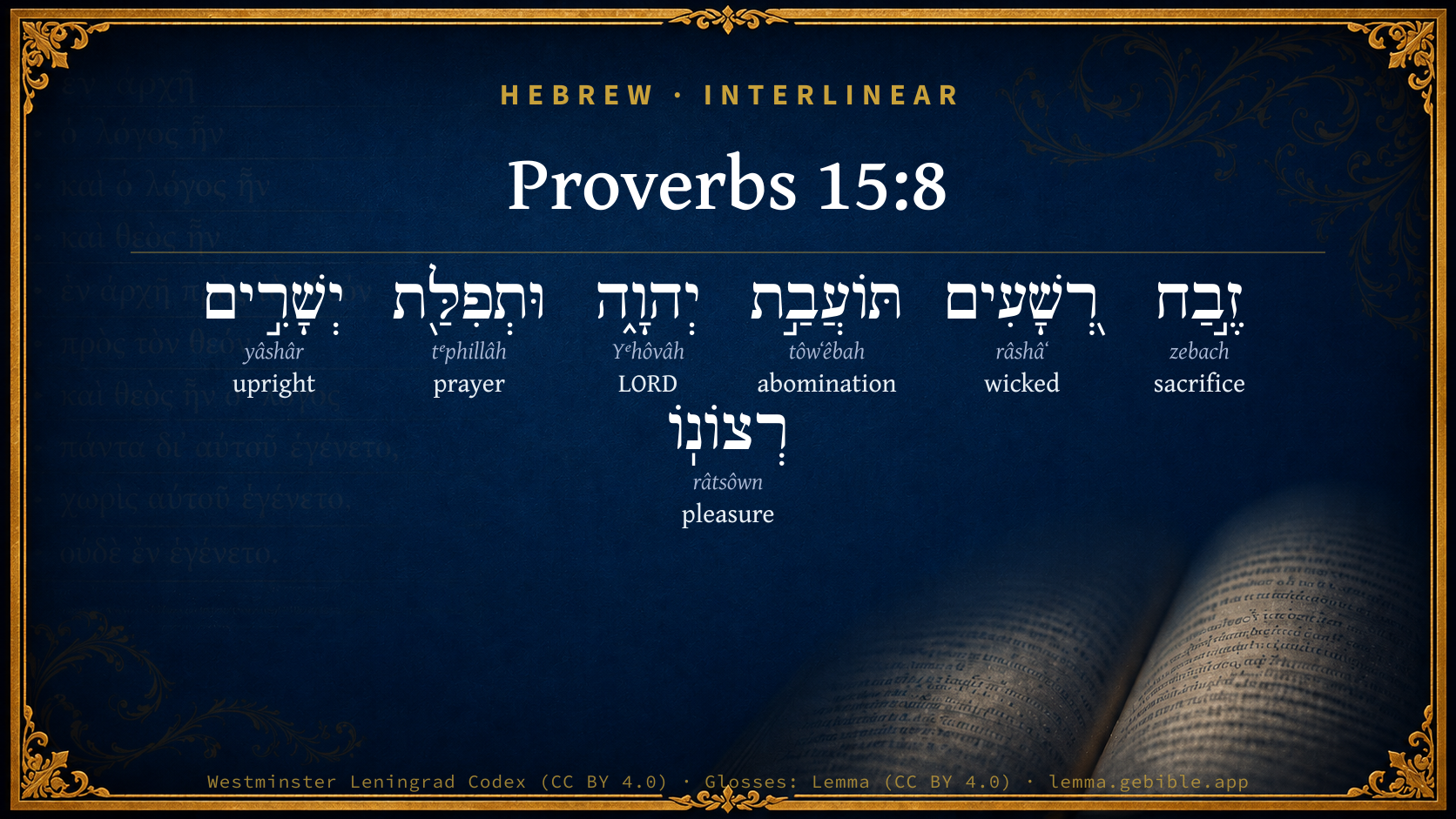
Hebrew (Westminster Leningrad Codex) Proverbs 15:8 appears in the Hebrew Old Testament. The text above is from the Westminster Leningrad Codex. Each word links to its Strong’s number, a concise gloss, and parsing drawn from the Open Scriptures Hebrew Bible morphology. Click any word for its full Brown-Driver-Briggs (BDB) entry.
Download image
Cite this verse

Proverbs 15:8 (World English Bible). Public Domain. Lemma interlinear Bible study tool, https://lemma.gebible.app/v/proverbs/15/8.

Show BibTeX & RIS
BibTeX
RIS
English Translation
The sacrifice made by the wicked is an abomination to Yahweh, But the prayer of the upright is his delight.
World English Bible · Public Domain
Download a study sheet

One document with this verse’s original text, its word-by-word gloss line, the meaning frame, cross-references with their text, attributed commentary, and full source and license credits — printable, and it pastes into notes with its structure intact.

This verse Autodidact and up

Study sheet (.html) Plain text (.txt)

A passage Seminary Student

Up to 50 verses in one chapter. A passage sheet keeps up to 6 commentary sources and 12 cross-references per verse, in the order this page ranks them, and says so on the sheet whenever that leaves anything out. Ask for a single verse and you get the Autodidact verse sheet above.

Everything on this page stays free to read, with no account — the sheet is a download of what is already on screen, not access to it.

Want to remove ads? Support Godless Engineer
Compare translations 3

The same verse in 3 English versions, stacked beneath the original-language interlinear above. Click any original word for its lexicon entry.

Each is an independent rendering of the whole verse — the interlinear is not word-aligned to these translations.

Highlighted words mark where these versions differ — a whole-verse word diff, not a word-by-word alignment.

  • World English Bible Public Domain
    The sacrifice made by the wicked is an abomination to Yahweh, But the prayer of the upright is his delight.
  • King James Version Public Domain
    The sacrifice of the wicked is an abomination to the LORD: but the prayer of the upright is his delight.
  • unfoldingWord Literal Text CC BY-SA 4.0
    The sacrifice of the wicked an abomination to Yahweh, but the prayer of the upright his delight.

unfoldingWord Literal Text — © unfoldingWord, licensed CC BY-SA 4.0. Word-aligned USFM3 via Door43 (git.door43.org/unfoldingWord/en_ult).

Versions to compare (up to 4)

3 of 4 selected

Show all 18 translations

Every available English version of this verse, each an independent rendering of the whole verse.

  • World English Bible Public Domain
    The sacrifice made by the wicked is an abomination to Yahweh, But the prayer of the upright is his delight.
  • Berean Standard Bible Public Domain
    The sacrifice of the wicked is detestable to the LORD, but the prayer of the upright is His delight.
  • Majority Standard Bible Public Domain
    The sacrifice of the wicked is detestable to the LORD, but the prayer of the upright is His delight.
  • King James Version Public Domain
    The sacrifice of the wicked is an abomination to the LORD: but the prayer of the upright is his delight.
  • American Standard Version (1901) Public Domain
    The sacrifice of the wicked is an abomination to Jehovah; But the prayer of the upright is his delight.
  • Revised Version (1885) Public Domain
    The sacrifice of the wicked is an abomination to the LORD: but the prayer of the upright is his delight.
  • Geneva Bible (1599) Public Domain
    The sacrifice of the wicked is abomination to the Lord: but the prayer of the righteous is acceptable vnto him.
  • Douay-Rheims (1899) Public Domain
    The victims of the wicked are abominable to the Lord: the vows of the just are acceptable.
  • Young's Literal Translation Public Domain
    The sacrifice of the wicked `is' an abomination to Jehovah, And the prayer of the upright `is' His delight.
  • Literal Standard Version CC BY-SA 4.0
    The sacrifice of the wicked [is] an abomination to YHWH, || And the prayer of the upright [is] His delight.
  • Unlocked Literal Bible CC BY-SA 4.0
    Yahweh hates the sacrifices of wicked people, but the prayer of upright people is his delight.
  • unfoldingWord Literal Text CC BY-SA 4.0
    The sacrifice of the wicked an abomination to Yahweh, but the prayer of the upright his delight.
  • Darby Bible Public Domain
    The sacrifice of the wicked is an abomination to Jehovah; but the prayer of the upright is his delight.
  • World Messianic Bible Public Domain
    The sacrifice made by the wicked is an abomination to the LORD, but the prayer of the upright is his delight.
  • Webster's Bible Public Domain
    The sacrifice of the wicked is an abomination to the LORD: but the prayer of the upright is his delight.
  • Free Bible Version CC BY-SA 4.0
    The Lord hates the sacrifices of the wicked, but he loves the prayers of the good.
  • Bible in Basic English Public Domain
    The offering of the evil-doer is disgusting to the Lord, but the prayer of the upright man is his delight.
  • JPS Tanakh (1917) Public Domain
    The sacrifice of the wicked is an abomination to the LORD; but the prayer of the upright is His delight.

Literal Standard Version (2020), Covenant Press — licensed CC BY-SA 4.0. Text via the HelloAO Bible API (eBible.org). Unlocked Literal Bible (unfoldingWord) — licensed CC BY-SA 4.0. Text via the HelloAO Bible API (eBible.org). unfoldingWord Literal Text — © unfoldingWord, licensed CC BY-SA 4.0. Word-aligned USFM3 via Door43 (git.door43.org/unfoldingWord/en_ult). Free Bible Version, Dr. Jonathan Gallagher — licensed CC BY-SA 4.0. Text via the HelloAO Bible API (eBible.org).

Word by word

More ways to search: Search by grammar → Find every occurrence → Compare this word →

Practice this passage: Drill this verse → Learn its vocabulary →

About this verse

These counts appear in no published source. They are computed here, from the morphology-tagged text and Lemma’s own curated glosses. What Lemma adds →

7
words
7
distinct lemmas
Wisdom
section

Shared distinctive vocabulary

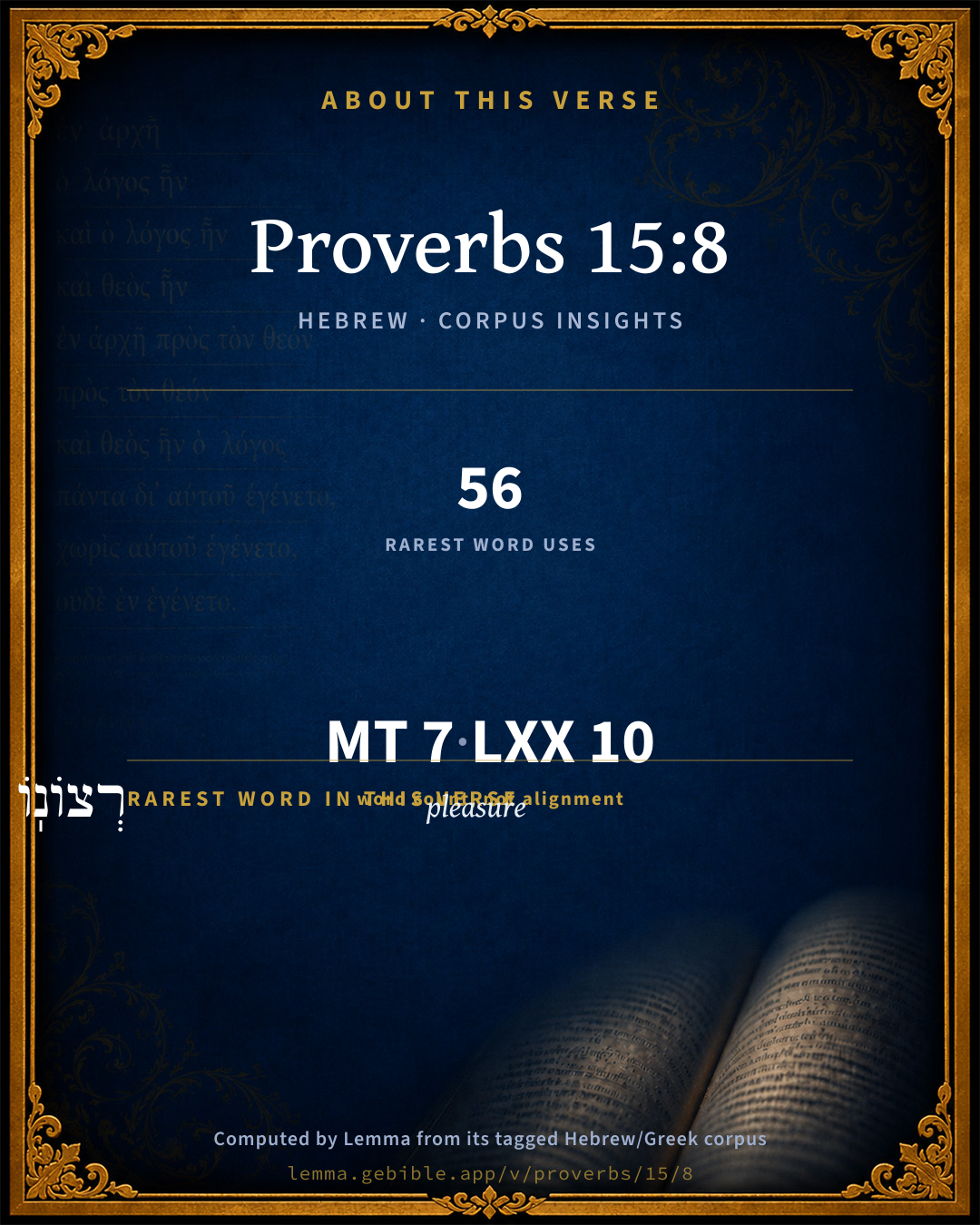
רְצוֹנֽוֹ pleasure H7522 occurs in 56 verses of the Hebrew Bible. Also found in:

Grammatical profile

  • 5 nouns
  • 2 adjectives

Hebrew & Septuagint length

In English translation the verse runs 20 words from the Hebrew and 23 from the Septuagint (LXX English) — closely comparable.

A rough comparison of the two English renderings, which tokenize alike — not a word-level alignment.

Word counts can differ between the Hebrew and the Greek without any difference in meaning — e.g. the Hebrew direct-object marker אֵת has no separate Greek word, and Greek often adds the article ὁ.

In the original languages it is 7 Hebrew tokens and 10 Greek tokens — but the two are counted differently (Hebrew bundles its prefixes and suffixes into one token; the Greek is in lemma form), so that isn’t a like-for-like length.

Cross-references

14

Topical passages linked to Proverbs 15:8 in the Treasury of Scripture Knowledge — connected by theme and wording, ordered by reader-vote popularity; previews shown in the World English Bible.

  • Proverbs 15:29 Yahweh is far from the wicked, But he hears the prayer of the righteous.
  • 1 Chronicles 29:17 I know also, my God, that you try the heart, and have pleasure in uprightness. As for me, in the uprightness of my heart I have willingly offered all these things: and now have I seen with joy your people, that are present here, offer willingly to you.
  • Proverbs 21:27 The sacrifice of the wicked is an abomination: How much more, when he brings it with a wicked mind!
  • Proverbs 28:9 He who turns away his ear from hearing the law, Even his prayer is an abomination.
  • Isaiah 1:10–15 Hear the word of Yahweh, you rulers of Sodom! Listen to the law of our God, you people of Gomorrah!
  • Jeremiah 6:20 To what purpose comes there to me frankincense from Sheba, and the sweet cane from a far country? your burnt offerings are not acceptable, nor your sacrifices pleasing to me.
  • Isaiah 61:8 For I, Yahweh, love justice, I hate robbery with iniquity; and I will give them their recompense in truth, and I will make an everlasting covenant with them.
  • John 4:24 God is spirit, and those who worship him must worship in spirit and truth."
  • Ecclesiastes 5:1 Guard your steps when you go to God's house; for to draw near to listen is better than to give the sacrifice of fools, for they don't know that they do evil.
  • Psalms 17:1 Hear, Yahweh, my righteous plea; Give ear to my prayer, that doesn't go out of deceitful lips.
  • Isaiah 66:3 He who kills an ox is as he who kills a man; he who sacrifices a lamb, as he who breaks a dog's neck; he who offers an offering, [as he who offers] pig's blood; he who burns frankincense, as he who blesses an idol. Yes, they have chosen their own ways, and their soul delights in their abominations:
  • Jeremiah 7:21–23 Thus says Yahweh of Hosts, the God of Israel: Add your burnt offerings to your sacrifices, and eat you flesh.
  • Song of Solomon 2:14 My dove in the clefts of the rock, In the hiding places of the mountainside, Let me see your face. Let me hear your voice; For your voice is sweet, and your face is lovely.
  • Amos 5:21–22 I hate, I despise your feasts, And I can't stand your solemn assemblies.

Cross-references courtesy of OpenBible.info (CC BY 4.0).

Hebrew and Greek witnesses Masoretic Hebrew ↔ Greek Septuagint

The same verse in the two great witnesses to the Old Testament, shown verse-for-verse.

These are two independent witnesses, not word-aligned to each other, and the Septuagint is shown in lemma (dictionary) form.

Hebrew Proverbs 15:8 Masoretic · Westminster Leningrad Codex

זֶ֣בַח רְ֭שָׁעִים תּוֹעֲבַ֣ת יְהוָ֑ה וּתְפִלַּ֖ת יְשָׁרִ֣ים רְצוֹנֽוֹ

The sacrifice made by the wicked is an abomination to Yahweh, But the prayer of the upright is his delight.

World English Bible · Public Domain

Greek LXX Proverbs 15:8 Septuagint · lemma form

θυσία ἀσεβής βδέλυγμα κύριος εὐχή δέ καταεὐθύνω δεκτός παρά αὐτός

The sacrifices of the ungodly are an abomination to the Lord; but the prayers of them that walk honestly are acceptable with him.

LXX2012 (modern English Septuagint) · Public Domain

Hebrew: Westminster Leningrad Codex (CC BY 4.0). Greek: Septuagint (public domain); English from LXX2012 (modern English Septuagint) (Public Domain). How the Septuagint differs from the Hebrew →

Commentary

Notes on Proverbs 15:8 from classic Christian and Jewish commentators (each source and its license shown beneath its notes). The classic Christian expositions comment on the surrounding passage and are grouped to its opening verse, so a note may address several verses; the Jewish commentaries on the Tanakh (Rashi and others) are per-verse, so they appear only where the commentator wrote on this verse.

Lemma curates 59 commentaries, every one of them public domain or Creative Commons licensed, each selected and text-cleaned for this edition rather than reprinted as found. About our sources →

Trapp's Complete Commentary

John Trapp

Pro 15:8 The sacrifice of the wicked [is] an abomination to the LORD: but the prayer of the upright [is] his delight.

Ver. 8. The sacrifice of the wicked is an abomination.] Their very incense stinks from the hand that offers it. {Isa 1:13} Good words may be uttered, but we cannot hear them, because uttered with a stinking breath: and good meat may be presented, but we cannot eat of it because it is cooked or brought to the table by a nasty sloven. Works materially good, may never prove so formally and eventually - viz., when they are not right quoad fontem, et quoad finem. (1). When they proceed not from a right principle, "a pure heart, a good conscience, and faith unfeigned"; {1Ti 1:5} (2). When they tend not to a right end, the glory of God in our own or other men’s salvation. Christus opera nostra non tam actibus quam finibus pensat. {a} The glory of God must consume all other ends, as the sun puts out the light of the fire.

But the prayer of the righteous is his delight.] His music, his honey drops, {Son 4:11} his sweetest perfume, {Psa 141:2} his "calves of the lips," {Hos 14:2} with which, when we cover his altar, he is abundantly well-pleased. For as all God’s senses, nay, his very soul is offended with the bad man’s sacrifice {Isa 1:13-15} - his sharp nose easily discerneth, and disgusteth the stinking breath of his rotten lungs, though his words be never so scented and perfumed with shows of holiness-so the prayer that proceeds from an upright heart, though but faint and feeble, doth come before God, "even into his ears," {Psa 18:6} and so strangely charms him, {Isa 26:16, marg.} {b} that he breaks forth into these words, "Ask me of things concerning my sons, and concerning the works of my hands command ye me." {Isa 45:11} Oh that we understood the latitude of this royal charter! then would we pray always with all prayers and supplications in the Spirit; then would we watch thereunto with all perseverance, and not faint or shrink back. {Eph 6:18 Luk 18:1, εκκακειν}

{a} Zanchius.

{b} לחשׁ Incantamentum.

John Trapp, A Commentary or Exposition upon All the Books of the Old and New Testament (1647–1656) — public domain. Text from a community e-Sword module.

Joseph Benson's Commentary

Pro 15:8-9. The sacrifice of the wicked — Or the religious services, yea, the best and most costly of them, one kind being put for all the rest; is an abomination to the Lord — Because not offered with a sincere desire to glorify him, nor from a principle of faith and love, but is made a cloak for sin, is used to silence the clamours of conscience, and commute for the neglect of obedience to God’s moral commands: see the margin. It is justly observed by Mr. Scott here, that “the most costly sacrifices of the wicked, under the Mosaic law, must have been an abomination to the Lord; because their whole way was abominable to him, and because of their corrupt motives; and the case is precisely the same with all external acts of worship, nay, with the largest oblations, and most liberal alms of the impenitent and unbelieving, under the Christian dispensation. For, by them, they either mean nothing determinate, or they intend to cover their sins, to bribe their Judge, to make compensation for past, or to purchase indulgences for future transgressions: they put their services in the stead either of Christ’s atonement, or of holy obedience; they present them with hypocritical hearts; and they grossly affront the holy God by supposing that he can be imposed on by forms or gifts, or pleased by them while they are enemies to his justice, his authority, and his grace.” But the prayer of the upright is his delight — Their cheapest and meanest services, even their very prayers, are acceptable, yea, highly pleasing to him, and prevail for great blessings from him.

Joseph Benson's Commentary on the Old and New Testaments (1811–1818) — public domain. Text from a community e-Sword module.

The Preacher's Complete Homiletical Commentary

Joseph S. Exell (gen. ed.)

MAIN HOMILETICS OF Pro_15:8-9

PRAYING AND LIVING

I. God loves righteous men with a special love. God has a love for all His human creatures—a love which springs out of His relationship to them as their Creator. He loves the “world” (Joh_3:16), but this love cannot be said to spring from likeness of character between Him and the objects of His love. There is a spontaneous love welling up in the mother’s heart towards her child long before that child has developed any qualities to win love. The love springs from the relationship that exists between the child and its parent, and it exists before there has been time and opportunity to develop a loveable character. And there is still love in the mother’s heart from the relationship, if, after there has been time to form a loveable character, no such character is manifested—if there is no response to the parent’s love. There is this spontaneous love in God for all His human children—a love that, even when it meets with no response, does not cease to pity those who reject it. “God commended His love toward us in that while we were yet sinners Christ died for us” (Rom_5:8). “But, after the kindness and love of God our Saviour toward man appeared, not by works of righteousness which we have done, but according to His mercy He saved us” (Tit_3:4-5). But the special love which God has to righteous men—to men of integrity—to men who are sincere in their love of righteousness, and who make conformity to it the end and aim of their life (see on chap. Pro_11:3, page 196), is a love which springs from likeness of character. It is the personal love of a perfectly Righteous Being for persons whose characters, in some degree, resemble His own. The good human father loves to see his own character in miniature in that of his child. He delights to see his son “following after” him in his holy habits and feelings—he loves him with a deeper and more joyful love as he sees in him the germs of holy desires and aims which he knows will be more fully developed as he grows into manhood. And so the “Heavenly Father” loves with the love of delight (chap. Pro_12:22) those of His human sons and daughters who have begun to reflect His image in their hearts and lives, and waits with patience until the blade changes to the ear, and the ear into the full corn—until they are not only just men, but “just men made perfect” (Heb_12:23).

II. One act of a righteous man which God regards with special pleasure. “The prayer of the upright.”

1. Because it is an expression of conscious need. A sense of spiritual need and weakness is indispensable, even to the continuance of a righteous character, much more to its growth. While a man feels his need, he will not only keep what he already has, but will be in the way of getting more. While he feels that he has not “already attained” neither is “already perfect” he will “follow after” perfection, he will “reach forth unto those things which are before, and press toward the mark for the prize of the high calling of God”—(Php_3:12-14), even to entire and absolute holiness of character. When he prays, he expresses his sense of need, and thus gives proof of that lowliness and contrition of heart without which no man can receive supplies of Divine grace. Therefore God delights in his prayer.

2. It is an expression of filial confidence. He not only knows what he wants, but he knows who is able and willing to supply his need. Prayer is in itself an act of faith—it is an expression of belief that “God is and that He is a rewarder of them that diligently seek Him. (Heb_11:6.) A human benefactor, especially a human parent, feels that application to him for help is a tribute to his goodness and to his power—it is a manifestation that those who seek his aid are assured of his willingness and ability to meet their need. So with the Divine Friend and Father. He loves to have His compassion and His power confided in by His creatures.

3. It is an act of obedience. God has commanded “men always to pray.” (Luk_18:1.) It was a condition to be observed under the Old Testament dispensation, as well as under that of the new. “Thus saith the Lord, I will yet for this be inquired of by the house of Israel to do it for them.” (Eze_36:37). “Ask and it shall be given you” (Luk_11:9). The conditions are easy, but they are indispensable. No wise parent gives his children what they desire, except certain conditions are fulfilled. They may be very easy, but in no well-governed family are they dispensed with. So in God’s family. True he knows what his children need before they ask Him, even better than the wisest and most tender human parent, but the command is absolute, the condition without exception. Prayer is therefore acceptable to Him because it is an act of obedience to His command.

III. God abhors the way of the wicked.

1. Because they are at war with their better nature. There are instincts in every mail which are opposed to wrong-doing. There is a light which lightens every man that cometh into the world. When men sin they war against their own better nature. Cain possessed instincts which he must have stifled and trampled down before he could shed his brother’s blood, and so it is with every son of Adam. God must hate that which debases the creature whom He created in His own image.

2. Because their ways are at war with His purpose to bless them. A wise statesman may conceive a plan which he sees by his superior intelligence is calculated to bring great blessings to his nation. He labours to make the nation see it also—he uses all his reasoning power and all the force of his eloquence to bring it into operation, to make it the law of the land. But the very people whom it is intended to benefit may, from ignorance and prejudice, oppose his wise and beneficent efforts. He looks upon their opposition with the deepest displeasure, because it is opposed to their own welfare. If a son rebel against the plans which a wise and good father has formed for his benefit, the father must be deeply displeased at the obstinacy which thus frustrates his purpose of love and wisdom. God’s complaint against Israel was, “I have nourished and brought up children, and they have rebelled against Me” (Isa_1:2)—rebelled against all His gracious plans and purposes concerning them, and that is His quarrel with the ways of wicked men in general that crosses all His purposes of mercy towards them.

IV. Their acts of worship are especially displeasing to Him. They are offered with no sense of spiritual need—with no desire to forsake sin. When such men engage in outward acts of worship it is as if a thief were to offer to his judge some of his unlawful gain as a bribe to be allowed to go free of punishment. God so regarded the sacrifices of Israel when they came into His courts with “hands full of blood.” “Your new moons and your appointed feasts My soul hateth” (Isa_1:14-15). They were an abomination to Jehovah because the hearts of the men who offered them were in love with sin and desired only, if possible, to escape the penalty due to it. Men in all ages would have been well pleased to “be pardoned and to retain the offence,” but the very suggestion of such a thing is a gross insult to the righteousness of God, and as this is the only construction that can be put upon a drawing near to Him in outward service while the heart is far from Him (Isa_29:13), the sacrifice of the wicked must be the act most abhorrent to God of a way which is altogether an “abomination unto Him.”

OUTLINES AND SUGGESTIVE COMMENTS

Pro_15:8. When an ungodly man prays, it is not the act of prayer that constitutes the sin, it is the want of a praying heart. The sin is in him, not in his prayer.—Wardlaw.

The formal devotion of a faithless man is not worth the crust of bread which he asks.—T. Adams.

Man judges by acts, God by principles. The sacrifice of the wicked, though it be part of God’s own service, yet “will be found in His register in the catalogue of sins to be accounted for” (Bp. Hopkins). Is he then finally rejected? Far from it. His desire to seek the Lord would be the beginning of the prayer that ensures acceptance. That which brings acceptance is—not the perfection, but the simplicity of uprightness.—Bridges.

“Sacrifice and prayer” are not here contrasted as the higher and the lower, but “sacrifice” is a gift to God, “prayer” is desiring from Him (Comp. Isa_1:11; Isa_1:15, etc.) Yet this is by no means an essential difference; for both sacrifice and prayer, which indeed fall likewise under the category of offering in the broadest sense (Psa_119:108; Heb_13:15) come under consideration here only as general tokens of reverence for God; and the value of both is clearly defined by this test, whether the state of heart is or is not well pleasing to God.—Lange’s Commentary.

It is not works that make the man good, but when a man is justified his works are also good. God in His grace makes well pleasing to Himself the works that come of faith, even though great imperfections still mingle with them.—Starke.

“The sacrifice of the wicked,” though it may be very costly—the column of Stylites, the hook-swinging of the east, the millions of anxious charity—without grace must be purely sin. “The prayer of the upright,” though it asks instead of gives, yet is a delight, where the other is an abomination. A man may serve God out of sheer selfish wickedness. Moreover, all are abominable. There is no just man upon earth. But the righteous has the righteousness of Christ; while these others are left, without a cover, to their own abominable guiltiness.—Miller.

Works materially good may never prove so formally and eventually, viz:

(1) When they proceed not from a right principle;

(2) When they tend not to a right end. The glory of God must consume all other ends, as the sun puts out the light of the fire. But the prayer that proceeds from an upright heart, though but faint and feeble, doth come before God, even “into His ears” (Psa_18:6), and so strangely charms Him (Isa_26:16) that He breaks forth into these words: “Ask me of things concerning my sons, and concerning the works of my hands command ye me” (Isa_45:11). Oh that we understood the latitude of this royal charter!—Trapp.

Pro_15:9. “The way of the wicked is abomination.” Not his sacrifices only, but his civilities: all his actions—natural, moral, recreative, religious—are offensive to God. The very “ploughing of the wicked is sin” (Pro_21:4).… “But He loveth him that followeth after righteousness, although he fulfil not all righteousness, yet if he make after it with might and main, if he pursue it and have it in chase, “if by any means he may attain to the resurrection of the dead” Php_3:11); that is, the height of holiness that accompanies the resurrection: this is the man whom God loves. Now God’s love is not an empty love; it is not like the winter sun, that casteth a goodly countenance when it shines, but gives little warmth and comfort. “Thou meetest him that rejoiceth and worketh righteousness; those that remember Thee in Thy ways” (Isa_64:5), “that think upon Thy commandments to do them” (Psa_103:20), that are weak but willing (Heb_13:8), that are lifting at the latch, though they cannot do up the door: “Surely, shall every such one say, in the Lord have I righteousness and strength” (Isa_45:24). “Righteousness,” that is, mercy to those that come over to Him, and “strength” to enable them to come, as the sea sends out waters to fetch us to it.—Trapp.

The way of the wicked and the abomination of the Lord go on with equal paces. It is his way, because he leadeth himself in it, refusing to follow the guide of instruction: and God’s way it is, wherein His abomination pursueth after him.… St. Bernard saith, “God loveth, neither doth this arise from anything in others, but Himself it is from whence He loveth; and therefore the more vehemently, because He doth not so much love, as rather Himself is love.”—Jermin.

The Preacher's Complete Homiletical Commentary (gen. ed. Joseph S. Exell; Funk & Wagnalls, c. 1892) — public domain (pre-1929). A full-Bible homiletical/sermon-outline anthology covering 65 of 66 books (2 John is absent from the source module). Text from a community e-Sword module.

Tyndale Open Study Notes

Tyndale Open Resources

15:8 God looks beyond the outward actions of sacrifice and prayers to see if they reflect the heart’s attitude (see also 21:27; Ps 40:6-8; Mic 6:6-8).

Tyndale Open Study Notes — © Tyndale Open Resources, licensed CC BY-SA 4.0. Text via the HelloAO Bible API.

Geneva Bible (1599)

Geneva Bible translators

That thing is abominable before God, which the wicked think to be most excellent, and whereby they think most to be accepted.

Geneva Bible (1599) marginal notes — public domain. Text via Bolls.life.

Matthew Henry's Commentary

Note, 1. God so hates wicked people, whose hearts are malicious and their lives mischievous, that even their sacrifices are an abomination to him. God has sacrifices brought him even by wicked men, to stop the mouth of conscience and to keep up their reputation in the world, as malefactors come to a sanctuary, not because it is a holy place, but because it shelters them from justice; but their sacrifices, though ever so costly, are not accepted of God, because not offered in sincerity nor from a good principle; they dissemble with God, and in their conversations give the lie to their devotions, and for that reason they are an abomination to him, because they are made a cloak for sin, Pro 7:14. See Isa 1:11. 2. God has such a love for upright good people that, though they are not at the expense of a sacrifice (he himself has provided that), their prayer is a delight to him. Praying graces are his own gift, and the work of his own Spirit in them, with which he is well pleased. He not only answers their prayers, but delights in their addresses to him, and in doing them good.

Matthew Henry's Commentary on the Whole Bible (1708–1710) — public domain (CC PDM 1.0). Text via the HelloAO Bible API.

Jamieson, Fausset & Brown

Robert Jamieson, A. R. Fausset & David Brown

The sacrifice [and] prayer--are acts of worship.

way . . . followeth . . . righteousness--denote conduct. God's regard for the worship and deeds of the righteous and wicked respectively, so stated in Psa 50:17; Isa 1:11.

Jamieson, Fausset & Brown — Commentary Critical and Explanatory on the Whole Bible (1871) — public domain (CC PDM 1.0). Text via the HelloAO Bible API.

Adam Clarke's Commentary

Verse 8. The sacrifice of the wicked is an abomination] Even the most sedulous attendance on the ordinances of God, and performance of the ceremonies of religion, is an abomination to the Lord, if the heart be not right with him, and the observance do not flow from a principle of pure devotion. No religious acts will do in place of holiness to the Lord.

The prayer of the upright is his delight.] What a motive to be upright; and what a motive to the upright to pray! But who is the upright? The man who is weary of sin, and sincerely desires the salvation of God; as well as he who has already received a measure of that salvation. Hence it is said in the next verse, "He loveth him that followeth after righteousness."

Adam Clarke's Commentary on the Bible (1810–1826) — public domain. Text from a community e-Sword/MySword module.

Ellicott's Commentary for English Readers

(8) The sacrifice of the wicked is an abomination to the Lord.—And their prayers also (Isa_1:11). The worthlessness of sacrifice without obedience (comp. 1Sa_15:22) may be here especially mentioned, because men are apt to think that what involves cost and trouble must be pleasing to God, even when not accompanied with what alone He cares for, a loving heart.

The prayer of the upright is his delight.—Even when offered by itself, without sacrifice.

A Bible Commentary for English Readers, edited by Charles John Ellicott (1878–1897) — public domain. Text from a community e-Sword module.

The Cambridge Bible for Schools and Colleges

gen. ed. J. J. S. Perowne

8. See Gen_4:3-5; Heb_11:4; Heb_11:6.

The Cambridge Bible for Schools and Colleges (gen. ed. J. J. S. Perowne; Cambridge University Press, 1878–1918) — public domain. Text from a community e-Sword module.

John Gill's Exposition

The sacrifice of the wicked is an abomination to the Lord,.... Even those sacrifices which were of divine appointment under the former dispensation, when offered by wicked men, without faith in Christ, without any sense of sin, repentance for it, and reformation from it; when these were used as a cloak for sin, under which they sheltered and satisfied themselves, and went on in sin; when they brought them "with a wicked mind", as in Pro 21:27; when either what they brought were not according to the law, the lame and the blind; or were not their own, but robbery for burnt sacrifice; or supposing that these would atone for their sins of themselves; when either of these, or all this, was the case, it was an abomination to the Lord; see Isa 1:11. Wherefore much more must Pagan sacrifices be an abomination to him; which were not of his appointing, and were offered to devils, and not to him; and which were many of them very inhuman and shocking; as giving a man's firstborn for his transgression, and the fruit of his body for the sin of his soul: and so likewise Papal sacrifices, the sacrifice of the mass; the bloodless sacrifice, the offering up again of the body and blood of Christ, they pretend to; which, as it is wicked and blasphemous, is an abomination to the Lord, and perhaps is chiefly intended. Sacrifice may stand for every religious duty performed by a wicked man, being hypocritically done, and with no good view; and all their good works, which seem to be so; and are either not according to the word and will of God, being never commanded by him, of which sort are many among the Papists; or they are not done in faith, and so sin, and do not spring from love to God; but are done with a heart full of enmity to him, and are not directed to his glory: in short, whatever is done by them, let it have ever such an appearance of devotion and goodness; yet if it is placed in the room of Christ, and used to the setting aside of his righteousness, satisfaction, and sacrifice, it is an abomination to the Lord;

but the prayer of the upright is his delight: the prayer of such, whose hearts are right with God; who have right spirits renewed in them; are Israelites indeed; have the truth of grace and root of the matter in them; are honest, sincere, and upright in heart: the prayer of such, which is an inwrought one, wrought in his heart by the Spirit of God, and so comes from God, and is his own breathing in him, must be well pleasing to him; that which is fervent, earnest, and importunate, which cometh not out of feigned lips, but from the heart, and is put up with a true heart, in the sincerity of it; the prayer of faith, the cry of the humble; the prayer which is addressed to God as a Father, in the name of Christ the Mediator, which comes perfumed with the incense of his mediation, introduced with the celebration of the divine perfections, contains humble confessions of sin and unworthiness, ascribes all blessings to the grace of God, and expresses thankfulness for favours received, is very acceptable and delightful to God; though it is the prayer of a poor, mean, despicable creature in his own eyes, and in the eyes of others, Psa 102:17. This stands opposed to the pompous rites and ceremonies, the gaudy worship and costly sacrifices, of wicked men; such as used by the Papists.

John Gill's Exposition of the Whole Bible (1746–1763) — public domain (CC PDM 1.0). Text via the HelloAO Bible API.

Haydock's Catholic Bible Commentary

Wicked. Still unconverted, Ecclesiasticus xxxiv. 23. When they repent, and offer sacrifice with sincerity, they will obtain mercy. The Donatists abused this text, to prove that baptism conferred by wicked ministers was unavailing. But St. Augustine shewed them, that Christ was the principal agent, and conferred grace, even though the minister might draw down judgments on his own head. (Con. Parm. ii. 6.) --- Even pagans confessed, that sacrifices, without virtue, could afford no benefit. "God was more pleased with the prayers of the Lacedemonians, than with all the sacrifices of the Greeks," say the idolatrous priests in Plato, Alcib. ii. (Seneca de Ben. i. 5.)

George Leo Haydock (1774–1849), Haydock's Catholic Family Bible and Commentary, 1859 edition — public domain. Excludes Psalms (Douay-Rheims chapter numbering differs from Protestant) and Deuterocanonical books (Catholic canon only).

Matthew Poole's English Annotations

The sacrifice; all the religious services, yea, the best and most costly of them; one kind being put for all the rest.

The prayer; the cheapest and meanest services.

Matthew Poole's English Annotations on the Holy Bible (1683–1685) — public domain. Text from a community e-Sword/MySword module.

Whedon's Commentary on the Bible

Daniel D. Whedon

8. The sacrifice of the wicked is an abomination — This is one of the most important sayings in the book. “Sacrifice,” as it was the chief of ceremonial observances under the old dispensation, here stands for the whole of them; and this proverb is as much as to say, that no ceremonial observance of a wicked man can be acceptable to God; nay, more, they are abomination in his sight. Of course, it is implied that the man is a sinner in the proper sense of that word; not a penitent, seeking forgiveness, but one who, notwithstanding his ceremonious worship, adheres to sin in his heart, and practices it in his life; moreover, that he offers this external worship as sufficient in itself for acceptance, instead of moral qualities of heart and life. All such substitution of ceremonials for moral qualities, for purity of heart and righteousness of life, are an abomination to Jehovah. So he has declared over and over again by his prophets in the old, and by his Son and his apostles under the new, dispensation. However pleasing such sacrifices may be from a man of pure heart and upright life, or from one hungering and thirsting after righteousness, they are as the oblations of Cain and Balaam when unaccompanied with purity or penitence. But the prayer (worship) of the upright is his delight —

Vainly we offer each ample oblation;

Vainly with gifts would his favour secure;

Richer by far is the heart’s adoration;

Dearer to God are the prayers of the poor.

Comp. Pro_21:27; Pro_28:9; also Pro_15:9 below; Isa_1:11; Isa_1:15; Isa_61:8; Isa_66:2. et seq.; Hos_6:6; Mic_6:6; Mic_6:8; Jer_6:20, et seq.; Jer_7:21; Psa_40:6-7; Psa_51:16; Amo_5:22; and on second clause, Luk_18:11, et seq.

Daniel D. Whedon (gen. ed.), Commentary on the Old and New Testaments (1874–1909) — public domain. Text from a community e-Sword module.

The Pulpit Commentary

The sacrifice of the wicked is an abomination unto the Lord. The costly sacrifice of the wicked is contrasted with the prayer, unaccompanied with sacrifice, of the upright. The first clause occurs again in Pro_21:27, and virtually in Pro_28:9. But in the latter passage the prayer of the wicked is denounced as abomination. Sacrifice, as legal and ceremonial, would be more naturally open to the charge of deadness and unreality; while prayer, as spontaneous and not legally enjoined, might be deemed less liable to for realism; all the more hateful, therefore, it is if not offered from the heart. The worthlessness of external worship without obedience and devotion of the heart is often urged by the prophets. (see 1Sa_15:22 Isa_1:11, etc.; Jer_6:20 Hos_5:6 Amo_5:22; see also Ecc 31:18, etc.) The lesson was needed that the value of sacrifice depended upon the mind and disposition of the offerer, the tendency being to rest in the opus operatum, as if the external action was all that was necessary to make the worshipper accepted. This text was wrested by the Donatists to support their notion of the inefficacy of heretical baptism. St. Augustine replied that the validity of the sacrament depended not on the spiritual condition of the minister, but on the appointment of Christ. The text has also been applied to confirm the opinion that all the acts of unjustified man are sin. The truer view is that God"s grace does act beyond the limits of his visible Church, and that the inspiration of the Holy Spirit concurs with the free will of man before he is formally justified. The second clause recurs virtually in ver. 29.

God"s hatreds and God"s delights.

We all have our aversions, natural antipathies, acquired hatreds. A noted author not long ago published a book called "Mes Haines." What are the hatreds of him who is Love? They should be our aversions.

I THE SACRIFICE OF THE WICKED. (Ver. 8) It is not the man"s works which make him good, but the justified man the man made right with God produces good works, and these, though imperfect, are well pleasing to God. The lack of heart sincerity must stamp every sacrifice, as that of Cain, as an abomination.

II THE PRAYER OF THE GOOD MAN. Symbolized by fragrant incense, sweet to him are pious thoughts, wishes for the best, charitable aspirations, all that in the finite heart aims at the Infinite.

III THE WAY OF THE WICKED. A prayerless life is a godless, and hence a corrupt life. It is a meaningless life, and God will not tolerate what is insignificant in his vast significant world.

IV THE PURSUIT OF GOOD. He who hunts after righteousness, literally, is loved of God. We learn the necessity of patience, constancy, diligence in well doing. In no other way can genuineness and thoroughness be shown. J.

Vers. 8, 9. With whom God is pleased.

With whom is God well pleased? A great question, that has had many answers. The statement of the text gives us

I GOD"S ATTITUDE TOWARD THE WICKED.

1. Their whole life is grievous to him. "The way of the wicked is an abomination," etc. And this, not because they hold some erroneous opinions, nor because they make many serious mistakes, nor because they are betrayed into occasional transgressions; but because they determinately withhold themselves from his service; because they claim and exercise the right to dispose of their own life according to their own will; because they deliberately disregard the will of God. They are thus in a state of fixed rebellion against his rule, of settled disavowal of his claims upon them, of consequent neglect of his holy Law. Therefore their entire course or "way" is one of disobedience and disloyalty; it must be painful, grievous, even "abominable" in the sight of the Holy One.

2. Their worship is wholly unacceptable to him. If we "regard iniquity is our heart, the Lord will not hear us". (Psa_50:16-22 Psa_66:18 Isa_1:15) God "desireth truth in the inward parts;" he cannot and will not accept as of any value whatever the offering that comes from a heart in a state of determined disloyalty to himself and hatred of his law.

3. Their worship is positively offensive. It is "an abomination" unto him. And it is so, because:

(1) It is an act of conscious rejection of his claim; the worshipper is taking his Name and his Law upon his lips, and at the very time he is consciously keeping back from God what he knows is his due.

(2) It is an act of positive insult, inasmuch as it supposes that God will be indifferent to the wrong things the worshipper is doing, that he will take a few words or offerings instead of purity, truthfulness, integrity, submission.

II GOD"S PLEASURE WITH THE RIGHTEOUS.

1. Who they are.

(1) They are not the absolutely perfect in creed or conduct; for these are not to be discovered.

(2) They are those who recognize in God the One whose they are and to whom they desire and intend to surrender their hearts and lives. It may be, it must be, an imperfect sacrifice; but it will be a genuine and therefore an acceptable one.

2. With what, in them, God is well pleased.

(1) With the whole spirit and aim of their life. "They follow after righteousness;" they have set their heart on being just, to God their Creator; to their neighbours, and especially those closely related to them; to themselves. And their daily and hourly life will be an honest and devout endeavour to realize their aim. (see Php_1:20 3:12-15) It is they who truly desire and steadfastly endeavour, against whatever obstacles and with whatever stumblings and haltings, to be right and to do right, with whom God is pleased.

(2) With their devotion. The prayer of these "upright" souls is God"s "delight." He is pleased when they reverently approach him, when they humbly confess their failures, when they gratefully bless him for his patience, when they earnestly ask him for strength and grace for coming duties and. struggles. C.

The Pulpit Commentary (1880–1919), ed. H.D.M. Spence-Jones & Joseph S. Exell — public domain. Text from a community e-Sword module.

John Wesley's Explanatory Notes

Sacrifice - All the religious services, yea, the most costly; one kind being put for all the rest. Prayer - The cheapest and meanest services.

John Wesley, Explanatory Notes Upon the Whole Bible (1754–1765) — public domain. Text via the GEBible commentary corpus.

Bridges on Proverbs

Charles Bridges

Let the reader ponder this awful question — ’What am I — what is my service — when upon my knees before God? an abomination or a delight!’ Man judges by acts; God by principles. The sacrifice of the wicked, though it be part of God’s own service, yet ’will be found in his register in the catalogue of sins to be accounted for.’†1 At best little is said or done, where nothing would be lost. But it is "the sacrifice of fools" (Ecc 5:1 ) — heedless and unreflecting, performed without interest, with the heart asleep. Nay more — where the heart is deliberately and habitually absent (Isa 29:13 ) — it is the acting of a lie. And whether it be smoothly fashioned to impose on man, or whether it be forced by the sting of an awakened conscience — instead of possessing the virtue of a sacrifice, it is an insulting provocation; not only vain (Mat 15:7-9 ), but abominable — yea abomination itself. (Pro 21:27 .) That is wanting, "without which it is impossible to please God;" the lack of which stamped the sacrifice of Cain as an abomination. (Gen 4:3-5, with Heb 11:4 .) It is a ’work, that doth not flow from a lively faith, and therefore hath in it the nature of sin.’ (Art. xiii.)

Not that prayer itself is a sin. ’It is,’ as Archbishop Usher expounds — ’a good duty, but spoiled in the carriage.’†2 And far indeed would we be from discouraging the wicked from prayer. (Act 8:22 .) We would only press the awakening conviction, that it must be done in God’s order and way; else never can it find his acceptance.

But not only the sacrifice but the way, of the wicked; not only his religion, but his common course, natural as well as moral, is abomination. (Pro 21:4 . Tit 1:15 .) All is the course of a rebel against God. All his doings are the corrupt stream from a corrupt fountain. Awful, indeed, is the thought of every step of life as being hateful to God!

Is he then finally rejected? Far from it. His desire to seek the Lord would be the beginning of the prayer, that ensures acceptance. The prayer of the upright, from its first, feeblest utterance, is not only acceptable to the Lord, but his delight. (Song of Son 2:14 ; Song of Son 4:11 . Dan 9:23 ; Dan 10:12 .) Here is that which brings acceptance — not the perfection, but the simplicity of uprightness. The man feelingly knows his own defilement. If he has not fathomed the depths of his corruptions, he has made the discovery, that to him at least they are unfathomable. (Jer 17:9 .) This consciousness of hidden sins only makes him more concerned to tear them from their hiding-place. His sacrifice therefore is that of truth, as contrasted with that of falsehood. That was the service of the outer — this of the inner — man. That seems what it is not, and covers what it is. This "cometh to the light," and "the deed is made manifest," with all its infirmities, "that it is wrought in God." (Joh 3:21 .) This prayer of the upright is the Lord’s delight. It is suited to his own spiritual nature. "The father seeketh such to worship him." (Joh 4:23-24 .) The golden censer above (Heb 10:19-22 ), and the gracious intercession within (Rom 8:26-27 ), combine with fragrant odour before our God. Never could we faint in prayer, did we realize more habitually this pure ground of acceptance. Not less pleasing to him is the course of the upright. He has given him a measure of righteousness, and an effort for more. And though he fulfills it not, he follows after it, cheered with the smile of his Father’s gracious love. (Pro 21:21 . Php 3:12 .)

Footnotes:

†1 Bishop Hopkins’ Works, ii. 481. Compare Isa 66:3 ; Hag 2:12-14 .

†2 Eighteen Sermons on Eph 2:1 .

Charles Bridges, An Exposition of the Book of Proverbs (1846) — public domain. Text from a community e-Sword module.

Kretzmann's Popular Commentary

Paul E. Kretzmann

v. 8. The sacrifice of the wicked is an abomination to the Lord, for it is brought in ungodliness and hypocrisy; but the prayer of the upright, by which they worship God in spirit and in truth and enter into true fellowship with Him, is His delight.

Paul E. Kretzmann, Popular Commentary of the Bible (1921–1924) — public domain. Text from a community e-Sword module.

Rashi

Rabbi Shlomo Yitzchaki (Rashi)

The sacrifice of the wicked is an abomination of the Lord Balak and Balaam.

but the prayer of the upright This is Moses.

Rashi on the Tanakh — English translations: “The Judaica Press complete Tanach with Rashi, translated by A. J. Rosenberg” (CC BY 4.0); “Pentateuch with Rashi's commentary by M. Rosenbaum and A.M. Silbermann, 1929-1934” (public domain); “The Metsudah Tanach series, Lakewood, N.J” (CC BY 4.0); and “The Book of Joshua, Metsudah Publications, 1997” (CC BY 4.0). Text via Sefaria.

Lesson kit

Teaching starters — assembled from the data on this page, not authored interpretation. Every prompt links to the verse data it draws on. Edit before teaching.

Proverbs, in the Wisdom, opens this verse with 7 words (7 distinct Hebrew lemmas). Its most distinctive word is râtsôwn (“pleasure”). A historical commentator’s framing appears above. Read the whole chapter for the surrounding context.

Discussion questions

  1. How does “pleasure” (râtsôwn) shape what this verse is saying?
  2. How does Genesis 49:6, which shares the word «pleasure», read alongside this verse?
  3. These translations render this verse differently. What is at stake in choosing one wording over another?
  4. Compare how Trapp's Complete Commentary and Joseph Benson's Commentary read this verse. Where do they agree or differ?

Things to notice

Reading settings

Reading text

Shown beneath each verse's original-language words.

Old Testament
Old Testament edition

Read the OT as the Masoretic Hebrew (MT) or the Greek Septuagint (LXX).

English shown for the Greek Septuagint (in the Hebrew ↔ Greek comparison).

Comparing translations? Open the Compare panel on any verse page to stack up to four side by side.