
Psalms 73:12

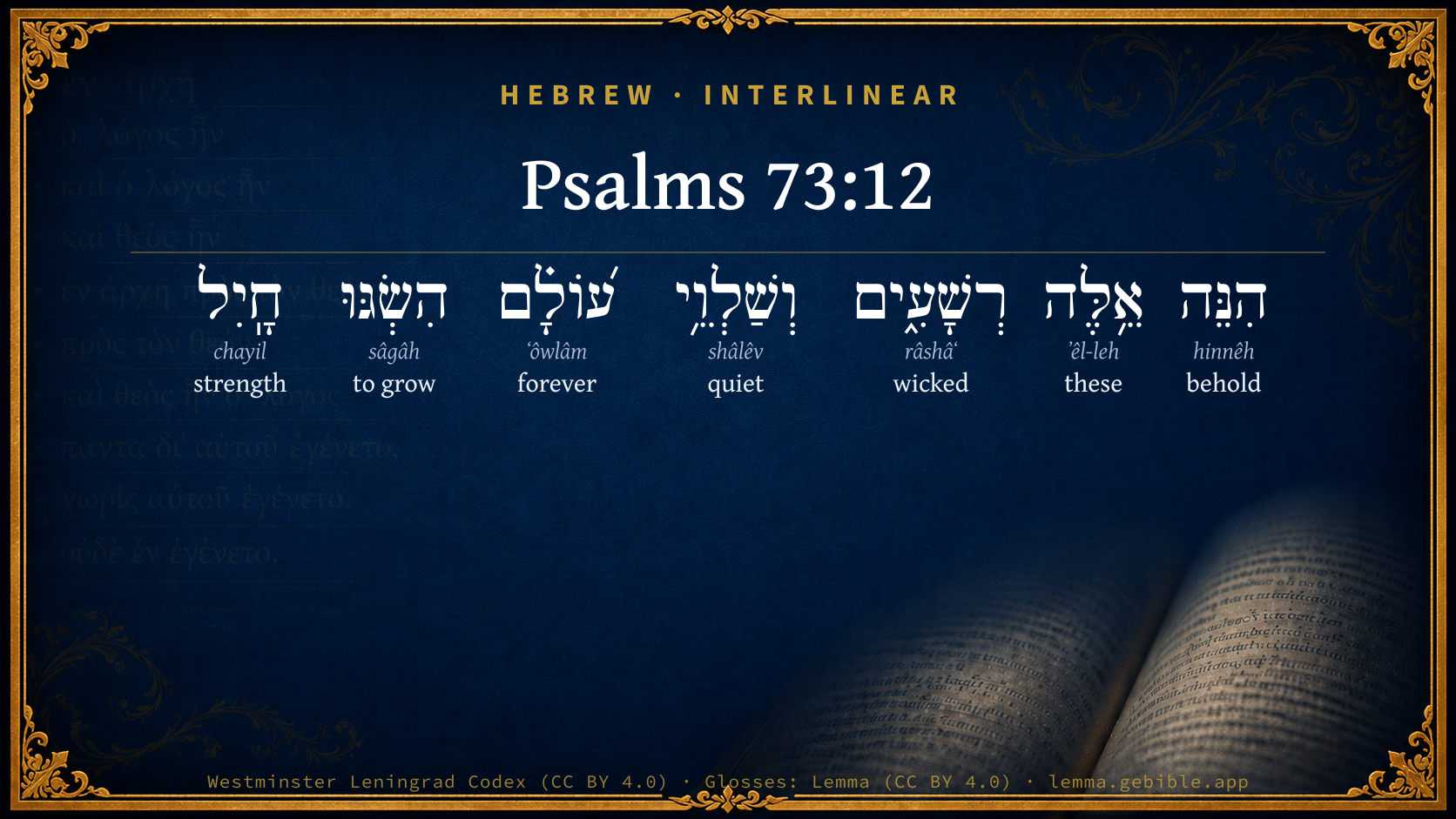
Hebrew (Westminster Leningrad Codex) Psalms 73:12 appears in the Hebrew Old Testament. The text above is from the Westminster Leningrad Codex. Each word links to its Strong’s number, a concise gloss, and parsing drawn from the Open Scriptures Hebrew Bible morphology. Click any word for its full Brown-Driver-Briggs (BDB) entry.
Download image
Cite this verse

Psalms 73:12 (World English Bible). Public Domain. Lemma interlinear Bible study tool, https://lemma.gebible.app/v/psalms/73/12.

Show BibTeX & RIS
BibTeX
RIS
English Translation
Behold, these are the wicked. Being always at ease, they increase in riches.
World English Bible · Public Domain
Download a study sheet

One document with this verse’s original text, its word-by-word gloss line, the meaning frame, cross-references with their text, attributed commentary, and full source and license credits — printable, and it pastes into notes with its structure intact.

This verse Autodidact and up

Study sheet (.html) Plain text (.txt)

A passage Seminary Student

Up to 50 verses in one chapter. A passage sheet keeps up to 6 commentary sources and 12 cross-references per verse, in the order this page ranks them, and says so on the sheet whenever that leaves anything out. Ask for a single verse and you get the Autodidact verse sheet above.

Everything on this page stays free to read, with no account — the sheet is a download of what is already on screen, not access to it.

Want to remove ads? Support Godless Engineer
Compare translations 3

The same verse in 3 English versions, stacked beneath the original-language interlinear above. Click any original word for its lexicon entry.

Each is an independent rendering of the whole verse — the interlinear is not word-aligned to these translations.

Highlighted words mark where these versions differ — a whole-verse word diff, not a word-by-word alignment.

  • World English Bible Public Domain
    Behold, these are the wicked. Being always at ease, they increase in riches.
  • King James Version Public Domain
    Behold, these are the ungodly, who prosper in the world; they increase in riches.
  • unfoldingWord Literal Text CC BY-SA 4.0
    Behold, these wicked; they are always at ease, they increase in wealth.

unfoldingWord Literal Text — © unfoldingWord, licensed CC BY-SA 4.0. Word-aligned USFM3 via Door43 (git.door43.org/unfoldingWord/en_ult).

Versions to compare (up to 4)

3 of 4 selected

Show all 18 translations

Every available English version of this verse, each an independent rendering of the whole verse.

  • World English Bible Public Domain
    Behold, these are the wicked. Being always at ease, they increase in riches.
  • Berean Standard Bible Public Domain
    Behold, these are the wicked—always carefree as they increase their wealth.
  • Majority Standard Bible Public Domain
    Behold, these are the wicked—always carefree as they increase their wealth.
  • King James Version Public Domain
    Behold, these are the ungodly, who prosper in the world; they increase in riches.
  • American Standard Version (1901) Public Domain
    Behold, these are the wicked; And, being alway at ease, they increase in riches.
  • Revised Version (1885) Public Domain
    Behold, these are the wicked; and, being alway at ease, they increase in riches.
  • Geneva Bible (1599) Public Domain
    Lo, these are the wicked, yet prosper they alway, and increase in riches.
  • Douay-Rheims (1899) Public Domain
    Behold these are sinners; and yet abounding in the world they have obtained riches.
  • Young's Literal Translation Public Domain
    Lo, these `are' the wicked and easy ones of the age, They have increased strength.
  • Literal Standard Version CC BY-SA 4.0
    Behold, these [are] the wicked and easy ones of the age, || They have increased strength.
  • Unlocked Literal Bible CC BY-SA 4.0
    Take notice: these people are wicked; they are always carefree, becoming richer and richer.
  • unfoldingWord Literal Text CC BY-SA 4.0
    Behold, these wicked; they are always at ease, they increase in wealth.
  • Darby Bible Public Domain
    Behold, these are the wicked, and they prosper in the world: they heap up riches.
  • World Messianic Bible Public Domain
    Behold, these are the wicked. Being always at ease, they increase in riches.
  • Webster's Bible Public Domain
    Behold, these are the ungodly, who prosper in the world; they increase in riches.
  • Free Bible Version CC BY-SA 4.0
    Look at these wicked people! They don't have a care in the world, and they're always making money!
  • Bible in Basic English Public Domain
    Truly, such are the sinners; they do well at all times, and their wealth is increased.
  • JPS Tanakh (1917) Public Domain
    Behold, such are the wicked; and they that are always at ease increase riches.

Literal Standard Version (2020), Covenant Press — licensed CC BY-SA 4.0. Text via the HelloAO Bible API (eBible.org). Unlocked Literal Bible (unfoldingWord) — licensed CC BY-SA 4.0. Text via the HelloAO Bible API (eBible.org). unfoldingWord Literal Text — © unfoldingWord, licensed CC BY-SA 4.0. Word-aligned USFM3 via Door43 (git.door43.org/unfoldingWord/en_ult). Free Bible Version, Dr. Jonathan Gallagher — licensed CC BY-SA 4.0. Text via the HelloAO Bible API (eBible.org).

Word by word

More ways to search: Search by grammar → Find every occurrence → Compare this word →

Practice this passage: Drill this verse → Learn its vocabulary →

About this verse

These counts appear in no published source. They are computed here, from the morphology-tagged text and Lemma’s own curated glosses. What Lemma adds →

7
words
7
distinct lemmas
Wisdom
section

Notable vocabulary

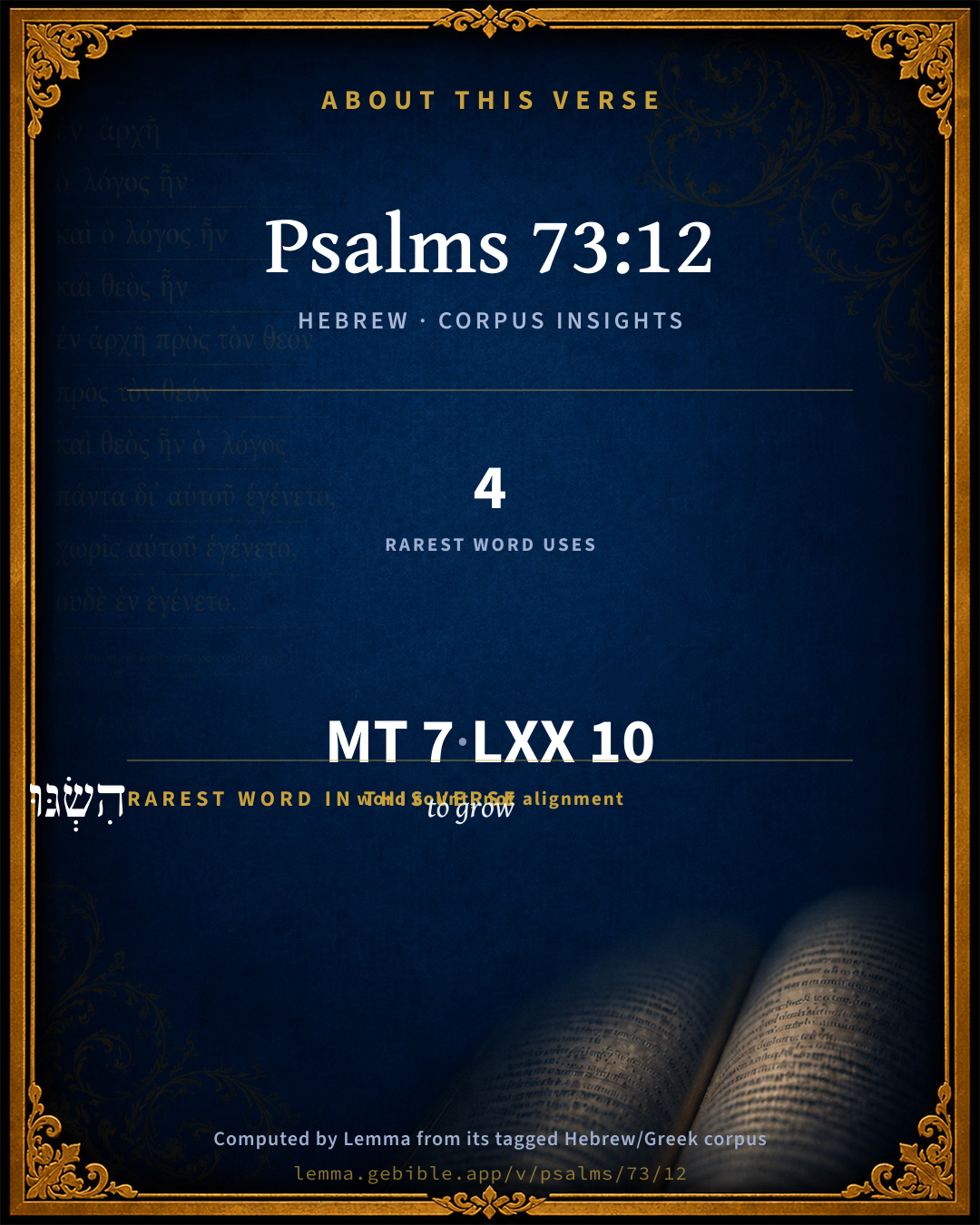
The rarest word here is הִשְׂגּוּ to grow H7685 — appearing just 4 times in the whole Hebrew Bible.

Shared distinctive vocabulary

הִשְׂגּוּ to grow H7685 occurs in 4 verses of the Hebrew Bible. Also found in:

Grammatical profile

  • 1 verb
  • 2 nouns
  • 2 adjectives
  • 1 pronoun
  • 1 particle

Verb forms

  • הִשְׂגּוּ Hiphil · Perfect

Hebrew & Septuagint length

In English translation the verse runs 13 words from the Hebrew and 14 from the Septuagint (LXX English) — closely comparable.

A rough comparison of the two English renderings, which tokenize alike — not a word-level alignment.

Word counts can differ between the Hebrew and the Greek without any difference in meaning — e.g. the Hebrew direct-object marker אֵת has no separate Greek word, and Greek often adds the article ὁ.

In the original languages it is 7 Hebrew tokens and 10 Greek tokens — but the two are counted differently (Hebrew bundles its prefixes and suffixes into one token; the Greek is in lemma form), so that isn’t a like-for-like length.

Cross-references

11

Topical passages linked to Psalms 73:12 in the Treasury of Scripture Knowledge — connected by theme and wording, ordered by reader-vote popularity; previews shown in the World English Bible.

  • Psalms 52:7 "Behold, this is the man who didn't make God his strength, But trusted in the abundance of his riches, And strengthened himself in his wickedness."
  • Jeremiah 5:28 They are grew fat, they shine: yes, they overpass in deeds of wickedness; they don't plead the cause, the cause of the fatherless, that they may prosper; and the right of the needy they don't judge.
  • Hosea 12:7–8 A merchant has dishonest scales in his hand. He loves to defraud.
  • Psalms 17:14 From men by your hand, Yahweh, From men of the world, whose portion is in this life. You fill the belly of your cherished ones. Your sons have plenty, And they store up wealth for their children.
  • Psalms 37:35 I have seen the wicked in great power, Spreading himself like a green tree in its native soil.
  • Psalms 49:6 Those who trust in their wealth, And boast in the multitude of their riches--
  • Psalms 62:10 Don't trust in oppression. Don't become vain in robbery. If riches increase, Don't set your heart on them.
  • Jeremiah 5:17 They shall eat up your harvest, and your bread, [which] your sons and your daughters should eat; they shall eat up your flocks and your herds; they shall eat up your vines and your fig trees; they shall beat down your fortified cities, in which you trust, with the sword.
  • Jeremiah 12:1–2 Righteous are you, Yahweh, when I contend with you; yet would I reason the cause with you: why does the way of the wicked prosper? why are all they at ease who deal very treacherously?
  • Luke 16:19 "Now there was a certain rich man, and he was clothed in purple and fine linen, living in luxury every day.
  • James 5:1–3 Come now, you rich, weep and howl for your miseries that are coming on you.

Cross-references courtesy of OpenBible.info (CC BY 4.0).

Hebrew and Greek witnesses Masoretic Hebrew ↔ Greek Septuagint

The same verse in the two great witnesses to the Old Testament, shown verse-for-verse.

You’re reading Greek Psalm 72 (Hebrew Psalm 73). The Septuagint counts the superscription, so verse numbers can differ from the Hebrew — chapter-level alignment, not verse-by-verse. Numbering follows Rahlfs.

These are two independent witnesses, not word-aligned to each other, and the Septuagint is shown in lemma (dictionary) form.

Hebrew Psalms 73:12 Masoretic · Westminster Leningrad Codex

הִנֵּה אֵ֥לֶּה רְשָׁעִ֑ים וְשַׁלְוֵ֥י ע֝וֹלָ֗ם הִשְׂגּוּ חָֽיִל

Behold, these are the wicked. Being always at ease, they increase in riches.

World English Bible · Public Domain

Greek LXX Greek Psalm 72:12 Septuagint · lemma form

ἰδού οὗτος ἁμαρτωλός καί εὐθηνέω εἰς ὁ αἰών καταἔχω πλοῦτος

Behold, these are the sinners, and they that prosper always: they have possessed wealth.

LXX2012 (modern English Septuagint) · Public Domain

On this verse, The Cambridge Bible for Schools and Colleges discusses the Septuagint’s reading. Read the note in Commentary ↓

Hebrew: Westminster Leningrad Codex (CC BY 4.0). Greek: Septuagint (public domain); English from LXX2012 (modern English Septuagint) (Public Domain). How the Septuagint differs from the Hebrew →

Commentary

Notes on Psalms 73:12 from classic Christian and Jewish commentators (each source and its license shown beneath its notes). The classic Christian expositions comment on the surrounding passage and are grouped to its opening verse, so a note may address several verses; the Jewish commentaries on the Tanakh (Rashi and others) are per-verse, so they appear only where the commentator wrote on this verse.

Lemma curates 59 commentaries, every one of them public domain or Creative Commons licensed, each selected and text-cleaned for this edition rather than reprinted as found. About our sources →

Trapp's Complete Commentary

John Trapp

Psa 73:12 Behold, these [are] the ungodly, who prosper in the world; they increase [in] riches.

Ver. 12. Behold, these are the ungodly] q.d. If God do take knowledge of things here below, and ordereth all events, how is it that the ungodly prosper, while better men suffer?

Who prosper in the world] An ill character, everything considered. See Psa 17:14. {See Trapp in "Psa 17:14"} Behold, these are the ungodly, the fortunate men of the world, so some render it. He that liveth in the height of the world’s blandishments is not far from destruction. Periculosa est summe bona corporis valetudo, saith Hippocrates, The height of health is nearest to sickness and death.

They increase in riches] They wallow in wealth; God pouring honey into their hives; but for a vengeance.

John Trapp, A Commentary or Exposition upon All the Books of the Old and New Testament (1647–1656) — public domain. Text from a community e-Sword module.

The Biblical Illustrator

Joseph S. Exell

Psa_73:12-13

Behold, these are the ungodly, who prosper in the world; they increase in riches.

Paganized Christianity

The trouble with us is that in our everyday life we do not make our faith vital enough. We bring the ways of the world into the Church, instead of taking the ways of the Church into the world. We find doubt, and temptation, and difficulty, and sin at the very threshold of our being, and we try to drive these foes out of our nature by the weapons which we find lying scattered around us in our mixed social life, instead of rising to the height of our privilege and our calling aa followers of Christ and children of our Father in heaven.

I. The common weapon of our moral life is duty--the sense of our moral obligation to a principle of right which is ruling us. It is a grand principle; it brings forth great moral results, but it is not the highest motive in the armoury of character. It is like the sure and faithful study of the primary school, which acts as a strong basis for the after education to rest upon. But the primary school can never be the university, and the mere sense of duty can never bring out of your nature the highest results of which you are capable A sense of duty is fine in a son and in a father, in a wife and in a husband; but there are higher motives in human nature than this primary motive of duty, and these higher motives bring about the higher results. A sense of duty is a fine element in an artist, in a poet, in a musician; but you know perfectly well that any genius, any nature with a soul and with a great executive capacity, will scorn this rudimentary germ of motive power. It is a primary motive; it is an clementary principle. It is like the ruled copy book to the child who is trying to write; it is like the transparent slate to the child who is learning to draw. You make use of it; you are trained and developed by it, and then you pass it by; it has done its formative work in the matter of your education.

II. The other motive is faith--grasp upon God--the privilege of service--the faculty of spiritual apprehension. We do our duty to believe in God: we believe in God, and as a result of this we do our duty. After all that we may say about it in the brisk and brilliant intellection of our younger days, a living God is better than an uncertain conscience; privilege is always a higher motive than duty, and the grasp of your nature upon divine things through the faculty of spiritual apprehension will be a surer and more intuitive guide than your hastily gathered deductions from the decalogue. Over our fears, over our failures, over our shortcomings and wrongdoings, the borrowed light of duty will at times be powerless to force its way. But the cry of the rejoicing prophet of old, as with a new belief in the God of their fathers the captives came back from the land of their exileship, will again and again be realized with us as we stand face to face with the hard problem put before us--Who art thou, O great mountain? etc. If you live for earth, for gain, for pleasure, or for self, you may gain your end, but you will lose your very soul. But if God is a reality, if the spiritual life has any meaning to you, if beneath all the rubbish of dogma and cant in religion, you get your feet once upon that rock which is the Rock of Ages--God above us--God in us--God in Christ--God in human life--God in immortality--then that instinct of the awakened soul, that hunger of the spiritual nature for the Being who created it, will generate its own motive power--a power fourfold greater than the mere sense of duty--and the problems of life which before had been too hard for you will be made easy when, like this far-off, honest doubter of our psalm to-day, you see the meaning of life as by a flash, when you stand in the presence, not of duty merely, but in the presence of God! (W. W. Newton.)

The prosperity of the wicked no argument against Gods providence

I. The prosperity of the ungodly, which the good man is grieved at seeing, is a mere illusion of fancy, when no such thing as happiness doth really attend them. The emptiness of worldly good, and its utter insufficiency to answer the endless cravings of our several desires, betray themselves in nothing more, than in that general imagination which seems to haunt all orders of men amongst us, that if they had somewhat which they have not, somewhat which they see others have, and fancy themselves to want, all would be well and easy with them; when yet those others are not more easy than themselves, but are teased with the same incurable imagination, the same dissatisfaction for want of somewhat which they have not, or for some unpleasing circumstance in what they have, which spoils their relish of all the entertainment they can find in life.

II. Divers considerations, which may clear the providence of God from all reproach and misconstruction in it.

1. It is fit and reasonable that some room should he left for the operations of faith, for the trials of virtue, and for liberty of action; all which ends would be defeated if the punishment of sin did in every instance immediately attend it.

2. Without such an interposal from the hand of Providence, as, for the reasons just given, would be improper and inconvenient, the sinner must and will have his chances in the scramble of life, must and will secure to himself more than a common share in the felicities of fortune.

3. Our present state is designed not so much for retribution as for trial; and consequently what best answers to the latter purpose is the fittest portion for us. Now, the ends of trial may be consulted as effectually in a station of prosperity as in a post of adversity; since each hath its proper temptations cleaving to it, which, upon proof, may exemplify the firmness or weakness of our several virtues. And in all reason and decency it ought to be presumed that the great Searcher of hearts is the fittest judge which of the two conditions is most likely to approve them.

4. It follows, as a certain consequence from the promiscuous distribution of adversity and prosperity in this present life, that there must and will be a life beyond it, in which the righteousness of our holy Judge will perfectly clear up the honour of His government, and signalize His never-failing regard to His laws. (N. Marshall, D. D.)

The Biblical Illustrator, edited by Joseph S. Exell (c. 1880s–1900s) — public domain. Text from a community e-Sword module.

Joseph Benson's Commentary

Psa 73:12. Behold, these are the ungodly who prosper in the world — This is their condition and behaviour in it. “The temptation is now stated in its full force. As if he had said, These worthless, ungodly, blasphemous wretches, whose characters I have been delineating, these are the men who prosper in the world, who succeed in every thing they undertake, and roll in riches! What are we to think of God, his providence, and his promises?”

Joseph Benson's Commentary on the Old and New Testaments (1811–1818) — public domain. Text from a community e-Sword module.

J. A. Alexander on Psalms

Joseph Addison Alexander

Psa 73:12. Lo, these are wicked (men), and (yet they are) secure for ever, they increase strength (or substance). These are, still the words of the perplexed believer, expressing his surprise at the prosperity of sinners. See, these are wicked men, and yet instead of being wretched, or prospering only for a little while, they are prosperers of eternity, perpetually prospered and at ease, secure from change. See above, on Psa 30:7. Instead of losing what they have, they still gain more, and go on adding to their wealth, and to the power which it gives them. See above, on Psa 60:12.

Joseph Addison Alexander, The Psalms Translated and Explained (1850) — public domain. Text from a community e-Sword module.

Adam Clarke's Commentary

Verse 12. These are the ungodly] The people still speak. It is the ungodly that prosper, the irreligious and profane.

Adam Clarke's Commentary on the Bible (1810–1826) — public domain. Text from a community e-Sword/MySword module.

John Calvin's Commentaries

12. Behold! these are the ungodly. The Psalmist here shows, as it were by a vivid pictorial representation, the character of that envy which had well nigh overthrown him. Behold! says he, these are wicked men! and yet they happily enjoy their ease and pleasures undisturbed, and are exalted to power and influence; and that not merely for a few days, but their prosperity is of long duration, and has, as it were, an endless course. And is there anything which seems to our judgment less reasonable than that persons whose wickedness is accounted infamous and detestable, even in the eyes of men, should be treated with such liberality and indulgence by God? Some here take the Hebrew word עולם, olam, for the world, but improperly. It rather denotes in this passage an age; and what David complains of is, that the prosperity of the wicked is stable and of long duration, and that to see it last so long wears out the patience of the righteous. Upon seeing the wicked so tenderly cherished by God, he descends to the consideration of his own case; and as his conscience bore him testimony that he had walked sincerely and uprightly, he reasons with himself as to what advantage he had derived from studiously devoting himself to the practice of righteousness, since he was afflicted and harassed in a very unusual degree. He tells us that he was scourged daily, and that as often as the sun rose, some affliction or other was prepared for him, so that there was no end to his calamities. In short the amount of his reasoning is this, “Truly I have labored in vain to obtain and preserve a pure heart and clean hands, seeing continued afflictions await me, and, so to speak, are on the watch to meet me at break of day. Such a condition surely shows that there is no reward for innocence before God, else he would certainly deal somewhat more compassionately towards those who serve him.” As the true holiness for which the godly are distinguished consists of two parts, first, of purity of heart, and, secondly, of righteousness in the outward conduct, David attributes both to himself. Let us learn, from his example, to join them together: let us, in the first place, begin with purity of heart, and then let us give evidence of this before men by uprightness and integrity in our conduct.

John Calvin's Commentaries (1540-1563) — public domain. Text from the Calvin Translation Society English edition (1840s-50s) via the Christian Classics Ethereal Library (ccel.org). Calvin's coverage is partial (roughly two-thirds of the Bible); uncommented books and verses are honest gaps, never fabricated. The 19th-century editor's footnotes and remarks are omitted so the notes are faithfully Calvin's own voice.

The Cambridge Bible for Schools and Colleges

gen. ed. J. J. S. Perowne

12. Behold, such are the wicked!

And being always at ease they have gotten much substance.

At ease is a favourite word in Job: e.g. Job_3:26; Psa_12:6 (A.V. prosper); Job_16:12; Job_20:20; Job_21:23; cp. Jer_12:1.

12–14. The Psalmist’s temptation as he contemplated the scene. Some commentators regard these verses as the continuation of the speech in Psa_73:11, giving the thoughts of the followers of the wicked, the speaker in Psa_73:13-14 being any individual among them. But it is preferable to regard them as the words of the Psalmist himself, expressing the thoughts which he had been tempted to indulge. (1) The form of the sentence, Behold, such &c., points to a summing up (cp. Job_5:27; Job_8:19-20; Job_18:21); (2) ‘the wicked’ is a more natural designation for the Psalmist than for their own followers to use; (3) there is nothing to shew that the speaker in Psa_73:15 is another than the speaker in Psa_73:13-14; (4) the LXX (followed by the P.B.V.) inserts And I said at the beginning of Psa_73:13.

The Cambridge Bible for Schools and Colleges (gen. ed. J. J. S. Perowne; Cambridge University Press, 1878–1918) — public domain. Text from a community e-Sword module.

John Gill's Exposition

Behold, these are the ungodly,.... Who say and do as before declared; such as these must be without the knowledge of God, the fear, love, and worship of him: who prosper in the world; in worldly and temporal things, in their bodies and outward estates, but not in their souls and spiritual things: "in this world", as the Targum is; all their prosperity is here; their good things are in this life, their evil things will be in that to come; though ungodly, they prosper in the world, and as long as they are in it; or they are at peace and in case, and are quiet; they have nothing to disturb them, they are not in outward trouble, and their sins do not distress them, and they have no concern about another world:

they increase in riches; which they are in the pursuit of, and overtake and enjoy in great abundance; whereby they become mighty and powerful, as the word (o) for "riches" signifies: these words are the observation of the psalmist, and which was the occasion of the following temptation he was led into.

(o) "vires", Junius & Tremellius; "potentiam", Piscator.

John Gill's Exposition of the Whole Bible (1746–1763) — public domain (CC PDM 1.0). Text via the HelloAO Bible API.

Albert Barnes' Notes on the Bible

Behold, these are the ungodly, who prosper in the world - This is also to be understood as the language of the good man perplexed and embarrassed by the fact that the wicked are prosperous and happy. The meaning is, “Lo, these are wicked people - people of undoubted depravity; they are people who live regardless of God; and yet they are peaceful, tranquil, happy, prospered.” This was one of the facts which so much embarrassed the psalmist. If there had been any doubt about the character of those people, the case would have been different. But there was none. They were people whose character for wickedness was well known, and yet they were permitted to live in peace and prosperity, as if they were the favorites of heaven. The literal meaning of the words rendered “who prosper in the world” is, “tranquil (or secure) for the age;” that is, forever, or constantly. They know no changes; they see no reverses; they are the same through life. They are always tranquil, calm, happy, successful.

They increase in riches - literally, “They become great in substance.” They make constant accumulations in wealth, until they become great.

Albert Barnes' Notes on the Bible (1834–1885) — public domain. Text from a community e-Sword/MySword module.

Matthew Poole's English Annotations

These are the ungodly; this is their condition and carriage in it. These seem to be the words of the psalmist, summing up the matter, and preparing his passage to the other part of the Psalm.

Matthew Poole's English Annotations on the Holy Bible (1683–1685) — public domain. Text from a community e-Sword/MySword module.

The Treasury of David

Charles H. Spurgeon

Ver. 12. Behold, these are the ungodly, who prosper in the world. Look! See! Consider! Here is the standing enigma! The crux of Providence! The stumblingblock of faith! Here are the unjust rewarded and indulged, and that not for a day or an hour, but in perpetuity. From their youth up these men, who deserve perdition, revel in prosperity. They deserve to be hung in chains, and chains are hung about their necks; they are worthy to be chased from the world, and yet the world becomes all their own. Poor purblind sense cries, Behold this! Wonder, and be amazed, and make this square with providential justice, if you can.

They increase in riches; or, strength. Both wealth and health are their dowry. No bad debts and bankruptcies weigh them down, but robbery and usury pile up their substance. Money runs to money, gold pieces fly in flocks; the rich grow richer, the proud grow prouder. Lord, how is this? Thy poor servants, who become yet poorer, and groan under their burdens, are made to wonder at thy mysterious ways.

Ver. 12. This verse suggests solemn enquiries for persons who are growing rich.

Psalms 73:13*

Charles H. Spurgeon's The Treasury of David (1869–1885) — public domain. Psalms only. Text from a community e-Sword/MySword module.

Whedon's Commentary on the Bible

Daniel D. Whedon

12. Behold, these are the ungodly—The psalmist speaks and “describes the impression made upon him, the representative of real and living piety, by this contradiction between sight and faith, between the reality and the idea.”—Hengstenberg. These prosperous are “the ungodly.”

Who prosper in the world—Who are the prosperous ones of the age. The word עולם, (‘olam,) here denotes continuance, not the habitable globe.

They increase in riches—An important element of prosperity, considering the relation of wealth to the supply of human wants and the gratification of the natural desires. The unequal distribution of property has always been a great stumblingblock to weak faith and a worldly mind.

Daniel D. Whedon (gen. ed.), Commentary on the Old and New Testaments (1874–1909) — public domain. Text from a community e-Sword module.

The Pulpit Commentary

Behold, these are the ungodly, who prosper in the world; rather, and they prosper always. They increase in riches. This is the impression which the psalmist has received from the general course of human affairs in his day. It is closely allied to the view taken by Job. (Job_21:7-15)

The Pulpit Commentary (1880–1919), ed. H.D.M. Spence-Jones & Joseph S. Exell — public domain. Text from a community e-Sword module.

John Wesley's Explanatory Notes

Behold - These seem to be the words of the psalmist, summing up the matter.

John Wesley, Explanatory Notes Upon the Whole Bible (1754–1765) — public domain. Text via the GEBible commentary corpus.

Rashi

Rabbi Shlomo Yitzchaki (Rashi)

Behold these are wicked They [are wicked] and transgress His Torah; yet they are tranquil in the world and increase power and wealth.

they are tranquil in the world An expression of tranquility.

have increased Heb. השגו, have increased. Menachem (p. 72) explains: יָשוּב עַמוֹ הֲלוֹם, the wicked will return to crush (להלם) the people of the Holy One, blessed be He. The first interpretation I learned from the words of Rabbi Meir the son of Isaac, the cantor, may the memory of the righteous be for a blessing.

Rashi on the Tanakh — English translations: “The Judaica Press complete Tanach with Rashi, translated by A. J. Rosenberg” (CC BY 4.0); “Pentateuch with Rashi's commentary by M. Rosenbaum and A.M. Silbermann, 1929-1934” (public domain); “The Metsudah Tanach series, Lakewood, N.J” (CC BY 4.0); and “The Book of Joshua, Metsudah Publications, 1997” (CC BY 4.0). Text via Sefaria.

Lesson kit

Teaching starters — assembled from the data on this page, not authored interpretation. Every prompt links to the verse data it draws on. Edit before teaching.

Psalms, in the Wisdom, opens this verse with 7 words (7 distinct Hebrew lemmas). Its most distinctive word is sâgâh (“to grow”). A historical commentator’s framing appears above. Read the whole chapter for the surrounding context.

Discussion questions

  1. What does “to grow” (sâgâh) contribute to the verse as a whole?
  2. How does Job 8:7, which shares the word «to grow», read alongside this verse?
  3. These translations render this verse differently; the difference is in the English rendering, not the original. What questions does that raise?
  4. «הִשְׂגּוּ» is a Hiphil Perfect verb. How does that grammatical form shape the action described?
  5. Compare how Trapp's Complete Commentary and The Biblical Illustrator read this verse. Where do they agree or differ?

Things to notice

Reading settings

Reading text

Shown beneath each verse's original-language words.

Old Testament
Old Testament edition

Read the OT as the Masoretic Hebrew (MT) or the Greek Septuagint (LXX).

English shown for the Greek Septuagint (in the Hebrew ↔ Greek comparison).

Comparing translations? Open the Compare panel on any verse page to stack up to four side by side.