
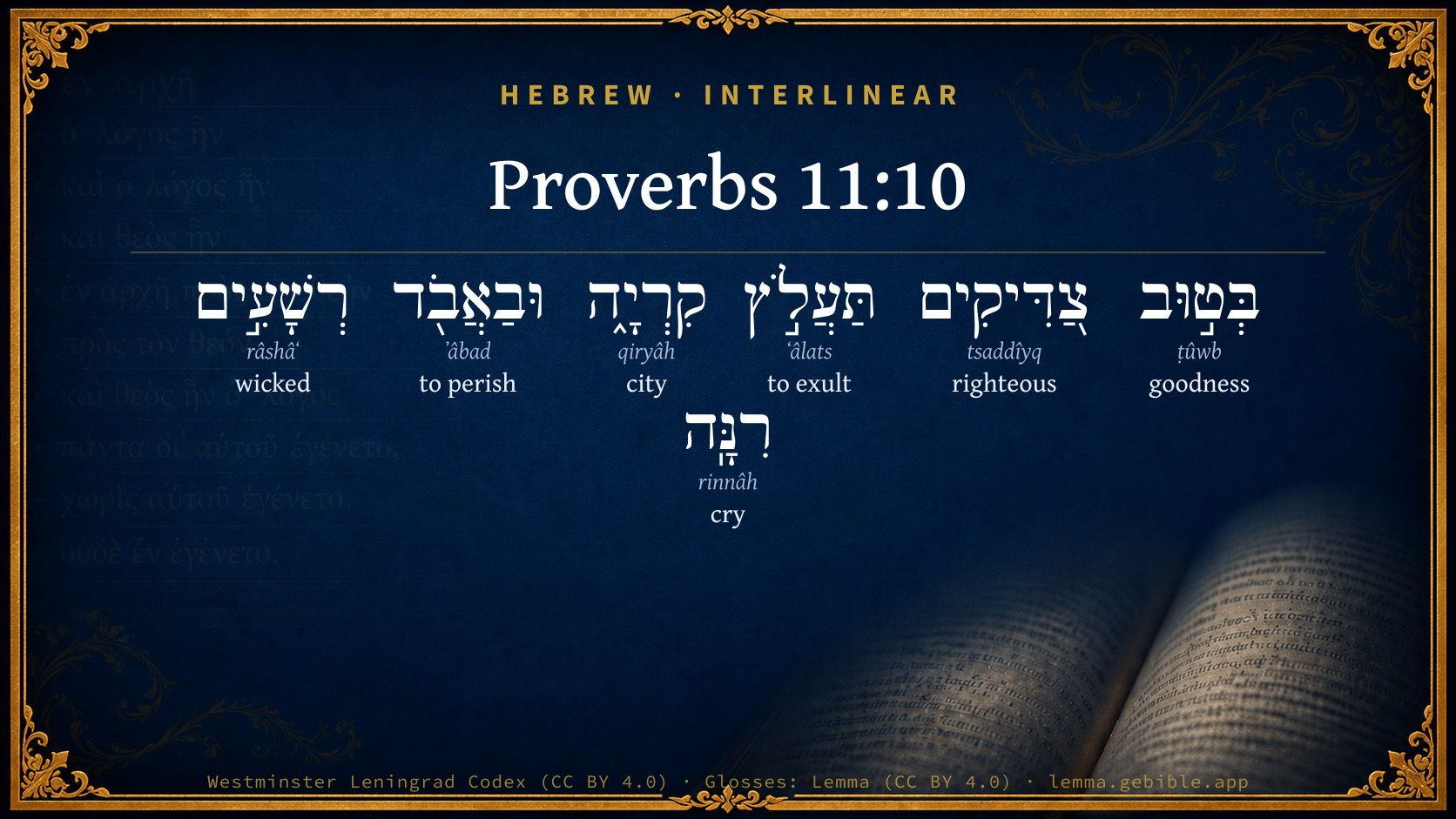
Proverbs 11:10

Hebrew (Westminster Leningrad Codex) Proverbs 11:10 appears in the Hebrew Old Testament. The text above is from the Westminster Leningrad Codex. Each word links to its Strong’s number, a concise gloss, and parsing drawn from the Open Scriptures Hebrew Bible morphology. Click any word for its full Brown-Driver-Briggs (BDB) entry.
Download image
Cite this verse

Proverbs 11:10 (World English Bible). Public Domain. Lemma interlinear Bible study tool, https://lemma.gebible.app/v/proverbs/11/10.

Show BibTeX & RIS
BibTeX
RIS
English Translation
When it goes well with the righteous, the city rejoices. When the wicked perish, there is shouting.
World English Bible · Public Domain
Download a study sheet

One document with this verse’s original text, its word-by-word gloss line, the meaning frame, cross-references with their text, attributed commentary, and full source and license credits — printable, and it pastes into notes with its structure intact.

This verse Autodidact and up

Study sheet (.html) Plain text (.txt)

A passage Seminary Student

Up to 50 verses in one chapter. A passage sheet keeps up to 6 commentary sources and 12 cross-references per verse, in the order this page ranks them, and says so on the sheet whenever that leaves anything out. Ask for a single verse and you get the Autodidact verse sheet above.

Everything on this page stays free to read, with no account — the sheet is a download of what is already on screen, not access to it.

Want to remove ads? Support Godless Engineer
Compare translations 3

The same verse in 3 English versions, stacked beneath the original-language interlinear above. Click any original word for its lexicon entry.

Each is an independent rendering of the whole verse — the interlinear is not word-aligned to these translations.

Highlighted words mark where these versions differ — a whole-verse word diff, not a word-by-word alignment.

  • World English Bible Public Domain
    When it goes well with the righteous, the city rejoices. When the wicked perish, there is shouting.
  • King James Version Public Domain
    When it goeth well with the righteous, the city rejoiceth: and when the wicked perish, there is shouting.
  • unfoldingWord Literal Text CC BY-SA 4.0
    In the good of the righteous a city exults; and when the wicked perish, a shout of joy.

unfoldingWord Literal Text — © unfoldingWord, licensed CC BY-SA 4.0. Word-aligned USFM3 via Door43 (git.door43.org/unfoldingWord/en_ult).

Versions to compare (up to 4)

3 of 4 selected

Show all 18 translations

Every available English version of this verse, each an independent rendering of the whole verse.

  • World English Bible Public Domain
    When it goes well with the righteous, the city rejoices. When the wicked perish, there is shouting.
  • Berean Standard Bible Public Domain
    When the righteous thrive, the city rejoices, and when the wicked perish, there are shouts of joy.
  • Majority Standard Bible Public Domain
    When the righteous thrive, the city rejoices, and when the wicked perish, there are shouts of joy.
  • King James Version Public Domain
    When it goeth well with the righteous, the city rejoiceth: and when the wicked perish, there is shouting.
  • American Standard Version (1901) Public Domain
    When it goeth well with the righteous, the city rejoiceth; And when the wicked perish, there is shouting.
  • Revised Version (1885) Public Domain
    When it goeth well with the righteous, the city rejoiceth: and when the wicked perish, there is shouting.
  • Geneva Bible (1599) Public Domain
    In the prosperitie of the righteous the citie reioyceth, and when the wicked perish, there is ioye.
  • Douay-Rheims (1899) Public Domain
    When it goeth well with the just the city shall rejoice: and when the wicked perish there shall be praise.
  • Young's Literal Translation Public Domain
    In the good of the righteous a city exulteth, And in the destruction of the wicked `is' singing.
  • Literal Standard Version CC BY-SA 4.0
    A city exults in the good of the righteous, || And in the destruction of the wicked [is] singing.
  • Unlocked Literal Bible CC BY-SA 4.0
    When righteous people prosper, a city rejoices; when the wicked perish, there are shouts of joy.
  • unfoldingWord Literal Text CC BY-SA 4.0
    In the good of the righteous a city exults; and when the wicked perish, a shout of joy.
  • Darby Bible Public Domain
    When it goeth well with the righteous, the city rejoiceth; and when the wicked perish, there is shouting.
  • World Messianic Bible Public Domain
    When it goes well with the righteous, the city rejoices. When the wicked perish, there is shouting.
  • Webster's Bible Public Domain
    When the righteous prosper, the city rejoiceth: and when the wicked perish, there is shouting.
  • Free Bible Version CC BY-SA 4.0
    The whole town celebrates when good people are successful; they also shout for joy when the wicked die.
  • Bible in Basic English Public Domain
    When things go well for the upright man, all the town is glad; at the death of sinners, there are cries of joy.
  • JPS Tanakh (1917) Public Domain
    When it goeth well with the righteous, the city rejoiceth; and when the wicked perish, there is joy.

Literal Standard Version (2020), Covenant Press — licensed CC BY-SA 4.0. Text via the HelloAO Bible API (eBible.org). Unlocked Literal Bible (unfoldingWord) — licensed CC BY-SA 4.0. Text via the HelloAO Bible API (eBible.org). unfoldingWord Literal Text — © unfoldingWord, licensed CC BY-SA 4.0. Word-aligned USFM3 via Door43 (git.door43.org/unfoldingWord/en_ult). Free Bible Version, Dr. Jonathan Gallagher — licensed CC BY-SA 4.0. Text via the HelloAO Bible API (eBible.org).

Word by word

More ways to search: Search by grammar → Find every occurrence → Compare this word →

Practice this passage: Drill this verse → Learn its vocabulary →

About this verse

These counts appear in no published source. They are computed here, from the morphology-tagged text and Lemma’s own curated glosses. What Lemma adds →

7
words
7
distinct lemmas
Wisdom
section

Notable vocabulary

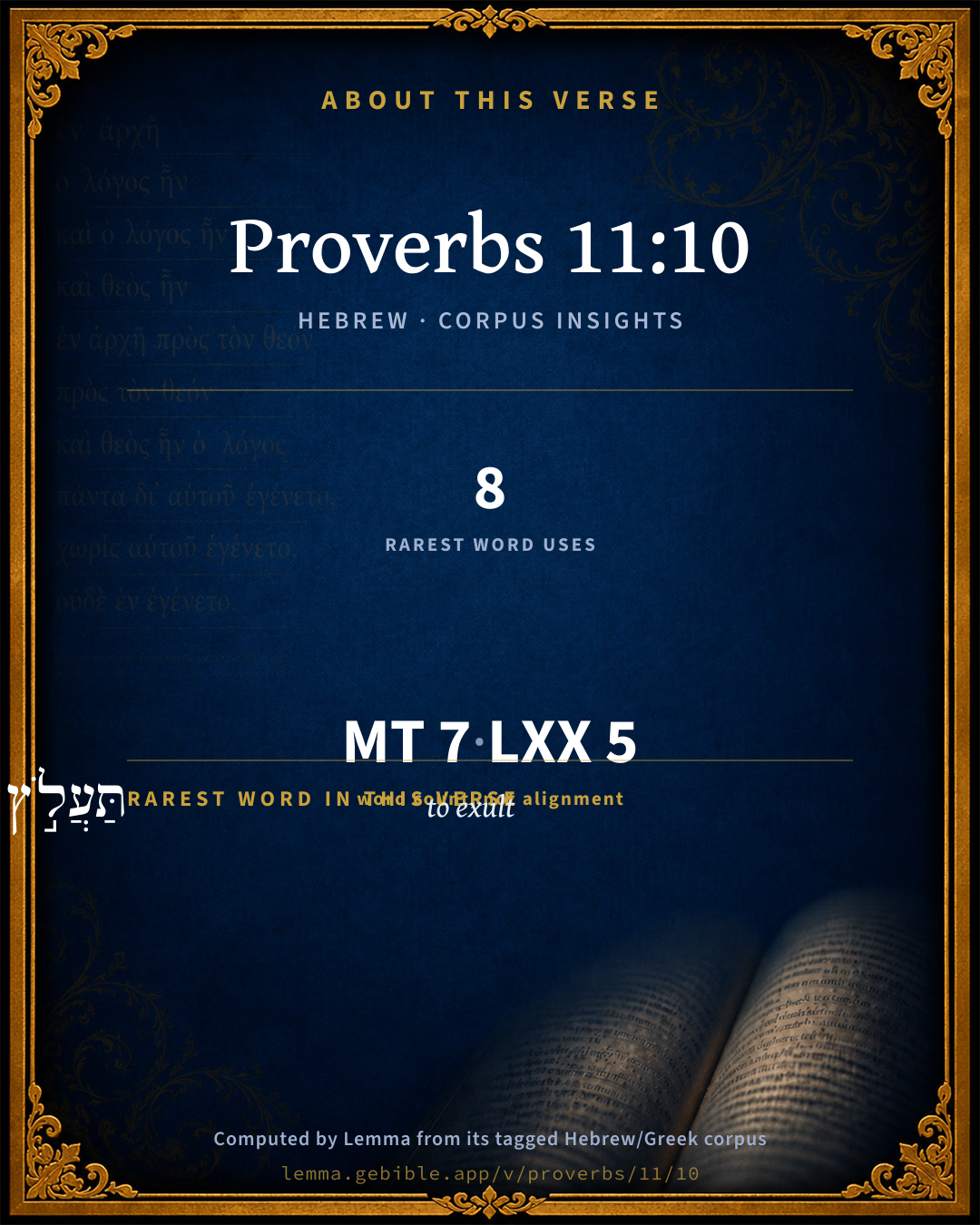
The rarest word here is תַּעֲלֹ֣ץ to exult H5970 — appearing just 8 times in the whole Hebrew Bible.

Shared distinctive vocabulary

תַּעֲלֹ֣ץ to exult H5970 occurs in 8 verses of the Hebrew Bible. Also found in:

Grammatical profile

  • 2 verbs
  • 3 nouns
  • 2 adjectives

Verb forms

  • תַּעֲלֹ֣ץ Qal · Imperfect
  • וּבַאֲבֹ֖ד Qal · Infinitive Construct

Hebrew & Septuagint length

In English translation the verse runs 17 words from the Hebrew and 19 from the Septuagint (LXX English) — closely comparable.

A rough comparison of the two English renderings, which tokenize alike — not a word-level alignment.

Word counts can differ between the Hebrew and the Greek without any difference in meaning — e.g. the Hebrew direct-object marker אֵת has no separate Greek word, and Greek often adds the article ὁ.

In the original languages it is 7 Hebrew tokens and 5 Greek tokens — but the two are counted differently (Hebrew bundles its prefixes and suffixes into one token; the Greek is in lemma form), so that isn’t a like-for-like length.

Cross-references

5

Topical passages linked to Proverbs 11:10 in the Treasury of Scripture Knowledge — connected by theme and wording, ordered by reader-vote popularity; previews shown in the World English Bible.

  • Proverbs 28:12 When the righteous triumph, there is great glory; But when the wicked rise, men hide themselves.
  • Esther 8:15–16 Mordecai went forth from the presence of the king in royal clothing of blue and white, and with a great crown of gold, and with a robe of fine linen and purple: and the city of Shushan shouted and was glad.
  • Psalms 58:10–11 The righteous shall rejoice when he sees the vengeance. He shall wash his feet in the blood of the wicked;
  • Judges 5:31 So let all your enemies perish, Yahweh: But let those who love him be as the sun when he goes forth in his might. The land had rest forty years.
  • Proverbs 28:28 When the wicked rise, men hide themselves; But when they perish, the righteous thrive.

Cross-references courtesy of OpenBible.info (CC BY 4.0).

Hebrew and Greek witnesses Masoretic Hebrew ↔ Greek Septuagint

The same verse in the two great witnesses to the Old Testament, shown verse-for-verse.

These are two independent witnesses, not word-aligned to each other, and the Septuagint is shown in lemma (dictionary) form.

Hebrew Proverbs 11:10 Masoretic · Westminster Leningrad Codex

בְּט֣וּב צַ֭דִּיקִים תַּעֲלֹ֣ץ קִרְיָ֑ה וּבַאֲבֹ֖ד רְשָׁעִ֣ים רִנָּֽה

When it goes well with the righteous, the city rejoices. When the wicked perish, there is shouting.

World English Bible · Public Domain

Greek LXX Proverbs 11:10 Septuagint · lemma form

ἐν ἀγαθός δίκαιος καταὀρθόω πόλις

In the prosperity of righteous men a city prospers: but by the mouth of ungodly men it is overthrown.

LXX2012 (modern English Septuagint) · Public Domain

On this verse, The Pulpit Commentary discusses the Septuagint’s reading. Read the note in Commentary ↓

Hebrew: Westminster Leningrad Codex (CC BY 4.0). Greek: Septuagint (public domain); English from LXX2012 (modern English Septuagint) (Public Domain). How the Septuagint differs from the Hebrew →

Commentary

Notes on Proverbs 11:10 from classic Christian and Jewish commentators (each source and its license shown beneath its notes). The classic Christian expositions comment on the surrounding passage and are grouped to its opening verse, so a note may address several verses; the Jewish commentaries on the Tanakh (Rashi and others) are per-verse, so they appear only where the commentator wrote on this verse.

Lemma curates 59 commentaries, every one of them public domain or Creative Commons licensed, each selected and text-cleaned for this edition rather than reprinted as found. About our sources →

Trapp's Complete Commentary

John Trapp

Pro 11:10 When it goeth well with the righteous, the city rejoiceth: and when the wicked perish, [there is] shouting.

Ver. 10. When it goeth well with the righteous.] When they are set in place of authority, all the country fare the better for it. All cannot choose but do well, so long as thou rulest well, {a} said the senate to Severus the emperor. And Ita nati estis, said he in Tacitus, ut bona malaque vestra ad rempublicam pertineant. Public persons are either a great mercy or a great misery to the whole country.

And when the wicked perish, there is shouting. For by their fall the people rise, and their ruin is the repair of the city.

" Cum mors crudelem rapuisset saeva Neronem,

Credibile est multos Romam agitasse iocos."

{a} παντες παντα καλως ποιουσιν επειδαν αυ καλως αρχεις. - Dion.

John Trapp, A Commentary or Exposition upon All the Books of the Old and New Testament (1647–1656) — public domain. Text from a community e-Sword module.

The Biblical Illustrator

Joseph S. Exell

Pro_11:10

When it goeth well with the righteous, the city rejoiceth.

The public conscience in relation to moral character

Down deep beneath the errors, follies, vanities of the community, there is a conscience. That conscience points evermore to the right and the just, as the needle to the pole.

I. The public conscience in relation to the righteous.

1. Public conscience is gratified by the prosperity of the righteous.

2. Public conscience acknowledges the usefulness of the righteous.

II. Public conscience in relation to the wicked.

1. It rejoices in their ruin.

2. It acknowledges their mischief.

The mouth of the wicked--the channel of impieties, falsehoods, impurities, and innumerable pernicious errors have caused in all ages, and is still causing, the overthrow of states. (Homilist.)

The tribute to righteousness

This is a tribute to righteousness which must come sooner or later. There is a heart in the city as well as in the individual man; a kind of civic personality as well as a narrow individuality. When principles of the highest morality govern the life of the city there is rejoicing everywhere, because where righteousness is the blessing of God is, and the blessing of God maketh rich, and no sorrow is added to that infinite and tender benediction. It is singular indeed that even bad men rejoice when good principles are so received and applied as to revive commercial industry and commercial confidence, and create a healthy state of feeling as between nation and nation, and city and city. When the wicked man perishes there is shouting of gladness, although there may have been during his lifetime adulation and hypocritical compliment paid to him. The wicked man never did anybody any lasting good. He always took away more than he gave, and he never pronounced a kind word except with a stinging spirit, and even in his superficial benedictions there was nothing enduring, nothing solid and lasting in the comfort which he pretended to bestow. The wicked man imagines that he is popular, but his imagination is vain. He is only made use of, looked for in order that he may help in a time of emergency, or in some way be unconsciously debased to uses the full range and purpose of which he does not perceive. Every one is proud to recall the repute of a righteous man. It is like reminding others of gardens of beauty, orchards of delight, landscapes rich in all features of excellence and attractiveness; the name of the righteous is a name of health; it is breathed as with the fresh air of heaven; men delight to hear it and find their honour even in its repetition. By the blessing of the upright the city is exalted, but it is overthrown by the mouth of the wicked. The upright may be for a time opposed, but for a time only; the issue is certain; truth will prevail, and they who oppose the upright shall come to humiliation, if not to contrition, and to such a sense of injury inflicted upon the innocent as will elicit from them words of compunction, petitions, and supplications for pardon. (J. Parker,D.D.)

When the wicked perish, there is shouting.

Joy in the fate of the wicked

On the death of Henry III of France, whose character was a contemptible mixture of weakness, folly, and vice, the Parisians, who had long held their king in distrust and contempt, gave themselves up to most disgraceful excesses of joy, and the Duchess of Montpensier ran about the streets crying, Good news, good news! the tyrant is dead! Robespierre was conveyed to the place of execution amid shouts and execrations of the populace, who were frantic with joy at the downfall of the tyrant, the women dancing about the procession in the most insane manner. There was great rejoicing in Ireland when it was known that James Carey, the informer, had been shot. (J. L. Nye.)

When Mordecai triumphed over Haman, the city of Shushan rejoiced and was glad (Est_8:15). When the wicked perish, there is shouting. When Athaliah was slain, all the people of the land rejoiced (2Ki_11:20).

The Biblical Illustrator, edited by Joseph S. Exell (c. 1880s–1900s) — public domain. Text from a community e-Sword module.

Joseph Benson's Commentary

Pro 11:10. When it goeth well with the righteous — When righteous men are encouraged and advanced to places of trust and power; the city rejoiceth — The citizens, or subjects, of that government, rejoice, because they confidently expect justice and tranquillity, and many other benefits, by their administration of public affairs. When the wicked perish, there is shouting — A common rejoicing, partly for the just vengeance of God upon them, who had been the instruments of so much mischief; and partly for the deliverance of the people from such public grievances and burdens as had been imposed upon them.

Joseph Benson's Commentary on the Old and New Testaments (1811–1818) — public domain. Text from a community e-Sword module.

The Preacher's Complete Homiletical Commentary

Joseph S. Exell (gen. ed.)

MAIN HOMILETICS OF Pro_11:10-11

THE REWARD OF THE RIGHTEOUS CITIZEN OR RULER. THE FATE OF THE UNRIGHTEOUS ONE

I. The words imply that it does not always go with the righteous. “When it goeth well,” etc. A good man’s plans and efforts for the good of his fellow-citizens or fellow-countrymen are not always successful. They may need more resources to make them effectual than he has at his command. The men whom he desires to benefit may not themselves be willing to exercise the self-denial for their own welfare that he is willing to undergo for them. They would be willing to reap the harvest of joy, but they do not like to sow the seed of suffering. It often happens that a righteous man is in the midst of a generation who cannot appreciate his moral worth and his intellectual wisdom. It has been said that the intellectual struggles of one age are the intuitions of the next, and men that are now regarded as grand and noble were perhaps looked upon as of little worth in the generation in which they lived. Or a man may not live long enough to complete his plans for the public benefit—the best things are often slow in coming to maturity, and many a righteous man has been called away before he has perfected his designs of blessing for his race. Although the good and faithful servant will always have the “Well-done” of his master, his plans and purposes are often seemingly frustrated by the shortness of his life, the scantiness of his resources, or the misconception of his fellows. History abounds with illustrations of this truth.

II. That there must come a time when it will go well with the righteous. It is an ordination of God’s providence that the righteous man should pass through both experiences. The soldier needs defeat as well as victory to develope all his latent talent, to make manifest all the heroism that is within him. The mariner must pass through storms as well as fair weather if he is to learn the true art of navigation. And so the righteons man must have the experience of apparent failure and defeat to develop faith, and patience, and courage, which would otherwise remain hidden or dwarfed. But when this has been accomplished, a “set time to favour him will come.” “He that goeth forth and weepeth, bearing precious seed, shall doubtless come again with rejoicing, bringing his sheaves with him” (Psa_126:6). The worth of his character and his work will be recognised freely and generously by many, and must be acknowledged, although it may be with reluctance, even by his opponents. Joseph passed many years in servitude and imprisonment, but by and by his worth was freely acknowledged. “Can we find such a one as this is, a man in whom the Spirit of God is? (Gen_41:38.) Both king and people decided that it ought to go well with him, and it did go well with him now that his ability and character were known.

III. The blessing and consequent joy that comes to others when the time has come for it to “go well with the righteous.” By the blessing of the righteous the city is exalted—“the city” as a consequence “rejoiceth.” Even the bad in a kingdom have cause for joy when the righteous have the pre-eminence in a community, whatever be their condition they would be much worse off under the rule of unrighteousness. The lost in hell and those who are being lost on earth are in a better condition from having the Righteous God upon the throne of the universe. The greatest criminals in our prisons find it better to have a just and righteous gaoler than an unrighteous one. So the whole city has reason to rejoice in the pre-eminence—in the success of the righteous. Such men exalt a city—

1. By forming a basis for commercial enterprise. The rule of the unrighteous in a city will, in time, prevent commercial prosperity by destroying public confidence.

2. By promoting the just rights of all. That community is blessed where each citizen enjoys freedom to live his life and do his best for himself and others without trampling on the rights of his fellows. Tyranny on the one hand provokes rebellion on the other, and misery to both parties is the issue. The head is intended to think and plan for the rest of the body, the limbs are intended to carry out the designs of the head; if either the one or the other fails to perform its work, suffering comes to the whole frame. So in the body politic. Righteous men strive for the union of all classes for the good of all, and this unity exalts a city—gives peace at home, and is the surest defence against foes without. Righteousness is a stronger wall than any material defence. This is the safeguard of the ideal city of Isaiah’s prophecy. “I will make thine officers peace, and thine exactors righteousness. Violence shall no more be heard in thy land, wasting nor destruction within thy borders; but thou shalt call thy walls Salvation, and thy gates Praise” (Isa_60:18).

3. By averting Divine judgments. Sodom would have been spared if there had been ten righteous within the city. Unrighteousness in a nation must bring national calamity, but a minority of good men delays the visitation. “Except the Lord of Hosts had left unto us a very small remnant, we should have been as Sodom, and we should have been like unto Gomorrah” (Isa_1:9). “For the elect’s sake, those days shall be shortened” (Mat_24:22).

IV. That as the character and services of the righteous man shall meet with public and grateful recognition, so the man who by his wicked influence has brought misery upon his fellow-creatures shall meet with public execration. Just as the righteous man often seems defeated by untoward circumstances, and all his unselfish and patriotic plans seem nipped in the bud for a time, yet success comes to him in the end, or, if not so, yet at his death his real worth is seen and acknowledged; so a wicked and selfish man may seem to carry all before him for a time, and may even succeed in blinding men to his real character, yet the time comes when his worthlessness and self-seeking meet with their terrible yet just reward. There is a tendency generally in human nature to condone a man’s sins after he is dead, but instances are not few in the history of the world when this hnmane tendency has been stifled by the exceeding curse that some men have been to the world.

ILLUSTRATIONS OF Pro_11:10-11

A more vivid illustration of what has been said here concerning a righteous man cannot be found than in the life and labours of William the Silent, Prince of Holland. This noble man gave his all to the liberation of the Netherlands from Spanish tyranny. For many years he bore the whole weight of a struggle which Motley designates “as unequal as men have ever undertaken.” “To exclude the Inquisition,” he continues, “to maintain the ancient liberties of his country, was the task which he appointed to himself when a youth of three and twenty. He accomplished the task, through danger, amid toils, and with sacrifices such as few men have ever been able to lay upon their country’s altar; for the disinterestedness of the man was as prominent as his fortitude. A prince of high rank and with royal revenues, he stripped himself of station, wealth, almost at times of the common necessaries of life, and became, in his country’s cause, nearly a beggar as well as an outlaw.” At times it seemed as if the cause to which he had thus devoted himself was lost, and even this disinterested man did not escape the envy and suspicion of those whom he was trying to serve. But he lived to see his work accomplished, and when he fell at last by the hand of an assassin, he was “entombed,” to quote again from his biographer, “amid the tears of a whole nation.” “The people were grateful and affectionate, for they trusted the character of their ‘Father William,’ and not all the clouds which calumny could collect ever dimmed to their eyes the radiance of that lofty mind to which they were accustomed, in their darkest calamities, to look for light. As long as he lived, he was the guiding star of a whole brave nation, and when he died, the little children cried in the streets.”—Motley’s Rise of the Dutch Republic.

Illustrations of the latter clause of Pro_11:10 abound in history. “Memorable in the prison experiences of Herod Agrippa was the arrival of news that the tyrant of Capreæ was dead. Immediately on the death of Tiberius, Marsyas, Agrippa’s faithful bondslave, hastened to his master’s dungeon, and communicated the joyful intelligence, saying, in the Hebrew language, “The lion is dead.” The centurion on guard heard the rejoicing, inquired as to the cause, ordered the royal prisoner’s chains to be struck off, and invited him to supper. But more memorable was the exultation, widely felt and cruelly expressed, at Agrippa’s own death—that loathsome death, so strange in its surroundings, of which a tale is told in the Acts of the Apostles. The inhabitants of Sebaste and Cæsarea, as we learn from Josephus, and particularly Herod’s own soldiers, indulged in the most brutal rejoicings at his death,—heaping his memory with reproaches.… In his account of the death of the Emperor Maximin, Gibbon says, “It is easier to conceive than to describe the universal joy of the Roman world on the fall of the tyrant.” The death of Richelieu is said to have been felt by France like the relief from a nightmare; from the king to the lowest rhymster, all joined in the burden of the couplets that proclaimed it—Il est parti, il a plié bagage, ce cardinal.—Jacox.

Judge Jeffreys. A disposition to triumph over the fallen has never been one of the besetting sins of Englishmen; but the hatred of which Jeffreys was the object was without a parallel in our history, and partook but too largely of the savageness of his own nature. The people, where he was concerned, were as cruel as himself, and exulted in his misery as he had been accustomed to exult in the misery of convicts listening to the sentence of death, and of families clad in mourning. The rabble congregated before his deserted mansion in Duke Street, and read on the door, with shouts of laughter, the bills which announced the sale of his property. Even delicate women, who had tears for highwaymen and housebreakers, breathed nothing but vengeance against him. The lampoons which were hawked about the town were distinguished by an atrocity rare even in those days. Hanging would be too mild a death for him: a grave under the gibbet would be too respectable a resting place: he ought to be whipt to death at the cart’s tail: he ought to be tortured like an Indian: he ought to be devoured alive.… Disease, assisted by strong drink and by misery, did its work fast. He dwindled in a few weeks from a portly and even corpulent man to a skeleton, and died in the forty-first year of his age. He had been Chief Justice of the King’s Bench at thirty-five, and Lord Chancellor at thirty-seven. In the whole history of the English bar there is no other instance of so rapid an elevation or so terrible a fall.—Macaulay.

Foulon, a French Official in the time of the great Revolution. This is that same Foulon named âme damnée (Familiar demon) du Parlement; a man grown gray in treachery, in griping, projecting, intriguing and iniquity: who once, when it was objected, to some finance-scheme of his, “What will the people do?” made answer, in the fire of discussion, “The people may eat grass:” hasty words, which fly abroad irrevocable, and will send back tidings.… We are but at the 22nd of the month, hardly above a week since the Bastile fell, when it suddenly appears that old Foulon is alive; nay, that he is here, in early morning, in the streets of Paris: the extortioner, the plotter, who would make the people eat grass, and was a liar from the beginning! It is even so. The deceptive “sumptuous funeral” (of some domestic that died); the hiding-place at Vitry towards Fontainebleau, have not availed that wretched old man. Some living domestic or dependent, for none loves old Foulon, has betrayed him to the village. Merciless boors of Vitry unearth him, pounce upon him, like hell-hounds. Westward, old Infamy! to Paris, to be judged at the Hotel-de-Ville! His old head, which seventy-four years have bleached, is bare; they have tied an emblematic bundle of grass upon his back; a garland of nettles and thistles is round his neck: in this manner, led with ropes, goaded on with curses and menaces, must he, with his old limbs, sprawl forward; the pitiablest, most unpitied of all old men. Sooty Saint-Antoine, and every street, musters its crowds as he passes; the Hall of the Hôtel-de-Ville, the Place de Grève itself, will scarcely hold his escort and him. Foulon must not only be judged righteously, but judged there where he stands without delay. Appoint seven judges, ye Municipals, or seventy and seven; name them yourselves, or we will name them, but judge him. Electoral rhetoric, eloquence of Mayor Bailly, is wasted for hours, explaining the beauty of the law’s delay. Delay, and still delay!… the morning has worn itself into noon, and he is still unjudged.… “Friends,” said a person, stepping forward, “what is the use of judging this man? Has he not been judged these thirty years?” With wild yells Sansculottism clutches him in its hundred hands: he is whirled across the Place de Grève to the Lanterne (lamp-iron), which there is at the corner of the Rue de la Vannerie, pleading bitterly for life—to the deaf winds. Only with the third rope—for two ropes broke, and the quavering voice still pleaded—can he be so much as got hanged. His body is dragged through the streets; his head goes aloft upon a pike, the mouth filled with grass: amid sounds as of Tophet, from a grass-eating people. Carlyle’s French Revolution.

OUTLINES AND SUGGESTIVE COMMENTS

Two things, as herein is showed, do move the righteous unto joy. The one is, the honouring and good success of the just. When it is well with them that do well, the well-disposed multitude cannot but be inwardly glad, and outwardly testify this inward joy by signs and tokens of mirth. The other thing that moveth the well-disposed to rejoice, and even to sing (or shout) is the destruction of the wicked. There is great cause why the people of God should rejoice at the vengeance that is executed on the ungodly; for they persecute the Church, or infect many with their evil counsel and example, or draw God’s punishments on the places wherein they live. Thus did the ancient Israelities rejoice in old time, when the enemies of God were overthrown; and thus did we of late sing and triumph when the proud Popish Spaniards were drowned and confounded.… A kingdom is overthrown by the flattery, heresy, foolish counsel, and conspiracy of mischievous and ungodly persons. Thus a tongue can even build and overthrow a city.—Muffet.

The world, in despite of the native enmity of the heart, bears its testimony to consistent godliness (ch. Pro_16:7; Mar_6:20) … The people of God unite in the shouting occasioned by the overthrow of the wicked; not from any selfish feeling of revenge; much less from unfeeling hardness towards their fellow-sinners. But when a hindrance to the good cause is removed (ch. Pro_28:28; Ecc_9:18); when the justice of God against sin (2Sa_18:14-28), and his faithful preservation of His Church (Exo_15:21; Jdg_5:31) are displayed, ought not every feeling to be absorbed in a supreme interest in His glory? Ought they not to shout? (Psa_52:6-7; Psa_58:10; Rev_18:20). The “Alleluia” of heaven is an exulting testimony to the righteous judgments of the Lord our God, hastening forward His glorious kingdom (Rev_19:1-2).—Bridges.

By the good of the righteous; not “in the good” or “when it goeth well.” “By the perishing of the wicked,” not when the wicked perish. A city is very far from exulting in the good of the righteous, or in the destruction of the wicked. But “by,” or “by means of,” as the unacknowledged cause there comes the exulting and shouting. That is, a city is blest by the prosperity of righteous men. “Good.” This word cannot be properly translated. It means both good and goodness. If we say “good,” the “good of the righteous” will mean their welfare. If we say “goodness” it will mean their piety. The word in the Hebrew means both. The text to be complete must confine itself to neither. The city is not only blessed by the good that characterises the righteous, but by the good that happens to them. How glorious this becomes when “the righteous” means the Church! The wilderness and the solitary place have been glad for her. It is true of all the universe. As the history of heaven and hell, the “good of the righteous,” and “the perishing of the wicked” will breed universal benefit. It was such texts as these that moved the Papists to realise the good by actually slaughtering the wicked out of the land.… Piety is in proportion to usefulness. If a Christian does not bless his city, it is a mark against him. “Bless” means to invoke good. “The mouth of the wicked” pulls down a neighbourhood by every form of teaching. The righteous builds it, and especially by prayer.—Miller.

“The mouth of the wicked.” Whether he be a seedsman of sedition or a seducer of the people, a Sheba or a Shebna, a carnal gospeller or a godless politician, whose drift is to formalise and enervate the power of the truth, till at length they leave us a heartless and sapless religion. “One of these sinners may destroy much good” (Ecc_9:18).—Trapp.

Good men have not only God’s hand to give them good things, but godly men’s hearts to be joyful for them. When Mordecai was advanced, the city of Shushan rejoiced and was glad. When the Lord showed His great mercy on Zacharias and Elizabeth in giving them a son, their kinsfolk and neighbours came and rejoiced with them.… It is well known that righteous men will make their brothers commoners with them in their prosperity; when they are advanced, others shall not be disgraced thereby: when they are enriched, others shall not be impoverished thereby: when they are made mighty, others shall not be weakened thereby; And so it is said concerning Mordecai, that when the royal apparel was on his back, and the crown of gold on his head, that unto the Jews was come light, and joy, and gladness, and honour (Est_8:16).… Here is instruction to them that be desirous to gain the hearts of honest men.… Many men desire to be popular, but few to be righteous.… Good liking is not gotten by pomp and power, and favour is not gained by wealth and riches, and love is not commanded by authority and dignity. These may be allured with goodness, but never compelled by violence.—Dod.

Such is the nature of righteousness, that though it cannot make all to love it, yet it maketh all to love the welfare of the righteous. Origen therefore saith, that the few righteous which were in Jerusalem were not carried into captivity for their own offences, but that the captive people might rejoice in their welfare. For, saith he, had the wicked only been carried away, and the righteous remained, the wicked had never had the comfort of returning. On the other side, such is the nature of wickedness, that though many embrace it themselves, yet they are pleased to see it destroyed in others.—Jermin.

The exultant shout of relief at a man’s death might almost wake the dead man. It is hideous to think of a choral symphony of voices, jubilant at a dead march, making the welkin ring with huzzas at death’s last feat, and welcoming it to the echo. For those tumultuous pæans have a vengeful curse in every note. They mean malediction; and they say what they mean. The bad man dead and gone is such a good riddance. The multitude account it for themselves, not for him, such a happy release. The greatest of the greater prophets of the Old Testament indites the “triumphant insultation,” of his country and his countrymen against the dead and gone king of Babylon, when that oppressor ceased.… (Isa_14:4). When Alexander Jannæus, desirous of a reconcilement with his people, asked them what he should do to make them quite content;—“Die!” was the response. It was the only way. The death of Ethwald, in Joanna Baillie’s tragedy, points the moral to the same bitter tale. Here are the closing lines of the drama:—

“Through all the vexed land

Let every heart bound at the joyful tidings,

Thus from his frowning height the tyrant falls

Like a dark mountain, whose interior fires,

Raging in ceaseless tumult, have devoured

Its own foundations. Sunk in sudden ruin

To the tremendous gulf, in the vast void

No friendly rock rears its opposing head

To stay dreadful crash.… The joyful hinds

Point to the traveller the hollow vale

Where once it stood.”

Jacox.

The Preacher's Complete Homiletical Commentary (gen. ed. Joseph S. Exell; Funk & Wagnalls, c. 1892) — public domain (pre-1929). A full-Bible homiletical/sermon-outline anthology covering 65 of 66 books (2 John is absent from the source module). Text from a community e-Sword module.

Tyndale Open Study Notes

Tyndale Open Resources

11:10 Our actions, whether godly or wicked, affect the whole city (cp. Eccl 8:9-13).

Tyndale Open Study Notes — © Tyndale Open Resources, licensed CC BY-SA 4.0. Text via the HelloAO Bible API.

Geneva Bible (1599)

Geneva Bible translators

The country is blessed, where there are godly men, and they ought to rejoice when the wicked are taken away.

Geneva Bible (1599) marginal notes — public domain. Text via Bolls.life.

Matthew Henry's Commentary

It is here observed,

I. That good men are generally well-beloved by their neighbours, but nobody cares for wicked people. 1. It is true there are some few that are enemies to the righteous, that are prejudiced against God and godliness, and are therefore vexed to see good men in power and prosperity; but all indifferent persons, even those that have no great stock of religion themselves, have a good word for a good man; and therefore when it goes well with the righteous, when they are advanced and put into a capacity of doing good according to their desire, it is so much the better for all about them, and the city rejoices. For the honour and encouragement of virtue, and as it is the accomplishment of the promise of God, we should be glad to see virtuous men prosper in the world, and brought into reputation. 2. Wicked people may perhaps have here and there a well-wisher among those who are altogether such as themselves, but among the generality of their neighbours they get ill-will; they may be feared, but they are not loved, and therefore when they perish there is shouting; every body takes a pleasure in seeing them disgraced and disarmed, removed out of places of trust and power, chased out of the world, and wishes no greater loss may come to the town, the rather because they hope the righteous may come in their stead, as they into trouble instead of the righteous, Pro 11:8. Let a sense of honour therefore keep us in the paths of virtue, that we may live desired and die lamented, and not be hissed off the stage, Job 27:23; Psa 52:6.

II. That there is good reason for this, because those that are good do good, but (as saith the proverb of the ancients) wickedness proceeds from the wicked. 1. Good men are public blessings - Vir bonus est commune bonum. By the blessing of the upright, the blessings with which they are blessed, which enlarge their sphere of usefulness, - by the blessings with which they bless their neighbours, their advice, their example, their prayers, and all the instances of their serviceableness to the public interest, - by the blessings with which God blesses others for their sake, - by these the city is exalted and made more comfortable to the inhabitants, and more considerable among its neighbours. 2. Wicked men are public nuisances, not only the burdens, but the plagues of their generation. The city is overthrown by the mouth of the wicked, whose evil communications corrupt good manners, are enough to debauch a town, to ruin virtue in it, and bring down the judgments of God upon it.

Matthew Henry's Commentary on the Whole Bible (1708–1710) — public domain (CC PDM 1.0). Text via the HelloAO Bible API.

Jamieson, Fausset & Brown

Robert Jamieson, A. R. Fausset & David Brown

The last may be a reason for the first. Together, they set forth the relative moral worth of good and bad men.

Jamieson, Fausset & Brown — Commentary Critical and Explanatory on the Whole Bible (1871) — public domain (CC PDM 1.0). Text via the HelloAO Bible API.

Adam Clarke's Commentary

Verse 10. When it goeth well] An upright, pious, sensible man is a great blessing to the neighbourhood where he resides, by his example, his advice, and his prayers. The considerate prize him on these accounts, and rejoice in his prosperity. But when the wicked perish, who has been a general curse by the contagion of his example and conversation, there is not only no regret expressed for his decease, but a general joy because God has removed him.

Adam Clarke's Commentary on the Bible (1810–1826) — public domain. Text from a community e-Sword/MySword module.

John Gill's Exposition

When it goeth well with the righteous, the city rejoiceth,.... As it always does, even in the worst of times; in times of public calamity and distress, and when enemies rise up on all hands; it is well with them in life, in death, and to all eternity; see Isa 3:10; but there are particular times when it goes well with them, which is matter of joy to others; when they prosper in the worm, increase in riches and honour, and are advanced to places of authority and trust; just magistrates in a city or commonwealth are a blessing, and so cause joy; see Pro 29:2; and when it goes well with them in spiritual things, they increase in gifts and grace, the humble hear of it and are glad; the city or church of God, the community of the saints, rejoice: and as it went well with them in Constantine's time, when Paganism was destroyed and persecution ceased; and at the time of the reformation, when the pure doctrines of the Gospel were revived, which were both times of joy to the city of God; so in the latter day, when the Lord's people will be righteous, the church will be the joy of many generations; and when the kingdom shall be given to the saints of the most High, and the kingdoms of the world become the Lord's and his Christ's, there will be great voices in heaven, rejoicings in the church, and a new song sung, Isa 60:21;

and when the wicked perish, there is shouting; as there will be great rejoicings, shoutings, and hallelujahs, when Babylon is fallen, Rev 18:20.

John Gill's Exposition of the Whole Bible (1746–1763) — public domain (CC PDM 1.0). Text via the HelloAO Bible API.

Matthew Poole's English Annotations

When it goeth well with the righteous, when such men are encouraged and advanced into places of power and trust, the city rejoiceth; the citizens or subjects of that government rejoice, because they confidently expect justice and tranquillity, and many other benefits, by their administration of public affairs.

There is shouting; a common rejoicing, partly for the just vengeance of God upon them who have been the instruments of so much mischief; and partly for their deliverance from such public grievances and burdens of the land.

Matthew Poole's English Annotations on the Holy Bible (1683–1685) — public domain. Text from a community e-Sword/MySword module.

Whedon's Commentary on the Bible

Daniel D. Whedon

10. Goeth well — When they prosper, especially when they are advanced to power and office.

Rejoiceth — Exults.

The wicked perish — Are cast down from high positions which they unworthily occupied and abused.

Where is shouting — Because of deliverance from such pests. Good men may be justified in rejoicing at the removal, by death or otherwise, of a very bad man from the city; not out of hatred to the man, but to his character and ways, and especially out of benevolence to the community that he was plundering and corrupting.

Daniel D. Whedon (gen. ed.), Commentary on the Old and New Testaments (1874–1909) — public domain. Text from a community e-Sword module.

The Pulpit Commentary

The city; any city. Ewald would argue that such language could not be used of the capital of the Jews till the times of Asa or Jehoshaphat. But what is to prevent the sentence being taken generally of any city or community? The Vatican manuscript of the Septuagint and some others give here only the first clause, "In the prosperity of the righteous the city succeeds," adding from ver. 11, "but by the mouths of the wicked it is overthrown". (see on ver. 4; comp. Psa_58:10, etc.)

The Pulpit Commentary (1880–1919), ed. H.D.M. Spence-Jones & Joseph S. Exell — public domain. Text from a community e-Sword module.

Keil & Delitzsch

C. F. Keil & F. Delitzsch

Three proverbs follow relating to the nature of city and national life, and between them two against mockery and backbiting:

10 In the prosperity of the righteous the city rejoiceth;

And if the wicked come to ruin, there is jubilation.

The בּ of בּטוּב denotes the ground but not the object, as elsewhere, but the cause of the rejoicing, like the ב 10b, and in the similar proverb, Pro 29:2, cf. Pro 28:12. If it goes well with the righteous, the city has cause for joy, because it is for the advantage of the community; and if the wicked (godless) come to an end, then there is jubilation (substantival clause for תּרן), for although they are honoured in their lifetime, yet men breathe freer when the city is delivered from the tyranny and oppression which they exercised, and from the evil example which they gave. Such proverbs, in which the city (civitas) represents the state, the πόλις the πολιτεία, may, as Ewald thinks, be of earlier date than the days of an Asa or Jehoshaphat; for "from the days of Moses and Joshua to the days of David and Solomon, Israel was a great nation, divided indeed into many branches and sections, but bound together by covenant, whose life did not at all revolve around one great city alone." We value such critical judgments according to great historical points of view, but confess not to understand why קריה must just be the chief city and may not be any city, and how on the whole a language which had not as yet framed the conception of the state (post-bibl. מדינה), when it would described the community individually and as a whole, could speak otherwise than of city and people.

Keil & Delitzsch — Biblical Commentary on the Old Testament (1861–1891) — public domain (CC PDM 1.0). Text via the HelloAO Bible API. (Old Testament only.)

Bridges on Proverbs

Charles Bridges

The world, in despite of the native enmity of the heart, bears its testimony to consistent godliness (Pro 16:7 . Mar 6:20 ), and rejoices in the prosperity of the righteous. Their elevation to authority is a matter of general joy. (Pro 29:2 . Est 8:15 .) A godly king;†1 a premier, using his authority for the glory of God (2Ch 24:16 ); a man of God of high influence in the church (2Ki 2:12 ) — these are justly regarded as a national exaltation. Their prayers (Exo 33:12 . Isa 37:14-36 . Jas 5:16-18 ), wisdom (Gen 41:38-42 ), disinterestedness, and example (Job 22:30 ), are a public blessing.

The wicked — they are only a curse to the community. Often has it been overthrown, or endangered by their mouth. (Num 16:3, Num 16:41 . 2Sa 15:1-14 ; 2Sa 20:1 .) So that their perishing is a matter of present exultation. (Job 27:23 .) Such was the joy of Rome on the death of Nero, and the public rejoicings in the French Revolution at the death of Robespierre. The people of God unite in the shouting; not from any selfish feeling of revenge; much less from unfeeling hardness towards their fellow-sinners. But when a hindrance to the good cause is removed (Pro 28:28 . Ecc 9:18 ); when the justice of God against sin (2Sa 18:14-28 ), and his faithful preservation of his church (Exo 15:21 . Jdg 5:31 ) are displayed, ought not every feeling to be absorbed in a supreme interest in his glory? Ought they not to shout? (Psa 52:6-7 ; Psa 58:10 . Rev 18:20 .) The "Alleluia" of heaven is an exulting testimony to the righteous judgments of the LORD our God, hastening forward his glorious kingdom. (Rev 19:1-2 .)

Footnotes:

†1 2Ch 30:25-26 . ’All things proper in every respect, so long as thou rulest well’ — was the speech of the Senate to the emperor Severus. Compare Isa 32:1-2 . 1Ti 2:1-2 .

Charles Bridges, An Exposition of the Book of Proverbs (1846) — public domain. Text from a community e-Sword module.

Kretzmann's Popular Commentary

Paul E. Kretzmann

v. 10. When it goeth well with the righteous, when they are prosperous and happy, the city rejoiceth, all the inhabitants receiving the benefit of their prosperity; and when the wicked perish, there is shouting, because both their oppression and their bad example are removed.

Paul E. Kretzmann, Popular Commentary of the Bible (1921–1924) — public domain. Text from a community e-Sword module.

Lesson kit

Teaching starters — assembled from the data on this page, not authored interpretation. Every prompt links to the verse data it draws on. Edit before teaching.

Proverbs, in the Wisdom, opens this verse with 7 words (7 distinct Hebrew lemmas). Its most distinctive word is ʻâlats (“to exult”). A historical commentator’s framing appears above. Read the whole chapter for the surrounding context.

Discussion questions

  1. How does “to exult” (ʻâlats) shape what this verse is saying?
  2. 1 Samuel 2:1 shares the word «to exult» with this verse. How do the two illuminate each other?
  3. These translations render this verse differently. What is at stake in choosing one wording over another?
  4. The verb «תַּעֲלֹ֣ץ» is Qal Imperfect. How does its form color the action?
  5. Reading how Trapp's Complete Commentary and The Biblical Illustrator read this verse, where do the two commentators agree and where do they part?

Things to notice

Reading settings

Reading text

Shown beneath each verse's original-language words.

Old Testament
Old Testament edition

Read the OT as the Masoretic Hebrew (MT) or the Greek Septuagint (LXX).

English shown for the Greek Septuagint (in the Hebrew ↔ Greek comparison).

Comparing translations? Open the Compare panel on any verse page to stack up to four side by side.