
Proverbs 4:14

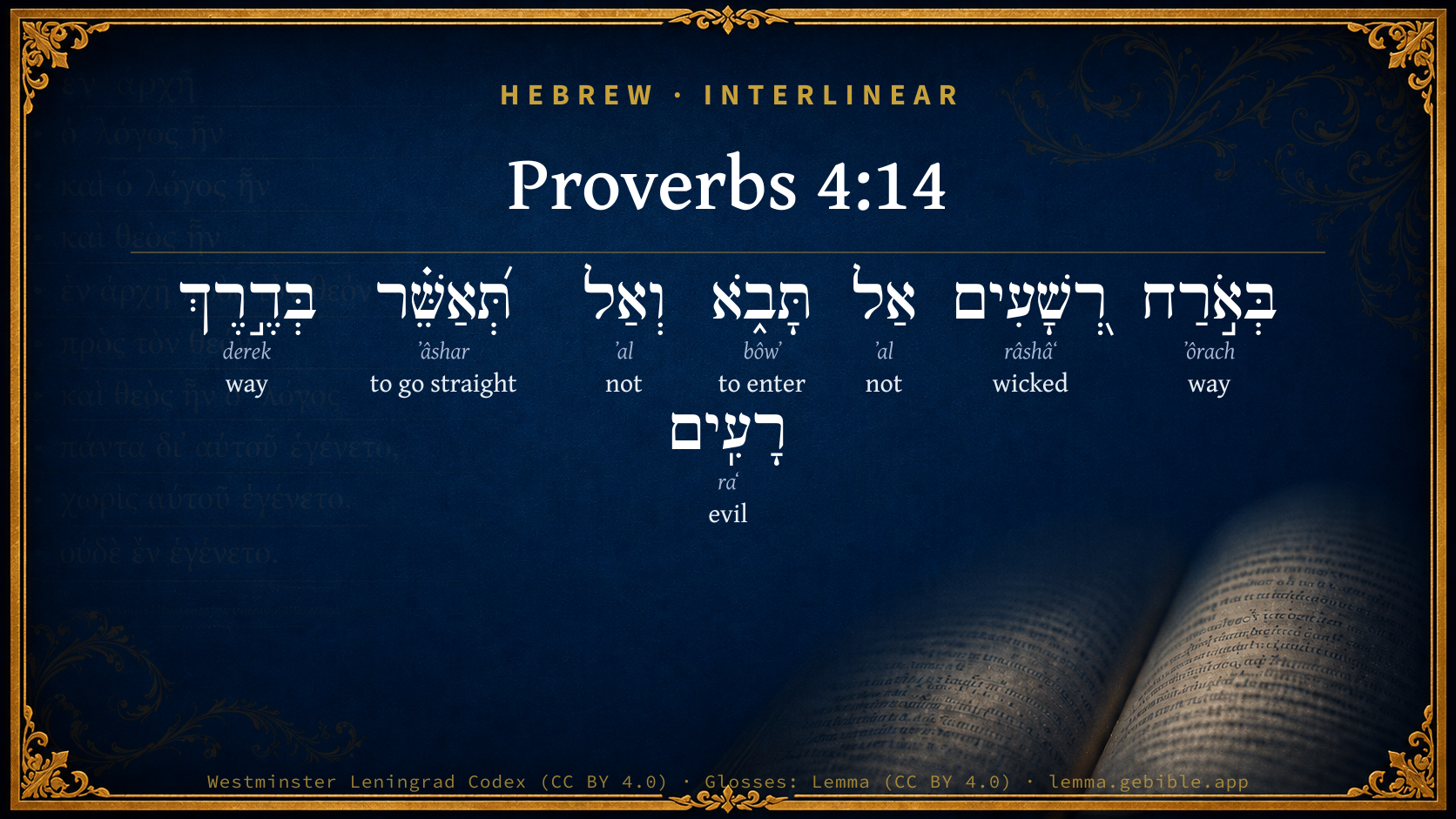
Hebrew (Westminster Leningrad Codex) Proverbs 4:14 appears in the Hebrew Old Testament. The text above is from the Westminster Leningrad Codex. Each word links to its Strong’s number, a concise gloss, and parsing drawn from the Open Scriptures Hebrew Bible morphology. Click any word for its full Brown-Driver-Briggs (BDB) entry.
Download image
Cite this verse

Proverbs 4:14 (World English Bible). Public Domain. Lemma interlinear Bible study tool, https://lemma.gebible.app/v/proverbs/4/14.

Show BibTeX & RIS
BibTeX
RIS
English Translation
Don't enter into the path of the wicked. Don't walk in the way of evil men.
World English Bible · Public Domain
Download a study sheet

One document with this verse’s original text, its word-by-word gloss line, the meaning frame, cross-references with their text, attributed commentary, and full source and license credits — printable, and it pastes into notes with its structure intact.

This verse Autodidact and up

Study sheet (.html) Plain text (.txt)

A passage Seminary Student

Up to 50 verses in one chapter. A passage sheet keeps up to 6 commentary sources and 12 cross-references per verse, in the order this page ranks them, and says so on the sheet whenever that leaves anything out. Ask for a single verse and you get the Autodidact verse sheet above.

Everything on this page stays free to read, with no account — the sheet is a download of what is already on screen, not access to it.

Want to remove ads? Support Godless Engineer
Compare translations 3

The same verse in 3 English versions, stacked beneath the original-language interlinear above. Click any original word for its lexicon entry.

Each is an independent rendering of the whole verse — the interlinear is not word-aligned to these translations.

Highlighted words mark where these versions differ — a whole-verse word diff, not a word-by-word alignment.

  • World English Bible Public Domain
    Don't enter into the path of the wicked. Don't walk in the way of evil men.
  • King James Version Public Domain
    Enter not into the path of the wicked, and go not in the way of evil men.
  • unfoldingWord Literal Text CC BY-SA 4.0
    On the path of wicked ones do not go, and do not advance on the way of evil ones.

unfoldingWord Literal Text — © unfoldingWord, licensed CC BY-SA 4.0. Word-aligned USFM3 via Door43 (git.door43.org/unfoldingWord/en_ult).

Versions to compare (up to 4)

3 of 4 selected

Show all 18 translations

Every available English version of this verse, each an independent rendering of the whole verse.

  • World English Bible Public Domain
    Don't enter into the path of the wicked. Don't walk in the way of evil men.
  • Berean Standard Bible Public Domain
    Do not set foot on the path of the wicked or walk in the way of evildoers.
  • Majority Standard Bible Public Domain
    Do not set foot on the path of the wicked or walk in the way of evildoers.
  • King James Version Public Domain
    Enter not into the path of the wicked, and go not in the way of evil men.
  • American Standard Version (1901) Public Domain
    Enter not into the path of the wicked, And walk not in the way of evil men.
  • Revised Version (1885) Public Domain
    Enter not into the path of the wicked, and walk not in the way of evil men.
  • Geneva Bible (1599) Public Domain
    Enter not into the way of the wicked, and walke not in the way of euill men.
  • Douay-Rheims (1899) Public Domain
    Be not delighted in the paths of the wicked, neither let the way of evil men please thee.
  • Young's Literal Translation Public Domain
    Into the path of the wicked enter not, And be not happy in a way of evil doers.
  • Literal Standard Version CC BY-SA 4.0
    Do not enter into the path of the wicked, || And do not be blessed in a way of evildoers.
  • Unlocked Literal Bible CC BY-SA 4.0
    Do not follow the path of the wicked and do not go along the way of those who do evil.
  • unfoldingWord Literal Text CC BY-SA 4.0
    On the path of wicked ones do not go, and do not advance on the way of evil ones.
  • Darby Bible Public Domain
    Enter not into the path of the wicked, and go not in the way of evil [men]:
  • World Messianic Bible Public Domain
    Don’t enter into the path of the wicked. Don’t walk in the way of evil men.
  • Webster's Bible Public Domain
    Enter not into the path of the wicked, and go not in the way of evil men.
  • Free Bible Version CC BY-SA 4.0
    Don't go the way of the wicked or follow the example of those who do evil.
  • Bible in Basic English Public Domain
    Do not go in the road of sinners, or be walking in the way of evil men.
  • JPS Tanakh (1917) Public Domain
    Enter not into the path of the wicked, and walk not in the way of evil men.

Literal Standard Version (2020), Covenant Press — licensed CC BY-SA 4.0. Text via the HelloAO Bible API (eBible.org). Unlocked Literal Bible (unfoldingWord) — licensed CC BY-SA 4.0. Text via the HelloAO Bible API (eBible.org). unfoldingWord Literal Text — © unfoldingWord, licensed CC BY-SA 4.0. Word-aligned USFM3 via Door43 (git.door43.org/unfoldingWord/en_ult). Free Bible Version, Dr. Jonathan Gallagher — licensed CC BY-SA 4.0. Text via the HelloAO Bible API (eBible.org).

Word by word

More ways to search: Search by grammar → Find every occurrence → Compare this word →

Practice this passage: Drill this verse → Learn its vocabulary →

About this verse

These counts appear in no published source. They are computed here, from the morphology-tagged text and Lemma’s own curated glosses. What Lemma adds →

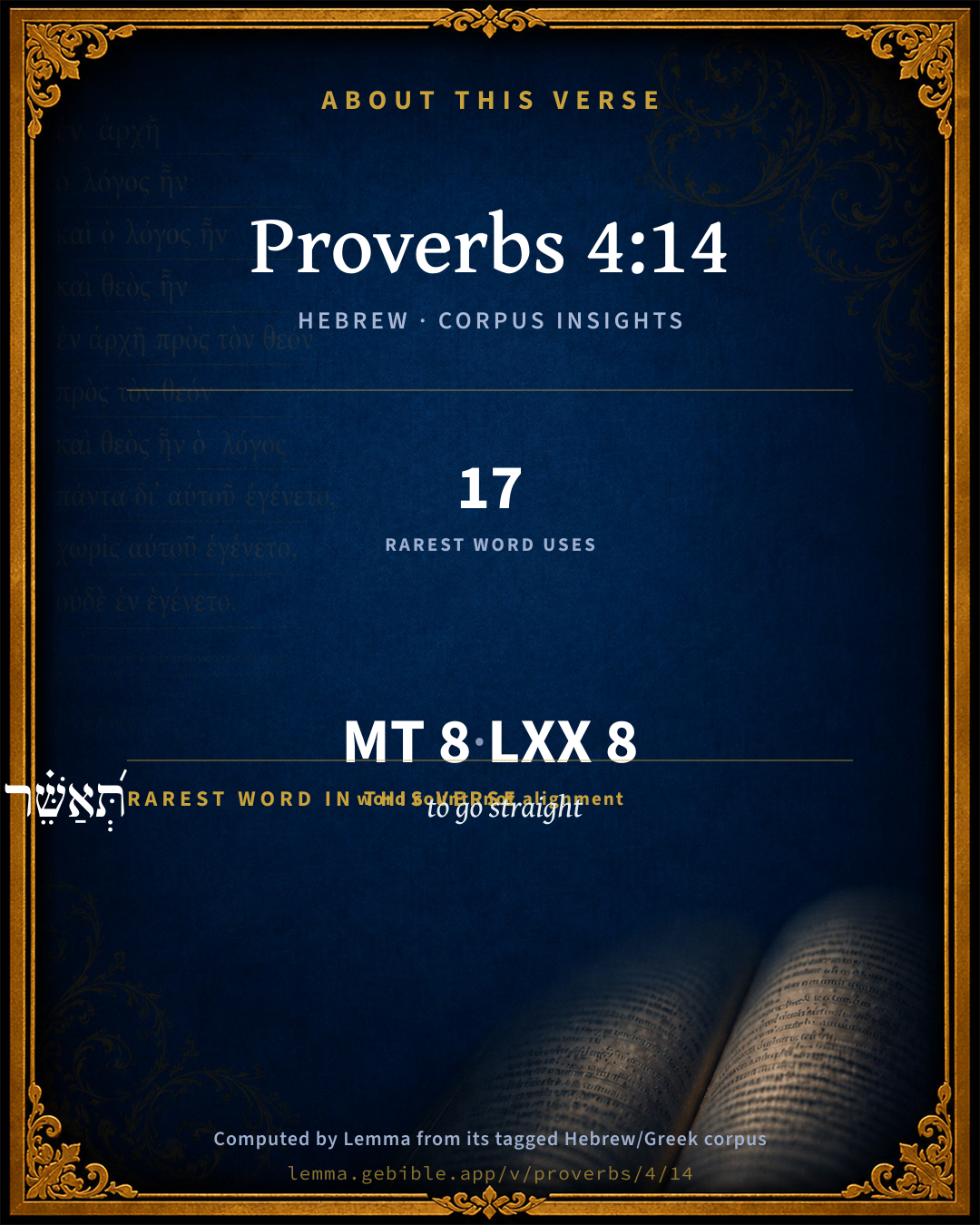
8
words
7
distinct lemmas
Wisdom
section

Notable vocabulary

The rarest word here is תְּ֝אַשֵּׁ֗ר to go straight H833 — appearing just 17 times in the whole Hebrew Bible.

Shared distinctive vocabulary

תְּ֝אַשֵּׁ֗ר to go straight H833 occurs in 15 verses of the Hebrew Bible. Also found in:

Grammatical profile

  • 2 verbs
  • 2 nouns
  • 2 adjectives
  • 2 particles

Verb forms

  • תָּבֹ֑א Qal · Jussive
  • תְּ֝אַשֵּׁ֗ר Piel · Jussive

Repetition

A word recurs within this verse — often emphatic in Hebrew:

  • אַל not H408 ×2

Hebrew & Septuagint length

In English translation the verse runs 16 words from the Hebrew and 14 from the Septuagint (LXX English) — closely comparable.

A rough comparison of the two English renderings, which tokenize alike — not a word-level alignment.

Word counts can differ between the Hebrew and the Greek without any difference in meaning — e.g. the Hebrew direct-object marker אֵת has no separate Greek word, and Greek often adds the article ὁ.

In the original languages it is 8 Hebrew tokens and 8 Greek tokens — but the two are counted differently (Hebrew bundles its prefixes and suffixes into one token; the Greek is in lemma form), so that isn’t a like-for-like length.

Cross-references

8

Topical passages linked to Proverbs 4:14 in the Treasury of Scripture Knowledge — connected by theme and wording, ordered by reader-vote popularity; previews shown in the World English Bible.

  • Psalms 1:1 Blessed is the man who doesn't walk in the counsel of the wicked, Nor stand in the way of sinners, Nor sit in the seat of scoffers;
  • 1 Corinthians 15:33 Don't be deceived! "Evil companionships corrupt good morals."
  • Proverbs 1:10 My son, if sinners entice you, don't consent.
  • Proverbs 1:15 My son, don't walk in the way with them. Keep your foot from their path,
  • Proverbs 9:6 Leave your simple ways, and live. Walk in the way of understanding."
  • Proverbs 13:20 One who walks with wise men grows wise, But a companion of fools suffers harm.
  • Proverbs 2:11–12 Discretion will watch over you. Understanding will keep you,
  • Psalms 26:4–5 I have not sat with deceitful men, Neither will I go in with hypocrites.

Cross-references courtesy of OpenBible.info (CC BY 4.0).

Hebrew and Greek witnesses Masoretic Hebrew ↔ Greek Septuagint

The same verse in the two great witnesses to the Old Testament, shown verse-for-verse.

These are two independent witnesses, not word-aligned to each other, and the Septuagint is shown in lemma (dictionary) form.

Hebrew Proverbs 4:14 Masoretic · Westminster Leningrad Codex

בְּאֹ֣רַח רְ֭שָׁעִים אַל תָּבֹ֑א וְאַל תְּ֝אַשֵּׁ֗ר בְּדֶ֣רֶךְ רָעִֽים

Don't enter into the path of the wicked. Don't walk in the way of evil men.

World English Bible · Public Domain

Greek LXX Proverbs 4:14 Septuagint · lemma form

ὁδός ἀσεβής μή ἐπιἔρχομαι μηδέ ζηλόω ὁδός παράνομος

Go not in the ways of the ungodly, neither covet the ways of transgressors.

LXX2012 (modern English Septuagint) · Public Domain

On this verse, John Gill's Exposition discusses the Septuagint’s reading. Read the note in Commentary ↓

Hebrew: Westminster Leningrad Codex (CC BY 4.0). Greek: Septuagint (public domain); English from LXX2012 (modern English Septuagint) (Public Domain). How the Septuagint differs from the Hebrew →

Commentary

Notes on Proverbs 4:14 from classic Christian and Jewish commentators (each source and its license shown beneath its notes). The classic Christian expositions comment on the surrounding passage and are grouped to its opening verse, so a note may address several verses; the Jewish commentaries on the Tanakh (Rashi and others) are per-verse, so they appear only where the commentator wrote on this verse.

Lemma curates 59 commentaries, every one of them public domain or Creative Commons licensed, each selected and text-cleaned for this edition rather than reprinted as found. About our sources →

Matthew Henry's Commentary

Some make David's instructions to Solomon, which began Pro 4:4, to continue to the end of the chapter; nay, some continue them to the end of the ninth chapter; but it is more probable that Solomon begins here again, if not sooner. In these verses, having exhorted us to walk in the paths of wisdom, he cautions us against the path of the wicked. 1. We must take heed of the ways of sin and avoid them, every thing that looks like sin and leads to it. 2. In order to this we must keep out of the ways of sinners, and have no fellowship with them. For fear of falling into wicked courses, we must shun wicked company. Here is,

I. The caution itself, Pro 4:14, Pro 4:15. 1. We must take heed of falling in with sin and sinners: Enter not into the paths of the wicked. Our teacher, having like a faithful guide shown us the right paths (Pro 4:11), here warns us of the by-paths into which we are in danger of being drawn aside. Those that have been well educated, and trained up in the way they should go, let them never turn aside into the way they should not go; let them not so much as enter into it, no, not to make trial of it, lest it prove a dangerous experiment and difficult to retreat with safety. "Venture not into the company of those that are infected with the plague, no, not though thou think thyself guarded with an antidote." 2. If at any time we are inveigled into an evil way, we must hasten out of it. "If, ere thou wast aware, thou didst enter in at the gate, because it was wide, go not on in the way of evil men. As soon as thou art made sensible of thy mistake, retire immediately, take not a step more, stay not a minute longer, in the way that certainly leads to destruction." 3. We must dread and detest the ways of sin and sinners, and decline them with the utmost care imaginable. "The way of evil men may seem a pleasant way and sociable, and the nearest way to the compassing of some secular end we may have in view; but it is an evil way, and will end ill, and therefore if thou love thy God and thy soul avoid it, pass not by it, that thou mayest not be tempted to enter into it; and, if thou find thyself near it, turn from it and pass away, and get as far off it as thou canst." The manner of expression intimates the imminent danger we are in, the need we have of this caution, and the great importance of it, and that our watchmen are, or should be, in good earnest, in giving us warning. It intimates likewise at what a distance we should keep from sin and sinners; he does not say, Keep at a due distance, but at a great distance, the further the better; never think you can get far enough from it. Escape for thy life: look not behind thee.

II. The reasons to enforce this caution.

1. "Consider the character of the men whose way thou art warned to shun." They are mischievous men (Pro 4:16, Pro 4:17); they not only care not what hurt they do to those that stand in their way, but it is their business to do mischief, and their delight, purely for mischief-sake. They are continually designing and endeavouring to cause some to fall, to ruin them body and soul. Wickedness and malice are in their nature, and violence is in all their actions. They are spiteful in the highest degree; for, (1.) Mischief is rest and sleep to them. As much satisfaction as a covetous man has when he has got money, an ambitious man when he has got preferment, and a good man when he has done good, so much have they when they have said or done that which is injurious and ill-natured; and they are extremely uneasy if they cannot get their envy and revenge gratified, as Haman, to whom every thing was unpleasant as long as Mordecai was unhanged. It intimates likewise how restless and unwearied they are in their mischievous pursuits; they will rather be deprived of sleep than of the pleasure of being vexatious. (2.) Mischief is meat and drink to them; they feed and feast upon it. They eat the bread of the wickedness (they eat up my people as they eat bread, Psa 14:4) and drink the wine of violence (Pro 4:17), drink iniquity like water, Job 15:16. All they eat and drink is got by rapine and oppression. Do wicked men think the time lost in which they are not doing hurt? Let good men make it as much their business and delight to do good. Amici, diem perdidi - Friends, I have lost a day. And let all that are wise, and wish well to themselves, avoid the society of the wicked; for, [1.] It is very scandalous; for there is no disposition of mind that is a greater reproach to human nature, a greater enemy to human society, a bolder defiance to God and conscience, that has more of the devil's image in it, or is more serviceable to his interests, than a delight to do mischief and to vex, and hurt, and ruin every body. [2.] It is very dangerous. "Shun those that delight to do mischief as thou tenderest thy own safety; for, whatever friendship they may pretend, one time or other they will do thee mischief; thou wilt ruin thyself if thou dost concur with them (Pro 1:18) and they will ruin thee if thou dost not."

2. "Consider the character of the way itself which thou art warned to shun, compared with the right way which thou art invited to walk in."

(1.) The way of righteousness is light (Pro 4:18): The path of the just, which they have chosen, and in which they walk, is as light; the light shines on their ways (Job 22:28) and makes them both safe and pleasant. Christ is their way and he is the light. They are guided by the word of God and that is a light to their feet; they themselves are light in the Lord and they walk in the light as he is in the light. [1.] It is a shining light. Their way shines to themselves in the joy and comfort of it; it shines before others in the lustre and honour of it; it shines before men, who see their good works, Mat 5:16. They go on in their way with a holy security and serenity of mind, as those that walk in the light. It is as the morning-light, which shines out of obscurity (Isa 58:8, Isa 58:10) and puts an end to the works of darkness. [2.] It is a growing light; it shines more and more, not like the light of a meteor, which soon disappears, or that of a candle, which burns dim and burns down, but like that of the rising sun, which goes forward shining, mounts upward shining. Grace, the guide of this way, is growing; he that has clean hands shall be stronger and stronger. That joy which is the pleasure of this way, that honour which is the brightness of it, and all that happiness which is indeed its light, shall be still increasing. [3.] It will arrive, in the end, at the perfect day. The light of the dayspring will at length be noon-day light, and it is this that the enlightened soul is pressing towards. The saints will not be perfect till they come to heaven, but there they shall themselves shine as the sun when he goes forth in his strength, Mat 13:43. Their graces and joys shall be all consummate. Therefore it is our wisdom to keep close to the path of the just.

(2.) The way of sin is as darkness, Pro 4:19. The works he had cautioned us not to have fellowship with are works of darkness. What true pleasure and satisfaction can those have who know no pleasure and satisfaction but what they have in doing mischief? What sure guide have those that cast God's word behind them? The way of the wicked is dark, and therefore dangerous; for they stumble and yet know not at what they stumble. They fall into sin, but are not aware which way the temptation came by which they were overthrown, and therefore know not how to avoid it the next time. They fall into trouble, but never enquire wherefore God contends with them; they consider not that they do evil, nor what will be in the end of it, Psa 82:5; Job 18:5, Job 18:6. This is the way we are directed to shun.

Matthew Henry's Commentary on the Whole Bible (1708–1710) — public domain (CC PDM 1.0). Text via the HelloAO Bible API.

Trapp's Complete Commentary

John Trapp

Pro 4:14 Enter not into the path of the wicked, and go not in the way of evil [men].

Ver. 14. Enter not into the path of the wicked.] Qui male vivunt, et peius credunt, saith one, which live ill, and believe worse. Qui aequo animo malis immiscetur, malus est, saith another. {a} He that is well content to keep company with those that are naught, is himself naught. The river Dee, in Merionethshire, running through Pimblemeer, remains entire, and mingles not her streams with the waters of the lake. See 1Co 5:9-11.

And go not in the way.] Ne tibi placeat via malorum; so the Vulgate. Think not thyself happy in their company, applaud not their way. Verbum eundi significationem felicitatis habet in multis linguis. {b} The Hebrew word to go signifies also to be happy; and Solomon haply here would take it in both senses.

{a} Fuller’s Holy State, 162.

{b} אשׁר, incessit, felicitavit. Ita συμβαινειν et ενοδουσθαι Graecis. Il va bien, Gallicis.

John Trapp, A Commentary or Exposition upon All the Books of the Old and New Testament (1647–1656) — public domain. Text from a community e-Sword module.

Joseph Benson's Commentary

Pro 4:14-19. Enter not into the path of the wicked — Avoid their practices and company; and go not in the way of evil men — Do not proceed further therein. If thou hast unadvisedly entered into it, do not persist in it, but get thee speedily out of it. Avoid it, pass not by it — Keep at a great distance from it. Turn from it, &c. — Shun all occasions of sin. For they sleep not — They cannot compose themselves to sleep with quietness and satisfaction to their own minds; unless they cause some to fall — Into their snares, either into sin or mischief. For they eat the bread of wickedness — Wickedness is as necessary and as pleasant to them as their bread; or, they live wholly upon what they get by wicked courses. Which gives the reason why they could not sleep without prey. And drink the wine of violence — That is, gotten by violence: see on the former clause. But the path of the just is as the shining light — The common course of their lives, or actions, is pure and spotless, clear and certain, safe and comfortable as light is; and their presence enlightens, instructs, edifies, and rejoices others. They carry light into every place by their example, and by their instructions. That shineth more and more unto the perfect day — Righteous men daily grow more and more in knowledge, and grace, and consolation, until all be perfected and swallowed up in glory. But the way of the wicked is as darkness — Full of gross ignorance and error, of uncertainty and confusion, of iniquity, of danger, and of misery: all which come under the name of darkness in the Scriptures, and suit well with the context. They know not at what they stumble — Hebrew, במה יכשׁלו, at what they shall, or are about to, stumble. Though they are always in danger, yet they are always secure, and do not discern their danger, nor the cause, or manner, or time of their ruin, till they be surprised with it. Or, as some interpret the clause, “They commit sin without scruple; they deliver themselves up to it without remorse; they fall without grief, and continue in it without repentance.”

Joseph Benson's Commentary on the Old and New Testaments (1811–1818) — public domain. Text from a community e-Sword module.

The Preacher's Complete Homiletical Commentary

Joseph S. Exell (gen. ed.)

CRITICAL NOTES.—

Pro_4:14. Go not. The Heb. is literally “to go straightforward;” also, “to pronounce happy.”

Pro_4:15. Avoid, “Let it go,” reject it.” Turn from it, i.e., even if thou hast entered, turn back.

Pro_4:16. Miller here reads: “For the mere reason that they sleep not, rest assured they do mischief; and that their sleep is stolen, rest assured they occasion stumbling:” and understands it to mean that the more sleepless the industrious impenitent, the faster he is carrying everything to eternal ruin. But all other commentators of importance read as in the English version.

Pro_4:18. Shining light, Lit. “the light of dawn that grows and brightens even to the establishment of the day.”

Pro_4:19. Darkness, “thick darkness,” the gloom of midnight.

MAIN HOMILETICS OF THE PARAGRAPH.—Pro_4:14-19

CONTRASTED PATHS AND OPPOSITE CHARACTERS

I. The just man’s path.

1. It is a pre-ordained one. The path which the sun takes through the heavens, the path in which our earth encircles the sun, are the paths which God has pre-ordained for them. They are the only paths which they could take and preserve the harmony of the system to which they belong. They are the orbits which are exactly adapted to the fulfilment of the end for which God created them. So the path—the manner of life—of the godly man is the path in which God intended man to walk when He created him. He called him into being in order that he might “walk before Him and be perfect” (Gen_17:1). “The highway of holiness” is the God-ordained path of man, the old way which was trodden by His creatures for ages before men had any existence.

2. It is a blessing-dispensing path. The sun, by keeping God’s pre-ordained path, is a blessing to the world. Its rays possess a quickening power which developes the hidden life of the plant, and so clothes the earth with beauty and fruitfulness. Without its heat and light our globe would be a great Sahara—a vast wilderness of black barrenness. It likewise brings into operation a sense in man which would otherwise be dormant. The light of the body is the eye, but where would sight be without sun? Creatures who have lived for years in darkness appear to lose the power of sight, even if light shines upon their eye-balls. The constant contact of the eye with light keeps alive the power of vision. So with the just man’s path. Without the godly this world would be a moral wilderness. All the beauty of goodness there is in it comes from the life of the children of wisdom. “They that dwell under his shadow shall return; they shall revive as the corn and grow as the vine; the scent thereof shall be as the wine of Lebanon” (Hos_14:7). And He keeps alive the inner eye of man—the conscience. It, too, needs external light to play upon it to keep it alive. And the holy walk of the godly does this for the ungodly, it prevents the conscience from being utterly stifled by sin.

3. It is a progessive path. It shines more and more. The light of dawn has glories all its own, but it is not strong enough to do the work of the noon-day rays, its heat is not able to penetrate beneath the surface of the earth and wake up the life of the seed-corn hidden there; its brightness touches the mountain-tops, but does not scatter the shadows in the valleys. But when the sun reaches its meridian “there is nothing hid from the heat thereof.” So with the children of wisdom. When they first set out upon their journey their godliness is not so manifest to others, nor does it yield so much comfort to themselves as when they have trodden the path for years. But it must, from a necessity of nature, go on unto perfection. “Just men will be made perfect” (Heb_12:3). “They go from strength to strength” (Psa_84:7). They come “to the perfect day.”

II. The wicked man’s way. It is in every point the converse of that which has just been sketched.

1. It is his own way (chap. Pro_1:31): not God’s way, not the way in which he was destined to walk. It is an old way (Job_22:15), but not the oldest way; it is a path cast up by the will of man and pre-Adamite sinners.

2. It is a way of darkness, because it is a way of blindness. Blindness puts a man in the dark, and, being in the dark, he has only the experience that springs from darkness. Wickedness puts out the eyes of the soul, and, like a blind Samson, it sits in darkness and the shadow of death. A state of blindness is a state of ignorance. A blind man cannot avoid objects that come in his way, and when he falls in consequence, he knows not the object that caused him to fall. So the wise man here describes the ungodly as one “who knows not at what he stumbles” (Pro_4:19). He has no realisation of the real character of his tempters, no insight into the sinfulness of sin; the lack of a guiding principle turns his walk into a series of stumblings. It follows of necessity that such a path is one of danger. It is more dangerous to walk in the night than in the day. The footpad or the highwayman can hide himself from our view in the darkness, and come upon us unawares. We may fall over the precipice at night that we could easily avoid in the day. So is it in a course of sin. A man who shuts his eyes to the light within him, and rejects the light which is to “lighten every man” (Joh_1:9), will, unawares, be overtaken by retribution, and fall into depths of remorse upon which he little counts.

3. Like the path of the just, it is a progressive path. No man stands still in it. The darkness thickens as the blindness increases, and the blindness grows the longer men refuse to “come to the light” (Joh_3:20). Men do not all at once come to the height or descend to the depth of iniquity described in Pro_4:16, when, unless they have done some iniquitous act, they feel that they have lost a day. The merchant may feel he has lost a day when he has failed to make a good bargain; the scholar feels it when he has not added to his stock of knowledge; the heathen emperor reckoned a day lost when he had not benefited some one; but for a man not to sleep except he has done a mischief, surely expresses as “perfect a night” as it is possible for human nature to attain to. Surely he then proves himself to be a child of him whose business it is to “go about seeking whom he may devour” (1Pe_5:8).

4. It is a path which is destructive to others. As the good man, by walking in God’s path, blesses his fellow-creatures as well as himself, so the wicked man, in his path of darkness, is a curse to others as well as himself. The force of evil example alone is pernicious to all who surround him, but although he may begin in this negative way, he soon advances to positive acts of sin, until he lives upon the misery of others. It becomes his meat and drink to drag others to destruction with him, or, failing that, to do them as much injury as he can (Pro_4:16-17).

III. The means of escape from this path of darkness and ruin. “Enter it not,” and, to make sure of not entering it, give it a wide berth—“pass not by it, turn away” (Pro_4:14-15). When we see those whom we love in danger, we multiply words of warning, and are not careful to avoid repeating words which may have little or no difference in their meaning. So Solomon’s anxiety shows itself here in the repetition of his exhortations. But there is some gradation observed in them.

1. We are not to enter the paths, not even to set one foot upon the forbidden way. Men may be tempted to venture a step or two just to take a glance, and intend to turn back as soon as they have done so, but it is enchanted ground, and it is more than likely if they are once upon the track they will go further than they at first intended. But if they do not enter it, they cannot walk in it.

2. If you have already entered, do not persevere another moment, turn from it at once. If the captain of a ship becomes all at once aware that he is steering his vessel upon the rocks, he puts about at once. The next best thing to not going wrong at all is to turn back—in Bible language, to repent, to put the face in the opposite direction, to turn the whole man back to the opposite goal.

3. In order to escape the danger of entering at all, or of re-entrance after having once forsaken it, avoid its very neighbourhood, pass not by it, go not in the way of temptation. If a youth has been induced to gamble, and has resolved to give up the habit, let him not go near the gambling house—let him give up all intercourse with gamblers; if he has been once under the fatal influence of strong drink, he must taste it no more—not even “look upon the wine when it is red” (ch. Pro_23:31). He must “flee youthful lusts,” and the most certain method of doing this is to strike out another course—to “follow after righteousness (1Ti_6:11-12), to get well into the way of wisdom, to know from experience the blessedness of the path of the just.” Men must have a “way” in life, there is no neutral ground; or if some men seem for a time to be living in the border-land, a time will come when they must declare for one side or the other.

OUTLINES AND SUGGESTIVE COMMENTS

Pro_4:14. We must all “enter” somewhere. We are all travelling. We all necessarily follow something. Don’t take the path of the wicked for it. That is the doctrine.—Miller.

Sin is like a whirlpool. He who once ventures within the circle of its eddying waters in the self-sufficient assurance that he may go a certain length, and then turn at his pleasure and stem the current back, may feel the fancied strength of the sinews of his moral resolution but weakness in the moment of need, and may—nay, almost certainly will—be borne on further and further, till, all power of resistance failing, he is carried round and round with increasing celerity, and sucked into the central gulf of irrecoverable perdition.—Wardlaw.

Jortin, in his remarks upon Ecclesiastical History, relates the story of a colloquy between a Father of the second century and an evil spirit in a Christian, whom he sought to expel. Upon inquiring how he dared be so impudent as to enter a Christian, the evil spirit replied, “I went not to church after him, but he came to the playhouse after me, and, finding him upon my own ground, I sought to secure him for myself.” Whatever becomes of the story, the moral of it deserves attention.—Leifchild.

We pray to be kept from temptation, and our practice ought not to contradict our prayers; otherwise, it is evident that we mock God by asking from Him what we do not wish to have.—Lawson.

Pro_4:15. This triple gradation of Solomon showeth, with a great emphasis, how necessary it is to flee from all appearance of sin.… Entireness (friendship) with wicked consorts is one of the strongest chains of hell, and binds me to a participation of both sin and punishment.—Brooks.

Come not near.

1. Because our corruption is so great that, if we come near it, we will both smell it with delight and smell of it.

2. Because wicked men stand upon the edge of their way to draw others into it, as thieves watch for their prey.

3. We may stumble into that way ourselves, if we be not pulled into it by others. He that walks on the brink of a river may fall in. There is but a narrow bridge between lawful and unlawful. And that which is lawful to-day may, by a circumstance, be made unlawful to-morrow.—Francis Taylor.

It would not be complaisance, but cowardice—it would be a sinful softness which allowed affinity in taste to imperil your faith or your virtue. It would be the same sort of courtesy which, in the equatorial forest, for the sake of its beautiful leaf, lets the liana, with its strangling arms, run up the plaintain or orange, and pays the forfeit in blasted boughs and total ruin. It would be the same sort of courtesy which, for fear of appearing rude or inhospitable, took into dock the infected vessel, or welcomed, not as a patient, but a guest, the plague-stricken stranger.—Jas. Hamilton.

Pro_4:16-17. The devil, their taskmaster, will not allow them time to sleep, which is very hard bondage.—Trapp.

The character of the wicked is here drawn in their father’s image—first, sinners; then tempters.… Judas with his midnight torches (Joh_18:3); the early morning assembly of the Jewish rulers (Luk_22:66); the frenzied vow of the enemies of Paul (Act_23:12); and many a plot in after ages against the Church—all vividly pourtray this unwearied wickedness.—Bridges.

The fearful stage of debasement when the tendency to sin is like the craving for stimulants, as a condition without which there can be no repose.—Plumptre.

The trouble of others is the rest of the wicked.—Jermin.

Just as bread forms the flesh, and makes it grow, according as it is eaten, so wickedness is the food of the spirit. “My meat is,” says Christ, “to do the will of Him that sent me, and to finish His work” (Joh_4:34). “Thy words were found, and I did eat them” (Jer_15:16). So in chap. Pro_1:31, “Therefore shall they eat of the fruit of their own way”—the meaning being, that a man’s way, spiritually considered, is all that forms him. He feeds upon it. If it is righteous, it nourishes him in life. If it is wicked, it nourishes him in death. He feeds on food of wickedness, and grows exactly in proportion as he sins. His very life is in its very self a deadly self-banqueting.—Miller.

They sin, not of frailty, but of malice; not by occasion, as it were, but by an insatiable desire of committing wickedness.—Muffet.

Pro_4:18. He sets forth betime in the morning and travels to meet the day.

The sun is an emblem, not of the just, but of the Justifier. Christ alone is the light of the world, Christians are the enlightened. The just are those whom the Sun of Righteousness shines upon.… When any portion of the earth’s surface begins to experience a dawn diminishing its darkness, it is because that portion is gradually turning round towards the sun, the centre of light fixed in the heavens. When any part of the earth lies away from the sun, and in proportion to the measure of its aversion, it is dark and cold, in proportion as it turns to him again its atmosphere grows clearer, until in its gradual progress it comes in sight of the sun, and its day is perfect then. So is the path of the just. Day is not perfect here in the believer’s heart.… but the machinery of the everlasting covenant is meantime going softly and silently as the motion of the spheres; and they that are Christ’s here, whatever clouds dim their present prospect, are wearing every moment farther from the night, and nearer to the day.—Arnot.

There is a day to be which shall be a day indeed, without cloud, without night, without morning, without evening. Unto this day leadeth the path of the righteous, and which going on, shineth more and more, until at last, when it seemeth to go out, it shall be received into that light which never goeth out.—Jermin.

Light is emblematical of knowledge, holiness, and joy. The three bear invariable proportion to each other—holiness springing from knowledge, and joy from both.… “The entrance of God’s word gives light.” But the entrance of this light into the mind is often, like the early dawn, feeble, glimmering, uncertain.… But it does not abide so.… He who is enlightened from above is eager for more of the blessed light. He thirsts for knowledge, and is on the alert to obtain it.… With growth in knowledge there is growth in holiness. At the first dawn of spiritual light some faint desires are felt after God and sanctity. These progressively increase, and they show their influence in the increase of practical godliness … And joy is the natural attendant of spiritual illumination and inward sanctity. It, too, is progressive. Like the sun in every stage of his diurnal course, it may be overcast by occasional clouds. But as the sun appears the brighter on his emerging from the cloudy veil, so the trials of the just serve to give lustre to their virtues.—Wardlaw.

Pro_4:19. It is interesting to note the resemblance between these words and those of our Lord (Joh_11:10; Joh_12:35).—Plumptre.

Strange enough! it is a confessed darkness. There is a sort of common light that tells a man that impenitence is darkness. And yet it does not teach him better. Like mere physical light at times, some chemical ray is absent. The darkness that remains is a darkness that may be felt. It constitutes our eternal chains (2Pe_2:4); it binds a man on the car of ruin. And like a Christian, who, in his partial light, may fail to know what is blessing him, so the sinner in his absolute darkness, takes industry for virtue, and family love for a wholesome righteousness; and does not know the incidents of life that are stumbling blocks to eternal ruin.—Miller.

Sinners are in such darkness that they are insensible to the objects that are leading them to ruin, thus they stumble—

1. At the great deceiver.

2. At one another.

3. At Divine Providence.

4. At their common employments.

5. At the nature and tendency of their religious performances.

6. At the preaching they hear.

7. At the blindness of their hearts.—Emmons, from Lange’s Commentary.

The Preacher's Complete Homiletical Commentary (gen. ed. Joseph S. Exell; Funk & Wagnalls, c. 1892) — public domain (pre-1929). A full-Bible homiletical/sermon-outline anthology covering 65 of 66 books (2 John is absent from the source module). Text from a community e-Sword module.

Jamieson, Fausset & Brown

Robert Jamieson, A. R. Fausset & David Brown

(Compare Psa 1:1). Avoid all temptations to the beginning of evil.

Jamieson, Fausset & Brown — Commentary Critical and Explanatory on the Whole Bible (1871) — public domain (CC PDM 1.0). Text via the HelloAO Bible API.

Adam Clarke's Commentary

Verse 14. Enter not into the path of the wicked] Never associate with those whose life is irregular and sinful; never accompany them in any of their acts of transgression.

Adam Clarke's Commentary on the Bible (1810–1826) — public domain. Text from a community e-Sword/MySword module.

The Cambridge Bible for Schools and Colleges

gen. ed. J. J. S. Perowne

14. The earnest warning of this and the following verses recalls the similar warnings of Pro_1:19 ff.; Pro_2:12 ff.; Pro_3:31 ff.

The Cambridge Bible for Schools and Colleges (gen. ed. J. J. S. Perowne; Cambridge University Press, 1878–1918) — public domain. Text from a community e-Sword module.

John Gill's Exposition

Enter not into the path of the wicked,.... Which leads to eternal death; join not with them in their wicked ways and practices; have no fellowship, keep no company, with them; do not set one foot in the path they tread, lest thou shouldest be tempted to proceed to more ungodliness; you do not know where and when there will be a stop, when once you begin, therefore enter not. The Vulgate Latin version is, "do not delight in the paths of the ungodly": but this supposes not only entrance, but progress and continuance in them, whereas the first is dehorted from in these words:

and go not in the way of evil men; if tempted and prevailed upon to take a step and make a trial, do not proceed; withdraw at once, do not go on. Some render it, seeing the word used has sometimes the signification of blessedness in it, "do not esteem the way of evil men blessed" (y); nor reckon thyself or them happy that walk in such ways; they are far from it: hence the Targum, Septuagint, and Syriac versions are, "do not envy the ways of wicked men"; their seeming pleasure will end in bitterness: the Arabic version is, "do not imitate" them; do not follow their example, and do as they do.

(y) "in via malorum ne te beatum existimes", Tiguriue version; "ne beatam praedices viam malorum", Michaelis.

John Gill's Exposition of the Whole Bible (1746–1763) — public domain (CC PDM 1.0). Text via the HelloAO Bible API.

Matthew Poole's English Annotations

Enter not into the path of the wicked; avoid their courses and company.

Go not; do not proceed further. If thou hast unadvisedly entered into it, do not persist in it, but get thee speedily out of it.

Matthew Poole's English Annotations on the Holy Bible (1683–1685) — public domain. Text from a community e-Sword/MySword module.

Whedon's Commentary on the Bible

Daniel D. Whedon

14. Enter not… wicked — Here begins a dissuasive from evil association, that fruitful source of mischief to all classes, especially to the young, who are the more imitative, and their habits not yet fixed.

Evil men — Primarily such as were noted in chap. 1 — men of violence and blood.

Daniel D. Whedon (gen. ed.), Commentary on the Old and New Testaments (1874–1909) — public domain. Text from a community e-Sword module.

The Pulpit Commentary

From admonition the father passes to warning. The connection with the preceding section is obvious. There are two ways diametrically opposite the way of wisdom and the way of evil; the one the way of life, the other fraught with death, because a way of darkness and violence. As the father has dealt with the former, so now he deals with the latter. With these warnings we may also comp. Pro_1:10-15 and Pro_2:10-15, where much the same warning is given, and the way of the wicked is described in almost the same terms. The warning of the father takes a threefold form:

(1) enter not;

(2) go not;

(3) avoid.

In effect he says this is the only course to be adopted in order to keep a firm hold of Wisdom which he has counselled in the preceding verse (13). Enter not; al-tavo, from bo. "to come in," "to enter," i.e. do not even enter. The Vulgate renders, "Delight not in," evidently from reading tove, which occurs in Pro_1:10. But our reading is to be preferred, as avah, "to acquiesce in," from which tov"e, is not used with Bi, here denoting place, but with li. Go not (al-t"ashsher); i.e. do not walk in. The two verbs "to enter" (bo) and "to go" (ishsher) stand in the relation of entering and going on ingressus and progressus. So Gejerus and Delitzsch. The piel ishsher, here used, is properly "to go straight on," like the kal ashar, of which it is an intensive. (cf. Pro_9:6) It is the bold, presumptuous walk, the stepping straight out of the evil, which is here indicated, and against this the father warns his son. The sense is, "If you have entered the way of the wicked, do not continue or persevere in it." The other meanings of the verb ashar, viz. "to guide straight", (Pro_23:19) "to esteem happy and prosperous", (Pro_31:28) are not in place here, as they destroy the parallelism of thought, and on the same ground the LXX and Syriac renderings, "envy not" and mhde zhlwshv , are to be rejected. The wicked (ishaim), i.e. the godless, (cf, Psa_1:1) is parallel with "evil men" (raim), i.e. the habitually wicked.

Vers. 14, 15. Bad company.

I THE DUTY OF AVOIDING BAD COMPANY. We are all more or less unconsciously affected by the tone of the society we frequent. Even the strongest, most independent spirit cannot wholly fortify himself against this influence. As water wears the hardest rock, the constant friction of social intercourse makes itself felt in course of time upon the most resolute character. We are naturally gregarious. Without knowing it, nay, even while protesting against it, we are carried away with the current through which our course lies. Salmon swim up against the stream; but men prefer to float with the stream. Hence the great reason for choosing society of good character. It is most essential that young men just entering business in a great city should bear this in mind. The class of companions they choose will very largely affect the whole future course of their lives. Christians are called to come out from the world; but our Lord showed his wisdom, as much as his kindliness, in instituting the Church as a fellowship of his people. Thus he sought to use the social influences of mankind in favour of purity and truth as a set off against the strong current of a corrupt worldly society. It is always dangerous to be cut off from these good influences. Emigrants and others who go to the colonies and to foreign countries should be on their guard against the peculiar dangers of their isolated situation. Many a young man has been ruined for life by going friendless to a distant country, and there falling a prey to the corruptions of bad company.

II DIFFICULTIES IN THE APPLICATION OF THIS DUTY. The early Church, seeing idolatrous rites associated with almost every political and social engagement, withdrew very considerably from public life. The logical outcome of her conduct was monasticism. We have not her peculiar difficulties to contend with. Yet the mere thought of avoiding bad company might lead us to a similar course unless we weighed well other considerations of duty. Thus there are Christians who eschew all connection with national affairs because they hold that politics are closely wrapped up with worldly and wicked practices. But if the worst is true, it is rather our duty to seek to mend matters. Since we must have government, we should see that this is of the best possible character. If all the good people forsake it, they hand the government of the nation over to the wicked, and thereby tacitly sanction bad government. So if they put a ban on all amusement, they indirectly degrade every kind of amusement, and increase the temptation of the great mass of people, who naturally seek some sort of recreation, and will have the bad if they do not get the good. We must remember also that our Lord was accused of keeping the worst of company, and that he did this deliberately for the good of those with whom he bad intercourse. We are not to be Pharisees, proud separatists, but brothers of all men, who are our fellow sinners. The important point is the motive with which men enter bad company. If this be to discharge some duty, or to benefit those who are visited, it is pure, and may be expected to ward off harm. If it be done carelessly and for selfish pleasure, there is danger in it.

Vers. 14-19. The two paths.

I LIFE UNDER THE IMAGE OF A PATH. It is a leading biblical image. There is much suggestion in it.

1. Life, like a path, has a starting point, a direction, and an end.

2. We have a choice of paths before us. The high road may image holy tradition and custom, the bypaths the choice of caprice or personal aberration.

3. It is only safe to follow beaten tracks. What we call "striking out an original course" may be conceited folly. "Gangin" our ain gait" is a dubious expression.

4. The selection of the path must be determined by whither we desire to arrive.

5. We are ever drawing near to some end. It alone can disclose the prudence or the folly of our choice.

II THE PATH OF THE WICKED. (Vers. 14-17, 19)

1. Religion passionately warns against it. The language of iteration is the very language of urgency and passion. What a force there is in the mere repetition of the cry, "Fire! fire! fire!" or in the warning of the mother to the little one against some dangerous object, "Don"t go near it; keep away; go further off!" Just so does Divine Wisdom deal with us children of a larger growth. Again and again she clamours, Enter not; go not; shun it; pass not over; turn away; pass by!" (vers. 14, 15). This throbbing earnestness, this emotion of the Bible, gives it its hold on man; and should be shared by every teacher.

2. Religion describes it in powerful invective (vers. 16, 17).

(1) The sleepless malice of the wicked. A common figure for the intense activity of the mind. As David had a sleepless ambition to build a temple for Jehovah; as the trophies of Marathon suffered not the glory-loving Themistocles to sleep; as care, or glowing study, or eager planning, breaks our nightly rest; so the evil have no repose from their dark cupidities and pernicious schemes.

(2) They are nourished by evil (ver. 17). To "eat bread and drink wine" is a Hebrew metaphor for living. (Amo_2:8 Amo_7:12) In a similar way, the "bread of misery" and the "wine of punishment" are spoken of. (Deu_16:3 Psa_127:2 Amo_2:8) They live upon villainy, as we might say. It is the root of their being. It is horrible, but true, that a man may, as it were, draw life and energy out of a perverted consciousness, as the drunkard cannot live without the alcohol which is killing him.

III THE PATH OF THE RIGHTEOUS. (Ver. 18) There is a change of figure; for the image of the path, the image of the advancing light of morning is substituted.

1. Light as an image of moral goodness. It is universal, Suggests itself to and strikes the fancy of all It associates with it the images of beauty, of joy, of expansion, of futurity, of infinity.

2. The growth of light from dawn to noon as an image of moral progress. This is true of knowledge and of practice. The good man travels out of dimmer perceptions and out of doubts, into clear convictions of reason. At first he realizes little; his will is weak and untrained. But keeping his eyes upon the ideal of the good, true, and beautiful, he embodies more and more of it in conduct. As the sun rests not (to speak and think in the dialect of poetry) till it "stands" (see the Hebrew) in high noon, so the righteous is ever advancing towards the goal of a life in perfect unity with God.

3. The safety of the light is an image of the course of the righteous. Translated into distinctively Christian thought, this is following Christ. (Joh_11:9, Joh_11:10)

4. The image serves to throw into contrast the course of the wicked. "Thick darkness" represents their mind and way. It is ignorant, full of peril, yet they are unconscious of it. Instead of growth and progress, their doom is sudden extinction. J. (comp. Pro_1:27 Pro_2:18, 22 3:35)

Vers. 14-17, 19. The prudence of piety.

We may say concerning piety or virtue the wisdom which is from God includes both that the essence of it is in right feeling, in loving him who is the Holy One and that which is the right and admirable thing, and in hating that which is evil and base; that the proof of it is in right acting in going those things and those only which are good and honourable, which God"s Word and our own conscience approve; and that the prudence of it is in these two things which are implied in our text.

I CHERISHING A WHOLESOME HORROR OF THE CONSEQUENCES OF SIN. There is an insensibility and an ignorance which passes for courage, and gets a credit which is not its due. Those who do not take the trouble to know what the issues of any line of conduct are, and who go fearlessly forward, are not brave; they are only blind. We ought to know all we can learn of the consequences of our behaviour, of the end in which the path we are treading terminates. The prudent man wilt see and shrink from the consequences of evil; and if he open his eyes or consult those who can tell him, he will find that they are simply disastrous.

1. For sin is mischievous in its spirit; it gloats over the ruin which it works; it finds a horrible delight in doing harm to human souls (vers. 16, 17).

2. And it succeeds in its shameful design. It does "mischief;" it makes men "to fall." It causes spiritual decline, decay, corruption the worst of all mischief; it leads purity, sobriety, honesty, truthfulness, reverence, love, to fall down into the ruinous depths of lasciviousness, intemperance, dishonesty, falsehood, profanity, hard-heartedness.

3. It leads down to a darkness and a death of which it did not dream (ver.19). It sinks into that awful soul-blindness in which the "eye is evil," in which the very "light is darkness", (Mat_6:23) in which the moral judgment, all perverted, leads astray. "The way of the wicked is as darkness: they know not at what they stumble." Their powers of moral distinction are gone; they are "altogether gone astray." Piety, virtue, may well in godly prudence shrink with wholesome horror from this.

II CAREFUL AVOIDANCE OF THE WAY OF THE WICKED, and so of the path of temptation.

1. True it is that we must be often found in perilous places at the call of daily duty.

2. True that at the invitation of mercy we shall sometimes be found there.

3. But it is also true that the wise will not needlessly expose themselves to the assaults of sin. They will refrain from so doing both because

(1) we are not sure of the measure of our own strength; there may be some very weak places in our armour, ill-fortified parts in our character; most men are weaker than they know, somewhere. And also because

(2) we do not know the full strength of temptation. Full often sin proves to have an unimagined force, an unsuspected skill. The full strength of the allurements and enticements of evil perhaps no man knows. The number of the slain that lie on the spiritual battlefield tells with a mournful eloquence that thousands of the children of men have overestimated their own resisting power, or underestimated the insidiousness, or the fascination, or the force of the foe. Therefore, if duty does not demand it, nor mercy plead for it, shun the dangerous path, "enter not into the way of it... avoid it, pass not by it, turn from it, and pass away" (vers. 14, 15) Let it be considered that this is a Divine injunction; therefore let there be no hesitation about obeying. There is nothing unmanly or ignoble in prudence. It is not a virtue to be anywise ashamed of. There is ample scope for the utmost heroism of spirit and of life without exposing our young hearts to evils the very nature of which we may not know, the force of which we cannot measure, and from the consequences of which we might never be able to escape. C.

The Pulpit Commentary (1880–1919), ed. H.D.M. Spence-Jones & Joseph S. Exell — public domain. Text from a community e-Sword module.

Bridges on Proverbs

Charles Bridges

How often does fellowship with the wicked loosen the fast hold of instruction! Their path is so contrary to the way of instruction, that the very entrance into it is forsaking the way of God. Their character is here drawn in their Father’s image — first sinners, then tempters. Mischief is their meat and drink. (Job 15:16 . Psa 14:4 .) ’To do evil is more proper and natural than to sleep, eat or drink.’†1 With sleepless eagerness do they pursue their work (Job 24:15-16 . Psa 36:4 . Mic 2:1 ), caring little for any lengths of violence, so that they do mischief, or cause some to fall. (Pro 1:10-14, Pro 1:16 ; Pro 2:14 ; Pro 24:2 . Psa 10:8 . 2Pe 2:14 .) Judas with his midnight torches (Joh 18:3 ); the early morning assemblage of the Jewish rulers (Luk 22:66 ); the frenzied vow of the enemies of Paul;†2 and many a plot in after ages against the Church — all vividly portray this unwearied wickedness.

Yet if we be preserved from this undisguised malignity, what are all the allurements for every rank and circumstance of life, but the more subtle poison of the murderer? A light-minded young person pours into his companion’s ear — simple and inexperienced in the ways of sin — perhaps filthy conversation; or presents before him images of lasciviousness. What but a rooted principle of grace can save his unsuspecting victim? Or again — the venomous infidel, intent upon "spoiling" (Col 2:8 ) his fellow-creature of his most precious treasure, drops into his bosom the repetition of the first lie. (Gen 3:4 .) No principle appears to be given up, no fundamental doctrine denied; yet the foundation of an unwavering confidence is shaken to pieces. And is not this mischief and violence as the murderer’s stab?

Surely then it is mercy, that forbids needless intercourse with the evil man. (Eph 5:11 .) With a constitution prone to evil, when the alternative is, whether we shall shun or dare the danger, can we doubt our path? The whole Scripture is on the side of caution, to hazard nothing, except on a plain call of Providence. ’Because we are free, we may not run wild.’†3 Half our virtue we owe to being out of the way of temptation. Observe how the wise man heaps up his words — Enter not into the path — no — not so much as set thy foot into it. If some accident throws thee into it, go not on in it; avoid it with detestation.†4 Pass not by it, lest thou shouldest unwittingly turn in. (Pro 5:8 .) Not only avoid it when near, but avoid nearness to it. It is like living in the atmosphere of contagion, in the midst of virulent and fatal disease. The earnest repetition of the warning shows at once the imminency of the danger, and the certainty of the injury. The world around us is the action of mind upon mind. We are continually, through the medium of intercourse, molding ourselves by other minds, and other minds by our own. Intercourse with the ungodly must, therefore, be fraught with fatal contamination. (1Co 15:33 . Psa 106:35 . Pro 22:24-25 .) The occasions, the company, the borders of temptation — all must be avoided. (Pro 9:10, Pro 9:15 . Gen 31:9-10 .)

Young people are apt to plead with those who have the charge of their best interests — ’What harm is there in this or that path?’ Apart from other evils — this is plain. It is a contagious atmosphere. You are drinking in poison. It is far more easy to shun the occasion of sin, than the sin when the occasion presents it; to resist the beginnings, than the progress, of sin. There must, therefore, be no tampering with it; no trial of strength, to see how far our resolutions will keep us. Let the examples of Lot (Gen 13:10-13 ; Gen 14:12 ), Dinah (Gen 34:1-2 ), Solomon (1Ki 11:1-5 ), Peter (Mat 26:58, Mat 26:69-74 ), warn us, how far only the entrance into the path of the wicked may carry us; lengths that we could never have contemplated in prospect without horror. It may appear an harmless outset. But how far on? The entrance is fatally connected with the next step onward. The frightful extent of the probability of falling might make the boldest tremble. Those at least, that know their own corruption and weakness, will shrink back, where you tread lightly. Here and there, indeed, there may be some special miracle of preservation. But no one comes out of the path without hurt (2Ch 18:1-3 ; 2Ch 19:2 ; 2Ch 20:35-37 ); and the general issue is an open door to ruin. To pretend to dread sin without fearing temptation, is self-delusion. Satan has too nearly allied them for us to separate them. The evil company is loved, then the evil of the company.†5 To pray "not to be led into temptation;" yet not to "watch, that we enter not into it" — is practically to contradict our prayers; to mock our God, by asking for what we do not heartily wish. "Walk then with God and with his people, separate from an ungodly world." (Pro 9:6 . 2Co 6:17 .) Yet do not presume upon safety, even in separation from the ungodly. The whole tempting world may be presented to your imaginations. The unsearchable deceitfulness of the heart may bear fearfully upon you. The tempter may in solitude, as with our Lord, put forth his special power. (Mat 4:1 .) Walk closely with God in secret, and he will spread his almighty covering over you for your security. Avoid fellowship with them, who hinder your fellowship with God. (Psa 119:63, Psa 119:114-115, also Psa 17:4 ; Psa 26:4-5 .)

Footnotes

†1 Reformers’ Notes.

†2 Act 23:12. Such a spirit is graphically described by the Classics: —

Et si non aliqua nocuisses, mortuus esses. — Virgil, Eclog. iii. 15.

Ergo non aliter poterit dormire; quibusdam

Somnum rixa facit. — Juvenal, Sat. iii. 278-282.

†3 Bishop Hall’s Contempt. B. xv. 3.

†4Leigh’s Critica Sacra. See Cartwright.

†5 Eusebius mentions a young man, whom St. John committed to the special charge of the Bishop of Ephesus; but who by evil company was drawn away to be a captain of robbers, until St. John went after him, and brought him back. B. iii. c. 20. — Augustine’s recollections of his youthful theft was — ’By myself alone I would not have done it. It was the company that I loved, with whom I did it.’ He adds — ’O nimis iniqua amicitia!’ When they said — ’Come, let us go and do it, I was ashamed not to be as shameless as they.’ — Confess. Lib. ii. 8, 9.

Charles Bridges, An Exposition of the Book of Proverbs (1846) — public domain. Text from a community e-Sword module.

Kretzmann's Popular Commentary

Paul E. Kretzmann

Warning against Wickedness

v. 14. Enter not into the path of the wicked, to join them in their godless conduct, and go not in the way of evil men, such behavior being incompatible with true wisdom.

v. 15. Avoid it, pass not by it, not only by ignoring, but by utterly rejecting the way of evil, turn from it and pass away, if one should inadvertently have strayed into such paths.

v. 16. For they, the wicked, sleep not except they have done mischief, the fact that they have not committed some trespass keeps the sleep from their eyes; and their sleep is taken away unless they cause some to fall, by betraying others and leading them into sin.

v. 17. For they eat the bread of wickedness and drink the wine of violence, of violent deeds, they seem to derive their strength from wicked acts, their means of subsistence are obtained in that manner.

v. 18. But the path of the just is as the shining light, like the growing brightness of dawn as it heralds and ushers in the day, that shineth more and more unto the perfect day, growing brighter with each succeeding minute, the comparison of the moral conduct of the righteous with the light of the rising sun being most appropriate; for he goes forward to ever greater clearness and perfection, not only in his inward knowledge, but also in its outward manifestation.

v. 19. The way of the wicked is as darkness, directly opposite to that of the righteous; they know not at what they stumble, they flounder around in immorality, going from bad to worse in their behavior.

v. 20. My son, attend to my words; incline thine ear unto my sayings, the admonition and warning going out once more, with a special reference to the ruinous consequences which the forgetting and ignoring of wisdom is sure to bring about.

v. 21. Let them not depart from thine eyes, so that they escape when vigilance is relaxed for so much as a moment; keep them in the midst of thine heart, so that this treasure will not be lost.

v. 22. For they are life unto those that find them, cf Pro 3:2; Pro 3:16; Pro 4:13, and health to all their flesh, to their whole body, since observing them results not only in moral and mental, but also in physical advantages, by a healthful reaction.

v. 23. Keep thy heart with all diligence, literally, "more than every object of watching guard thy heart," the seat of moral life; for out of it are the issues of life, as Jesus also points out, Mat 12:35; Mat 15:19.

v. 24. Put away from thee a froward mouth, deceitful and malicious speaking, and perverse lips, those misdirected toward evil, put far from thee.

v. 25. Let thine eyes look right on, straight ahead, without any self-seeking, and let thine eyelids look straight before thee, intent upon the duties of each day and hour.

v. 26. Ponder the path of thy feet, making it straight, avoiding errors and sins, and let all thy ways be established, the entire conduct guided by wise forethought.

v. 27. Turn not to the right hand nor to the left, to by-paths of evil; remove thy foot from evil, withdrawing it at once in case of danger. The entire admonition may fitly be summarized in the words of the Lord: "Watch and pray, that ye enter not into temptation; the spirit indeed is willing, but the flesh is weak," Mat 26:41.

Paul E. Kretzmann, Popular Commentary of the Bible (1921–1924) — public domain. Text from a community e-Sword module.

Rashi

Rabbi Shlomo Yitzchaki (Rashi)

You shall not come in the way of the wicked, and do not walk [as translated,] do not walk, as in (Job 23:11), “My foot has held to His path,” and as in (Proverbs 14:15), “but a cunning man understands his steps.”

Rashi on the Tanakh — English translations: “The Judaica Press complete Tanach with Rashi, translated by A. J. Rosenberg” (CC BY 4.0); “Pentateuch with Rashi's commentary by M. Rosenbaum and A.M. Silbermann, 1929-1934” (public domain); “The Metsudah Tanach series, Lakewood, N.J” (CC BY 4.0); and “The Book of Joshua, Metsudah Publications, 1997” (CC BY 4.0). Text via Sefaria.

Lesson kit

Teaching starters — assembled from the data on this page, not authored interpretation. Every prompt links to the verse data it draws on. Edit before teaching.

Proverbs, in the Wisdom, opens this verse with 8 words (7 distinct Hebrew lemmas). Its most distinctive word is ʼâshar (“to go straight”). A historical commentator’s framing appears above. Read the whole chapter for the surrounding context.

Discussion questions

  1. The word ʼâshar carries the sense “to go straight.” How does it shape the verse?
  2. Genesis 30:13 shares the word «to go straight» with this verse. How do the two illuminate each other?
  3. “not” occurs 2× in this one verse. What is the effect of the repetition?
  4. The translations on this page render this verse differently — a whole-verse word diff, not a word-by-word alignment. What might account for the different wordings?
  5. The verb «תָּבֹ֑א» is Qal Jussive. How does its form color the action?
  6. Reading how Matthew Henry's Commentary and Trapp's Complete Commentary read this verse, where do the two commentators agree and where do they part?

Things to notice

Reading settings

Reading text

Shown beneath each verse's original-language words.

Old Testament
Old Testament edition

Read the OT as the Masoretic Hebrew (MT) or the Greek Septuagint (LXX).

English shown for the Greek Septuagint (in the Hebrew ↔ Greek comparison).

Comparing translations? Open the Compare panel on any verse page to stack up to four side by side.