
Proverbs 10:27

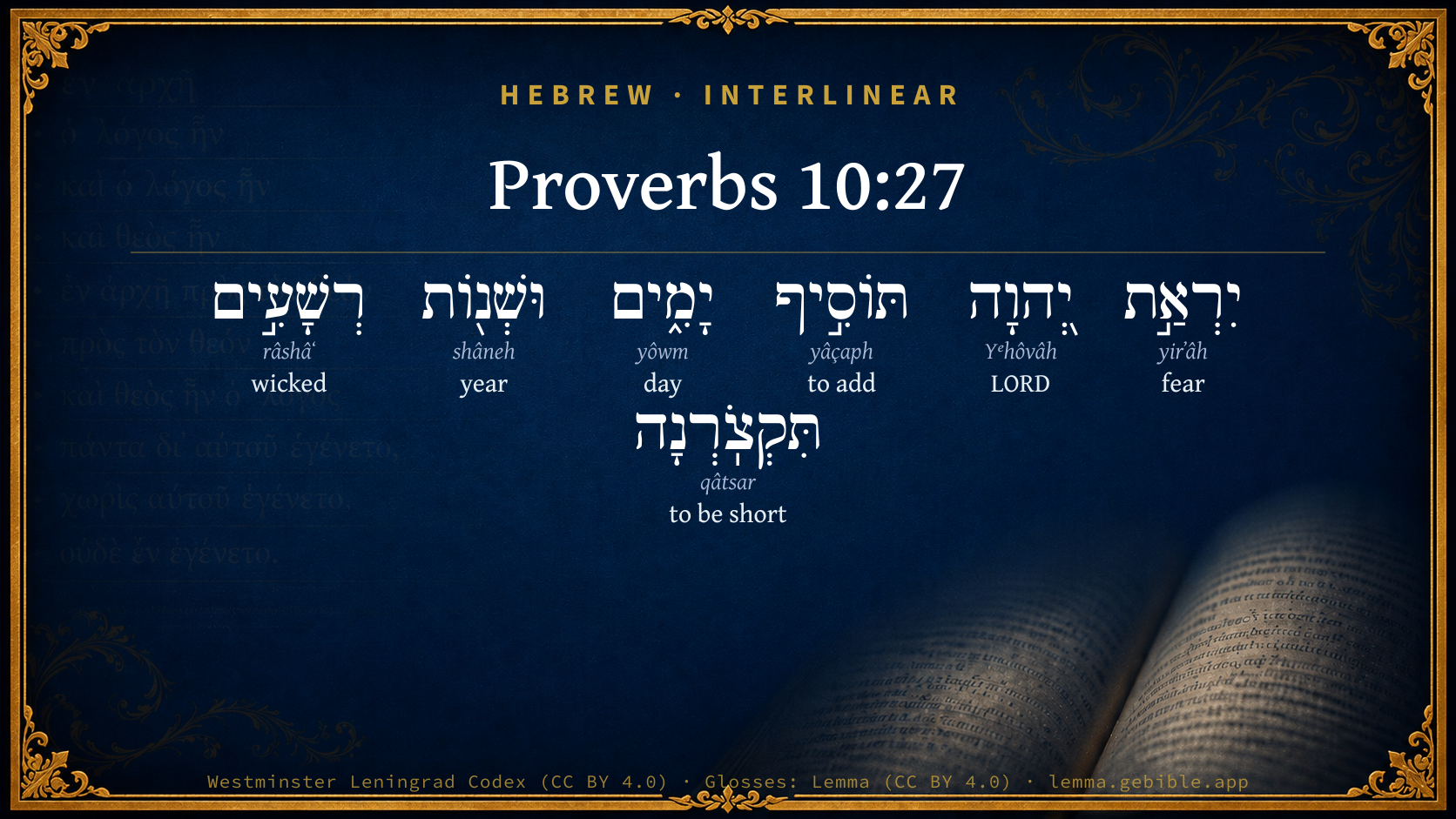
Hebrew (Westminster Leningrad Codex) Proverbs 10:27 appears in the Hebrew Old Testament. The text above is from the Westminster Leningrad Codex. Each word links to its Strong’s number, a concise gloss, and parsing drawn from the Open Scriptures Hebrew Bible morphology. Click any word for its full Brown-Driver-Briggs (BDB) entry.
Download image
Cite this verse

Proverbs 10:27 (World English Bible). Public Domain. Lemma interlinear Bible study tool, https://lemma.gebible.app/v/proverbs/10/27.

Show BibTeX & RIS
BibTeX
RIS
English Translation
The fear of Yahweh prolongs days, But the years of the wicked shall be shortened.
World English Bible · Public Domain
Download a study sheet

One document with this verse’s original text, its word-by-word gloss line, the meaning frame, cross-references with their text, attributed commentary, and full source and license credits — printable, and it pastes into notes with its structure intact.

This verse Autodidact and up

Study sheet (.html) Plain text (.txt)

A passage Seminary Student

Up to 50 verses in one chapter. A passage sheet keeps up to 6 commentary sources and 12 cross-references per verse, in the order this page ranks them, and says so on the sheet whenever that leaves anything out. Ask for a single verse and you get the Autodidact verse sheet above.

Everything on this page stays free to read, with no account — the sheet is a download of what is already on screen, not access to it.

Want to remove ads? Support Godless Engineer
Compare translations 3

The same verse in 3 English versions, stacked beneath the original-language interlinear above. Click any original word for its lexicon entry.

Each is an independent rendering of the whole verse — the interlinear is not word-aligned to these translations.

Highlighted words mark where these versions differ — a whole-verse word diff, not a word-by-word alignment.

  • World English Bible Public Domain
    The fear of Yahweh prolongs days, But the years of the wicked shall be shortened.
  • King James Version Public Domain
    The fear of the LORD prolongeth days: but the years of the wicked shall be shortened.
  • unfoldingWord Literal Text CC BY-SA 4.0
    The fear of Yahweh will add days, but the years of the wicked ones will be short.

unfoldingWord Literal Text — © unfoldingWord, licensed CC BY-SA 4.0. Word-aligned USFM3 via Door43 (git.door43.org/unfoldingWord/en_ult).

Versions to compare (up to 4)

3 of 4 selected

Show all 18 translations

Every available English version of this verse, each an independent rendering of the whole verse.

  • World English Bible Public Domain
    The fear of Yahweh prolongs days, But the years of the wicked shall be shortened.
  • Berean Standard Bible Public Domain
    The fear of the LORD prolongs life, but the years of the wicked will be cut short.
  • Majority Standard Bible Public Domain
    The fear of the LORD prolongs life, but the years of the wicked will be cut short.
  • King James Version Public Domain
    The fear of the LORD prolongeth days: but the years of the wicked shall be shortened.
  • American Standard Version (1901) Public Domain
    The fear of Jehovah prolongeth days; But the years of the wicked shall be shortened.
  • Revised Version (1885) Public Domain
    The fear of the LORD prolongeth days: but the years of the wicked shall be shortened.
  • Geneva Bible (1599) Public Domain
    The feare of the Lord increaseth the dayes: but the yeeres of the wicked shalbe diminished.
  • Douay-Rheims (1899) Public Domain
    The fear of the Lord shall prolong days: and the years of the wicked shall be shortened.
  • Young's Literal Translation Public Domain
    The fear of Jehovah addeth days, And the years of the wicked are shortened.
  • Literal Standard Version CC BY-SA 4.0
    The fear of YHWH adds days, || And the years of the wicked are shortened.
  • Unlocked Literal Bible CC BY-SA 4.0
    The fear of Yahweh prolongs life, but the years of the wicked will be short.
  • unfoldingWord Literal Text CC BY-SA 4.0
    The fear of Yahweh will add days, but the years of the wicked ones will be short.
  • Darby Bible Public Domain
    The fear of Jehovah prolongeth days; but the years of the wicked shall be shortened.
  • World Messianic Bible Public Domain
    The fear of the LORD prolongs days, but the years of the wicked shall be shortened.
  • Webster's Bible Public Domain
    The fear of the LORD prolongeth days: but the years of the wicked shall be shortened.
  • Free Bible Version CC BY-SA 4.0
    Honoring the Lord makes your life longer, but the years the wicked live will be cut short.
  • Bible in Basic English Public Domain
    The fear of the Lord gives long life, but the years of the evil-doer will be cut short.
  • JPS Tanakh (1917) Public Domain
    The fear of the LORD prolongeth days; but the years of the wicked shall be shortened.

Literal Standard Version (2020), Covenant Press — licensed CC BY-SA 4.0. Text via the HelloAO Bible API (eBible.org). Unlocked Literal Bible (unfoldingWord) — licensed CC BY-SA 4.0. Text via the HelloAO Bible API (eBible.org). unfoldingWord Literal Text — © unfoldingWord, licensed CC BY-SA 4.0. Word-aligned USFM3 via Door43 (git.door43.org/unfoldingWord/en_ult). Free Bible Version, Dr. Jonathan Gallagher — licensed CC BY-SA 4.0. Text via the HelloAO Bible API (eBible.org).

Word by word

More ways to search: Search by grammar → Find every occurrence → Compare this word →

Practice this passage: Drill this verse → Learn its vocabulary →

About this verse

These counts appear in no published source. They are computed here, from the morphology-tagged text and Lemma’s own curated glosses. What Lemma adds →

7
words
7
distinct lemmas
Wisdom
section

Shared distinctive vocabulary

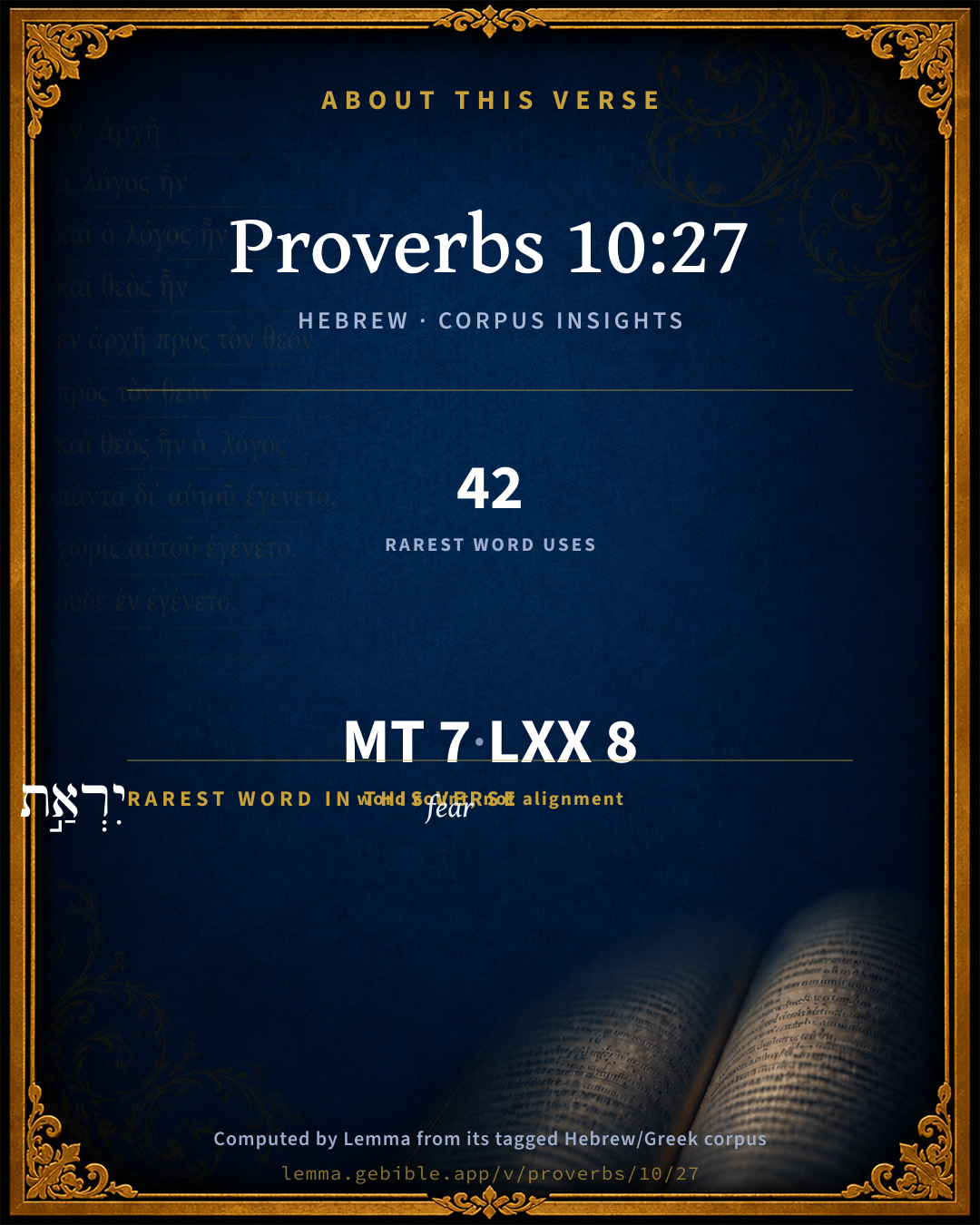
יִרְאַ֣ת fear H3374 occurs in 42 verses of the Hebrew Bible. Also found in:

Grammatical profile

  • 2 verbs
  • 4 nouns
  • 1 adjective

Verb forms

  • תּוֹסִ֣יף Hiphil · Imperfect
  • תִּקְצֹֽרְנָה Qal · Imperfect

Hebrew & Septuagint length

In English translation the verse runs 15 words from the Hebrew and 18 from the Septuagint (LXX English) — closely comparable.

A rough comparison of the two English renderings, which tokenize alike — not a word-level alignment.

Word counts can differ between the Hebrew and the Greek without any difference in meaning — e.g. the Hebrew direct-object marker אֵת has no separate Greek word, and Greek often adds the article ὁ.

In the original languages it is 7 Hebrew tokens and 8 Greek tokens — but the two are counted differently (Hebrew bundles its prefixes and suffixes into one token; the Greek is in lemma form), so that isn’t a like-for-like length.

Cross-references

12

Topical passages linked to Proverbs 10:27 in the Treasury of Scripture Knowledge — connected by theme and wording, ordered by reader-vote popularity; previews shown in the World English Bible.

  • Proverbs 9:11 For by me your days will be multiplied. The years of your life will be increased.
  • Proverbs 3:2 For length of days, and years of life, And peace, will they add to you.
  • Psalms 91:16 I will satisfy him with long life, And show him my salvation."
  • Job 15:32–33 It shall be accomplished before his time. His branch shall not be green.
  • Job 22:15–16 Will you keep the old way Which wicked men have trodden,
  • Psalms 21:4 He asked life of you, you gave it to him, Even length of days forever and ever.
  • Psalms 34:11–13 Come, you children, listen to me. I will teach you the fear of Yahweh.
  • Psalms 55:23 But you, God, will bring them down into the pit of destruction. Bloodthirsty and deceitful men shall not live out half their days, But I will trust in you.
  • Proverbs 3:16 Length of days is in her right hand. In her left hand are riches and honor.
  • Ecclesiastes 7:17 Don't be too wicked, neither be foolish. Why should you die before your time?
  • Luke 12:20 "But God said to him, 'You foolish one, tonight your soul is required of you. The things which you have prepared--whose will they be?'
  • Jeremiah 17:11 As the partridge that sits on [eggs] which she has not laid, so is he who gets riches, and not by right; in the midst of his days they shall leave him, and at his end he shall be a fool.

Cross-references courtesy of OpenBible.info (CC BY 4.0).

Hebrew and Greek witnesses Masoretic Hebrew ↔ Greek Septuagint

The same verse in the two great witnesses to the Old Testament, shown verse-for-verse.

These are two independent witnesses, not word-aligned to each other, and the Septuagint is shown in lemma (dictionary) form.

Hebrew Proverbs 10:27 Masoretic · Westminster Leningrad Codex

יִרְאַ֣ת יְ֭הוָה תּוֹסִ֣יף יָמִ֑ים וּשְׁנ֖וֹת רְשָׁעִ֣ים תִּקְצֹֽרְנָה

The fear of Yahweh prolongs days, But the years of the wicked shall be shortened.

World English Bible · Public Domain

Greek LXX Proverbs 10:27 Septuagint · lemma form

φόβος κύριος προςτίθημι ἡμέρα ἔτος δέ ἀσεβής ὀλιγόω

The fear of the Lord adds length of days: but the years of the ungodly shall be shortened.

LXX2012 (modern English Septuagint) · Public Domain

Hebrew: Westminster Leningrad Codex (CC BY 4.0). Greek: Septuagint (public domain); English from LXX2012 (modern English Septuagint) (Public Domain). How the Septuagint differs from the Hebrew →

Commentary

Notes on Proverbs 10:27 from classic Christian and Jewish commentators (each source and its license shown beneath its notes). The classic Christian expositions comment on the surrounding passage and are grouped to its opening verse, so a note may address several verses; the Jewish commentaries on the Tanakh (Rashi and others) are per-verse, so they appear only where the commentator wrote on this verse.

Lemma curates 59 commentaries, every one of them public domain or Creative Commons licensed, each selected and text-cleaned for this edition rather than reprinted as found. About our sources →

Trapp's Complete Commentary

John Trapp

Pro 10:27 The fear of the LORD prolongeth days: but the years of the wicked shall be shortened.

Ver. 27. The fear of the Lord prolongeth days.] Heb., Addeth days, viz., beyond expectation or likelihood in a course of nature. "The days of mourning for my father are at hand," said bloody Esau, "and then will I slay my brother Jacob." {Gen 27:41} But threatened men, if they fear God especially, {Ecc 8:12-13} live long. For even Isaac who died soonest, lived above fifty years beyond this. {See Trapp on "Exo 20:12"}

But the years of the wicked shall be shortened.] "Be not overmuch wicked, neither be thou foolish: why shouldst thou die before thy time?" {Ecc 7:17} Sin brings death, and the worst of deaths, an unseasonable death, when it were better for a man to do anything than to die; for to such, death is a trap door to hell: and as their friends are scrambling for their goods, the worms for their bodies, so are the devils for their souls.

John Trapp, A Commentary or Exposition upon All the Books of the Old and New Testament (1647–1656) — public domain. Text from a community e-Sword module.

The Biblical Illustrator

Joseph S. Exell

Pro_10:27

The fear of the Lord prolongeth days.

Long life a promised blessing

We may wish for one another long life. Every one wishes it for himself. It is a mistake to regard this wish as an infirmity. Strong love of life is not necessarily sinful.

1. Long life is distinctly promised in Scripture as a blessing to Gods people, both in the Old and New Testaments.

2. See why long life is a blessing. Because God rewards the good works of His people. He enables them to do good works, and rewards their work. The reward is not salvation but glory. Life, like health, intellect, influence, is a talent, lent to us for our Masters service and our own profit; the greater the loan the larger the profit; the longer it is in trust, the fuller the results. There are difficulties in the way of accepting this truth. One is the seemingly contradictory language of Scripture on the subject. Some passages speak of early departure as a blessing. This is true only in special cases. And we must distinguish between things good and desirable in themselves, and things which become so by Gods appointment. Another objection is this--Admitting that long life is a blessing, and a promised blessing, still we do not see the fulfilment of the promise. We see young saints departing, and old sinners remaining. In reply it may be urged that, if we could take the average of life, we should find it to be in favour of godly men. And the exceptions to the rule are more apparent than real. In many cases we see only the pious death, we are not acquainted with the whole previous life. It may be that the good man, whose early death so distresses and perplexes us, has, in early life, deserved that his days should have been thus shortened. And the cases of early death are simply exceptions to a generally working law.

3. What practical bearing shall this truth have upon our lives? We have rescued this text from the strained interpretation of those who do not look on long life as in itself a blessing. We have learned the true meaning and use of this longing after life which all men feel. It is no small gain to our peace of mind, when we can see that this love of life is not always an infirmity or a sin, but that the Christian may lawfully desire long life, as a longer time of working and suffering for Christ. And such a lawful desire for long life gives the strongest motive for rightly using life as it passes.

4. The tendency of vice is to shorten mens days. The text implies that, as life is a talent given to be rightly used, so, if abused, it is taken away from the possessor. We desire a longer life for the ungodly and careless, because we know that life is an opportunity for salvation; we would give the wicked further chance of repentance. (Abp. W. C. Magee.)

The fear of the Lord prolongeth days

There is no doubt about it. The fear of the Lord leads to virtuous habits, and these prevent that waste of life which comes of sin and vice. The holy rest which springs out of faith in the Lord Jesus also greatly helps a man when he is ill. Every physician rejoices to have a patient whose mind is fully at ease. Worry kills, but confidence in God is like healing medicine. We have therefore all the arrangements for long life, and if it be really for our good, we shall see a good old age, and come to our graves as shocks of corn in their season. Let us not be overcome with sudden expectation of death the moment we have a finger-ache, but let us rather expect that we may have to work on through a considerable length of days. And what if we should soon be called to the higher sphere? Certainly there would be nothing to deplore in such a summons, but everything to rejoice in. Living or dying we are the Lords. If we live, Jesus will be with us; if we die, we shall be with Jesus. The truest lengthening of life is to live while we live, wasting no time, but using every hour for the highest ends. (C. H. Spurgeon.)

The Biblical Illustrator, edited by Joseph S. Exell (c. 1880s–1900s) — public domain. Text from a community e-Sword module.

Joseph Benson's Commentary

Pro 10:27-28. The fear of the Lord prolongeth days — For it gives those who are influenced by it a title to the promise of long life, as well as to other promises; it gladdens their hearts, which does good like a medicine, Pro 17:22; and it preserves them from those wicked practices which tend to the shortening of a man’s days. The hope of the righteous shall be gladness — Though at present it be mixed with doubts, and fears, and disappointments, yet at last it shall be accomplished and turned into enjoyment; but the expectation of the wicked, &c. — Shall be utterly frustrated, and so shall end in sorrow.

Joseph Benson's Commentary on the Old and New Testaments (1811–1818) — public domain. Text from a community e-Sword module.

The Preacher's Complete Homiletical Commentary

Joseph S. Exell (gen. ed.)

MAIN HOMILETICS OF Pro_10:27

LONG LIFE

This verse must be looked at—

I. Generally. The fear of the Lord prolongs life because, other things being equal, godliness tends to bodily health. A good man governs his life by some kind of law, his passions and inclinations do not play the lord over his conscience and will. This has a beneficial influence upon his bodily health. He has contentment with his present lot, trust in his God amid all the anxieties of life, and hope for the future. Such a state of mind tends to soundness of bodily health, whereas the manner of life of a godless man is opposed to health and consequently to long life. If a complicated machine is permitted to work with some of its parts improperly adjusted and fretting against each other at every turn of the wheel, the friction will soon wear away the parts, and ere long they will cease to act. A soul without godliness is a complicated mechanism which has never been rightly adjusted. There is no ruling principle, no guiding hand, one passion wars against another, the man bears the burden of life alone, he is at times a prey to the fears spoken of in Pro_10:24, and the rule of all these devils in the soul has a tendency to wear out the body before its time. This is a truth universally admitted. But the words must also be regarded—

II. Relatively. That is, with a due regard to other circumstances. The length of a good man’s life does not always depend upon himself, but upon the age in which he lives—upon the people by whom he is surrounded. The godliness of Abel shortened his life very materially. If his works had not been righteous, his brother would not have murdered him. The first Christian martyr met with an early and a violent death because he was a “man full of faith and of the Holy Ghost” (Act_6:5); and the fear of the Lord has shortened the days of millions since then. The ranks of the “noble army of martyrs” have been filled up by volunteers of every age and many nations since Stephen fell asleep, testifying to the fact that, so far as life in this world is concerned, other things must be taken into consideration.

OUTLINES AND SUGGESTIVE COMMENTS

There is no such wholesome air—there is no such kindly physic—there is no such sovereign cordial—as the fear of the Lord. That makes the days of the godly as long as the years of the wicked.—Jermin.

The righteous’ days are great and noble, and the wicked’s days are mean and small. And this is the meaning of the Proverb, “Made little,” literally, “shortened” (E.V.). We thought at first that this was decisive against our sense, and against our rendering of all the verses expounded in chap. 3. (Pro_10:2-16). Our thought of this was increased by Job_14:1, and by all the expositions. But when we turned to Psa_102:23, our own sense was wonderfully confirmed. That verse reads, “He weakened my strength in the way; He shortened my days:” where “shortened” must have a sense coincident with continued living. And what that sense is, such passages as these: “Is my hand shortened?” (Isa_50:2), “The soul of the people was (lit.) shortened,” “The days of his youth hast Thou shortened” (Num_21:4; Psa_89:45), and nearly all the other instances strikingly confirm. The meaning is, Wisdom makes our days grander and grander, and Impenitence makes them weaker, and always of less account.—Miller.

The Preacher's Complete Homiletical Commentary (gen. ed. Joseph S. Exell; Funk & Wagnalls, c. 1892) — public domain (pre-1929). A full-Bible homiletical/sermon-outline anthology covering 65 of 66 books (2 John is absent from the source module). Text from a community e-Sword module.

Geneva Bible (1599)

Geneva Bible translators

The time of their prosperity shall be short because of their great fall, though they seem to live long.

Geneva Bible (1599) marginal notes — public domain. Text via Bolls.life.

Matthew Henry's Commentary

Observe, 1. Religion lengthens men's lives and crowns their hopes. What man is he that loves life? Let him fear God, and that will secure him from many things that would prejudice his life, and secure to him life enough in this world and eternal life in the other; the fear of the Lord will add days more than was expected, will add them endlessly, will prolong them to the days of eternity. What man is he that would see good days? Let him be religious, and then his days shall not only be many, but happy, very happy as well as very many, for the hope of the righteous shall be gladness; they shall have what they hope for, to their unspeakable satisfaction. It is something future and unseen that they place their happiness in (Rom 8:24, Rom 8:25), not what they have in hand, but what they have in hope, and their hope will shortly be swallowed up in fruition, and it will be their everlasting gladness. Enter thou into the joy of thy Lord. 2. Wickedness shortens men's lives, and frustrates their hopes: The years of the wicked, that are spent in the pleasures of sin and the drudgery of the world, shall be shortened. Cut down the trees that cumber the ground. And whatever comfort or happiness a wicked man promises himself, in this world or the other, he will be frustrated; for the expectation of the wicked shall perish; his hope shall be turned into endless despair.

Matthew Henry's Commentary on the Whole Bible (1708–1710) — public domain (CC PDM 1.0). Text via the HelloAO Bible API.

Jamieson, Fausset & Brown

Robert Jamieson, A. R. Fausset & David Brown

(Compare Pro 9:11; Psa 55:23).

Jamieson, Fausset & Brown — Commentary Critical and Explanatory on the Whole Bible (1871) — public domain (CC PDM 1.0). Text via the HelloAO Bible API.

Ellicott's Commentary for English Readers

(27) The fear of the Lord prolongeth days.—The special Old Testament blessing for obedience (comp. Pro_9:11), often fulfilled now, too, in the case of those who live on to old age, in the quiet fulfilment of duty; while others are shortening their lives by excessive anxieties, or the pursuit of pleasure.

A Bible Commentary for English Readers, edited by Charles John Ellicott (1878–1897) — public domain. Text from a community e-Sword module.

The Cambridge Bible for Schools and Colleges

gen. ed. J. J. S. Perowne

27. Comp. Pro_3:2.

The Cambridge Bible for Schools and Colleges (gen. ed. J. J. S. Perowne; Cambridge University Press, 1878–1918) — public domain. Text from a community e-Sword module.

John Gill's Exposition

The fear of the Lord prolongeth days,.... Not beyond the time fixed in the unalterable purposes and decrees of God, Job 14:5; but longer than some others, or than those that fear the Lord expect to live; or longer than, according to the course of nature, and the weakness of their constitutions, it could be thought they should live. Long life is promised to them that fear the Lord; godliness has the promise of this life and of that to come; the fear of the Lord is the means of preserving persons from those things which are pernicious to the health of men, and so of prolonging their days; as well as it has length of days, for ever and ever, even eternal life, annexed to it; see Psa 34:11;

but the years of the wicked shall be shortened; through diseases, which their sins bring upon them, which cut them off before they have lived out half their days; or by means of which, their sins, they come into the hand of the civil magistrate, and die before their time; or are taken off in their full strength by the immediate judgment of God, as were Ananias and Sapphira; and so they die in the midst of their days; and before the time, which, according to the course of nature, and the common period of life, in all human probability they might have arrived unto, Psa 55:23.

John Gill's Exposition of the Whole Bible (1746–1763) — public domain (CC PDM 1.0). Text via the HelloAO Bible API.

Matthew Poole's English Annotations

Prolongeth days; partly because it gives them a title to the promise of long life, as well as to other promises; partly because it gladdeth the heart, which doth good like a medicine, Pro 17:22, and preserves a man from those wicked practices which tend to the shortening of the days.

Matthew Poole's English Annotations on the Holy Bible (1683–1685) — public domain. Text from a community e-Sword/MySword module.

Whedon's Commentary on the Bible

Daniel D. Whedon

27. Prolongeth — Literally, addeth.

Shortened — Cut off short, curtailed, because they feared not Jehovah. Compare Pro_3:2; Pro_9:11; Pro_14:27; Psa_55:23; Ecc_7:17; Ecc_8:12-13.

Daniel D. Whedon (gen. ed.), Commentary on the Old and New Testaments (1874–1909) — public domain. Text from a community e-Sword module.

The Pulpit Commentary

The fear of the Lord prolongeth days. The premise of long life as the reward of a religious conversation is often found in our book, where temporal retribution is set forth. (see Pro_3:2 Pro_9:11 Pro_14:27) Shall be shortened, as Psa_55:23 Ecc_7:17.

Vers. 27-32. Impression by tautology.

These verses contain mostly iterations of maxims already delivered. (on ver. 27, see on Pro_3:2 Pro_9:11; on ver. 28, see on ver. 24; Pro_11:7) That religion is a protector to the man of good conscience, while overthrow awaits the ungodly, again brings out an often expressed thought with emphasis. (ver. 30; see on ver. 25; Pro_3:21) Vers, 31, 32 again contrast the speech of the good and the wicked; the former like a sappy and fruitful tree, the latter destined to oblivion; the former appealing to the sense of beauty and grace, the latter shocking by its deformity.

I THERE IS A SAMENESS IN GOD. He does not and cannot change. He is invariable substance, unalterable will and law.

II THERE IS A SAMENESS IN NATURE. The heavens above us, with all their worlds, the great mountains and features of the landscape, the daily sights of sunrise and evening, form and colour. Abraham and Solomon looked upon essentially the same world with ourselves.

III THERE IS A SAMENESS IN HUMAN NATURE its passions, strength, and weakness. The same types of character appear and reappear in every age in relatively new forms. And it is proverbial that history repeats itself.

IV THE ESSENTIAL RELATIONS OF MAN TO GOD MUST BE THE SAME IN EVERY AGE. Hence the teacher"s deliverances must constantly recur to the same great points.

V THAT WHICH VARIES IS THE TRIVIAL OR TRANSIENT ELEMENT; THAT WHICH DOES NOT VARY IS THE SUBLIME AND THE ETERNAL.

VI EVERY TRUE TEACHER MAY THUS VARY THE FORM OF HIS INSTRUCTION AS MUCH AS HE WILL. Let him see to it that he works in unison with God and nature, experience, the conscience, and leaves a few great impressions firmly fixed in the mind. "Line upon line, precept upon precept, here a little and there a little. J.

The Pulpit Commentary (1880–1919), ed. H.D.M. Spence-Jones & Joseph S. Exell — public domain. Text from a community e-Sword module.

Keil & Delitzsch

C. F. Keil & F. Delitzsch

21 The lips of the righteous edify many;

But fools die through want of understanding.

Keil & Delitzsch — Biblical Commentary on the Old Testament (1861–1891) — public domain (CC PDM 1.0). Text via the HelloAO Bible API. (Old Testament only.)

Bridges on Proverbs

Charles Bridges

The fear of the LORD is not a single grace. It includes the substance of all godly tempers. For all are radically one principle, from one source. It essentially differs from the fear of the wicked. They fear those whom they hate. The child of God — whom he loves. Whether his temporal life be shortened or prolonged, he lives long in a little time. He is an infinite gainer by the contraction of life; when his days are prolonged and swallowed up in the one unclouded day, of which "the sun shall no more go down." (Pro 9:11 . Psa 91:16 . Isa 60:19 .) Justly is the fear of the LORD contrasted with the wicked; because the absence of this grace is their distinguishing mark (Psa 36:1 ), the principle of all their ungodliness. (Rom 3:10-18 .) And often do we see the letter of this curse realized in the shortening of their years. Excessive worldliness wears out the spring of life (Ecc 5:10-12 ), and often brings it to an untimely end.†1 Sometimes the God of vengeance breaks out, and "takes away" the darling offender "with his stroke." (Job 36:18 . 1Sa 2:32 ; 1Sa 4:11 . Act 5:1-10 .) Yet, if he be "visited after the visitation of all men," awful indeed is the course of a long life wasted in folly and sin; living little in a long time — "The sinner, being an hundred years old, shall be accursed." (Isa 65:20 .)

Footnotes:

†1 Impurity, Pro 5:9-11 . Drunkenness, Pro 23:29-32 . Malice, Psa 55:23 . 1Ki 2:31-44 . Wickedness, Psa 37:9, Psa 37:20 . Ecc 7:17 . Jer 17:11 . Compare Job 15:32-33 ; Job 22:15-16 .

Charles Bridges, An Exposition of the Book of Proverbs (1846) — public domain. Text from a community e-Sword module.

Scofield Reference Notes

C. I. Scofield

fear

(See Scofield "Psa 19:9")

The Scofield Reference Bible (1917 edition), notes by C. I. Scofield — public domain. Text from a community e-Sword module.

Kretzmann's Popular Commentary

Paul E. Kretzmann

v. 27. The fear of the Lord prolongeth days, adding to their number; but the years of the wicked shall be shortened, their span of life will not reach the normal length.

Paul E. Kretzmann, Popular Commentary of the Bible (1921–1924) — public domain. Text from a community e-Sword module.

Lesson kit

Teaching starters — assembled from the data on this page, not authored interpretation. Every prompt links to the verse data it draws on. Edit before teaching.

Proverbs, in the Wisdom, opens this verse with 7 words (7 distinct Hebrew lemmas). Its most distinctive word is yirʼâh (“fear”). A historical commentator’s framing appears above. Read the whole chapter for the surrounding context.

Discussion questions

  1. What does “fear” (yirʼâh) contribute to the verse as a whole?
  2. How does Genesis 20:11, which shares the word «fear», read alongside this verse?
  3. The translations on this page render this verse differently — a whole-verse word diff, not a word-by-word alignment. What might account for the different wordings?
  4. «תּוֹסִ֣יף» is a Hiphil Imperfect verb. How does that grammatical form shape the action described?
  5. Compare how Trapp's Complete Commentary and The Biblical Illustrator read this verse. Where do they agree or differ?

Things to notice

Reading settings

Reading text

Shown beneath each verse's original-language words.

Old Testament
Old Testament edition

Read the OT as the Masoretic Hebrew (MT) or the Greek Septuagint (LXX).

English shown for the Greek Septuagint (in the Hebrew ↔ Greek comparison).

Comparing translations? Open the Compare panel on any verse page to stack up to four side by side.