
Daniel 12:10

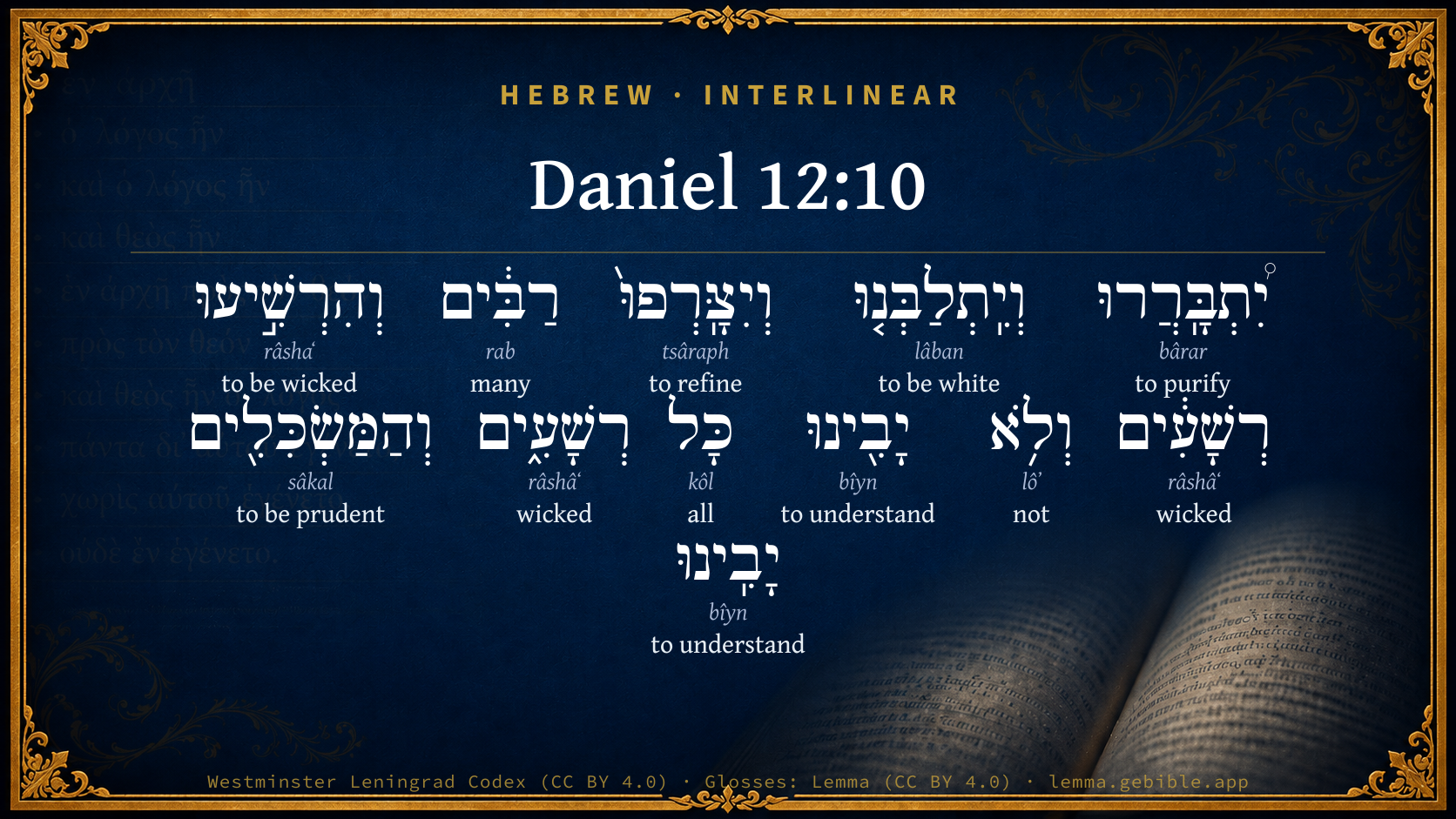
Hebrew (Westminster Leningrad Codex) Daniel 12:10 appears in the Hebrew Old Testament. The text above is from the Westminster Leningrad Codex. Each word links to its Strong’s number, a concise gloss, and parsing drawn from the Open Scriptures Hebrew Bible morphology. Click any word for its full Brown-Driver-Briggs (BDB) entry.
Download image
Cite this verse

Daniel 12:10 (World English Bible). Public Domain. Lemma interlinear Bible study tool, https://lemma.gebible.app/v/daniel/12/10.

Show BibTeX & RIS
BibTeX
RIS
English Translation
Many shall purify themselves, and make themselves white, and be refined; but the wicked shall do wickedly; and none of the wicked shall understand; but those who are wise shall understand.
World English Bible · Public Domain
Download a study sheet

One document with this verse’s original text, its word-by-word gloss line, the meaning frame, cross-references with their text, attributed commentary, and full source and license credits — printable, and it pastes into notes with its structure intact.

This verse Autodidact and up

Study sheet (.html) Plain text (.txt)

A passage Seminary Student

Up to 50 verses in one chapter. A passage sheet keeps up to 6 commentary sources and 12 cross-references per verse, in the order this page ranks them, and says so on the sheet whenever that leaves anything out. Ask for a single verse and you get the Autodidact verse sheet above.

Everything on this page stays free to read, with no account — the sheet is a download of what is already on screen, not access to it.

Want to remove ads? Support Godless Engineer
Compare translations 3

The same verse in 3 English versions, stacked beneath the original-language interlinear above. Click any original word for its lexicon entry.

Each is an independent rendering of the whole verse — the interlinear is not word-aligned to these translations.

Highlighted words mark where these versions differ — a whole-verse word diff, not a word-by-word alignment.

  • World English Bible Public Domain
    Many shall purify themselves, and make themselves white, and be refined; but the wicked shall do wickedly; and none of the wicked shall understand; but those who are wise shall understand.
  • King James Version Public Domain
    Many shall be purified, and made white, and tried; but the wicked shall do wickedly: and none of the wicked shall understand; but the wise shall understand.
  • unfoldingWord Literal Text CC BY-SA 4.0
    Many will be purified, cleansed, and refined, but the wicked will act wickedly. None of the wicked will understand, but those who have insight will understand.

unfoldingWord Literal Text — © unfoldingWord, licensed CC BY-SA 4.0. Word-aligned USFM3 via Door43 (git.door43.org/unfoldingWord/en_ult).

Versions to compare (up to 4)

3 of 4 selected

Show all 18 translations

Every available English version of this verse, each an independent rendering of the whole verse.

  • World English Bible Public Domain
    Many shall purify themselves, and make themselves white, and be refined; but the wicked shall do wickedly; and none of the wicked shall understand; but those who are wise shall understand.
  • Berean Standard Bible Public Domain
    Many will be purified, made spotless, and refined, but the wicked will continue to act wickedly. None of the wicked will understand, but the wise will understand.
  • Majority Standard Bible Public Domain
    Many will be purified, made spotless, and refined, but the wicked will continue to act wickedly. None of the wicked will understand, but the wise will understand.
  • King James Version Public Domain
    Many shall be purified, and made white, and tried; but the wicked shall do wickedly: and none of the wicked shall understand; but the wise shall understand.
  • American Standard Version (1901) Public Domain
    Many shall purify themselves, and make themselves white, and be refined; but the wicked shall do wickedly; and none of the wicked shall understand; but they that are wise shall understand.
  • Revised Version (1885) Public Domain
    Many shall purify themselves; and make themselves white, and be refined; but the wicked shall do wickedly; and none of the wicked shall understand: but they that be wise shall understand.
  • Geneva Bible (1599) Public Domain
    Many shalbe purified, made white, and tried: but the wicked shall doe wickedly, and none of the wicked shall haue vnderstanding: but the wise shall vnderstand.
  • Douay-Rheims (1899) Public Domain
    Many shall be chosen, and made white, and shall be tried as fire: and the wicked shall deal wickedly, and none of the wicked shall understand, but the learned shall understand.
  • Young's Literal Translation Public Domain
    Purify themselves, yea, make themselves white, yea, refined are many: and the wicked have done wickedly, and none of the wicked understand, and those acting wisely do understand;
  • Literal Standard Version CC BY-SA 4.0
    Purify themselves, indeed, make themselves white, indeed, many are refined: and the wicked have done wickedly, and none of the wicked understand, and those acting wisely understand;
  • Unlocked Literal Bible CC BY-SA 4.0
    Many will be purified, cleansed, and refined, but the wicked will act wickedly. None of the wicked will understand, but those who are wise will understand.
  • unfoldingWord Literal Text CC BY-SA 4.0
    Many will be purified, cleansed, and refined, but the wicked will act wickedly. None of the wicked will understand, but those who have insight will understand.
  • Darby Bible Public Domain
    Many shall be purified, and be made white, and be refined; but the wicked shall do wickedly: and none of the wicked shall understand; but the wise shall understand.
  • World Messianic Bible Public Domain
    Many will purify themselves, and make themselves white, and be refined, but the wicked will do wickedly; and none of the wicked will understand, but those who are wise will understand.
  • Webster's Bible Public Domain
    Many shall be purified, and made white, and tried; but the wicked shall do wickedly: and none of the wicked shall understand; but the wise shall understand.
  • Free Bible Version CC BY-SA 4.0
    Many will be purified and cleansed and refined, but the wicked will go on being wicked. None of the wicked will understand, but the wise will understand.
  • Bible in Basic English Public Domain
    Till a number are tested and make themselves clean; and the evil-doers will do evil; for not one of the evil-doers will have knowledge; but all will be made clear to those who are wise.
  • JPS Tanakh (1917) Public Domain
    Many shall purify themselves, and make themselves white, and be refined; but the wicked shall do wickedly; and none of the wicked shall understand; but they that are wise shall understand.

Literal Standard Version (2020), Covenant Press — licensed CC BY-SA 4.0. Text via the HelloAO Bible API (eBible.org). Unlocked Literal Bible (unfoldingWord) — licensed CC BY-SA 4.0. Text via the HelloAO Bible API (eBible.org). unfoldingWord Literal Text — © unfoldingWord, licensed CC BY-SA 4.0. Word-aligned USFM3 via Door43 (git.door43.org/unfoldingWord/en_ult). Free Bible Version, Dr. Jonathan Gallagher — licensed CC BY-SA 4.0. Text via the HelloAO Bible API (eBible.org).

Word by word

More ways to search: Search by grammar → Find every occurrence → Compare this word →

Practice this passage: Drill this verse → Learn its vocabulary →

וְיִֽתְלַבְּנ֤וּ
lâban
H3835
“and · to be white”
Conjunction + Verb, Hithpael, Imperfect, 3rd Person, Masculine, Plural
Part of Speech
Conjunction + Verb
Stem
Hithpael
Form
Imperfect
Person
3rd Person
Gender
Masculine
Number
Plural
Full BDB Definition

Origin: a primitive root

TWOT: 1074b , 1074h

to be white - (Hiphil) - to make white, become white, purify - to show whiteness, grow white - (Hithpael) to become white, be purified (ethical) - (Qal) to make bricks
  1. יִ֠תְבָּֽרֲרוּ bârar H1305 “to purify” Verb, Hithpael, Imperfect, 3rd Person, Masculine, Plural
  2. וְיִצָּֽרְפוּ֙ tsâraph H6884 “and · to refine” Conjunction + Verb, Niphal, Imperfect, 3rd Person, Masculine, Plural
  3. רַבִּ֔ים rab H7227 “many” Adjective, Adjective, Masculine, Plural, Absolute
  4. וְהִרְשִׁ֣יעוּ râshaʻ H7561 “and · to be wicked” Conjunction + Verb, Hiphil, Sequential Perfect, 3rd Person, Common, Plural
  5. רְשָׁעִ֔ים râshâʻ H7563 “wicked” Adjective, Adjective, Masculine, Plural, Absolute
  6. וְלֹ֥א lôʼ H3808 “and · not” Conjunction + Particle, Negative
  7. יָבִ֖ינוּ bîyn H995 “to understand” Verb, Qal, Imperfect, 3rd Person, Masculine, Plural
  8. כָּל kôl H3605 “all of” Noun, Common, Masculine, Singular, Construct
  9. רְשָׁעִ֑ים râshâʻ H7563 “wicked” Adjective, Adjective, Masculine, Plural, Absolute
  10. וְהַמַּשְׂכִּלִ֖ים sâkal H7919 “and · the · being prudent” Conjunction + Particle, Definite Article + Verb, Hiphil, Participle Active, Masculine, Plural, Absolute
  11. יָבִֽינוּ bîyn H995 “to understand” Verb, Qal, Imperfect, 3rd Person, Masculine, Plural

About this verse

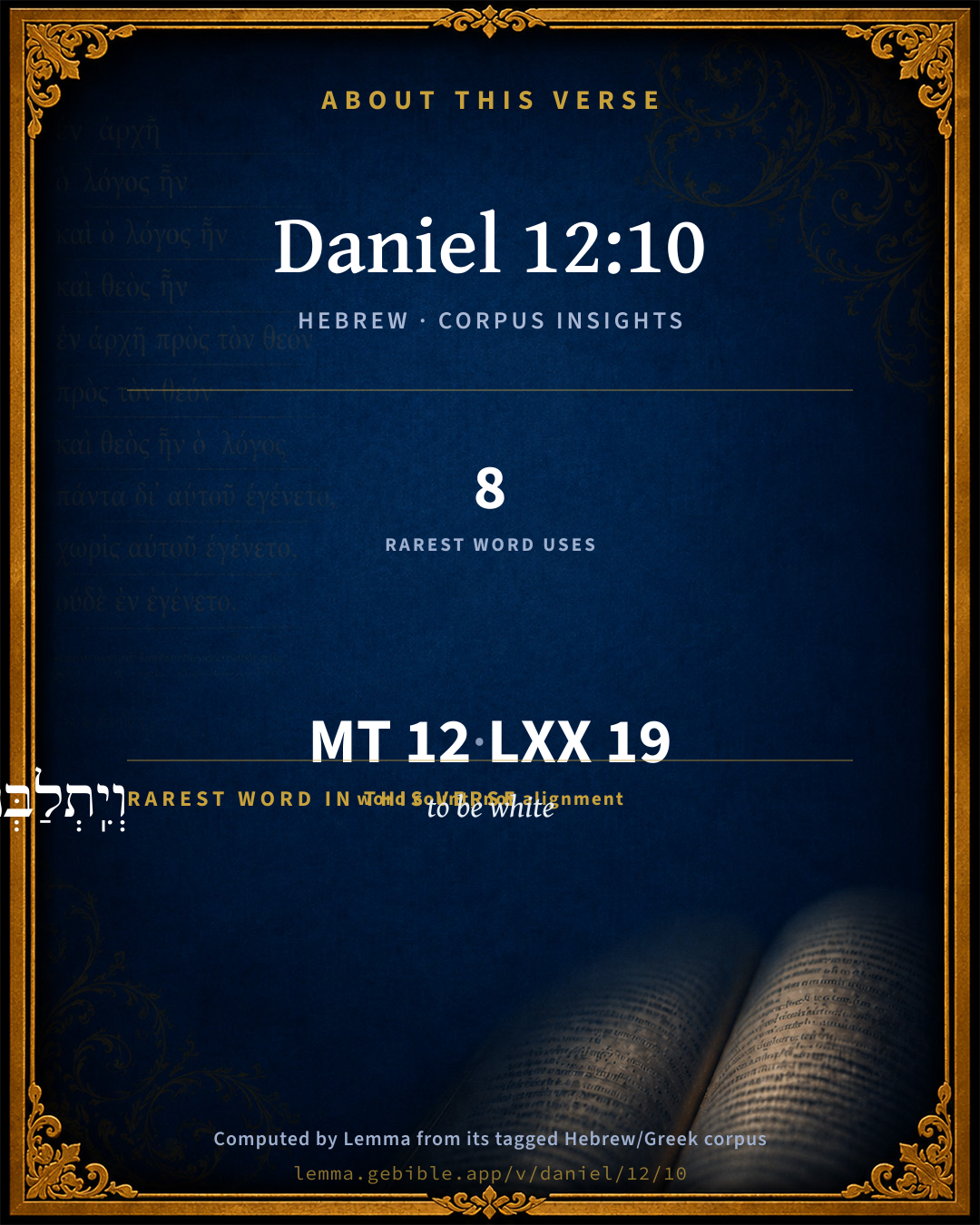
These counts appear in no published source. They are computed here, from the morphology-tagged text and Lemma’s own curated glosses. What Lemma adds →

12
words
10
distinct lemmas
Prophets
section

Notable vocabulary

The rarest word here is וְיִֽתְלַבְּנ֤וּ to be white H3835 — appearing just 8 times in the whole Hebrew Bible.

Shared distinctive vocabulary

וְיִֽתְלַבְּנ֤וּ to be white H3835 occurs in 8 verses of the Hebrew Bible. Also found in:

Grammatical profile

  • 7 verbs
  • 1 noun
  • 3 adjectives
  • 1 particle

Verb forms

  • יִ֠תְבָּֽרֲרוּ Hithpael · Imperfect
  • וְיִֽתְלַבְּנ֤וּ Hithpael · Imperfect
  • וְיִצָּֽרְפוּ֙ Niphal · Imperfect
  • וְהִרְשִׁ֣יעוּ Hiphil · Sequential Perfect
  • יָבִ֖ינוּ Qal · Imperfect
  • וְהַמַּשְׂכִּלִ֖ים Hiphil · Participle Active
  • יָבִֽינוּ Qal · Imperfect

Repetition

Words recur within this verse — often emphatic in Hebrew:

  • רְשָׁעִ֔ים wicked H7563 ×2
  • יָבִ֖ינוּ to understand H995 ×2

Hebrew & Septuagint length

In English translation the verse runs 31 words from the Hebrew and 30 from the Septuagint (LXX English) — closely comparable.

A rough comparison of the two English renderings, which tokenize alike — not a word-level alignment.

Word counts can differ between the Hebrew and the Greek without any difference in meaning — e.g. the Hebrew direct-object marker אֵת has no separate Greek word, and Greek often adds the article ὁ.

In the original languages it is 12 Hebrew tokens and 19 Greek tokens — but the two are counted differently (Hebrew bundles its prefixes and suffixes into one token; the Greek is in lemma form), so that isn’t a like-for-like length.

Cross-references

36

Topical passages linked to Daniel 12:10 in the Treasury of Scripture Knowledge — connected by theme and wording, ordered by reader-vote popularity; previews shown in the World English Bible.

  • Revelation 22:11 He who acts unjustly, let him act unjustly still. He who is filthy, let him be filthy still. He who is righteous, let him do righteousness still. He who is holy, let him be holy still."
  • Daniel 11:35 Some of those who are wise shall fall, to refine them, and to purify, and to make them white, even to the time of the end; because it is yet for the time appointed.
  • Hosea 14:9 Who is wise, that he may understand these things? Who is prudent, that he may know them? For the ways of Yahweh are right, And the righteous walk in them; But the rebellious stumble in them.
  • John 8:47 He who is of God hears the words of God. For this cause you don't hear, because you are not of God."
  • 2 Thessalonians 2:10–12 and with all deception of wickedness for those who are being lost, because they didn't receive the love of the truth, that they might be saved.
  • Revelation 9:20–21 The rest of mankind, who were not killed with these plagues, didn't repent of the works of their hands, that they wouldn't worship demons, and the idols of gold, and of silver, and of brass, and of stone, and of wood; which can neither see, nor hear, nor walk.
  • Proverbs 2:1–5 My son, if you will receive my words, And store up my commandments within you;
  • Isaiah 32:6–7 For the fool will speak folly, and his heart will work iniquity, to practice profanity, and to utter error against Yahweh, to make empty the soul of the hungry, and to cause the drink of the thirsty to fail.
  • 1 John 5:20 We know that the Son of God has come, and has given us an understanding, that we know him who is true, and we are in him who is true, in his Son Jesus Christ. This is the true God, and eternal life.
  • Luke 24:25 He said to them, "Foolish men, and slow of heart to believe in all that the prophets have spoken!
  • John 7:17 If anyone desires to do his will, he will know about the teaching, whether it is from God, or if I am speaking from myself.
  • Proverbs 1:5 That the wise man may hear, and increase in learning; That the man of understanding may attain to sound counsel:
  • Revelation 3:18 I counsel you to buy from me gold refined by fire, that you may become rich; and white garments, that you may clothe yourself, and that the shame of your nakedness may not be revealed; and eye salve to anoint your eyes, that you may see.
  • Ezekiel 47:11 But the miry places of it, and the marshes of it, shall not be healed; they shall be given up to salt.
  • Daniel 11:33 Those who are wise among the people shall instruct many; yet they shall fall by the sword and by flame, by captivity and by spoil, [many] days.
  • Romans 11:8–10 According as it is written, "God gave them a spirit of stupor, eyes that they should not see, and ears that they should not hear, to this very day."
  • 1 Peter 1:7 that the proof of your faith, which is more precious than gold that perishes even though it is tested by fire, may be found to result in praise, glory, and honor at the revelation of Jesus Christ--
  • 1 Samuel 24:13 As says the proverb of the ancients, Out of the wicked comes forth wickedness; but my hand shall not be on you.
  • Psalms 51:7 Purify me with hyssop, and I will be clean. Wash me, and I will be whiter than snow.
  • Psalms 107:43 Whoever is wise will pay attention to these things. They will consider the loving kindnesses of Yahweh.
  • Isaiah 1:18 "Come now, and let us reason together," says Yahweh: "Though your sins be as scarlet, they shall be as white as snow. Though they be red like crimson, they shall be as wool.
  • Ezekiel 36:25 I will sprinkle clean water on you, and you shall be clean: from all your filthiness, and from all your idols, will I cleanse you.
  • Daniel 12:3 Those who are wise shall shine as the brightness of the expanse; and those who turn many to righteousness as the stars forever and ever.
  • Zechariah 13:9 I will bring the third part into the fire, And will refine them as silver is refined, And will test them like gold is tested. They will call on my name, and I will hear them. I will say, 'It is my people;' And they will say, 'Yahweh is my God.'"
  • Mark 4:11 He said to them, "To you is given the mystery of the Kingdom of God, but to those who are outside, all things are done in parables,
  • 1 Corinthians 6:11 Such were some of you, but you were washed. But you were sanctified. But you were justified in the name of the Lord Jesus, and in the Spirit of our God.
  • 2 Corinthians 7:1 Having therefore these promises, beloved, let us cleanse ourselves from all defilement of flesh and spirit, perfecting holiness in the fear of God.
  • Titus 2:14 who gave himself for us, that he might redeem us from all iniquity, and purify for himself a people for his own possession, zealous for good works.
  • Hebrews 12:10 For they indeed, for a few days, punished us as seemed good to them; but he for our profit, that we may be partakers of his holiness.
  • 1 Peter 1:22 Seeing you have purified your souls in your obedience to the truth through the Spirit in sincere brotherly affection, love one another from the heart fervently:
  • Revelation 7:13–14 One of the elders answered, saying to me, "These who are arrayed in white robes, who are they, and from where did they come?"
  • Revelation 16:11 and they blasphemed the God of heaven because of their pains and their sores. They didn't repent of their works.
  • Revelation 19:8 It was given to her that she would array herself in bright, pure, fine linen: for the fine linen is the righteous acts of the saints.
  • Revelation 19:14 The armies which are in heaven followed him on white horses, clothed in white, pure, fine linen.
  • 1 Corinthians 2:10–16 But to us, God revealed them through the Spirit. For the Spirit searches all things, yes, the deep things of God.
  • John 18:37 Pilate therefore said to him, "Are you a king then?" Jesus answered, "You say that I am a king. For this reason I have been born, and for this reason I have come into the world, that I should testify to the truth. Everyone who is of the truth listens to my voice."

Cross-references courtesy of OpenBible.info (CC BY 4.0).

Hebrew and Greek witnesses Masoretic Hebrew ↔ Greek Septuagint

The same verse in the two great witnesses to the Old Testament, shown verse-for-verse.

These are two independent witnesses, not word-aligned to each other, and the Septuagint is shown in lemma (dictionary) form.

Hebrew Daniel 12:10 Masoretic · Westminster Leningrad Codex

יִ֠תְבָּֽרֲרוּ וְיִֽתְלַבְּנ֤וּ וְיִצָּֽרְפוּ֙ רַבִּ֔ים וְהִרְשִׁ֣יעוּ רְשָׁעִ֔ים וְלֹ֥א יָבִ֖ינוּ כָּל רְשָׁעִ֑ים וְהַמַּשְׂכִּלִ֖ים יָבִֽינוּ

Many shall purify themselves, and make themselves white, and be refined; but the wicked shall do wickedly; and none of the wicked shall understand; but those who are wise shall understand.

World English Bible · Public Domain

Greek LXX Daniel 12:10 Septuagint · lemma form

πειράζω καί ἁγιάζω πολύς καί ἁμαρτάνω ὁ ἁμαρτωλός καί οὐ μή διανοέομαι πᾶς ὁ ἁμαρτωλός καί ὁ διανοέομαι προςἔχω

Many must be tested, and thoroughly whitened, and tried with fire, and sanctified; but the transgressors shall transgress: and none of the transgressors shall understand; but the wise shall understand.

LXX2012 (modern English Septuagint) · Public Domain

On this verse, The Pulpit Commentary discusses the Septuagint’s reading. Read the note in Commentary ↓

Hebrew: Westminster Leningrad Codex (CC BY 4.0). Greek: Septuagint (public domain); English from LXX2012 (modern English Septuagint) (Public Domain). How the Septuagint differs from the Hebrew →

Commentary

Notes on Daniel 12:10 from classic Christian and Jewish commentators (each source and its license shown beneath its notes). The classic Christian expositions comment on the surrounding passage and are grouped to its opening verse, so a note may address several verses; the Jewish commentaries on the Tanakh (Rashi and others) are per-verse, so they appear only where the commentator wrote on this verse.

Lemma curates 59 commentaries, every one of them public domain or Creative Commons licensed, each selected and text-cleaned for this edition rather than reprinted as found. About our sources →

Trapp's Complete Commentary

John Trapp

Dan 12:10 Many shall be purified, and made white, and tried; but the wicked shall do wickedly: and none of the wicked shall understand; but the wise shall understand.

Ver. 10. Many shall be purified, and made white, &c., ] q.d., It is enough for thee to know, and that I should now tell thee, quales sint futuri homines postremi saeculi, what kind of folk there shall be towards the end of the world. Some shall be good people, and they shall meet with hard measure, but all shall be for the best unto them in the end. See Dan 11:35. Others shall be as bad, and so desperately set upon sinning that they shall mind nothing else - no, not when these prophecies are fulfilled - but be "destroyed for lack of knowledge." {Hos 4:6} Infatuati seducentur, et seducti iudabuntur; being infatuated they shall be seduced, and being seduced they shall be judged, as Augustine’s note is on 2Th 2:10.

John Trapp, A Commentary or Exposition upon All the Books of the Old and New Testament (1647–1656) — public domain. Text from a community e-Sword module.

The Biblical Illustrator

Joseph S. Exell

Dan_12:10

And none of the wicked shall understand; but the wise shall understand.

A Virtuous Mind the Best Help to Understand True Religion

To seek a mans true and final interest, by parting with some present and inconsiderable advantages for the sake of more and much greater ones to come, is the proper act of wisdom; and the general character of folly is the purchasing of soma trivial present benefit at the hazard of much better and more valuable things in reversion. Folly is but another name for sin. To understand may be taken in two senses. Either the understanding of particular providences, or the understanding the true nature of religion in general. Consider the text, according to the latter interpretation. The proposition they contain is this--A virtuous disposition of mind is the beat help, and a vicious inclination the greatest hindrance, to a right understanding of the doctrine of true religion. What is there in the nature of things themselves, and what there is in the positive appointment of God, which makes a virtuous disposition so great a help, and a vicious inclination so great a hindrance, to a right understanding in matters of religion.

1. There is something in the nature of things themselves, something in the very frame and constitution of the mind of man, something in the nature and tendency of all religious truths, which helps to verify the general proposition. In a mind virtuously disposed, there is a native agreeableness to the principles of true religion; in like manner as in a healthful body the organs are fitted to their proper objects; and as in the frame of the material world, everything is suited to its proper use and employment. In the study of every human science there is some particular previous temper, some certain predisposition of mind, which makes men fit for that particular study, and apt to understand it with easiness and delight; generally and specially, a love to that particular science, and a high esteem of its value and usefulness. The same holds true in proportion in religious matters likewise. A general love of virtue, an equitable, fair, and charitable spirit, and a just sense of the necessity and reasonableness of obeying Gods commands, is the first principle and beginning of religion. Practice and experience in the course of a virtuous life, and in the obedience of Gods commands, is in continuance the best information and perpetual improvement of a mans understanding and judgment in the knowledge of Divine truths. He that keepeth the law of the Lord, getteth the understanding thereof, says the wise Son of Sirach. He that practises what he knows, improves his knowledge continually by that practice. By actions, even more than by speculation and study, is the understanding of practical truths enlarged. There is a spirit and a life in the discourse of a righteous man, proceeding from the sincerity of an upright heart, which no skill or art can imitate. In religion, there is no man truly wise and knowing but he that has lived like a Christian, instead of disputing about it. On the other hand, a vicious disposition blinds mens eyes, corrupts their principles, and subverts their judgments. It prejudices men against the truth, and causes them even to hate it, and become professed enemies to it. Now we consider what there is in the positive appointment and constitution of God, by which we are assured that none of the wicked shall understand, but the wise (righteous) shall understand.

1. In general, God will take care that righteous and piously-disposed persons shall attain to so much understanding as is necessary for their own particular salvation.

2. By the secret influence and assistance of His Holy Spirit, God will peculiarly direct and enlighten those that are truly sincere. But where there is a vicious inclination, and an affection to wickedness, there mens minds are not only blinded by the natural consequence of such a disposition, but God moreover withdraws His Spirit from them, and the Holy Ghost will not dwell in a heart that takes pleasure in unrighteousness. Indeed,, God justly permits wicked men, when they obstinately refuse to hear Him, to be deceived by the Evil One to their own destruction. From what has been said, we may infer:

(1) That wicked men have no reason to complain for their not being able to understand religion, and infidels no excuse for their not believing it.

(2) From hence appears the reason of our Saviours speaking so much in parables.

(3) We may observe how it comes to pass that faith ,which is generally looked upon us an act of the understanding, and so not in our own power, is yet in the New Testament always required and insisted upon as a moral virtue. The reason is, because faith, in the Scripture sense, is not barely an act of the understanding, but a mixt act of the will also, consisting very much in that simplicity and unprejudicedness of mind which our Saviour calls receiving the Kingdom of God as a little child.

(4) There is then no need of an infallible guide on earth, or of an unerring Church. All necessary truth is sufficiently made known in Scripture.

(5) Yet this must be so understood as to be a security, not against all, but against fatal mistakes. The best and most pious persons may in many things err, but their errors cannot be dangerous, or of final ill consequence; for in things absolutely necessary to salvation the wicked only can be void of understanding. (S. Clarke, D. D.)

Ability to Understand Moral rather than an Intellectual Quality

This passage seems to warrant three inferences of importance.

(1) That though God for certain reasons saw fit to give this revelation of the future to Daniel at a certain date, He did not intend it to be understood for centuries; since, whatever may be the exact limits of the time of the end, it could not include more than the course of this dispensation, the commencement of which was several centuries distant when Daniel wrote.

(2) That even when in the lapse of ages the men, nine of this prophecy should become apparent to some, even when knowledge should be increased, and the wise understand, it was the will of God that it should still remain a dark mystery to others, that none of the wicked should understand.

(3) That the comprehension or ignorance of this prophecy, when the time for its being understood at all arrived, would depend rather on the moral than on the intellectual state of those who should study it. The wise alone should understand it; the wicked should not. (H. Grattan Guiness.)

The Biblical Illustrator, edited by Joseph S. Exell (c. 1880s–1900s) — public domain. Text from a community e-Sword module.

Joseph Benson's Commentary

Dan 12:10. Many shall be purified, and made white, and tried — See chap. Dan 11:35, where the same words are found, but in different order. They are words of general and ordinary use, expressive of the purification intended to be produced in the minds of men by afflictions. If we would ascertain their import, the first word is borrowed from wheat, which is cleansed from the chaff; the second from cloth, which is whitened by the fuller; and the third from metal, tried and separated from its dross by goldsmiths. I would refer the whole, says Wintle, to the righteous, who, it is here foretold, should be cleansed by various tribulations and trials; but the like discipline would have no effect on the wicked: see Rev 22:11. Their wickedness would blind their minds, so that they would not understand, nor attend to these predictions, which the wise, that is, the considerate and divinely enlightened, should understand; should be fully instructed in themselves, and so should be able to teach them to others: see Wintle.

Joseph Benson's Commentary on the Old and New Testaments (1811–1818) — public domain. Text from a community e-Sword module.

Jamieson, Fausset & Brown

Robert Jamieson, A. R. Fausset & David Brown

There is no need of a fuller explanation as to the time; for when the predictions so far given shall have come to pass, the godly shall be "purified" by the foretold trials and shall understand that the end is at hand; but the wicked shall not understand, and so shall rush on to their own ruin (Dan 11:33-35) [MAURER]. The "end" is primarily, of Antiochus' persuasion; antitypically, the end of Antichrist's. It is the very clearness in the main which renders necessary the obscurity. The fulfilment of God's decree is not a mere arithmetical problem which the profane may understand by arithmetical calculations, but a holy enigma to stimulate to a faithful observance of God's ways, and to a diligent study of the history of God's people [AUBERLEN]. To this Christ refers (Mat 24:15), "Whose readeth, let him understand."

Jamieson, Fausset & Brown — Commentary Critical and Explanatory on the Whole Bible (1871) — public domain (CC PDM 1.0). Text via the HelloAO Bible API.

Adam Clarke's Commentary

Verse 10. Many shall be purified] During the interim, the great work of God's providence and grace shall be carried on in the salvation of men; who, in the midst of trials, temptations, and difficulties, shall be purified and made white-be fully saved from their sins.

None of the wicked shall understand] Because they are wicked, and will continue in their sins, the eyes of their understanding shall be closed, and their hearts hardened; so that they shall not see the light of the glorious Gospel.

But the wise] Those who open their hearts to God, that he may pour in his light, shall understand the things that make for their peace.

Adam Clarke's Commentary on the Bible (1810–1826) — public domain. Text from a community e-Sword/MySword module.

John Calvin's Commentaries

Again, the angel mentions the persecutions which were at hand for the purpose of arming the faithful for the approaching conflicts. We know from other sources how tender and weak our minds naturally are, for as soon as any cause for fear arises, before it comes to blows, we fall down lifeless through terror. As, therefore, our natural imbecility is so great, we necessarily require many stimulants to patience, and to urge us to contend with earnestness, and never to yield to any temptations. This is the reason why the angel announces the necessity for such multiplied purification’s, to cleanse them, as wheat from chaff; to whiten them, as cloth by the fuller; and to melt them, as metal to be separated from dross. First of all, as I have previously explained, he admonishes Daniel and all the pious of the future state of the Church, to lead them to prepare and gird themselves for battle, and to gather up their unconquered fortitude, since the condition of life set before them is that of forcing their way through the midst of troubles. This is one point. Again, the angel shews the practical utility of this kind of life, which might otherwise seem too bitter. We naturally refuse the cross because we feel it contrary to our disposition, while God shews the pious that nothing can be more profitable to them than a variety of afflictions. This is a second point. But afflictions by themselves might possibly consume us, and hence we are cast into a furnace. Now, then, could we expect these sufferings to promote our salvation, except God changed their nature in some wonderful way, as their natural tendency is to effect our destruction? But while we are melted down, and whitened, and cleansed, we perceive how God consults for our welfare by pressing us with his cross and causing us to submit to adversity. Now, thirdly, the angel shews the insufficiency of one single act of cleansing, and our need of many more. This is the object of this numerous heaping together of words, they shall be cleansed, and whitened, and melted down, or poured forth. He might have embraced the whole idea in a single word; but, as through our whole lives God never ceases to test us in various ways, the angel heaps together these three words to shew the faithful their need of continual cleansing as long as they are clothed in flesh; just as garments which are in daily use have need of continual washing. However snowy a mantle may be, it becomes soiled immediately when used for even a single day; requiring constant ablution to restore it to its original purity. Thus we are brought in contact with the defilement’s of sin; and as long as we are pilgrims in this world, we necessarily become subject to constant pollution. And as the faithful also are infected with the contagion of numerous iniquities, they require daily purification’s hi different ways. We ought, then, diligently to notice these three distinct processes.

The angel afterwards adds, The impious will act impiously, and will never understand anything; but the prudent will be ever endued with intelligence Here he wishes to fortify the pious against a stumbling block in their way, when they see the profane despisers of God exulting in every direction, and defying God to his face. When the faithful see the world so full of the impious, they seem to be indulging so freely in lust as if there were no God in heaven’ time they are naturally subject to grievous sorrow and distress. To prevent this trial from agitating their minds, the angel announces how the impious should conduct themselves impiously; implying, — there is no reason why thou, O Daniel, or the rest of the righteous, should depend upon the example of others; Satan will cunningly set before you whatever obstacles may draw you into the contempt of God, and the abyss of impiety, unless you are remarkably cautious; but let not the conduct of the impious cause either you or the rest of the pious to stumble. Howsoever they conduct themselves, do you stand invincible. He afterwards assigns a reason for their behavior — they understand nothing, they are perfectly blinded. But what is the source of this blindness? Their being given over to a reprobate sense. If any one should see a blind man fall, and should cast himself down after this blind man, would he be excusable? Surely his blindness was the cause of his perishing so miserably, but why does the other person destroy himself willingly? Whenever we see the impious rushing furiously on to their destruction, while God is admonishing them that their blindness proceeds from Satan, and that they are given over to a reprobate mind, are we not doubly mad if we willingly follow them? The cause then of this impious behavior on the part of the wicked, is added with good reason; namely, they understand nothing. Meanwhile, the faithful are recalled to the true remedy, and the angel subjoins, But the prudent shall understand, meaning they shall not permit themselves to be implicated in the errors of those whom they see entirely devoted to their own destruction. Lastly, the angel points out to us the true remedy which will prevent Satan from drawing us off towards impiety, and the impious from infecting us with their evil examples, if we earnestly apply ourselves to the pursuit of heavenly doctrine. If, therefore, we heartily desire to be taught by God and to become his true disciples, the instruction which we derive from him will snatch us from destruction. This is the true sense of the passage. It afterwards follows, —

John Calvin's Commentaries (1540-1563) — public domain. Text from the Calvin Translation Society English edition (1840s-50s) via the Christian Classics Ethereal Library (ccel.org). Calvin's coverage is partial (roughly two-thirds of the Bible); uncommented books and verses are honest gaps, never fabricated. The 19th-century editor's footnotes and remarks are omitted so the notes are faithfully Calvin's own voice.

Ellicott's Commentary for English Readers

(10) Many shall be purified.—See Notes on Rev_22:11, and comp. Dan_11:35. The words imply that all shall be fulfilled, the time of persecution shall certainly arise, the righteous will be purified, while the wicked will become apostates. The wise (see Dan_11:33), and they only, will understand the true meaning and profit of tribulation as it is set forth in this prophecy.

A Bible Commentary for English Readers, edited by Charles John Ellicott (1878–1897) — public domain. Text from a community e-Sword module.

The Cambridge Bible for Schools and Colleges

gen. ed. J. J. S. Perowne

10. The ‘time of the end’ characterized: it will be an age of trial and probation, in which many will come out purified and ennobled, while others will only have their wickedness confirmed.

Many shall cleanse themselves, and make themselves white, and be refined] by their sufferings, and their constancy under temptation, their characters will be ennobled and refined (cf. Dan_11:35). The two reflexives are not to be pressed unduly; but they imply that the martyrs, by their deliberate acceptance of suffering, are, to a certain degree, the agents in the purification of their characters.

but the wicked shall do wickedly] The trial will have no effect upon them, beyond giving them further opportunities of doing wickedly, and so confirming them in their wickedness.

none of the wicked shall understand—i.e. act with understanding—but they that be wise shall understand] shall act with understanding. The wicked act blindly, not perceiving the consequences of their wickedness; the ‘wise,’ the religious teachers of the nation (the same word as in Dan_12:3, Dan_11:33; Dan_11:35), shew insight into the ways and providence of God. For ‘understand,’ cf. Psa_49:20; Psa_82:5, Hos_4:14.

The Cambridge Bible for Schools and Colleges (gen. ed. J. J. S. Perowne; Cambridge University Press, 1878–1918) — public domain. Text from a community e-Sword module.

John Gill's Exposition

Many shall be purged, and made white, and tried,.... Though Christ does not give, in plain, clear, and explicit terms, an answer to the above question, when, and how, and what would be the end of the church's troubles and afflictions; yet he here points out the use of them, which for the present should be chiefly attended to; and, when duly considered, would be a means of causing the saints to endure them with more patience and cheerfulness: many should be hereby made more pure and holy, and more free from their spots, their chaff, and their dross; their corruptions, and the power of them, weakened; their graces tried, and become more bright and shining; and they themselves a greater ornament to the religion they profess: hereby they should be "purified", or cleansed from the chaff of their sins; or be separated, as the chaff is by the fan, from hypocrites and ungodly men, who would not be able to endure persecution for the sake of the Gospel: and "be made white"; as cloth is by the fuller; freed both from their own spots in their garments, being led to the blood of Christ to wash their garments, and make them white therein; which afflictions may be the means of guiding them to, under the direction of the blessed Spirit; and from such persons who were spots in their feasts of love: and "be tried", as gold and silver in the furnace, and so be rid of their own dross, and of the wicked of the earth, who are like unto it; see the note on Dan 11:35.

But the wicked shall do wickedly; go on in a course of sin, and be never the better for the afflictive dispensations of Providence; these either mean formal professors, that turn apostates from the faith, and become openly wicked livers; or the profane world in common; and particularly furious persecutors of the saints: such as each of these there will be till the end of things come; see Rev 22:11,

and none of the wicked shall understand; neither the doctrines of the Gospel spiritually and experimentally; nor the providences of God, and what he is doing in the world; and particularly not the prophecy of this book, and especially what has been just delivered:

but the wise shall understand; more or less of each of these things, such as are wise unto salvation; that search the Scriptures, seek to God by prayer, and are much in meditation, and make use of every help for the understanding of divine things, and even of these prophecies; and especially towards the close of time, as the accomplishment of them draws near.

John Gill's Exposition of the Whole Bible (1746–1763) — public domain (CC PDM 1.0). Text via the HelloAO Bible API.

Albert Barnes' Notes on the Bible

Many shall be purified - In future times. That is, as the connection would seem to require, there will be a system introduced by which many will become purified, and made holy. Daniel might hope and expect that under the arrangements which God would make, many of the human race would be cleansed from sin. To what he would apply this we cannot determine, but it is a great truth of immense importance in regard to the human family, that, before the “end,” or the consummation, “many” will be made holy.

And made white - White is the emblem of innocence or purity, and hence, the term is so often applied to the righteous. “They have washed their robes, and made them white in the blood of the Lamb,” “they shall walk before me in white,” etc. Hence, the angels are represented as appearing in white raiment. The meaning here is, that many on the earth would be made holy before the end would come. The mind of Daniel was thus directed onward to one of the most glorious truths pertaining to future times - that multitudes of the human race would be redeemed, and would be prepared for a holy heaven.

And tried - Tried as in a furnace; that is, they will be subjected to persecutions, and to various other forms of suffering, that will test the strength of their faith, and the nature of their religion. This language, also, is of a general character, and would in itself apply to the times of Antiochus, but it is also fitted to describe what would occur in other ages. Perhaps the meaning is, that it would be a prominent thing in the future, in introducing the triumphs of religion; and in preparing the people of God for heaven, that they would be subjected to various forms of trial. There have been facts enough of this kind in the history of the church to justify this description, and to show that it would be a marked feature in spreading religion on the earth, that its friends would be persecuted. “But the wicked shall do wickedly.” They will continue to do wickedly. Notwithstanding all the judgments that will come upon men; notwithstanding all that will be done to purify the people of God, and, notwithstanding the fact that “many” will be of a different character - will be “purified and made white, and tried,” yet it will be a truth still, that there will be wicked men upon the earth, and that they will act out their nature.

This remark seems to have been thrown in by the angel to prevent the impression which Daniel might possibly get from what was said, not only that the true religion would generally prevail, but that wickedness would wholly cease in the earth. Such a time, perhaps, we are not authorized to look for; while we may hope and believe that there will be a period when the worship of God will pervade the world, and will supersede all other forms of worship, yet we have no reason to expect that every individual of the human family at any one time will be converted, and that none of the remains of the apostasy will be seen on the earth. There will be wicked men still, and they will act out their nature, despite all that is done to save them, and despite the fact that religion will have the ascendency in the hearts and lives of the great mass of mankind. For an illustration of this, see the notes at Rev 9:20-21; notes at Rev 20:7.

And none of the wicked shall understand - This, also, is a general declaration. It means, that none of the wicked would understand the import of these prophecies, or the true nature of religion. Their depravity of heart would prevent it; their purpose to lead a wicked life would so cloud their understandings, and pervert their moral judgments, that they would have no correct appreciation of the government of God, and the nature of the Divine plans and dispensations. Compare the notes at 1Co 2:14. The fact here asserted has been always true, and always will be, that sin prevents a clear perception of Divine truth, and that wicked men have no appropriate views of the plans and purposes of God. To comprehend religion aright a man needs a pure heart; and no one under the influence of depraved feelings, and corrupt propensities and appetites, can expect to have a just appreciation of what is good. Doubtless it will be found to be true in the days of millennial glory, when the true religion shall spread over the world, and when the earth shall be filled with light, that there will be wicked men who will have no correct understanding of the nature of religion, and whose minds will be blind to all the evidences of the truth of revelation which shall be diffused around them. No man, unless he is converted, has any proper conception of the beauty of religion.

But the wise shall understand - They who serve God and love him, and who, therefore, come under the denomination of the truly wise. See the notes at Dan 12:3. The meaning is, that religion - the love of God and a pure heart - will qualify them to perceive the import of Divine truth; to appreciate what is revealed, and to obtain a just view of passing events - or to “understand the signs of the times.” Humble and sincere piety - a heart and mind made pure and clear by the influence of Divine truth - is the best preparation for understanding the works and ways of God. Compare the notes at 1Co 2:9-12, 1Co 2:14-15.

Albert Barnes' Notes on the Bible (1834–1885) — public domain. Text from a community e-Sword/MySword module.

Haydock's Catholic Bible Commentary

White, by persecution endured with patience. (Chap. xi. 35.) --- Learned. While the weak Jews will be scandalized at this treatment, the virtuous will reflect that suffering is a trial of God’s servants, and a mark of predestination.

George Leo Haydock (1774–1849), Haydock's Catholic Family Bible and Commentary, 1859 edition — public domain. Excludes Psalms (Douay-Rheims chapter numbering differs from Protestant) and Deuterocanonical books (Catholic canon only).

Matthew Poole's English Annotations

Of this purging and purifying you heard before, Dan 11:35; the meaning is, the great afflictions of the church are to prepare them, by taking away their filth, for the Bridegroom, as gold and silver are tried and refined.

None of the wicked shall understand; but the wise shall understand: they shall be blinded, they know not what they do, viz. they shall not be bettered by the word, or rod, or any warnings of God, but be hardened to their ruin; but the godly shall be taught of God to understand the ways of God’s providence, foretold by the prophets, for this is it they are always minded of and commended for; particularly in this kind of wisdom:

1. Because it is obscure.

2. Because they are concerned greatly to know their safety, and God’s honour lies in it.

Matthew Poole's English Annotations on the Holy Bible (1683–1685) — public domain. Text from a community e-Sword/MySword module.

Whedon's Commentary on the Bible

Daniel D. Whedon

10. See note Dan_11:35. R.V. reads, “Many shall purify themselves, and make themselves white, and be refined.” The human will must always act conjointly with the divine in the struggle for purity. (Compare Rev_7:14.) Some Scripture texts emphasize the manward side of salvation and others the God-ward side. (Compare Act_3:19; Jas_5:20.) In this particular case it is the suffering for God’s cause which is to be the purifying agent. (Compare Heb_2:10.)

None of the wicked shall understand — No sufferings can purify those who “do wickedly,” and such men cannot understand the meaning of these divine chastisements.

But the wise — These shall understand now that the truth has been revealed to Daniel by God’s angel. Perhaps the phrases of this revelation were made so peculiarly enigmatical in order that the wicked and the careless should not understand.

Daniel D. Whedon (gen. ed.), Commentary on the Old and New Testaments (1874–1909) — public domain. Text from a community e-Sword module.

The Pulpit Commentary

Many shall be purified, and made white, and tried; but the wicked shall do wickedly: and none of the wicked shall understand; but the wise shall understand. As before observed, the Septuagint takes the first words of this verse and joins them to the verse preceding, omitting, however, one of the three stages of the process. The rest of the verse is, "And the sinners shall sin, and none of the sinners shall understand, and the wise shall attend." The version of Theodotion is longer than the Massoretic, "Many shall be chosen and made white, and tested, and sanctified; and none of the transgressors shall understand, and the wise shall understand." The additional stage is probably due to a "doublet." The Peshitta rendering is, "Many shall be chosen, and made white, and tried; and the wicked shall do wickedly: and none of the sinners shall understand; but those that then do good shall understand." The Vulgate rendering is, "And many shall be chosen, and made white, and tried as by fire; and the wicked shall do wickedly: and none of the wicked shall understand; but the learned shall understand." It is to be observed that all the versions take the hithpael of rrb and bl as if they were the passives of the kal a view that shows the grammatical influence of the Aramaic dialects. This verse as a whole is paraphrased in Rev_22:11, "He that is unjust, let him be unjust still: and he that is filthy, let him be filthy still: and he that is righteous, let him be righteous still: and he that is holy, let him be holy still." Many shall be purified, and made tchite. If we keep strictly to the meaning of the hithpael, we ought to render, "Many shall purify themselves and make themselves white," as the Revised renders. When men make a sincere effort after purity, then the Lord is ready to help them. Joh_7:17, "If any man will do his will, he shall know of the doctrine." Then, when men were thus striving after purity, would the meaning of Daniel"s prophecy be made known. An age in which there is great religious fervour is never one in which men are conscious of prevailing goodness; on the contrary, it is one when men are conscious of prevailing evil in themselves and others. Hence the Book of Daniel could not have been written in the age of the Maccabees; by their very earnestness they would be conscious of moral and spiritual defects in themselves and others, and would not reckon their age one in which special revelations could be expected. Tried. The reference implied in the word used is trying by fire after these saints have purified themselves they are tested by fire. But the wicked shall do wickedly. No amount of affliction will of itself produce purity. The northern tribes were oppressed by Hazael, but that did not work any change in them. The most striking example of this in all history is the siege of Jerusalem, The sufferings of the siege made the besieged more utterly lawless than before. Our Lord interprets a portion of this passage as referring to this siege. None of the wicked shall understand; but the wise shall understand. This again repeats the doctrine that effort after holiness is necessary to understanding God"s ways. The historical instance above cited proves the truth of the statement here. The Christians, who were the wise in the sense of those that considered and sought after God, understood the signs of the times, and left Jerusalem; but none of the wicked understood, and so perished in the fall of the city.

The Pulpit Commentary (1880–1919), ed. H.D.M. Spence-Jones & Joseph S. Exell — public domain. Text from a community e-Sword module.

John Wesley's Explanatory Notes

And tried - The afflictions of the church are to prepare them, by taking away their filth, for the bridegroom, as gold and silver are tried and refined.

John Wesley, Explanatory Notes Upon the Whole Bible (1754–1765) — public domain. Text via the GEBible commentary corpus.

Keil & Delitzsch

C. F. Keil & F. Delitzsch

The first clause of this verse is interpreted from Dan 11:35. The being purified is effected through tribulation and affliction, which the people shall endure to the end. The prophecy shall serve for the gaining of this object. It is true, indeed, that this perfection shall not be attained by all; they that are ungodly shall remain ungodly still, and therefore they do not come to the understanding of the words which all the wise shall gain. יבינוּ and יבינוּ לא stand in such distinct relation to the אבין לא (I understood not), Dan 12:8, that they must be taken in the same sense in both places, i.e., not to have insight in general, but by supplying הדּברים as the object from Dan 12:8, to have understanding of the prophecy. This is denied of the wicked or the godless. Only the wise shall gain it. Thus the angel says to Daniel for the purpose of calming him regarding his non-understanding: - Calm thyself, Daniel, if thou dost not understand these words. The prophecy shall be preserved for all times to the end of the days. These times shall bring many tribulations, to purify thy people; and though by these afflictions all shall not be converted, but the wicked shall remain wicked still and shall not understand the prophecy, yet the wise shall be purified and made white by the afflictions, and the longer they are tried the better shall they learn to understand the prophecy. Thus, though thou thyself understandest it not, yet it shall be a source of great blessing to the people of God, and in all times, even unto the end, they shall have more and more an understanding of it.

Thus has Kliefoth rightly presented the meaning of both verses, and in confirmation of this interpretation has referred to Pe1 1:10,Pe1 1:12, where, with reference to the passage before us (cf. Hengstenberg, Beitrag. i. p. 273f.), it is said that the prophets received the prophecies of the end not for themselves alone, but much rather for "us," for those who come after.

Keil & Delitzsch — Biblical Commentary on the Old Testament (1861–1891) — public domain (CC PDM 1.0). Text via the HelloAO Bible API. (Old Testament only.)

Scofield Reference Notes

C. I. Scofield

many shall be

A prophecy describing the moral state of the world from Daniel’s day to the time of the end. Cf. Mat 13:24-30; Mat 13:36-43; Mat 13:47-49.

The Scofield Reference Bible (1917 edition), notes by C. I. Scofield — public domain. Text from a community e-Sword module.

unfoldingWord translationNotes

Door43 World Missions Community

General Information:

The angel clothed in linen continues speaking to Daniel.

Many will be purified, cleansed, and refined

Yahweh does the purifying. These three terms mean basically the same thing. AT: "Yahweh will purify, cleanse, and refine many people" (See: Active or Passive and Doublet)

refined

purified by removing anything that does not belong in them

but the wicked will act wickedly

The evil people will do evil or sinful things.

None of the wicked will understand

The evil people can not understand spiritual knowledge.

but those who are wise will understand

"but those who obey Yahweh are wise and will understand"

the regular burnt offering is ... is set up

The king of the north is the one who stops the temple sacrifices. AT: "the king of the North takes away the regular burnt offering and sets up the abomination that causes complete desolation" (See: Assumed Knowledge and Implicit Information)

the abomination that causes complete desolation

This refers to an idol that will make the temple desolate, that is, that will cause God to leave his temple. See how you translated this in Daniel 11:31. AT: "the disgusting idol that will cause God to abandon the temple" or "the disgusting thing that will make the temple unclean" (See: Idiom)

1,290 days

"one thousand two and hundred ninety days" or "twelve hundred and ninety days." Here "days" refers to a period of time. Most commonly rendered as days, but can also imply years. (See: Numbers)

translationWords

pure

evil

wise

burnt offering

abomination

desolate

unfoldingWord translationNotes — © Distant Shores Media and the Door43 World Missions Community, licensed CC BY-SA 4.0. Source: git.door43.org/Door43/en_tn.

Rashi

Rabbi Shlomo Yitzchaki (Rashi)

They will be clarified and whitened [i.e.,] these calculations.

and...will be purified [i.e.,] many [will be purified] by them to understand them.

and the wicked will pervert the calculations by computing them incorrectly, and when they terminate, they will say that there is no more redemption.

will not understand All the wicked [will not understand] them.

but the wise will understand them when the time of the end arrives.

Rashi on the Tanakh — English translations: “The Judaica Press complete Tanach with Rashi, translated by A. J. Rosenberg” (CC BY 4.0); “Pentateuch with Rashi's commentary by M. Rosenbaum and A.M. Silbermann, 1929-1934” (public domain); “The Metsudah Tanach series, Lakewood, N.J” (CC BY 4.0); and “The Book of Joshua, Metsudah Publications, 1997” (CC BY 4.0). Text via Sefaria.

Lesson kit

Teaching starters — assembled from the data on this page, not authored interpretation. Every prompt links to the verse data it draws on. Edit before teaching.

Daniel, in the Prophets, opens this verse with 12 words (10 distinct Hebrew lemmas). Its most distinctive word is lâban (“to be white”). A historical commentator’s framing appears above. Read the whole chapter for the surrounding context.

Discussion questions

  1. What does “to be white” (lâban) contribute to the verse as a whole?
  2. How does Genesis 11:3, which shares the word «to be white», read alongside this verse?
  3. What does the repetition of “wicked” (2× in this one verse) do in this verse?
  4. The translations on this page render this verse differently — a whole-verse word diff, not a word-by-word alignment. What might account for the different wordings?
  5. «יִ֠תְבָּֽרֲרוּ» is a Hithpael Imperfect verb. How does that grammatical form shape the action described?
  6. Compare how Trapp's Complete Commentary and The Biblical Illustrator read this verse. Where do they agree or differ?

Things to notice

Reading settings

Reading text

Shown beneath each verse's original-language words.

Old Testament
Old Testament edition

Read the OT as the Masoretic Hebrew (MT) or the Greek Septuagint (LXX).

English shown for the Greek Septuagint (in the Hebrew ↔ Greek comparison).

Comparing translations? Open the Compare panel on any verse page to stack up to four side by side.