
Psalms 10:15

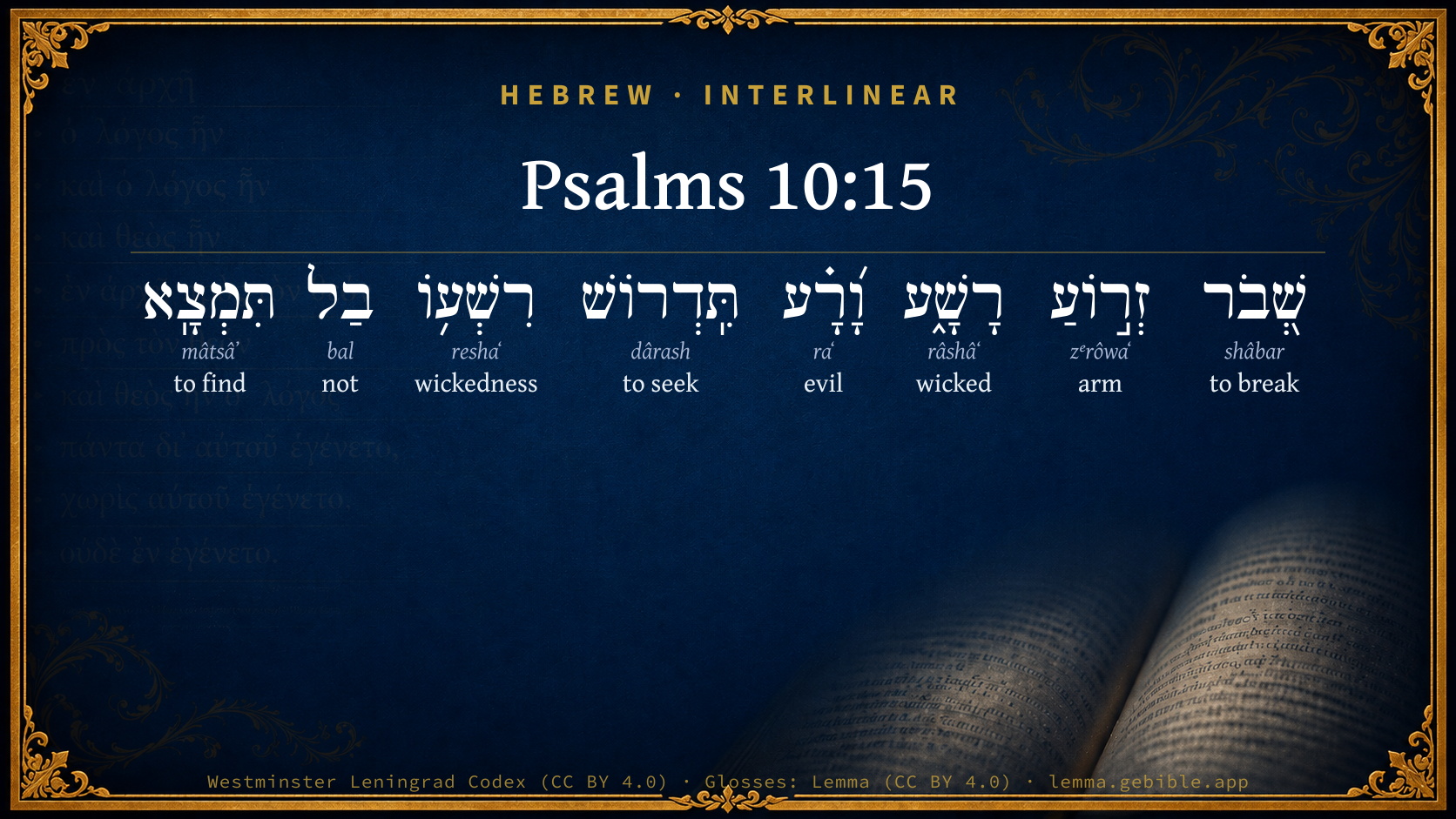
Hebrew (Westminster Leningrad Codex) Psalms 10:15 appears in the Hebrew Old Testament. The text above is from the Westminster Leningrad Codex. Each word links to its Strong’s number, a concise gloss, and parsing drawn from the Open Scriptures Hebrew Bible morphology. Click any word for its full Brown-Driver-Briggs (BDB) entry.
Download image
Cite this verse

Psalms 10:15 (World English Bible). Public Domain. Lemma interlinear Bible study tool, https://lemma.gebible.app/v/psalms/10/15.

Show BibTeX & RIS
BibTeX
RIS
English Translation
Break the arm of the wicked. As for the evil man, seek out his wickedness until you find none.
World English Bible · Public Domain
Download a study sheet

One document with this verse’s original text, its word-by-word gloss line, the meaning frame, cross-references with their text, attributed commentary, and full source and license credits — printable, and it pastes into notes with its structure intact.

This verse Autodidact and up

Study sheet (.html) Plain text (.txt)

A passage Seminary Student

Up to 50 verses in one chapter. A passage sheet keeps up to 6 commentary sources and 12 cross-references per verse, in the order this page ranks them, and says so on the sheet whenever that leaves anything out. Ask for a single verse and you get the Autodidact verse sheet above.

Everything on this page stays free to read, with no account — the sheet is a download of what is already on screen, not access to it.

Want to remove ads? Support Godless Engineer
Compare translations 3

The same verse in 3 English versions, stacked beneath the original-language interlinear above. Click any original word for its lexicon entry.

Each is an independent rendering of the whole verse — the interlinear is not word-aligned to these translations.

Highlighted words mark where these versions differ — a whole-verse word diff, not a word-by-word alignment.

  • World English Bible Public Domain
    Break the arm of the wicked. As for the evil man, seek out his wickedness until you find none.
  • King James Version Public Domain
    Break thou the arm of the wicked and the evil man: seek out his wickedness till thou find none.
  • unfoldingWord Literal Text CC BY-SA 4.0
    Break the arm of the wicked and the evil. May it seek his wickedness, not find.

unfoldingWord Literal Text — © unfoldingWord, licensed CC BY-SA 4.0. Word-aligned USFM3 via Door43 (git.door43.org/unfoldingWord/en_ult).

Versions to compare (up to 4)

3 of 4 selected

Show all 17 translations

Every available English version of this verse, each an independent rendering of the whole verse.

  • World English Bible Public Domain
    Break the arm of the wicked. As for the evil man, seek out his wickedness until you find none.
  • Berean Standard Bible Public Domain
    Break the arm of the wicked and evildoer; call him to account for his wickedness until none is left to be found.
  • Majority Standard Bible Public Domain
    Break the arm of the wicked and evildoer; call him to account for his wickedness until none is left to be found.
  • King James Version Public Domain
    Break thou the arm of the wicked and the evil man: seek out his wickedness till thou find none.
  • American Standard Version (1901) Public Domain
    Break thou the arm of the wicked; And as for the evil man, seek out his wickedness till thou find none.
  • Revised Version (1885) Public Domain
    Break thou the arm of the wicked; and as for the evil man, seek out his wickedness till thou find none.
  • Geneva Bible (1599) Public Domain
    Breake thou the arme of the wicked and malicious: searche his wickednes, and thou shalt finde none.
  • Young's Literal Translation Public Domain
    Break the arm of the wicked and the evil, Seek out his wickedness, find none;
  • Literal Standard Version CC BY-SA 4.0
    Break the arm of the wicked and the evil, || Seek out his wickedness, find none;
  • Unlocked Literal Bible CC BY-SA 4.0
    Break the arm of the wicked and evil man. Make him account for his evil deeds, which he thought you would not discover.
  • unfoldingWord Literal Text CC BY-SA 4.0
    Break the arm of the wicked and the evil. May it seek his wickedness, not find.
  • Darby Bible Public Domain
    Break thou the arm of the wicked, and as for the evil man, seek out his wickedness [till] thou find none.
  • World Messianic Bible Public Domain
    Break the arm of the wicked. As for the evil man, seek out his wickedness until you find none.
  • Webster's Bible Public Domain
    Break thou the arm of the wicked and the evil man: seek out his wickedness till thou shalt find none.
  • Free Bible Version CC BY-SA 4.0
    Destroy the power of the wicked, those evil people! Call each of them to account until there are none left!
  • Bible in Basic English Public Domain
    Let the arm of the sinner and the evil-doer be broken; go on searching for his sin till there is no more.
  • JPS Tanakh (1917) Public Domain
    Break Thou the arm of the wicked; and as for the evil man, search out his wickedness, till none be found.

Literal Standard Version (2020), Covenant Press — licensed CC BY-SA 4.0. Text via the HelloAO Bible API (eBible.org). Unlocked Literal Bible (unfoldingWord) — licensed CC BY-SA 4.0. Text via the HelloAO Bible API (eBible.org). unfoldingWord Literal Text — © unfoldingWord, licensed CC BY-SA 4.0. Word-aligned USFM3 via Door43 (git.door43.org/unfoldingWord/en_ult). Free Bible Version, Dr. Jonathan Gallagher — licensed CC BY-SA 4.0. Text via the HelloAO Bible API (eBible.org).

Word by word

More ways to search: Search by grammar → Find every occurrence → Compare this word →

Practice this passage: Drill this verse → Learn its vocabulary →

About this verse

These counts appear in no published source. They are computed here, from the morphology-tagged text and Lemma’s own curated glosses. What Lemma adds →

8
words
8
distinct lemmas
Wisdom
section

Shared distinctive vocabulary

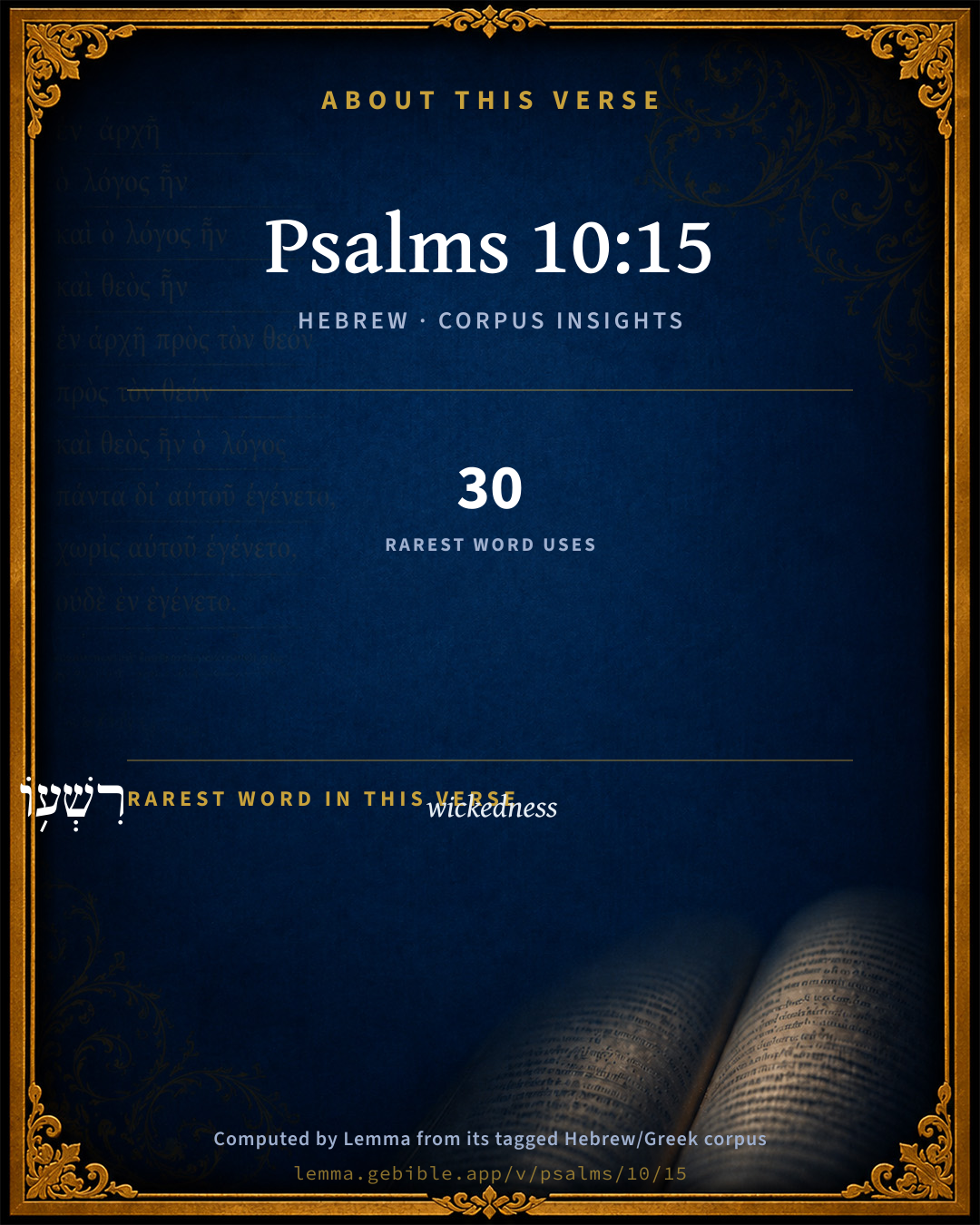
רִשְׁע֥וֹ wickedness H7562 occurs in 29 verses of the Hebrew Bible. Also found in:

Grammatical profile

  • 3 verbs
  • 2 nouns
  • 2 adjectives
  • 1 particle

Verb forms

  • שְׁ֭בֹר Qal · Imperative
  • תִּֽדְרוֹשׁ Qal · Imperfect
  • תִּמְצָֽא Qal · Imperfect

Hebrew & Septuagint length

In English translation the verse runs 19 words from the Hebrew and 21 from the Septuagint (LXX English) — closely comparable.

A rough comparison of the two English renderings, which tokenize alike — not a word-level alignment.

Word counts can differ between the Hebrew and the Greek without any difference in meaning — e.g. the Hebrew direct-object marker אֵת has no separate Greek word, and Greek often adds the article ὁ.

Cross-references

10

Topical passages linked to Psalms 10:15 in the Treasury of Scripture Knowledge — connected by theme and wording, ordered by reader-vote popularity; previews shown in the World English Bible.

  • Job 38:15 From the wicked, their light is withheld, The high arm is broken.
  • Psalms 37:17 For the arms of the wicked shall be broken, But Yahweh upholds the righteous.
  • Zephaniah 1:12 It will happen at that time, that I will search Jerusalem with lamps, and I will punish the men who are settled on their dregs, who say in their heart, "Yahweh will not do good, neither will he do evil."
  • Psalms 7:9 Oh let the wickedness of the wicked come to an end, But establish the righteous; Their minds and hearts are searched by the righteous God.
  • Ezekiel 30:21–22 Son of man, I have broken the arm of Pharaoh king of Egypt; and, behold, it has not been bound up, to apply [healing] medicines, to put a bandage to bind it, that it be strong to hold the sword.
  • Jeremiah 2:34 Also in your skirts is found the blood of the souls of the innocent poor: you did not find them breaking in; but it is because of all these things.
  • Zechariah 11:17 Woe to the worthless shepherd who leaves the flock! The sword will be on his arm, and on his right eye. His arm will be completely withered, and his right eye will be totally blinded!"
  • Psalms 3:7 Arise, Yahweh! Save me, my God! For you have struck all of my enemies on the cheek bone. You have broken the teeth of the wicked.
  • Ezekiel 23:48 Thus will I cause lewdness to cease out of the land, that all women may be taught not to do after your lewdness.
  • 2 Kings 21:12–15 therefore thus says Yahweh, the God of Israel, Behold, I bring such evil on Jerusalem and Judah, that whoever hears of it, both his ears shall tingle.

Cross-references courtesy of OpenBible.info (CC BY 4.0).

Hebrew and Greek witnesses Masoretic Hebrew ↔ Greek Septuagint

The same verse in the two great witnesses to the Old Testament, shown verse-for-verse.

You’re reading Greek Psalm 9 (Hebrew Psalm 10). The Septuagint counts the superscription, so verse numbers can differ from the Hebrew — chapter-level alignment, not verse-by-verse. Numbering follows Rahlfs.

These are two independent witnesses, not word-aligned to each other, and the Septuagint is shown in lemma (dictionary) form.

Hebrew Psalms 10:15 Masoretic · Westminster Leningrad Codex

שְׁ֭בֹר זְר֣וֹעַ רָשָׁ֑ע וָ֝רָ֗ע תִּֽדְרוֹשׁ רִשְׁע֥וֹ בַל תִּמְצָֽא

Break the arm of the wicked. As for the evil man, seek out his wickedness until you find none.

World English Bible · Public Domain

Greek LXX Greek Psalm 9:15 Septuagint · lemma form

ὅπως ἄν ἐκἀγγέλλω πᾶς ὁ αἴνεσις σύ ἐν ὁ πύλη ὁ θυγάτηρ σιων ἀγαλλιάομαι ἐπί ὁ σωτήριον σύ

The heathen are caught in the destruction which they planned: in the very snare which they hid is their foot taken.

LXX2012 (modern English Septuagint) · Public Domain

On this verse, Ellicott's Commentary for English Readers discusses the Septuagint’s reading. Read the note in Commentary ↓

Hebrew: Westminster Leningrad Codex (CC BY 4.0). Greek: Septuagint (public domain); English from LXX2012 (modern English Septuagint) (Public Domain). How the Septuagint differs from the Hebrew →

Commentary

Notes on Psalms 10:15 from classic Christian and Jewish commentators (each source and its license shown beneath its notes). The classic Christian expositions comment on the surrounding passage and are grouped to its opening verse, so a note may address several verses; the Jewish commentaries on the Tanakh (Rashi and others) are per-verse, so they appear only where the commentator wrote on this verse.

Lemma curates 59 commentaries, every one of them public domain or Creative Commons licensed, each selected and text-cleaned for this edition rather than reprinted as found. About our sources →

Trapp's Complete Commentary

John Trapp

Psa 10:15 Break thou the arm of the wicked and the evil [man]: seek out his wickedness [till] thou find none.

Ver. 15. Break thou the arm of the wicked] That arm that hath been lifted up against the godly. See Psa 3:8; Psa 58:7.

Seek out his wickedness till thou find none] Ad alios vel inficiendos, vel infestandos, Eze 23:48. Or, leave no sin of his unpunished. The Franciscans, to prove that Francis, the founder of their order, was without sin, foolishly allege this text, Quaeretur peccatum illius et non invenietur; wherein (according to the sense of the psalmist) what do they else but wish that God would trace him quite through the course and trade of his iniquities, even to the uttermost end of them, and punish him accordingly; which is done, no doubt, long since.

John Trapp, A Commentary or Exposition upon All the Books of the Old and New Testament (1647–1656) — public domain. Text from a community e-Sword module.

Joseph Benson's Commentary

Psa 10:15. Break thou the arm of the wicked — That is, their strength, the instrument of their violence and cruelty. Deprive them of all power to do mischief. Seek out his wickedness — Search for it, and punish these wicked atheists; till thou find none — Till no such wickedness be left in the world, or at least, in the church. “This,” says Dr. Horne, “may be either a prayer or a prediction, implying that the time will come when the power of Jehovah will dash in pieces that of the enemy, by the demolition either of sin or the sinner, until wickedness be come utterly to an end, and righteousness be established for ever in the kingdom of Messiah.”

Joseph Benson's Commentary on the Old and New Testaments (1811–1818) — public domain. Text from a community e-Sword module.

Tyndale Open Study Notes

Tyndale Open Resources

10:15 The psalmist strongly invokes a curse as he prays (see “Prayers for Vengeance” Theme Note). • Arms represent an ability to wage war (18:34; 44:3).

Tyndale Open Study Notes — © Tyndale Open Resources, licensed CC BY-SA 4.0. Text via the HelloAO Bible API.

Geneva Bible (1599)

Geneva Bible translators

For thou hast utterly destroyed him.

Geneva Bible (1599) marginal notes — public domain. Text via Bolls.life.

Jamieson, Fausset & Brown

Robert Jamieson, A. R. Fausset & David Brown

arm--power.

till thou find none--So far from not requiting (Psa 10:11, Psa 10:13), God will utterly destroy the wicked and his deeds (Psa 9:5-6; Psa 34:16; Psa 37:36).

Jamieson, Fausset & Brown — Commentary Critical and Explanatory on the Whole Bible (1871) — public domain (CC PDM 1.0). Text via the HelloAO Bible API.

Adam Clarke's Commentary

Verse 15. Break thou the arm] Destroy his power, deprive him of his influence, that he may be no longer able to oppress.

Seek out his wickedness till thou find none.] All his public haunts and private ways shall be investigated; thou wilt bring all his villanies to light, and continue to inflict punishment, while there is a crime to punish. Or, "Continue to judge and punish transgressors, till not one is to be found." This agrees with the following verse.

Adam Clarke's Commentary on the Bible (1810–1826) — public domain. Text from a community e-Sword/MySword module.

John Calvin's Commentaries

15. Break thou the arm. This form of expression just means breaking the power of the wicked. And it is not simply a prayer; it may also be regarded as a prophecy. As the ungovernable fury of our enemies very often makes us lose courage, as if there were no means by which it could be restrained, David, in order to support his faith, and preserve it from failing through the fears which presented themselves, sets before himself the consideration, that whenever it shall please God to break the power of the ungodly, he will bring to nothing both themselves and all their schemes. To make the meaning the more evident, the sentence may be explained in this way, — Lord, as soon as it shall seem good to thee to break the arm of the wicked, thou wilt destroy him in a moment, and bring to nought his powerful and violent efforts in the work of doing mischief. David, indeed, beseeches God to hasten his assistance and his vengeance; but, in the meantime, while these are withheld, he sustains himself by the consolatory reflection, that the ungodly cannot break forth into violence and mischief except in so far as God permits them; since it is in his power, whenever he ascends into the judgment-seat, to destroy them even with his look alone. And certainly, as the rising sun dissipates the clouds and vapours by his heat, and clears up the dark air, so God, when he stretches forth his hand to execute the office of a Judge, restores to tranquillity and order all the troubles and confusions of the world. The Psalmist calls the person of whom he speaks not only wicked, but the wicked and the evil man, and he does so, in my judgment, for the purpose of setting forth in a stronger light the greatness of the wickedness of the character which he describes. His words are as if he had said, Wicked men may even be frantic in their malice and impiety; but God can promptly and effectually remedy this evil whenever he pleases.

John Calvin's Commentaries (1540-1563) — public domain. Text from the Calvin Translation Society English edition (1840s-50s) via the Christian Classics Ethereal Library (ccel.org). Calvin's coverage is partial (roughly two-thirds of the Bible); uncommented books and verses are honest gaps, never fabricated. The 19th-century editor's footnotes and remarks are omitted so the notes are faithfully Calvin's own voice.

Ellicott's Commentary for English Readers

(15) Seek out.—The meaning of the verse is clear, from Psa_37:36, and Isa_41:12, where we see that to seek and not find was a proverb expressing “riddance of evil;” but the construction is difficult. The first clause should end at “wicked,” the words “and the evil” being absolute; and the verbs, which are in form either second or third person, should be taken in the second. Translate, and as for the evil man, thou shalt look for his wickedness, and not find it (thou=anybody, which preserves the proverbial tone. So the LXX., “his sin shall be sought, and not be found “).

A Bible Commentary for English Readers, edited by Charles John Ellicott (1878–1897) — public domain. Text from a community e-Sword module.

The Cambridge Bible for Schools and Colleges

gen. ed. J. J. S. Perowne

15. Break &c.] Paralyse his power to do mischief. Cp. Psa_37:17; Job_38:15.

of the wicked and the evil man] So the ancient versions, taking the most obvious division of the words. R.V. follows the accentuation of the Hebrew text in rendering, and as for the evil man, seek out &c.

seek out &c.] Lit. when thou requirest his wickedness, thou shall not find. The word is the same as that used in Psa_9:12 and in Psa_10:4; Psa_10:13. The Psalmist looks forward to a time when the wicked will be powerless to do harm. When God ‘makes inquisition’ and holds His assize, He will find no crime to punish, cp. Psa_17:3. There may be an allusion to the proverbial phrase ‘to seek and not find,’ used in reference to what has utterly disappeared (Psa_37:36), but a special word for ‘seek’ is chosen for the sake of the allusion indicated.

15, 16. Stanza of Shin. Prayer for the extermination of evil, based on the facts of faith and history.

The Cambridge Bible for Schools and Colleges (gen. ed. J. J. S. Perowne; Cambridge University Press, 1878–1918) — public domain. Text from a community e-Sword module.

John Gill's Exposition

Break thou the arm of the wicked and the evil man,.... His power and strength, so that he shall not be able to hold the sword, to strike a blow, or do any hurt to the people of God; see Eze 30:21. This prayer is in some measure already fulfilled in antichrist, the man of sin, or pope of Rome; though his kingdom is not broke to pieces; as it will be when Christ's kingdom shall be more visibly set up, to which reference is had in Psa 10:16; see Dan 2:44; yet his strength is weakened, his arm is broken, he has not the power he had, nor can he tyrannise and do the mischief he once did: "but as for the evil man" (m), for so the words should be read, there being an "athnach" under the word "wicked", which ends the proposition there:

seek out his wickedness till thou find none; which designs a thorough search after sin, full punishment of it, and the entire ruin and destruction of the wicked; and the sense is, that God would make a strict inquiry into the wickedness of the man of sin, which he promised himself he would not, Psa 10:13; and that he would punish him and his followers to the uttermost for it, until there should not be one of the antichristian party found upon earth; with which sense agrees Psa 10:16; see Psa 104:35.

(m) "improbum quod attinet, requiras", &c. Gejerus; so Michaelis.

John Gill's Exposition of the Whole Bible (1746–1763) — public domain (CC PDM 1.0). Text via the HelloAO Bible API.

Albert Barnes' Notes on the Bible

Break thou the arm of the wicked - The arm is the instrument by which we effect a purpose, and especially in wielding a sword or a spear, as in battle; and if the arm is broken, we are powerless. The psalmist, therefore, prays that God would render the wicked, in this respect, powerless.

And the evil man - Of all the evil, or the wicked. In regard to the prayer here, see the note at Psa 5:10.

Seek out his wickedness until thou find none - Until it is all punished; until there has been a full recompense. This is a wish that no wicked act of his should be forgotten; that exact justice should be rendered. If it is right to punish the wicked at all, it is right to deal with them just as they deserve; if any wickedness may properly be punished, all may be; and, whatever may occur, the sinner may be assured that he will not be punished merely for a part of his sins. If God punishes the wicked at all, there will be nothing left unpunished.

Albert Barnes' Notes on the Bible (1834–1885) — public domain. Text from a community e-Sword/MySword module.

Matthew Poole's English Annotations

Break thou; or, Thou wilt break. For it may be either a prayer or a prophecy.

The arm, i.e. his strength, the instrument of violence and mischief.

Seek out his wickedness; search for it so strictly, and punish these wicked atheists so severely.

Till thou find none, i.e. no such wickedness, to wit, undiscovered and unpunished, or indeed left in the world, or at least in the church; which might happen, because those wicked men here spoken of should be generally either convinced or rooted out, and the rest should be warned and reformed by their example, and so this lewdness should cease out of the land, as the phrase is, Eze 23:48. That is said to be sought for, and not found, which is utterly lost, as Job 20:7,8; Psa 37:36; Rev 16:20; 18:21. And this phrase is used both of good men, whose sins are taken away by God’s grace and mercy, pardoning and purging them away, and of wicked men in the sense above mentioned.

Matthew Poole's English Annotations on the Holy Bible (1683–1685) — public domain. Text from a community e-Sword/MySword module.

Whedon's Commentary on the Bible

Daniel D. Whedon

15. Seek out—Thou wilt seek out. This stands opposed to the doctrine of the wicked in Psa_10:13, where, using the same word, they say: “God will not require, or seek out,” the sin, to punish it.

Daniel D. Whedon (gen. ed.), Commentary on the Old and New Testaments (1874–1909) — public domain. Text from a community e-Sword module.

John Wesley's Explanatory Notes

Seek - Search for it, and punish these wicked atheists. 'Till - No such wickedness be left in the world, or at least in the church.

John Wesley, Explanatory Notes Upon the Whole Bible (1754–1765) — public domain. Text via the GEBible commentary corpus.

Keil & Delitzsch

C. F. Keil & F. Delitzsch

The desire for Jahve's interposition now rises again with fresh earnestness. It is a mistake to regard דּרשׁ and מצא as correlative notions. In the phrase to seek and not find, when used of that which has totally disappeared, we never have דּרשׁ, but always בּקּשׁ, Psa 37:36; Isa 41:12; Jer 50:20, and frequently. The verb דּרשׁ signifies here exactly the same as in Psa 10:4, Psa 10:13, and Psa 9:13 : "and the wicked (nom. absol. as in Psa 10:4) - mayst Thou punish his wickedness, mayst Thou find nothing more of it." It is not without a meaning that, instead of the form of expression usual elsewhere (Psa 37:36; Job 20:8), the address to Jahve is retained: that which is no longer visible to the eye of God, not merely of man, has absolutely vanished out of existence. This absolute conquest of evil is to be as surely looked for, as that Jahve's universal kingship, which has been an element of the creed of God's people ever since the call and redemption of Israel (Exo 15:18), cannot remain without being perfectly and visibly realised. His absolute and eternal kingship must at length be realised, even in all the universality and endless duration foretold in Zac 14:9; Dan 7:14, Rev 11:15. Losing himself in the contemplation of this kingship, and beholding the kingdom of God, the kingdom of good, as realised, the psalmist's vision stretches beyond the foes of the church at home to its foes in general; and, inasmuch as the heathen in Israel and the heathen world outside of Israel are blended together into one to his mind, he comprehends them all in the collective name of גּוים, and sees the land of Jahve (Lev 25:23), the holy land, purified of all oppressors hostile to the church and its God. It is the same that is foretold by Isaiah (Isa 52:1), Nahum (Nah 2:1), and in other passages, which, by the anticipation of faith, here stands before the mind of the suppliant as an accomplished fact - viz. the consummation of the judgment, which has been celebrated in the hymnic half (Ps 9) of this double Psalm as a judgment already executed in part.

Keil & Delitzsch — Biblical Commentary on the Old Testament (1861–1891) — public domain (CC PDM 1.0). Text via the HelloAO Bible API. (Old Testament only.)

J. A. Alexander on Psalms

Joseph Addison Alexander

15. Break thou the arm, destroy the power, of the wicked, and the bad (man), or as to the bad man, thou wilt seek for his wickedness (and) not find it. This may either mean, thou wilt utterly destroy him and his wickedness, so that when sought for it cannot be found (Psa 37:36), or thou wilt judicially investigate his guilt, and punish it till nothing more is left to punish. The Hebrew verb (wrd) has then the same sense as in ver. Psa 10:4; Psa 10:13, above, and there is a direct allusion to the sinner's boast that God will not inquire into men's acts or require an account of them. There may be a latent irony or sarcasm, as if he had said, Thou wilt find nothing, as he boasts, but in a very different sense; not because there is nothing worthy of punishment, but because there will be nothing left unpunished.

Joseph Addison Alexander, The Psalms Translated and Explained (1850) — public domain. Text from a community e-Sword module.

unfoldingWord translationNotes

Door43 World Missions Community

Break the arm of the wicked and evil man

Here "arm" represents power. AT: "Destroy the power of the wicked and evil man" or "Make the wicked and evil man weak" (See: Metonymy)

wicked and evil

These words have the same meaning. You can use one word to express both concepts. (See: Doublet)

Make him account for his evil deeds

Making someone account for his evil deeds represents punishing him. AT: "Punish him for the evil things he has done" (See: Metonymy)

the nations are driven out of his land

This can be stated in active form. "Yahweh forces the people of other nations to leave his land" (See: Active or Passive)

translationWords

works

king

nation

unfoldingWord translationNotes — © Distant Shores Media and the Door43 World Missions Community, licensed CC BY-SA 4.0. Source: git.door43.org/Door43/en_tn.

Rashi

Rabbi Shlomo Yitzchaki (Rashi)

Break the arm of the wicked Esau.

but as for the evil one—You will seek his wickedness and not find [it] As for the wicked of Israel, when they see the wicked [of the nations] prospering, their heart inspires them to deal wickedly, but when You break the arm of the wicked, if You were to come [then] to seek the wickedness of the wicked of Israel, You would not find it.

Rashi on the Tanakh — English translations: “The Judaica Press complete Tanach with Rashi, translated by A. J. Rosenberg” (CC BY 4.0); “Pentateuch with Rashi's commentary by M. Rosenbaum and A.M. Silbermann, 1929-1934” (public domain); “The Metsudah Tanach series, Lakewood, N.J” (CC BY 4.0); and “The Book of Joshua, Metsudah Publications, 1997” (CC BY 4.0). Text via Sefaria.

Radak

Rabbi David Kimhi (Radak)

Break Thou the arm of the wicked: – Break his arm and his strength.

And as for the evil man, do Thou seek out his wickedness and Thou shalt find none: – When he says Thou wilt not require, as he said above (13), shew him that Thou dost require; and if Thou doest so, Thou shalt not find wickedness in the earth, for if Thou shouldest break his arm, then those who remain will hear and fear. And רשע and רע (wickedness and evil) are synonyms (lit., is a double word).

Radak on the Tanakh — English translations: “Sefaria Community Translation” (CC0 1.0 (public-domain dedication)); “Eliyahu Munk, HaChut Hameshulash” (CC BY 4.0); “Rabbi Mike Feuer, Jerusalem Anthology” (CC BY 4.0); and “R. David Kimhi on the first book of Psalms, Translated by R.G. Finch, London, 1919” (public domain). Text via Sefaria.

Lesson kit

Teaching starters — assembled from the data on this page, not authored interpretation. Every prompt links to the verse data it draws on. Edit before teaching.

Psalms, in the Wisdom, opens this verse with 8 words (8 distinct Hebrew lemmas). Its most distinctive word is reshaʻ (“wickedness”). A historical commentator’s framing appears above. Read the whole chapter for the surrounding context.

Discussion questions

  1. How does “wickedness” (reshaʻ) shape what this verse is saying?
  2. How does Deuteronomy 9:27, which shares the word «wickedness», read alongside this verse?
  3. These translations render this verse differently; the difference is in the English rendering, not the original. What questions does that raise?
  4. «שְׁ֭בֹר» is a Qal Imperative verb. How does that grammatical form shape the action described?
  5. Compare how Trapp's Complete Commentary and Joseph Benson's Commentary read this verse. Where do they agree or differ?

Things to notice

Reading settings

Reading text

Shown beneath each verse's original-language words.

Old Testament
Old Testament edition

Read the OT as the Masoretic Hebrew (MT) or the Greek Septuagint (LXX).

English shown for the Greek Septuagint (in the Hebrew ↔ Greek comparison).

Comparing translations? Open the Compare panel on any verse page to stack up to four side by side.