
Psalms 139:19

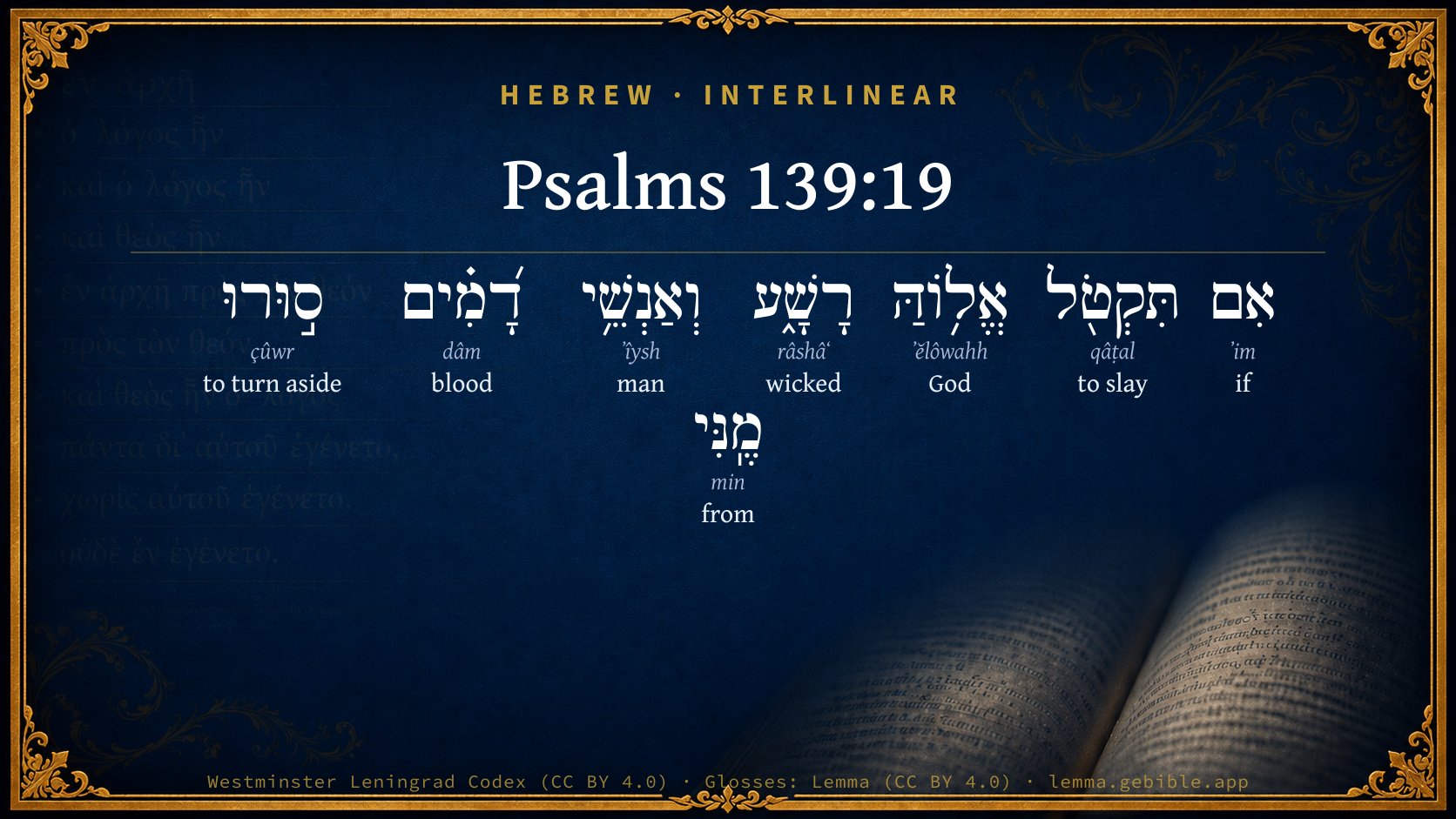
Hebrew (Westminster Leningrad Codex) Psalms 139:19 appears in the Hebrew Old Testament. The text above is from the Westminster Leningrad Codex. Each word links to its Strong’s number, a concise gloss, and parsing drawn from the Open Scriptures Hebrew Bible morphology. Click any word for its full Brown-Driver-Briggs (BDB) entry.
Download image
Cite this verse

Psalms 139:19 (World English Bible). Public Domain. Lemma interlinear Bible study tool, https://lemma.gebible.app/v/psalms/139/19.

Show BibTeX & RIS
BibTeX
RIS
English Translation
If only you, God, would kill the wicked. Get away from me, you bloodthirsty men!
World English Bible · Public Domain
Download a study sheet

One document with this verse’s original text, its word-by-word gloss line, the meaning frame, cross-references with their text, attributed commentary, and full source and license credits — printable, and it pastes into notes with its structure intact.

This verse Autodidact and up

Study sheet (.html) Plain text (.txt)

A passage Seminary Student

Up to 50 verses in one chapter. A passage sheet keeps up to 6 commentary sources and 12 cross-references per verse, in the order this page ranks them, and says so on the sheet whenever that leaves anything out. Ask for a single verse and you get the Autodidact verse sheet above.

Everything on this page stays free to read, with no account — the sheet is a download of what is already on screen, not access to it.

Want to remove ads? Support Godless Engineer
Compare translations 3

The same verse in 3 English versions, stacked beneath the original-language interlinear above. Click any original word for its lexicon entry.

Each is an independent rendering of the whole verse — the interlinear is not word-aligned to these translations.

Highlighted words mark where these versions differ — a whole-verse word diff, not a word-by-word alignment.

  • World English Bible Public Domain
    If only you, God, would kill the wicked. Get away from me, you bloodthirsty men!
  • King James Version Public Domain
    Surely thou wilt slay the wicked, O God: depart from me therefore, ye bloody men.
  • unfoldingWord Literal Text CC BY-SA 4.0
    If only you would kill the wicked, God! And men of bloodshed, depart from me,

unfoldingWord Literal Text — © unfoldingWord, licensed CC BY-SA 4.0. Word-aligned USFM3 via Door43 (git.door43.org/unfoldingWord/en_ult).

Versions to compare (up to 4)

3 of 4 selected

Show all 17 translations

Every available English version of this verse, each an independent rendering of the whole verse.

  • World English Bible Public Domain
    If only you, God, would kill the wicked. Get away from me, you bloodthirsty men!
  • Berean Standard Bible Public Domain
    O God, that You would slay the wicked—away from me, you bloodthirsty men—
  • Majority Standard Bible Public Domain
    O God, that You would slay the wicked—away from me, you bloodthirsty men—
  • King James Version Public Domain
    Surely thou wilt slay the wicked, O God: depart from me therefore, ye bloody men.
  • American Standard Version (1901) Public Domain
    Surely thou wilt slay the wicked, O God: Depart from me therefore, ye bloodthirsty men.
  • Revised Version (1885) Public Domain
    Surely thou wilt slay the wicked, O God: depart from me therefore, ye bloodthirsty men.
  • Geneva Bible (1599) Public Domain
    Oh that thou wouldest slay, O God, the wicked and bloody men, to whom I say, Depart ye from mee:
  • Young's Literal Translation Public Domain
    Dost Thou slay, O God, the wicked? Then, men of blood, turn aside from me!
  • Literal Standard Version CC BY-SA 4.0
    Do You slay, O God, the wicked? Then, men of blood, turn aside from me!
  • Unlocked Literal Bible CC BY-SA 4.0
    If only you would kill the wicked, God; get away from me, you violent men.
  • unfoldingWord Literal Text CC BY-SA 4.0
    If only you would kill the wicked, God! And men of bloodshed, depart from me,
  • Darby Bible Public Domain
    Oh that thou wouldest slay the wicked, O +God! And ye men of blood, depart from me.
  • World Messianic Bible Public Domain
    If only you, God, would kill the wicked. Get away from me, you bloodthirsty men!
  • Webster's Bible Public Domain
    Surely thou wilt slay the wicked, O God: depart from me therefore, ye bloody men.
  • Free Bible Version CC BY-SA 4.0
    God, if you would only kill the wicked! Murderers, get away from me!
  • Bible in Basic English Public Domain
    If only you would put the sinners to death, O God; go far from me, you men of blood.
  • JPS Tanakh (1917) Public Domain
    If Thou but wouldest slay the wicked, O God — depart from me therefore, ye men of blood;

Literal Standard Version (2020), Covenant Press — licensed CC BY-SA 4.0. Text via the HelloAO Bible API (eBible.org). Unlocked Literal Bible (unfoldingWord) — licensed CC BY-SA 4.0. Text via the HelloAO Bible API (eBible.org). unfoldingWord Literal Text — © unfoldingWord, licensed CC BY-SA 4.0. Word-aligned USFM3 via Door43 (git.door43.org/unfoldingWord/en_ult). Free Bible Version, Dr. Jonathan Gallagher — licensed CC BY-SA 4.0. Text via the HelloAO Bible API (eBible.org).

Word by word

More ways to search: Search by grammar → Find every occurrence → Compare this word →

Practice this passage: Drill this verse → Learn its vocabulary →

About this verse

These counts appear in no published source. They are computed here, from the morphology-tagged text and Lemma’s own curated glosses. What Lemma adds →

8
words
8
distinct lemmas
Wisdom
section

Notable vocabulary

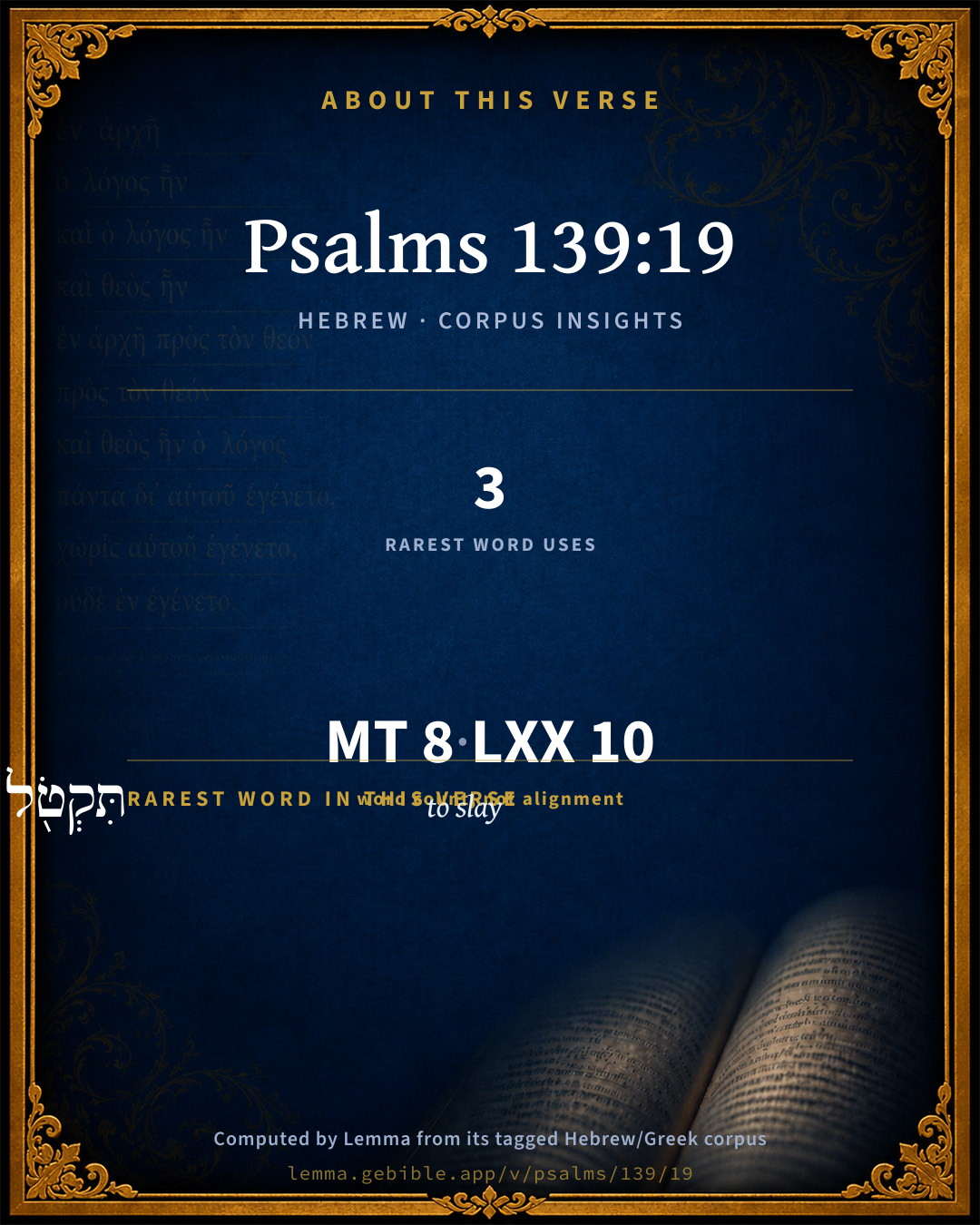
The rarest word here is תִּקְטֹ֖ל to slay H6991 — appearing just 3 times in the whole Hebrew Bible.

Shared distinctive vocabulary

תִּקְטֹ֖ל to slay H6991 occurs in 3 verses of the Hebrew Bible. Also found in:

Grammatical profile

  • 2 verbs
  • 3 nouns
  • 1 adjective
  • 1 preposition
  • 1 conjunction

Verb forms

  • תִּקְטֹ֖ל Qal · Imperfect
  • ס֣וּרוּ Qal · Imperative

Hebrew & Septuagint length

In English translation the verse runs 15 words from the Hebrew and 16 from the Septuagint (LXX English) — closely comparable.

A rough comparison of the two English renderings, which tokenize alike — not a word-level alignment.

Word counts can differ between the Hebrew and the Greek without any difference in meaning — e.g. the Hebrew direct-object marker אֵת has no separate Greek word, and Greek often adds the article ὁ.

In the original languages it is 8 Hebrew tokens and 10 Greek tokens — but the two are counted differently (Hebrew bundles its prefixes and suffixes into one token; the Greek is in lemma form), so that isn’t a like-for-like length.

Cross-references

11

Topical passages linked to Psalms 139:19 in the Treasury of Scripture Knowledge — connected by theme and wording, ordered by reader-vote popularity; previews shown in the World English Bible.

  • Psalms 5:6 You will destroy those who speak lies. Yahweh abhors the blood-thirsty and deceitful man.
  • Psalms 119:115 Depart from me, you evildoers, That I may keep the commandments of my God.
  • Isaiah 11:4 but with righteousness shall he judge the poor, and decide with equity for the humble of the earth; and he shall strike the earth with the rod of his mouth; and with the breath of his lips shall he kill the wicked.
  • Psalms 6:8 Depart from me, all you workers of iniquity, For Yahweh has heard the voice of my weeping.
  • Psalms 9:17 The wicked shall be turned back to Sheol, Even all the nations that forget God.
  • Psalms 55:23 But you, God, will bring them down into the pit of destruction. Bloodthirsty and deceitful men shall not live out half their days, But I will trust in you.
  • Psalms 64:7 But God will shoot at them. They will be suddenly struck down with an arrow.
  • 2 Corinthians 6:17 Therefore, "'Come out from among them, And be separate,' says the Lord, 'Touch no unclean thing. I will receive you.
  • Psalms 94:23 He has brought on them their own iniquity, And will cut them off in their own wickedness. Yahweh, our God, will cut them off.
  • Matthew 25:41 Then he will say also to those on the left hand, 'Depart from me, you cursed, into the eternal fire which is prepared for the devil and his angels;
  • Matthew 7:23 Then I will tell them, 'I never knew you. Depart from me, you who work iniquity.'

Cross-references courtesy of OpenBible.info (CC BY 4.0).

Hebrew and Greek witnesses Masoretic Hebrew ↔ Greek Septuagint

The same verse in the two great witnesses to the Old Testament, shown verse-for-verse.

You’re reading Greek Psalm 138 (Hebrew Psalm 139). The Septuagint counts the superscription, so verse numbers can differ from the Hebrew — chapter-level alignment, not verse-by-verse. Numbering follows Rahlfs.

These are two independent witnesses, not word-aligned to each other, and the Septuagint is shown in lemma (dictionary) form.

Hebrew Psalms 139:19 Masoretic · Westminster Leningrad Codex

אִם תִּקְטֹ֖ל אֱל֥וֹהַּ רָשָׁ֑ע וְאַנְשֵׁ֥י דָ֝מִ֗ים ס֣וּרוּ מֶֽנִּי

If only you, God, would kill the wicked. Get away from me, you bloodthirsty men!

World English Bible · Public Domain

Greek LXX Greek Psalm 138:19 Septuagint · lemma form

ἐάν ἀποκτείνω ἁμαρτωλός ὁ θεός ἀνήρ αἷμα ἐκκλίνω ἀπό ἐγώ

Oh that you would kill the wicked, O God; depart from me, you⌃ men of blood.

LXX2012 (modern English Septuagint) · Public Domain

On this verse, John Gill's Exposition discusses the Septuagint’s reading. Read the note in Commentary ↓

Hebrew: Westminster Leningrad Codex (CC BY 4.0). Greek: Septuagint (public domain); English from LXX2012 (modern English Septuagint) (Public Domain). How the Septuagint differs from the Hebrew →

Commentary

Notes on Psalms 139:19 from classic Christian and Jewish commentators (each source and its license shown beneath its notes). The classic Christian expositions comment on the surrounding passage and are grouped to its opening verse, so a note may address several verses; the Jewish commentaries on the Tanakh (Rashi and others) are per-verse, so they appear only where the commentator wrote on this verse.

Lemma curates 59 commentaries, every one of them public domain or Creative Commons licensed, each selected and text-cleaned for this edition rather than reprinted as found. About our sources →

Trapp's Complete Commentary

John Trapp

Psa 139:19 Surely thou wilt slay the wicked, O God: depart from me therefore, ye bloody men.

Ver. 19. Surely thou wilt slay the wicked] Those that traduce and slander me for a hypocrite and a Belialist. Some render it, Oh that thou wouldest slay them! inasmuch as they hate me for my zeal, and forwardness to turn the wheel of justice over them, and to give them their due and condign punishment; for, for mine own part, I cannot abide them, but bid tbem avaunt, with

Depart from me therefore, ye bloody men] Ye that dare to destroy so goodly a piece of God’s handiwork as man is above described to be. See Gen 9:6. Or, ye that seek to double, undo me; first by detraction and then by deadly practice. See Eze 22:9, "In thee are men that carry tales to shed blood."

John Trapp, A Commentary or Exposition upon All the Books of the Old and New Testament (1647–1656) — public domain. Text from a community e-Sword module.

Albert Barnes' Notes on the Bible

Surely thou wilt slay the wicked, O God - Compare the notes at Isa 11:4. The literal translation of this would be, “If thou wilt slay the wicked.” It is not easy to account for the sudden and remarkable transition or diversion of the train of thought from the main subject of the psalm, in these verses Psa 139:19-22, in which the psalmist gives vent to his feelings toward the wicked, and prays that they may depart from him. Perhaps the explanation of it may be, that as the psalmist was reflecting on the fact that God is everywhere present, that he searches the hearts of people, that he must know all their conduct, he was suddenly struck with the idea of the condition of wicked people in the presence, and under the eye, of such a Being. As God knows all things, he must know them; and this instantaneously suggested the idea of their guilt and danger. People of such characters could not deceive such a God. They could not but be known to him, and could not but be objects of his aversion. They could not, therefore, but be in danger.

Depart from me, therefore, ye bloody men - See Psa 119:115. The Hebrew is, “Men of bloods;” that is, men who shed blood. The language is used to denote wicked men in general. The idea here is not that the psalmist was in danger from them at that time, but that he desired to be separate from that class of people; he did not wish to be ranked with them, to partake of their conduct, or to share in their fate. He had no sympathy with them, and he desired to be separate from them altogether.

Albert Barnes' Notes on the Bible (1834–1885) — public domain. Text from a community e-Sword/MySword module.

The Biblical Illustrator

Joseph S. Exell

Psa_139:19-22

Surely Thou wilt slay the wicked, O God: depart from me, therefore, ye bloody men.

Indignation against the wicked

I. Here is a fact in relation to the moral government of God. That fact is the ultimate ruin of the wicked. Surely Thou wilt slay the wicked, O God. The wicked will ultimately be ruined.

1. This fact agrees with the dictates of conscience. The consciences of mankind the world over proclaim it.

2. This fact agrees with the principle of moral causation. Sin brings ruin, every act of transgression carries with it its penalty, and tends to death.

3. This fact agrees with the declaration of the Bible, Be sure your sins will find you out. He that soweth to the flesh, etc.

II. Here is a fact in the experience of pious men. Do not I hate them, O Lord, that hate Thee? Whether these words breathe piety or not, they suggest a fact in the experience of all godly men. It is this--antipathy to the character that is opposed to God.

1. The fact is a necessity. From the laws of our mental constitution it is impossible for us go love those who hate the object we most love. Love makes the twain one, hence it is impossible for a man truly to love God and not hate that which is opposed to Him.

2. This fact is an excellence. It is morally right and grand to see the godly man rising up in indignation against all that is opposed to the character and will of God. (Homilist.)

The Biblical Illustrator, edited by Joseph S. Exell (c. 1880s–1900s) — public domain. Text from a community e-Sword module.

Joseph Benson's Commentary

Psa 139:19. Surely, thou wilt slay the wicked, O God — And as thou hast precious and gracious thoughts toward me, (which thou also hast toward all that love and fear thee,) so thou wilt not now desert me and leave me in the hands of those wicked men who, unmindful of thy presence and thy all-seeing eye, regard not by what means they plot my ruin. But rather, as thou knowest all things, and art perfectly acquainted “with the justice of my cause, and the iniquity of my adversaries; and as thou hast formed, and hitherto in so wonderful a manner watched over and preserved me, thou wilt slay the wicked, and deliver me, as thou hast promised to do, out of their hands. Depart from me, therefore, ye bloody men — I trust in my God, and will have no connection in the way of treaty or friendship with you.” Thus David, in this verse, draws the intended conclusion from the premises so largely expatiated upon in the former part of the Psalm.

Joseph Benson's Commentary on the Old and New Testaments (1811–1818) — public domain. Text from a community e-Sword module.

J. A. Alexander on Psalms

Joseph Addison Alexander

19. (Psa 139:19) If thou wilt slay, 0 God, the wicked (man)! And ye men of blood, depart from me? The first clause is in fact, though not in form, the expression of a wish. If thou wouldst but slay! In form, there is no aposiopesis, which may be variously supplied by adding, I will praise thee, I will rejoice, it will be just, or the like. Men of bloods, murderers or murderous men. See above, on Psa 5:6; Psa 26:9; Psa 55:23. Depart from me is the same expression as in Psa 6:8; Psa 119:15, but the main idea here is that of disavowal or repudiation. Oh that God would slay them, and until he does, I desire to have no communion with them. Compare Job 21:14, Mat 7:23.

Joseph Addison Alexander, The Psalms Translated and Explained (1850) — public domain. Text from a community e-Sword module.

Tyndale Open Study Notes

Tyndale Open Resources

139:19-24 The psalmist’s sense of awe leads him to consider the wicked and to reflect on himself. The Lord, as the examiner of all people, judges the wicked for their destructive acts and speech; thus, the psalmist prays that he will not be among them.

Tyndale Open Study Notes — © Tyndale Open Resources, licensed CC BY-SA 4.0. Text via the HelloAO Bible API.

Adam Clarke's Commentary

Verse 19. Surely thou wilt slay the wicked] The remaining part of this Psalm has no visible connexion with the preceding. I rather think it a fragment, or a part of some other Psalm.

Ye bloody men.] אנשי דמים anshey damim, men of blood, men guilty of death.

Adam Clarke's Commentary on the Bible (1810–1826) — public domain. Text from a community e-Sword/MySword module.

John Calvin's Commentaries

19. If thou shalt slay, etc. It is unnatural to seek, as some have done, to connect this with the preceding verse. Nor does it seem proper to view the words as expressing a wish — “I wish,” or, “Oh! if thou God wouldst slay the wicked.” Neither can I subscribe to the idea of those who think that David congratulates himself upon the wicked being cut off. The sentiment seems to me to be of another kind, that he would apply himself to the consideration of the divine judgments, and advance in godliness and in the fear of his name, so often as vengeance was taken upon the ungodly. There can be no question that God designs to make an example of them, that his elect ones may be taught by their punishment to withdraw themselves from their society. David was of himself well disposed to the fear and worship of God, and yet he needed a certain check, like other saints, as Isaiah says, (Isaiah 26:9,) “when God has sent abroad his judgments, the inhabitants of the earth shall learn righteousness,” that is, to remain in the fear of the Lord. At the same time, I have no doubt that the Psalmist presents himself before God as witness of his integrity; as if he had said, that he came freely and ingenuously to God’s bar, as not being one of the wicked despisers of his name, nor having any connection with them.

John Calvin's Commentaries (1540-1563) — public domain. Text from the Calvin Translation Society English edition (1840s-50s) via the Christian Classics Ethereal Library (ccel.org). Calvin's coverage is partial (roughly two-thirds of the Bible); uncommented books and verses are honest gaps, never fabricated. The 19th-century editor's footnotes and remarks are omitted so the notes are faithfully Calvin's own voice.

Ellicott's Commentary for English Readers

(19) Slay the wicked.—This abrupt transition from a theme so profound and fascinating to fierce indignation against the enemies of God, would certainly be strange anywhere but in the Psalms. And yet, perhaps, philosophically regarded, the subject of God’s omniscience must conduct the mind to the thought of the existence of evil, and speculation on its origin and development. But the Hebrew never speculated for speculation’s sake. The practical concerns of life engaged him too intensely. Where a modern would have branched off into the ever-recurring problem of the entrance of evil into the world, the Israelite turned with indignation on those who then and there proved the existence of sin in concrete act.

Surely . . . —Or, rather—

“O that thou wouldest slay, O God, the wicked,

And that ye bloody men would depart from me.”

We get the last clause, which is better than an abrupt change to the imprecations, by a slight change of reading.

A Bible Commentary for English Readers, edited by Charles John Ellicott (1878–1897) — public domain. Text from a community e-Sword module.

The Cambridge Bible for Schools and Colleges

gen. ed. J. J. S. Perowne

19. Surely &c.] Rather as R.V. marg., Oh that thou wouldest slay the wicked. The problem of the existence of evil perplexes him, as it perplexed Job (Job_21:7 ff.). Evil for him is no abstract idea; it is embodied in evil men. Will not God free His world from this insult to His government? Cp. Psa_104:35.

depart from me] lest I be tempted by your example and involved in your fate. Cp. Psa_6:8; Psa_119:115.

ye bloody men] Men of blood, who do not shrink from violence and murder (Psa_5:6; Pro_29:10).

19–24. But how can this omniscient God tolerate the existence of wicked men, who blaspheme and hate Him? With such the Psalmist will have no fellowship; and he concludes with a prayer that God will purify his heart, and lead him in the right way.

The Cambridge Bible for Schools and Colleges (gen. ed. J. J. S. Perowne; Cambridge University Press, 1878–1918) — public domain. Text from a community e-Sword module.

John Gill's Exposition

For they speak against thee wickedly,.... Against his being, his perfections, his purposes, his providences, his doctrines, ordinances, ministers, and people; or "they speak of thee for wickedness" (b), they made mention of the name of God to cover their wickedness, pretending to fear God and love him, to have a reverence of him and serve him, putting on a form of godliness, but denying the power thereof;

and thine enemies take thy name in vain: either by profane swearing, or by false swearing. The Targum interprets both clauses of swearing deceitfully and vainly; or "he", that is, everyone that is "lifted up to vanity are thine enemies" (c), whose hearts are lifted up to vanity, idols, riches, self-righteousness, sensual lusts and pleasures; these are the enemies of God, are estranged from him, hold friendship with the world, harbour his enemies, love what he hates, hate what he loves, and commit acts of hostility against him. The Septuagint, Vulgate Latin, Syriac, Arabic, and Ethiopic versions, read, "they take thy cities in vain".

(b) Or "to a mischievous purpose"; so Ainsworth. (c) "qui elatus est ad vanitatem, hostes tui sunt", De Dieu.

John Gill's Exposition of the Whole Bible (1746–1763) — public domain (CC PDM 1.0). Text via the HelloAO Bible API.

Matthew Poole's English Annotations

Surely thou wilt slay the wicked: and as thou hast precious and gracious thoughts towards me, and all that love and fear thee; so thou hast other kinds of thoughts and purposes towards wicked men, such as thou knowest mine enemies to be, even to destroy them utterly.

Depart from me therefore; I renounce your friendship and society. I will not partake with you in your sins, lest I should also partake of your plagues.

Ye bloody men, Heb. ye men of blood; either,

1. Passively, deserving death, or guilty of blood, or of death, as the phrase is, Num 35:27,31; Mt 26:66. Or rather,

2. Actively, blood-thirsty, or shedders of blood, as this phrase is generally taken, as 2Sa 16:8; Psa 26:9; 55:23; 59:2. Having called them wicked men in general, he now gives a particular account of their wickedness; they were unjust and cruel towards men, and withal profane and impious towards God, as he tells us in the next verse.

Matthew Poole's English Annotations on the Holy Bible (1683–1685) — public domain. Text from a community e-Sword/MySword module.

The Treasury of David

Charles H. Spurgeon

Ver. 19. Surely thou wilt slay the wicked, O God. There can be no doubt upon that head, for thou hast seen all their transgressions, which indeed have been done in thy presence; and thou hast long enough endured their provocations, which have been so openly manifest before thee. Crimes committed before the face of the Judge are not likely to go unpunished. If the eye of God is grieved with the presence of evil, it is but natural to expect that he will remove the offending object. God who sees all evil will slay all evil. With earthly sovereigns sin may go unpunished for lack of evidence, or the law may be left without execution from lack of vigour in the judge; but this cannot happen in the case of God, the living God. He beareth not the sword in vain. Such is his love of holiness and hatred of wrong, that he will carry on war to the death with those whose hearts and lives are wicked. God will not always suffer his lovely creation to be defaced and defiled by the presence of wickedness: if anything is sure, this is sure, that he will ease him of his adversaries.

Depart from me therefore, ye bloody men. Men who delight in cruelty and war are not fit companions for those who walk with God. David chases the men of blood from his court, for he is weary of those of whom God is weary. He seems to sayIf God will not let you live with him I will not have you live with me. You would destroy others, and therefore I want you not in my society. You will be destroyed yourselves, I desire you not in my service. Depart from me, for you depart from God. As we delight to have the holy God always near us, so would we eagerly desire to have wicked men removed as far as possible from us. We tremble in the society of the ungodly lest their doom should fall upon them suddenly, and we should see them lie dead at our feet. We do not wish to have our place of intercourse turned into a gallows of execution, therefore let the condemned be removed out of our company.

Ver. 19. Depart from me therefore, ye bloody men. The expression, "bloody men", or "men of blood", includes not only homicides, who shed human blood, but all other wicked and evil doers, who injure, or seek to injure others, or who slay their own souls by sin, or the souls of others by scandal; all of whom may be truly called homicides; for hatred may be called the mainspring of homicide, and thus St. John says, "Whoso hateth his brother is a homicide." Robert Bellarmine.

Ver. 19. Therefore. When we have a controversy with the wicked we should take heed that private spleen do not rule us, but that only our interest in God's quarrel with them doth move us, as the Psalmist doth here. David Dickson.

Ver. 19.

1. The doctrine of punishment the necessary outcome of omniscience.

2. Inevitable judgment an argument for separation from sinners.

W.B.H.

Psalms 139:20*

Charles H. Spurgeon's The Treasury of David (1869–1885) — public domain. Psalms only. Text from a community e-Sword/MySword module.

Whedon's Commentary on the Bible

Daniel D. Whedon

19-22. From the foregoing survey of the divine perfections the psalmist draws unbounded consolation and hope for the righteous. He now, however, sees that the same causes secure the ultimate, inevitable punishment of the wicked. Sin, in the light of God, now appears “exceeding sinful;” and before the omniscience and omnipresence of God, cannot escape its desert. The transition of the poem at this point is abrupt, but natural, upon the laws of antithesis.

Surely—The Hebrew is a strong asseveration. God will punish sin. It follows from his attributes.

Depart from me—The author will have no alliance with the enemies of God. Their guilt and their ruin are, before him, alike abhorrent; on the other hand, the glory of God attracts him.

Daniel D. Whedon (gen. ed.), Commentary on the Old and New Testaments (1874–1909) — public domain. Text from a community e-Sword module.

The Pulpit Commentary

Surely thou wilt slay the wicked, O God; or, "Oh that thou wouldst slay the wicked!". (comp. Psa_5:6, 10 7:9-13 9:19 10:15 21:8-12, etc.) Depart from me therefore, ye bloody men. (comp. Psa_119:115) There is no fellowship between light and darkness, between the wicked and the God-fearing.

The Pulpit Commentary (1880–1919), ed. H.D.M. Spence-Jones & Joseph S. Exell — public domain. Text from a community e-Sword module.

Keil & Delitzsch

C. F. Keil & F. Delitzsch

And this God is by many not only not believed in and loved, but even hated and blasphemed! The poet now turns towards these enemies of God in profound vexation of spirit. The אם, which is conditional in Psa 139:8, here is an optative o si, as in Psa 81:9; Psa 95:7. The expression תּקטל אלוהּ reminds one of the Book of Job, for, with the exception of our Psalm, this is the only book that uses the verb קטל, which is more Aramaic than Hebrew, and the divine name Eloah occurs more frequently in it than anywhere else. The transition from the optative to the imperative סוּרוּ is difficult; it would have been less so if the Waw copul. had been left out: cf. the easier expression in Psa 6:9; Psa 119:115. But we may not on this account seek to read יסוּרוּ, as Olshausen does. Everything here is remarkable; the whole Psalm has a characteristic form in respect to the language. מנּי is the ground-form of the overloaded ממּנּי, and is also like the Book of Job, Job 21:16, cf. מנהוּ Job 4:12, Psa 68:24. The mode of writing ימרוּך (instead of which, however, the Babylonian texts had יאמרוּך) is the same as in Sa2 19:15, cf. in Sa2 20:9 the same melting away of the Aleph into the preceding vowel in connection with אחז, in Sa2 22:40 in connection with אזּר, and in Isa 13:20 with אהל. Construed with the accusative of the person, אמר here signifies to declare any one, profiteri, a meaning which, we confess, does not occur elsewhere. But למזמּה (cf. למרמה, Psa 24:4; the Targum: who swear by Thy name for wantonness) and the parallel member of the verse, which as it runs is moulded after Exo 20:7, show that it has not to be read ימרוּך (Quinta: παρεπικρανάν σε). The form נשׁוּא, with Aleph otians, is also remarkable; it ought at least to have been written נשׂאוּ (cf. נרפּוּא, Eze 47:8) instead of the customary נשׂאוּ; yet the same mode of writing is found in the Niphal in Jer 10:5, ינשׁוּא, it assumes a ground-form נשׂה (Psa 32:1) = נשׂא, and is to be judged of according to אבוּא in Isa 28:12 [Ges. 23, 3, rem. 3]. Also one feels the absence of the object to נשׁוּא לשּׁוא. It is meant to be supplied according to the decalogue, Exo 20:7, which certainly makes the alteration שׁמך (Bttcher, Olsh.) or זכרך (Hitzig on Isa 26:13), instead of עריך, natural. But the text as we now have it is also intelligible: the object to נשׂוא is derived from ימרוך, and the following עריך is an explanation of the subject intended in נשׂוא that is introduced subsequently. Psa 89:52 proves the possibility of this structure of a clause. It is correctly rendered by Aquila ἀντίζηλοί σου, and Symmachus οἱ ἐναντίοι σου. ער, an enemy, prop. one who is zealous, a zealot (from עוּר, or rather עיר, = Arab. gâr, med. Je, ζηλοῦν, whence עיר, Arab. gayrat = קנאה), is a word that is guaranteed by Sa1 28:16; Dan 4:16, and as being an Aramaism is appropriate to this Psalm. The form תּקומם for מתּקומם has cast away the preformative Mem (cf. שׁפתּים and משׁפּתים, מקּרה in Deu 23:11 for ממּקּרה); the suffix is to be understood according to Psa 17:7. Pasek stands between יהוה and אשׂנה in order that the two words may not be read together (cf. Job 27:13, and above Psa 10:3). התקוטט as in the recent Psa 119:158. The emphasis in Psa 139:22 lies on לי; the poet regards the adversaries of God as enemies of his own. תּכלית takes the place of the adjective: extremo (odio) odi eos. Such is the relation of the poet to the enemies of God, but without indulging any self-glorying.

Keil & Delitzsch — Biblical Commentary on the Old Testament (1861–1891) — public domain (CC PDM 1.0). Text via the HelloAO Bible API. (Old Testament only.)

unfoldingWord translationNotes

Door43 World Missions Community

get away from me, you violent men

The psalmist is only pretending to speak directly to the violent men whom he has in mind. Translators may decide to express this command as a wish. (See: Apostrophe)

They rebel against you

"They rebel against your authority, God"

your enemies tell lies

"your enemies lie about you"

translationWords

evil

rebel

deceive

adversary

unfoldingWord translationNotes — © Distant Shores Media and the Door43 World Missions Community, licensed CC BY-SA 4.0. Source: git.door43.org/Door43/en_tn.

Rashi

Rabbi Shlomo Yitzchaki (Rashi)

If only You would slay the wicked If only You would slay the wicked.

Rashi on the Tanakh — English translations: “The Judaica Press complete Tanach with Rashi, translated by A. J. Rosenberg” (CC BY 4.0); “Pentateuch with Rashi's commentary by M. Rosenbaum and A.M. Silbermann, 1929-1934” (public domain); “The Metsudah Tanach series, Lakewood, N.J” (CC BY 4.0); and “The Book of Joshua, Metsudah Publications, 1997” (CC BY 4.0). Text via Sefaria.

Lesson kit

Teaching starters — assembled from the data on this page, not authored interpretation. Every prompt links to the verse data it draws on. Edit before teaching.

Psalms, in the Wisdom, opens this verse with 8 words (8 distinct Hebrew lemmas). Its most distinctive word is qâṭal (“to slay”). A historical commentator’s framing appears above. Read the whole chapter for the surrounding context.

Discussion questions

  1. How does “to slay” (qâṭal) shape what this verse is saying?
  2. How does Job 13:15, which shares the word «to slay», read alongside this verse?
  3. These translations render this verse differently; the difference is in the English rendering, not the original. What questions does that raise?
  4. «תִּקְטֹ֖ל» is a Qal Imperfect verb. How does that grammatical form shape the action described?
  5. Compare how Trapp's Complete Commentary and Albert Barnes' Notes on the Bible read this verse. Where do they agree or differ?

Things to notice

Reading settings

Reading text

Shown beneath each verse's original-language words.

Old Testament
Old Testament edition

Read the OT as the Masoretic Hebrew (MT) or the Greek Septuagint (LXX).

English shown for the Greek Septuagint (in the Hebrew ↔ Greek comparison).

Comparing translations? Open the Compare panel on any verse page to stack up to four side by side.