
Psalms 94:3

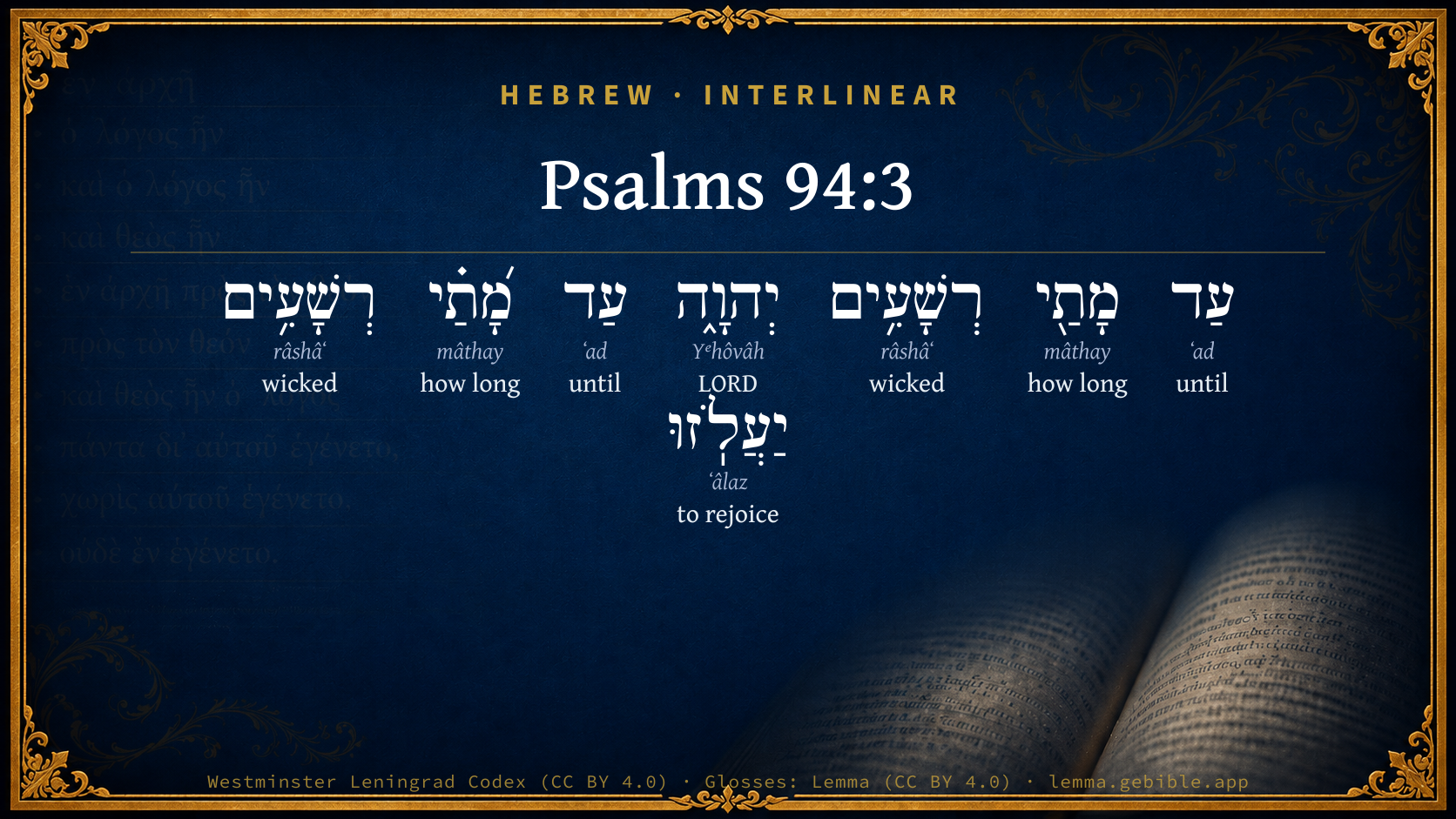
Hebrew (Westminster Leningrad Codex) Psalms 94:3 appears in the Hebrew Old Testament. The text above is from the Westminster Leningrad Codex. Each word links to its Strong’s number, a concise gloss, and parsing drawn from the Open Scriptures Hebrew Bible morphology. Click any word for its full Brown-Driver-Briggs (BDB) entry.
Download image
Cite this verse

Psalms 94:3 (World English Bible). Public Domain. Lemma interlinear Bible study tool, https://lemma.gebible.app/v/psalms/94/3.

Show BibTeX & RIS
BibTeX
RIS
English Translation
Yahweh, how long will the wicked, How long will the wicked triumph?
World English Bible · Public Domain
Download a study sheet

One document with this verse’s original text, its word-by-word gloss line, the meaning frame, cross-references with their text, attributed commentary, and full source and license credits — printable, and it pastes into notes with its structure intact.

This verse Autodidact and up

Study sheet (.html) Plain text (.txt)

A passage Seminary Student

Up to 50 verses in one chapter. A passage sheet keeps up to 6 commentary sources and 12 cross-references per verse, in the order this page ranks them, and says so on the sheet whenever that leaves anything out. Ask for a single verse and you get the Autodidact verse sheet above.

Everything on this page stays free to read, with no account — the sheet is a download of what is already on screen, not access to it.

Want to remove ads? Support Godless Engineer
Compare translations 3

The same verse in 3 English versions, stacked beneath the original-language interlinear above. Click any original word for its lexicon entry.

Each is an independent rendering of the whole verse — the interlinear is not word-aligned to these translations.

Highlighted words mark where these versions differ — a whole-verse word diff, not a word-by-word alignment.

  • World English Bible Public Domain
    Yahweh, how long will the wicked, How long will the wicked triumph?
  • King James Version Public Domain
    LORD, how long shall the wicked, how long shall the wicked triumph?
  • unfoldingWord Literal Text CC BY-SA 4.0
    Until when will the wicked, Yahweh, until when will the wicked rejoice?

unfoldingWord Literal Text — © unfoldingWord, licensed CC BY-SA 4.0. Word-aligned USFM3 via Door43 (git.door43.org/unfoldingWord/en_ult).

Versions to compare (up to 4)

3 of 4 selected

Show all 18 translations

Every available English version of this verse, each an independent rendering of the whole verse.

  • World English Bible Public Domain
    Yahweh, how long will the wicked, How long will the wicked triumph?
  • Berean Standard Bible Public Domain
    How long will the wicked, O LORD, how long will the wicked exult?
  • Majority Standard Bible Public Domain
    How long will the wicked, O LORD, how long will the wicked exult?
  • King James Version Public Domain
    LORD, how long shall the wicked, how long shall the wicked triumph?
  • American Standard Version (1901) Public Domain
    Jehovah, how long shall the wicked, How long shall the wicked triumph?
  • Revised Version (1885) Public Domain
    LORD, how long shall the wicked, how long shall the wicked triumph?
  • Geneva Bible (1599) Public Domain
    Lord how long shall the wicked, how long shall the wicked triumph?
  • Douay-Rheims (1899) Public Domain
    How long shall sinners, O Lord: how long shall sinners glory?
  • Young's Literal Translation Public Domain
    Till when `do' the wicked, O Jehovah? Till when do the wicked exult?
  • Literal Standard Version CC BY-SA 4.0
    Until when do the wicked, O YHWH—Until when do the wicked exult?
  • Unlocked Literal Bible CC BY-SA 4.0
    How long will the wicked, Yahweh, how long will the wicked rejoice?
  • unfoldingWord Literal Text CC BY-SA 4.0
    Until when will the wicked, Yahweh, until when will the wicked rejoice?
  • Darby Bible Public Domain
    How long shall the wicked, O Jehovah, how long shall the wicked triumph?
  • World Messianic Bible Public Domain
    LORD, how long will the wicked, how long will the wicked triumph?
  • Webster's Bible Public Domain
    LORD, how long shall the wicked, how long shall the wicked triumph?
  • Free Bible Version CC BY-SA 4.0
    How long, Lord? How long will the wicked celebrate in triumph?
  • Bible in Basic English Public Domain
    How long will sinners, O Lord, how long will sinners have joy over us?
  • JPS Tanakh (1917) Public Domain
    LORD, how long shall the wicked, how long shall the wicked exult?

Literal Standard Version (2020), Covenant Press — licensed CC BY-SA 4.0. Text via the HelloAO Bible API (eBible.org). Unlocked Literal Bible (unfoldingWord) — licensed CC BY-SA 4.0. Text via the HelloAO Bible API (eBible.org). unfoldingWord Literal Text — © unfoldingWord, licensed CC BY-SA 4.0. Word-aligned USFM3 via Door43 (git.door43.org/unfoldingWord/en_ult). Free Bible Version, Dr. Jonathan Gallagher — licensed CC BY-SA 4.0. Text via the HelloAO Bible API (eBible.org).

Word by word

More ways to search: Search by grammar → Find every occurrence → Compare this word →

Practice this passage: Drill this verse → Learn its vocabulary →

About this verse

These counts appear in no published source. They are computed here, from the morphology-tagged text and Lemma’s own curated glosses. What Lemma adds →

8
words
5
distinct lemmas
Wisdom
section

Notable vocabulary

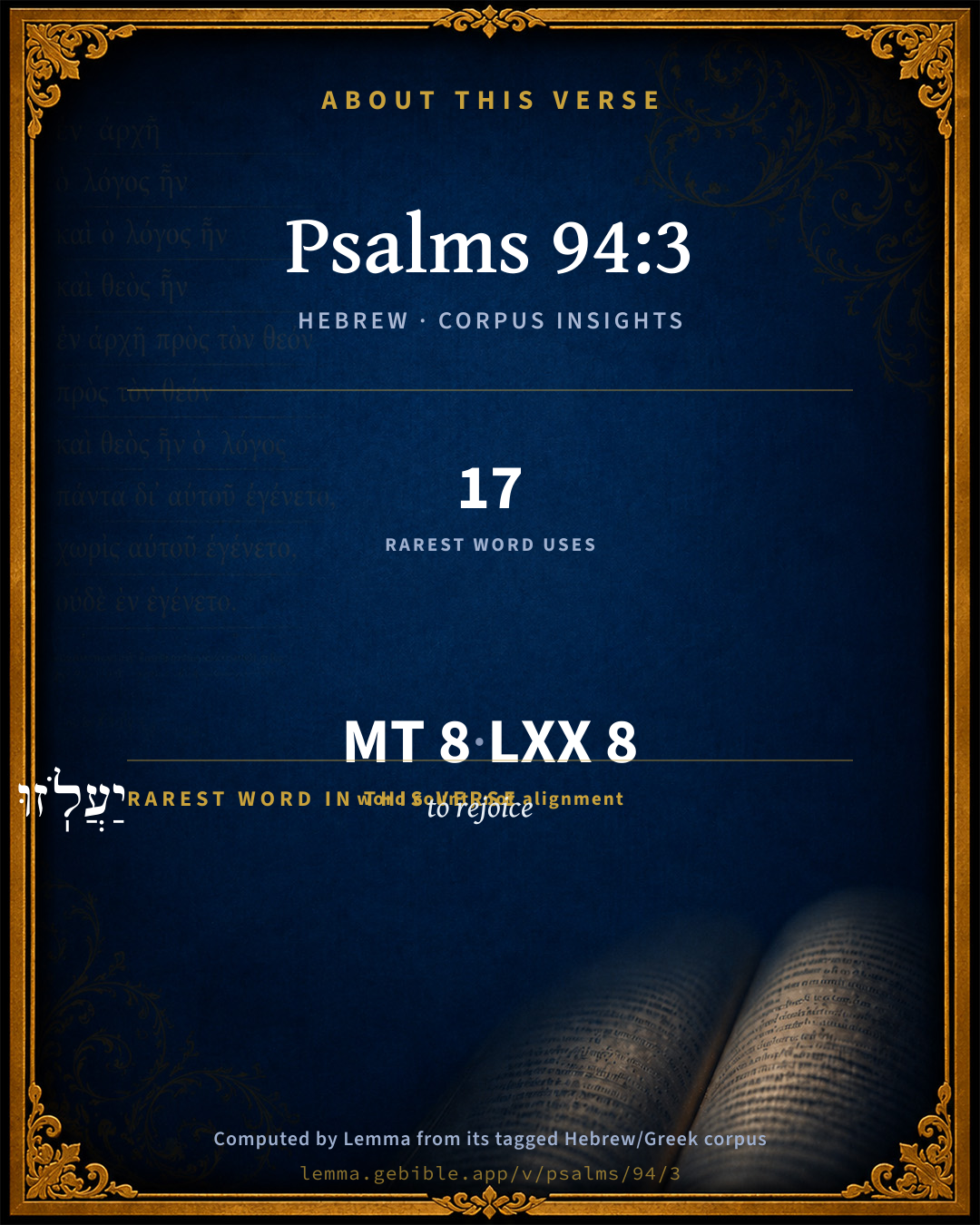
The rarest word here is יַעֲלֹֽזוּ to rejoice H5937 — appearing just 17 times in the whole Hebrew Bible.

Shared distinctive vocabulary

יַעֲלֹֽזוּ to rejoice H5937 occurs in 16 verses of the Hebrew Bible. Also found in:

Grammatical profile

  • 1 verb
  • 1 noun
  • 2 adjectives
  • 2 prepositions
  • 2 particles

Verb forms

  • יַעֲלֹֽזוּ Qal · Imperfect

Repetition

Words recur within this verse — often emphatic in Hebrew:

  • עַד until H5704 ×2
  • מָתַ֖י how long H4970 ×2
  • רְשָׁעִ֥ים wicked H7563 ×2

Hebrew & Septuagint length

In English translation the verse runs 12 words from the Hebrew and 11 from the Septuagint (LXX English) — closely comparable.

A rough comparison of the two English renderings, which tokenize alike — not a word-level alignment.

Word counts can differ between the Hebrew and the Greek without any difference in meaning — e.g. the Hebrew direct-object marker אֵת has no separate Greek word, and Greek often adds the article ὁ.

In the original languages it is 8 Hebrew tokens and 8 Greek tokens — but the two are counted differently (Hebrew bundles its prefixes and suffixes into one token; the Greek is in lemma form), so that isn’t a like-for-like length.

Cross-references

15

Topical passages linked to Psalms 94:3 in the Treasury of Scripture Knowledge — connected by theme and wording, ordered by reader-vote popularity; previews shown in the World English Bible.

  • Job 20:5 That the triumphing of the wicked is short, The joy of the godless but for a moment?
  • Jeremiah 12:1–2 Righteous are you, Yahweh, when I contend with you; yet would I reason the cause with you: why does the way of the wicked prosper? why are all they at ease who deal very treacherously?
  • Revelation 6:10 They cried with a loud voice, saying, "How long, Master, the holy and true, until you judge and avenge our blood on those who dwell on the earth?"
  • Psalms 43:2 For you are the God of my strength. Why have you rejected me? Why do I go mourning because of the oppression of the enemy?
  • Psalms 73:8 They scoff and speak with malice. In arrogance, they threaten oppression.
  • Psalms 74:9–10 We see no miraculous signs. There is no longer any prophet, Neither is there among us anyone who knows how long.
  • Esther 5:11–12 Haman recounted to them the glory of his riches, and the multitude of his children, and all the things in which the king had promoted him, and how he had advanced him above the princes and servants of the king.
  • Esther 6:6–10 So Haman came in. The king said to him, What shall be done to the man whom the king delights to honor? Now Haman said in his heart, To whom would the king delight to do honor more than to myself?
  • Esther 7:6 Esther said, An adversary and an enemy, even this wicked Haman. Then Haman was afraid before the king and the queen.
  • Esther 7:10 So they hanged Haman on the gallows that he had prepared for Mordecai. Then was the king's wrath pacified.
  • Psalms 79:5 How long, Yahweh? Will you be angry forever? Will your jealousy burn like fire?
  • Psalms 80:4 Yahweh God of hosts, How long will you be angry against the prayer of your people?
  • Psalms 89:46 How long, Yahweh? Will you hide yourself forever? Will your wrath burn like fire?
  • Jeremiah 47:6 You sword of Yahweh, how long will it be before you be quiet? put up yourself into your scabbard; rest, and be still.
  • Acts 12:22–23 The people shouted, "The voice of a god, and not of a man!"

Cross-references courtesy of OpenBible.info (CC BY 4.0).

Hebrew and Greek witnesses Masoretic Hebrew ↔ Greek Septuagint

The same verse in the two great witnesses to the Old Testament, shown verse-for-verse.

You’re reading Greek Psalm 93 (Hebrew Psalm 94). The Septuagint counts the superscription, so verse numbers can differ from the Hebrew — chapter-level alignment, not verse-by-verse. Numbering follows Rahlfs.

These are two independent witnesses, not word-aligned to each other, and the Septuagint is shown in lemma (dictionary) form.

Hebrew Psalms 94:3 Masoretic · Westminster Leningrad Codex

עַד מָתַ֖י רְשָׁעִ֥ים יְהוָ֑ה עַד מָ֝תַ֗י רְשָׁעִ֥ים יַעֲלֹֽזוּ

Yahweh, how long will the wicked, How long will the wicked triumph?

World English Bible · Public Domain

Greek LXX Greek Psalm 93:3 Septuagint · lemma form

ἕως πότε ἁμαρτωλός κύριος ἕως πότε ἁμαρτωλός καυχάομαι

How long shall sinners, O Lord, how long shall sinners boast?

LXX2012 (modern English Septuagint) · Public Domain

Hebrew: Westminster Leningrad Codex (CC BY 4.0). Greek: Septuagint (public domain); English from LXX2012 (modern English Septuagint) (Public Domain). How the Septuagint differs from the Hebrew →

Commentary

Notes on Psalms 94:3 from classic Christian and Jewish commentators (each source and its license shown beneath its notes). The classic Christian expositions comment on the surrounding passage and are grouped to its opening verse, so a note may address several verses; the Jewish commentaries on the Tanakh (Rashi and others) are per-verse, so they appear only where the commentator wrote on this verse.

Lemma curates 59 commentaries, every one of them public domain or Creative Commons licensed, each selected and text-cleaned for this edition rather than reprinted as found. About our sources →

Trapp's Complete Commentary

John Trapp

Psa 94:3 LORD, how long shall the wicked, how long shall the wicked triumph?

Ver. 3. Lord, how long shall the wicked, how long?] Bis, quia de die in diem gloriantur, saith Aben Ezra. Twice he saith it, because the wicked boast day after day, with such insolence and outrage, as if they were above control.

John Trapp, A Commentary or Exposition upon All the Books of the Old and New Testament (1647–1656) — public domain. Text from a community e-Sword module.

J. A. Alexander on Psalms

Joseph Addison Alexander

3. (Psa 94:3) How long shall wicked (men), Jehovah, how long shall wicked (men) triumph? The question, as usual in such cases, implies that they have already triumphed long enough or too long, and therefore really involves a prayer that they may triumph no longer. The interruption and resumption of the sentence is like that in Psa 94:1, and in Psa 92:8), Psa 93:1; Psa 93:3.

Joseph Addison Alexander, The Psalms Translated and Explained (1850) — public domain. Text from a community e-Sword module.

Geneva Bible (1599)

Geneva Bible translators

That is, brag of their cruelty and oppression: or esteem themselves above all others.

Geneva Bible (1599) marginal notes — public domain. Text via Bolls.life.

Adam Clarke's Commentary

Verse 3. How long shall the wicked triumph?] The wicked are often in prosperity; and this only shows us of how little worth riches are in the sight of God, when he bestows them on the most contemptible of mortals. But their time and prosperity have their bounds.

Adam Clarke's Commentary on the Bible (1810–1826) — public domain. Text from a community e-Sword/MySword module.

John Calvin's Commentaries

3 O Jehovah! how long shall the wicked? The Psalmist justifies himself in this verse for the fervent importunity which he showed in prayer. There was need of immediate help, when the wicked had proceeded to such an extent of audacity. The necessity of our case may justly embolden us in our requests, which must be all the more readily heard as they are reasonable; and here the Psalmist insists that his complaints were not without cause, nor originated in trifling reasons, but were extorted by injuries of the most flagrant description. Notice is taken of the length of time during which their persecutions had lasted, as an aggravating circumstance. They had become hardened under the long-continued forbearance of God, and had in consequence contracted a shamelessness, as well as obstinacy of spirit, imagining that he looked upon their wickedness with an eye of favor. The term how long twice repeated, implies the extent of impunity which had been granted, that it was not as if they had newly started upon their career, but that they had been tolerated for a length of time, and had become outrageously flagitious. It was thus that in former times wicked men tyrannized to such a degree over the Church, while yet God did not interfere to apply a remedy; and we need not be surprised that he should subject her now to protracted persecutions, nor should we conclude that, because he does not immediately proceed to cure existing evils, he has utterly forsaken her. The term triumph denotes that fullness of audacious and boasting exultation which the wicked feel when they are intoxicated with continued prosperity, and conceive that they may indulge in every excess without restraint.

John Calvin's Commentaries (1540-1563) — public domain. Text from the Calvin Translation Society English edition (1840s-50s) via the Christian Classics Ethereal Library (ccel.org). Calvin's coverage is partial (roughly two-thirds of the Bible); uncommented books and verses are honest gaps, never fabricated. The 19th-century editor's footnotes and remarks are omitted so the notes are faithfully Calvin's own voice.

The Cambridge Bible for Schools and Colleges

gen. ed. J. J. S. Perowne

3–7. How long will Jehovah tolerate the tyrannies of these proud blasphemers?

The Cambridge Bible for Schools and Colleges (gen. ed. J. J. S. Perowne; Cambridge University Press, 1878–1918) — public domain. Text from a community e-Sword module.

John Gill's Exposition

Lord, how long shall the wicked,.... The reign of antichrist is thought long by the saints, being the space of forty two months, or 1260 days or years and this tries the faith and patience of the church of Christ, Rev 13:5.

how long shall the wicked triumph? in their prosperity, and in the ruins of the interest of Christ; the Targum is,

"how long shall they sit in tranquillity, or prosperity?''

the triumphing of the wicked may seem long, but it is but short, Job 20:5, the inhabitants of the Romish jurisdiction will triumph when the witnesses are slain, and send gifts to one another, as a token of their joy; but this will not last long, no more than three days, or three years and a half; and while antichrist is saying, I sit a queen, and shall know no sorrow, her plagues shall come upon her in one day, Rev 11:10.

John Gill's Exposition of the Whole Bible (1746–1763) — public domain (CC PDM 1.0). Text via the HelloAO Bible API.

Albert Barnes' Notes on the Bible

Lord, how long shall the wicked ... - As if there were to be no end to their exaltation; their joy; their success. How long would God allow this? How long would he sit by and see it done? Was he disposed to let them go on forever? Would he never interpose, and arrest them in their career? How often do we wonder that God does not interpose! How often does it seem inexplicable that a Being of almighty power and infinite goodness does not interfere with respect to the wickedness, the oppression, the slavery, the wrong, the cruelty, the fraud, the violence of the world - and put an end to it! Nay, how entirely are we overwhelmed at the thought that he does not put an end to iniquity in the universe altogether; that he never “will” thus interpose, and put an end to sin and sorrow! Such things are too high for us now; perhaps will be always so. Things on earth are not as we should suppose they would be; and we can only pause and adore where we cannot comprehend!

Albert Barnes' Notes on the Bible (1834–1885) — public domain. Text from a community e-Sword/MySword module.

The Treasury of David

Charles H. Spurgeon

Ver. 3. LORD, how long shall the wicked, how long shall the wicked triumph? Shall wrong for ever rule? Are slavery, robbery, tyranny, never to cease? Since there is certainly a just God in heaven, armed with almighty power, surely there must be sooner or later an end to the ascendancy of evil, innocence must one day find a defender. This "how long?" of the text is the bitter complaint of all the righteous in all ages, and expresses wonder caused by that great enigma of providence, the existence and predominance of evil. The sound "how long?" is very akin to howling, as if it were one of the saddest of all the utterances in which misery bemoans itself. Many a time has this bitter complaint been heard in the dungeons of the Inquisition, at the whipping posts of slavery, and in the prisons of oppression. In due time God will publish his reply, but the full end is not yet.

Ver. 3. How long shall the wicked, how long, etc. Twice he saith it, because the wicked boast day after day, with such insolence and outrage, as if they were above control. John Trapp.

Ver. 3. How long shall the wicked triumph? For "triumph, "the Hebrew word is wzley which signifies to exalt. That is, they give themselves vain applause on account of their prosperity, and declare their success both with words and with the gestures of their body, like peacocks spreading their feathers. How long shall they utter? etc. For "utter" the Hebrew is weyby, they shall flow, they shall cast forth. The metaphor is taken from fountains springing out of the rock with a rush and abundance of water. Where the abundance of words is noted, their rashness, their waste and profusion, their sound and eagerness, their continuance and the difficulty of obstructing them. Le Blanc.

Ver. 3. How long shall the wicked triumph? What answer shall we give, what date shall we put to this, "How long?" The answer is given in Ps 94:23, "He shall bring upon them their own iniquity, and shall cut them off in their own wickedness, "etc. As if he had said, Except the Lord cut them off in their wickedness, they will never leave off doing wickedly. They are men of such a kind that there is no curing of them, they will never have done doing mischief until they be cut off by death, therefore God threatens death to deter men from sin. A godly man saith, "If God kill me, yet will I trust in him; "and some wicked men say (in effect, if not in the letter), Till God kills us we will sin against him. Joseph Caryl.

Ver. 3-4. Triumph, utter and speak, boast. In the very terms wherein the Psalmist complains of the continued prevalence of the wicked, there is matter of comfort, for we have three (rather four, as in the authorised version) words to denote speaking, and only one, workers, to denote action, showing us that they are far more powerful with their tongues than with their hands. Hugo Cardinalis, quoted by Neale.

Ver. 3.

I. The sweet potion of the wickedpresent triumph.

2. The gall which embitters itit is but temporary, and is prayed against. C. A. Davis.

Psalms 94:4*

Charles H. Spurgeon's The Treasury of David (1869–1885) — public domain. Psalms only. Text from a community e-Sword/MySword module.

Whedon's Commentary on the Bible

Daniel D. Whedon

3. How long—Twice uttered for emphasis, implying that the delays of justice are mysterious.

Daniel D. Whedon (gen. ed.), Commentary on the Old and New Testaments (1874–1909) — public domain. Text from a community e-Sword module.

The Pulpit Commentary

Lord, how long shall the wicked, how long shall the wicked triumph? "How long?" is the continual cry of the psalmists to God, as it is of the souls under the altar. (Rev_6:10; comp. above, Psa_6:3 Psa_13:1, 2 35:7 74:10 79:5 89:46 90:13) It is a cry of weakness and impatience, but has an element of faith in it, on which God looks with favour.

The saint"s perplexity at the triumph of sin.

"Lord, how long?" etc. This question, which the inspired psalmist, in the anguish of his spirit, could not help putting, is not one of those which are solved by the lapse of time. Rather it grows more urgent. Thousands of years have rolled by since these words were written, and still the awful mystery confronts us which St. Paul so forcibly describessin reigning unto death. It is true that in each particular case "the triumphing of the wicked is short at least, compared with eternity. True, also, that nothing can shake the truth of the promise, which runs through the whole Bible, that, come what may, "it shall be well with the righteous eternally well and that all things shall work together for good to them that love God." Nevertheless, when we think, if we could wield absolute power with unerring knowledge, how eagerly we should make short work with injustice, cruelty, tyranny, lawless crime, we cannot but marvel at the spectacle, prolonged age after age, of our heavenly Father "making his sun to rise on the evil and on the good, and sending rain on the just and on the unjust." The psalmist assumes the fact as unquestionable, and reverently, yet urgently, appeals to God, as the Judge of the earth How long is it to be suffered to continue?

I First, HERE IS THE UNDENIABLE FACT, WHICH WOULD ASTONISH US INFINITELY MORE THAN IT DOES, IF WE WERE NOT SO FAMILIAR WITH IT. "The wicked triumph.

1. They do so every day, often for long years, in two ways when they are strong enough, by defying justice; and when they are crafty enough, by evading justice. It is the former of these which especially awakens the indignation and distress of the psalmist. He sees might, which ought to be the servant of right, become the ally of wrong; and justice poisoned at its fountain. It is the spectacle which meets us on every page of history. Joseph a slave and an exile in the dungeon, while his brothers are peacefully feeding their flocks in Canaan, and his wicked, false accuser is dwelling in a palace. Pharaoh blaspheming on the throne, and God"s people bleeding and weeping under the lash. Saul in his court, and David hiding in dens and caves. Nebuchadnezzar at the height of earthly glory, and God"s faithful servants in the fiery furnace. Herod worshipped as a god, and James slain with the sword. Nero on the judgment seat, and Paul a prisoner at his bar. Popes receiving Divine honours, and martyrs for Christ burning at the stake. Ages roll on, and still, in one form or another, this hideous anomaly bears witness that we live in a world whose whole moral frame is disordered. True, as those ages roll, they show us another side to the picture. Joseph in power, and his brethren trembling before him. Pharaoh"s host buried in the waters or bleaching on the shore, and Israel free. Saul stark on Gilboa, and David crowned and victorious. Nebuchadnezzar a maniac, herding with beasts. Herod eaten of worms. Nero a wretched suicide, hooted out of life with curses. But still, successors arise. History repeats itself. The One Arm which could strike down oppression, not only here and there, now and then, but everywhere and forever, seems to delay the blow. (Ecc_8:11) Still the cry goes up, which St. John heard from the souls beneath the altar, "How long, O Lord?" In our own land, thanks be to God, we must look back two hundred years if we would see tyranny and injustice openly triumphing on the throne and on the judgment seat, and God"s servants exiled, starved, imprisoned merely for preaching the gospel. Englishmen have almost forgotten that such things ever were in England. But we see crime continually evading justice, and even successfully concealing itself behind a mask of respectability. One terrible vice drunkenness has this mitigating circumstance, that it cannot long be concealed, and the mischief and misery it works cannot be denied. But if dishonesty, extortion, gambling, false speaking, secret immorality, could in like manner be brought to view, it would be found (alas!) that the crimes human law can reach are but a fraction of crimes actually committed against the Law of God.

2. There is a wider and deeper view we cannot help taking. The power of sin is the power of Satan. He is expressly declared to be "the prince of this world," "the god of this world," who blinds the minds of "them that believe not." Apart from this, neither the extreme wickedness of men nor the slow progress of Christ"s kingdom and gospel can be accounted for.

II IS THERE NO ANSWER TO THIS CRY WHICH HAS GONE UP FOR SO MANY AGES FROM GOD"S PEOPLE TO HIS THRONE? The tempest of his vengeance does not awaken. The lightning does not strike the tyrant, the slave dealer, the seducer, the assassin. The earthquake does not yawn under guilty cities. Satan is not yet chained. But yet, to the ear of faith there comes from God"s Word an answer; not, indeed, such as to end the trial of faith, by clearing away the whole mystery of God"s dealings; but enough to sustain faith, nourish patience and courage, kindle hope and stimulate labour. How long?

1. Long enough to answer those Divine purposes for which sin was at first permitted to enter, and the wicked wicked men or wicked spirits ever to exist at all. We cannot avoid seeing that it was possible for God to have prevented sin from ever existing; if in no other way (of which we cannot judge), at all events by refraining from creating beings, angels or men, capable of sin. The lower creatures are incapable of sin, and, therefore, incapable also of obedience to moral law and of likeness to God. God has seen fit to create beings capable of loving him, knowing him, obeying him; therefore capable of sinning against him. Knowing infinitely better than we the mischief and misery of sin, he has seen it worth while to allow room for sin to display its character and consequences. And we may well believe the lessons thus taught wilt never be forgotten or need repeating in eternity.

2. Long enough to reveal the infinite preciousness of the Divine atonement for sin the blood of Jesus Christ which cleanseth from all sin; and the glorious power of Divine love, truth, and grace; the power, that is, of God"s Spirit to restore even souls dead in sin to God"s likeness.

3. Long enough to perfect that trial of faith and discipline of character, by means of which God is training, in a world of temptation, sorrow, sin, and death, those whom he redeems "from this present evil world," for a life of perfect holiness and endless joy.

4. Long enough to show beyond all question God"s patience and longsuffering, "not willing that any should perish;" and to justify his righteousness when at last he will "render to every man according to his deeds". (Rom 2:2-11Jo Rom 5:22 2Pe_3:9, 2Pe_3:10)

HOMILIES BY S. CONWAY Ver. 3. "How long shall the wicked triumph?

I SUPPOSE THEY NEVER DID.

1. Then the devil would be right when he asked, "Doth Job serve God for nought?" He meant to say that men serve God only from selfish, interested motives.

2. Men would want to sin, though from fear they held back. The heart would remain unchanged, character would be the same.

3. The essential discipline and test of the righteous would be destroyed. We are tested when, though we see the wicked triumph, we still cleave to God.

4. The wicked would wax worse and worse. "The strength of sin is the Law.

5. It would be a confession that men cannot be governed by higher motives than earthly gain.

II SUPPOSE THEY ALWAYS DID.

1. Earth would become hell, because of the wickedness of them that dwell therein.

2. The faith and fear of God would disappear.

III SUPPOSE THEY SOMETIMES DO. This is the case. And sometimes they appear generally to triumph. Nevertheless, it is not always, nor for long. But the present order avails:

1. To glorify God by the fidelity of his people.

2. To lift them to a higher life.

3. To convince the world of the reality of the faith the believer holds. S.C.

The tether of the ungodly.

"How long shall the wicked triumph?" Men ask this question only when they cannot see the rope, or the chain, which keeps the movements of the ungodly within strict limitations. In Jersey and Guernsey the cattle are not left free in the fields, but are tethered so that they can only feed within a defined circle; and the visitor is interested in the different lengths of tether allowed to each animal. Bunyan represents his pilgrim as alarmed at the lions at the entrance to the palace Beautiful, and reassured when told that they were chained, and the chains did not permit of their reaching the middle of the pathway: he would be quite safe if he kept to the middle. The waves lift up themselves, and sometimes seem as if they would overwhelm; but God holds the waters in the hollow of his hand, puts his limitations even on their storm time swellings. The martyr souls are represented in Rev_6:10 as crying from under the altar of God, "How long, O Lord, holy and true, dost thou not judge and avenge our blood on them that dwell on the earth?

I THE TETHER OF THE UNGODLY IS FIXED FOR THE HONOUR OF GOD. He will not permit his Name to be dishonoured or his work to be hindered. Nebuchadnezzar finds he has reached the limit of his tether when he begins to boast himself against God. Herod reaches his limit when, unreproved, he allows the people to shout concerning him, "It is the voice of a god, and not of a man." Because God is and must be supreme, every man is under limitations. Against that men fret, but they can only hopelessly fret.

II THE TETHER OF THE UNGODLY IS FIXED FOR THE SAFETY OF GOD"S PEOPLE. "What can harm you if ye be followers of that which is good?" The figure is presented of Satan, the deceiver and persecutor of the saints, as bound for a thousand years. He is always bound. See the figure of Satan, in the Book of Job, obliged to get Divine permission ere he can touch Job, or a thing that Job has. Even the malice of persecuting ages, and the shameless wickedness of the Inquisition, were in Divine limitations.

III THE TETHER OF THE UNGODLY IS FIXED IN THE INTERESTS OF THE UNGODLY THEMSELVES. Illustrate from the antediluvians. Their life tether was about a thousand years, so they became gigantic in wickedness. What would proud, vicious men become now, if they could get free from Divine restraints? Mercy puts limits on the wicked. R.T.

The Pulpit Commentary (1880–1919), ed. H.D.M. Spence-Jones & Joseph S. Exell — public domain. Text from a community e-Sword module.

unfoldingWord translationNotes

Door43 World Missions Community

How long will the wicked, Yahweh, how long will the wicked rejoice?

The psalmist repeats the question to show that he is unhappy with how long Yahweh has allowed the wicked to rejoice. This rhetorical question can be translated as a statement. AT: "You have waited too long Yahweh; you have waited too long to stop the wicked from rejoicing." (See: Rhetorical Question)

will the wicked rejoice

Why the wicked rejoice can be stated clearly. AT: "will the wicked rejoice because you never punish them for the evil deeds they do" (See: Assumed Knowledge and Implicit Information)

They pour out

"All those who do evil pour out"

They pour out their arrogant words

The psalmist writes of the wicked speaking as if their words were a liquid being poured out. (See: Metaphor)

all those who do evil boast

The translation can make explicit that these people boast about their evil actions. AT: "all those who do evil boast about their evil deeds" (See: Assumed Knowledge and Implicit Information)

translationWords

evil

arrogant

boast

unfoldingWord translationNotes — © Distant Shores Media and the Door43 World Missions Community, licensed CC BY-SA 4.0. Source: git.door43.org/Door43/en_tn.

Lesson kit

Teaching starters — assembled from the data on this page, not authored interpretation. Every prompt links to the verse data it draws on. Edit before teaching.

Psalms, in the Wisdom, opens this verse with 8 words (5 distinct Hebrew lemmas). Its most distinctive word is ʻâlaz (“to rejoice”). A historical commentator’s framing appears above. Read the whole chapter for the surrounding context.

Discussion questions

  1. How does “to rejoice” (ʻâlaz) shape what this verse is saying?
  2. 2 Samuel 1:20 shares the word «to rejoice» with this verse. How do the two illuminate each other?
  3. “until” occurs 2× in this one verse. What is the effect of the repetition?
  4. The translations on this page render this verse differently — a whole-verse word diff, not a word-by-word alignment. What might account for the different wordings?
  5. The verb «יַעֲלֹֽזוּ» is Qal Imperfect. How does its form color the action?
  6. Reading how Trapp's Complete Commentary and J. A. Alexander on Psalms read this verse, where do the two commentators agree and where do they part?

Things to notice

Reading settings

Reading text

Shown beneath each verse's original-language words.

Old Testament
Old Testament edition

Read the OT as the Masoretic Hebrew (MT) or the Greek Septuagint (LXX).

English shown for the Greek Septuagint (in the Hebrew ↔ Greek comparison).

Comparing translations? Open the Compare panel on any verse page to stack up to four side by side.