
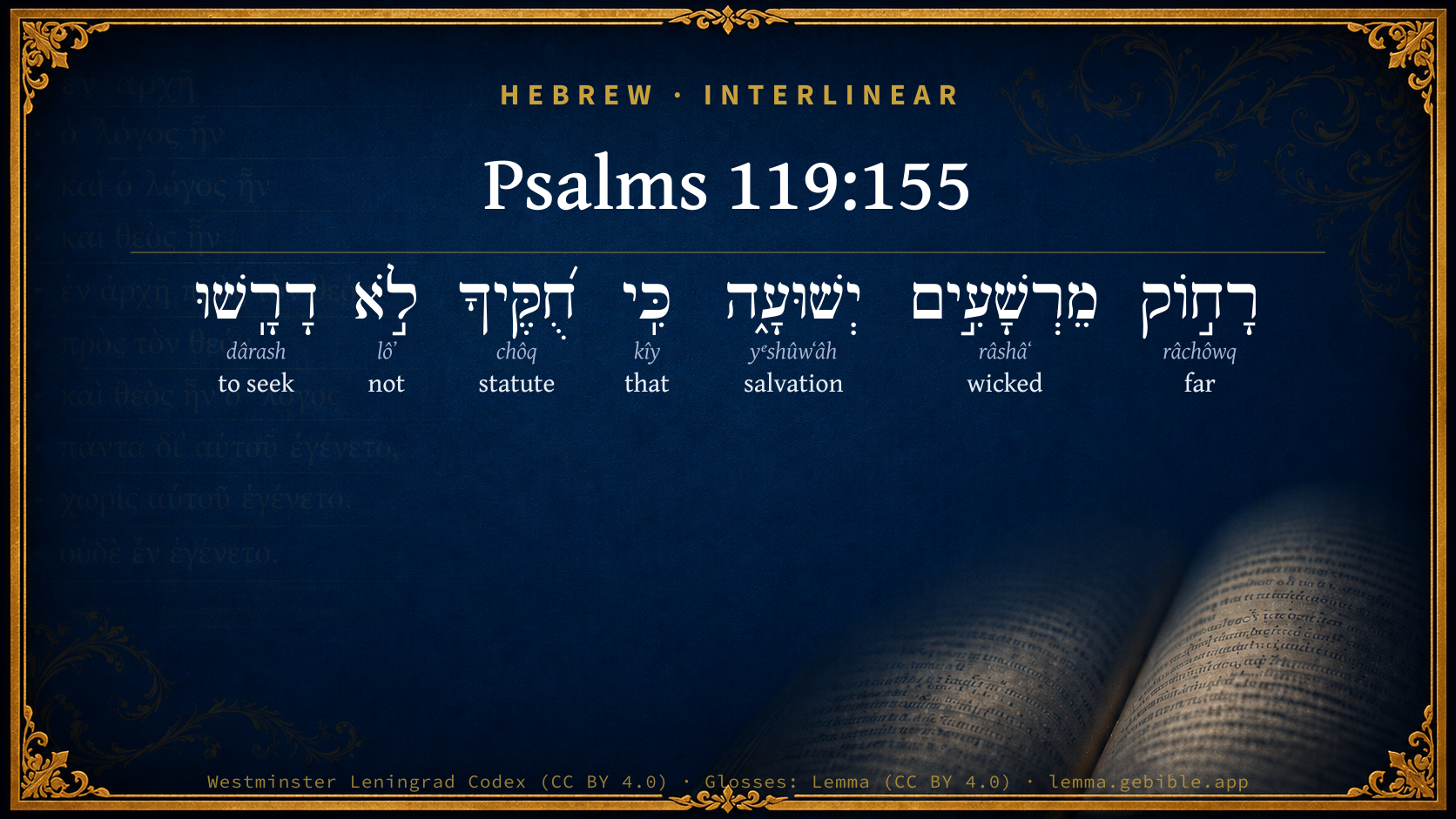
Psalms 119:155

Hebrew (Westminster Leningrad Codex) Psalms 119:155 appears in the Hebrew Old Testament. The text above is from the Westminster Leningrad Codex. Each word links to its Strong’s number, a concise gloss, and parsing drawn from the Open Scriptures Hebrew Bible morphology. Click any word for its full Brown-Driver-Briggs (BDB) entry.
Download image
Cite this verse

Psalms 119:155 (World English Bible). Public Domain. Lemma interlinear Bible study tool, https://lemma.gebible.app/v/psalms/119/155.

Show BibTeX & RIS
BibTeX
RIS
English Translation
Salvation is far from the wicked, For they don't seek your statutes.
World English Bible · Public Domain
Download a study sheet

One document with this verse’s original text, its word-by-word gloss line, the meaning frame, cross-references with their text, attributed commentary, and full source and license credits — printable, and it pastes into notes with its structure intact.

This verse Autodidact and up

Study sheet (.html) Plain text (.txt)

A passage Seminary Student

Up to 50 verses in one chapter. A passage sheet keeps up to 6 commentary sources and 12 cross-references per verse, in the order this page ranks them, and says so on the sheet whenever that leaves anything out. Ask for a single verse and you get the Autodidact verse sheet above.

Everything on this page stays free to read, with no account — the sheet is a download of what is already on screen, not access to it.

Want to remove ads? Support Godless Engineer
Compare translations 3

The same verse in 3 English versions, stacked beneath the original-language interlinear above. Click any original word for its lexicon entry.

Each is an independent rendering of the whole verse — the interlinear is not word-aligned to these translations.

Highlighted words mark where these versions differ — a whole-verse word diff, not a word-by-word alignment.

  • World English Bible Public Domain
    Salvation is far from the wicked, For they don't seek your statutes.
  • King James Version Public Domain
    Salvation is far from the wicked: for they seek not thy statutes.
  • unfoldingWord Literal Text CC BY-SA 4.0
    Salvation far from the wicked, for they have not sought your statutes.

unfoldingWord Literal Text — © unfoldingWord, licensed CC BY-SA 4.0. Word-aligned USFM3 via Door43 (git.door43.org/unfoldingWord/en_ult).

Versions to compare (up to 4)

3 of 4 selected

Show all 17 translations

Every available English version of this verse, each an independent rendering of the whole verse.

  • World English Bible Public Domain
    Salvation is far from the wicked, For they don't seek your statutes.
  • Berean Standard Bible Public Domain
    Salvation is far from the wicked because they do not seek Your statutes.
  • Majority Standard Bible Public Domain
    Salvation is far from the wicked because they do not seek Your statutes.
  • King James Version Public Domain
    Salvation is far from the wicked: for they seek not thy statutes.
  • American Standard Version (1901) Public Domain
    Salvation is far from the wicked; For they seek not thy statutes.
  • Revised Version (1885) Public Domain
    Salvation is far from the wicked; for they seek not thy statutes.
  • Geneva Bible (1599) Public Domain
    Saluation is farre from the wicked, because they seeke not thy statutes.
  • Young's Literal Translation Public Domain
    Far from the wicked `is' salvation, For Thy statutes they have not sought.
  • Literal Standard Version CC BY-SA 4.0
    Salvation [is] far from the wicked, || For they have not sought Your statutes.
  • Unlocked Literal Bible CC BY-SA 4.0
    Salvation is far from the wicked, for they do not love your statutes.
  • unfoldingWord Literal Text CC BY-SA 4.0
    Salvation far from the wicked, for they have not sought your statutes.
  • Darby Bible Public Domain
    Salvation is far from the wicked; for they seek not thy statutes.
  • World Messianic Bible Public Domain
    Salvation is far from the wicked, for they don’t seek your statutes.
  • Webster's Bible Public Domain
    Salvation is far from the wicked: for they seek not thy statutes.
  • Free Bible Version CC BY-SA 4.0
    Wicked people can't be saved, because they don't care about what you say.
  • Bible in Basic English Public Domain
    Salvation is far from evil-doers; for they have made no search for your rules.
  • JPS Tanakh (1917) Public Domain
    Salvation is far from the wicked; for they seek not Thy statutes.

Literal Standard Version (2020), Covenant Press — licensed CC BY-SA 4.0. Text via the HelloAO Bible API (eBible.org). Unlocked Literal Bible (unfoldingWord) — licensed CC BY-SA 4.0. Text via the HelloAO Bible API (eBible.org). unfoldingWord Literal Text — © unfoldingWord, licensed CC BY-SA 4.0. Word-aligned USFM3 via Door43 (git.door43.org/unfoldingWord/en_ult). Free Bible Version, Dr. Jonathan Gallagher — licensed CC BY-SA 4.0. Text via the HelloAO Bible API (eBible.org).

Word by word

More ways to search: Search by grammar → Find every occurrence → Compare this word →

Practice this passage: Drill this verse → Learn its vocabulary →

About this verse

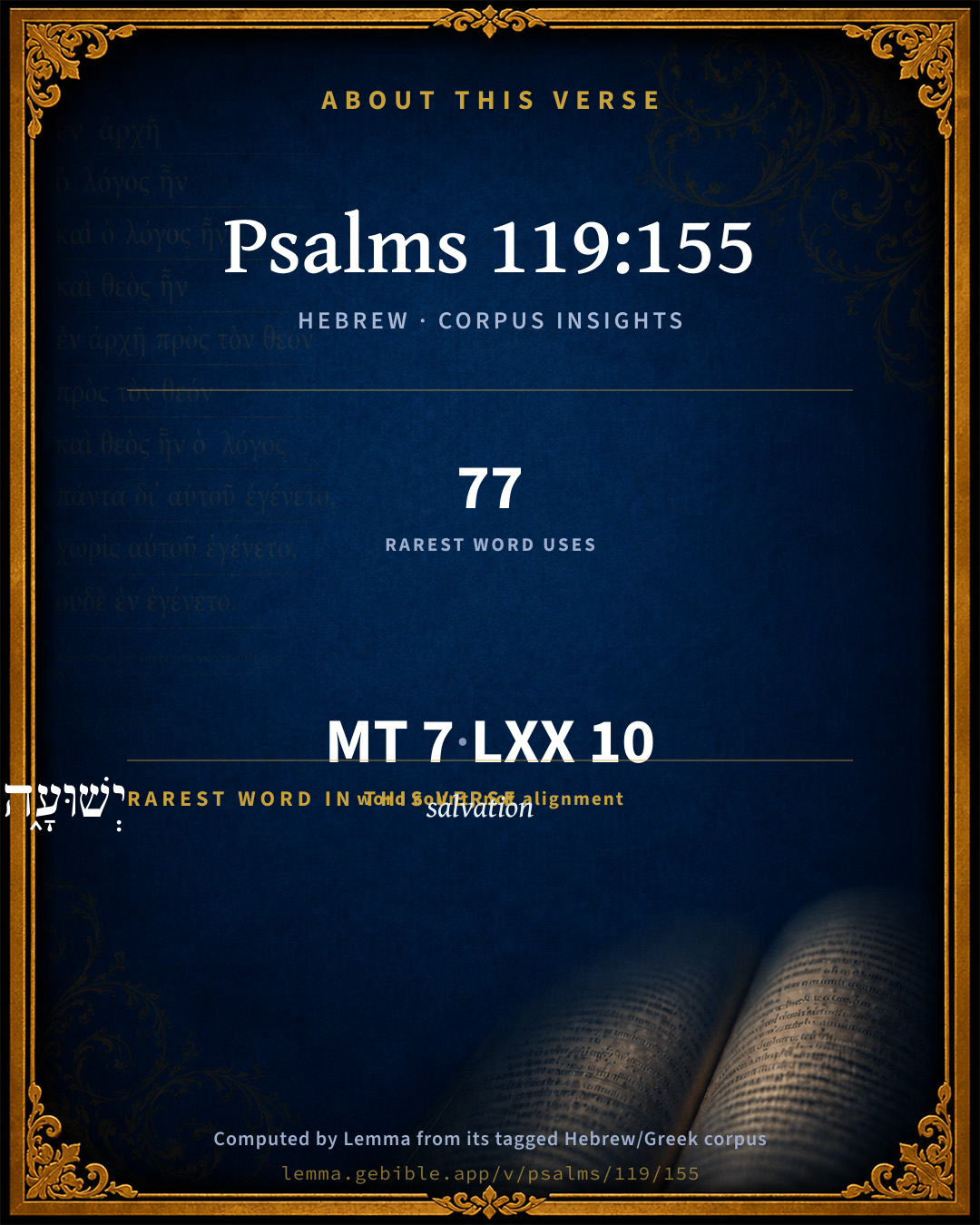
These counts appear in no published source. They are computed here, from the morphology-tagged text and Lemma’s own curated glosses. What Lemma adds →

7
words
7
distinct lemmas
Wisdom
section

Grammatical profile

  • 1 verb
  • 2 nouns
  • 2 adjectives
  • 1 conjunction
  • 1 particle

Verb forms

  • דָרָֽשׁוּ Qal · Perfect

Hebrew & Septuagint length

In English translation the verse runs 12 words from the Hebrew and 13 from the Septuagint (LXX English) — closely comparable.

A rough comparison of the two English renderings, which tokenize alike — not a word-level alignment.

Word counts can differ between the Hebrew and the Greek without any difference in meaning — e.g. the Hebrew direct-object marker אֵת has no separate Greek word, and Greek often adds the article ὁ.

In the original languages it is 7 Hebrew tokens and 10 Greek tokens — but the two are counted differently (Hebrew bundles its prefixes and suffixes into one token; the Greek is in lemma form), so that isn’t a like-for-like length.

Cross-references

10

Topical passages linked to Psalms 119:155 in the Treasury of Scripture Knowledge — connected by theme and wording, ordered by reader-vote popularity; previews shown in the World English Bible.

  • Job 5:4 His children are far from safety, They are crushed in the gate. Neither is there any to deliver them,
  • Ephesians 2:17–18 He came and preached peace to you who were far off and to those who were near.
  • Romans 3:11 There is no one who understands. There is no one who seeks after God.
  • Psalms 10:4 The wicked, in the pride of his face, Has no room in his thoughts for God.
  • Psalms 18:27 For you will save the afflicted people, But the haughty eyes you will bring down.
  • Proverbs 1:7 The fear of Yahweh is the beginning of knowledge; But the foolish despise wisdom and instruction.
  • Isaiah 46:12 Listen to me, you stout-hearted, who are far from righteousness:
  • Isaiah 57:19 I create the fruit of the lips: Peace, peace, to him who is far off and to him who is near, says Yahweh; and I will heal him.
  • Luke 16:24 He cried and said, 'Father Abraham, have mercy on me, and send Lazarus, that he may dip the tip of his finger in water, and cool my tongue! For I am in anguish in this flame.'
  • Job 21:14–15 They tell God, 'Depart from us, For we don't want to know about your ways.

Cross-references courtesy of OpenBible.info (CC BY 4.0).

Hebrew and Greek witnesses Masoretic Hebrew ↔ Greek Septuagint

The same verse in the two great witnesses to the Old Testament, shown verse-for-verse.

You’re reading Greek Psalm 118 (Hebrew Psalm 119). The Septuagint counts the superscription, so verse numbers can differ from the Hebrew — chapter-level alignment, not verse-by-verse. Numbering follows Rahlfs.

These are two independent witnesses, not word-aligned to each other, and the Septuagint is shown in lemma (dictionary) form.

Hebrew Psalms 119:155 Masoretic · Westminster Leningrad Codex

רָח֣וֹק מֵרְשָׁעִ֣ים יְשׁוּעָ֑ה כִּֽי חֻ֝קֶּיךָ לֹ֣א דָרָֽשׁוּ

Salvation is far from the wicked, For they don't seek your statutes.

World English Bible · Public Domain

Greek LXX Greek Psalm 118:155 Septuagint · lemma form

μακράν ἀπό ἁμαρτωλός σωτηρία ὅτι ὁ δικαίωμα σύ οὐ ἐκζητέω

Salvation is far from sinners: for they have not searched out your ordinances.

LXX2012 (modern English Septuagint) · Public Domain

Hebrew: Westminster Leningrad Codex (CC BY 4.0). Greek: Septuagint (public domain); English from LXX2012 (modern English Septuagint) (Public Domain). How the Septuagint differs from the Hebrew →

Commentary

Notes on Psalms 119:155 from classic Christian and Jewish commentators (each source and its license shown beneath its notes). The classic Christian expositions comment on the surrounding passage and are grouped to its opening verse, so a note may address several verses; the Jewish commentaries on the Tanakh (Rashi and others) are per-verse, so they appear only where the commentator wrote on this verse.

Lemma curates 59 commentaries, every one of them public domain or Creative Commons licensed, each selected and text-cleaned for this edition rather than reprinted as found. About our sources →

Trapp's Complete Commentary

John Trapp

Psa 119:155 Salvation [is] far from the wicked: for they seek not thy statutes.

Ver. 155. Salvation is far from the wicked] How can it be otherwise? when as God is neither in their heads, Psa 10:4, nor hearts, Psa 14:1, nor words, Psa 12:4, nor ways, Tit 1:16, can these have part or portion in his salvation?

For they seek not] This contempt of God’s word is a plain proof that no part or piece of God’s favour belongeth to them.

John Trapp, A Commentary or Exposition upon All the Books of the Old and New Testament (1647–1656) — public domain. Text from a community e-Sword module.

Joseph Benson's Commentary

RESH.

Psa 119:155. Salvation — Which is nigh to the faithful, because they diligently and earnestly seek to know and do the will of God, revealed to them in his word; is far from the wicked — They cannot, upon any good grounds, promise themselves even temporal deliverance, when they are in any adversity or trouble, but certainly eternal salvation is far from them. They may, indeed, flatter themselves that it is near, or that they are in the way to it; but they are dreadfully mistaken. It is at a great distance, for they thrust it from them, by thrusting the Saviour from them, and his statutes, to know, and much more, to practise which, they give themselves no concern; and the longer they persist in sin, at the greater distance it is. But, while salvation is far from them, damnation is near; it slumbers not: for, behold, the Judge standeth before the door.

Joseph Benson's Commentary on the Old and New Testaments (1811–1818) — public domain. Text from a community e-Sword module.

J. A. Alexander on Psalms

Joseph Addison Alexander

155. (Psa 119:155) Far from, the wicked (is) salvation: because thy statutes they seek not. The first word in Hebrew is a masculine adjective, and does not agree regularly with salvation, which is feminine, but is construed as a neuter, something far, as the first word in Psa 119:72 means a good thing, Seek not, and have not sought, i.e. desired either to know or do thy will. See above, on Psa 119:45.

Joseph Addison Alexander, The Psalms Translated and Explained (1850) — public domain. Text from a community e-Sword module.

Matthew Henry's Commentary

Here is, 1. The description of wicked men. They do not only do God's statutes, but they do not so much as seek them; they do not acquaint themselves with them, nor so much as desire to know their duty, nor in the least endeavour to do it. Those are wicked indeed who do not think the law of God worth enquiring after, but are altogether regardless of it, being resolved to live at large and to walk in the way of their heart. 2. Their doom: Salvation is far from them. They cannot upon any good grounds promise themselves temporal deliverance. Let not that man think that he shall receive any thing of the Lord. How can those expect to seek God's favour with success, when they are in adversity, who never sought his statutes when they were in prosperity? But eternal salvation is certainly far from them. They flatter themselves with a conceit that it is near, and that they are going to heaven; but they are mistaken: it is far from them. They thrust it from them by thrusting the Saviour from them; it is so far from them that they cannot reach it, and the longer they persist in sin the further it is; nay, while salvation is far from them, damnation is near; it slumbers not. Behold, the Judge stands before the door.

Matthew Henry's Commentary on the Whole Bible (1708–1710) — public domain (CC PDM 1.0). Text via the HelloAO Bible API.

Adam Clarke's Commentary

Verse 155. Salvation is far from the wicked] There is no hope of their conversion.

For they seek not thy statutes.] And they who do not seek, shall not find.

Adam Clarke's Commentary on the Bible (1810–1826) — public domain. Text from a community e-Sword/MySword module.

John Calvin's Commentaries

155 Safety is far from the wicked. Fully persuaded that the world is governed by the secret providence of God, who is a just judge, the Prophet draws from that source the doctrine, That the wicked are far removed from safety, and safety from them. Hence proceeds the confidence of prayer; for as God is turned away from the despisers of his word, so he is ready to succor his servants. It is to be noticed, that when the Prophet saw that his enemies were elated by their prosperity, he on the contrary lifted up his heart by faith that thus he might come to the settled persuasion that all their delights were cursed and tended to destruction. Whenever then the wicked prosper in the world according to their wishes, so that being pampered to the full they exult in their own fatness, let us learn, in order to defend ourselves, to lay hold upon this buckler which the Holy Spirit is holding out to us, namely, that they shall at length miserably perish, because they seek not the commandments of God. From this we draw a contrary doctrine, That although genuine believers, whilst they walk sincerely in the fear of God may be as sheep appointed to the slaughter, yet their salvation, which is under the special care and protection of God’s secret providence, is just at hand. In this sense the Prophet adds in the following verse,

John Calvin's Commentaries (1540-1563) — public domain. Text from the Calvin Translation Society English edition (1840s-50s) via the Christian Classics Ethereal Library (ccel.org). Calvin's coverage is partial (roughly two-thirds of the Bible); uncommented books and verses are honest gaps, never fabricated. The 19th-century editor's footnotes and remarks are omitted so the notes are faithfully Calvin's own voice.

The Cambridge Bible for Schools and Colleges

gen. ed. J. J. S. Perowne

155. seek not] Or, study not. Cp. Psa_119:45; Psa_119:94.

The Cambridge Bible for Schools and Colleges (gen. ed. J. J. S. Perowne; Cambridge University Press, 1878–1918) — public domain. Text from a community e-Sword module.

John Gill's Exposition

Consider how I love thy precepts,.... How ardently and affectionately, how cordially and sincerely, Psa 119:127; and that was the reason why he was so grieved and distressed when wicked men transgressed and despised them;

quicken me, O Lord, according to thy loving kindness; See Gill on Psa 119:88.

John Gill's Exposition of the Whole Bible (1746–1763) — public domain (CC PDM 1.0). Text via the HelloAO Bible API.

Albert Barnes' Notes on the Bible

Salvation is far from the wicked - That is,

(a) in their present course: they are very far from being safe, or from having a prospect of salvation;

(b) they are constantly going farther and farther off - making their salvation less probable - not going toward heaven, but from it.

(c) Destruction is very near to them, and they are constantly making it nearer and nearer.

(d) In their present course it may be said that salvation is far - is infinitely remote - from them, so that they can never come to it.

(e) If they would be saved, they must change their course altogether, and go “toward” salvation and not from it.

For they seek not thy statutes - They do not regard thy law; they do not make it a principle to obey thy commandments.

Albert Barnes' Notes on the Bible (1834–1885) — public domain. Text from a community e-Sword/MySword module.

Matthew Poole's English Annotations

And therefore, on the contrary, I trust that thou wilt save me because I do seek them. My wicked enemies shall certainly be destroyed, by which means I shall be delivered.

Matthew Poole's English Annotations on the Holy Bible (1683–1685) — public domain. Text from a community e-Sword/MySword module.

The Treasury of David

Charles H. Spurgeon

Ver. 155. Salvation is far from the wicked. By their perseverance in evil they have almost put themselves out of the pale of hope. They talk about being saved, but they cannot have known anything of it or they would not remain wicked. Every step they have taken in the path of evil has removed them further from the kingdom of grace: they go from one degree of hardness to another till their hearts become as stone. When they fall into trouble it will be irremediable. Yet they talk big, as if they either needed no salvation or could save themselves whenever their fancy turned that way.

For they seek not thy statutes. They do not endeavour to be obedient, but quite the reverse; they seek themselves, they seek evil, and therefore they never find the way of peace and righteousness. When men have broken the statutes of the Lord their wisest course is by repentance to seek forgiveness, and by faith to seek salvation: then salvation is near them, so near them that they shall not miss it; but when the wicked continue to seek after mischief, salvation is set further and further from them. Salvation and God's statutes go together: those who are saved by the King of grace love the statutes of the King of glory.

Ver. 155. Salvation is far from the wicked. The Lord is almighty to pardon; but he will not use it for thee an impenitent sinner. Thou hast not a friend on the bench, not an attribute in all God's name will speak for thee. Mercy itself will sit and vote with the rest of its fellow attributes for thy damnation. God is able to save and help in a time of need, but upon what acquaintance is it that thou art so bold with God, as to expect his saving arm to be stretched forth for thee? Though a man rise at midnight to let in a child that cries and knocks at his door, yet he will not take so much pains for a dog that lies howling there. This presents thy condition, sinner, sad enough, yet this is to tell thy story fairest; for that almighty power of God which is engaged for the believer's salvation, is as deeply obliged to bring thee to thy execution and damnation. What greater tie than an oath? God himself is under an oath to be the destruction of every impenitent soul. That oath which God sware in his wrath against the unbelieving Israelites, that they should not enter into his rest, concerns every unbeliever to the end of the world. In the name of God consider, were it but the oath of a man, or a company of men that, like those in the Acts, should swear to be the death of such an one, and thou wert the man, would it not fill thee with fear and trembling, night and day, and take away the quiet of thy life, till they were made thy friends? What then are their pillows stuffed with, who can sleep so soundly without any horror or amazement, though they be told that the almighty God is under an oath of damning them body and soul, without timely repentance? William Gurnall.

Ver. 155. Salvation! What music is there in that word. Music that never tires, but is always new, that always rouses yet always rests us! It holds in itself all that our hearts would say. It is sweet rigour to us in the morning, and in the evening it is contented peace. It is a song that is always singing itself deep down in the delighted soul. Angelic ears are ravished by it up in heaven; and our Eternal Father himself listens to it with adorable complacency. It is sweet even to him out of whose mind is the music of a thousand worlds. To be saved! What is it to be saved in the fullest and utmost meaning? Who can tell? Eye hath not seen, nor car heard. It is a rescue, and from such a shipwreck! It is a rest, and in such an unimaginable home! It is to lie down for ever in the bosom of God, in an endless rapture of insatiable contentment. Frederick William Faber, 1853.

Ver. 155, 156. Salvation is far from the wicked. "Great are thy tender mercies, O LORD." When the godly do think and speak of the damnable condition of the wicked, they should not be senseless of their own ill deserving, nor of God's grace which hath made the difference between the wicked and them. David Dickson.

Ver. 155.

1. An awful distance.

2. A distance never decreased by seeking.

3. A distance increased by sinning.

Ver. 155.

1. When salvation is far off.

2. When it is near.

OR

1. When the word is far off salvation is far off.

2. When the word is near salvation is near.

G.R.

Ver. 155. How to avoid salvation.

1. Salvation is inseparable from conformity to God's law: Le 18:5; Lu 5:25-28; Mt 19:17.

2. Salvation is brought to lawbreakers by the Law giver condescending to become the Law keeper and the Law victim. Salvation is avoided by those who refuse to be conformed to the eternal law or will of God. They perish themselves: their own sin punishes them: necessity punishes them. C.A.D.

Ver. 155. A syllogism on salvation.

1. Salvation and obedience go together.

(a) Have a common centre God, his arm and his lips.

(b) A mutual relation: we are saved in order to obedience.

In obeying we are being saved. Without obedience there is

no salvation.

(c) An identical aim our good and God's glory.

(d) Obedience and salvation are inseparable for ever.

2. The godless are far from obedience.

(a) Commands avoided.

(b) Submission excluded.

3. Therefore they are far from salvation. They will not have the one; they cannot have the other.

W.B.H.

Psalms 119:156*

Charles H. Spurgeon's The Treasury of David (1869–1885) — public domain. Psalms only. Text from a community e-Sword/MySword module.

The Pulpit Commentary

Salvation is far from the wicked: for they seek not thy statutes. "Salvation" is only attainable by man through obedience to the commandments of God. If men will not even "seek" to know and do his commandments, they put "salvation" from them.

Salvation for the obediently disposed.

"Salvation is far from the wicked." Why cannot God save the wicked man against his will? Because

(1) such a salvation would do the wicked man no good; and

(2) because when God saves a man, what he saves is his bad will. Therefore the absolute first condition of salvation must necessarily be "repentance." And this truth has its further application in the life of the saved man, who is ever needing God"s further salvations. He cannot have them if he is self-willed and rebellious. They can only come as he keeps the spirit of sonship, and is "obediently disposed.

I SALVATION IS FAR FROM THE WILFUL. It is, and it must necessarily be. Illustrate by the paper which is to receive the photographic picture it must be in a prepared state. The willful man does not want the salvation. He has no intention of responding to it. God"s salvation is always a work in the man himself, not in his circumstances. The father, in the parable of the prodigal son, could do nothing for his boy so long as he kept in his willful mind. Hope for him dawned when "he came to himself." So penitence is the door of salvation. No man can ever have God"s soul-salvation until he feels that he both needs it and wants it. There can be no waste in God"s spiritual dealings; and it would be waste to give salvation to a man who did not care for the gift, and would make no return for it.

II SALVATION IS NEAR TO THE WILLING AND OBEDIENT. These represent the attitude and mood of mind with which God can work. Let a man want to obey, God will help him to obey. Let a man want to get free from sin, and God will deliver and save him from sin. Let a man be in any kind of disability and distress, if he be a son of God, and cherishing the spirit of sonship, he may be sure of the Father"s deliverance. So the preservation of right attitudes and moods of soul bears direct relation to the workings of the Divine Deliverer in our lives. R.T.

The Pulpit Commentary (1880–1919), ed. H.D.M. Spence-Jones & Joseph S. Exell — public domain. Text from a community e-Sword module.

unfoldingWord translationNotes

Door43 World Missions Community

Salvation is far from the wicked

God not saving a person is spoken of as if salvation were far from the person. The abstract noun "Salvation" can be stated as "save." AT: "You will certainly not save the wicked" (See: Metaphor and Abstract Nouns)

Great are your merciful actions

Here "great" means "many." AT: "You have shown mercy to people many times" or "You have done many merciful things"

as you always do

Another possible meaning is "because you do what is just."

translationWords

save

evil

love

statute

mercy

life

unfoldingWord translationNotes — © Distant Shores Media and the Door43 World Missions Community, licensed CC BY-SA 4.0. Source: git.door43.org/Door43/en_tn.

Lesson kit

Teaching starters — assembled from the data on this page, not authored interpretation. Every prompt links to the verse data it draws on. Edit before teaching.

Psalms, in the Wisdom, opens this verse with 7 words (7 distinct Hebrew lemmas). Its most distinctive word is yᵉshûwʻâh (“salvation”). A historical commentator’s framing appears above. Read the whole chapter for the surrounding context.

Discussion questions

  1. How does “salvation” (yᵉshûwʻâh) shape what this verse is saying?
  2. Job 5:4 shares this passage’s theme. How do the two illuminate each other?
  3. These translations render this verse differently. What is at stake in choosing one wording over another?
  4. The verb «דָרָֽשׁוּ» is Qal Perfect. How does its form color the action?
  5. Reading how Trapp's Complete Commentary and Joseph Benson's Commentary read this verse, where do the two commentators agree and where do they part?

Things to notice

Reading settings

Reading text

Shown beneath each verse's original-language words.

Old Testament
Old Testament edition

Read the OT as the Masoretic Hebrew (MT) or the Greek Septuagint (LXX).

English shown for the Greek Septuagint (in the Hebrew ↔ Greek comparison).

Comparing translations? Open the Compare panel on any verse page to stack up to four side by side.