
Job 9:22

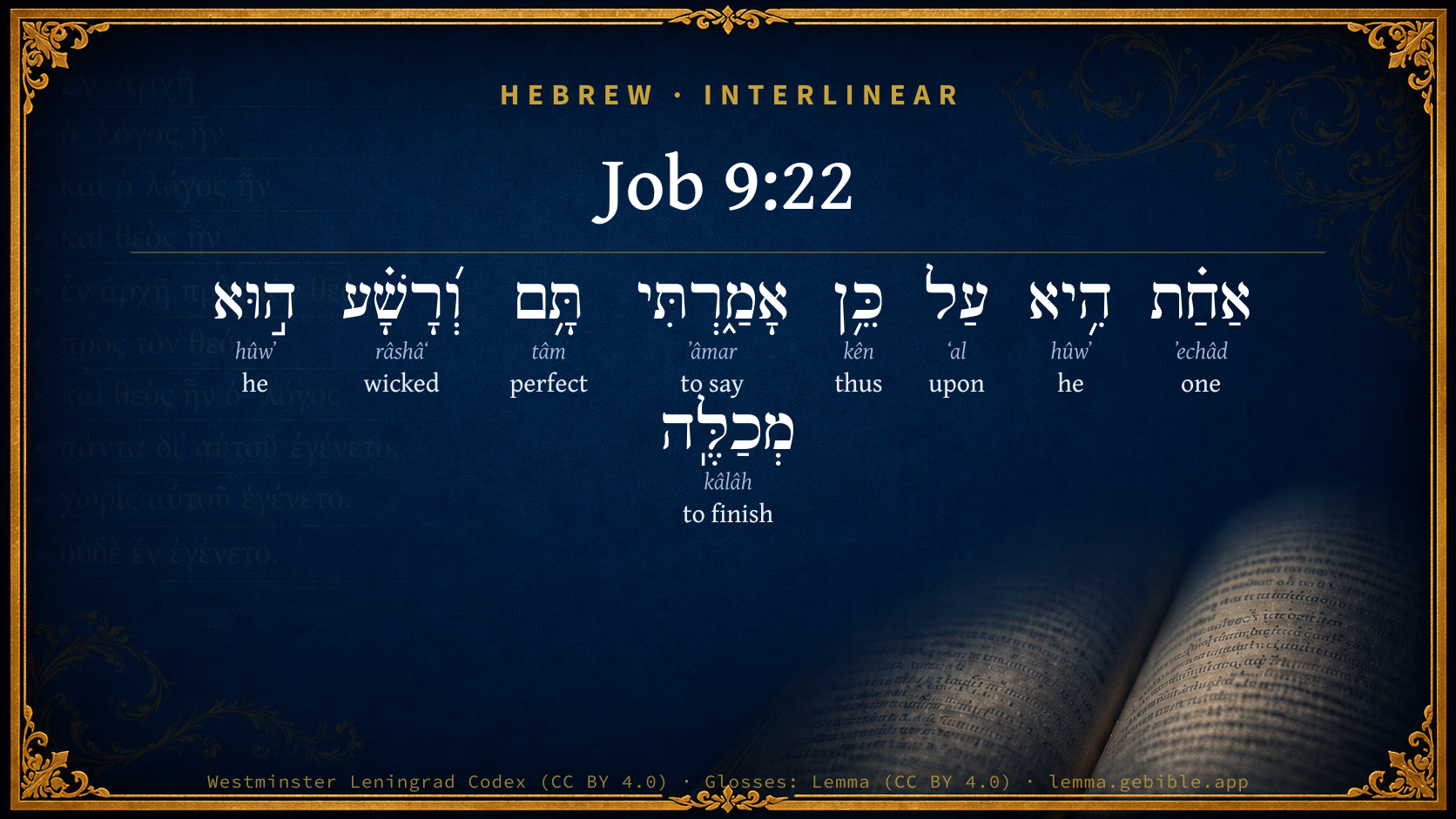
Hebrew (Westminster Leningrad Codex) Job 9:22 appears in the Hebrew Old Testament. The text above is from the Westminster Leningrad Codex. Each word links to its Strong’s number, a concise gloss, and parsing drawn from the Open Scriptures Hebrew Bible morphology. Click any word for its full Brown-Driver-Briggs (BDB) entry.
Download image
Cite this verse

Job 9:22 (World English Bible). Public Domain. Lemma interlinear Bible study tool, https://lemma.gebible.app/v/job/9/22.

Show BibTeX & RIS
BibTeX
RIS
English Translation
"It is all the same. Therefore I say, He destroys the blameless and the wicked.
World English Bible · Public Domain
Download a study sheet

One document with this verse’s original text, its word-by-word gloss line, the meaning frame, cross-references with their text, attributed commentary, and full source and license credits — printable, and it pastes into notes with its structure intact.

This verse Autodidact and up

Study sheet (.html) Plain text (.txt)

A passage Seminary Student

Up to 50 verses in one chapter. A passage sheet keeps up to 6 commentary sources and 12 cross-references per verse, in the order this page ranks them, and says so on the sheet whenever that leaves anything out. Ask for a single verse and you get the Autodidact verse sheet above.

Everything on this page stays free to read, with no account — the sheet is a download of what is already on screen, not access to it.

Want to remove ads? Support Godless Engineer
Compare translations 3

The same verse in 3 English versions, stacked beneath the original-language interlinear above. Click any original word for its lexicon entry.

Each is an independent rendering of the whole verse — the interlinear is not word-aligned to these translations.

Highlighted words mark where these versions differ — a whole-verse word diff, not a word-by-word alignment.

  • World English Bible Public Domain
    "It is all the same. Therefore I say, He destroys the blameless and the wicked.
  • King James Version Public Domain
    This is one thing, therefore I said it, He destroyeth the perfect and the wicked.
  • unfoldingWord Literal Text CC BY-SA 4.0
    It one; therefore I have said, ‘The blameless and the wicked, he is destroying.’

unfoldingWord Literal Text — © unfoldingWord, licensed CC BY-SA 4.0. Word-aligned USFM3 via Door43 (git.door43.org/unfoldingWord/en_ult).

Versions to compare (up to 4)

3 of 4 selected

Show all 18 translations

Every available English version of this verse, each an independent rendering of the whole verse.

  • World English Bible Public Domain
    "It is all the same. Therefore I say, He destroys the blameless and the wicked.
  • Berean Standard Bible Public Domain
    It is all the same, and so I say, ‘He destroys both the blameless and the wicked.’
  • Majority Standard Bible Public Domain
    It is all the same, and so I say, ‘He destroys both the blameless and the wicked.’
  • King James Version Public Domain
    This is one thing, therefore I said it, He destroyeth the perfect and the wicked.
  • American Standard Version (1901) Public Domain
    It is all one; therefore I say, He destroyeth the perfect and the wicked.
  • Revised Version (1885) Public Domain
    It is all one; therefore I say, He destroyeth the perfect and the wicked.
  • Geneva Bible (1599) Public Domain
    This is one point: therefore I said, Hee destroyeth the perfite and the wicked.
  • Douay-Rheims (1899) Public Domain
    One thing there is that I have spoken, both the innocent and the wicked he consumeth.
  • Young's Literal Translation Public Domain
    It is the same thing, therefore I said, `The perfect and the wicked He is consuming.'
  • Literal Standard Version CC BY-SA 4.0
    It is the same thing, therefore I said, || He is consuming the perfect and the wicked.
  • Unlocked Literal Bible CC BY-SA 4.0
    It makes no difference, which is why I say that he destroys blameless people and wicked people together.
  • unfoldingWord Literal Text CC BY-SA 4.0
    It one; therefore I have said, ‘The blameless and the wicked, he is destroying.’
  • Darby Bible Public Domain
    It is all one; therefore I said, he destroyeth the perfect and the wicked.
  • World Messianic Bible Public Domain
    “It is all the same. Therefore I say he destroys the blameless and the wicked.
  • Webster's Bible Public Domain
    This is one thing, therefore I said it, he destroyeth the perfect and the wicked.
  • Free Bible Version CC BY-SA 4.0
    That's why I say, ‘It makes no difference to God. He destroys both the innocent and the wicked.’
  • Bible in Basic English Public Domain
    It is all the same to me; so I say, He puts an end to the sinner and to him who has done no wrong together.
  • JPS Tanakh (1917) Public Domain
    It is all one — therefore I say: He destroyeth the innocent and the wicked.

Literal Standard Version (2020), Covenant Press — licensed CC BY-SA 4.0. Text via the HelloAO Bible API (eBible.org). Unlocked Literal Bible (unfoldingWord) — licensed CC BY-SA 4.0. Text via the HelloAO Bible API (eBible.org). unfoldingWord Literal Text — © unfoldingWord, licensed CC BY-SA 4.0. Word-aligned USFM3 via Door43 (git.door43.org/unfoldingWord/en_ult). Free Bible Version, Dr. Jonathan Gallagher — licensed CC BY-SA 4.0. Text via the HelloAO Bible API (eBible.org).

Word by word

More ways to search: Search by grammar → Find every occurrence → Compare this word →

Practice this passage: Drill this verse → Learn its vocabulary →

About this verse

These counts appear in no published source. They are computed here, from the morphology-tagged text and Lemma’s own curated glosses. What Lemma adds →

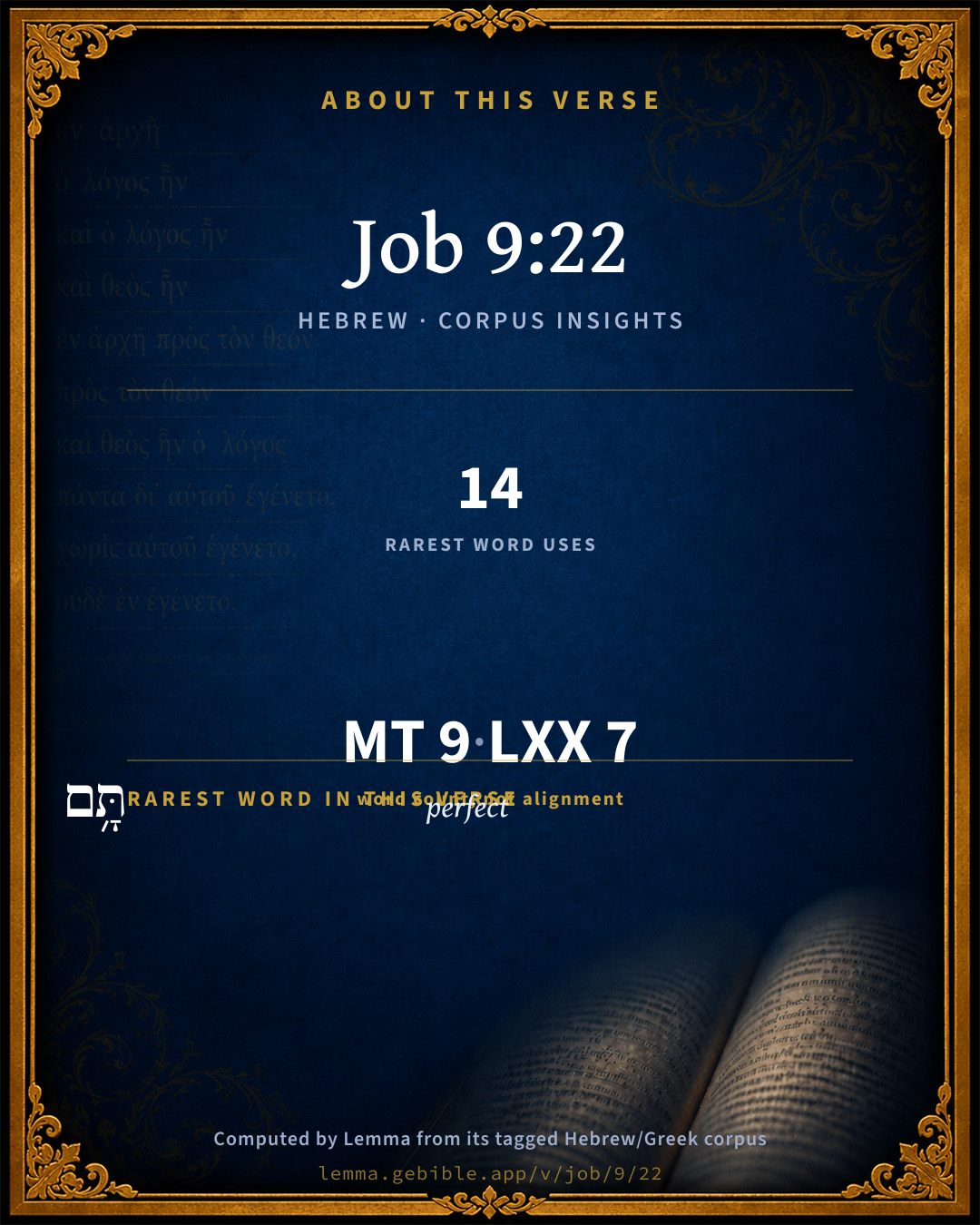
9
words
8
distinct lemmas
Wisdom
section

Notable vocabulary

The rarest word here is תָּ֥ם perfect H8535 — appearing just 14 times in the whole Hebrew Bible.

Shared distinctive vocabulary

תָּ֥ם perfect H8535 occurs in 14 verses of the Hebrew Bible. Also found in:

Grammatical profile

  • 2 verbs
  • 3 adjectives
  • 2 pronouns
  • 1 preposition
  • 1 particle

Verb forms

  • אָמַ֑רְתִּי Qal · Perfect
  • מְכַלֶּֽה Piel · Participle Active

Repetition

A word recurs within this verse — often emphatic in Hebrew:

  • הִ֥יא he H1931 ×2

Hebrew & Septuagint length

In English translation the verse runs 15 words from the Hebrew and 10 from the Septuagint (LXX English) — the Septuagint runs noticeably shorter here. See the side-by-side →

A rough comparison of the two English renderings, which tokenize alike — not a word-level alignment.

Word counts can differ between the Hebrew and the Greek without any difference in meaning — e.g. the Hebrew direct-object marker אֵת has no separate Greek word, and Greek often adds the article ὁ.

In the original languages it is 9 Hebrew tokens and 7 Greek tokens — but the two are counted differently (Hebrew bundles its prefixes and suffixes into one token; the Greek is in lemma form), so that isn’t a like-for-like length.

Cross-references

4

Topical passages linked to Job 9:22 in the Treasury of Scripture Knowledge — connected by theme and wording, ordered by reader-vote popularity; previews shown in the World English Bible.

  • Ecclesiastes 9:1–3 For all this I laid to my heart, even to explore all this: that the righteous, and the wise, and their works, are in the hand of God; whether it is love or hatred, man doesn't know it; all is before them.
  • Job 10:8 'Your hands have framed me and fashioned me altogether; Yet you destroy me.
  • Ezekiel 21:3–4 and tell the land of Israel, Thus says Yahweh: Behold, I am against you, and will draw forth my sword out of its sheath, and will cut off from you the righteous and the wicked.
  • Luke 13:2–4 Jesus answered them, "Do you think that these Galileans were worse sinners than all the other Galileans, because they suffered such things?

Cross-references courtesy of OpenBible.info (CC BY 4.0).

Hebrew and Greek witnesses Masoretic Hebrew ↔ Greek Septuagint

The same verse in the two great witnesses to the Old Testament, shown verse-for-verse.

Here the Septuagint runs noticeably shorter than the Hebrew — LXX2012 (modern English Septuagint) 10 words vs World English Bible 15. A rough length comparison of the two English translations, not a word-level alignment — read both below.

These are two independent witnesses, not word-aligned to each other, and the Septuagint is shown in lemma (dictionary) form.

Hebrew Job 9:22 Masoretic · Westminster Leningrad Codex

אַחַ֗ת הִ֥יא עַל כֵּ֥ן אָמַ֑רְתִּי תָּ֥ם וְ֝רָשָׁ֗ע ה֣וּא מְכַלֶּֽה

"It is all the same. Therefore I say, He destroys the blameless and the wicked.

World English Bible · Public Domain

Greek LXX Job 9:22 Septuagint · lemma form

διό εἶπον μέγας καί δυνάστης ἀποὀλλύω ὀργή

Therefore I said, Wrath slays the great and mighty man.

LXX2012 (modern English Septuagint) · Public Domain

On this verse, John Gill's Exposition discusses the Septuagint’s reading. Read the note in Commentary ↓

Hebrew: Westminster Leningrad Codex (CC BY 4.0). Greek: Septuagint (public domain); English from LXX2012 (modern English Septuagint) (Public Domain). How the Septuagint differs from the Hebrew →

Commentary

Notes on Job 9:22 from classic Christian and Jewish commentators (each source and its license shown beneath its notes). The classic Christian expositions comment on the surrounding passage and are grouped to its opening verse, so a note may address several verses; the Jewish commentaries on the Tanakh (Rashi and others) are per-verse, so they appear only where the commentator wrote on this verse.

Lemma curates 59 commentaries, every one of them public domain or Creative Commons licensed, each selected and text-cleaned for this edition rather than reprinted as found. About our sources →

Trapp's Complete Commentary

John Trapp

Job 9:22 This [is] one [thing], therefore I said [it], He destroyeth the perfect and the wicked.

Ver. 22. This is one thing, therefore I say it] And will stand to it, though I stand alone; this being the one thing wherein I differ in opinion from you; and because it is the hinge upon which the whole dispute between us is turned, therefore I will abide by it, and be Doctor resolutus, resolute in the maintenance of it, viz.

He destroyeth the perfect and the wicked] A harsh doctrine, yet a good one, saith an interpreter. Grace is no shield against the greatest affliction. See Ecc 9:1-3 Mal 3:14 Eze 21:3 Heb 11:36-38 shows that none out of hell have ever suffered more than God’s dearest children; and Heb 12:6, He not only chasteneth, but scourgeth every son whom he receiveth. God will not cast away a righteous man, said Bildad, Job 8:20; that is, totally destroy him in temporals, but restore him again. No such matter, saith Job, for it may, and many times doth happen, that a godly man may, as to this life present, perish, as well as a wicked man; he may be totally and finally bereft of outward comforts, the righteous perisheth, Isa 57:1; only with this difference, as hath been before noted, God’s judgments on the wicked are penal and typical of eternal torment; whereas upon the godly they are no more than medicinal or probational, &c.

John Trapp, A Commentary or Exposition upon All the Books of the Old and New Testament (1647–1656) — public domain. Text from a community e-Sword module.

Joseph Benson's Commentary

Job 9:22-23. This one thing — In the other things which you have spoken of, God’s greatness, power, and justice, I do not contend with you; but this one thing I do, and must affirm against you. Therefore I said it — I did not utter it rashly, but upon deep consideration. He destroyeth the perfect and the wicked — God sends afflictions promiscuously upon good and bad men. If the scourge slay suddenly — If some common judgment come upon a people, which destroys both good and bad: or if God inflict some grievous and unexpected stroke upon a holy person. He will laugh at the trial of the innocent — God will be pleased to see how the same, or a similar scourge, which is the perdition of the wicked, is only the trial of the integrity, faith, and patience of the innocent, that is, of his own people, and a means of their further purification and improvement.

Joseph Benson's Commentary on the Old and New Testaments (1811–1818) — public domain. Text from a community e-Sword module.

Geneva Bible (1599)

Geneva Bible translators

If God punish according to his justice, he will destroy as well them, that are counted perfect as them that are wicked.

Geneva Bible (1599) marginal notes — public domain. Text via Bolls.life.

Matthew Henry's Commentary

Here Job touches briefly upon the main point now in dispute between him and his friends. They maintained that those who are righteous and good always prosper in this world, and none but the wicked are in misery and distress; he asserted, on the contrary, that it is a common thing for the wicked to prosper and the righteous to be greatly afflicted. This is the one thing, the chief thing, wherein he and his friends differed; and they had not proved their assertion, therefore he abides by his: "I said it, and day it again, that all things come alike to all." Now, 1. It must be owned that there is very much truth in what Job here means, that temporal judgments, when they are sent abroad, fall both upon good and bad, and the destroying angel seldom distinguishes (though once he did) between the houses of Israelites and the houses of Egyptians. In the judgment of Sodom indeed, which is called the vengeance of eternal fire (Jde 1:7), far be it from God to slay the righteous with the wicked, and that the righteous should be as the wicked (Gen 18:25); but, in judgments merely temporal, the righteous have their share, and sometimes the greatest share. The sword devours one as well as another, Josiah as well as Ahab. Thus God destroys the perfect and the wicked, involves them both in the same common ruin; good and bad were sent together into Babylon, Jer 24:5, Jer 24:9. If the scourge slay suddenly, and sweep down all before it, God will be well pleased to see how the same scourge which is the perdition of the wicked is the trial of the innocent and of their faith, which will be found unto praise, and honour, and glory, Pe1 1:7; Psa 66:10.

Against the just th' Almighty's arrows fly,

For he delights the innocent to try,

To show their constant and their Godlike mind,

Not by afflictions broken, but refined.

- Sir R. Blackmore

Let this reconcile God's children to their troubles; they are but trials, designed for their honour and benefit, and, if God be pleased with them, let not them be displeased; if he laugh at the trial of the innocent, knowing how glorious the issue of it will be, at destruction and famine let them also laugh (Job 5:22), and triumph over them, saying, O death! where is thy sting? On the other hand, the wicked are so far from being made the marks of God's judgments that the earth is given into their hand, Job 9:24 (they enjoy large possessions and great power, have what they will and do what they will), into the hand of the wicked one (in the original, the word is singular); the devil, that wicked one, is called the god of this world, and boasts that into his hands it is delivered, Luk 4:6. Or into the hand of a wicked man, meaning (as bishop Patrick and the Assembly's Annotations conjecture) some noted tyrant then living in those parts, whose great wickedness and great prosperity were well known both to Job and his friends. The wicked have the earth given them, but the righteous have heaven given them, and which is better - heaven without earth or earth without heaven? God, in his providence, advances wicked men, while he covers the faces of those who are fit to be judges, who are wise and good, and qualified for government, and buries them alive in obscurity, perhaps suffers them to be run down and condemned, and to have their faces covered as criminals by those wicked ones into whose hand the earth is given. We daily see that this is done; if it be not God that does it, where and who is he that does it? To whom can it be ascribed but to him that rules in the kingdoms of men, and gives them to whom he will? Dan 4:32. Yet, 2. It must be owned that there is too much passion in what Job here says. The manner of expression is peevish. When he meant that God afflicts he ought not to have said, He destroys both the perfect and the wicked; when he meant that God pleases himself with the trial of the innocent he ought not to have said, He laughs at it, for he doth not afflict willingly. When the spirit is heated, either with dispute or with discontent, we have need to set a watch before the door of our lips, that we may observe a due decorum in speaking of divine things.

Matthew Henry's Commentary on the Whole Bible (1708–1710) — public domain (CC PDM 1.0). Text via the HelloAO Bible API.

Jamieson, Fausset & Brown

Robert Jamieson, A. R. Fausset & David Brown

one thing--"It is all one; whether perfect or wicked--He destroyeth." This was the point Job maintained against his friends, that the righteous and wicked alike are afflicted, and that great sufferings here do not prove great guilt (Luk 13:1-5; Ecc 9:2).

Jamieson, Fausset & Brown — Commentary Critical and Explanatory on the Whole Bible (1871) — public domain (CC PDM 1.0). Text via the HelloAO Bible API.

Adam Clarke's Commentary

Verse 22. This is one thing] My own observation shows, that in the course of providence the righteous and the wicked have an equal lot; for when any sudden calamity comes, the innocent and the guilty fall alike. There may be a few exceptions, but they are very extraordinary, and very rare.

Adam Clarke's Commentary on the Bible (1810–1826) — public domain. Text from a community e-Sword/MySword module.

The Cambridge Bible for Schools and Colleges

gen. ed. J. J. S. Perowne

22. This verse reads,

It is all one, therefore I say,

He destroyeth the perfect and the wicked,

that is, indiscriminately. Here there is not only the former statement of ch. 7. that the destiny of man at the hands of God is hard and crushing, but in addition an express denial of the position of Bildad that God’s dealing with men was discriminating. An emphasis falls on He. It is not quite easy to decide what is meant by it is all one. The close connexion with Job_9:21 makes it most natural to understand: it is all one whether I live or die; so that the Job_9:21-24 are all one outburst, in which the Almighty is described as a crushing force that bears down on all good and bad without distinction.

The Cambridge Bible for Schools and Colleges (gen. ed. J. J. S. Perowne; Cambridge University Press, 1878–1918) — public domain. Text from a community e-Sword module.

John Gill's Exposition

If the scourge slay suddenly,.... Not Satan, as Jarchi and Bar Tzemach; but any sore calamity which surrounds a man, lashes, cuts, and distresses him, as a whip or scourge; such as any of God's sore judgments, the sword, famine, pestilence, or evil beasts, which sometimes come suddenly, unawares, unthought of, and unexpected; and are sometimes only chastisements in love, the scourgings of a father, though generally in wrath and hot displeasure, and are an overflowing scourge, which carry all before them; and therefore some restrain it to wicked men, as the Septuagint version; and some understand it as if they were more mildly and gently dealt with, by being suddenly and at once slain with such a scourge, in their persons, families, and substance, while others have their afflictions protracted, and linger long under them, as in the next clause:

he will laugh at the trial of the innocent; not that are free from sin entirely; for there are none such, no, not newborn infants; though they may be comparatively so, yet they are not in an absolute sense, being conceived in sin and shapen in iniquity: besides, here it means adult persons, good men, that are truly gracious, sincere, upright, harmless in their lives and conversations, whose afflictions are "trials" of their faith and patience, and other graces; and when God is said to "laugh" at them, who seems to be designed here, this must be understood consistent with his pity to his people, his sympathy with them under all their afflictions, he not willingly afflicting or grieving the children of men; nor can it be thought that he has them in derision and contempt, or laughs at their calamities, or in reality, as he does at wicked men; but that he carries it so oftentimes, in the dispensations of his providence, as if he made no difference between them, but mocked at the one as well as the other; seemingly giving no heed to their cries; not hastening to their help and deliverance, but lengthening out their troubles for the trial of their graces; and so indeed is greatly delighted with the exercise of them under them, and with seeing them bear them with so much patience, courage, and greatness of mind and submission to his will. Some interpret this of a wicked man laughing at the calamities of the righteous, as the Ammonites and Edomites rejoiced at the destruction of the Jews; the church's enemy at her fall, and as the Papists will at the witnesses being slain; but the former sense seems best; rather the scourge itself laughs at the trial of the innocent; so Schultens.

John Gill's Exposition of the Whole Bible (1746–1763) — public domain (CC PDM 1.0). Text via the HelloAO Bible API.

Albert Barnes' Notes on the Bible

This is one thing, therefore I said it - This may mean, “it is all the same thing. It makes no difference whether a man be righteous or wicked. God treats them substantially alike; he has one and the same rule on the subject. Nothing can be argued certainly about the character of a man from the divine dealings with him here.” This was the point in dispute, this the position that Job maintained - that God did not deal with people here in strict accordance with their character, but that the righteous and the wicked in this world were afflicted alike.

He destroyeth the perfect and the wicked - He makes no distinction among them. That Job was right in this his main position there can be no doubt; and the wonder is, that his friends did not all see it. But it required a long time in the course of events, and much observation and discussion, before this important point was made clear. With our full views of the state of retribution in the future world, we can have no doubt on the subject. Heavy and sudden judgments do not necessarily prove that they who are cut off are especially guilty, and long prosperity is no evidence that a man is holy. Calamity, by fire and flood, on a steamboat, or in the pestilence, does not demonstrate the unusual and eminent wickedness of those who suffer (compare Luk 13:1-5), nor should those who escape from such calamities infer that of necessity they are the objects of the divine favor.

Albert Barnes' Notes on the Bible (1834–1885) — public domain. Text from a community e-Sword/MySword module.

Haydock's Catholic Bible Commentary

Consumeth. Ecclesiastes ix. 2. (Haydock) --- This principle is incontrovertible. (Worthington) --- I do not retract it. (Menochius) --- The misery inflicted on the just, is not contrary to the goodness of the Almighty. Job perfectly discovered this truth, which puzzled his enlightened friends, and most of those who lived before Christ; (Psalm lxxii. 2., and Jeremias xii. 1.; Calmet) and even Job himself was not fully convinced of the motives of the Providence, till God had explained them. (Houbigant) (Chap. xlii.)

George Leo Haydock (1774–1849), Haydock's Catholic Family Bible and Commentary, 1859 edition — public domain. Excludes Psalms (Douay-Rheims chapter numbering differs from Protestant) and Deuterocanonical books (Catholic canon only).

Matthew Poole's English Annotations

In the other things which you have spoken of God’s greatness, justice, &c., I do not contend with you, but this one thing I do and must affirm against you.

Therefore I said it; I did not utter it rashly, but upon deep consideration. God sends afflictions promiscuously upon good and bad men. Compare Psa 73:2; Ecc 9:2; Jer 12:1, &c.

Matthew Poole's English Annotations on the Holy Bible (1683–1685) — public domain. Text from a community e-Sword/MySword module.

Whedon's Commentary on the Bible

Daniel D. Whedon

22. This is one thing — It is all one, “a matter of indifference whether I live or die.” — Dillmann. The Chaldee rendering, “There is one and the same measure,” Wordsworth thus follows: “There is one and the same thing to the wicked and righteous;” but this would tautologically anticipate the same thought in the next clause. “It is all one,” Job cries; I have nothing more to hope or fear; therefore I will say it (out with it) — the good and the wicked are involved in the same doom. HE destroys; (God, whom he names not,) thus giving terrific emphasis to the question in Job_9:24. Job_9:23-24 give the specifications under this charge.

Daniel D. Whedon (gen. ed.), Commentary on the Old and New Testaments (1874–1909) — public domain. Text from a community e-Sword module.

The Pulpit Commentary

This is one thing; rather, the matter is one"or it is all one. There is no difference, that is, between the case of the righteous and the wicked; all are alike sinful in God"s sight, all equally "concluded under sin", (Gal_3:22) and all consequently obnoxious to punishment at his hands. (comp. Ecc_9:2) In a certain sense the statement is true, and corresponds with the argument of Romans 1-3; but no account is taken here of God"s gracious forgiveness of sin, much less of the general scheme of redemption, or the compensation for earthly sufferings in an eternity of happiness, on which the hope of the Christian rests. Therefore I said it ; rather, therefore I say with the Revised Version. He destroyeth the perfect and the wicked. As far as this world is concerned, it is undoubtedly true that calamities fall alike upon the just and upon the unjust. Death is the lot of all; trouble, suffering, grief, the lot of all. (Job_6:7) Nor can it even be said that the wicked in this world suffer more than the good (comp. 1 Oct. 1529). Their sufferings are more the natural consequence of their actions, but do not seem to exceed in amount or severity the sufferings of the good. But this only shows that there must be a future life to redress the apparent injustice of the present one, and set the balance right.

The injustice of equality.

Job complains that the same doom is meted out to the perfect and the wicked; this seems to be unjust. Our modern complaints are of the injustice of the terrible inequalities of life. But Job"s position suggests to us that justice is not simple equality. Equal dealing may be unjust dealing. To be fair to all, we must not treat all alike. Yet the injustice of equality is apparently a common thing in the experience of life, and even in the dispensations of Providence. Thus special providence seems to be lost, and one broad, rough treatment appears to serve for the greatest variety of people.

I IT WOULD BE UNJUST TO TREAT ALL ALIKE. This much may be conceded if we think of the whole of life, not of external experience alone, nor only of this temporal and limited sphere of existence. To look for absolute equality is to ignore variations of requirements and distinctions of character. But if this be so, what are we to understand by the apparent disregard of those differences? The world is governed by general laws. Events have widespread influences. Calamities come in a swelling tide, not in a meandering stream, and when they sweep over the land, weeds and fruitful plants suffer from the same devastation.

II NEVERTHELESS, GOD IS NOT THUS UNJUST. Job is mistaken.

1. We only see the outside of life. The events which are common to all alike are external. They are visible objects of superficial observation. But these events do not constitute the whole of experience. The blow that breaks stone only toughens iron. The calamity that is a crushing judgment to one man is a healing tonic to another. When a flood sweeps over a district it leaves behind very different effects; for while it only brings ruin to houses, it brings fertility to fields. So the trouble is only equal externally. If only we could follow it into the experience of different men, we should discover that the inequality has ceased, and that a different effect is produced according to character and condition. While it is a curse to one life, it is a blessing to another.

2. We only see the present experience. Now, and on earth, there seems to be a rough, indiscriminate treatment of men. Here the injustice of equality is too often seen. Bat we must wait for the end. In Job"s case the end brought about a complete reversal of the whole course of events. Now God makes his sun to shine and his rain to fall on good and bad alike favouring equally, as he sometimes chastises equally. But this equality will not continue after death. Wheat and tares grow together, but only until the harvest. There will be a great inequality of treatment, when the one is gathered into the barns, and the other is burned. Surely men should learn to bear the common troubles of life patiently, if they know that beyond them all there is more than compensation: there is fruitful increase, with richest blessings, for the true servants of God who endure patiently. W.F.A.

The Pulpit Commentary (1880–1919), ed. H.D.M. Spence-Jones & Joseph S. Exell — public domain. Text from a community e-Sword module.

John Wesley's Explanatory Notes

This - In the other things which you have spoken of God's greatness, and justice, I do not contend with you, but this one thing I do, and must affirm against you. He - God sends afflictions promiscuously upon good and bad men.

John Wesley, Explanatory Notes Upon the Whole Bible (1754–1765) — public domain. Text via the GEBible commentary corpus.

Kretzmann's Popular Commentary

Paul E. Kretzmann

Job Insists that God Visits also the Righteous with Affliction

v. 22. This is one thing, it is all one, or, it makes no difference whether a person is innocent or guilty; therefore I said it, He destroyeth the perfect and the wicked; this statement Job feels constrained to make against God.

v. 23. If the scourge slay suddenly, namely, by means of any calamity, he will laugh at the trial of the innocent, God will mock at the despair of the guiltless, not permitting Himself to be disturbed in the enjoyment of His heavenly bliss.

v. 24. The earth is given into the hand of the wicked, this God readily permits; He covereth the faces of the judges thereof, veiling their eyes and permitting them to render wicked decisions, to practise unrighteousness; if not, where and who is He? Who but God could it be that does this!

v. 25. Now, my days are swifter than a post, flying away more swiftly than the motion of a courier, or runner; they flee away, they see no good; Job despairs of ever being released of his affliction, he has entirely forgotten his former state of prosperity.

v. 26. They are passed away as the swift ships, sweeping past like vessels of bulrush, known for their lightness and swiftness; as the eagle that hasteth to the prey, swooping down upon it with almost incredible speed. Thus Job illustrates the hasty flight of his life.

v. 27. If I say, I will forget my complaint, making an attempt to rouse himself from his stupor, I will leave off my heaviness, literarily, "my countenance," that is, his gloomy and downcast look, and comfort myself, looking cheerful once more.

v. 28. I am afraid of all my sorrows, he is once more forced to shudder with pain; I know that Thou wilt not hold me innocent, that God would not declare him guiltless.

v. 29. If I be wicked, rather, "I am to be guilty," declared to be wicked by the decree of God, why, then, labor I in vain? It was a useless endeavor on his part trying to appear innocent; he felt that he was tiring himself out without result.

v. 30. If I wash myself with snow-water, which was considered as containing greater cleansing power than ordinary water, and make my hands never so clean, literally, "cleansing my hands with lye," in an effort to purge away all impurities,

v. 31. yet shalt Thou plunge me in the ditch, into a sink or sewer, and mine own clothes shall abhor me. This would happen while he was still naked after his washing and would cause him to become so filthy as to make his own clothes ashamed of him. That is: "Not even the best grounded self-justification can avail him; for God, would still bring it to pass that his clearly proved innocence should change to the most horrible impurity. " (Delitzsch. )

v. 32. For He is not a man, as I am, that I should answer Him, standing on the same level with Him before a court of justice, and we should come together in judgment.

v. 33. Neither is there any daysman, arbitrator or mediator, betwixt us that might lay his hand upon us both, acting as umpire between God and Job to settle his case; for God was both accuser and judge.

v. 34. Let Him take His rod away from me, the scourge and calamity wherewith He was smiting Job, and let not His fear terrify me, stupefying him by His majestic presence;

v. 35. then would I speak and not fear Him, namely, with this handicap of overpowering majesty removed; but it is not so with me, in his own person he was not conscious of any reason why he should fear Him. Job’s defense of himself becomes so emphatic that it verges on self-righteous boasting, an act against which every believer must guard with the greatest care.

Paul E. Kretzmann, Popular Commentary of the Bible (1921–1924) — public domain. Text from a community e-Sword module.

Rashi

Rabbi Shlomo Yitzchaki (Rashi)

It is all one in the world, concerning which I said that He destroys both the innocent and the wicked. Now, what is it?...

Rashi on the Tanakh — English translations: “The Judaica Press complete Tanach with Rashi, translated by A. J. Rosenberg” (CC BY 4.0); “Pentateuch with Rashi's commentary by M. Rosenbaum and A.M. Silbermann, 1929-1934” (public domain); “The Metsudah Tanach series, Lakewood, N.J” (CC BY 4.0); and “The Book of Joshua, Metsudah Publications, 1997” (CC BY 4.0). Text via Sefaria.

Lesson kit

Teaching starters — assembled from the data on this page, not authored interpretation. Every prompt links to the verse data it draws on. Edit before teaching.

Job, in the Wisdom, opens this verse with 9 words (8 distinct Hebrew lemmas). Its most distinctive word is tâm (“perfect”). The Greek Septuagint runs shorter here. A historical commentator’s framing appears above. Read the whole chapter for the surrounding context.

Discussion questions

  1. What does “perfect” (tâm) contribute to the verse as a whole?
  2. Genesis 25:27 shares the word «perfect» with this verse. How do the two illuminate each other?
  3. “he” occurs 2× in this one verse. What is the effect of the repetition?
  4. Compared with the Hebrew, the Septuagint runs shorter here. What questions does that raise?
  5. These translations render this verse differently. What is at stake in choosing one wording over another?
  6. The verb «אָמַ֑רְתִּי» is Qal Perfect. How does its form color the action?
  7. Reading how Trapp's Complete Commentary and Joseph Benson's Commentary read this verse, where do the two commentators agree and where do they part?

Things to notice

Reading settings

Reading text

Shown beneath each verse's original-language words.

Old Testament
Old Testament edition

Read the OT as the Masoretic Hebrew (MT) or the Greek Septuagint (LXX).

English shown for the Greek Septuagint (in the Hebrew ↔ Greek comparison).

Comparing translations? Open the Compare panel on any verse page to stack up to four side by side.