
Isaiah 48:22

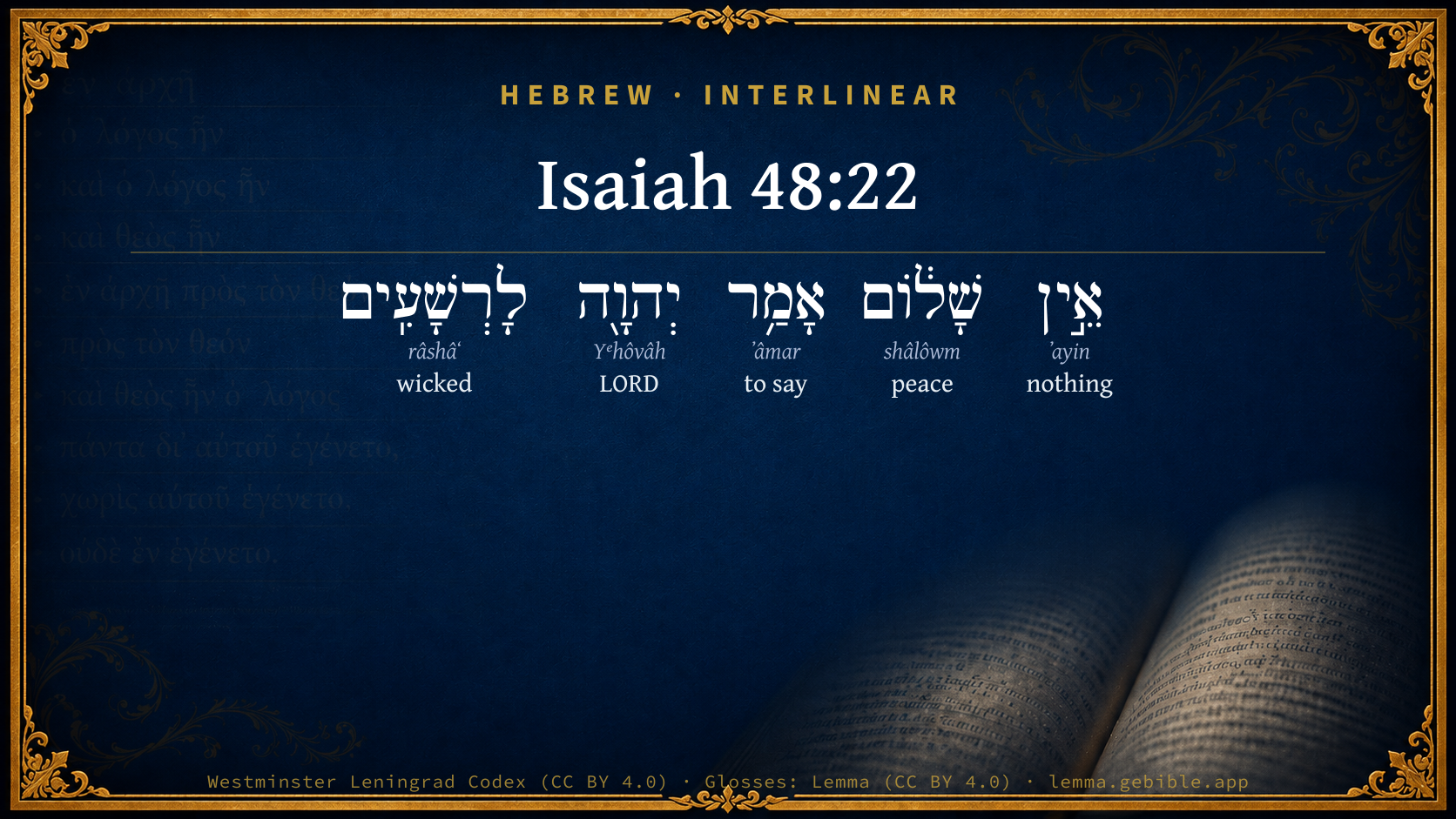
Hebrew (Westminster Leningrad Codex) Isaiah 48:22 appears in the Hebrew Old Testament. The text above is from the Westminster Leningrad Codex. Each word links to its Strong’s number, a concise gloss, and parsing drawn from the Open Scriptures Hebrew Bible morphology. Click any word for its full Brown-Driver-Briggs (BDB) entry.
Download image
Cite this verse

Isaiah 48:22 (World English Bible). Public Domain. Lemma interlinear Bible study tool, https://lemma.gebible.app/v/isaiah/48/22.

Show BibTeX & RIS
BibTeX
RIS
English Translation
There is no peace, says Yahweh, to the wicked.
World English Bible · Public Domain
Download a study sheet

One document with this verse’s original text, its word-by-word gloss line, the meaning frame, cross-references with their text, attributed commentary, and full source and license credits — printable, and it pastes into notes with its structure intact.

This verse Autodidact and up

Study sheet (.html) Plain text (.txt)

A passage Seminary Student

Up to 50 verses in one chapter. A passage sheet keeps up to 6 commentary sources and 12 cross-references per verse, in the order this page ranks them, and says so on the sheet whenever that leaves anything out. Ask for a single verse and you get the Autodidact verse sheet above.

Everything on this page stays free to read, with no account — the sheet is a download of what is already on screen, not access to it.

Want to remove ads? Support Godless Engineer
Compare translations 3

The same verse in 3 English versions, stacked beneath the original-language interlinear above. Click any original word for its lexicon entry.

Each is an independent rendering of the whole verse — the interlinear is not word-aligned to these translations.

Highlighted words mark where these versions differ — a whole-verse word diff, not a word-by-word alignment.

  • World English Bible Public Domain
    There is no peace, says Yahweh, to the wicked.
  • King James Version Public Domain
    There is no peace, saith the LORD, unto the wicked.
  • unfoldingWord Literal Text CC BY-SA 4.0
    “There is no peace,” says Yahweh, “for the wicked.”

unfoldingWord Literal Text — © unfoldingWord, licensed CC BY-SA 4.0. Word-aligned USFM3 via Door43 (git.door43.org/unfoldingWord/en_ult).

Versions to compare (up to 4)

3 of 4 selected

Show all 18 translations

Every available English version of this verse, each an independent rendering of the whole verse.

  • World English Bible Public Domain
    There is no peace, says Yahweh, to the wicked.
  • Berean Standard Bible Public Domain
    “There is no peace,” says the LORD, “for the wicked.”
  • Majority Standard Bible Public Domain
    “There is no peace,” says the LORD, “for the wicked.”
  • King James Version Public Domain
    There is no peace, saith the LORD, unto the wicked.
  • American Standard Version (1901) Public Domain
    There is no peace, saith Jehovah, to the wicked.
  • Revised Version (1885) Public Domain
    There is no peace, saith the LORD, unto the wicked.
  • Geneva Bible (1599) Public Domain
    There is no peace, sayeth the Lord, vnto the wicked.
  • Douay-Rheims (1899) Public Domain
    There is no peace to the wicked, saith the Lord.
  • Young's Literal Translation Public Domain
    There is no peace, said Jehovah, to the wicked!
  • Literal Standard Version CC BY-SA 4.0
    “There is no peace,” said YHWH, “for the wicked!”
  • Unlocked Literal Bible CC BY-SA 4.0
    There is no peace for the wicked—says Yahweh.”
  • unfoldingWord Literal Text CC BY-SA 4.0
    “There is no peace,” says Yahweh, “for the wicked.”
  • Darby Bible Public Domain
    There is no peace, saith Jehovah, unto the wicked.
  • World Messianic Bible Public Domain
    “There is no peace”, says the LORD, “for the wicked.”
  • Webster's Bible Public Domain
    There is no peace, saith the LORD, to the wicked.
  • Free Bible Version CC BY-SA 4.0
    The wicked have no peace, says the Lord.
  • Bible in Basic English Public Domain
    There is no peace, says the Lord, for the evil-doers.
  • JPS Tanakh (1917) Public Domain
    There is no peace, saith the LORD concerning the wicked.

Literal Standard Version (2020), Covenant Press — licensed CC BY-SA 4.0. Text via the HelloAO Bible API (eBible.org). Unlocked Literal Bible (unfoldingWord) — licensed CC BY-SA 4.0. Text via the HelloAO Bible API (eBible.org). unfoldingWord Literal Text — © unfoldingWord, licensed CC BY-SA 4.0. Word-aligned USFM3 via Door43 (git.door43.org/unfoldingWord/en_ult). Free Bible Version, Dr. Jonathan Gallagher — licensed CC BY-SA 4.0. Text via the HelloAO Bible API (eBible.org).

Word by word

More ways to search: Search by grammar → Find every occurrence → Compare this word →

Practice this passage: Drill this verse → Learn its vocabulary →

שָׁל֔וֹם
shâlôwm
H7965
“peace”
Noun, Common, Masculine, Singular, Absolute
Part of Speech
Noun
Type
Common
Gender
Masculine
Number
Singular
State
Absolute
Full BDB Definition

Origin: from H7999

TWOT: 2401a

completeness, soundness, welfare, peace - completeness (in number) - safety, soundness (in body) - welfare, health, prosperity - peace, quiet, tranquillity, contentment - peace, friendship - of human relationships - with God especially in covenant relationship - peace (from war) - peace (as adjective)
  1. אֵ֣ין ʼayin H369 “nothing” Particle, Negative
  2. אָמַ֥ר ʼâmar H559 “to say” Verb, Qal, Perfect, 3rd Person, Masculine, Singular
  3. יְהוָ֖ה Yᵉhôvâh H3068 “LORD” Noun, Proper
  4. לָרְשָׁעִֽים râshâʻ H7563 “to/for the · wicked” Preposition, Determined + Adjective, Adjective, Masculine, Plural, Absolute

About this verse

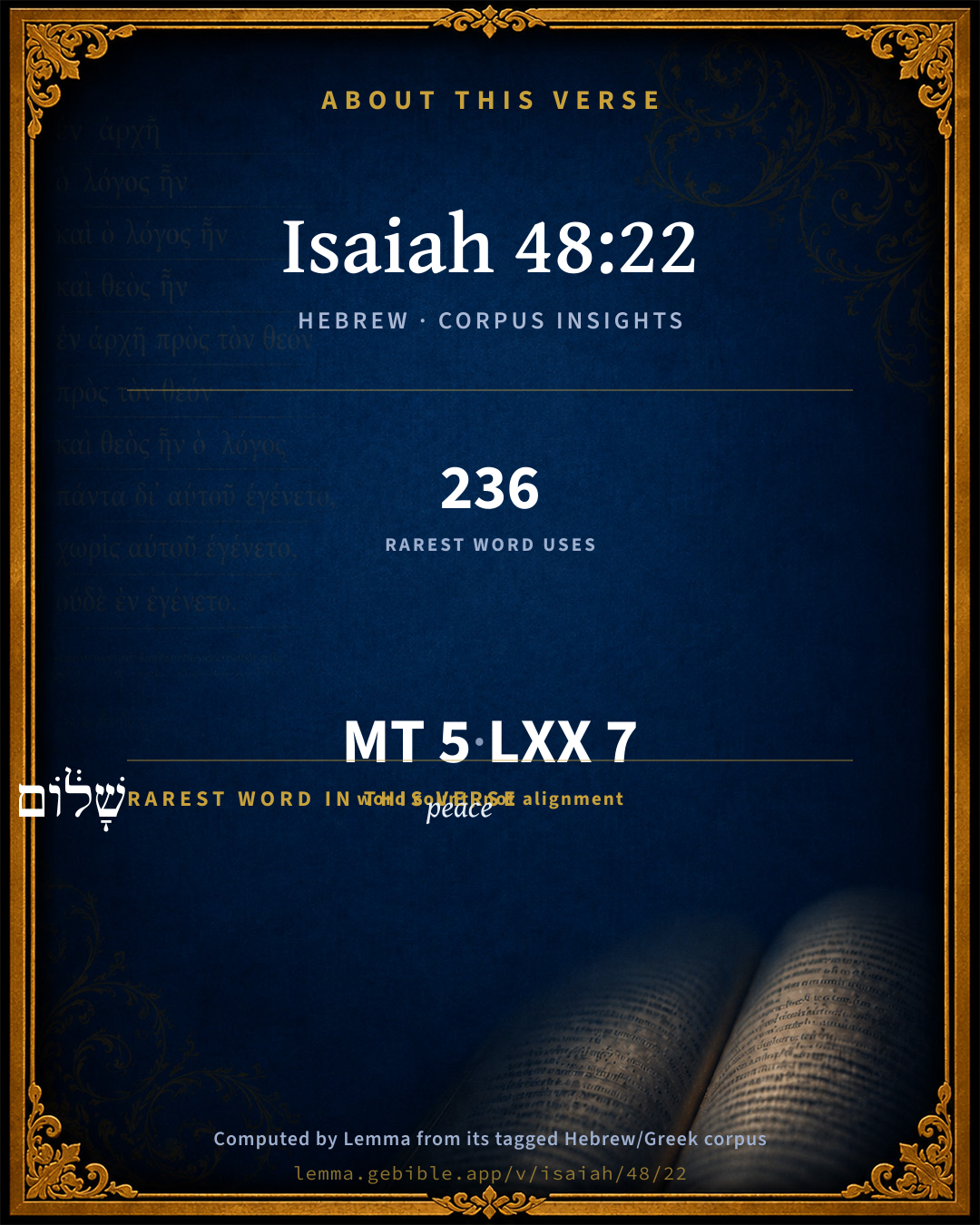
These counts appear in no published source. They are computed here, from the morphology-tagged text and Lemma’s own curated glosses. What Lemma adds →

5
words
5
distinct lemmas
Prophets
section

Grammatical profile

  • 1 verb
  • 2 nouns
  • 1 adjective
  • 1 particle

Verb forms

  • אָמַ֥ר Qal · Perfect

Hebrew & Septuagint length

In English translation the verse runs 9 words from the Hebrew and 10 from the Septuagint (LXX English) — closely comparable.

A rough comparison of the two English renderings, which tokenize alike — not a word-level alignment.

Word counts can differ between the Hebrew and the Greek without any difference in meaning — e.g. the Hebrew direct-object marker אֵת has no separate Greek word, and Greek often adds the article ὁ.

In the original languages it is 5 Hebrew tokens and 7 Greek tokens — but the two are counted differently (Hebrew bundles its prefixes and suffixes into one token; the Greek is in lemma form), so that isn’t a like-for-like length.

Cross-references

4

Topical passages linked to Isaiah 48:22 in the Treasury of Scripture Knowledge — connected by theme and wording, ordered by reader-vote popularity; previews shown in the World English Bible.

  • Isaiah 57:21 There is no peace, says my God, to the wicked.
  • Job 15:20–24 The wicked man travails with pain all his days, Even the number of years that are laid up for the oppressor.
  • Luke 19:42 saying, "If you, even you, had known today the things which belong to your peace! But now, they are hidden from your eyes.
  • Romans 3:17 The way of peace, they haven't known."

Cross-references courtesy of OpenBible.info (CC BY 4.0).

Hebrew and Greek witnesses Masoretic Hebrew ↔ Greek Septuagint

The same verse in the two great witnesses to the Old Testament, shown verse-for-verse.

These are two independent witnesses, not word-aligned to each other, and the Septuagint is shown in lemma (dictionary) form.

Hebrew Isaiah 48:22 Masoretic · Westminster Leningrad Codex

אֵ֣ין שָׁל֔וֹם אָמַ֥ר יְהוָ֖ה לָרְשָׁעִֽים

There is no peace, says Yahweh, to the wicked.

World English Bible · Public Domain

Greek LXX Isaiah 48:22 Septuagint · lemma form

οὐ εἰμί χαίρω ὁ ἀσεβής λέγω κύριος

There is no joy, says the Lord, to the ungodly.

LXX2012 (modern English Septuagint) · Public Domain

On this verse, Haydock's Catholic Bible Commentary discusses the Septuagint’s reading. Read the note in Commentary ↓

Hebrew: Westminster Leningrad Codex (CC BY 4.0). Greek: Septuagint (public domain); English from LXX2012 (modern English Septuagint) (Public Domain). How the Septuagint differs from the Hebrew →

Targum (Aramaic paraphrase)

1

The Targum is the ancient Jewish Aramaic paraphrase of the Hebrew Scriptures — an interpretive translation, not the Hebrew text itself. Onkelos (literal) and Pseudo-Jonathan (expansive) render the Torah, and Jonathan the Prophets. Coverage is partial: where no permissively-licensed English translation exists for a verse, only the Aramaic is shown. This is verse-level text, not a word-by-word alignment to the Hebrew.

  1. Targum Jonathan Prophets (Joshua–Malachi)
    לֵית שְׁלָם אֲמַר יְיָ לְרַשִׁיעַיָא:

    There is no peace, saith the Lord, unto the wicked.

    Targum Jonathan — Aramaic: “Mikraot Gedolot” (public domain). English: “Sefaria Community Translation” (CC0 1.0 (public-domain dedication)); “London "Chaldee Paraphrase," 1871” (public domain). Text via Sefaria.

Commentary

Notes on Isaiah 48:22 from classic Christian and Jewish commentators (each source and its license shown beneath its notes). The classic Christian expositions comment on the surrounding passage and are grouped to its opening verse, so a note may address several verses; the Jewish commentaries on the Tanakh (Rashi and others) are per-verse, so they appear only where the commentator wrote on this verse.

Lemma curates 59 commentaries, every one of them public domain or Creative Commons licensed, each selected and text-cleaned for this edition rather than reprinted as found. About our sources →

Trapp's Complete Commentary

John Trapp

Isa 48:22 [There is] no peace, saith the LORD, unto the wicked.

Ver. 22. There is no peace, saith the Lord, unto the wicked.] Babylon’s best days are past: therefore go ye forth of her. {Isa 48:20} The wicked of what nation soever that hearken not to God’s commandments, {as Isa 48:18} well they may have a truce, but no true peace certainly. That which they have is pax infida, pax incerta {a} (as that of the Romans with the Samnites), a peace no peace; and how can it be better so long as their wickednesses and witchcrafts are so many? {2Ki 9:22} Tranquillitas illa tempestas erit; as after a south wind arose Euroclydon, {Act 27:13-14} so, after a false peace, storm and tempest everlasting: this shall be the portion of their cup {Psa 11:6} See Isa 57:20-21.

{a} Liv. Hist., lib. ix.

John Trapp, A Commentary or Exposition upon All the Books of the Old and New Testament (1647–1656) — public domain. Text from a community e-Sword module.

Joseph Benson's Commentary

Isa 48:22. There is no peace unto the wicked — God having, in the foregoing verses, foretold that blessed deliverance which he would give to his servant Jacob, (Isa 48:20,) here adds an explication and limitation of the blessing, and declares that wicked men should not enjoy the benefit of this mercy. And by the wicked, he means the unbelieving and ungodly Jews; of whom these very words are used again, (Isa 57:21,) and for whom such a denunciation was very proper and necessary, because they were exceeding prone to cry, Peace, Peace, to themselves, when there was no solid ground of peace. This, therefore, was a very seasonable caution to the Jews in Babylon, to take heed to themselves, and prepare for this mercy. For those of them who should either wickedly tarry in Babylon, when God invited and required them to go out of it, and return to their own land; or who should continue in wickedness when they had returned, should not enjoy the tranquillity and comfort which they promised themselves. “There is no peace,” says Vitringa, “no serenity of mind and conscience; more desirable than all blessings, superior to all conception; there is no durable prosperity on earth, no eternal salvation or hope of salvation to hypocrites, unbelievers, and profane persons; to despisers of God and his prophetic word; to those who honour him with their lips, but in mind and affection are alienated and removed to a great distance from him, remaining in a state of impenitence. But why? Because they have no part in the righteousness and favour of God, which is not obtained without faith, reverence for the divine word, and an humble obedience to the divine commands.”

Joseph Benson's Commentary on the Old and New Testaments (1811–1818) — public domain. Text from a community e-Sword module.

The Preacher's Complete Homiletical Commentary

Joseph S. Exell (gen. ed.)

THE POSSESSORS OF PEACE

Isa_48:22. There is no peace, saith the Lord, to the wicked.

“There is a caveat put in against the wicked, that go on still in their trespasses. Let them not think they have any benefit amongst God’s people, though in show and profession they herd themselves among them—let them not expect to come in shares. What have they to do with peace that are enemies to God? Their false prophets cried peace to them to whom it did not belong; but God tells them that there shall be no peace to the wicked.”

Whatever the reason for its introduction here, this verse contains a most important truth which demands universal attention.

I. WHAT THE TEXT ASSERTS—that there is no peace to the wicked (H. E. I. 2296–2301).

1. Who are the wicked?

(1.) Enemies of God (Psa_37:20; Psa_87:1-5; Rom_1:30; Jas_4:4).

(2.) Enemies of the Cross of Christ (Php_3:18).

(3.) Evil-doers (Psa_28:3; Psa_36:12; Psa_37:1; 1Pe_2:14).

(4.) Men of the world (Psa_17:14). The wicked are “not only all who think and feel and do wrong, but all who have not the right spirit within them—supreme sympathy with the supremely good. There are degrees in wickedness as well as in goodness. All bad men are not equally bad. Sin has its blade, its ear, its full corn in the ear.”

2. The wicked have no true peace. They may have the semblance, but even that is transient and vain (Job_20:6; Luk_12:20; Ecc_2:1; Ecc_7:6). They have no real peace—

(1.) In the act of wickedness. There can be no happiness in sin—simply the gratification of bad passions.

(2.) In the business or pleasures of life. The world in none of its forms or modifications can afford solid, substantial, elevated peace. “Pleasures pall upon the sense;” riches take wings; disappointment comes, and the highest earthly and sensual pleasure leaves a sad sense of want—a feeling that there is something in the capacities and wants of the undying mind which has not been filled (H. E. I. 4969–4974).

(3.) Of conscience—no conviction that they are right. Indeed there is often the reverse of peace—care, distress, alarm, apprehension. “They and their consciences are ever and anon at drawn daggers; … their consciences are still galling and terrifying them for imprisoning their convictions” (Flavel). This world can furnish nothing which will give peace to the heart that is agitated with a sense of unforgiven sin (Isa_57:20; H. E. I. 1321–1324).

(4.) In death. There may be callousness, insensibility, freedom from alarm, but that is not peace, any more than sterility is fruitfulness, &c. Often, however, the mind is filled with alarm, and the death-bed is a scene of blank despair (H. E. I. 1567, 1568, 1590–1593; P. D. 684).

(5.) Beyond the grave. “A sinner can have no peace at the judgment bar of God—no peace in hell. In all the future world there is no place where he can find repose.”

It is not man but GOD who says the wicked have no peace—God who made them, redeemed them, knows them; God who has no interest of His own to serve, who is “abundant in goodness and truth.”

The urgent necessity of repentance and faith. “The quarrel sinners have commenced with God, if not taken up in time by repentance, will be an everlasting quarrel.” Christ has procured peace. Realised by penitent faith in His all-meritorious atonement (Rom_5:1, &c.) How earnestly should all who have not this peace seek it, since the world can neither give it nor take it away. It is necessary to the enjoyment of life (Psa_34:12; Psa_34:14, with 1Pe_3:10-11).

II. WHAT THE TEXT IMPLIES—that the godly have peace.

1. Who are the godly? They are frequently described in the Sacred Word (e.g., Isa_1:10). They fear the Lord, obey His commandments, and amid providential darkness they trust in Him.

2. The godly have peace. God’s word everywhere declares it, and Christian experience uniformly confirms its statements.

(1.) They are justified by faith in Christ, and have peace with God (Rom_5:1). Once at enmity with God, at war with the law and perfections of God, with all the truths of religion and with conscience; but now they are reconciled to God, and they acquiesce in all His claims.

(2.) They are Christ’s disciples, and the peace which He has left He gives—He breathes it into their hearts (Joh_14:27; P. D. 2666–2669). Peace such as Jesus only can impart. Not such as worldly objects, pursuits, and pleasures give. Not such as systems of philosophy and false religion give. But such as meets and satisfies the soul’s deepest needs, silences the alarms of conscience, abides amidst all the changing scenes and circumstances of human life, and in the hour of death and for ever.

(3.) They love God’s law, and have great peace (Psa_119:156). They have great calmness of mind. They are not troubled and anxious. They believe and feel (Rom_8:28). Great because divine, satisfying, abiding (P. D. 2673, 2677). Great because powerful: “It keeps the heart and mind.” Great because incomprehensible. “It passeth all understanding.”

(4.) They cultivate the devotional spirit in relation to “everything,” and consequently have “the peace of God” (Php_4:6-7). How desirable in a world of anxiety and care to possess this peace—this rest from corroding care and distressing anxiety (Isa_26:3).—Alfred Tucker.

The Preacher's Complete Homiletical Commentary (gen. ed. Joseph S. Exell; Funk & Wagnalls, c. 1892) — public domain (pre-1929). A full-Bible homiletical/sermon-outline anthology covering 65 of 66 books (2 John is absent from the source module). Text from a community e-Sword module.

Lange's Commentary on the Holy Scriptures

6. THE CONTRASTIVE CONCLUSION

Isa_48:22

22     There is no peace, saith the Lord, unto the wicked.

EXEGETICAL AND CRITICAL

These words do not fit on to Isa_48:20-21. They could better connect with Isa_48:19 as the negative proof of the thought, that Israel, had it hearkened to the commandments of the Lord, would have found abundant salvation (comp. especially “thy peace had been as a river,” Isa_48:18). But if Isa_48:22 were only to belong to Isa_48:17-19, then the words would not occur in another place and connection. But such is the case at the close of 57. This circumstance proves that the words are meant to form a similar and hence the like-sounding conclusion of the first two Enneads. Indeed even chap. 66 concludes, not with the same words, yet with the same thought, and that in an enhanced and drastic form. It is certainly not accidental that chaps. 40–66. are in general a book of consolation, that the three chief parts begin with words of consolation, and yet all of them conclude with the words so threatening. Doubtless the Prophet would thereby impress on his readers that the consolation is not unconditional for all, but that only the pious shall partake of it. This threatening earnestness of the respective conclusions, so harshly emphasized and directly in contrast with the predominating consolatory character of the book, should lead the wicked to a thorough introspection.

Lange's Commentary on the Holy Scriptures (Critical, Doctrinal, and Homiletical), ed. John Peter Lange, English translation edited by Philip Schaff (1864–1880) — public domain. Text from a community e-Sword module.

Tyndale Open Study Notes

Tyndale Open Resources

48:22 This refrain, no peace for the wicked (also 57:21), continues the sharp divide between the godly and the wicked (see 66:24). Peace speaks of God’s kingdom, from which the wicked are excluded.

Tyndale Open Study Notes — © Tyndale Open Resources, licensed CC BY-SA 4.0. Text via the HelloAO Bible API.

Geneva Bible (1599)

Geneva Bible translators

Thus he speaketh that the wicked hypocrites should not abuse God’s promise, in whom was neither faith nor repentance, as Isa. 57:21.

Geneva Bible (1599) marginal notes — public domain. Text via Bolls.life.

Jamieson, Fausset & Brown

Robert Jamieson, A. R. Fausset & David Brown

Repeated (Isa 57:21). All the blessings just mentioned (Isa 48:21) belong only to the godly, not to the wicked. Israel shall first cast away its wicked unbelief before it shall inherit national prosperity (Zac 12:10-14; Zac 13:1, Zac 13:9; Zac 14:3, Zac 14:14, Zac 14:20-21). The sentiment holds good also as to all wicked men (Job 15:20-25, Job 15:31-34).

Messiah, as the ideal Israel (Isa 49:3), states the object of His mission, His want of success for a time, yet His certainty of ultimate success.

Next: Isaiah Chapter 49

Jamieson, Fausset & Brown — Commentary Critical and Explanatory on the Whole Bible (1871) — public domain (CC PDM 1.0). Text via the HelloAO Bible API.

Adam Clarke's Commentary

Verse 22. There is no peace, saith the Lord, unto the wicked.] See below, Clarke's note on "Isa 57:21". As the destruction of Babylon was determined, God commands his people to hasten out of it; for, saith the Lord, there is no peace (prosperity) to the wicked; ουκ εστι χαιρειν τοις ασεβεσιν, λεγει Κυριος. - Sept. "There is no rejoicing or prosperity to the wicked saith the Lord." Their is not pese to unrytous men seith the Lord.-Old MS. Bible.

Adam Clarke's Commentary on the Bible (1810–1826) — public domain. Text from a community e-Sword/MySword module.

Ellicott's Commentary for English Readers

(22) There is no peace.—The warning was needed even for the liberated exiles. There was an implied condition as to all God’s gifts. Even the highest blessings, freedom and home, were no real blessings to those who were unworthy of them.

A Bible Commentary for English Readers, edited by Charles John Ellicott (1878–1897) — public domain. Text from a community e-Sword module.

The Cambridge Bible for Schools and Colleges

gen. ed. J. J. S. Perowne

22. The words are taken from ch. Isa_57:21, where, however, they stand in their proper connexion. Here they are either a gloss or an editorial insertion intended to mark the close of a division of the prophecy. see the Introduction, p. x.

The Cambridge Bible for Schools and Colleges (gen. ed. J. J. S. Perowne; Cambridge University Press, 1878–1918) — public domain. Text from a community e-Sword module.

John Gill's Exposition

There is no peace, saith the Lord, unto the wicked,.... To Nebuchadnezzar and his seed, says Jarchi; to the Babylonians, say Aben Ezra and Kimchi; who enjoyed no more peace and prosperity, being conquered by Cyrus, and their monarchy dissolved, and put an end to: but rather this is to be understood of the wicked among the Jews; which sense Aben Ezra mentions, though he prefers the former; and either those are meant, who refused to go out of Babylon, and the land of Chaldea, when they might, but continued among an idolatrous people, and therefore are threatened with want of peace and prosperity; or rather the Jews in the times of Christ and his apostles, who disbelieved the Messiah, despised his Gospel, and rejected his ordinances; the consequence of which was, they had no peace, no outward prosperity, but all the reverse; their nation, city, and temple, were destroyed, and they carried captive, and scattered up and down in the world; nor any inward spiritual peace, nor eternal happiness; for blaspheming and contradicting the word of the Gospel, and putting it away from them, they judged themselves unworthy of everlasting life; and the apostles were bid to turn from them to the Gentiles, and preach the Gospel to them; hence the next chapter begins,

listen, O isles, unto me, &c.; see Luk 19:4.

Next: Isaiah Chapter 49

John Gill's Exposition of the Whole Bible (1746–1763) — public domain (CC PDM 1.0). Text via the HelloAO Bible API.

Albert Barnes' Notes on the Bible

There is no peace, saith the Lord, unto the wicked - This verse contains a sentiment whose truth no one can doubt. To the transgressor of the laws of God there can be no permanent peace, enjoyment, or prosperity. The word peace is used in the Scriptures in all these senses (see the note at Isa 48:18). There may be the appearance of joy, and there may be temporary prosperity. But there is no abiding, substantial, permanent happiness, such as is enjoyed by those who fear and love God. This sentiment occurs not unfrequently in Isaiah. It is repeated in Isa 57:21; and in Isa 57:20, he says that ‘the wicked are like the troubled sea when it cannot rest, whose waters cast up mire and dirt.’ Of the truth of the declaration here there can be no doubt; but it is not perfectly apparent why it is introduced here. It is probably a part of the song with which they would celebrate their return; and it may have been used for one of the following reasons:

1. As a general maxim, expressed in view of the joy which they had in their return to their own land. They had elevated peace and triumph and joy. This was produced by the fact that they had evidence that they were the objects of the divine favor and protection. How natural was it in view of these blessings to say, that the wicked had no such comfort, and in general, that there was no peace to them of any kind, or from any quarter. Or,

2. It may have been uttered in view of the fact that many of their countrymen may have chosen to remain in Babylon when they returned to their own land. They probably formed connections there, amassed wealth, and refused to attend those who returned to Judea to rebuild the temple. And the meaning may be, that they, amidst all the wealth which they might have gained, and amidst the idolatries which prevailed in Babylon, could never enjoy the peace which they now had in their return to the land of their fathers.

Whatever was the reason why it was used here, it contains a most important truth which demands the attention of all people. The wicked, as a matter of sober truth and verity, have no permanent and substantial peace and joy. They have none:

1. In the act of wickedness. Sin may be attended with the gratifications of bad passions, but in the act of sinning, as such, there can be no substantial happiness.

2. They have no solid, substantial, elevated peace in the business or the pleasures of life. This world can furnish no such joys as are derived from the hope of a life to come. Pleasures ‘pall upon the sense,’ riches take wings; disappointment comes; and the highest earthly and sensual pleasure leaves a sad sense of want - a feeling that there is something in the capacities and needs of the undying mind which has not been filled.

3. They have no peace of conscience; no deep and abiding conviction that they are right. They are often troubled; and there is nothing which this world can furnish which will give peace to a bosom that is agitated with a sense of the guilt of sin.

4. They have no peace on a deathbed. There may be stupidity, callousness, insensibility, freedom from much pain or alarm. But that is not peace, anymore than sterility is fruitfulness; or than death is life; or than the frost of winter is the verdure of spring; or than a desert is a fruitful field.

5. There is often in these circumstances the reverse of peace. There is not only no positive peace, but there is the opposite. There is often disappointment, care, anxiety, distress, deep alarm, and the awful apprehension of eternal wrath. There is no situation in life or death, where the sinner can certainly calculate on peace, or where he will be sure to find it. There is every probability that his mind will be often filled with alarm, and that his deathbed will be one of despair.

6. There is no peace to the wicked beyond the grave. “A sinner can have no peace at the judgment bar of God; he can have no peace in hell.” In all the future world there is no place where he can find repose; and whatever this life may be, even if it be a life of prosperity and external comfort, yet to him there will be no prosperity in the future world, and no external or internal peace there.

Albert Barnes' Notes on the Bible (1834–1885) — public domain. Text from a community e-Sword/MySword module.

Haydock's Catholic Bible Commentary

Peace. Septuagint, "rejoicing," or prosperity for the Chaldeans or wicked Jews, ver. 18. (Calmet) --- It is promised only to the penitent. (Worthington)

George Leo Haydock (1774–1849), Haydock's Catholic Family Bible and Commentary, 1859 edition — public domain. Excludes Psalms (Douay-Rheims chapter numbering differs from Protestant) and Deuterocanonical books (Catholic canon only).

Matthew Poole's English Annotations

God having in the next foregoing verses foretold, that peace and blessed deliverance which he would certainly give to his servant Jacob, Isa 48:20, he here adds an explication and limitation of this mercy, and declareth that wicked men should not enjoy the benefit of this mercy; where, by the wicked, he means either,

1. The Babylonians, who well deserved that title; who shall be destroyed, when God’s Israel shall be delivered: or rather,

2. The unbelieving and ungodly Jews, of whom these very words are used again, Isa 57:21, and to whom such a denunciation as this was far more proper and necessary, at least in this place, than to the Babylonians; for he had already said far more and worse things than this concerning them, having again and again declared that Babylon should be destroyed, in order to this deliverance of God’s people out of it. But there was great need why he should say this to the ungodly Jews, because they were exceeding prone to cry, Peace, peace to themselves, when there was no solid ground of peace; and they confidently expected a share in this great deliverance. This therefore was a very seasonable caution to the Jews in Babylon to take heed to themselves, and to prepare for this mercy, and to purify themselves from ali wickedness; because those of them who should either wickedly tarry in Babylon, when God invited and required them to go out of it, and when their godly brethren returned to their own land, and to the place of God’s worship; or continue in wickedness, when they were restored to their own country; should not enjoy that tranquillity and comfort which they promised to themselves. And the necessity of this commination appears from the event; for the Jews that returned to Canaan did, for the most part, relapse to many of their former sins, and therefore fell short of that peace and prosperity which otherwise they might have enjoyed.

Matthew Poole's English Annotations on the Holy Bible (1683–1685) — public domain. Text from a community e-Sword/MySword module.

The Pulpit Commentary

There is no peace, etc. This warning phrase occurs again, "in the manner of a refrain" (Cheyne), at the close of what most commentators regard as the second section of this portion of Isaiah"s work. (Isa_57:21) The third section closes with a still more solemn warning. (Isa_66:24)

Peace: appearance and reality.

"There is no peace, saith the Lord, unto the wicked." We may look at

I THE ANTECEDENT LIKELIHOOD that there would be none. For the wicked are:

1. In rebellion against the Lord of all righteousness and power; i.e. against one who is bound to visit sin with penalty and who is able to do so.

2. In an element of disturbance and disorder. They are in a wrong and false position; they are in a sphere which is unnatural and unlawful; they stand where storms may be anticipated, where calms are things to be surprised at and suspected.

II THE DELUSIVE APPEARANCE of peace in the case of the unrighteous. It is continually happening that ungodly men, that unbelieving men, that even vicious men, spend lives of domestic comfort, prosper in the calling in which they are engaged, are untroubled in their conscience for considerable periods of time, die without great alarm or even serious apprehension. It often appears as if there were peace to the wicked. These facts, however, are consistent with

III THE ABSOLUTE CERTAINTY that guilt and peace are never found together. It is not only true:

1. That crime is almost always attended with a haunting dread of exposure and penalty.

2. That vice and irreligion are commonly associated with a sense of guilt and with the rebukings of conscience. But it is also true:

3. That no guilty soul can possibly have that in his heart which deserves the name of peace. He may have insensibility or false security; but these are not peace. Peace is the blessed calm which belongs to a consciousness of rectitude before God; it is the possession of those alone who are right with God, and who believe that they are so. No hardihood, no delusion, can confer this. A man who is living apart from God, unreconciled to him, unaccepted by him, must be destitute of the peace of God-of the peace which Christ gives to his own. C.

The unrest of the wicked.

"There is no peace, saith Jehovah, to the ungodly." There may be what the world calls success and prosperity, without peace. Peace is an inward state and condition. It is not a matter of circumstance, but of mood. "Thou wilt keep him in perfect peace whose mind is stayed on thee." It is not a specially sent threatening, that there shall be no peace to the wicked; it is the permanently appointed Divine arrangement. By the constitution of things there can be no peace to the wicked peace with God, or their own consciences, no real good, whatever is pretended to." It may be urged that the ungodly have no inward peace, because

I OF THE DISSATISFACTION WHICH WICKEDNESS BRINGS. Bad men cannot rest in their badness, cannot regard it with pleasure. They want to get away from it to something else. A new excitement alone can clear away the thought of old sins. That is the saddest thing for the wilful and wayward man he can never be happy in his wrong-doing. Excited he may be, never restful.

II OF THE SMITINGS WHICH CONSCIENCE GIVES. For though a man may gag and stifle Conscience, she will find her way to speak. The one thing absolutely impossible to the most wilful man is the silencing of Conscience. She has a way of waking up, and looking daggers when we think she is dead. If a man will force his own way against God, he must take into account that, as long as he lives, he shall have no peace; for he shall fight daily against his own conscience. It will lie down with him; it will go forth with him.

III OF THE FEARS WHICH WICKEDNESS SUGGESTS. There are always consequences to actions. Every act is a cause. Every result is appropriate to its cause. Sow to the flesh, and you must reap corruption. The bad man fears

(1) the circumstances which his wilfulness may create;

(2) the enmities which his wilfulness may excite;

(3) the future in which all the power may nay, must lie in the hands of the God he insults. Wherever the ungodly man walks he can know no real peace; "fears are in the way.

IV OF THE DISTURBANCES OF THE DIVINE ORDER WHICH HIS SELF-WILL OCCASIONS. There is a Divine order; and it involves the very highest well-being up to its capacity of every creature, great and small. That order is based upon man"s obedient and submissive harmony with God"s will. This the wicked man refuses, and so this order the wicked man breaks. Alas! spoiling the peace, not for himself alone, but for all with whom he has to do. The everlasting peace will come when we are "all righteous," and not a moment before. R.T.

The Pulpit Commentary (1880–1919), ed. H.D.M. Spence-Jones & Joseph S. Exell — public domain. Text from a community e-Sword module.

John Wesley's Explanatory Notes

No peace - God having foretold that peace which he would give to his servant Jacob, adds an explication; and declares, that wicked men should not enjoy the benefit of this mercy.

John Wesley, Explanatory Notes Upon the Whole Bible (1754–1765) — public domain. Text via the GEBible commentary corpus.

J. A. Alexander on Isaiah

Joseph Addison Alexander

“There is no peace, saith Jehovah, to the wicked.” The meaning of this sentence, in itself considered, is too clear to be disputed. There is more doubt as to its connection with what goes before. That it is a mere aphorism, added to this long discourse, like a moral to an ancient fable, can only satisfy the minds of those who look upon the whole book as a series of detached and incoherent sentences. Vastly more rational is the opinion, now the current one among interpreters, that this verse was intended to restrict the operation of the foregoing promises to true believers, or the genuine Israel; as if he had said, ‘All this will God accomplish for His people, but not for the wicked among them.’ The grand conclusion to which all tends is, that God is all and man nothing; that even the chosen people must be sufferers, because they are sinners; that peculiar favor confers no immunity to sin or exemption from responsibility, but that even amidst the enjoyment of the most extraordinary privileges, it still remains forever true that "there is no peace to the wicked."

Joseph Addison Alexander, The Prophecies of Isaiah (1846–1847; New York: Scribner, 1870–1878) — public domain. Text from a community e-Sword module.

Rashi

Rabbi Shlomo Yitzchaki (Rashi)

for the wicked For Nebuchadnezzar and his seed.

Rashi on the Tanakh — English translations: “The Judaica Press complete Tanach with Rashi, translated by A. J. Rosenberg” (CC BY 4.0); “Pentateuch with Rashi's commentary by M. Rosenbaum and A.M. Silbermann, 1929-1934” (public domain); “The Metsudah Tanach series, Lakewood, N.J” (CC BY 4.0); and “The Book of Joshua, Metsudah Publications, 1997” (CC BY 4.0). Text via Sefaria.

Ibn Ezra

Rabbi Abraham ibn Ezra

There is no peace unto the wicked, that is, unto the wicked of Israel, as some explain, or unto the Babylonians; for this blessing shall be for Israel alone, but there shall be no peace for the Babylonians.

Ibn Ezra on the Tanakh — English translations: “Sefaria Community Translation” (CC0 1.0 (public-domain dedication)); “Yalkut, Sifsei Chachomim Chumash, Metsudah Publications, 2009” (CC BY 4.0); and “Commentary of Ibn Ezra on Isaiah - trans. by M. Friedlander, 1873” (public domain). Text via Sefaria.

Lesson kit

Teaching starters — assembled from the data on this page, not authored interpretation. Every prompt links to the verse data it draws on. Edit before teaching.

Isaiah, in the Prophets, opens this verse with 5 words (5 distinct Hebrew lemmas). Its most distinctive word is shâlôwm (“peace”). A historical commentator’s framing appears above. Read the whole chapter for the surrounding context.

Discussion questions

  1. What does “peace” (shâlôwm) contribute to the verse as a whole?
  2. How does Isaiah 57:21, which shares this passage’s theme, read alongside this verse?
  3. These translations render this verse differently. What is at stake in choosing one wording over another?
  4. «אָמַ֥ר» is a Qal Perfect verb. How does that grammatical form shape the action described?
  5. Compare how Trapp's Complete Commentary and Joseph Benson's Commentary read this verse. Where do they agree or differ?

Things to notice

Reading settings

Reading text

Shown beneath each verse's original-language words.

Old Testament
Old Testament edition

Read the OT as the Masoretic Hebrew (MT) or the Greek Septuagint (LXX).

English shown for the Greek Septuagint (in the Hebrew ↔ Greek comparison).

Comparing translations? Open the Compare panel on any verse page to stack up to four side by side.