
Proverbs 10:11

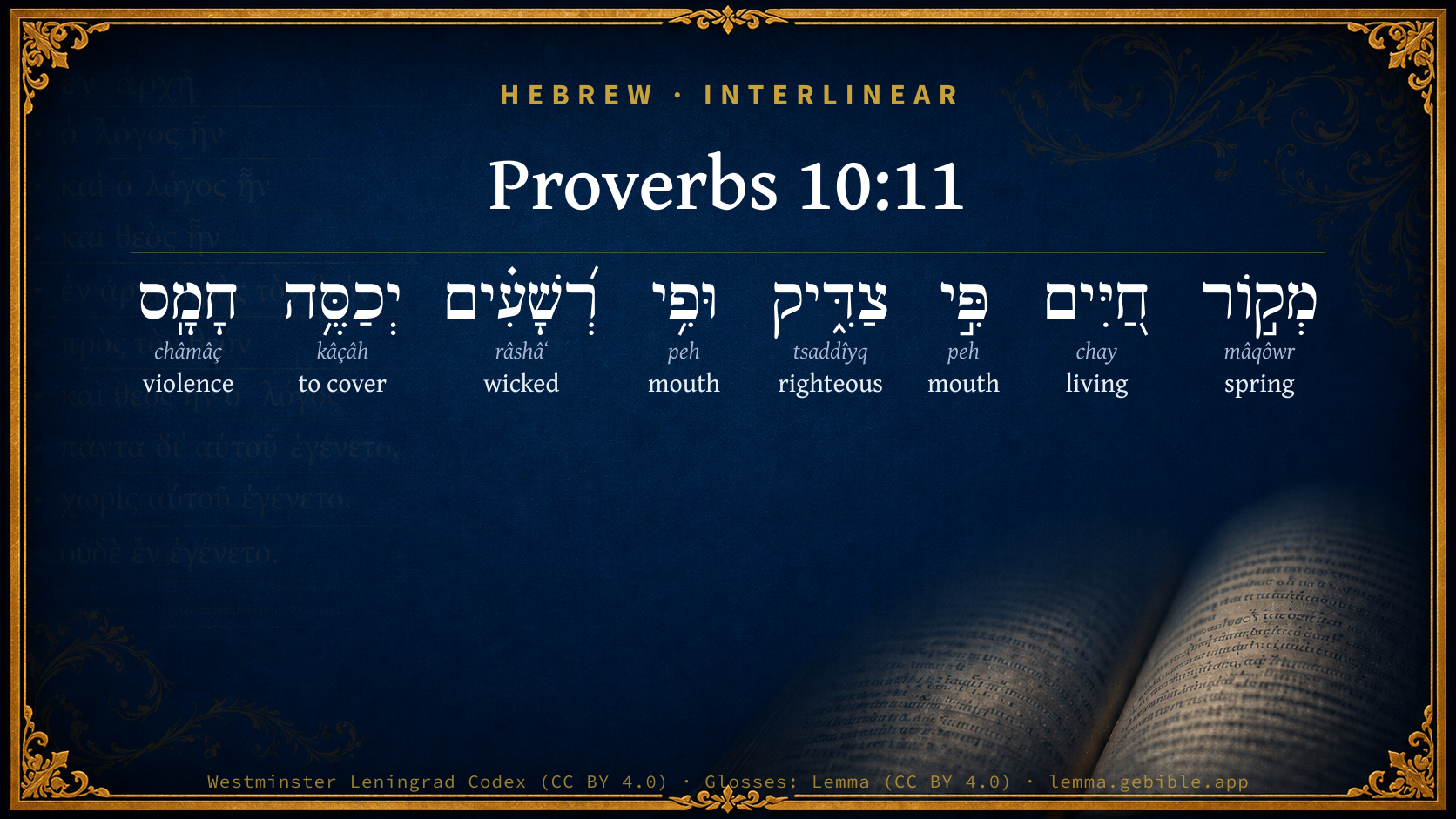
Hebrew (Westminster Leningrad Codex) Proverbs 10:11 appears in the Hebrew Old Testament. The text above is from the Westminster Leningrad Codex. Each word links to its Strong’s number, a concise gloss, and parsing drawn from the Open Scriptures Hebrew Bible morphology. Click any word for its full Brown-Driver-Briggs (BDB) entry.
Download image
Cite this verse

Proverbs 10:11 (World English Bible). Public Domain. Lemma interlinear Bible study tool, https://lemma.gebible.app/v/proverbs/10/11.

Show BibTeX & RIS
BibTeX
RIS
English Translation
The mouth of the righteous is a spring of life, But violence covers the mouth of the wicked.
World English Bible · Public Domain
Download a study sheet

One document with this verse’s original text, its word-by-word gloss line, the meaning frame, cross-references with their text, attributed commentary, and full source and license credits — printable, and it pastes into notes with its structure intact.

This verse Autodidact and up

Study sheet (.html) Plain text (.txt)

A passage Seminary Student

Up to 50 verses in one chapter. A passage sheet keeps up to 6 commentary sources and 12 cross-references per verse, in the order this page ranks them, and says so on the sheet whenever that leaves anything out. Ask for a single verse and you get the Autodidact verse sheet above.

Everything on this page stays free to read, with no account — the sheet is a download of what is already on screen, not access to it.

Want to remove ads? Support Godless Engineer
Compare translations 3

The same verse in 3 English versions, stacked beneath the original-language interlinear above. Click any original word for its lexicon entry.

Each is an independent rendering of the whole verse — the interlinear is not word-aligned to these translations.

Highlighted words mark where these versions differ — a whole-verse word diff, not a word-by-word alignment.

  • World English Bible Public Domain
    The mouth of the righteous is a spring of life, But violence covers the mouth of the wicked.
  • King James Version Public Domain
    The mouth of a righteous man is a well of life: but violence covereth the mouth of the wicked.
  • unfoldingWord Literal Text CC BY-SA 4.0
    A fountain of life the mouth of the righteous one, but the mouth of the wicked ones covers violence.

unfoldingWord Literal Text — © unfoldingWord, licensed CC BY-SA 4.0. Word-aligned USFM3 via Door43 (git.door43.org/unfoldingWord/en_ult).

Versions to compare (up to 4)

3 of 4 selected

Show all 18 translations

Every available English version of this verse, each an independent rendering of the whole verse.

  • World English Bible Public Domain
    The mouth of the righteous is a spring of life, But violence covers the mouth of the wicked.
  • Berean Standard Bible Public Domain
    The mouth of the righteous is a fountain of life, but the mouth of the wicked conceals violence.
  • Majority Standard Bible Public Domain
    The mouth of the righteous is a fountain of life, but the mouth of the wicked conceals violence.
  • King James Version Public Domain
    The mouth of a righteous man is a well of life: but violence covereth the mouth of the wicked.
  • American Standard Version (1901) Public Domain
    The mouth of the righteous is a fountain of life; But violence covereth the mouth of the wicked.
  • Revised Version (1885) Public Domain
    The mouth of the righteous is a fountain of life: but violence covereth the mouth of the wicked.
  • Geneva Bible (1599) Public Domain
    The mouth of a righteous man is a welspring of life: but iniquitie couereth the mouth of the wicked.
  • Douay-Rheims (1899) Public Domain
    The mouth of the just is a vein of life: and the mouth of the wicked covereth iniquity.
  • Young's Literal Translation Public Domain
    A fountain of life `is' the mouth of the righteous, And the mouth of the wicked cover doth violence.
  • Literal Standard Version CC BY-SA 4.0
    A fountain of life [is] the mouth of the righteous, || And the mouth of the wicked covers violence.
  • Unlocked Literal Bible CC BY-SA 4.0
    The mouth of the righteous person is a water spring of life, but the mouth of the wicked covers up violence.
  • unfoldingWord Literal Text CC BY-SA 4.0
    A fountain of life the mouth of the righteous one, but the mouth of the wicked ones covers violence.
  • Darby Bible Public Domain
    The mouth of a righteous [man] is a fountain of life; but the mouth of the wicked covereth violence.
  • World Messianic Bible Public Domain
    The mouth of the righteous is a spring of life, but violence covers the mouth of the wicked.
  • Webster's Bible Public Domain
    The mouth of a righteous man is a well of life: but violence covereth the mouth of the wicked.
  • Free Bible Version CC BY-SA 4.0
    What good people say is a spring that gives life, but what the wicked say hides their violent nature.
  • Bible in Basic English Public Domain
    The mouth of the upright man is a fountain of life, but the mouth of the evil-doer is a bitter cup.
  • JPS Tanakh (1917) Public Domain
    The mouth of the righteous is a fountain of life; but the mouth of the wicked concealeth violence.

Literal Standard Version (2020), Covenant Press — licensed CC BY-SA 4.0. Text via the HelloAO Bible API (eBible.org). Unlocked Literal Bible (unfoldingWord) — licensed CC BY-SA 4.0. Text via the HelloAO Bible API (eBible.org). unfoldingWord Literal Text — © unfoldingWord, licensed CC BY-SA 4.0. Word-aligned USFM3 via Door43 (git.door43.org/unfoldingWord/en_ult). Free Bible Version, Dr. Jonathan Gallagher — licensed CC BY-SA 4.0. Text via the HelloAO Bible API (eBible.org).

Word by word

More ways to search: Search by grammar → Find every occurrence → Compare this word →

Practice this passage: Drill this verse → Learn its vocabulary →

About this verse

These counts appear in no published source. They are computed here, from the morphology-tagged text and Lemma’s own curated glosses. What Lemma adds →

8
words
7
distinct lemmas
Wisdom
section

Notable vocabulary

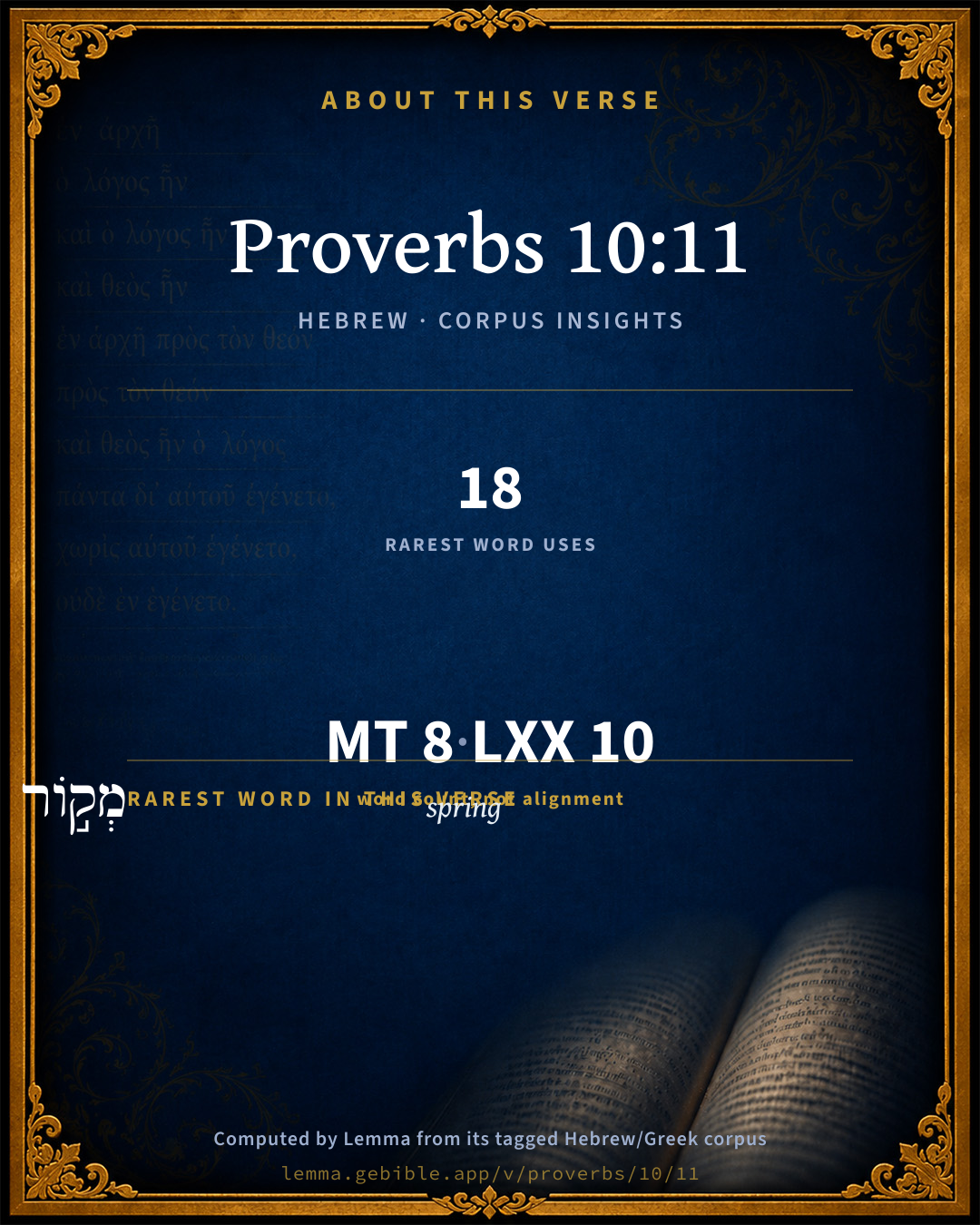
The rarest word here is מְק֣וֹר spring H4726 — appearing just 18 times in the whole Hebrew Bible.

Shared distinctive vocabulary

מְק֣וֹר spring H4726 occurs in 17 verses of the Hebrew Bible. Also found in:

Grammatical profile

  • 1 verb
  • 5 nouns
  • 2 adjectives

Verb forms

  • יְכַסֶּ֥ה Piel · Imperfect

Repetition

A word recurs within this verse — often emphatic in Hebrew:

  • פִּ֣י mouth H6310 ×2

Hebrew & Septuagint length

In English translation the verse runs 18 words from the Hebrew and 22 from the Septuagint (LXX English) — closely comparable.

A rough comparison of the two English renderings, which tokenize alike — not a word-level alignment.

Word counts can differ between the Hebrew and the Greek without any difference in meaning — e.g. the Hebrew direct-object marker אֵת has no separate Greek word, and Greek often adds the article ὁ.

In the original languages it is 8 Hebrew tokens and 10 Greek tokens — but the two are counted differently (Hebrew bundles its prefixes and suffixes into one token; the Greek is in lemma form), so that isn’t a like-for-like length.

Cross-references

14

Topical passages linked to Proverbs 10:11 in the Treasury of Scripture Knowledge — connected by theme and wording, ordered by reader-vote popularity; previews shown in the World English Bible.

  • Proverbs 13:14 The teaching of the wise is a spring of life, To turn from the snares of death.
  • Ephesians 4:29 Let no corrupt speech proceed out of your mouth, but such as is good for building up as the need may be, that it may give grace to those who hear.
  • Proverbs 10:6 Blessings are on the head of the righteous, But violence covers the mouth of the wicked.
  • Proverbs 10:20–21 The tongue of the righteous is like choice silver. The heart of the wicked is of little worth.
  • Proverbs 18:4 The words of a man's mouth are like deep waters. The fountain of wisdom is like a flowing brook.
  • Psalms 37:30–31 The mouth of the righteous talks of wisdom. His tongue speaks justice.
  • Proverbs 10:32 The lips of the righteous know what is acceptable, But the mouth of the wicked is perverse.
  • Proverbs 15:7 The lips of the wise spread knowledge; Not so with the heart of fools.
  • Proverbs 16:22–24 Understanding is a fountain of life to one who has it, But the punishment of fools is their folly.
  • Proverbs 20:15 There is gold and abundance of rubies; But the lips of knowledge are a rare jewel.
  • Ecclesiastes 10:12–14 The words of a wise man's mouth are gracious; but a fool is swallowed by his own lips.
  • Matthew 12:34–37 You offspring of vipers, how can you, being evil, speak good things? For out of the abundance of the heart, the mouth speaks.
  • James 3:5–8 So the tongue is also a little member, and boasts great things. See how a small fire can spread to a large forest!
  • Psalms 107:42 The upright will see it, and be glad. All the wicked will shut their mouths.

Cross-references courtesy of OpenBible.info (CC BY 4.0).

Hebrew and Greek witnesses Masoretic Hebrew ↔ Greek Septuagint

The same verse in the two great witnesses to the Old Testament, shown verse-for-verse.

These are two independent witnesses, not word-aligned to each other, and the Septuagint is shown in lemma (dictionary) form.

Hebrew Proverbs 10:11 Masoretic · Westminster Leningrad Codex

מְק֣וֹר חַ֭יִּים פִּ֣י צַדִּ֑יק וּפִ֥י רְ֝שָׁעִ֗ים יְכַסֶּ֥ה חָמָֽס

The mouth of the righteous is a spring of life, But violence covers the mouth of the wicked.

World English Bible · Public Domain

Greek LXX Proverbs 10:11 Septuagint · lemma form

πηγή ζωή ἐν χείρ δίκαιος στόμα δέ ἀσεβής καλύπτω ἀπώλεια

There is a fountain of life in the hand of a righteous man; but destruction shall cover the mouth of the ungodly.

LXX2012 (modern English Septuagint) · Public Domain

On this verse, The Pulpit Commentary discusses the Septuagint’s reading. Read the note in Commentary ↓

Hebrew: Westminster Leningrad Codex (CC BY 4.0). Greek: Septuagint (public domain); English from LXX2012 (modern English Septuagint) (Public Domain). How the Septuagint differs from the Hebrew →

Commentary

Notes on Proverbs 10:11 from classic Christian and Jewish commentators (each source and its license shown beneath its notes). The classic Christian expositions comment on the surrounding passage and are grouped to its opening verse, so a note may address several verses; the Jewish commentaries on the Tanakh (Rashi and others) are per-verse, so they appear only where the commentator wrote on this verse.

Lemma curates 59 commentaries, every one of them public domain or Creative Commons licensed, each selected and text-cleaned for this edition rather than reprinted as found. About our sources →

Trapp's Complete Commentary

John Trapp

Pro 10:11 The mouth of a righteous [man is] a well of life: but violence covereth the mouth of the wicked.

Ver. 11. The mouth of a righteous man is a well of life.] Vena vitae os iusti. A fountain runs after it hath run, so doth a good man’s mouth incessantly utter the "words of truth and soberness," {Act 25:26} more perennis aquae. See the reason hereof: {Psa 37:30-31} the "law of his God is in his heart," that "law of his mind," {Rom 7:23} that counterpane of the written law, {Heb 8:10} that "good treasure" {Mat 12:35} that is daily drawn out, and yet not diminished. Salienti aquarum fonti undas si tollas, nec exhauritur, nec extenuatur, sed dulcesit. Take water from a well, it loses nothing, but becomes better and sweeter.

But violence covereth.] {See Trapp on "Pro 10:6"}

John Trapp, A Commentary or Exposition upon All the Books of the Old and New Testament (1647–1656) — public domain. Text from a community e-Sword module.

The Biblical Illustrator

Joseph S. Exell

Pro_10:11

The mouth of the righteous is a well of life.

Streams in the desert

A man who receives, professes, and obeys the truth, is like a well of water; while a man who retains the form of religion, but denies its power, is like a waterless well.

I. The true believer is like a well. The likeness between the natural and the spiritual may be thus traced.

1. In the manner of its flow. It is an overflow. When the well flows for the benefit of others, itself is full. Itself is satisfied, and out of its abundance it flows over to satisfy the wants of others. When a Christian has not much for himself, he has nothing for his neighbours. As the full well must run over, so the satisfied soul must make known in some form the Saviours love.

2. In the effects of its overflow. It refreshes and fertilises the surrounding barrenness. Travellers always take special notice of the effects produced by springs on certain spots in the desert. They make oases. So the neighbourhood feels the effect of the presence of Christians. There cannot be a lively Christian in a godless family, or a lively Church in a godless neighbourhood, without some spiritual commotion among those who are near.

3. As to source whence the well gets its supply. Though the water springs up from beneath, the supply has come down from above. So the Christian says, All my springs are in Thee. The facts in nature are well known. For Christians, all depends on the supply they get from a covenant God. The Spirit poured out reaches by hidden paths the veins of the heart, and fills it--then it can overflow in blessing. This truth is taught as a doctrine (Joh_7:37-39), and manifested in the experience of the disciples (Luk_9:54).

II. A hypocrite is like a well without water. He who has neither the profession nor the power, is not a well at all. He who has the profession but not the power is a well, but there is no water in it. Counterfeit Christians are not simply useless, they are destroyers (compare Jud_1:12 : Clouds without water). Christian professors need to see well to it that they are not deceiving and destroying their neighbours. Their profession constitutes them wells, but what if they are wells without water? When God finds us dry, we have cause to fear lest He visit us in judgment, and cut off from us our own supply. Practical lessons:

1. Some wells are not empty, and yet are as useless as if they were. They are filled with bitter water. Some professing Christians with knowledge and correct principles, nevertheless are of an angry, biting, censorious, malicious, proud, selfish spirit. Let Christians imitate the gentleness as well as the faithfulness of Christ.

2. Some wells are not empty, and yet are as useless as if they were. They are filled, or nearly filled, with stagnant water. The water is stagnant, for none has found its way in for a long time from the secret channels, and none has run out over the brim. Secret, earnest, constant getting of the fulness that is hid in Christ is the only sure way of being blessed yourself and becoming s blessing to others. (Christian Treasury.)

The Biblical Illustrator, edited by Joseph S. Exell (c. 1880s–1900s) — public domain. Text from a community e-Sword module.

Joseph Benson's Commentary

Pro 10:11. The mouth of a righteous man is a well of life — Continually sending forth waters of life, or such words as are refreshing and useful, both to himself and others, both for the preserving of natural life, the promoting of spiritual, and ensuring of eternal life; but violence, &c. — See on Pro 10:6. As the mouth of a good man speaketh those things which are good and beneficial to himself and others, so the mouth of a wicked man uttereth violence, or injury, or things injurious to others, which at last fall upon himself.

Joseph Benson's Commentary on the Old and New Testaments (1811–1818) — public domain. Text from a community e-Sword module.

The Preacher's Complete Homiletical Commentary

Joseph S. Exell (gen. ed.)

MAIN HOMILETICS OF THE PARAGRAPH.—Pro_10:6-7; Pro_10:11

THE WAY TO PRESENT BLESSEDNESS AND FUTURE FAME

We connect the first and last of these verses, because the latter clause in both is the same.

I. Opposite characters revealed by a great contrast in speech (Pro_10:11). When a righteous man opens his mouth, it is as if the cover was removed from a pure, clear well of water. He has no evil intentions to conceal: his words are an index to his heart. By them men may read his thoughts with the same ease as they can see what is at the bottom of a clear spring of water. There is medicinal virtue in them—they heal as well as refresh the spirits of men. What a well of life have the words of Christ been for centuries to millions of the human race. But a wicked man cannot let all the thoughts of his heart be laid open to the light of day. His “mouth conceals injury” (see Critical Notes). He has plans which are not devised for the good of his fellow-creatures, and he must use his words not to reveal, but to hide what is in his mind. And if he lets his tongue loose, and permits his thoughts to flow out into words, they do not bless his hearers, but are like a poisonous stream, carrying moral death wherever they flow.

II. Character yields a present blessing or a present curse. “Blessings are upon the head of the righteous,” etc. A man’s present comfort within himself, and the inheritance of good-will he now receives from his fellow-men, as well as the favour of God, are all dependent upon what he is in his character. The kingdom of heaven is now inherited by him. All the beatitudes uttered by our Lord speak of a present blessedness. “Blessed are the poor in spirit,” etc. The opposite truth is not expressed, but it is implied. Curses, not blessings, are the present inheritance of the man whose “mouth is covered by violence.”

III. Character determines the nature of our future fame (Pro_10:7).

1. The memory of the righteous is blessed, because what they did upon the earth is the means of bringing blessings upon others after they are gone. Many a son has received kindness for the sake of the righteousness of his father. God blesses the children for the father’s sake. “I will make him prince all the days of his life for David my servant’s sake, whom I chose, because he kept my commandments and my statutes” (1Ki_11:34). “Fear not,” said God to Isaac, for I am with thee, and will bless thee, and multiply thy seed for my servant Abraham’s sake (Gen_26:24). Cyrus was raised up to deliver Israel for Jacob’s sake (Isa_45:4). Men can but bless the memory of those whose past godliness is the means of bringing blessings upon them in the present.

2. The just man’s memory is blessed because he leaves behind him reproductions of his own character. All life will reproduce itself. After a tree has decayed and gone to dust, others will be in full life and vigour that were seedlings of the old tree. Intellectual life is reproductive. The man of mighty genius leaves disciples to carry out his ideas after he is gone. Good men are the parents of good children, or make other men good by their words and lives. “They that dwell under his shadow shall return,” and “they shall grow as the vine” (Hos_14:7). The good must be held in blessed remembrance so long as there are those upon earth who are the reproductions of their character.

3. The memory of some is blessed because they did deeds which never can be reproduced by others—which have left a fragrance behind them which can never be repeated. The one act of Abraham, when he prepared to offer up Isaac at God’s command, can never be repeated; but is the one which, above all his other acts of faith, causes him to be held in everlasting remembrance. And so it has been with many of the leaders of the Church in all ages. They have performed acts of godly heroism which we cannot imitate, but of which we reap the reward, and for which we bless their memory. Especially is this true of Him who is pre-eminently the Holy One and the Just, whose glorious “name is blessed for ever” (Psa_72:19), because “He endured the cross and despised the shame.” But the converse of all this is the lot of the wicked. We can but remember them when we are brought face to face with the evil they have left behind them; but we turn from the remembrance as we turn from some offensive putrid object, while the memory of the just is as a sweet savour. Contrast the feelings with which Christendom now regards the emperors of Rome and the fishermen of Galilee.

OUTLINES AND SUGGESTIVE COMMENTS

Pro_10:6. Not one, but many blessings are on the head of the righteous: the blessing of peace, the blessing of plenty, the blessing of health, and the blessing of grace, shall be upon them. The precious ointment of the Lord’s favour or blessing shall so be poured upon their heads as that it shall not here stay, but run down to the rest of the members of their bodies, and enter into their very hearts.—Muffet.

“Blessings:” not simply good things, but good things bestowed by another; not simply good things bestowed by another, but divinely bestowed as sacred benedictions. “Blessings” are for the righteous exclusively; that is, for no one else. “For the head;” not the mouth, not the hand; because often without either’s agency. “On his head;” because unconsciously, and sometimes even when asleep.—Miller.

Pro_10:7. The memory of the just is blessed

(1) because of his winning friendship;

(2) because of his unfeigned piety;

(3) because of his steadfast patience;

(4) because of his noble, public-spirited activity.—Ziegler, from Lange’s Commentary.

And what signifies an empty name? It brings honour to God, and prolongs the influence of his good example who has left it. His good works not only follow him, but live behind him. As Jeroboam made Israel to sin after he was dead, so the good man helps to make others holy whilst he is lying in the grave. Should it so happen that his character is mistaken in the world, or should his name die out among men, it shall yet be had in everlasting remembrance before God; for never shall those names be erased from the Lamb’s book of life, which were written in it from the foundation of the world.—Lawson.

Not what he remembers, but what is remembered of him. He blesses after he is dead. So does the wicked, but, like most other growths in nature, by his decay. “Name;” that which is known of a man. The “name of God” is that which may be known of God. “The memory of the righteous,” viz., of the Church of God, is that which propagates her, and causes her to hand down her strength. Our walk about Zion, our telling her towers, our marking her bulwarks, is for this grand aim, among the rest, that we may tell to the generation following (Psa_48:12-13).—Miller.

I. The memory of the just is blessed, self-evidently so, for the mind blesses it and reverts to it with complacency, mingled with solemnity,—returns to it with delight from the sight of the living evil in the world, sometimes even prefers this silent society to the living good. They show in a most evident and pleasing manner the gracious connection which God has constantly maintained with a sinful world. His uninterrupted connection with it by justice and sovereign power has been manifest in mighty evidence: but His saints have been the peculiar illustration of His grace, His mercy, acting on this world. II. It is so, when we consider them as practical illustrations, verifying examples of the exellence of genuine religion; that it is a noble thing in human nature, and makes, and alone makes, that nature noble;—that, whatever scoffers may say, or the vain world pretend to disbelieve, here is what has made such men as nothing else, under heaven, could or can. III. Their memory is blessed while we regard them as diminishing to our view the repulsiveness and horror of death. Our Lord’s dying was the fact that threw out the mightiest agency to this effect. But, in their measure, His faithful disciples have done the same. When we contemplate them as having prepared for it with a calm resolution—as having approached it—multitudes with a calm resignation and fortitude, and very many with an animated exultation;—as having passed it, and emerged in brightness beyond its gloom—they seem to shine back through the gloom, and make the shade less thick. IV. It is blessed, also, as combined with the whole progress of God upon the earth,—with its living agency throughout every stage. He has never, and nowhere, had a visible cause in the world, without putting men in trust with it.… Think of what men have been employed and empowered to do in the propagation of truth, in the incessant warfare against evil, in the exemplification of all the virtues by which he could be honoured.—John Foster.

Pro_10:11. A Church is but a body of righteous men. What would the world do without the Church? The influences of a Church, and that a land is ruined without a Church, and that one generation hands on the worship of God to another, all are illustrations on a grand scale of how the mouth of the righteous is a fountain of life. A good man will constantly be doing good to others. But “wrong covers the mouth of the wicked,” so that he can give no blessing; so keeps him from any possible usefulness, that he cannot utter good, or make his mouth, as the righteous can, “a fountain of life” to all about him.—Miller.

In a hot summer’s day I was sailing with a friend in a tiny boat on a miniature lake, enclosed like a cup within a circle of steep, bare Scottish hills. On the shoulders of the brown, sun-burnt mountain, and full in sight, was a well, with a crystal stream trickling over its lip, and making its way down towards the lake. Around the well’s mouth, and along the course of the rivulet, a belt of green stood out in strong contrast with the iron surface of the rock all around. “What do you make of that?” said my friend, who had both an open eye to read the book of Nature and a heart all aglow with its lessons of love. We soon agreed as to what should be made of it. It did not need us to make it into anything. There it was, a legend clearly printed by the finger of God on the side of these silent hills, teaching the passer-by how needful a good man is, and how useful he may be in a desert world.… The Lord looks down, and men look up, expecting to see a fringe of living green around the lip of a Christian’s life-course.—Arnot.

The Preacher's Complete Homiletical Commentary (gen. ed. Joseph S. Exell; Funk & Wagnalls, c. 1892) — public domain (pre-1929). A full-Bible homiletical/sermon-outline anthology covering 65 of 66 books (2 John is absent from the source module). Text from a community e-Sword module.

Tyndale Open Study Notes

Tyndale Open Resources

10:11 As a fountain provides water that sustains life, the words of the godly give life to those who hear them. In contrast, the violent intentions concealed in the words of the wicked bring death (see also 10:6; Jas 3:1-12).

Tyndale Open Study Notes — © Tyndale Open Resources, licensed CC BY-SA 4.0. Text via the HelloAO Bible API.

Matthew Henry's Commentary

See here, 1. How industrious a good man is, by communicating his goodness, to do good with it: His mouth, the outlet of his mind, is a well of life; it is a constant spring, whence issues good discourse for the edification of others, like streams that water the ground and make it fruitful, and for their consolation, like streams that quench the thirst of the weary traveller. It is like a well of life, that is pure and clean, not only not poisoned, but not muddled, with any corrupt communication. 2. How industrious a bad man is, by concealing his badness, to do hurt with it: The mouth of the wicked covers violence, disguises the designed mischief with professions of friendship, that it may be carried on the more securely and effectually, as Joab kissed and killed, Judas kissed and betrayed; this is his sin, to which the punishment answers (Pro 10:6): Violence covers the mouth of the wicked; what he got by violence shall by violence be taken from him, Job 5:4, Job 5:5.

Matthew Henry's Commentary on the Whole Bible (1708–1710) — public domain (CC PDM 1.0). Text via the HelloAO Bible API.

Jamieson, Fausset & Brown

Robert Jamieson, A. R. Fausset & David Brown

a well--or, "source" of good to himself and others (Joh 7:37-38). On last clause, see on Pro 10:6.

Jamieson, Fausset & Brown — Commentary Critical and Explanatory on the Whole Bible (1871) — public domain (CC PDM 1.0). Text via the HelloAO Bible API.

Adam Clarke's Commentary

Verse 11. The mouth of a righteous man is a well of life] מקור חיים mekor chaiyim, is the vein of lives; an allusion to the great aorta, which conveys the blood from the heart to every part of the body. The latter clause of this verse is the same with that of Pr 10:6.

Adam Clarke's Commentary on the Bible (1810–1826) — public domain. Text from a community e-Sword/MySword module.

Ellicott's Commentary for English Readers

(11) Violence covereth the mouth of the wicked.—If these words are to be taken as in Pro_10:6, then the first line must mean that the righteous man speaks to his own profit. But perhaps it will be better here to interpret the second line in the sense of “the mouth of the godless hideth violence,” i.e., it conceals under deceitful words the mischief intended for others. With God is the “well of life” (Psa_36:9; Rev_22:17); and in like manner the “mouth of the righteous” brings comfort and refreshment to the weary and heavy laden.

A Bible Commentary for English Readers, edited by Charles John Ellicott (1878–1897) — public domain. Text from a community e-Sword module.

The Cambridge Bible for Schools and Colleges

gen. ed. J. J. S. Perowne

11. violence covereth &c.] See Pro_10:6, note. The former (a) of the meanings suggested there best suits the parallelism here.

The Cambridge Bible for Schools and Colleges (gen. ed. J. J. S. Perowne; Cambridge University Press, 1878–1918) — public domain. Text from a community e-Sword module.

John Gill's Exposition

The mouth of a righteous man is a well of life,.... Like a fountain of living water, continually running and flowing with water, wholesome, reviving, and refreshing; so the righteous man's mouth, out of the abundance of his heart, overflows with good things, which minister grace to the hearers, and are for the use of edifying; things that are pleasant and profitable, grateful and acceptable, comforting, refreshing, and pleasing, and which tend to the good of the life that now is, and that which is to come;

but violence covereth the mouth of the wicked; so that nothing comes out of it but what is pernicious and hurtful; what savours of rapine and violence; nothing but lying and deceit, cursing and swearing, and such like filthy and corrupt communication; See Gill on Pro 10:6. The Targum is, "the mouth of the ungodly covers injury"; which is meditated in the heart; so the Vulgate Latin version.

John Gill's Exposition of the Whole Bible (1746–1763) — public domain (CC PDM 1.0). Text via the HelloAO Bible API.

Albert Barnes' Notes on the Bible

Compare Pro 10:6. Streams of living water (like the “fountain of living waters” of Jer 2:13; Jer 17:13, and the “living water” of Joh 4:10), flow from the mouth of the righteous, but that of the wicked is “covered,” i. e., stopped and put to silence by their own violence.

Albert Barnes' Notes on the Bible (1834–1885) — public domain. Text from a community e-Sword/MySword module.

Haydock's Catholic Bible Commentary

Life. Or a never-failing spring, fons perennis, as we should speak in Latin, chap. xiii. 14., and Apocalypse vii. 17.

George Leo Haydock (1774–1849), Haydock's Catholic Family Bible and Commentary, 1859 edition — public domain. Excludes Psalms (Douay-Rheims chapter numbering differs from Protestant) and Deuterocanonical books (Catholic canon only).

Matthew Poole's English Annotations

A well of life; continually sending forth waters of life, or such good and wholesome words as are very refreshing and useful, both to themselves and others, for the preserving of their natural life, and for the promoting of their spiritual and eternal life. We have the same phrase Psa 36:9. Violence covereth the mouth of the wicked; the same words were used before, Pro 10:6, where see the notes; and they may be understood in the same sense here, and the opposition of this clause to the former may be conceived thus: As the mouth of a good man speaketh those things which are good and beneficial to himself and others, so the mouth of the wicked uttereth violence, or injury, or things injurious to others. which at last fall upon himself. But it is no new thing for the same words and phrases to be taken in different senses in the same chapter, and sometimes in the same verse, as Mat 8:22, and elsewhere; and therefore these words may here be, and are by many, translated and interpreted thus, the mouth of the wicked covereth (i.e. concealeth) violence or mischief, which he plotteth against others. And so here is a double opposition between the righteous and the wicked; first in the contrary effects, the former causeth life, the latter mischief and death; and secondly in the manner of producing them, the righteous doth it by uttering his words, and the wicked doth it by concealing his mind.

Matthew Poole's English Annotations on the Holy Bible (1683–1685) — public domain. Text from a community e-Sword/MySword module.

Whedon's Commentary on the Bible

Daniel D. Whedon

11. A well of life — Comp, Pro_13:14; Pro_18:4. A fountain continually sending forth refreshing and wholesome speech. But violence, etc. — This is the same as the latter clause of Pro_10:6, which see.

Covereth — Perhaps the meaning of the word here is over-spreads, spreads abroad, or covers over, as the waters do the sea, in which the idea of abundance exists. The verb is in the intensive form. If, with some, we take pi, “mouth,” as the nominative, we can make out the antithesis; but the mouth of the wicked covers over with (spreads abroad) violence, injury; that is, does great injury; in opposition to the good which is done by the mouth of the righteous. On first clause compare Psa_37:30; Eph_4:29; Ecc_10:12; Mat_12:34; Jas_3:5-6.

Daniel D. Whedon (gen. ed.), Commentary on the Old and New Testaments (1874–1909) — public domain. Text from a community e-Sword module.

The Pulpit Commentary

A well of life. (Pro_13:14:18:4) The good man utters words of wisdom, comfort, and edification. God himself is said to have "the well of life", (Psa_36:9) and to be "the Fountain of living waters": (Jer_2:13) and the holy man, drawing from this supply, sheds life and health around. The second clause should be takes as in Ver. 6, but the mouth of the wicked concealeth violence, the contrast being between the open usefulness of the good man"s words and the harmful reticence of the malicious sinner. The Septuagint has, "A fountain of life is in the hand of the righteous; but destruction shall cover the mouth of the wicked." This is explained to mean that a good man"s words and actions tend to spiritual health; a bad man"s words bring down sorrow and punishment.

Vers. 11-14. A fourfold opposition.

I SPEECH THAT QUICKENS AND SPEECH THAT KILLS. (Ver. 11)

1. The speech of the wise and good is sound, "seasoned with salt;" that of the wicked is hollow or else poisonous.

2. The former edifies, builds up and strengthens the good principle in the minds of those who convene with him; the bluer destroys the good, and sows evil in its stead.

II QUARRELSOMENESS AND AMIABILITY. (Ver. 12; see on Pro_6:14) The former begets evil, increases that already existing, inflames wounds lets nothing pass that may serve as fuel to its fire. The latter puts an end to much evil, prevents the rise of more, soothes every wound, and mitigates every mischief. The former is ever dividing, the latter reconciling. They undo one another"s work; but love in the end prevails. (Pro_17:9 1Co_13:4 Jam_5:20 1Pe_4:8)

III THE GRACE OF WISDOM AND THE DISGRACE OF FOLLY. (Ver. 13) The pure eloquence of the good man attracts admiration and wins confidence; while the fallacies of the pretender, the spurious rhetoric of the insincere certain to be exposed and castigated. The life of the, House of Commons, or of any great assembly, furnishes constant illustrations.

IV PRUDENT RESERVE AND PERNICIOUS LOQUACITY. (Ver. 14) There is a time end place for silence, the wise man knows both for the recovery of his own thoughts, and for the opportunity of watching others. By a bold figure of speech, it may often be that silence is the greatest eloquence. In many instances we think we have produced no effect, have not committed ourselves to the expression of opinion; on the contrary, our reserve has spoken. In all this lies a science and art of living. The fool does not see this; he is too self-absorbed to see anything that passes in others" minds, or too unsympathetic to feel; and hence blurts out things that had better have been left unsaid, hurts sensibilities, blackens reputations, causes false positions for himself and others.

1. The heart must be watched. There is no other source of pleasing, gentle manners, nor of sound behaviour in society. Reserve and unreserve of the right kind are simply the government of the tongue by charity.

2. The tongue must be watched. And regulated by good models of Conversation. Never must it be forgotten how much we learn by imitation. J.

The Pulpit Commentary (1880–1919), ed. H.D.M. Spence-Jones & Joseph S. Exell — public domain. Text from a community e-Sword module.

Keil & Delitzsch

C. F. Keil & F. Delitzsch

Another proverb, similar to the half of Pro 10:6 :

A fountain of life is the mouth of the righteous;

But the mouth of the godless hideth violence.

If we understand 11b wholly as 6b: os improborum obteget violentia, then the meaning of 11a would be, that that which the righteous speaks tends to his own welfare (Fl.). But since the words spoken are the means of communication and of intercourse, one has to think of the water as welling up in one, and flowing forth to another; and the meaning of 11b has to accommodate itself to the preceding half proverb, whereby it cannot be mistaken that חמס (violence), which was 6b subj., bears here, by the contrast, the stamp of the obj.; for the possibility of manifold windings and turnings is a characteristic of the Mashal. In the Psalms and Prophets it is God who is called מקור חיּים, Psa 36:10; Jer 2:13; Jer 17:13; the proverbial poetry plants the figure on ethical ground, and understands by it a living power, from which wholesome effects accrue to its possessor, Pro 14:27, and go forth from him to others, Pro 13:14. Thus the mouth of the righteous is here called a fountain of life, because that which he speaks, and as he speaks it, is morally strengthening, intellectually elevating, and inwardly quickening in its effect on the hearers; while, on the contrary, the mouth of the godless covereth wrong (violentiam), i.e., conceals with deceitful words the intention, directed not to that which is best, but to the disadvantage and ruin of his neighbours; so that words which in the one case bring to light a ground of life and of love, and make it effectual, in the other case serve for a covering to an immoral, malevolent background.

Keil & Delitzsch — Biblical Commentary on the Old Testament (1861–1891) — public domain (CC PDM 1.0). Text via the HelloAO Bible API. (Old Testament only.)

Bridges on Proverbs

Charles Bridges

The Indwelling Spirit — "a well of living water" — is the glorious privilege of the righteous. (Joh 4:14 ; Joh 7:38 .) Hence his mouth, replenished from the heavenly source, is a well of life, sending forth refreshing waters. (Pro 16:23 .) The precious talent of speech is thus consecrated to His service, "who made man’s mouth." "Grace in its measure is poured upon our lips" (Psa 45:2 ); and our "tongue" becomes "our glory." (Psa 57:8 ; Psa 108:1 .) Wit, originality, imagination may furnish ’the feast of reason, and the flow of soul.’ But how poor is this pleasure compared with the godly instruction — perhaps with little intellectual attraction — that pours forth from a well of life! Servant of God! honour your high privilege of thus ministering a blessing to the Church. (Pro 10:21 ; Pro 15:7 . Eph 4:29 .) Enlarge its exercise by increasing your spiritual store, and walking in closer fellowship with your God. What owe you to His grace, who hath made your mouth a well of life; while the violence of the wicked falls back upon themselves, and covers their mouth with confusion?

Charles Bridges, An Exposition of the Book of Proverbs (1846) — public domain. Text from a community e-Sword module.

Kretzmann's Popular Commentary

Paul E. Kretzmann

v. 11. The mouth of a righteous man is a well of life, on account of the cheerful and helpful utterances which proceed from it; but violence covereth the mouth of the wicked, he hides it for a while, but revenge will surely overtake him and give him the proper punishment for his malice.

Paul E. Kretzmann, Popular Commentary of the Bible (1921–1924) — public domain. Text from a community e-Sword module.

Rashi

Rabbi Shlomo Yitzchaki (Rashi)

The mouth of the righteous is a fountain of life, but the mouth of the wicked, etc. Their mouth conceals the violence that is in their heart, for they talk smoothly with their lips, but hatred is hidden in their heart. Now the interpretation of this verse is not the same as the above verse (8); the context is indicative of their meaning.

Rashi on the Tanakh — English translations: “The Judaica Press complete Tanach with Rashi, translated by A. J. Rosenberg” (CC BY 4.0); “Pentateuch with Rashi's commentary by M. Rosenbaum and A.M. Silbermann, 1929-1934” (public domain); “The Metsudah Tanach series, Lakewood, N.J” (CC BY 4.0); and “The Book of Joshua, Metsudah Publications, 1997” (CC BY 4.0). Text via Sefaria.

Lesson kit

Teaching starters — assembled from the data on this page, not authored interpretation. Every prompt links to the verse data it draws on. Edit before teaching.

Proverbs, in the Wisdom, opens this verse with 8 words (7 distinct Hebrew lemmas). Its most distinctive word is mâqôwr (“spring”). A historical commentator’s framing appears above. Read the whole chapter for the surrounding context.

Discussion questions

  1. What does “spring” (mâqôwr) contribute to the verse as a whole?
  2. Leviticus 12:7 shares the word «spring» with this verse. How do the two illuminate each other?
  3. “mouth” occurs 2× in this one verse. What is the effect of the repetition?
  4. These translations render this verse differently. What is at stake in choosing one wording over another?
  5. The verb «יְכַסֶּ֥ה» is Piel Imperfect. How does its form color the action?
  6. Reading how Trapp's Complete Commentary and The Biblical Illustrator read this verse, where do the two commentators agree and where do they part?

Things to notice

Reading settings

Reading text

Shown beneath each verse's original-language words.

Old Testament
Old Testament edition

Read the OT as the Masoretic Hebrew (MT) or the Greek Septuagint (LXX).

English shown for the Greek Septuagint (in the Hebrew ↔ Greek comparison).

Comparing translations? Open the Compare panel on any verse page to stack up to four side by side.