
Proverbs 13:5

Hebrew (Westminster Leningrad Codex) Proverbs 13:5 appears in the Hebrew Old Testament. The text above is from the Westminster Leningrad Codex. Each word links to its Strong’s number, a concise gloss, and parsing drawn from the Open Scriptures Hebrew Bible morphology. Click any word for its full Brown-Driver-Briggs (BDB) entry.
Download image
Cite this verse

Proverbs 13:5 (World English Bible). Public Domain. Lemma interlinear Bible study tool, https://lemma.gebible.app/v/proverbs/13/5.

Show BibTeX & RIS
BibTeX
RIS
English Translation
A righteous man hates lies, But a wicked man brings shame and disgrace.
World English Bible · Public Domain
Download a study sheet

One document with this verse’s original text, its word-by-word gloss line, the meaning frame, cross-references with their text, attributed commentary, and full source and license credits — printable, and it pastes into notes with its structure intact.

This verse Autodidact and up

Study sheet (.html) Plain text (.txt)

A passage Seminary Student

Up to 50 verses in one chapter. A passage sheet keeps up to 6 commentary sources and 12 cross-references per verse, in the order this page ranks them, and says so on the sheet whenever that leaves anything out. Ask for a single verse and you get the Autodidact verse sheet above.

Everything on this page stays free to read, with no account — the sheet is a download of what is already on screen, not access to it.

Want to remove ads? Support Godless Engineer
Compare translations 3

The same verse in 3 English versions, stacked beneath the original-language interlinear above. Click any original word for its lexicon entry.

Each is an independent rendering of the whole verse — the interlinear is not word-aligned to these translations.

Highlighted words mark where these versions differ — a whole-verse word diff, not a word-by-word alignment.

  • World English Bible Public Domain
    A righteous man hates lies, But a wicked man brings shame and disgrace.
  • King James Version Public Domain
    A righteous man hateth lying: but a wicked man is loathsome, and cometh to shame.
  • unfoldingWord Literal Text CC BY-SA 4.0
    A righteous hates a word of falsehood, but a wicked causes a stink and causes embarrassment.

unfoldingWord Literal Text — © unfoldingWord, licensed CC BY-SA 4.0. Word-aligned USFM3 via Door43 (git.door43.org/unfoldingWord/en_ult).

Versions to compare (up to 4)

3 of 4 selected

Show all 18 translations

Every available English version of this verse, each an independent rendering of the whole verse.

  • World English Bible Public Domain
    A righteous man hates lies, But a wicked man brings shame and disgrace.
  • Berean Standard Bible Public Domain
    The righteous hate falsehood, but the wicked bring shame and disgrace.
  • Majority Standard Bible Public Domain
    The righteous hate falsehood, but the wicked bring shame and disgrace.
  • King James Version Public Domain
    A righteous man hateth lying: but a wicked man is loathsome, and cometh to shame.
  • American Standard Version (1901) Public Domain
    A righteous man hateth lying; But a wicked man is loathsome, and cometh to shame.
  • Revised Version (1885) Public Domain
    A righteous man hateth lying: but a wicked man is loathsome, and cometh to shame.
  • Geneva Bible (1599) Public Domain
    A righteous man hateth lying wordes: but the wicked causeth slander and shame.
  • Douay-Rheims (1899) Public Domain
    The just shall hate a lying word: but the wicked confoundeth, and shall be confounded.
  • Young's Literal Translation Public Domain
    A false word the righteous hateth, And the wicked causeth abhorrence, and is confounded.
  • Literal Standard Version CC BY-SA 4.0
    The righteous hates a false word, || And the wicked causes abhorrence, and is confounded.
  • Unlocked Literal Bible CC BY-SA 4.0
    The righteous person hates lies, but a wicked person makes himself repugnant, and he does what is shameful.
  • unfoldingWord Literal Text CC BY-SA 4.0
    A righteous hates a word of falsehood, but a wicked causes a stink and causes embarrassment.
  • Darby Bible Public Domain
    A righteous [man] hateth lying; but the wicked maketh himself odious and cometh to shame.
  • World Messianic Bible Public Domain
    A righteous man hates lies, but a wicked man brings shame and disgrace.
  • Webster's Bible Public Domain
    A righteous man hateth lying: but a wicked man is lothsome, and cometh to shame.
  • Free Bible Version CC BY-SA 4.0
    Good people hate lies, but the wicked cause a stink and bring disgrace.
  • Bible in Basic English Public Domain
    The upright man is a hater of false words: the evil-doer gets a bad name and is put to shame.
  • JPS Tanakh (1917) Public Domain
    A righteous man hateth lying; but a wicked man behaveth vilely and shamefully.

Literal Standard Version (2020), Covenant Press — licensed CC BY-SA 4.0. Text via the HelloAO Bible API (eBible.org). Unlocked Literal Bible (unfoldingWord) — licensed CC BY-SA 4.0. Text via the HelloAO Bible API (eBible.org). unfoldingWord Literal Text — © unfoldingWord, licensed CC BY-SA 4.0. Word-aligned USFM3 via Door43 (git.door43.org/unfoldingWord/en_ult). Free Bible Version, Dr. Jonathan Gallagher — licensed CC BY-SA 4.0. Text via the HelloAO Bible API (eBible.org).

Word by word

More ways to search: Search by grammar → Find every occurrence → Compare this word →

Practice this passage: Drill this verse → Learn its vocabulary →

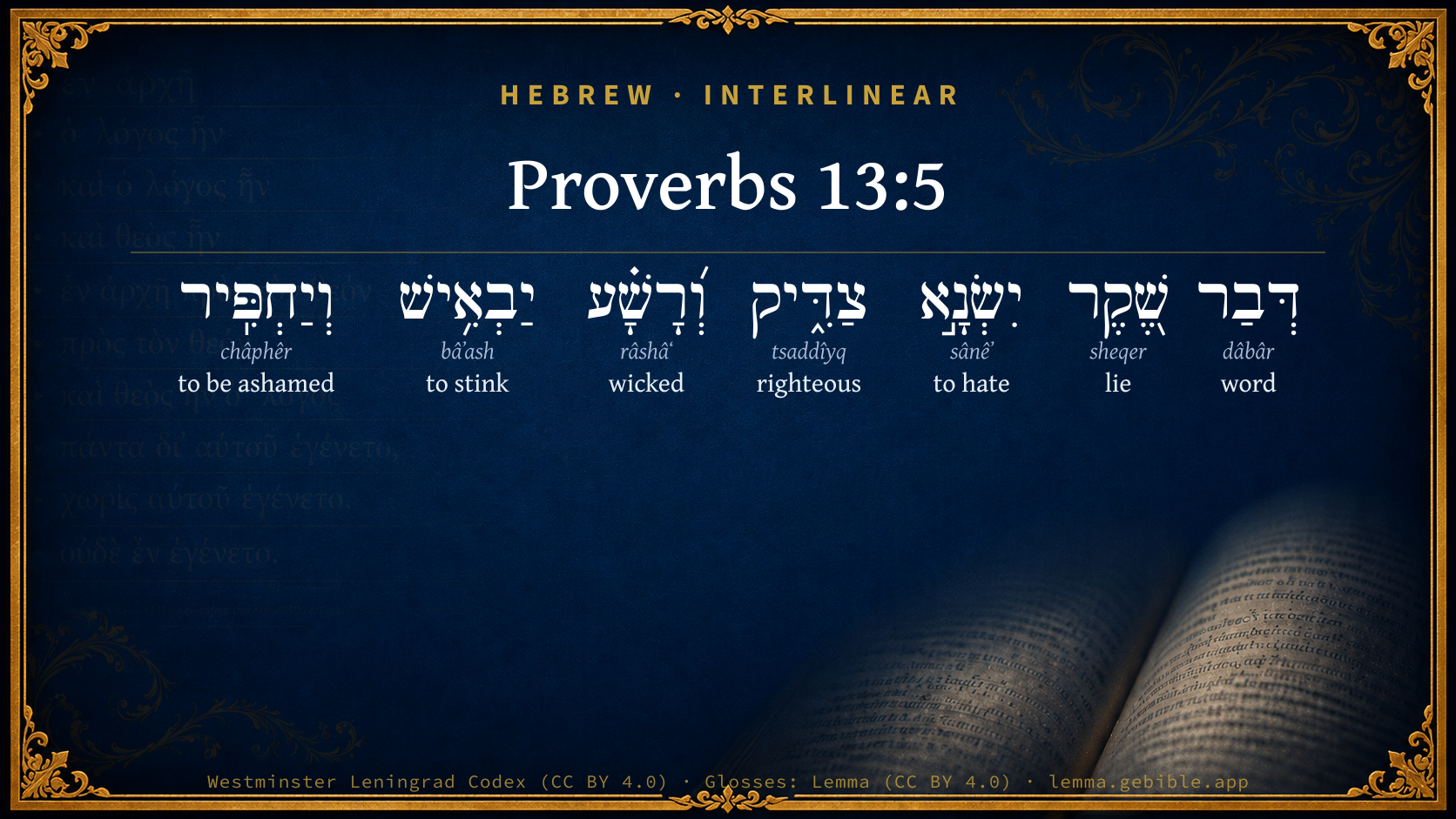
וְיַחְפִּֽיר
châphêr
H2659
“and · to be ashamed”
Conjunction + Verb, Hiphil, Imperfect, 3rd Person, Masculine, Singular
Part of Speech
Conjunction + Verb
Stem
Hiphil
Form
Imperfect
Person
3rd Person
Gender
Masculine
Number
Singular
Full BDB Definition

Origin: a primitive root [perhaps rath, the same as H2658 through the idea of detection]

TWOT: 715

to be ashamed, be confounded, be abashed, feel abashed - (Qal) to be ashamed, be abashed - (Hiphil) to display shame, demonstrate shame, cause embarrassment
  1. דְּבַר dâbâr H1697 “word of” Noun, Common, Masculine, Singular, Construct
  2. שֶׁ֭קֶר sheqer H8267 “lie” Noun, Common, Masculine, Singular, Absolute
  3. יִשְׂנָ֣א sânêʼ H8130 “to hate” Verb, Qal, Imperfect, 3rd Person, Masculine, Singular
  4. צַדִּ֑יק tsaddîyq H6662 “righteous” Adjective, Adjective, Masculine, Singular, Absolute
  5. וְ֝רָשָׁ֗ע râshâʻ H7563 “and · wicked” Conjunction + Adjective, Adjective, Masculine, Singular, Absolute
  6. יַבְאִ֥ישׁ bâʼash H887 “to stink” Verb, Hiphil, Imperfect, 3rd Person, Masculine, Singular

About this verse

These counts appear in no published source. They are computed here, from the morphology-tagged text and Lemma’s own curated glosses. What Lemma adds →

7
words
7
distinct lemmas
Wisdom
section

Notable vocabulary

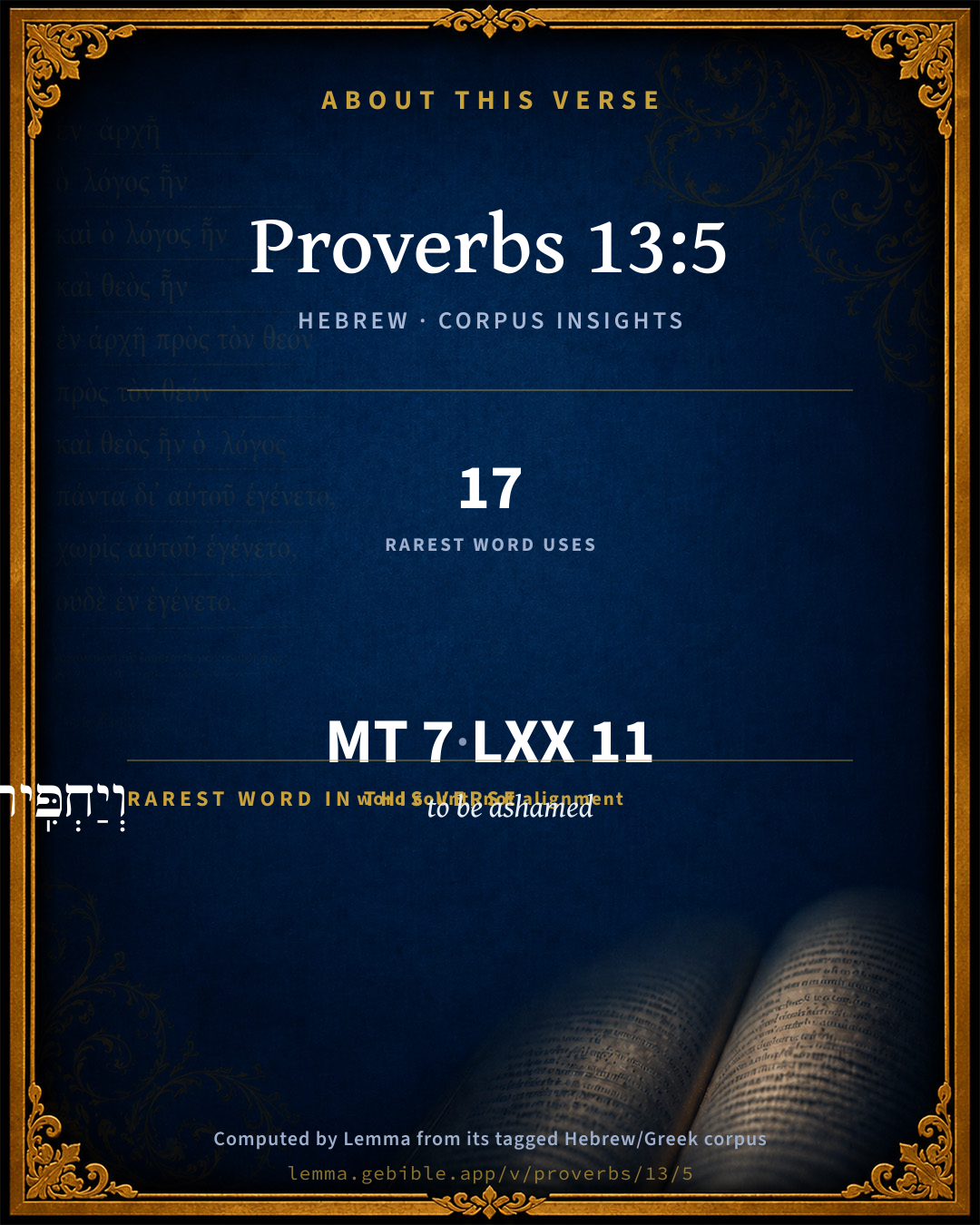
The rarest word here is וְיַחְפִּֽיר to be ashamed H2659 — appearing just 17 times in the whole Hebrew Bible.

Shared distinctive vocabulary

וְיַחְפִּֽיר to be ashamed H2659 occurs in 17 verses of the Hebrew Bible. Also found in:

Grammatical profile

  • 3 verbs
  • 2 nouns
  • 2 adjectives

Verb forms

  • יִשְׂנָ֣א Qal · Imperfect
  • יַבְאִ֥ישׁ Hiphil · Imperfect
  • וְיַחְפִּֽיר Hiphil · Imperfect

Hebrew & Septuagint length

In English translation the verse runs 13 words from the Hebrew and 18 from the Septuagint (LXX English) — closely comparable.

A rough comparison of the two English renderings, which tokenize alike — not a word-level alignment.

Word counts can differ between the Hebrew and the Greek without any difference in meaning — e.g. the Hebrew direct-object marker אֵת has no separate Greek word, and Greek often adds the article ὁ.

In the original languages it is 7 Hebrew tokens and 11 Greek tokens — but the two are counted differently (Hebrew bundles its prefixes and suffixes into one token; the Greek is in lemma form), so that isn’t a like-for-like length.

Cross-references

12

Topical passages linked to Proverbs 13:5 in the Treasury of Scripture Knowledge — connected by theme and wording, ordered by reader-vote popularity; previews shown in the World English Bible.

  • Colossians 3:9 Don't lie to one another, seeing that you have put off the old man with his doings,
  • Psalms 119:163 I hate and abhor falsehood. I love your law.
  • Ephesians 4:25 Therefore, putting away falsehood, speak truth each one with his neighbor. For we are members one of another.
  • Ezekiel 20:43 There shall you remember your ways, and all your doings, in which you have polluted yourselves; and you shall loathe yourselves in your own sight for all your evils that you have committed.
  • Ezekiel 36:31 Then shall you remember your evil ways, and your doings that were not good; and you shall loathe yourselves in your own sight for your iniquities and for your abominations.
  • Proverbs 3:35 The wise will inherit glory, But shame will be the promotion of fools.
  • Revelation 21:8 But for the cowardly, unbelieving, sinners, abominable, murderers, sexually immoral, sorcerers, idolaters, and all liars, their part is in the lake that burns with fire and sulfur, which is the second death."
  • Proverbs 6:17 Haughty eyes, a lying tongue, Hands that shed innocent blood;
  • Proverbs 30:8 Remove far from me falsehood and lies. Give me neither poverty nor riches. Feed me with the food that is needful for me;
  • Ezekiel 6:9 Those of you that escape shall remember me among the nations where they shall be carried captive, how that I have been broken with their lewd heart, which has departed from me, and with they eyes, which play the prostitute after their idols: and they shall loathe themselves in their own sight for the evils which they have committed in all their abominations.
  • Daniel 12:2 Many of those who sleep in the dust of the earth shall awake, some to everlasting life, and some to shame and everlasting contempt.
  • Zechariah 11:8 I cut off the three shepherds in one month; for my soul was weary of them, and their soul also loathed me.

Cross-references courtesy of OpenBible.info (CC BY 4.0).

Hebrew and Greek witnesses Masoretic Hebrew ↔ Greek Septuagint

The same verse in the two great witnesses to the Old Testament, shown verse-for-verse.

These are two independent witnesses, not word-aligned to each other, and the Septuagint is shown in lemma (dictionary) form.

Hebrew Proverbs 13:5 Masoretic · Westminster Leningrad Codex

דְּבַר שֶׁ֭קֶר יִשְׂנָ֣א צַדִּ֑יק וְ֝רָשָׁ֗ע יַבְאִ֥ישׁ וְיַחְפִּֽיר

A righteous man hates lies, But a wicked man brings shame and disgrace.

World English Bible · Public Domain

Greek LXX Proverbs 13:5 Septuagint · lemma form

λόγος ἄδικος μισέω δίκαιος ἀσεβής δέ αἰσχύνω καί οὐ ἕξις παρρησία

A righteous man hates an unjust word: but an ungodly man is ashamed, and will have no confidence.

LXX2012 (modern English Septuagint) · Public Domain

On this verse, The Pulpit Commentary discusses the Septuagint’s reading. Read the note in Commentary ↓

Hebrew: Westminster Leningrad Codex (CC BY 4.0). Greek: Septuagint (public domain); English from LXX2012 (modern English Septuagint) (Public Domain). How the Septuagint differs from the Hebrew →

Commentary

Notes on Proverbs 13:5 from classic Christian and Jewish commentators (each source and its license shown beneath its notes). The classic Christian expositions comment on the surrounding passage and are grouped to its opening verse, so a note may address several verses; the Jewish commentaries on the Tanakh (Rashi and others) are per-verse, so they appear only where the commentator wrote on this verse.

Lemma curates 59 commentaries, every one of them public domain or Creative Commons licensed, each selected and text-cleaned for this edition rather than reprinted as found. About our sources →

Trapp's Complete Commentary

John Trapp

Pro 13:5 A righteous [man] hateth lying: but a wicked [man] is loathsome, and cometh to shame.

Ver. 5. A righteous man hateth lying.] Hateth it as hell. {Rom 12:9} {a} "I hate and abhor lying," saith David; {Psa 119:163} and yet, among other corruptions, he had an inclination to this sin. See how roundly he tells three or four lies together; {1Sa 21:2; 1Sa 21:8; 1Sa 27:8; 1Sa 27:10} but he both hated it in himself and prayed against it {Psa 119:29}

But a wicked man is loathsome.] Stinks above ground; a liar especially is looked upon as a pest. Riches cannot make a man so graceful as lying will disgrace him; for "a poor man walking in his integrity, is better than a rich man that is a liar." {Pro 19:1; Pro 19:22} Hence the liar denies his own lie, because he is ashamed to be taken with it. Some read it thus, ‘a wicked man maketh others loathsome, and casteth shame upon them,’ scil., by raising or reporting lies of them, by blasting or blemishing their good names. Thus Core and his complices sought to cast an odium on Moses; the Pharisees upon our Saviour; the Arians upon Athanasius; the Papists upon Wycliffe, whom Binius slanders for his missing the bishopric of Worcester, to have fallen upon that successful contradiction; like as the spiteful Jews said Paul did, because he could not obtain the high-priest’s daughter to wife. {b}

{a} αποστυγουντες.

{b} Epiphan.

John Trapp, A Commentary or Exposition upon All the Books of the Old and New Testament (1647–1656) — public domain. Text from a community e-Sword module.

The Biblical Illustrator

Joseph S. Exell

Pro_13:5

A righteous man hateth lying.

Moral truthfulness

I. An instinct to the righteous. A righteous man hateth lying. A soul that has been made right in relation to the laws of its own spiritual being to the universe and to God has an instinctive repugnance to falsehood. A right-hearted man cannot be false in speech or life. The prayer of his soul is, Remove from me the way of lying: and grant me Thy law graciously (Psa_119:29).

II. Moral truthfulness is a safeguard against evil. The evils specified in these two verses in connection with the wicked must be regarded as kept off from the righteous by his moral truthfulness. What are the evils here implied connected with falsehood?

1. Loathsomeness. A wicked man is loathsome. A liar is an unlovely and an unlovable object; he is detestable; he attracts none; he repels all.

2. Shame. He cometh to shame. A liar either in lip, or life, or both, must come to shame. A rigorous destiny will strip off his mask, and leave him exposed, a hideous hypocrite, to the scorn of men and angels.

3. Destruction. Wickedness overthroweth the sinner. Inevitable destruction is the doom of the false. They have built their houses on the sand of fiction, and the storms of reality will lay them in ruins. From all these evils, moral truthfulness guards the righteous. (D. Thomas, D.D.)

Lying hateful

There is no knowing the effects of a lie even in this world. Said a lady, I told once for all the fashionable lie of having my servant announce at the door that I was not at home. At night my husband said, Mrs.

died to-day. It went through me like cold steel. She had made me promise that I would be at her bedside at the last hour, as she had something of great importance to disclose. And, said my husband, she died in great distress to see you, having sent three times, only to learn that you were not at home. How I loathed myself! No more lies for me!

The Biblical Illustrator, edited by Joseph S. Exell (c. 1880s–1900s) — public domain. Text from a community e-Sword module.

Joseph Benson's Commentary

Pro 13:5. A righteous man hateth lying — Both in himself and in other men, whereby he gets that good name, which is like a precious ointment; but a wicked man — Who accustoms himself to lying; cometh to shame —

Makes himself contemptible and hateful to all that know him; there being scarcely any reproach which men endure more impatiently, or revenge more severely, than that of being called or accounted liars.

Joseph Benson's Commentary on the Old and New Testaments (1811–1818) — public domain. Text from a community e-Sword module.

The Preacher's Complete Homiletical Commentary

Joseph S. Exell (gen. ed.)

CRITICAL NOTES.—

Pro_13:5. Lying, rather “deceit.” Stuart renders it “a false report.” Zöckler translates the latter clause of this verse, “the ungodly acteth basely and shamefully.” The translations of Stuart and Delitzsch are nearly the same. Miller reads the whole verse, “A deceiving business hates the righteous man, but also shames and disgraces the wicked.”

MAIN HOMILETICS OF Pro_13:5

A LAWFUL HATRED

I. A righteous man hates lying.

1. Because it is contrary to his ruling disposition. His own righteous character has been created by believing the truth. His spiritual life is constantly renewed and sustained by believing the truth, and reducing his belief to practice. He is a child of the truth, and, therefore, apart from all the consequences of lying he instinctively abhors it.

2. He hates it also because of its evil influence upon men. Confidence in a lie ruined our first parents, and confidence in a lie has ruined whole nations and mighty empires in the past. In proportion as men “believe a lie” (2Th_2:11) in the same proportion will be their ruin. The righteous man knows that the kingdom of God is a kingdom of truth (Joh_18:37), and as his great desire is to see that kingdom spread he must hate all that opposes it, and thus mars the happiness of the human race.

II. Wicked men are untruthful men. As the righteous man’s character is built by truth and upon truth, so that of an ungodly man is built upon false hood. All such men are the children of him who was a liar from the beginning, and although they may not be liars in the common acceptation of the word, there is a lack of truthfulness in the character of the most outwardly moral. In some shape or other he is a liar—he is a subject of him whose kingdom is built upon lying, and who could not retain under his influence a man who “hated lying” in every form and under every disguise. Such a man must come to shame. What would be the fate of a cripple if he were to challenge a man with sound limbs to run a race? Must he not be worsted in the end? Not more surely than will every subject of the kingdom whose foundation was laid in a lie. There is an Italian proverb which says, “A liar is sooner caught than a cripple.” If “lying lips are an abomination to the Lord,” he who owns the lips must be an abomination also (see Homiletics on chap. Pro_12:22).

OUTLINES AND SUGGESTIVE COMMENTS

Clear and round dealing is the honour of man’s nature; and that mixture of falsehood is like alloy in coin of gold or silver, which may make the metal work the better but embaseth it. For these winding and crooked courses are the goings of the serpent, which goeth basely upon the belly, and not upon the feet. There is no vice that doth so cover a man with shame as to be found false and perfidious; and, therefore, Montaigne sayeth prettily, when he inquired the reason why the word of the lie should be such a disgrace and such an odious charge, “If it be well weighed, to say that a man lieth, is as much as to say that he is brave towards God, and a coward towards men. For a lie faces God and shrinks from man.”—Lord Bacon.

The natural man shuns lying and deceit on account of the outward shame and reproach; the pious abhors them with all his heart for God’s sake.—Starke, in Langes Commentary.

The allegiance of the soul to truth is tested by small things, rather than by those which are more important. There is many a man who would lose his life rather than perjnre himself in a court of justice, whose life is yet a tissue of small insincerities. We think that we are hating falsehood when we are only hating the consequences of falsehood. We resent hypocrisy and treachery, and calumny, not because they are untrue, but because they harm us. We hate the false calumny, but are half-pleased by the false praise. It is evidently not the element of untruth here that is displeasing, but the element of harmfulness. Now he is a man of integrity who hates untruth as untruth; who resents the smooth and polished falsehood of society, which does no harm; who turns in indignation from the glittering whitened lie of sepulchral Pharisaism which injures no one. Integrity recoils from deception, which men would almost smile to hear called deception. To a moral pure mind the artifices in every department of life are painful. The stained wood which passes for a more firm and costly material in a building, and deceives the eye by passing for what it is not—marble. The painting which is intended to be taken for reality; the gilding which is meant to pass for gold; and the glass which is worn to look like jewels; for there is a moral feeling and a truthfulness in architecture, in painting, and in dress, as well as in the market-place and in the senate, and in the judgment hall. “These are trifles.” Yes, these are trifles; but it is just these trifles which go to the formation of character. He that is habituated to deceptions and artificialities in trifles will try in vain to be true in matters of importance; for truth is a thing of habit rather than of will.… And it is a fearful question, and a difficult one, how all these things, the atmosphere of which we breathe in our daily life, may sap the very foundation of the power of becoming a servant of the truth.—F. W. Robertson.

It is not said that a righteous man never lies. David lied more than once, and yet he could say with truth that he abhorred lying. Though he lied to Abimelech the priest, and to the king of the Philistines, yet his fixed hatred of sin was an evidence of piety, to which those can lay no claim who never spoke a lie in their lives, if their abstinence from this sin was caused by some other motive than hatred.… God and men agree in almost nothing but this, that a liar is detestable to both, and therefore he must, sooner or later, come to disgrace.—Lawson.

The affections are of as great force in the service of God as the words and actions, and the heart hath no less place than the members of the body. It must be one and the principal agent in love, where they have calling; and it must deal alone with detestation of those abominations which they are discharged to intermeddle with.… Here we have instruction to inform our hearts against all manner of wickedness, that they may be the more incensed against it. The less we like sin the more righteous we are, and the better the Lord will love us. And the more agreement there is between sin and our souls, the less peace there is between our souls and God. All the hurts and miseries that have ever come upon us, or on Christ for our sakes, do give us just occasion to fall out with sinfulness, that hath been the cause thereof.—Dod.

Where grace reigns, sin is loathsome, where sin reigns the man is loathsome. Henry.

The Preacher's Complete Homiletical Commentary (gen. ed. Joseph S. Exell; Funk & Wagnalls, c. 1892) — public domain (pre-1929). A full-Bible homiletical/sermon-outline anthology covering 65 of 66 books (2 John is absent from the source module). Text from a community e-Sword module.

Matthew Henry's Commentary

Note, 1. Where grace reigns sin is loathsome. It is the undoubted character of every righteous man that he hates lying (that is, all sin, for every sin is a lie, and particularly all fraud and falsehood in commerce and conversation), not only that he will not tell a lie, but he abhors lying, from a rooted reigning principle of love to truth and justice, and conformity to God. 2. Where sin reigns the man is loathsome. If his eyes were opened, and his conscience awakened, he would be so to himself, he would abhor himself and repent in dust and ashes; however, he is so to God and all good men; particularly, he makes himself so by lying, than which there is nothing more detestable. And, though he may think to face it out awhile, yet he will come to shame and contempt at last and will blush to show his face, Dan 12:2.

Matthew Henry's Commentary on the Whole Bible (1708–1710) — public domain (CC PDM 1.0). Text via the HelloAO Bible API.

Jamieson, Fausset & Brown

Robert Jamieson, A. R. Fausset & David Brown

loathsome . . . shame--better, causeth shame and reproach (compare Pro 19:26), by slander, &c., which the righteous hates.

Jamieson, Fausset & Brown — Commentary Critical and Explanatory on the Whole Bible (1871) — public domain (CC PDM 1.0). Text via the HelloAO Bible API.

Ellicott's Commentary for English Readers

(5) A wicked man is loathsome, and cometh to shame.—Or it may signify, “disgraceth and putteth to shame” (by his calumnies), or “acts basely and shamefully.”

A Bible Commentary for English Readers, edited by Charles John Ellicott (1878–1897) — public domain. Text from a community e-Sword module.

The Cambridge Bible for Schools and Colleges

gen. ed. J. J. S. Perowne

5. is loathsome] lit. stinketh. Comp. Ecc_10:1; Exo_5:21, where the same Heb. word occurs.

In R.V. marg. an alternative rendering is suggested: causeth shame and bringeth reproach.

The Cambridge Bible for Schools and Colleges (gen. ed. J. J. S. Perowne; Cambridge University Press, 1878–1918) — public domain. Text from a community e-Sword module.

John Gill's Exposition

A righteous man hateth lying,.... Or, "a word of falsehood" (y); as being contrary to honour, truth, and conscience. He hates it in himself and others; he hates all sorts of lies, lies in common conversation, religious lies, doctrinal ones, false doctrines, lies spoken in hypocrisy; such as the followers of antichrist spread, being given up unto them that they might be damned, Ti1 4:2; these are an abomination to God and all good men, Rev 21:27;

but a wicked man is loathsome, and cometh to shame; or, "causes" or "spreads a stink" (z): all wicked men are loathsome and abominable, being very corrupt in principle and practice; all over defiled with sin, and covered with wounds, bruises, and putrefying sores, from the crown of the head to the sole of the feet; and especially liars, who are often brought to shame and confusion in this life, and will hereafter come to everlasting shame and contempt. Or, "makes himself to stink" (a); in the nostrils of all good men, and so brought to shame: or "digs"; a metaphor, as Cartwright thinks, from those that dig in the earth, where such as are covered with shame would gladly put their heads.

(y) "verbum falsitatis", Montanus, Michaelis; "verbum fuci", Schulteus. (z) "foetere facit", Vatablus, Mercerus; "foetere faciet", Montanus; "foetere fecit foetorem", Gussetius, p. 114. "foetorem spargit", Schultens. (a) "Se ipse foetere facit", Coccei Lexic. col. 77. "foetidum se reddit", Piscator.

John Gill's Exposition of the Whole Bible (1746–1763) — public domain (CC PDM 1.0). Text via the HelloAO Bible API.

Haydock's Catholic Bible Commentary

Confounded. The detractor is like swine, stirring up dirt. (St. Chrysostom, 32. ad Pop.) --- The liar is not believed, even when he speaks the truth. (Aristotle)

George Leo Haydock (1774–1849), Haydock's Catholic Family Bible and Commentary, 1859 edition — public domain. Excludes Psalms (Douay-Rheims chapter numbering differs from Protestant) and Deuterocanonical books (Catholic canon only).

Matthew Poole's English Annotations

Hateth lying, both in himself and in other men, whereby he getteth that good name which is like a precious ointment.

A wicked man; who accustometh himself to lying, as may be gathered from the foregoing words.

Cometh to shame; makes himself contemptible and hateful to all that know him; there being scarce any reproach which men more impatiently endure, and severely revenge, than that of being called or accounted a liar.

Matthew Poole's English Annotations on the Holy Bible (1683–1685) — public domain. Text from a community e-Sword/MySword module.

Whedon's Commentary on the Bible

Daniel D. Whedon

5. Hateth lying — דבר שׁקר, (debhar sheker,) a word of lying; that is, a lying word — slander or false report. Zockler takes debhar in the sense of thing — any deceitful thing; a possible sense. Miller: “A deceitful business.”

But a wicked man is loathsome, and cometh to shame — Causes a badodour, and acts shamefully, or puts to the blush. This is, doubtless, to be understood metaphorically of false and slanderous reports put in circulation by him, but the expressions are strong, and may readily be understood. Comp. on first clause, Pro_19:26; also, Col_3:9; Rom_12:9; Eph_4:25; Lev_19:11.

Daniel D. Whedon (gen. ed.), Commentary on the Old and New Testaments (1874–1909) — public domain. Text from a community e-Sword module.

The Pulpit Commentary

Lying; Vulgate, verbum mendax; Septuagint, logon adikon ; literally, a word of falsehood. But debar, "word," is used, like rhma in Hellenistic Greek, in a general sense for "thing," i.e. the subject of speech. So here it is not only verbal lying that is meant, but every kind of deceit and guile. This naturally betrays itself by the speech, according to the proverb, "Show me a liar, and I will show you a thief." A wicked man is loathsome, and cometh to shame. The clause is variously translated. Vulgate, confundit et confundetur, "causes shame to others and to himself." Septuagint, "is put to shame, and shall not have licence of tongue ( parrhsian )." The Revised Version margin, "causeth shame and bringeth reproach." Delitzsch, "brings into bad odour (Gen_34:30) and causes shame." Hitzig, "behaveth injuriously and shamefully." The antithesis is best brought out by the rendering that marks the effect of the wicked man"s "lying;" "He brings disgrace upon others (who have trusted him or have been associated with him) and causes shame.

Purity and impurity of sentiment.

I AVERSION FROM ALL UNTRUTH A LEADING CHARACTER OF PURITY. This does not imply that the good man never falls into acts or words which are untrue to his nature. But as a child of God, there is in his spiritual or ideal nature a rooted antipathy to lies, and a deep sympathy with truth in all its forms. "Tis only truthfulness which can impart fragrance, charm, delight, to character.

II THE CONTRARY DISPOSITION OF THE WICKED IS LOATHSOME AND SHAMEFUL. Antipathy to truth and, alas! perversion may actually bring men to this produces upon the pure moral taste an impression akin to that of nausea or deformity upon the physical sensibility. And we blush for it as a common odium and disgrace of human nature. J.

The Pulpit Commentary (1880–1919), ed. H.D.M. Spence-Jones & Joseph S. Exell — public domain. Text from a community e-Sword module.

Keil & Delitzsch

C. F. Keil & F. Delitzsch

Two proverbs of the character of the righteous and of the effect of righteousness:

A deceitful thing the righteous hateth;

But the godless disgraceth and putteth to shame.

With דּבּר in the sphere of an intelligible generality (as here of falsehood, or Psa 41:9 of worthlessness) a concrete event is in view, as with דּברי in the following plur. a general fact is separated into its individual instances and circumstances (vid., at Psa 65:4); for דבר means not only the word in which the soul reveals itself, but also any fact in which an inner principle or a general fact or a whole comes forth to view. The righteous hateth all that bears in it the character of a falsehood (punctuate דּבר־שׁקר with Gaja, cf. Pro 12:19), but the godless ... Should we now, with Bertheau, Hitzig, and others, translate "acteth basely and shamefully"? It is true that both Hiphs. may be regarded as transitive, but this expression gives not right contrast to 5a, and is pointless. We have seen at Pro 10:5 that הבישׁ, like השׂכּיל, has also a causative signification: to put to shame, i.e., bring shame upon others, and that Pro 19:26, where מבישׁ וּמחפּיר are connected, this causative signification lies nearer than the intrinsically transitive. Thus it will also here be meant, that while the righteous hateth all that is false or that is tainted by falsehood, the godless on the contrary loves to disgrace and to put to shame. But it is a question whether יבאישׁ is to be derived from בּאשׁ = בּושׁ, and thus is of the same meaning as יבישׁ; הבאישׁ, Isa 30:5, which there signifies pudefactum esse, is pointed הבאישׁ, and is thus derived from a יבשׁ = בּושׁ, vid., Sa2 19:6. But הבאישׁ occurs also as Hiph. of בּאשׁ, and means transitively to make of an evil savour, Gen 34:30, cf. Exo 5:21, as well as intransitively to come into evil savour, Sa1 27:12. In this sense of putidum faciens, bringing into evil savour, יבאישׁ occurs here as at Pro 19:26, suitably along with יחפיר; Pro 19:26 is the putidum facere by evil report (slander), into which the foolish son brings his parents, here by his own evil report, thus to be thought of as brought about by means of slander. The old translators here fall into error; Luther renders both Hiphils reflexively; only the Venet. (after Kimchi) is right: ὀζώσει (from an ὀζοῦν as trans. to ὀζεῖν) καὶ ἀτιμώσει, he makes to be of ill odour and dishonours.

Keil & Delitzsch — Biblical Commentary on the Old Testament (1861–1891) — public domain (CC PDM 1.0). Text via the HelloAO Bible API. (Old Testament only.)

Bridges on Proverbs

Charles Bridges

Observe the accuracy of Scripture. It is not that a righteous man never lies. David lied.†1 Peter lied.†2 Yet David could say — "I hate and abhor lying."†3 He prayed to have it "removed from him."†4 He would not suffer the "liar in his sight."†5 Peter in the painful remembrance of his sin earnestly shewed the happiness of departure from it.†6 The child of God, though always a sinner, maintains an holy antipathy against sin — "What I hate, that do I."†7

Nor is it a proof of a righteous man that he avoids lying. Selfish motives, regard for character, may dictate restraint, without any hatred of the sin as sin. But true religion brings in the new taste, conformity to the mind of God. Therefore, as "lying lips" — however common, profitable, convenient, or pardonable, they may be counted — "are abomination to the LORD," the righteous man hateth them. (Pro 12:22 . Rom 12:9 .) He would rather suffer by truth, than sin by lying. (Dan 3:16-18 .)

And yet how often, even in the Church, is this feature of godliness obscured! Is not strict truth often sacrificed to courtesy? Is not lying sometimes acted, insinuated, or implied, where we should be ashamed of plainly speaking it? Is not the simple truth often coloured with exaggeration? "Abstain from all appearance of evil" (1Th 5:22 ) — is the rule for the man of God. Commit the tongue to the only safe ordering, the restraint and guidance of the God of Truth. (Psa 19:14 ; Psa 141:3 .)

A wicked man indeed takes pleasure in deceit. Scripture gives him his right name. His base means often bring him to shame on this side of the grave. (2Ki 5:27 . Act 12:21-23 .) But however this be, shame will be his "everlasting recompense." (Dan 12:2 . Rev 21:8 .)

Footnotes:

†1 1Sa 21:2 ; 1Sa 27:9-10 .

†2 Mat 26:70-74.

†3 Psa 119:163.

†4 Psa 119:29.

†5 Psa 101:7; Psa 26:4 .

†6 1Pe 3:10 ; 1Pe 2:1 .

†7 Rom 7:15, Rom 7:19 .

Charles Bridges, An Exposition of the Book of Proverbs (1846) — public domain. Text from a community e-Sword module.

Kretzmann's Popular Commentary

Paul E. Kretzmann

v. 5. A righteous man hateth lying, deceitful language as well as deceitful matters; but a wicked man is loathsome, all his acts being done in baseness, and cometh to shame, literally, "maketh offensive," he brings disgrace upon every one with whom he comes in contact.

Paul E. Kretzmann, Popular Commentary of the Bible (1921–1924) — public domain. Text from a community e-Sword module.

unfoldingWord translationNotes

Door43 World Missions Community

repugnant

causing a strong feeling of disgust

Righteousness protects those

"Righteousness" represents a way of life approved by Yahweh. This quality acts like a person who protects. AT: "A way of life approved by Yahweh protects" (See: Personification)

who are faultless in their path

Here "path" represents how a person directs his life. AT: "who are faultless in their way of living" or "who live lives of integrity" (See: Metonymy)

wickedness turns away those who commit sin

Here "wickedness" represents an evil conduct of life. This quality acts like a person who turns away those who commit sin. AT: "wickedness turns sinners away from a successful path" or "wickedness ruins sinners' lives" (See: Personification)

translationWords

evil

shame

righteous

turn

sin

unfoldingWord translationNotes — © Distant Shores Media and the Door43 World Missions Community, licensed CC BY-SA 4.0. Source: git.door43.org/Door43/en_tn.

Rashi

Rabbi Shlomo Yitzchaki (Rashi)

The righteous man hates a false word The righteous man hates a false word, but the wicked accepts it.

disgraces and embarrasses the people therewith.

Rashi on the Tanakh — English translations: “The Judaica Press complete Tanach with Rashi, translated by A. J. Rosenberg” (CC BY 4.0); “Pentateuch with Rashi's commentary by M. Rosenbaum and A.M. Silbermann, 1929-1934” (public domain); “The Metsudah Tanach series, Lakewood, N.J” (CC BY 4.0); and “The Book of Joshua, Metsudah Publications, 1997” (CC BY 4.0). Text via Sefaria.

Lesson kit

Teaching starters — assembled from the data on this page, not authored interpretation. Every prompt links to the verse data it draws on. Edit before teaching.

Proverbs, in the Wisdom, opens this verse with 7 words (7 distinct Hebrew lemmas). Its most distinctive word is châphêr (“to be ashamed”). A historical commentator’s framing appears above. Read the whole chapter for the surrounding context.

Discussion questions

  1. The word châphêr carries the sense “to be ashamed.” How does it shape the verse?
  2. Job 6:20 shares the word «to be ashamed» with this verse. How do the two illuminate each other?
  3. These translations render this verse differently. What is at stake in choosing one wording over another?
  4. The verb «יִשְׂנָ֣א» is Qal Imperfect. How does its form color the action?
  5. Reading how Trapp's Complete Commentary and The Biblical Illustrator read this verse, where do the two commentators agree and where do they part?

Things to notice

Reading settings

Reading text

Shown beneath each verse's original-language words.

Old Testament
Old Testament edition

Read the OT as the Masoretic Hebrew (MT) or the Greek Septuagint (LXX).

English shown for the Greek Septuagint (in the Hebrew ↔ Greek comparison).

Comparing translations? Open the Compare panel on any verse page to stack up to four side by side.