
Proverbs 21:27

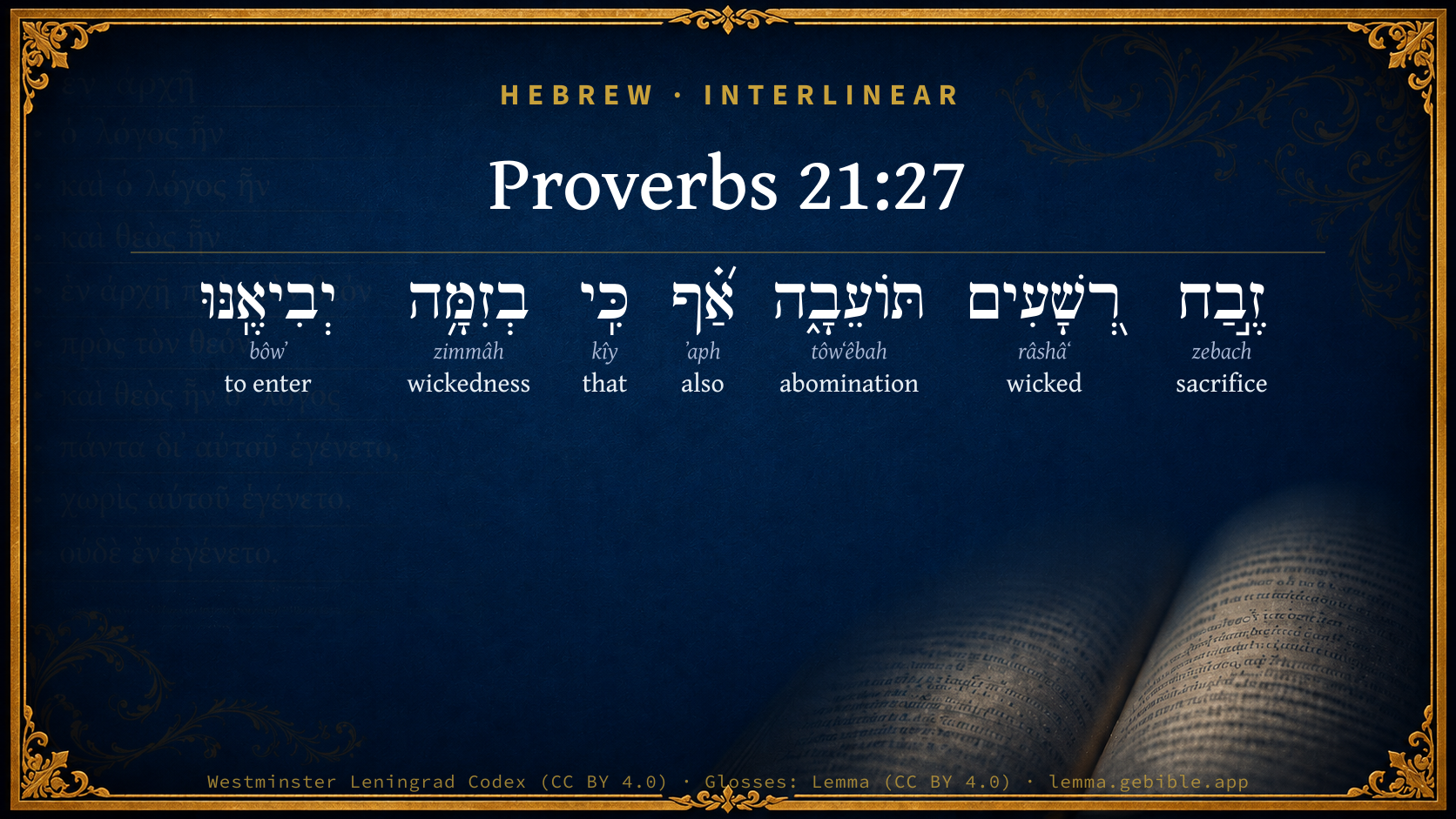
Hebrew (Westminster Leningrad Codex) Proverbs 21:27 appears in the Hebrew Old Testament. The text above is from the Westminster Leningrad Codex. Each word links to its Strong’s number, a concise gloss, and parsing drawn from the Open Scriptures Hebrew Bible morphology. Click any word for its full Brown-Driver-Briggs (BDB) entry.
Download image
Cite this verse

Proverbs 21:27 (World English Bible). Public Domain. Lemma interlinear Bible study tool, https://lemma.gebible.app/v/proverbs/21/27.

Show BibTeX & RIS
BibTeX
RIS
English Translation
The sacrifice of the wicked is an abomination: How much more, when he brings it with a wicked mind!
World English Bible · Public Domain
Download a study sheet

One document with this verse’s original text, its word-by-word gloss line, the meaning frame, cross-references with their text, attributed commentary, and full source and license credits — printable, and it pastes into notes with its structure intact.

This verse Autodidact and up

Study sheet (.html) Plain text (.txt)

A passage Seminary Student

Up to 50 verses in one chapter. A passage sheet keeps up to 6 commentary sources and 12 cross-references per verse, in the order this page ranks them, and says so on the sheet whenever that leaves anything out. Ask for a single verse and you get the Autodidact verse sheet above.

Everything on this page stays free to read, with no account — the sheet is a download of what is already on screen, not access to it.

Want to remove ads? Support Godless Engineer
Compare translations 3

The same verse in 3 English versions, stacked beneath the original-language interlinear above. Click any original word for its lexicon entry.

Each is an independent rendering of the whole verse — the interlinear is not word-aligned to these translations.

Highlighted words mark where these versions differ — a whole-verse word diff, not a word-by-word alignment.

  • World English Bible Public Domain
    The sacrifice of the wicked is an abomination: How much more, when he brings it with a wicked mind!
  • King James Version Public Domain
    The sacrifice of the wicked is abomination: how much more, when he bringeth it with a wicked mind?
  • unfoldingWord Literal Text CC BY-SA 4.0
    The sacrifice of the wicked an abomination; how much more when he brings it with a wicked plan!

unfoldingWord Literal Text — © unfoldingWord, licensed CC BY-SA 4.0. Word-aligned USFM3 via Door43 (git.door43.org/unfoldingWord/en_ult).

Versions to compare (up to 4)

3 of 4 selected

Show all 18 translations

Every available English version of this verse, each an independent rendering of the whole verse.

  • World English Bible Public Domain
    The sacrifice of the wicked is an abomination: How much more, when he brings it with a wicked mind!
  • Berean Standard Bible Public Domain
    The sacrifice of the wicked is detestable—how much more so when brought with ill intent!
  • Majority Standard Bible Public Domain
    The sacrifice of the wicked is detestable—how much more so when brought with ill intent!
  • King James Version Public Domain
    The sacrifice of the wicked is abomination: how much more, when he bringeth it with a wicked mind?
  • American Standard Version (1901) Public Domain
    The sacrifice of the wicked is an abomination: How much more, when he bringeth it with a wicked mind!
  • Revised Version (1885) Public Domain
    The sacrifice of the wicked is an abomination: how much more, when he bringeth it with a wicked mind!
  • Geneva Bible (1599) Public Domain
    The sacrifice of the wicked is an abomination: how much more when he bringeth it with a wicked minde?
  • Douay-Rheims (1899) Public Domain
    The sacrifices of the wicked are abominable, because they are offered of wickedness.
  • Young's Literal Translation Public Domain
    The sacrifice of the wicked `is' abomination, Much more when in wickedness he bringeth it.
  • Literal Standard Version CC BY-SA 4.0
    The sacrifice of the wicked [is] abomination, || Much more when he brings it in wickedness.
  • Unlocked Literal Bible CC BY-SA 4.0
    The sacrifice of the wicked is detestable; it is even more detestable when he brings it with evil motives.
  • unfoldingWord Literal Text CC BY-SA 4.0
    The sacrifice of the wicked an abomination; how much more when he brings it with a wicked plan!
  • Darby Bible Public Domain
    The sacrifice of the wicked is abomination: how much more when they bring it with a wicked purpose!
  • World Messianic Bible Public Domain
    The sacrifice of the wicked is an abomination— how much more, when he brings it with a wicked mind!
  • Webster's Bible Public Domain
    The sacrifice of the wicked is abomination: how much more, when he bringeth it with a wicked mind?
  • Free Bible Version CC BY-SA 4.0
    The sacrifices given by the wicked are obnoxious, worse still when they're offered with evil motives.
  • Bible in Basic English Public Domain
    The offering of evil-doers is disgusting: how much more when they give it with an evil purpose!
  • JPS Tanakh (1917) Public Domain
    The sacrifice of the wicked is an abomination; how much more, when he bringeth it with the proceeds of wickedness?

Literal Standard Version (2020), Covenant Press — licensed CC BY-SA 4.0. Text via the HelloAO Bible API (eBible.org). Unlocked Literal Bible (unfoldingWord) — licensed CC BY-SA 4.0. Text via the HelloAO Bible API (eBible.org). unfoldingWord Literal Text — © unfoldingWord, licensed CC BY-SA 4.0. Word-aligned USFM3 via Door43 (git.door43.org/unfoldingWord/en_ult). Free Bible Version, Dr. Jonathan Gallagher — licensed CC BY-SA 4.0. Text via the HelloAO Bible API (eBible.org).

Word by word

More ways to search: Search by grammar → Find every occurrence → Compare this word →

Practice this passage: Drill this verse → Learn its vocabulary →

About this verse

These counts appear in no published source. They are computed here, from the morphology-tagged text and Lemma’s own curated glosses. What Lemma adds →

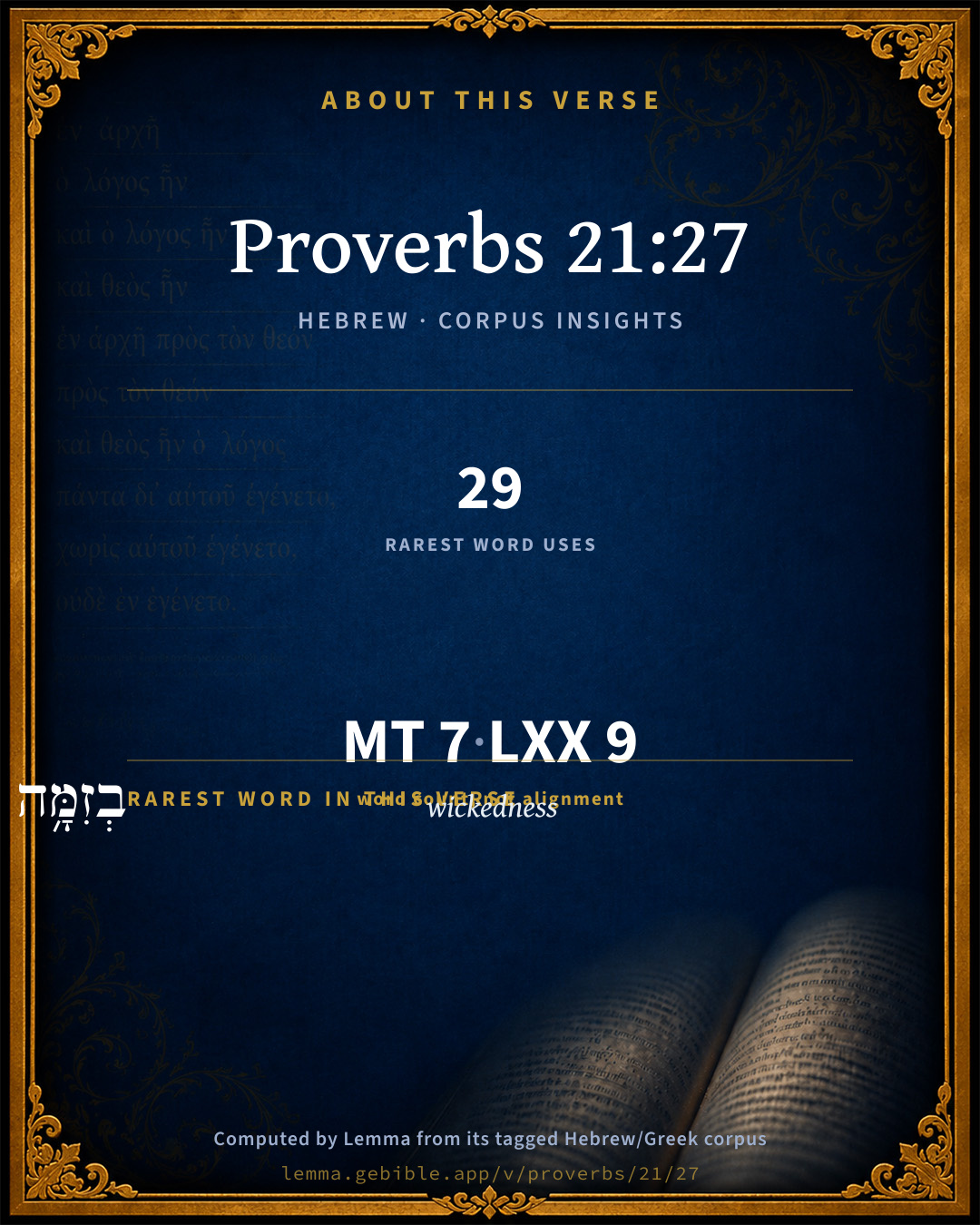
7
words
7
distinct lemmas
Wisdom
section

Shared distinctive vocabulary

בְזִמָּ֥ה wickedness H2154 occurs in 27 verses of the Hebrew Bible. Also found in:

Grammatical profile

  • 1 verb
  • 3 nouns
  • 1 adjective
  • 1 conjunction
  • 1 particle

Verb forms

  • יְבִיאֶֽנּוּ Hiphil · Imperfect

Hebrew & Septuagint length

In English translation the verse runs 19 words from the Hebrew and 15 from the Septuagint (LXX English) — closely comparable.

A rough comparison of the two English renderings, which tokenize alike — not a word-level alignment.

Word counts can differ between the Hebrew and the Greek without any difference in meaning — e.g. the Hebrew direct-object marker אֵת has no separate Greek word, and Greek often adds the article ὁ.

In the original languages it is 7 Hebrew tokens and 9 Greek tokens — but the two are counted differently (Hebrew bundles its prefixes and suffixes into one token; the Greek is in lemma form), so that isn’t a like-for-like length.

Cross-references

11

Topical passages linked to Proverbs 21:27 in the Treasury of Scripture Knowledge — connected by theme and wording, ordered by reader-vote popularity; previews shown in the World English Bible.

  • Isaiah 66:3 He who kills an ox is as he who kills a man; he who sacrifices a lamb, as he who breaks a dog's neck; he who offers an offering, [as he who offers] pig's blood; he who burns frankincense, as he who blesses an idol. Yes, they have chosen their own ways, and their soul delights in their abominations:
  • Proverbs 15:8 The sacrifice made by the wicked is an abomination to Yahweh, But the prayer of the upright is his delight.
  • Matthew 23:13 "Woe to you, scribes and Pharisees, hypocrites! For you devour widows' houses, and as a pretense you make long prayers. Therefore you will receive greater condemnation.
  • Jeremiah 6:20 To what purpose comes there to me frankincense from Sheba, and the sweet cane from a far country? your burnt offerings are not acceptable, nor your sacrifices pleasing to me.
  • 1 Samuel 15:21–23 But the people took of the spoil, sheep and oxen, the chief of the devoted things, to sacrifice to Yahweh your God in Gilgal.
  • Isaiah 1:11–16 "What are the multitude of your sacrifices to me?," says Yahweh. "I have had enough of the burnt offerings of rams, And the fat of fed animals. I don't delight in the blood of bulls, Or of lambs, Or of male goats.
  • Amos 5:21–22 I hate, I despise your feasts, And I can't stand your solemn assemblies.
  • 1 Samuel 13:12–13 therefore said I, Now will the Philistines come down on me to Gilgal, and I haven't entreated the favor of Yahweh: I forced myself therefore, and offered the burnt offering.
  • Psalms 50:8–13 I don't rebuke you for your sacrifices. Your burnt offerings are continually before me.
  • Proverbs 28:9 He who turns away his ear from hearing the law, Even his prayer is an abomination.
  • Jeremiah 7:11–12 Is this house, which is called by my name, become a den of robbers in your eyes? Behold, I, even I, have seen it, says Yahweh.

Cross-references courtesy of OpenBible.info (CC BY 4.0).

Hebrew and Greek witnesses Masoretic Hebrew ↔ Greek Septuagint

The same verse in the two great witnesses to the Old Testament, shown verse-for-verse.

These are two independent witnesses, not word-aligned to each other, and the Septuagint is shown in lemma (dictionary) form.

Hebrew Proverbs 21:27 Masoretic · Westminster Leningrad Codex

זֶ֣בַח רְ֭שָׁעִים תּוֹעֵבָ֑ה אַ֝֗ף כִּֽי בְזִמָּ֥ה יְבִיאֶֽנּוּ

The sacrifice of the wicked is an abomination: How much more, when he brings it with a wicked mind!

World English Bible · Public Domain

Greek LXX Proverbs 21:27 Septuagint · lemma form

θυσία ἀσεβής βδέλυγμα κύριος καί γάρ παρανόμως προςφέρω αὐτός

The sacrifices of the ungodly are abomination to the Lord, for they offer them wickedly.

LXX2012 (modern English Septuagint) · Public Domain

On this verse, John Gill's Exposition discusses the Septuagint’s reading. Read the note in Commentary ↓

Hebrew: Westminster Leningrad Codex (CC BY 4.0). Greek: Septuagint (public domain); English from LXX2012 (modern English Septuagint) (Public Domain). How the Septuagint differs from the Hebrew →

Commentary

Notes on Proverbs 21:27 from classic Christian and Jewish commentators (each source and its license shown beneath its notes). The classic Christian expositions comment on the surrounding passage and are grouped to its opening verse, so a note may address several verses; the Jewish commentaries on the Tanakh (Rashi and others) are per-verse, so they appear only where the commentator wrote on this verse.

Lemma curates 59 commentaries, every one of them public domain or Creative Commons licensed, each selected and text-cleaned for this edition rather than reprinted as found. About our sources →

Trapp's Complete Commentary

John Trapp

Pro 21:27 The sacrifice of the wicked [is] abomination: how much more, [when] he bringeth it with a wicked mind?

Ver. 27. The sacrifice of the wicked, &c.] {See Trapp on "Pro 15:8"}

How much more when he bringeth it, &c.] As Balak and Balaam did. {Num 23:1-2} As those that present ex rapine holocaustum, a sacrifice of what they have got by rapine and robbery; and as those likewise that ask good things at God’s hand, that they may "consume them upon their lusts." {Jas 4:3} Let the wicked bring his sacrifice with never so good an intention, he is an abomination; but if with an evil mind, his dissembled sanctity is double iniquity, as if a man think by observing the Sabbath to take out a license to walk licentiously all the week long; or by praying in a morning to get a dispensation to do evil all day after. I have read of one that would haunt the taverns, theatres, and whore houses at London all day; but he durst not go forth without private prayer in the morning, and then would say at his departure, Now devil do thy worst. {a} The Circassians are said to divide their life between rapine and repentance. {b} The Papists, many of them, make account of confessing, as drunkards do of vomiting. When we have sinned, say they, we must confess, and when we have confessed, we must sin again, that we may also confess again, and make work for new indulgences and jubilees. {c}

{a} Mr Shepherd’s Sincere Convert, p. 232.

{b} Breerwood, Enquire.

{c} Sandys’s Relat. of West. Religion.

John Trapp, A Commentary or Exposition upon All the Books of the Old and New Testament (1647–1656) — public domain. Text from a community e-Sword module.

Joseph Benson's Commentary

Pro 21:27. The sacrifice of the wicked — All the most glorious and costly services which they offer to God; is abomination — God rejects and abhors them, because they are offered by such men, and in such a manner, as God justly abhors; how much more when — Hebrew, אŠ כי, because, or, even because, as all the ancient translators render it; he bringeth it with a wicked mind — With a hypocritical and impenitent heart, or from a bad motive; not in obedience to God’s command, and with a desire and intention to glorify him; but either to cover, or countenance, or promote some wicked design or practice, which, notwithstanding all his professions of religion, he is not determined to relinquish.

Joseph Benson's Commentary on the Old and New Testaments (1811–1818) — public domain. Text from a community e-Sword module.

The Preacher's Complete Homiletical Commentary

Joseph S. Exell (gen. ed.)

CRITICAL NOTES.—

Pro_21:27. With a wicked mind, literally “for iniquity, and may refer to a desire to cloak a sinful purpose by an outward show of piety, or an attempt to expiate a sinful act by an outward atonement. Miller reads for “how much more” “because also.”

Pro_21:28. Constantly, rather for ever. Stuart understands the verse to mean “that the sincere listener to the Divine commands will ever be at liberty to speak, and find confidence put in what he says.”

MAIN HOMILETICS OF Pro_21:27

THE SACRIFICE OF THE WICKED

I. A Divine institution may become an abomination to the Divine Being. The right use of the gifts of God makes them blessings to men, but the abuse of them turns them into curses. So with the ordinances of worship, both under the Old Testament dispensation and in the New—that which is designed to bless men may by misuse add to their guilt before God, and that which, done in a right spirit, is most acceptable to Him, will, when joined to a sinful motive, be most abhorrent to His holy nature. The sacrifice of the Levitical dispensation was an ordinance of Divine appointment, but even those who lived before the days of the prophets were not left to suppose that the merely ceremonial act was of any value in the sight of God if a correspondent state of heart was wanting. The offering of Cain was unacceptable, because he lacked the faith of his brother Abel. (Heb_11:4). Samuel taught the truth that “to obey is better than sacrifice, and to hearken than the fat of rams (1Sa_15:22), and the father of our preacher was deeply conscious that “sacrifice and burnt offering” would not be acceptable to God unless they were the outcome of a “broken spirit, a broken and a contrite heart” (Psa_51:16-17). The doctrine that “God is a spirit, and they who worship Him must worship Him in spirit and in truth (Joh_4:24), is taught in the Old Testament as well as in the New. It is the teaching of this proverb.

II. A Divine institution may be used by men to cloak their iniquity. The absence of right motive is enough to turn the sacrifice into an abomination, as we have seen (see also on chapter Pro_15:9, page 408), but this comparatively negative wrong seems to lose some of its guilt beside the actual crime of the second clause of the verse, when men actually put on an outward semblance of religion, not from inadequate ideas of the requirements of God’s law, or from the force of habit, or in a thoughtless spirit, but with the deliberate intention of deceiving their fellow-creatures. For it is inconceivable that any reasonable being can for a moment suppose that he can blind Him before whom all things must be “naked and opened” (Heb_4:13). If he believes in a God he cannot think that He is a Being who can be imposed upon by such a miserable deception, and, this being granted, it is most astonishing that any creature can presume to offer so great an insult to his Creator. And yet we know sacrifices have been and are even now being offered to God for no other purpose than to cloak sin.

OUTLINES AND SUGGESTIVE COMMENTS

This is a New Testament idea:—“Ye ask and receive not,” saith the Apostle James, “because ye ask amiss.” How? Why, precisely in the way that the proverb points out, because ye do it for an interested purpose; as the Apostle expresses it, “that ye may consume it upon your desires.” The wicked man asks for heaven that he may consume it in keeping comfortable through a long eternity. The proverb in Pro_21:17 postulates the opposite, In merely loving happiness a man cannot create wealth. The mass of hypocrites, therefore, are these eternal-happiness hypocrites.… There may be other reasons, but that additional and fundamental among them all is this deepest one, that religious acts cannot be accepted if they are built upon nothing tenderer than “a calculated purpose.” (So Miller translates the last two words. See also Critical Notes.) “Ye seek Me,” says our blessed Redeemer, “not because ye saw the miracles, but because ye did eat of the loaves and were filled” (Joh_6:26).—Miller.

For Homiletics of Pro_21:28, see on chap. Pro_12:19, page 275. “The man that heareth” is evidently the man who is teachable and open to conviction, and therefore qualified to bear witness of the truth.

OUTLINES AND SUGGESTIVE COMMENTS

The last clause of the proverb seems to fix and restrict the first. A false witness often becomes so by the culpable habit of thoughtlessly repeating, without examination or certain knowledge. A man may thus do very serious injury to his neighbour’s character or property. It proves a very loose conscience, and an utter want of that “charity which covers” instead of exposing faults. It is “rejoicing in iniquity” rather than “rejoicing in truth.” This false witness will certainly be punished by God; and even by man he will be confounded and silenced. No one for the future will regard or receive his testimony. But the man that heareth—the true witness who speaketh only what he heareth, and is fully acquainted with—he speaketh constantly—to conviction. He holds to his testimony and never contradicts himself. He “speaks the truth, the whole truth, and nothing but the truth.” His word, even if it had been slighted at first, gains more and more credit and authority when the false witness shall have perished (chap. Pro_12:19).—Bridges.

The Preacher's Complete Homiletical Commentary (gen. ed. Joseph S. Exell; Funk & Wagnalls, c. 1892) — public domain (pre-1929). A full-Bible homiletical/sermon-outline anthology covering 65 of 66 books (2 John is absent from the source module). Text from a community e-Sword module.

Bridges on Proverbs

Charles Bridges

This is the repetition of a former proverb (Pro 15:8 ) with additional intensity. At no time, under no circumstances, can the sacrifice of the wicked be acceptable. All the true requisites of holy worship are wanting. There is no heart. The service is therefore only formality or hypocrisy. (Mat 15:7-9 .) There is no way of access;†1 no "altar to sanctify the gift."†2 Therefore it is presumption, self-righteousness, will-worship.†3 There is no "faith, without which it is impossible to please God." (Heb 11:6 .) The material act, considered in itself, may be good; but the corrupt principle makes the sacrifice an abomination. (Mal 1:7-8 .)

How much more — the sin is double — when he bringeth it with a wicked mind! The mind under the dominant power of sin is like a pestilential atmosphere, which infests all within its sphere of influence. Such was it, when Balaam brought his sacrifice, that he might curse Israel;†4 Saul, in wayward disobedience;†5 Absalom and Jezebel, to cover their treachery;†6 the adulteress, as a lulling to her unwary prey;†7 the Pharisees, as a handle to their covetousness;†8 Antinomian professors, for the indulgence of their lusts!†9 What an abomination must their service be before him, who is "of purer eyes than to behold evil, and cannot look on iniquity!"†10

And yet apparent acceptance is sometimes granted to the sacrifice of the wicked. God, as the moral governor of the world, externally rewards actions externally good.†11 But never does he fail to punish the evil principle in those very actions, which are the subjects of his reward. Our Lord’s love of the amiable victim of self-delusion was the confession of his humanity, not Divine complacency; and fully consistent with holy abhorrence of his proud rejection of the gospel. (Mar 10:17-21 .) What then are the wicked to do, rejected as they are under the most favorable circumstances? Shall they lie down in despondency, or harden themselves in rebellion? (Jer 2:25 ; Jer 7:10 .) Or shall they wait for better dispositions, and prepare themselves for the gospel? The door of prayer is their only refuge. (Act 8:22 .) That door opens the gospel to them with a free warrant of faith, abundant encouragement, and sure acceptance.†12

Footnotes:

†1 Joh 14:6.

†2 Heb 13:10. Mat 23:19 .

†3 Gen 4:3-5.

†4 Num 23:1-3, Num 23:13 .

†5 1Sa 13:8-15 ; 1Sa 15:21-23 .

†6 2Sa 15:7-13 . 1Ki 21:9-12 . Isa 1:13-16 .

†7 Pro 7:14-15.

†8 Mat 23:14.

†9 Jas 4:3.

†10 Hab 1:13.

†11 1Ki 21:27-29 . 2Ki 10:29-31 .

†12 Isa 1:16-18; Isa 55:6-7 .

Charles Bridges, An Exposition of the Book of Proverbs (1846) — public domain. Text from a community e-Sword module.

Matthew Henry's Commentary

Sacrifices were of divine institution; and when they were offered in faith, and with repentance and reformation, God was greatly honoured by them and well-pleased in them. But they were often not only unacceptable, but an abomination, to God, and he declared so, which was an indication both that they were not required for their own sakes and that there were better things, and for effectual, in reserve, when sacrifice and offering should be done away. They were an abomination, 1. When they were brought by wicked men, who did not, according to the true intent and meaning of sacrificing, repent of their sins, mortify their lusts, and amend their lives. Cain brought his offering. Even wicked men may be found in the external performances of religious worship. Many can freely give God their beasts, their lips, their knees, who would not give him their hearts; the Pharisees gave alms. But when the person is an abomination, as every wicked man is to God, the performance cannot but be so; even when he brings it diligently; so some read the latter part of the verse. Though their offerings are continually before God (Psa 50:8), yet they are an abomination to him. 2. Much more when they were brought with wicked minds, when their sacrifices were made, not only consistent with, but serviceable to, their wickedness, as Absalom's vow, Jezebel's fast, and the Pharisees' long prayers. When men make a show of devotion, that they may the more easily and effectually compass some covetous or malicious design, when holiness is pretended, but some wickedness intended, then especially the performance is an abomination, Isa 66:5.

Matthew Henry's Commentary on the Whole Bible (1708–1710) — public domain (CC PDM 1.0). Text via the HelloAO Bible API.

Jamieson, Fausset & Brown

Robert Jamieson, A. R. Fausset & David Brown

God regards the heart, and hypocrisy is more odious than open inconsistency.

wicked mind--or, "design" (Pro 1:4).

Jamieson, Fausset & Brown — Commentary Critical and Explanatory on the Whole Bible (1871) — public domain (CC PDM 1.0). Text via the HelloAO Bible API.

Adam Clarke's Commentary

Verse 27. When he bringeth it with a wicked mind?] If such a person even bring the sacrifices and offerings which God requires, they are an abomination to him, because the man is wicked; and if such offerings be imperfect in themselves, or of goods ill-gotten, or offered by constraint of custom, &c., they are doubly abominable.

Adam Clarke's Commentary on the Bible (1810–1826) — public domain. Text from a community e-Sword/MySword module.

Ellicott's Commentary for English Readers

(27) How much more when he bringeth it with a wicked mind?—Plotting at the same time future wickedness, or thinking to make God, by the sacrifice, overlook his sin, and so become, as it were, his confederate.

A Bible Commentary for English Readers, edited by Charles John Ellicott (1878–1897) — public domain. Text from a community e-Sword module.

The Cambridge Bible for Schools and Colleges

gen. ed. J. J. S. Perowne

27. with a wicked mind] In any case the sacrifice of the wicked is an abomination, even when he brings it in a mere formal spirit, because of the moral character of the offerer (Pro_15:8; Isa_1:13-15). But when he bringeth it with a wicked mind, or intent, to purchase immunity by it from the punishment of sin (to atone for wickedness, R.V. marg.) it is much more so. The sacrifice of Cain was an abomination, because he was wicked (Gen_4:5; 1Jn_3:12). How much more hateful would it have been, if he had brought it with the wicked intention of atoning by it for the murder of his brother? Comp. Sir_34:18-20.

The Cambridge Bible for Schools and Colleges (gen. ed. J. J. S. Perowne; Cambridge University Press, 1878–1918) — public domain. Text from a community e-Sword module.

John Gill's Exposition

The sacrifice of the wicked is abomination,.... That is, to the Lord, as in Pro 15:8; and as it is here added in the Septuagint and Arabic versions;

how much more, when he bringeth it with a wicked mind? the Arabic version is, "with a mind alien from the law"; or when it is not brought according to law; when it is a corrupt thing, that which is torn, lame, or sick, or robbery for burnt sacrifice; when it is done with an evil intention, to cover sin, to atone for without repenting of it or forsaking it; that they may go on in sin with impunity, and be allowed to commit it; for which cause Balak and Balsam offered sacrifices, which is the instance Jarchi produces; and indeed every religious action not done in faith, and love, and sincerity, and with a view to the glory of God, but in hypocrisy and with selfish views, in order to procure acceptance with God and justification in his sight; setting aside the righteousness, sacrifice, and satisfaction of the son of God, is done with a wicked mind, and is an abomination to the Lord. Some render it, "even though he brings it diligently", or "with great art and skill" (i); is constant at his devotion, and carries it so artfully, and with such a show of religion, as to deceive men, yet he cannot deceive the Lord.

(i) "solerter", De Dieu.

John Gill's Exposition of the Whole Bible (1746–1763) — public domain (CC PDM 1.0). Text via the HelloAO Bible API.

Albert Barnes' Notes on the Bible

A lower depth even than Pro 15:8. The wicked man may connect his devotion with his guilt, offer his sacrifice and vow his vow (as men have done under paganism or corrupted Christianity) for success in the perpetration of a crime.

Albert Barnes' Notes on the Bible (1834–1885) — public domain. Text from a community e-Sword/MySword module.

Haydock's Catholic Bible Commentary

Wickedness. Hebrew, "with an evil thought." (Montanus) Ecclesiasticus xxxiv. 24. (Haydock)

George Leo Haydock (1774–1849), Haydock's Catholic Family Bible and Commentary, 1859 edition — public domain. Excludes Psalms (Douay-Rheims chapter numbering differs from Protestant) and Deuterocanonical books (Catholic canon only).

Matthew Poole's English Annotations

The sacrifice; all the most glorious and costly services which they offer to God.

Is abomination; God rejects and abhors them, because they are offered by such men and in such manner as God justly abhors.

When; or, because, as all the ancient translators render it, the Hebrew particle aph being expletive; or, even because; so the following clause gives the reason of the former proposition.

With a wicked mind; with a hypocritical and impenitent heart, or with a bad design, not in obedience to God’s command, and with respect to his honour and service; but either to cover, or countenance, or promote some wicked intention or course, which notwithstanding all his professions of religion he is resolved to prosecute.

Matthew Poole's English Annotations on the Holy Bible (1683–1685) — public domain. Text from a community e-Sword/MySword module.

Whedon's Commentary on the Bible

Daniel D. Whedon

27. The sacrifice of the wicked — The ceremonial worship in general, (compare Pro_15:8,) which is performed without any purpose to amend their lives.

With a wicked mind — When he has some evil design in the very act itself. Men sometimes join in worship to better their worldly fortunes, to secure trade or office, or for other selfish and even dishonest purposes. It is all “abomination.” Comp Pro_15:8; Psa_50:9; Isa_66:3; Jer_6:20; Amo_5:22. The latter clause would probably express the idea better thus: “Because he brings it with an evil purpose; a calculated purpose.” — Miller.

Daniel D. Whedon (gen. ed.), Commentary on the Old and New Testaments (1874–1909) — public domain. Text from a community e-Sword module.

The Pulpit Commentary

The first hemistich occurs in Pro_15:8 (where see note). How much more, when he bringeth it with a wicked mind! rather, for evil, equivalent to "in order to atone for wickedness." The sacrifice of the sinner is abominable, as offered formally without repentance and faith; much more abominable, when he brings his offering to win, as it were, God"s connivance in the sin which he commits and has no intention of renouncing, brings it as a kited of bribe and recompense to compensate or his transgression. Such an outrage on God"s purity and justice may well be called an abomination. Septuagint, "The sacrifices of the ungodly are abomination unto the Lord, for they. offer them wickedly (paranomwv )." The notion of propitiating the Deity by sharing with him the proceeds of sin is expressed in proverbial language. We have the homely saw, "Steal the goose, and give the giblets in alms;" and the Spaniards say, "Huerto el puerco, y dar los pies por Dios," "Steal the pig, and give away the pettitoes for God"s sake" (Kelly). (See Ecc 31:18, etc.)

Vers. 27-31. The just judgments of the Eternal.

I ON RELIGIOUS ACTS. (Ver. 27; Pro_15:8) The hypocrisy of devotion, the play acting of religion, is as hideous a sight as true worship is beautiful. All the conditions of genuine worship are wanting in the bad man; there is no heart, no way of access, no faith (Bridges). We have scriptural examples in Balaam. (Nu 23) Saul, (1Sa 13) Absalom, (2Sa 15) Jezebel, the Pharisees. Compare the terrible invective of Isaiah (Isa 1) against those who come with hands full of blood to worship and offer vain oblations.

II ON FALSEHOOD. (Ver. 28) Compare the ninth commandment. "The essence of a lie is the intention to deceive." But exaggeration, the vice of those who perpetually talk for talking"s sake, seems also pointed at. The second clause describes the quality of the trustworthy witness. To hear before we speak; and witness to nothing but what we have heard and seen and known to be true. It is more from carelessness about truth than unintentional falsehood, that there is so much untruth in the world (Dr. Johnson).

III ON INSOLENCE AND PRESUMPTION. (Ver. 29) Effrontery, which assumes the brazen brow upon guilt. There was nothing among the heathen which was thought more to expose a man to the wrath of Heaven than presumption. The picture of the opposite temper is given as a willing docility to rebuke, anxiety for improvement, which brings honour in the sight of God and of man. Insolent presumption would force its will and way in spite of God; true humility would seek direction in its way by the will of God. Ver. 30 reminds us of the folly and presumption of vain human creatures to lift themselves up in rivalry to heaven. Earthly greatness, state policy, pride, stoical firmness, avail nothing against the Divine wisdom and the eternal will. Entire obedience and resignation are our duty and our safety. May all (up doings be begun, continued, and ended in God! There is no success without God (ver. 31). The horse may be ready for the battle, the "powder may be dry," but all is vain unless his blessing has been sought and gained; and this cannot be unless our enterprise is just. Never act without dependence on God, nor without attention to the appropriate means of success. J.

See homily on Pro_15:8. C.

The Pulpit Commentary (1880–1919), ed. H.D.M. Spence-Jones & Joseph S. Exell — public domain. Text from a community e-Sword module.

John Wesley's Explanatory Notes

The sacrifice - All the most costly services which they offer to God. Because - As all the ancient translators render it, the Hebrew particle, aph, being expletive: or, even because; so the following clause gives the reason. A wicked mind - Not in obedience to God's command, but either to cover, or countenance, or promote some wicked design.

John Wesley, Explanatory Notes Upon the Whole Bible (1754–1765) — public domain. Text via the GEBible commentary corpus.

Keil & Delitzsch

C. F. Keil & F. Delitzsch

27 The sacrifice of the godless is an abomination;

How much more if it is brought for evil!

Line first = Pro 15:8. Regarding the syllogistic אף כּי, vid., 12:31; Pro 15:11; regarding זמּה, crime, particularly the sin of lewdness (from זמם, to press together, to collect the thoughts upon something, to contrive, cf. raffinement de la volupt), at Pro 10:23. בּזמּה is too vaguely rendered in the lxx by παρονόμως, falsely by Jerome, ex scelere (cf. ἐξ ἀδίκου, Sir. 31:18, with Mal 1:13). The ב is not meant, as at Eze 22:11, of the way and manner; for that the condition of life of the רשׁע is not a pure one, is not to be supposed. It is as Hitzig, rightly, that of price: for a transgression, i.e., to atone for it; one is hereby reminded, that he who had intercourse with a betrothed bondmaid had to present an ascham [trespass-offering], Lev 19:20-22. But frequently enough would it occur that rich sensualists brought trespass-offerings, and other offerings, in order thereby to recompense for their transgressions, and to purchase for themselves the connivance of God for their dissolute life. Such offerings of the godless, the proverb means, are to God a twofold and a threefold abomination; for in this case not only does the godless fail in respect of repentance and a desire after salvation, which are the conditions of all sacrifices acceptable to God, but he makes God directly a minister of sin.

Keil & Delitzsch — Biblical Commentary on the Old Testament (1861–1891) — public domain (CC PDM 1.0). Text via the HelloAO Bible API. (Old Testament only.)

Kretzmann's Popular Commentary

Paul E. Kretzmann

v. 27. The sacrifice of the wicked is abomination, no amount of mechanical, outward acting will take the place of worship in spirit and in truth; how much more when he bringeth it with a wicked mind, for transgression, while his heart is still filled with wickedness, the outward sacrifice being intended to cover up the lack of repentance. This verse applies to all outward, mere mechanical worship, to all the churchgoing of hypocrites.

Paul E. Kretzmann, Popular Commentary of the Bible (1921–1924) — public domain. Text from a community e-Sword module.

unfoldingWord translationNotes

Door43 World Missions Community

The sacrifice of the wicked is detestable

The writer does not mention Yahweh here, as in Proverbs 15:8, but the reader should understand that it is Yahweh who detests the sacrifice of the wicked.

the wicked

The nominal adjective "wicked" can be translated as a noun phrase. AT: "the wicked person" or "wicked people" (See: Nominal Adjectives)

it is even more detestable

"Yahweh detests the sacrifice even more"

will speak for all time

This is because people will never forget what he said.

translationWords

sacrifice

evil

detest

corrupt witness

perish

unfoldingWord translationNotes — © Distant Shores Media and the Door43 World Missions Community, licensed CC BY-SA 4.0. Source: git.door43.org/Door43/en_tn.

Rashi

Rabbi Shlomo Yitzchaki (Rashi)

how much more if he brings it with plans of wickedness! How much more if he brings it to be wicked and with evil counsel, such as the sacrifices of Balaam and Balak, who brought them only to curse Israel.

Rashi on the Tanakh — English translations: “The Judaica Press complete Tanach with Rashi, translated by A. J. Rosenberg” (CC BY 4.0); “Pentateuch with Rashi's commentary by M. Rosenbaum and A.M. Silbermann, 1929-1934” (public domain); “The Metsudah Tanach series, Lakewood, N.J” (CC BY 4.0); and “The Book of Joshua, Metsudah Publications, 1997” (CC BY 4.0). Text via Sefaria.

Lesson kit

Teaching starters — assembled from the data on this page, not authored interpretation. Every prompt links to the verse data it draws on. Edit before teaching.

Proverbs, in the Wisdom, opens this verse with 7 words (7 distinct Hebrew lemmas). Its most distinctive word is zimmâh (“wickedness”). A historical commentator’s framing appears above. Read the whole chapter for the surrounding context.

Discussion questions

  1. How does “wickedness” (zimmâh) shape what this verse is saying?
  2. How does Leviticus 18:17, which shares the word «wickedness», read alongside this verse?
  3. These translations render this verse differently; the difference is in the English rendering, not the original. What questions does that raise?
  4. «יְבִיאֶֽנּוּ» is a Hiphil Imperfect verb. How does that grammatical form shape the action described?
  5. Compare how Trapp's Complete Commentary and Joseph Benson's Commentary read this verse. Where do they agree or differ?

Things to notice

Reading settings

Reading text

Shown beneath each verse's original-language words.

Old Testament
Old Testament edition

Read the OT as the Masoretic Hebrew (MT) or the Greek Septuagint (LXX).

English shown for the Greek Septuagint (in the Hebrew ↔ Greek comparison).

Comparing translations? Open the Compare panel on any verse page to stack up to four side by side.