
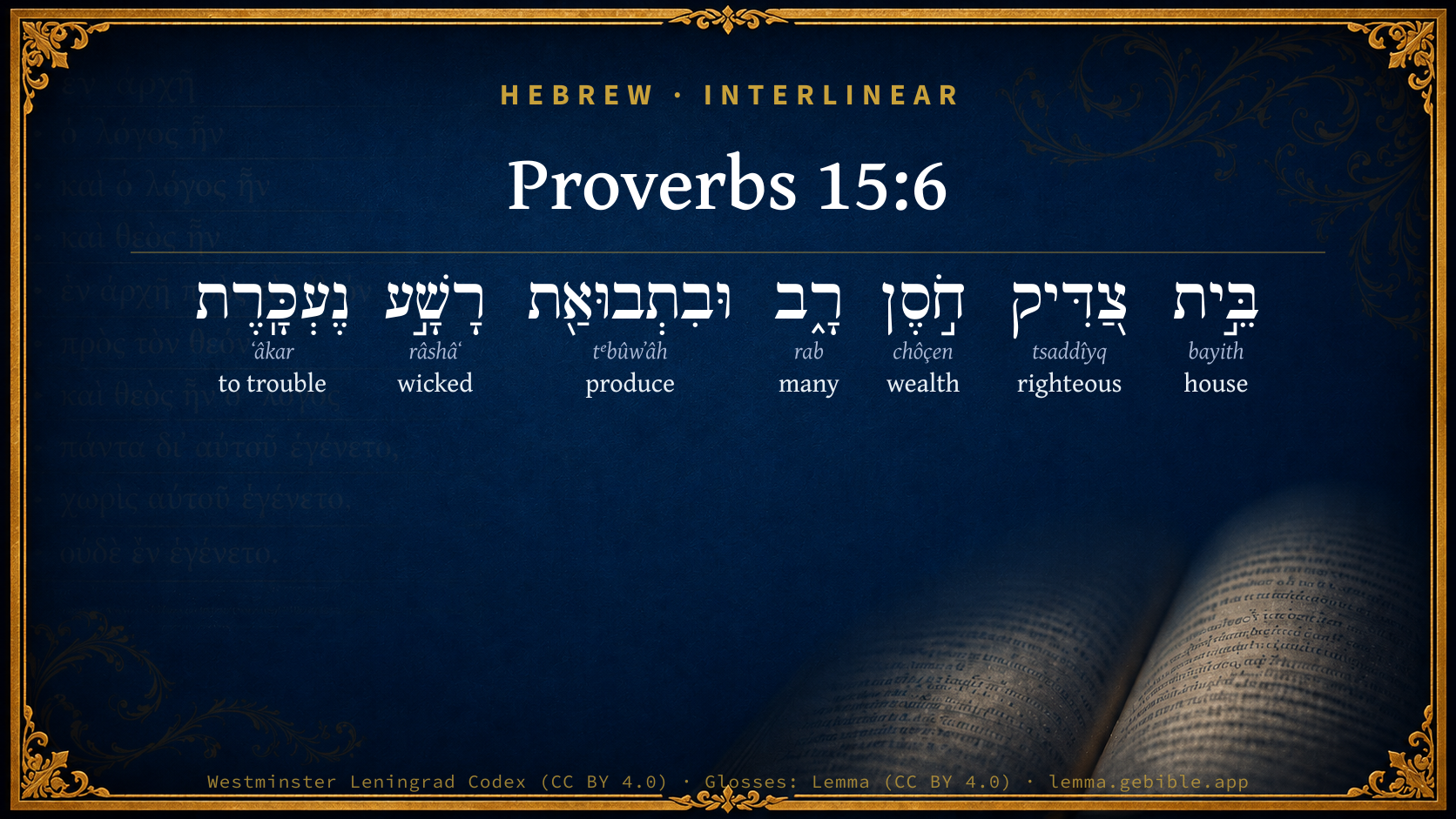
Proverbs 15:6

Hebrew (Westminster Leningrad Codex) Proverbs 15:6 appears in the Hebrew Old Testament. The text above is from the Westminster Leningrad Codex. Each word links to its Strong’s number, a concise gloss, and parsing drawn from the Open Scriptures Hebrew Bible morphology. Click any word for its full Brown-Driver-Briggs (BDB) entry.
Download image
Cite this verse

Proverbs 15:6 (World English Bible). Public Domain. Lemma interlinear Bible study tool, https://lemma.gebible.app/v/proverbs/15/6.

Show BibTeX & RIS
BibTeX
RIS
English Translation
In the house of the righteous is much treasure, But the income of the wicked brings trouble.
World English Bible · Public Domain
Highlights
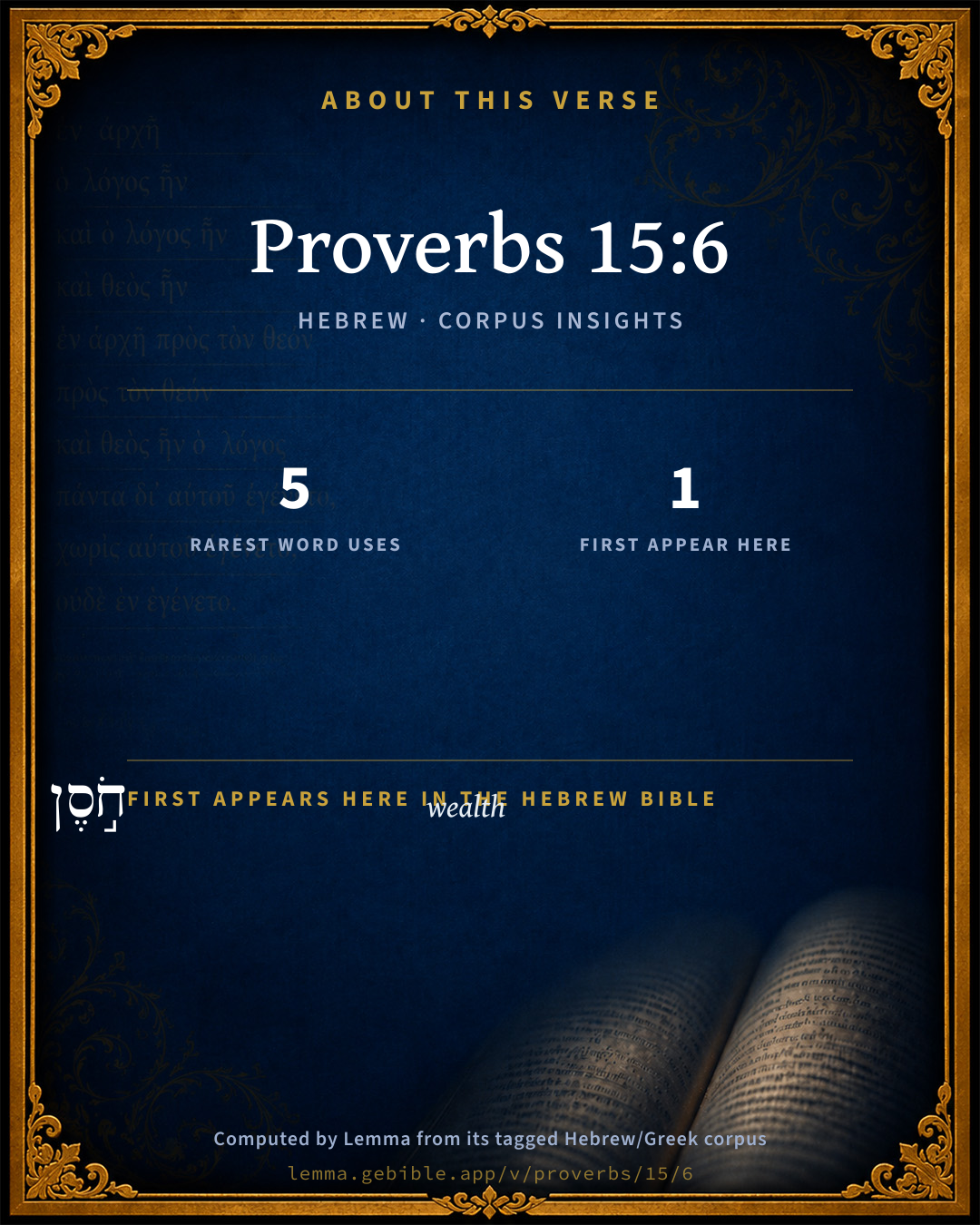
  • 1 first appearance in the Hebrew Bible
Full analysis ↓
Download a study sheet

One document with this verse’s original text, its word-by-word gloss line, the meaning frame, cross-references with their text, attributed commentary, and full source and license credits — printable, and it pastes into notes with its structure intact.

This verse Autodidact and up

Study sheet (.html) Plain text (.txt)

A passage Seminary Student

Up to 50 verses in one chapter. A passage sheet keeps up to 6 commentary sources and 12 cross-references per verse, in the order this page ranks them, and says so on the sheet whenever that leaves anything out. Ask for a single verse and you get the Autodidact verse sheet above.

Everything on this page stays free to read, with no account — the sheet is a download of what is already on screen, not access to it.

Want to remove ads? Support Godless Engineer
Compare translations 3

The same verse in 3 English versions, stacked beneath the original-language interlinear above. Click any original word for its lexicon entry.

Each is an independent rendering of the whole verse — the interlinear is not word-aligned to these translations.

Highlighted words mark where these versions differ — a whole-verse word diff, not a word-by-word alignment.

  • World English Bible Public Domain
    In the house of the righteous is much treasure, But the income of the wicked brings trouble.
  • King James Version Public Domain
    In the house of the righteous is much treasure: but in the revenues of the wicked is trouble.
  • unfoldingWord Literal Text CC BY-SA 4.0
    The house of the righteous much treasure, but in the harvest of the wicked is being troubled.

unfoldingWord Literal Text — © unfoldingWord, licensed CC BY-SA 4.0. Word-aligned USFM3 via Door43 (git.door43.org/unfoldingWord/en_ult).

Versions to compare (up to 4)

3 of 4 selected

Show all 18 translations

Every available English version of this verse, each an independent rendering of the whole verse.

  • World English Bible Public Domain
    In the house of the righteous is much treasure, But the income of the wicked brings trouble.
  • Berean Standard Bible Public Domain
    The house of the righteous has great treasure, but the income of the wicked is trouble.
  • Majority Standard Bible Public Domain
    The house of the righteous has great treasure, but the income of the wicked is trouble.
  • King James Version Public Domain
    In the house of the righteous is much treasure: but in the revenues of the wicked is trouble.
  • American Standard Version (1901) Public Domain
    In the house of the righteous is much treasure; But in the revenues of the wicked is trouble.
  • Revised Version (1885) Public Domain
    In the house of the righteous is much treasure: but in the revenues of the wicked is trouble.
  • Geneva Bible (1599) Public Domain
    The house of the righteous hath much treasure: but in the reuenues of the wicked is trouble.
  • Douay-Rheims (1899) Public Domain
    The house of the just is very much strength: and in the fruits of the wicked is trouble.
  • Young's Literal Translation Public Domain
    `In' the house of the righteous `is' abundant strength, And in the increase of the wicked -- trouble.
  • Literal Standard Version CC BY-SA 4.0
    Abundant strength [is in] the house of the righteous, || And in the increase of the wicked—trouble.
  • Unlocked Literal Bible CC BY-SA 4.0
    In the house of the righteous person there is great treasure, but the earnings of the wicked person give him trouble.
  • unfoldingWord Literal Text CC BY-SA 4.0
    The house of the righteous much treasure, but in the harvest of the wicked is being troubled.
  • Darby Bible Public Domain
    In the house of a righteous [man] is much treasure; but in the revenue of a wicked [man] is disturbance.
  • World Messianic Bible Public Domain
    In the house of the righteous is much treasure, but the income of the wicked brings trouble.
  • Webster's Bible Public Domain
    In the house of the righteous is much treasure: but in the revenues of the wicked is trouble.
  • Free Bible Version CC BY-SA 4.0
    There's plenty of treasure where good people live, but the income of the wicked brings them trouble.
  • Bible in Basic English Public Domain
    In the house of the upright man there is a great store of wealth; but in the profits of the sinner there is trouble.
  • JPS Tanakh (1917) Public Domain
    In the house of the righteous is much treasure; but in the revenues of the wicked is trouble.

Literal Standard Version (2020), Covenant Press — licensed CC BY-SA 4.0. Text via the HelloAO Bible API (eBible.org). Unlocked Literal Bible (unfoldingWord) — licensed CC BY-SA 4.0. Text via the HelloAO Bible API (eBible.org). unfoldingWord Literal Text — © unfoldingWord, licensed CC BY-SA 4.0. Word-aligned USFM3 via Door43 (git.door43.org/unfoldingWord/en_ult). Free Bible Version, Dr. Jonathan Gallagher — licensed CC BY-SA 4.0. Text via the HelloAO Bible API (eBible.org).

Word by word

More ways to search: Search by grammar → Find every occurrence → Compare this word →

Practice this passage: Drill this verse → Learn its vocabulary →

About this verse

These counts appear in no published source. They are computed here, from the morphology-tagged text and Lemma’s own curated glosses. What Lemma adds →

7
words
7
distinct lemmas
Wisdom
section

Notable vocabulary

The rarest word here is חֹ֣סֶן wealth H2633 — appearing just 5 times in the whole Hebrew Bible.

First appearance in Scripture

This word makes its first canonical appearance in the Hebrew Bible here:

  • חֹ֣סֶן wealth H2633

Shared distinctive vocabulary

חֹ֣סֶן wealth H2633 occurs in 5 verses of the Hebrew Bible. Also found in:

Grammatical profile

  • 1 verb
  • 3 nouns
  • 3 adjectives

Verb forms

  • נֶעְכָּֽרֶת Niphal · Participle Active

Hebrew & Septuagint length

In English translation the verse runs 17 words from the Hebrew and 17 from the Septuagint (LXX English) — the same length.

A rough comparison of the two English renderings, which tokenize alike — not a word-level alignment.

Word counts can differ between the Hebrew and the Greek without any difference in meaning — e.g. the Hebrew direct-object marker אֵת has no separate Greek word, and Greek often adds the article ὁ.

Cross-references

13

Topical passages linked to Proverbs 15:6 in the Treasury of Scripture Knowledge — connected by theme and wording, ordered by reader-vote popularity; previews shown in the World English Bible.

  • Proverbs 8:21 That I may give wealth to those who love me. I fill their treasuries.
  • Proverbs 10:22 Yahweh's blessing brings wealth, And he adds no trouble to it.
  • Proverbs 21:20 There is precious treasure and oil in the dwelling of the wise; But a foolish man swallows it up.
  • Psalms 112:3 Wealth and riches are in his house. His righteousness endures forever.
  • Psalms 37:16 Better is a little that the righteous has, Than the abundance of many wicked.
  • Proverbs 16:8 Better is a little with righteousness, Than great revenues with injustice.
  • Hebrews 11:26 accounting the reproach of Christ greater riches than the treasures of Egypt; for he looked to the reward.
  • Job 20:19–23 For he has oppressed and forsaken the poor. He has violently taken away a house, and he shall not build it up.
  • Proverbs 13:22 A good man leaves an inheritance to his children's children, But the wealth of the sinner is stored for the righteous.
  • Proverbs 15:16 Better is little, with the fear of Yahweh, Than great treasure with trouble.
  • Ecclesiastes 4:6 Better is a handful, with quietness, than two handfuls with labor and chasing after wind.
  • James 5:1–3 Come now, you rich, weep and howl for your miseries that are coming on you.
  • Ecclesiastes 5:10–14 He who loves silver shall not be satisfied with silver; nor he who loves abundance, with increase: this also is vanity.

Cross-references courtesy of OpenBible.info (CC BY 4.0).

Hebrew and Greek witnesses Masoretic Hebrew ↔ Greek Septuagint

The same verse in the two great witnesses to the Old Testament, shown verse-for-verse.

These are two independent witnesses, not word-aligned to each other, and the Septuagint is shown in lemma (dictionary) form.

Hebrew Proverbs 15:6 Masoretic · Westminster Leningrad Codex

בֵּ֣ית צַ֭דִּיק חֹ֣סֶן רָ֑ב וּבִתְבוּאַ֖ת רָשָׁ֣ע נֶעְכָּֽרֶת

In the house of the righteous is much treasure, But the income of the wicked brings trouble.

World English Bible · Public Domain

Greek LXX Proverbs 15:6 Septuagint · lemma form

ἐν πλεονάζω δικαιοσύνη ἰσχύς πολύς ὁ δέ ἀσεβής ὁλόρριζος ἐκ γῆ ὄλλυμι οἶκος δίκαιος ἰσχύς πολύς καρπός δέ ἀσεβής ἀποὀλλύω

In the houses of the righteous is much strength: but the fruits of the ungodly shall perish.

LXX2012 (modern English Septuagint) · Public Domain

On this verse, The Pulpit Commentary discusses the Septuagint’s reading. Read the note in Commentary ↓

Hebrew: Westminster Leningrad Codex (CC BY 4.0). Greek: Septuagint (public domain); English from LXX2012 (modern English Septuagint) (Public Domain). How the Septuagint differs from the Hebrew →

Commentary

Notes on Proverbs 15:6 from classic Christian and Jewish commentators (each source and its license shown beneath its notes). The classic Christian expositions comment on the surrounding passage and are grouped to its opening verse, so a note may address several verses; the Jewish commentaries on the Tanakh (Rashi and others) are per-verse, so they appear only where the commentator wrote on this verse.

Lemma curates 59 commentaries, every one of them public domain or Creative Commons licensed, each selected and text-cleaned for this edition rather than reprinted as found. About our sources →

Trapp's Complete Commentary

John Trapp

Pro 15:6 In the house of the righteous [is] much treasure: but in the revenues of the wicked is trouble.

Ver. 6. In the house of the righteous is much treasure.] Every righteous man is a rich man, whether he hath more or less of the things of this life. For, first, he hath plenty of that which is precious. Secondly, Propriety; what he hath is his own; he holds all in capite tenure {a} in Christ; he shall not be called to account as a usurper. "All is yours," {1Co 3:22} "because you are Christ’s, and Christ is God’s." And although he hath little, many times, in present possession, yet he is rich in reversion; rich in bills and bonds, rich in an apparent pledge, that is worth all the world besides - that is, in Christ; for, having given us his Son, "how shall he not with him also freely give us all things?" {Rom 8:32}

But in the revenues of the wicked are trouble.] For besides the curse of unsatisfiableness, in the very pursuit of them, he meets with many grievances, fears, jealousies, disgraces, interruptions, discontentments, and then, after the unsanctified enjoyment of them, follows the sting of conscience that dissweetens all, and that will unexpressibly vex and torment him through all eternity. "He hath swallowed down riches, and he shall vomit them up again; God shall cast them out of his belly." {Job 20:15} Disgorge he shall surely those murdering morsels, either by remorse and restitution in the meantime, or with despair and impenitent horror hereafter.

{a} The name of a tenure (abolished by Act 12:1-25 Chas. II, xxiv.), by which land was held immediately of the King, or of the crown?

John Trapp, A Commentary or Exposition upon All the Books of the Old and New Testament (1647–1656) — public domain. Text from a community e-Sword module.

Joseph Benson's Commentary

Pro 15:6. In the house of the righteous is much treasure — “A truly just and merciful man is very rich, whether he have little or much, because he is well contented, and what he hath is likely to continue in his family: but there is much disquiet and trouble in the greatest revenues of the wicked; which can neither stay long with him, nor give him satisfaction while he enjoys them.” — Bishop Patrick.

Joseph Benson's Commentary on the Old and New Testaments (1811–1818) — public domain. Text from a community e-Sword module.

The Preacher's Complete Homiletical Commentary

Joseph S. Exell (gen. ed.)

CRITICAL NOTES.—

Pro_15:6. Miller translates the first clause, “The house of the righteous is great treasure” (see his Comment); revenue, rather “gain.”

Pro_15:7. Disperse; some translators read “winnow,” or “sift.” Stuart translates the last clause of this verse “The heart of the fool is not stable;” Delitzsch reads, “Direction is wanting to the heart of fools,” i.e., it has not the right direction.

MAIN HOMILETICS OF Pro_15:6

LIKE IN CIRCUMSTANCES, BUT UNLIKE IN CHARACTER

I. The wicked and the righteous are often on a level as regards material wealth. One may have “much treasure” and the other great “revenues,” or gain. The laws of nature have no respect to character. God makes His sun to “shine upon the evil and the good, and sendeth rain upon the just and upon the unjust” (Mat_5:45), so that the wicked man reaps a harvest as abundant as that of the righteous man. And all the laws of Providence move with the same even step, certainly showing no favour to the good man over the bad.

II. But though their possessions may be equal, there is a great inequality in the enjoyment of them. Character makes all the difference here. Even “a little that a righteous man hath is better than the riches of many wicked” (Psa_37:16). The wicked man is troubled by a sense of being out of harmony with all that is holy, and just, and true in the universe of God, and with a foreboding of future retribution. The wealth of the spirit is so much more than material wealth as the spirit is so much more than the body. It is wealth to have “a conscience purged from, dead works to serve the living God” (Heb_9:14), and to “lay up treasure” without being thus “rich toward God” (Luk_12:21) is only to “spend money for that which is not bread, and labour for that which satisfieth not.” (See on chap. Pro_3:14-15; Pro_8:11-19, etc.)

OUTLINES AND SUGGESTIVE COMMENTS

“The treasure in the house of the righteous” may be understood not of mere wealth, but of whatever is possessed with contentment and cheerfulness, with gratitude to God, with an assurance of His fatherly regard, with the peace that passeth all understanding, with resignation of spirit to the Divine will, with the present enjoyment of spiritual blessing, and the well-founded “hope of glory, honour, and immortality.” … We may suppose the revenues of the wicked to be acquired and enjoyed wickedly. But if not—yet if possessed and expended without the fear of God, and if the means themselves of banishing that fear, and preventing the choice of a better portion,—it may truly be affirmed that in them there is “trouble.”—Wardlaw.

“The house,” as we have repeatedly seen (see on chap. Pro_9:1, Pro_14:1), means a man’s whole interest. The mere interest of the “righteous,” whether it seem high or low; his lot, whether it be on high or on a dunghill; his hap, just as it is, whether it be easy or under pain, is, under the covenant of the Almighty, an enormous riches; while not “the house of the wicked” (for the wise man intends another of his climaxes); but stating his condition in the most favourable way, “the revenue of the wicked,” imagining that to be of the most favourable kind; and not “the revenue of the wicked,” but in the revenue, as though the trouble were in the revenue itself, is, literally, the being troubled (Niphal). The splendours of the lost will involve but trouble in the whole eternity.—Miller.

The treasures of the wicked are too much for their good and too little for their lusts.… But is it not the crown of the Christian’s crown, and the glory of his glory that he cannot desire more?—Bridges.

The riches of the wicked, in which they pride themselves, often consist of paper, and if bonds and charters make a man rich, the righteous cannot be poor, when they have bonds upon God Himself for everything they need, and the charter which shows their sure title to an everlasting inheritance. The devil robbed Job, but he could not make him poor, for his chief treasure lay quite out of reach of the enemy.—Lawson.

Every righteous man is a rich man, whether he hath more or less of the things of this life. For, first, he hath plenty of that which is precious. Secondly, Propriety; what he hath is his own; he holds all in capite-tenure in Christ; he shall not be called to account as a usurper. “All is yours” (1Co_3:22), “because you are Christ’s, and Christ is God’s.” And although he hath little, many times, in present possession, he is rich in reversion.—Trapp.

His house is God’s treasury, himself is God’s treasure; wherefore God watcheth over his house to defend and preserve it; and himself God keepeth, as the apple of His eye.—Jermin.

Even the trifling sum which the righteous keeps in his house is a great treasure, because it has God’s blessing; but all the revenues, the large annual rents of the wicked from all his vast estate, are mere troubles.—Burgon.

The thought of Pro_15:7 has been treated before. (See Pro_15:2, etc.)

OUTLINES AND SUGGESTIVE COMMENTS

Utterance is a gift, and dumb Christians are blameworthy as well as dumb ministers. “Speak, that I may see thee,” said Socrates. When the heart is full, it overfloweth in speech. We know metals by their tinkling, and men by their talking.—Brooks.

In their houses, they catechise their children; in the company of their neighbours, they entreat of God’s word and works; in the church, if they be teachers, they publish wholesome doctrine.—Muffet.

Most commentators say scatter or disperse. “Winnow,” which has usage (Rth_3:2), bears better upon the second clause. (See renderings in Critical Notes.) Winnowing knowledge, i.e., letting the lips, under the guidance of wisdom, be an instrument for holding folly back and giving utterance to knowledge, must be the finest practice for giving strength to piety; while the second clause shows the incompetence of folly to “winnow” anything, by saying that “the heart of the foolish is not fixed” (and therefore lacks the first principles of choice, in separating one thing from the other).—Miller.

The foolish sow cockle as fast as wiser men do corn, and are as busy in digging descents to hell as others are in building staircases for heaven.—Trapp.

The Preacher's Complete Homiletical Commentary (gen. ed. Joseph S. Exell; Funk & Wagnalls, c. 1892) — public domain (pre-1929). A full-Bible homiletical/sermon-outline anthology covering 65 of 66 books (2 John is absent from the source module). Text from a community e-Sword module.

Tyndale Open Study Notes

Tyndale Open Resources

15:6 God blesses the godly with wealth (10:22; cp. 10:15 and 14:24). The wicked may also gain wealth, but it will bring trouble rather than blessing (11:4, 18; 13:11; 21:6; 22:16).

Tyndale Open Study Notes — © Tyndale Open Resources, licensed CC BY-SA 4.0. Text via the HelloAO Bible API.

Geneva Bible (1599)

Geneva Bible translators

For though they have much, yet it is full of trouble and care.

Geneva Bible (1599) marginal notes — public domain. Text via Bolls.life.

Matthew Henry's Commentary

Note, 1. Where righteousness is riches are, and the comforts of them: In the house of the righteous is much treasure. Religion teaches men to be diligent, temperate, and just, and by these means, ordinarily, the estate is increased. But that is not all: God blesses the habitation of the just, and that blessing makes rich without trouble. Or, if there be not much of this world's goods, yet where there is grace there is true treasure; and those who have but little, if they have a heart to be therewith content, and to enjoy the comfort of that little, it is enough; it is all riches. The righteous perhaps are not themselves enriched, but there is treasure in their house, a blessing in store, which their children after them may reap the benefit of. A wicked worldly man is only for having his belly filled with those treasures, his own sensual appetite gratified (Psa 17:14); but a righteous man's first care is for his soul and then for his seed, to have treasure in his heart and then in his house, which his relations and those about him may have the benefit of. 2. Where wickedness is, though there may be riches, yet there is vexation of spirit with them: In the revenues of the wicked, the great incomes they have, there is trouble; for there is guilt and a curse; there is pride and passion, and envy and contention; and those are troublesome lusts, which rob them of the joy of their revenues and make them troublesome to their neighbours.

Matthew Henry's Commentary on the Whole Bible (1708–1710) — public domain (CC PDM 1.0). Text via the HelloAO Bible API.

Jamieson, Fausset & Brown

Robert Jamieson, A. R. Fausset & David Brown

treasure--implying utility.

trouble--vexation and affliction.

Jamieson, Fausset & Brown — Commentary Critical and Explanatory on the Whole Bible (1871) — public domain (CC PDM 1.0). Text via the HelloAO Bible API.

Ellicott's Commentary for English Readers

(6) In the house of the righteous is much treasure.—For God’s blessing (Pro_3:33) is upon it; while the wicked, from his recklessness in the pursuit of gain, brings trouble (Pro_15:27) upon himself and his family.

A Bible Commentary for English Readers, edited by Charles John Ellicott (1878–1897) — public domain. Text from a community e-Sword module.

John Gill's Exposition

In the house of the righteous is much treasure,.... God sometimes blesses the righteous with great riches, as he did Abraham; or, however, if they have but little, it is better than the riches of many wicked; because they have what they have with a blessing, and they are content with it: and they have abundance of spiritual treasure; they have God for their portion; Christ, and all good things along with him; the rich graces of the Spirit; a rich experience of the grace of God; and all this is but a pledge and earnest of what they shall possess hereafter;

but in the revenues of the wicked is trouble; they have much trouble in getting their riches, by which they pierce themselves through with many sorrows; they have much trouble in keeping them; cannot rest nor sleep because of their abundance, lest it should be taken away from them; and they have much trouble in parting with them, when they are, by one providence or another, stripped of them; and, besides, they have them with a curse, and are ever attended with uneasiness, on one account or another.

John Gill's Exposition of the Whole Bible (1746–1763) — public domain (CC PDM 1.0). Text via the HelloAO Bible API.

Matthew Poole's English Annotations

House, or family; whereby he implies that it is not only enjoyed by him, but also left to his posterity.

In the revenues of the wicked is trouble: though he may obtain great revenues, yet they are attended with much trouble and vexation; either because they are strangely blasted and taken from them, or because they are imbittered to them by their own insatiable desires, or tormenting cares and fears, or the horrors of their guilty consciences, or by divers other ways.

Matthew Poole's English Annotations on the Holy Bible (1683–1685) — public domain. Text from a community e-Sword/MySword module.

Whedon's Commentary on the Bible

Daniel D. Whedon

6. Treasure — Perhaps our word ability would more nearly express the original; great ability of means; great wealth. The word, however, is not to be taken in its usual sense of great riches; but, rather, in the occult signification of what he has, be it much or little, being a source of comfort to the family. This idea is elsewhere more clearly set forth. (See Pro_15:16.) The prosperity of the righteous is a blessing; the gain of the wicked is trouble.

Daniel D. Whedon (gen. ed.), Commentary on the Old and New Testaments (1874–1909) — public domain. Text from a community e-Sword module.

The Pulpit Commentary

In the house of the righteous is much treasure. (chosen; see on Pro_27:24) The good man"s store is not wasted or wrongly used, and is blest by God: and therefore, whether absolutely much or little, it is safe, and it is sufficient. In a spiritual sense, the soul of the righteous is filled with graces and adorned with good works. Septuagint, "In the houses of the righteous is much strength;" plurima fortitudo, Vulgate. But in the revenues of the wicked is trouble. Great revenues acquired by wrong or expended badly bring only trouble, vexation, and ruin upon a man and his family. Septuagint, "The fruits of the wicked shall perish." Spiritually, the works of the wicked cause misery to themselves and others.

True and false gains.

I A MAN MAY RE POOR, YET POSSESS ALL THINGS. (2Co_6:10) Deus meus, et omnia!

II A MAN MAY BE RICH, YET DESTITUTE, POOR, BLIND, AND MISERABLE. If we are not satisfied, we are not rich. If we are content, we are never poor.

III GOD IS THE TRUE AND ONLY GAIN OF THE SOUL. We have a nature which will be satisfied with nothing short of the Infinite. To attempt to feed it with anything less is found to be a cheat and a self-delusion. J.

The Pulpit Commentary (1880–1919), ed. H.D.M. Spence-Jones & Joseph S. Exell — public domain. Text from a community e-Sword module.

John Wesley's Explanatory Notes

Revenues - Though he may obtain great revenues, yet they are attended with much trouble.

John Wesley, Explanatory Notes Upon the Whole Bible (1754–1765) — public domain. Text via the GEBible commentary corpus.

Bridges on Proverbs

Charles Bridges

The comparison between the righteous and the wicked, always turns in favor of the righteous. Even in treasure (Pro 15:16-17 ; Pro 3:33 ), the world’s idol, he exceeds. For though his house may be destitute of money, yet is there much treasure; often unseen (2Co 6:10 ), yet such, that the revenues of the wicked, compared with it, sink into nothing. Divine Teaching alone can convey any just apprehension of it. (1Co 2:9 .) Even eternity cannot fully grasp it; as throughout eternity it will be progressively increasing. ’Drop millions of gold, boundless revenues, ample territories, crowns and scepters; and a poor contemptible worm lays his One God against all of them.’†1 The treasures of the wicked are too much for their good, and too little for their lust. They cannot satisfy their senses, much less their souls. (Ecc 5:10 .) They may "take wings" (Pro 23:5 ) at any moment; and, while they continue, unlike the treasures of the righteous (Pro 10:22 ), they are burdened with trouble. (Ecc 4:6 .) But is it not the crown of the Christian’s crown, and the glory of his glory, that his portion is so full, that he cannot desire more? All the excellences of the creation are only dark shadows of its more substantial excellency. What a mercy to be delivered from the idolatrous bait, so ruinous alike to our present peace and eternal welfare! (1Ti 6:9-10 .) But a greater mercy still, to be enriched with that treasure, beyond the reach of harm, that raises to heaven; a portion in God, his favor, his image, his everlasting joy.

Footnotes:

†1 Bishop Hopkins’ Works, i. 43. Treatise on Vanity of the World.

Charles Bridges, An Exposition of the Book of Proverbs (1846) — public domain. Text from a community e-Sword module.

Kretzmann's Popular Commentary

Paul E. Kretzmann

v. 6. In the house of the righteous is much treasure, such prosperity being the blessing of the Lord; but in the revenues of the wicked is trouble, the income of the ungodly results in desolation; for the more they have, the more they spend in the service of sin.

Paul E. Kretzmann, Popular Commentary of the Bible (1921–1924) — public domain. Text from a community e-Sword module.

Rashi

Rabbi Shlomo Yitzchaki (Rashi)

The house of a righteous man possesses great strength The Temple that David the Righteous built is a great strength and a mighty tower for Israel.

but it becomes ruined with the bringing of the wicked man But with the bringing of the idols that Manasseh brought into it, it was ruined.

Rashi on the Tanakh — English translations: “The Judaica Press complete Tanach with Rashi, translated by A. J. Rosenberg” (CC BY 4.0); “Pentateuch with Rashi's commentary by M. Rosenbaum and A.M. Silbermann, 1929-1934” (public domain); “The Metsudah Tanach series, Lakewood, N.J” (CC BY 4.0); and “The Book of Joshua, Metsudah Publications, 1997” (CC BY 4.0). Text via Sefaria.

Lesson kit

Teaching starters — assembled from the data on this page, not authored interpretation. Every prompt links to the verse data it draws on. Edit before teaching.

Proverbs, in the Wisdom, opens this verse with 7 words (7 distinct Hebrew lemmas). Its most distinctive word is chôçen (“wealth”). A historical commentator’s framing appears above. Read the whole chapter for the surrounding context.

Discussion questions

  1. The word chôçen carries the sense “wealth.” How does it shape the verse?
  2. This is the first place “wealth” appears in Scripture (first appears here). What does its debut here establish?
  3. How does Proverbs 27:24, which shares the word «wealth», read alongside this verse?
  4. The translations on this page render this verse differently — a whole-verse word diff, not a word-by-word alignment. What might account for the different wordings?
  5. «נֶעְכָּֽרֶת» is a Niphal Participle Active verb. How does that grammatical form shape the action described?
  6. Compare how Trapp's Complete Commentary and Joseph Benson's Commentary read this verse. Where do they agree or differ?

Things to notice

  • 1 word makes its first canonical appearance in Scripture here.
  • These translations choose different wording for 7 words in this verse.
  • 7 distinct Hebrew lemmas span 7 words in this verse.

Reading settings

Reading text

Shown beneath each verse's original-language words.

Old Testament
Old Testament edition

Read the OT as the Masoretic Hebrew (MT) or the Greek Septuagint (LXX).

English shown for the Greek Septuagint (in the Hebrew ↔ Greek comparison).

Comparing translations? Open the Compare panel on any verse page to stack up to four side by side.