Isaiah 57:20

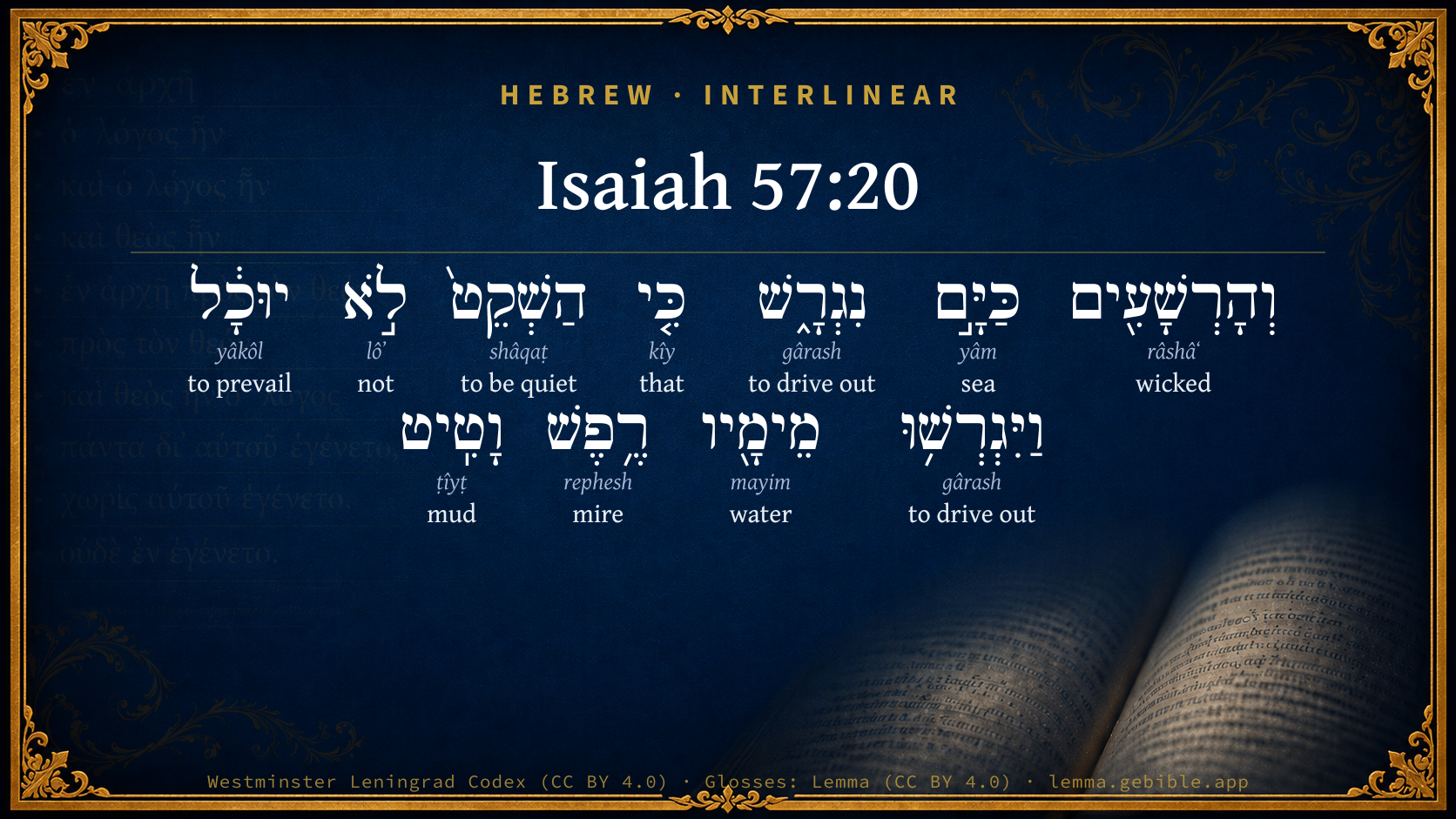
Hebrew (Westminster Leningrad Codex) Isaiah 57:20 appears in the Hebrew Old Testament. The text above is from the Westminster Leningrad Codex. Each word links to its Strong’s number, a concise gloss, and parsing drawn from the Open Scriptures Hebrew Bible morphology. Click any word for its full Brown-Driver-Briggs (BDB) entry.
Download image
Cite this verse

Isaiah 57:20 (World English Bible). Public Domain. Lemma interlinear Bible study tool, https://lemma.gebible.app/v/isaiah/57/20.

Show BibTeX & RIS
BibTeX
RIS
English Translation
But the wicked are like the troubled sea; for it can't rest, and its waters cast up mire and dirt.
World English Bible · Public Domain
Highlights
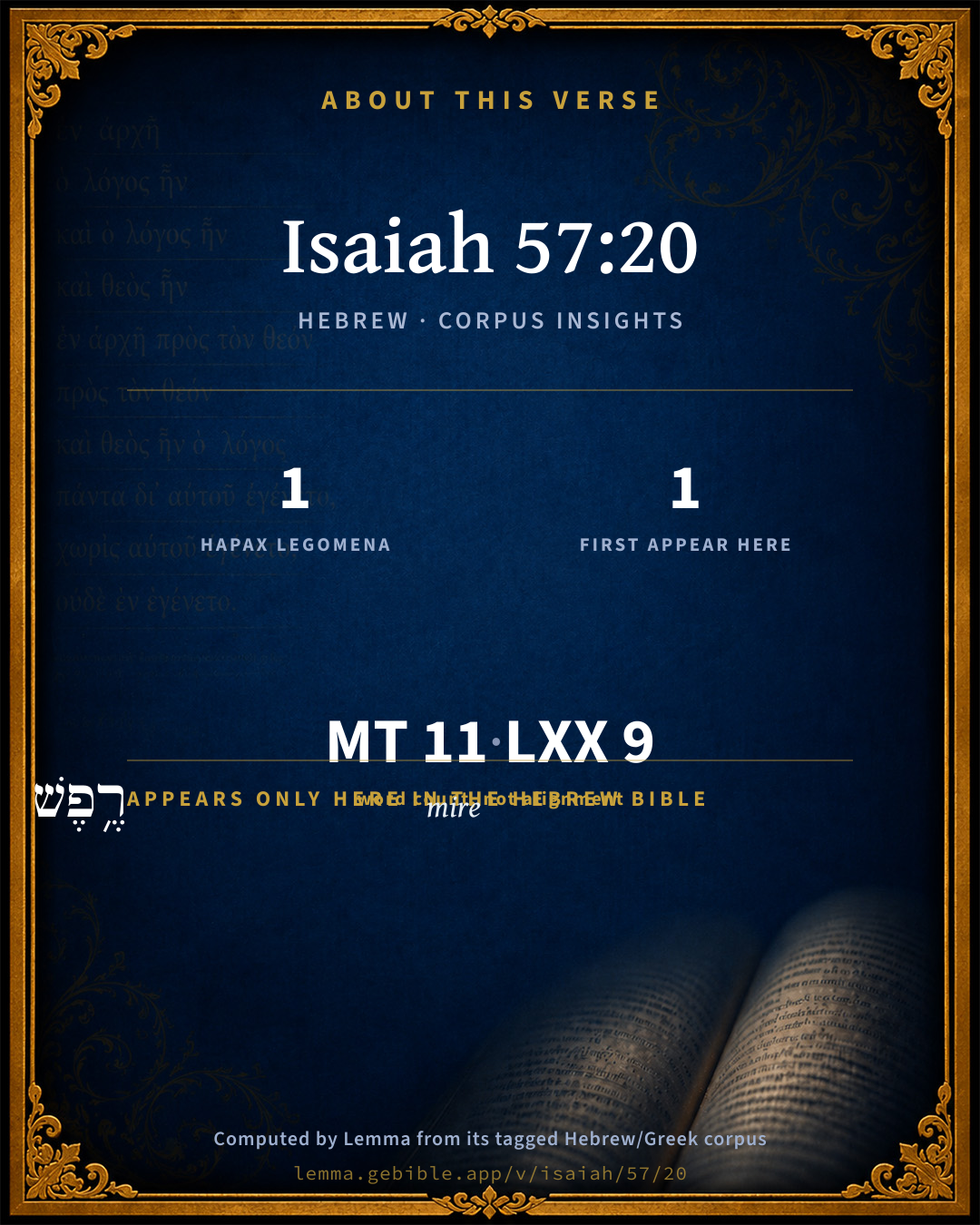
  • 1 hapax legomenon — only here in the Hebrew Bible
  • 1 first appearance in the Hebrew Bible
Full analysis ↓
Download a study sheet

One document with this verse’s original text, its word-by-word gloss line, the meaning frame, cross-references with their text, attributed commentary, and full source and license credits — printable, and it pastes into notes with its structure intact.

This verse Autodidact and up

Study sheet (.html) Plain text (.txt)

A passage Seminary Student

Up to 50 verses in one chapter. A passage sheet keeps up to 6 commentary sources and 12 cross-references per verse, in the order this page ranks them, and says so on the sheet whenever that leaves anything out. Ask for a single verse and you get the Autodidact verse sheet above.

Everything on this page stays free to read, with no account — the sheet is a download of what is already on screen, not access to it.

Want to remove ads? Support Godless Engineer
Compare translations 3

The same verse in 3 English versions, stacked beneath the original-language interlinear above. Click any original word for its lexicon entry.

Each is an independent rendering of the whole verse — the interlinear is not word-aligned to these translations.

Highlighted words mark where these versions differ — a whole-verse word diff, not a word-by-word alignment.

  • World English Bible Public Domain
    But the wicked are like the troubled sea; for it can't rest, and its waters cast up mire and dirt.
  • King James Version Public Domain
    But the wicked are like the troubled sea, when it cannot rest, whose waters cast up mire and dirt.
  • unfoldingWord Literal Text CC BY-SA 4.0
    But the wicked like the driven sea, for it is not able to rest, but its waters drive out mud and mire.

unfoldingWord Literal Text — © unfoldingWord, licensed CC BY-SA 4.0. Word-aligned USFM3 via Door43 (git.door43.org/unfoldingWord/en_ult).

Versions to compare (up to 4)

3 of 4 selected

Show all 18 translations

Every available English version of this verse, each an independent rendering of the whole verse.

  • World English Bible Public Domain
    But the wicked are like the troubled sea; for it can't rest, and its waters cast up mire and dirt.
  • Berean Standard Bible Public Domain
    But the wicked are like the storm-tossed sea, for it cannot be still, and its waves churn up mire and muck.
  • Majority Standard Bible Public Domain
    But the wicked are like the storm-tossed sea, for it cannot be still, and its waves churn up mire and muck.
  • King James Version Public Domain
    But the wicked are like the troubled sea, when it cannot rest, whose waters cast up mire and dirt.
  • American Standard Version (1901) Public Domain
    But the wicked are like the troubled sea; for it cannot rest, and its waters cast up mire and dirt.
  • Revised Version (1885) Public Domain
    But the wicked are like the troubled sea; for it cannot rest, and its waters cast up mire and dirt.
  • Geneva Bible (1599) Public Domain
    But the wicked are like the raging sea, that can not rest, whose waters cast vp myre and dirt.
  • Douay-Rheims (1899) Public Domain
    But the wicked are like the raging sea, which cannot rest, and the waves thereof cast up dirt and mire.
  • Young's Literal Translation Public Domain
    And the wicked `are' as the driven out sea, For to rest it is not able, And its waters cast out filth and mire.
  • Literal Standard Version CC BY-SA 4.0
    And the wicked [are] as the driven out sea, || For it is not able to rest, || And its waters cast out filth and mire.
  • Unlocked Literal Bible CC BY-SA 4.0
    But the wicked are like the tossing sea, which cannot rest, and its waters churn up mire and mud.
  • unfoldingWord Literal Text CC BY-SA 4.0
    But the wicked like the driven sea, for it is not able to rest, but its waters drive out mud and mire.
  • Darby Bible Public Domain
    But the wicked are like the troubled sea, which cannot rest, and whose waters cast up mire and dirt.
  • World Messianic Bible Public Domain
    But the wicked are like the troubled sea; for it can’t rest and its waters cast up mire and mud.
  • Webster's Bible Public Domain
    But the wicked are like the troubled sea, when it cannot rest, whose waters cast up mire and dirt.
  • Free Bible Version CC BY-SA 4.0
    But the wicked are like the sea that is tossed about, never keeping still, churning up the mud and muck with its waves.
  • Bible in Basic English Public Domain
    But the evil-doers are like the troubled sea, for which there is no rest, and its waters send up earth and waste.
  • JPS Tanakh (1917) Public Domain
    But the wicked are like the troubled sea; for it cannot rest, and its waters cast up mire and dirt.

Literal Standard Version (2020), Covenant Press — licensed CC BY-SA 4.0. Text via the HelloAO Bible API (eBible.org). Unlocked Literal Bible (unfoldingWord) — licensed CC BY-SA 4.0. Text via the HelloAO Bible API (eBible.org). unfoldingWord Literal Text — © unfoldingWord, licensed CC BY-SA 4.0. Word-aligned USFM3 via Door43 (git.door43.org/unfoldingWord/en_ult). Free Bible Version, Dr. Jonathan Gallagher — licensed CC BY-SA 4.0. Text via the HelloAO Bible API (eBible.org).

Word by word

More ways to search: Search by grammar → Find every occurrence → Compare this word →

Practice this passage: Drill this verse → Learn its vocabulary →

רֶ֥פֶשׁ
rephesh
H7516
“mire”
Noun, Common, Masculine, Singular, Absolute
Part of Speech
Noun
Type
Common
Gender
Masculine
Number
Singular
State
Absolute
Full BDB Definition

Origin: from H7515

TWOT: 2203a

mire, mud
  1. וְהָרְשָׁעִ֖ים râshâʻ H7563 “and · the · wicked” Conjunction + Particle, Definite Article + Adjective, Adjective, Masculine, Plural, Absolute
  2. כַּיָּ֣ם yâm H3220 “like/as the · sea” Preposition, Determined + Noun, Common, Masculine, Singular, Absolute
  3. נִגְרָ֑שׁ gârash H1644 “driving out” Verb, Niphal, Participle Active, Masculine, Singular, Absolute
  4. כִּ֤י kîy H3588 “that” Conjunction
  5. הַשְׁקֵט֙ shâqaṭ H8252 “to be quiet” Verb, Hiphil, Infinitive Absolute
  6. לֹ֣א lôʼ H3808 “not” Particle, Negative
  7. יוּכָ֔ל yâkôl H3201 “to prevail” Verb, Qal, Imperfect, 3rd Person, Masculine, Singular
  8. וַיִּגְרְשׁ֥וּ gârash H1644 “and · to drive out” Conjunction + Verb, Qal, Sequential Imperfect, 3rd Person, Masculine, Plural
  9. מֵימָ֖יו mayim H4325 “water(s) · his” Noun, Common, Masculine, Plural, Construct + Suffix, Personal, 3rd Person, Masculine, Singular
  10. וָטִֽיט ṭîyṭ H2916 “and · mud” Conjunction + Noun, Common, Masculine, Singular, Absolute

About this verse

These counts appear in no published source. They are computed here, from the morphology-tagged text and Lemma’s own curated glosses. What Lemma adds →

11
words
10
distinct lemmas
Prophets
section

Notable vocabulary

1 hapax legomenon — a word that appears only here in the entire Hebrew Bible:

  • רֶ֥פֶשׁ mire H7516

First appearance in Scripture

This word makes its first canonical appearance in the Hebrew Bible here:

  • רֶ֥פֶשׁ mire H7516

Shared distinctive vocabulary

וָטִֽיט mud H2916 occurs in 12 verses of the Hebrew Bible. Also found in:

Grammatical profile

  • 4 verbs
  • 4 nouns
  • 1 adjective
  • 1 conjunction
  • 1 particle

Verb forms

  • נִגְרָ֑שׁ Niphal · Participle Active
  • הַשְׁקֵט֙ Hiphil · Infinitive Absolute
  • יוּכָ֔ל Qal · Imperfect
  • וַיִּגְרְשׁ֥וּ Qal · Sequential Imperfect

Repetition

A word recurs within this verse — often emphatic in Hebrew:

  • נִגְרָ֑שׁ to drive out H1644 ×2

Hebrew & Septuagint length

In English translation the verse runs 20 words from the Hebrew and 16 from the Septuagint (LXX English) — closely comparable.

A rough comparison of the two English renderings, which tokenize alike — not a word-level alignment.

Word counts can differ between the Hebrew and the Greek without any difference in meaning — e.g. the Hebrew direct-object marker אֵת has no separate Greek word, and Greek often adds the article ὁ.

In the original languages it is 11 Hebrew tokens and 9 Greek tokens — but the two are counted differently (Hebrew bundles its prefixes and suffixes into one token; the Greek is in lemma form), so that isn’t a like-for-like length.

Cross-references

7

Topical passages linked to Isaiah 57:20 in the Treasury of Scripture Knowledge — connected by theme and wording, ordered by reader-vote popularity; previews shown in the World English Bible.

  • Proverbs 4:16–17 For they don't sleep, unless they do evil. Their sleep is taken away, unless they make someone fall.
  • Isaiah 3:11 Woe to the wicked! Disaster is upon them; For the deeds of his hands will be paid back to him.
  • Job 18:5–14 "Yes, the light of the wicked shall be put out, The spark of his fire shall not shine.
  • Job 15:20–24 The wicked man travails with pain all his days, Even the number of years that are laid up for the oppressor.
  • Job 20:11–29 His bones are full of his youth, But youth shall lie down with him in the dust.
  • Psalms 73:18–20 Surely you set them in slippery places. You throw them down to destruction.
  • Jude 1:12 These are hidden rocky reefs in your love feasts when they feast with you, shepherds who without fear feed themselves; clouds without water, carried along by winds; autumn leaves without fruit, twice dead, plucked up by the roots;

Cross-references courtesy of OpenBible.info (CC BY 4.0).

Hebrew and Greek witnesses Masoretic Hebrew ↔ Greek Septuagint

The same verse in the two great witnesses to the Old Testament, shown verse-for-verse.

These are two independent witnesses, not word-aligned to each other, and the Septuagint is shown in lemma (dictionary) form.

Hebrew Isaiah 57:20 Masoretic · Westminster Leningrad Codex

וְהָרְשָׁעִ֖ים כַּיָּ֣ם נִגְרָ֑שׁ כִּ֤י הַשְׁקֵט֙ לֹ֣א יוּכָ֔ל וַיִּגְרְשׁ֥וּ מֵימָ֖יו רֶ֥פֶשׁ וָטִֽיט

But the wicked are like the troubled sea; for it can't rest, and its waters cast up mire and dirt.

World English Bible · Public Domain

Greek LXX Isaiah 57:20 Septuagint · lemma form

ὁ δέ ἄδικος οὕτως κλυδωνίζομαι καί ἀναπαύω οὐ δύναμαι

But the unrighteous shall be tossed as troubled waves, and shall not be able to rest.

LXX2012 (modern English Septuagint) · Public Domain

On this verse, Albert Barnes' Notes on the Bible discusses the Septuagint’s reading. Read the note in Commentary ↓

Hebrew: Westminster Leningrad Codex (CC BY 4.0). Greek: Septuagint (public domain); English from LXX2012 (modern English Septuagint) (Public Domain). How the Septuagint differs from the Hebrew →

Targum (Aramaic paraphrase)

1

The Targum is the ancient Jewish Aramaic paraphrase of the Hebrew Scriptures — an interpretive translation, not the Hebrew text itself. Onkelos (literal) and Pseudo-Jonathan (expansive) render the Torah, and Jonathan the Prophets. Coverage is partial: where no permissively-licensed English translation exists for a verse, only the Aramaic is shown. This is verse-level text, not a word-by-word alignment to the Hebrew.

  1. Targum Jonathan Prophets (Joshua–Malachi)
    וְרַשִׁיעַיָא כְּיַמָא דִטְרִיד דְבָעֵי לְמֵינַח וְלָא יָכִיל וְעָבְדִין מוֹהִי סִין וְטִין:

    But the wicked are like the troubled sea, that seeketh to rest, but cannot, and its waters bring forth mire and dirt.

    Targum Jonathan — Aramaic: “Mikraot Gedolot” (public domain). English: “Sefaria Community Translation” (CC0 1.0 (public-domain dedication)); “London "Chaldee Paraphrase," 1871” (public domain). Text via Sefaria.

Commentary

Notes on Isaiah 57:20 from classic Christian and Jewish commentators (each source and its license shown beneath its notes). The classic Christian expositions comment on the surrounding passage and are grouped to its opening verse, so a note may address several verses; the Jewish commentaries on the Tanakh (Rashi and others) are per-verse, so they appear only where the commentator wrote on this verse.

Lemma curates 59 commentaries, every one of them public domain or Creative Commons licensed, each selected and text-cleaned for this edition rather than reprinted as found. About our sources →

Trapp's Complete Commentary

John Trapp

Isa 57:20 But the wicked [are] like the troubled sea, when it cannot rest, whose waters cast up mire and dirt.

Ver. 20. But the wicked are like the troubled sea.] Whose surges are not more lofty than muddy. The sea is of itself unquiet and troublesome, much more when tossed with winds and tempests; so wicked men, when it is at best with them, are restless; but under terrors and temptations, they cast up the mire and dirt of desperation and blasphemy, as did Cain, Judas, Julian, Latomus, &c. God in afflictions marks men out; and then conscience will prey upon them, as Simeon and Levi did upon the Shechemites when sore. Then, {as Pro 5:12} men shall cry out, "How have I hated instruction, and my heart despised reproof!" Then, {as Gen 42:21} afflictions are to the soul as storms are to the sea, or as earthquakes to the ground, which reveals a great deal of filth. Vatablus rendereth the text thus, Impii autem Euripi instar fremunt. Now Euripus ebbeth and floweth seven times a day, and must needs therefore be in continual motion and agitation. Mr Dod {a} was wont to compare wicked men to the waves of the sea: those which were of a great estate were great waves, said he; those that were of small estate were small waves; but all were restless as waves. {Job 20:20}

{a} His Life in Mr Clark.

John Trapp, A Commentary or Exposition upon All the Books of the Old and New Testament (1647–1656) — public domain. Text from a community e-Sword module.

The Biblical Illustrator

Joseph S. Exell

Isa_57:20

But the wicked are like the troubled sea

The restlessness of sin

Who are the wicked?

Not only all who think and feel and do the wrong, but all who have not the right spirit within them--supreme sympathy with the supremely good. There are degrees inwickedness as well as in goodness. There are certain things that render it impossible for wicked men to have true repose. What are they?

I. DISAPPOINTMENTS. The sinner is doomed to perpetual disappointments. He expects happiness in certain pursuits and objects that cannot according to the constitution of his soul yield him true satisfaction. He reposes trust in objects as frail as the reed and as uncertain as the clouds, and he is doomed to have his plans broken up and his confidence destroyed. Hence he is the subject of perpetual vexations and annoyances, for disappointment is evermore a soul-agitating power; it comes down sometimes upon the heart like a strong south-wester, stirring it to its very depths.

II. COMPUNCTIONS. Where there is sin there must come sooner or later remorse. An accusing conscience is not a mere wind that passes over the soul, rippling its surface; it is a volcanic force in its centre, shaking every part. It gave Cain no rest, it made Belshazzar totter and Felix tremble; it drove Judas to the rope.

III. SELFISH PASSIONS. Selfishness, which is the essence of wickedness, is the great disturbing force in the moral universe. Avarice, ambition, jealousy, revenge, envy, anger, are some of its fiendish progeny. (Homilist.)

The troubled sea

In order that the wicked may understand how far from peace they really are, the prophet points seaward, and bids the people listen to the moaning of the ocean. He bids them hearken to its thunders, as it pounds upon the rock-bound coast, and says eloquently and graphically, The wicked are like yon troubled sea, for it cannot rest; its waters cast up mire and dirt.

I. THE RESTLESSNESS OF THE OCEAN IS AN EMBLEM OF THE WICKED.

1. The sea is never still. We have, indeed, beheld it like a millpond, as we say; its surface so glassy and mirror-like that some would conclude that it was perfectly still. The sails, and masts, and hull of the ship were reflected in its glassy bosom. Yet even then the deep was not perfectly still. There was a solemn heave about it, as the flapping of the sails and the rolling of the yards plainly revealed. Moreover, even if the swell could have altogether subsided, the sea was not still for all that. There were currents, imperceptible save when the log was heaved and the reckoning taken, that bore the ship silently along. Furthermore, even if it were possible to get into a place where there were neither swell nor currents, the tides are everywhere uplifting and depressing the vessel at regular intervals to high or low watermark. The sea, therefore, is perhaps one of the best emblems of restlessness, for it has several motions and movements, even in its serenest moods. But it is not to the sea in a state of calm, but when it is lashed to foam, that the prophet compares the wicked. There is to them no permanent enjoyment: their pleasures are fleeting: they have no real rest of heart. Uncomfortable thoughts and painful prickings of conscience come when they are least welcome. Conscience is ill at ease, fear of death and of judgment can by no means be altogether set aside. Those who have been converted to God after a life of dissipation and a career of sin have honestly confessed that though there was a certain sort of pleasure in the ways of wickedness, there was meanwhile a strange unrest. Like Marcellus, the Roman general, of whom it is said that whether conqueror or conquered he was still dissatisfied, they were never content. The reference here is principally to the fierce passions that are in every human breast. In the breast of the saint they are restrained by the power of the reigning Christ, but in the life of the wicked they remain uncurbed, unbridled, let loose upon the world.

2. How readily the sea is stirred! At one moment it is comparatively calm, the surface smooth and glistening, but presently the accustomed eye notices in the distance the cats paw of the wind--a little ruffling of the surface in quite a circumscribed area. But the puffs become frequent and grow in force; the ripples become wavelets, and the wavelets waves; the waves soon rise to billows, and by and by the sea runs mountains high. It is identically the same with the wicked, now-soever gently the Prince of the power of the air blows upon them at first, all too soon the angry passions rear and-rage and roar. Pride and envy, lust and covetousness, ambition, malice, revenge, all these, little in their beginnings, grow in size and increase in number until they become adulteries, murders, blasphemies, and the like.

3. To what an awful pitch the agitation of the sea can attain. Oh, the dreadful length to which wickedness is carried!

4. How long, also, the agitation of the sea remains. Some seas, indeed, are always rough. They never know repose. Off some headlands the waves run mountains high at all seasons of the year, but in other places the storm that rises so readily takes long to subside. I have encountered the after-swell of a storm that must have raged some days before; long after the hurricane had blown itself out our vessel came into the region where its tracks remained. We crossed the pathway of the storm, though we were fortunate enough to miss the tempest itself. Oh, how long the agitation of sin remains. With some, indeed, there is a temporary lull, an attempt at reformation, more or less successful. Sometimes a man will curb his passions with philosophy, or become suddenly impressed that for his own reputations sake he must hold himself in cheek, but he has scarcely done so ere Satan raises another vehement wind and begins to arouse his passions in a different direction. I have known sinners get into just such a ease that they have overcome this temptation; they have managed, by sheer force of character and strength of purpose, to restrain certain unholy passions, and then the devil, fearing that he may miss his hold of them, raises another wind, in a contrary direction; and the remains of the previous storm come clashing with the beginnings of a new one, and the poor sinner is likely to be swamped betwixt the twain.

5. What a mighty noise the sea makes when it is troubled. There is a pleasant murmur with it in the time of calm, but when the winds of heaven begin to play upon it it thunders as it rolls and breaks on the beach, and hisses as it surges on the shore. Behold here another emblem of sin and of sinners. The wicked seem to delight in making loud proclamation of their sin.

6. When the sea is troubled it works havoc on every hand. Thus do the wicked work destruction in our midst. Alas! for those who are the prey of their passions. The great, the learned, the aged are not spared. Huge liners founder in the gale. Alas! that wicked men are constantly compassing the destruction of the smaller ships; and the children of our families and our schools are wrecked while yet their years are few. Moreover, wickedness is so insidious that some who have thought to rescue men from sin have been themselves engulfed by it. They had it in their hearts to be as lifeboats to them, but they themselves have gone down too. Law and order, like great cliffs and granite walls, have been torn down by the grasping hands of iniquity, while proprieties and decencies which one would have thought that even sinners would observe, have been levelled or overridden by men who ran to an excess of riot.

II. THE SEA IS AN EMBLEM OF WICKED MEN BECAUSE OF THE DEBRIS THAT IT CASTS UP. The egecta of the sea is, in Gods esteem, a fit image of the outcome of wicked mens hearts. When the storm has subsided you will find a good deal of objectionable matter littering the beach--the vomit of the sea. How apt an emblem of that which the Christless heart produces! What evil deeds the unregenerate heart is capable of! And what shall we say about the words of wicked men? What shall the end be? Is the storm evermore to last? I see no cure for all this unless the Lord speaks peace. Oh where is He that trod the sea? He is on the mountain top; He is on His high and holy hill. It is dark, and Jesus has not yet come to us, but He has not forgotten us. Thrice happy day when the Christ of Galilee says, Peace, be still, to a sin-stirred world! (T. Spurgeon.)

Bad men and good: a contrast

What a contrast with the calm of Gods holy mountain (Isa_57:13) high above all sublunary storms. (J. R.Macduff, D. D.)

The Biblical Illustrator, edited by Joseph S. Exell (c. 1880s–1900s) — public domain. Text from a community e-Sword module.

The Preacher's Complete Homiletical Commentary

Joseph S. Exell (gen. ed.)

THE UNHAPPINESS OF SINNERS

Isa_57:20-21. The wicked are like the troubled sea, &c. [1728]

[1728] See pp. 318, 319.

A true picture of that continued state of restlessness, uncertainty, and apprehension in which the wicked are held daily by the terrors of an alarmed conscience; or even by the distrust and anxiety they are doomed to experience in the very midst of their fancied freedom and enjoyments! Whoever has looked upon the ocean when tossed by storm and tempest, must acknowledge that the prophet could have selected no better comparison to depict to the life the state of a sinner’s spirit.

I. The sea cannot, if it would, sink to repose, but is doomed to heave wave after wave uselessly to the shore, till the mind of the spectator is oppressed with a sense of weariness, and almost sorrow for such incessant and fruitless tossings. Such, exactly, is the state of the sinner’s mind; it cannot rest. With the stain of unrepented sin on the conscience, the mind can enjoy no peace, can taste no rational pleasure [1731]

[1731] H. E. I. 1331, 1332, 1334–1341; P. D. 560, 562, 569, 572.

I. In illustrating these declarations we are not required to maintain that the life of wicked men is one of pure and unqualified wretchedness; common experience would be against us, and such is not the meaning of our text. We may admit, in perfect conformity with Isaiah’s views, that the persons here mentioned are very often possessed of many worldly blessings, and have much apparent enjoyment (Psa_35:15, &c.; H. E. I. 5045–5047). Yea, they are capable of deriving certain comforts from these outward benefits, and would sometimes be surprised if you told them that they were altogether strangers to peace. It is difficult to suppose that wealth, power, and distinction, although the portion of worldly and wicked men, convey to them no satisfaction. And especially if we contemplate that large class who spend their time amidst worldly amusements and dissipations—is there no comfort here? Is it possible that these buoyant and lively spirits are a prey to inward vexation? Can it be supposed that the thoughtless, the cheerful, and the gay, who seem to be far remote from anxiety and care, are, at the very moment, miserable? Must we suppose that even the sensual, who work all uncleanness with greediness, really do not find even any sordid pleasure in their pursuits? We need not make any statements so strong and unqualified. Nor, whatever be the alleged gratification that such persons can have, and whatever be their exemption, at any stated period, from harassing anxiety, it is not peace (α). The only condition which answers to the word peace is totally distinct both from the animal spirits, which are sometimes mistaken for it, and from the insensibility which marks the practised and daring sinner. True peace must be something essentially distinct from the changing objects of time and sense; it must be something which includes the freedom of the mind from just apprehensions of evil, and which breathes over the soul a calm which the world cannot take away. Now, there is nothing which can do this but the peace made known and offered to us by the Gospel (Joh_14:27; Rom_14:17).

Where there is no reconciliation with God, this peace cannot exist. The wicked, therefore, have it not; on the contrary, they “are like the troubled sea; for it cannot rest, and its waters cast up mire and dirt.” There may sometimes be a calm over the face of the deep, but it is not of long continuance; and the time comes when we observe the sea in commotion: no longer hushed in repose and presenting the stillness and clearness of a placid lake, but working up from its depths the sediment which is there deposited, and mingling it, even to the surface, with its waves. Such is the just and accurate image to represent the real state of mind of the wicked. Making all due allowance for the different natural dispositions of men, we see this to be generally the case with them. While all is cheerfulness and gaiety around them, while nothing occurs to interfere with their worldly pleasures, or the indulgence of their depraved minds, there is the apparent quiet and repose of the unruffled ocean: but let the soothing influence be removed, let the object of their gratifications and pursuits desert them, nay, let them be followed only to their own chamber and left to the solitude of their own thoughts, and how little have they of rest!

II. Why is there no peace to the wicked? Several reasons. 1. The unsuitableness of any earthly things to satisfy the soul. God created man in His own image; and although that image has been defaced, it is not absolutely destroyed; the temple which God created has not been ploughed up from the foundation; although a ruin, it is still a splendid ruin. The soul no longer possesses those elevated and lofty views and desires which distinguished it before the fall; but there is still in us a desire for something which this world cannot supply. Give to a man all that his heart can wish for of things visible: it will be found that the spirit is not satisfied. If we would give peace to the soul, we must have recourse to something better than the world with all its promises, and more suited to afford solid gratification than wickedness in all its branches (H. E. I. 4969–4974, 5006–5025).

2. The corrupt influence of depraved appetites and ungoverned passions. The terrible results of this influence will be obvious to any one who will observe the wicked, the perpetual outbreaking of their bad passions, and the misery thus inflicted on them (H. E. I. 4955).

3. An unpacified conscience. This troubles them in their solitude even in the days of their health; but how terrible is the distress it causes when death seems at hand.

CONCLUSION.—1. The folly of continuing in any known sin. No man would willingly and avowedly pursue a course which must involve him in misery. Why, then, is it that men persist in transgression? 2. How conducive to our happiness, even in this life, must be the spirit of true religion in the heart—reconciliation with God; peace of conscience; the peace which Christ can give. 3. What cause have we for gratitude to God, that He has provided a way of reconciliation even for the chief of sinners!—W. Dealtry, D.D., F.R.S.: Sermons, pp. 281–297.

II. The sinner, in his impurity, is like the troubled sea, “whose waters cast up mire and dirt.” As in a tempest the waves of the ocean fling nothing but foam and weed and refuse to the shore, so the mind of the sinner is productive of nothing but polluted thoughts and corrupted actions, as worthless as the mire and clay left behind it by the retiring storm. This is of all others the greatest evil that sin brings with it. By it true happiness of soul and nobleness of life are rendered impossible. It is only when the stain of sin has been blotted out by faith, and the feelings of the heart purified by grace continually sought for in fervent prayer, that the peace of God reigns in the heart, and the fruits of peace show themselves in the life and practice.

III. Several things render the sinner unhappy even in this life. Not only shall he have no peace hereafter, but he has no peace here and now. “There is no peace, saith my God, to the wicked.”

1. The wicked have no real comfort of mind from the pleasures of this world.

(1.) Nothing can afford us any real or lasting pleasures except so far as it can be enjoyed innocently and with a good conscience. The indulgence of disordered passion may, indeed, sometimes give a momentary delight; but it is always followed, on reflection, by the pangs of remorse and sorrow.

(2.) Even those delights which are pure and innocent the sinner enjoyeth not like other men; for his taste is too much corrupted and deadened by the intoxicating draughts of sin to relish the simple pleasures of innocence and virtue.

2. The wicked must necessarily want all effectual support under the many evils and calamities of life. In the time of affliction, what a contrast there is between the faithful Christian and the sinner. What the Christian can say (Psa_57:1; 2Co_4:17-18). But when the storm overtakes the sinner, it finds him naked and exposed to its influence, without one single prospect of succour or of safety. He cannot retire within himself, and derive comfort in his adversity from the uprightness of his conduct and the purity of his intentions, for these never have had a place in his bosom; he cannot look back with pleasure on the past, and he dare not look forward to the future. Moreover, the world feels no pity for the unfortunate sinner, and his own companions in guilt will be the first to shun and the last to succour him.

3. The wicked are troubled perpetually with the reproofs of conscience, and unwelcome thoughts of death.—R. Parkinson, B.D.: Sermons, vol. i. pp. 148–158.

Words have different meanings on different lips. “A rich man”—a farmer’s wife will so describe a man on whom a Baring or a Rothschild looks down as poor. To God and His inspired prophets “peace” has a loftier significance than it has to us, when uninstructed by them. Their peace means a condition of the heart arising from the harmony of the heart with God. A great work has been accomplished in any heart in which there is this peace. Its source is invisible, its results supernatural. The world does not give it; the world cannot take it away. It is independent of circumstances. Those who possess it are conscious of it when resting in the pleasant shade around which falls the pleasant sunshine of a summer day, and also when tossed to and fro at midnight on a stormy ocean. Christ, who gives it, had it when the cross was full in view: it was when He was on His way to torture and death that He bequeathed it to His disciples (Joh_14:27).

If we forget what “peace” means in Scripture, we shall be disposed to regard this Scripture declaration as inaccurate, as exaggerated. Great was Asaph’s distress when he forgot it (Psa_73:2-4). In the world there are many counterfeits of peace on which our observation is apt to rest. These counterfeits of peace prevail: nevertheless to the wicked there is no peace. What they imagine is peace is like the smoothness of the ocean on a summer evening: there is in it no stability. The wicked man, after all, is “like the troubled sea.”

I. He cannot rest. That is true of the sea, and it is just as true of the sinner, for there are mighty winds from which he cannot long escape.

1. The wind of an accusing conscience. No opiate will consign conscience to an endless slumber; no gag will keep it always silent. There are times when it will escape, and the work it does then is like the work done by a hurricane on the ocean. In solitude, in the sleepless midnight hours, in the season of sickness, the wicked man feels himself helpless before it.

2. The wind of approaching death, for which the wicked man feels he is not ready (P. D. 684).

3. The wind of judgment beyond death. In health, he scoffed at the thought of it as a silly superstitious delusion; but when he feels the chill hand of death is upon him, where is his “peace”?

These mighty winds render it impossible for the wicked man to rest. They expose the worthlessness of the counterfeits in which for a little while he rejoices.

II. He cannot permanently conceal the foulness that is within him. When the storm strikes the sea, “its waters cast up mire and dirt;” it is seen that they are not throughout as pellucid as on a quiet summer evening they seem. Their charm is merely superficial. On the wicked man, likewise, forces are exerted which show what is in him. For a time there may be a fair outward appearance, that deceives himself and others; but ere long it is dispersed by such things as these—

1. The fierce gale of sensual passion. What scandals shock society every day! What surprise is felt! And yet how unreasonable is the surprise! The temptation only showed what was in the man.

2. The fierce gale of disappointed ambition. What falsehood, meanness, cruelty, appears in men who are being deposed or hurled from power! With what base weapon they seek to defend themselves, and to retain their position!

3. The fierce gale of pecuniary necessity. There are in jail to-day men whose word a year ago was considered “as good as their bond;” but there never was in them real honesty. All these things show what is in the wicked; that beneath the surface, yea, to the very depths of their being, there is foulness.

CONCLUSION.—

1. Let us not envy the wicked in their time of success and serenity (Psa_37:34-37; H. E. I. 4943–4948, 4955–4966).

2. Let us seek the true peace and the permanent serenity we need where alone it can be found.

3. Let us have Divine compassion for the wicked.—R. A., 73.

THE HYPOCRITE UNMASKED

Isa_58:1-5. Cry aloud, spare not, &c.

The history of nations is pre-eminently the history of God’s providential government of the world. The special charge laid at the door of Israel in our text is that of hypocrisy: a malady from which many a modern temple-worshipper is suffering. Indeed there is the tendency of it to be found lurking in the nature of us all. Consider—

I. The false professions with which the Israelites are charged.

1. An apparent diligence in the search after truth and justice.

2. They appeared to be regular and punctual in their observance of the ordinances of religion. Often secondary motives prompt to a religious profession and to attendance at the house of God. It is considered fashionable and respectable to keep the Sabbath and to be present at the sanctuary at least once on the Lord’s Day. Besides, it is pleasing to our friends, &c. If these are your only motives to a religious profession, they are unworthy, and will not stand the lightning glance of Him who is the searcher of all hearts. This will help us to account for the apparent lapses and so-called backslidings of professing Christians. Learn the vital difference between a spurious and a genuine piety.

3. Look also at the spirit in which their sacrifices were made.

4. Evidently some of them were possessed of a strong desire to maintain the standard of orthodoxy (Isa_57:4; 1 Corinthians 1). To-day the olden spirit of strife and sectarian jealousy still stalks through Christendom, and there is the same smiting at any rate with the mental fist that we find in the dark days of old. How is it with ourselves? What is the great object of all our self-sacrifice and labour? Is it merely to bolster up our own little sect or Church, &c.

5. The spirit of mock humility in which the Israelites indulged (Isa_57:5). Custom of the East; the humiliation was feigned (Job_8:12). Such are some of the false professions with which the Israelites are here charged.

II. The vehement rebuke with which, because of their false professions, they are visited (Isa_57:1; Eze_33:3). It is possible for God’s people even to harbour in their midst the accursed thing which God hateth. And although we are sometimes slow to detect and confess the lurking evil, which like a worm is gnawing the root of our piety, and sapping the very fount of our spiritual life; yet God detects it, and it must be put away if we would still be accepted of Him.

CONCLUSION.—If your character answers at all to that of Israel, suffer the word of honest rebuke. Of all hateful things in God’s sight, hypocrisy is the chief.—J. W. Atkinson: The Penny Pulpit, New Series, No. 882.

The Preacher's Complete Homiletical Commentary (gen. ed. Joseph S. Exell; Funk & Wagnalls, c. 1892) — public domain (pre-1929). A full-Bible homiletical/sermon-outline anthology covering 65 of 66 books (2 John is absent from the source module). Text from a community e-Sword module.

Tyndale Open Study Notes

Tyndale Open Resources

57:20 restless sea . . . never still: Those who live in constant opposition to God (see Pss 46:3, 6; 93:3-4) do not enjoy inner quiet because they are not at peace with God (Isa 30:15; 32:17). • churns up mud and dirt: Their activity has little productivity (see Ps 40:2).

Tyndale Open Study Notes — © Tyndale Open Resources, licensed CC BY-SA 4.0. Text via the HelloAO Bible API.

Geneva Bible (1599)

Geneva Bible translators

Their evil conscience doth ever torment them, and therefore they can never have rest, read Isa. 48:22.

Geneva Bible (1599) marginal notes — public domain. Text via Bolls.life.

Jamieson, Fausset & Brown

Robert Jamieson, A. R. Fausset & David Brown

when it cannot rest--rather, "for it can have no rest" (Job 15:20, &c.; Pro 4:16-17). English Version represents the sea as occasionally agitated; but the Hebrew expresses that it can never be at rest.

Jamieson, Fausset & Brown — Commentary Critical and Explanatory on the Whole Bible (1871) — public domain (CC PDM 1.0). Text via the HelloAO Bible API.

Ellicott's Commentary for English Readers

(20) The wicked are like the troubled sea . . .—The promise of healing is, however, not unconditional. The acceptance of peace requires calmness; but for the wicked, whose thoughts are restlessly seething with evil ripening into act, this true peace is, in the nature of the case, impossible. We note the recurrence of the watchword of Isa_48:22, as indicating the close of another section of the prophecy. The MSS. and versions present a curious variation in Isa_57:21 : some “saith Jehovah,” some “God,” some “the Lord God.” It would almost seem as if transcribers and translators had shrunk from the prophet’s boldness in claiming God as in some special sense his God. It has a parallel, however, in Isa_7:13, and may be noted, accordingly, as one of the characteristic touches common to the two parts of Isaiah. The “Sea” of which Isaiah speaks may possibly have been the Dead Sea, casting up its salt bituminous deposits.

A Bible Commentary for English Readers, edited by Charles John Ellicott (1878–1897) — public domain. Text from a community e-Sword module.

The Cambridge Bible for Schools and Colleges

gen. ed. J. J. S. Perowne

20, 21. Their peace is contrasted with the eternal unrest of the wicked. For the image cf. Judges 13.

when (for) it cannot rest] as Jer_49:23.

The Cambridge Bible for Schools and Colleges (gen. ed. J. J. S. Perowne; Cambridge University Press, 1878–1918) — public domain. Text from a community e-Sword module.

John Gill's Exposition

But the wicked are like the troubled sea, when it cannot rest,.... Disturbed by winds, storms, and hurricanes, when its waves rise, rage, and tumble about, and beat against the shore and sand, threatening to pass the bounds fixed for it. In such like agitations will the minds of wicked men be, through the terrors of conscience for their sins; or through the malice and envy in them at the happiness and prosperity of the righteous, now enjoyed, upon the downfall of antichrist; and through the judgments of God upon them, gnawing their tongues for pain, and blaspheming the God of heaven, because of their plagues and pains, Rev 16:9,

whose waters cast up mire and dirt; from the bottom of the sea upon the shore; so the hearts of wicked men, having nothing but the mire and dirt of sin in them, cast out nothing else but the froth and foam of their own shame, blasphemy against God, and malice against his people.

John Gill's Exposition of the Whole Bible (1746–1763) — public domain (CC PDM 1.0). Text via the HelloAO Bible API.

Albert Barnes' Notes on the Bible

But the wicked - All who are transgressors of the law and who remain unpardoned. The design of this is to contrast their condition with that of those who should enjoy peace. The proposition is, therefore, of the most general character. All the wicked are like the troubled sea. Whether prosperous or otherwise; rich or poor; bond or free; old or young; whether in Christian, in civilized, or in barbarous lands; whether living in palaces, in caves, or in tents; whether in the splendor of cities, or in the solitude of deserts; All are like the troubled sea.

Are like the troubled sea - The agitated (נגרשׁ nigrâsh), ever-moving and restless sea. The sea is always in motion, and never entirely calm. Often also it lashes into foam, and heaves with wild commotion.

When it cannot rest - Lowth renders this, ‘For it never can be at rest.’ The Hebrew is stronger than our translation. It means that there is no possibility of its being at rest; it is unable to be still (יוּכל לא השׁקט כי kı̂y hasheqēṭ lo' yûkal). The Septuagint renders it, ‘But the wicked are tossed like waves (κλυδωνισθήσονται kludōnisthēsontai), and are not able to be at rest.’ The idea, as it seems to me, is not exactly that which seems to be conveyed by our translation, that the wicked are like the sea, occasionally agitated by a storm and driven by wild commotion, but that, like the ocean, there is never any peace, as there is no peace to the restless waters of the mighty deep.

Whose waters - They who have stood on the shores of the ocean and seen the waves - especially in a storm - foam, and roll, and dash on the beach, will be able to appreciate the force of this beautiful figure, and cannot but have a vivid image before them of the unsettled and agitated bosoms of the guilty. The figure which is used here to denote the want of peace in the bosom of a wicked man, is likewise beautifully employed by Ovid:

Cumque sit hibernis agitatum fluctibus aequor,

Pectora sunt ipso turbidiora mari.

Trist. i. x. 33

The agitation and commotion of the sinner here referred to, relates to such things as the following:

1. There is no permanent happiness or enjoyment. There is no calmness of soul in the contemplation of the divine perfections, and of the glories of the future world. There is no substantial and permanent peace furnished by wealth, business, pleasure; by the pride, pomp, and flattery of the world. All leave the soul unsatisfied, or dissatisfied; all leave is unprotected against the rebukes of conscience, and the fear of hell.

2. Raging passions. The sinner is under their influence. and they may be compared to the wild and tumultuous waves of the ocean. Thus the bosoms of the wicked are agitated with the conflicting passions of pride, envy, malice, lust, ambition, and revenge. These leave no peace in the soul; they make peace impossible. People may learn in some degree to control them by the influence of philosophy; or a pride of character and respect to their reputation may enable them in some degree to restrain them; but they are like the smothered fires of the volcano, or like the momentary calm of the ocean that a gust of wind may soon lash into foam. To restrain them is not to subdue them, for no man can tell how soon he may be excited by anger, or how soon the smothered fires of lus may burn.

3. Conscience. Nothing more resembles an agitated ocean casting up mire and dirt, than a soul agitated by the recollections of past guilt. A deep dark cloud in a tempest overhangs the deep; the lightnings play and the thunder rolls along the sky, and the waves heave with wild commotion. So it is with the bosom of the sinner. Though there may be a temporary suspension of the rebukes of conscience, yet there is no permanent peace. The soul cannot rest; and in some way or other the recollections of guilt will be excited, and the bosom thrown into turbid and wild agitation.

4. The fear of judgment and of hell. Many a sinner has no rest, day or night, from the fear of future wrath. His troubled mind looks onward, and he sees nothing to anticipate but the wrath of God, and the horrors of an eternal hell. How invaluable then is religion! All these commotions are stilled by the voice of pardoning mercy, as the billows of the deep were hushed by the voice of Jesus. How much do we owe to religion! Had it not been for this, there had been no peace in this world. Every bosom would have been agitated with tumultuous passion; every heart would have quailed with the fear of hell. How diligently should we seek the influence of religion! We all have raging passions to be subdued. We all have consciences that may be troubled with the recollections of past guilt. We are all traveling to the bar of God, and have reason to apprehend the storms of vengeance. We all must soon lie down on beds of death, and in all these scenes there is nothing that can give permanent and solid peace but the religion of the Redeemer. Oh! that stills all the agitation of a troubled soul; lays every billow of tumultuous passion to rest; calms the conflicts of a guilty bosom; reveals God reconciled through a Redeemer to our souls, and removes all the anticipated terrors of a bed of death and of the approach to the judgment bar. Peacefully the Christian can die - not as the troubled sinner, who leaves the world with a bosom agitated like the stormy ocean but as peacefully as the gentle ripple dies away on the beach.

How blest the righteous when they die,

When holy souls retire to rest I

How mildly beams the closing eye,

How gently heaves the expiring breast!

So fades a summer cloud away;

So sinks the gale when storms are o’er;

So gently shuts the eve of day;

So dies a wave along the shore.

- Barbauld

Albert Barnes' Notes on the Bible (1834–1885) — public domain. Text from a community e-Sword/MySword module.

Haydock's Catholic Bible Commentary

Dirt. Literally, "treading," conculcationem. (Haydock) --- The works of the wicked are fruitless. They have no content. (Calmet) Non enim gazæ neque consularis

Summovet lictor miseros tumultus,

Mentis et curas laqueata circum,

Tecta volantes. ----- (Horace, ii. ode 16.)

--- The obstinate sinner can receive no pardon. (Worthington)

George Leo Haydock (1774–1849), Haydock's Catholic Family Bible and Commentary, 1859 edition — public domain. Excludes Psalms (Douay-Rheims chapter numbering differs from Protestant) and Deuterocanonical books (Catholic canon only).

Matthew Poole's English Annotations

Their minds are restless, being perpetually hurried and tormented with their own lusts and passions, and with the horror of their guilt, and the dread of the Divine vengeance due unto them, and ready to come upon them.

Matthew Poole's English Annotations on the Holy Bible (1683–1685) — public domain. Text from a community e-Sword/MySword module.

Whedon's Commentary on the Bible

Daniel D. Whedon

20, 21. But the wicked — The incorrigible, the rejected of Israel — type of the wicked, always and everywhere — have no peace at all.

Like the troubled sea — The symbol of perpetual heart-disturbance, turbid with mire from its shore deposits.

No peace — Fearfully decisive is this!

No peace, saith my God — And saith, also, my inmost spirit, my deepest convictions, divinely awakened within me.

To the wicked — Who have sealed their own condition of everlasting unrest.

Daniel D. Whedon (gen. ed.), Commentary on the Old and New Testaments (1874–1909) — public domain. Text from a community e-Sword module.

The Pulpit Commentary

The wicked are like the troubled sea. A striking metaphor, but one which occurs nowhere else in the Old Testament, and once only in the New. (Jud_1:13) The sea"s restless action well expresses the unquiet of the wicked; and the mud and mire that it casts up resembles their evil thoughts and evil deeds. "There is no peace" for such persons, either bodily or spiritual, either in this world or the world to come.

Vers. 20, 21. The unrest of the wicked.

"But the wicked are like the sea that is tossed up, for it cannot rest, and its waters toss up mire and mud" (Cheyne). Comp. Jud_1:13 for the figure. It is curious to note the marked contrast between our ideas and sentiments concerning the sea, and those of ancient times and Eastern lands. To us it is the beautiful shining sea, and many of us feel that we must see it at least once a year. To us it is the most soothing and calming of Nature"s influences, and we. sympathize with Bonar as he sings"Summer ocean, how I"ll miss thee, Miss the thunder of thy roar, Miss the music of thy ripple, Miss thy sorrow-soothing shore. Summer ocean, how I"ll miss thee, When "the sea shall be no more"!

But to Eastern people generally in ancient times, and to Israelites in particular, the sea was a great dread. It was the separator, the engulpher of life, the restless storm-darkened, storm-tossed, wailing sea; suggestive only of foulness, unrest, and peril. So it was a type of the wicked man in ways, and with applications, which we find it most difficult to realize. But the unresting character of the sea does impress us. There is no peace to the heaving, swirling, wind-driven, tide-drawn sea.

I THERE IS NO PEACE TO THE WICKED BECAUSE, IN HIS WAY, HE CAN NEVER GET IT. His way is breaking up the Divine order: rest can never come that way. His way is striving with everything that makes fair promises, apart from God: rest can never come that way. His way is to seek for rest in things that he can possess, not in the character which he can be: rest can never come that way. God"s world was made for good men, and it will yield its best treasures to, and satisfy, nobody but the good.

II THERE IS NO PEACE TO THE WICKED BECAUSE, ON HIS CONDITIONS, GOD WILL NEVER GIVE IT. And peace for man is the gift of God. So, speaking for God, Jesus said, "Peace I leave with you, my peace I give unto you." The wicked want to buy it. God does not sell it. The wicked would consume it on their lusts if they obtained it. God will never allow his gifts to be abused. The wicked are not prepared to ear that peace which God calls peace; so he will wait until they come to a right mind. Show, in contrast, that we have "peace with God through our Lord Jesus Christ a heart-peace that works itself out into all sacred testings of life and relationship. R.T.

The Pulpit Commentary (1880–1919), ed. H.D.M. Spence-Jones & Joseph S. Exell — public domain. Text from a community e-Sword module.

John Wesley's Explanatory Notes

Cast up - Their minds are restless, being perpetually hurried with their own lusts and passions, and with guilt, and the dread of the divine vengeance.

John Wesley, Explanatory Notes Upon the Whole Bible (1754–1765) — public domain. Text via the GEBible commentary corpus.

J. A. Alexander on Isaiah

Joseph Addison Alexander

“And the wicked (are) like the troubled sea, for rest it cannot, and its waters cast up mire and dirt.” Interpreters are commonly agreed in making this verse a necessary limitation of the foregoing promise to its proper objects. There is a force in the original which cannot be retained in a translation arising from the etymological affinity between the words translated ‘wicked’, ‘troubled’, and ‘cast up’. Among the various epithets applied to sinners, the one here used is that which originally signifies their turbulence or restlessness. Lowth’s version of this last clause is more than usually plain and vigorous: ‘its waters work up mire and filth’. The verb means strictly to expel or drive out, and is therefore happily descriptive of the natural process here referred to. There seems to be allusion to this verse in Jud 1:13.

Joseph Addison Alexander, The Prophecies of Isaiah (1846–1847; New York: Scribner, 1870–1878) — public domain. Text from a community e-Sword module.

unfoldingWord translationNotes

Door43 World Missions Community

But the wicked are like the tossing sea ... mire and mud

This compares the wicked to rough water on the shore that makes the water dirty. (See: Simile)

translationWords

evil

rest

water

peace

God

unfoldingWord translationNotes — © Distant Shores Media and the Door43 World Missions Community, licensed CC BY-SA 4.0. Source: git.door43.org/Door43/en_tn.

Rashi

Rabbi Shlomo Yitzchaki (Rashi)

But the wicked who do not give a thought to repent.

like the turbulent sea This seaits waves raise themselves high and strive to go out of the boundary of sand that I made as a boundary for the sea, and when it reaches there, against its will it breaks. The next wave sees all this, yet does not turn back. Similarly, the wicked man sees his friend being punished for his wickedness; yet he does not turn back. Also, just as the sea has its mud and its offensive matter on its mouth, [i.e., on its surface,] so do the wicked have their offensive matter in their mouth; e.g., Pharaoh said, (Exodus 5:2) “Who is the Lord?” Sennacherib said (supra 36:20), “Who are they among all the Gods of the lands...?” Nebuchadnezzar said, (supra 14:14) “I will liken myself to the Most High.”

like the turbulent sea Like the sea, which is turbulent, that casts up all day mud and dirt.

Rashi on the Tanakh — English translations: “The Judaica Press complete Tanach with Rashi, translated by A. J. Rosenberg” (CC BY 4.0); “Pentateuch with Rashi's commentary by M. Rosenbaum and A.M. Silbermann, 1929-1934” (public domain); “The Metsudah Tanach series, Lakewood, N.J” (CC BY 4.0); and “The Book of Joshua, Metsudah Publications, 1997” (CC BY 4.0). Text via Sefaria.

Ibn Ezra

Rabbi Abraham ibn Ezra

But the wicked are, etc. God heals the righteous of Israel, but not the wicked, because the latter are troubled, like the sea that is continually troubled. נגרש Troubled. It has the same meaning as ויגרשו and they moved, and is probably of the same root as גורש driving out (Ex. 34:11);

it is explained by the words which follow: when it cannot rest. Before נגרש the relative (אשר═) שהוא is to be supplied; for נגרש is an adjective.

ויגרשו And they moved.

Ibn Ezra on the Tanakh — English translations: “Sefaria Community Translation” (CC0 1.0 (public-domain dedication)); “Yalkut, Sifsei Chachomim Chumash, Metsudah Publications, 2009” (CC BY 4.0); and “Commentary of Ibn Ezra on Isaiah - trans. by M. Friedlander, 1873” (public domain). Text via Sefaria.

Lesson kit

Teaching starters — assembled from the data on this page, not authored interpretation. Every prompt links to the verse data it draws on. Edit before teaching.

Isaiah, in the Prophets, opens this verse with 11 words (10 distinct Hebrew lemmas). Its most distinctive word is rephesh (“mire”). A historical commentator’s framing appears above. Read the whole chapter for the surrounding context.

Discussion questions

  1. How does “mire” (rephesh) shape what this verse is saying?
  2. 1 word here appears nowhere else in the Hebrew Bible. Why might the author reach for such rare wording?
  3. This is the first place “mire” appears in Scripture (first appears here). What does its debut here establish?
  4. How does 2 Samuel 22:43, which shares the word «mud», read alongside this verse?
  5. What does the repetition of “to drive out” (2× in this one verse) do in this verse?
  6. These translations render this verse differently; the difference is in the English rendering, not the original. What questions does that raise?
  7. «נִגְרָ֑שׁ» is a Niphal Participle Active verb. How does that grammatical form shape the action described?
  8. Compare how Trapp's Complete Commentary and The Biblical Illustrator read this verse. Where do they agree or differ?

Things to notice

  • 1 word in this verse appears nowhere else in the Hebrew Bible.
  • 1 word makes its first canonical appearance in Scripture here.
  • This verse counts 11 Hebrew ↔ 9 Greek words.
  • These translations choose different wording for 13 words in this verse.
  • “to drive out” occurs 2× in this single verse.

Reading settings

Reading text

Shown beneath each verse's original-language words.

Old Testament
Old Testament edition

Read the OT as the Masoretic Hebrew (MT) or the Greek Septuagint (LXX).

English shown for the Greek Septuagint (in the Hebrew ↔ Greek comparison).

Comparing translations? Open the Compare panel on any verse page to stack up to four side by side.