Psalms 68:2

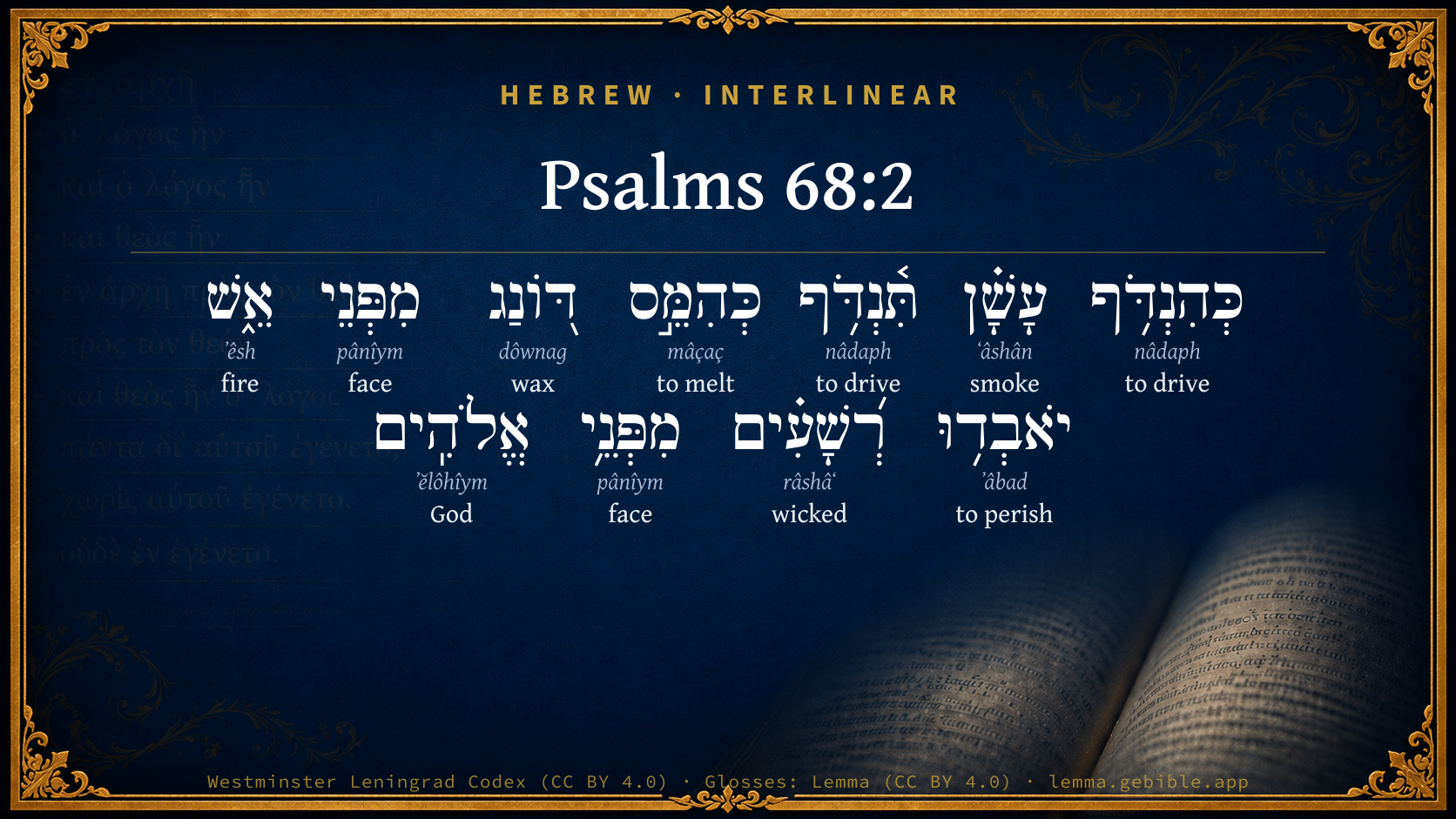
Hebrew (Westminster Leningrad Codex) Psalms 68:2 appears in the Hebrew Old Testament. The text above is from the Westminster Leningrad Codex. Each word links to its Strong’s number, a concise gloss, and parsing drawn from the Open Scriptures Hebrew Bible morphology. Click any word for its full Brown-Driver-Briggs (BDB) entry.
Download image
Cite this verse

Psalms 68:2 (World English Bible). Public Domain. Lemma interlinear Bible study tool, https://lemma.gebible.app/v/psalms/68/2.

Show BibTeX & RIS
BibTeX
RIS
English Translation
As smoke is driven away, So drive them away. As wax melts before the fire, So let the wicked perish at the presence of God.
World English Bible · Public Domain
Download a study sheet

One document with this verse’s original text, its word-by-word gloss line, the meaning frame, cross-references with their text, attributed commentary, and full source and license credits — printable, and it pastes into notes with its structure intact.

This verse Autodidact and up

Study sheet (.html) Plain text (.txt)

A passage Seminary Student

Up to 50 verses in one chapter. A passage sheet keeps up to 6 commentary sources and 12 cross-references per verse, in the order this page ranks them, and says so on the sheet whenever that leaves anything out. Ask for a single verse and you get the Autodidact verse sheet above.

Everything on this page stays free to read, with no account — the sheet is a download of what is already on screen, not access to it.

Want to remove ads? Support Godless Engineer
Compare translations 3

The same verse in 3 English versions, stacked beneath the original-language interlinear above. Click any original word for its lexicon entry.

Each is an independent rendering of the whole verse — the interlinear is not word-aligned to these translations.

Highlighted words mark where these versions differ — a whole-verse word diff, not a word-by-word alignment.

  • World English Bible Public Domain
    As smoke is driven away, So drive them away. As wax melts before the fire, So let the wicked perish at the presence of God.
  • King James Version Public Domain
    As smoke is driven away, so drive them away: as wax melteth before the fire, so let the wicked perish at the presence of God.
  • unfoldingWord Literal Text CC BY-SA 4.0
    As smoke is driven away, drive away; as wax melts from the face of fire, let the wicked perish from the face of God.

unfoldingWord Literal Text — © unfoldingWord, licensed CC BY-SA 4.0. Word-aligned USFM3 via Door43 (git.door43.org/unfoldingWord/en_ult).

Versions to compare (up to 4)

3 of 4 selected

Show all 18 translations

Every available English version of this verse, each an independent rendering of the whole verse.

  • World English Bible Public Domain
    As smoke is driven away, So drive them away. As wax melts before the fire, So let the wicked perish at the presence of God.
  • Berean Standard Bible Public Domain
    As smoke is blown away, You will drive them out; as wax melts before the fire, the wicked will perish in the presence of God.
  • Majority Standard Bible Public Domain
    As smoke is blown away, You will drive them out; as wax melts before the fire, the wicked will perish in the presence of God.
  • King James Version Public Domain
    As smoke is driven away, so drive them away: as wax melteth before the fire, so let the wicked perish at the presence of God.
  • American Standard Version (1901) Public Domain
    As smoke is driven away, so drive them away: As wax melteth before the fire, So let the wicked perish at the presence of God.
  • Revised Version (1885) Public Domain
    As smoke is driven away, so drive them away: as wax melteth before the fire, so let the wicked perish at the presence of God.
  • Geneva Bible (1599) Public Domain
    As the smoke vanisheth, so shalt thou driue them away: and as waxe melteth before the fire, so shall the wicked perish at the presence of God.
  • Douay-Rheims (1899) Public Domain
    Let God arise, and let his enemies be scattered: and let them that hate him flee from before his face.
  • Young's Literal Translation Public Domain
    As the driving away of smoke Thou drivest away, As the melting of wax before fire, The wicked perish at the presence of God.
  • Literal Standard Version CC BY-SA 4.0
    You drive them away as the driving away of smoke, || As the melting of wax before fire, || The wicked perish at the presence of God.
  • Unlocked Literal Bible CC BY-SA 4.0
    As smoke is driven away, so drive them away; as wax melts before the fire, so let the wicked perish in the presence of God.
  • unfoldingWord Literal Text CC BY-SA 4.0
    As smoke is driven away, drive away; as wax melts from the face of fire, let the wicked perish from the face of God.
  • Darby Bible Public Domain
    As smoke is driven, thou wilt drive them away; as wax melteth before the fire, the wicked shall perish at the presence of God.
  • World Messianic Bible Public Domain
    As smoke is driven away, so drive them away. As wax melts before the fire, so let the wicked perish at the presence of God.
  • Webster's Bible Public Domain
    \\68:1\\To the chief Musician, A Psalm or Song of David. Let God arise, let his enemies be scattered: let them also that hate him flee before him.
  • Free Bible Version CC BY-SA 4.0
    Blow them away as if they were smoke; melt them like beeswax in a fire. Let the wicked die in God's presence.
  • Bible in Basic English Public Domain
    Let them be like smoke before the driving wind; as wax turning soft before the fire, so let them come to an end before the power of God.
  • JPS Tanakh (1917) Public Domain
    (68-3) As smoke is driven away, so drive them away; as wax melteth before the fire, so let the wicked perish at the presence of God.

Literal Standard Version (2020), Covenant Press — licensed CC BY-SA 4.0. Text via the HelloAO Bible API (eBible.org). Unlocked Literal Bible (unfoldingWord) — licensed CC BY-SA 4.0. Text via the HelloAO Bible API (eBible.org). unfoldingWord Literal Text — © unfoldingWord, licensed CC BY-SA 4.0. Word-aligned USFM3 via Door43 (git.door43.org/unfoldingWord/en_ult). Free Bible Version, Dr. Jonathan Gallagher — licensed CC BY-SA 4.0. Text via the HelloAO Bible API (eBible.org).

Word by word

More ways to search: Search by grammar → Find every occurrence → Compare this word →

Practice this passage: Drill this verse → Learn its vocabulary →

דּ֭וֹנַג
dôwnag
H1749
“wax”
Noun, Common, Masculine, Singular, Absolute
Part of Speech
Noun
Type
Common
Gender
Masculine
Number
Singular
State
Absolute
Full BDB Definition

Origin: of uncertain derivation

TWOT: 444a

wax (always figurative 'of melting')
  1. כְּהִנְדֹּ֥ף nâdaph H5086 “like/as · to drive” Preposition + Verb, Niphal, Infinitive Construct
  2. עָשָׁ֗ן ʻâshân H6227 “smoke” Noun, Common, Masculine, Singular, Absolute
  3. תִּ֫נְדֹּ֥ף nâdaph H5086 “to drive” Verb, Qal, Imperfect, 2nd Person, Masculine, Singular
  4. כְּהִמֵּ֣ס mâçaç H4549 “like/as · to melt” Preposition + Verb, Niphal, Infinitive Construct
  5. מִפְּנֵי pânîym H6440 “from · face(s) of” Preposition + Noun, Common, Both, Plural, Construct
  6. אֵ֑שׁ ʼêsh H784 “fire” Noun, Common, Both, Singular, Absolute
  7. יֹאבְד֥וּ ʼâbad H6 “to perish” Verb, Qal, Imperfect, 3rd Person, Masculine, Plural
  8. רְ֝שָׁעִ֗ים râshâʻ H7563 “wicked” Adjective, Adjective, Masculine, Plural, Absolute
  9. מִפְּנֵ֥י pânîym H6440 “from · face(s) of” Preposition + Noun, Common, Both, Plural, Construct
  10. אֱלֹהִֽים ʼĕlôhîym H430 “God(s)” Noun, Common, Masculine, Plural, Absolute

About this verse

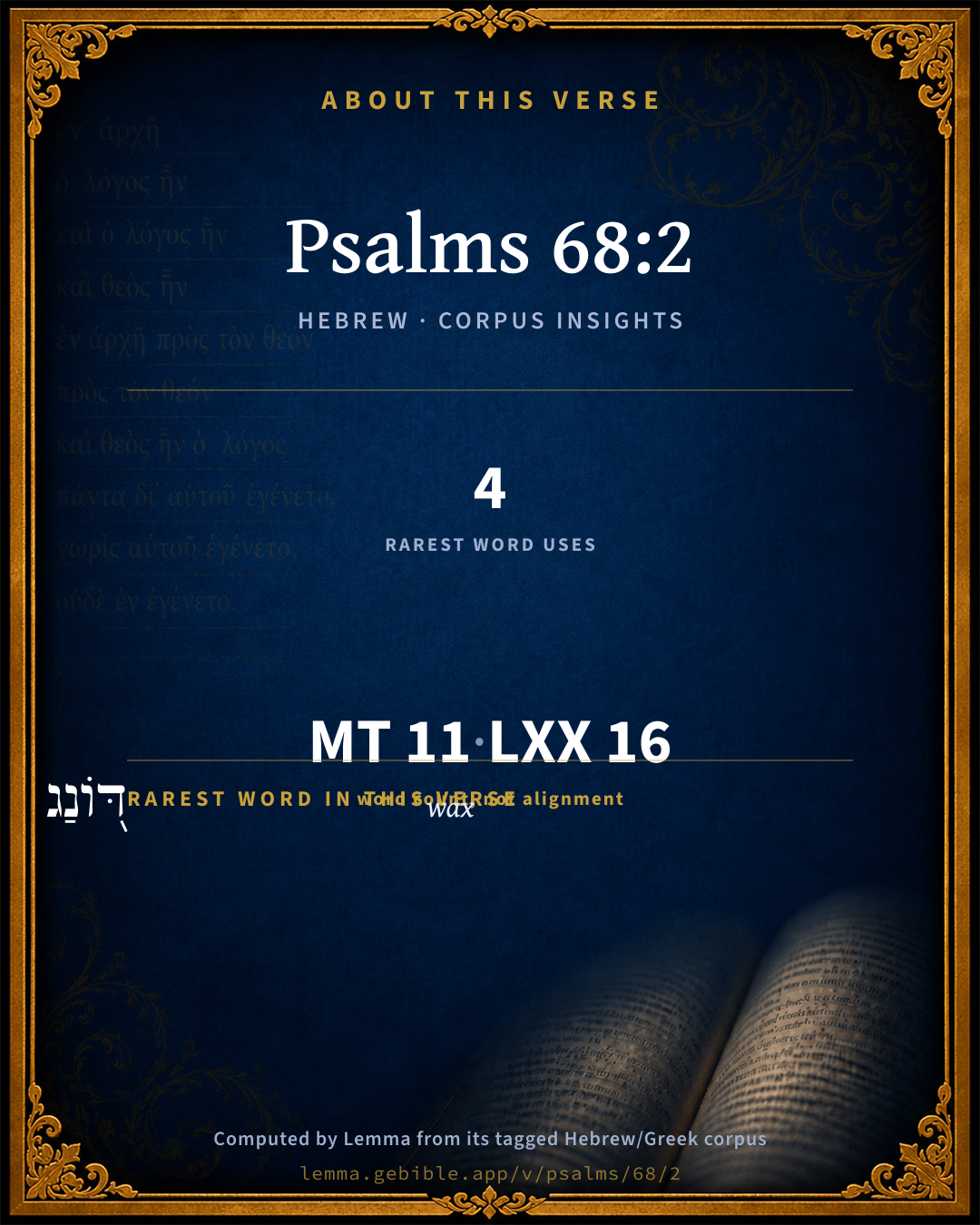
These counts appear in no published source. They are computed here, from the morphology-tagged text and Lemma’s own curated glosses. What Lemma adds →

11
words
9
distinct lemmas
Wisdom
section

Notable vocabulary

The rarest word here is דּ֭וֹנַג wax H1749 — appearing just 4 times in the whole Hebrew Bible.

Shared distinctive vocabulary

דּ֭וֹנַג wax H1749 occurs in 4 verses of the Hebrew Bible. Also found in:

Grammatical profile

  • 4 verbs
  • 6 nouns
  • 1 adjective

Verb forms

  • כְּהִנְדֹּ֥ף Niphal · Infinitive Construct
  • תִּ֫נְדֹּ֥ף Qal · Imperfect
  • כְּהִמֵּ֣ס Niphal · Infinitive Construct
  • יֹאבְד֥וּ Qal · Imperfect

Repetition

Words recur within this verse — often emphatic in Hebrew:

  • כְּהִנְדֹּ֥ף to drive H5086 ×2
  • מִפְּנֵי face H6440 ×2

Hebrew & Septuagint length

In English translation the verse runs 25 words from the Hebrew and 20 from the Septuagint (LXX English) — closely comparable.

A rough comparison of the two English renderings, which tokenize alike — not a word-level alignment.

Word counts can differ between the Hebrew and the Greek without any difference in meaning — e.g. the Hebrew direct-object marker אֵת has no separate Greek word, and Greek often adds the article ὁ.

In the original languages it is 11 Hebrew tokens and 16 Greek tokens — but the two are counted differently (Hebrew bundles its prefixes and suffixes into one token; the Greek is in lemma form), so that isn’t a like-for-like length.

Cross-references

12

Topical passages linked to Psalms 68:2 in the Treasury of Scripture Knowledge — connected by theme and wording, ordered by reader-vote popularity; previews shown in the World English Bible.

  • Micah 1:4 The mountains melt under him, And the valleys split apart, Like wax before the fire, Like waters that are poured down a steep place.
  • Psalms 37:20 But the wicked shall perish. The enemies of Yahweh shall be like the beauty of the fields. They will vanish-- Vanish like smoke.
  • Hosea 13:3 Therefore they will be like the morning cloud, And like the dew that passes away early, Like the chaff that is driven with the whirlwind out of the threshing floor, And like the smoke out of the chimney.
  • Psalms 97:5 The mountains melt like wax at the presence of Yahweh, At the presence of the Lord of the whole earth.
  • Isaiah 9:18 For wickedness burns as the fire; it devours the briers and thorns; yes, it kindles in the thickets of the forest, and they roll upward in a column of smoke.
  • Revelation 6:16–17 They told the mountains and the rocks, "Fall on us, and hide us from the face of him who sits on the throne, and from the wrath of the Lamb,
  • Psalms 80:16 It's burned with fire. It's cut down. They perish at your rebuke.
  • Psalms 22:14 I am poured out like water. All my bones are out of joint. My heart is like wax; It is melted within me.
  • Psalms 76:7 You, even you, are to be feared. Who can stand in your sight when you are angry?
  • Isaiah 64:2 as when fire kindles the brushwood, [and] the fire causes the waters to boil; to make your name known to your adversaries, that the nations may tremble at your presence!
  • Nahum 1:5–6 The mountains quake before him, and the hills melt away. The earth trembles at his presence, yes, the world, and all who dwell in it.
  • 2 Thessalonians 1:8–9 giving vengeance to those who don't know God, and to those who don't obey the Gospel of our Lord Jesus,

Cross-references courtesy of OpenBible.info (CC BY 4.0).

Hebrew and Greek witnesses Masoretic Hebrew ↔ Greek Septuagint

The same verse in the two great witnesses to the Old Testament, shown verse-for-verse.

You’re reading Greek Psalm 67 (Hebrew Psalm 68). The Septuagint counts the superscription, so verse numbers can differ from the Hebrew — chapter-level alignment, not verse-by-verse. Numbering follows Rahlfs.

These are two independent witnesses, not word-aligned to each other, and the Septuagint is shown in lemma (dictionary) form.

Hebrew Psalms 68:2 Masoretic · Westminster Leningrad Codex

כְּהִנְדֹּ֥ף עָשָׁ֗ן תִּ֫נְדֹּ֥ף כְּהִמֵּ֣ס דּ֭וֹנַג מִפְּנֵי אֵ֑שׁ יֹאבְד֥וּ רְ֝שָׁעִ֗ים מִפְּנֵ֥י אֱלֹהִֽים

As smoke is driven away, So drive them away. As wax melts before the fire, So let the wicked perish at the presence of God.

World English Bible · Public Domain

Greek LXX Greek Psalm 67:2 Septuagint · lemma form

ἀναἵστημι ὁ θεός καί διασκορπίζω ὁ ἐχθρός αὐτός καί φεύγω ὁ μισέω αὐτός ἀπό πρόσωπον αὐτός

As smoke vanishes, let them vanish: as wax melts before the fire, so let the sinners perish from before God.

LXX2012 (modern English Septuagint) · Public Domain

Hebrew: Westminster Leningrad Codex (CC BY 4.0). Greek: Septuagint (public domain); English from LXX2012 (modern English Septuagint) (Public Domain). How the Septuagint differs from the Hebrew →

Commentary

Notes on Psalms 68:2 from classic Christian and Jewish commentators (each source and its license shown beneath its notes). The classic Christian expositions comment on the surrounding passage and are grouped to its opening verse, so a note may address several verses; the Jewish commentaries on the Tanakh (Rashi and others) are per-verse, so they appear only where the commentator wrote on this verse.

Lemma curates 59 commentaries, every one of them public domain or Creative Commons licensed, each selected and text-cleaned for this edition rather than reprinted as found. About our sources →

Trapp's Complete Commentary

John Trapp

Psa 68:2 As smoke is driven away, [so] drive [them] away: as wax melteth before the fire, [so] let the wicked perish at the presence of God.

Ver. 2. As smoke is driven away, &c.] Smoke at first sight seemeth formidable, but soon vanisheth; and the higher it ascendeth the sooner it is dissipated: so here. Guicciardine saith of Charles VIII of France, that he came into the field like thunder and lightning, but went out like a snuff; more than a man at first, and less than a woman at last. A semblably of God’s enemies.

As wax melteth before the fire, &c.] Wax is a more solid substance than smoke, but, held to the fire, it quickly dissolveth. The psalmist both prayeth and prophesieth here, that the downfall of the Church’s enemies may be praeceps et praesentissimum, sad and sudden, as is elegantly set forth by these two similitudes.

John Trapp, A Commentary or Exposition upon All the Books of the Old and New Testament (1647–1656) — public domain. Text from a community e-Sword module.

J. A. Alexander on Psalms

Joseph Addison Alexander

3. (Psa 68:2). As smoke is driven, thou wilt drive (them); as wax is melted before fire, the wicked shall perish before God. The form of expression is the same as in the preceding verse, from the face of fire, from the face (or presence) of God. The verb in the first clause is the same with that in Psa 1:4, where the wind, implied here, is expressly mentioned, as the driving or propelling agent. The comparison with wax is a common one in Scripture, and occurs above, in Psa 22:14. With the last clause compare the conclusion of the Song of Deborah (Jdg 5:31), of which there are various imitations, or at least reminiscences, in this psalm.

Joseph Addison Alexander, The Psalms Translated and Explained (1850) — public domain. Text from a community e-Sword module.

Tyndale Open Study Notes

Tyndale Open Resources

68:2 Both smoke and wax represent a transitory existence (22:12-18; 37:20; 102:3).

Tyndale Open Study Notes — © Tyndale Open Resources, licensed CC BY-SA 4.0. Text via the HelloAO Bible API.

Ellicott's Commentary for English Readers

(2) Smoke.—The figure of the vanishing smoke has occurred before (see Psa_37:20); for that of the melting wax see Psa_97:5. Both figures are too obvious to need reference to the cloud and fire of the ancient encampment.

A Bible Commentary for English Readers, edited by Charles John Ellicott (1878–1897) — public domain. Text from a community e-Sword module.

The Cambridge Bible for Schools and Colleges

gen. ed. J. J. S. Perowne

2. The verbs should be rendered as in Psa_68:1 by futures: As smoke … so shalt thou drive them away: as wax … so shall the wicked perish at the presence of God. The smoke scattered by the wind is an apt emblem for total disappearance (Psa_37:20; Hos_13:3); the wax melted by the fire for unresisting impotence (Psa_97:5; Mic_1:4). “At the blast of the breath of Jehovah” the wicked vanish, leaving no trace behind; the consuming fire of His wrath they are powerless to withstand.

The Cambridge Bible for Schools and Colleges (gen. ed. J. J. S. Perowne; Cambridge University Press, 1878–1918) — public domain. Text from a community e-Sword module.

John Gill's Exposition

As smoke is driven away, so drive them away,.... This both describes the character of wicked men, Christ's enemies; as their darkness and ignorance, their will worship and superstition, and their detestableness to God, Rev 9:2; and the manner of their destruction; which is as easily brought about as smoke is driven by the wind, and is as irretrievable, like smoke that vanisheth into air (o); see Psa 37:20;

as wax melteth before fire; whereby its consistency, form, and strength, are lost. Respect may be had, both in this and the foregoing metaphor, to the fire of, divine wrath, and the smoke of eternal torments; since it follows:

so let the wicked perish at the presence of God; the appearance of Christ, either in his awful dispensation against the Jews, or in the last judgment; when the wicked shall not be able to stand before his face, but shall call to the rocks and mountains to hide them from him; and when they shall be bid to depart from him, and shall be punished with everlasting destruction in soul and body, from the presence of the Lord, and the glory of his power.

(o) "----et tenues fugit, ceu fumus in auras". Virgil. Aeneid. 5. prope finem.

John Gill's Exposition of the Whole Bible (1746–1763) — public domain (CC PDM 1.0). Text via the HelloAO Bible API.

Albert Barnes' Notes on the Bible

As smoke is driven away - To wit, by the wind. Smoke - vapor - easily disturbed and moved by the slightest breath of air - represents an object of no stability, or having no power of resistance, and would thus represent the real weakness of the most mighty armies of men as opposed to God.

So drive them away - With the same ease with which smoke is driven by the slightest breeze, so do the enemies of God disappear before his power. Compare the notes at Psa 1:4.

As wax melteth before the fire - Compare Psa 22:14. The meaning here is plain. As wax is melted down by fire - losing all its hardness, its firmness, its power of resistance, so must the most mighty armies melt away before God.

So let the wicked perish at the presence of God - That is, those who rise up against him; his enemies. It will be as easy for God to destroy wicked men as it is for fire to melt down wax.

Albert Barnes' Notes on the Bible (1834–1885) — public domain. Text from a community e-Sword/MySword module.

Matthew Poole's English Annotations

As smoke is driven away; as smoke at first mounts high and fills a great space of air, but speedily vanisheth into air, or is dispersed with the wind.

Matthew Poole's English Annotations on the Holy Bible (1683–1685) — public domain. Text from a community e-Sword/MySword module.

The Treasury of David

Charles H. Spurgeon

Ver. 2. As smoke is driven away. Easily the wind chases the smoke, completely it removes it, no trace is left; so, Lord, do thou to the foes of thy people. They fume in pride, they darken the sky with their malice, they mount higher and higher in arrogance, they defile wherever they prevail. Lord, let they breath, thy Spirit, thy Providence, make them to vanish for ever from the march of thy people. Philosophic scepticism is as flimsy and as foul as smoke; may the Lord deliver his Church from the reek of it.

As wax melteth before the fire, so let the wicked perish at the presence of God. Wax is hard when by itself, but put it to the fire, how soft it is. Wicked men are haughty till they come into contact with the Lord, and then they faint for fear; their hearts melt like wax when they feel the power of his anger. Wax, also, burns and passes away; the taper is utterly consumed by the flame: so shall all the boastful power of the opposers of the gospel be as a thing of nought. Rome, like the candles on her altars, shall dissolve, and with equal certainty shall infidelity disappear. Israel saw, in the ark, God on the mercyseat--power in connection with propitiation --and they rejoiced in the omnipotence of such a manifestation; this is even more clearly the confidence of the New Testament church, for we see Jesus, the appointed atonement, clothed with glory and majesty, and before his advance all opposition melts like snow in the sun; the pleasure of the Lord shall prosper in his hands. When he comes by his Holy Spirit, conquest is the result; but when he arises in person, his foes shall utterly perish.

Ver. 2. As smoke is driven away, etc. The psalmist adds a striking figure to illustrate how easily God can overthrow the machinations of our enemies, comparing them to smoke which vanishes away when blown upon by the wind, or wax which melts before the fire. We consider it utterly incredible that such a formidable array of opposition should be made to disappear in a moment. But the Spirit takes this method of chiding the fearfulness of our carnal minds, and teaching us that there is no such strength in our enemies as we suppose--that we allow the smoke of them to blind our eyes, and the solid mass of resistance which they present to deceive us into a forgetfulness of the truth, that the mountains themselves flow down at the presence of the Lord. John Calvin.

Ver. 2. As smoke is driven away, etc. "Their end was bitter as the smoke, "said an aged teacher. What meanest thou, O Master? asked his young disciple. "I was thinking of the end of the unrighteous, " replied the old man, "and of how too often I, like the psalmist, have been envious when they were in prosperity. Their lives have seemed so bright and glowing that I have thought they resembled the blaze of a cheerful fire on a winter's night. But, as I have watched them, they have suddenly vanished like the flame that fades into black and bitter smoke; and I have ceased to envy them. Trust not, O my scholar, only to that which appears brilliant; but watch also for its ending, lest thou be deceived." Hubert Bower, in "Parables and Similitudes of the Christian Life, " 1871.

Charles H. Spurgeon's The Treasury of David (1869–1885) — public domain. Psalms only. Text from a community e-Sword/MySword module.

Whedon's Commentary on the Bible

Daniel D. Whedon

2. Smoke… wax—Emblems of the feebleness and instability of such as fight against God.

Daniel D. Whedon (gen. ed.), Commentary on the Old and New Testaments (1874–1909) — public domain. Text from a community e-Sword module.

The Pulpit Commentary

As smoke is driven away, so drive them away. As clouds of smoke are dispersed and driven away by the wind, and totally disappear, so let God, whenever his enemies congregate, scatter and disperse them, and reduce them to nothingness. As wax melteth before the firs, so let the wicked perish at the presence of God. As smoke vanishes, so wax entirely melts away and disappears before a hot fire. (comp. Psa_22:14 Psa_97:5)

The Pulpit Commentary (1880–1919), ed. H.D.M. Spence-Jones & Joseph S. Exell — public domain. Text from a community e-Sword module.

Rashi

Rabbi Shlomo Yitzchaki (Rashi)

May God rise; His enemies scatter Amalek and his ilk.

Rashi on the Tanakh — English translations: “The Judaica Press complete Tanach with Rashi, translated by A. J. Rosenberg” (CC BY 4.0); “Pentateuch with Rashi's commentary by M. Rosenbaum and A.M. Silbermann, 1929-1934” (public domain); “The Metsudah Tanach series, Lakewood, N.J” (CC BY 4.0); and “The Book of Joshua, Metsudah Publications, 1997” (CC BY 4.0). Text via Sefaria.

Lesson kit

Teaching starters — assembled from the data on this page, not authored interpretation. Every prompt links to the verse data it draws on. Edit before teaching.

Psalms, in the Wisdom, opens this verse with 11 words (9 distinct Hebrew lemmas). Its most distinctive word is dôwnag (“wax”). A historical commentator’s framing appears above. Read the whole chapter for the surrounding context.

Discussion questions

  1. How does “wax” (dôwnag) shape what this verse is saying?
  2. Psalms 22:14 shares the word «wax» with this verse. How do the two illuminate each other?
  3. “to drive” occurs 2× in this one verse. What is the effect of the repetition?
  4. These translations render this verse differently. What is at stake in choosing one wording over another?
  5. The verb «כְּהִנְדֹּ֥ף» is Niphal Infinitive Construct. How does its form color the action?
  6. Reading how Trapp's Complete Commentary and J. A. Alexander on Psalms read this verse, where do the two commentators agree and where do they part?

Things to notice

Reading settings

Reading text

Shown beneath each verse's original-language words.

Old Testament
Old Testament edition

Read the OT as the Masoretic Hebrew (MT) or the Greek Septuagint (LXX).

English shown for the Greek Septuagint (in the Hebrew ↔ Greek comparison).

Comparing translations? Open the Compare panel on any verse page to stack up to four side by side.