
Psalms 119:61

Hebrew (Westminster Leningrad Codex) Psalms 119:61 appears in the Hebrew Old Testament. The text above is from the Westminster Leningrad Codex. Each word links to its Strong’s number, a concise gloss, and parsing drawn from the Open Scriptures Hebrew Bible morphology. Click any word for its full Brown-Driver-Briggs (BDB) entry.
Download image
Cite this verse

Psalms 119:61 (World English Bible). Public Domain. Lemma interlinear Bible study tool, https://lemma.gebible.app/v/psalms/119/61.

Show BibTeX & RIS
BibTeX
RIS
English Translation
The ropes of the wicked bind me, But I won't forget your law.
World English Bible · Public Domain
Download a study sheet

One document with this verse’s original text, its word-by-word gloss line, the meaning frame, cross-references with their text, attributed commentary, and full source and license credits — printable, and it pastes into notes with its structure intact.

This verse Autodidact and up

Study sheet (.html) Plain text (.txt)

A passage Seminary Student

Up to 50 verses in one chapter. A passage sheet keeps up to 6 commentary sources and 12 cross-references per verse, in the order this page ranks them, and says so on the sheet whenever that leaves anything out. Ask for a single verse and you get the Autodidact verse sheet above.

Everything on this page stays free to read, with no account — the sheet is a download of what is already on screen, not access to it.

Want to remove ads? Support Godless Engineer
Compare translations 3

The same verse in 3 English versions, stacked beneath the original-language interlinear above. Click any original word for its lexicon entry.

Each is an independent rendering of the whole verse — the interlinear is not word-aligned to these translations.

Highlighted words mark where these versions differ — a whole-verse word diff, not a word-by-word alignment.

  • World English Bible Public Domain
    The ropes of the wicked bind me, But I won't forget your law.
  • King James Version Public Domain
    The bands of the wicked have robbed me: but I have not forgotten thy law.
  • unfoldingWord Literal Text CC BY-SA 4.0
    The cords of the wicked ensnare me; I do not forget your teaching.

unfoldingWord Literal Text — © unfoldingWord, licensed CC BY-SA 4.0. Word-aligned USFM3 via Door43 (git.door43.org/unfoldingWord/en_ult).

Versions to compare (up to 4)

3 of 4 selected

Show all 17 translations

Every available English version of this verse, each an independent rendering of the whole verse.

  • World English Bible Public Domain
    The ropes of the wicked bind me, But I won't forget your law.
  • Berean Standard Bible Public Domain
    Though the ropes of the wicked bind me, I do not forget Your law.
  • Majority Standard Bible Public Domain
    Though the ropes of the wicked bind me, I do not forget Your law.
  • King James Version Public Domain
    The bands of the wicked have robbed me: but I have not forgotten thy law.
  • American Standard Version (1901) Public Domain
    The cords of the wicked have wrapped me round; `But' I have not forgotten thy law.
  • Revised Version (1885) Public Domain
    The cords of the wicked have wrapped me round; but I have not forgotten thy law.
  • Geneva Bible (1599) Public Domain
    The bandes of the wicked haue robbed me: but I haue not forgotten thy Lawe.
  • Young's Literal Translation Public Domain
    Cords of the wicked have surrounded me, Thy law I have not forgotten.
  • Literal Standard Version CC BY-SA 4.0
    Cords of the wicked have surrounded me, || I have not forgotten Your law.
  • Unlocked Literal Bible CC BY-SA 4.0
    The cords of the wicked have ensnared me; I have not forgotten your law.
  • unfoldingWord Literal Text CC BY-SA 4.0
    The cords of the wicked ensnare me; I do not forget your teaching.
  • Darby Bible Public Domain
    The bands of the wicked have wrapped me round: I have not forgotten thy law.
  • World Messianic Bible Public Domain
    The ropes of the wicked bind me, but I won’t forget your Torah.
  • Webster's Bible Public Domain
    The bands of the wicked have robbed me: but I have not forgotten thy law.
  • Free Bible Version CC BY-SA 4.0
    Even though wicked people try to tie me up, I won't forget your instructions.
  • Bible in Basic English Public Domain
    The cords of evil-doers are round me; but I have kept in mind your law.
  • JPS Tanakh (1917) Public Domain
    The bands of the wicked have enclosed me; but I have not forgotten Thy law.

Literal Standard Version (2020), Covenant Press — licensed CC BY-SA 4.0. Text via the HelloAO Bible API (eBible.org). Unlocked Literal Bible (unfoldingWord) — licensed CC BY-SA 4.0. Text via the HelloAO Bible API (eBible.org). unfoldingWord Literal Text — © unfoldingWord, licensed CC BY-SA 4.0. Word-aligned USFM3 via Door43 (git.door43.org/unfoldingWord/en_ult). Free Bible Version, Dr. Jonathan Gallagher — licensed CC BY-SA 4.0. Text via the HelloAO Bible API (eBible.org).

Word by word

More ways to search: Search by grammar → Find every occurrence → Compare this word →

Practice this passage: Drill this verse → Learn its vocabulary →

עִוְּדֻ֑נִי
ʻûwd
H5749
“to testify · me”
Verb, Piel, Perfect, 3rd Person, Common, Plural + Suffix, Personal, 1st Person, Common, Singular
Part of Speech
Verb
Stem
Piel
Form
Perfect
Person
3rd Person
Gender
Common
Number
Plural
Full BDB Definition

Origin: a primitive root

TWOT: 1576 , 1576d

to return, repeat, go about, do again - (Piel) to surround, go round and round - (Pilel) to restore, relieve - (Hithpalel) to be restored - to bear witness - (Qal) to bear witness, say again and again - (Hiphil) - to testify, bear witness - to cause to testify, take or call as witness, invoke - to protest, affirm solemnly, warn, exhort or enjoin solemnly, admonish, charge - (Hophal) to protest, give warning
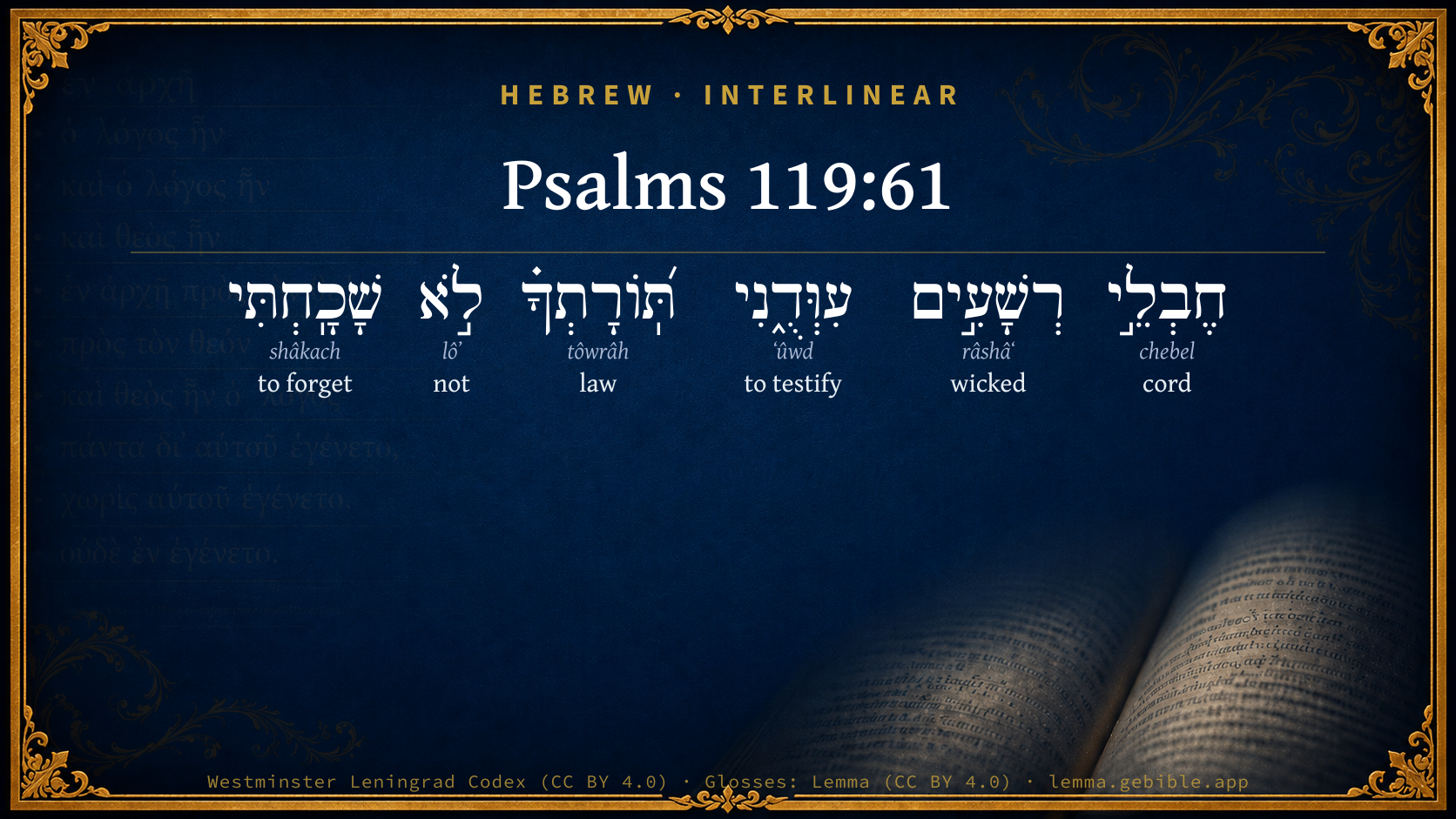
  1. חֶבְלֵ֣י chebel H2256 “cords of” Noun, Common, Both, Plural, Construct
  2. רְשָׁעִ֣ים râshâʻ H7563 “wicked” Adjective, Adjective, Masculine, Plural, Absolute
  3. תּֽ֝וֹרָתְךָ֗ tôwrâh H8451 “law · your” Noun, Common, Feminine, Singular, Construct + Suffix, Personal, 2nd Person, Masculine, Singular
  4. לֹ֣א lôʼ H3808 “not” Particle, Negative
  5. שָׁכָֽחְתִּי shâkach H7911 “to forget” Verb, Qal, Perfect, 1st Person, Common, Singular

About this verse

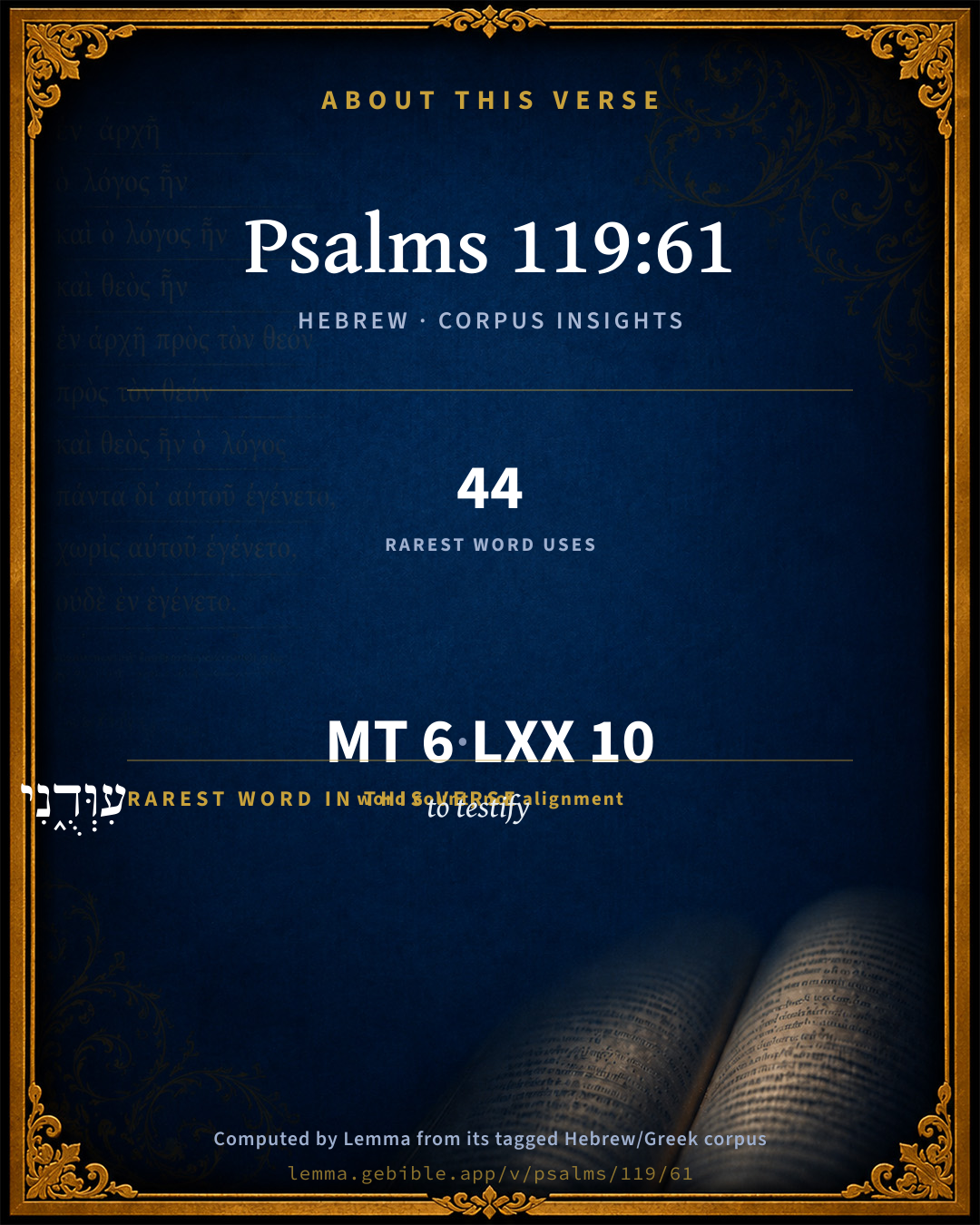
These counts appear in no published source. They are computed here, from the morphology-tagged text and Lemma’s own curated glosses. What Lemma adds →

6
words
6
distinct lemmas
Wisdom
section

Shared distinctive vocabulary

עִוְּדֻ֑נִי to testify H5749 occurs in 40 verses of the Hebrew Bible. Also found in:

Grammatical profile

  • 2 verbs
  • 2 nouns
  • 1 adjective
  • 1 particle

Verb forms

  • עִוְּדֻ֑נִי Piel · Perfect
  • שָׁכָֽחְתִּי Qal · Perfect

Hebrew & Septuagint length

In English translation the verse runs 13 words from the Hebrew and 12 from the Septuagint (LXX English) — closely comparable.

A rough comparison of the two English renderings, which tokenize alike — not a word-level alignment.

Word counts can differ between the Hebrew and the Greek without any difference in meaning — e.g. the Hebrew direct-object marker אֵת has no separate Greek word, and Greek often adds the article ὁ.

In the original languages it is 6 Hebrew tokens and 10 Greek tokens — but the two are counted differently (Hebrew bundles its prefixes and suffixes into one token; the Greek is in lemma form), so that isn’t a like-for-like length.

Cross-references

11

Topical passages linked to Psalms 119:61 in the Treasury of Scripture Knowledge — connected by theme and wording, ordered by reader-vote popularity; previews shown in the World English Bible.

  • Romans 12:17–21 Repay no one evil for evil. Respect what is honorable in the sight of all men.
  • Psalms 119:176 I have gone astray like a lost sheep. Seek your servant, for I don't forget your commandments.
  • Hosea 6:9 As gangs of robbers wait to ambush a man, So the company of priests murder in the way toward Shechem, Committing shameful crimes.
  • 1 Samuel 26:9–11 David said to Abishai, Don't destroy him; for who can put forth his hand against Yahweh's anointed, and be guiltless?
  • Job 1:17 While he was still speaking, there came also another, and said, "The Chaldeans made three bands, and swept down on the camels, and have taken them away, yes, and killed the servants with the edge of the sword; and I alone have escaped to tell you."
  • Psalms 3:1 Yahweh, how my adversaries have increased! Many are those who rise up against me.
  • Psalms 119:95 The wicked have waited for me, to destroy me. I will consider your statutes.
  • Psalms 140:5 The proud have hidden a snare for me, They have spread the cords of a net by the path. They have set traps for me. Selah.
  • Proverbs 24:29 Don't say, "I will do to him as he has done to me; I will render to the man according to his work."
  • 1 Samuel 24:9–11 David said to Saul, Why listen you to men's words, saying, Behold, David seeks your hurt?
  • 1 Samuel 30:3–5 When David and his men came to the city, behold, it was burned with fire; and their wives, and their sons, and their daughters, were taken captive.

Cross-references courtesy of OpenBible.info (CC BY 4.0).

Hebrew and Greek witnesses Masoretic Hebrew ↔ Greek Septuagint

The same verse in the two great witnesses to the Old Testament, shown verse-for-verse.

You’re reading Greek Psalm 118 (Hebrew Psalm 119). The Septuagint counts the superscription, so verse numbers can differ from the Hebrew — chapter-level alignment, not verse-by-verse. Numbering follows Rahlfs.

These are two independent witnesses, not word-aligned to each other, and the Septuagint is shown in lemma (dictionary) form.

Hebrew Psalms 119:61 Masoretic · Westminster Leningrad Codex

חֶבְלֵ֣י רְשָׁעִ֣ים עִוְּדֻ֑נִי תּֽ֝וֹרָתְךָ֗ לֹ֣א שָׁכָֽחְתִּי

The ropes of the wicked bind me, But I won't forget your law.

World English Bible · Public Domain

Greek LXX Greek Psalm 118:61 Septuagint · lemma form

σχοινίον ἁμαρτωλός περιπλέκω ἐγώ καί ὁ νόμος σύ οὐ ἐπιλανθάνω

The snares of sinners entangled me: but I forgot not your law.

LXX2012 (modern English Septuagint) · Public Domain

Hebrew: Westminster Leningrad Codex (CC BY 4.0). Greek: Septuagint (public domain); English from LXX2012 (modern English Septuagint) (Public Domain). How the Septuagint differs from the Hebrew →

Commentary

Notes on Psalms 119:61 from classic Christian and Jewish commentators (each source and its license shown beneath its notes). The classic Christian expositions comment on the surrounding passage and are grouped to its opening verse, so a note may address several verses; the Jewish commentaries on the Tanakh (Rashi and others) are per-verse, so they appear only where the commentator wrote on this verse.

Lemma curates 59 commentaries, every one of them public domain or Creative Commons licensed, each selected and text-cleaned for this edition rather than reprinted as found. About our sources →

Trapp's Complete Commentary

John Trapp

Psa 119:61 The bands of the wicked have robbed me: [but] I have not forgotten thy law.

Ver. 61. The bands of the wicked have robbed me] In these late stripping times many a poor man’s whole life’s settings were lost in an instant.

But I have not forgotten thy law] I have encouraged myself in the Lord my God, as at the sack of Ziklag, 1Sa 30:6

John Trapp, A Commentary or Exposition upon All the Books of the Old and New Testament (1647–1656) — public domain. Text from a community e-Sword module.

J. A. Alexander on Psalms

Joseph Addison Alexander

61. (Psa 119:61) The bands of wicked men environed me, (but) thy law I did not forget. As descriptive of personal experience, this may be translated in the present (environ me, forget not); but in order to include a reference to the Babylonish exile, and the preservation of the people from apostasy at that eventful crisis, the preterite forms of the original must be preserved. The figure of the first clause is borrowed from Psa 18:4-5, but with the substitution of a verbal form used only here, and represented by the word environed. The relation of the clauses, to denote which in English but has been supplied, is the same as in Psa 119:51 above.

Joseph Addison Alexander, The Psalms Translated and Explained (1850) — public domain. Text from a community e-Sword module.

Tyndale Open Study Notes

Tyndale Open Resources

119:61 Evil people try to drag him into sin, but the psalmist’s memory of God’s word keeps him standing firm (see 119:16).

Tyndale Open Study Notes — © Tyndale Open Resources, licensed CC BY-SA 4.0. Text via the HelloAO Bible API.

Geneva Bible (1599)

Geneva Bible translators

They have gone about to draw me into their company.

Geneva Bible (1599) marginal notes — public domain. Text via Bolls.life.

Matthew Henry's Commentary

Here is, 1. The malice of David's enemies against him. They were wicked men, who hated him for his godliness. There were bands or troops of them confederate against him. They did him all the mischief they could; they robbed him; having endeavoured to take away his good name (Psa 119:51), they set upon his goods, and spoiled him of them, either by plunder in time of war or by fines and confiscations under colour of law. Saul (it is likely) seized his effects, Absalom his palace, and the Amalekites rifled Ziklag. Worldly wealth is what we may be robbed of. David, though a man of war, could not keep his own. Thieves break through and steal. 2. The testimony of David's conscience for him that he had held fast his religion when he was stripped of every thing else, as Job did when the bands of the Chaldeans and Sabeans had robbed him: But I have not forgotten thy law. No care nor grief should drive God's word out of our minds, or hinder our comfortable relish of it and converse with it. Nor must we ever think the worse of the ways of God for any trouble we meet with in those ways, nor fear being losers by our religion at last, however we may be losers for it now.

Matthew Henry's Commentary on the Whole Bible (1708–1710) — public domain (CC PDM 1.0). Text via the HelloAO Bible API.

Adam Clarke's Commentary

Verse 61. The bands of the wicked have robbed me] חבלי chebley, the cables, cords, or snares of the wicked. They have hunted us like wild beasts; many they have taken for prey, and many they have destroyed.

Adam Clarke's Commentary on the Bible (1810–1826) — public domain. Text from a community e-Sword/MySword module.

John Calvin's Commentaries

61. The cords of the wicked have caught hold of me. Those who translate חבלי, cheblei, by sorrows, bring out no natural meaning, and perplex themselves as well as wrest the passage. Two readings then remain, either of which may be admitted: The cords of the wicked have caught hold of me, or The companies of the wicked have robbed me. Whether we adopt the one or the other of these readings, what the prophet intends to declare is, that when Satan assailed the principles of piety in his soul, by grievous temptations, he continued with undeviating steadfastness in the love and practice of God’s law. Cords may, however, be understood in two ways; either, first, as denoting the deceptive allurements by which the wicked endeavored to get him entangled in their society; or, secondly, the frauds which they practiced to effect his ruin. If the first sense is preferred, David intimates that he had manifested a rare virtue, in continuing in the observance of God’s law, even when the wicked seemed to have involved him in their nets; but as it is more generally agreed that the verb עוד, ived, signifies to despoil or rob, let us adopt this interpretation — that the prophet being assailed by troops of the ungodly, and afterwards robbed and rifled at their pleasure, never deserted his ground. This was a proof of singular fortitude; for when we are exposed to dangers and wrongs of a more than ordinary kind, if God does not succour us we immediately begin to doubt of his providence: it seems to be of no advantage for a man to be godly; we imagine also that we may lawfully take revenge; and amidst these waves, the remembrance of the Divine law is easily lost, and, as it were, submerged. But the prophet assures us:, that to continue to love the law, and to practice righteousness, when we are exposed as a prey to the ungodly, and perceive no help from God, is an evidence of genuine piety.

John Calvin's Commentaries (1540-1563) — public domain. Text from the Calvin Translation Society English edition (1840s-50s) via the Christian Classics Ethereal Library (ccel.org). Calvin's coverage is partial (roughly two-thirds of the Bible); uncommented books and verses are honest gaps, never fabricated. The 19th-century editor's footnotes and remarks are omitted so the notes are faithfully Calvin's own voice.

Ellicott's Commentary for English Readers

(61) The bands . . .—Rather, cords of the wicked surrounded me. (See Psa_18:5-6.) So all ancient versions except the Targum.

A Bible Commentary for English Readers, edited by Charles John Ellicott (1878–1897) — public domain. Text from a community e-Sword module.

The Cambridge Bible for Schools and Colleges

gen. ed. J. J. S. Perowne

61. The cords of the wicked have entangled me] A metaphor from the snare or noose of the hunter. Cp. Psa_119:110; Psa_18:5. Though the wicked lay snares for him, he will not cast in his lot with those who forget God. P.B.V. and A.V. follow some Jewish authorities, and Luther.

The Cambridge Bible for Schools and Colleges (gen. ed. J. J. S. Perowne; Cambridge University Press, 1878–1918) — public domain. Text from a community e-Sword module.

John Gill's Exposition

The earth, O Lord, is full of thy mercy,.... "Goodness" or "grace" (o); both of the providential mercy and goodness of God, which extends to all his creatures; and of his special grace and goodness to his own people, held forth in his word and ordinances; see Psa 33:5;

teach me thy statutes: as an instance of mercy, grace, and goodness; see Psa 119:12.

(o) "gratia tua", Cocceius, Gejerus.

John Gill's Exposition of the Whole Bible (1746–1763) — public domain (CC PDM 1.0). Text via the HelloAO Bible API.

Albert Barnes' Notes on the Bible

The bands of the wicked - Margin, “companies.” The Hebrew word properly means a cord, a rope; then a snare, gin, net; then, a band or a company of men. The reference is to some time in the life of the psalmist when he was surrounded by wicked men.

Have robbed me - Rather, have surrounded me; have environed me - for so the Hebrew word means.

But I have not forgotten thy law - I have not been deterred from keeping it by the dangers to which I have been exposed.

Albert Barnes' Notes on the Bible (1834–1885) — public domain. Text from a community e-Sword/MySword module.

Matthew Poole's English Annotations

Robbed me; or, made a prey of me; done me many injuries for my respect to thy law.

Matthew Poole's English Annotations on the Holy Bible (1683–1685) — public domain. Text from a community e-Sword/MySword module.

The Treasury of David

Charles H. Spurgeon

Ver. 61. The bands of the wicked have robbed me. Aforetime they derided him, and now they have defrauded him. Ungodly men grow worse, aria become more and more daring, so that they go from ridicule to robbery. Much of this bold opposition arose from their being banded together: men will dare to do in company what they durst not have thought of alone. When firebrands are laid together there is no telling what a flame they will create. It seems that whole bands of men assailed this one child of God, they are cowardly enough for anything; though they could not kill him, they robbed him; the dogs of Satan will worry saints if they cannot devour them. David's enemies did their utmost: first the serpents hissed, and then they stung. Since words availed not, the wicked fell to blows. How much the ungodly have plundered the saints in all ages, and how often have the righteous borne gladly the spoiling of their goods!

But I have not forgotten thy law. This was well. Neither his sense of injustice, nor his sorrow at his losses, nor his attempts at defence diverted him from the ways of God. He would not do wrong to prevent the suffering of wrong, nor do ill to avenge ill. He carried the law in his heart, and therefore no disturbance of mind could take him off from following it. He might have forgotten himself if he had forgotten the law: as it was, he was ready to forgive and forget the injuries done him, for his heart was taken up with the word of God. The bands of the wicked had not robbed him of his choicest treasure, since they had left him his holiness and his happiness.

Some read this passage, "The bands of the wicked environ me." They hemmed him in, they cut him off from succour, they shut up every avenue of escape, but the man of God had his protector with him; a clear conscience relied upon the promise, and a brave resolve stuck to the precept. He could not be either bribed or bullied into sin. The cordon of the ungodly could not keep God from him, nor him from God: this was because God was his portion, and none could deprive him of it neither by force or fraud. That is true grace which can endure the test: some are barely gracious among the circle of their friends, but this man was holy amid a ring of foes.

Ver. 61. The bands of the wicked have robbed me. Two readings remain, either of which may be admitted: The cords of the wicked have caught hold of me, or, The companies of the wicked have robbed me. Whether we adopt the one or the other of these readings, what the prophet intends to declare is, that when Satan assailed the principles of piety in his soul, by grievous temptations, he continued with undeviating steadfastness in the love, and practice of God's law. Cords may, however, be understood in two ways; either, first, as denoting the deceptive allurements by which the wicked endeavoured to get him entangled in their society; or, secondly, the frauds which they practised to effect his ruin. John Calvin.

Ver. 61. The bands of the wicked have robbed me. Some have it, "Cords of wicked men have entwined me." Others, "Snares of wicked men surround me." The meaning is that wicked men by their plots and contrivances had beset him, as men would ensnare a wild beast in their toils. They might, indeed, hem him round about in the wilderness, but they could not enthral the free mind; he would still feel at liberty in spirit, he would not forget God's law. John, Stephen.

Ver. 61. The bands of the wicked have robbed me. They set upon his goods, and spoiled him of them, either by plunder in the time of war, or by fines and confiscations under colour of law. Saul (it is likely) seized his effects; Absalom his palace; the Amalekites rifled Ziklag. Matthew Henry.

Ver. 61. The friendship of the wicked must be shunned. First, because it binds us, as they are bound together "bands of the wicked." Every sinner is a gladiator with net and sword, going down into the arena, and endeavouring to enmesh any one who comes near him. A second reason for shunning the friendship of the wicked, which may be taken from the Hebrew word, is their cruelty and barbarity: for not only do the wicked bind their friends, but they make a spoil and a prey of them: "have robbed me." They are decoying thieves, journeying with an unwary traveller, until they have led him into thick and dark woods, where they strip him of heavenly riches. Thomas Le Blanc.

Ver. 61. The bands of the wicked have robbed me. Then said Christian to his fellow, Now I call to remembrance that which was told me of a thing that happened to a good man hereabout. The name of the man was Little Faith, but a good man, and he dwelt in the town of Sincere. The thing was this; at the entering in of this passage there comes down from Broadway gate a lane called Dead man's lane; so called because of the murders that are commonly done there. And this Little Faith going on pilgrimage, as we do now, chanced to sit down there and slept. Now there happened, at that time, to come down that lane from Broadway gate three sturdy rogues, and their names were Faint heart, Mistrust, and Guilt, (three brothers,) and they espying Little Faith where he was came galloping up with speed. Now the good man was just awaked from his sleep, and was getting up to go on his journey. So they came all up to him, and with threatening language bid him stand. At this, Little Faith looked as white as a cloud, and had neither power to fight nor flee. Then said Faint heart, Deliver thy purse; but he making no haste to do it, (for he was loath to lose his money,)Mistrust ran up to him, and thrusting his hand into his pocket, pulled out thence a bag of silver. Then he cried out, Thieves! Thieves! With that Guilt, with a great club that was in his hand, struck Little Faith on the head, and with that blow felled him flat to the ground, where he lay bleeding as one that would bleed to death...The place where his jewels were they never ransacked, so those he kept still; but, as I was told, the good man was much afflicted for his loss. For the thieves got most of his spending money. That which they got not (as I said) were jewels, also he had a little odd money left, but scarce enough to bring him to his journey's end; nay, (if I was not misinformed,)he was forced to beg as he went, to keep himself alive (for his jewels he might not sell). But beg, and do what he could he went (as we say) with many a hungry belly, the most part of the rest of the way. John Bunyan.

Ver. 61. Bands. Howsoever, to strengthen themselves in an evil course, the wicked go together by bands and companies, yet shall it not avail them, nor hurt us. Babel's builders; Moab, Ammon, Edom, conspiring in one, may tell us, "Though hand join in hand, the wicked shall not escape unpunished." The wicked are like thorns before the fire; their multitude may well embolden the flame, but cannot resist it. William Cowper.

Ver. 61. It is a salutary reflection to bear in mind, that thousands of spiritual adversaries are ever watching to make us their prey. John Morison.

Ver. 61.

1. Spiritual highway robbery.

2. The traveller keeping his road. Or, what enemies can do, and what they cannot do.

Psalms 119:62*

Charles H. Spurgeon's The Treasury of David (1869–1885) — public domain. Psalms only. Text from a community e-Sword/MySword module.

The Pulpit Commentary

The bands of the wicked have robbed me; rather, the snares of wicked men entangled me (comp. vers. 23, 157, 161). But I have not forgotten (or, I did not forget) thy Law.

The Pulpit Commentary (1880–1919), ed. H.D.M. Spence-Jones & Joseph S. Exell — public domain. Text from a community e-Sword module.

John Wesley's Explanatory Notes

Robbed - Done me many injuries, for my respect to thy law.

John Wesley, Explanatory Notes Upon the Whole Bible (1754–1765) — public domain. Text via the GEBible commentary corpus.

unfoldingWord translationNotes

Door43 World Missions Community

The cords of the wicked have ensnared me

In this metaphor, wicked or evil people tried to cause the writer to sin like a hunter seeking to catch an animal with a trap. AT: "My enemies have tried to catch me" (See: Metaphor)

translationWords

evil

raise

righteous

unfoldingWord translationNotes — © Distant Shores Media and the Door43 World Missions Community, licensed CC BY-SA 4.0. Source: git.door43.org/Door43/en_tn.

Rashi

Rabbi Shlomo Yitzchaki (Rashi)

Bands of wicked men robbed me Heb. עודני. Bands of wicked men plundered me, like (Gen. 49: 27): “in the morning he will eat plunder (עד).” In this manner, Menachem (p. 131) associated it. It may also be interpreted as an expression of עוֹד, more, i.e., increased and outnumbered me.

Rashi on the Tanakh — English translations: “The Judaica Press complete Tanach with Rashi, translated by A. J. Rosenberg” (CC BY 4.0); “Pentateuch with Rashi's commentary by M. Rosenbaum and A.M. Silbermann, 1929-1934” (public domain); “The Metsudah Tanach series, Lakewood, N.J” (CC BY 4.0); and “The Book of Joshua, Metsudah Publications, 1997” (CC BY 4.0). Text via Sefaria.

Lesson kit

Teaching starters — assembled from the data on this page, not authored interpretation. Every prompt links to the verse data it draws on. Edit before teaching.

Psalms, in the Wisdom, opens this verse with 6 words (6 distinct Hebrew lemmas). Its most distinctive word is ʻûwd (“to testify”). A historical commentator’s framing appears above. Read the whole chapter for the surrounding context.

Discussion questions

  1. The word ʻûwd carries the sense “to testify.” How does it shape the verse?
  2. Genesis 43:3 shares the word «to testify» with this verse. How do the two illuminate each other?
  3. These translations render this verse differently; the difference is in the English rendering, not the original. What questions does that raise?
  4. The verb «עִוְּדֻ֑נִי» is Piel Perfect. How does its form color the action?
  5. Reading how Trapp's Complete Commentary and J. A. Alexander on Psalms read this verse, where do the two commentators agree and where do they part?

Things to notice

Reading settings

Reading text

Shown beneath each verse's original-language words.

Old Testament
Old Testament edition

Read the OT as the Masoretic Hebrew (MT) or the Greek Septuagint (LXX).

English shown for the Greek Septuagint (in the Hebrew ↔ Greek comparison).

Comparing translations? Open the Compare panel on any verse page to stack up to four side by side.