

Psalms 37:35

Hebrew (Westminster Leningrad Codex) Psalms 37:35 appears in the Hebrew Old Testament. The text above is from the Westminster Leningrad Codex. Each word links to its Strong’s number, a concise gloss, and parsing drawn from the Open Scriptures Hebrew Bible morphology. Click any word for its full Brown-Driver-Briggs (BDB) entry.
Download image
Cite this verse

Psalms 37:35 (World English Bible). Public Domain. Lemma interlinear Bible study tool, https://lemma.gebible.app/v/psalms/37/35.

Show BibTeX & RIS
BibTeX
RIS
English Translation
I have seen the wicked in great power, Spreading himself like a green tree in its native soil.
World English Bible · Public Domain
Download a study sheet

One document with this verse’s original text, its word-by-word gloss line, the meaning frame, cross-references with their text, attributed commentary, and full source and license credits — printable, and it pastes into notes with its structure intact.

This verse Autodidact and up

Study sheet (.html) Plain text (.txt)

A passage Seminary Student

Up to 50 verses in one chapter. A passage sheet keeps up to 6 commentary sources and 12 cross-references per verse, in the order this page ranks them, and says so on the sheet whenever that leaves anything out. Ask for a single verse and you get the Autodidact verse sheet above.

Everything on this page stays free to read, with no account — the sheet is a download of what is already on screen, not access to it.

Want to remove ads? Support Godless Engineer
Compare translations 3

The same verse in 3 English versions, stacked beneath the original-language interlinear above. Click any original word for its lexicon entry.

Each is an independent rendering of the whole verse — the interlinear is not word-aligned to these translations.

Highlighted words mark where these versions differ — a whole-verse word diff, not a word-by-word alignment.

  • World English Bible Public Domain
    I have seen the wicked in great power, Spreading himself like a green tree in its native soil.
  • King James Version Public Domain
    I have seen the wicked in great power, and spreading himself like a green bay tree.
  • unfoldingWord Literal Text CC BY-SA 4.0
    I have seen a wicked, violent, and spreading himself out like a green native

unfoldingWord Literal Text — © unfoldingWord, licensed CC BY-SA 4.0. Word-aligned USFM3 via Door43 (git.door43.org/unfoldingWord/en_ult).

Versions to compare (up to 4)

3 of 4 selected

Show all 18 translations

Every available English version of this verse, each an independent rendering of the whole verse.

  • World English Bible Public Domain
    I have seen the wicked in great power, Spreading himself like a green tree in its native soil.
  • Berean Standard Bible Public Domain
    I have seen a wicked, ruthless man flourishing like a well-rooted native tree,
  • Majority Standard Bible Public Domain
    I have seen a wicked, ruthless man flourishing like a well-rooted native tree,
  • King James Version Public Domain
    I have seen the wicked in great power, and spreading himself like a green bay tree.
  • American Standard Version (1901) Public Domain
    I have seen the wicked in great power, And spreading himself like a green tree in its native soil.
  • Revised Version (1885) Public Domain
    I have seen the wicked in great power, and spreading himself like a green tree in its native soil.
  • Geneva Bible (1599) Public Domain
    I haue seene the wicked strong, and spreading himselfe like a greene bay tree.
  • Douay-Rheims (1899) Public Domain
    I have seen the wicked highly exalted, and lifted up like the cedars of Libanus.
  • Young's Literal Translation Public Domain
    I have seen the wicked terrible, And spreading as a green native plant,
  • Literal Standard Version CC BY-SA 4.0
    I have seen the wicked terrible, || And spreading as a green native plant,
  • Unlocked Literal Bible CC BY-SA 4.0
    I have seen the wicked and terrifying person spread out like a green tree in its native soil.
  • unfoldingWord Literal Text CC BY-SA 4.0
    I have seen a wicked, violent, and spreading himself out like a green native
  • Darby Bible Public Domain
    I have seen the wicked in great power, and spreading like a green tree in its native soil:
  • World Messianic Bible Public Domain
    I have seen the wicked in great power, spreading himself like a green tree in its native soil.
  • Webster's Bible Public Domain
    I have seen the wicked in great power, and spreading himself like a green bay tree.
  • Free Bible Version CC BY-SA 4.0
    I have watched the wicked acting brutally, spreading like a large tree in its native land.
  • Bible in Basic English Public Domain
    I have seen the evil-doer in great power, covering the earth like a great tree.
  • JPS Tanakh (1917) Public Domain
    I have seen the wicked in great power, and spreading himself like a leafy tree in its native soil.

Literal Standard Version (2020), Covenant Press — licensed CC BY-SA 4.0. Text via the HelloAO Bible API (eBible.org). Unlocked Literal Bible (unfoldingWord) — licensed CC BY-SA 4.0. Text via the HelloAO Bible API (eBible.org). unfoldingWord Literal Text — © unfoldingWord, licensed CC BY-SA 4.0. Word-aligned USFM3 via Door43 (git.door43.org/unfoldingWord/en_ult). Free Bible Version, Dr. Jonathan Gallagher — licensed CC BY-SA 4.0. Text via the HelloAO Bible API (eBible.org).

Word by word

More ways to search: Search by grammar → Find every occurrence → Compare this word →

Practice this passage: Drill this verse → Learn its vocabulary →

וּ֝מִתְעָרֶ֗ה
ʻârâh
H6168
“and · uncovering”
Conjunction + Verb, Hithpael, Participle Active, Masculine, Singular, Absolute
Part of Speech
Conjunction + Verb
Stem
Hithpael
Form
Participle Active
Gender
Masculine
Number
Singular
State
Absolute
Full BDB Definition

Origin: a primitive root

TWOT: 1692

to be bare, be nude, uncover, leave destitute, discover, empty, raze, pour out - (Piel) - to bare, lay bare - to lay bare by emptying, empty - to pour out - (Hiphil) - to make naked, strip bare (of sexual offences) - to pour out - (Niphal) to be poured out, be exposed - (Hithpael) - to expose oneself, make oneself naked - pouring oneself, spreading oneself (participle)
  1. רָ֭אִיתִי râʼâh H7200 “to see” Verb, Qal, Perfect, 1st Person, Common, Singular
  2. רָשָׁ֣ע râshâʻ H7563 “wicked” Adjective, Adjective, Masculine, Singular, Absolute
  3. עָרִ֑יץ ʻârîyts H6184 “awesome” Adjective, Adjective, Masculine, Singular, Absolute
  4. כְּאֶזְרָ֥ח ʼezrâch H249 “like/as · native” Preposition + Noun, Common, Masculine, Singular, Absolute
  5. רַעֲנָֽן raʻănân H7488 “luxuriant” Adjective, Adjective, Masculine, Singular, Absolute

About this verse

These counts appear in no published source. They are computed here, from the morphology-tagged text and Lemma’s own curated glosses. What Lemma adds →

6
words
6
distinct lemmas
Wisdom
section

Notable vocabulary

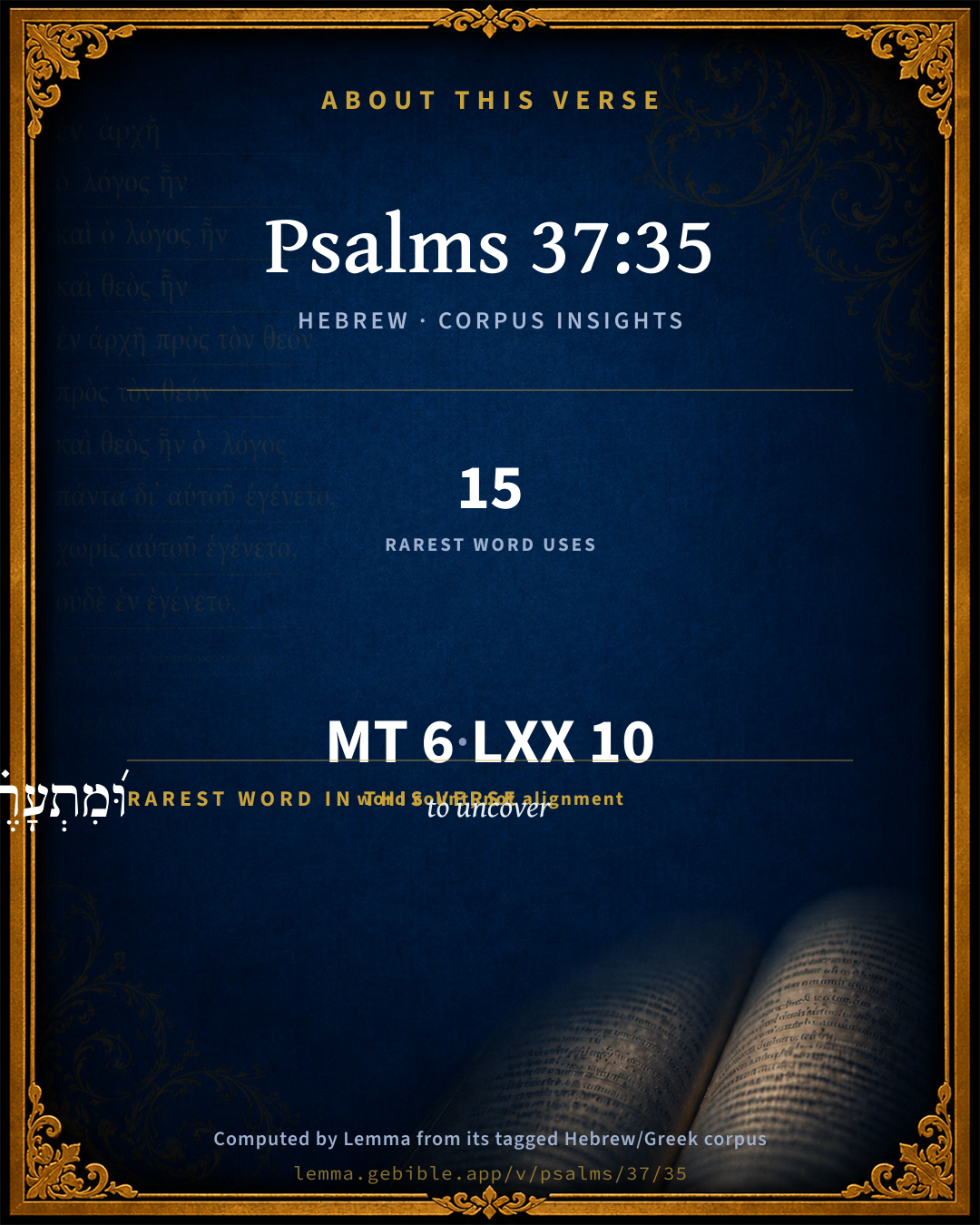
The rarest word here is וּ֝מִתְעָרֶ֗ה to uncover H6168 — appearing just 15 times in the whole Hebrew Bible.

Shared distinctive vocabulary

וּ֝מִתְעָרֶ֗ה to uncover H6168 occurs in 14 verses of the Hebrew Bible. Also found in:

Grammatical profile

  • 2 verbs
  • 1 noun
  • 3 adjectives

Verb forms

  • רָ֭אִיתִי Qal · Perfect
  • וּ֝מִתְעָרֶ֗ה Hithpael · Participle Active

Hebrew & Septuagint length

In English translation the verse runs 18 words from the Hebrew and 17 from the Septuagint (LXX English) — closely comparable.

A rough comparison of the two English renderings, which tokenize alike — not a word-level alignment.

Word counts can differ between the Hebrew and the Greek without any difference in meaning — e.g. the Hebrew direct-object marker אֵת has no separate Greek word, and Greek often adds the article ὁ.

In the original languages it is 6 Hebrew tokens and 10 Greek tokens — but the two are counted differently (Hebrew bundles its prefixes and suffixes into one token; the Greek is in lemma form), so that isn’t a like-for-like length.

Cross-references

9

Topical passages linked to Psalms 37:35 in the Treasury of Scripture Knowledge — connected by theme and wording, ordered by reader-vote popularity; previews shown in the World English Bible.

  • Job 5:3 I have seen the foolish taking root, But suddenly I cursed his habitation.
  • Job 21:7–17 "Why do the wicked live, Become old, yes, and grow mighty in power?
  • Psalms 73:3–11 For I was envious of the arrogant, When I saw the prosperity of the wicked.
  • Esther 5:11 Haman recounted to them the glory of his riches, and the multitude of his children, and all the things in which the king had promoted him, and how he had advanced him above the princes and servants of the king.
  • Job 8:13–19 So are the paths of all who forget God. The hope of the godless man shall perish,
  • Isaiah 14:14–19 I will ascend above the heights of the clouds; I will make myself like the Most High.
  • Ezekiel 31:6–10 All the birds of the sky made their nests in its boughs; and under its branches did all the animals of the field bring forth their young; and under its shadow lived all great nations.
  • Ezekiel 31:18 To whom are you thus like in glory and in greatness among the trees of Eden? yet shall you be brought down with the trees of Eden to the lower parts of the earth: you shall lie in the midst of the uncircumcised, with those who are slain by the sword. This is Pharaoh and all his multitude, says the Lord Yahweh.
  • Daniel 4:20–33 The tree that you saw, which grew, and was strong, whose height reached to the sky, and the sight of it to all the earth;

Cross-references courtesy of OpenBible.info (CC BY 4.0).

Hebrew and Greek witnesses Masoretic Hebrew ↔ Greek Septuagint

The same verse in the two great witnesses to the Old Testament, shown verse-for-verse.

You’re reading Greek Psalm 36 (Hebrew Psalm 37). The Septuagint counts the superscription, so verse numbers can differ from the Hebrew — chapter-level alignment, not verse-by-verse. Numbering follows Rahlfs.

These are two independent witnesses, not word-aligned to each other, and the Septuagint is shown in lemma (dictionary) form.

Hebrew Psalms 37:35 Masoretic · Westminster Leningrad Codex

רָ֭אִיתִי רָשָׁ֣ע עָרִ֑יץ וּ֝מִתְעָרֶ֗ה כְּאֶזְרָ֥ח רַעֲנָֽן

I have seen the wicked in great power, Spreading himself like a green tree in its native soil.

World English Bible · Public Domain

Greek LXX Greek Psalm 36:35 Septuagint · lemma form

ὁράω ἀσεβής ὑπερὑψόω καί ἐπιαἴρω ὡς ὁ κέδρος ὁ λίβανος

I saw the ungodly very highly exalting himself, and lifting himself up like the cedars of Libanus.

LXX2012 (modern English Septuagint) · Public Domain

On this verse, The Treasury of David discusses the Septuagint’s reading. Read the note in Commentary ↓

Hebrew: Westminster Leningrad Codex (CC BY 4.0). Greek: Septuagint (public domain); English from LXX2012 (modern English Septuagint) (Public Domain). How the Septuagint differs from the Hebrew →

Commentary

Notes on Psalms 37:35 from classic Christian and Jewish commentators (each source and its license shown beneath its notes). The classic Christian expositions comment on the surrounding passage and are grouped to its opening verse, so a note may address several verses; the Jewish commentaries on the Tanakh (Rashi and others) are per-verse, so they appear only where the commentator wrote on this verse.

Lemma curates 59 commentaries, every one of them public domain or Creative Commons licensed, each selected and text-cleaned for this edition rather than reprinted as found. About our sources →

Trapp's Complete Commentary

John Trapp

Psa 37:35 I have seen the wicked in great power, and spreading himself like a green bay tree.

Ver. 35. I have seen the wicked in great power] Or, formidable to others; first, a terror, and, shortly after, a scorn.

And spreading himself like a green bay tree] Or, cedars of Lebanon, as the Greek hath it, i.e. priding himself in his great prosperity.

John Trapp, A Commentary or Exposition upon All the Books of the Old and New Testament (1647–1656) — public domain. Text from a community e-Sword module.

The Biblical Illustrator

Joseph S. Exell

Psa_37:35-37

I have seen the wicked in great power, and spreading himself like a green bay-tree.

Yet he passed away, and lo, he was not.

The two characters

The word perfect in the Old Testament is generally used in the same sense as the word godly in the New. This perfect man is he He feareth God and escheweth evil. His perfection is that of an earthly saint, not that of a heavenly saint. The wicked of the text are the same as the evildoers, the workers of iniquity, and the ungodly of the preceding verses. There is no need to trace out the character of these people, for do they not work it out in the sight of all in their ungodly conversation and conduct? And yet, forsooth, they dream of heaven. But what sort of a heaven?

I. The wicked as set forth in the text.

1. He is strong in health--like a green bay-tree.

2. In riches. His fields have cropped heavily; he has much goods laid up for many years. Pharaoh-like, he defies all authority, and contemptuously asks, Who is the Lord?

3. In pride and selfishness. Haman is a correct representation of this class; and Nebuchadnezzar.

4. Spreading himself out--ostentatious, pompous, showy. What a contrast with the life of Christ, or with the idea of the Bible concerning the celestial state.

5. Till he pass away. He disappears in darkness. The name of the wicked shall rot.

II. The perfect, the upright man:

1. Mark him in the virtuousness of his life.

2. In his patience under trials.

3. In the secret comfort he enjoys. He has strong consolations. Where? The natural man cannot understand it.

4. In his departure from this life. Oh yes, mark him, behold him, follow him with the eye; he is drawing towards the close, it is true, but he will not be lost; it is growing light--lighter the deeper he goes. Christ shall give thee light. The end of that man is peace.

5. Mark the perfect, behold the upright once more--to see him entering on his eternal state. If the religion of the Bible lead to and produce such an end, is it not worth our while to seek it? (Anon.)

The wicked in three aspects

I. As favoured with great secular prosperity.

1. Material nature, from which man draws all his secular good, pays no regard to moral character.

2. Greed for gain is one of the strongest passions in the heart of the wicked.

3. The efforts of the wicked are not restricted by moral considerations.

II. As swept unexpectedly from the earth.

1. Though he appeared, the last time he was seen, strong, he is gone.

2. Though he appeared the most important object in the scene, he is gone.

III. As standing in striking contrast to the righteous (Psa_37:37-40).

1. In relation to character. The good are in these verses called perfect, upright, righteous. All these terms stand for the same thing--moral excellence. The wicked are spoken of as transgressors: they outrage the everlasting principles of virtue, truth, and happiness; they are violators of the moral laws of the universe.

2. In relation to their end. Tholuck renders this sentence, It shall go well with such a man. Peace is evermore the end of a good man--peace of conscience, peace with God, peace that passeth all understanding. What said Luther in dying? God is the Lord by whom we escape death. What said Baxter? I have pain, there is no arguing against sense; but I have peace, peace.

3. In relation to God. He is the destroyer of the wicked. (Homilist.)

Why wicked men are spared

I. That the long-suffering and goodness of god may lead them to repentance. The avenues to the heart are accessible in different persons by different ways. While some are naturally led to thought and reflection, by the fear of danger, or the sufferings of distress, others are more sensibly affected by instances of kindness and benevolence. Where there is a strong sensibility, and a sufficient generosity of natural disposition, the blessings of prosperity will be even more effectual than the arrows of adversity to awaken men to the consideration of their ways, to lead them by the pleasing ties of gratitude, to the most affectionate love of God, to the most sincere respect for religion and virtue.

II. For the sake of those with whom they are connected in society.

1. Perhaps this wicked man is the head of a numerous family, and you cannot inflict on him the penalty he deserves, without at the same time entailing misery on his wife, his children, and, probably, a great number of dependants, all of whom may be entirely innocent of the crimes he has committed.

2. Suppose a wicked man to be placed in a public station, a station for which, perhaps, you will imagine he is very unfit, as his bad example, when his influence is thus extended, may be still more contagious in corrupting the morals of others; yet, notwithstanding of this circumstance, which is in itself of great weight, he may still be possessed of several good qualities, which enable him, with superior advantage, to discharge the duties of the distinguished office; he may, perhaps, be possessed of great talents, or great industry, which render him more useful upon the whole, in that particular situation, than another man of more virtue, but of less ability.

III. That they may be the means of administering rebuke and chastisement to others, who, perhaps, are not so wicked as themselves, but who probably are not sufficiently sensible of the advantages they enjoy, or who do not improve these advantages in all respects as they ought. (W. Shiels.)

The Biblical Illustrator, edited by Joseph S. Exell (c. 1880s–1900s) — public domain. Text from a community e-Sword module.

The Treasury of David

Charles H. Spurgeon

Ver. 35. A second time David turns to his diary, and this time in poetic imagery tells us of what he had observed. It were well if we too took notes of divine providences. I have seen the wicked in great power. The man was terrible to others, ruling with much authority, and carrying things with a high hand, a Caesar in might, a Croesus in wealth. And spreading himself like a green bay tree. Adding house to house and field to field, rising higher and higher in the state. He seemed to be ever verdant like a laurel, he grew as a tree in its own native soil, from which it had never been transplanted. No particular tree is here meant, a spreading beech or a wide expanding oak may serve us to realize the picture; it is a thing of earth, whose roots are in the clay; its honours are fading leaves; and though its shadow dwarfs the plants which are condemned to pine beneath it, yet it is itself a dying things as the feller's axe shall prove. In the noble tree, which claims to be king of the forest, behold the grandeur of the ungodly today; wait awhile and wonder at the change, as the timber is carried away, and the very root torn from the ground.

Ver. 35. Green bay tree. The LXX translate (Nner xrzak) as if it were (Nnbl xrzak), "Like the cedar of Lebanon; "but (Nner xrza) according to Delitzsch, means a noble timber tree, one that in the course of centuries of growth has acquired a gigantic trunk, and an umbrageous, dome like crown.

Ver. 35. Green bay tree. The marginal rendering"a tree that groweth in his own soil" is, no doubt, the true one. The idea generally formed of this passage by the reader of the English Bible is that the tree referred to was the bay laurel (Prunus laurocerasus), or cherry laurel of our gardens. But this plant belongs to an entirely different family. The bay and the Portugal laurels, whose forms of growth and evergreen leaves make them highly ornamental in shrubberies, belong to a subfamily (Drupaceae, Lind.) of the rose tribe (Rosaceae), but the bay tree proper, which flourisheth luxuriantly in Southern Europe, is the type of the laurel family (Lauraceae). Several circumstances make it unlikely that the true bay tree represents the Hebrew esrach. There is no evidence that it was ever so plentiful in Palestine as to be chosen by the psalmist in an illustration in a poem for popular use. It is indeed to be met with, but that chiefly in localities on the borders of the eastern shore of the Great Sea. The chief objection to the supposition that the bay tree was referred to by the royal poet is to be found in the Psalm itself. Having mentioned it in the lines quoted above, he adds, "Yet he passed away, and, lo, he was not: yea, I sought him, but he could not be found." The idea here is not one which could be represented and illustrated by an evergreen plant, slow of growth, and yet reaching in maturity a height of above thirty feet. The words demand a quick growing tree, in a soil more than usually favourable to its growth. Thus planted, and shooting up in calm and sunshine, it would attract every eye; but when the storm broke over it, when the strong wind swept imperiously through its branches, it would not stand. Torn up by the root, and its timber comparatively useless, like Abraham's dead, it would be buried out of sight. And thus with the wicked. He was sought and could not be found. John Duns, D.D., F.R.S.E., in "Biblical Natural Science."

Ver. 35. We see no force in the observation of Dr. Duns; in fact, if there were not other reasons for preferring the translation given in the following note by Wilson, we should see all the more reason to keep to the bay tree. It was a tree of permanence and of long continued verdure, and so the prosperous wicked seem to be. They look as if their happiness would be eternal; yet, for all that, those who carefully note the dealings of providence, observe with holy wonder that divine justice cuts short their glory, and they perish utterly. C. H. S.

I have seen the wicked in great power (terrible, fierce, violent), and spreading himself like a green bay tree (a tree in its native soil, vigorous, and luxuriant, that had never been transplanted). A striking figure of the ungodly man of the world, firmly rooted in earthly thingshis native soil, grown proud and wanton in his prosperity, without fear or apprehension of any reverse. William Wilson.

Ver. 35. Like a green bay tree, which produces all leaves and no fruit. Matthew Henry.

Ver. 35. I have seen the wicked, saith David, in great power, and spreading himself like a green bay tree. And why like a green bay tree? Because in the winter, when all other treesas the vine tree, fig tree, apple tree, etc., which are more profitable trees are withered and naked, yet the bay tree continueth as green in the winter as the summer. So fares it with wicked men when the children of God, in the storms of persecutions, and afflictions, and miseries, seem withered, and, as it were, dead, yet the wicked all that time flourish, and do appear green in the eyes of the world: they wallow in worldly wealth, but it is for their destruction; they wax fat, but it is for the day of slaughter. It was the case of Hophni and Phinehas: the Lord gave them enough and suffered them to go on and prosper in their wickedness; but what was the reason? Because he would destroy them. J. Gore's Sermon at St. Paul's, 1633.

Ver. 35-36.

Today he puts forth

The tender leaves of hopes, tomorrow blossoms,

And bears his blushing honours upon him:

Third day comes a frost, a killing frost;

Andwhen he thinks, good easy man, full surely

His greatness is a ripeningnips his root,

And then he falls, as I do.

William Shakespeare, in Henry VIII.

Ver. 35-37. Three memorable scenes.

1. The imposing spectacle.

2. The astounding disappearance.

3. The delightful exit.

Psalms 37:36*

Ver. 35-36. See Psalms on "Ps 37:35" for further information.

Ver. 35-37. Three memorable scenes.

1. The imposing spectacle.

2. The astounding disappearance.

3. The delightful exit.

Psalms 37:37*

Ver. 35-37. Three memorable scenes.

1. The imposing spectacle.

2. The astounding disappearance.

3. The delightful exit.

Psalms 37:38*

Charles H. Spurgeon's The Treasury of David (1869–1885) — public domain. Psalms only. Text from a community e-Sword/MySword module.

Joseph Benson's Commentary

Psa 37:35-36. I have seen the wicked in great power — Hebrew, עריצ, gnaritz, violent, or formidable: not only himself out of danger, as it seemed, but terrible to others; and spreading himself — And therefore firmly and deeply rooted; like a green bay-tree — Which is continually green and flourishing, yea, even in the winter season. Hebrew, כאזרח, cheezrach, sicut arbor indigena virens, like a green native plant, or a green tree in its native soil, where trees flourish much better than when they are transplanted into another soil. Houbigant, after the LXX., and many of the ancient versions, renders it, Like a flourishing cedar. Yet he passed away — Houbigant, I passed by; and lo, he was not — He was gone, like a tree blasted and blown down, or cut off and rooted out, and carried away in a moment. I sought him, but he could not be found — There was no monument nor remainder of him left.

Joseph Benson's Commentary on the Old and New Testaments (1811–1818) — public domain. Text from a community e-Sword module.

Keil & Delitzsch

C. F. Keil & F. Delitzsch

עריץ (after the form צדּיק) is coupled with רשׁע, must as these two words alternate in Job 15:20 : a terror-inspiring, tyrannical evil-doer; cf. besides also Job 5:3. The participle in Psa 37:35 forms a clause by itself: et se diffundens, scil. erat. The lxx and Jerome translate as though it were כארז הלבנן, "like the cedars of Lebanon," instead of כאזרח רענן. But אזרח רענן is the expression for an oak, terebinth, or the like, that has brown from time immemorial in its native soil, and has in the course of centuries attained a gigantic size in the stem, and a wide-spreading overhanging head. ויּעבר does not mean: then he vanished away (Hupfeld and others); for עבר in this sense is not suitable to a tree. Luther correctly renders it: man ging vor׬ber, one (they) passed by, Ges. ֗137, 3. The lxx, Syriac, and others, by way of lightening the difficulty, render it: then I passed by.

Keil & Delitzsch — Biblical Commentary on the Old Testament (1861–1891) — public domain (CC PDM 1.0). Text via the HelloAO Bible API. (Old Testament only.)

J. A. Alexander on Psalms

Joseph Addison Alexander

35. (Psa 37:35) I saw a wicked (man). The issue just predicted is now made the subject of a picture, as if present to the senses. The Hebrew word which follows means terrible, especially from one's extraordinary strength or power, with an implication sometimes of its violent exertion. I saw (such) a wicked man, a terrible one, and spreading himself, like a native (tree) i.e. one which has never been transplanted, green and flourishing. The word translated native is always elsewhere used of human subjects, but is here applied, by a bold personification, to a vigorous tree, rooted in its native soil, and seemingly immoveable.

Joseph Addison Alexander, The Psalms Translated and Explained (1850) — public domain. Text from a community e-Sword module.

Tyndale Open Study Notes

Tyndale Open Resources

37:35-36 The wicked might appear to be flourishing like a tree (cp. 52:8; 92:12-13), but they eventually die and are forgotten (37:2).

Tyndale Open Study Notes — © Tyndale Open Resources, licensed CC BY-SA 4.0. Text via the HelloAO Bible API.

Jamieson, Fausset & Brown

Robert Jamieson, A. R. Fausset & David Brown

of which a picture is given, under the figure of a flourishing tree (compare Margin), which soon withers.

Jamieson, Fausset & Brown — Commentary Critical and Explanatory on the Whole Bible (1871) — public domain (CC PDM 1.0). Text via the HelloAO Bible API.

Adam Clarke's Commentary

Verse 35. I have seen the wicked in great power, and spreading himself like a green bay-tree.] Does not this refer to Nebuchadnezzar, king of Babylon, and to the vision he had of the great tree which was in the midst of the earth, the head of which reached up to heaven? See Da 4:10, &c.

Adam Clarke's Commentary on the Bible (1810–1826) — public domain. Text from a community e-Sword/MySword module.

John Calvin's Commentaries

35. and 36 I have seen the wicked terrible, etc. David here confirms from his own experience what I have just said, namely, that although the wicked are intoxicated with their prosperity, and held in admiration by all on account of it, yet their happiness is transitory and evanescent, and, therefore, nothing else than a mere illusion. In the 35th verse he tells us, that it is no strange or unwonted thing for the ungodly, puffed up with their prosperity, to spread themselves far and wide, and to give occasion of terror to the innocent. Then he adds, that their greatness, which had been regarded with so much wonder, disappears in a moment. As to the meaning of the words, עריף, arits, which we have rendered terrible, might also be translated strong, because the word from which it is derived signifies sometimes to terrify, and sometimes to strengthen. The word מתערה, mithareh, is taken by some for green, but it rather means discovering or spreading himself out, as high and broad trees spread out their branches. David, I have no doubt, here rebukes the insolence of those who vaunt themselves immoderately. To pass away, in the 36th verse, is used for to vanish away; and thus he admonishes us to sit still for a time, in order that it may appear, after it has passed away, that all that the world admires in the prosperity of the wicked has been only a mist.

John Calvin's Commentaries (1540-1563) — public domain. Text from the Calvin Translation Society English edition (1840s-50s) via the Christian Classics Ethereal Library (ccel.org). Calvin's coverage is partial (roughly two-thirds of the Bible); uncommented books and verses are honest gaps, never fabricated. The 19th-century editor's footnotes and remarks are omitted so the notes are faithfully Calvin's own voice.

Ellicott's Commentary for English Readers

(35) In great power.—Terrible, like a tyrant.

Green bay tree.—The Hebrew word elsewhere implies a “native” as opposed to “a foreigner.” So here an indigenous tree. “It may be questioned whether any particular tree is intended by the psalmist; but if so, it must have been an evergreen, and may possibly be the Sweet Bay (Laurus nobilis), which is a native of Palestine. We met with it near Hebron; on Mount Carmel in great plenty; on Tabor, and in various glades of Galilee and Gilead” (Tristram, Natural History of Bible, 338).

The LXX. and Vulg., by slightly altering the text, have, “as cedars of Lebanon.”

A Bible Commentary for English Readers, edited by Charles John Ellicott (1878–1897) — public domain. Text from a community e-Sword module.

The Cambridge Bible for Schools and Colleges

gen. ed. J. J. S. Perowne

35. I have seen] Comp. the similar appeal to experience in Psa_37:25; and the close parallel in Job_5:3.

in great power] Or, in his terribleness, inspiring terror by tyrannical oppression. Cp. the cognate verb in Psa_10:18 (R.V.).

like a green bay tree] R.V. like a green tree in its native soil, some deeply-rooted giant of the primeval forest, apparently secure from all danger of sudden disturbance.

35, 36. Stanza of Resh. The transitoriness of the wicked. Cp. Psa_37:10; Psa_52:5 ff.; Job_8:16 ff

The Cambridge Bible for Schools and Colleges (gen. ed. J. J. S. Perowne; Cambridge University Press, 1878–1918) — public domain. Text from a community e-Sword module.

John Gill's Exposition

Yet he passed away,.... At once, on a sudden; either his riches and honour, which, in one hour, came to nought, by one providence or another; or he himself by death; in the midst of all his prosperity, and while blessing himself in it, his soul was required of him; and so the Targum is, "he ceased from the world"; he went out of it unawares: the laurel, or bay tree, very quickly grows old (d);

and, lo, he was not; he was not reduced to nothing; he did not become a nonentity, though he might wish himself to be so; it being better for him if he had never been born; but he was not in the land of the living, in hell he lifted up his eyes;

yea, I sought him, but he could not be found; in the place where he formerly was, that knowing him no more; he could not be found on earth, from whence he was gone; nor in heaven, where no place is found for such wicked men; he was gone to his own place, as is said of Judas, and of whom Jerom interprets the whole of this passage.

(d) "Senescit velociter", Plin. Nat. Hist. l. 16. c. 44.

John Gill's Exposition of the Whole Bible (1746–1763) — public domain (CC PDM 1.0). Text via the HelloAO Bible API.

Albert Barnes' Notes on the Bible

I have seen - I have had an opportunity, in my long life Psa 37:25, of witnessing the accuracy of the statement just made, that a righteous man may live to see a confirmation of the truth that wickedness, however prosperous the wicked man may be, will lead to ultimate ruin - as I have had an opportunity of seeing Psa 37:25-26 the effect of a course of righteousness on the ultimate prosperity and happiness of its possessor. The same experience, with the same result, is referred to in Job 5:3.

In great power - The word used here - עריץ ‛ârı̂yts - means properly “terrible; inspiring terror.” It is applied to God in Jer 20:11; and to powerful nations, Isa 25:3. It is also used in a bad sense, as denoting violent, fierce, lawless, or a tyrant, Isa 13:11; Isa 25:4-5; Job 15:20; Job 27:13. Here it may be used in the sense of one who was prosperous and mighty, and as referring to a man who wielded vast power; but there is connected with that also, undoubtedly, the idea that that power was wielded, not for purposes of benevolence, but for injustice, oppression, and wrong. It was a “wicked” man that was thus powerful.

And spreading himself - The word used here means properly to be naked; to make naked; to empty; then, to pour oneself out; and then, to spread oneself abroad. It is applied here to a tree that seems to pour itself out, or to spread itself out in every direction - sending its limbs aloft, and its branches far on every side.

Like a green bay tree - Margin: “a green tree that groweth in its own soil.” The “bay tree” is a species of laurel, but there is no evidence that the original word here refers particularly to this, or specifically to any other tree. The original word אזרח 'ezrâch - is derived from זרח zârach, to rise; and then, to spring up as a plant does, and it properly means here, as expressed in the margin, “a native tree;” that is, a tree that grows in its own soil, or that has not been transplanted. Then, also, it comes to denote a native; one born in the country, not a foreigner: Lev 16:29; Lev 18:26, et al. The idea here is that a tree which thus remains in its own soil is more vigorous, and will attain to a larger growth, than one which is transplanted; and thus the figure becomes an emblem of a prosperous and mighty man. “Perhaps,” also, there is included here, respecting the man, the idea that he has grown up where he is; that he has not been driven from place to place; that he has had uniform prosperity; that on the very soil which gave him birth he has risen to rank, to wealth, to power. His life has been spent in tranquil scenes, where everything seemed to be stable and secure; what his end will be, the psalmist states in the next verse.

Albert Barnes' Notes on the Bible (1834–1885) — public domain. Text from a community e-Sword/MySword module.

Matthew Poole's English Annotations

In great power, or formidable; not only himself out of danger, as it seemed, but terrible to others.

And spreading himself; and therefore firmly and deeply rooted.

Like a green bay tree, which is continually green and flourishing, yea, even in the winter season. Or, like a green tree in its own native soil, where trees flourish much better than when they are transplanted into another soil.

Matthew Poole's English Annotations on the Holy Bible (1683–1685) — public domain. Text from a community e-Sword/MySword module.

Whedon's Commentary on the Bible

Daniel D. Whedon

35. Like a green bay tree—The word rendered “bay tree” means an indigenous, native born tree, one that has never been checked in its growth by transplanting or change of climate, hence vigorous, strong, and flourishing.

Daniel D. Whedon (gen. ed.), Commentary on the Old and New Testaments (1874–1909) — public domain. Text from a community e-Sword module.

The Pulpit Commentary

I have seen the wicked in great power, and flourishing like a green bay tree; rather, as in the margin, like a green tree in his own (or, his native) soil. Growing, i.e. , rankly and luxuriantly, like a leafy shrub, that has never suffered transplantation. (comp. Psa_1:3 Eze_31:3)

The Pulpit Commentary (1880–1919), ed. H.D.M. Spence-Jones & Joseph S. Exell — public domain. Text from a community e-Sword module.

John Wesley's Explanatory Notes

Bay-tree - Which is continually green and flourishing even in winter.

John Wesley, Explanatory Notes Upon the Whole Bible (1754–1765) — public domain. Text via the GEBible commentary corpus.

unfoldingWord translationNotes

Door43 World Missions Community

the wicked and terrifying person

This does not refer to a specific person. It is a general statement. (See: Generic Noun Phrases)

spread out like a green tree in its native soil

Here the prosperity of the wicked man is spoken of as if he were a healthy tree growing in good soil. (See: Simile)

he could not be found

This can be stated in active form. AT: "I could not find him" or "Yahweh had taken him away" (See: Active or Passive)

translationWords

terror

unfoldingWord translationNotes — © Distant Shores Media and the Door43 World Missions Community, licensed CC BY-SA 4.0. Source: git.door43.org/Door43/en_tn.

Rashi

Rabbi Shlomo Yitzchaki (Rashi)

well-rooted Heb. ומתערה, rooted, as (in Isa. 19:7): “the well-rooted plants (ערות) by the stream.” In the language of the Mishnah there are many [examples]: e.g. (Oktzin 3:8): “A tree that was cut off but is yet rooted by its bark.”

as a native who is fresh As one of the natives of the land who are well- rooted and abounding with property. And so did Menachem (p. 20) explain it: כאזרח רענן moist and growing like a well-rooted tree, and the native (אזרח) of the natives (מאזרחי) of humans are men of roots.

Rashi on the Tanakh — English translations: “The Judaica Press complete Tanach with Rashi, translated by A. J. Rosenberg” (CC BY 4.0); “Pentateuch with Rashi's commentary by M. Rosenbaum and A.M. Silbermann, 1929-1934” (public domain); “The Metsudah Tanach series, Lakewood, N.J” (CC BY 4.0); and “The Book of Joshua, Metsudah Publications, 1997” (CC BY 4.0). Text via Sefaria.

Lesson kit

Teaching starters — assembled from the data on this page, not authored interpretation. Every prompt links to the verse data it draws on. Edit before teaching.

Psalms, in the Wisdom, opens this verse with 6 words (6 distinct Hebrew lemmas). Its most distinctive word is ʻârâh (“to uncover”). A historical commentator’s framing appears above. Read the whole chapter for the surrounding context.

Discussion questions

  1. What does “to uncover” (ʻârâh) contribute to the verse as a whole?
  2. Genesis 24:20 shares the word «to uncover» with this verse. How do the two illuminate each other?
  3. The translations on this page render this verse differently — a whole-verse word diff, not a word-by-word alignment. What might account for the different wordings?
  4. The verb «רָ֭אִיתִי» is Qal Perfect. How does its form color the action?
  5. Reading how Trapp's Complete Commentary and The Biblical Illustrator read this verse, where do the two commentators agree and where do they part?

Things to notice

Reading settings

Reading text

Shown beneath each verse's original-language words.

Old Testament
Old Testament edition

Read the OT as the Masoretic Hebrew (MT) or the Greek Septuagint (LXX).

English shown for the Greek Septuagint (in the Hebrew ↔ Greek comparison).

Comparing translations? Open the Compare panel on any verse page to stack up to four side by side.