
Job 15:20

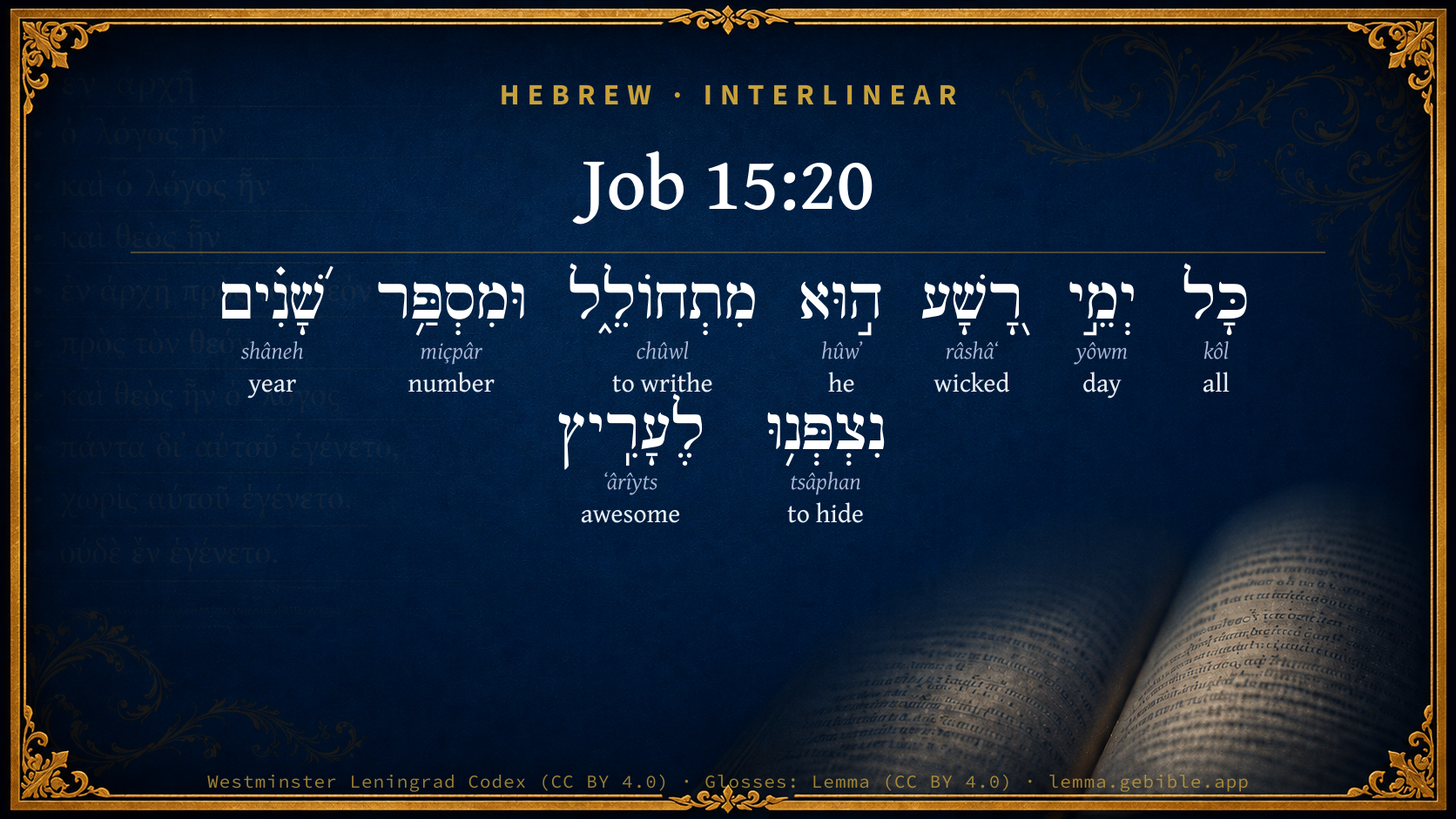
Hebrew (Westminster Leningrad Codex) Job 15:20 appears in the Hebrew Old Testament. The text above is from the Westminster Leningrad Codex. Each word links to its Strong’s number, a concise gloss, and parsing drawn from the Open Scriptures Hebrew Bible morphology. Click any word for its full Brown-Driver-Briggs (BDB) entry.
Download image
Cite this verse

Job 15:20 (World English Bible). Public Domain. Lemma interlinear Bible study tool, https://lemma.gebible.app/v/job/15/20.

Show BibTeX & RIS
BibTeX
RIS
English Translation
The wicked man travails with pain all his days, Even the number of years that are laid up for the oppressor.
World English Bible · Public Domain
Download a study sheet

One document with this verse’s original text, its word-by-word gloss line, the meaning frame, cross-references with their text, attributed commentary, and full source and license credits — printable, and it pastes into notes with its structure intact.

This verse Autodidact and up

Study sheet (.html) Plain text (.txt)

A passage Seminary Student

Up to 50 verses in one chapter. A passage sheet keeps up to 6 commentary sources and 12 cross-references per verse, in the order this page ranks them, and says so on the sheet whenever that leaves anything out. Ask for a single verse and you get the Autodidact verse sheet above.

Everything on this page stays free to read, with no account — the sheet is a download of what is already on screen, not access to it.

Want to remove ads? Support Godless Engineer
Compare translations 3

The same verse in 3 English versions, stacked beneath the original-language interlinear above. Click any original word for its lexicon entry.

Each is an independent rendering of the whole verse — the interlinear is not word-aligned to these translations.

Highlighted words mark where these versions differ — a whole-verse word diff, not a word-by-word alignment.

  • World English Bible Public Domain
    The wicked man travails with pain all his days, Even the number of years that are laid up for the oppressor.
  • King James Version Public Domain
    The wicked man travaileth with pain all his days, and the number of years is hidden to the oppressor.
  • unfoldingWord Literal Text CC BY-SA 4.0
    All of the days of the wicked, he is writhing, and the number of years, they are reserved for the oppressor.

unfoldingWord Literal Text — © unfoldingWord, licensed CC BY-SA 4.0. Word-aligned USFM3 via Door43 (git.door43.org/unfoldingWord/en_ult).

Versions to compare (up to 4)

3 of 4 selected

Show all 18 translations

Every available English version of this verse, each an independent rendering of the whole verse.

  • World English Bible Public Domain
    The wicked man travails with pain all his days, Even the number of years that are laid up for the oppressor.
  • Berean Standard Bible Public Domain
    A wicked man writhes in pain all his days; only a few years are reserved for the ruthless.
  • Majority Standard Bible Public Domain
    A wicked man writhes in pain all his days; only a few years are reserved for the ruthless.
  • King James Version Public Domain
    The wicked man travaileth with pain all his days, and the number of years is hidden to the oppressor.
  • American Standard Version (1901) Public Domain
    The wicked man travaileth with pain all his days, Even the number of years that are laid up for the oppressor.
  • Revised Version (1885) Public Domain
    The wicked man travaileth with pain all his days, even the number of years that are laid up for the oppressor.
  • Geneva Bible (1599) Public Domain
    The wicked man is continually as one that traueileth of childe, and the nomber of yeeres is hid from the tyrant.
  • Douay-Rheims (1899) Public Domain
    The wicked man is proud all his days, and the number of the years of his tyranny is uncertain.
  • Young's Literal Translation Public Domain
    `All days of the wicked he is paining himself, And few years have been laid up for the terrible one.
  • Literal Standard Version CC BY-SA 4.0
    All [the] days of the wicked he is paining himself, || And few years have been laid up for the terrible one.
  • Unlocked Literal Bible CC BY-SA 4.0
    The wicked man twists in pain all his days, the number of years that are laid up for the oppressor to suffer.
  • unfoldingWord Literal Text CC BY-SA 4.0
    All of the days of the wicked, he is writhing, and the number of years, they are reserved for the oppressor.
  • Darby Bible Public Domain
    All his days the wicked man is tormented, and numbered years are allotted to the violent.
  • World Messianic Bible Public Domain
    the wicked man writhes in pain all his days, even the number of years that are laid up for the oppressor.
  • Webster's Bible Public Domain
    The wicked man travaileth with pain all his days, and the number of years is hidden to the oppressor.
  • Free Bible Version CC BY-SA 4.0
    The wicked writhe in pain all their lives, through all the years these oppressors survive.
  • Bible in Basic English Public Domain
    The evil man is in pain all his days, and the number of the years stored up for the cruel is small.
  • JPS Tanakh (1917) Public Domain
    The wicked man travaileth with pain all his days, even the number of years that are laid up for the oppressor.

Literal Standard Version (2020), Covenant Press — licensed CC BY-SA 4.0. Text via the HelloAO Bible API (eBible.org). Unlocked Literal Bible (unfoldingWord) — licensed CC BY-SA 4.0. Text via the HelloAO Bible API (eBible.org). unfoldingWord Literal Text — © unfoldingWord, licensed CC BY-SA 4.0. Word-aligned USFM3 via Door43 (git.door43.org/unfoldingWord/en_ult). Free Bible Version, Dr. Jonathan Gallagher — licensed CC BY-SA 4.0. Text via the HelloAO Bible API (eBible.org).

Word by word

More ways to search: Search by grammar → Find every occurrence → Compare this word →

Practice this passage: Drill this verse → Learn its vocabulary →

לֶעָרִֽיץ
ʻârîyts
H6184
“to/for the · awesome”
Preposition, Determined + Adjective, Adjective, Feminine, Singular, Absolute
Part of Speech
Preposition + Adjective
Type
Adjective
Gender
Feminine
Number
Singular
State
Absolute
Full BDB Definition

Origin: from H6206

TWOT: 1702b

awe-inspiring, terror-striking, awesome, terrifying, ruthless, mighty
  1. כָּל kôl H3605 “all of” Noun, Common, Masculine, Singular, Construct
  2. יְמֵ֣י yôwm H3117 “days of” Noun, Common, Masculine, Plural, Construct
  3. רָ֭שָׁע râshâʻ H7563 “wicked” Adjective, Adjective, Masculine, Singular, Absolute
  4. ה֣וּא hûwʼ H1931 “he” Pronoun, Personal, 3rd Person, Masculine, Singular
  5. מִתְחוֹלֵ֑ל chûwl H2342 “writhing” Verb, Hithpolel, Participle Active, Masculine, Singular, Absolute
  6. וּמִסְפַּ֥ר miçpâr H4557 “and · number of” Conjunction + Noun, Common, Masculine, Singular, Construct
  7. שָׁ֝נִ֗ים shâneh H8141 “years” Noun, Common, Feminine, Plural, Absolute
  8. נִצְפְּנ֥וּ tsâphan H6845 “to hide” Verb, Niphal, Perfect, 3rd Person, Common, Plural

About this verse

These counts appear in no published source. They are computed here, from the morphology-tagged text and Lemma’s own curated glosses. What Lemma adds →

9
words
9
distinct lemmas
Wisdom
section

Notable vocabulary

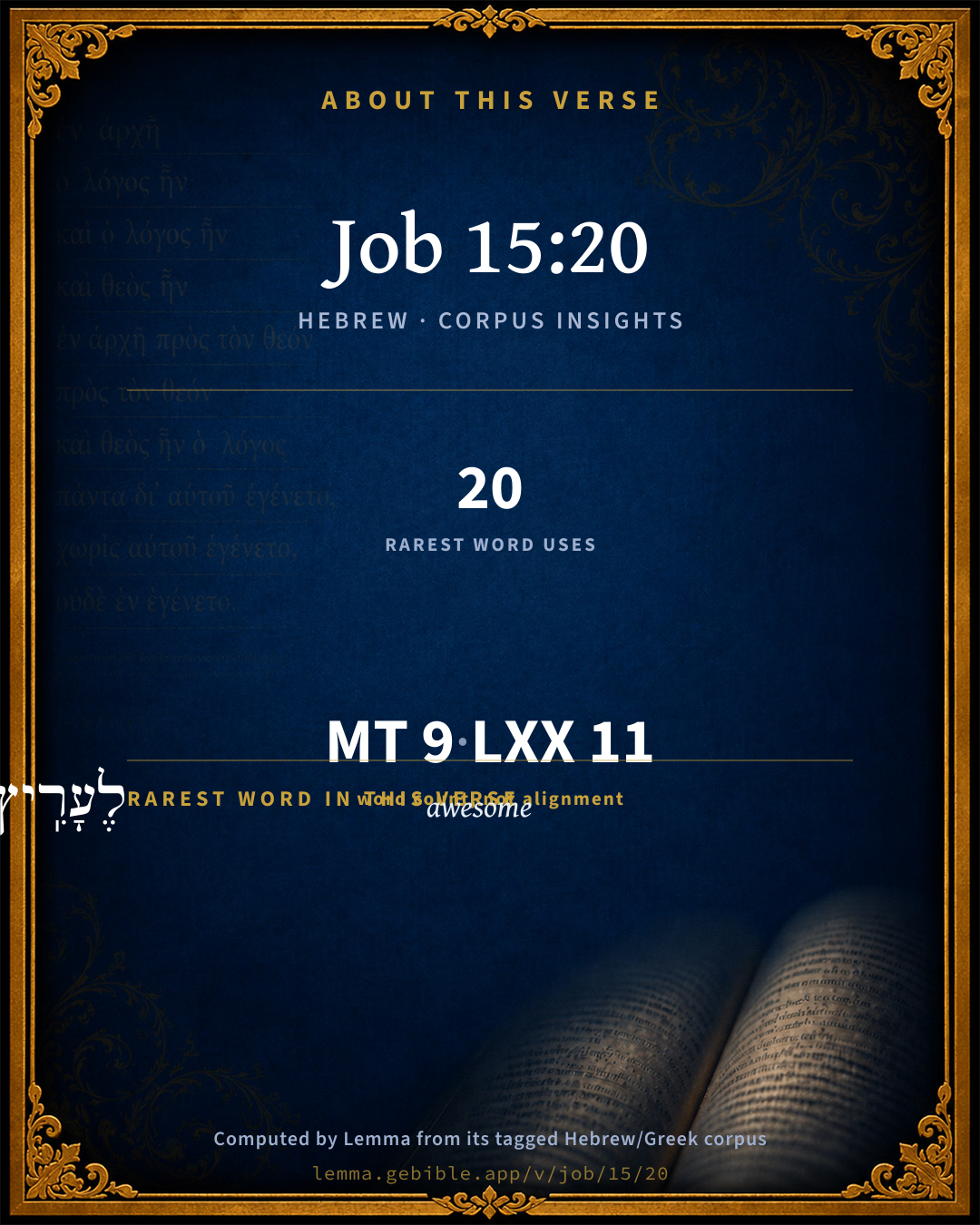
The rarest word here is לֶעָרִֽיץ awesome H6184 — appearing just 20 times in the whole Hebrew Bible.

Shared distinctive vocabulary

לֶעָרִֽיץ awesome H6184 occurs in 20 verses of the Hebrew Bible. Also found in:

Grammatical profile

  • 2 verbs
  • 4 nouns
  • 2 adjectives
  • 1 pronoun

Verb forms

  • מִתְחוֹלֵ֑ל Hithpolel · Participle Active
  • נִצְפְּנ֥וּ Niphal · Perfect

Hebrew & Septuagint length

In English translation the verse runs 21 words from the Hebrew and 19 from the Septuagint (LXX English) — closely comparable.

A rough comparison of the two English renderings, which tokenize alike — not a word-level alignment.

Word counts can differ between the Hebrew and the Greek without any difference in meaning — e.g. the Hebrew direct-object marker אֵת has no separate Greek word, and Greek often adds the article ὁ.

In the original languages it is 9 Hebrew tokens and 11 Greek tokens — but the two are counted differently (Hebrew bundles its prefixes and suffixes into one token; the Greek is in lemma form), so that isn’t a like-for-like length.

Cross-references

8

Topical passages linked to Job 15:20 in the Treasury of Scripture Knowledge — connected by theme and wording, ordered by reader-vote popularity; previews shown in the World English Bible.

  • Job 27:13 "This is the portion of a wicked man with God, The heritage of oppressors, which they receive from the Almighty.
  • James 5:1–6 Come now, you rich, weep and howl for your miseries that are coming on you.
  • Job 24:1 "Why aren't times laid up by the Almighty? Why don't those who know him see his days?
  • Luke 12:19–21 I will tell my soul, "Soul, you have many goods laid up for many years. Take your ease, eat, drink, be merry."'
  • Psalms 90:3–4 You turn man to destruction, saying, "Return, you children of men."
  • Psalms 90:12 So teach us to number our days, That we may gain a heart of wisdom.
  • Ecclesiastes 9:3 This is an evil in all that is done under the sun, that there is one event to all: yes also, the heart of the sons of men is full of evil, and madness is in their heart while they live, and after that they go to the dead.
  • Romans 8:22 For we know that the whole creation groans and travails in pain together until now.

Cross-references courtesy of OpenBible.info (CC BY 4.0).

Hebrew and Greek witnesses Masoretic Hebrew ↔ Greek Septuagint

The same verse in the two great witnesses to the Old Testament, shown verse-for-verse.

These are two independent witnesses, not word-aligned to each other, and the Septuagint is shown in lemma (dictionary) form.

Hebrew Job 15:20 Masoretic · Westminster Leningrad Codex

כָּל יְמֵ֣י רָ֭שָׁע ה֣וּא מִתְחוֹלֵ֑ל וּמִסְפַּ֥ר שָׁ֝נִ֗ים נִצְפְּנ֥וּ לֶעָרִֽיץ

The wicked man travails with pain all his days, Even the number of years that are laid up for the oppressor.

World English Bible · Public Domain

Greek LXX Job 15:20 Septuagint · lemma form

πᾶς ὁ βίος ἀσεβής ἐν φροντίς ἔτος δέ ἀριθμητός δίδωμι δυνάστης

All the life of the ungodly is spent in care, and the years granted to the oppressor are numbered.

LXX2012 (modern English Septuagint) · Public Domain

On this verse, Haydock's Catholic Bible Commentary discusses the Septuagint’s reading. Read the note in Commentary ↓

Hebrew: Westminster Leningrad Codex (CC BY 4.0). Greek: Septuagint (public domain); English from LXX2012 (modern English Septuagint) (Public Domain). How the Septuagint differs from the Hebrew →

Commentary

Notes on Job 15:20 from classic Christian and Jewish commentators (each source and its license shown beneath its notes). The classic Christian expositions comment on the surrounding passage and are grouped to its opening verse, so a note may address several verses; the Jewish commentaries on the Tanakh (Rashi and others) are per-verse, so they appear only where the commentator wrote on this verse.

Lemma curates 59 commentaries, every one of them public domain or Creative Commons licensed, each selected and text-cleaned for this edition rather than reprinted as found. About our sources →

Ellicott's Commentary for English Readers

(20) Travaileth with pain.—This and the following verses contain the result of this experience. Here, again, we have a highly-coloured and poetical description of the oppressor, true to the character of the speaker in Job_4:12, &c. We should read Job_15:20 : The wicked man travaileth with pain all his days, even the number of years that are laid up for the oppressor. It is not an independent statement, as in the Authorised Version. A sound of terror is for ever in his ears lest the spoiler should come upon him in his prosperity—he always seems to dread his war-swoop. And this condition of darkness within, which contrasts so painfully with his outward prosperity, he sees no escape from; he is over in fear of a sword hanging over him, like Damocles.

A Bible Commentary for English Readers, edited by Charles John Ellicott (1878–1897) — public domain. Text from a community e-Sword module.

Trapp's Complete Commentary

John Trapp

Job 15:20 The wicked man travaileth with pain all [his] days, and the number of years is hidden to the oppressor.

Ver. 20. The wicked man travaileth with pain all his days] He tormenteth himself, or thrusteth himself through (so some read it), 1Ti 6:10. He takes no more rest than one upon a rack; he hath his hands on his loins, as a woman in travail, Jer 30:6; he smiteth upon his thigh; sicut mulierculae in puerperio facere solent, saith Luther in his marginal note on Jer 31:19. And if he would do so for his sin, as he doth for his misery, pia esset illa tristitia, et, si disci potest, beata miseria, as Austin hath it (Aug. Epist. 545), his grief would be godly, and his misery a blessing, God would pity him, as he did his moan making Ephraim, and earnestly remember him still, Job 15:23. But, alas, that wicked are strong, the hypocrite in heart, as he heaps up wrath, so he crieth not when God bindeth him, Job 36:16. Or if he do cry, it is peril, and not peccavi, I am undone, and not, I have done amiss. Hence God many times turneth loose upon him those three vultures, care, fear, and grief, to feed upon his heart. It is seldom seen that God alloweth unto the greatest darlings of the world a perfect contentment. In the very pursuit of these outward vanities is much anguish, many grievances, fears, jealousies, disgraces, interruptions, discontentments. In the unsanctified enjoyment of them, something the wicked shall have to complain of, that shall give an unsavoury verdue to their sweetest morsels, and make their very felicity miserable; witness Ahab, Haman, &c. But then followeth the sting of conscience, that maketh a Cain, a Pashur, a Richard III, to be a terror to himself. And with this pain some wicked men travail all their days here, but hereafter it shall infallibly and inexpressibly torment the souls of them all, through all eternity. And this, with the following illustrations, is that oracle or divine sentence which Eliphaz received from those famous men above mentioned, and which he not obscurely applieth and wresteth against Job, whom herehence he would prove a wicked man by his own confessions, Job 3:25-26; Job 7:13-14, compared with Lev 26:36 Deu 28:65, for that which Eliphaz had heard from his ancestors was but the same law, for substance, that was afterwards written by Moses.

And the number of years is hidden to the oppressor] Heb. To the terrible tyrant, who, as he hath not a more cruel executioner than his own conscience, so not a more sensible displeasure than to know that he is mortal, and yet to be ignorant when his tyranny must end. The number of the years of his tyranny is uncertain, saith the Vulgate translation. And from this uncertainty, which he knoweth not how to remedy (though he run to light a candle at the devil sometimes, viz. by consulting with soothsayers and sorcerers, to know of them how long he shall live, and who shall succeed him, as Tiberius and other tyrants did), followeth suspicion and fear, saith Aquinas upon this text.

John Trapp, A Commentary or Exposition upon All the Books of the Old and New Testament (1647–1656) — public domain. Text from a community e-Sword module.

Joseph Benson's Commentary

Job 15:20. The wicked man travaileth with pain — That is, lives a life of care, and fear, and grief, by reason of God’s wrath, the torments of his own mind, and his outward calamities. The number of his years is hidden — He knows not how short the time of his life is, and therefore lives in continual fear of losing it. To the oppressor — To the wicked man: he names this one sort of them, because he supposed Job to be guilty of this sin; and in opposition to what Job had affirmed of the safety of such persons, Job 12:6, and because such are apt to promise themselves a longer and happier life than other men.

Joseph Benson's Commentary on the Old and New Testaments (1811–1818) — public domain. Text from a community e-Sword module.

Whedon's Commentary on the Bible

Daniel D. Whedon

Second division — THE WISDOM OF PRIMITIVE AGES INCULCATED THE DIVINE PUNISHMENT OF THE WICKED IN THIS PRESENT LIFE, Job_15:20-35.

First strophe — Notwithstanding external appearances, fear and anxiety torment the wicked their entire life, Job_15:20-24.

The remainder of the chapter appears to be a fragment of some ancient poem. Clericus supposes that these maxims originated among the Joktanidae, or pure original Arabs. (The queen of Sheba is believed to have been of this people.) The deepest interest gathers about this poem, which is evidently of very high antiquity.

20. Is hidden — Rather, That are reserved, for the oppressor. His life is prolonged, but with the intention of punishment. Years of splendour have no power to allay his trouble — it lies deep within, where God and the soul come together. Hence the word conscience, which implies a second and divine party to the knowledge and punishment of sin. In its maturest form the compunction of conscience becomes remorse, with its meaning of to bite back upon the soul. Eliphaz uses a figure common in the East when he compares the gnawing of conscience to the pains of childbirth. In the Greek language, the term wickedness, (πονηρια,) in its root, signifies labor, misery, and the Hebrew word for sin (עון) means misfortune and punishment. (See note, Job_3:17.) A most remarkable letter was that of Tiberius Cesar, monarch of the world, (Luk_3:1,) to his Senate, commencing in these words: “What to write you, Conscript Fathers, or in what manner to write, or what altogether not to write at this juncture, if I can determine, may all the gods and goddesses doom me to worse destruction than that by which I feel myself consuming daily.” — TACITUS, Annals.

Daniel D. Whedon (gen. ed.), Commentary on the Old and New Testaments (1874–1909) — public domain. Text from a community e-Sword module.

Tyndale Open Study Notes

Tyndale Open Resources

15:20-35 The wicked also suffer everything that happened to Job (see 1:16-19)—attacks by marauders (15:21), loss of possessions (15:29), crumbled houses (15:28), and fire (15:30, 34).

Tyndale Open Study Notes — © Tyndale Open Resources, licensed CC BY-SA 4.0. Text via the HelloAO Bible API.

Geneva Bible (1599)

Geneva Bible translators

The cruel man is ever in danger of death, and is never quiet in conscience.

Geneva Bible (1599) marginal notes — public domain. Text via Bolls.life.

Jamieson, Fausset & Brown

Robert Jamieson, A. R. Fausset & David Brown

travaileth--rather, "trembleth of himself," though there is no real danger [UMBREIT].

and the number of his years, &c.--This gives the reason why the wicked man trembles continually; namely, because he knows not the moment when his life must end.

Jamieson, Fausset & Brown — Commentary Critical and Explanatory on the Whole Bible (1871) — public domain (CC PDM 1.0). Text via the HelloAO Bible API.

Adam Clarke's Commentary

Verse 20. The wicked man travaileth with pain] This is a most forcible truth: a life of sin is a life of misery; and he that WILL sin MUST suffer. One of the Targums gives it a strange turn: - "All the days of the ungodly Esau, he was expected to repent, but he did not repent; and the number of years was hidden from the sturdy Ishmael." The sense of the original, מתחולל mithcholel, is he torments himself: he is a true heautontimoreumenos, or self-tormentor; and he alone is author of his own sufferings, and of his own ruin.

Adam Clarke's Commentary on the Bible (1810–1826) — public domain. Text from a community e-Sword/MySword module.

The Cambridge Bible for Schools and Colleges

gen. ed. J. J. S. Perowne

20. The sense is,

All the days of the wicked man he is in pain,

And the number of years that are laid up for the oppressor,

i. e., constantly and throughout his whole life, as long as it endures, the wicked man is in pain (or, torments himself). The word “laid up” means appointed, reserved, for the oppressor. This is said against Job’s statement, Job_12:6, that the tents of robbers were in peace.

20–35. This doctrine itself. The passage gives a picture of the conscience of the wicked man filled with presentiments of evil, in opposition to such statements as that of Job, ch. Job_12:6, and to his whole claims regarding himself.

The Cambridge Bible for Schools and Colleges (gen. ed. J. J. S. Perowne; Cambridge University Press, 1878–1918) — public domain. Text from a community e-Sword module.

John Gill's Exposition

The wicked man travaileth with pain all his days,.... Either to commit iniquity, which he is at great pains to do, and even to weariness; and, agreeably to the metaphor used, he conceives it in his heart, he travails with it in his mind, and he brings forth falsehood and a lie, what disappoints him, and which issues in death, eternal death, see Psa 7:14; or to get wealth and riches, in obtaining of which he pierces himself through with many sorrows; and these being like thorns, in using them he gets many a scratch, and has a good deal of trouble, pain, and uneasiness in keeping them, insomuch that he cannot sleep comfortably through fear of losing them; wherefore he does not enjoy that peace, comfort, and happiness, it may be thought he does; and, besides all this, he has many an inward pain and gripe of conscience for his many sins and transgressions, which lie at the door of conscience, and when it is opened rush in, and make sad work, and put him to great pain and distress; for otherwise this cannot be said of every wicked man, that they are in outward pain and distress, or in uncomfortable circumstances, at least in appearance; for of some it is said, "they are not in trouble as other men, neither are they plagued like other men", Psa 73:5; they live wholly at ease, and are quiet, and die so, at least seemingly: some restrain this to some particular person whom Eliphaz might have in view; the Targum paraphrases it of wicked Esau, who it was expected would repent, but did not; others think that he had in his eye some notorious oppressor, that had lived formerly, or in his time, as Nimrod, the mighty hunter and tyrant, or Chedorlaomer, who held for some years several kings in subjection to him; but it is much if he does not design Job himself; however, he forms the description of the wicked man in such a manner, that it might as near as possible suit his case, and in many things he plainly refers to it: and this is a sad case indeed, for a wicked man to travail in pain all his days in this life, and in the world to come to suffer the pains of hell fire to all eternity; the pains of a woman, to which the allusion is, are but short at most, but those of the wicked man are for life, yea, for ever; and among the rest of his pains of mind, especially in this world, what follows is one, and which gives much uneasiness: and the number of years is hidden to the oppressor; Mr. Broughton renders it, soon numbered years; that is, few, as the years of man's life at most are but few, and those of the oppressor fewer still, since bloody and deceitful men do not live out half the days of the years of man's life, but are oftentimes cut off in the midst of their days; and be they more or fewer, they are all numbered and fixed, and the number of them is with God, and him only; they are fixed and settled by the decree of God, and laid up in his purposes, and reserved for the oppressor; but they are a secret to him, he does not know how long he shall live, or how soon he may die, and then there will be an end of his oppression and tyranny, and of his enjoyment of his wealth and riches unjustly got; and this frets him, and gives him pain, and makes him uneasy; whereas a good man is easy about it, he is willing to wait his appointed time, till his change comes; he is not so much concerned to know the time of his death as to be in a readiness for it. The Targum paraphrases this of Ishmael the mighty: the oppressor is the same with the wicked man in the preceding clause.

; they live wholly at ease, and are quiet, and die so, at least seemingly: some restrain this to some particular person whom Eliphaz might have in view; the Targum paraphrases it of wicked Esau, who it was expected would repent, but did not; others think that he had in his eye some notorious oppressor, that had lived formerly, or in his time, as Nimrod, the mighty hunter and tyrant, or Chedorlaomer, who held for some years several kings in subjection to him; but it is much if he does not design Job himself; however, he forms the description of the wicked man in such a manner, that it might as near as possible suit his case, and in many things he plainly refers to it: and this is a sad case indeed, for a wicked man to travail in pain all his days in this life, and in the world to come to suffer the pains of hell fire to all eternity; the pains of a woman, to which the allusion is, are but short at most, but those of the wicked man are for life, yea, for ever; and among the rest of his pains of mind, especially in this world, what follows is one, and which gives much uneasiness: and the number of years is hidden to the oppressor; Mr. Broughton renders it, soon numbered years; that is, few, as the years of man's life at most are but few, and those of the oppressor fewer still, since bloody and deceitful men do not live out half the days of the years of man's life, but are oftentimes cut off in the midst of their days; and be they more or fewer, they are all numbered and fixed, and the number of them is with God, and him only; they are fixed and settled by the decree of God, and laid up in his purposes, and reserved for the oppressor; but they are a secret to him, he does not know how long he shall live, or how soon he may die, and then there will be an end of his oppression and tyranny, and of his enjoyment of his wealth and riches unjustly got; and this frets him, and gives him pain, and makes him uneasy; whereas a good man is easy about it, he is willing to wait his appointed time, till his change comes; he is not so much concerned to know the time of his death as to be in a readiness for it. The Targum paraphrases this of Ishmael the mighty: the oppressor is the same with the wicked man in the preceding clause.

Job 15:21

job 15:21

job 15:21

job 15:21A dreadful sound is in his ears,.... Or "a voice", or "sound of fears" (t), of what causes fears; and which are either imaginary; sometimes wicked men, fear when there is no cause or occasion for it; they fancy an enemy at their heels, and flee, when none pursues them; they are a "Magormissabib", or "terror on every side", a fear to themselves and all about them, Jer 20:3; like Cain, who fancied and feared that every man that met him would slay him Gen 4:13; such is the effect of a guilty conscience: or real; and these either extraordinary sounds, such as were made in the ears of the Syrian host, which caused them to flee, and leave their tents, and all their substance in them, Kg2 7:6; or ordinary, as the sound of the trumpet, the alarm of war, wars and rumours which are very terrible, especially to some persons; or sounds of fears, reports of one calamity after another, which cause fears; and so may respect Job's troubles, and the dreadful sound of them in his ears, brought by one messenger of bad tidings after another: but there is a more dreadful sound than either of these, which is sometimes in the ears of wicked men; the terrors of the law of God broken by them, the menaces and curses of it, and a sound of hell and damnation, which continually rings in their ears, and fills the with horror and black despair; and so the Targum,

"the voice or sound of the fears in hell is in his ears;''

and among the rest of his fears what follows is one, and so some connect the words, that (u).

in prosperity the destroyer shall come upon him; either God the lawgiver, whose law he has transgressed, and who is able, as to save his people, so to destroy the wicked, soul and body, in hell; and destruction from the Almighty, Job himself says, was a terror to him, Job 31:23; or a destroying angel, such an one as went through the land of Egypt, and destroyed the firstborn, and into the camp of Israel, when they committed sin, and were destroyed of the destroyer; or some enemy, plunderer, and robber, such as the Sabeans and Chaldeans were, and to whom respect may be had; or even the devil himself, Apollyon, the destroyer of the souls of men, and who sometimes wicked men fear will come and carry them away, soul and body, to hell; or it may be death is meant, which kills and destroys all men; and wicked men are afraid that in the midst of all their peace and prosperity sudden destruction by death should come upon them, like a thief in the night, and remove them from all their enjoyments; and whether they are or no under any fearful apprehensions of this, it certainly will be their case.

(t) "sonitus timorum", Pagninus, Montanus, Bolducius; to the same sense Codurcus, Junius & Tremellius, Mercerus, Cocceius, Schmidt, Schultens. (u) "Vastatorem invasurum eum", Junius & Tremellius.

John Gill's Exposition of the Whole Bible (1746–1763) — public domain (CC PDM 1.0). Text via the HelloAO Bible API.

Albert Barnes' Notes on the Bible

Travaileth with pain - That is, his sorrows are like the pains of parturition. Eliphaz means to say that he is a constant sufferer.

All his days - It seems difficult to see how they could have ever formed this universal maxim. It is certainly not literally true now; nor was it ever. But in order to convey the doctrine that the wicked would be punished in as pointed and striking a manner as possible, it was made to assume this universal form - meaning that the life of the wicked would be miserable. There is some reason to think that this and what follows to the close of the chapter, is an ancient fragment which Eliphaz rehearses as containing the sentiments of a purer age of the world.

And the number of years is hidden to the oppressor - Wemyss renders this, “and a reckoning of years is laid up for the violent.” So, also, Dr. Good. The Vulgate renders it, “and the number of the years of his tyranny is uncertain.” Rosenmuller, Cocceius, Drusius, and some others suppose that there should be understood here and repeated the clause occurring in the first hemistich, and that it means, “and in the number of years which are laid up for the violent man, he is tortured with pain.” Luther renders it, “and to a tyrant is the number of his years concealed.” It is difficult to tell what the passage means. To me, the most probable interpretation is one which I have not met with in any of the books which I have consulted, and which may be thus expressed,” the wicked man will be tormented all his days.” To one who is an oppressor or tyrant, the number of his years is hidden. He has no security of life. He cannot calculate with any certainty on its continuance. The end is hid. A righteous man may make some calculation, and can see the probable end of his days. He may expect to see an honored old age. But tyrants are so often cut down suddenly; they so frequently perish by assassination, and robbers are so often unexpectedly overcome, that there is no calculation which can be formed in respect to the termination of their course. Their end is hid. They die suddenly and disappear. This suits the connection; and the sentiment is, in the main, in accordance with facts as they occur.

Albert Barnes' Notes on the Bible (1834–1885) — public domain. Text from a community e-Sword/MySword module.

Haydock's Catholic Bible Commentary

Proud; uncertain. Hebrew, "in pain." (Haydock) --- Septuagint, "numbered," or few, Genesis xxxiv. 30. These are the maxims which Eliphaz had received in a vision, or from the ancients, ver. 17. The description of a tyrant’s life was admirably verified in Dionysius, of Syracuse, (Calmet) and in our Cromwell, (Haydock)--- "-----pale and trembling in the dead of night." (Pope)

---who rarely lodged two night in one chamber. (Clarendon.) --- Such live in dread, (Haydock) and seldom die a natural death.

Ad generum Cereris sine cæde et vulnere pauci

Descendunt reges et sicca morte Tyranni. (Juvenal x. 113.)

Nocte dieque suum gestare in pectore testem. (Juvenal xiii.)

They bear always about the witness, "conscience." (Haydock) --- They distrust every one, and are hated by all.

Districtus ensis cui super impia

Cervice pendet, &c. (Horace iii. Ode 1.)

--- These miseries are incident to the wicked, but are improperly addressed to Job. (Worthington)

George Leo Haydock (1774–1849), Haydock's Catholic Family Bible and Commentary, 1859 edition — public domain. Excludes Psalms (Douay-Rheims chapter numbering differs from Protestant) and Deuterocanonical books (Catholic canon only).

Matthew Poole's English Annotations

Travaileth with pain, i.e. lives a life of care, and fear, and grief, by reason of God’s wrath, and the torments of his own mind, and his manifold and dreadful outward calamities.

The number of his years is hidden, i.e. he knows not how short the time of his tyranny and life is, and therefore lives in continual fear of losing them. The number of a good man’s years are also hid from him as well as they are from the wicked men; but to those this is a great torment and mischief; whereas it is not so to him. Or, and a few years (Heb. a number of years, put by a common hypallage for years of number; as few years are called, Job 16:22, because they are soon numbered; as men of number, is put for a few men, Gen 34:30; Deu 4:27; 33:6) are laid or treasured up, i.e. are allotted to him by God’s secret counsel; for God cuts off such men in the midst of their days. Psa 55:23; whereas long life is promised, and commonly given, to righteous men.

To the oppressor, i.e. to the wicked man; but he names this one sort of them, the oppressors, partly, because he supposed Job to be guilty of this sin, Job 22:6; partly, in opposition to what Job had affirmed of the safety and happiness of such persons, Job 12:6; and partly, because such are most apt to expect and promise to themselves a longer and happier life than other men, because of their singular preservatives and advantages of life above other men.

Matthew Poole's English Annotations on the Holy Bible (1683–1685) — public domain. Text from a community e-Sword/MySword module.

The Pulpit Commentary

Vers. 20-35. Schultens calls this "a magnificently elaborate oration, crowded with illustrations and metaphors, in which it is shown that the wicked cannot possibly escape being miserable, but that the punishment which they have so richly deserved assuredly awaits them, and is to be inflicted on them, as an example and terror to others, by a holy and just God, because, just as he loves virtue, so he pursues vice with a fierce and deadly hatred" ("Liber Jobi," p. 104, edit. R. Grey). The wicked man travaileth with pain all his days. Certainly an over-statement of the truth. With a much nearer approach to the facts of the case, the Psalmist remarked, "I was grieved at the wicked: I do also see the ungodly in such prosperity. For they are in no peril of death, but are lusty and strong. They come in no misfortune like other folk; neither are they plagued like other men". (Psa_73:3-5) And the number of years is hidden to the oppressor; rather, even the number of years that is laid up for the oppressor. So Merx and the Revised Version. Another possible meaning is, "And a small number of years is laid up," etc. If we take the former view, we must regard the clause as exegetical of "all his days.

Vers. 20-35. Warnings from the wisdom of experience.

I THE TERRIBLE TORMENTS OF THE WICKED. (Vers. 20-24)

1. Lifelong pain. Notwithstanding all appearances of ease and prosperity, the bad man only suffers. The sword seems ever suspended above the tyrant"s head. The serpent is ever busy with the tooth of remorse at his heart..

2. Dread fancies throng through every sound into his imagination; he is ever in terror of some sudden doom. He sees a darkness coming upon him from which there is no possibility of escape. In the glance of dread fancy he sees himself already singled out for the fatal sword-stroke. The gaunt shape of famine seems to haunt his steps; from his soft couch and splendid table he looks out into a dark scene, and realizes it as present; he is overcome by anguish and trouble, as a king is borne down amidst the turmoil of battle. Thus conscience makes the guilty man a coward, and the "native hue of resolution is sicklied o"er with the pale cast of thought." "A guilty conscience! I ask no other hell.

II THE CAUSE OF HIS SUFFERINGS. (Vers. 25-28)

1. Rebellion against God. This is presented under the powerful figure of a warrior, rushing against his foe, on the field, in headstrong fury. Self-will, leading to contempt of the moral order of God, and this to violent resistance to all moral restraint; here is the genesis and development of sin. See the history of Pharaoh.

2. His selfish life. He lives in luxury, pampering his body till he becomes a gross mass of flesh, full of carnal appetite. In his unsocial ambition and greed he has laid waste flourishing cities rich in men, that he may abide in them alone, as if he could not find place enough for the dwelling of his body"and preferred to live alone amidst wide desolation, rather than peacefully among a multitude of the happy. So in Isa_5:8, "Woe to them that join house to house, that lay field to field, till there be no place, that they may be placed alone in the midst of the earth!" "He enlargeth his desire as hell, and is as death, and cannot be satisfied, but gathereth unto him all nations, and heapeth unto him all people". (Hab_2:5) "He builds a town with blood, and lays its foundations in iniquity. (Hab_2:12) The picture is one of grasping, insatiable greed and covetousness, which shut a man out from the sympathy of his fellows. Some, however, take ver. 28 as referring further to an act of disobedience in fixing his dwelling among ruins, cursed by God and forbidden to future habitation.

III THE INSTABILITY OF THE WICKED. (Vers. 29-33) His hopes are disappointed, riches elude him, his accumulations melt away. Unlike the heavy harvest of the waving corn, he is rather like the tree whose roots do not sink deeply into the earth (ver. 29), so that every outward misfortune becomes in extreme source of danger all his blossoms and fruits are cast away before the time of gathering! Then, again, the figure of darkness returns, which he only escapes, to fall into the glowing breath of Gods anger, which blasts everything that is green and fair in his prospects.

IV THE VANITY AND FOLLY OF THE WICKED. (Vers. 34, 35) He begins by trusting in vanity, in what is baseless, such as all absence of moral principle; and vanity, according to the moral constitution of the world, must be the end of his schemes. The time of ripeness and harvest must be that of destruction; or like the blossoms of the olive in certain years, which fall off without fruit being formed, his plans never come to maturity. The "brood" of the wicked man is unfruitful; the fire devours his tent. Or like the woman who has falsely conceived, and remains long in deception, but at last perceives with grief the nothingness of her hopes, so with the wicked man. (comp. Isa_7:14-17 Isa_33:11)

LESSONS.

1. Goodness alone has substance, vitality, endurance, fruitfulness.

2. Evil is emptiness; it carries with it self-delusion; its end is disappointment and failure. J.

There is a fitness of things, and wisdom becomes the wise man the man who is either truly wise or who would presume to be wise. Let his words testify to the justness of his profession. Consider

I THE INCONGRUITY OF WORDS OF FOLLY PROCEEDING FROM THE LIPS OF THE WISE. All may reasonably hope that he who is tutored with knowledge, and who has accustomed himself to direct his knowledge to good ends, will speak only words of truth and soberness words trustworthy and useful. For one known to be wise, or professing to be wise, to use words of foolishness is an utter incongruity. The speech is the expression of the soul. Out of the heart the mouth speaketh. The world has need of wisdom need of its salt to save it from the corruptions of error and folly. "Should a wise man utter vain knowledge?" It is inconsistent; it is misleading; it is destructive.

II THE PRECIOUSNESS OF THE WORDS OF HIM WHO TRULY SPEAKETH WISDOM. To assume the position of the teacher, to dare to guide the ignorant, to set up one"s self as a ruler in the world of thought, is to assume a position of the highest possible importance. Knowingly or unknowingly, the world is led by the words of its teachers, good or bad. The souls of men are in the hands of the teacher. His words lead to life or death. The bulk of men are ignorant and timid, and therefore under the control of the stronger minds. The world"s sad history proves that men, like a flock of sheep, may be led into any path by their teachers. The dry and arid sands will not keep the feet of the sheep from following their leader and shepherd, nor will the rugged and stony ground. The world is led by the ears. How precious, then, to the world are words of true wisdom! Truly the feet of him who publisheth peace, and bringeth good tidings, are beautiful. The world is more indebted to its teachers of wisdom than to its chieftains in valour. Error binds men in chains; but words of wisdom, which are words of truth, set them free.

III THE TRULY WISE MAN IS HE WHO DOTH NOT "REASON WITH UNPROFITABLE TALK," AND WITH WHOSE SPEECHES IT CANNOT BE SAID, "HE CAN DO NO GOOD." He is truly wise who, with words which he has good reason to believe are wise words, seeks to lead the world in paths of safety paths of light, joy, and blessing. Let the man be judged by his words, and by his words condemned before the universal bar. Let the world cast its uttermost condemnations on him who by false words leads the unsuspecting fool into the path of peril; but let the world gather its garlands for him who with wise words proves himself to be wise, and leads the feet of men into the way of life. To be able to do good by speech is a great endowment; to be faithful in the use of right speech is to be truly wise, and a wise word is a word of life. R.G.

Vers. 20-30. The consequences of evil-doing.

It is impossible that wrong-doing should go wholly unpunished, for were there no positive penal inflictions, the mere natural consequences of wrong-doing would bring inevitable penalties. The words in these verses refer to the present natural consequences of wrong-doing, not to the final penal inflictions which must follow. The evils which the practice of wickedness tends to bring upon the head of the evil-doer, though many may escape, are thus stated.

I HE ENDURES PAIN ALL HIS DAYS. The reference is probably to inward sufferings, and the anxieties which a course of wrong must cause. But the physical pains are also great. Perhaps most physical pain is the consequence of wrong-doing. Keeping the righteous Law of God by man would free the human life from suffering as truly as it frees the life of the beast or the bird. Broken law, known or unknown, must, in the disturbance it brings, cause pain.

II Another source of punishment to the evil-doer is in THE CONDEMNATIONS OF CONSCIENCE WHICH HE INCURS. The seat of all true judgment is the conscience. It is the sum of all the soul"s powers the great tribunal before which all actions are brought. There the verdict is passed; there the penalty imposed dreadful sound is in his ears." If the conscience be indurated, the life is so much the more degraded and the punishment the greater.

III The wicked man suffers in THE FEARS WHICH HE EXPERIENCES. "He knoweth that the day of darkness is ready at his hand." A dark day awaits him, and he knows it. He carries his fear with him wherever he goes. Judgment has been passed upon his evil-doing by his own conscience by himself. The penalty has been awarded, and he goes about expecting its infliction. The fear of punishment hangs over his head.

IV ALL THIS DEEPENS INTO A DARK DREAD BY WHICH HE IS HAUNTED. His spirit has no rest. "Trouble and anguish make him afraid." They wage war against him and despoil him. They "prevail against him, as a king ready to the battle.

V Further evils follow in HIS OUTWARD CIRCUMSTANCES.

1. His dwelling shall be desolate (ver. 28).

2. His riches fade away. He holds everything by an uncertain tenure.

3. He shall dwell in gloom. "He shall not depart out of darkness.

4. He finally perishes by the breath of God. "By the breath of his mouth shall he go away." This is the portion of the man who "stretcheth out his hand against God." The assured Christian hope is bright, clear, comforting. It changes "the night into day;" it makes the darkness short, because of light; the "grave" is exchanged for the "house" on high; "corruption" puts on incorruption; "the bars of the pit" are burst; anti the resting "together in the dust" passes into the "rest in him. R.G.

The Pulpit Commentary (1880–1919), ed. H.D.M. Spence-Jones & Joseph S. Exell — public domain. Text from a community e-Sword module.

John Wesley's Explanatory Notes

Pain - Lives a life of care, and fear, and grief, by reason of God's wrath, the torments of his own mind, and his outward calamities. Hidden - He knows not how short the time of his life is, and therefore lives in continual fear of losing it. Oppressor - To the wicked man: he names this one sort of them, because he supposed Job to be guilty of this sin, in opposition of what Job had affirmed of the safety of such persons, chap. xii, 6, and because such are apt to promise themselves a longer and happier life than other men.

John Wesley, Explanatory Notes Upon the Whole Bible (1754–1765) — public domain. Text via the GEBible commentary corpus.

Keil & Delitzsch

C. F. Keil & F. Delitzsch

20 So long as the ungodly liveth he suffereth,

And numbered years are reserved for the tyrant.

21 Terrors sound in his ears;

In time of peace the destroyer cometh upon him.

22 He believeth not in a return from darkness,

And he is selected for the sword.

23 He roameth about after bread: "Ah! where is it?"

He knoweth that a dark day is near at hand for him.

24 Trouble and anguish terrify him;

They seize him as a king ready to the battle.

All the days of the ungodly he (the ungodly) is sensible of pain. רשׁע stands, like Elohim in Gen 9:6, by the closer definition; here however so, that this defining ends after the manner of a premiss, and is begun by הוּא after the manner of a conclusion. מתחולל, he writhes, i.e., suffers inward anxiety and distress in the midst of all outward appearance of happiness. Most expositors translate the next line: and throughout the number of the years, which are reserved to the tyrant. But (1) this parallel definition of time appended by waw makes the sense drawling; (2) the change of עריץ (oppressor, tyrant) for רשׁע leads one to expect a fresh affirmation, hence it is translated by the lxx: ἔτη δὲ ἀριθμητὰ δεδομένα δυνάστῃ. The predicate is, then, like Job 32:7, comp. Job 29:10; Job 2:4 (Ges. 148), per attractionem in the plur. instead of in the sing., and especially with מספּר followed by gen. plur.; this attraction is adopted by our author, Job 21:21; Job 38:21. The meaning is not, that numbered, i.e., few, years are secretly appointed to the tyrant, which must have been sh'nôth mispâr, a reversed position of the words, as Job 16:22; Num 9:20 (vid., Gesenius' Thes.); but a (limited, appointed) number of years is reserved to the tyrant (צפן as Job 24:1; Job 21:19, comp. טמן, Job 20:26; Mercerus: occulto decreto definiti), after the expiration of which his punishment begins. The thought expressed by the Targ., Syr., and Jerome would be suitable: and the number of the years (that he has to live unpunished) is hidden from the tyrant; but if this were the poet's meaning, he would have written שׁניו, and must have written מן־העריץ.

With regard to the following Job 15:21-24, it is doubtful whether only the evil-doer's anxiety of spirit is described in amplification of הוא מתחולל, or also how the terrible images from which he suffers in his conscience are realized, and how he at length helplessly succumbs to the destruction which his imagination had long foreboded. A satisfactory and decisive answer to this question is hardly possible; but considering that the real crisis is brought on by Eliphaz later, and fully described, it seems more probable that what has an objective tone in Job 15:21-24 is controlled by what has been affirmed respecting the evil conscience of the ungodly, and is to be understood accordingly. The sound of terrible things (startling dangers) rings in his ears; the devastator comes upon him (בוא seq. acc. as Job 20:22; Pro 28:22; comp. Isa 28:15) in the midst of his prosperity. He anticipates it ere it happens. From the darkness by which he feels himself menaced, he believes not (האמין seq. infin. as Psa 27:13, לראות, of confident hope) to return; i.e., overwhelmed with a consciousness of his guilt, he cannot, in the presence of this darkness which threatens him, raise to the hope of rescue from it, and he is really - as his consciousness tells him - צפוּ (like עשׂוּ, Job 41:25; Ges. 75, rem. 5; Keri צפוי, which is omitted in our printed copies, contrary to the testimony of the Masora and the authority of correct MSS), spied out for, appointed to the sword, i.e., of God (Job 19:29; Isa 31:8), or decreed by God. In the midst of abundance he is harassed by the thought of becoming poor; he wanders about in search of bread, anxiously looking out and asking where? (abrupt, like הנה, Job 9:19), i.e., where is any to be found, whence can I obtain it? The lxx translates contrary to the connection, and with a strange misunderstanding of the passage: κατατέτακται δὲ δἰς σῖτα γυψίν (איּה לחם, food for the vulture). He sees himself in the mirror of the future thus reduced to beggary; he knows that a day of darkness stands in readiness (נכון, like Job 18:12), is at his hand, i.e., close upon him (בּידו, elsewhere in this sense ליד, Psa 140:6; Sa1 19:3, and על־ידי, Job 1:14).

In accordance with the previous exposition, we shall now interpret וּמצוּקה צר, Job 15:24, not of need and distress, but subjectively of fear and oppression. They come upon him suddenly and irresistibly; it seizes or overpowers him (תּתקפהוּ with neutral subject; an unknown something, a dismal power) as a king עתיד לכּידור. lxx ὥσπερ στρατηγὸς πρωτοστάτης πίπτων, like a leader falling in the first line of the battle, which is an imaginary interpretation of the text. The translation of the Targum also, sicut regem qui paratus est ad scabellum (to serve the conqueror as a footstool), furnishes no explanation. Another Targum translation (in Nachmani and elsewhere) is: sicut rex qui paratus est circumdare se legionibus. According to this, כידור comes from כּדר, to surround, be round (comp. כּתר, whence כּתר, Assyr. cudar, κίδαρις, perhaps also הזר, Syr. חדר, whence chedor, a circle, round about); and it is assumed, that as כּדּוּר signifies a ball (not only in Talmudic, but also in Isa 22:18, which is to be translated: rolling he rolleth thee into a ball, a ball in a spacious land), so כּידור, a round encampment, an army encamped in a circle, synon. of מעגּל. In the first signification the word certainly furnishes no suitable sense in connection with עתיד; but one may, with Kimchi, suppose that כידור, like the Italian torniamento, denotes the circle as well as the tournament, or the round of conflict, i.e., the conflict which moves round about, like tumult of battle, which last is a suitable meaning here. The same appropriate meaning is attained, however, if the root is taken, like the Arabic kdr, in the signification turbidum esse (comp. קדר, Job 6:16), which is adopted of misfortunes as troubled experiences of life (according to which Schultens translates: destinatus est ad turbulentissimas fortunas, beginning a new thought with עתיד, which is not possible, since כמלך by itself is no complete figure), and may perhaps also be referred to the tumult of battle, tumultus bellici conturbatio (Rosenm.); or of, with Fleischer, one starts from another turn of the idea of the root, viz., to be compressed, solid, thick, which is a more certain way gives the meaning of a dense crowd.

(Note: The Arab. verb kdr belongs to the root kd, to smite, thrust, quatere, percutere, tundere, trudere; a root that has many branches. It is I. transitive cadara (fut. jacduru, inf. cadr) - by the non-adoption of which from the original lexicons our lexicographers have deprived the whole etymological development of its groundwork - in the signification to pour, hurl down, pour out, e.g., cadara-l-ma, he has spilt, poured out, thrown down the water; hence in the medial VII. form incadara intransitive, to fall, fall down, chiefly of water and other fluids, as of the rain which pours down from heaven, of a cascade, and the like; then improperly of a bird of prey which shoots down from the air upon its prey (e.g., in the poetry in Beidhwi on Sur. 81, 2: "The hawk saw some bustards on the plain f'ancadara, and rushed down"); of a hostile host which rushes upon the enemy first possible signification for כידור]; of a man, horse, etc., which runs very swiftly, effuse currit, effuso curru ruit; of the stars that shall fall from heaven at the last day (Sur. 81, 2). Then also II. intransitive cadara (fut. jacdiru) with the secondary form cadira (fut. jacdaru) and cadura (fut. jacduru), prop. to be shaken and jolted; then also of fluid things, mixed and mingled, made turgid, unclean, i.e., by shaking, jolting, stirring, etc., with the dregs (the cudre or cudde); then gen. turbidum, non limpidum (opp. Arab. ṣf'), with a similar transition of meaning to that in turbare (comp. deturbare) and the German trben (comp. traben or trappen, treiben, treffen). The primary meaning of the root takes another III. turn in the derived adjectives cudur, cudurr, cundur, cundir, compressed, solid, thick; the last word with us (Germans) forms a transition from cadir, cadr, cadr, dull, slimy, yeasty, etc., inasmuch as we speak of dickes Bier (thick beer), etc., cerevisia spissa, de la bire paisse. Here the point of contact of the word כידור, tumult of battle, κλόνος ἀνδρῶν, seems indicated: a dense crowd and tumult, where one is close upon another; as also נלחם, מלחמה, signify not reciprocal destruction, slaughter, but to press firmly and closely upon one another, a dense crowd. - Fl.)

Since, therefore, a suitable meaning is obtained in two ways, the natural conjecture, which is commended by Pro 6:11, עתיד לכּידון, paratus ad hastam = peritus hastae (Hupf.), according to Job 3:8) where ערר = לערר), may be abandoned. The signification circuitus has the most support, according to which Saadia and Parchon also explain, and we have preferred to translate round of battle rather than tumult of conflict; Jerome's translation, qui praeparatur ad praelium, seems also to be gained in the same manner.

Keil & Delitzsch — Biblical Commentary on the Old Testament (1861–1891) — public domain (CC PDM 1.0). Text via the HelloAO Bible API. (Old Testament only.)

Rashi

Rabbi Shlomo Yitzchaki (Rashi)

All the days of a wicked man who does not repent of his sin and does not confess his transgressions, all his days...

he mourns and grieves over his certainty of being requited for his evil that he committed. All the number of years that were laid up for the oppressor, he mourns.

The word מתחולל is an expression of mourning, but I did not hear this.

Rashi on the Tanakh — English translations: “The Judaica Press complete Tanach with Rashi, translated by A. J. Rosenberg” (CC BY 4.0); “Pentateuch with Rashi's commentary by M. Rosenbaum and A.M. Silbermann, 1929-1934” (public domain); “The Metsudah Tanach series, Lakewood, N.J” (CC BY 4.0); and “The Book of Joshua, Metsudah Publications, 1997” (CC BY 4.0). Text via Sefaria.

Lesson kit

Teaching starters — assembled from the data on this page, not authored interpretation. Every prompt links to the verse data it draws on. Edit before teaching.

Job, in the Wisdom, opens this verse with 9 words (9 distinct Hebrew lemmas). Its most distinctive word is ʻârîyts (“awesome”). A historical commentator’s framing appears above. Read the whole chapter for the surrounding context.

Discussion questions

  1. What does “awesome” (ʻârîyts) contribute to the verse as a whole?
  2. How does Job 6:23, which shares the word «awesome», read alongside this verse?
  3. These translations render this verse differently; the difference is in the English rendering, not the original. What questions does that raise?
  4. «מִתְחוֹלֵ֑ל» is a Hithpolel Participle Active verb. How does that grammatical form shape the action described?
  5. Compare how Ellicott's Commentary for English Readers and Trapp's Complete Commentary read this verse. Where do they agree or differ?

Things to notice

Reading settings

Reading text

Shown beneath each verse's original-language words.

Old Testament
Old Testament edition

Read the OT as the Masoretic Hebrew (MT) or the Greek Septuagint (LXX).

English shown for the Greek Septuagint (in the Hebrew ↔ Greek comparison).

Comparing translations? Open the Compare panel on any verse page to stack up to four side by side.