Psalms 3:7

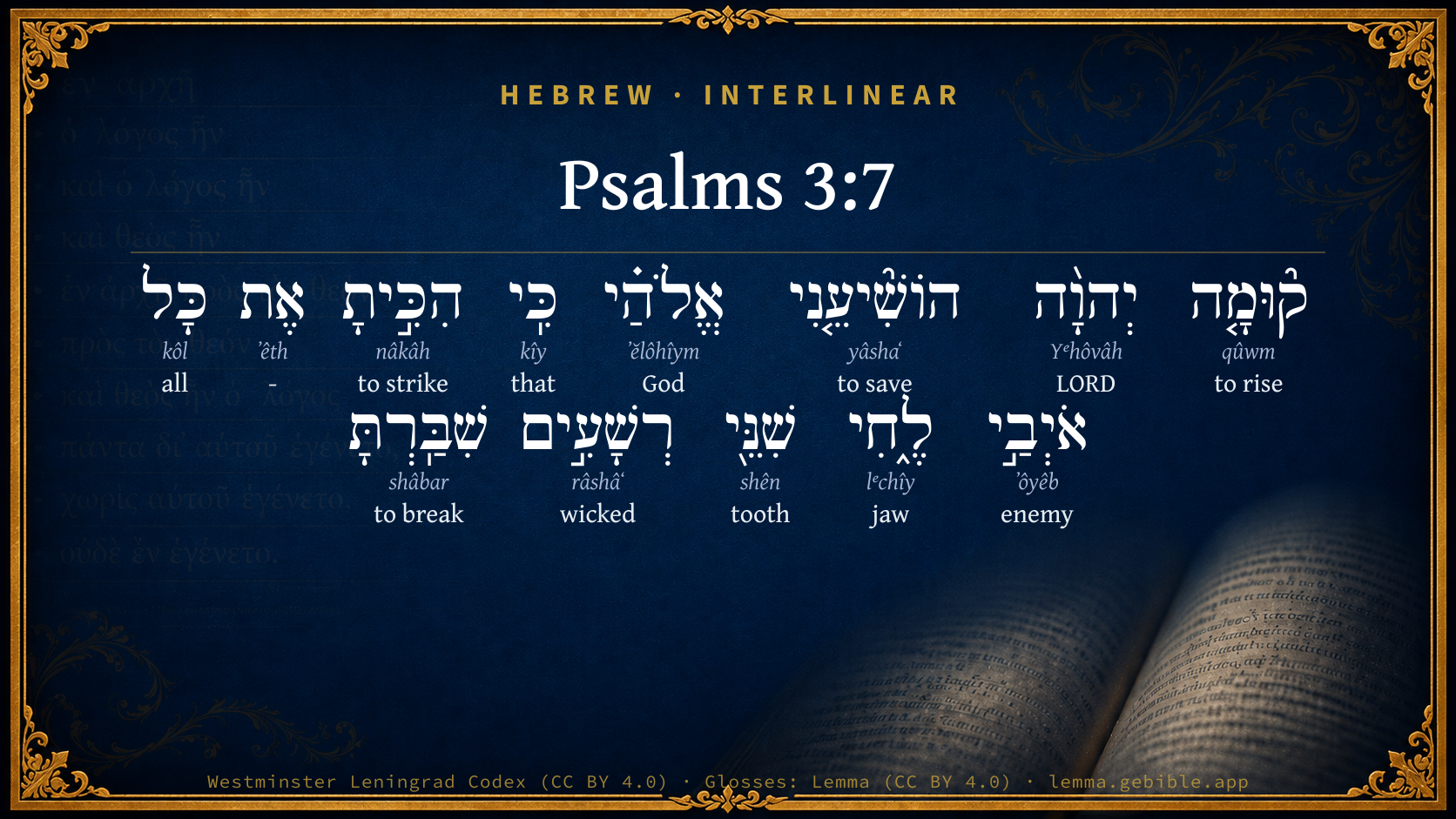
Hebrew (Westminster Leningrad Codex) Psalms 3:7 appears in the Hebrew Old Testament. The text above is from the Westminster Leningrad Codex. Each word links to its Strong’s number, a concise gloss, and parsing drawn from the Open Scriptures Hebrew Bible morphology. Click any word for its full Brown-Driver-Briggs (BDB) entry.
Download image
Cite this verse

Psalms 3:7 (World English Bible). Public Domain. Lemma interlinear Bible study tool, https://lemma.gebible.app/v/psalms/3/7.

Show BibTeX & RIS
BibTeX
RIS
English Translation
Arise, Yahweh! Save me, my God! For you have struck all of my enemies on the cheek bone. You have broken the teeth of the wicked.
World English Bible · Public Domain
Download a study sheet

One document with this verse’s original text, its word-by-word gloss line, the meaning frame, cross-references with their text, attributed commentary, and full source and license credits — printable, and it pastes into notes with its structure intact.

This verse Autodidact and up

Study sheet (.html) Plain text (.txt)

A passage Seminary Student

Up to 50 verses in one chapter. A passage sheet keeps up to 6 commentary sources and 12 cross-references per verse, in the order this page ranks them, and says so on the sheet whenever that leaves anything out. Ask for a single verse and you get the Autodidact verse sheet above.

Everything on this page stays free to read, with no account — the sheet is a download of what is already on screen, not access to it.

Want to remove ads? Support Godless Engineer
Compare translations 3

The same verse in 3 English versions, stacked beneath the original-language interlinear above. Click any original word for its lexicon entry.

Each is an independent rendering of the whole verse — the interlinear is not word-aligned to these translations.

Highlighted words mark where these versions differ — a whole-verse word diff, not a word-by-word alignment.

  • World English Bible Public Domain
    Arise, Yahweh! Save me, my God! For you have struck all of my enemies on the cheek bone. You have broken the teeth of the wicked.
  • King James Version Public Domain
    Arise, O LORD; save me, O my God: for thou hast smitten all mine enemies upon the cheek bone; thou hast broken the teeth of the ungodly.
  • unfoldingWord Literal Text CC BY-SA 4.0
    Rise up, Yahweh! Save me, my God! For you hit all my enemies on the cheek; the teeth of the wicked you break.

unfoldingWord Literal Text — © unfoldingWord, licensed CC BY-SA 4.0. Word-aligned USFM3 via Door43 (git.door43.org/unfoldingWord/en_ult).

Versions to compare (up to 4)

3 of 4 selected

Show all 18 translations

Every available English version of this verse, each an independent rendering of the whole verse.

  • World English Bible Public Domain
    Arise, Yahweh! Save me, my God! For you have struck all of my enemies on the cheek bone. You have broken the teeth of the wicked.
  • Berean Standard Bible Public Domain
    Arise, O LORD! Save me, O my God! Strike all my enemies on the jaw; break the teeth of the wicked.
  • Majority Standard Bible Public Domain
    Arise, O LORD! Save me, O my God! Strike all my enemies on the jaw; break the teeth of the wicked.
  • King James Version Public Domain
    Arise, O LORD; save me, O my God: for thou hast smitten all mine enemies upon the cheek bone; thou hast broken the teeth of the ungodly.
  • American Standard Version (1901) Public Domain
    Arise, O Jehovah; save me, O my God: For thou hast smitten all mine enemies upon the cheek bone; Thou hast broken the teeth of the wicked.
  • Revised Version (1885) Public Domain
    Arise, O LORD; save me, O my God: for thou hast smitten all mine enemies upon the cheek bone; thou hast broken the teeth of the wicked.
  • Geneva Bible (1599) Public Domain
    O Lord, arise: helpe me, my God: for thou hast smitten all mine enemies vpon the cheeke bone: thou hast broken the teeth of the wicked.
  • Douay-Rheims (1899) Public Domain
    I will not fear thousands of the people, surrounding me: arise, O Lord; save me, O my God.
  • Young's Literal Translation Public Domain
    Rise, O Jehovah! save me, my God. Because Thou hast smitten All mine enemies `on' the cheek. The teeth of the wicked Thou hast broken.
  • Literal Standard Version CC BY-SA 4.0
    Rise, O YHWH! Save me, my God! For You have struck all my enemies [on] the cheek. You have broken the teeth of the wicked.
  • Unlocked Literal Bible CC BY-SA 4.0
    Rise up, Yahweh! Save me, my God! For you will hit all my enemies on the jaw; you will break the teeth of the wicked.
  • unfoldingWord Literal Text CC BY-SA 4.0
    Rise up, Yahweh! Save me, my God! For you hit all my enemies on the cheek; the teeth of the wicked you break.
  • Darby Bible Public Domain
    Arise, Jehovah; save me, my God! For thou hast smitten all mine enemies upon the cheekbone, thou hast broken the teeth of the wicked.
  • World Messianic Bible Public Domain
    Arise, LORD! Save me, my God! For you have struck all of my enemies on the cheek bone. You have broken the teeth of the wicked.
  • Webster's Bible Public Domain
    \\3:6\\I will not be afraid of ten thousands of people, that have set themselves against me on all sides.
  • Free Bible Version CC BY-SA 4.0
    Stand up for me, Lord! Save me, my God! Hit all my enemies on the cheek; break the teeth of the wicked!
  • Bible in Basic English Public Domain
    Come to me, Lord; keep me safe, O my God; for you have given all my haters blows on their face-bones; the teeth of the evil-doers have been broken by you.
  • JPS Tanakh (1917) Public Domain
    (3-8) Arise, O LORD; save me, O my God; for Thou hast smitten all mine enemies upon the cheek, Thou hast broken the teeth of the wicked.

Literal Standard Version (2020), Covenant Press — licensed CC BY-SA 4.0. Text via the HelloAO Bible API (eBible.org). Unlocked Literal Bible (unfoldingWord) — licensed CC BY-SA 4.0. Text via the HelloAO Bible API (eBible.org). unfoldingWord Literal Text — © unfoldingWord, licensed CC BY-SA 4.0. Word-aligned USFM3 via Door43 (git.door43.org/unfoldingWord/en_ult). Free Bible Version, Dr. Jonathan Gallagher — licensed CC BY-SA 4.0. Text via the HelloAO Bible API (eBible.org).

Word by word

More ways to search: Search by grammar → Find every occurrence → Compare this word →

Practice this passage: Drill this verse → Learn its vocabulary →

לֶ֑חִי
lᵉchîy
H3895
“jaw”
Noun, Common, Both, Singular, Absolute
Part of Speech
Noun
Type
Common
Gender
Both
Number
Singular
State
Absolute
Full BDB Definition

Origin: from an unused root meaning to be soft

TWOT: 1101a

jaw, cheek - jaw, jawbone (of animal) - cheek (of man)
  1. ק֘וּמָ֤ה qûwm H6965 “rise” Verb, Qal, Imperative, 2nd Person, Masculine, Singular + Suffix, h
  2. יְהוָ֨ה Yᵉhôvâh H3068 “LORD” Noun, Proper
  3. הוֹשִׁ֘יעֵ֤נִי yâshaʻ H3467 “save · me” Verb, Hiphil, Imperative, 2nd Person, Masculine, Singular + Suffix, Personal, 1st Person, Common, Singular
  4. אֱלֹהַ֗י ʼĕlôhîym H430 “God(s) · my” Noun, Common, Masculine, Plural, Construct + Suffix, Personal, 1st Person, Common, Singular
  5. כִּֽי kîy H3588 “that” Conjunction
  6. הִכִּ֣יתָ nâkâh H5221 “to strike” Verb, Hiphil, Perfect, 2nd Person, Masculine, Singular
  7. אֶת ʼêth H853 “-” Particle, Direct Object
  8. כָּל kôl H3605 “all of” Noun, Common, Masculine, Singular, Construct
  9. אֹיְבַ֣י ʼôyêb H341 “enemy · me” Verb, Qal, Participle Active, Masculine, Plural, Construct + Suffix, Personal, 1st Person, Common, Singular
  10. שִׁנֵּ֖י shên H8127 “teeth of” Noun, Common, Both, Dual, Construct
  11. רְשָׁעִ֣ים râshâʻ H7563 “wicked” Adjective, Adjective, Masculine, Plural, Absolute
  12. שִׁבַּֽרְתָּ shâbar H7665 “to break” Verb, Piel, Perfect, 2nd Person, Masculine, Singular

About this verse

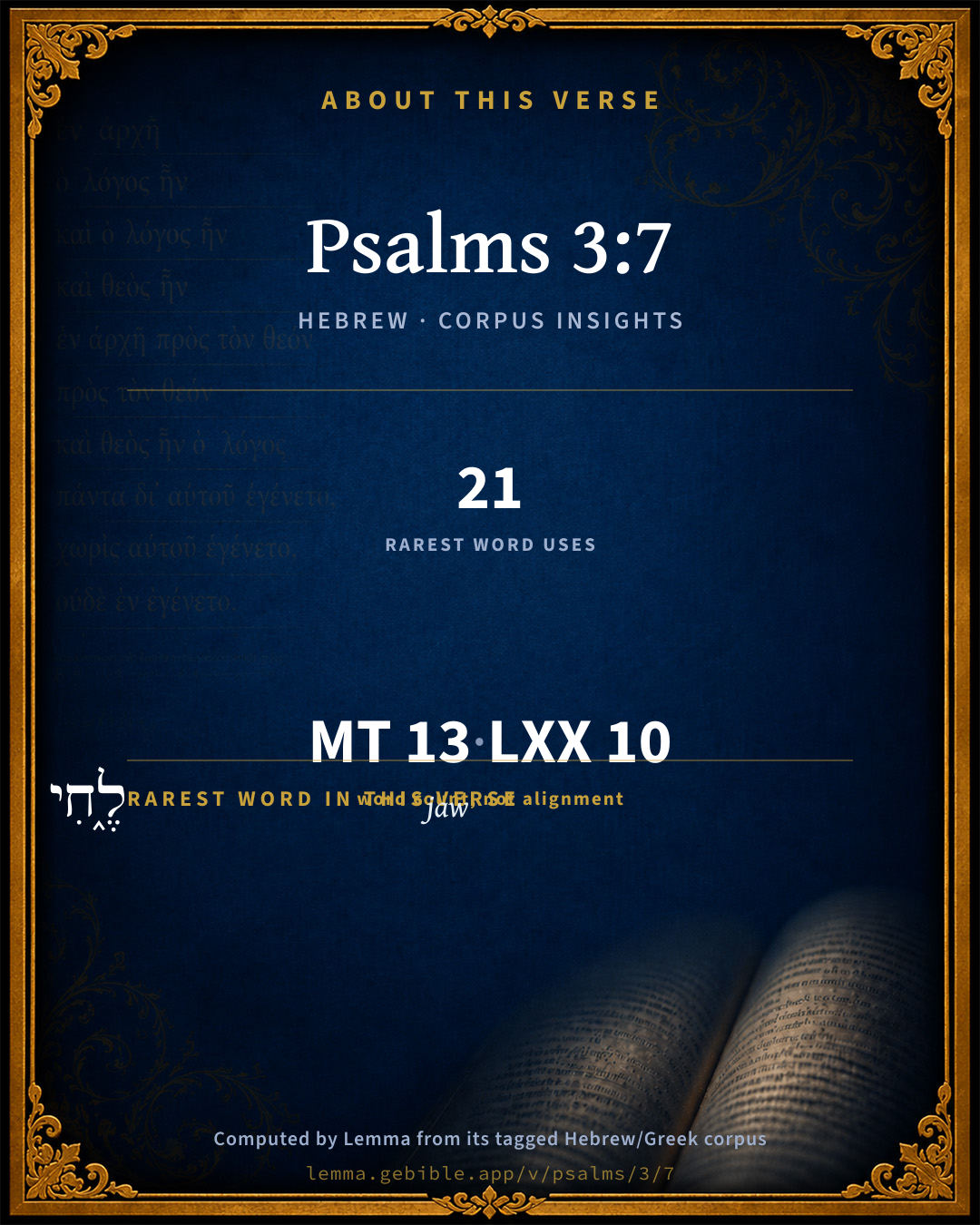
These counts appear in no published source. They are computed here, from the morphology-tagged text and Lemma’s own curated glosses. What Lemma adds →

13
words
13
distinct lemmas
Wisdom
section

Notable vocabulary

The rarest word here is לֶ֑חִי jaw H3895 — appearing just 21 times in the whole Hebrew Bible.

Shared distinctive vocabulary

לֶ֑חִי jaw H3895 occurs in 20 verses of the Hebrew Bible. Also found in:

Grammatical profile

  • 5 verbs
  • 5 nouns
  • 1 adjective
  • 1 conjunction
  • 1 particle

Verb forms

  • ק֘וּמָ֤ה Qal · Imperative
  • הוֹשִׁ֘יעֵ֤נִי Hiphil · Imperative
  • הִכִּ֣יתָ Hiphil · Perfect
  • אֹיְבַ֣י Qal · Participle Active
  • שִׁבַּֽרְתָּ Piel · Perfect

Hebrew & Septuagint length

In English translation the verse runs 26 words from the Hebrew and 24 from the Septuagint (LXX English) — closely comparable.

A rough comparison of the two English renderings, which tokenize alike — not a word-level alignment.

Word counts can differ between the Hebrew and the Greek without any difference in meaning — e.g. the Hebrew direct-object marker אֵת has no separate Greek word, and Greek often adds the article ὁ.

In the original languages it is 13 Hebrew tokens and 10 Greek tokens — but the two are counted differently (Hebrew bundles its prefixes and suffixes into one token; the Greek is in lemma form), so that isn’t a like-for-like length.

Cross-references

15

Topical passages linked to Psalms 3:7 in the Treasury of Scripture Knowledge — connected by theme and wording, ordered by reader-vote popularity; previews shown in the World English Bible.

  • Psalms 58:6 Break their teeth, God, in their mouth. Break out the great teeth of the young lions, Yahweh.
  • Job 29:17 I broke the jaws of the unrighteous, And plucked the prey out of his teeth.
  • Job 16:10 They have gaped on me with their mouth; They have struck me on the cheek reproachfully. They gather themselves together against me.
  • Psalms 10:12 Arise, Yahweh! God, lift up your hand! Don't forget the helpless.
  • Psalms 59:5 You, Yahweh God of hosts, the God of Israel, Rouse yourself to punish the nations. Show no mercy to the wicked traitors. Selah.
  • Psalms 6:4 Return, Yahweh. Deliver my soul, And save me for your loving kindness' sake.
  • Psalms 12:5 "Because of the oppression of the weak and because of the groaning of the needy, I will now arise," says Yahweh; "I will set him in safety from those who malign him."
  • Psalms 35:23 Wake up! Rise up to defend me, my God! My Lord, contend for me!
  • Psalms 44:23 Wake up! Why do you sleep, Lord? Arise! Don't reject us forever.
  • Psalms 74:11 Why do you draw back your hand, even your right hand? Take it out of your pocket and consume them!
  • Psalms 76:9 When God arose to judgment, To save all the afflicted ones of the earth. Selah.
  • Lamentations 3:30 Let him give his cheek to him who strikes him; let him be filled full with reproach.
  • Psalms 7:6 Arise, Yahweh, in your anger. Lift up yourself against the rage of my adversaries. Awake for me. You have commanded judgment.
  • Isaiah 51:9 Awake, awake, put on strength, arm of Yahweh; awake, as in the days of old, the generations of ancient times. Isn't it you who did cut Rahab in pieces, who pierced the monster?
  • Habakkuk 2:19 Woe to him who says to the wood, 'Awake!' or to the mute stone, 'Arise!' Shall this teach? Behold, it is overlaid with gold and silver, and there is no breath at all in the midst of it.

Cross-references courtesy of OpenBible.info (CC BY 4.0).

Hebrew and Greek witnesses Masoretic Hebrew ↔ Greek Septuagint

The same verse in the two great witnesses to the Old Testament, shown verse-for-verse.

You’re reading Greek Psalm 3 (Hebrew Psalm 3). The Septuagint counts the superscription, so verse numbers can differ from the Hebrew — chapter-level alignment, not verse-by-verse. Numbering follows Rahlfs.

These are two independent witnesses, not word-aligned to each other, and the Septuagint is shown in lemma (dictionary) form.

Hebrew Psalms 3:7 Masoretic · Westminster Leningrad Codex

ק֘וּמָ֤ה יְהוָ֨ה הוֹשִׁ֘יעֵ֤נִי אֱלֹהַ֗י כִּֽי הִכִּ֣יתָ אֶת כָּל אֹיְבַ֣י לֶ֑חִי שִׁנֵּ֖י רְשָׁעִ֣ים שִׁבַּֽרְתָּ

Arise, Yahweh! Save me, my God! For you have struck all of my enemies on the cheek bone. You have broken the teeth of the wicked.

World English Bible · Public Domain

Greek LXX Greek Psalm 3:7 Septuagint · lemma form

οὐ φοβέω ἀπό μυριάς λαός ὁ κύκλος συν ἐπιτίθημι ἐγώ

Arise, Lord; deliver me, my God: for you have struck all who were without cause my enemies; you have broken the teeth of sinners.

LXX2012 (modern English Septuagint) · Public Domain

Hebrew: Westminster Leningrad Codex (CC BY 4.0). Greek: Septuagint (public domain); English from LXX2012 (modern English Septuagint) (Public Domain). How the Septuagint differs from the Hebrew →

Commentary

Notes on Psalms 3:7 from classic Christian and Jewish commentators (each source and its license shown beneath its notes). The classic Christian expositions comment on the surrounding passage and are grouped to its opening verse, so a note may address several verses; the Jewish commentaries on the Tanakh (Rashi and others) are per-verse, so they appear only where the commentator wrote on this verse.

Lemma curates 59 commentaries, every one of them public domain or Creative Commons licensed, each selected and text-cleaned for this edition rather than reprinted as found. About our sources →

Trapp's Complete Commentary

John Trapp

Psa 3:7 Arise, O LORD; save me, O my God: for thou hast smitten all mine enemies [upon] the cheek bone; thou hast broken the teeth of the ungodly.

Ver. 7. Arise, O Lord, &c.] If the Lord do but arise only his enemies shall be scattered; those also that hate him shall flee before him, Psa 68:1. And God will arise and harness when his people put his promises in suit by their faithful prayers. This Moses knew, and therefore appointed the priests, whensoever the ark removed, to say, "Rise up, Lord," &c., Num 10:35. Commanders must pray before they lead on their forces to battle, as did Huniades, and that late brave king of Sweden, more addicted to prayer than to fighting; according to that,

Vincere quisquis aves hostilem exercitum, age ante

Invictum, vincas per tun vota, Deum.

Save me, O my God] David had many good old soldiers about him, as the Cherethites, Pelethites, Gittites, and others that would stick to him, 2Sa 15:18, - Animasque capaces mortis (Lucan.), mighty men of war, and chafed in their minds, as a bear robbed of her whelps in the field; himself also was a man of war from his youth, 2Sa 17:8, and not used to be worsted; yet he flees to God for deliverance, and pleads the covenant ("Save me, O my God"), which is that Alvearium Divini mellis, the beehive of heavenly honey. So Psa 119:94, "I am thine, save me."

For thou hast smilten all mine enemies on the cheek bone] Thou hast given them a box on the ear, as Queen Elizabeth once did the Earl of Essex, turning his back upon her uncivilly, upon some discontent. Or, as some great man doth a mean fellow, with whom he scorns to fight. Thou hast sent them away with smart and shame enough, Job 16:10. Thou hast so handled them that now they may go seek their teeth in their throats, as the proverb is. God’s hand is a mighty hand, saith Peter, 1Pe 5:6, it is a fearful thing to fall into it, saith Paul, Heb 10:31. For who knoweth the power of his wrath? saith Moses, Psa 90:11. His enemies are sure to speed worse than did Dares in Virgil (Aeneid), whom, when he had been well beaten by old Entellus, his fellows led away

Iaetantemque utroque caput, crassumque cruorem

Ore reiectantem, mistosque in sanguine dentes.

John Trapp, A Commentary or Exposition upon All the Books of the Old and New Testament (1647–1656) — public domain. Text from a community e-Sword module.

The Biblical Illustrator

Joseph S. Exell

Psa_3:7

Thou hast smitten all mine enemies upon the cheek bone.

The secret of Davids confidence

This shows that Davids expectation of victory was not in himself, in his personal prowess as a warrior, but in the faithfulness of the Lord his God. Hence his impassioned cry, Arise, O Lord! save me, O my God! It is true that David marshalled his forces as a skilful and experienced general should, and as carefully as if everything in the battle to ensue was to be accomplished by the sword alone;--and yet he still looked to God alone for success. And to inspire himself with confidence that God would give success, he refers to the victories He had given him in times past, saying, Thou hast smitten all mine enemies upon the cheek bone; thou hast broken the teeth of the ungodly. This imagery of breaking the cheek bone and teeth of enemies is likening them to wild beasts whose great power is in their jaws and teeth, so that when their jaws and teeth are broken their power to injure is gone. The imagery, then, indicates that the Lord had always destroyed the power of Davids enemies to injure him. And as the Lord had subdued his enemies before him hitherto, David could not but believe that He would subdue them still. This, his belief, was not in vain, as the speedy winding up of Absaloms rebellion showed; for Absaloms forces, though outnumbering his fathers probably more than ten to one, were utterly routed and dispersed, and himself slain, in the first and only battle fought. The battle was the Lords, the victory His, and to Him David ascribes it. (David Caldwell, A. M.)

The Biblical Illustrator, edited by Joseph S. Exell (c. 1880s–1900s) — public domain. Text from a community e-Sword module.

Joseph Benson's Commentary

Psa 3:7. Arise, O Lord, save me — Defer no longer, but let them see thou hast not forsaken me; O my God — Who art mine by special relation and covenant: Lord, save thy own. Deliver me from these my rebellious subjects, whose policy and power I am unable to withstand without thee. For thou hast smitten mine enemies — Namely, in times past; on the cheek bone — Hast discomfited and put them to shame, hast subdued and exposed them to contempt and reproach. Thou hast broken the teeth of the ungodly — That is, their strength, and the instruments of their cruelty. As, then, thou hast hitherto helped me, do not now leave me; but deliver me from these, as thou hast formerly delivered me from other powerful enemies. Thus David, in his distress, encouraged himself in God by the experience he had had of his former gracious interpositions in his favour, by saving him from his cruel enemies, who had frequently attempted his destruction, and whom he compares to savage beasts, which tear their prey with their teeth, and grind it with their jaws, an allusion which, in a country abounding with these ravenous creatures, was natural and expressive. Some, however, consider him as relating, in the former verses, the state of his mind during his flight, and as expressing, in the latter part of this, and in the following, his thankfulness for his deliverance, which he ascribes entirely to God’s power and goodness. See Chandler.

Joseph Benson's Commentary on the Old and New Testaments (1811–1818) — public domain. Text from a community e-Sword module.

Tyndale Open Study Notes

Tyndale Open Resources

3:7-8 The psalmist does not seek revenge; instead, he waits for the Lord’s vengeance. • Arise: The psalmist calls upon the Lord to take action now.

Tyndale Open Study Notes — © Tyndale Open Resources, licensed CC BY-SA 4.0. Text via the HelloAO Bible API.

Jamieson, Fausset & Brown

Robert Jamieson, A. R. Fausset & David Brown

Arise, O Lord--God is figuratively represented as asleep to denote His apparent indifference (Psa 7:6). The use of "cheekbone" and "teeth" represents his enemies as fierce, like wild beasts ready to devour (Psa 27:2), and smiting their cheekbone (Kg1 22:24) denotes violence and insult.

thou hast broken--God took his part, utterly depriving the enemy of power to injure.

Jamieson, Fausset & Brown — Commentary Critical and Explanatory on the Whole Bible (1871) — public domain (CC PDM 1.0). Text via the HelloAO Bible API.

Adam Clarke's Commentary

Verse 7. Arise, O Lord] Though he knew that God had undertaken his defence, yet he knew that his continued protection depended on his continual prayer and faith. God never ceases to help as long as we pray. When our hands hang down, and we restrain prayer before him, we may then justly fear that our enemies will prevail.

Thou hast smitten] That is, Thou wilt smite. He speaks in full confidence of God's interference; and knows as surely that he shall have the victory, as if he had it already. Breaking the jaws and the teeth are expressions which imply, confounding and destroying an adversary; treating him with extreme contempt; using him like a dog, &c.

Adam Clarke's Commentary on the Bible (1810–1826) — public domain. Text from a community e-Sword/MySword module.

John Calvin's Commentaries

7 Arise, O Lord. As in the former verses David boasted of his quiet state, it would now appear he desires of the Lord to be preserved in safety during the whole of his life; as if he had said, Lord, since thou hast overthrown my enemies, grant that this thy goodness may follow me, and be continued even to the end of my course. But because it is no uncommon thing for David, in the Psalms, to mingle together various affections, it seems more probable, that, after having made mention of his confidence in God, he returns again to make the same prayers as at the beginning. A faire les mesmes prieres qu’au commencement. — Fr.

Et puis a cause qu’il a obtenu cela, c’est a dire, qu’il est demeure, en sauvete, it luy en rend graces; tesmoignant par cela qu’il tient de Dieu sa deliverance et la recognoist de luy. — Fr. And then having obtained this, that is to say, having been preserved in safety, he gives thanks to God, testifying by this, that he owed his deliverance to him, and recognized it as coming from him.

John Calvin's Commentaries (1540-1563) — public domain. Text from the Calvin Translation Society English edition (1840s-50s) via the Christian Classics Ethereal Library (ccel.org). Calvin's coverage is partial (roughly two-thirds of the Bible); uncommented books and verses are honest gaps, never fabricated. The 19th-century editor's footnotes and remarks are omitted so the notes are faithfully Calvin's own voice.

Ellicott's Commentary for English Readers

(7) Thou hast smitten . . . broken.—Better, thou smitest . . . breakest. The enemies are conceived of as wild beasts, like the lion and bear of the adventures of David’s own youth, whom God would render harmless to him.

A Bible Commentary for English Readers, edited by Charles John Ellicott (1878–1897) — public domain. Text from a community e-Sword module.

The Cambridge Bible for Schools and Colleges

gen. ed. J. J. S. Perowne

7. Arise, O Lord] The opening words of the ancient marching-shout of Israel, rich in memories of deliverance and victory. See Num_10:35. Cp. Psa_68:1.

for thou hast smitten] Again, as in Psa_3:4, appeal is made to the experience of the past as the ground of prayer. Hitherto Jehovah has put His enemies to shame, and destroyed their power for mischief. The buffet on the cheek was a climax of insult which shewed that all spirit and power of resistance were gone. Cp. 1Ki_22:24; Job_16:10; Lam_3:30; Mic_5:1. Then, by a natural figure (how appropriate in David’s mouth! cp. 1Sa_17:34), the wicked are pictured as ferocious wild beasts, rushing upon their prey, but suddenly deprived of their power to hurt. Cp. Psa_58:6.

7, 8. The Psalm concludes with a prayer for deliverance as in times past, and for a blessing on the people.

The Cambridge Bible for Schools and Colleges (gen. ed. J. J. S. Perowne; Cambridge University Press, 1878–1918) — public domain. Text from a community e-Sword module.

John Gill's Exposition

Arise, O Lord; save me, O my God,.... God sometimes, in the apprehension of his people, seems to be as if he was asleep: when he does not appear to them and for them, and does not exert his power on their behalf, then they call to him to awake and arise; see Psa 44:23; and it may be some respect is had to the words of Moses when the ark set forward, Num 10:35; and it may be observed, that though David enjoyed so much peace and tranquillity of mind, and was in such high spirits as not to be afraid of ten thousands of men, yet he did not neglect the right means of deliverance and safety, prayer to God, who he knew was his God; and he addresses him as such, and uses his covenant interest in him, as an argument with him to arise and save him from his enemies, who was able to do it, and to whom salvation belongs: so Christ, his antitype, prayed to God as his God to save him, and was heard by him in like manner; so the saints call upon God in a day of trouble, cry to him in their distresses, to be delivered out of them;

for thou hast smitten all mine enemies upon the cheekbone; to smite anyone upon the cheek is reckoned reproachful, and is casting contempt upon them; see Job 16:10 and the sense is, that God had poured contempt upon his enemies in time past, and had brought them to shame and confusion: hence he puts up the above prayer as a prayer of faith for salvation, founded on past experience of God's goodness; he prayed that his God would arise and save him, and he believed he would because he had hitherto appeared for him, and against his enemies;

thou hast broken the teeth of the ungodly; who were like to beasts of prey, whose strength lies in their teeth, whereby they do the mischief they do; and the breaking of their teeth signifies the taking away from them the power of hurting, and refers to the victories which God had given David over the Philistines, Edomites, Syrians, and others; and maybe applied to Christ, and be expressive of sin, Satan, the world, and death, being overcome and abolished by him, and of the victory which the saints have through him over the same enemies.

John Gill's Exposition of the Whole Bible (1746–1763) — public domain (CC PDM 1.0). Text via the HelloAO Bible API.

Albert Barnes' Notes on the Bible

Arise, O Lord - This is a common mode of calling upon God in the Scriptures, as if he had been sitting still, or had been inactive. It is, of course, language taken from human conceptions, for in the intervals of active effort, in labor or in battle, we sit or lie down, and when we engage in toil we arise from our sitting or recumbent posture. So the mind accustoms itself to think of God. The idea is simply that David now calls upon God to interpose in his behalf and to deliver him.

Save me, O my God - He was still surrounded by numerous enemies, and he, therefore, calls earnestly upon God to help him. In accordance with a common usage in the Scriptures, and with what is right for all the people of God, he calls him “his” God: “O my God.” That is, he was the God whom he recognized as his God in distinction from all idols, and who had manifested himself as his God by the many mercies which he had conferred on him.

For thou hast smitten all mine enemies - That is, in former exigencies, or on former occasions. In his conflicts with Saul, with the Philistines, and with the surrounding nations, he had done this; and as the result of all he had established him on the throne, and placed him over the realm. In the remembrance of all this he appeals with the full confidence that what God had done for him before He would do now, and that, notwithstanding he was surrounded with numerous foes, He would again interpose. So we may derive comfort and assurance in present trouble or danger from the recollection of what God has done for us in former times. He who has saved us in former perils can still save us; we may believe that he who did not forsake us in those perils will not leave us now.

Upon the cheek-bone - This language seems to be taken from a comparison of his enemies with wild beasts; and the idea is, that God had disarmed them as one would a lion or tiger by breaking out his teeth. The cheek-bone denotes the bone in which the teeth are placed; and to smite that, is to disarm the animal. The idea here is not that of “insult,” therefore; but the meaning is simply that he had deprived them of the power of doing him wrong.

Thou hast broken the teeth of the ungodly - The same idea is here expressed under another form, “as if” the teeth of wild animals were broken out, rendering them harmless. As God had thus disarmed his enemies in times past, the psalmist hoped that he would do the same thing now, and he confidently called on him to do it.

Albert Barnes' Notes on the Bible (1834–1885) — public domain. Text from a community e-Sword/MySword module.

Matthew Poole's English Annotations

Arise; bestir thyself on my behalf, and be no longer as an idle spectator of my miseries.

O my God; who art mine by special relation and covenant, and I am thy son and thy servant; Lord, save thine own.

Thou hast smitten all mine enemies thou hast hitherto helped me, do not now leave me.

Upon the cheek-bone; which implies either contempt and reproach, as this phrase signifies, 1Ki 22:24; Mic 5:1; Joh 18:22; 19:3; or the smartness and soreness of the blow, whereby, as the next clause explains it, their teeth were struck out; and so they did not only receive hurt themselves, but were disenabled from doing that mischief to others which they desired and were accustomed to do.

The teeth, i.e. their strength and the instruments of their cruelty. He compares them to wild beasts.

Matthew Poole's English Annotations on the Holy Bible (1683–1685) — public domain. Text from a community e-Sword/MySword module.

The Treasury of David

Charles H. Spurgeon

Verse 7. His only hope is in his God, but that is so strong a confidence, that he feels the Lord hath but to arise and he is saved. It is enough for the Lord to stand up, and all is well. He compares his enemies to wild beasts, and he declares that God hath broken their jaws, so that they could not injure him; "Thou hast broken the teeth of the ungodly." Or else he alludes to the peculiar temptations to which he was then exposed. They had spoken against him; God, therefore, has smitten them upon the cheek bone. They seemed as if they would devour him with their mouths; God hath broken their teeth, and let them say what they will, their toothless jaws shall not be able to devour him. Rejoice, O believer, thou hast to do with a dragon whose head is broken, and with enemies whose teeth are dashed from their jaws!

Verse 7. "Arise, O Lord," Jehovah! This is a common scriptural mode of calling upon God to manifest his presence and his power, either in wrath or favour. By a natural anthropomorphism, it describes the intervals of such manifestations as periods of inaction or of slumber, out of which he is besought to rouse himself. "Save me," even me, of whom they say there is no help for him in God. "Save me, O my God," mine by covenant and mutual engagement, to whom I therefore have a right to look for deliverance and protection. This confidence is warranted, moreover, by experience. "For thou hast," in former exigencies, "smitten all mine enemies," without exception "(on the) cheek" or jaw, an act at once violent and insulting.

J. A. Alexander, D.D.

Verse 7. "Upon the cheek bone." The language seems to be taken from a comparison of his enemies with wild beasts. The cheek bone denotes the bone in which the teeth are placed, and to break that is to disarm the animal.

Albert Barnes, in loc.

Verse 7. When God takes vengeance upon the ungodly, he will smite in such a manner as to make them feel his almightiness in every stroke. All his power shall be exercised in punishing and none in pitying. O that every obstinate sinner would think of this, and consider his unmeasurable boldness in thinking himself able to grapple with Omnipotence!

Stephen Charnock.

Verse 7.

(1) Describe the Lord's past dealing with his enemies; "thou hast."

(2) Show that the Lord should be our constant resort, "O Lord," "O my God."

(3) Enlarge upon the fact that the Lord is to be stirred up: "Arise."

(4) Urge believers to use the Lord's past victories as an argument with which to prevail with him.

Verse 7. (last clause). Our enemies vanquished foes, toothless lions.

Verse 7. "For thou hast smitten all mine enemies upon the cheekbone; thou hast broken the teeth of the ungodly." Hieronymus uses this metaphor of "cheek bones", and "teeth", to represent cutting words, detractions, calumnies, and other injuries of the same kind, by which the innocent are oppressed: according to that of Proverbs 30:14, "There is a generation whose teeth are as swords, and their jaw-teeth as knives, to devour the poor from off the earth, and the needy from among men." It was by these that Christ was devoured, when, before Pilate, he was condemned to the cross by the voices and accusations of his enemies. And hence it is that the apostle saith (Galatians 5:15), "But if ye bite and devour one another, take heed that ye be not consumed one of another."

Charles H. Spurgeon's The Treasury of David (1869–1885) — public domain. Psalms only. Text from a community e-Sword/MySword module.

Whedon's Commentary on the Bible

Daniel D. Whedon

7. Arise, O Lord—The rising, here, is to be taken in the military or hostile sense, as in Psa_3:1, and Psa_92:11. The crisis is upon him, and he calls upon Jehovah to take a position openly against his enemies. They had said, “There is no help for him in God,” Psa_3:2; he had said, “Thou, O Lord, art a shield for me; my glory, and the lifter up of my head,” Psa_3:3. Everything depended upon some manifest interference of God in behalf of the exiled king.

Thou hast smitten—The perfect tense here either refers to past triumphs in support of present faith, and as an argument for present help, or is what is called the “prophetical perfect,” as indicating the answer which is immediately expected, as if it had been already made. And this latter appears to be the true sense.

Broken the teeth—David’s enemies are here compared to wild beasts, who, with their teeth and strong jaws, tear their prey; but God had now rendered them as powerless as these beasts of prey would be with their jaws broken and their teeth dashed out. See Job_29:17; Psa_58:6

Daniel D. Whedon (gen. ed.), Commentary on the Old and New Testaments (1874–1909) — public domain. Text from a community e-Sword module.

The Pulpit Commentary

Arise, O Lord. (comp. Num_10:35 Psa_7:6 Psa_9:19 Psa_10:12 Psa_17:13 Psa_68:1) This call is generally made when God"s forbearance towards his enemies is thought to have been excessive, and his tolerance of sinners too great. Save me, O my God. David was in imminent danger. "All Israel" had come against him. (2Sa_16:15) He was short of supplies. (2Sa_17:29) He was doubtful how God was disposed towards him. (2Sa_15:25, 2Sa_15:26) It was a time when, unless God would save, there could be no hope. Hence the intense earnestness of his prayer. For thou hast smitten all mine enemies upon the cheek-bone. Heretofore, i.e. , thou hast always taken my part thou hast smitten mine enemies, and given me victory over them, and by breaking their jaw-bones thou hast taken away from them all power to hurt. (see Psa_58:6) The reference is, of course, to David"s long series of victories, as those over the Philistines, (2Sa_5:17-25 2Sa_8:1) over Moab, (2Sa_8:2) over Hadadezer, King of Zobah, (2Sa_8:3, 2Sa_8:4) over the Syrians of Damascus, (2Sa_8:6) over the Edomites, (2Sa_8:13, 2Sa_8:14) over the Ammonites, (2Sa_10:7-14) and over the "Syrians beyond the river". (2Sa_10:16-19) Thou hast broken the teeth of the ungodly. (comp. Job_4:10 Psa_58:6) The ungodly, enemies alike of David and of God, are represented as wild beasts whose weapons are their jaws and teeth. Let God break these, and they are harmless.

The Pulpit Commentary (1880–1919), ed. H.D.M. Spence-Jones & Joseph S. Exell — public domain. Text from a community e-Sword module.

John Wesley's Explanatory Notes

Cheek bone - Which implies contempt and reproach. Teeth - Their strength and the instruments of their cruelty. He compares them to wild beasts.

John Wesley, Explanatory Notes Upon the Whole Bible (1754–1765) — public domain. Text via the GEBible commentary corpus.

Keil & Delitzsch

C. F. Keil & F. Delitzsch

(Heb.: 3:8-9) The bold קוּמה is taken from the mouth of Moses, Num 10:35. God is said to arise when He takes a decisive part in what takes place in this world. Instead of kûmah it is accented kumáh as Milra, in order (since the reading קומה אדני is assumed) that the final ah may be sharply cut off from the guttural initial of the next word, and thus render a clear, exact pronunciation of the latter possible (Hitz., Ew. 228, b).

(Note: This is the traditional reason of the accentuation shub h, kûm h, shith h before יהוה: it is intended to prevent the one or other of the two gutturals being swallowed up (יבולעו שׁלא) by too rapid speaking. Hence it is that the same thing takes place even when another word, not the name of God, follows, if it begins with א or the like, and is closely connected with it by meaning and accentuation: e.g., Jdg 4:18 סוּרה twice Milra before ;א Psa 57:9 עוּרה, Milra before ;ה למּה, Milra before ;ה Exo 5:22; נחה Isa 11:2, and חבאת Gen 26:10, Milra before ;ע and the following fact favours it, viz., that for a similar reason Pasek is placed where two י owt would come together, e.g., Gen 21:14 Adonaj jir'eh with the stroke of separation between the two words, cf. Exo 15:18; Pro 8:21. The fact that in Jer 40:5, ישׁבה remains Milel, is accounted for by its being separated from the following אל־גּליה by Pazer; a real exception, however (Michlol 112 b), - and not as Norzi from misapprehension observes, a controverted one, - is שׁבה, Milel before העיר Sa2 15:27, but it is by no means sufficient to oppose the purely orthophonic (not rhythmical) ground of this ultima-accentuation. Even the semi-guttural ר sometimes has a like influence over the tone: rı̂báh rı̂bı̂ Psa 43:1; Psa 119:154.)

Beside יהוה we have אלהי evah, with the suff. of appropriating faith. The cry for help is then substantiated by כּי and the retrospective perf. They are not such perff. of prophetically certain hope as in Psa 6:9; Psa 7:7; Psa 9:5., for the logical connection requires an appeal to previous experience in the present passage: they express facts of experience, which are taken from many single events (hence כל) down to the present time. The verb הכּה is construed with a double accusative, as e.g., Iliad xvi. 597 τὸν μὲν ἄρα Γλαῦκος στῆθος μέσον οὔτασε δουρί. The idea of contempt (Job 16:10) is combined with that of rendering harmless in this "smiting upon the cheek." What is meant is a striking in of the jaw-bone and therewith a breaking of the teeth in pieces (שׁבּר). David means, an ignominious end has always come upon the ungodly who rose up against him and against God's order in general, as their punishment. The enemies are conceived of as monsters given to biting, and the picture of their fate is fashioned according to this conception. Jahve has the power and the will to defend His Anointed against their hostility: הישׁוּעה לה penes Jovam est salus. ישׁוּעה (from ישׁע, Arab. wasi‛a, amplum esse) signifies breadth as applied to perfect freedom of motion, removal of all straitness and oppression, prosperity without exposure to danger and unbeclouded. In the ל of possession lies the idea of the exclusiveness of the possession and of perfect freedom of disposal. At Jahve's free disposal stands הישׁוּעה, salvation, in all its fulness (just so in Jon 2:10, Rev 7:10). In connection therewith David first of all thinks of his own need of deliverance. But as a true king he cannot before God think of himself, without connecting himself with his people. Therefore he closes with the intercessory inference: ברכתך על־עמּך Upon Thy people by Thy blessing! We may supply תּהי or תּבא. Instead of cursing his faithless people he implores a blessing upon those who have been piteously led astray and deceived. This "upon Thy people be Thy blessing!" has its counterpart in the "Father forgive them" of the other David, whom His people crucified. The one concluding word of the Psalm - observes Ewald - casts a bright light into the very depths of his noble soul.

Keil & Delitzsch — Biblical Commentary on the Old Testament (1861–1891) — public domain (CC PDM 1.0). Text via the HelloAO Bible API. (Old Testament only.)

J. A. Alexander on Psalms

Joseph Addison Alexander

8. That this courage was not founded upon self-reliance, he now shows by asking God for that which he before expressed his sure hope of obtaining. Arise, 0 Lord, Jehovah This is a common scriptural mode of calling upon God to manifest his presence and his power, either in wrath or favour. By a natural anthropomorphism, it describes the intervals of such manifestations as periods of inaction or of slumber, out of which he is besought to rouse himself. Save me, even me, of whom they say there is no help for him in God. See above, Psa 3:3. Save me, 0 my God, mine by covenant and mutual engagement, to whom I therefore have a right to look for deliverance and protection. This confidence is warranted, moreover, by experience. For thou hast, in former exigencies, smitten all my enemies, without exception, (on the) cheek or jaw, an act at once violent and insulting. See 1Ki 22:24; Mic 4:10; Mic 5:1; Lam 3:30. The teeth of the wicked, here identified with his enemies, because he was the champion and representative of God's cause, thou hast broken, and thus rendered harmless. The image present to his mind seems to be that of wild beasts eager to devour him, under which form his enemies are represented in Psa 27:2.

Joseph Addison Alexander, The Psalms Translated and Explained (1850) — public domain. Text from a community e-Sword module.

unfoldingWord translationNotes

Door43 World Missions Community

Rise up

David speaks of starting to do something as getting up. AT: "Take action" or "Do something" (See: Metonymy)

hit all my enemies ... break the teeth of the wicked

These phrases say very similar things. The phrases "my enemies" and "the wicked" refer to the same group of people. (See: Parallelism)

For you will hit all my enemies on the jaw

This was a way of insulting people. David speaks as if Yahweh would come and physically hit his enemies. AT: "For you will insult all my enemies like someone hitting them on the jaw" (See: Symbolic Action and Metaphor)

you will break the teeth of the wicked

Animals attack with their teeth. Breaking their teeth takes away their power to attack. David speaks as if Yahweh would come and physically fight against the wicked. AT: "you will make the wicked unable to harm me like someone breaking the teeth of a ferocious animal" (See: Metaphor)

Salvation comes from Yahweh

The abstract noun "salvation" can be expressed with the verb "save." AT: "Yahweh saves his people" (See: Abstract Nouns)

translationWords

raise

save

adversary

evil

save

bless

people group

selah

unfoldingWord translationNotes — © Distant Shores Media and the Door43 World Missions Community, licensed CC BY-SA 4.0. Source: git.door43.org/Door43/en_tn.

Rashi

Rabbi Shlomo Yitzchaki (Rashi)

have set themselves Heb. שתו, an expression of desolation, gatiront in Old French, to destroy. Others say that שתו is like שמו, they placed, like (Exod. 10:1): “in order that I set up (שתי) my signs.”

Rashi on the Tanakh — English translations: “The Judaica Press complete Tanach with Rashi, translated by A. J. Rosenberg” (CC BY 4.0); “Pentateuch with Rashi's commentary by M. Rosenbaum and A.M. Silbermann, 1929-1934” (public domain); “The Metsudah Tanach series, Lakewood, N.J” (CC BY 4.0); and “The Book of Joshua, Metsudah Publications, 1997” (CC BY 4.0). Text via Sefaria.

Radak

Rabbi David Kimhi (Radak)

I will not be afraid of ten thousands of the people: – for all Israel were with Absalom, except those who were with David in Jerusalem, and had gone out with him, and those who had joined him afterwards.

That have set themselves (שתו) against me round about: – They have set their battle in array against me. Or the interpretation of שתו may be “they have fought.” And so “they have taken their stand” (fought, שת שתו) “at the gate” (Is. 22:7); and “He will assail (ישית) thy waves with violence” (job 38:1 1).

Radak on the Tanakh — English translations: “Sefaria Community Translation” (CC0 1.0 (public-domain dedication)); “Eliyahu Munk, HaChut Hameshulash” (CC BY 4.0); “Rabbi Mike Feuer, Jerusalem Anthology” (CC BY 4.0); and “R. David Kimhi on the first book of Psalms, Translated by R.G. Finch, London, 1919” (public domain). Text via Sefaria.

Ibn Ezra

Rabbi Abraham ibn Ezra

They have set [themselves] against me (אֲשֶׁר... שָׁתוּ עָלָי - Asher... shatu alai): [This means 'they arrayed themselves', from the root שׁית/שׁות - sh-y-t/sh-w-t]. It is similar in sense to [meaning] "they fought" (nilchamu). And some interpreted [the verb shatu as related to the noun] the foundations (הַשָּׁתוֹת - ha-shatot, cf. Psalm 11:3), and the meaning [in context] is like nets (reshatot). Therefore [Scripture adds] the word around (saviv).

Ibn Ezra on the Tanakh — English translations: “Sefaria Community Translation” (CC0 1.0 (public-domain dedication)); “Yalkut, Sifsei Chachomim Chumash, Metsudah Publications, 2009” (CC BY 4.0); and “Commentary of Ibn Ezra on Isaiah - trans. by M. Friedlander, 1873” (public domain). Text via Sefaria.

Lesson kit

Teaching starters — assembled from the data on this page, not authored interpretation. Every prompt links to the verse data it draws on. Edit before teaching.

Psalms, in the Wisdom, opens this verse with 13 words (13 distinct Hebrew lemmas). Its most distinctive word is lᵉchîy (“jaw”). A historical commentator’s framing appears above. Read the whole chapter for the surrounding context.

Discussion questions

  1. What does “jaw” (lᵉchîy) contribute to the verse as a whole?
  2. Deuteronomy 18:3 shares the word «jaw» with this verse. How do the two illuminate each other?
  3. These translations render this verse differently; the difference is in the English rendering, not the original. What questions does that raise?
  4. The verb «ק֘וּמָ֤ה» is Qal Imperative. How does its form color the action?
  5. Reading how Trapp's Complete Commentary and The Biblical Illustrator read this verse, where do the two commentators agree and where do they part?

Things to notice

Reading settings

Reading text

Shown beneath each verse's original-language words.

Old Testament
Old Testament edition

Read the OT as the Masoretic Hebrew (MT) or the Greek Septuagint (LXX).

English shown for the Greek Septuagint (in the Hebrew ↔ Greek comparison).

Comparing translations? Open the Compare panel on any verse page to stack up to four side by side.