
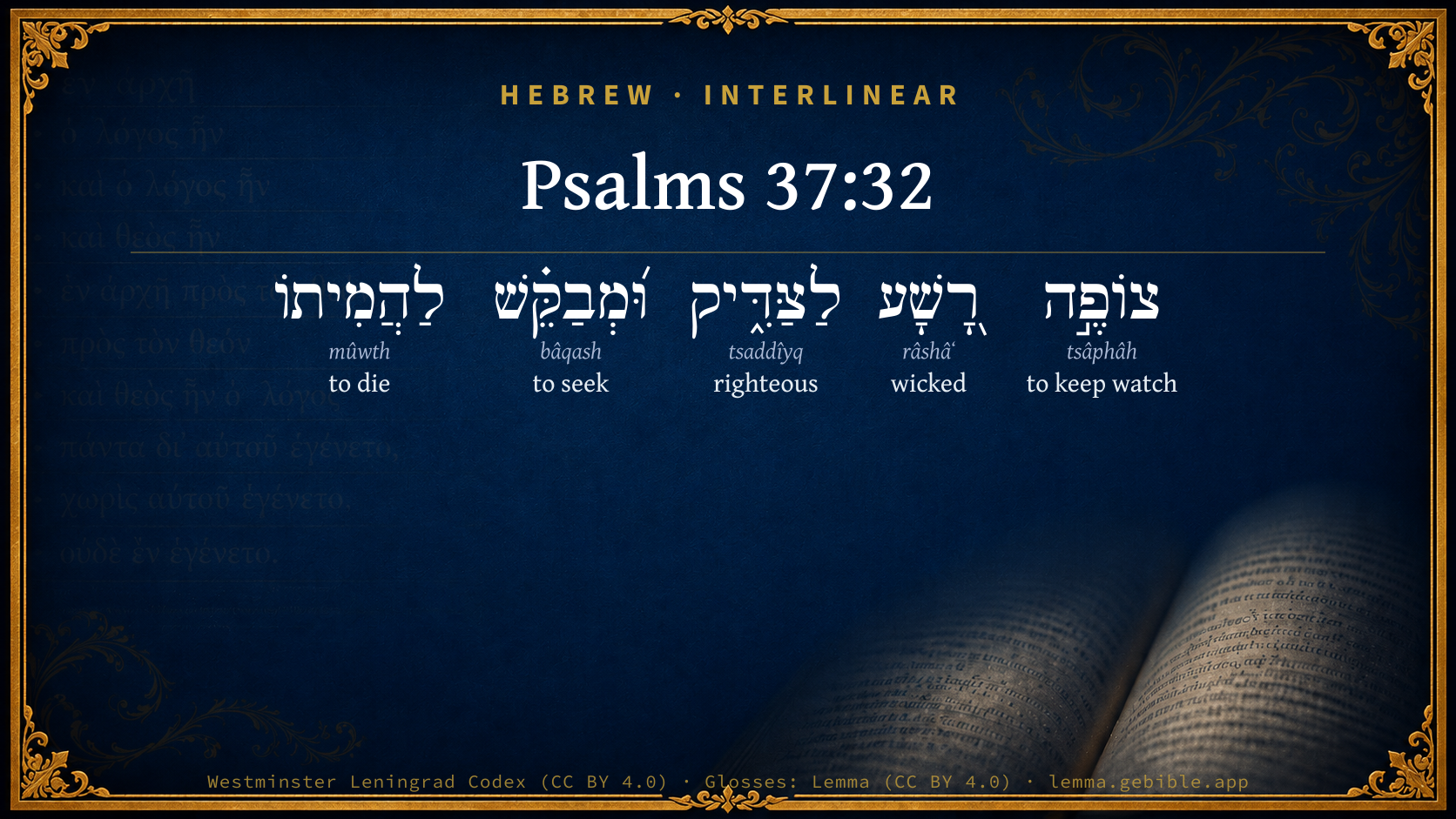
Psalms 37:32

Hebrew (Westminster Leningrad Codex) Psalms 37:32 appears in the Hebrew Old Testament. The text above is from the Westminster Leningrad Codex. Each word links to its Strong’s number, a concise gloss, and parsing drawn from the Open Scriptures Hebrew Bible morphology. Click any word for its full Brown-Driver-Briggs (BDB) entry.
Download image
Cite this verse

Psalms 37:32 (World English Bible). Public Domain. Lemma interlinear Bible study tool, https://lemma.gebible.app/v/psalms/37/32.

Show BibTeX & RIS
BibTeX
RIS
English Translation
The wicked watches the righteous, And seeks to kill him.
World English Bible · Public Domain
Download a study sheet

One document with this verse’s original text, its word-by-word gloss line, the meaning frame, cross-references with their text, attributed commentary, and full source and license credits — printable, and it pastes into notes with its structure intact.

This verse Autodidact and up

Study sheet (.html) Plain text (.txt)

A passage Seminary Student

Up to 50 verses in one chapter. A passage sheet keeps up to 6 commentary sources and 12 cross-references per verse, in the order this page ranks them, and says so on the sheet whenever that leaves anything out. Ask for a single verse and you get the Autodidact verse sheet above.

Everything on this page stays free to read, with no account — the sheet is a download of what is already on screen, not access to it.

Want to remove ads? Support Godless Engineer
Compare translations 3

The same verse in 3 English versions, stacked beneath the original-language interlinear above. Click any original word for its lexicon entry.

Each is an independent rendering of the whole verse — the interlinear is not word-aligned to these translations.

Highlighted words mark where these versions differ — a whole-verse word diff, not a word-by-word alignment.

  • World English Bible Public Domain
    The wicked watches the righteous, And seeks to kill him.
  • King James Version Public Domain
    The wicked watcheth the righteous, and seeketh to slay him.
  • unfoldingWord Literal Text CC BY-SA 4.0
    The wicked is watching the righteous and is seeking to kill him.

unfoldingWord Literal Text — © unfoldingWord, licensed CC BY-SA 4.0. Word-aligned USFM3 via Door43 (git.door43.org/unfoldingWord/en_ult).

Versions to compare (up to 4)

3 of 4 selected

Show all 18 translations

Every available English version of this verse, each an independent rendering of the whole verse.

  • World English Bible Public Domain
    The wicked watches the righteous, And seeks to kill him.
  • Berean Standard Bible Public Domain
    Though the wicked lie in wait for the righteous, and seek to slay them,
  • Majority Standard Bible Public Domain
    Though the wicked lie in wait for the righteous, and seek to slay them,
  • King James Version Public Domain
    The wicked watcheth the righteous, and seeketh to slay him.
  • American Standard Version (1901) Public Domain
    The wicked watcheth the righteous, And seeketh to slay him.
  • Revised Version (1885) Public Domain
    The wicked watcheth the righteous, and seeketh to slay him.
  • Geneva Bible (1599) Public Domain
    The wicked watcheth the righteous, and seeketh to slay him.
  • Douay-Rheims (1899) Public Domain
    The wicked watcheth the just man, and seeketh to put him to death,
  • Young's Literal Translation Public Domain
    The wicked is watching for the righteous, And is seeking to put him to death.
  • Literal Standard Version CC BY-SA 4.0
    The wicked is watching for the righteous, || And is seeking to put him to death.
  • Unlocked Literal Bible CC BY-SA 4.0
    The wicked person watches the righteous person and seeks to kill him.
  • unfoldingWord Literal Text CC BY-SA 4.0
    The wicked is watching the righteous and is seeking to kill him.
  • Darby Bible Public Domain
    The wicked watcheth the righteous, and seeketh to slay him:
  • World Messianic Bible Public Domain
    The wicked watch the righteous, and seek to kill him.
  • Webster's Bible Public Domain
    The wicked watcheth the righteous, and seeketh to slay him.
  • Free Bible Version CC BY-SA 4.0
    The wicked lie in wait for those who do good, intending to kill them.
  • Bible in Basic English Public Domain
    The sinners are watching the upright man, desiring to put him to death.
  • JPS Tanakh (1917) Public Domain
    The wicked watcheth the righteous, and seeketh to slay him.

Literal Standard Version (2020), Covenant Press — licensed CC BY-SA 4.0. Text via the HelloAO Bible API (eBible.org). Unlocked Literal Bible (unfoldingWord) — licensed CC BY-SA 4.0. Text via the HelloAO Bible API (eBible.org). unfoldingWord Literal Text — © unfoldingWord, licensed CC BY-SA 4.0. Word-aligned USFM3 via Door43 (git.door43.org/unfoldingWord/en_ult). Free Bible Version, Dr. Jonathan Gallagher — licensed CC BY-SA 4.0. Text via the HelloAO Bible API (eBible.org).

Word by word

More ways to search: Search by grammar → Find every occurrence → Compare this word →

Practice this passage: Drill this verse → Learn its vocabulary →

About this verse

These counts appear in no published source. They are computed here, from the morphology-tagged text and Lemma’s own curated glosses. What Lemma adds →

5
words
5
distinct lemmas
Wisdom
section

Shared distinctive vocabulary

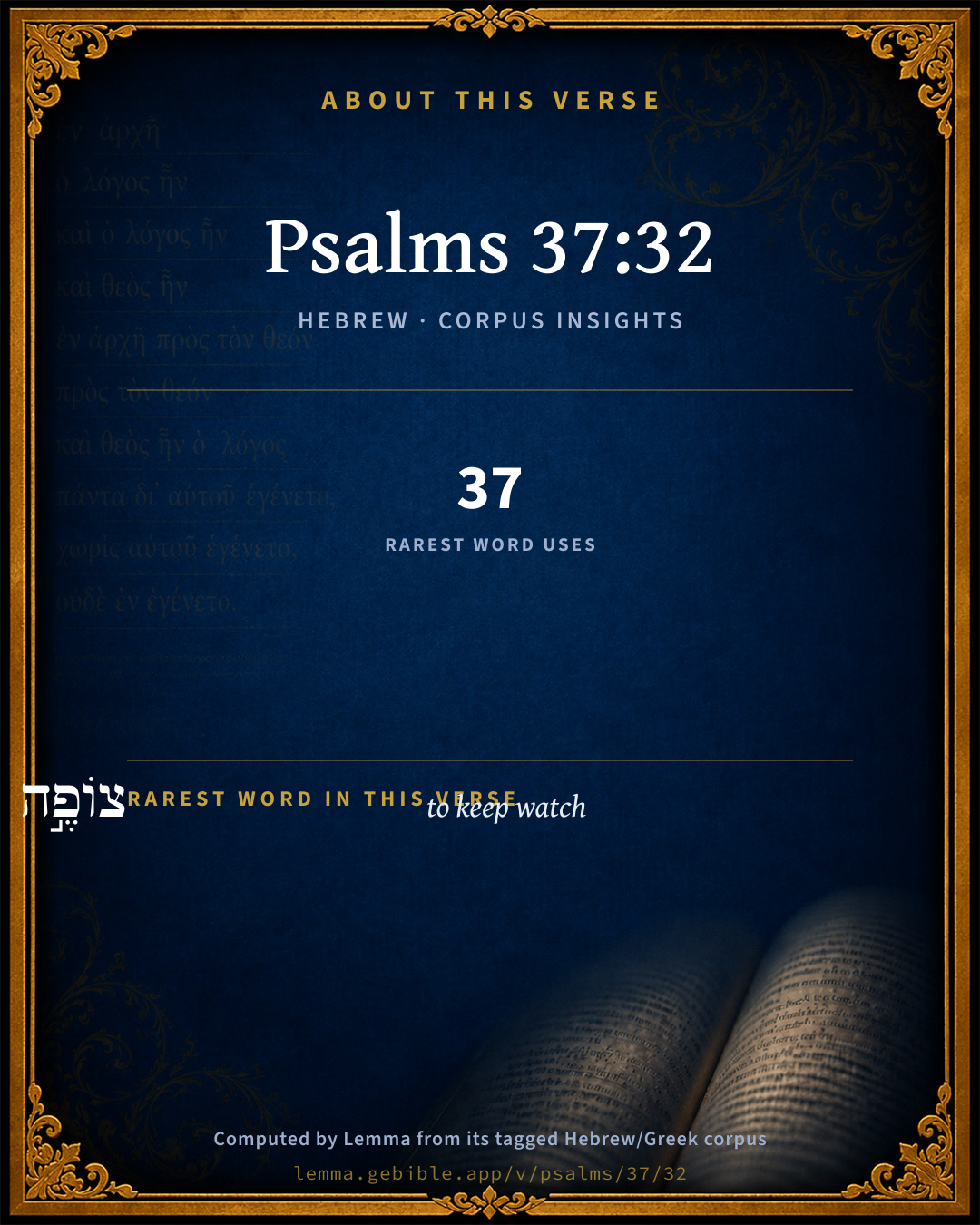
צוֹפֶ֣ה to keep watch H6822 occurs in 33 verses of the Hebrew Bible. Also found in:

Grammatical profile

  • 3 verbs
  • 2 adjectives

Verb forms

  • צוֹפֶ֣ה Qal · Participle Active
  • וּ֝מְבַקֵּ֗שׁ Piel · Participle Active
  • לַהֲמִיתוֹ Hiphil · Infinitive Construct

Hebrew & Septuagint length

In English translation the verse runs 10 words from the Hebrew and 10 from the Septuagint (LXX English) — the same length.

A rough comparison of the two English renderings, which tokenize alike — not a word-level alignment.

Word counts can differ between the Hebrew and the Greek without any difference in meaning — e.g. the Hebrew direct-object marker אֵת has no separate Greek word, and Greek often adds the article ὁ.

Cross-references

9

Topical passages linked to Psalms 37:32 in the Treasury of Scripture Knowledge — connected by theme and wording, ordered by reader-vote popularity; previews shown in the World English Bible.

  • Psalms 10:8–10 He lies in wait near the villages. From ambushes, he murders the innocent. His eyes are secretly set against the helpless.
  • Jeremiah 20:10 For I have heard the defaming of many, terror on every side. Denounce, and we will denounce him, [say] all my familiar friends, those who watch for my fall; peradventure he will be persuaded, and we shall prevail against him, and we shall take our revenge on him.
  • Luke 14:1 It happened, when he went into the house of one of the rulers of the Pharisees on a Sabbath to eat bread, that they were watching him.
  • Luke 19:47–48 He was teaching daily in the temple, but the chief priests and the scribes and the leading men among the people sought to destroy him.
  • Luke 20:20 They watched him, and sent out spies, who pretended to be righteous, that they might trap him in something he said, so as to deliver him up to the power and authority of the governor.
  • Psalms 37:12 The wicked plots against the just, And gnashes at him with his teeth.
  • Luke 6:7 The scribes and the Pharisees watched him, to see whether he would heal on the Sabbath, that they might find an accusation against him.
  • Luke 11:54 lying in wait for him, and seeking to catch him in something he might say, that they might accuse him.
  • Acts 9:24 but their plot became known to Saul. They watched the gates both day and night that they might kill him,

Cross-references courtesy of OpenBible.info (CC BY 4.0).

Hebrew and Greek witnesses Masoretic Hebrew ↔ Greek Septuagint

The same verse in the two great witnesses to the Old Testament, shown verse-for-verse.

You’re reading Greek Psalm 36 (Hebrew Psalm 37). The Septuagint counts the superscription, so verse numbers can differ from the Hebrew — chapter-level alignment, not verse-by-verse. Numbering follows Rahlfs.

These are two independent witnesses, not word-aligned to each other, and the Septuagint is shown in lemma (dictionary) form.

Hebrew Psalms 37:32 Masoretic · Westminster Leningrad Codex

צוֹפֶ֣ה רָ֭שָׁע לַצַּדִּ֑יק וּ֝מְבַקֵּ֗שׁ לַהֲמִיתוֹ

The wicked watches the righteous, And seeks to kill him.

World English Bible · Public Domain

Greek LXX Greek Psalm 36:32 Septuagint · lemma form

κατανοέω ὁ ἁμαρτωλός ὁ δίκαιος καί ζητέω ὁ θανατόω αὐτός

The sinner watches the righteous, and seeks to kill him.

LXX2012 (modern English Septuagint) · Public Domain

Hebrew: Westminster Leningrad Codex (CC BY 4.0). Greek: Septuagint (public domain); English from LXX2012 (modern English Septuagint) (Public Domain). How the Septuagint differs from the Hebrew →

Commentary

Notes on Psalms 37:32 from classic Christian and Jewish commentators (each source and its license shown beneath its notes). The classic Christian expositions comment on the surrounding passage and are grouped to its opening verse, so a note may address several verses; the Jewish commentaries on the Tanakh (Rashi and others) are per-verse, so they appear only where the commentator wrote on this verse.

Lemma curates 59 commentaries, every one of them public domain or Creative Commons licensed, each selected and text-cleaned for this edition rather than reprinted as found. About our sources →

Trapp's Complete Commentary

John Trapp

Psa 37:32 The wicked watcheth the righteous, and seeketh to slay him.

Ver. 32. The wicked wateheth the righteous] See Psa 10:8-10, {See Trapp on "Psa 10:8"} {See Trapp on "Psa 10:9"} {See Trapp on "Psa 10:10"} Speculatur, he accurately observeth, looking this way and that, as a watchman in a watch tower. Thus Saul eyed David, and laid out for him. Thus Jeroboam watched those of the ten tribes that went to Jerusalem to worship, he watched them, and waylaid them, Hos 5:1.

And seeketh to slay him] All malice is bloody, and there want not those still that carry about Cain’s bloody club, hating to the death that goodness in another that they neglect in themselves.

John Trapp, A Commentary or Exposition upon All the Books of the Old and New Testament (1647–1656) — public domain. Text from a community e-Sword module.

The Biblical Illustrator

Joseph S. Exell

Psa_37:32-33

The wicked watcheth the righteous, and waiteth to slay him.

The Lord will not leave him in his hand, nor condemn him when he is judged.

The foes of the righteous and how to escape them

We have seen a dog run after a bird when it was upon the ground, and nearly catch it; but, as soon as it mounted into its native element, all the dog could do was to look and bark. Christian, bird of Paradise, if thou settle upon earthly things, the great hell dog will stand some chance of injuring thee; but if thou keep in the heavenlies thou art safe. (W. Luff.)

The Biblical Illustrator, edited by Joseph S. Exell (c. 1880s–1900s) — public domain. Text from a community e-Sword module.

Joseph Benson's Commentary

Psa 37:32-33. The wicked watcheth the righteous — To find out a fit season or occasion to destroy him. The Lord will not leave him in his hand — That is, will not give him up to his power and rage; nor condemn him when he is judged — Will not give his consent to the sentence of condemnation, which the wicked have pronounced against him, but will justify him, and vindicate his innocence, and deliver him. Some understand the words thus: Nor shall he (the wicked) condemn him when he is judged, observing, “that it seems more to the purpose to say, that God would not suffer the wicked man to condemn the righteous, or to find him guilty, (for that probably was the way in which he proposed to murder him,) than that he would not do it himself.” — Mudge.

Joseph Benson's Commentary on the Old and New Testaments (1811–1818) — public domain. Text from a community e-Sword module.

J. A. Alexander on Psalms

Joseph Addison Alexander

32. (Psa 37:32) Watching, ever watching, (is) the wicked for the righteous, for means and opportunities of injury, and seeking to kill him. The enemies of God, as all the wicked are, must needs be the enemies of his people also.

Joseph Addison Alexander, The Psalms Translated and Explained (1850) — public domain. Text from a community e-Sword module.

Jamieson, Fausset & Brown

Robert Jamieson, A. R. Fausset & David Brown

The devices of the wicked against the good fail because God acquits them.

Jamieson, Fausset & Brown — Commentary Critical and Explanatory on the Whole Bible (1871) — public domain (CC PDM 1.0). Text via the HelloAO Bible API.

Adam Clarke's Commentary

Verse 32. The wicked watcheth the righteous, and seeketh to slay him.] Similar to what is said Ps 37:8: "The wicked plotteth against the righteous." But it is added, Ps 37:33: "The Lord will not leave him in his hands;" he will confound his devices, and save his own servants.

Adam Clarke's Commentary on the Bible (1810–1826) — public domain. Text from a community e-Sword/MySword module.

John Calvin's Commentaries

32. and 33. The wicked watcheth the righteous, etc. David here illustrates more plainly the nature of the possession of the earth, of which he had spoken, namely, that God preserves his own people, though they are beset with enemies round about. And hence we are again taught, that the faithful are not promised in the preceding context a quiet state of life, and one free from all trouble and distress. If so, these two statements would be contradictory: first, that the faithful possessing an inheritance, enjoy repose and pleasure; and, secondly, that yet they are daily delivered as sheep out of the mouth of wolves. These two verses, however, contain this special ground of consolation, that the faithful, though surrounded by such a variety of dangers, shall notwithstanding escape, and be preserved in safety by the help of God. Accordingly, David here teaches them, that when they shall see their enemies lying in wait for them, and seeking by every means in their power to annoy them, they, on the contrary, ought to consider how deeply interested God is in the welfare of his own people, and how carefully he watches over them to preserve them in safety. David indeed confesses that the stratagems to which the wicked have recourse in seeking not only to deprive good men of their property, but even to take away their lives, are terrible in themselves, because they cruelly plot their destruction; but still he teaches us at the same time, that we ought to continue to preserve firm and undaunted courage, because God has promised that he will be our guardian and defender: Jehovah will not leave him in his hand This circumstance, however, ought to be considered, that God does not always grant us deliverance at the first, but often delays it till we seem to be even at the point of death. In the last clause of the verse, we are also admonished, that however carefully good men may guard against giving offense to any, and endeavor to secure the good-will of all, and shun debate and strife, yet they shall not be exempted from false accusations: Jehovah will not condemn them when they are judged David does not say that they shall receive the applause of the world, and that their virtues shall be celebrated in such praises as they deserve; but he exhorts them, when they shall be haled to judgment, and as it were overwhelmed with slander, so that they already resemble those who are condemned, to rest contented with the protection of God, who will at length manifest their innocence, and maintain it against the unrighteous judgments of men. If any one object, that, on the contrary, many of the children of God, after having been condemned, have suffered a cruel and bitter death, I answer, that their avenger nevertheless is in heaven. Christ was put to death in the most cruel form, and in circumstances of the deepest ignominy, but notwithstanding, as the prophet Isaiah says, Isaiah 53:8, “he was taken from that distress and condemnation;” and in the same manner God is still acting daily towards those who are his members. If it may still be objected, that David is here discoursing not of the life to come, but of the state of the godly in the present life, I must again repeat in answer to this, the explanation which I have given before, namely, that earthly blessings are at God’s disposal, and are regulated entirely according to his will; and hence it is that he never bestows them in an equal measure upon all, but according to his wisdom, and as he sees meet, sometimes withdrawing them either in whole or in part, and at other times displaying them to the view of all. Accordingly, it may happen, that the holy martyrs, after they have been condemned, may also be put to death, as if God had forsaken them; but this is only because it is better for themselves, and because they desire nothing more than to glorify God by their death. Yet he who permits the ungodly to exercise their cruelty, ceases not to be the assertor of the righteousness of his servants: for he openly shows before his angels, and before his whole Church, that he approves it, and declares that he will make inquisition for it; nay, more, raising them from the darkness in which they have been hid, he makes their ashes yield a sweet and pleasant odour. Finally, after the Lord has suffered them to be overwhelmed by reproach and violence, he will pronounce the judgment by which he will vindicate their righteous cause from wicked calumnies and false accusations.

John Calvin's Commentaries (1540-1563) — public domain. Text from the Calvin Translation Society English edition (1840s-50s) via the Christian Classics Ethereal Library (ccel.org). Calvin's coverage is partial (roughly two-thirds of the Bible); uncommented books and verses are honest gaps, never fabricated. The 19th-century editor's footnotes and remarks are omitted so the notes are faithfully Calvin's own voice.

The Cambridge Bible for Schools and Colleges

gen. ed. J. J. S. Perowne

32. Cp. Psa_10:8 ff.: Pro_1:11 ff. The next verse shews that wrong by judicial corruption (Isa_5:13) as well as actual violence is meant.

32, 33. Stanza of Tsadi. Malice defeated.

32–40. The final contrast.

The Cambridge Bible for Schools and Colleges (gen. ed. J. J. S. Perowne; Cambridge University Press, 1878–1918) — public domain. Text from a community e-Sword module.

John Gill's Exposition

The Lord will not leave him in his hand,.... Or power; but will in his own time deliver him from all the reproach, affliction, and persecution endures by him; as he will also deliver him out of all the temptations of Satan;

nor condemn him when he is judged; by the wicked man: he will not join in the sentence, but reverse it, and condemn the tongue that rises up in judgment against him, and save him from him; see Psa 109:31; nor will the Lord condemn him when he is judged by him at the hast judgment; but will acquit him before men and angels, and introduce him into his kingdom and glory.

John Gill's Exposition of the Whole Bible (1746–1763) — public domain (CC PDM 1.0). Text via the HelloAO Bible API.

Albert Barnes' Notes on the Bible

The wicked watcheth the righteous ... - Observes closely; looks out for him; has his eye on him, seeking an opportunity to slay him. See the notes at Psa 10:8-9. The sense is, that the wicked are the enemies of the righteous, and seek to do them wrong. It is a characteristic of the wicked that they seek to destroy the righteous. This was manifested in the case of the prophets; in the case of the apostles; in the case of the Saviour; and it has been so manifest in the deaths of the martyrs, and all the persecutions which the Church has suffered, as to justify the general declaration that it is one of the characteristics of a wicked world that it desires to do this.

Albert Barnes' Notes on the Bible (1834–1885) — public domain. Text from a community e-Sword/MySword module.

Matthew Poole's English Annotations

Watcheth, to find out a fit season or occasion to destroy him.

Matthew Poole's English Annotations on the Holy Bible (1683–1685) — public domain. Text from a community e-Sword/MySword module.

The Treasury of David

Charles H. Spurgeon

Ver. 32. The wicked watcheth the righteous, and seeketh to slay him. If it were not for the laws of the land, we should soon see a massacre of the righteous. Jesus was watched by his enemies, who were thirsting for his blood: his disciples must not look for favour where their Master found hatred and death.

Ver. 32-33. The Jews watched that Just One daily and hourly; they sought to slay him, and did so; but Jehovah left him not on their hands, but vindicated his innocence by raising him from the dead. George Horne.

Ver. 32-33. Our enemies; their inveterate malice; our safeguard and justification.

Psalms 37:33*

Ver. 32-33. The Jews watched that Just One daily and hourly; they sought to slay him, and did so; but Jehovah left him not in their hands, but vindicated his innocence by raising him from the dead. George Horne.

Ver. 32-33. Our enemies; their inveterate malice; our safeguard and justification.

Psalms 37:34*

Charles H. Spurgeon's The Treasury of David (1869–1885) — public domain. Psalms only. Text from a community e-Sword/MySword module.

The Pulpit Commentary

The wicked watcheth the righteous, and seeketh to slay him. Wicked men hate righteous men, as being a reproach to them, and also as being a hindrance and a danger. The righteous thwart their plans, oppose their proceedings, often frustrate their counsels. Sometimes their opposition brings the wicked man into peril, as when it takes the shape of prosecution before a court, or of help given to one who has fallen among thieves. Hence the hatred felt by the wicked towards the righteous is not surprising. It leads the wicked to entertain murderous thoughts to be ever "watching" for an opportunity when he may take the righteous man at a disadvantage, and, if no other means of removing him from his path present themselves, kill him. Modern civilization, with its precautions and "resources," prevents actual violence for the most part; but the thunderous instinct remains, and even now, in his heart, many a wicked man is a murderer.

The Pulpit Commentary (1880–1919), ed. H.D.M. Spence-Jones & Joseph S. Exell — public domain. Text from a community e-Sword module.

Keil & Delitzsch

C. F. Keil & F. Delitzsch

The Lord as ἀνακρίνων is, as in Co1 4:3., put in contrast with the ἀνακρίνειν of men, or of human ἡμέρᾳ. If men sit in judgment upon the righteous, yet God, the supreme Judge, does not condemn him, but acquits him (cf. on the contrary Psa 109:7). Si condemnamur a mundo, exclaimed Tertullian to his companions in persecution, absolvimur a Deo.

Keil & Delitzsch — Biblical Commentary on the Old Testament (1861–1891) — public domain (CC PDM 1.0). Text via the HelloAO Bible API. (Old Testament only.)

Lesson kit

Teaching starters — assembled from the data on this page, not authored interpretation. Every prompt links to the verse data it draws on. Edit before teaching.

Psalms, in the Wisdom, opens this verse with 5 words (5 distinct Hebrew lemmas). Its most distinctive word is tsâphâh (“to keep watch”). A historical commentator’s framing appears above. Read the whole chapter for the surrounding context.

Discussion questions

  1. How does “to keep watch” (tsâphâh) shape what this verse is saying?
  2. How does Genesis 31:49, which shares the word «to keep watch», read alongside this verse?
  3. The translations on this page render this verse differently — a whole-verse word diff, not a word-by-word alignment. What might account for the different wordings?
  4. «צוֹפֶ֣ה» is a Qal Participle Active verb. How does that grammatical form shape the action described?
  5. Compare how Trapp's Complete Commentary and The Biblical Illustrator read this verse. Where do they agree or differ?

Things to notice

Reading settings

Reading text

Shown beneath each verse's original-language words.

Old Testament
Old Testament edition

Read the OT as the Masoretic Hebrew (MT) or the Greek Septuagint (LXX).

English shown for the Greek Septuagint (in the Hebrew ↔ Greek comparison).

Comparing translations? Open the Compare panel on any verse page to stack up to four side by side.