Exodus 22:8

Hebrew (Westminster Leningrad Codex) Exodus 22:8 appears in the Hebrew Old Testament. The text above is from the Westminster Leningrad Codex. Each word links to its Strong’s number, a concise gloss, and parsing drawn from the Open Scriptures Hebrew Bible morphology. Click any word for its full Brown-Driver-Briggs (BDB) entry.
Download image
Cite this verse

Exodus 22:8 (World English Bible). Public Domain. Lemma interlinear Bible study tool, https://lemma.gebible.app/v/exodus/22/8.

Show BibTeX & RIS
BibTeX
RIS
English Translation
If the thief isn't found, then the master of the house shall come near to God, to find out if he hasn't put his hand to his neighbor's goods.
World English Bible · Public Domain
Download a study sheet

One document with this verse’s original text, its word-by-word gloss line, the meaning frame, cross-references with their text, attributed commentary, and full source and license credits — printable, and it pastes into notes with its structure intact.

This verse Autodidact and up

Study sheet (.html) Plain text (.txt)

A passage Seminary Student

Up to 50 verses in one chapter. A passage sheet keeps up to 6 commentary sources and 12 cross-references per verse, in the order this page ranks them, and says so on the sheet whenever that leaves anything out. Ask for a single verse and you get the Autodidact verse sheet above.

Everything on this page stays free to read, with no account — the sheet is a download of what is already on screen, not access to it.

Want to remove ads? Support Godless Engineer
Compare translations 3

The same verse in 3 English versions, stacked beneath the original-language interlinear above. Click any original word for its lexicon entry.

Each is an independent rendering of the whole verse — the interlinear is not word-aligned to these translations.

Highlighted words mark where these versions differ — a whole-verse word diff, not a word-by-word alignment.

  • World English Bible Public Domain
    If the thief isn't found, then the master of the house shall come near to God, to find out if he hasn't put his hand to his neighbor's goods.
  • King James Version Public Domain
    If the thief be not found, then the master of the house shall be brought unto the judges, to see whether he have put his hand unto his neighbor's goods.
  • unfoldingWord Literal Text CC BY-SA 4.0
    If the thief is not found, then the owner of the house shall be brought to God, whether or not he has stretched out his hand against the property of his neighbor.

unfoldingWord Literal Text — © unfoldingWord, licensed CC BY-SA 4.0. Word-aligned USFM3 via Door43 (git.door43.org/unfoldingWord/en_ult).

Versions to compare (up to 4)

3 of 4 selected

Show all 18 translations

Every available English version of this verse, each an independent rendering of the whole verse.

  • World English Bible Public Domain
    If the thief isn't found, then the master of the house shall come near to God, to find out if he hasn't put his hand to his neighbor's goods.
  • Berean Standard Bible Public Domain
    If the thief is not found, the owner of the house must appear before the judges to determine whether he has taken his neighbor’s property.
  • Majority Standard Bible Public Domain
    If the thief is not found, the owner of the house must appear before the judges to determine whether he has taken his neighbor’s property.
  • King James Version Public Domain
    If the thief be not found, then the master of the house shall be brought unto the judges, to see whether he have put his hand unto his neighbor's goods.
  • American Standard Version (1901) Public Domain
    If the thief be not found, then the master of the house shall come near unto God, `to see' whether he have not put his hand unto his neighbor's goods.
  • Revised Version (1885) Public Domain
    If the thief be not found, then the master of the house shall come near unto God, to see whether he have not put his hand unto his neighbour’s goods.
  • Geneva Bible (1599) Public Domain
    If the thiefe be not founde, then the master of the house shalbe brought vnto the Iudges to sweare, whether he hath put his hande vnto his neighbours good, or no.
  • Douay-Rheims (1899) Public Domain
    If the thief be not known, the master of the house shall be brought to the gods, and shall swear that he did not lay his hand upon his neighbour's goods,
  • Young's Literal Translation Public Domain
    `If the thief is not found, then the master of the house hath been brought near unto God, whether he hath not put forth his hand against the work of his neighbour;
  • Literal Standard Version CC BY-SA 4.0
    If the thief is not found, then the master of the house has been brought near to God [to see] whether he has not put forth his hand against the work of his neighbor.
  • Unlocked Literal Bible CC BY-SA 4.0
    But if the thief is not found, then the owner of the house must come before the judges to see whether he has put his own hand on his neighbor's property.
  • unfoldingWord Literal Text CC BY-SA 4.0
    If the thief is not found, then the owner of the house shall be brought to God, whether or not he has stretched out his hand against the property of his neighbor.
  • Darby Bible Public Domain
    if the thief be not found, the master of the house shall be brought before the judges, [to see] if he has not put his hand unto his neighbour's goods.
  • World Messianic Bible Public Domain
    If the thief isn’t found, then the master of the house shall come near to God, to find out whether or not he has put his hand on his neighbor’s goods.
  • Webster's Bible Public Domain
    If the thief shall not be found, then the master of the house shall be brought to the judges, to see whether he hath put his hand to his neighbor's goods.
  • Free Bible Version CC BY-SA 4.0
    If the thief isn't caught the owner of the house must appear before the judges to find out whether he took his neighbor's property.
  • Bible in Basic English Public Domain
    If they do not get the thief, let the master of the house come before the judges and take an oath that he has not put his hand on his neighbour's goods.
  • JPS Tanakh (1917) Public Domain
    (22-7) If the thief be not found, then the master of the house shall come near unto God, to see whether he have not put his hand unto his neighbour's goods.

Literal Standard Version (2020), Covenant Press — licensed CC BY-SA 4.0. Text via the HelloAO Bible API (eBible.org). Unlocked Literal Bible (unfoldingWord) — licensed CC BY-SA 4.0. Text via the HelloAO Bible API (eBible.org). unfoldingWord Literal Text — © unfoldingWord, licensed CC BY-SA 4.0. Word-aligned USFM3 via Door43 (git.door43.org/unfoldingWord/en_ult). Free Bible Version, Dr. Jonathan Gallagher — licensed CC BY-SA 4.0. Text via the HelloAO Bible API (eBible.org).

Word by word

More ways to search: Search by grammar → Find every occurrence → Compare this word →

Practice this passage: Drill this verse → Learn its vocabulary →

הַגַּנָּ֔ב
gannâb
H1590
“the · thief”
Particle, Definite Article + Noun, Common, Masculine, Singular, Absolute
Part of Speech
Particle + Noun
Type
Common
Gender
Masculine
Number
Singular
State
Absolute
Full BDB Definition

Origin: from H1589

TWOT: 364b

thief
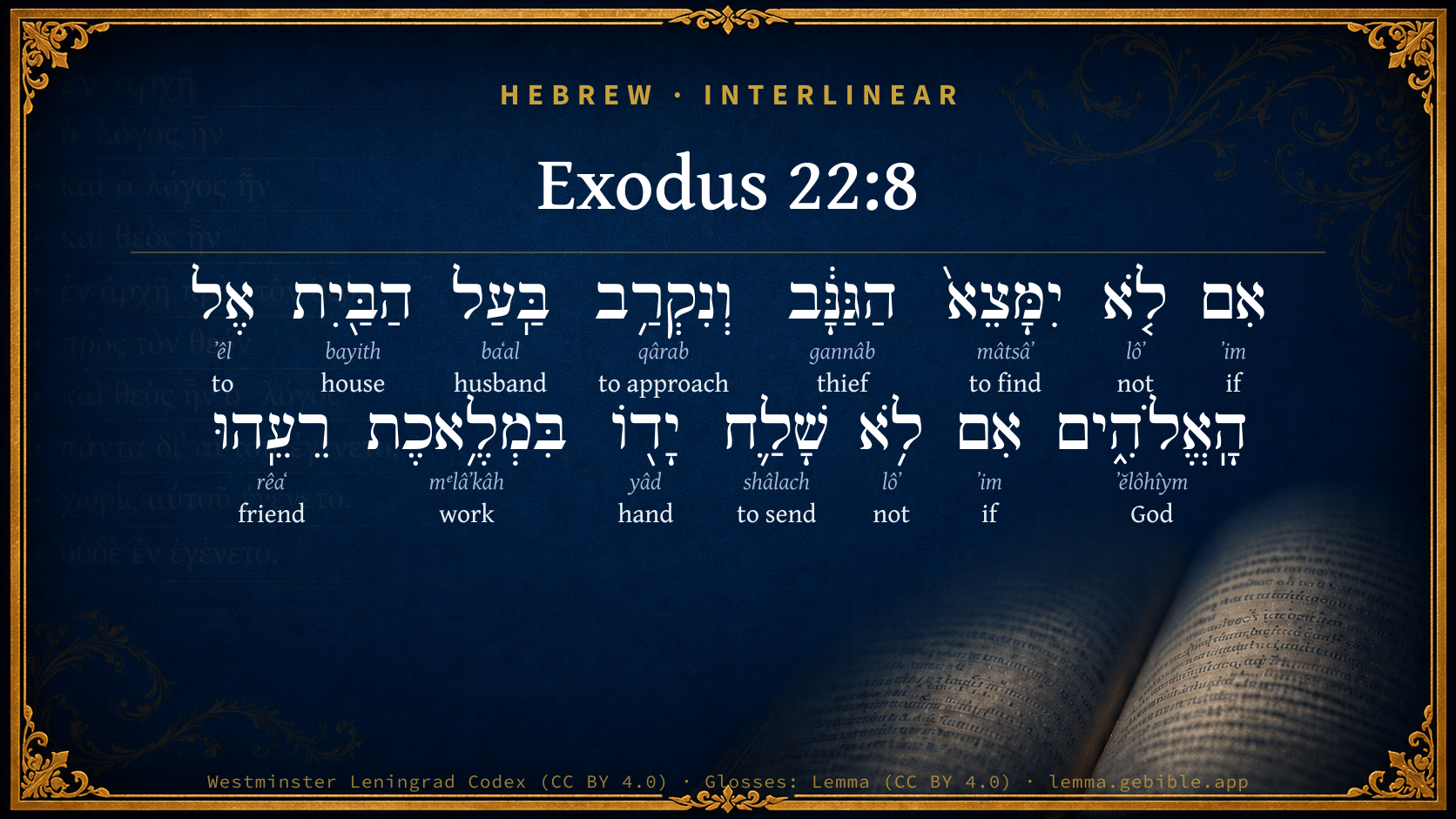
  1. אִם ʼim H518 “if” Conjunction
  2. לֹ֤א lôʼ H3808 “not” Particle, Negative
  3. יִמָּצֵא֙ mâtsâʼ H4672 “to find” Verb, Niphal, Imperfect, 3rd Person, Masculine, Singular
  4. וְנִקְרַ֥ב qârab H7126 “and · to approach” Conjunction + Verb, Niphal, Perfect, 3rd Person, Masculine, Singular
  5. בַּֽעַל baʻal H1167 “husband of” Noun, Common, Masculine, Singular, Construct
  6. הַבַּ֖יִת bayith H1004 “the · house” Particle, Definite Article + Noun, Common, Masculine, Singular, Absolute
  7. אֶל ʼêl H413 “to” Preposition
  8. הָֽאֱלֹהִ֑ים ʼĕlôhîym H430 “the · God(s)” Particle, Definite Article + Noun, Common, Masculine, Plural, Absolute
  9. אִם ʼim H518 “if” Conjunction
  10. לֹ֥א lôʼ H3808 “not” Particle, Negative
  11. שָׁלַ֛ח shâlach H7971 “to send” Verb, Qal, Perfect, 3rd Person, Masculine, Singular
  12. יָד֖וֹ yâd H3027 “hand · his” Noun, Common, Both, Singular, Construct + Suffix, Personal, 3rd Person, Masculine, Singular
  13. בִּמְלֶ֥אכֶת mᵉlâʼkâh H4399 “in/at · work of” Preposition + Noun, Common, Feminine, Singular, Construct
  14. רֵעֵֽהוּ rêaʻ H7453 “friend · his” Noun, Common, Masculine, Singular, Construct + Suffix, Personal, 3rd Person, Masculine, Singular

About this verse

These counts appear in no published source. They are computed here, from the morphology-tagged text and Lemma’s own curated glosses. What Lemma adds →

15
words
13
distinct lemmas
Pentateuch
section

Notable vocabulary

The rarest word here is הַגַּנָּ֔ב thief H1590 — appearing just 17 times in the whole Hebrew Bible.

Shared distinctive vocabulary

הַגַּנָּ֔ב thief H1590 occurs in 17 verses of the Hebrew Bible. Also found in:

Grammatical profile

  • 3 verbs
  • 7 nouns
  • 1 preposition
  • 2 conjunctions
  • 2 particles

Verb forms

  • יִמָּצֵא֙ Niphal · Imperfect
  • וְנִקְרַ֥ב Niphal · Perfect
  • שָׁלַ֛ח Qal · Perfect

Repetition

Words recur within this verse — often emphatic in Hebrew:

Hebrew & Septuagint length

In English translation the verse runs 29 words from the Hebrew and 36 from the Septuagint (LXX English) — closely comparable.

A rough comparison of the two English renderings, which tokenize alike — not a word-level alignment.

Word counts can differ between the Hebrew and the Greek without any difference in meaning — e.g. the Hebrew direct-object marker אֵת has no separate Greek word, and Greek often adds the article ὁ.

Cross-references

8

Topical passages linked to Exodus 22:8 in the Treasury of Scripture Knowledge — connected by theme and wording, ordered by reader-vote popularity; previews shown in the World English Bible.

  • Exodus 22:28 "You shall not blaspheme God, nor curse a ruler of your people.
  • Exodus 21:6 then his master shall bring him to God, and shall bring him to the door or to the door-post, and his master shall bore his ear through with an awl, and he shall serve him for ever.
  • Deuteronomy 16:18 Judges and officers shall you make you in all your gates, which Yahweh your God gives you, according to your tribes; and they shall judge the people with righteous judgment.
  • Exodus 22:9 For every matter of trespass, whether it be for ox, for donkey, for sheep, for clothing, or for any kind of lost thing, about which one says, 'This is mine,' the cause of both parties shall come before God. He whom God condemns shall pay double to his neighbor.
  • Deuteronomy 17:8–9 If there arise a matter too hard for you in judgment, between blood and blood, between plea and plea, and between stroke and stroke, being matters of controversy within your gates; then shall you arise, and go up to the place which Yahweh your God shall choose;
  • Deuteronomy 19:17–18 then both the men, between whom the controversy is, shall stand before Yahweh, before the priests and the judges who shall be in those days;
  • 1 Chronicles 23:4 Of these, twenty-four thousand were to oversee the work of the house of Yahweh; and six thousand were officers and judges;
  • Psalms 82:1 God presides in the great assembly. He judges among the gods.

Cross-references courtesy of OpenBible.info (CC BY 4.0).

Hebrew and Greek witnesses Masoretic Hebrew ↔ Greek Septuagint

The same verse in the two great witnesses to the Old Testament, shown verse-for-verse.

These are two independent witnesses, not word-aligned to each other, and the Septuagint is shown in lemma (dictionary) form.

Hebrew Exodus 22:8 Masoretic · Westminster Leningrad Codex

אִם לֹ֤א יִמָּצֵא֙ הַגַּנָּ֔ב וְנִקְרַ֥ב בַּֽעַל הַבַּ֖יִת אֶל הָֽאֱלֹהִ֑ים אִם לֹ֥א שָׁלַ֛ח יָד֖וֹ בִּמְלֶ֥אכֶת רֵעֵֽהוּ

If the thief isn't found, then the master of the house shall come near to God, to find out if he hasn't put his hand to his neighbor's goods.

World English Bible · Public Domain

Greek LXX Exodus 22:8 Septuagint · lemma form

κατά πᾶς ῥητός ἀδίκημα περί τε μόσχος καί ὑποζύγιον καί πρόβατον καί ἱμάτιον καί πᾶς ἀπώλεια ὁ ἐνκαλέω ὅς τις οὖν ἄν εἰμί ἐνώπιον ὁ θεός ἔρχομαι ὁ κρίσις ἀμφότεροι καί ὁ ἁλίσκω διά ὁ θεός ἀποτίνω διπλοῦς ὁ πλησίον

But if the thief be not found, the master of the house shall come forward before God, and shall swear that surely he has not wrought wickedly in regard of any part of his neighbor's deposit,

LXX2012 (modern English Septuagint) · Public Domain

On this verse, Ellicott's Commentary for English Readers discusses the Septuagint’s reading. Read the note in Commentary ↓

Hebrew: Westminster Leningrad Codex (CC BY 4.0). Greek: Septuagint (public domain); English from LXX2012 (modern English Septuagint) (Public Domain). How the Septuagint differs from the Hebrew →

Targum (Aramaic paraphrase)

2

The Targum is the ancient Jewish Aramaic paraphrase of the Hebrew Scriptures — an interpretive translation, not the Hebrew text itself. Onkelos (literal) and Pseudo-Jonathan (expansive) render the Torah, and Jonathan the Prophets. Coverage is partial: where no permissively-licensed English translation exists for a verse, only the Aramaic is shown. This is verse-level text, not a word-by-word alignment to the Hebrew.

  1. Targum Onkelos Torah (Genesis–Deuteronomy)
    עַל כָּל פִּתְגַם דְחוֹב עַל תּוֹר עַל חֲמַר עַל אִמָר עַל כְּסוּ עַל כָּל אֲבֶדְתָּא דִי יֵימַר אֲרֵי הוּא דֵין לִקֳדָם דַיָנַיָא יֵיעוֹל דִין תַּרְוֵיהוֹן דִי יְחַיְבוּן דַיָנַיָא יְשַׁלֵם עַל חַד תְּרֵין לְחַבְרֵהּ:

    (no public-domain English translation for this verse)

    Targum Onkelos — Aramaic: “Onkelos Genesis” (public domain); “Onkelos Exodus” (public domain); “Onkelos Leviticus” (public domain); “Onkelos Numbers” (public domain); “Onkelos Deuteronomy” (public domain). English: “Sefaria Community Translation” (CC0 1.0 (public-domain dedication)); “J.W. Etheridge. The Targums of Onkelos and Jonathan Ben Uzziel on the Pentateuch. London: Longmans, Green, 1862” (public domain). Text via Sefaria.

  2. Targum Pseudo-Jonathan Torah (Genesis–Deuteronomy)
    עַל כָּל מִדַּעַם דְּאִתְּבִיר בְּכוּסְיָא עַל תּוֹר עַל חֲמוֹר עַל אִימַר עַל כְּסוּי עַל כָּל אֲבִידְתָּא יוֹמֵי כַּד יֵימַר אֲרוּם הוּא דֵין וְכַד מִשְׁתַּכְּחָא גְנִיבוּתָא בָּתַר כֵּן בְּיַד גַּנָבָא קֳדָם דַּיָינַיָא יוֹעִיל דִּין תַּרְוֵויהוֹם דִּין מָרֵיהּ דְּבֵיתָא וְדִין גַּנְבָא וּלְמַאן דִּמְחַיְיבִין דַּיָינַיָא יְשַׁלֵּם גַּנְבָא עַל חַד תְּרֵין לְחַבְרֵיהּ

    And about whatever is injured covertly, whether ox, or ass, or sheep, or raiment, of whatever is (so) lost, he shall make oath when he saith that so it is; and when the thing stolen shall be afterward found in the hand of the thief, the cause of both shall be brought before the judges, the cause of the householder and the cause of the thief; and whom the judges shall condemn, the thief shall restore twofold to his neighbour.

    Targum Pseudo-Jonathan — Aramaic: “Targum Jonathan on Genesis” (public domain); “Targum Jonathan on Exodus” (public domain); “Targum Jonathan on Leviticus” (public domain); “Targum Jonathan on Numbers” (public domain); “Targum Jonathan on Deuteronomy” (public domain). English: “The Targum of Jonathan ben Uzziel, trans. J. W. Etheridge, London, 1862” (public domain). Text via Sefaria.

Commentary

Notes on Exodus 22:8 from classic Christian and Jewish commentators (each source and its license shown beneath its notes). The classic Christian expositions comment on the surrounding passage and are grouped to its opening verse, so a note may address several verses; the Jewish commentaries on the Tanakh (Rashi and others) are per-verse, so they appear only where the commentator wrote on this verse.

Lemma curates 59 commentaries, every one of them public domain or Creative Commons licensed, each selected and text-cleaned for this edition rather than reprinted as found. About our sources →

Trapp's Complete Commentary

John Trapp

Exo 22:8 If the thief be not found, then the master of the house shall be brought unto the judges, [to see] whether he have put his hand unto his neighbour’s goods.

Ver. 8. To see whether,] sc., By putting him to his oath. {Exo 22:11} Some think that a private oath may be in such a case as this lawfully taken for the satisfaction of another, if he will not otherwise be satisfied.

John Trapp, A Commentary or Exposition upon All the Books of the Old and New Testament (1647–1656) — public domain. Text from a community e-Sword module.

Geneva Bible (1599)

Geneva Bible translators

Hebrew, gods.

That is, whether he hath stolen.

Geneva Bible (1599) marginal notes — public domain. Text via Bolls.life.

Adam Clarke's Commentary

Verse 8. Unto the judges] See Clarke on Ex 21:6.

Adam Clarke's Commentary on the Bible (1810–1826) — public domain. Text from a community e-Sword/MySword module.

Ellicott's Commentary for English Readers

(8) To see whether he have put his hand.—Kalisch translates, to swear that he has not put his hand, and so the LXX. (καὶ δμεῖται) and Vulg. (et jurabit quod non extenderit manum).

A Bible Commentary for English Readers, edited by Charles John Ellicott (1878–1897) — public domain. Text from a community e-Sword module.

The Cambridge Bible for Schools and Colleges

gen. ed. J. J. S. Perowne

8. unto God] i.e. to the local sanctuary. On the term ‘God,’ here and v. 9, and the paraphrase ‘the judges’ (marg.), see on Exo_21:6 and Exo_18:15. To judge by the analogy of v. 11, a denial on oath was sufficient for an acquittal. Comp. 1Ki_8:31-32.

The Cambridge Bible for Schools and Colleges (gen. ed. J. J. S. Perowne; Cambridge University Press, 1878–1918) — public domain. Text from a community e-Sword module.

John Gill's Exposition

If the thief be not found,.... And so no account can be given of the goods deposited, what is become of them, and it becomes a doubtful case whether they have been stolen or embezzled, and there is suspicion of the latter:

then the master of the house shall be brought unto the judges: here called Elohim, gods, because they were God's vicegerents, and represented him, and acted under his power and authority; and who at this present were Moses, and those that judged the people under him, and afterwards the seventy elders, and all such who in succeeding times were judges in Israel, and bore the office of civil magistrates; before these the master of the house, or the person who had any goods committed to his care, and they were lost, was to be brought and put to his oath, and upon it examined, in order to find out what was become of the goods committed to him: to see whether he has put his hand to his neighbour's goods: took them to himself, made use of them, or disposed of them to his own advantage, and which was no other than a kind of theft.

John Gill's Exposition of the Whole Bible (1746–1763) — public domain (CC PDM 1.0). Text via the HelloAO Bible API.

Albert Barnes' Notes on the Bible

It would appear that if the master of the house would clear himself of imputation, the loss of the pledged article fell upon its owner.

Albert Barnes' Notes on the Bible (1834–1885) — public domain. Text from a community e-Sword/MySword module.

Haydock's Catholic Bible Commentary

Gods. "In the presence of the Lord," Septuagint.

George Leo Haydock (1774–1849), Haydock's Catholic Family Bible and Commentary, 1859 edition — public domain. Excludes Psalms (Douay-Rheims chapter numbering differs from Protestant) and Deuterocanonical books (Catholic canon only).

Matthew Poole's English Annotations

That they may examine all circumstances, and use all means to find out the truth, by offering him his oath, or otherwise.

Unto his neighbour’s goods; either to take and reserve them for his own use, or to dispose of them to another for his own advantage.

Matthew Poole's English Annotations on the Holy Bible (1683–1685) — public domain. Text from a community e-Sword/MySword module.

Whedon's Commentary on the Bible

Daniel D. Whedon

8. Whether he have put his hand unto his neighbour’s goods — The magistrates would carefully examine if there were any evidence of fraudulent appropriation of the goods, and if none were found, such an oath as is mentioned in Exo_22:11 would be taken as a release for the suspected party. The loss in that case would fall upon the owner.

Daniel D. Whedon (gen. ed.), Commentary on the Old and New Testaments (1874–1909) — public domain. Text from a community e-Sword module.

The Pulpit Commentary

If the thief be not found. It is not clear what was to be done in this case. Kalisch supposes that it came under the law of the oath (ver. 10), and that if the man entrusted with the deposit swore that he had not embezzled it, he was let go free. But as stolen cattle were to be compensated for to the owner (ver. 12), it would seem to be more consistent that stolen money or chattels should also have been made good.

The Pulpit Commentary (1880–1919), ed. H.D.M. Spence-Jones & Joseph S. Exell — public domain. Text from a community e-Sword module.

Rashi

Rabbi Shlomo Yitzchaki (Rashi)

על כל דבר פשע FOR ALL MANNER OF TRESSPASS in which he (the bailee) is proved a liar in respect of his oath (i. e. is convicted of perjury), because witnesses testify that he himself has stolen it and the judges condemn him on the evidence of the witnesses,

ישלם שנים לרעהו HE SHALL PAY THE DOUBLE TO HIS FELLOW-MAN — Scripture teaches you that in a case of a bailment where one pleads that it has been stolen from him and it is proved that he himself has stolen it he is liable to pay “kefel” (twice the value of the article) to the owner. When, however, does this law hold good? In the case that he has taken an oath that it has been stolen from him and witnesses afterwards appear and testify to the contrary. For our Rabbis expound this phrase as follows: (Bava Kamma 63b) “and the owner of the house shall approach unto the judges” — this “approaching the judges” is an expression signifying the taking of an oath. You say that it means approaching the judges in order to take an oath, but perhaps this is not so, and it means that he approaches them to put his case, and that the meaning of the verse is. that as soon as the bailee appears before the court and denies any liability, saying, “it has been stolen” from me, he at once becomes liable to pay double if witnessess appear who testify that the bailment is still in his possession? You certainly cannot argue thus! For “conversion” (שליחות יד) is mentioned here and later on (v. 10) it is mentioned again: “Then shall the oath of the Lord be between the two of them, if he hath not put his hand (אם לא שלח ידו) unto his fellow-man’s goods”. — Now, what is the meaning of the phrase in the latter case? It is evident from what precedes it that it is a matter of taking an oath! So also here it is a matter of taking an oath. (Bava Kamma 63b).

אשר יאמר כי הוא זה means, according to the literal sense, any article about which the witness will say: “this is the very article” about which you have taken an oath that it has been stolen from you; see, it is actually in your possession! — then the matter of dispute between the two of them shall come before the judges. These shall examine the witnesses, and if they prove to be trustworthy and they (the judges) condemn this bailee, then he has to pay double. If, however, they condemn the witnesses because these are found to be “plotting” witnesses (זוממין) then shall they (the witnesses) pay double to the bailee. Our Rabbis, of blessed memory, however, explained that כי הוא זה tells us that no oath can be imposed upon him (the defendant) except if he admits a part of the other’s claim asserting, “So-and-so much I owe you, and the rest has been stolen from me” (according to this explanation the phrase כי הוא זה is not a statement of the witnesses but that of the bailee himself; i. e. he says, כי הוא זה, “it is this only” that you have to claim and not as much as you say) (Bava Kamma 107b).

Rashi on the Tanakh — English translations: “The Judaica Press complete Tanach with Rashi, translated by A. J. Rosenberg” (CC BY 4.0); “Pentateuch with Rashi's commentary by M. Rosenbaum and A.M. Silbermann, 1929-1934” (public domain); “The Metsudah Tanach series, Lakewood, N.J” (CC BY 4.0); and “The Book of Joshua, Metsudah Publications, 1997” (CC BY 4.0). Text via Sefaria.

Ramban (Nachmanides)

Rabbi Moshe ben Nachman (Ramban / Nachmanides)

WHEREOF ONE SAITH: ‘THIS IS IT.’ Rashi comments: “according to the literal sense it means: that which the witness will say ‘this is it — this is that article about which you have taken an oath [that it was stolen from you] but see, it is in your possession!’ And our Rabbis have explained that the phrase this is it teaches us that an oath cannot be imposed [by the court on a defendant] unless he admits part of the claim, saying ‘I owe you so and so much, but the rest was stolen from me.’” But this principle of partial admission which the Rabbi [Rashi] has written here, is in accordance with the opinion of certain individual Rabbis [in the Talmud], but is not the accepted decision of the law, for guardians [to incur liability to an oath] need not partially deny and partially admit the claim, but even if they claim that the whole article was stolen, they still have to take the oath of the guardians, [unlike debts, which, if the debtor denies completely, do not require an oath of the Torah]. Moreover, it has been explained in the Gemara with convincing proofs, that when he denies the very fact that he ever became a guardian, such as where he says “you have never given me the object to keep,” in that case if he denied it totally, he is free from taking an oath, and if he admitted it partially he is obliged to take an oath, this being the opinion of all Rabbis in the Talmud, even though the Rabbi [Rashi] has not written so in his commentaries to the Gemara. If so, we may say that the phrase [this is it — from which we derive the principle of partial admission, as explained above], speaks according to the interpretation of the Sages of a case where the guardian’s defense is: “He never gave me anything to keep,” in which case if he denied it totally he is free of an oath, and if he partially admitted it and partially denied it, he is liable to take an oath. Thus the verses are to be explained as follows: If the thief be not found, then the master of the house shall come near unto the judges — for every claim of trespass which he may claim against him, such as: “You were negligent in your guarding it,” or where the guardian says: “this is it, — this is what you have deposited with me, and you did not deposit any more with me” — then the one with whom the article was deposited that the judges will condemn, [upon testimony given before them that he embezzled it], shall pay double unto his neighbor. Thus, both [the debtor and the guardian] pay, but double restitution is only where the guardian claims falsely that it was stolen, and the rule concerning the plea of partial admission applies to all claims, even to loans, robbery and other matters. In all these laws the verses of Scripture are few and the rules many. But there is no need to explain them here, except in order to interpret the verses.

Ramban (Nachmanides) on the Tanakh — English translation: “Commentary on the Torah by Ramban (Nachmanides). Translated and annotated by Charles B. Chavel. New York, Shilo Pub. House, 1971-1976” (CC BY 4.0). Text via Sefaria.

Lesson kit

Teaching starters — assembled from the data on this page, not authored interpretation. Every prompt links to the verse data it draws on. Edit before teaching.

Exodus, in the Pentateuch, opens this verse with 15 words (13 distinct Hebrew lemmas). Its most distinctive word is gannâb (“thief”). A historical commentator’s framing appears above. Read the whole chapter for the surrounding context.

Discussion questions

  1. What does “thief” (gannâb) contribute to the verse as a whole?
  2. Exodus 22:2 shares the word «thief» with this verse. How do the two illuminate each other?
  3. “if” occurs 2× in this one verse. What is the effect of the repetition?
  4. These translations render this verse differently. What is at stake in choosing one wording over another?
  5. The verb «יִמָּצֵא֙» is Niphal Imperfect. How does its form color the action?
  6. Reading how Trapp's Complete Commentary and Geneva Bible (1599) read this verse, where do the two commentators agree and where do they part?

Things to notice

Reading settings

Reading text

Shown beneath each verse's original-language words.

Old Testament
Old Testament edition

Read the OT as the Masoretic Hebrew (MT) or the Greek Septuagint (LXX).

English shown for the Greek Septuagint (in the Hebrew ↔ Greek comparison).

Comparing translations? Open the Compare panel on any verse page to stack up to four side by side.