
Isaiah 13:11

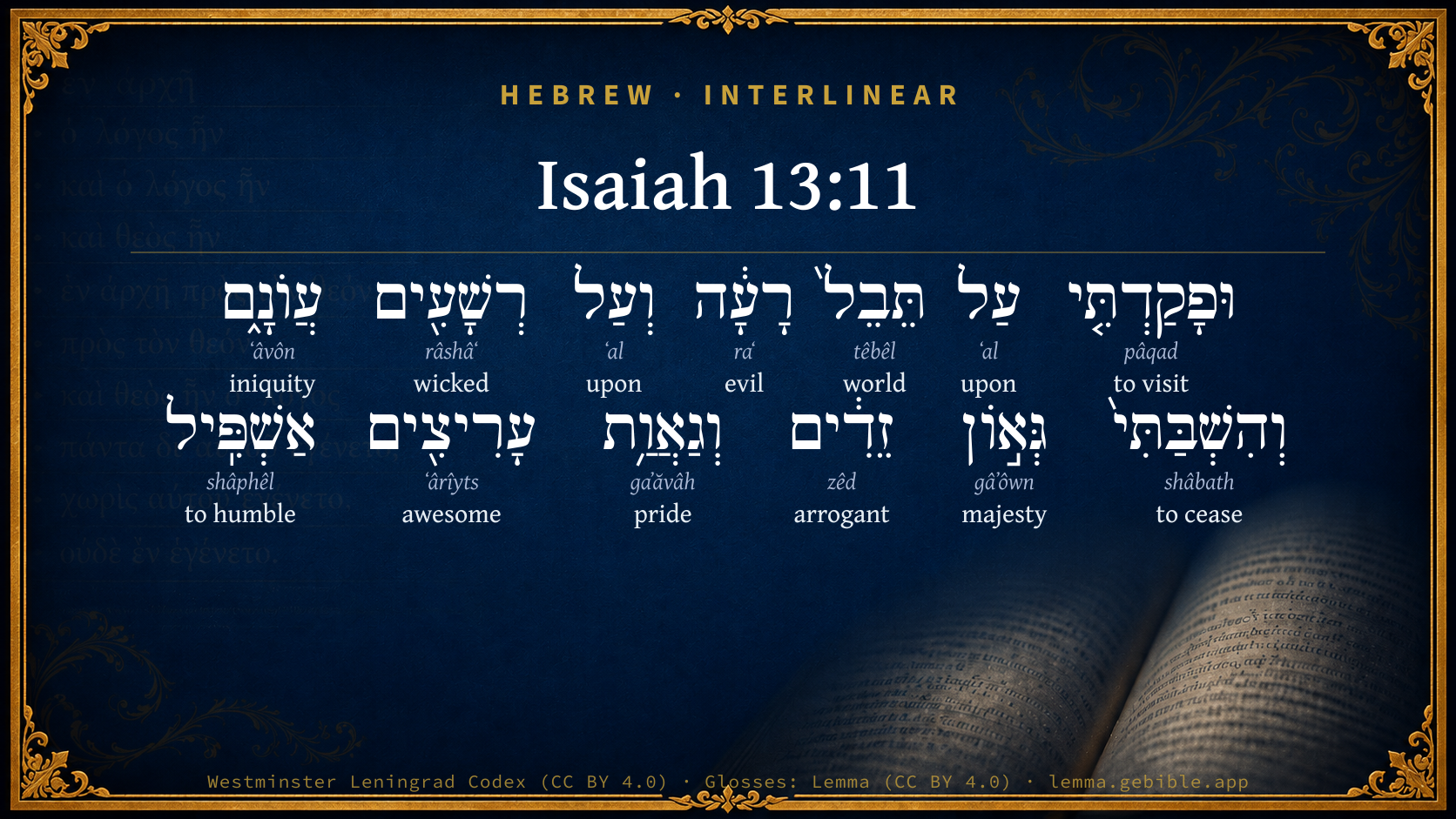
Hebrew (Westminster Leningrad Codex) Isaiah 13:11 appears in the Hebrew Old Testament. The text above is from the Westminster Leningrad Codex. Each word links to its Strong’s number, a concise gloss, and parsing drawn from the Open Scriptures Hebrew Bible morphology. Click any word for its full Brown-Driver-Briggs (BDB) entry.
Download image
Cite this verse

Isaiah 13:11 (World English Bible). Public Domain. Lemma interlinear Bible study tool, https://lemma.gebible.app/v/isaiah/13/11.

Show BibTeX & RIS
BibTeX
RIS
English Translation
I will punish the world for [their] evil, and the wicked for their iniquity: and I will cause the arrogance of the proud to cease, and will lay low the haughtiness of the terrible.
World English Bible · Public Domain
Download a study sheet

One document with this verse’s original text, its word-by-word gloss line, the meaning frame, cross-references with their text, attributed commentary, and full source and license credits — printable, and it pastes into notes with its structure intact.

This verse Autodidact and up

Study sheet (.html) Plain text (.txt)

A passage Seminary Student

Up to 50 verses in one chapter. A passage sheet keeps up to 6 commentary sources and 12 cross-references per verse, in the order this page ranks them, and says so on the sheet whenever that leaves anything out. Ask for a single verse and you get the Autodidact verse sheet above.

Everything on this page stays free to read, with no account — the sheet is a download of what is already on screen, not access to it.

Want to remove ads? Support Godless Engineer
Compare translations 3

The same verse in 3 English versions, stacked beneath the original-language interlinear above. Click any original word for its lexicon entry.

Each is an independent rendering of the whole verse — the interlinear is not word-aligned to these translations.

Highlighted words mark where these versions differ — a whole-verse word diff, not a word-by-word alignment.

  • World English Bible Public Domain
    I will punish the world for [their] evil, and the wicked for their iniquity: and I will cause the arrogance of the proud to cease, and will lay low the haughtiness of the terrible.
  • King James Version Public Domain
    And I will punish the world for their evil, and the wicked for their iniquity; and I will cause the arrogancy of the proud to cease, and will lay low the haughtiness of the terrible.
  • unfoldingWord Literal Text CC BY-SA 4.0
    “And I will visit upon the world evil, and the wicked, their iniquity. And I will make the pride of the arrogant cease, and I will bring low the pride of the mighty.

unfoldingWord Literal Text — © unfoldingWord, licensed CC BY-SA 4.0. Word-aligned USFM3 via Door43 (git.door43.org/unfoldingWord/en_ult).

Versions to compare (up to 4)

3 of 4 selected

Show all 18 translations

Every available English version of this verse, each an independent rendering of the whole verse.

  • World English Bible Public Domain
    I will punish the world for [their] evil, and the wicked for their iniquity: and I will cause the arrogance of the proud to cease, and will lay low the haughtiness of the terrible.
  • Berean Standard Bible Public Domain
    I will punish the world for its evil and the wicked for their iniquity. I will end the haughtiness of the arrogant and lay low the pride of the ruthless.
  • Majority Standard Bible Public Domain
    I will punish the world for its evil and the wicked for their iniquity. I will end the haughtiness of the arrogant and lay low the pride of the ruthless.
  • King James Version Public Domain
    And I will punish the world for their evil, and the wicked for their iniquity; and I will cause the arrogancy of the proud to cease, and will lay low the haughtiness of the terrible.
  • American Standard Version (1901) Public Domain
    And I will punish the world for `their' evil, and the wicked for their iniquity: and I will cause the arrogancy of the proud to cease, and will lay low the haughtiness of the terrible.
  • Revised Version (1885) Public Domain
    And I will punish the world for their evil, and the wicked for their iniquity; and I will cause the arrogancy of the proud to cease, and will lay low the haughtiness of the terrible.
  • Geneva Bible (1599) Public Domain
    And I will visite the wickednes vpon the worlde, and their iniquitie vpon the wicked, and I wil cause the arrogancie of the proud to cease, and will cast downe the pride of tyrants.
  • Douay-Rheims (1899) Public Domain
    And I will visit the evils of the world, and against the wicked for their iniquity: and I will make the pride of infidels to cease, and will bring down the arrogancy of the mighty.
  • Young's Literal Translation Public Domain
    And I have appointed on the world evil, And on the wicked their iniquity, And have caused to cease the excellency of the proud, And the excellency of the terrible I make low.
  • Literal Standard Version CC BY-SA 4.0
    “And I have appointed evil on the world, || And on the wicked their iniquity, || And have caused the excellence of the proud to cease, || And I make the excellence of the terrible low.
  • Unlocked Literal Bible CC BY-SA 4.0
    I will punish the world for its evil and the wicked for their iniquity. I will put an end to the arrogance of the proud and will bring down the arrogance of the ruthless.
  • unfoldingWord Literal Text CC BY-SA 4.0
    “And I will visit upon the world evil, and the wicked, their iniquity. And I will make the pride of the arrogant cease, and I will bring low the pride of the mighty.
  • Darby Bible Public Domain
    And I will punish the world for evil, and the wicked for their iniquity; and I will make the arrogance of the proud to cease, and will bring low the haughtiness of the violent.
  • World Messianic Bible Public Domain
    I will punish the world for their evil, and the wicked for their iniquity. I will cause the arrogance of the proud to cease, and will humble the arrogance of the terrible.
  • Webster's Bible Public Domain
    And I will punish the world for their evil, and the wicked for their iniquity; and I will cause the arrogance of the proud to cease, and will lay low the haughtiness of the terrible.
  • Free Bible Version CC BY-SA 4.0
    I will punish the world for its evil, and the wicked for their sin, says the Lord. I will put an end to the conceit of the arrogant, and I will humiliate tyrants and their pride.
  • Bible in Basic English Public Domain
    And I will send punishment on the world for its evil, and on the sinners for their wrongdoing; and I will put an end to all pride, and will make low the power of the cruel.
  • JPS Tanakh (1917) Public Domain
    And I will visit upon the world their evil, and upon the wicked their iniquity; and I will cause the arrogancy of the proud to cease, and will lay low the haughtiness of the tyrants.

Literal Standard Version (2020), Covenant Press — licensed CC BY-SA 4.0. Text via the HelloAO Bible API (eBible.org). Unlocked Literal Bible (unfoldingWord) — licensed CC BY-SA 4.0. Text via the HelloAO Bible API (eBible.org). unfoldingWord Literal Text — © unfoldingWord, licensed CC BY-SA 4.0. Word-aligned USFM3 via Door43 (git.door43.org/unfoldingWord/en_ult). Free Bible Version, Dr. Jonathan Gallagher — licensed CC BY-SA 4.0. Text via the HelloAO Bible API (eBible.org).

Word by word

More ways to search: Search by grammar → Find every occurrence → Compare this word →

Practice this passage: Drill this verse → Learn its vocabulary →

זֵדִ֔ים
zêd
H2086
“arrogant”
Adjective, Adjective, Masculine, Plural, Absolute
Part of Speech
Adjective
Type
Adjective
Gender
Masculine
Number
Plural
State
Absolute
Full BDB Definition

Origin: from H2102

TWOT: 547a

arrogant, proud, insolent, presumptuous - the arrogant ones (as noun collective plural) - presumptuous (as adjective)
  1. וּפָקַדְתִּ֤י pâqad H6485 “and · to visit” Conjunction + Verb, Qal, Perfect, 1st Person, Common, Singular
  2. עַל ʻal H5921 “upon” Preposition
  3. תֵּבֵל֙ têbêl H8398 “world” Noun, Common, Feminine, Singular, Absolute
  4. רָעָ֔ה raʻ H7451 “evil” Noun, Common, Feminine, Singular, Absolute
  5. וְעַל ʻal H5921 “and · upon” Conjunction + Preposition
  6. רְשָׁעִ֖ים râshâʻ H7563 “wicked” Adjective, Adjective, Masculine, Plural, Absolute
  7. עֲוֺנָ֑ם ʻâvôn H5771 “iniquity · their” Noun, Common, Both, Singular, Construct + Suffix, Personal, 3rd Person, Masculine, Plural
  8. וְהִשְׁבַּתִּי֙ shâbath H7673 “and · to cease” Conjunction + Verb, Hiphil, Sequential Perfect, 1st Person, Common, Singular
  9. גְּא֣וֹן gâʼôwn H1347 “majesty of” Noun, Common, Masculine, Singular, Construct
  10. וְגַאֲוַ֥ת gaʼăvâh H1346 “and · pride of” Conjunction + Noun, Common, Feminine, Singular, Construct
  11. עָרִיצִ֖ים ʻârîyts H6184 “awesome” Adjective, Adjective, Masculine, Plural, Absolute
  12. אַשְׁפִּֽיל shâphêl H8213 “to humble” Verb, Hiphil, Imperfect, 1st Person, Common, Singular

About this verse

These counts appear in no published source. They are computed here, from the morphology-tagged text and Lemma’s own curated glosses. What Lemma adds →

13
words
12
distinct lemmas
Prophets
section

Notable vocabulary

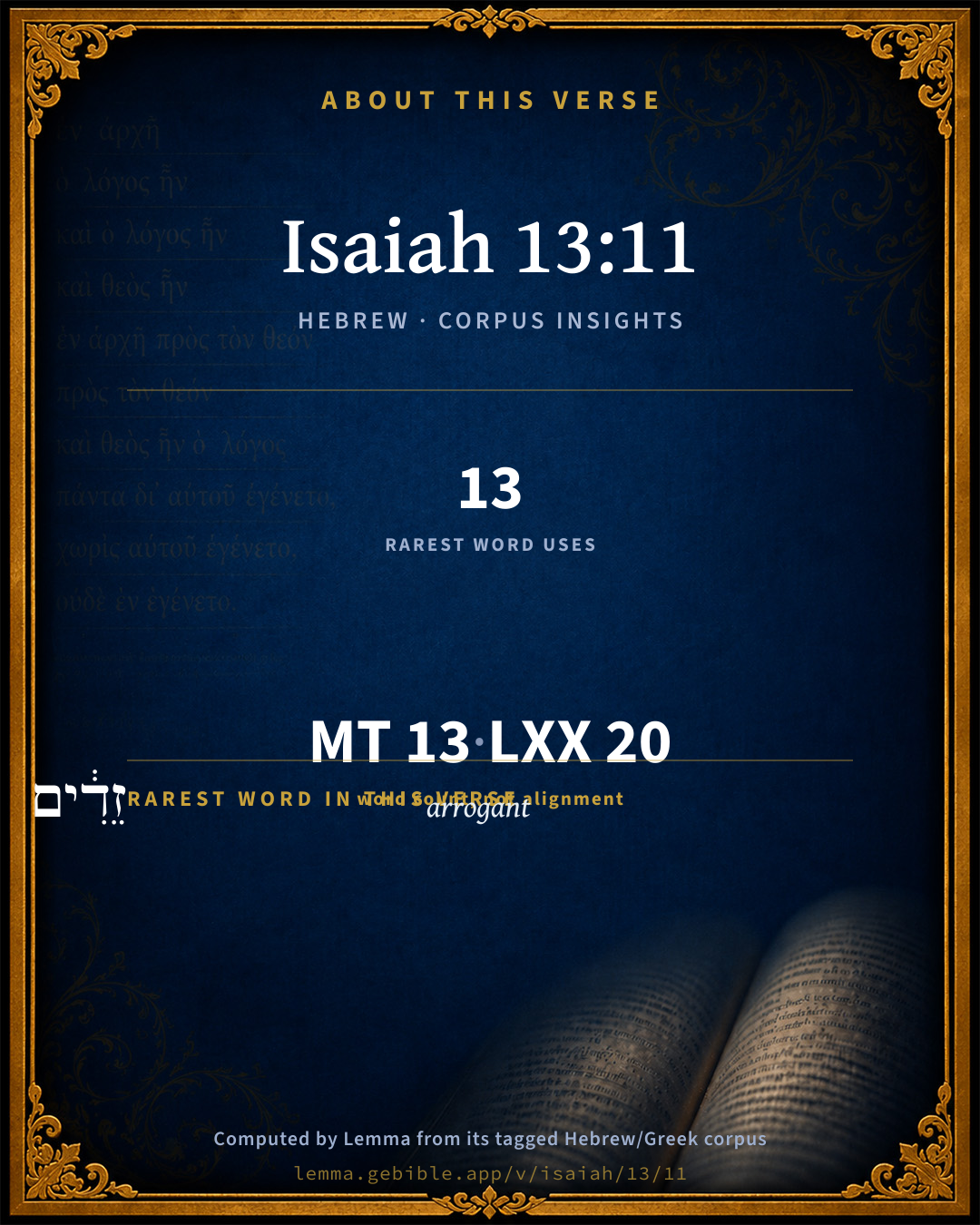
The rarest word here is זֵדִ֔ים arrogant H2086 — appearing just 13 times in the whole Hebrew Bible.

Shared distinctive vocabulary

זֵדִ֔ים arrogant H2086 occurs in 13 verses of the Hebrew Bible. Also found in:

Grammatical profile

  • 3 verbs
  • 5 nouns
  • 3 adjectives
  • 2 prepositions

Verb forms

  • וּפָקַדְתִּ֤י Qal · Perfect
  • וְהִשְׁבַּתִּי֙ Hiphil · Sequential Perfect
  • אַשְׁפִּֽיל Hiphil · Imperfect

Repetition

A word recurs within this verse — often emphatic in Hebrew:

Hebrew & Septuagint length

In English translation the verse runs 34 words from the Hebrew and 34 from the Septuagint (LXX English) — the same length.

A rough comparison of the two English renderings, which tokenize alike — not a word-level alignment.

Word counts can differ between the Hebrew and the Greek without any difference in meaning — e.g. the Hebrew direct-object marker אֵת has no separate Greek word, and Greek often adds the article ὁ.

In the original languages it is 13 Hebrew tokens and 20 Greek tokens — but the two are counted differently (Hebrew bundles its prefixes and suffixes into one token; the Greek is in lemma form), so that isn’t a like-for-like length.

Cross-references

14

Topical passages linked to Isaiah 13:11 in the Treasury of Scripture Knowledge — connected by theme and wording, ordered by reader-vote popularity; previews shown in the World English Bible.

  • Isaiah 2:11 The lofty looks of man will be brought low, The haughtiness of men will be bowed down, And Yahweh alone will be exalted in that day.
  • Isaiah 5:15 So man is brought low, Mankind is humbled, And the eyes of the arrogant ones are humbled;
  • Jeremiah 50:29–32 Call together the archers against Babylon, all those who bend the bow; encamp against her round about; let none of it escape: recompense her according to her work; according to all that she has done, do to her; for she has been proud against Yahweh, against the Holy One of Israel.
  • Daniel 5:22–23 You his son, Belshazzar, have not humbled your heart, though you knew all this,
  • Isaiah 2:17 The loftiness of man shall be bowed down, And the haughtiness of men shall be brought low; And Yahweh alone shall be exalted in that day.
  • Isaiah 3:11 Woe to the wicked! Disaster is upon them; For the deeds of his hands will be paid back to him.
  • Isaiah 11:4 but with righteousness shall he judge the poor, and decide with equity for the humble of the earth; and he shall strike the earth with the rod of his mouth; and with the breath of his lips shall he kill the wicked.
  • Isaiah 14:12–16 How you are fallen from heaven, day-star, son of the morning! How you are cut down to the ground, who laid the nations low!
  • Isaiah 14:21 Prepare slaughter for his children for the iniquity of their fathers, that they not rise up, and possess the earth, and fill the surface of the world with cities.
  • Isaiah 24:4–6 The earth mourns and fades away, the world languishes and fades away, the lofty people of the earth do languish.
  • Isaiah 26:21 For, behold, Yahweh comes forth out of his place to punish the inhabitants of the earth for their iniquity: the earth also shall disclose her blood, and shall no more cover her slain.
  • Jeremiah 51:34–38 Nebuchadrezzar the king of Babylon has devoured me, he has crushed me, he has made me an empty vessel, he has, like a monster, swallowed me up, he has filled his maw with my delicacies; he has cast me out.
  • Revelation 12:9–10 The great dragon was thrown down, the old serpent, he who is called the devil and Satan, the deceiver of the whole world. He was thrown down to the earth, and his angels were thrown down with him.
  • Revelation 18:2–3 He cried with a mighty voice, saying, "Fallen, fallen is Babylon the great, and she has become a habitation of demons, a prison of every unclean spirit, and a prison of every unclean and hateful bird!

Cross-references courtesy of OpenBible.info (CC BY 4.0).

Hebrew and Greek witnesses Masoretic Hebrew ↔ Greek Septuagint

The same verse in the two great witnesses to the Old Testament, shown verse-for-verse.

These are two independent witnesses, not word-aligned to each other, and the Septuagint is shown in lemma (dictionary) form.

Hebrew Isaiah 13:11 Masoretic · Westminster Leningrad Codex

וּפָקַדְתִּ֤י עַל תֵּבֵל֙ רָעָ֔ה וְעַל רְשָׁעִ֖ים עֲוֺנָ֑ם וְהִשְׁבַּתִּי֙ גְּא֣וֹן זֵדִ֔ים וְגַאֲוַ֥ת עָרִיצִ֖ים אַשְׁפִּֽיל

I will punish the world for [their] evil, and the wicked for their iniquity: and I will cause the arrogance of the proud to cease, and will lay low the haughtiness of the terrible.

World English Bible · Public Domain

Greek LXX Isaiah 13:11 Septuagint · lemma form

καί ἐντελέω ὁ οἰκέω ὅλος κακός καί ὁ ἀσεβής ὁ ἁμαρτία αὐτός καί ἀποὀλλύω ὕβρις ἄνομος καί ὕβρις ὑπερήφανος ταπεινόω

And I will command evils for the whole world, and will visit their sins on the ungodly: and I will destroy the pride of transgressors, and will bring low the pride of the haughty.

LXX2012 (modern English Septuagint) · Public Domain

On this verse, Keil & Delitzsch discusses the Septuagint’s reading. Read the note in Commentary ↓

Hebrew: Westminster Leningrad Codex (CC BY 4.0). Greek: Septuagint (public domain); English from LXX2012 (modern English Septuagint) (Public Domain). How the Septuagint differs from the Hebrew →

Targum (Aramaic paraphrase)

1

The Targum is the ancient Jewish Aramaic paraphrase of the Hebrew Scriptures — an interpretive translation, not the Hebrew text itself. Onkelos (literal) and Pseudo-Jonathan (expansive) render the Torah, and Jonathan the Prophets. Coverage is partial: where no permissively-licensed English translation exists for a verse, only the Aramaic is shown. This is verse-level text, not a word-by-word alignment to the Hebrew.

  1. Targum Jonathan Prophets (Joshua–Malachi)
    וְאַסְעַר עַל זְדַיְרִין בְּתֵבֵל בִּישְׁתָא וְעַל רַשִׁיעַיָא חוֹבֵיהוֹן וַאֲבַטֵיל רְבוּת רַשִׁיעִין וּתְקוֹף תַּקִיפִין אַמְאִיךְ:

    And I will visit the inhabitants of the world with the punishment for evil, and the wicked for their iniquity: and I will put an end to the greatness of the wicked, and the strength of the mighty I will humble.

    Targum Jonathan — Aramaic: “Mikraot Gedolot” (public domain). English: “Sefaria Community Translation” (CC0 1.0 (public-domain dedication)); “London "Chaldee Paraphrase," 1871” (public domain). Text via Sefaria.

Commentary

Notes on Isaiah 13:11 from classic Christian and Jewish commentators (each source and its license shown beneath its notes). The classic Christian expositions comment on the surrounding passage and are grouped to its opening verse, so a note may address several verses; the Jewish commentaries on the Tanakh (Rashi and others) are per-verse, so they appear only where the commentator wrote on this verse.

Lemma curates 59 commentaries, every one of them public domain or Creative Commons licensed, each selected and text-cleaned for this edition rather than reprinted as found. About our sources →

Trapp's Complete Commentary

John Trapp

Isa 13:11 And I will punish the world for [their] evil, and the wicked for their iniquity; and I will cause the arrogancy of the proud to cease, and will lay low the haughtiness of the terrible.

Ver. 11. And I will punish the world.] That is, the Chaldean state; for they reckoned themselves κοσμοκρατορας, or lords of the world. See on Isa 13:5. Or to show that, if the whole world should conspire against the Lord, he can as easily punish them as he did that rabble of rebels the old world. See Dan 4:17.

And lay low the haughtiness of the terrible.] Or, Of the roysters or tyrants.

John Trapp, A Commentary or Exposition upon All the Books of the Old and New Testament (1647–1656) — public domain. Text from a community e-Sword module.

Joseph Benson's Commentary

Isa 13:11-16. I will punish the world — The Babylonish empire, which is called the world, as the Roman empire afterward was, (Luk 2:1,) because it was extended to a great part of the world, and because it was very populous, and Babylon itself looked more like a world than one city. I will lay low the haughtiness of the terrible — Of them who formerly were very terrible for their great power and cruelty. I will make a man more precious, &c. — The city and nation shall be so depopulated, that few men shall be left in it. I will shake the heavens, &c. — A poetical and prophetical description of great confusions and terrors, as if heaven and earth were about to meet together. And it shall be as the chased roe — That Babylon, which used to be like a roaring lion and a raging bear to all about her, shall become like the timid, frighted roe, pursued by the hunter, and as a sheep which no man taketh up — In a most forlorn and neglected condition. And the army they shall bring into the field, consisting of troops from divers nations, as great armies usually do, shall be so dispirited by their own fears, and so dispersed by their enemies’ sword, that they shall turn every man to his own people — Shall each shift for his own safety. Or the prophet may refer to those inhabitants of Babylon who were originally of different nations, but had settled there: as many of these, he signifies, as can, shall flee out of it, and endeavour to escape to their own countries. Every one that is found — In Babylon, at the taking of it; shall fall by the sword — The fear of which shall make them flee away with all speed. Their children also shall be dashed, &c. — As a just recompense for the like cruelty acted by them upon the Jews, 2Ch 36:17, which was also foretold Psa 137:9.

Joseph Benson's Commentary on the Old and New Testaments (1811–1818) — public domain. Text from a community e-Sword module.

Tyndale Open Study Notes

Tyndale Open Resources

13:11 punish the world: See Rev 20:11.

Tyndale Open Study Notes — © Tyndale Open Resources, licensed CC BY-SA 4.0. Text via the HelloAO Bible API.

Geneva Bible (1599)

Geneva Bible translators

He compareth Babylon to the whole world, because they so esteemed themselves by reason of their great empire.

He noteth the principal vice, whereunto they are most given, as are all that abound in wealth.

Geneva Bible (1599) marginal notes — public domain. Text via Bolls.life.

Jamieson, Fausset & Brown

Robert Jamieson, A. R. Fausset & David Brown

world--the impious of the world (compare Isa 11:4).

arrogancy--Babylon's besetting sin (Dan 4:22, Dan 4:30).

the terrible--rather, tyrants [HORSLEY].

Jamieson, Fausset & Brown — Commentary Critical and Explanatory on the Whole Bible (1871) — public domain (CC PDM 1.0). Text via the HelloAO Bible API.

Adam Clarke's Commentary

Verse 11. I will punish the world - "I will visit the world"] That is, the Babylonish empire; as η οικουμενη, for the Roman empire, or for Judea, Lu 2:1; Ac 11:28. So the universus orbis Romanus, for the Roman empire; Salvian. lib. v. Minos calls Crete his world: "Creten, quae meus est orbis," Ovid. Metamorph. viii. 9.

Adam Clarke's Commentary on the Bible (1810–1826) — public domain. Text from a community e-Sword/MySword module.

The Cambridge Bible for Schools and Colleges

gen. ed. J. J. S. Perowne

11, 12. Jehovah is again the speaker, as in Isa_13:3. The prophet has already in Isa_13:9 intimated the purpose of the judgment; here the thought is added that in its execution the existing generation will be all but exterminated; so wide-spread is the wickedness and tyranny of the world.

The Cambridge Bible for Schools and Colleges (gen. ed. J. J. S. Perowne; Cambridge University Press, 1878–1918) — public domain. Text from a community e-Sword module.

John Gill's Exposition

And I will punish the world for their evil,.... Not the whole world, but the kingdom of Babylon, so called because of its large extent, and the number of its inhabitants, just as the Roman empire is called the whole world, Luk 2:1 "evil" may be meant, either of the evil of sin, which was the cause of punishment, or else of the evil of punishment itself; and the sense be this, I will visit, or, in a way of visitation, I will bring evil, or evils, upon the world; so the Targum,

and the wicked for their iniquity, or "on the wicked their iniquity"; that is, I will visit on them, or inflict upon them, the punishment of their iniquity; meaning the notorious and abandoned sinners among them, see Isa 13:9,

and I will cause the arrogancy of the proud to cease, and I will lay low the haughtiness of the terrible: such as Nebuchadnezzar and Belshazzar, famous for their pride, arrogance, and haughtiness, tyranny and oppression, whereby they became terrible to others.

John Gill's Exposition of the Whole Bible (1746–1763) — public domain (CC PDM 1.0). Text via the HelloAO Bible API.

Albert Barnes' Notes on the Bible

And I will punish the world - By the ‘world’ here is evidently meant the Babylonian empire, in the same way as ‘all the world’ in Luk 2:1, means Judea; and in Act 11:28, means the Roman empire. Babylonia, or Chaldea, was the most mighty empire then on earth, and might be said to comprehend the whole world.

And I will cause the arrogancy - This was the prevailing sin of Babylon, and it was on account of this pride mainly that it was overthrown (see the notes at Isa. 14; notes at Isa 47:1-7; compare Dan 4:22, Dan 4:30).

Albert Barnes' Notes on the Bible (1834–1885) — public domain. Text from a community e-Sword/MySword module.

Haydock's Catholic Bible Commentary

World. The vices of all nations were concentrated at Babylon. (Calmet)

George Leo Haydock (1774–1849), Haydock's Catholic Family Bible and Commentary, 1859 edition — public domain. Excludes Psalms (Douay-Rheims chapter numbering differs from Protestant) and Deuterocanonical books (Catholic canon only).

Matthew Poole's English Annotations

The world; the Babylonish empire, which is called the world, as the Roman empire afterward was, Luk 2:1, because it was extended to a great part of the world, and because it was vastly populous, and Babylon itself looked more like a world than one city.

Of the terrible; of them who formerly were very terrible for their great power and cruelty.

Matthew Poole's English Annotations on the Holy Bible (1683–1685) — public domain. Text from a community e-Sword/MySword module.

Whedon's Commentary on the Bible

Daniel D. Whedon

11, 12. Punish the world — The Babylonian world, the symbol (Isa_13:5) of all resisting human wills and kingdoms of the earth hostile to God. Here the prophet, as afterward elsewhere, resolves his figures into literal expressions. Isa_1:22; Isa_11:9.

Arrogancy — Babylon’s prevailing sin.

The terrible — Tyrants and oppressors.

Make a man more precious — More scarce or rare than fine gold.

Than the… wedge of Ophir — “Wedge,” כתם, (kethem,) properly means “gold” — Ophir’s gold. For the probable location of “Ophir,” see notes on 1Ki_9:28; 1Ki_10:11. But the main point of the text is the scarcity of man, weak and frail, אנושׁ, (Enosh,) and man אדם, (Adam,) men of the common origin. Both words would seem to include man exhaustively. Babylon’s defenders shall be so cut off that a single man will be more scarce than the finest gold. This is the common explanation. But Kay (Bible Commentary) hints another meaning. It is in substance this: “I will make a man,” the lowly man, in comparison with the “haughty,” “arrogant,” “the terrible ones,” of more consequence to me in caring, providing, etc., for him (Psalm viii) than the choicest gold. The lowly man, the man formed out of the dust, is the holy man of my “remnant” preserved in Babylon to be returned to Jerusalem. He shall be kept safe amid the terrible judgments upon Babylon by the army of Cyrus. This seems far-fetched, yet it has some plausibility.

Daniel D. Whedon (gen. ed.), Commentary on the Old and New Testaments (1874–1909) — public domain. Text from a community e-Sword module.

The Pulpit Commentary

I will punish the world for their evil. Here the prophecy certainly goes beyond the destruction of Babylon, and becomes a general warning to the wicked of all court-tries. Each country is to feel that its turn will come. Punishment will fall especially on the unjust, the proud, and the haughty. (comp. Isa_1:28 Isa_2:11-17, etc.)

The Pulpit Commentary (1880–1919), ed. H.D.M. Spence-Jones & Joseph S. Exell — public domain. Text from a community e-Sword module.

John Wesley's Explanatory Notes

The world - The Babylonish empire, which is called the world, as the Roman empire afterwards was, because it was extended to a great part of the world.

John Wesley, Explanatory Notes Upon the Whole Bible (1754–1765) — public domain. Text via the GEBible commentary corpus.

Keil & Delitzsch

C. F. Keil & F. Delitzsch

The prophet now hears again the voice of Jehovah revealing to him what His purpose is - namely, a visitation punishing the wicked, humbling the proud, and depopulating the countries. "And I visit the evil upon the world, and upon sinners their guilt, and sink into silence the pomp of the proud; and the boasting of tyrants I throw to the ground. I make men more precious than fine gold, and people than a jewel of Ophir." The verb pâkad is construed, as in Jer 23:2, with the accusative of the thing punished, and with על of the person punished. Instead of 'eretz we have here tēbel, which is always used like a proper name (never with the article), to denote the earth in its entire circumference. We have also ‛ârı̄tzı̄m instead of nedı̄bı̄m: the latter signifies merely princes, and it is only occasionally that it has the subordinate sense of despots; the former signifies men naturally cruel, or tyrants (it occurs very frequently in Isaiah). Everything here breathes the spirit of Isaiah both in thought and form. "The lofty is thrown down:" this is one of the leading themes of Isaiah's proclamation; and the fact that the judgment will only leave a remnant is a fundamental thought of his, which also runs through the oracles concerning the heathen (Isa 16:14; Isa 21:17; Isa 24:6), and is depicted by the prophet in various ways (Isa 10:16-19; Isa 17:4-6; Isa 24:13; Isa 30:17). There it is expressed under the figure that men become as scarce as the finest kinds of gold. Word-painting is Isaiah's delight and strength. 'Ophir, which resembles 'okir in sound, was the gold country of India, that lay nearest to the Phoenicians, the coast-land of Abhira on the northern shore of the Runn (Irina), i.e., the salt lake to the east of the mouths of the Indus (see at Gen 10:29 and Job 22:24; and for the Egypticized Souphir of the lxx, Job 28:16).

Keil & Delitzsch — Biblical Commentary on the Old Testament (1861–1891) — public domain (CC PDM 1.0). Text via the HelloAO Bible API. (Old Testament only.)

J. A. Alexander on Isaiah

Joseph Addison Alexander

The Prophet according to his custom (see above, on Isa 1:22; Isa 5:7; Isa 11:9), now resolves his figures into literal expressions, showing that the natural convulsions just predicted are to be understood as metaphorical descriptions of the divine judgments. “And I will visit upon the world (its) wickedness (i.e., manifest my presence for the purpose of punishing it), and upon the wicked their iniquity, and I will cause to cease the arrogance of presumptuous sinners, and the pride of tyrants (or oppressors) I will humble.” World is here applied to the Babylonian empire, as embracing most of the known world.

Joseph Addison Alexander, The Prophecies of Isaiah (1846–1847; New York: Scribner, 1870–1878) — public domain. Text from a community e-Sword module.

unfoldingWord translationNotes

Door43 World Missions Community

Connecting Statement:

Yahweh continues to talk about what he will do on the day of Yahweh.

the world

This refers to people. AT: "the people of the world" (See: Metonymy)

the wicked ... the proud ... the ruthless

These phrases refer to people who have these qualities. AT: "wicked people ... proud people ... ruthless people" (See: Nominal Adjectives)

the ruthless

"cruel people"

will bring down the arrogance of the ruthless

Being low often represents being humble. Bringing down people's arrogance represents making them humble. AT: "will humble the ruthless" (See: Metaphor)

I will make men more rare than fine gold

Why there will be so few people can be stated clearly. AT: "I will cause so many people to die that living people will be more rare than fine gold" (See: Assumed Knowledge and Implicit Information)

men more rare than fine gold ... mankind harder to find than the pure gold of Ophir

These two phrases mean basically the same thing. (See: Parallelism)

pure gold of Ophir

Ophir was the name of a place where there was pure gold. (See: How to Translate Names)

translationWords

punish

world

evil

iniquity

arrogant

proud

gold

unfoldingWord translationNotes — © Distant Shores Media and the Door43 World Missions Community, licensed CC BY-SA 4.0. Source: git.door43.org/Door43/en_tn.

Rashi

Rabbi Shlomo Yitzchaki (Rashi)

upon the earth On their land.

Rashi on the Tanakh — English translations: “The Judaica Press complete Tanach with Rashi, translated by A. J. Rosenberg” (CC BY 4.0); “Pentateuch with Rashi's commentary by M. Rosenbaum and A.M. Silbermann, 1929-1934” (public domain); “The Metsudah Tanach series, Lakewood, N.J” (CC BY 4.0); and “The Book of Joshua, Metsudah Publications, 1997” (CC BY 4.0). Text via Sefaria.

Ibn Ezra

Rabbi Abraham ibn Ezra

The world. Cyrus conquered many countries, as he says; All the kingdoms of the earth the Lord, the God of heavens, hath given me (Ezr. 1:2)

Ibn Ezra on the Tanakh — English translations: “Sefaria Community Translation” (CC0 1.0 (public-domain dedication)); “Yalkut, Sifsei Chachomim Chumash, Metsudah Publications, 2009” (CC BY 4.0); and “Commentary of Ibn Ezra on Isaiah - trans. by M. Friedlander, 1873” (public domain). Text via Sefaria.

Lesson kit

Teaching starters — assembled from the data on this page, not authored interpretation. Every prompt links to the verse data it draws on. Edit before teaching.

Isaiah, in the Prophets, opens this verse with 13 words (12 distinct Hebrew lemmas). Its most distinctive word is zêd (“arrogant”). A historical commentator’s framing appears above. Read the whole chapter for the surrounding context.

Discussion questions

  1. How does “arrogant” (zêd) shape what this verse is saying?
  2. How does Psalms 19:13, which shares the word «arrogant», read alongside this verse?
  3. What does the repetition of “upon” (2× in this one verse) do in this verse?
  4. These translations render this verse differently. What is at stake in choosing one wording over another?
  5. «וּפָקַדְתִּ֤י» is a Qal Perfect verb. How does that grammatical form shape the action described?
  6. Compare how Trapp's Complete Commentary and Joseph Benson's Commentary read this verse. Where do they agree or differ?

Things to notice

Reading settings

Reading text

Shown beneath each verse's original-language words.

Old Testament
Old Testament edition

Read the OT as the Masoretic Hebrew (MT) or the Greek Septuagint (LXX).

English shown for the Greek Septuagint (in the Hebrew ↔ Greek comparison).

Comparing translations? Open the Compare panel on any verse page to stack up to four side by side.